Volume. 2 Issue. 4
$4.99
Winter 2013
Spec Tucs ial on Issue
Serving Contracting Firms and the Arizona Community …Then & Now
Ÿ Ÿ Ÿ Ÿ Ÿ Ÿ
Harold Ashton’s Rags-to-Bridges Life No Mere Pop Bottle Rockets: Tucson’s Titan Missiles Uphill Both Ways: Scaling the Santa Catalina Range Big Iron and Bigger Dreams: Borderland Construction Bill Buckmaster‘s Construction Beat Bum Steer on the Brink
Branco provides the highest quality and most advanced products available in the positioning industry today. Branco has the in-house expertise to assist you in the selection of the right technology and the right products to get the job done right the first time.
Topcon Machine Control Motor Graders
Construction Rotating Lasers
Dozers
Pipe Lasers
Excavators
Automatic 3D GPS+ Technology
Scrapers
Sales, Rental, Service
Pavers
Installation &Training
3DMC² Graders & Dozers
Rental Equipment
Ground Engaging Tools
Motor Graders
3D GPS Products
Grade Tractors
2D Machine Control
Skid Steers
Lasers & Receivers
Tungsten Carbide Custom Application for: Blades, Teeth, Wear Plates, Segments, & Routers Patterns to fit your needs.
Cutting Edges For: Dozers, Loaders, Scrapers, Motor Graders sAll O.E.M. Edges sCustom Blades (Made to order)
Shanks & Teeth sAll O.E.M. Replacement Teeth sRipper Box Assemblies sReplacement Tooth Adapters
Fabrication / Repair Backhoe and Excavator Buckets
Replacement Parts for Elevating Scrapers Flights, Chains, Sprockets, Rollers, & Grouser Bar. Dozer Undercarriage
www.brancomachinery.com For More Information Call: 480-892-5657 1205 N. McQueen Rd. Gilbert, Arizona 85233
Publisher William Horner Billy@arizcc.com Editor Douglas Towne Douglas@arizcc.com Magazine Consultant Chuck Runbeck Chuck@arizcc.com 602-881-0907 Production Manager Laura Harley Laura@arizcc.com Columnists Paul Beaulieu John Bueker Contributing Writers Roberta Graham Lee Addis Advertising Chuck Runbeck Chuck@arizcc.com 602-881-0907 Shane Addington Shane@arizcc.com 623-826-8598
Visit us at: www.arizcc.com Annual subscriptions. $16 - One year subscription $28 - Two year subscription Make check payable to: A.C.C. PO BOX 6912, Glendale, AZ 85312 Printed at Lithotech Arizona Contractor & Community (ACC) magazine is published quarterly (spring, summer, fall, & winter). ACC is a professional publication designed for the contracting industry, engineers, architects, and others interested in Arizona and its history. Content including text, photographs or illustrations may not be reproduced without the written permission from the publisher. The publisher does not assume responsibility for unsolicited submissions. ACC reserves the right to reject any editorial and advertising material and reserves the right to edit all submitted content material. Arizona Contractor & Community Copyright Š 2013 All rights reserved.
10 Volume. 2 Issue. 4 Winter 2013
CONTENTS
8
8 . Editors’s Column: Tucson’s Titanic Warheads 32
Douglas Towne
10. Construction Around Arizona - William Horner 14. A Venerable Project Restores ‘Unwanted’ Old Main - Eric Jay Toll
27. Industry Highlights 30. Uphill Both Ways: Scaling the Santa Catalina
30
Range - Roberta Graham
32. Cattleman Contractor: Karl Ronstadt’s New Pueblo Legacy - Douglas Towne
38. Big Iron and Bigger Dreams: Borderland Construction - Douglas Towne
42. Have MGB, Will Travel: Bill Buckmaster’s Construction Beat - Douglas Towne
46. Mechanical Mastermind: Harold Ashton’s Rags-to-Bridges Life - Douglas Towne
38
52. Bum Steer on the Brink - John Bueker 54. Taking ‘Stock’ in Arizona: Jokake Turns 30 Paul Beaulieu
56. Digging Through the Archives: New Pueblo Constructors - William Horner
61. Construction Marketplace & Bid Results Bidjudge
62. ACC Advertiser’s Index
42 46 52
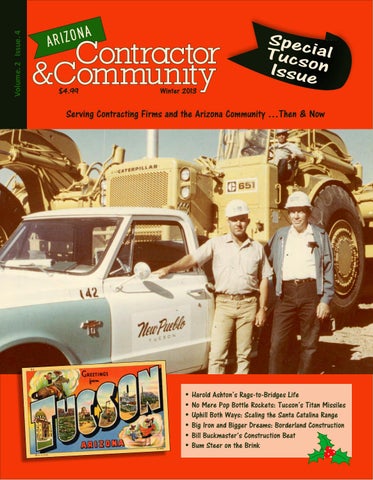
Front Cover - New Pueblo Constructors employees Bruce Green and Dan Kellogg work at Rio Rico, Arizona, ����. See story on page ��.
54 56
Tucson’s Titanic Warheads Douglas Towne
D
uring much of the Cold War, Tucson was home to an unimaginably powerful underground arsenal. Eighteen silos were located around the Old Pueblo loaded not with grain but with weapons of mass destruction. The subterranean, eight-foot-thick concrete silos held Titan II missiles targeted at sites in the former Soviet Union. No mere pop bottle rockets, the Titan II’s were the largest operational, land-based missiles ever manufactured by the U.S. These goliath projectiles packed a wallop, carrying the nation’s most powerful nuclear warhead ever produced—a nine megaton yield that was roughly 600 times more explosive than the
atomic bomb dropped on Japan to end World War II. Their tremendous force was designed to make up for their primitive targeting accuracy. The U.S. developed the Titan II from its predecessor, the Titan I missile, 54 of which were deployed at five locations around the country from 1962-1965. The Titan II was a significant advancement on both the Titan I and the Atlas missiles, the latter being the nation’s first intercontinental ballistic missile, 123 of which were in operation from 1959 to 1965. Getting the Titan II’s on alert was a military priority as both the Atlas and Titan I missiles were deemed susceptible to attack due to their lengthy launch process which involved raising them from
underground silos to be fired. Cold War politics, including the recent Cuban missile crisis, and the missile gap with the Soviets, increased the urgency of their deployment. Eighteen Titan II missiles each were scheduled for deployment near three U.S. Air Force bases around the country: McConnell in Wichita, Kansas, Little Rock in Little Rock, Arkansas, and Davis-Monthan in Tucson, Arizona. The Pentagon’s decision to surround Arizona’s second largest city with nuclear-tipped missiles came without any public notice or input but the $80 million dollar missile project was a major economic boost to Tucson.
Eight
Images courtesy of author
“No mere pop bottle rockets, the Titan II’s were the largest operational, land-based missiles ever manufactured by the U.S. Their tremendous force was designed to make up for their primitive targeting accuracy.”
”Over time, however, the missiles became as much of a liability as a weapon. In 1980, a Titan II missile in Damascus, Arkansas exploded…”
and caused a leak. The missile subsequently exploded, killing one serviceman and blowing the 740-ton launch door 200 feet into the air and 600 feet northeast of the missile complex. The nuclear warhead landed about 100 feet from the launch complex’s entry gate without detonating; its safety features operated correctly and prevented the loss of any radioactive material. Soon afterward, President Ronald Reagan announced the decommissioning of the Titan II missiles which occurred between 1982 and 1987. The presence of these nuclear weapons ringing Tucson was unknown to me when I arrived at the University of Arizona in 1984. In those information-sparse, pre-Google days, my initial awareness of these missiles came via pop culture at the Boondocks Lounge on North First Avenue. Attracted by the nightclub’s unique sign in the shape of an oversized Italian fiasco wine bottle, I stopped in to enjoy a bluegrass band called the Titan Valley Warheads. Intrigued with their name, I asked a band member where Titan Valley was located. “You’re standing in it,” he said. “All around the city are Titan missiles loaded with nukes aimed at Russia.” Retiring these military facilities was a complicated project. After the warheads and missiles were removed, each ten-acre launch site was stripped of valuable components and covered in dirt. Former missile properties were sold and, as Tucson expanded, some became sites for homes, a fitness center, plant nursery, and church. One home owner expanded his square footage in what might be the ultimate home remodel by excavating the access portal to the underground facility. Despite having been buried under eight feet of soil for 15 years, he reportedly opened the 6,000-pound blast door to the launch control center rather easily. Fortunately, one missile launching facility was preserved to illustrate Tucson’s unique atomic age legacy. The Titan Missile Museum located south of the city, features a neverfueled, training missile inside a silo. Operated by the Arizona Aerospace Foundation and named a National Historic Place in 1994, the museum communicates the vital contribution that the Tucson area contributed to the nation’s defense during the Cold War.
Upper left: Patch of the 571 Strategic Missile Squadron that served in Tucson from 1963-1983. Left: Editor atop a former Titan II launch site near Interstate 10 and Arizona Highway 83 in 1998. Left inset: Maureen Towne simulating a Titan II launch at the Titan Missile Museum outside Green Valley in 2003. Right: An early 1960s test launch of a Titan II missile.
Image courtesy of author
To facilitate construction of the launch facilities in Tucson, a concurrence scheme was used; design and construction happened almost simultaneously as engineers drawing up the plans were barely ahead of the construction workers building off the blueprints. This process saved time but was expensive due to thousands of change orders and facility modifications. Heavy construction on the Tucson silos started on December 9, 1960 and was completed before Christmas in 1961 according to Chuck Pension’s, Titan II Handbook: A Civilian’s Guide to the Most Powerful ICBM America Ever Built. M.M. Sundt Construction Company excavated the silo pits to a depth of 155 feet using a bulldozer scraping its way down in ever deepening circles. The soil was removed by a lift bucket. The essential infrastructure was installed by February 1962 and M.M. Sundt and Matich Brothers were subsequently selected as the joint construction managers for Phase II which included installing the piping, and electrical systems. The U.S. Air Force took over from the contractors to install communication systems and the missiles themselves. The Titan II launch sites became operational in October 1963. Titan II facilities were retaliation launch silos, designed with three-ton blast doors to theoretically withstand all but a direct nuclear detonation and still be able to launch missiles in response. The silos were separated by a minimum of eight miles to lessen the possibility that a single atomic bomb could wipe out more than one site. Although armed with only one warhead, the Titan II missile could be targeted on any of three predetermined sites. Mutual annihilation was the high risk chess game the U.S. played with its adversary for decades until the breakup of the Soviet Union in 1989. Tucson’s nuclear-tipped missiles, which could be launched in less than a minute, helped deter attacks during the most crucial crises of the Cold War. The most heightened state of alert occurred early on when President John F. Kennedy was assassinated on November 22, 1963. Reportedly, the keys used to fire the missiles were ordered placed near the launch consoles. Fortunately, no armed missiles were launched during the Titan II’s roughly twodecades of operational status. Originally designed with a life span of ten years, upgrades doubled the Titan II’s service period. Over time, however, the missiles became as much of a liability as a weapon. In 1980, a Titan II missile in Damascus, Arkansas exploded after a maintenance worker dropped a tool 80 feet down the silo which pierced the fuel tank
Construction Arizona Arizona
Freeways • Roadways • Commercial William Horner Moving Soil to Replenish Tucson Water rcher Western Contractors are creating three, 15-acre ponds to receive and recharge effluent from the new Agua Nueva Facility Reclamation Facility in Tucson. The job site is located between Interstate 10 and the Santa Cruz River north of downtown Tucson. Work started in July moving an estimated 200,000 cubic yards of material to an adjacent site which was a former gravel pit. The project has been anything but routine with archeologists locating Hohokam Ten
artifacts and workers rescuing a homeless man from beneath a sewer manhole. The equipment used in the earthmoving project was rented from Red Mountain Machinery. R.W. Strunk Excavating of Tucson is the subcontractor for the blade work and fine grade. Above: Grade Foreman Shane Strunk of R.W. Strunk Excavating, Tucson and Superintendent Brian Pilon of Archer Western Contractors. Below: Southern Account Manager Pete Costa and Superintendent Brian Pilon of Archer Western Contractors.
Images courtesy of author
A