Volume 3 Issue 3
$4.99 Fall 2014
Serving Contracting Firms and the Arizona Community… Then & Now
• The Inside Angle on Grand Avenue • Arizona’s “Luckiest” Nightclub • City’s “Surprise” Female Founder • The Friendly Place: The Trunk Space • Grand Times at Hayden West Plaza • Caravan Inns: Sheik Places to Stay • 35 Years of Sunland Asphalt
Branco provides the highest quality and most advanced products available in the positioning industry today. Branco has the in-house expertise to assist you in the selection of the right technology and the right products to get the job done right the first time.
Topcon Machine Control Motor Graders
Construction Rotating Lasers
Dozers
Pipe Lasers
Excavators
Automatic 3D GPS+ Technology
Scrapers
Sales, Rental, Service
Pavers
Installation &Training
3DMC² Graders & Dozers
Rental Equipment
Ground Engaging Tools
Motor Graders
3D GPS Products
Grade Tractors
2D Machine Control
Skid Steers
Lasers & Receivers
Tungsten Carbide Custom Application for: Blades, Teeth, Wear Plates, Segments, & Routers Patterns to fit your needs.
Cutting Edges For: Dozers, Loaders, Scrapers, Motor Graders sAll O.E.M. Edges sCustom Blades (Made to order)
Shanks & Teeth sAll O.E.M. Replacement Teeth sRipper Box Assemblies sReplacement Tooth Adapters
Fabrication / Repair Backhoe and Excavator Buckets
Replacement Parts for Elevating Scrapers Flights, Chains, Sprockets, Rollers, & Grouser Bar. Dozer Undercarriage
www.brancomachinery.com For More Information Call: 480-892-5657 1205 N. McQueen Rd. Gilbert, Arizona 85233
Want More Grand Avenue? Magazine Editor Douglas Towne will be curating the exhibit, “The Lone Diagonal in a Grid Town: What’s Grand about Grand Avenue” that opens on First Friday, December 5, 2014 at the Frontal Lobe Community Space and Gallery, 1301 Grand Avenue. The show will feature additional historic photos and vintage ephemera from the vaults of Arizona Contractor & Community magazine as well as other historic resources, and art pieces inspired by the architecture along Grand Avenue. The gallery is located within Bragg’s Pie Factory, which was constructed in 1947. The Bragg family operated a bakery, mostly supplying local restaurants and grocers but also offered retail sales. The factory relocated in the 1960s. The building was vacant until Beatrice Moore and her partner, Tony Zahn, purchased it in 2007 and turned it into space for galleries, artist studios, and small businesses.
Publisher William Horner Billy@arizcc.com
Editor Douglas Towne Douglas@arizcc.com
Contributing Writers Lee Addis John Bueker J.J.M. Czep Robert Graham Katie Mayer Carol Palmer Eric J. Toll Maureen E. Towne
Magazine Consultant Chuck Runbeck Chuck@arizcc.com 602-881-0907
Production Manager Laura Harley Laura@arizcc.com 623-698-6436
Publisher’s Representatives Tom Hogarty Tom@arizcc.com 480-559-2327
Circulation Manager Tina Crigler Tina@arizcc.com
Barry Warner 602-920-7325
Advertising Manager Chuck Runbeck Chuck@arizcc.com 602-881-0907
To serve Contracting Firms and the Arizona Community, Then & Now…
s: ription r c s b u ls yea Annua $16 - One ion ipt subscr year wo $28 - T n Make iptio subscr ayable to: p check Magazine . C . enA.C 1 2 , Gl 9 6 x o PO B
Printed at Lithotech
Whenever, Wherever and However
Arizona Contractor & Community (ACC) magazine is published quarterly (spring, summer, fall, & winter). ACC is a professional publication designed for the contracting industry, engineers, architects, and others interested in Arizona and its history. Content including text, photographs or illustrations may not be reproduced without the written permission from the publisher. The publisher does not assume responsibility for unsolicited submissions. ACC reserves the right to reject any editorial and advertising material and reserves the right to edit all submitted content material. Arizona Contractor & Community Copyright © 2014 All rights reserved.
8 Volume.3 Issue 3 Fall 2014
10
CONTENTS
28
30
32 36
8.
Phoenix’s Friendly Place - Editor’s Column Douglas Towne
11. 12. 29. 31.
Magazine Feedback
33.
Sunland Ashpalt, 35 Years - Special advertising section
49.
The Lone Diagonal in a Grid Town: What’s Grand about Grand Avenue - Douglas Towne
54. 58.
Grand Times at Hayden Plaza West - John Bueker
Industry Highlights Community Commerce: The Evolution of Grand Avenue in Peoria - J.J.M. Czep
“Sheik” Places to Stay: A Tale of Two Caravan Inns - Maureen E. Towne
62 .
Rediscovering a City’s Roots: The Surprise History Project - Carol Palmer
66.
The Angle: Grand Avenue, Phoenix’s Strange Diagonal Boulevard - Robert Graham
71.
More than Lucky: The Man, the Sign and the Story behind Arizona’s Most Renowned Nightclub Katie Mayer
74.
Digging Through the Archives: An Interview with Leon Slade - William Horner
77. 78.
Bid Results - Bidjudge
40 42
Construction Around Arizona
ACC Advertisers Index
46 52
48
59
59
Front Cover -
60
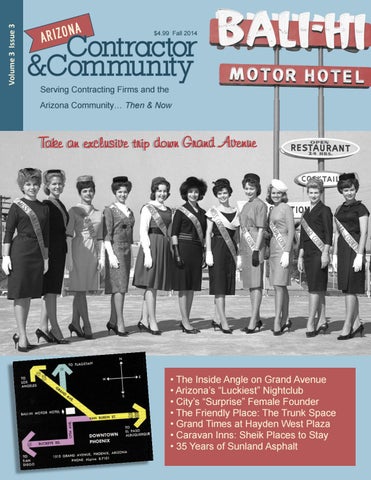
Top: Bali-Hi Motor Motel, ���� Grand Avenue, Phoenix with Miss Arizona Contestants, ����. Bottom: Pre-Interstate Highway Map of Phoenix
Phoenix’s Friendly Place
T
he 11th issue of Arizona Contractor & Community magazine promises to be a grand occasion, in more ways than one. We’re focusing on one of the Valley’s most unique yet misunderstood streets, Grand Avenue. This lone diagonal in a grid town was created to help market real estate developments almost 130 years ago. The road later became a major, coast-to-coast highway that was the main drag between Phoenix and Los Angeles. Influenced by parallel train tracks, now frequented by Burlington-Santa Fe locomotives, Grand Avenue is also an important industrial zone. Recently, Lower Grand between downtown Phoenix and Interstate 10 has reinvented itself as a burgeoning arts and small business district. And, coincidentally, a small art space on Lower Grand, the Trunk Space, is the birthplace of Arizona Contractor & Community magazine. The Trunk Space was named with a nod to the Valley’s most famous alleged “Trunk” murderess, Winnie Ruth Judd. She was convicted, but likely was set up, with killing and dismembering her two female friends, packing their parts into steamer trunks, and heading off for Los Angeles on the Golden State Limited passenger train in 1931. The wry humor and historical connotation of the Trunk Space’s name characterize the interests of co-owners Steph Carrico and Jason Nosaj. “We were both doing our art around downtown in the early 2000s; Jason was doing performance art and I was showing photography and mixed media pieces,” recalls Carrico. “Scott Sanders from the Paper Heart art space asked us to help him book shows and run coffee for him
at his old location on Fifth Avenue and Van Buren in 2003. We agreed and did that for about a year. At the end of that year Scott decided to move to a larger location at the former Quebedeaux Chevrolet building at 750 Grand Avenue and serve alcohol. It was our plan all along to branch off at some point and do our own thing. This seemed like a good time to do that so in April of 2004 we opened the Trunk Space.” They located their new entity near what Nosaj calls the “Grandavelt Corner,” the funky
“A small art space on Lower Grand, the Trunk Space, is the birthplace of magazine.” intersection of Grand Avenue, Roosevelt and 15th Avenue. “Grand Avenue itself is an attraction since some of the nicest, most unique architecture in the city can be found on the street,” says Nosaj. “Our space at 1506 Grand still has some cool features of the original building like the tin ceiling.” City directories cite the first commercial use of the property as the P.J. Shaughnessy Auto Camp in 1928. The place, offering modest overnight accommodations to travelers on crosscountry U.S. Highways 60, 70, and 89 lasted a few years before changing its name to the Fifteenth and Grand Tourist Camp in 1931. The Shaughnessy Building complex that presently houses the Trunk Space along with its neighbors, the Jackalope Trading Post, Bikini Lounge, and Kooky Krafts was constructed around this time.
Businesses at the Trunk Space’s location evolved from serving travelers to industrial purposes. The progression included R.E. Wagner Liquors (1935), Dick’s Place, a bar owned by R.E. Wagner, (1940), Mac’s Bar & Café (1941), Mac’s Friendly Place Café (1950), Master Power Corporation-Black and Decker Manufacturing (1962), PEM Corp. in Arizona (1967), Pendleton Equipment Company (1983), and Precision Petroleum (1994). So how did a construction magazine come together courtesy of the Trunk Space? Although our publisher, Billy Horner, has spent his career as a blade man working in the Arizona construction field, following in the footsteps of his father, uncle, and grandfather, he has many other talents. When not tinkering with collectible cars or vintage Harley Davidsons, Billy plays a mean set of drums. Starting with the Moon Valley High School marching band, he has played in a myriad of Valley groups including The Vrooom, Liam and the Ladies, and Man About A Dog. Balancing his drumming passion with work was a challenge. “Getting home from my construction job, I would clean up, head out to a gig. After the band finished, I would go to the job site in the middle of the night and camp there,” Horner recalls. Sleeping in his vehicle, Billy would manage a few hours of slumber before waking at 5 am for work. “This made for a deep sleep at the end of the work week,” he laughs. Some of Billy’s percussion performances took place on Lower Grand at the Trunk Space, a place where, coincidently I’d befriended the
Left: Tourist camp at 15�� and Grand avenues, 1926. Top right: Trunk Space owners Steph Carrico and Jason Nosaj. Across page, top right: Quebedenaux Chevrolet night view of used cars, 1955. Across page, Mid right: Mac’s Friendly Place matchbook cover. Across page, bottom right: Winnie and Mitch at the Shaughnessy Motor Court, 1929. Across page, bottom left: Dick’s place. Eight
owners while writing about events there for the Phoenix New Times. In addition to hosting bands, vaudeville, burlesque, the talk show, “Grand Avenue Live,” and the vintage “haunted” photo booth, the Trunk Space is an edgy art gallery. Along with hip historian Marshall Shore, I became guest curator for the annual “Grid Show” that highlights the city’s past. I’d also contribute floating art montages that creatively utilize vintage advertisements to craft what former Phoenix New Times reviewer Wynter Holden called, works “as much about social commentary as they are homage to the past.” For many years, I’ve also been editor of the Society for Commercial Archeology (SCA) Journal. The SCA is the oldest nationwide organization dedicated to the preservation of roadside architecture. I would leave extra copies of the publication sprinkled around the Trunk Space to attract new members to the SCA. For a long time, Billy had envisioned creating a start-up magazine to serve Arizona’s construction industry. His idea was to mix current projects with the history behind the state’s many people, companies, and projects. “Before the magazine, I started a blog to put together some articles,” Horner says. “I brought my camera to the jobsite and would stop while grading to shoot the work being done by other tradesman. I’d write up some text to go with the photos. Some people got a kick out of the blog while others could care less.” One encounter Billy had sticks out in his mind. He and his superintendent, Barry Warner, approached a rather nervous general contractor to see if they could grab a short interview and a few pictures. “Are you compiling evidence for a lawsuit?" was the supervisor’s suspicious reply. “I had met Steph Carrico, who is an accomplished photographer, years before when she photographed my sister’s wedding,” Horner
recalls. “And as a frequent musical guest to Steph’s club, I felt comfortable asking if she had any leads on an editor for my wild idea for a hybrid contracting and history publication. She showed me the Society for Commercial Archeology Journal and said to contact Doug.” After a lengthy phone conversation and endless meetings, the foundation of the magazine was created. The Billy and Doug duo became a quartet with the vital addition of a spry, 86-year-old advertising man, Charles Runbeck, and English import, designer Laura Harley. Arizona Contractor & Community might be the first magazine to come out of interactions at the Trunk Space, but it’s certainly not the only occasion where people have come together at this historically “friendly place” to create something grand.
From the start, Carrico and Nosaj wanted to create something more than just a performance space or an art gallery. They wanted a place where creative people could simply meet each other. “Collaboration and critique through peers is essential to growing as an artist,” Nosaj reflects. “Not only that, but honestly, the only way Phoenix is going to grow as a place for creative people, is to have
Arizona Contractor & Community
such 'salon' places, multi-use rooms that can adapt to the needs and whims of the community.” “When we opened the Trunk Space we wanted it to be open and welcoming to all ages, anyone from little kids to grandparents,” Carrico concurs. “We also wanted to accept all art forms, not just music, or just visual art. I believe these two things have been the driving force behind Trunk Space being a meeting place for folk who had creative energy they needed to get out.” The Trunk Space has managed the unusual in that it recently celebrated its 10th anniversary with the “Indie 500” that featured 50 bands playing 500 songs over 10 days. But even with this success, what does the future hold for the volunteer-run art space, especially since Nosaj recently stepped back from active management to become a silent partner. “I believe Trunk Space
?
with the same spirit to come along and fill that void.” Carrico has nothing but positive vibes for the Trunk Space. “As for the future I want to see Trunk Space be around for at least another 10 years.” she exclaims. “We have a solid group of “We wanted a place where volunteers, and I am hopeful that people will continue to want to volunteer, play shows, and creative people could attend events to aid in Trunk Space continuing generations of art lovers.” simply meet each other.” for more Let’s hope Arizona Contractor & Community magazine can emulate the Trunk Space’s success become obsolete. It is a rare institution that can and positive impact on the community. continue on forever. I hope Trunk Space will be Top, left to right: Billy Horner drumming with unique and exemplary in this way. But even if it Liam and the Ladies at the Trunk Space; Billy and isn't, I do feel secure in knowing that if Trunk Doug pose by the latter’s contribution to the Space fades away someday, there will be people Trunk Space’s “The Grid - 2013: Personal Maps”; can always serve a useful purpose as long as it is able to adapt to changing needs, and there is an invested community around it,” Nosaj reflects. “There is a truth though, that in the realm of DIY art spaces, by nature they do tend to
Produce band rocks out at the Trunk Space, 2005.
Magaz W
e just became aware of your magazine after stumbling on the picture of one of our company’s first concrete plaques in the article written by Douglas Towne (Editor’s Column, Summer 2012). Being a third generation Arizona company, we are very proud of our part in the state’s history. I forwarded the article to my father who is now retired in Prescott. He related how he actually used to work at Hanny’s after Homes & Son built it. Russ Homes
J
ust a note to let you know that I enjoy your new magazine!
Terry Welch, Meadow Contractors, Inc.
I
Valley
wanted to express my thanks for the feature you did on my Dad, John Lattimore (Digging Through the Archives, Spring 2013). My family and I enjoyed the article and photos! My daughters loved reading about their Grandpa's company and remember going on some of his jobs with him. I grew up watching this hard working man rise to the top of his field, always with honesty and integrity. When Dad first started contracting in the Valley, a gentleman's agreement and personal reputation were the most important elements for a job. By the time he was ready to retire, I recall the frustration he experienced as jobs were often run by business/accountant wonks and legal departments, rather than by the people who actually knew how to build and complete a project. In spite of that, he had a good run and achieved personal satisfaction and financial security. I'm still thrilled when I walk along a side walk and see his name imprinted! Thanks again and continued good luck and success with your publications! Cheryl (Lattimore) Wamsle
I
have enjoyed reading many of the historic architectural articles in your magazine, including those on Town and Country shopping center (Winter, 2012), which was my old neighborhood from 19551966, and Legend City (Summer 2013). During the past five years I have authored three books on local historic architecture and include Images of America: Scottsdale Architecture, Plugger: The Architecture of Reginald Sydnor (my father’s architecture), and Images of America: Paradise Valley Architecture. I obviously have an affinity for historic architects and their architecture. There are many architects that created extraordinary architecture in the Valley over the decades and yet some of them are largely unknown. In time it would be great to feature some of them and their work. A few examples include Don K. Taylor, Hugo Olson, T.S. Montgomery, Hiram Hudson Benedict, Joe Wong, Paul Schweikher, John Schotanus, and Pierson and Miller. Doug Sydnor
R
eally enjoyed the article on the Bingham Brothers (Digging Through the Archives,Summer 2013); having worked with them, it brought back a lot of memories! Wayne Seratt
I
enjoyed your article " Turning Copper into Cable: The Western Electric Company" (Summer 2014) by J.J.M. Czep and wanted to comment about the connection between the company and my son, Billy Horner, the publisher of Arizona Contractor and Community magazine. William “Bill” F. Sullivan was 21 years old when he started at the Western Electric Company in Buffalo, New York in 1955. He was
a twister operator, running the machine that twisted cable for telephones. In 1968, the Buffalo plant was closing down and, to keep their jobs, the workers had to relocate plants in other cities. Bill transferred to the new plant in
Phoenix and retired as a supervisor in the 1980s. His son, and my father, William “Bill” M. Sullivan also worked at the Western Electric plant in Phoenix for over 30 years. When my son, Billy Horner, was a little kid, we toured
vmc
Construction Around Arizona
Construction Around Arizona Freeways ● Roadways ● Commercial
GoDaddy Gets New Tempe Home
Twelve
include a full-service kitchen with on-site chefs, a fitness area with showers, yoga room, and outdoor areas with a basketball and sand volleyball courts, as well as a soccer field. The ASU Research Park is joint commercial real estate venture involving the university and Sunbelt Holdings. Top: Left to right, Gunsight employees Andrew Ruiz, Rudy Alba, Edmond Winn, and Thomas Smith. Right: Gunsight Supervisor James Weldon balancing subgrade for the 10,000 tons of ABC.
Images courtesy of author
GoDaddy’s Global Technology Center is set to open this year in Tempe at the Arizona State University Research Park. The web domain provider is known for its spicy Super Bowl commercials featuring attractive young ladies, including race car driver Danica Patrick. The GoDaddy complex, constructed by Ryan Companies, will include a two-story, 150,000 squarefoot facility providing space for more than 1,300 employees including engineers, developers, corporate staff, and customer care representatives. The new space will
WWW.DDIEQUIP.COM
EQUIPMENT, INC. SALES, RENTAL & SERVICE
(602)-243-5243 (602)-510-7123 3615. S. 7th Ave Phoenix, AZ 85041
Do you need rental solutions for screening, crushing, grinding or land clearing?
We can help, contact us today!
Construction Around Arizona
Sky Harbor Business Park Takes Off
A
Working as a subcontractor to General Contractor Wespac Construction, the completed portion of Phase 1 will include three new Class- A buildings totaling 630,000 square feet (sf). Improvements to both onsite and offsite areas include grading, underground utilities, sidewalk and curb, paving and landscaping. Phase I of the project is slated for completion in the fall of 2014. At build out, the site will comprise five Class A industrial buildings totaling 920,584 sf. Rummel Construction’s earthwork component of the project
includes 96,413 cubic yard (cy) excavation, 42,758 cy inert crushing (concrete and asphalt), 22,463 cy of import, and 50,100 cy of paving. A challenging aspect of the project is that the site is located on an old inert landfill. Inert material can be found from 1 to 20 feet below surface, and crushing and screening operations are needed to make the onsite material suitable for building pad construction. Wespac chose Rummel Construction to complete the project due to their approach in meeting an aggressive schedule, as well as price.
The Airport I-10 Business Park is the first major development in the Airport submarket in the last five years. Its high-end corporate image, institutional quality development, and airport submarket location has direct access to all transportation and major roadways, making it a premier industrial or business location. Buildings will include brand new cross dock and rear loaded buildings, and the project will be completed by fall 2014. Images: Rummel Construction conducting earthwork and site prep.
Images courtesy of author
irliners weren’t the only things taking off this spring at Sky Harbor International Airport as construction also started on an adjacent business park. Local civil contractor Rummel Construction is completing the earthwork component for the new Airport Interstate 10 Business Park located off of 24th Street and Riverview Drive in Phoenix. The large commercial project sits on 62 acres in the Commercial-Industrial park area located near Sky Harbor, and is being developed by Wentworth Property Company/Clarion Partners.
Fourteen
he rapidly growing area south of Tucson includes the communities of Sahuarita and Green Valley along with the Sahuarita Mine. In 1995, the Arizona Corporation Commission approved Tucson Electric Power (TEP) to construct a new 138kV transmission alignment for additional reliability. The final phase of the project was the eightmile-long Green Valley Transmission Upgrade that included a 720-foot-long bore under Interstate 19. TEP’s plans for the bore were for the installation of 24-inch casing to carry four, six-inch conduits. Specialized Services Company (SSC), an Arizonabased trenchless technology construction firm, was consulted on the bore. Auger boring was determined to be best method, but required upsizing to 42-inch casing. TEP agreed to this design change and modified their plans to install 14, six-inch conduits for future use or sale/lease to another utility. Behan Excavating, a Tucson contractor, was low bidder and selected SSC as the trenchless contractor. Construction was originally scheduled to begin in September 2012, but delays in permits from the Arizona Department of Transportation (ADOT) delayed the project by several months. Abe Veidmark, SSC co-owner and vice president, was selected as project manager. His first step was to dig and shore the bore pit, which was designed for best equipment access and stockpile locations for materials and spoils. SSC began auguring in December. Soil conditions proved challenging so a drift-ring bit was replaced by a Christmas-tree bit. The company was able to bore and install 300 feet of
Sixteen
Not A Boring Project: SSC Tunnels Underneath I-19
Images courtesy of Freeport- McMoRan
Construction Around Arizona
T
casing by mid-January. The project strained the machine, which turned 35,000 pounds of auger and pushed 66,480 pounds of casing. To aid in boring, SSC pumped polymer along the casing through slick lines. At the 517, 530, and 580-foot marks, the shear force exerted by the length of auger caused the shaft to snap. This required the auger to be pulled out, cutting out the broken piece and removing it, and
subsequent pieces using a hydraulic tugger. Following the last break, the fourinch hex auger was replaced with a five-inch hex. Another 60 feet of bore was completed before the auger again broke. The bore machine was at its limit; the project would need to be completed by hand tunneling or open cut. Since the bore had already traversed the freeway, TEP petitioned ADOT to allow the remaining 80 feet of
casing to be installed using the faster method of open cutting. ADOT agreed and, by April 5th, SSC crews had dug the open cut trench, completed the entire 720 feet of casing, and backfilled the open cut, returning traffic access after only three days. For the next two weeks SSC crews welded a rail system inside the casing to push the conduit bundles inside. With the carrier lines fully installed and bulkheads built, the final step was grouting the annular space. This would create extreme heating inside the casing as the grout cured, which threatened to damage the conduits with no recourse to repair or replace them. Veidmark and his crew plumbed a cooling system to continuously pump water through the conduits to absorb some of the heat generated by the curing grout. Even the day after grouting, the water temperature increased more than 30 degrees, proving the value of this cooling system. By being able to bore 90 percent of the tunnel, SSC was able to complete the project on schedule. The conduits were installed on line and grade, and thanks to the ingenuity of Veidmark’s cooling design, the grouting operation was a successful conclusion to a challenging project.
Finding unique Solutions to Solve your Changing Needs!
Certified Cranes Certified Operators Machinery Moving Site Surveys - Storage 480-967-0026
TANNER
Images courtesy of McCarthy Building Companies
Construction Around Arizona
Verrado Expands Options
M
arking a decade of growth in Verrado, the DMB Associates community is entering a new phase of development with the Heritage District. This consists of an additional 634 lots that will be added to the more than 2,100 completed homes in the development. Eight local and national homebuilders were selected for the Heritage District. The addition of this new neighborhood, set on 150 acres, includes 16 uniquely themed neighborhood parks. Markham Contracting is completing the civil improvements in the final phase of Heritage District and the parks are being constructed by Agave Environmental and AR Mays Construction. There are more than 50 floor plans to consider in the district, including newer products like Pinnacle West’s green court lots. Verrado will be adding a major community amenity, the Heritage Swim Park, in Spring 2015. Architect Eighteen
Cory Wiebers designed the aquatic center. Wespac, the general contractor, began work on the center in July 2014. This recreational family center set on four acres will feature an event pavilion and lawn for special events, swimming pool, and splashpad and a beach entry for kids. The next major development at Verrado will be DMB’s first active adult community, Victory at Verrado. Markham Contracting is currently preparing the site for development. DMB will be offering a variety of homes built by four homebuilders including Lennar, Maracay Homes, Standard Pacific, and T.W. Lewis by David Weekley Homes. There will be 417 homes built in the first phase. The Big Patio, Victory’s welcome center showcasing its outdoor lifestyle, is scheduled to open in January 2015. Later in 2015, DMB will open the private amenity,
the Victory Club, a 30,000 square foot club set in the foothills of the White Tank Mountains. Development teams are excavating one of the upper bluffs in the mountains for a building site. The clubhouse will look out onto the mountains and down toward the Verrado Golf Club and the private putting greens. Hart Howerton is
the design architect, working with SHJ Studio on the design of the building. Major infrastructure and civil improvements are underway now with Markham Contracting. In the next phase of development, work will begin on Victory’s club and golf course. DMB anticipates completion of the golf course at Victory in 2016.
Metro Traffic Control, LLC 7777 North 70th Ave Glendale, AZ 85303 *ATTSA Member* 623-879-0610 Brantley Gallimore brantley@metrotrafficcontrol.net
Katie Mayer
S
undt Construction has begun working on the newest location of Village Health Clubs & Spas called Ocotillo Village Health Club & Spa in Chandler. The company broke ground on June 18, and the 82,000 squarefoot health club is scheduled to open in April 2015. The $15 million project, located near Alma School and Ocotillo roads, will feature an outdoor aquatic center, a sports complex featuring tennis, squash, and racquetball courts, gymnasium, group fitness and hot yoga studio plus full fitness, cardio and spa areas. The land surrounding the construction site was previously farmland and the project is located on a corner lot in what is now a suburban area. Teddi Fowler, of Sundt Construction, said the team is
working on an aggressive construction schedule and is determined to meet the goals of the client. One way the team is working to achieve its goals is through utilizing Last Planner principles on the project to expedite work with their partners, Village Health Clubs, Butler Design Group, and Deutsch Architecture Group. The project is expected to create 250 construction jobs, according to a statement from DMB Associates. Sundt Construction would not provide details on the subcontractors working on the project. The health club is one of four Village Health Clubs & Spas owned by DMB Associates and will be the company’s first location in the East Valley.
Image courtesy of McCarthy Building Companies
Construction Around Arizona
The Ocotillo Village Health Club & Spa Project
Images courtesy of The Weitz Company
Construction Around Arizona
Historic Flagstaff Building Cooking Again Jordon Tarantino
I
n 1937, Lou Lucero constructed a brick building at 110 South San Francisco Street in Flagstaff to house his restaurant, the Spanish Kitchen Café. Although much of the building’s history is unknown, the cafe only lasted until 1943. The building was subsequently home to several bars including Grieg’s Tavern, which opened in 1948, and a gentleman’s club before sitting vacant for 21 years. Current owner David Kincade decided to refurbish the Lucero Building and hired Wespac Construction, which began work in September 2013.
The restoration goal was to recreate how the building looked in 1937, although the earliest photo of the building was from 1992. Wespac soon learned how difficult the project would be because of the many changes made to the building during its 76-year history. Initial work was done on the building’s exterior, hand-laid stone masonry. The stone had become weathered from exposure to Flagstaff’s extreme elements and needed cleaning. When Wespac began to sandblast the bricks however, the stone began to
Metro Traffic Control, LLC 7777 North 70th Ave Glendale, AZ 85303 *ATTSA Member* 623-879-0610 Brantley Gallimore brantley@metrotrafficcontrol.net Twenty two
disintegrate. Wespac quickly switched to using a mild chemical stripper to clean the fragile brick and grout. Kincade also wanted to preserve the building’s internal features, but they had suffered during the 21 years the building was unoccupied. There was insulation showing through the ceiling and wood rot through the multiple layers of the sub flooring. The building is in a floodplain and had suffered water damage to the flooring and wood supports in the basement. Wespac removed three layers of added unlevel sub flooring and replaced old footings to ensure a stable and level floor for the historical structure. When Wespac replaced the ceiling, they discovered framing made entirely out of Ponderosa pine cut at the local sawmill. Although in great shape, the framing had not been updated and the building would not pass the city’s much more stringent snow load requirements. This forced Wespac to essentially reconstruct a roof system within the existing frame, which threatened preservation of the coved coping around the plaster ceiling. Wespac decided to notch the ceiling just enough to fit the new wood in place, allowing the least amount of plaster removal possible. Although the roof was still in good
shape, Kincade requested that it be replaced too. The back of the building had a rickety set of stairs that led to the second story, which was once a comfortable living space. The vacant apartment, however, had become home to unwelcome occupants ranging from animal to human. The floors and ceiling were far from level, which became a challenge for Wespac throughout the renovation. The uneven, “rollercoaster” flooring, however, added character to the space. An old brick boiler flue inspired a creative design to accommodate it in the existing kitchen. Much like the first floor, the plaster ceiling and walls were salvaged, adding to the vintage feel of the finished apartment. Wespac Construction and David Kincade were able to change the fate of the Lucero “mystery building” and hopefully inspire the restoration of other historic structures in downtown Flagstaff. The once dilapidated building now houses two restaurants, a deli, and an apartment. Kincade believes that these businesses will help rejuvenate South San Francisco Street.
Top left, clockwise: Interior before; exterior final; and interior final.
Construction Around Arizona
Steel Reinforcements for Tempe Town Lake Lee Addis
T
rubber bladders. After much research, the Tempe City Council decided a hydraulically operated steel gate dam and new reinforced concrete spillway slab was the best solution. The new dam will be located about 100 feet west or downstream of the current rubber bladder dam, which will make construction easier. The dam will be 950 feet long, including concrete piers and shore embankments, and will contain eight steel gates that are 17 feet high and 107 feet long. Construction began on the new dam in early June and included relocation of large storm drains and
which also replaced the rubber bladders after the dam burst in 2010. The large steel gates will also be manufactured in Phoenix to save on transportation costs, Steel Fab and Schuff Steel will be manufacturing the gates. The overall cost of the project is estimated to be $40.8 Million, which is being paid using the City of Tempe’s cash reserves and the sales of bonds. Lake access will not be impacted during construction with the exception of the temporary closure of the path near Tempe Center for the Arts due to the relocation of a storm water line.
Images courtesy of author
he City of Tempe has started work on replacing the western dam on Tempe Town Lake, a project that will be the city’s most significant capital project since the construction of the lake itself in 1999. The new hydraulicallyoperated steel gate dam will provide additional safety, reliability, durability, and flow flexibility to Town Lake. Over a billion gallons of water was inadvertently released from Town Lake when the one of the rubber bladders on the current western dam burst in July 2010. The temporary solution to fix Town Lake was to replace the failed
prepping the dry river bed for the concrete foundations. Construction of the foundations will begin later in 2014, and the dam is scheduled to be operational by December 28, 2015. That is also the date which the rubber bladder dam must be rendered inoperable as part of the City’s agreement with the manufacturer, Bridgestone. Not meeting this deadline could cost the city up to $300,000 per month, though it may be waived if delays are caused by the weather. The Tempe Town Lake project uses many local companies. Gannett Fleming, with offices in Phoenix, designed the new dam; Tempebased PCL Construction based in Tempe, is the prime contractor,
Twenty Four
Eric Jay Toll for Arizona Builder's Exchange
T
here are two potential solutions to create an intersection at Bell Road and Grand Avenue in Surprise that will actually move traffic at tolerable speeds. After reviewing 21 different options, the Arizona Department of Transportation (ADOT) and the Federal Highway Administration have hosted public meetings, collected and analyzed input, and are going to release a final Environmental Assessment on the potential $66.6 million project in the coming months. The final designs are modifications of earlier proposals, tweaked to respond to stakeholder requests and recommendations. The price tag on the project has gone up from $36 million in last year’s projections to somewhere between $49 - 67 million. Originally, Surprise officials were happy with a plan that lifted Bell Road over Grand Avenue and the adjoining Burlington Northern Santa Fe railroad (BNSF) tracks. That plan has been scrapped. From the seven alternatives analyzed in the April 15 Draft Environmental Assessment, two alternatives are moving forward. Alternative A creates a Bell-Grand interchange, but Alternative B allows no direct access at the point where the roads cross. A third option, the “No Build” alternative must be reviewed by law, but keeps the intersection gridlocked. Alternative A: Median Urban Design Called the “Median Urban Design” option, Alternative A provides a grade separation with Grand Avenue and the railroad depressed under Bell Road. A new traffic interchange for turn movements is created with a ramp from Grand Avenue to Bell Road. Through traffic on Grand Avenue does not stop. This alternative satisfied all of the major criteria for evaluation but carries a price tag of $66.6 million, including $3.0 million for design, $14.4 million for right-ofway acquisition, $1.7 million for utility relocation, and $49.2 million for construction.
Twenty six
Alternative B: Grade Separation Only Some stakeholders preferred no intersection between Bell Road and Grand Avenue, which is reflected in Alternative B. This plan shifts all the turning movements to Litchfield Road on the west and Dysart Road on the east. Traffic wanting to move east or west on Bell Road would exit to the other two roads. As with Alternative A, Grand Avenue and the BNSF Railway would
both be depressed under Bell Road. In place of an intersection at the top of the Bell overpass, through traffic on both Bell Road and Grand Avenue would flow freely with no traffic signals or turning movements. Alternative B costs only $48.7 million for grade separation, including $1.8 million is for design, $16.2 million for right-of-way acquisition, $3.2 million for utility relocation, and $30.7 million in construction.
If ADOT finds no significant impact for the final Environmental Assessment, the project will be out for Design/Build selection in January 2015. Below: Top to Bottom: Alternative A, which is supported by Surprise and area businesses, drops Grand Avenue and the BNSF Railway under Bell Road, and creates an intersection used for turning movements only at the top of the ramp. Alternative B lets through traffic on Bell Road and Grand Avenue flow freely, but puts all turning movements on to Litchfield Road on the west and Dysart Road on the east.
Image courtesy of McCarthy Building Companies
Construction Around Arizona
ADOT to Make Grand Decision on Bell Road Alternatives
ARIZONA
Your Global Equipment Sales Specialists Bidadoo is the West’s largest and most trusted on-line auction service for construction and industry equipment •
10-50%+ more than traditional auctions
• 250 million global buyers
Desert Brooms & Desert Sweeping Keeping the Valley Clean
"A Sweeping Company" Construction and Parking Lot sweeping Using street and parking lot sweeper trucks Yard centrally located in Tempe
• Sells in days/weeks, not months
Family run business for 18+ years Start Selling with Bidadoo today! • Bidadoo provides free equipment estimates Ÿ Call today for an appointment or questions:
Phone: 1.877.bidadoo Email: info@bidadoo.com Web: www.bidadoo.com
SBE Certified by the City of Phoenix Accredited by the Better Business Bureau Sky Harbor Security Badged Arizona Dust Control # SC0802715 Tim and Lisa Corcoran Lisazdesert@aol.com Lisa - (480) 688-7980 Tim -(602) 339-9982 Fax (480) 279-4433 Azdesertbrooms-sweeping.com
Industry Highlights Atlas Rises to Green Status
With innovative products and services, Atlas Copco delivers solutions for sustainable Newsweek Green Rankings, one of the productivity. The company was founded in 1873, world’s foremost corporate environmental raters, is based in Stockholm, Sweden, and in excess of recently ranked Atlas Copco seventh among the 40,000 employees in more than 170 countries. 500 largest publicly traded, global companies. The firm is an industrial group manufacturing Construction Mysteries Exposed at ASU compressors, expanders and air treatment Building systems, construction and mining equipment, power tools, and assembly systems. Newsweek ASU’s College Avenue Commons is a mixedscored qualified companies against eight key use facility being built on College Avenue one performance indicators including total energy block north of University Drive in Tempe. The consumption, greenhouse gas emissions, water 137,000 square-foot, five-story building was use, waste generation and recycling, reputation, designed by the Gensler Architekton team for the and sustainability incentives for management. ASU School of Sustainable Engineering, the Built “We are extremely proud to be recognized Environment, and the Sun Devil Marketplace. The by an organization like Newsweek for our facility will provide classrooms, offices, labs, and commitment to sustainable productivity,” said study spaces for Del E. Webb School of Jim Levitt, president of Atlas Copco North Construction, Construction Engineering, the America. “This top 10 ranking is a reflection of Alliance for Construction Excellence, and the Civil, our employees’ dedication to our sustainability Environmental and Sustainable Engineering initiatives surrounding safety, health, and Department. environmental issues.” A unique feature of the project is that after completion, the building will be used as a teaching tool. Elements of the design and construction were modeled in 3-D so students can look inside the walls and ceilings to see how the building was built. Exposed mechanical, structural, and electrical systems will be used as part of instruction. This will allow students to develop an understanding of the coordination and skill needed to design and install these systems. The chilled water, fire alarm, and data systems are also exposed to illustrate how these systems are integrated into modern buildings. Touring the building will reveal insights into the first floor’s
(520) 682-4063
Sierra Vista
(520) 378-2321
Globe
(928)425-5775
Phoenix
(602) 416-2652
Flagstaff
(928) 526-5250
Prescott
(928) 443-9207
Camp Verde
(928) 567-0893
Yuma
(928) 343-4150
Bullhead
(928) 763-1022
Trafficade Opens Doors to New Facility The Grand Opening of Trafficade’s new 25,000 square-foot sign shop, warehouse, and safety products store will feature vendors, manufacturers, and even a free lunch. The celebration will take place from 10 am to 6 pm at 2544 West McDowell Road in Phoenix on Wednesday, September 24th. Lunch will be
A Global Ready-mix, Aggregate, Asphalt & Cement Supplier
WWW.CEMEXUSA.COM
Images courtesy of Tom Hogarty
Tucson
plumbing system, while views of the structural scaffolding support for the solar screen and a mock-up elevation of the exterior skin are featured on the third floor. Aside from the tactile and visible elements of the building, the utilities will be metered on a dashboard for analysis. The building skin has thermocouples embedded at each change of material to measure heat transfer through the building. A Mechanical Plumbing Electrical (MPE) lab has an independent forced air HVAC system and active chilled beam system that measures effectiveness under different building loads. Utility stub-outs ensure that future systems can be tested in a real-life environment.
Images
served from 11 am to 2 pm. The new facility is close to the company’s headquarters at 2533 West Holly Street, located between I-17 and 27th Avenue. “We are very proud of our new building and want to show it off to the entire safety and sign industry stakeholders throughout Arizona,” says Trafficade founder and President Jeff Johnson. “All are welcome. Many of our key longtime vendors and manufacturers will be on-site displaying their products. This is a great opportunity for our customers and DOT agencies to learn about the latest safety products direct from the sources, many of which are readily available at the on-site Safety Product Store."
PacWest Rentals is celebrating six years of business with the recent addition of three key members: Peter Osborne as Vice President of Sales and Operations, Ken Bright, Controller, and Ken Glaze, Fleet and Service Manager. The company offers a fleet of more than 120 machines, including a large selection of service and fuel/lube trucks, for nationwide rental. The company is headed by Jim Maetzold who is assisted by Jean Kasitch. The core of PacWest Rentals, however, is their beloved mascot, Rori the Tractor Dog, who is celebrating her fifth birthday. Rori enthusiastically greets visitors, helps out in the shop, and moves equipment --as needed.
In conjunction with its 25th anniversary Architekton, an award-winning design firm in Tempe, has named three employees as senior associates. John Cahoon, John Williams AIA, and Harold Gebhardt were recently promoted to coincide with the firm’s silver jubilee. Cahoon has been an architect with the firm for nine of his 26 years in the industry. He has managed the design, documentation, and construction of large projects worldwide including master planned communities, university student centers, government projects, and religious facilities. Of his 30-year architectural career, Williams has spent the last four years with Architekton. His design philosophy is dedicated to ensuring that architecture is sustainable, hospitable, and distinct for the client and the associated community. Gebhardt has been with the company for 14 years as controller and chief financial officer. From Architekton’s establishment in 1989 by the firm’s four founding partners, the firm has grown to a staff of 35. The company is celebrating 25 years of community achievements and their dedication to buildings that celebrate public architecture. Architekton’s client services include institutional, recreational, corporate, commercial, and private sector entities throughout Arizona and the Southwest. The firm specializes in contextual designs which create structures that relate to their site on a variety of levels: iconic when required, subtle when appropriate, informative when logical, and cost effective as a rule. Paw Prints at PacWest Rentals
Thirty
Images courtesy of ACC staff
Architekton Celebrates Silver Jubilee by Promoting Trio
Grand Opening of K-Mart at 8515 W. Grand Avenue, Peoria, 1975.
Community Commerce: The Evolution of Grand Avenue in Peoria
T
he intersection of Grand Avenue that skips past the heart of downtown Peoria has seen its share of ups and downs through the years. As businesses have replaced one another, the desert winds seem to blow these stores away before they can truly take root. The location offers plenty of traffic along Grand Avenue, a former highway that starts 13 miles southwest at 7th Avenue and Van Buren Street in downtown Phoenix. But as vehicles roll by to the outlying communities of El Mirage, Sun City, Surprise, and Wickenburg, they rarely stop where Grand, Peoria, and 83rd avenues intersect, since the location consists mostly of vacant commercial buildings. What is now a nearly empty husk of commerce was once a vibrant shopping center. A Smitty’s grocery store was one of the main anchors of Adobe Plaza. The store closed after an influx of big box stores changed the community’s shopping patterns. At the nearby Peoria Town Center, a Walmart briefly drew customers to the once bustling intersection. But the retail giant has since relocated along Grand Avenue in a location built specifically for their purposes near 79th
Avenue. This move by Walmart might have been good for business, but it now draws customers away from downtown Peoria. Even the plaza’s once thriving K-Mart store stands as an empty shell, its blue light specials forever dimmed. The location’s final embarrassment was when the last of the Blockbuster Video rental stores recently closed its doors. Only a few small stores, attracted by inexpensive commercial space, cling to the failing plaza despite the lack of anchor stores. Across Grand Avenue on the east side of the road, there is yet another large commercial project that never flourished. Though the sign remains for the Zocalo Mall project, this shopping center only has a few small shops and businesses. There is, of course, no way to rewind time in order to avoid the commercial blight, but potential developers of the location could gain insight from the past. Businesses of all sizes have attempted to establish themselves at this location along Grand Avenue. Big box stores have briefly brought in customers only to close or move to more appealing commercial properties. What is it about this shopping area that causes
an ever-shifting environment and often blighted appearance? Perhaps more importantly, what can be done to change this situation? Many Peoria residents feel there is little possibility of revitalizing the plaza, but some see hope for the future. Other sections of Grand Avenue are being resurrected, especially the Lower Grand Arts and Small Business District near downtown Phoenix. Peoria continues to try new ideas hoping a small miracle will occur, specifically with the help of local non-profit organization, Chicanos por la Causa under the project name of P83. “Chicanos por la Causa’s development arm, Tiempo, is not focused on the profitability of an area as much as they are driven to support the communities,” says Cecil Yates, Tiempo’s director of commercial property projects. A four-year veteran of Tiempo, Yates has worked with numerous municipalities in the metro Phoenix area. One of his goals to create a positive impact on the Peoria area is to start planning with communities along Grand Avenue to the west. “We want to be true community developers,” Yates says. “For Tiempo it is about Arizona Contractor & Community
“…it is the connection of the community to the new development that will determine the future success of the intersection where Grand and Peoria avenues meet.”
Vacant strip mall at Grand and Peoria avenues.
building what the residents need rather than what big box companies want to profit from. Could it be that maybe the reason businesses cannot seem to take root is because the land is really more nourishing for some other community need?” This does not imply that there is not a place for the developers of big box stores and
commercial properties. To the contrary, Yates notes the need for all types of developers, large and small, corporate, and commercial, as well as those focused on community connection. There is very often the need to build partnerships with development work, especially with specialized projects like medical facilities, according to Yates. Tiempo enjoys many
partnerships with area contractors since the company is stretched to handle their many community building projects. This will likely be the case for the Grand Avenue properties. This area, including the former Smitty’s grocery, the Zocalo Mall, and an undeveloped parcel, are currently being assessed for best use of the properties. Tiempo is connecting with municipal leaders and the surrounding neighbors to determine the needs of the community through surveys and studies. Once that information is available, Yates believes decisions and construction could quickly take place. In the long term, it is the connection of the community to the new development that will determine the future success of the intersection where Grand and Peoria avenues meet. The involvement of Chicanos Por la Causa and municipal officials who focus on community vitality more than profit is a positive sign. There is hope along Grand Avenue in Peoria, and it will be exciting to see what transpires at this location in the future.
The Lone Diagonal in a Grid Town: What’s Grand about Grand Avenue
W
northwest before ending in Wickenburg. In a metropolitan area largely laid out in a rigid grid pattern oriented along the four cardinal points, with major east-west arteries uniformly one mile Avenue was planned by the apart, Grand Avenue stands out on maps as a “ G r a n d road that knows where it starts, where it wants then-ruling cabal of real estate speculators led to go, and isn’t afraid to cut against the grain to by W. J. Murphy’s Arizona Improvement Company,” says architect Robert Graham, whose Motley Design Group’s office is located on Lower “Grand Avenue’s original Grand. “It was created in 1886, pre-dated the purpose was to open the railroad, and replaced or connected to the northwest Valley, including the Wickenburg Stage Road that was in use by 1879,” Graham says. “Grand Avenue’s original purpose agricultural settlements of was to open the northwest Valley, including the Alhambra, Glendale, Peoria, and agricultural settlements of Alhambra, Glendale, Peoria, and Marionette that were established by Marionette…” these real estate speculators.” Murphy’s group later helped build the Santa get there. Many think Grand Avenue’s distinctive Fe, Prescott, and Phoenix Railroad, which orientation was created in the 1870s, as the most paralleled Grand Avenue. Completed in 1895, the direct supply route between the farming rail line enhanced the ability to haul produce out community of Phoenix and Wickenburg, which of the newly created farming communities and was prosering from the nearby Vulture gold mine. haul ore from gold mines in the WickenburgOr that the road’s angle was a consequence of Prescott area, which Murphy’s group had also Grand Avenue’s Genesis being built alongside the tracks of the Santa Fe, Top: Aerial view of Lower Grand Avenue Originating at “Five Points,” the intersection Prescott, and Phoenix Railroad in the 1890s. The (highlighted in lavender) from McDowell Road of 7th Avenue and Van Buren Street in downtown street’s unique diagonal path however, has an southeast towards 7th Avenue, 1956. Phoenix, Grand Avenue bisects the right angle even more interesting history. formed by these roads, heading 53 miles to the e’ve all heard about the alleged power of the pyramid, but does the hypotenuse leg of a triangle also contain a little magic? The curious that flock on First Fridays to the art spaces and unique businesses along Grand Avenue—the lone diagonal in a grid town—would agree there’s a distinctive vibe on this directionally-challenged street that can’t be found elsewhere in Phoenix. “I feel that there's something special about Grand Avenue,” says Jason Nosaj, co-owner of The Trunk Space, one of the art venues along the street. “Artists like things with cool angles,” says Nosaj. “If you go to a big metropolitan area like New York City, there are wedge-shaped, flatiron buildings everywhere, but Grand Avenue has a monopoly on that in the Valley.” Many who explore the edgy galleries and funky nightspots don’t realize, however, that Grand Avenue throbbed with life long before its present reincarnation as an edgy arts and small business district.
Arizona Contractor & Community
Concurrently, transportation along Grand invested in. “I believe it’s coincidental that Grand Avenue ends up in Wickenburg, or at least it’s not Avenue progressed from horse-drawn carriages the reason for its establishment,” concludes to automobiles. Public transportation had a similar evolution. Long before light-rail became Graham. the local buzz word, there was a Grand Avenue trolley, albeit originally powered by a mule. The Grand Avenue’s Development line transported passengers to the city limits then The character of Grand Avenue has changed at McDowell Road, also called “Six Points” over its almost 130-year history and retains because of the number of intersecting roads. The remnants of each development era. Originally a mule trolley, which began in 1890 and was mix of agricultural and residential lands, the street upgraded to an electric system in 1909, briefly had a few commercial buildings clustered around flourished until losing favor to autos. The trolley “Five Points” at Van Buren Street up to about Polk remained busy each fall transporting passengers Street. By the 1920s, clusters of commercial to the Arizona State Fair, but business was so poor buildings were built around 15th and 19th at other times that during the 1930s, a conductor of the Phoenix trolley accepted a goat as a passenger since its owner system hung on until Avenues. was willing to pay full fare. Although other routes 1947, the unprofitable Grand Avenue trolley made its final run in 1934. Even with trolley service terminated, commercial activity expanded on Grand Avenue in the 1930s, particularly neighborhood businesses such as grocers, barbers, and hardware stores. “Lots of commercial businesses doubled as residential uses during the Great Depression,” Graham says. “Homes underwent conversion to commercial use, with or without additions. Many of these transitional buildings are still present with the house in back rising above a flat-roofed commercial addition in front.” Grand Avenue was also transitioning into a major conduit for cross-country auto travelers motoring along one of its many numerical designations: U.S. Highway 60, 70 and 89 and Top left: Traffic Control Box at Six Points (Grand Avenue, McDowell Road and 19th Avenue). Top middle: First National Bank along Grand Avenue at 1769 West Willetta Street, 1963. Top right: Looking north at Grand Ave and 43�� Ave south of the railroad tracks, 1960. Above: Ads from 1952: General Tire, 712 Grand Ave at Five Points; Shriver Machinery Co., 1756 Grand Ave; and Auto Glass Co., 940 Grand Ave. Across page top left: Egyptian Motor Motel, 1962. Across page left: Poolside party at Western Village, 1969. Across page right: Bali-Hi Motor Motel, 1962. Across page bottom left: Motel Desert Sun, 1950s.
Arizona State Route 93. Starting with the Model T and running though the muscle cars of the 1970s, Grand Avenue was the “Western Gateway to Phoenix” and pulsated with 24-hour traffic as the main highway linking Phoenix and Los Angeles. Grand Avenue’s Zenith Gas, food, and lodging businesses were opened along Grand Avenue, starting with auto courts and cafes in the 1920s. After World War II, more elaborate tourist facilities were built, an especially swank strip was located along Lower Grand. These motels often replaced residences or older tourist businesses. They had exotic themes where one could slumber, nosh, and celebrate in establishments masquerading as
outposts of the Middle East, the South Pacific, or the Wild West. Checking in, motorists were instantly transported to distant worlds without the need for passports or vaccination shots. Some also featured cocktail and dining facilities complementing their exotic themes, allowing for spiritual and culinary immersion in the chosen setting. Travelers, and city residents alike, reveled in their faux ambiance. Just north of Van Buren, the Egyptian Motor Hotel hyped its Arab mystique, describing itself as, “A Mirage on the Desert…Come True.” Amidst towering palm trees, it boasted of being “The Most Convenient and Modern Hotel in Phoenix” adding, in an inadvertent double-entendre that Alfred Hitchcock would surely appreciate, that
this hotel could be enjoyed “For the Rest of Your Life.” A few blocks up Grand Avenue across Roosevelt Street, or depending on your perspective—across the Indian Ocean in the South Seas—was the Bali Hi Motor Hotel, an “Island of Western Hospitality.” The Bali Hi featured “A South Pacific lagoon captured in gleaming tile—just steps from your door,” where you could retreat to the Tabu Room for a cocktail experience “…snug and quiet, nestled in the beauty and harmony of a Balinese atmosphere.” Nearby at the Western Village Motor Hotel, Jim Daley was your Corral Boss at the Trails End Bar and Café. This enterprise billed itself as “The West’s Most Western Hotel,” adding “This beautiful resort hotel authentically captures the Western atmosphere and offers guests luxurious moderately priced accommodations.” Another Grand Avenue mini-resort, the Hotel Desert Sun, was all about luxurious recreation. The Desert Sun, located just south of Roosevelt Street, touted on its brochure, “Two large shuffleboards are convenient if you want exercise with your sun fun. You'll meet congenial people that you would be proud to invite into your own home." A few miles north of Lower Grand, near Thomas Road, were the Rock Center Motel and Western States Garden Stone Supply, maybe the world’s only one-stop shop for lodging and landscape rock. This unique business combination was created in the late 1950s when a rock supply business was added to the motel. Two of the Arizona Contractor & Community
cottages were converted into an office and show room, with the other units retained as overnight accommodations. Eventually, the entire motel was turned into a stone show room of sorts, with each unit covered with different rock faces, all linked by a stone sidewalk that was a work of lapidary art. Grand Avenue’s Decline and Rebirth Alas, the idyllic Grand Avenue resort strip would not last forever. The completion of Interstate 10 between Phoenix and Los Angeles in 1978 lured away the majority of the highway’s cross-country traffic. As a result, urban blight gradually enveloped the artery, causing the decay and eventual demise of most of its most unique places. As tourist-oriented businesses began closing because of non-existent travelers, Grand Avenue became a road of abandoned motels, empty diners, and shuttered gas stations that attracted a hardscrabble street population. But from this proverbial boulevard of broken dreams arose the beginning of a surprising renewal. Grand Avenue has a newly emerging identity, at least the first half mile section known as Lower Grand. Blight is slowly being transformed into renewal, and not the dull-asdishwater variety that typically emerges from bureaucratic planning commissions. Lower Grand’s unique buildings and affordable rents lured an influx of professionals, entrepreneurs, and artists. This grassroots revitalization interspersed with the street’s surviving businesses is called the Grand Avenue Arts and Small Business District.
Grand Avenue’s abandoned storefronts are slowly being transformed into youth-oriented—or for the young-at-heart—congregational spaces for those seeking options beyond reality TV, spectator sports, and franchised mediocrity. Art of every hue, form, sound, and talent-level are found there. Moreover, on the first and third Friday of each month, Grand Avenue becomes one of the city’s funkiest social gatherings when urban hipsters and curious suburbanites are drawn by Grand Avenue’s distinctive geometry, architecture, art, and activities. A catalyst in the ongoing revitalization is Beatrice Moore, who along with her partner, Tony Zahn, has lived nearby since 1986. Moore has fostered the Grand Avenue Members’ Association, the Grand Avenue Street Fair, and worked with the City of Phoenix on streetscape improvements called “Greening Grand Avenue” that was kick started by an $80,000 planning grant from the Environmental Protection Agency via the annual Greening America’s Capitals program. The City of Phoenix then contributed over $600,000 to a reduced version of the plan that was completed in 2013. The project slowed traffic along Lower Grand by converting the five-lane road to two lanes with a turn lane, two bike lanes, and on-street parking. The street was brightened with energy-efficient LED lights, colorful
crosswalks, and planters that were individually decorated by artists. Moore and Zahn co-own eight properties in the neighborhood including one of the street’s most compelling buildings, Bragg’s Pie Factory. This 15,000 square-foot, streamlined Moderne building was built in the late-1940s as an industrial bakery. The space now contains independent businesses and studios including Bragg’s Factory Diner and the Frontal Lobe Gallery. Their other holdings include the Trunk Space, Moore’s own shop, Kooky Krafts, and the Bikini Lounge, a classic Tiki establishment that vacillates between its twin identities as a dive bar and hipster hangout. Opened in 1953, the lounge was the brainchild of a serviceman returning from the South Pacific and is one of the oldest bars in the Valley. Another success story is the former Caravan West Motel. The motel, which later became part of the adjacent Bali Hi Motor Lodge before degenerating into a flophouse, was purchased by Tom and Laurie Carmody. Under the leadership
of Tim Sprague, the complex was redeveloped into the Oasis on Grand. The complex offers affordable housing and caters to artists. "Having an art studio at the Oasis was a dream come true,” artist Darcy McGrane says. “It was very gratifying being a gallery owner and, on First Fridays, talking with patrons, conducting live art demonstrations, and enjoying their compliments.” Grand Avenue’s Future
Sanders, the venture closed four years later and Despite the major improvements along the beautiful, mid-century modern building Grand Avenue, neglected properties remain. remains unoccupied. Foremost is the former Quebedeaux Chevrolet building, designed by Ralph Haver for Victor Across page top: Bragg’s Pies along Grand Ave, Gruen Associates. Completed in 1955, its bold 1947. lines and glass walls suggest space travel and the Across page left: Lower Grand Ave map. atomic age. The building was home to one of the Top left: Quebedenaux Chevrolet night view of new show room cars, 1955. first art spaces that opened on Grand Avenue, Top right: The abandoned Paper Heart Gallery, the Paper Heart Gallery. Opened in 2004 by Scott 2014.
Contact: Brad Cable (602) 415-0449 • Cell (602) 763-8039 Email: reufab@qwestoffice.net For Information
G
rand Avenue in Phoenix has never been particularly renowned for its memorable shopping centers, but at the convergence of Grand Avenue, Indian School Road, and 33rd Avenue, there did once stand the venerable Hayden Plaza West, an important and ambitious mid-century Phoenix retail institution. Perched along the western edge of briskly expanding Phoenix suburbia, the development was constructed for $2 million in 1963 and early 1964. This site was a 26-acre tract that once belonged to the Airhaven Airport that operated from 1946-1961. A nearly identical plaza, Hayden Plaza East, was constructed 12 miles across town
in Tempe at the corner of Curry and Scottsdale Roads. This was a project of exceptional scope. Comprising 250,000 square feet of retail space housing 36 individual stores and parking for 2,500 cars, the plaza’s construction was contracted to Manhattan-Dickman Construction Company of Phoenix. K-Way Associates of Scottsdale provided the project management under the direction of William Kretzer, and the general architect was Elmo K. Lathrop. The emerging vision during this era was for a shopping center where families could spend the entire day, shopping for merchandise at
department stores, buying groceries at a supermarket, banking, enjoying a movie, and accessing a wide variety of other services and merchants. This approach was developed with an eye to making centers like Hayden Plaza competitive with the upper-tier Valley shopping malls like Chris-Town and Park Central. The primary anchor tenant of the new shopping plaza was a Woolco department store, which was an innovative new division of the F.W. Woolworth Company, already famous for their five-and-dime stores across America. Woolcos were an early experiment in the low-profit, mass-merchandising discount store concept that would ultimately give rise to stores like Target and Wal-Mart. The Woolco format, with its greatly expanded floor space, enabled the company to offer a much broader selection of merchandise including significantly more expensive items than could be sold through their dime-store counterparts. Interestingly, a Woolworth’s store was situated directly next door to the Woolco at both Hayden Plaza locations, giving Hayden customers access to both businesses. Top: Hayden West Plaza, 1965. Left: Airhaven Airport building and coffee shop, 1947. Right: Woolco at Hayden West, 1968.
Sisty Four
Images courtesy of author
Grand Times at Hayden Plaza West
Evans Drug Store would furnish “Bayer aspirin and other aids” should anyone “over-indulge” at the event. The celebration was topped off with a tour of the new Woolco conducted by Store Manager B.D. Smith. The Hayden Plazas were among the first Valley shopping centers to incorporate a cinema into their original construction plans. The Hayden West Plaza single-screen movie theatre was spacious, occupying 12,000 square feet and offering a seating capacity of 860. The theatre’s grand opening was celebrated on Friday night, February 19, 1965 with a showing of Goldfinger starring Sean Connery.
Museum archivist Steve Hoza, keeper of the Wallace and Ladmo flame at www.wallacewatchers.com, grew up near Hayden Plaza West and often attended the theatre. “They had Saturday morning matinees and double features, something that is long gone today. I can remember every film I ever saw there.” Hoza added, “One thing that stands out is that smoking was allowed in the theatre, so it often reeked in there!” A Golden 8 Ball billiards parlor was introduced to Hayden West in the late 1960s, adding a new entertainment dimension to the shopping center. This pool hall was originally quite the classy affair, Arizona Contractor & Community
Images courtesy of author
Woolco offered appliances, drugs, a men’s department, and auto supplies and service in addition to a greatly expanded selection of shoes, sporting goods, and jewelry. Some of the departments were leased to outside vendors, a common practice among discount retailers at the time. Like Woolworth’s, Woolco stores had a popular in-store cafeteria-style restaurant called the Red Grille. The Woolco approach was a hit with the public, with most of the stores nationwide exceeding initial revenue projections. The Woolco and Woolworth’s at Hayden West Plaza were complemented by a remarkable variety of local businesses that included an A.J. Bayless grocer, Ryan-Evans Drugs, Raven Books, Hayden Plaza Liquors, Gallenkamp’s Shoes, Mr. Robert’s Beauty Salon, Denny’s Barber Shop, and a Dari-Delite ice cream shop. A free-standing Valley National Bank, with 5,400 square feet of space, was completed in April 1964 to coincide with the grand opening of the shopping center. The completion of the Woolco building at Hayden Plaza West was celebrated on April 27, 1964 with a cookout for the construction workers and their families sponsored by K-Way and Manhattan-Dickman. Guests were treated to films of the building construction as they dined on steak and chicken provided by Bayless and the Sizzler restaurant, with drinks supplied by the Woolco and Woolworth’s stores. Advertisements for the cookout assured invitees that the Ryan-
with staff attired in black dress slacks and tuxedo shirts maintaining over 50, nine-foot Brunswick Gold Crown tables. In its early years, the Golden 8 succeeded in attracting a steady stream of big names from the billiards world to attend promotional exhibitions and competitions. Long-time local entertainer and author Jonathan Abel worked for a small Phoenix advertising agency that managed to lure the legendary Minnesota Fats to Hayden Plaza West’s Golden 8 Ball for a “championship exhibition” in 1970. “My buddies used to hang out at the
Golden 8 and I somehow got the idea to contact Minnesota Fats and ask him to make an appearance. Much to our amazement, he actually agreed and showed up.” Other pool greats like Willie Mosconi and Luther Lassiter also gave exhibitions at Golden 8 Ball during this period. The billiard parlor endured at the shopping center for a quarter century before being closed down in 1994 after a shooting. Like many of the wonderful 1960s Phoenix shopping centers, Hayden Plaza West disappeared gradually into history, one business
at a time, starting in the 1980s. Woolco’s fortunes steadily declined through the late 1970s, and the closure of all 336 stores was announced in the fall of 1982. The Hayden West movie theatre lingered on into the mid-1980s, primarily featuring Spanish-language films before it too closed its doors. The shopping center’s vitality was buoyed somewhat by the introduction of the country and rock nightclub Graham Central Station in 1979, which drew large crowds but ultimately relocated to Tempe in 2002.
A half century after the opening of Hayden Plaza West, a shopping center of sorts still exists on the site. Some remnants of the original structures remain, housing a Costco Business Center warehouse, which opened in November 2001, in addition to various discount outlets and fast food establishments. The old Valley Bank building, these days a Chase Bank, still stands in the northwest corner of the parking lot, somewhat obscured now by a large retail structure added to the west end of the property in the early 1990s.
The memories of course linger on. “I have especially fond memories of Woolco,” Hoza reminisces. “They had one of those photo booths at the exit, along with tons of gum and toy dispensers. I still have two strips of photos that my brother and I made at the Woolco photo booth, around 1972. Woolco had everything. It always seemed to be bustling in there.” Never let it be said that Grand Avenue has never had a decent shopping center. Hayden Plaza West was one of the best.
Across top, left to right: A.J. Bayless match cover. A.J. Bayless produce section the day after the plaza’s grand opening, April 28, 1964. Top, left to right: Hayden West Theatre featuring A Hard Days Night starring the Beatles and It's a Mad Mad Mad World, April 10, 1965. Hayden West Grand Opening flyer for A.J. Bayless.
“Sheik” Places to Stay: A Tale of Two Caravan Inns Maureen E. Towne
I
n the middle of the twentieth century, before Yelp and Priceline, motels had curbside competition for patrons. Families rolled into town, road-weary after a long day of shouts of “Get on your side!” followed by threats of, “Stop it this instant or I’m pulling over,” and cruised motel row to choose their lodging for the night. In order to compete, motels across the country were designed with themes, like an alpine escape, a European village, and the exotic Polynesian-themed motel. From their eyecatching signs, evocative names, and distinctive if not Disney-esque architecture, each motel differentiated itself from the next. Most were laid out in wings around a courtyard open to the road. This allowed easy access to the motorist, but also served to showcase the motel’s sparkling pool and happy guests relaxing after a long day’s journey. From the 1940’s through the 1960’s Phoenix’s gateway motel row was along Van Buren Street, primarily from 44th Street to 7th Street. At one time lovely, safe, and quiet, Van Buren showcased more than 150 motor hotels, which attests to the abundant traffic coming into Phoenix. After all, four major US highways came together along Van Buren: 60, 70, 80 and 89. Rising on the south side of the street at 3333 East Van Buren, the Caravan Inn looked a little
like Scheherazade meets Googie-style midcentury modern, transporting one from their Ford Galaxy to a land of mod camels, sheiks, and Ali Baba. Designed by Los Angeles architecture firm, Ashton and Wilson, the Caravan Inn was built by local contractors H & J Construction Company in 1959. The facade sported tall, colorful cylinders up front, towering above the structure like tent poles. The lobby entrance was marked with a large swooping porte-cochere and stone veneer walls. Roadside, a figure draped in blue rides atop the large sign announcing “Caravan Inn.” Inside, the Caravan had a restaurant and cocktail lounge named the Oasis. The interior of the Oasis was bathed in reds, carried on the Middle Eastern theme of the motel, and was touted as “one of Phoenix's most popular dining places.” The motel itself consisted of wings around a pool and
courtyard, but the latter was not visible from the road. Instead it was laid open behind the “protective” walls of the large facade out front. This was a fitting design given its historical reference. Caravan inns, or caravanserai, were a network of inns situated along trade routes in North Africa, Southeastern Europe, and Central Asia from the ninth through the nineteenth centuries. Largely an invention of the Persian Empire, caravanserai provided shelter from bandits behind tall, fortress-like walls where food and water were provided for the travelers and their animals. Behind those walls, one would find a large, open courtyard lined with stalls in which the camels and people in the caravan would rest and recuperate. It’s not much of a stretch from camel stalls to rows of rooms facing out onto a modern motel courtyard.
“The Caravan Inn looked a little like Scheherazade meets Googie-style mid-century modern.”
Top: Caravan Inn East on 3333 East Van Buren St., 1962. Right: Post card of the Caravan Inn East. Across page, top right: The former Caravan Inn West renamed the Oasis Hotel. Fifty eight Arizona Contractor & Community
Just five miles down the road, the Caravan Inn West was built at the same time as its Van Buren brethren. Where Grand Avenue crosses Roosevelt Avenue and 15th Avenue, Caravan Inn West was built on a wedge-shaped site along U.S. Highways 60, 70, and 89. The shape of this northwest corner site hollered out for a midcentury modern building to be built on it, and Los Angeles architect James Barrington was happy to oblige. H & J Construction Company built at both locations simultaneously using the same pumiceconcrete block construction. Similar long, colorful tent poles jazzed up the front of this sister motel, but due to site conditions, this lot had neither a courtyard nor a prominent facade. The same “Caravan Inn” sign as on Van Buren was erected at 15th Avenue and Grand. Research suggests that “Caravan Inn” was a brand name owned by Western Hotels Inc., as identical “Caravan Inn” signs advertise motels in Bakersfield and Lancaster, California. The Arizona Caravan Inns prospered until new Interstate highway construction in Phoenix deprived both locations of tourist traffic. Subsequently, both motels experienced dramatic changes as the adjacent neighborhoods declined. Caravan Inn East changed ownership and names several times, and the Middle Eastern motif disappeared, along with the tent poles and swooping porte-cochere. Moreover, the splendor of Van Buren's motel row quickly
Images courtesy of author
became one of Phoenix’s seediest sections of town, pulled downward by prostitution and drug trafficking. Rather than preserve these unique buildings, most of the motels were razed. The Caravan East survived the bulldozers, and was purchased in 1994 by United Methodist Outreach Ministries (UMOM). With determination, sound business practices, and a successful capital campaign in 2005, UMOM transformed the property into Arizona’s largest homeless family shelter. Providing emergency shelter, long-term shelter, a health clinic, day care, and more, Jessica Palacio, Director of Marketing, describes UMOM’s goal as to “wrap services around each individual and family in order to help them achieve their own permanent housing.” The Caravan Inn’s former restaurant and cocktail lounge is now Helpings Cafe, Catering, and Market run by UMOM. All proceeds from Helpings Café go to UMOM programs, and residents of the center work there, gaining on-the-job training as baristas and servers. “What once offered lodging for travelers passing through Phoenix now supports families yearning to send down permanent roots in our town,” says long-time volunteer, Barbara Zippel. “It is a safe haven with a hopeful vibe.” Zippel especially enjoys observing the community that develops among UMOM residents. “They can commiserate, encourage, laugh, and understand each other in a special way. I often see parents chatting together in the courtyard while their kids climb and slide on the cool play equipment in the middle. I think, ‘They are shoring each other up as parents and as homeless folks straining to get back into independent housing.’ Residents go from homeless, frightened, and isolated to sheltered, hopeful, and knit into a supportive community. In the end, it’s not about finance; it’s about attitude and life skills.” The new life that UMOM helps to make for thousands of
people at this site has generated positive momentum on East Van Buren. Over at Grand and 15th Avenues, the Caravan Inn West became part of the adjacent Bali Hi Motor Hotel in the mid-1960s, and later split off again, eventually being dubbed the Oasis
“What once offered lodging for travelers passing through Phoenix now supports families yearning to send down permanent roots in our town.” Hotel. The motel descended into a pit of crime and despair. The owner took advantage of the residents at the Oasis, dodging the Landlord Tenant Act by claiming to be running a motel,
when it had really become a low-end apartment complex. People desperate for shelter were paying him weekly to live there long-term in dangerous, squalid conditions. In 2007, adaptive reuse developers, Tom and Laurie Carmody purchased and boarded up the property; crime in the area subsequently dropped 60 percent. Beatrice Moore, neighbor and catalyst for Lower Grand Avenue historic preservation and rebirth, says the change was “immediate and palpable.” Following this, the Carmodys teamed up with visionary and community leader Tim Sprague of Habitat Metro to transform this blighted property into Oasis on Grand, a collection of vibrant artist studios and affordable living spaces. “We were very lucky that the Carmodys, together with Tim Sprague, came in and made an adaptive reuse of the building rather than tear it down,” Moore says. “This project is important because it sets an example for others to see, since not everyone has the vision it takes to do this. It’s the people who own and inhabit it that make a blighted building what it is. It’s not the fault of the building.” And it’s the people like Carmodys, Sprague, and the artists at Oasis on Grand that make the old Caravan Inn West a success. Today the site buzzes with creative energy and is a cornerstone for the continued renewal of Lower Grand Avenue. And so this tale of two motels ends happily. Both started out as delightful places to stay for a night, and eventually, both have become vibrant places to live, generating positive change for Phoenix.
Top: Three painted poles cut at the roof line are all that remain of the original Caravan Inn West sign. Left: “Live Work & Create” is the current motto at the former Caravan Inn West.
Sisty
1984 interview with Statler and Ludden’s business manager, Harold Lundberg, revealed that Statler deserved credit for founding Surprise, El Mirage, and developing other properties in the West Valley. A sales agreement dated March 8, 1951, shortly after Ludden and Statler married, provided definitive proof of her role as property owner and deal-maker. It recorded the sale of trying to preserve the links to the community’s multiple properties in Surprise and El Mirage to early years. The preparations for the 2010 Northern Water Valley Utility Company by “Flora incorporation anniversary provided her with the M. Ludden, wife of Homer C. Ludden, formerly perfect opportunity to expand that undertaking. Flora M. Statler, an unmarried woman, as her From its onset, the project uncovered sole and separate property.” Who was Flora Statler? Born in Missouri in conflicting accounts about Surprise’s founding in 1938. On the one hand, the city’s version credited 1890, her parents moved the family to Glendale, Homer Ludden, a Glendale businessman, civic Arizona in 1895. Her father, Charles Edwin Gillette, a Baptist Brethren leader, and state lawmaker served as the first with investing in and “…the sounds, smells, leader, pastor at the Glendale Brethren marketing the lots in the town’s first neighborhood. sights, and stories of a Church. In 1912, Statler According to an official report, community built on farm married fellow church member Ward Statler. After living Ludden, born in Surprise, labor and family ties.” Luther in Benson, Arizona for several Nebraska, named the years, the Statler family development in honor of his birthplace. In contrast, longtime residents of the returned to Glendale. In 1920, she began working original town site credited Ludden’s business in her father’s business, an insurance, real estate, partner and, later, wife, Flora Statler, for and service station partnership with Homer purchasing, platting, and naming the property, Ludden. Despite the boom-bust cycles so common then selling the first home sites. Resolving this discrepancy became the first in the Arizona real estate market and the focus of the history project. The research challenges of the Great Depression, Statler included recording oral histories, collecting experienced success in the property newspaper accounts, and reviewing state and development business. In 1928, she purchased county records. The evidence gleaned from these an expansive parcel in Glendale and began efforts supported the contention of the early developing a large residential tract she named residents. Documents at the Maricopa County Floralcroft. One of Glendale’s first subdivisions, Recorder’s Office, Statler’s 1953 obituary, and a the neighborhood became part of the National Register of Historic Places in 2006. During the next two decades, she purchased, subdivided, and sold property across the Northwest Valley. In 1938, she procured, platted, and began marketing lots in what she named “Surprize,” the first neighborhood in what would become Surprise, Arizona. While Statler’s success as a woman in the real estate business was unusual for the time, it occurred during a period when a few Arizona women were making groundbreaking achievements, particularly, in the political arena. Frances Willard Munds served as a State Senator in 1914, just the second woman in the nation to hold that position. Elsie Toles, the first woman in the United States to achieve statewide office, became Arizona’s Superintendent of Public Instruction in 1920. Ana Frohmiller became the first woman in the country elected State Auditor in 1926, and ran for governor in 1950. In 1933, voters from southern Arizona elected Isabella Greenway to represent them in Congress, only the 16th woman to ever hold a seat in the House of Representatives. Until the early 1970s, Arizona women who achieved business and political success had to overcome state laws as well as social norms. Flora Statler found ways to work through
Rediscovering a City’s Roots: The Surprise History Project Carol Palmer
I
n 2008, as the addition of 70,000 residents in seven years pushed Surprise’s population over the 100,000 mark, the stories of the town’s first decades all but vanished under the crush of new development. In that same year, City Clerk Sherry Simmons Aguilar seized an opportunity to reclaim those memories. As city leaders considered options for celebrating the city’s upcoming 50th anniversary of incorporation, Aguilar successfully lobbied for a history project as one element of the commemoration. That initiative upended the official version of Surprise’s founding and produced a rich array of photographs, oral histories, and documents that depicted the resolve and resourcefulness of the city’s first residents. Aguilar had a personal interest in a history project. Born and raised in Surprise and the great-granddaughter of one its first residents, she still lived in what locals refer to as the “original town site.” She remembered the sounds, smells, sights, and stories of a community built on farm labor and family ties. In 1990, she joined the city staff, rising to the position of city clerk. Watching the community change dramatically and confronted with new residents claiming, “Surprise is new, it does not have a history,” Aguilar began collecting documents and artifacts,
Sisty two
central Arizona, occasionally returning to Texas for harvests, before purchasing property in Surprise in the early 1950s. Chester Marshall, a Texas cotton contractor, moved his family to Arizona in the late 1940s. The Marshalls lived in a farm camp before purchasing a lot in Surprise in 1951. When he was five, Fidel Leon’s parents moved their family to Arizona to escape the economic turmoil and violence of the Mexican Revolution. As an adult, Leon moved to the West Valley to work in the fields. His family lived in a West Valley farm camp until the early 1950s when he purchased a lot in Surprise. After years of living in temporary, makeshift housing, families like the Cumbies, Marshalls, and Leons embraced the opportunity to own a home site. Early Surprise residents exhibited their resourcefulness in the construction of homes on their property. Many established makeshift temporary residences. Tents and lean-tos served
Images courtesy of the City of Surprise
restrictions while navigating the risks inherent in real estate development and surviving the economic instability of the 1930s. Her ability to recognize value and assess market demand garnered praise from her peers in the business arena. Statler’s obituary in the Glendale News noted that many had “high admiration for her business acumen.” The newspaper also labeled her one of the “most prominent businesswomen in the Valley.” In terms of Surprise, Statler saw beyond a dusty expanse of mesquite and cacti. She comprehended the economic potential of the Santa Fe railroad and Grand Avenue, which also served as a major cross-county highway that crossed the northern boundary of her property. The hundreds of thousands of acres of farmland that surrounded the parcel would create jobs for workers who needed housing. In addition to her business experience, Statler previously raised cotton on a nearby acreage. She was familiar with the dynamics of farm labor, the need for year-round and seasonal workers, and the lack of housing for both groups. She also understood the price point that would appeal to this group. When Statler began marketing her lots in 1938, she attracted a slow but steady stream of buyers. Initially, she sold parcels for $250 to $300, with a $10 down payment and $10 per month. Within their budget and advantageously located, they appealed to the families of farm workers. Property ownership gave them an alternative to the limited, often substandard, housing options they typically found in the Northwest Valley. As these new residents constructed homes, raised children, established churches, and created social networks, they refashioned a desert and agricultural space into a neighborhood place centered on family, church, and school. Most of the first residents arrived in Surprise from two regions. One large cohort consisted of farm families driven west by the reordering of the economic infrastructure of south-central U.S. states such as Missouri and Arkansas. A complex set of political, economic, and social factors pushed and pulled members of the second group from Mexico into central Arizona. Many who settled in Surprise had lived and worked in the West Valley for several generations. The stories of several families are typical. The Cumbies, Arkansas sharecroppers, loaded eight children into a wood-panel truck and set out for California looking for work in the mid1930s. They made it as far as the Northwest Valley before their truck broke down. Surrounded by a landscape of cotton fields that offered them the opportunity to make a living, and, lacking the funds to repair the truck, they opted to stay. The Simmons family left Texas in the 1930s. They worked in fields in California and Top right: Flora Statler, 1950. Across page left: First plat of “Surprise,” 1938.
Arizona Contractor & Community
Image courtesy of Sherry Simmons Aguilar
I
as transition housing. Having experienced the subdivisions of standardized homes springing up financial hardships of the Great Depression while in the residential areas of nearby Phoenix during facing the shortages produced by World War II, the post-war period. they used ingenious strategies to obtain building Other factors set the community apart from materials. Some moved homes the Valley’s typical mid-century “…the community scheduled for demolition at subdivisions. Utilities proved other sites to their property. added 54 new residents problematic in this For others, surplus barracks or unincorporated area. Some every 24 hours.” used ammunition crates from families had to haul water from Luke Field became the lumber local farm wells. Others did of choice for home construction. Some used rocks without electricity or telephone service until the taken from the Agua Fria riverbed to construct early 1960s. Without a sewer system, everyone exteriors. This creative reuse and recycling made do with outside privies or a septic tank. resulted in a community of unique homes that Smells from the surrounding fields of roses, stood in stark contrast to the planned citrus, and onions filled the air. Unfortunately,
TRUCK WORKS
when the wind blew from the north, it brought the odors generated by thousands of cattle at the Circle One Feedlot. In the late 1980s, Surprise began the transition from rural enclave to metropolitan suburb. The success of Del Webb’s Sun City prompted other developers to enter the retirement community market. Construction began on Sun Village and Happy Trails. The availability of large tracts of relatively inexpensive land also lured developers of traditional housing projects such as Kingswood Parke and Mountain Vista Ranch. After 2000, the city experienced hypergrowth. Astonishing statistics tell the story of
frenetic construction. Between July 2004 and June 2005, 37 construction firms broke ground on 7,075 residences, an average of 19 per day. City officials estimated that the community added 54 new residents every 24 hours. In late 2005, concerned about infrastructure capacity, the city’s Community Development Department began to limit the number of building permits in the busiest construction zones to 500 per month. In 2008, as the population topped 100,000, the construction frenzy came to a halt as the nation’s financial crisis deepened. While the city’s expansion stalled, preparations for the 50th anniversary commemoration, including the history project, moved forward. On February 10, 2010, Sherry Aguilar welcomed city officials and residents to the first event celebrating the community’s incorporation. Assembled in the multi-story atrium of the new Surprise City Hall, attendees viewed the official unveiling of the culmination of the history project: a book and a DVD. Aguilar also announced the reinstatement of Flora Statler as the town founder. Later that day, Surprise’s communications directory removed the story of Ludden from the city’s website and replaced it with the one about Flora Statler. Top: Farm workers near Surprise, 1962. Across page top left: A home in Surprise on Paradise Lane, 1964. Across page top right: The Simmons family, 1960.
Grand Avenue: From the Valley to the Mines and Back Grand Avenue, the six lanes of highway that cut across Surprise, began as a trail variously called Vulture Road or the Wickenburg Stage Road. In 1863, Henry Wickenburg discovered gold in the hills along the Hassayampa River and established the first mine in the area, Vulture Mine. In that same year other prospectors found gold near Prescott, Rich Hill, and Weaver’s Gulch. Soon 80 mines operated in the area. Mine operators faced a challenge: securing provisions in the sparsely populated Arizona Territory, which meant bringing supplies from California. The miners’ dilemma became an opportunity for the territory’s entrepreneurial pioneers. Although Arizona legend credits Jack Swilling as the first to see the potential for reusing Hohokam canals to irrigate farms to supply the mining communities, records indicate that others preceded him. Camillo C. C. Carr, a Fort McDowell army officer, used the Salt River and Hohokam canals to irrigate fields in 1866. In June of 1867, two groups filed water rights claims to use the river for irrigation. On a visit to a hay farm on the Salt River in the fall of 1867, Swilling saw the prehistoric canals and returned to Wickenburg to form the Swilling Irrigating and
Canal Company. To fund the enterprise, he organized a group of 16 people, including Bryan Philip Darrell Duppa and Henry Wickenburg. In December of 1867, Swilling led a group of workers back to the Valley. They completed the first canal on March 12th. Either Duppa or Swilling recognized the significance of building on the ruins of another civilization and named the area Phoenix, after the mythological Egyptian bird that emerged from its own ashes. After the first harvest, mule team freighters used Vulture Road to take the Valley’s farm goods to the mining communities. On several occasions the trail was relocated to improve travel. In 1868, a stage coach line began operation, running for 30 years. An 1896 survey map shows a wagon trail cutting through the location of Surprise’s Ashton Ranch, Royal Ranch, Legacy Park, and West Meadows subdivisions. The coaches using this road needed stations every 30 miles to change horses and serve passengers. In 1870, Darrell Duppa established a claim on the banks of the Agua Fria, near El Mirage, and built a station. Beginning in 1887, Glendale pioneer W. J. Murphy constructed 18 miles of Grand Avenue from Phoenix to Glendale. He resurfaced the road from Phoenix to Marinette with gravel in 1914. In 1920, Maricopa County supervisors officially named the street Grand Avenue. However, in rural areas further to the west, like Surprise, it remained the Wickenburg-Phoenix Highway for several more decades.
Arizona Contractor & Community
The Angle: Grand Avenue, Phoenix’s Strange Diagonal Boulevard Robert Graham, Motley Design Group
L
estate deals. One of the earliest and biggest was William John “WJ” Murphy, who was a party to many key companies and organizations, most of them tracing back to his founding of the Arizona Improvement Company (AIC). Murphy was a man who saw the big picture: desert plus water equals farms, which draw residents, who build homes and businesses, all of which need land. The AIC, led by Murphy, not only bought and sold land, but also as a private business invested in the kind of infrastructure and institutions that we associate with government: canals, streets, railroads, water systems, landscape, and streetcars. These improvements made settlement possible, and in turn, increased the value of everyone’s landholdings. When Murphy, an earthwork contractor, came to Arizona, Phoenix was a small hamlet of farmsteads making use of recycled Hohokam canals. The topography of the Salt River Valley allowed for potential irrigation of vast areas, far beyond the capabilities of prehistoric natives, and a group of investors came together in 1883 to build a canal as far uphill as they could manage: W. J. Murphy and the Roots of Grand Avenue the Arizona Canal. Murphy’s grading company Phoenix’s economy has always been was in the territory, and had the capacity to dominated by people making their living in real perform on such a large contract. Taking much of
Image courtesy of Brad Hall
ong-time residents and newcomers alike have a fascination for Grand Avenue, the diagonal street that cuts across the map of Phoenix. The drive into downtown Phoenix along Grand Avenue seems like the industrial back door of the city until you hit the six-point intersection at 19th Avenue and McDowell Road, where it transforms into a quirky mixture of old storefronts, motels, houses, and vacant lots. You have entered Lower Grand or Historic Grand Avenue, an area that in the last 20 years has evolved into the next big thing in downtown revitalization and the focus of urban pioneers. Historic Grand Avenue has been developing and changing since before the establishment of Phoenix, and these layers of history may be more evident here than in any other place in the Valley. Here you can get a sense of Phoenix’s rural roots, the boosterism that transformed Phoenix from farms to a gigantic real estate venture, the evolution of the city from walkable neighborhoods to autocentric suburbs, and the decay and rebirth of the central city.
his payment in company stock, he emerged in 1886 as majority owner of the largest irrigation system in Arizona, as well as owner or controller of significant land holdings. But how to sell this arid desert land, most of which was still covered in cactus and mesquite? Murphy saw that irrigation was not enough; people needed to see how rich the returns could be, and how civilized and modern the settlements were. With local and California investors, Murphy formed the AIC. Among other ventures, a series of settlements were conceived by the AIC west of Phoenix –Alhambra, Glendale, Peoria, and Marionette – all conveniently located four to six miles south of the Arizona Canal, cutting through the center of the newly arable lands. Connecting all of these new towns to the county seat would be a highway set on the diagonal: Grand Avenue. Grand Avenue replaced, within the Salt River Valley, the old wagon road that connected Phoenix to Wickenburg and its nearby mines. At the point where the new alignment came in to the Phoenix townsite at 7th Avenue and Van Buren Street, there were additional opportunities for commercial development and suburban (for the time) homes. The AIC did not miss out. They purchased some land in this key area and, in 1887, partnered with other landholders to plat the Grand Avenue Addition and the University Addition, which together set the direction for development of Grand Avenue from Van Buren up to Christy (McDowell) Road. A land boom in the new addition took hold immediately. Murphy himself built a mansion on the west side of Grand Avenue two blocks north of Roosevelt (then Ash) Street, and paid to have 1,000, two-year-old ash trees planted along the street. In creating the plats for these areas, the AIC retained the rights to water and gas service as well as for streetcar infrastructure. True to plan, in 1890, mule-drawn streetcars operated by the AIC were put into service on rail lines installed by Murphy’s grading firm. In 1905, the Arizona Territorial Exposition was moved to permanent grounds at the northwest corner of 19th Avenue and McDowell, providing the Grand Avenue streetcar (thereafter known as the “Fairgrounds Line”) a destination and terminus. The land for the fairgrounds was initially purchased by a Murphy associate, and later conveyed to a citizen’s group, the Arizona Fair Association. Left, top to bottom: Grand Ave by McDowell Road, 1922. Arizona Improvement Co. ,map, 1895. Across page, left to right: A&W Refrigeration; Five Points; and Darcy McGrane decorates Grand Avenue planter.
Sixty six
Floods and Slow Development The Grand Avenue and University Additions didn’t take off quite as the speculators hoped. The biggest problem was flooding. Cave Creek, an intermittent stream with fairly indeterminate banks, flowed south through just about the entire area from 7th to 19th Avenues. The years after 1889 were wet ones and the Grand Avenue and University additions were regularly inundated. Eight major floods flowed through the area between 1889 and 1921, with the latter event flooding the State Capitol. So while some trusted to Providence and built in the area anyway, development in Phoenix generally shifted instead to the higher ground north of the townsite rather than going west. While a commercial center quickly arose around
BLUELINE
the intersection of Grand with 7th Avenue and Van Buren, known as “Five Points,” past Polk Street, located one block north, there was nothing but sparse homes and empty lots until at least 1915. Area investors continued to boost development the best they could. Hopeful that improved streetcar service might do the trick, in 1905 they took up a collection of $1,000 and pledged it to the streetcar company if they would improve the line. In 1909 the streetcar company did upgrade and electrify the Fairgrounds line. Still, the sparse development between Five Points and Six Points barely justified the cost of operation, except when there were events at the fairground.
The Rise of Commerce and Tourism The threat of flooding finally abated in 1923 with the construction of Cave Creek Dam. Development in the Grand Avenue area surged in anticipation of its completion, with commercial development creeping north of Five Points, and Six Points becoming more established as a business node. In between, a mixture of businesses and residences slowly filled in Grand Avenue. During the Great Depression, automobile travel was in ascendance. Tourist camps began to spring up at the end of the 1920s to cater to the motorists looking for cheap accommodations. Since the Grand Avenue addition was on the outskirts of town, and Grand was the road coming in from Los Angeles, it was the perfect place to catch weary drivers as they came into town. Anyone with extra land could easily establish a camp, only needing to provide campsites and common toilet and shower facilities. In 1932, Grand Avenue was designated part of U.S. Route 60, reflecting the growth in auto travel. (It was later to receive the additional designations as U.S. Highways 70, 89 and State Route 93.) As the Depression faded and people could afford better accommodations, many of these camps turned into Auto Courts with permanent cabins and more private facilities. Auto courts reached their peak on Grand Avenue around 1940, when there were at least 13 such businesses in the area. Other Grand Avenue businesses were a mixture of those catering to the tourist trade and those providing local services. Auto repair garages, gas stations, and restaurants were numerous, but so were groceries, barber and beauty shops, hardware stores and second-hand shops. Grand was already acquiring the eclectic texture that can be seen today. The Fairgrounds streetcar line was finally shut down at the height of the Depression in 1934 due to lack of ridership. Grand never did become a residential “streetcar suburb” like the northern additions, and people began to drive to the fairgrounds instead of paying to take the streetcar.
Sixty eight
The Booming Fifties Grand Avenue fully matured during the postwar years. The economy was booming, and as people took to their cars once again for vacation travel, they wanted better and more modern accommodations. So as most of the tourist courts faded away, they were replaced by larger “motels” or “motor hotels” with romantic, travel-inspired names: the Western Village, the Bali Hi, the Egyptian, the Desert Sun, the Caravan Inn West. Many old houses were either converted to commercial use, or had commercial additions made to the front of the property. This phenomenon was prompted by City policies that encouraged commercial redevelopment along the major streets, and is common in the older parts of Phoenix, where steep residential roofs can be seen rising behind flat commercial facades. As one example, in 1927 Julia Elders (McDonald), a divorcée, acquired and moved into the home of her parents, mining businessman Martin Elders and his wife Maria. True pioneers, the Elders family was in the Salt River Valley at least as early as 1872. They were one of the earliest to buy in to the University Addition and lived at 1020 Grand Avenue since 1909. Julia took in boarders to help support herself. In 1940, she built a three-unit commercial block in her front yard, and for many years thereafter lived in back and leased out the front to various businesses, such as the Arizona Gem Shop, the Y.P. Amusement Co. (phonograph sales), Beaver TV & Radio Co., and the Grand Avenue Beauty Salon. Mrs. Elders held the property in this way through 1979, just before her death at the age of about 96, which probably qualifies her and her parents as the longest tenured landowners in the history of the street. The property is currently in use as part of the La Melgosa art galleries.
During the late 1970s and early 1980s the “Moreland Corridor” was cut through the heart of downtown neighborhoods to create right-of way for the Interstate. Hundreds of historic buildings were demolished. At Grand Avenue, about a city block was cleared on either side north of Moreland Street. Traffic declined through the 1980s as the new freeway was completed in stages from the west, and by 1990 traffic flowed freely on the Interstate carried high above Grand Avenue and through central Phoenix. Grand stagnated. The properties on the street as well as those in the adjacent neighborhoods aged and deteriorated. By the early 1990s, property values had declined significantly and the area became attractive for investment by urban pioneers, including artists and studio owners who had been gentrified out of the Warehouse District south of downtown. Slowed only by the recession of 2007, Grand Avenue has come back together to form a cohesive neighborhood that embraces both the eclectic past and the artistic future. The Grand Avenue Members Association now acts as the voice of Historic Grand Avenue and is working to revitalize the area. The Grand Avenue Rail Project is working to reconstruct the streetcar line on Grand, partnering with the Phoenix Trolley Museum to explore the possibility of moving the museum there. The project could run the only known remaining original Phoenix streetcar on the Fairgrounds line once again. The City has been supporting the community’s revitalization efforts. A recent Federal grant paid for planning of the Greening of Grand, a so-called “complete streets” initiative. Last year the City built the first phase of the plan, reducing the number of traffic lanes, adding bike lanes and street parking, and installing landscape planters and energy-efficient lighting. Local artists have decorated the planters Decline and Rebirth with paint, mosaics, and sculpture. Passing traffic By 1960, Grand Avenue was almost entirely slows, and notices not only the brightly colored commercial and profited mainly from the passing planters, but also the mysterious streetscape traffic. Planning for Interstate Highway 10, which along the side of the road. would bypass the surface highways, began in Top, left to right: Rebhein Grocery; Smith Radiator; 1957. and Grand Avenue.
Public Auction held the 2nd Saturday of every month. Preview Every Monday – Friday 8am – 4pm. Consignments Welcome. Western Sales Management, Inc
623-936-3300
1616 S 67th Ave.
Wsmauctioneers.com
Phoenix, AZ 85043
Wsmauctionbiz@yahoo.com
Images courtesy of author
More than Lucky: The Man, the Sign and the Story behind Arizona’s Most Renowned Nightclub Katie Mayer
I
t was among the most popular country music nightspots in the West and drew some of biggest names in country music history. In this nightclub, you could wash down your all-you-caneat fish fry with cold drinks, dance to rock or country music, and even bring your family along for kids’ singing competitions on Friday nights. It was called Mr. Lucky’s and for nearly 40 years, the 19,000 square foot western nightclub dominated the country music scene in Phoenix, attracting the greatest performers of its time and drawing crowds from near and far. Featuring country music headliners on the main floor and rock music acts in the basement, Mr. Lucky’s first opened its doors in 1966 and offered something for everyone. “Very few people in my business at the time knew that having good bands was really the key to success,” said Bob Sikora, the successful restaurateur who started Mr. Lucky’s. “I was always around the country looking for them.” One of those musical groups was longtime house band, The Rogues, fronted by J. David Sloan who is a former member of Willie Nelson’s touring band. Among the nightclub’s most popular visiting headliners were Waylon Jennings (who served as best man at Sikora’s wedding), Glen Campbell, Charley Pride, Marty Robbins, and Kenny Chesney. “It was the steadiest job in town,” Sloan said of his decades of playing music at Mr. Lucky’s. “We kept up with the latest hits, and
everyone could go floor to floor and hear great music.” Today, what remains of the beloved nightclub and its glory days is a fenced off vacant building in a largely industrial area on Grand Avenue near Indian School Road. But the biggest reminder of the past is what stands out front. Perched high above the street, a large yellow court jester sign grins mischievously down at cars driving along Grand Avenue. Beneath the leering character is “Mr. Lucky’s” in lights and a weathered marquee that has tilted out of alignment from the rest of the sign. Although the sign is weathered and faded, and the jester has lost the balls of his hat, it remains a fascinating landmark and a nostalgic reminder of simpler days – and of course, country music. “People don’t go out to nightclubs like they used to,” Sikora said. “It’s a whole different set of rules.” “Mr. Lucky’s was crazy popular because it brought two groups together,” said Marshall Shore, The Hip Historian. “You had other music venues, but this one was just so huge…they would do rodeos in the parking lot.” Shore said the only remaining nightclub from that era on the former main artery to Los Angeles is The Bikini Lounge, which opened in 1953. Sikora said he selected Grand Avenue for Mr. Lucky’s in the mid-1960s after searching for a spot all over the west side of town. He finally found a location where he could lease the building and
also construct it as he wanted – a process which took more than a year. The court jester sign cost $12,000 in 1966 and was created by sign maker Glen Guyette, who also created many other memorable Valley signs including the legendary Bill Johnson’s Big Apple restaurant sign on Van Buren. Sikora said he selected the image of a jester because he wanted it to represent his theme of gambling. “That sign is the nicest sign in the state when you stop to think about it,” Sikora said. Sikora, who is 76 and owns barbecue restaurant Bobby-Q near Interstate 17 and Dunlap Avenue, started working in the restaurant business when he was just 16 at what he says was the first McDonalds franchise, located off Central Avenue and Indian School Road. “I was a high school dropout and I didn’t know anything; I just had a hard back,” Sikora said.
Top: Bob Sikora Bottom: Mr. Lucky’s match cover.
Arizona Contractor & Community
Working two jobs, Sikora saved up enough money to start his own restaurant – Bob’s Pancake House at the Town and Country Food Bazaar – when he was just 20. He then sold his business and started and sold several other restaurants, including a coffee shop and nightclub combination called Jeb’s and another nightclub, Magoos, which opened in 1964. “I just kept parlaying money into the next one,” Sikora said. In 1966, after some practice in the nightclub business, Sikora opened Mr. Lucky’s. In the years following the successful nightclub, he later opened a chain of restaurants called Bobby McGees, which were so popular, he had 24 of them in multiple states and even Australia. “A nightclub is not as easy as a restaurant because you have the nightlife to deal with,” Sikora said, “Dealing with live entertainment is a trick in itself.” Not only did Sikora have to find and secure the top talent around the country and rotate their schedules, but he had to make sure the bands didn’t change out players. After nearly two decades of success, Sikora sold Mr. Lucky’s in the mid1980s, but the buyers couldn’t pay for the business. Shortly after, he approached his l o n g t i m e entertainer J. David Sloan with an offer. “Waylon Jennings had talked me into moving back to Nashville, so my family and I were down there a year when Bob
called and offered to sell the club to me,” Sloan said. “My kids wanted to come home anyway, so we moved back here, and I bought it from him and operated it from 1988 until 2004.” Sloan said he initially leased the property to the guys who ran Alice Cooperstown in Phoenix’s Warehouse District then the business changed hands a few times before Sloan sold it in 2004. He sold the 4.5 acre parcel of land and building in 2007 – and the sign was part of the deal. “That sign is grandfathered in, so it has to stay there,” Sloan said. Sloan remembers the hours of time he and his maintenance man invested in upkeep on the court jester sign and marquee over the years. “My son-in-law painted it and boy it looked great,”
Sloan said, “but people would come by and shoot at it and shoot up the neon signs, so every now and then we’d have to get a great big lift and replace things.” He added, “When I sold the property, they didn’t take care of it…they just let it go.” Just a couple years after Sloan sold the property, it served as a popular Hispanic music nightclub and then as a banquet hall for events such as quinceaneras. The brightly colored Spanish “Musica” and “En Vivo” signs still dangle from Mr. Lucky’s name on the sign. After the economic decline, the property went into foreclosure in 2009. California-based investor Victor Minassian purchased it in a trustee sale in 2010 and recently placed a “For Lease” sign up in July. Minassian said he does not know what the future will hold for the property, but said he has no plans to tear down the building or the sign. “I’m interested in restoring that property and bringing it to life again…it’s going to take time but we’re working on it,” Minassian said. He added the property has faced controversy in the community over the years, but continues to garner interest among prospective tenants and buyers. Minassian also owns the old Desert Sun Hotel, on the southwest corner of Roosevelt and Grand avenues, and is in the process of converting the restaurant lobby to a hacienda with a traditional Mexican restaurant and the hotel portion into art studios and lofts. He has also donated 5,500 square feet to create a community garden, he said. Top left to right: Waylon Jennings at Mr. Lucky’s and Mr. Lucky’s sign, both 1980. Left: Wanda Jackson outside of Mr. Lucky’s, 1968. Across page, top left: Mr. Lucky’s sign at night.
Seventy two
Artist and businesswoman Beatrice Moore, who owns a number of properties on Grand Avenue, said she “threw an idea out” to Minassian recently. “Just futuristically, if the property changes hands, or if someone rents it or buys it and someone is not interested in the sign there…he could move it down to the Desert Sun Hotel and we could save it with a Kickstarter campaign,” Moore said. “It would be a shame to see that sign go by the wayside.” Moore said she has an open mind about the sign and could see it used as either art or as a sign in another location, if a variance is obtained. “The problem with a lot of these signs is that they are just getting torn down, and that’s happened to a lot of the motel signs,” Moore said. Tucson artist and champion of vintage signs Dirk Arnold, of Endangered Architecture, said Tucson has been able to save at least eight vintage signs since the city amended its sign code in 2011 to help protect vintage signs. Arnold served on the city’s subcommittee along with the Tucson Pima Historic Commission to develop the rules that would protect the vintage signs and the criteria to designate them as historic signs. “We got that in place just in time because our historic signs were dropping like flies,” Arnold said. As for Mr. Lucky’s deteriorating sign, Minassian said he would love to see it look beautiful once again. “The sign is a really exciting sign and we would like to restore it to its original state, but it needs a lot of money,” Minassian said.
“I’ve been approached to move the sign to central Phoenix, but I’m preventing that because of the history of the sign.” Sikora said he doesn’t see the sign often, but when he does, it reminds him of his Mr. Lucky’s days. He added, “I was out that way one day looking for a location for a new concept and admired my sign and said to myself ‘It seems like just yesterday when all that happened.” J. David Sloan, who is 72, said he has fond memories from his Mr. Lucky’s days, but is happy he still plays the music he loves for the fans who love him. He plays every Wednesday night with The Herndon Brothers and The HBJ Horns at Handlebar J in Scottsdale. The night is even called “Back to Lucky’s Night” and draws fans from the old days. “Several of the kids who grew up singing in our kids’ contests now come out to watch me play with their own little kids,” Sloan said. “It thrills me to death; I have to hug them.” There is even a Facebook page with more than 2,100 followers dedicated to Mr. Lucky’s, where fans share their memories of the great country western music nightclub. There was also an imitation Mr. Lucky’s that once existed in “There are so many memories,” Sloan said. Glendale, Colorado and featured the same theme “People still tell me they met their husbands or and sign. Sikora said he allowed a former business their wives at Mr. Lucky’s.” partner of his to use the concept and even some “We just had a lot of fun all of the time,” of his bands at one time. Sikora said. “We worked hard and played hard.”
Digging Through the Archives: An Interview with Leon Slade William Horner
Q A
: Tell me about yourself?
: I was born in Eager, Arizona in 1934. My first construction job was with Tanner Company doing work on Route 66 five miles east of Flagstaff. Q: Describe the job? A: I was a screed operator on a laydown machine and was trained by Arthur Rogers who was in charge of Tanner operations on Route 66. But it was “Tuffy” Tanner who really broke me in on resurfacing. Q: Do you remember the Buffalo Springfield roller?
A: Yes, that was the “Cadillac” roller we used on A: Barber-Greene had 60 the Route 66 project for Tanner in 1959. percent of the world market at the time. Q: What other companies did you work for prior They brought out the first paddle for feeding to starting your own business? A: After Tanner, I came to the Valley to work for asphalt into the Arizona Sand & Rock as a screed operator. machine. I can my Because I had experience running the screed, remember Elmo they started training me on asphalt and operator, Chesley saying, “I don’t pneumatic rollers. know if I like this because I get no exercise with my legs.” Previous pavers required Q: Why did you choose Arizona Sand & Rock? A: They called me out of the Local 428 Union Hall. feeding the asphalt to the screed with your feet. And wanted to train me on something besides a screed but five others from the hall didn’t pass Q: So the truck would dump the asphalt into the the screed test. So I stayed on the screed until hopper and there was no drive? Portland Cement Company took Arizona Sand & A: No hydrostatic drives. The operator had a little foot pedal and had to push it as it was dry clutch Rock over in the late 1960s. operated. He also had to run the auger with his Q: After you left Arizona Sand & Rock, you went feet. Everything was manual, worked with dry clutches. back to Tanner? A: Yes, I paved many parking lots in downtown Phoenix and along North Central Avenue for Q: Tell me about your father, Jessie Slade, and Tanner. We also did subdivisions like Alma his paving days. Estates and Holiday Village. But I paved all over A: Dad worked for Tanner during the war on airports in Arizona where they were training the Valley including Thomas Mall. Q: What were some of the early laydown pilots. We went to Luke, Williams, Marana, and Yuma and laid asphalt paving airstrips. machines like?
Montgomery Wards at Thomas Mall under construction with new parking area paved by Tanner, 1963.
Seventy four
Leon’s father, Jessie Slade at the controls of a Arizona Sand & Rock Company Barber Greene lay down machine paving the Goodyear Auxiliary runway and landing strip, 1951.
Q: After World War II, he went back paving highways? A: Yes, where ever there was work for Arizona Sand and Rock. He died in 1955 from a massive stroke when he was 46 years old. I was in stationed in Berlin at the time.
Leon’s father, Jesse Slade with Arizona Sand & Rock Company including his canvas water bag at left, late 1940s.
Q: You started the first custom paving company in the state? A: We were told by many that it wouldn’t work. In 1978, I talked Elmo Chesley into starting our own business, Arizona Custom Paving and after six months changed the name to Roadrunner Paving.
Across page, top left: Leon Slade at his Tempe home, 2014. Across page, left: “The Cadillac of Rollers,” a Buffalo Springfield used on Tanner's Route 66 project. Across right: Early Arizona Sand & Rock Company match cover. Above: Arizona Custom Paving, Leon and Elmo's first business card, 1978. Arizona Contractor & Community
Q: Why was there so much skepticism about you guys branching out paving on your own? A: All the contracting companies had a laydown machine. I’m the one that looked at the big picture and figured out, Phoenix is large enough that we can rent ourselves out. In the late 1970s the asphalt suppliers were selling material to individual companies. So I said, this will work and it took off like wildfire. Q: Was financing difficult? A: Copper State Equipment Company was so adamant about us buying this machine that their sales rep at the time was playing racquetball with one of the guys at General Electric Finance. During their game, he kept egging him on to finance us. When General Electric called us in, they wanted to know if we were serious and that they were going to decelerate our payments. And I didn’t know what decelerate meant. You’re going to get four years to pay this machine off and your payment the first year is $4,000 a month! You think that wasn’t scary going down the road? I used to ride down the freeway, and grab the steering wheel, and wonder if I could stay in business for four years. Q: What were some of companies you paved for? A: Some of the first were Professional Contracting, Knochel Brothers, Kelton, Nesbitt, and Mesa Paving. Pete Minters out of Tucson really got us started. Pete Minter was in the trucking business, hauling oil from the railroad cars to various companies. He had boot trucks for hot oil; they would shoot oil out in front of the pavers. Q: What year did you turn the operations over to your son, David? A: In 2005. Q: Do you have any final thoughts, any jobs you were particularly proud of? A: Shoot… I was proud of almost everything I did. Paving next to the Mayer Central Building on North Central Avenue, early 1980s.
Leon's modified ski design, which he fabricated in Copper State Equipment's machine shop, 1980.
Seventy six
The first week using Roadrunner Paving's new Blaw Knox PF-120H, 1979.
Kingman Ash Fork Hwy 5/9/2014 Skanska $2,975,983.00 Claypool Jakes Corner Hwy Globe 5/9/2014 FNF $499,977.00 Switzer Canyon Transmission Main 5/6/2014 Redpoint $1,217,213.00 Bullhead Lift Stations 5/6/2014 Steve P Rados $4,981,040.00 (CMAR) 56th Street Improvements 4/28/2014 Achen Gardner $2,400,000.00 Frye Rd Sewer Manhole Rehabilitation 4/24/2014 Redpoint $638,000.00 FY 2014 Pavement Reconstruction 4/24/2014 Asphalt Paving & Supply $2,461,747.00
(JOC) Street Transportation & Sidewalk 4/21/2014 Talis $750,000.00 Water Main Tie Over & Extension 4/18/2014 RK Sanders $908,120.00 Gleeson Road Improvements 4/17/2014 KE&G $447,587.00 Willow Creek Dam Repairs 4/17/2014 Technology $180,000.00 Access Street Improvement SR389 4/15/2014 JnJ Engineering $247,798.00 Arizona City Flood Mitigation 4/14/2014 Falcone Brothers & Assoc. $1,217,783.00 (CMAR) Gila Bridge Replacement 4/14/2014 FNF $2,000,000.00 Somerton Gardens Reconstruction 4/11/2014 Cemex $602,901.00
East Mesa Subdivisions Rehab Phase II 4/24/2014 Talis $1,790,096.00 12th Street Improvements 4/23/2014 Alliance Streetworks $1,293,422.00 West Route 66 Water Transmission Main 4/22/2014 T&T $1,114,044.00 Metering Station PV02 Structural Repairs 4/22/2014 Currier $1,102,916.00 (CMAR) Lake Pleasant Water Treatment Plant 4/21/2014 Hunter Contracting $1,900,000.00 Arizona Contractor & Community
Allstate Rent a Fence 602-233-1433 www.allstatefenceaz.com
48
ECCO Heavy Equipment Rentals 602-276-2040 www.eccoequipment.com
25
Red Mountain Machinery 480-899-3800 www.redmountain.com
BC
Anderson Law Firm 480-292-6021 www.theandersonlawfirmaz.com
29
Empire Sales Center 520-582-2050 www.empirecat.com/eloy
54
Reuter Fabrication 602-415-0449 www.reuterequipment.com
38
Apache Rentals 602-272-7368 www.apacherentals.com
17
EYE SITE 855-466-8433 www.goeyesite.com
15
4 & 19
Arizona Desert Brooms 480-279-4433 www.azdesertbrooms-sweeping.com
17
First Step 480-705-9136 www.firststepcontracting.com
5
Road Machinery Prescott/Flagstaff: 928-848-6074 Phoenix West of I-17: 520-306-6039 South of the 202: 602-885-4702 North of the 202: 602-757-9461 Tucson: 602-469-0937 www.roadmachinery.com
Arizona Hi-Lift 602-462-1315 www.azhilift.com
55
Forklift Exchange 602-454-9808 www.forkliftexchange.com
42
Shanes Grading & Paving 602-992-2201 www.shanesgradingandpavingservice.com
27
Arizona Materials 602-278-4444 www.arizonamaterials.net
34
GenTech 800-625-8324 www.gentechusa.com
19
Sunland Asphalt 800-540-4413 www.sunlandasphalt.com
39
Arnold Machinery 801-972-4000 www.arnoldmachiery.com
13
55
Sunstate Equipment Co 888-456-4560 www.sunstateequip.com
21
Atlas Copco 623-780-0200 www.atlascopco.us/phoenix
44
Hertz Gilbert 480-507-1680 Tucson 520-573-1344 Phoenix 602-269-5931 Hertzequip.com
17
47
AZBEX 480-709-4190 www.azbex.com
42
Iron Planet 602-295-9645 www.ironplanet.com
Tempe Crane 480-967-0026 www.tempecrane.com
31 & 58
11
Bidadoo Auctions 877-243-2366 www.bidadoo.com
39
JCB 602-761-5225 www.flaskaJCB.com
Titan Rentals Flagstaff: 928-526-5991 Phoenix: 602-269-3221 Tucson: 520-623-5848 Titanrents.com
25
20
48
Branco Machinery 480-892-5657 www.brancomachinery.com
IFC
MDI Rock 602-569-8722 www.mdirock.com
Trafficade Phoenix: 602-431-0911 Signs & Sales: 602-272-3776 Chandler: 602-431-0911 Flagstaff: 928-759-0094 Tucson: 520-624-0465 Prescott: 928-759-0094
23 & 27
BidJudge 602-456-2493 www.bidjudge.com
Liberty GMC 866-212-3229 www.libertygmcaz.com
17
26
Truck Works 602-233-3713 www.truckworksinc.com
27
Cemex Tucson 520-682-4063 Sierra Vista 520-378-2321 Globe 928-425-5775 Phoenix 602-416-2652 Flagstaff 928-526-5250 Prescott 928-443-9207 Camp Verde 928-567-0893 Yuma 928-343-4150 Bullhead 928-763-1022 WWW.CEMEXUSA.COM
Metro Engineering & Survey 623-466-6640 www.metroaz.net Metro Traffic Control 623-879-0610 www.metrotrafficcontrol.net
17
TSR Phoenix: 602-253-3311 Tucson: 520-352-3311 www.tsraz.com
55
Motley Design Group 602-254-5599 www.motleydesigngroup.com
50 Vermeer Sales Southwest 480-785-4800 www.vermeersouthwest.com
51
15
23
Williams Scotsman 800-782-1500 www.willscot.com
3
Direct Sales LLC 602-930-8415 www.directsalesllc.com
New Western Rentals 623-847-3594 www.newwesternrentals.com
23
41
Woudenberg Properties 480-620-8555 www.woudenbergprops.com
38
Ditchwitch/Doosan 602-437-0351 www.ditchwitchaz.com
O'Brien Concrete Pumping 602-278-8926 www.obrienpumping.com
53
30
WSM Auctioneers 623-936-3300 www.wsmauctioneers.com
IBC
Drake 480-607-3999 www.drakeus.com
Pacwest Rentals 480-832-0855 www.pacwesttrading.com RDO 877-90 RDOIC www.rdoic.com
7
Seventy eight
PRSRT STD U.S. Postage PAID Phoenix, AZ Permit No. 3418