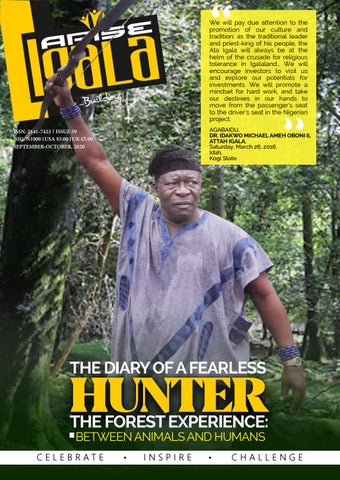
“
We will pay due attention to the promotion of our culture and tradition; as the traditional leader and priest-king of his people, the Ata Igala will always be at the helm of the crusade for religious tolerance in Igalaland… We will encourage investors to visit us and explore our potentials for investments. We will promote a mindset for hard work, and take our destinies in our hands to move from the passenger’s seat to the driver’s seat in the Nigerian project.
“
AGABAIDU, DR. IDAKWO MICHAEL AMEH OBONI II, ATTAH IGALA, Saturday, March 26, 2016. Idah, Kogi State.
ISSN: 2141-7423 ISSUE 59 NIG. N1000 USA $5.00 UK £5.00 SEPTEMBER-OCTOBER, 2020
THE DIARY OF A FEARLESS
HUNTER THE FOREST EXPERIENCE: BETWEEN ANIMALS AND HUMANS
C E L E B R AT E
INSPIRE
CHALLENGE
ARISE IGALA-ISSUE 59
1
2 ARISE IGALA-ISSUE 59
OMA UFEDO ATA
FACE OF INIKPI
Full Name Oguche Esther Eleojo Native Town Ette, Olamaboro LGA Occupation Student, Teen Model and Influencer Favourite Igala Food Oje Uchu and Oro Like(s) Acting, speaking, traveling, reading Dislike(s) Pretence, jealousy Igala Heroine/Role Model(s) Chief, Barrister Festus Oguche Dream(s) for Igalaland Unity, peace and progress in Igala land. Email nkpatfestus@gmail.com Mobile 08167734667 (Mother’s Contact)
INTERESTED IN THIS PAGE, CONTACT: E: ariseigala@gmail.com | M: +234 (0)0706 455 2909 ONOJA RUTH OJONE (MRS.) The Senior Vice President, Onoja Dreams Network Limited
ARISE IGALA-ISSUE 59
3
4 ARISE IGALA-ISSUE 59
ARISE IGALA-ISSUE 59
5
2020 OFFICIAL ADVERT RATES IN ARISE IGALA MAGAZINE (ISSN: 2141-7423) Published by ONOJA DREAMS NETWORK LIMITED(RC 868974)
SPECIALS Inside Front Cover ----------- N450,000 Inside Back Cover ------------ N400,000 Back Cover ------------------- N950,000 Spread ------------------------N700,000 Front Cover Strip -------------N300,000
THE MAKING OF
ATTAH IGALA ALL SIDES OF THE STORY
REGULARS Full Page --------------------- N250,000 Half Page -------------------- N200,000 Quarter Page ---------------- N150,000
EVENTS Within Kogi State & Abuja ----N150,000 per page Outside Kogi State & Abuja ---N150,000 Per page + Cost of Logistics
SPECIAL PROJECTS Negotiable Note: - The cost of two colours is minus 15% of original cost and Black & White is minus 25% of original cost. - All charges attracts 5% VAT and Political Ads/Events attract 15% extra charges.
BASIC CIRCULATION AREAS Kogi, Abuja, Lagos, Benue, Nasarawa, Kaduna, Port Harcourt, Delta, and Kano. Also, direct delivery services are available to individuals, associations, groups nationwide and across the globe plus 24/7 online and social media services/ activities. Hotline: +234(0)803 698 0602 Email: ariseigala.sales@gmail.com 6 ARISE IGALA-ISSUE 59
EXCLUSIVE
50
THE DIARY OF A FEARLESS
HUNTER THE FOREST EXPERIENCE: BETWEEN ANIMALS AND HUMANS
13
CONTENTS THE ASCENSION:
IGALA SELF SACRIFICE:
Igala, Jukun and Kwararafa Unity Revived
Princess Inikpi And The Culture Of Sacrificial Leadership For National Development
18
36
The Funeral Rites And Rituals Of The Ata-Igala
27
THE REFORMER: Redeeming Igala Identity Through Royal Fathers Dressing And Appearance
AMEH OBONI II 34
Raw Royalty Magnified In A Great Personality
46
DISCLAIMER We invite comments and request that they be civil and on-topic. We do not moderate or assume any responsibility for views. The views in this publication are not sacrosanct. Readers have right to reply. All photographs in ARISE IGALAare copyright of the magazine and may not be reproduced, copied or used in any form without written permission from the publisher
ARISE IGALA-ISSUE 59
7
GRAND PATRON His Royal Majesty DR. IDAKWO MICHAEL AMEH OBONI Agabaidu, Ata Igala & Chairman, Kogi State Council of Chiefs. FOUNDER/PUBLISHER ONOJA JAMES OKPANACHI President/CEO, Onoja Dreams Network Limited Ag. Managing Editor Ibrahim Garba Ogwu Editor-At-Large Emmanuel Nathan Oguche Columnists Dr. Saidat Lami Hussein Ojochide Yusuf-Nathan Emmanuel Nelson Arome Pst. Livinus Husseini Okpe Mallam Mohhammed Atojoko Contributors Abdullahi Haruna (Haruspice) Idibia Ojabo Muhammed Nasirdeen Lawal (Eleojo Mama) Moses Abimaje David Usman Yakubu PHOTO PARTNERS De Famous Studio | JT Digital World | Ottagab Voice & Vision PRODUCTION ARISE IGALA MAGAZINE (ISSN: 2141-7423) is published by ONOJA DREAMS NETWORK LIMITED (RC 868974), ABUJA: C29, MIB Plaza, First Avenue, Gwarinpa, F.C.T. | LOKOJA: C/O NUJ Press Centre, Lokoja. +234 (0)803 698 0602, (0)805 663 0751, (0)803 968 1501 Website: www.ariseigala.com, Twitter: @ariseigala, Facebook: ARISE IGALA Magazine Email: ariseigala@gmail.com, ariseigala.sales@gmail.com, ariseigala.opinion@gmail.com Copyright (c) 2010-2020 Onoja Dreams Network Limited. All Rights Reserved. With SUPPORT from
ARISE IGALA GRASSROOT SENSITIZATION INITIATIVE (CAC/IT/NO 94508)
VISION
To inspire a generational change that will give birth to a new breed of Igala people in the face of globalization thereby changing perspectives on selves as we consciously bring out the beauty in our people
MISSION
To be (and remain) the most informative, educative, entertaining, challenging, inspiring and authentic source of information on the past and current issues of Igala Kingdom and her people as the authoritative voice and image maker of Igala race via publications and media activities.
MANDATE
Our mandate is to Celebrate, Inspire and Challenge Igala sons and daughters at home and abroad into positive ventures for the benefit of mankind.
8 ARISE IGALA-ISSUE 59
THE ROYAL QUOTE
HRM, DR. IDAKWO
AMEH OBONI II, JP ATA IGALA Agabaidu, Ata Igala and Chairman, Kogi State Council of Chiefs.
We will pay due attention to the promotion of our culture and tradition; as the traditional leader and priest-king of his people, the Ata Igala will always be at the helm of the crusade for religious tolerance in Igalaland… We will encourage investors to visit us and explore our potentials for investments. We will promote a mindset for hard work, and take our destinies in our hands to move from the passenger’s seat to the driver’s seat in the Nigerian project
The quotation above is part of His Royal Majesty’s Speech at the Third Anniversary of his ascension to the throne of his forefathers as Ata Igala in March, 2016 at Idah, Kogi State. 59 ARISE IGALA-ISSUE 55
9
FROM THE ARCHIVE
THROW BACK THE JOURNEY FROM UWGOLAWO TO ACHADU PALACE, IGALA-OGBA, IDAH ON FOOT IN MARCH, 2013 AS PART OF THE TRADITIONAL RITES IN THE MAKING OF ATTAH IGALA
Agabaidu (as Aidokanya at the time), Idakwo Michael Ameh Oboni II restored the dignity of Igala culture which seemed to have been going into extinction before his coming. He was on this journey and in the whole process accompanied by our brothers, The Jukuns.
10 ARISE IGALA-ISSUE 59
THE PUBLISHER’S DESK
ONOJA J. OKPANACHI PUBLISHER/CHIEF EDITOR
AGAIN, I’M SAYING IT LOUDER; HE WHO OWNS THE CAP, LET HIM WEAR IT!
I
have said it before and I am saying it again. And, this time very louder because foundation, as the meaning implies is very fundamental to any structure, society or system of operation. The foundation of a thing determines how strong or even how long it could last. So, the existence of any people, society or community worldwide is hinged on its foundation which is embedded in its tradition, culture, norms and customs. Therefore, any attempt to disconnect the people from all these basics could push them into extinction or irrelevance even while they live. For the Igala nation, it is piteous to see that one of the seven (7) most prominent established Kingdoms alongside Ashanti, Ife, Oyo, Dahomey, Bini and Jukun on the coast of West Africa before the coming of the colonialists is gradually heading into oblivion at a time when people are vigorously trading volumes in the global village. Our recent efforts have shown that we are busy destroying our own Point of Sales including the most revered institution in the land, Attahship. The Attah Igala Institution has established modalities which have stood the test of time. This tradition was in operation before the Colonial Administration; our elders in their wisdom operated this system before the introduction of the defunct Igala Native Authority. The 1961 modification laid serious emphasis on the Achadu choosing the Ata Igala in consultation with the ‘Traditional’ Igalamela. The choice of the word ‘Traditional’ added to the ‘Igalamela’ in the 1961 modification leaves one wondering why the introduction of the word instead of the original way which is the Igalamela Kingmakers. No wonder, the drama continues until the clear script of the 1998 which reduces the role of the Achadu. Well, the obvious truth at this point in our history is that majority are tired of watching their culture been bastardized broad day light. It’s better to return to the
traditional pattern of the Attah Igala Institution else we risk making it less relevant amongst the people. If we allow either political or religious influence to take the lead in the making of an Attah, it therefore means that someday, the Attah office will be based on campaigns and votes (May God forbid), and rigging would be introduced in no distance time. It is very important to note that in the traditional selection and the making of an Attah, many are involved; Achadu, Igalamela Kingmakers, Onede, Unubi Ogbo, Egwola, Agapoje etc. All these have designated roles to play in the process before an Attah is made (i.e. born traditionally). However, it is heartbreaking to see people introducing elements of confusion into a system that has its own checks and balances that could naturally make the rotational ascendancy to the highly exalted throne of the land very simple. No doubt, most of the time, the winner in this kind of ‘legalized’ confusion is that one who has piled wealth and cheap popularity to his credit. But, the looming danger is that more people are now aware of the truth and doing the wrong thing will translate into creating an Attah that is not truly the Attah Igala. The people may not stop him ascending the throne but throne would not be able to command the kind of respect it should naturally. The world is watching - Igala cannot afford to fail. Let’s endeavor to give the cap to whom it fits. In fact, to who truly owns it (today) so that we can be rest assured that the efforts of our dear father, Agabaidu, Dr. Idakwo Michael Ameh Oboni II in correcting many errors before him are upheld and His Majesty will be the happiest on the other side.
Arise!
ARISE IGALA-ISSUE 59
11
EDITORIAL
Not Too Young for the Throne “When it comes to progressive leadership, it’s not your age that counts, it’s the age of your ideas” – Alexandria Ocasio-Cortex
W
hen it comes to effective leadership, age does not really count; competence laced with other intangibles such as passion, drive, character, intelligence, discernment are of greater value than age. The “Not too young for the throne” mantra is therefore similar to the youth-friendly “not too young to rule” bill that was signed to law by President Muhammadu Buhari sometimes ago. Young leaders can and should be defined by many other attributes, not just their age. Unfortunately, in Nigeria, young people have to deal with a number of negative stereotypes about their being young. It explains why young people in our clime are often referred to as “leaders of tomorrow.” Such negative appellations are diversionary, conspiratorial and carefully designed to serve the interest of those who have been feasting from the statusquo. Although there are many studies on leadership, surprisingly, few of such studies have looked at how age impacts leadership. Ironically, even those few studies don’t present a clear picture, as they cannot really say whether or not, age is a significant factor when it comes to leadership. It is true that maturity has the advantage of wisdom and experience, it’s also true that youth has the advantage of energy, but neither precludes the hard work, intelligence, passion and drive required to be a successful leader. I therefore strongly agree with Alexandria Ocasio-Cortex, an American politician serving as the U.S Representative for New York’s 14th congressional district, who asserts that “When it comes to progressive leadership, it’s not your age that counts, it’s the age of your ideas.” Within the global leadership landscape, lots of people have been clamouring for a paradigm shift that seeks to dismantle the old structure that exclusively reserves leadership positions for the older generations. Indeed, what an older generation can do, the younger folks can even do better. Older people are more likely to maintain the existing order and they are more likely to exercise their leadership role using a passive approach. Younger leaders are favoured with unusual vigour and vitality, they are more responsive and amenable to change, and are susceptible to innovations and progressive thinking. History abounds with numerous examples of young people who have succeeded where the old people have failed. Ancient Egypt’s King Tutankhamun is arguably the most famous of his kinds, ascending the throne when he was 9 years and ruling impressively until his death at age 19. Another impressive example is Queen Elizabeth I who ascended the throne when she was 25 years old, and ruled remarkably for 45 years. In Nigeria, Ooni of Ife, Oba Adeyeye Enitan Ogunwusi is a good example of a monarch who is proving to the whole world that royalty is not about old age but delivery. Olowo Moyinoluwa a 24 years old woman who was crowned Onibule of Ibulesoro, Ifedore Local Government Area of Ondo state is another popular ‘King’ who has been found not too young for the throne. All of these examples call for solemn reflection. ARISE IGALA… Nathan Oguche Emmanuel Founding Managing Editor/Editor-At-Large
12 ARISE IGALA-ISSUE 55 59
COVER STORY
THE DIARY OF A FEARLESS
HUNTER ARISE IGALA-ISSUE 59
13
COVER STORY
THE DIARY OF A FEARLESS
HUNTER THE FOREST EXPERIENCE – BETWEEN ANIMALS AND HUMANS ONOJA J. OKPANACHI
H
is Royal Majesty, Agabaidu, Dr. Idakwo Michael Ameh Oboni II, Attah Igala came at a time that the people’s hope was extremely high and so the expectations from him in particular was such that the turn-around were to be instant, immediate and miraculous for many but he has to employ great wisdom and tact not get it wrong but to meet the people’s expectations of him and the demand of the throne as well. For him (Ameh Oboni II), his moves were such gradual ones but sure changes that he brought in spheres of the Igala Kingdom were obvious. There were so many things to be corrected and at the same time, they must be corrected the bright ways that at the end, all parties involved will have their conscience to tell them the truth. So, his experience is no doubt like that of a fearless hunter who has embarked on hunting expedition – he was inbetween the animals in the forest and the humans outside. Both in the forest and on the other side, he
is confronted with challenges. The task before him were such that either he acts or not, he will still take some blames either ways – acting right will means offending those who the situation has favoured until his action, and, not acting equally means offending those who expect that with his reign justice must be served. So, it was a great battle ring for Ameh Oboni II and the only option like a fearless hunter is to go farther into the forest to confront all the wild animals so to bring about justice and peace in the land for his people. So many instances that you hear many complaining about some of his actions as not favourable and not expected of him as well but a simple question to the complainants either what he did was actually right or wrong will get them stammering any time. THE CHIEFTAINCY AND ROYAL STOOL TUSSLES: The ascension on the throne of Attah Igala for Ameh Oboni II gave many people confidences
HRH, Agabaidu, Idakwo Ameh Oboni Ii After The Succesful Hunting Expedition At The 2019 Ocho Festival
14 ARISE IGALA-ISSUE 59
COVER STORY
Royal Meriment After Hrh, Agabaidu, Idakwo Ameh Oboni Ii After The Succesful Hunting Expedition At The 2019 Ocho Festival
to eventually speak out and complain about the so many ills done against them but since they had no powers, money or network to help them secure justice, they rather chose to remain silent for years until Ameh Oboni II came and instantly, they regain confidence and their hope rekindled and as such, they seek for justice. In many cases that were reconsidered, the truth was so glaring but for reasons known and unknown, justice was not served and Ameh Oboni II took it upon himself to do the right thing. Many he succeeded at the palace level and some who were not satisfied went to court and most judgement from the court were in line with the decisions of the palace and so justice were eventually served to many and this of course means more enemies than friends to Ameh Oboni II. THE LAND MATTERS: Denying someone of the rightful ownership to his land is one of the cruellest thing that can be done to anyone particularly when he was challenged to his face that he can do nothing against the “tyrant” who has forcefully taken over his land. The experience of many in this regard is horrible and not a story to be shared in public space but many victims find confidence in Ameh Oboni II and resolved to seek justice through him and in fact got justice and as usual, those who got the hit and heat of Ameh Oboni II never found it palatable and so became aggrieved. Some went to court but the decision of the palace stood upright. This is one of such challenges that confronted Ameh Oboni II – he was in-between the oppressed and the oppressor and so receiving all manners of attacks
to tarnish his image and reputation but looking back now, it’s getting clearer that he needed to take on the path he followed as it was a great responsibility bestowed on him to liberate many and then bring everybody together for the good and progress of the Kingdom. THE UNITY OF IGALA LAND: Ameh Oboni II was deeply worried about the state of disunity in the Kingdom before his ascension to the revered stool of Attah Igala. The disunity for so many reasons were so grave that the people keep falling apart and so our impact as a people on national and global issues keep dwindling. Hence, Ameh Oboni took the tour of Igala Kingdom and that singular move brought a very great sense of oneness to the kingdom. Since the tour of Igala Kingdom shortly after his ascension to the throne, there was a cultural revival and more reasons for the people to keep networking for the development of the land. THE UNITY OF IGALA HOME AND ABROAD: It’s no longer news that the Igala people spread beyond the shores of Kogi state but for many years, no one (on the throne) put in the kind of real efforts to bring that consciousness amongst the people. Ameh Oboni II took it upon himself to begin to invite all our brothers in the Eastern, North and Southern parts of the country to events and cultural activities in Idah with every group attesting to their roots from Idah and how they have so longed to reconnect and with the opportunity offered them by their father, the Attah Igala there was no hesitating so the unity becomes so great that our integration is
ARISE IGALA-ISSUE 59
15
COVER STORY
Royal Meriment After Hrh, Agabaidu, Idakwo Ameh Oboni Ii After The Succesful Hunting Expedition At The 2019 Ocho Festival
becoming more of reality than history hidden in the books. Today, we can confirm many of our brothers across various states in Nigeria and we are in good contact with them and this will surely lead to greater opportunities for all groups. THE JUKUN IGALA RELATIONSHIP: Unfortunately, the first thing that comes to the mind of many people today the moment Igala/ Jukun relationship is mentioned would be that of the Master/Slave relationship – Wrong, very wrong. It wasn’t, the relationship was of two brothers who at a point had misunderstanding that resulted into war. However, blood is truly thicker than water and so, for over 500 years of that ugly incident,
we successfully went beyond the assumption to the reality that we are one and so, the relationship between the two groups grew better and still growing. In fact, the moves of Ameh Oboni II with his brother, Agabaidu, Aku Uka of Wukari has revived the great Kwararafa people and their unity is becoming very real and this will be good for everyone. One of the very good testimonies to the benefit of this unity of the Igala/Jukun is the copy of this magazine in your hand right now (ISSUE 59 of ARISE IGALA Magazine) as it was 70% sponsored by a Jukun brother who so love what we are doing. This will not be the first time, this has been happening
Royal Meriment After Hrh, Agabaidu, Idakwo Ameh Oboni Ii After The Succesful Hunting Expedition At The 2019 Ocho Festival
16 ARISE IGALA-ISSUE 59
COVER STORY
Posing For With Hrh, Agabaidu, Idakwo Ameh Oboni Ii After The Successful Hunting Expedition At The 2019 Ocho Festival
and more interestingly, our Jukun brothers have shown more interest in the realization of the ARISE IGALA Television than we have so far. May God Almighty bless this great show of love. We are sure better together. FINALLY, ON THE EXPERIENCE OF THE FEARLESS HUNTER BETWEEN ANIMALS AND HUMANS: While Ameh Oboni II (the Fearless Hunter) was/is in the forest tactically fighting hard to see that the humans in the kingdom benefits from his hunting expeditions, he always gets the lash of humans who only analyse on what should be and not even though they are not in the forest with him to know what he is encountering with the animals on their
behalf. Most times Ameh Oboni II will be in the forest hunting to bring something good home for the people while receiving attacks right there in the forest, the news that streams in from the people are always discouraging but like a fearless hunter that he is, his focus is always the game so that he can at the end have a very good catch. The lesson therefore, for every leader who desire to succeed, noise and distraction should be ignored even though it is very important to analyse them but the main skill to be mastered is the art of focus – eyes on the goal always.
The Palace Drummers Playing For Hrh, Agabaidu, Idakwo Ameh Oboni Ii After The Succesful Hunting Expedition At The 2019 Ocho Festival
ARISE IGALA-ISSUE 59
17
THE ASCENSION: Igala, Jukun and Kwararafa Unity Revived
T
he return of Ogbaikolo is what the ascension on throne of HRM, Dr. Idakwo Michael Ameh Oboni II was popularly referred to amongst many people of Igala Kingdom, home and abroad as they see his coming as a fulfilment of prophecy by his father, Ameh Oboni the Great. In the light of this, he was well accepted and the joy of the people reached the heavens. The ascension of Ameh Oboni II brought about strong unity amongst the Igala people and their brothers, Jukun and other members of the great Kwararafa Empire. His coronation process saw our Jukun brothers leading the way all through which symbolizes great bond between brothers – it signifies the relationship between a caring elder brother and his younger one; the former ensuring the later going through the right processes in life to guarantee success. On Tuesday, March 5, 2013 the journey to Ugwolawo from his Lokoja residence started and all the way, people were at various junction to welcome their Attah home. Arriving at Ugwolawo, the crowd that received him was unprecedented. On Wednesday, March 6, 2013, in Ugwolawo, after receiving the cow whisk from Ikabi the previous day, the thatch hut was raised down with fire and the journey to Idah on foot commenced. On Thursday, March 7, 2013 at Achadu Palace, Iye Okpo pierced Aidokanya’s ear. And, on Friday, March 8, 2013, Egwola beaded Aidokanya at the Ojaina Shrine and the wearing of beads officially started for Aidokanya. The ceremony was completed on Sunday, March 10, 2013 as the Aidokanya was transformed (traditional child delivery) at Ofukolo after crossing the Inachalo stream from Ojaina to Onede’s place. And, thereafter, the Aidokanya was transformed to Agabaidu, completely dressed in his royal regalia and escorted to the palace amidst great celebration.
18 ARISE IGALA-ISSUE 59
THE ASCENSION
The Traditional Prayers By Our Jukun Brothers Delegated By Agabaidu, Aku Uka From Wukari
The Traditional Prayers By Our Jukun Brothers Delegated By Agabaidu, Aku Uka From Wukari
The Traditional Prayers By Our Jukun Brothers Delegated By Agabaidu, Aku Uka From Wukari
The Traditional Prayers By Our Jukun Brothers Delegated By Agabaidu, Aku Uka From Wukari
ARISE IGALA-ISSUE 59
19
THE ASCENSION
The Christian Prayers
The Muslim Prayers Being Led By Hrh, Ejeh Dekina
Our Jukun Brothers Leading The Way Out From Aidokanya’s Lokoja Residence
Our Jukun Brothers Leading The Way Out From Aidokanya’s Lokoja Residence
Some Personalities At Aidokanya’s Residence In Lokoja Before The Journey To Ugwolawo Commnced
Some Of The Kogi State House Of Assembly Members In 2013 At The Aidokanya’s Residence In Lokoja
20 ARISE IGALA-ISSUE 59
THE ASCENSION
ARISE IGALA-ISSUE 59
21
THE ASCENSION
22 ARISE IGALA-ISSUE 59
THE ASCENSION
Arriving Ugwolawo, The Crowd Was Unprecedented
Arriving Ugwolawo, The Crowd Was Unprecedented
Arriving Ugwolawo, The Crowd Was Unprecedented
ARISE IGALA-ISSUE 59
23
THE ASCENSION
Arriving Ugwolawo, The Crowd Was Unprecedented
Arriving Ugwolawo, The Crowd Was Unprecedented
In Front Of The Thatch Hut Where Aidokanya Spent The Night Before Proceeding To Idah The Following Day
24 ARISE IGALA-ISSUE 59
THE ASCENSION
Some Firends With Prince Ocholi (Middle On Blue Ochachi)
ARISE IGALA-ISSUE 59
25
THE ASCENSION
Some Firends With Prince Ocholi (Middle On Blue Ochachi)
Aidokanya In Front Of The Thatch Hut In Ugwolawo
The Thatch Hut In Ugwolawo Where Aidokanya Spent A Night. It Raised Down With Fire Before Proceeding To Idah
26 ARISE IGALA-ISSUE 59
THE FUNERAL RITES AND RITUALS
OF THE ATA-IGALA BY IDRIS EJIMA ARUWA
An excerpt from his book
READINGS ON IGALA (PEOPLE, LAND AND LANGUAGE) (2020)
T
he details of the funeral rites of the Ata-Igala is written based on the information collected from oral tradition and practice of the Igala tradition, the book “An Igala-English Lexicon: A bilingual Dictionary With Notes on Igala Language, History and Priest-Kings” by John Idakwo (2015, Pg.: 608-613) and the manuscript of an article published by Geoffrey Miles Clifford in 1932 titled “The Igala Chiefdom: Some Notes on the Igala Tribe and Their Divine King“ in the 1932, based on the record of the burial of Ata Atabo Ijomi in1926 by G. C. Monekton, a colonial administrative officer in Idah as published by Blackwood Magazine of November, 1904. In the event of the passage of An AtaIgala, the first set of people to know as expected are his immediate family members and palace officers like the Amonoji (that is; Ora’Ata, Ogbe-Ata, Ugbola-Ata, Ocheje-Ata, Elakwu, Eju-Ata, Okotonowa, Adenyi and Enekadugbo). These set of chiefs are in control of the daily activities of the Ata-Igala and are expected to take control of the events at the palace and keep the news of the passage of the Ata-Igala secret for a considerable period of time from the public and even the royal councilors. In the past, the public announcement
of the death of the Ata-Igala is kept for a minimum of three lunar months and sometimes up to a year to ensure that the palace is secured and all necessary preparations for the funeral are put in place and a successor to the throne of the Ata-Igala is chosen by the Kingmakers, to avoid the emergence of a usurper or any form of sabotage to the selection of a new Ata-Igala, that way there will be no vacuum in the leadership of the Kingdom. The deceased Ata-Igala is said to be suffering from “extreme waist pain” (Ata ada’go) and cannot appear in public during this period of interregnum. However, following the modification of the Order of Igala Area Traditional Council Native Law and Custom by the government of kogi state on the 27th day of April, 2015 and Kogi State of Nigeria, Gazette of 21st May, 2015 page 5, the process for the selection of a successor to the throne of the Ata-Igala, begins after the completion of all burial rites. “Upon the demise of an incumbent Attah and after the completion of all traditional rites, and period of observation, The Achadu Attah, shall, request and/or demand the traditional Igalamela Kingmakers to consider setting in motion, the process of
ARISE IGALA-ISSUE 59
27
THE FUNERAL RITES selecting a successor to the throne of the Attah Igala”. (KOGI STATE OF NIGERIA GAZZETTE, No. 1, Vol. 1, 21st May, 2015, Pg.: 5) As a result of the advancement in information technology and social media, the information of the death of the Ata-Igala becomes public even before the palace officers get to know of the incident, as in the case of Late Ata Aliyu Obaje Ocheje in 2012 and Late Ata Michael Idakwo Ameh Oboni (II) on 27th of August, 2020. The immediate family of the Ata-Igala in defiance to the tradition goes ahead to hold press conferences and write formal communication to the government of Kogi state and the federal government of Nigeria. Despite the public knowledge of the passage of the AtaIgala, the palace officers are bound by tradition to deny the news of the passage of the Ata-Igala until, certain traditional title holders who are considered the Chief mourners and have statutory responsibilities to perform various rites before, during and after the interment of the deceased Ata-Igala as demanded by the tradition. TRADITIONAL ANNOUNCEMENT OF THE PASSAGE OF THE ATA-IGALA The sets of traditional title holders to be notified are considered in line with the Igala traditional practice of announcing the death of an Ata-Igala. These title holders are the Achadu-oko-Ata-Igala, the Atebo (the Chief Priest), the Onubiogbo, the Onede and the Adaokpulu. These Chiefs with the exception of the Atebo who is the Chief Priest are considered the traditional personal relatives of the Ata-Igala. The Achadu-oko-Ata-Igala, simply referred to as “Achadu” is considered to be the husband of the Ata-Igala; the Onubiogbo is the traditional father of the Ata-Igala, the Onede is his traditional mother and the Adaokpulu plays the double role of being the Ata-Igala’s Uncle and the custodian of the royal grave yard “Ojaina” who also supervises the funeral rites.
28 ARISE IGALA-ISSUE 59
NOTIFICATION OF THE ACHADU-OKOATA-IGALA In the royal tradition, the Ata-Igala is a feminine figure with the Achadu chieftaincy title holder as his husband; hence the title is called “Achadu–oko-AtaIgala. He is considered the “Mourner-in– chief” and the first person to be informed by the palace officers. The Ugbola-Ata, one of the Amonoji is sent to inform him. The Ugbola-Ata will hand-over a small pillow to the Achadu who upon receiving the pillow will get the message that the Ata-Igala had passed-on; he will clap his hands on the pillow and lament over the loss of his traditional wife. A pot of water will be presented to him with a monetary equivalent of Ten (10) shillings (present value of the olden days Ten Shillings) inside and a black shroud known as “okpe dudu”, which he will keep for himself. The Achadu will proceed to the Ata-Igala palace in the evening where he will be received by the Amonoji and the immediate family members of the departed Ata-Igala to commensurate with them over the demise of Ata-Igala. The Achadu will later inform the Igalamela Kingmakers to commence the procedure of appointing and installation of a new AtaIgala from among the male descendants of the four lineage of Ata Ayegba oma Idoko. THE ATEBO TAKES OVER DURING THE INTERREGNUM The Ogbe-Ata will send for the Atebo (The Head Priest). On arrival in the palace, the Atebo will proceed to the death chambers, he will lift up his staff “Okwute” which he had always use in invoking the ancestors on behalf of the Ata-Igala and hit the base on the floor, seven times and exclaim “Ata, you are dead; may you find good health with your ancestors”. He then enters the room; strip the dead of his beads and sandals which he must wear throughout the period of interregnum until a new Ata-Igala is installed. The Atebo will take over the daily spiritual activities for and on behalf of the Ata-Igala. The action of the Atebo is in keeping with the divine dynamism of the Ata-Igala alive until it can be re-absorbed into the person of the new
THE FUNERAL RITES Ata-Igala. In other words, “Ata-Igala do not die”. NOTIFICATION OF THE ONUBIOGBO AND ONEDE The Onubiogbo chieftaincy title holder is the traditional father of the Ata-Igala while the Onede Chieftaincy holder is the traditional mother of the Ata-Igala. The pair of Onubiogbo and Onede had adopted the late Ata-Igala during his coronation in the ritual of the rebirth of the Ata-Igala from an ordinary prince known as Aidokoanya to a divine King “Ata-Igala” and from an immigrant to an autochthonous son of Igala kingdom. Therefore, the pair had to be formally informed of the death of their adopted son, to enable them prepare for the necessary rituals required for the coronation of the new Ata-Igala.
“
In the event of the passage of An Ata-Igala, the first set of people to know as expected are his immediate family members and palace officers like the Amonoji (that is; Ora’Ata, Ogbe-Ata, UgbolaAta, Ocheje-Ata, Elakwu, EjuAta, Okotonowa, Adenyi and Enekadugbo). These set of chiefs are in control of the daily activities of the Ata-Igala and are expected to take control of the events at the palace and keep the news of the passage of the Ata-Igala secret for a considerable period of time from the public and even the royal councilors. To inform the Onubiogbo and the Onede, the Ogbe-Ata (another Amonoji and the head of the edibos) will be sent to the Onubiogbo’s palace in Opata known as “Okenyi Agbala” with a black goat, a cock, a basket of Kola nut, a black shroud (okpe
dudu) and unspecified amount of money. The Ogbe-Ata will then proceed to inform the Onede at Ukwaja with a basket of Kola nut, a black shroud (okpe dudu) and unspecified amount of money. Following the formal notification of the traditional parents of the late Ata-Igala, the Onubiogbo will carry out the sacrifice of the Otutubatu and Okwo-Ibegwu “the royal ancestral deity” for the peace of Igala Kingdom. THE ADA-OKPULU STEPS IN The Ada-okpulu Aganapoje traditional chieftaincy title holder is a linear male descendant of Abutu-Ejeh, the progenitor of the Ata Ayegba oma Idoko dynasty. The first person to take the title was the elder brother to Ata Idoko; who is the father of Ata Ayegba oma Idoko. This tradition had been upheld since the establishment of the Ata Ayegba oma Idoko dynaty making the current holder of the title the traditional uncle of the present Ata-Igala. The Ada-okpulu Aganapoje has a dual role in the traditional royal family; he is the uncle of the Ata-Igala and the custodian of the royal burial ground at “Ojaina”. As the custodian of the royal grave and the highest recognized member of the AbutuEjeh clan, he has to be informed of the passage of the Ata-Igala before any public announcement and the funeral rites of the Ata-Igala can start. “To inform the Ada-okpulu, a selected group of fairly old women from his matrilineal clan is sent to Ojaina to see the Ada-Okpulu Aganapoje at his palace. They carry with them some personal effects of the deceased king; a pair of ‘Iche ke lewu shoes’ and ‘utowo –iwe obijimu’ (a hand-fan made from Ostrich feathers), a black shroud (okpe dudu) and a black cock. Upon seeing these items, the Ada-okpulu flinches, then loosens up with a casual remark “so you have remembered me today? They respond: “when the duiker grazes far afield for a
ARISE IGALA-ISSUE 59
29
THE FUNERAL RITES whole day, he returns to the roost in the evening”. Then he asks them about his “brother” and they inform him, that for the past three days, he had not been feeling fine. He then tells them that he will go and see him. Then, accompanied by the other members of Adaokpulu Aganapoje-in-council, he goes to Ata’s palace. There, he will be received by the Amonoji (i.e, the title clans of the Ata’s retainers namely; Ocheje-Ata, Ora-Ata, Ogbe-Ata, and Eju-Ata). Also present are other titled clan representatives, Ugbola and Oduma (Elakwu) together Atebo (the king’s high priest). (Idakwoji, 2015: 609). The Ada-okpulu goes into a meeting with the Amonoji and representatives of other clans responsible for the various rituals required for the passage of the divine king to take his place among his ancestors. He gives the necessary instructions and return to his palace at Ojaina to inform the rest members of his clan to begin preparation for the burial of the late Ata-Igala. PUBLIC ANNOUNCEMENT OF THE PASSAGE OF THE ATA-IGALA The tradition of the Igala kingdom does not permit for the verbal announcement of the demise of the Ata-Igala. It is forbidden for anyone to say “the Ata-Igala is dead” rather the Ata-Igala had gone to join his ancestors on a hunting expedition. The spirits of the royal ancestors are believed to continuously look over Igala kingdom and ensure its protection from both its internal and external enemies. They met out punishment to those who perpetrate injustice and defile the kingdom. Therefore, the present practice of announcement of the demise of the Ata-Igala through social media, press conference and publications are an aberration to the Igala traditional law and customs. According to laid down tradition, it is the Ada-okpulu after consultation with the Amonoji, that gives instruction for the roof
30 ARISE IGALA-ISSUE 59
of “Odogo”; an ancient square-shape onestorey building in the palace of Ata-Igala, to be turned upside down. The Odogo used to be the tallest man made structure in Idah such that, in those days it can be seen from any part of Idah. The upturning of the roof of the Odogo is the non-verbal but symbolic public announcement of the demise of the Ata-Igala. After which all other funeral rites commenced. THE AMONOJI KEEPS VIGIL The body of the deceased Ata-Igala is prepared and kept protected from the public by the class of palace officers known as Amonoji, these officers are under oath to serve and protect the AtaIgala throughout his lifetime and that of successive Ata-Igala. The Amonoji retains their positions from one Ata-Igala to the other. The Amonoji led by the Ora’Ata, have the following titles: Ogbe-Ata, Ugbola-Ata, Ocheje-Ata, Elakwu, Eju-Ata, Okotonowa, Adenyi and Enekadugbo. They are independent of the rotating succession of the throne of the Ata-Igala; they provide executive continuity between reigns and play critical role in the rite of passage of both departed Ata-Igala and the installation of a new Ata-Igala. They report to the palace everyday to keep vigil and try as humanly possible to carry on the normal activities of the palace as if nothing had happened during the interregnum. They attend to the needs of the deceased and supervise the entire process of the funeral rites and call up other Chiefs and clans who perform various customary rites as at when required as part of the rites of passage. They also take custody of AtaIgala treasuries and properties. The Adenyi takes possession of royal robes, regalia and other insignia of the Ata-Igala in trust for the new Ata-Igala. THE MAKING OF THE CANOE-SHAPED COFFIN The Achadu kekele Ukwaja, a member of the autochthonous Igalamela clan, will mobilize the members of his clan to proceed into the forest of Ogo-efa (the forest used for the Ocho festival) in Idah,
where the aerodrome is now situated, to select a baobab tree for the production of the canoe-shaped coffin. A strip of white cloth is wrapped around the tree and a libation of blood and palm oil is made on it in order to placate the spirit inhabiting in the tree and to commemorate the use of the tree. The Achadu kekele Ukwaja inspect the felling of the tree and mark the portion of it which is to be used in making the coffin. The rest of the tree is left to rot in the bush and it is forbidden for anybody to touch it or use it for any purpose. The selected baulk is split into halves and taking to the palace, where they are fashioned into two canoe-shaped receptacles which will form the body and lid of the coffin. The coffin is produced under the personal supervision of the Enekadugbo, one of the Amonoji. While the coffin is being prepared, the Achadu kekele Ukwaja and the Ogbe will meet with the Ada-okpulu for the selection of the site where the deceased Ata-Igala is to be buried. Achadu kekele Ukwaja is statutorily charged with the responsibility of identifying the appropriate spot where the stone (Okwuta) has been placed by the deceased AtaIgala to mark his grave when he was performing his installation rites. THE DECORATION OF THE COFFIN After the completion of the coffin to the satisfaction of the Enekadugbo, the Aleji Ayija (an Igalamela Chief) carries out the decoration of the coffin by plating it with tin. The Aleji Ayija will first slaughter a hegoat and a cock as libation over the tin before it is hammered flat to the coffin and fashioned into plates ornamented with beads and necklaces in repousse, the tin plate are carefully nailed to the wooden shells and further decorated with brasswork. The Adenyi-Ata (one of the Amonoji) will adorn the exterior of the coffin with the skin of a monitor lizard, a leopard and an image of a heart and a man with his arms raised. In the absence of a leopard skin, an image of the leopard is drawn on the body
“
THE FUNERAL RITES
he tradition of the Igala kingdom does not permit for the verbal announcement of the demise of the Ata-Igala. It is forbidden for anyone to say “the Ata-Igala is dead” rather the Ata-Igala had gone to join his ancestors on a hunting expedition
of the coffin. The significant of the leopard skin is because the leopard is regarded as a royal animal and the Ata-Igala have absolute right to the skin of any leopard killed within his territories. The raised arms is a sign of greeting reserved for one’s kinsman or important personages, it may be symbolical to the deceased Ata-Igala greeting his ancestors while the image of the heart signifies fertility. The Ochijenu title holder will fit rows of miniature bells on the exterior of the coffin. The royal blacksmiths from Ofiji are summoned to perform their hereditary task and are given bars of iron which, after the usual libations, are wrought into six upright and cross-pieces which will form a cradle on which to support the coffin so that it shall not have contact with the earth. This is because Ata-Igala’s body is sacred. ADA-OKPULU REQUIREMENTS FOR THE FINAL BURIAL RITES After three lunar months of the formal announcement of the transition of the Ata-Igala, the Ada-okpulu Aganapoje-in-
ARISE IGALA-ISSUE 59
31
THE FUNERAL RITES council will request for items for the ritual of passage, namely; nine goats, one male horse and two cows. The digging of the royal graves begins on a traditional day known as Ede. There are four days in a week in Igala tradition; these days are Eke, Ede, Afor and Ukwo. The grave is dug with considerable depth and is furnished with nine steps or ledges and when completed, the interior is plastered with a form of cement with which dye-pits are lined. As soon as this is dry, it is ready to receive the coffin. PAYING TRIBUTES TO THE DECEASED ATA-IGALA (EJI ENYI) When the grave and the coffin is completed, in the morning at about 10.00am, relatives accompanied by members of the king’s household and some selected chieftaincy title holders will assemble at the palace to pay their last respect to the deceased Ata-Igala. Tribute-paying was mournful, poetic renditions and eulogies in which the benevolence and the goods of the royal father while he was alive are catalogued. These speeches are accompanied with all kinds of gifts: cash donations, food items, drinks, length of white or black shrouds. In modern days, condolence registers are opened from this day of tribute. At sunset a well decorated mock-coffin around which people are gathered (Abahi) is taken inside and the same session of tribute continues for the next nine days at Ojaina. THE FINAL JOURNEY TO OJAINA The body of the deceased Ata-Igala which has been preserved under extreme secrecy is laid reverently (in complete silence and solemn respect) inside the coffin by the Amonoji. It is interesting to note that the coffin does not pass through any of the gates of the compound, a pre-selected point on the fence is breached and a big hole is made on the fence of the palace through which the coffin is passed to the Agaidoko clans’ men by the Amonoji; this is to signify that the deceased Ata-Igala is now a spirit and
32 ARISE IGALA-ISSUE 59
on his way to join his ancestors and as a spirit, he has no need to pass through a gateway but can pass where he will. An animal is sacrificed and placed at the point of the wall and the coffin is passed over it. The canoe shaped- coffin is carried in the middle of the night or early hours of the morning by the people of Agaidoko clan; whose ancestor performed a similar service on the occasion of the burial Ata Idoko, father of Ata-Ayegba oma Idoko. In the course of the journey to Ojaina any clan member found outside along the route does so at his own peril. At a place called Ayija in Idah, the clans men from Agaidoko and that of Aleji clan engages in a tug of war with a cow in the middle (earlier provided by Ada-okpolu),
“
The digging of the royal graves begins on a traditional day known as Ede. There are four days in a week in Igala tradition; these days are Eke, Ede, Afor and Ukwo. The grave is dug with considerable depth and is furnished with nine steps or ledges and when completed, the interior is plastered with a form of cement with which dye-pits are lined. As soon as this is dry, it is ready to receive the coffin. whoever wins in the tug of war goes away with the cow to his clan. From there the coffin continues on the journey to Ojaina. En route to Ojaina sacrifices are made at nine different points to the spirits of the land (Ane), the objects of these sacrifices are provided by the nine Igalamela clans.
THE FUNERAL RITES kingdom. All relatives of the deceased Ata-Igala and the members of Agaidoko clan accompanying the coffin will be stopped at the bank of river Inachalo. As a rule they don’t get to the road intersection called Amuna Okpanya Kp’okwuno. At this point the Ada-okpulu and his clans’ men take delivery of the deceased Ata and proceed to the royal burial ground where the coffin is lowered on top of an Iron support erected at the base of the grave. During this interval, the Ogbe is dispatched to Ogande, an Island just above the Rivers Niger-Benue confluence (in the present Koton-Karfi Local Govement of Kogi State) to invite the Ohimogbo of Ogande with whom he returns to Ojaina to inspect the grave before it is finally sealed. The dead king’s bed is placed on top of the grave and it is filled with earth to form a mound and over this a shelter is erected, at the same time one of the existing grave mounds is demolished and leveled with to ground to maintain the number of nine graves. There are usually nine graves covered in earthen mounds under a shelter that are allowed to exist in Ojaina at any point in time. Therefore, for a new deceased AtaIgala to be buried the oldest of the shelters is destroyed and the earthen mound is flattened to enable the new grave to be properly constructed, so that the number of graves will be nine in line with the tradition, just as when the new Ata-Igala is given his traditional staff of office (Okwute) one of the nine existing staff which he inherits from his predecessor is destroyed. Three days after this is done, the relatives and followers, once more assembled at Ojaina where suddenly a masquerade (Egwu Ilo) will appear wearing the robes of the dead Ata-Igala and makes some statement to the effect that he’s going to join the ancestors and gives them various instructions. The purpose of this is to provide assurance that there is no foul play, he lay curses on those who plan to sabotage the Igala kingdom and blesses those who works for the progress of the
The following morning the grave is sealed with a wood from the Kiriya tree which is reputed to be impervious to the action of termites and the top of the grave is left open for the period of nine days; the mourners will withdraw and a guard is placed over the burial ground to ensure that nobody approaches it. The deceased is left alone at Ojaina with the exception of the Atebo who remains there in solitary retirement with the ancestral staff for the nine days. In those days, before the final passage of the Ata-Igala to Ojaina, a successor to the throne of the Ata-Igala must have been announced and on the ninth day of the burial of the deceased Ata-Igala, the Atebo leaves the grave site at Ojaina and proceed to wherever the Ata-Igala elect is resident to salute him, marking the beginning of a new era. The grave is attended to by Egwu-ola at the instance of the new Ata-Igala for at least a year and libations are poured upon it periodically; tradition demands these attentions should continue throughout the new Ata-Igala’s life and certainly at the annual traditional festivals. THE FINAL DANCE The burial rites are concluded with the Okweje; a member of the autochthonous Igalamela clan performs the Oko masquerade dance during the funeral ceremony and the dance of the Olibi drum which involves a small boy, and two live sheep all covered with white clothes, are brought out and dance around to the rhythm of the Olibi drum which is made out of a hollowed log and is said to be wardrum of Ata Ayegba Oma Idoko.
NOTE: More Details In The Book, “READINGS ON IGALA (PEOPLE, LAND AND LANGUAGE)”, Contact: idrisaruwa@yahoo.com
ARISE IGALA-ISSUE 59
33
THE REFORMER: REDEEMING IGALA IDENTITY THROUGH ROYAL FATHERS DRESSING AND APPEARANCE
34 ARISE IGALA-ISSUE 59
THE REFORMER
T
he ascension of His Royal Majesty, Agabaidu, Dr. Idakwo Michael Ameh Oboni II came at a time that our cultural identity as Igala was giving way to so many cultural appearances that one can hardly say which was of Igala and which was not. His coming gradually but clearly addressed that part of the challenge that we encountered in the past. Today, you can easily tell of an Igala royal father. However, what pricked many at the beginning of his reign was the misconception and unnecessary fear that he was anti-northern dressing of the royal fathers. Many even dragged it to the point that they took the misconception to the very pick of it by further misinterpreting his actions as deliberate attempt or attack on the Muslim royal fathers. No. They were all wrong as events later proved that all Ameh Oboni II was doing was purely aimed at redeeming the real identity of the Igala people through the royal fathers irrespective of their religious or regional affiliations. They all later started enjoying their identity as one can easily distinguished an Igala royal fathers today even with their title beads et al.
and concerned leader to take such as a task even when he knows it may draw him some foes – yes, it earned him some foes truly but they became friends with time as his intent became clearer to them and as they too realized that they are also cultural ambassadors themselves and truly should represent their people culturally in their appearance. So, our royal fathers can keep this great work of redemption alive by living truthfully cultural in all ways of their lifestyle as it will be great to keep passing on our culture from generation to generation.
It took courage to embark on such mission as it touches the pattern of human life. Anything that has to do with lifestyle is indeed very difficult to change but the change eventually came to our royal fathers and today, they are very proud wherever and whenever they appear fully dressed in their royal regalia. It takes only a very conscious
ARISE IGALA-ISSUE 59
35
IGALA SELF SACRIFICE
IGALA SELF SACRIFICE: Princess Inikpi And The Culture Of Sacrificial Leadership For National Development BY PROFESSOR MABEL I. E. EVWIERHOMA (DIRECTOR, DIASPORA CENTRE, UNIVERSITY OF ABUJA)
This paper was delivered on Saturday, May 25, 2019 at the 6th Edition of ARISE IGALA LEADERSHIP AWARDS & LECTURES held at Sheraton Hotel & Towers, Abuja, Nigeria. The paper is even more important now for reflection in times like this in the life of a nation.
INTRODUCTION people united by a single, cardinal purpose are difficult to defeat. The binding cords of unity are very difficult to untie or break where there is a single knot of determination to attain development. The quest for development is not the preserve of educated people, nor the rights of the powerful and influential. Once development is the goal, the processes to facilitate it should be put in
A
36 ARISE IGALA-ISSUE 59
place by different segments of the society. No people gain from unilateral, development, or one activated and demonstrated by a single lone individual who exploits a position of leadership or control to facilitate development. People must contribute to and constitute the indices of development. Such development is all-encompassing and generates tributaries of equity that reach and benefit people irrespective of class, age, gender, or other
IGALA SELF SACRIFICE
social categories. To this writer, the centrality of people to development cannot be gainsaid. Our subject of focus today is Princess Inikpi and how she saved the day in Igala land by providing a rewarding escape from annihilation of Igala land. This may sound as a veritable alternative to war, a desperate means to avoid combat and ensure peace. Some may wager that the supreme sacrifice resulting from war or self-immolation, or ritual suicide still amounts to the loss of life that could have contributed to population growth and therefore, development. We shall ask some questions about this ‘shero’ of all times and seasons, to which the Igala nation should provide answers to. Thereafter, suggestions shall be proffered on the needed steps to take in order to heighten the stakes of national development. NATIONAL DEVELOPMENT Development is both a process and a destination. The growth of persons, institutions and communities is tied to broad-based developmental processes at local, state and national levels. Once the focus is on mutation that targets the future or looks forward, to attain the said targets, development is said to take place. Once development results in progress or increase in the quality of what is spent or procured, and even consumed, development is said to happen. Approaches to development are prevalent in the study of the concept, which refers in economic, political, human, cultural, and other kinds of development. Theorists like Talcott Parsons, Emile Durkheim, W. W. Rostow, David McClelland, Amartya Sen, Dudley Seers, Wolfgang Sachs, in no particular order, have dwelt on development, how it can happen, through marked stages of growth, division of labour, industrialization, mental exertions, or through social connectedness, and sociological factors, or by economic, modern, dependency, nationalistic or combined approaches. The United Nations Development Programme (UNDP) concept of human development revolves round the notion as a process that leads to a targeted destination. The components are: enlargement of people’s choices, health, long and healthy life, education, decency of standard of living, which in other words means a high physical quality of life index. (UNDP, 15). The prime elements of human development are in the areas of the physical, economic emotional and health, which open into equity, sustainability, productivity and empowerment. Any focus on development aims at the individual and the
“
A people united by a single, cardinal purpose are difficult to defeat. The binding cords of unity are very difficult to untie or break where there is a single knot of determination to attain development. The quest for development is not the preserve of educated people, nor the rights of the powerful and influential. Once development is the goal, the processes to facilitate it should be put in place by different segments of the society. general population. The three key indicators of human development are health, education, income and should factor in others like political imbalance, inequalities, freedom as stated by McGillivray and White. Amartya Sen avers that development should ensure the “substantive freedoms of individuals, seen as active agents of change rather than as passive recipients of dispensed benefits” (xii). He also considers development to be “the removal of various types of UN freedoms that leave people with little choice and little opportunity of exercising their reasoned agency” (xii). This lack of choice is implicated in aid, assistance that nations like Nigeria obtain in the name of development. As a people therefore, it is paramount to note those who release benefits, especially as assistance received has implications for individual and group worth or esteem. National development bears deliverables that the citizenry should benefit from. Any development that is national in scope is expected to capture the indices of growth for the constituents of the national group. However, the total representation of the people as target or beneficiaries of national development is never fully attained in Nigeria. It goes without saying that true national development is based on leadership and service and this country has suffered deficiency in this sphere at different levels of governance. Development in Nigeria pertains
ARISE IGALA-ISSUE 59
37
IGALA SELF SACRIFICE and Ebu in Delta State, and Onitsha, Aguleri, to progress, profit and welfare evident in the Umuleri, Anam and Anaocha in Anambra different National development plans rolled State as well as Nsukka and Ete in Enugu out by the government. Whatever is gained State. (Ameje, 72). Some accounts also cite should directly impact on the lives of the the dispersal of the Igala people from Amana people as they pursue their general wellAttah clan in Ukwaja, Idah to Amanamta and being on all fronts. This further connects with Amaogelewu clans in present-day Ohaukwu leadership and equity and standards of living Local Government Area in Ebonyi State. The that seek to obliterate poverty and ensure stock were of the lineage of Amanabo Ogili. peace. (Ayegba Abdullahi Aduojoh cited on the The impediments to national development Facebook wall of Aduojo Agi). Prior to this cannot be lumped together in one group. In time, before political independence from Nigeria, there are several clogs in the wheel Britain in 1960, Igala land was separate into of development that question the gains or three divisions made up of Idah, Dekina and the reality of the process. One of the major Ankpa. (Ameje, 37). Also, Ameje groups the actors is war or conflict. Others are poverty, Igala identity into the autochthonous Kpoto underdevelopment, illegal migration, low life or Ankpoto people, who were land owners, expectancy, infrastructure deficit and decay, the immigrant or settler among several others. The (interloping) Yoruba, Benin, reverse of development Igbo, Jukun, and the for the nation as a hybridized Igala peoples. whole, or any ethnic The impediments to (73). Politically, the Igala nationality translates to have existed in assorted the incarceration of hope national development politico-geographical and fettered freedom cannot be lumped together constructs like Northern or underdevelopment. in one group. In Nigeria, Province, Kabba Province, There are few reasons, there are several clogs in Kwara State, Benue or in fact no reason at State and currently Kogi all why Nigeria should the wheel of development State (Ameje 74). There be a statistic among that question the gains or is ample evidence of underdeveloped nations the reality of the process. the resistance put up in Africa, or the world. One of the major actors is by Igala people against One therefore hazards a British colonial invasion wild conjecture that with war or conflict. Others are (M. S. Abdulkadir, 56). Of the spate of the current poverty, underdevelopment, the earlier inhabitants insecurity, the standpoints illegal migration, low life of the confluence of of Emile Durkheim as expectancy, infrastructure the Rivers Niger and highlighted by Cottrell deficit and decay, among Benue, Ukwedeh lists (19) and Robert K. Merton the Akpoto as the major (673) on anomy and several others. group that commenced normlessness refer in the ‘peopling’ of the area contemporary Nigeria. referred to as Igala before Is it possible that such state creation. He also asserts that they are the conditions as was faced by the Igala nation precursors of “present Igala, Idoma, Igbirra, etc in the Seventeenth Century are common to of the confluence region”, or the ‘proto-culture’ us now? Is it possible for sacrificial servantof the region under consideration (Ukwedeh leadership to come to the rescue? Whither 2003, 57, 58; R. G. Armstrong, 1970; Ukwedeh, the personal interests, political chicanery and 1979, 17-27). Ukwedeh however argues against group responsibility in Nigeria? the views of Samuel Ajayi Crowther and R. G. Armstrong which consider the Akpoto as THE IGALA PEOPLE refugees, or settlers and not original dwellers. Nigeria consists of over three hundred ethnic (Crowther S. A.1854). The present reference to nationalities, respectively bonded together the people as Igala, and not Akpoto to Ukweeh by distinct language, religion and culture occurred in the early part of the 17th Century, and rich historical accounts of inter-ethnic trade relations especially or turbulent political “during the reign of Attah Ayegba Om’idoko associations and dealings. The Igala People (C. 1614-1634 A.D.) when the influence of the are mostly in present-day Kogi State. They Attah seemed to have permeated far into the are found also among the Osomalla, Asaba interior to give rise to what is regarded as Igala
“
38 ARISE IGALA-ISSUE 59
IGALA SELF SACRIFICE land/Igala culture area today” (Ukwedeh, 2003, 68). According to Grace Laruba Ameje, four district lineages lay claim to royal status, in Igala land. These are Aju Akogu, Aju Ocholi, Aju Ame Achor, and Aju Aku. Some Igala titles are: Achadu, Prime Minister, Aboko, the leader of riverine clans, Amoma Ajata, Royal Councillors, Amajofe, beaded chiefs, Agapoje, the head of Adopulu, Ogijo Olupu, the head of any clan, Ogbe, beaded chief (viii-xii). The Igala people are among the ethnic groups that revere their monarchs. The veneration could be exploited first for local and conveyed to the national levels. The zeal and enterprise of the Igala people for the entrenchment of communal liberties from extermination can augur well for Nigeria if properly directed. NEIGHBOURHOOD RELATIONS The Igala and their neighbours often had turbulent relations in times of war and even peace. Trade and other communal dealing also transpired in times of peace, minor and major disputes or war. There are accounts of relations with the Igbirra, Nupe, Bini (Edo), Yoruba, Idoma, Jukun and other tribes. Of the Bini specifically, there are accounts by Jacob Egharevba that the Bini defeated and displaced the Iginua (Igala) whom they met on arriving at their abode. One could therefore submit that something is amiss when neighbours, to wit, existing, or former trading partners go to war. Such conflicts were evident in Igbo-Igala relations according to Gabriel Akor (31) who cites P. E. Oguagha on his assertion about raids by Idah on her Igbo naighbours (Oguagha, ii). In the view by P. E. Okwoli, Atta Ayegba Oma Idoko was a great ruler, in whose time Igala successfully carried out war against the Jukun and Bini (49). Trade remains one major reason for inter-ethnic relations around the Niger-Benue confluence. Igala chiefs also ruled some parts of Igbo land, Nsukka to be specific and titles like Oshiaba, Momo, and Aduku were given by the Atta of Igala (Akor, 34). The political and economic relations of the Igala rulers were therefore extended to non-Igala areas. SELF SACRIFICE: INIKPI There are two accounts of the sacrifice of Inikpi. In one account, she was sacrificed during the Igala-Jukun war, while another account, has it that Inikpi paid the supreme sacrifice during the Bini-Igala war. Emmy Idegu avers that (6) “Inikpi died by life burial for the Igala-Bini war and by the river Niger
bank (where her statue stands till today)”. He continues: … the playwright wants the reader to look at the Inikpi story from the right angle; the Igala Bini war. By so doing, I am not wholeheartedly glorifying tradition as it were, but in a way, re-historicizing history by attempting to give the Inikpi case a prominent place and in a special way never done before (6). The appeal of the play by Idegu is the opportunity available for the assessment of the play as text and theatre. In the words of Kalu Uka, (88) on his appraisal of adequate dramatic appeal from the communal perspective, “To be “adequate” an audience must be capable of the closest attention; must not be afraid of its own emotions; must be sufficiently wellread and intelligent to understand the subtle nuances of language and implications therein”. In this treatise therefore, one pays rapt attention to the play text and narratives about the sacrificial princess from historical accounts, interviews and other documentation. In a remote interview with Aduojo Agi, he asserted that: “Inikpi paid the supreme price of SACRIFICING HER LIFE to save the Igala Kingdom from destruction from the imminent war against it by the BINI KINGDOM” (Remote
“
Development is both a process and a destination. The growth of persons, institutions and communities is tied to broad-based developmental processes at local, state and national levels. Once the focus is on mutation that targets the future or looks forward, to attain the said targets, development is said to take place. Once development results in progress or increase in the quality of what is spent or procured, and even consumed, development is said to happen.
ARISE IGALA-ISSUE 59
39
IGALA SELF SACRIFICE
“
Interview via text on Telephone and
WhatsApp. Emphasis in response). The opinion of Ahmed Yerima, provides some light on the celebrated princess: Inikpi was not a brave, strong, “Goliath” figure of strength, instead, she was a young girl. No mention is made of her age, but she must have been a frail innocent developing girl. The second aspect of uniqueness is that she was not interested in the normal sense of selfish interest to discover life and live it to the fullest as girls her age would. Endowed with the grace and knowledge of the serious aspect of governance and bravery, she willing gives her life as sacrifice for the pride of her father’s victory and the safety and oneness of the Igala people for generations to come. (1). It is for this reason that many people of Igala origin consider the sacrifice of Inikpi to be of tremendous value to the people and beyond. In a response to the question posed to Respondent Aduojo Agi: “Is her death still relevant today”? He responded by declaring: YES, her death is still very relevant to the Igala people and Kingdom. Because her sacrifice restored the Dignity,
40 ARISE IGALA-ISSUE 59
Survival; Averted Disaster on the land; Restored Hope and Glory for the Igala Nation. She still represents the symbol of Unity and Love amongst Igalas wherever they are. Her name is being Immortalized in the hearts of Igala people especially as many do name their daughters after INIKPI. (Remote Interview via Telephone). Emphasis in response. The oracle sealed Inikpi’s mortality. It was prophesied that she should pay the supreme price for Igala land to be free from the marauding soldiers of the Bini King and his people. Emmy Unuja Idegu’s play The Legendary Inikpi constitutes one of the major sources of the accounts on Inikpi in this paper. Although, the playwright counselled in the prefatory notes to the play which he calls ‘The Playwright’s Message’ that “History per say should not be used in its entirety to measure the success or pitfalls of (the) play; rather its failure or success should be gauged against rules determining a work of art, in this regard, playwriting” (7). However, it is to history that we shall turn, to enable an opposite and legitimate performance of the task at hand. A remote interview via text message on WhatsApp was held with Aduojo Agi, on Princess Inikpi and the Igala nation in contemporary times. It is imperative that the views of female respondents be sought on how Princess Inikpi resonates with them today, especially in regard to dispute resolution. Again, one would want to find out if the yearly sacrifice or ritual observances in her honour were necessary. QUESTIONS It is important to query the contexts in which Inikpi died, as a means of locating the nexus between sacrifice, of the self, or group, and national development. Why would a woman always give herself for the sustenance of community? This relates to the sacrifice of Omodoko, Idoko’s daughter who was sacrificed during the Igala-Jukun war. The sacrifice of women, and young ones at that, may be as a result of the patriarchal division of labour, or the cultural delineation of the rights of succession and inheritance in some Nigerian societies. If the oracle decreed it, who was a young woman to counter the hegemonic dictates of the deity? It is akin to the overbearing influence of the state over an individual, or
IGALA SELF SACRIFICE a lone family, out of several families in the nation, so to speak. What would be lost if a man and not a woman was sacrificed? Little or nothing is threatened according to the standards of male hegemony. The family name is not endangered as it does not go extinct where the woman is concerned, as she is married out of her natal home into her spousal home. Were Inikpi to be male, generations of successive family lines would be extinct, and the family name through that particular male, be lost forever. A male sacrifice was out of the question. It is possible that he would have obtained a seat or stool of authority. Her age is also a factor of deliberation. How could a girl so young be encouraged to surrender her all, where there were older men and women? Was virginity the only criterion? Was it her royal blood that qualified her? Could the sacrifice be attributed to the king’s love for her daughter? Why did the ruling houses not surrender an old woman of royal stock to bear the communal burden? Does the notion of women as second class citizens refer here in reference to such a feat by Inikpi? The level, of our discussion above highlights some woman-centred posture that would insist that if one should trace Princess Inikpi through the female line to future generations, there would be a stop and no continuation in terms of successors or descendants. Her line can only be traced backwards, up to her predecessors and stop at her person. Therefore, wither her family line? Because women are often involved in the sacrifice of their lives for the community, many of their family lines cannot be traced, due to patriarchy. To Hadiza L. Ampah, “A society is considered patriarchal when men establish or inherit a social order where they dominate positions of power and authority” (58). Often, these sacrificial women are without spouses, or where they exist, are bereft of children, they are lone individuals in the consciousness of those who venerate them. Some have been banished to the sphere of legends and myths, often doubted and cast aspersion upon for their uncommon venture into male sphere of endeavour like war. Women like Queen Amina of Zazzau and Efunsetan Aniwura are such. History is replete with accounts of women who paid the supreme sacrifice for the community to thrive or surrendered their
independence and marital unions in order to enshrine peace in the community. There are reports of Olurombi, Emotan, Amina, among several others who dared to venture where male hegemonic exploits would have prevailed especially in war times. The film Basorun Gaa is one example where Agbonyin was sacrificed for elongation purposes. Is the life of a woman so cheaply expendable? Accounts of men who were buried alive or sacrificed for socio-communal concord are a rarity. Who raised the consciousness of Inikpi? Certainly, the African notion of the community-influenced education may come in here. One may wager that her mother contributed a lot to ‘conscientize’ Inikpi to give her life and existence more political grounding. Another line of one’s thought is that the woman is a symbol of fecundity and so her interconnections with fertility would make the sacrifice accomplish the communal goals. Some other factors of impact are as follows: Were Rights Violated? The guarantee of human rights is central to individual or national development. The act of elongating the fortunes of the community by self-sacrifice is not new in the history, myths and legends of some Nigerian communities. In contemporary times, rights would have been deemed infringed upon, especially the right to life, if Inikpi carried out such an act. The
“
Who raised the consciousness of Inikpi? Certainly, the African notion of the community-influenced education may come in here. One may wager that her mother contributed a lot to ‘conscientize’ Inikpi to give her life and existence more political grounding
ARISE IGALA-ISSUE 59
41
IGALA SELF SACRIFICE question remains; if Inikpi did not carry out the community-sanctioned suicide, who would have? What also transpired in the narratives about the ritual sacrifice of Inikpi was communal affirmation and elongation as against individual or family Annihilation. If it was possible for the king to raise an army based on the accounts of his influence, why did he not do so? Inikpi’s community needed security, safety and based on Maslow’s Hierarchy of Needs, she went beyond the usual ways often exploited to satisfy these needs to give her life. Perhaps, a death at the war front would have accorded Inikpi more contemporary and nay, global relevance than the live burial that she was subjected to. Just as the Igala community was considered the major beneficiary, one wonders if her parents or family sought any rent or obtained such from the community political apparatus. Furthermore, the circumstances of Inikpi’s family political economy would have been affected by her death. Her sacrifice created a gap and meant fewer hands at labour especially on the farm, capital generation and contribution to community strengths. On the notions of individual and social responsibility, in the case of Inikpi, was she the only contributor to Igala development? Is it proper to forget the other sociopolitical factors and co-contributors that contributed to the success of her sacrifice? Could an individual contribute to national development? Indeed, the sum total of the contributions by different individuals constitutes a critical mass or whole to national lifting across board. The reaction to the question on Inikpi’s contribution to local development by a respondent further established the high pedestal of honour on which the Princess is placed. Mr. Aduojo Agi was asked: “How can the deification of Inikpi contribute to local or community development?” AA: The deification of INIKPI symbolizes the Ultimate sacrifice of Love for a Kingdom, hence, when the people in COMMUNITIES and Localities are being reminded of what the Princess did to save her Father s Kingdom as the case of the Igala people, it motivates them to become selfless in Service and Commitment to the development of their Communities and Localities. (Remote Interview). Emphasis in
42 ARISE IGALA-ISSUE 59
response. In terms of development, aside from the local perception to advancement, this writer wondered if any form of development in Nigeria could ever assume a national colouration. Where pockets of communities are concerned and are in search of relevance on wider perspectives, especially at the national level, the respondent Mr. Agi was requested to respond on the significance of the deification of Inikpi and how it could contribute to national development. His reply was more of solidarity and support for the sustained veneration of the sacrificial princess. He retorts: The deification of INIKPI can contribute to National Development through imbibing the Spirit of Sacrificing one’s greed and self-centered attitude for the overall benefit and development of the Nation. It can appeal to the consciousness of people with fraudulent and corrupt practices to retrace their steps back to the Value of Sacrifice. Her deification, just as Jesus is to Christians the World and Mohammed is to Islam, so also INIKPI will symbolize Love for Nation and Willingness to even pay the supreme price of death if need be for the development of the Nation and Others above self. INIKPI symbolizes Peace, Serenity, Love and Unity. (Remote Interview. Emphasis in
“
IGALA SELF SACRIFICE response). Inikpi was not an only child therefore the chance that the specific choice made by the oracle for her meant that she had much value than her siblings. Tradition holds that because of the love of her father, the king for Inikpi, another sibling of hers was sacrificed, but the sacrifice was rejected by the gods. This value was the high, exceptional and unfeigned love that her father, the king had for her. Therefore, the question was put to the respondent Aduojo Agi: “Why Inikpi and not any other person”? His reply corroborated the accounts in Emmy Idegu’s play, of the requirement of a pristine and unspoiled young girl. He declared: The Oracle was consulted as the tradition was at that time, and the gods demanded that A VIRGIN, YOUNG AND PROMISING GIRL WITH ROYAL BLOOD must be sacrificed and buried alive if the Attah of Igala and his Kingdom must survive the imminent war from the Bini Kingdom. The Attah Ayegba Oma Idoko even sent a Virgin girl in place of the Princess to the Oracle, but the Oracle insisted on a Virgin girl with Royal Blood which Simply means that the Oracle was referring to none other than Princess INIKPI who was deeply loved by her father the Attah of Igala. (Remote Interview. Emphasis in response). The current state of fractured political identity, where loyalty for ethnic structures are superimposed over national prospects and outlook came to the fore strongly when the perspectives of the respondent on current status of the Igala people in the national scheme of things was sought. He was asked: “How does the Igala nation fare today in the national scheme?” The respondent had a litany of resentment and grudges against the central government for the marginalisation of the Igala people. They are listed below for clarity and perhaps proper gauge of the Igala ethnic standpoint and quest for a better situation in the national political architecture. The Igala Nation has fared badly in National Scheme as FOLLOWS: a. We were the 7th or 8th largest tribe in Nigeria as at the 1963 census and we are far from enjoying the dividends of National development till date in spite
of our vantage position even in the history of Nigeria. b. The Okene - Ajaokuta - Itobe Ayangba - Ankpa- Otukpa Federal Road is a death trap. This road links the North to the South Eastern and South South States. c. The Ajaokuta Steel Company remains abandoned. d. The Oil Wells in Ibaji LGA (about 16 of them) which are of Commercial quantity and Value is more than enough for the Federal government to declare KOGI State as an Oil Producing State rather Politics is being played with the issue. e. Igala land is richly blessed with abundant Historical sites and landmarks that have not been gazetted as National Monuments and Tourism sites. f. The First prison in Northern Nigeria is located at Idah. g. The First Man made Aerodrome in Northern Nigeria is at Idah. h. The River Inachalo in Idah where the fish in the river cannot be cooked because it will not get cooked (That’s another history of Sacrifice by another Princess and daughter Attah of Igala that sacrificed her life for the Igalas to defeat the Jukun Empire and be liberated from being servants to the Jukuns). i. There is no Federal Government Industry especially in the area of Agriculture which they Igalas are known for their agricultural productivity especially in Cassava, Yams, Cashew and Palm Oil Plantations, legumes and grains, Fishing etc. j. Igala land lacks Infrastructural development, functional Health care centres etc. j. We are still far from enjoying Federal appointment commiserate to tribes in our numbers.
ARISE IGALA-ISSUE 59
43
IGALA SELF SACRIFICE k. In spite of the RIVERS Niger and Benue flowing and bordering around the Igala Kingdom there is no Waterways Transportation which will ease a lot of the challenges of the people in moving their goods and products to neighbouring states etc. (Remote Interview. Emphasis in text) The twelve points listed above by Aduojo Agi are not different from the stance of any other ethnic nationality in Nigeria. The crux of the matter for this writer is, what is good for one ethnic group is good for another. The quest for development cannot be said to be the prerogative of one ethnic group. The support for one ethnic group by government in terms of infrastructure support and general overhaul of subsisting infrastructure and procurement of needed goods, services should be translatable in another ethnic setting, if the goal is national development in the true sense of the word. CONCLUSION To the Igala and every ethnic nationality in Nigeria, train your girl child. Without training, Inikpi’s contribution to the Igala nation would not account for much, centuries after her sacrifice. The
“
To the Igala and every ethnic nationality in Nigeria, train your girl child. Without training, Inikpi’s contribution to the Igala nation would not account for much, centuries after her sacrifice
constituents of national development that we considered in this present effort were meant to facilitate the need for peace and justice. Citizens in a just and equitable society thrive better when corporate interests override individual interests. This writer has put across these queries in order for the necessary body or group responsible for the renegotiation of and re-entrenchment of the historicity surrounding Inikpi to be ensured. First would be to affirm the war for which she died in Igala land. Next would be a deliberate production of knowledge indices for the succeeding generations of Igala peoples, especially in the Diaspora. As it stands, HRM Agabaidu should be in touch with the Igala Descendants Union across the Globe and make the Igala Day celebration uniform. Ethnic cohesion may augur well in the interim where and when the national knot that ought to hold the cord of diversity in place is fragile. Therefore, alternatives to the desired goals by means of particular ethnic development could also be sought in order for the nation to be stable. At the same time, the whole is the totality of the parts that constitute it. That whole nation bound in liberty is what we should seek. Igala land as one of the whole, should invest in education, transform from a subsistent to an industrialized society and harness the gains from these for further local and national development. Domestic production from the ‘Akpoto Zone’ alone across states where they are found in Nigeria could yield much development. From Igala land, Import Substitution Industrialization could be attained via social action that mainly focuses on the universal but voluntary goals of the Igala people. Therein lies freedom from cataloguing complaints of marginalization and a genuine march towards national development. WORKS CITED Abdulkadir, M. S. (1988). “Colonial Conquest and Africa Resistance: The Case of Idah and Ankpa in Igalaland (1896-1904)”. Kano Studies New Series Volume 3, Number 1: 55-120. Aduojoh, Ayegba Abdullahi (2019) Remote Interview on Text by Telephone
44 ARISE IGALA-ISSUE 59
IGALA SELF SACRIFICE via Whatsapp. Abuja: May 18. Akor, Gabriel (2014) “The Decline of the Igala Kingdom. C. 1830-1976 A.D.” A Thesis Submitted to the Postgraduate School in Partial Fulfilment of the Requirements for the Award of Ph. D History in the Department of History, Faculty of Arts, University of Abuja. Ameje, Grace Laruba. (2009). “The Impact of Colonial Rule on the Attah Kingship Institution in Igala Land, 1896-1960”. A Masters Dissertation Submitted to Post Graduate School, in Partial Fulfilment of Requirement for the Award of Master of Arts Degree in the Department of History, Faculty of Arts University of Abuja, Nigeria. Ampah, Hadiza Lantana. (2008) “Female Space in Pre-Colonial Society: An Example of Chinua Achebe’s Things Fall Apart”. The Ker Review: A Journal of Nigerian Literature. Volume 4, No. 2 JulyDecember:57-63. Armstrong, R. G. Ed. (1970) Peoples of the Niger-Benue Confluence. London:1970. Cotterrell, Roger B. (1999) Emile Durkheim: Law in a Moral Domain. Stanford, California: Stanford University Press. Crowther, S. A. (1970) Journal of an Expedition up the Niger and Tshadda Rivers undertaken by Macgregor Laird in Connection with the British Government in 1854. London: 1970: 64-65.
University of Ibadan Okwoli, P. E.(1973) A Short History of Igala. Ilorin: Matanmi Press. Parsons, Talcott. (1978) Action Theory and the Human Condition. New York: The Free Press. Parsons, Talcott (1968) The Structure of Social Action: A Study in Social Theory with Special Reference to a Group of Recent European Writers. New York: The Free Press. Rostow, W. W. (1960) The Stages of Economic Growth: A Non-Communist Manifesto. Cambridge: Cambridge University Press: Chapter 2. Sachs, Wolfgang (1992) The Development Dictionary: A Guide to Knowledge as Power. London: Zed Books. Seers, Dudley (1983) The Political Economy of Nationalism. Oxford: Oxford University Press. Sen, Armatya. (1999) Development as Freedom. Oxford: Oxford University Press. Uka, Kalu (1977) “Beyond the ‘Carthasis’: The Communal Perspective of Dramatic Appeal” Nigerian Journal of the Humanities. Volume 1, September 1977:77-90.
Durkheim, Emile. (1997) The Division of Labour in Society. Trans. Lewis A. Coser. New York: Free Press.
Ukwedeh, J. N. (2003) The ‘Akpoto’ Phenomenon in the History of the NigerBenue Confluence Area: A Review of Evidence”. SAPHA: A Journal of Historical Studies (Published by The Department of History, University of Abuja), Volume 1, Number 1:57-72.
McGillivray, Mark and Howard White. (2006). “Measuring Development? The UNDP’s Human Development Index”. Journal of International Development, Vol. 5, No. 2 November: 183-192.
Ukwedeh, J. N. (1979) “The Rise of the Attah System in Igala, C 13th Century A.D. ?”. [History Postgraduate Seminar, History Department, A.B.U. Zaria], 16th June, 1979:17-27.
Merton, Robert K. (1938) “Social Structure and Anomie”. American Sociological Review. Vol. 3, No. 5 October: 672-682. Doi:10.2307/2084686.
United Nations Development Programme (1997) Human Development Report.
Oguagha, P. A. (1981) ‘Igbo-Igala Relations up to 1900” Ph. D Thesis,
Yerima, Ahmed “Princess Inikpi and Culture of Sacrificial Leadership for National Development.
ARISE IGALA-ISSUE 59
45
AMEH OBONI II RAW ROYALTY MAGNIFIED IN A GREAT PERSONALITY By CHIEF FESTUS AMEH OGUCHE (CIK) CHIEF FESTUS AMEH OGUCHE AT THE 2019 ARISE IGALA LEADERSHIP AWARDS & LECTURES WHERE HE WAS HONOURED
46 ARISE IGALA-ISSUE 59
AMEH OBONI II
It was one hot Wednesday afternoon some couple of years ago that an unknown number kept buzzing at my phone stridently over and over. True caller was installed in most smart phones at the time but it hadn’t turned to the vogue it is today. For me, it was simply that I was not aware that the device was lurking somewhere disengaged in my phone. I broke my tradition of ignoring calls from strange numbers, and answered the call. “Hello!” the heavy baritone voice at the other end boomed in my ears. “This is the Attah Igala calling; are you Barrister Oguche?”. I knew it was a joke and I bluntly told the caller to pack well and stop playing such prank on me – but the call kept coming, and ceased after a while. Thereafter two calls came running over themselves trying to get my attention, firstly, Chief Aaron Akor, the Onu Ette my traditional ruler, and the very amiable Robert Audu. The two calls were coming almost simultaneously but I ended up picking up Bob’s. “Oguche! Oguche!!, what are you doing? Attah Igala called you and you refused to talk to him?” I immediately felt flustered. Soon Chief Ako’s call came through and I picked. “Agabaidu is calling you and you are there speaking grammar: call him immediately, he is waiting!”. I was full of apologies when I got through to His Majesty, in spite of which he wasn’t given to any glib talk or frivolous drama and rather went straight to the subject matter. He summoned me before his presence immediately the next Tuesday by 10am in the morning, without given an option. I had no choice than to respond to this royal call and on Monday, I proceeded on that long tortuous journey with my good friend and colleague, Emmanuel Akor, whose
dexterity on the wheels relieved me of much burden. Gaabaidu was coming to his court when I arrived, and I was bewildered by the elaborate ceremonies and procession that accompanied him. His radiance exuded like untamed crystals. His tall frame and extra physique accentuated his royalty. Immediately he crossed the bar between his household and the courtyard, it was like a great gentle wind swept everybody standing on the ground, just like a helicopter hovering around the grasses. We all fell on the ground in solemn profound veneration of our great king. I had the initial confusion of whether I should simply bow my head down, or plant my knees on the ground. His presence was awe striking, – raw royalty magnified in a great personality – strides measured in calculated dignified steps which pace the drummers could not dictate to. It’s all there – boldness, confidence, splendor, aura, dignity subsumed into a nobility that you can feel and touch. Gaabaidu! Ododo Ki ma majan! I held my breathe when I was ushered into his presence. Much as I strained my ears to catch his words with my smattering knowledge of my language, Igala, I could not catch up with him. His was deeper than I could comprehend, but Adama Sule, the Palace Secretary sensing my predicament gave me an assuring look and later took me to a corner where he explained His Majesty’s instructions to me. He forbade himself to communicate in English with a son of Igala land, his own son. Whatever was responsible for my inadequacies, it was immaterial. And so we went on for a while with that heavily
ARISE IGALA-ISSUE 59
47
AMEH OBONI II
strained communication laden with my jaundiced Igala mutterings for a couple of months, until something sparked in me and my cherished language started flowing from my mouth with ease. Gaabaidu! Ukokolo kia ma ef’ odudu unan. Great one!!! His wisdom was profound and overwhelming. When we got entangled, I felt deeply honored for the rare privilege of being in His Majesty’s service. Where I come from, the Attah Igala is a deity worshipped by our elders. I recall with nostalgia some years past in the early seventies when as a toddler we ran over ourselves to be chosen to attend to the Attah’s goat and fetch palm fronds for it. That goat was usually the biggest from the bunch, and carefully taken from the steads of the elders and sent to Idah each year. I wondered then, in my little mind, how the goats would get to Idah which, we were told, existed in the farthest end of the planet, beyond the land of the Spirits. Gaabaidu knew what he wanted, and has a master plan for actualizing them, and he laid all the cards on the table for me. On the Ette case, he rolled out documents upon documents that opened my eyes to the intrigues and manipulations that culminated to the truncation of my father land in the southern protectorate, away from our kiths and kins where we almost lost our identity. He opened my eyes more to the deliberate inclination of the British to constrict and emasculate the Igala traditional-political prowess and grandeur. Then his tales veered into the 1841 British expedition resulting to the sale of the Ajaokuta, Lokoja and Koton Karfe lands and beyond to Queen Victoria of Great Britain and Ireland. Scores of documents
48 ARISE IGALA-ISSUE 59
kept flying all the way from Idah, through my Nsukka office to Port Harcourt. Credible and authentic documents, that you’ll locate with ease in the archives both here and in London some of them are even annotated from the colonial office. The ownership of the vast expanse of the lands can never be in doubt, being already established and unassailable, even in the face of a flawed or warped judicial system. Till date we keep discovering more. My joy is that it is not an adjudication that would terminate within our domestic jurisdiction, the circumstance of the case being one that is adorned with an international character. Indeed it is one veritable case that will provide the gauge or barometer for measuring the effectiveness and efficiency of our judicial system vis-a-vis entrenched international standards of adjudication and notions of justice. The liaison officer the British left behind to co–ordinate between His Majesty and Great Britain was well at home with documentation and he made a good job of his official duties in that aspect. From him, we have complete graphic details of the activities on that land from the date the Deed of cession was executed in the palace, until Lugard came asserting his inchoate and undefined authority on an estate already abandoned by his government upon a deceit and misrepresentation that defies even the simplest logic. There is a clear picture as to how the different peoples currently on the land came to occupy parts of the land, which were at the instance of the Attah most of which are embodied in written agreements. His Majesty never looked back until the judgment was delivered. Gaabaidu! Ojiji Kia b’ile ailo! Great scion of the Ayegba royal transcendence!! His visit to Port Harcourt caused quite some stir around the city. Somehow, word got
AMEH OBONI II
around about his presence, and that he would pass through my office on his way to the Presidential Hotel for a meeting of traditional rulers from across the country. I could not find my way through the crowd to get to my desk. It was difficult. I never in my wildest imagination envisaged the possibility of the existence of Igala communities in Rivers State, but here they are – parts of Omoku, Andoni, Mbiama, Onne, Ndoni etc, and my eyes opened to that reality on that day. At the lobby of the Presidential Hotel, were Igwes, Obongs, Amanyanabos, Ezes, Emirs, Obas, traditional monarchs and kings of all shades and colour. Gabaidu stood out. His arrival saw the entire crowd rise to attend to his Majestic presence, it was awesome!!! Yes, there are kings, and there are kings. Gaabaidu. Adagba a bo lawu lawu! The one that astounds mortals – other kings bow and tremble at his presence. He is an institution to himself, a divine enigma, an irrepressible prestige and a fountain of pure radiance, filled in all corners with the strands of the king lion’s mane. Gaabaidu!! The mighty forest king that is greater than boundaries!! He diligently proved his mettle with utmost tact and resilience – came, saw and conquered. His passion for his people was likened to the care and warmth the mother hen provides his brood in the colds of the harmattan. The paramount issues that agitated his mind essentially touch on the survival and future of the Igala kingdom – a kingdom that has lost the greater chunk of its glory and which traverses beyond the territorial boundaries of Kogi state. Through his carefully chosen ambassadors, he reached out to the children of Onoja Oboni, Okekwu, Achimugwu and a whole lot of them strung out in far flung – places across
the country – the Igala Ebus in Delta, Edo, the Attah family of Omoku, Rivers State, the Achadu family in Inyele Delta State, the royal Onokpa kindreds in Asaba, the Amai kingdom, Delta state, the Igala communities constituting the Unalo family in Bayelsa, the Ogabidu families in Benue State and many other states including the varied offsprings of Igala ancestry in diaspora, the Nagos of the State of Bahia, Brazil. From this entire venture, prominent names sprung up – Agabaidu Jideani, Sam Ogabidu, HRH, Paul Solomon Ifeneziuche, HRM, Akor E.C. Ebiechina, HRH, Onu Paul Opili and numerous other persons that space would not allow me to mention. Onu Ette triumphantly returned to his people, and the community is properly located in Olamaboro Local Government Area, Kogi State. The work has been tremendous and it culminated to the first ever Igala Peoples Congress held in Idah earlier this year. Gaabaidu went the extra-mile, took the extra milestone and drove his desire and goals to the hilt. He saw them as achievable ends, and went on their vigorous pursuit. He overtook and conquered all the challenges that reared their ugly heads and was vindicated. Gaabaidu! Okpaka K ia moli egbe d’ olubo !! He had much more in his kitty, but the hunting expedition is an inevitable call and he had to depart on this journey. It is for those of us left behind a painful choice to tend the homestead while he is away, and continue in the pursuit of his dreams for which he’d already laid a formidable foundation precedence. Safe journey, His Royal majesty, safe journey my King. Gaabaidu! The great one!! Ubi oko kiya g’enw ki dogane omi!!! Adieu, until the morning comes.
ARISE IGALA-ISSUE 59
49
THE MAKING OF
ATTAH IGALA Onoja J. Okpanachi
ALL SIDES OF THE STORY
(SEE ALSO ISSUE 9 OF ARISE IGALA MAGAZINE)
50 ARISE IGALA-ISSUE 59
THE MAKING OF ATTAH IGALA
“
Doing the right thing always is key as Igala people attach so much importance to the knowledge that comes from the past because to them, the records of the past give people the voice and the voice of the people actually in a methodologically carried out cultural responsibility is the voice of God. So, the voice of God must be adhered to at all times for justice and peace in the land.
O
nce again, the need to republish this same article which first appeared in the ISSUE 9 of ARISE IGALA Magazine in the early 2013 has become very necessary. One of the reasons is to actually keep keeping the records fresh and to keep reminding The Kingmakers and all stakeholders that the people (home and abroad) are keenly watching and that the world indeed taking into records all the actions and inactions of all in view of the fact the Igala Attahship is one revered institutions that should never be toyed with at any cost. Hence, it is a divine duty as it is also a moral burden and great responsibility on all stakeholders only to the right thing always. Doing the right thing always is key as Igala people attach so much importance to the knowledge that comes from the past because to them, the records of the past give people the voice and the voice of the people actually in a methodologically carried out cultural responsibility is the voice of God. So, the voice of God must be adhered to at all times for justice and peace in the land. The Igala people have clear-cut methods of distinguishing facts from fallacies; truths from opinion by allowing truth to live and play itself out in the sequence of events and thereby making obvious for the people to see and know the truth for themselves. It is on this note that narratives that are based on oral and/or recorded facts with certainty and objectivity are described by the term ita, whilst narratives which embellish truth with fancy is termed ohiala or ohiaka. Ita (proverbs/story/history) are forms of
ARISE IGALA-ISSUE 59
51
THE MAKING OF ATTAH IGALA
“
The peaceful nature of the transfer of sovereignty is significant; it implies a high degree of unity, organization and structure for continuity from the older system and stresses the complementary nature of the relationship between all the groups involved
inherited and objective presentations in the form of proverbs, story and history telling. Ohiala includes folk tales, fables and wide range of popular and imaginative stories. Ita are told for a serious purpose however comic their actual content may be. Ohiala on the other hand exists to stimulate the imagination and facts whose true nature and relationship is recorded in ita The great character of early period of the Igala Kingship is reflected in the genealogical status of the early royals. There were four Attahs including a woman before Ayegba eventually established the current dynasty that produce the Attah Igala till date. Ayegba’s forbears were Abutu-Eje – Agenapoje - Ebulejonu – Idoko. Idoko precedes Ayegba hence Ayegba’s name is given as Ayegba Om’Idoko (son of Idoko). Ayegba and his father
52 ARISE IGALA-ISSUE 59
however were transitional figures; they link the period of survival of the fittest and period of stability leading to period of development in which events occur giving fame to the Igala kingdom and its spread across many areas establishing territories and doing great exploits. The peaceful nature of the transfer of sovereignty is significant; it implies a high degree of unity, organization and structure for continuity from the older system and stresses the complementary nature of the relationship between all the groups involved. It is clear from this structure that as the king’s son inherits a right to rule, the descendents of the other clans inherit something of their forefathers’ position as kingmakers known as Igalamela headed by the Etemahi. These kingmakers control the selection/election of a new Attah and umpire the rotation of authority amongst the four maximal lineages of the ruling house (which at the beginning was actually three). Igala oral tradition explains the role of the kingmakers in the state system by postulating a transfer of political sovereignty from the first settlers to the immigrant founder of the royal clans. This transfer created a contractual relationship between the one group of clans and the royal descent group. However, the modification of this arrangement was the assimilation of another immigrant group which consolidated the indigenous clans under the authority of its own head, the Achadu. Within the federation of kingmakers, the Achadu clan performs a co-ordinating role within the much more restricted field of kingmakers’ activities thus the Achadu is the leader of the
THE MAKING OF ATTAH IGALA
kingmakers. These groups formed a great whole which eventually become the great Igala Kingdom and their unity in all ventures made them great as history has recorded. The kingmakers’ official duties fall into two major categories; one centring on succession to the Attah throne and the other on ritual connected with the land shrine, Erane. Normally, when an Attah transits (goes hunting in the world beyond), an interregnum is avoided by synchronizing the funeral rites with the accession ceremonies of his successor. The Attah institution had been a rotational ascendancy system, the royal family leaders (Ogijo Olopu) whose turn it is to produce the next Attah selects from their family the candidate that meets the criteria for an Attah and presents him to the Etemahi, the head of the Igalamela kingmakers. The Etemahi will then go to the Achadu palace to inform the Achadu that the man to succeed the Attah (went hunting) has been presented by the ruling house whose turn it is to produce the next Attah. The Achadu in turn will inform the Ikabi, the traditional messenger to Aidokanya (Attah Elect) to instruct his most senior wife Iye Okpo who is a beaded title holder to prepare to pierce the ears of the Aidokanya. The coronation rite of an Attah begins from Ugwolawo. At Ugwolawo, the Aidokanya (Attah Elect) is presented with a cow-whisk by the Ikabi from the Achadu. The cow-whisk is an emblem of a title holder and so the Aidokanya is greeted “todo”. At the end of the ceremony, some young men are mobilised to build a one room grass house where the Aidokanya would pass the night at Ugwolawo. At
about three o’clock in the afternoon, a group of people led by the Ikabi come to the front of the new house of the Aidokanya and call him out. The Aidokanya comes out and stands in front of his house. The Ikabi then asks him to turn round and face the house, touching the roof of the house, the Ikabi then proclaim that the Aidokanya was on his way to become the next man to be the custodian of Igalaland and this house that he, Ikabi was touching was his last property on earth. The Ikabi then lit a match and set the house ablaze. Immediately after this ceremony, the Aidokanya and his entourage leave Ugwolawo for Idah which according to tradition must be done by foot. On getting to Idah, the Aidokanya and his entourage is lodged at Igala-Ogba quarter where the Achadu resides. The significance of the journey on foot to Idah (Igala-Ogba) is to instil in the Attah a sense of strict adherence to the
“
The Attah institution had been a rotational ascendancy system, the royal family leaders (Ogijo Olopu) whose turn it is to produce the next Attah selects from their family the candidate that meets the criteria for an Attah and presents him to the Etemahi, the head of the Igalamela kingmakers
ARISE IGALA-ISSUE 59
53
THE MAKING OF ATTAH IGALA
norms of the Igala society, respect for the institution and readiness for the anticipated responsibilities ahead. The following morning, the Iye Okpo with a group of women comes to the Aidokanya’s lodge where she states her price for the job of piercing the Aidokanya’s ears. The price is paid and in less than twenty minutes the ceremony is performed and from that day, the Iye Okpo comes every morning and evening to dress the ears. During this period, the Aidokanya is thought the basic functions performed by Attah. On the day of the Aidokanya departure from the Achadu’s palace at Igala-Ogba, the Aidokanya is asked to come and pound boiled yam in a mortar for the Achadu, he picks a pestle and pound twice before he is asked to stop and the pestle received from him. The piercing of the Aidokanya’s ears and the pounding of boiled
“
The coronation rite of an Attah begins from Ugwolawo. At Ugwolawo, the Aidokanya (Attah Elect) is presented with a cow-whisk by the Ikabi from the Achadu. The cowwhisk is an emblem of a title holder and so the Aidokanya is greeted “todo”. At the end of the ceremony, some young men are mobilised to build a one room grass house where the Aidokanya would pass the night at Ugwolawo.
54 ARISE IGALA-ISSUE 59
yams for the Achadu have historical significance which date back to the early times when Ebulejonu was the Attah, being a woman, she had her ears pierced and as a wife to the Achadu had to feed her husband. The Attah after her were all male and were therefore compelled to follow that tradition by performing these ceremonies. The Aidokanya leaves the Achadu’s palace accompanied by his clansmen to Ojaina; Egwola, the custodian of the royal burial ground meets the Aidokanya and states his requirements for performing his own version of the coronation ceremony. Having met the requirements and the ceremony performed, the Aidokanya and his entourage then move from Ojaina crossing the Inachalo stream to Ofukolo to meet the Onede. The Onede is the traditional mother of the Attah while the Unubi Ogbo is the traditional husband of the Onede. At Ofukolo, the Aidokanya is ritually reborn by the Onede. This stage is the rite of passage from the status of Aidokanya to that of Attah after a mock quarrel between the Onede and the “baby Attah” that would result into the Onede and the Attah never to see face to face in their life time again after that ceremony. Unubi Ogbo is the first to announce the birth of new Attah then everybody would proclaim that an Attah had been born. The Attah is then clothed in his ceremonial garments and invested with the insignia of office. When this has been done at the same site, the Attah then mounts a horse and rides to the palace. On the way the Attah stops at the land shrine, Erane and offers a tortoise and kola nuts; the act of sacrifice being performed
THE MAKING OF ATTAH IGALA
“
The piercing of the Aidokanya’s ears and the pounding of boiled yams for the Achadu have historical significance which date back to the early times when Ebulejonu was the Attah, being a woman, she had her ears pierced and as a wife to the Achadu had to feed her husband
by the Atebo, an Igala chief, whilst the actual invocation to the land is made by the Achadu. From Erane the Attah passes through the Igalamela quarter to his palace, receiving his first acclamation as Attah from the people. In this ceremonial transition from the status of royal heir to that of king there are five main stages; in the first, the candidate becomes the ‘wife’ of the Achadu and is prepared for the office. In the second the Ayidokanya visits several shrines and remains at the last one visited, the royal burial ground. Next, he is reborn, as Ata, and invested with the royal regalia. Fourthly, he makes an offering at the land shrine before entering the palace. And finally, he offers to the royal ancestral shrine within the palace and also sends offerings to various other royal shrines that were not among those visited at the Ayidokanya stage. The accession ceremonies are not conducted wholly by the Igalamela,
only three of the chiefs in this group have actual duties to perform on this occasion. But the Igalamela initiates three of the stages and makes a major contribution to the underlying symbolism. In the course of the accession, the Attah goes through the whole of his ritual responsibilities. And, the ceremonies define his position in relation to various social groups and to the spiritual agencies with which they are associated. The Igalamela has some duties in connection with the royal funeral ceremonies and the Attah’s eventual transition to ancestral status. But their main duties are connected with the land related in the notion of their authority over the Attah, which is expressed in the accession ceremonies as basic role. The act of rebirth symbolizes the delegation of political sovereignty to the royal line, but also, in conjunction with the offering made at the land shrine, emphasizes the continuance of the kingmakers ’ritual sovereignty over the land.
ARISE IGALA-ISSUE 59
55
THE MAKING OF ATTAH IGALA
The coronation of an Ata Igala is one aspect of the Igala cultural heritage full of true essence of connection between people who consciously formed a team to realize their common dreams together. Within this period of time, the traditional power that has preserved and dignified the Attah Stool and gave the Igala kingdom it rightful place in Africa is displayed to the world. The Attah Igala is the centre of unity of the Igala Nation and he is the custodian of its culture. The Attah therefore lives in the hearts of all true sons and daughters of Igalaland. ATTAH IGALA INSITUTION SINCE AYEGBA OM’IDOKO Now, for proper understanding of the rotational ascendancy of the Attah Igala Institution since the time of the dynasty established by Agabaidu, Attah Ayegba Om’Idoko, here is the complete chart of all the twenty-one (21) Attah Igala so far: (GRAPH A)
56 ARISE IGALA-ISSUE 59
THE MAKING OF ATTAH IGALA
A careful look at the chart above may leave one with some fundamental questions like how the lineages in the Attahship suddenly became four (4) when it originally started as three (3) and also, from the dates, one will be compelled to ask if the order of ascension is serial (i.e. A – B – C – D) or another way round. These questions will be answered correctly in order to make plain all the detail so that the people can understand better and keep the records straight for the sake of posterity and clarity by having a comprehensive knowledge of this vital aspect of our tradition as a people. THE FIRST GENERATION AFTER AYEGBA OM’IDOKO: A: Akumabi
B: Akogu
C: Ohiemi Obogo
At this very point, the rotational ascendancy to the Throne of Ata Igala was in alphabetic order of A, B and C but after this first order there was an interruption when the turn moved from C (Ohiemi Obogo) to A (Akumabi); the sacred wall (Aidokanya) cracked and an internal arrangement without the knowledge of others was made which eventually produced another Aidokanya who then emerged as the Attah. With this development, the elders and members of the other Ruling Houses agreed and re-arrange the order ascendancy because of the brotherhood emanating from true love and commitment to the progress of the land. AFTER THE EXPANSION OF THE AKUMABI INTO TWO: A: Ameachor (Akumabi) B: Itodo Adugba (Akumabi) C: Ogala (Akogu) D: Idoko Adegbe (Ohiemi) From this point, the order of rotational ascendancy follows this pattern from A (Ameachor) to C (Akogu), Then from C to B (Itodo Adugba), and then from B finally to D (Ohiemi Obogo). See the chart below: Again, in 1956 when the rotation moved from D (Ata Ameh Oboni), A was to take over but between A and B there was incomprehensible calculations in the land which return the throne to B (Attah Aliyu Obaje). From this point, it became obvious that something was definitely wrong and honest people would want a correction of this anomaly to ensure the sustenance of this revered institution which is the prime custodian of Igala Culture.
ARISE IGALA-ISSUE 59
57
THE MAKING OF ATTAH IGALA
THE FOUR RULING HOUSES FOR THE ATTAH IGALA STOOL: THE LAST TIME THEY WERE IN POWER A – 1911 -1919 (101 Years ago) B – 1956 – 2013 (7 Years ago) C – 1919 -1926 (94 Years ago) D – 2013 to date (transiting)
ARGUMENTS AND POPULAR OPINION 1 – There should be a return to the traditional rotational ascendancy order which implies it should be given to A since D has corrected the error presumably made in the past by the colonialists. 2 – The 2015 documented gazetted under the supervision of HRM, Agabaidu, Dr. Idakwo Michael Ameh Oboni II approved the ascendancy of Grandson, GreatGrandson of an Attah where there is no direct son alive. 3 – The Modification of Native Law And Customs Order, 2015 which deals with the procedure and regulation of the selection and Ascension to the Stool of Attah Igala was published in Lokoja, May 21, 2015 as a Legal Notice No. 2 of 2015. 4 – In view of Natural Justice and for the sustenance of the Four Ruling Houses, it is of great importance to select the next Attah Igala from the Ruing House A who last was on throne one hundred and one years ago. This is also purely in order with the traditional order as set out by our forefathers in their great wisdom for the common good of all. With this, the kingmakers will no doubt write their name in the good history book of our great land, Igala Kingdom.
58 ARISE IGALA-ISSUE 59
ARISE IGALA-ISSUE 59
59
60 ARISE IGALA-ISSUE 59