Sarang-ini OFFICIAL MAGAZINE OF DEPED DIVISION OF SARANGANI
AUGUST 2017
Sustaining Excellence in Diversity:
The 21st Century Sarangan
AUGUST 2017
Sarang-ini
1
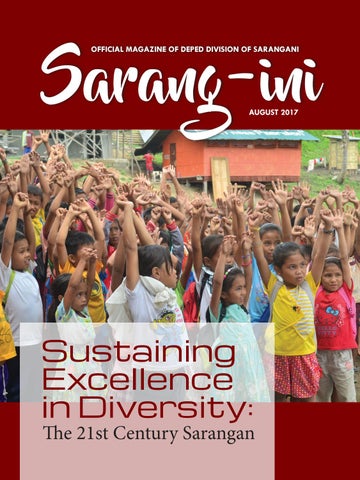
about the cover "Who wants to be a teacher? Who wants to be a policeman? Who wants to be a doctor? Who wants AUGUST 2017 to finish college?" the teacher asked the kids. The kids excitedly raised their hands after each question, hope glimmering in their eyes. Every Sarangan kid, wherever they may be, whatever their cultural background may be, they now have better chances at achieving their dreams. The Department of Education continues to work with our partners in bringing education closer to the child, improving the quality of education we deliver, and empowering education managers to govern schools, make them inclusive, child-centered, and global. This issue is a testament of how the Division of Sarangani synergizes with our stakeholders to sustain excellence in spite of the differences of the people we serve.
editorial staff
Sarang-ini
OFFICIAL MAGAZINE OF DEPED DIVISION OF SARANGANI
AUGUST 2017
Schools Div. Superintendent CRISPIN A. SOLIVEN, JR., CESE Assistant SDS DIOSDADO F. ABLANIDO, CPA CID Chief DONNA S. PANES SGOD Chief MA. SHIRLEY M. CARDINAL Editor in Chief LAFOREZA L. MAGUATE, EPS I Associate Editor ELIZABETH G. TORRES, EPS I Layout Editor ARIEL C. LALISAN, T-III Writers ROMY L. MARTIN, SEPS SocMob ARACELI J. DINOPOL, BSP Coordinator GIAN CARLO C. LICANDA, T-I BRYLL O. REGIDOR, T-I LODGIN L. LEAÑO, T-III JANICE B. LORANIA, T-I JENNETH R. RUTA, T-I MAY OLASIMAN-MARIPOSQUE, T-I RALPH JAYVEN C. ALABA Sarang-ini is published by DepEd Division of Sarangani, Provincial Capitol Compound, Alabel, Sarangani Province (083) 508-2228 / info.depedsarangani@gmail.com
2
Sarang-ini
in this issue
3
Sarangani welcomes SDS Jun Soliven
4
ONE SoCCSKSarGen takes off SHS Implementation goes full swing
Brigada Eskwela '17 earns mass support
6
BSP Updates A Productive and Fun Summer
7
NSPC 2107 Result: Sarangani Smiles SPJ: Creating Future Journalists
8
Portrait of a Great Educator
Flalok Project: Reviving the Blaan Art of Storytelling
10
16
Mentors, learners assess SBT, push institutionalization
Experiencing NSTW 2017: Artificial Intelligence
19
14
IS/IP Graduates: They, Too, Can Be Competitive!
SBB: Cultivating a Culture of Reading, The Community Spirit Way
17
9
Project CHILD
Leaving No One Behind
15
5
18
Sulong Kaligtasan: Protecting Sarangans with the Highest of Standards AUGUST 2017
NEW LEADER. Newly inducted Schools Division Superintendent Crispin A. Soliven, CESE, raises the staff representing the responsibilities he has accepted -- leading the DepEd Division of Sarangani -- during the turnover ceremony, July 7 at Family Country Hotel in General Santos City.
Sarangani welcomes
SDS Jun Soliven by Gian Carlo C. Licanda
T
he Department of Education- Sarangani Division welcomed its new Schools Division Superintendent in a turnover and installation ceremony held on July 07, 2017, at Family Country Hotel Convention Center, General Santos City. Mr. Crispin A. Soliven, Jr., CESE stepped in as the new Schools Division Superintendent of the Division of Sarangani, replacing Mr. Isagani S. Dela Cruz, CESO V, who assumed the superintendence of the South Cotabato Division where Soliven was previously assigned. In his speech during the ceremony, Soliven expressed gratitude for what he described as “overwhelming warm welcome” of the Sarangans as the ceremony yielded an almost perfect attendance from the officials including governor Steve Chiongbian-Solon, vice governor Elmer De Peralta, the mayor of the municipality of Malungon, Atty. Maria Theresa D. Constantino, the board members of Sarangani, and the DepEd Sarangani personnel. The ceremony was also graced by the DepEd XII Regional Director, Dr. Arturo B. Bayocot, CESO V, and personnel from the division of South Cotabato. Soliven appeals to the teachers, school heads, and division personnel of Sarangani to extend their all-out support to him, and to complement each other’s effort in making a difference in the lives of the Sarangans. He emphasized the value of teambuilding, partnership, relationship building, the importance of hardwork, imagination, and more importantly, respect for others as
AUGUST 2017
the qualities that will guide him in his efforts in the Sarangani division. He also said that the SDS office is everybody’s office, that it will be welcoming and accommodating to all teachers who will visit, and that he will acknowledge ideas and opinions from everyone as he emphasized that he does not have the monopoly of knowledge. Sir Jun, as he is fondly called by everyone around him, is a true Mindanaoan by blood and origin. He was born on July 22, 1961, in Iligan City, and has lived in Marawi and Malabang, and settled his family in Cotabato City. He came from a humble family of educators. His father is a retired superintendent, his mother a retired teacher, and three of his sisters are teachers. He is married to Ms. Helen Dela Cruz-Soliven, a master teacher in Koronadal National Comprehensive High School. Thus, the love for education seems to have run from his blood and the desire to educate is deeply rooted in the core of his being, a calling which is too much to be ignored. He is now serving 31
fruitful years in the Department of Education. A consistent honor student since elementary, Soliven is truly a man of excellence. He fuelled himself with academics. He took Bachelor of Science in Agriculture at the University of Southern Mindanao, Bachelor of Secondary Education at the Philippine Harvardian College. He finished his Master of Arts in Education at Mindanao State University- Dinaig Campus and has completed the academic requirements of Doctor of Education at Cotabato City State Polytechnic College. He is a Career Executive Service Eligible and was, for seven years, hailed outstanding in the Career Executive Service Performance Evaluation System in the following dimensions: Strategic and Critical Thinking, Leading in a Continuously Changing Environment, Developing/ Empowering Others to Establish Accountability for Results, Linkaging and Networking for Productive Partnership, Planning and Organizing for Greater Impact, and Driving
Importance for Integrity in Services. His skilled leadership is attributed to the numerous trainings, educational tours, seminars, and workshops that he attended in the country, and abroad in Australia, Japan, Hong Kong and Macau. During the first Education Summit on K to 12 at the Philippine International Convention Center, the South Cotabato Division was recognized as one of the top 5 Implementers of Senior High School in the Philippines. His genius is attested by the eligibilities he acquired throughout the years: the Career Executive Service written examination in 2010, The Educational Management Test for Superintendents in 2008, the Professional Board Examination for Teachers in 1986, and the Civil Service Professional Examination in 1998. Soliven promised to give his best to fulfil his mandate as Schools Division Superintendent in the province, exclaiming at the end of his speech the battle cry of every Sarangan educator, “Sulong Sarangani! Sulong Karunungan!”
Sarang-ini
3
ONE SOCCSKSARGEN takes off
Sarangani’s flagship program and innovations ascend
by Bryll O. Regidor
W
ith its persistent vow to expedite quality and functional education for its learners, the Department of Education Division Region XII initiated the R-XII Confab on K to 12 Innovations cum Launching of ONE (Organizational. Nurturing. Engaging) SOCCSKSARGEN on June 13-14, 2017 at Greenleaf Hotel, General Santos City. Inspired by the theme, “One SOCCSKSARGEN for Quality and Liberating Basic Education,” the two-day conference has congregated education officials, administrators, curriculum specialists and education stakeholders from the different divisions of the region to banner and share their respective innovations and flagship programs. The Division of Sarangani,
under the baton of Schools Division Superintendent Isagani S. Dela Cruz, featured its Flagship Program dubbed as Project CHILD. This program which stands for Communities and Homes Inspiring Innovative Leadership and Learning Designs is geared towards addressing gaps along three performance indicators (access, quality and governance). Moreover, it focuses on the authentically inclusive, culturally sensitive and learner-centered curriculum which is directed towards the development of 21st Century Skills among Sarangan learners. In addition to this, the confab was also composed of plenary and parallel sessions. The first plenary highlighted the message of DepEd Secretary Leonor Magtolis Briones. It was then followed by parallel sessions where the participants were distributed to breakout terms covering various programs
in the different key stages of basic education/; Kinder-Grade 6, Junior High School and Senior High school. In the break-out sessions, the likes of Garelene V. Dona-al (Public School District Supervisor), Judith B. Alba (Education Program Supervisor), Shiela Butil who represented Jorge D. Liansing, Jr. (Principal II), and Hemilda Napila (Public Schools District Supervisor) from the Division of Sarangani presented their innovations and researches to the participants as an integral part of the program. Mrs. Dona-al shared the division’s effort of establishing a communitybased kinder classes and facilitating trainings for teacher for this matter. Mrs. Alba on the other hand, primed to the participant the founding of 28 community-based elementary learning centers and 6 open high schools operating in the remote areas of Sarangani leading to the admission
538 elementary and 1,032 secondary learners. Meanwhile in a separate session, Mrs. Butil underscored Alabel National Science High School’s effective and strong partnership with different sectors which resulted to the school’s achievement of various milestones such as their participation to international research competitions. She also highlighted their practice of integrating virtual learning environment and technology like the Google Classroom which relevantly contributed to the 30% increase of their performance in the National Achievement Test. In similar fashion, Ms. Napila accentuated the strong linkage and partnership that MNHS has forged with Philrice, RCPC, Regional, Provincial and Municipal Agriculture office which yielded to teacher’s agri-training, students field study, procurement of floating tiller and construction of Metarisume Laboratory Facilities. Dr. Arturo B. Bayocot, DepEd Region XII Director, stressed that the initiatives invested by the divisions and their personnel adhere to very principle of adaptation which are essential for growth and survival, thus worthy of celebration. “Let us celebrate every step of the way as we journey CHANGE that holds adaptability as its password. Remember what Charles Darwin said: The species that survived were not the most intelligent. They were the most adaptable to change.”
support towards SHS implementation. Buildings were constructed for classrooms and laboratories; stakeholders were tapped as partners
for the immersion; and, books and facilities were starting to be handed to the schools. There were still insufficiency in terms of learning materials, teaching force, facilities and laboratories, however, these things can be provided or managed through an exerted effort of the community, school and stakeholders. Such actions reflect the SHS’s path in Sarangani into where it is heading towards. The government is spending millions for the betterment of its educational system and for upholding the potential skills of its youth. It would never stop improving and enhancing its mechanisms on providing quality education. All these labors and effort boils down for the fulfillment of this tagline: “K-12 Graduates: Handa sa Kolehiyo, Negosyo at Trabaho.”
SHS implementation goes full-swing
by May Olasiman-Mariposque
P
rogress calls forth changes which includes our educational system. Under Republic Act 10533 also known as “Enhanced Basic Education Act of 2013”, K-12 Program was implemented to cater the increasing demands of globalization. It has kindergarten, elementary, Junior High School and Senior High School as its component. Senior High School (SHS) covers the last two years of the K to 12 program which is the Grades 11 and 12. In SHS, students will go through a core curriculum and subjects under a track of their choice. It offered four tracks namely academic, technical-vocational, sports, and arts & design. The grade
4
Sarang-ini
12 students went through the different tracks that they chose and immersed on the skills that they should acquire. Sarangani showed magnificent
AUGUST 2017
Brigada Eskwela '17 earns mass support by Romy L. Martin
M
ore than 52,000 volunteers trooped to public elementary and secondary schools during the 2017 Brigada Eskwela schools improvement week on May 15-20 in the Schools Division of Sarangani, pouring in an estimated 156,000 hours to helping prepare the schools for the opening of School Year 2017-2018. Composed of parents, learners, national and local government workers, representatives from the private sector, non-government agencies and members of school communities, the volunteers cleaned school grounds and surroundings, repaired and repainted classrooms, desks and other school facilities. In terms of resource generation, the schools pulled together more than
PhP 58 million support from partners and stakeholders in kind and in cash. Material contributions came mostly in the form of construction materials and supplies. School partners included the provincial government of Sarangani and component municipal and barangay government units, business sector, national government agencies, governmentowned and controlled corporations, non-government organizations, school alumni associations, individual donors and benefactors. Biggest contributors in this year’s Brigada Eskwela were the Philippine Amusement and Gaming Corporation (PAGCOR), the Provincial Government of Sarangani and the Parents-Teachers’ Association of Alabel National Science High School.
Alabel National High School topped all schools in the area of stakeholder resources generation with PhP 41.27 million. Alabel Science National High School came in far second with PhP 5.3 million. Aniceto Lopez National High School was third with PhP 3.7 million. Alabel NHS also led all schools with 4,988 volunteers, followed by Alabel SPED Center Integrated School with 3,474, Malandag National High School with 3,391 and Glan School of Arts and Trades with 2,426. Last year, the schools marshalled 38,600 volunteers and a scanty PhP 3.52 million in stakeholder resources. The increases this year were attributed to early preparations of schools and massive campaigns for stakeholders support and partnership across the Division.
asa IS of West Alabel District – edging 10 other medium elementary schools. Kinam ES may fell short of its planned scope of work and alignment to the theme – which comprised 40 percent of the selection criteria – it however did excellently in diverse volunteer participation and resource generation. The school registered 932 volunteers and generated close to PhP 400,000 stakeholder cash and in-kind contributions that it used for constructing a multi-purpose pavement, a comfort room for the faculty, as well as repair and repainting of roofs, classrooms, desks, tables and other school facilities. The manner Kinam ES presented their Brigada Eskwela Accomplishment Report was impressive, as well. Besides neat layout and completeness in contents and means of verification, the school made life easy for the evaluators by providing Program of Works (POW) of all the physical improvement
jobs it initiated during the Brigada Eskwela Week. In fact, it was the only contender school that provided POW. A best practice.
BEST IMPLEMENTERS Elementary Level VT Garcia ES (Small) Pag-asa IS (Medium) Malalag CES SPED Center (Large) Kiamba CES (Mega) Secondary Level Alabel NSHS (Medium) Malandag NHS (Large) Alabel NHS (Mega)
And the 2017 Brigada Eskwela second best implementing schools are…
T
wo humble schools captivated my heart in this year’s Brigada Eskwela in Sarangani. Kinam Elementary School and Kablacan Integrated School, which happened to be led by inspiring leaders – the breed that brought out the best in their people against all odds. Kinam ES A hinterland school of mostly Blaan indigenous cultural community learners, Kinam ES is located in the centre of Barangay Kinam in Malapatan 3 District. It has 680 enrolees, including 142 from four extension schools in neighbouring ICCs, and 17 teachers including school head Marichu Jopson. On a good day and on a conditioned transport vehicle, Ma’am Marichu and her team of teachers would get to Kinam ES in three to four hours from the national highway in Barangay Lun Padidu, Malapatan. On bad days, the teachers would walk to school four to five hours from the centre of Barangay Daan Suyan on muddy provincial road, cross a swelling Lun Masla River 13 times, or at instances, swim across deep sections of the river. On really bad weather conditions and when the road and rivers are unpassable, the teachers would opt to stay home or stay in school. The challenging terrain didn’t prevent Ma’am Marichu and team from achieving honours in the 2017 Brigada Eskwela implementation. Kinam ES ranked second best implementing school – next to Pag-
AUGUST 2017
Kablacan IS I didn’t expect Kablacan IS to place second. The medium secondary schools category was dominated by schools with rich partners and stakeholder base. But Kablacan IS did it, besting five other schools in flying colours! At the dawn of 2017, School Head Renante Carido knew he would need to build classrooms to accommodate four sections of incoming Grade 8. Otherwise, the school would lose more than 200 students to adjacent junior high schools. New classrooms from DepEd would not happen in the immediate term as Kablacan IS has yet to be included in the list of priority schools. Sir Renante lose no time.
His school was among the first to begin the Brigada Eskwela season by holding fundraising activities on Valentine’s Day. He rallied his teachers, parents, local government officials, school alumni and other local stakeholders to contribute resources to build makeshift classrooms. So convincing a leader that Sir Renante was, the school was able to generate more than PhP 300,000 cash. And voila, a fourclassroom semi-concrete building was erected during the Brigada Eskwela week! Kablacan IS scored excellently in resource generation and very good marks in the other criteria. It rallied 1,178 volunteers to clean up the school grounds and helped in the repair jobs while generating close to PhP1 million in stakeholder monetary and material resources. My hats off to you, Sir Renante and Ma’am Marichu IS! Sometimes, second best is the best.
Sarang-ini
5
BSP Updates
by Araceli J. Dinopol
T
he Sarangani Associate Council, as chartered by the Boy Scouts of the Philippines consents to accept its responsibility for leadership, supervision, cooperation and extension of the Boy Scouts Movement in the Philippines in the Province of Sarangani and pledges itself, through its officers and members, to uphold the principles of Scouting for the welfare of the Filipino Youth in Sarangani. Guided by the Charter, the Sarangani Associate Council led by Gov. STEVE CHIONGBIAN SOLONCouncil Chairman and Ms. ARACELI J. DINOPOLCouncil Scout Executive, demonstrates great and commendable accomplishments in the areas of memberships, activities, trainings, and advancements (MATA in Scouting) in both pupils/students and adult leaders/teachers levels. Recently, the Sarangani Associate Council is being recommended by the Regional Field Scouts Office to be eligible to become a Council on its own, a significant elevation from being an Associate Council. While we eagerly await the final approval of such lofty vision of the Sarangani Associate Council to become a Council that is independent and fully operational on its own, the Council is doing its best to let the Scouting spirit burn continuously without wavering by regularly holding and winning awards in scouting activities, trainings and advancements and encouraging new memberships. We keep our faith in the BSP Sarangani Associate Council to continue to soar with pride and with the staunch support of all the Sarangan Scouts, PLGUs, LGUs, NGOs and the Department of EducationSarangani Division, the Sarangani Associate Council will live to see its dream become a reality. ACHIEVEMENTS: • 2nd Place in the Advancement Of Scouts for the Year 2016 to train for responsible Citizenship and to Strengthen Scout Leadership • 2nd Place for Outstanding Performance in Scout Membership against Goal for the Year 2016 (Class D), reaching out to as many boys of scouting age to join the Scouting Movement • 4th Place for its Outstanding Performance in Scout Membership, Activities, Trainings, Advancement and Administration among Councils in Eastern Mindanao Region for Scouting Year 2016 • 4th Place in the conduct of Training Courses to Young People for the year 2016 to Strengthen Leadership • 5th Place in the Council Activities for the Year 2016 which Lead to the Successful Operations of the Council • 5th Place in the conduct of Training Courses for Adults for the Year 2016 to Strengthen Unit Leadership • 4th Place for Performing Councils for 2016 out of 20 Local Councils in Eastern Mindanao Region UPCOMING EVENT: 6th ASEAN Scouts Jamboree November 27 to December 2, 2017 @ Energy Park, Tagum City
6
Sarang-ini
A Productive and Fun
Summer by Lodgin L. Leaňo
Summer spent in school is valuable! This is how pupils and students described their experiences and activities done during summer time as 2017 Summer Catch-Up Program struck again in a new dimension of its implementation in Sarangani Division bringing new levels of learning specifically at Glan Central Integrated SPED Center (GCISC) from April 24-May 15, 2017. Aside from the usual offering of remedial and intervention programs like Kindergarten CatchUp Education and Summer Reading Camp that addressed learners with weak fluency in reading and difficulty in comprehending advanced texts, GCISC focused also in giving enhancement programs that discover further the potentials and skills of pupils in different learning areas and extra-curricular activities. Always be ready! The School-Based Emergency Preparedness Training of GCISC gave the 11 teachers and 42 pupils various mechanisms that prepare, guarantee protection and increase resiliency in the face of disasters as it focused on giving First Aid Treatments to victims of natural disasters or during emergencies. Members of Glan Rescue Team and the Bureau of Fire Protection (BOFP) Personnel demonstrated the proper methods of reviving and giving Cardiopulmonary Resuscitation (CPR) to conscious and unconscious victims as well as the use of Spine Board in carrying them. Music is their language… Fourteen pupils from different grade levels completed the 15-day training on playing ukulele, guitars, organs and other musical instruments of the Musical Enhancement Program offered during the Summer Catch –Up Program as another enhancement activity of the school for learners who are musically inclined and wanted to improve their skills in singing and playing instruments.
Write what is right ! Campus writers of GCISC were guided on this line in writing varied journalism articles during the 15-day Journalism Enhancement Activity of the Summer Catch-Up Program of the school. Twenty-one writers attended this enhancement activity and they were trained to write editorials, features, news for radio broadcasting, and make four-page school publication in collaborative desktop publishing. Groove to the rhythm of music. The Summer Dance Workshop as another enhancement program under the Summer CatchUp Program became interesting to every child of different ages as it enrolled 100 pupils and students last April 24-May 15.
Categorized according to age brackets, participants were trained to learn dance lessons on hiphop, ethnic, modern, and folk dances through a step by step process held at GSAT covered court. This program was sponsored by Happy Kids Foundation. Dribble and shoot! Sports enthusiasts from grades one to six flocked in Sports Clinic Activity as another enhancement program offered in the 15-day Summer Catch-Up Program. Participants on this program were mostly boys since it focused more on Basketball game as sponsored by the Municipal Councilor Victor James B. Yap, Jr. This annual implementation of Summer Catchup Program aimed to cater learners who are unable to attend regular class program due to physical impairment, work financial difficulties, distance of home to school and other legitimate reasons from Kindergarten to Secondary Levels in every public and private school in Sarangani. However, it does not limit only to reinforcement activities but also on enhancing skills in the field of journalism, sports, research, music and arts.
AUGUST 2017
NSPC 2017 Result: Sarangani smiles by Bryll O. Regidor
C
ertainly, there comes a moment in a team’s quest when it’s awkward not to break into a grin. This is what the Sarangani Division delegation did when they snagged another remarkable feat during the National Schools Press Conference (NSPC) in Pagadian City, Zamboanga Del Sur. The team cleared high finishes in two different categories at the January 21-25 event. Rhoda Mae Ebad of Alabel National High School with Bryll Regidor as her coach, lead the delegation as she placed second in the News Writing Secondary English category, just one spot behind Limuel Limbago of CALABARZON. On the other hand, Jerica Mae Ducusin with her coach Airin T. Ramos, secured the 7th place in Photojournalism Elementary English. Overjoyed with the accolade, Laforeza L. Maguate, the Sarangani Division Journalism Coordinator for English, said that this NSPC is the most memorable among all the NSPC’s she has attended due to the overwhelming turnout. “These have been the most noteworthy things I’ve ever experienced in division’s campus journalism stint, and I couldn’t be happier with the results,” Maguate, said in an informal conversation after the awarding. Challenges fared Prior to NSPC, the delegation encountered multiple challenges leading up to the competition. Some
a sense encouraging for the campus journalists. This coerced the coaches and contestants to spend way out of their planned budget just to have a decent meal. “We were saddened that the almost perfect and elusive opportunity to participate to the NSPC was overshadowed by the disappointing fact that we (Sarangani Delegation) were not accommodated well, and the consistent repetitive meals served before us do not tickle our appetite; so we left them rotten in the corner and buy ourselves good foods” Ms. Ramos said. Smiling on the way home The division’s supervisors and heads played a significant role in the group’s success. Mrs. Elizabeth
SPJ: Creating Future Journalists
by Jenneth R. Ruta
W
of which are financial in nature, but through the efforts of the local and provincial government units, these hurdles were eased and the worried participants were relieved. Upon arrival in the host city, the early-arriving team members discovered that the quarters intended for Region XII were already occupied by the neighboring delegation, Region XI, thus, not any more conducive for coaching and practice sessions. The team was left with no choice but to engage in a meager accommodation. But that wasn’t the only problem that required enduring patience and understanding. Ms. Airin T. Ramos, one of the coaches, for instance aired out that the reduplicated meals served from day one to five are not in
Sollano, one of the coaches of “Ang Alay ng Sarangani” shared that the technical support extended by Mrs. Laforeza Maguate, Mrs. Analiza Domingo and CID Chief Donna Panes is vital for the team’s victory. “Malaking bagay talaga ang mga intensive trainings and workshops na inihanda ng mga journalism coordinators natin at ni Maam Panes sa dibisyon lalo na ‘yong pagimbita niya ng mga mahuhusay na tagapagsanay at lecturers.” [“The trainings and workshops facilitated by our division journalism coordinators and Ma’am Panes were really big things specially their initiative of inviting high-caliber trainers and lecturers.” Mrs. Sollano said.] Mrs. Maguate believed that preparation is really the key towards nailing a goal. She added that the triumph recorded by the team imply that Sarangani is the team to watch out for in the next conference. “Nothing in the classroom can prepare you for the disappointments, but we can always prepare for success. When you’re in competition, everything matters and our team high second-place finish in news writing this year proved that we are good, but there is still work to be done before we become exceptional,” she cheerfully said in a ride on the way home.
ho would ever think that a mere pen can be a powerful weapon? Jose Rizal once used his pen to stir the nationalistic spirit of Filipinos to fight and defend the country’s freedom from the cruelty of Spaniards. For centuries, the pen becomes the basic tool of writers. It symbolizes the profession’s vehicle in carrying out the truth and information about the world. Eventually, journalism was born to give wide outlet for writers to convey facts and express opinions. In the Philippines, journalism is even strengthened through Republic Act 7079 otherwise known as “Campus Journalism Act”. It empowers student-journalists to practice freedom of expression through responsible journalism. Moreover, the Department of Education through the Bureau of Secondary Education launches Special Program in Journalism (SPJ) to enhance the journalistic skills and
AUGUST 2017
competencies of potential students. The Special Program in Journalism According to its Manual of Operations provided by the Bureau, SPJ is a six-year course in Journalism which aims to strengthen free and responsible journalism in secondary schools and develop the learners’ skills required in mass communication particularly journalism and broadcast media. Its main focused is primarily on the mastery of competencies required to land a prolific career in journalism. Scope of the Program Anchored on the K to 12 Curriculum, the program offers two new subjects such as Journalism and Advanced English. Journalism subject aims to provide learners with understanding of the basic principles and theories of journalism, its practices and techniques, and responsibly applies them as tools for effective
communication and information. The subject has the following course description per grade level, Grade 7 and 8 – Print Media, Grade 9 – Radio Broadcasting, and Grade 10 – TV Broadcasting. On the other hand, Advanced English targets to give learners understanding of advanced concepts and information communication technology to effectively use them as tools for responsible journalism. It four division are Grade 7 – Reading to Writing, Grade 8 – Oral Communication, Grade 9 – Technical Writing, and Grade 10 – Research. SPJ in Sarangani The implementation of SPJ kicked off at Irineo Santiago National High School as pilot school in Region XII. Based on good performance in Schools Press Conference, Sarangani Division tapped its schools namely: Alegria
National High School, Kiamba National High School, and Lun Padidu National High School to initiate the program in 2009. Despite the challenge in facilities and equipment, the program implementers take initiative on different innovations and best practices like the conduct of Media Tour, School Summit, and Course Immersion to provide real world experience to the learners. Today, the implementing schools have produced a total of 350 graduates all equip with necessary skills for higher education. Boost of confidence, team leader of the class, advanced level of knowledge and experiences are among the testimonies of SPJ graduates in Sarangani. From its humble beginning, SPJ in Sarangani has blossomed, creating young journalists with integrity and professionalism.
Sarang-ini
7
Portrait of a Great Educator M by Ariel C. Lalisan
y first encounter with Mr. Isagani S. Dela Cruz was when I claimed my check as honorarium for being a demonstration teacher during a Regional Training of Trainers in Science back in 2008. It was my first year of teaching then and Sir Gani, as he is fondly called by everyone in the department, was the Assistant Schools Division Superintendent. “Why were you chosen to be the demonstration teacher instead of a master teacher?” He asked. I was taken aback. A newbie in the department, I did not know that such rules exist. I explained that it was Dr. Estrelieta Tenizo, the Regional Science Coordinator back then who contacted me after the contestant I coached won in the Regional Science Quiz. “Did they have a sort of screening for demonstration teachers?” his follow-up question. There, I had an impression of him that behind the soft-spoken and calm demeanor is a strict administrator – someone you should not mess with. In 2011 Sir Gani was briefly transferred to Koronadal but went back to Sarangani as the Schools Division Superintendent in the year that followed. In the last five years, Sir Gani led the Division of Sarangani to triumphs in various areas like raising the Mean Percentage Score in the National Achievement Test, with the Division holding the top ranks among elementary and secondary schools in Region XII. Father of Integrated and IP Schools More importantly, Sir Gani, has been known to be the father of Integrated Schools and IP Schools, after having worked for the opening of said schools in places where they are needed. This has resulted, of course, to improving the access to quality basic education among the underprivileged communities in the hinterlands of Sarangani. Not only did he work on the establishment of Integrated and IP Schools, he made sure he visited these schools – all of them if possible. I have gone with him in visiting the farthest schools in the Division of Sarangani. Last year, we made a seven-hour trek to Laginan Integrated School, in the municipality of Malungon,
8
Sarang-ini
which he eagerly gave the moniker, School in the Sky. The school sits on top of a hill and once you stand on the school grounds you could see Mt. Matutum across the distance, giving you a feeling that you are at almost the same elevation with it. He came to personally congratulate the community of parents, local officials, school administrators, teachers, and students for the wonderful example of synergy they have shown – working together to construct six concrete, typhoon-proof classrooms despite the distance and the difficult terrain. Earlier this year, I joined him again on a trek to the farthest school in the municipality of Glan – the fabled Lanao Kapanglao Integrated School. It took us three days of bumpy rides and muddy treks to visit four schools in the border of Malapatan and Glan. In all of those “outdoor adventures” I saw how Sir Gani wanted to inspire the teachers who go to great lengths just to be able to teach the children in far-flung schools. He never wasted any chance to talk to the teachers and encourage them to faithfully perform their duties despite the difficulties, for the sake of the children. He cares about the children
in the mountains so much that he launched Project Samento, where he looked for donors of cement for the construction of a school building in Lanao Kapanglao. Openness to Innovation I have once worked with Sir Gani on a research. He was interested in the application of Gamification in teaching Physics. Incidentally, I have previously worked on an action research on the same area, where his son, Prince, was one of the respondents. Although the research work has not come into fruition yet, it revealed the kind of educator he is – innovative and current. Sir Gani has also been supportive of our activities in the Google Educator Group. In fact, whenever we come across each other, he would always ask me to update him about the group’s activities. He has also envisioned the use of technology in teaching. He introduced Orange Apps with a vision of schools having their own website and their teachers and students using mobile application for various tasks as attendance checking, quizzes, grading, and communicating with parents. When schools get better funding, maybe, for equipment and
internet connection, this vision will surely be realized. A Music and Sports Enthusiast For those who have spent time with Sir Gani when he is not very busy with his professional duties, you would know that he loves two things: music and basketball. Give him a microphone and he can sing all night with his selection of love songs and pop rock. No wonder he was supportive of Teacher Joylaine when she joined Tawag ng Tanghalan sa Showtime. I remember that he once joined our basketball team. Although he has only played with us twice, due to his busy schedule, I saw his passion for the sport. In fact, even during our treks, when we stop by a community that has a basket ring, he would play with the kids as if he did not just walked for miles. His love for music and sports would tell us that he is a well-rounded person, and that, yes, he knows how to relax. Now that Sir Gani is off to perform his duty and serve another division, we wish him well and we thank him for the wonderful job he has done in Sarangani.
AUGUST 2017
Flalok Project: Reviving the Blaan Art of Storytelling by Ariel C. Lalisan
L
anguage death, in linguistics, occurs when a language loses its last native speaker. Around the world about one language dies every 14 days, estimates a study by UNESCO. By the end of this century about half of the world’s 7,000 languages will go extinct. Unless we do something. Good thing, here in Sarangani efforts are being made to preserve the language – and with it, the culture and traditions – of the local indigenous people. The Blaans, for one, are fortunate that several organizations came together to preserve their culture through various projects. The Flalok Project is one that is gaining ground and is hoped to impact the lives of Blaans greatly. Flalok is the traditional art form of oral storytelling of the Blaans. Sadly, this tradition has been gradually fading away as there have been very scarce written records about the Blaan tradition and the stories. THE BIRTH OF FLALOK It is because of this that the Flalok Project was born. Spearheaded by the Conrado and Ladislawa Alcantara Foundation, Inc. (CLAFI), and funded by USAID, the Flalok Project aims to revive the Blaan art of storytelling with the help of “big books,” as well as teacher guides and learning materials, that can be used as a platform to improve literacy among young Blaan learners, while at the same time developing their love for reading. The production of Big Books supports the current movement in the Department of Education where mother tongue-based multilingual education (MTBMLE) is being pushed as a strategy to improve the learning of pupils in the early grades. Studies have found out that students learn better in Mathematics and Science when the mother tongue is used as a medium of instruction. The use of English, for non-native
AUGUST 2017
speakers, becomes a learning barrier for young learners who do not yet understand it well. CLAFI partnered with experts from the Department of Education in the development of big books, teacher’s guides, and learner’s materials that will be used in teaching young Blaan learners.
FLALOK IN THE CLASSROOM As of this writing, 120 Blaan stories have been collected, documented, and converted into written format with the help of Blaan writers and teachers. Out of the 120 stories collected, 72 were chosen based on their adherence to the prescribed themes and curriculum guidelines laid out by the Department of Education. The stories were organized into two big books with 36 stories each that are intended to be used in Grade 1 and Grade 2 classes. The big books, teacher’s guides, and learner’s materials will be distributed to the project’s 76 partner schools in Region XII. The DepEd Regional Office has committed to help in the reproduction of the Flalok learning materials and to ensure the sustainability of the project, it shall be integrated in the MTBMLE program. “We at CLAFI are happy to be a part of this project because we are not only focused on enriching the lives of our community partners, we also want to help them preserve their culture,” remarks Richard Lyndon Magtulis, Executive Director of CLAFI, said during the 1st Flalok Congress held in Polomolok, South Cotabato last May 25. “All the stories contained in the Flalok big books will now be passed on to future generations to ensure that
their culture and identity as a people will not be lost,” former Sarangani governor and now VP for operations of Alson’s Aqua (of the Alcantara Group, which runs CLAFI), Miguel Rene Dominguez said. BEYOND FLALOK Aside from Flalok, the Division of Sarangani has been working on preservation efforts of Indigenous Knowledge Systems and Practices (IKSP) of the Indigenous People groups in Sarangani, namely, the Blaans, Tbolis, and Tagakaulos, through the office of the Curriculum and Instruction Division under the leadership of Donna S. Panes, CID Chief, who herself has been conferred the title, Bae Tamdo di Banwe or Princess of Educators in Saragani. The CID Chief Panes envisions a great outcome out of the contextualization and localization efforts she has led. “I am positive that through this our IP learners can relate better to the lessons…and of course, they would take pride with themselves and their culture,” she said. “I firmly believe that if we produce educated minds in Sarangani, I can say that Sarangani will eventually rise beyond its current state as one of the poorest provinces in the country,” she concluded.
Sarang-ini
9
Project
CHILD The Flagship Project of DepEd Division of Sarangani
G
ood education empowers our children to realize their full potential and capabilities as human beings. It encourages growth in personal aspiration, secures financial stability and dignity of life, develops skill for job proficiency, and facilitates the capacity to absorb and enhance new technologies. As we step into the 21st century, we aspire to produce holistically developed Filipinos by empowering not only our learners but the teachers and the communities as well. It is then our collective responsibility to build our youth for the future by investing in the education of our children. The Schools Division Office of Sarangani does not rest on bringing children to school but we endeavor to bring quality education and keeping it equitable to all. We, at SDO Sarangani, in partnership with the provincial and local government offices of Sarangani and all the education stakeholders, now implements a new framework to better our services towards the Sarangan youth encompassing ACCESS, QUALITY and GOVERNANCE through the Communities and Homes Inspiring Leadership and Learning Designs (CHILD) program.
ACCESS With ACCESS Sulong Karunungan, Kahit Kailan, Kahit Saan, we thrusts more on the effectiveness of alternative delivery by practically bringing quality education almost to their doorstep all throughout Sarangani and even beyond, with the close cooperation of the communities. Bringing Education Beyond Boundaries is meant to establish division strategies and innovations
10
Sarang-ini
Bringing Education Beyond Boundaries
to expand enrolment especially those who suffer from exclusion such as working children, those belonging to indigenous groups and linguistic minorities, and those children with special needs. Through CHILD we will be able to establish and improve more Integrated Schools and Indigenous People’s Schools; leverage the utilization of Alternative Delivery Mode for our pupils and students; and
build Community-based Learning Centers. Expanding access to education also involves a variety of pedagogical approaches to accomplish the dissemination of knowledge across the diversity of social, cultural, economic, and biological backgrounds and encourages teachers to incorporate adjustments in their lesson plan to foster themes of equal opportunity in education.
Q
Being
In QUAL tungo sa Ma venture in child-centered opportunities learning need and shared c through imp as: ALIVE, IP ALS, E-learni Tech-Voc The int today will d children and their full pote a future of w marginalizatio only bringing school but als of education
AUGUST 2017
GOVERNANCE Empowered Leadership
And through GOVERNANCE, Handang Tumugon sa Lahat ng Pagkakataon, with the support of all education partners we are assured of an empowered leadership by: • Teaching and Non-Teaching Capacity Building • Intensifying SBM Implementation • Strengthened Partnership and networking to Support Child Policy Program • Reinforced and Sustained Planning & Research Innovations • Quality and Effective Monitoring and Evaluation • Responsive and accessible Education Facilities • Efficient and sustained health and nutrition program for students, teachers and nonteaching personnel • Responsiveness and effective cash management system • Strengthened implementation in the processing of personnel action documents • Transparent, liberating and responsive implementation of hiring employees • Effective management of
QUALITY
g, Belonging, Becoming
LITY, Batang Sarangan Matatag na Buhay, we creating meaningful, d and engaging learning suitable to the unique ds of each pupil/student community aspirations proved programs such PED, SPED, Multigrade, ing, SPA/SPJ/SPS/SPRS,
terventions we make determine whether our youth are able to reach entials or are left to face worsening inequity and on. Our focus now is not all Sarangan children to so improving the quality services and keeping it
equitable to all as well. Being, Belonging, and Becoming, are tag lines used in visioning the kind of teaching approaches and learning environment that allows learners to be aware of their own potentials and their need of self-development. For Sarangan Educators, achieving quality basic education means, helping Sarangan learners to develop creativity, emotional maturity, and acquire the skills, knowledge, values and attitudes necessary for responsible, active and productive citizenship in a child friendly climate. The kind of individuals who are equipped with the 21st century skills and who can equally race with the challenges in this globally competitive generation.
AUGUST 2017
information from documents and records • Efficient, transparent and well-managed activities related to acquisition and utilization of materials and resources • Effective and efficient general support services • Responsive, transparent and efficient accounting management system. Empowered Leadership in schools and community participation is seen as an effective strategy in overcoming challenges in order to improve access and achieve quality education. Empowerment in the context of school leadership encourages teachers and stakeholders to get involve in participative management. It ensures transparency and accountability in the utilization of financial, physical and human resources. Its goals are to improve the School-based Management level of practice for both elementary and secondary, and to strengthen fund utilization and program management of special programs.
We encourage all our education partners in the industry, the local and national government offices, and the community to invest in the education of children by co-ownership in delivering the DepEd programs and projects. This will manifest in the reconciliation of gaps and improvement of services in terms of ACCESS, QUALITY, and GOVERNANCE. If we are serious about achieving greater equity and social stability, this CHILD program is imperative. Redoubling our efforts for educational development, especially the most disadvantaged and marginalized children, is essential in achieving the K to 12’s mission of Nurturing the Holistically Developed Filipino. The principle of CHILD may invoke controversy, but however we look at it, to invest in the education of children is to invest in our common future: the world of tomorrow will inherit the children of today. Children are important because they are the future leaders. Some may become nation leaders in the sense that they will be the ones who will nurture the next generation. The education of children is our collective responsibility. So we call on all stakeholders to make a personal investment in the education of our learners. We are confident that the Schools Division Office of Sarangani with the staunch support of all the education stakeholders, we will be able to actualize the goals and objectives of CHILD.
Sarang-ini
11
SALIENT FEATURES
T
he CHILD as Sarangani Division’s flagship program initiative has laid down three significant features in its effort to bring education closer to where the learners are. These are the following: Convergence, Ensuring a Learner –Centered Curriculum, and Transformational Leadership, liberating school leaders to be responsible of their own programs for continuous school improvement towards higher performance and productivity.
1
CONVERGENCE Establishment of learning communities, improvement of schools and ensure sustainable alternative learning through strengthened partnership and strong collaboration with stakeholders. In convergence, the strength of the organization relies greatly in the strong alliance of stakeholders towards the achievement of educational goals and objectives.
2
ENSURING A LEARNERCENTERED CURRICULUM Ensures that learners are actively engaged in the teaching-learning process in a learning environment where individual differences are recognized, where students are able to construct meanings and ideas given the learning experiences, and where learners are able to reflect on their own learning and how they are learning. All these can be achieved by means of integrating technology with instruction, intensified mentoring and coaching, establishing a friendly learning atmosphere, encouraging collaboration among learners, and properly addressing learners’ diversity.
12
Sarang-ini
3
LIBERATING Liberating in the context of CHILD means giving local school leaders and their respective stakeholders the freedom to design their own programs for school improvement and takes greater ownership and pride of their own accomplishments. This also involves transformational leadership, where school leaders are able to create a valuable and positive change in teachers by enhancing their motivation, morale, and performance through a variety of mechanisms, which are aspects of good governance. Transformational leadership takes every opportunity to create visionary leaders who are people and task oriented, promote active collaboration with stakeholders, act as models of integrity and fairness, and who inspire teachers to do their tasks and in this way liberating schools from a plateau of midget performance towards better and higher productivity.
ACKNOWLEDGMENT Writers: Bryll O. Regidor, Mark Christopher M. Quiño, Joy L. Quiño, Lodgin L. Leaño, John Lawrence A. Panding, Ariel C. Lalisan Technical Working Group: Isabelita O. Jabines, Mario S. Donio, Garelene V. Donaal, Laforeza L. Maguate Layout: Jonathan B. Agreda, Renetchie B. Martinez Consultants: Donna S. Panes, CID Chief (Lead Person); Shirley M. Cardinal, SGOD Chief; SDS Isagani S. dela Cruz, CESO V; ASDS Diosdado F. Ablanido, CPA
AUGUST 2017
C.H.I.L.D. OBJECTIVES There are at least three objectives of the program in accordance with the three performance indicators- access, quality and governance. Each are presented below. 1. PROVIDE all learners equal access to quality basic education in a friendly environment, regardless of ethnicity and culture, religious beliefs, political ideologies, or physical disabilities. An education that is inclusive which recognizes and values every child and family as equally important and deserves equal opportunities and experiences. 2. DELIVER quality basic education in all levels through the provision of quality instructions, appropriate learning experiences which are able to hone the learners’ skills and mastery of concepts, through the use of a variety of performance-based assessment strategies, provision of a contextualized curriculum that addresses the needs and interests of diverse learners, and creating a child friendly environment that enhances the psychological and physical learning environment of learners. 3. IMPROVE the delivery of basic educational services by creating transformational leaders characterized by their ability to effect revolutionary change within the system, their ability to inspire and motivate people to work for a unified goal, ability to convert followers into leaders, and most importantly, ability to tap and use resources through active collaboration and participation with stakeholders.
DUTIES & RESPONSIBILITIES 1. SDS and ASDS
>> Oversee the implementation in all levels >>Provide sufficient appropriate resources to effectively implement the program >>Utilize feedbacks and other data to enhance program implementation >>Approve policies governing program implementation >>Empower school leaders and implementation team to design interventions and implement programs
2. Division Chiefs
>>Mobilize program implementation teams >>Guide school heads in the implementation and proper utilization of funds >>Conduct writeshops in the formulation of instructional materials and M & E tools >>Identify training needs and equip CHILD implementers with the required trainings >>Ensure proper flow of communications, feedbacks, and deal efficiently with issues and concerns relative to program implementation >>Always keep an updated record of actual accomplishments such as data mapping and conduct of periodic review of performance.
AUGUST 2017
>>Recommend and formulate policies to improve program implementation.
3. Education Program Specialists
>>Monitor CHILD implementation >>Gather and organize data and feedbacks from schools and communities >>Provide technical assistance to school heads and teachers >>Guide teachers in developing appropriate instructional materials
4. District Heads
>>Oversee the actual implementation of the CHILD program >>Ensure availability of all curricular materials in the assigned learning area/s >>Guide teachers in the development of instructional materials >>Supervise the annual mapping of children in the community and ensures that every child in the community is enrolled in the nearest school >>Gather feedbacks from school heads and communities
5. Schools/Learning Centers
>>Creates an environment that is
conducive to teaching and learning >>Implements, monitors and assesses Project CHILD for higher learning outcome >>Ensure that Project CHILD is integrated in the SIP >>Introduce new and innovative modes of instruction to diverse learners and provides inclusive education to achieve higher learning outcome >>Administers and manages all the resources of the learning centers >>Recommends the staffing complements based on the school needs >>Establishes school and community partnership and engages them in the implementation of Project CHILD
6. School Heads
>>Mobilize and optimize all school resources for program implementation through active collaboration with stakeholders >>Ensure proper utilization of program funds by involving stakeholders in planning and systematic reporting. >>Supervise the conduct of CHILD activities in the school and community >>Provide material inputs in the development of instructional
materials >>Collect and organize data and feedbacks from teachers, students, parents, and stakeholders >>Organize master teachers for the purpose of providing technical assistance to teachers >>Ensure active participation of local partners >>Submit bi-annual report to the SDS >>Implement new programs and recommend policies to enhance program implementation >>Spearhead the annual mapping of children in the community and ensure that every child in the community is in school
7. Teachers
>>Prepare daily CHILD lesson plans >>Ensure a child friendly learning atmosphere by enhancing the physical learning environment and psychological climate inside the classroom >>Ensure learners’ active participation and collaboration during the teaching-learning process through providing learners with hands-on learning experiences. >>Integrate technology in the teaching-learning process. >>Ensure ready-to-use appropriate instructional materials >>Conduct regular performancebased assessment >>Conduct intervention activities to learners who are at risk of subject failure
Sarang-ini
13
LEAVING no one
BEHIND Reaching out to the Marginalized through the Alternative Delivery Mode by Ralph Jayven C. Alaba
E
ducation is the most powerful weapon which you can use to change the world. Imagine the opportunity he misses when he is deprived of it. There are several reasons why people specifically children do not have access to quality basic education, to name some: poverty, geographic location, and peace and order instability. To address these challenges, the Department of Education developed and implemented the Alternative Delivery Mode Program. This program is anchored on the visions of the Department; make basic education free and accessible to all; deliver inclusive and nondiscriminating education to every Filipino; and unite all significant entities towards the holistic development of the learners. In school year 2014-2015, the said program was institutionalized here in Sarangani through the efforts of the former Schools Division Superintendent Isagani S. Dela Cruz, CESO V with the help of Mrs. Judith B. Alba, the Division ADM Coordinator and the stakeholders of SDO Sarangani. Based from the EBEIS data of same year, there were only 4 out of 10 secondary learners have access to quality education while there are still 2 out of 10 elementary-age children who are out of school. With the number of learner in-school, still, 3 of
14
Sarang-ini
the secondary and 3 from elementary out of 10 did not complete the level of basic education. According to Mrs. Alba, these are due to the topographical location of the province; peace and order situation in some areas of Sarangani; distance of school to learners’ homes; health and nutrition of the learners; and the socio-economic status of the learners. These challenges hindered the learners to attend regular classes, thus others opted to drop out of school and left the Province with poor performance rate in terms of cohort survival. Due to the overwhelming support that the Division had received from the Provincial Government of Sarangani, NonGovernment Organizations such as Plan International and Save the Children, as well as from the parents and the community, the enrolment rate of SDO Sarangani significantly
improved in school year 2015-2016. To date, 19 community-based centers in Elementary and 9 centers for secondary were established in the remote areas of Sarangani having a total of 1,632 learners enrolled. The Division hired 40 teacher facilitators to accommodate the educational needs of the learners in the far flung areas. Their honoraria are borne from the Local Government funds and utilizing self instructional modules provided by Plan International and K-to-12 teachers’ innovated materials. These community-based facilitators directly deal with the learners and are supervised by a regular teacher who then assesses the learning of the children. The modular classes were conducted through one on one tutorials, study groups and self-learning groups. For elementary, the modified in-school and out of school approach is being utilized while for secondary the Open high
ADM in Numbers
19 9 1632
community-based elementary learning centers
40
community-based secondary learning centers learners under the alternative delivery mode
full-time teachers
school modalities is used. Catching up with these learners was made through home visits, mentoring and remediation. As per school reports received by the Division ADM Coordinator, learners who undergone the flexible learning option in Sarangani are now mainstreamed in regular classes while others enrolled in ALS for skills and livelihood training. Recently, SDO Sarangani established 3 community-based centers as primary school at Sitio Lagandang, Sitio Mahayag and Sitio Angko in Maitum, which are now offering multi-grade classes that are manned by 6 regular teachers. To truly live up to the visions of the Department, school heads and teachers are continuously conducting community mapping, reaching learners who are unreachable, providing education at any form of modalities, and creating learning centers even without the presence of a structured classhomes. With the implementation of Alternative Delivery Mode in Sarangani, children from far flung areas of the province already have access to quality basic education and as a result a lot lives will progress. Now we can say, regardless of our status of living, what tribe we belong to, and how far the place we live in, through this program we can change the world and no one will be left behind.
AUGUST 2017
IS/IP Graduates
They, Too, Can Be COMPETITIVE! by Ariel C. Lalisan
I
t is the first day of class. Ronald Miguel, 16, wakes up early and readies himself up for school. He is officially a Grade 11 student today. Unlike the many first-day-of-classes he has had, today is going to be different. Ronald, after finishing Grade 10 at Datal Anggas Integrated School, decided to pursue Senior High at Alabel National Science High School. His family is very proud of him. He is the first from his barrio to enrol at AlSci. But most of his friends think that it is so brave of Ronald to make such a decision. In fact, one of his teachers reminded him that it is going to be very different at AlSci because his classmates would be the best students from different schools in Sarangani and nearby towns and cities. “They have been telling me that I would need to cope with the academic pressure, and I prepared myself for that,” Ronald says. Improving Access to Education Datal Anggas Integrated School is only one of the 103 integrated schools in the Division of Sarangani. According to DepEd Order 91 series of 1999, Integrated Schools are built where: a) there are no schools offering basic education; b) the only elementary school in the locality is offering multi- grade program; c) the number of elementary graduates does not warrant the establishment of a separate secondary school; d) there are not enough items for teachers and school heads that would justify the establishment of a separate elementary and a secondary school; e) there is a difficulty in acquiring school site for a secondary school; f) there are inadequate equipment and resources to support the operation in separate
AUGUST 2017
elementary and secondary schools. In Sarangani most of these conditions are satisfied. The landscape of Sarangani is dominated by mountainous terrains, rolling hills, and coastal flatlands, and the history of Sarangani records that the original inhabitants − the lumads − of the lowlands receded to the mountains when settlers from Visayas and Luzon arrived in Mindanao. Datal Anggas, where Ronald lives, for one, is a farflung barangay in the municipality of Alabel that is hard to reach because the road is rough and transportation is difficult. Aside from Integrated Schools, the Division of Sarangani also opened IP Schools in areas where the majority of the population belong to indigenous people’s groups. These IP schools are manned by teachers who also belong to the IP group in the area. There are currently 17 IP schools in the Division of Sarangani. Keeping at Par with Lowland Schools Ronald appreciates the sacrifice their teachers have to make just to reach their place to teach them. That is why he really makes sure that he learns from all of his classes. “They have to cross the river several times and spend P600 for fare for a trip that could become riskier
in the rainy season when the road becomes muddy and slippery,” Ronald narrates. He thinks that if the students do not study well the efforts of their teachers are put to waste. He recalls that during his junior high school years, he has been sent to various competitions, representing his school and it always excites him because it has been an opportunity for him to visit the town. “I am proud to say that we have also won in some competitions. I won first place in nutrition quiz,” he says. Many of Ronald’s classmates at Datal Anggas IS would also like to make the same decision he made. They would also like to enrol at AlSci. He does not doubt the ability of the graduates from integrated schools. He thinks that like those who studied in regular schools, they also have a chance at excelling in academics. He says that he is fortunate that his parents are very supportive of him. He admits, though, that there is a big difference in the way the subjects are taught in his previous school and the way he is learning now at AlSci. “My classmates are quicklearners. They are used to the way that teachers here deliver the lesson, while I am used to everything being spoonfed to us,” Ronald says. Because of the lack of materials
back in his previous school, the teachers used to just demonstrate and explain everything to the students. “Here, the teachers only facilitate activities and we try to create our own learning based on what we have observed and experienced,” Ronald explains. He and other transferees have similar predicament. To cope, Ronald frequents an internet café after school to watch videos and to access materials that could help him understand those lessons that he was not able to grasp fully in the classroom. He also said that his new classmates have also been helpful to him in many ways. An Engineer in the Making “I have always dreamed of becoming an engineer,” Ronald muses. If he succeeds he will be the first in his family to become one. His father is an electrician and Ronald learns practical skills from him. He believes that success lies in the individual – in his willingness to make personal sacrifices and his attitude towards challenges in life. He chose AlSci because he believes that he could gain the right learning experiences needed for the field he envisions himself to go. Ronald sits at the rear rows of Grade 11 Bosons classroom, excited to learn the day’s lesson.
Sarang-ini
15
Sarangani Big Brother on its 11th Year:
CULTIVATING A CULTURE OF READING The Community-Spirit Way by Janice B. Lorania
“I
t takes a village to raise a child.” Raising a child requires a collaborative environment that involves the family, school and stakeholders. The same collective system works in teaching a child, one at a time, to read. Such is the unique feature of Summer Big Brother: Reading is Fun Program or SBB which aims to address reading problems of incoming Grade III Sarangan learners underscored by the partnership and voluntary services of school community from youth, parents, and private entities to officials of barangay, municipal and provincial local government units. Ceaselessly trying to streak a wave of difference on its 11th year of implementation, as adopted by Conrado Ladislawa and Alcantara Foundation Incorporated (CLAFI), the SBB continues to splash tides of change in several schools in Sarangani. It has proven even its value as its crest extends to key cities of Mindanao including General Santos, Davao, Iligan and Zamboanga. Its existence for over a decade has become a fort of learning where increasing number of children as well as volunteers have found reading to be an enjoyable activity and a passionate commitment. The school year 2015-2016 was marked by 17 schools in the province as recipient of the program with 197 youth volunteers and 57 teachers. On the school year 2016-2017, the program has involved 19 schools with 260 youth volunteers and 67 teachers. This positive trend yields an increase of 32% on volunteers’ participation and 24% on teachers’ involvement. This clearly indicates the attractiveness of the program not to mention that a significant number of these partnerships was composed of youth volunteers tapped to commit themselves to selfless service to their constituents, motivated by inner drive to help improve the literacy status of children in the province. This year, the SBB Reading Program marked an inspiring leap in the academic success of SBB kids. Solid data driven evidences like the post assessment that tested 606 SBB kids revealed that after three weeks of intensive reading classes collaboratively worked by reading teachers and volunteers, at-risk readers were trimmed down from 273 to 53, a whooping decrease of 81%; from 169 to 144 under confused level, a decrease of 85%; from 97 up to 188 directive students, an increase of 193%; and from 35 to 201 self-
16
Sarang-ini
sufficient readers, an increase of 574%. These results analytically indicate that the reading program helped struggling readers to improve their reading ability including letter identification, hearing and recording, word recognition, writing vocabulary, speed in reading and text comprehension. Encouraged by the zeal of youth volunteers and teachers, SBB kids gladly went to school for three weeks, from Monday until Friday. Each day, they spent six hours of fun and worthwhile reading classes aligned in the SBB guide book. The first week focused on “Back to Basic” with essential activities such as sound and letter identification, blending of consonants, 3 to 4 letter-word recognition and storytelling by Big ate and kuya. Week 2 concentrated on “Let’s Read” where most of the undertakings were reading of and understanding words, poem, short passages and stories with word games like puzzles, tongue twisters and message relays. Lastly, week 3 or the “Final Session” continued on reading enhancements partnered by varied and fun-filled doings. The provision of exciting activities by teachers and youth volunteers plus the aid of peer coaches named as “baby volunteers”
who were advanced readers in the same school is emphasized. SBB kids have their scheduled time to keep in touch with baby volunteers, who were as well excited to teach them read simple words accompanied by visuals aids. And while carrying on remedial reading and enrichment, nothing beats the reward system. This increased learners’ interest in listening and participating in classes because it made them feel on the right track and recognized for a job well done.As they were appreciated, their eyes and actions expressed an inner desire to learn more to read.To even more sustain learner’s attendance, children received school supplies such as notebooks and pencils that they can be used within the whole duration. No one went back home because heavy snacks and lunch were served for free, too. Not only for the kids, SBB has made progress in the performance of teachers, youth and baby volunteers. Teachers’ training conducted by CLAFI armed teachers with updated knowledge and skills in teaching reading. An evaluation tool for teachers was also given, thus, teachers can assess their performance and monitor their progress. The youth volunteers who were both in school and out of school youth have find
their importance in SBB. Through volunteers’ training, these youth were able to improve their self-esteem and leadership skills. They learned how to spend their time productive, and that’s by sharing their efforts voluntarily in school for needy learners. Baby volunteers who were top students have also found their presence significant during summer. While helping others read in their own simple way, baby volunteers have also aided themselves not only in academic field but also in building strong foundation of social and moral skills as they spontaneously create friendship filled with care and respect. Moreover, SBB informed and reminded stakeholders that child’s education is a community’s concern. To contribute fully, the local government unit in all levels and private organizations partnered recipient schools, decisively gave out financial assistance and visited schools during its implementation as moral support. All these concerted efforts from the inside and outside of the school made the main target, mastery in reading for most of Sarangan learners, if not all, lighter to hit. Indeed, every hand counts in raising a community of literate citizens.
AUGUST 2017
From Reading to Leading...
Mentors, learners assess SBT Program;
and Making a Difference push institutionalization by Janice B. Lorania
“Today a reader, tomorrow a leader.” - Margaret Fuller Archie M. Gutang, 22 years old, youth volunteer in H. Diamalod Ebrahim Elementary School (HDEES) cited this line as he believes that SBB’s goal does not only concentrate on decreasing the number of students identified as struggling readers, but as well to develop good leadership out of those learners and from among the youth volunteers called as Big ate and kuya who assisted reading teachers during SBB summer classes. And he is in! Back in 2012, he was one of the out of school youth who found life unfortunate and meaningless. Then one day, someone asked him if he wanted to become a volunteer; he certainly nodded because he felt it is a door way to great chances of life. And he certainly did the right thing! “Sumaliakosa volunteers’ training, team building activities at leadership skill development napinangunahan ng CLAFI. At masasabi kong napaunlad ko ang aking sarili sa larangan ng pakikipagugnayan at pagunguna”, said Archie. His voluntary services offered in the school conducting summer classes invited other youth volunteers and made them popular in the barangay where he lives. One of his achievements which he considered a product of SBB is his leadership in Samahan ng Kabataang Volunteers, formed through him and proudly in Lun Padidu, Malapatan, Sarangani only. During summer, he and the rest of volunteers shared time and efforts in the conduct of SBB caravan and house-to house visitation for information dissemination and fund-raising activities including fun run for a cause and zumba. During its implementation, these volunteers assist reading teachers in the conduct of classesand preparation of
AUGUST 2017
instructional materials. Finally, at its postimplementation, particularly, he helped in the completion of SBB narrative report and inventory of all stakeholders’ donations. With the teamwork approach made by the school and community, H. Diamalod Ebrahim Elementary School where Archie offered voluntary services was proclaimed as grand championin the SBB community Spirit Awards in two consecutive years, 2016 and 2017, a featthat made him tall as a youth volunteer.“Ang aking pagsaludo sa mga gurong – bayani lalo na kina Ma’am Lorie Kamid at Arlyn Humang-it na sa buong taon ay tilawala ng pagod na maging bahagi sa pagpapa-unlad ng kaalaman sa mga batang Sarangan. Sa mga kasamahan kong volunteers, salamat sa pakikibahagi”, he exclaimed with pride. Moreover, through the organization which he formed and steered, Archie became one of the eight members of the Barangay’s Youth Development Task Force. This force extends voluntary efforts inbudget planning and organizing events in all activities related to the barangay. With gratitude, Archie related, “Nag papasalamat ako dahil nakilala ko ang SBB. Ang mga namamahala ng CLAFI na nagbigay buhay sa programang ito at nagpapatuloy hanggang sa ngayon ay hindi lamang kaagapay ng DepEd sa pagpapaunlad ng mga mag-aaral sa larangan ng pagbasa; nagiging tulay din ito upang mabago ang takbo ng buhay at mapausbong ang damdaming makabayan ng kabataang Sarangan tulad ko”. Surely, the story of Archie attests that reading takes a person not only to become reader of the print language, but also unravels that original inspiration of humanity, which is to lead the community meaningfully and passionately.
by Lodgin L. Leaňo
Institutionalization. Parent Involvement. Internal and External Support. These were the three improving factors in the implementation of School-Based Tutorial (SBT) Program emphasized and recommended by groups of Public School District Supervisors (PSDS), School Heads, Teachers, tutors, and tutees in a Division Rotated Focus Group Discussion (FGD) conducted last March 1, 2017 at Capitol Gymnasium, Capitol Compound, Alabel, Sarangani Province. In the assessment done during the FGD, the participants suggested that institutionalization of SBT can be the solution in the next phases of implementation to the hindering factors such as conflict in schedules, overlapping of activities, lack of time in devoting to reading, unavailability of reading materials and others as encountered by teachers, tutors and tutees in its implementation for two school years. “Involvement of parents through parent mentoring should be done also on teaching reading so that the program will be extended at home,” a group of PSDS cited. It was also found out during the FGD that SBT tutors and advisers encountered difficulties in carrying out the program due to lack of support from both internal and external stakeholders in terms of financial assistance, reproduction of reading materials, time allotment and delegating to teachers, recognition and awards, and monitoring. On the other hand, the SBT Program provided positive impact to tutors, tutees and advisers though there were challenges and problems met during the implementation as they were able to develop their patience, self-confidence, socialization skills, sense of responsibility, gain more friends and most importantly, their reading skills and learning increased. “Personal relationships, positive attitudes among tutees, tutors, and advisers were some of the facilitating factors that gave us strength to continue delivering the program and look for better strategies in the next phases,” a group of teachers/ advisers reiterated. This School-Based Tutorial Program is anchored on the thrusts of the Department of Education-Sarangani Division and the eight-point agenda of the Governor’s Office aiming to promote quality basic education in the entire province and at the same time addressed the increasing number of pupils who have problems in different reading activities and identified as struggling readers in their school.
Sarang-ini
17
Experiencing National Science
& Technology Week 2017:
Artificial Intelligence by Ariel C. Lalisan
I
have always looked forward to opportunities to witness the state of science and technology in the country today, so my heart leaped in excitement when I received a message that I, and my co-teacher Shiela P. Butil, were chosen to attend the National Science and Technology Week (NSTW) 2017 at the World Trade Center in Pasay City from July 11-15, 2017.
Each year since 1950 the country stages the National Science Week. It used to be held in November and was moved to July in 1993 by virtue of Proclamation No. 169. The NSTW is a showcase of Filipino ingenuity, innovation, and developments in Science and Technology. It has also served as a platform for promoting science and technology, highlighting its role in economic development. I immediately browsed for ticket prices through a mobile app to see if I can afford the fare. I was told later that our tickets have already been bought. Great! I started looking for accommodations, instead, through Agoda, Traveloka, and Trip Advisor to get a good deal and to read reviews and insider information from people who have previously booked those places. On the day of our travel, Google and Facebook both reported a good weather for the day. It was quite an assurance that our flight would be smooth. True enough, I was able to catch some sleep on board and we reached Manila on schedule. We decided to proceed to the NSTW Exhibit straight from the airport. Aware of taxi drivers who take advantage of people who come from the province, I booked us a Grab taxi cab. It took the mobile app less than a minute to send a driver to our chosen pickup point. Despite the current debate on these taxi-hailing services, I believe that it is a very useful tool for commuters who want a safer means of transportation. The app can tell you the driver’s name, vehicle type, and fare information even before you get in the car. Who would have thought public transportation could be this safe? “You have arrived,” announced Waze, the ubiquitous navigation mobile app for drivers and commuters alike, after our cab wove through Manila traffic. The cavernous hall of the World Trade Center was teeming with excited students upon our arrival. We presented our identification cards at the registration booth manned by cheery
18
Sarang-ini
frontline staff from the Department of Science and Technology. After keying in our information into the computer, they printed out stickers with our names on them, which served as our passport to the exhibit hall. The hall was abuzz with frenetic exhibit-goers as they hopped from one area of the hall to another. I was eager to go around, too, but I decided to see the exhibit directory first so I can plan my foot trail. At the center of the hall stood the main exhibit kiosk. A touchscreen panel, mounted on a convenient wooden stand served as an interactive directory. It also featured videos of the recent programs of DOST. I checked out on the layout of the exhibit as well as the schedule of talks. One conference caught my eye and I was sure I would be attending it: Artificial Intelligence.
De La Salle University and Google Developer Group Manager showed the different AI applications existing today. “Artificial Intelligence has already been integrated in things we are using without us knowing it. The technology we are using have been learning about our behavior and tailor its service based on our choices and activities,” Regalado said. Among the technologies that use AI are social media accounts that use our search history to display ads that fit our interest. More important applications include those that are used in manufacturing industries and medical services that improve efficiency of work and promote safety of employees.
“ Artificial Intelligence has already been integrated in things we are using without us knowing it.
Artificial Intelligence in the Spotlight I have always been fascinated with modern technology so as soon as I found out that there was going to be a session on Artificial Intelligence, I decided to sign up. Dr. Ma. Mercedes Rodrigo of Ateneo de Manila University introduced us to Artificial Intelligence, especially the things that it can do. She also allayed fears that due to artificial intelligence, many people would go unemployed or, worse, enslaved by robots. “I hope that Artificial Intelligence will lead to the creation of new products and services, produce highvalue jobs, and lead to kinder, just, and more humane society,” Rodrigo said. Dr. Ralph Vincent Regalado of
From Farms to the Table If I were to choose an exhibit that could greatly impact the lives of Filipinos, it would be the exhibit on technology involved in food production. Amazingly, artificial intelligence is also a promising technology in food production. The Philippine Council for Agriculture, Aquatic and Natural Resources Research and Development (DOSTPCAARRD) funded a microcontrollerpowered moisture sensor for coffee and quality assessment device for cacao -both geared to improve the quality of farm produce that Filipino farmers sell. Organic fertilizers and biocontrol, new techniques in propagating oysters and seaweeds, and new processed food products and packaging were also on display. Most of the technologies on display are still on the lookout for investors. The mechanized rice harvester and transplanter, for example, which can help decrease the time needed for transplanting and harvesting rice, requires local fabricators in various parts of the
country so that the technology can be deployed in farms in the countryside, where they are most needed. When brought to grassroot communities, those technologies will definitely change the people’s lives. Disaster Risk Reduction and Readiness Probably the most opulent exhibit was that on Disaster Risk Reduction and Management (DRRM). It seemed like Pagasa and Phivolcs brought their most technologically advanced equipment like the Stormchaser. Stormchasers are weather laboratories on wheels. They are fullyequipped vans that Pagasa uses to gather weather data that are crucial for decision-making and event response. There are also early-warning systems that rely heavily on artificial intelligence. They use sensors that gather weather information and combine them in a processor that analyzes the input and sends commands to communication modules for appropriate warnings. The NSTW 2017 has shown us how science and technology benefit the people. Indeed, science is for the people. Even Artificial Intelligence, including machine learning and deep learning, which most of us have only seen featured in sci-fi movies and TV shows, have been so interwoven into our lives. Google, for one, analyzes our search data, personal profile, and online habits to choose the advertisement that will appear on our newsfeeds, like products that we might need or want to buy. With your GPS turned on, it can tell you about traffic situations around you, your distance from home, or where you parked your vehicle. These and other more useful applications make artificial intelligence indispensable nowadays. After going around the exhibits at the World Trade Center our stomachs started grumbling. I fumbled for my phone inside my bag and spoke to the microphone, “Ok, Google, where’s the nearest fastfood?”
AUGUST 2017
Sulong-Kaligtasan:
Protecting Sarangans with the Highest of Standards
S
by Ariel C. Lalisan
arangani has been awarded Gawad Kalasag Best Provincial Disaster Risk Reduction and Management Council for three straight years since 2014. Over the years, under the leadership of Gov. Steve Chiongbian-Solon through PRDRRMO Rene A. Punzalan, the PDRRMC of Sarangani has been doing best practices that are worth-emulating. Featured here are just three of their award-winning efforts.
EARLY WARNING SYSTEM Distributed around critical areas in the province are early warning devices. Sirens, like the Model RTX 177, which is a remote siren system with handheld controller, are placed in over 27 barangays and schools. These are very useful in warning people of approaching dangers like tsunami, flooding, landslides, mudflows, and similar events. People in identified areas are also informed about what they should do when a specific siren sound begins to blare.
SAR- 117 (EMERGENCY HOTLINE) Even before President Rodrigo Duterte ordered the implementation of the country's 911 Emergency Hotline, Sarangani already had its SAR-117. SAR 117 - is the emergency communication and information facility operational for 24/7 as a “nerve center� for collaborative implementation of strategy and approach to monitor and address emergency / distress situation to save lives and irreversible damages to properties.
GEOGRAPHIC INFORMATION SYSTEM (GIS) MAPPING FOR DISASTER PREPAREDNESS AND RESPONSE (DPR) GIS is a tool and an information system that is fundamentally used to answer questions and make decisions. GIS is unique because it combines location and information about the location. Using GIS, you can not only see the 'place' but find out more information about the place. Putting this concept in a system gives the ability to analyze this information in a powerful way. GIS plays a vital role in the various stages of emergency and disaster management
In addition to these technologies, the PDRRMC has also provided training on Standard first-aid, Basic life support, and Basic search and rescue to over 2,000 locals in over 70 barangays in the province. "There is no telling when calamities will happen. But we can strengthen our communities and make them resilient for whatever event may take place. We have identified the hazards in specific communities and conducted mitigation activities. The people must always be prepared by knowing what to do, where to go, and who to call in times of emergencies," PDRRMO Rene Punzalan told the senior high school students of Alabel National Science High School during their KAHANDAAN 2017, a Disaster Readiness and Risk Reduction Camp.
AUGUST 2017
Sarang-ini
19
Day 1 - August 10, 2017 Lagao Gymnasium, General Santos City 6:30 AM - 8:00 AM I. Thanksgiving Service 8:00 AM - 11:30 AM II. Founding Anniversary Program 1.Production Number 2.Yell per Municipality 3.State of the Division Address 4.Gawad Parangal a)Stakeholders/Brigada Eskwela b)SEAMEO Innotech Completers 5.Induction of Officers a)PESPA b)Federated PTA c)Federated SPG/SSG d)ALIVE e)Private Schools Association 11:30 AM - 12:30 PM
III. Fellowship Lunch (By Municipality)
12:30 PM - 5:00 PM IV. Search for Mr. And Ms. DepEd 2017 V. Hiphop Contest VI. Dula-Sayaw-Awit
Day 2 - August 11, 2017 Capitol Gymnasium, Alabel, Sarangani Province 7:00 AM - 8:00 AM I. Zumba (In front of Provincial Capitol) 8:00 AM - 10:00 AM II. Festival Parade and Presentations 10:00 AM - 12:00 AM III. Booth Ribbon Cutting IV. Parlor Games V. Sports Competitions 12:00 NN - 1:00 PM VI. Fellowship Lunch (By Municipality) 1:00 PM - 4:00 PM VII. Battle of the Bands/ Your Face Sounds Familiar VIII. Raffle Draw 4:00PM - 5:00 PM IX. Closing Program and Awarding Ceremony
20
Sarang-ini
AUGUST 2017