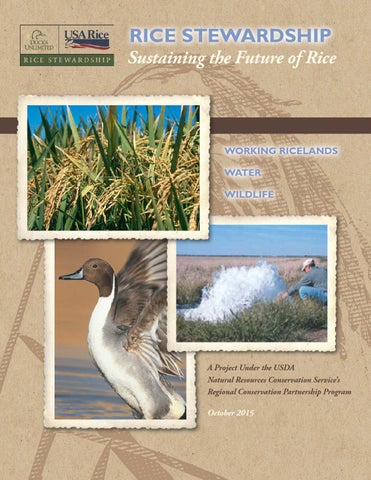
RICE STEWARDSHIP Sustaining the Future of Rice
WORKING RICELANDS WATER WILDLIFE
A Project Under the USDA Natural Resources Conservation Service’s Regional Conservation Partnership Program
October 2015
OUR VISION REMAINS UNCHANGED, AND WITH PROOF OF PROGRESS OVER THE LAST TWO YEARS, WE HAVE A SOLID FOUNDATION FOR POSITIVE CONSERVATION OUTCOMES GOING FORWARD.
RICE STEWARDSHIP: SUSTAINING THE FUTURE OF RICE
More information on conservation values of ricelands, including 2014 National Rice RCPP proposal, can be found at www.ducks.org/ricelands
USA Rice and Ducks Unlimited, Inc. (DU) formed a strategic partnership in February 2013, with a vision to conserve three critical natural resources in North America; working ricelands, water, and wetland wildlife. As the most widely consumed grain, rice, sustains about half of the world’s population and is a critical dietary staple on which billions depend. Water, our most valuable natural resource, must be conserved for the environment, agriculture, and industry. Wetland wildlife such as ducks and geese thrive on riceland habitats which are estimated to provide up to 35% of the forage needed across primary migration and wintering landscapes.
New Approach – More Partners The 2014 Farm Bill authorized the Natural Resources Conservation Service (NRCS) to create the new conservation program known as the Regional
The distribution of U.S. rice production regions relative to the most important areas for wintering waterfowl in North America. Areas of rice production within a Joint Venture are indicated by cross-hatching.
Conservation Partnership Program (RCPP). The RCPP competitively awards funds to conservation projects designed by local partners specifically for their regions. Eligible partners include universities, non-profit organizations, local and tribal governments and others joining with agricultural and conservation organizations and producers to invest money, manpower and materials to their proposed initiatives. With participating partners investing along with the NRCS, $1.2 billion in funding over the life of the five-year program can leverage an additional $1.2 billion from partners for a total of $2.4 billion for conservation; $400 million in NRCS funding was made available in 2014, with approximately $200 million per year thereafter. Through RCPP, partners propose conservation projects to improve water use efficiency, water quality, wildlife habitat, and other related natural resources on private lands.
WORKING RICELANDS, WATER & WILDLIFE USA Rice and Ducks Unlimited along with 40-plus agriculture and conservation partners were successful in securing $10 million in RCPP funding to benefit rice producers across all rice producing states. The project proposal – Rice Stewardship Partnership - Sustaining the Future of Rice – provides NRCS funding to rice producers for the planning, design and delivery of conservation practices on working ricelands. The funding bolsters the Environmental Quality Incentives Program (EQIP) starting in 2016.
First of its kind – this is the first time that an entire commodity crop worked to establish a conservation program developed solely for its producers. The project offers rice producers several onfarm conservation options focused on water quantity, water quality, and wildlife habitat, all while trending to a better bottom line.
State By State Approach & Connection to NRCS Field Offices Specific National Rice RCPP sign-up dates for EQIP will vary state by state beginning as early as mid-August 2015. USA Rice, DU, NRCS, and partners will notify rice producers of the specific dates as they are set. Interested rice producers will sign-up in local NRCS Field Offices as normal and inform NRCS that the application falls under National Rice RCPP - Rice Stewardship Partnership - Sustaining the Future of Rice. These new RCPP funds are in addition to regular EQIP funding in the rice producing states. Also in order to ensure RCPP funds go to rice producers, and as many rice producers as possible, USA Rice, DU, and NRCS are developing state-specific screening and ranking criteria targeted to working ricelands and water and wildlife conservation.
Increasing the level of conservation planning is the cornerstone of this RCPP effort with the goal of implementing conservation practices and management regimes that conserve the three linked resource concerns of water quantity, quality, and wildlife habitat.
Working with NRCS or partner planners, producers will select EQIP practices specifically tailored for their operations. While the full suite of NRCS practices will be available, many common practices from
PARTNERS USA Rice and Ducks Unlimited proudly thank the following organizations for their support and for being partners in this effort (* reflects key cash contributions): Agri Drain Corporation
Louisiana Rice Research & Promotion Board
Arkansas Assn. Conservation Districts
Lower Colorado River Authority
Irrigation Practices
American Rice Inc.*
Lower Mississippi Valley Joint Venture
Irrigation Pipeline EQIP 430
Anheuser Busch
Louisiana State University AgCenter
Irrigation Reservoir EQIP 436
Arkansas Rice Federation
MacDon Industries*
Irrigation Water Management EQIP 449
Arkansas Rice Research & Promotion Board
Mars
Irrigation Land Leveling EQIP 464
Arkansas Chapter – The Nature Conservancy
Mississippi Rice Research & Promotion Board
Pumping Plant EQIP 533
BASF*
Missouri Department of Conservation
Bunge North America
Missouri Rice Producers Group
California Rice Research & Promotion Board
National Fish & Wildlife Foundation
California Rice Commission
Northern California Water Assn.
Central Valley Joint Venture
Riceland Foods
Delta Council
RiceTec
Delta Plastics
Syngenta
Delta Wildlife
Texas Parks & Wildlife Department
Dow AgroSciences
Texas Rice Producers Legislative Group
Farmers Rice Mill*
The Climate Trust
Field to Market
The Rice Foundation
Garden Highway Mutual Water Company
Unilever
Gulf Coast Joint Venture
USA Rice Council
Early Succession
Horizon Ag
USA Rice Merchants’ Assn.
Habitat Management EQIP 647
Kellogg
USA Rice Millers’ Assn.
Louisiana Rice Mill
USA Rice Producers’ Group
rice growing regions are listed below:
Nutrient Management Grade Stabilization Structure EQIP 410 Drainage Water Management EQIP 554 Structure for Water Control EQIP 587 Nutrient Management EQIP 590 Integrated Pest Management EQIP 595
Wildlife Wetland Wildlife Management EQIP 644 Shallow Water Management for Wildlife EQIP 646
Louisiana Rice Growers Assn.
For more information, contact:
& *6/2+ 125)0360 &," ( !! & *5/0+ 561)//12 &, " ( & *4/0+ 2/0)2020 &( , (" ( #
& *6/2+ 125)0360 &," ( !' *805+ 740)4244 # !', " ( & *805+ 012)3456 ( &, (" ( #
& *6/2+ 125)0360 &," ( *226+ 3/7)2177 , " ( !! $ *207+ 512)0347 !!( $ , (" ( #
& *6/2+ 125)0360 &," ( # ! *551+ 575)226/ , ! $ ( & *5/0+ 854)41/4 %1000 &( , (" ( #
& *6/2+ 125)0360 &," ( *462+ 123)1021 %067 , " ( " ! *462+ 765)8252 " !( , (" ( #
& *6/2+ 125)0360 &," ( !! *721+ 582)7628 , " ( *143+ 631)8770 ( ,!%(" ( #
2014 National Rice – Regional Conservation Partnership Program
RICE PRODUCTION COUNTIES