OCTOBER 30, 2026 | VOLUME 29 | ISSUE 22
Farm Bureau Press A PEEK INSIDE
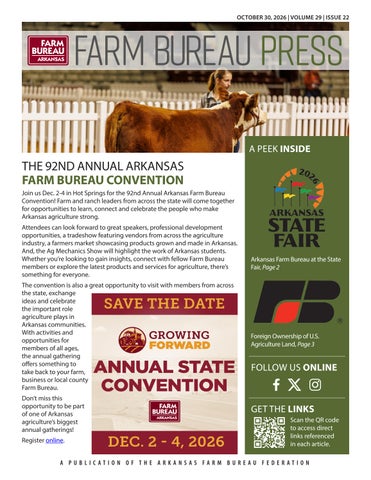
THE 92ND ANNUAL ARKANSAS FARM BUREAU CONVENTION Join us Dec. 2-4 in Hot Springs for the 92nd Annual Arkansas Farm Bureau Convention! Farm and ranch leaders from across the state will come together for opportunities to learn, connect and celebrate the people who make Arkansas agriculture strong. Attendees can look forward to great speakers, professional development opportunities, a tradeshow featuring vendors from across the agriculture industry, a farmers market showcasing products grown and made in Arkansas. And, the Ag Mechanics Show will highlight the work of Arkansas students. Whether you’re looking to gain insights, connect with fellow Farm Bureau members or explore the latest products and services for agriculture, there’s something for everyone. The convention is also a great opportunity to visit with members from across the state, exchange ideas and celebrate the important role agriculture plays in Arkansas communities. With activities and opportunities for members of all ages, the annual gathering offers something to take back to your farm, business or local county Farm Bureau. Don’t miss this opportunity to be part of one of Arkansas agriculture’s biggest annual gatherings! Register online.
Arkansas Farm Bureau at the State Fair, Page 2
Foreign Ownership of U.S. Agriculture Land, Page 3
FOLLOW US ONLINE
GET THE LINKS Scan the QR code to access direct links referenced in each article.
A PUBLICATION OF THE ARKANSAS FARM BUREAU FEDERATION
ARKANSAS FARM BUREAU AT THE STATE FAIR Agriculture is central to the Arkansas State Fair. Dating back to its earliest years in the late 19th century, the fair provides a place to showcase the state’s crops and livestock. In 1937, state leaders established the Arkansas Livestock Show Association to formalize the agricultural focus, and the first official livestock exposition was held in 1938. Over the years, the Little Rock fairgrounds expanded to include barns and exhibition halls for cattle, pigs, poultry and horses. Youth agriculture programs, particularly the Junior Livestock Program, also grew in importance, helping educate Arkansans and promote modern farming practices. Arkansas Farm Bureau is a longtime supporter of the fair’s agricultural mission, with a particular focus on youth livestock and exhibition programs. In 2005, ArFB became the primary sponsor and coordinator of the Purple Circle Club, a longstanding honor society recognizing top youth livestock exhibitors. Today, ArFB continues to support the fair through production assistance and staff, agricultural storytelling, promotion of Arkansas agriculture and support for the Sale of Champions. The organization also highlights the experiences that make the fair unique, helping connect fairgoers with the farmers and food systems that sustain communities. ArFB remains committed to encouraging the next generation of Arkansas farmers and keeping agriculture at the heart of the fair. Explore more Arkansas State Fair coverage on ArFB’s social channels or view additional photos here.
2
A PUBLICATION OF THE ARKANSAS FARM BUREAU FEDERATION
This competition is evaluated on an exchange of ideas and information on a pre-determined topic. The judges look for the competitor who offers constructive criticism, cooperation and communication while analyzing agricultural issues and developing solutions. The 2026 Discussion Meet will be held Dec. 2 and 3 at the Arkansas Farm Bureau Annual Convention in Hot Springs. The deadline to enter is Nov. 13. Applications can be found online, and Discussion Meet questions can be found here. The 2026 winner receives an all-expenses-paid trip to the American Farm Bureau Annual Convention, on Jan. 8-13, 2027 in Charlotte, North Carolina.
Arkansas Farm Bureau Annual Convention
Applications are open for the 2026 Young Farmers & Ranchers Discussion Meet competition. The Discussion Meet simulates a committee meeting where discussion and active participation are expected from each participant. By participating, young men and women build basic discussion skills, develop a keen understanding of important agricultural issues and explore how groups can pool knowledge to reach consensus and solve problems. The Discussion Meet provides young men and women opportunities to strengthen their ability to analyze agricultural issues and decide on solutions.
2026 YF&R Discussion Meet
2026 ARFB YOUNG FARMERS AND RANCHERS DISCUSSION MEET APPLICATIONS NOW OPEN
Dec. 2, 2026 | 10 a.m. Hot Springs Convention Center
Final round to be held at 10 a.m. Dec.3 on the trade show stage.
Deadline to return applications is Nov. 13, 2026. Applications & details are available at arfb.com and your county office.
Prizes
1st Place receives $7,000 3 Runners Up each receive $500 Prizes courtesy of Southern Farm Bureau Life Insurance.
Winner receives an all-expenses-paid trip to the American Farm Bureau Annual Convention. The convention will be held Jan. 8-13, 2027 in Charlotte, N.C. Discussion Meet questions, resource materials and other information can be found on arfb.com under the Young Farmers & Ranchers tab.
FOREIGN OWNERSHIP OF U.S. AGRICULTURAL LAND STILL GROWING The Agricultural Foreign Investment Disclosure Act of 1978 requires foreign entities to self-report purchases, sales and other interests in U.S. agricultural land to USDA’s Farm Service Agency. Reporting is mandatory, with penalties of up to 25% of the land’s fair market value. It relies on self-reporting, and enforcement that has historically been limited. USDA has proposed regulatory changes to broaden categories that require reporting and increase penalties for non-compliance. Agricultural land reported under AFIDA includes cropland, pastureland and forestland. Reportable interests include purchases and leases of 10 years or more, so a foreign-held acre is not always a foreignowned acre. Much of the land tied to wind and solar projects is leased from U.S. landowners who still own the land. According to USDA’s 2024 AFIDA report, foreign investors held interests in approximately 47.24 million acres of U.S. agricultural land, an increase of roughly 2.34 million acres compared to 44.9 million acres in 2023. This represents an increase of approximately 3% over the previous year. Foreign-held acreage has increased substantially since 2010, when foreign investors held approximately 24.8 million acres. The 2024 total represents an increase of approximately 22 million acres, or 90%, over that period. Land use remains an important distinction. Forestland accounted for approximately 22.2 million acres of foreign holdings in 2024, nearly half of the reported acreage. Cropland accounted for approximately 13.7 million acres, with the remainder consisting largely of pastureland and other agricultural land. The large share of forestland reflects substantial investment by foreign-owned timber and forest products companies. It also underscores why foreign agricultural land holdings should not be interpreted exclusively as foreign purchases of actively cultivated farmland. Read more of American Farm Bureau’s report here. A PUBLICATION OF THE ARKANSAS FARM BUREAU FEDERATION
3
MARKET NEWS as of October 28, 2026 Contact Brandy Carroll
brandy.carroll@arfb.com
Tyler Oxner
tyler.oxner@arfb.com
Addie Stamps
addie.stamps@Arfb.com
Rice Rice futures continue to trend higher. Export demand improved, with net sales last week up 58% from the previous week at 69,000 metric tons for 26/27 delivery. Mexico, Haiti, and Canada were the top destinations for Arkansas rice. The crop has been harvested, and milling yield reports are again disappointing. In the monthly WASDE, USDA cut the yield estimate by 22 pounds per acre, resulting in a 500,000-cwt. cut in the production estimate, and poor milling yields will further cut the amount of whole-grain rice available. The continued El Nino weather pattern has the market concerned about production potential in Asia. As a result of these supply-side concerns, January rice has traded to a high of $18.21, the highest price on a front-month basis in 2.5 years. Soybeans Soybean harvest is winding down, with 79% of the crop in the bins as of Oct. 25. In Arkansas, farmers have harvested 91% of the crop. The market has clearly topped and continues to work lower. The October production report increased the yield estimate by 0.3 bushels/ acre, increasing the production estimate to 4.562 billion bushels, but anecdotal yield reports suggest this is still too low, and we can expect UDSA to increase the yield estimate in future reports. Export sales have improved significantly—with the largest weekly sales total in nearly three years coming in mid-October. China is back in the market after buying no beans from the U.S. for an entire marketing year, having now 4
purchased 494 million bushels. That is over 50% of their stated target for the year. November futures are currently testing long-term trendline support, and a close below that trendline near $12.28 would signal further losses are likely. Corn Corn harvest progress has slowed considerably over the last several weeks, marking the slowest pace for this date since 2019 and trailing the five-year average by a notable 11%. It remains unclear what final impact this prolonged harvest timeline will ultimately have on overall national yields. Field results emerging from Nebraska and Indiana continue to indicate disappointing yield numbers, while early reports out of Iowa remain highly spotty and inconsistent. Market attention stays firmly focused on incoming U.S. harvest data, near-term export demand trends and early-season South American weather conditions as producers in Brazil and Argentina navigate rising input costs and expanding acreage. On the charts, corn futures have yet to establish a confirmed bottom. As December futures moved lower to start the week, the primary downside technical support target shifts directly toward the June lows around the $4.30 mark. Cotton December cotton futures broke out of their recent consolidation range to the downside, closing below the key 200-day moving average to signal growing technical weakness. Seasonal harvest pressure continues to weigh heavily on price action, with national harvest reaching 41% complete as of October 18 and making significant forward progress over recent days. Despite this accelerating harvest pace, widespread questions remain regarding quality following excessive rainfall events in late September and early October across west Texas, Georgia, and the Delta. Traders are keeping a close watch on cash
A PUBLICATION OF THE ARKANSAS FARM BUREAU FEDERATION
market premiums and loan values as ginning activity picks up speed across the Cotton Belt, though sluggish export demand and broader economic headwinds continue to cap any meaningful rally attempts. Wheat Wheat futures have experienced extreme volatility since June, with March Chicago futures rallying from $6.15 to over $8.00 before tumbling back down toward the $6.20 level. Domestically, the primary drag on the market continues to be an exceptionally weak U.S. export pace. Current sales are running significantly behind last year’s level and the fiveyear average, falling well short of the pace needed to hit the USDA’s official export projection, which is already the second-smallest target since the 1971-72 marketing year. Global competition remains intense as cheaper Black Sea supplies continue to undercut U.S. origin grain in major destination markets. From a technical view, the chart leaves little doubt that a major market top was established nearly two months and two dollars ago, leaving futures vulnerable to further downside testing. Cattle Cattle markets strengthened over the past two weeks, USDA’s fedcattle prices increased, while supply remains limited. USDA reduced its beef-production forecast slightly due to slower anticipated slaughter pace while raising its 2026 cattle-price outlook to reflect recent strength. The October Cattle on Feed report also showed September placements down 12% and marketings down 7% from last year, the lowest September totals since reporting began in 1996. Tighter supplies should continue supporting cattle prices, although USDA raised its beef-import forecast following the reopening of two ports of entry.
EDITOR Shaylee Wallace Barber shaylee@arfb.com