FARM, FOOD & NATIONAL SECURITY ACT PASSES THE HOUSE
The farm bill is a critical tool for ensuring our nation’s food supply remains secure. Funding for this comprehensive package includes risk management tools for farmers, access to nutrition for low-income families, conservation programs, and investments in agricultural research.
Farming is a difficult business, yet critical to the well-being of our nation. It’s often stated that food security is national security. Few pieces of legislation are more significant than the farm bill when it comes to ensuring our food system is secure. Agriculture is strategically important to the survival of the United States. Our nation’s economy, energy, environment and national security are dependent upon the viability of the agricultural industry. Agriculture must be treated as a strategic resource by our nation and reflected as such in local, state and national government policies.
The One Big Beautiful Bill Act (OBBBA) reconciliation package, was enacted on July 4, 2025, and invested $66B in farm programs. Although the OBBBA included much-needed farm program investment, Congress still must pass a comprehensive farm bill to address numerous programs that are critical to the success of farmers and ranchers.
The food and farm bill has been a bipartisan effort in the past, presenting an important opportunity for lawmakers to rise above partisanship and work together again to pass legislation that protects food security for all Americans and the future success of our farmers and ranchers.
On Thursday, April 30, the U.S. House of Representatives passed a 5-year, bipartisan and modernized farm bill that provides stability and ensures farmers can continue to provide food, fiber and fuel that all American families rely on.
Now, farmers and ranchers await the release of the Senate Agriculture Committee’s version of the bill in coming weeks. A conference committee from both chambers must then both be formed to negotiate a final farm bill, with each chamber passing the identical reconciled bill before it can be sent to the President to be signed into law.
Continued on page 2
2026 County Farm Families of the Year Announced, Page 3
Two Arkansans Graduate AFBF’s Communication Boot Camp, Page 3
Scan the QR code to access direct links referenced in each article.
FARM, FOOD & NATIONAL SECURITY ACT PASSES THE HOUSE
Continued from page 1
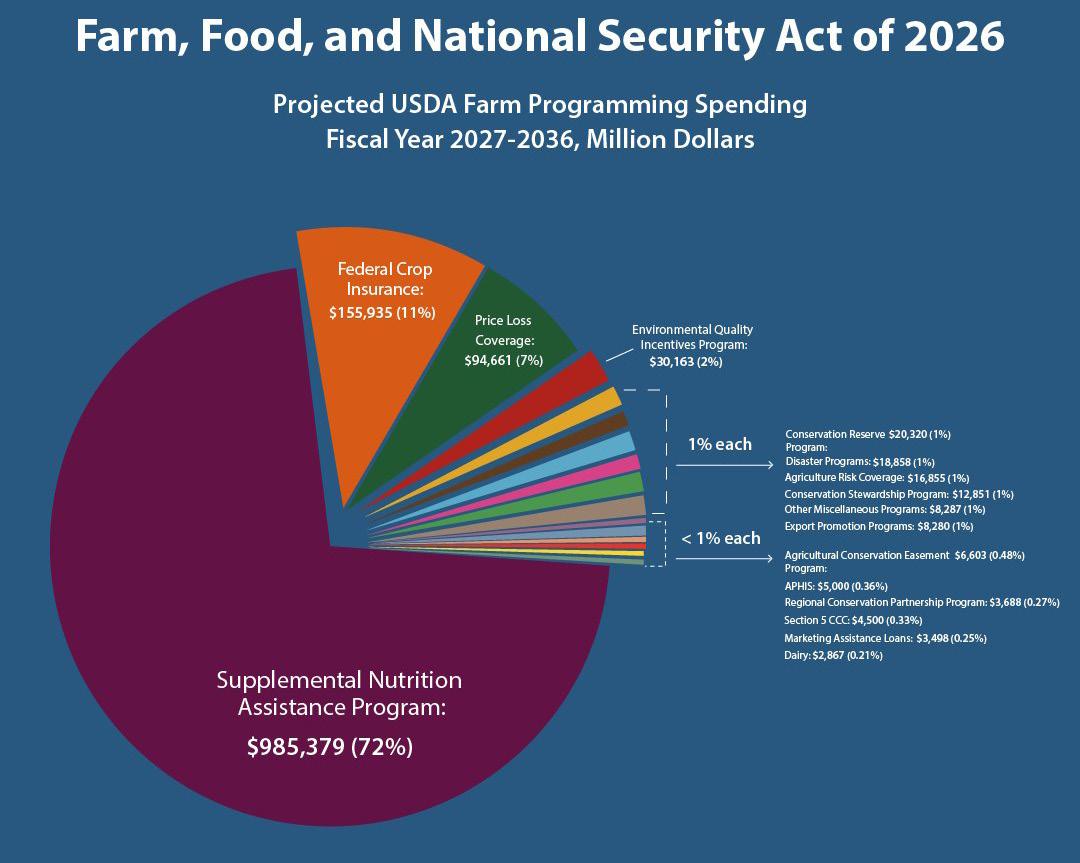
American Farm Bureau Federation President Zippy Duvall commented on the House of Representatives vote to pass the Farm, Food, and National Security Act of 2026.
“Farmers and ranchers applaud the House of Representatives for passing a new, modernized farm bill. We appreciate Chairman G.T. Thompson’s leadership to get this done. After three years of extensions and eight years since a farm bill was passed, we’re grateful the House found a bipartisan path forward. Important updates to research and conservation, as well as increased loan limits and clarity on interstate commerce, will help farmers survive today’s challenges and give them the tools to thrive in the future.
“We urge the Senate to follow the House’s lead and move this important bipartisan legislation forward. Food security is national security, and investing in America’s farmers and ranchers is an investment in America’s families. We all benefit from a reliable and affordable food supply.”
Arkansas Farm Bureau would like to thank all four members of the Arkansas delegation in the House of Representatives, Congressmen Crawford, Hill, Westerman and Womack, for voting to pass the bipartisan Farm, Food and National Security Act of 2026. Their support demonstrates their commitment to the Natural State’s top industry, and the farmers and ranchers who keep it moving every day.
Read more about why the farm bill matters for everyone here.
2026 COUNTY FARM FAMILIES OF THE YEAR
ANNOUNCED
The Arkansas Farm Family of the Year program announces its 2026 County Farm Families of the Year. The Arkansas Farm Family of the Year program has helped recognize outstanding farm families throughout the state since 1947. The objectives of the Farm Family of the Year program are:
• To give recognition and encouragement to farm families who are doing an outstanding job on their farm and in their community;
• To recognize the importance of agriculture in the community and state; and
• To disseminate information on improved farm practices and management.
Arkansas Farm Family of the Year selection criteria includes efficiency of production, conservation of energy and resources, leadership in agricultural and community affairs, home and farm improvement, and home and farm management. The program is open to all counties and is voluntary. Participation varies, explaining why not all counties have a recipient.
Read the full list of County Farm Family of the Year Recipients online
TWO ARKANSANS GRADUATE AFBF’S WOMEN’S COMMUNICATION BOOT CAMP
Twelve farm and ranch women leaders graduated from the spring session of Women’s Communications Boot Camp hosted by the American Farm Bureau Federation. Arkansas Farm Bureau would like to congratulate Kelsey Prothro and Margie Raimondo, two Arkansans who were among the graduates!
The agricultural leaders completed an intensive four-day course that featured hands-on sessions focused on public speaking, working with the media and messaging. Program graduates will use their training to strategically support issues important to farmers and help tell agriculture’s story.
Read more here
Kelsey Prothro of Madison County was one of twelve women to graduate from AFBF’s Women’s Communication Boot Camp.
Margie Raimondo of Pulaski County was one of twelve women to graduate from AFBF’s Women’s Communication Boot Camp.
MARKET NEWS
as of April 15, 2026
Contact
Brandy Carroll brandy.carroll@arfb.com
Tyler Oxner tyler.oxner@arfb.com
Rice
Dry conditions have resulted in farmers being able to get in the field early. As of April 26, 79% of intended acres were planted in Arkansas, well ahead of the 5-year average of 54%. Over 50% of the crop has emerged and some has been fertilized and recent rains will help farmers flood those fields. The changing weather pattern brought much needed moisture but didn’t completely erase drought concerns in many areas. One of the big questions hanging over the market is exactly how many acres actually get planted to rice— will Arkansas plant the one million acres UDSA projects, or will we drop below that number for the first time in 50 years? A recent American Farm Bureau survey showed that less than 15% of Arkansas farmers had prepurchased fertilizer before prices spiked. That sharp increase in the cost of production makes break-even prices/yields difficult to reach, and more acres may shift from rice to soybeans. July futures have recently fallen through support at $11, leaving the market vulnerable to a downside move to close the February gap between $10.61 and $10.68.
Soybeans
Old-crop soybean prices are trending mostly sideways between support at $11.60 and resistance at $12. Newcrop November is trending slightly higher, but with tough resistance at $11.75. Both contracts have seen bearish key-reversals charted in recent weeks with little followthrough, but it is possible the recent market consolidation will turn out to
be a bear flag formation, indicating additional downside potential. There is a lot of speculation about just how big the soybean crop will be, with many analysts expecting the final total to be at least a million acres above the March prospective plantings total of 84.7 million acres. According to a survey by AFBF, 33% of farmers in the Mid-west didn’t prebook any fertilizer prior to recent price increases of 20-40%, and there are reports farmers returning corn seed in favor of soybean seed because the cost of production for corn is now simply too high and they can’t afford the fertilizer it will take.
Corn
Early season planting progress and shifting acreage expectations are setting the tone in the corn market. Recent USDA Crop Progress data shows a rapid pace of soybean planting across southern states, which is raising concerns that soybeans could pull acres away from corn as producers respond to elevated input costs. Some analysts have already trimmed planted acreage expectations slightly from USDA’s 95.3 million acres estimate to around 95.0 million, though it is still early and these figures remain fluid. Using a 95 million acre scenario and a trendline yield of 185.3 bushels per acre, projected ending stocks would fall from 1.648 billion bushels to 1.575 billion. That shift would push the stocks to use ratio below 10%, a level that historically supports stronger price potential. On the price side, both September and December futures are testing their March highs near $4.80 and $5.00. Planting progress is also ahead of normal, with 25% of the 2026 crop in the ground compared to 22% last year and a fiveyear average of 19%.
Cotton
Cotton markets have paused after a strong rally, with the December contract moving into a more sideways trading pattern after breaking above 80 cents. The market is viewed as technically overbought
following a sharp 1,400 point rally over six consecutive weeks without a meaningful pullback. In situations like this, markets often correct either through lower prices or by trading sideways to allow fundamentals to catch up. Some traders believe a period of consolidation would help support a more sustainable move higher later on. Planting progress is slightly ahead of normal, with USDA reporting 16% of the crop planted compared to 14% last year and a fiveyear average of 13%.
Wheat
Wheat futures have moved higher as adverse weather in key western growing regions continues to stress crop conditions. Prices have pushed through key resistance levels and are approaching new contract highs, supported in part by increased fund buying. While technical indicators suggest the market is overbought, that has not slowed the current momentum. Fundamentally, the rally is being driven by deteriorating crop conditions. USDA rates only 30% of the crop as good to excellent, unchanged from last week, while 35% is rated poor to very poor, up two points. This is a notable decline from last year when 49% of the crop was rated good to excellent, reinforcing concerns about overall production potential.
Cattle
Cattle futures remain in an uptrend, despite some recent weakness amid speculative profit-taking and softer cash markets. News that USDA will not re-open the Texas border to Mexican feeders in the near futures provided support. June has support at $240.93, and a close below that level would violate the uptrend and open the market to further weakness.