As Americans prepare to celebrate the Fourth of July and mark the nation’s 250th anniversary, many families will gather in a familiar way: around the grill with burgers, sides, lemonade and dessert.
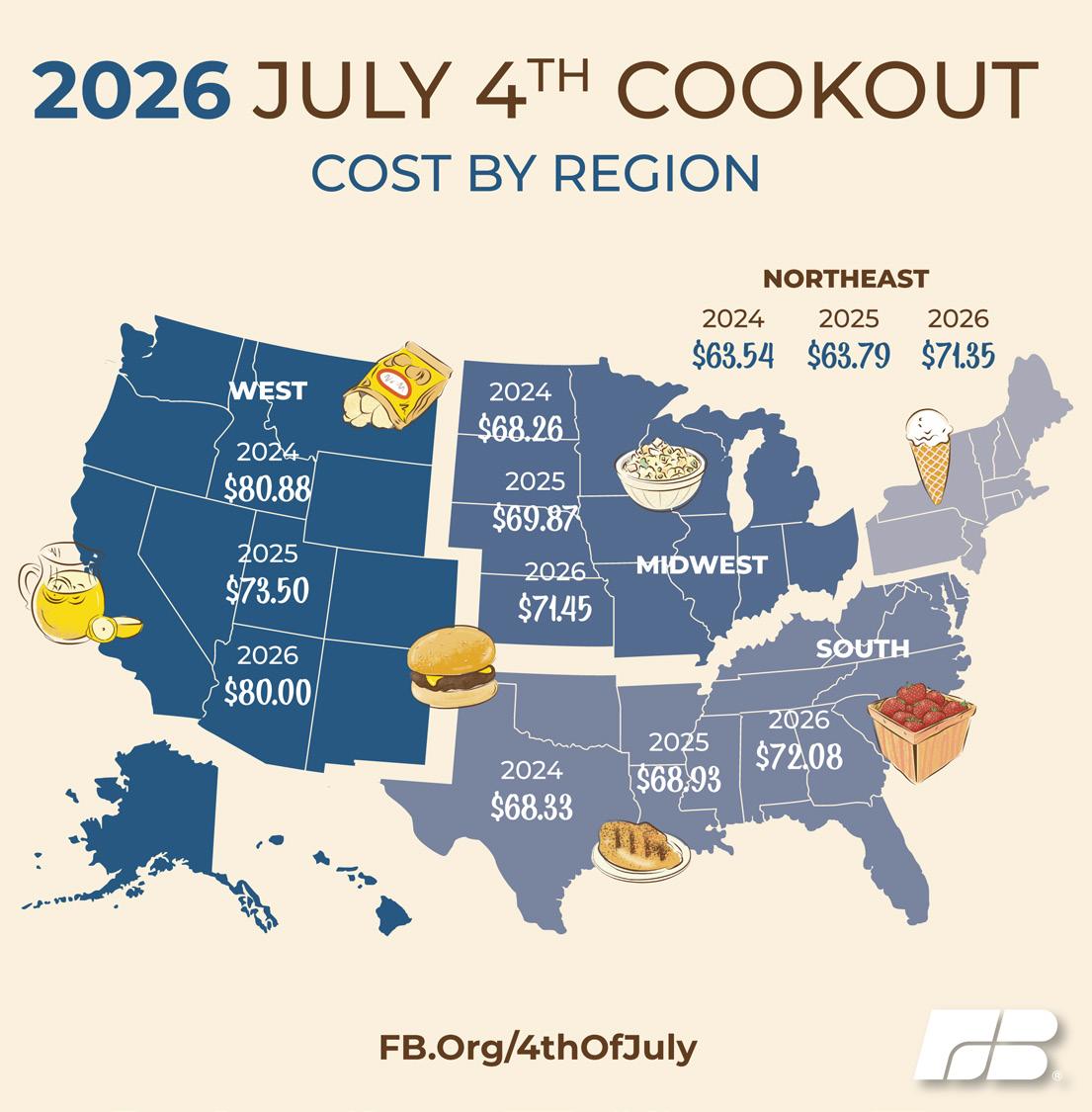
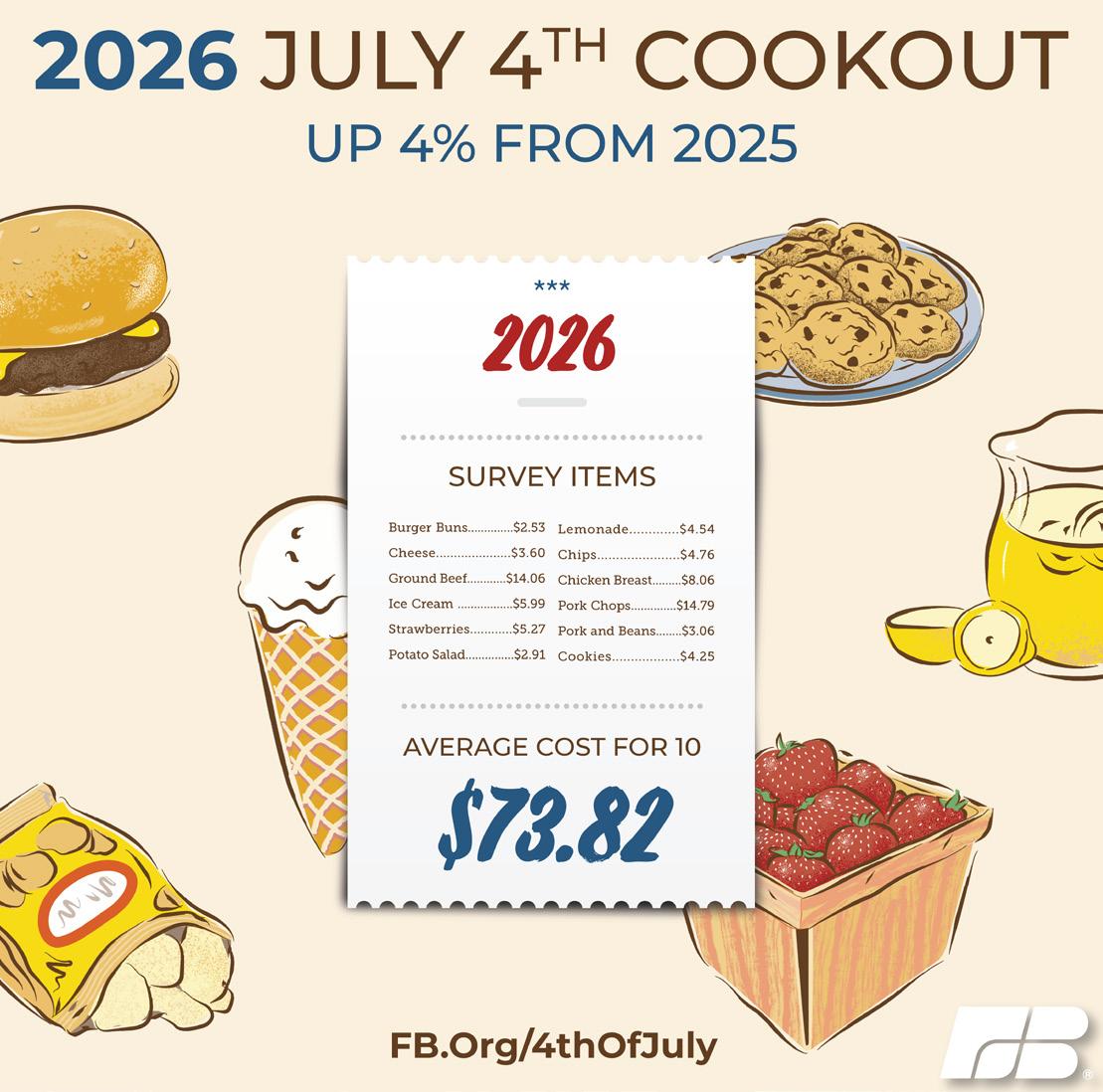
According to the American Farm Bureau Federation’s 2026 Summer Cookout Cost Survey, a classic Independence Day cookout for 10 people will cost $73.82, or about $7.38 per person. That is an increase of $2.90, or 4%, from last year.
The grocery basket includes summer cookout staples such as hamburgers, cheese, chicken breasts, pork chops, potato chips, pork and beans, fresh strawberries, homemade potato salad ingredients, fresh-squeezed lemonade ingredients, chocolate chip cookies and ice cream.
While this year’s total is the highest since Farm Bureau began conducting the summer cookout survey in 2016, the increase closely reflects broader inflation. The cost of the cookout basket rose about 4%, while overall inflation in the United States
Continued on page 2
2026-27 Women’s Leadership Pop Tab Challenge, Page 2
2027 Arkansas Farm Trail Applications Open , Page 3
FOURTH OF JULY COOKOUT COSTS REFLECT INFLATION
Continued from page 1
increased 4.2% over the 12 months ending in May. That means families are seeing higher prices at the grocery store, but this year’s cookout cost is generally moving in line with the broader economy.
Inflation–Adjusted Cost
The sticker price of a Fourth of July cookout is higher this year, but inflation-adjusted figures provide perspective. When deflating the value using the Consumer Price Index (CPI), the cost of the basket is $22.03 in 1982-84 dollars, slightly lower than the $22.06 observed in 2025. On a per-person basis, the inflation-adjusted cost is $2.20, compared to $2.21 last year.
In other words, while families are paying more dollars at checkout, the purchasing-power cost of the basket is nearly flat from last year. Inflation-adjusted cookout costs have also remained relatively stable over the last several years and remain below the peak of $23.84 reached in 2022. Read more online.
ARFB WOMEN’S LEADERSHIP COMMITTEE
ANNOUNCES 2026-27 POP TAB CHALLENGE
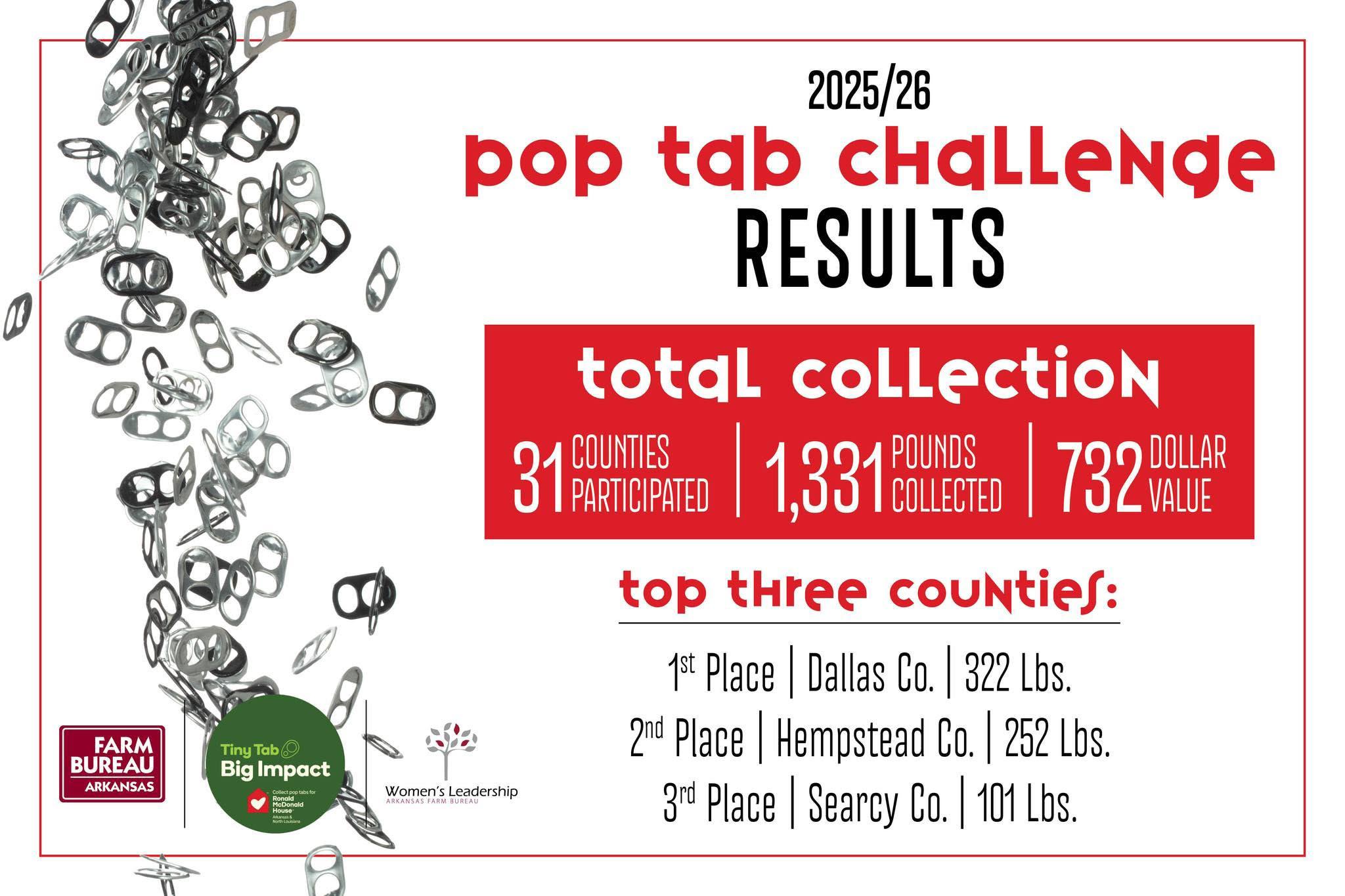
During the 2025–26 year, county women’s leadership committees and county Farm Bureaus collected more than 1,300 pounds of pop tabs, generating over $730 for Ronald McDonald House of Arkansas and North Louisiana. These small contributions make a meaningful impact—funds raised through recycling support a “home
away from home” for families with children receiving medical care in hospitals across our region.
To continue this important effort, the State Women’s Leadership Committee is proud to sponsor the Pop Tab Challenge again this year. Counties will be recognized for collecting and donating the highest total weight of pop tabs. Final collection and weigh-in will take place, Friday, April 16, 2027, during the 2027 Women’s Leadership Conference in Little Rock.
Prizes will be awarded to the top three counties:
1st Place: $300
2nd Place: $200
3rd Place: $100
Winners will be announced and recognized during the 2027 Women’s Leadership Conference.
Learn more online.
NEW WORLD SCREWWORM: WHAT ARKANSAS PRODUCERS NEED TO KNOW
The USDA confirmed the first New World screwworm case in the U.S. since 1966 on June 3, 2026. Since then, containment efforts have increased, with targeted sterile fly releases and increased surveillance. However, the case numbers and affected species continue to increase.
New World screwworm was eradicated completely in the continental U.S. by 1966, primarily via the sterile insect technique with help from the weather. Like horn flies, New World screwworm activity tends to decline in the colder months as the threshold for survival is 20 degrees Fahrenheit. However, for Mexico, and many southern states, temperatures don’t often drop to that level. The sterile insect technique is the only proven method to control fly populations. New World screwworm females only mate once in a lifetime, so when lab-raised, sterile males are released into the population and mate, a generation of flies doesn’t hatch, and we see a population reduction.
There is one sterile insect production facility in Panama, which is operated by the Panama-United States Commission for the Eradication and Prevention of Screwworm Infestation in Livestock, with two more in construction; one in Mexico and one in Texas. There are three dispersal facilities, two in Mexico and one in Texas. The aerial and ground release of flies occur in targeted locations, where there is a population of New World screwworm.
During the last outbreak, it took six years for the continental U.S. to fully eradicate the parasite. Knowing what we know now, how do we prepare? Ranchers should work with a veterinarian to create a fly management plan, which may include FDA-approved preventative products.
A wound as small as a tick bite can become infested, which makes monitoring animals essential. Livestock management practices such as castration, dehorning and branding put livestock at risk. Anyone calving in the upcoming months should check the navels of newborn animals. Keep an eye out for wounds and certain behaviors such as animals that appear sick, animals that isolate themselves, animals that become lethargic or stop eating, and animals shaking their heads or excessively scratching. It’s important to note that, while we typically think of New World screwworm affecting cattle, U.S. cases have included goats, sheep and a dog. If you own livestock and farm dogs or barn cats, check all animals. Report suspected cases to a veterinarian or the Arkansas Department of Agriculture for testing.
Read the latest Ag Insider here.
2027 ARKANSAS FARM TRAIL APPLICATIONS OPEN
Calling Arkansas direct-to-consumer farmers and ranchers! The Arkansas Farm Trail is back for another season, and expanding with more farms. Are you looking for a unique way to promote your local food business, increase sales and connect with consumers? The Arkansas Farm Trail is a passport program that brings consumers across the state directly to your farm.
By joining the program, you’ll be featured in ArFB’s Arkansas Farm Trail passport, which incentivizes Arkansans to visit farms and collect stamps to earn prizes. Our hope is that visitors will learn your farm’s story, purchase your products and learn firsthand where their food comes from.
ArFB’s Arkansas Farm Trail is focused on promoting the
production of local foods such as fruits and vegetables, grains and meat/animal products. Value-added products such as jams, jellies and pickles are included as well.
Slots on the 2026 farm trail are limited and may be selected based on factors including regionality, product diversification and other factors.
Learn more at arfarmtrail.com.
MARKET NEWS
as of June 24, 2026
Contact
Brandy Carroll brandy.carroll@arfb.com
Tyler Oxner
tyler.oxner@arfb.com
Rice
Rice futures have surged higher in recent days, despite other grains being under pressure from recent strength in the dollar. The rice crop is expected to be the smallest since the 1970s when the U.S. ended rice allotments, allowing anyone who wanted to raise rice. USDA will provide an update on planted acres on June 30. Riceland Foods, one of the world’s largest millers of rice, announced last week that they will close 9 of their 23 locations from receiving deliveries in 2026, a sure indication the industry is planning for an historically small crop. USDA says 71% of the U.S. crop is in good to excellent condition, while only 65% of the crop in Arkansas is in good to excellent condition as of June 21—before heavy rains across NE Arkansas left many fields under water. The September contract is leading the way higher as traders roll out of July positions. The market has resistance at the May high of $13.43 ½ and has so far been unable to challenge that resistance. The market is building support just above $12.
Soybeans
Soybean futures posted sharp gains last week, indicating that the market had put in a bottom for the time being. However, futures are now trading in a mostly sideways pattern between last week’s low of $11.34 ¾ and last week’s high of $11.58 ¼ in the November contract. 66% of the U.S. crop is rated good to excellent, while in Arkansas that total was 74% as of June 21, before torrential rains across NE Arkansas flooded fields, submerging small soybeans in the process. There are
indications that recent price declines have resulted in China purchasing U.S. beans, but sales remain 387 million bushels behind the previous marketing year, so small sales won’t make that much of a difference. Soy oil futures remain under pressure and will limit the upside potential of the market.
Corn
September corn futures have dropped roughly 70 cents since the highs in May, establishing a new point of support at a recent low of $4.14 after breaking trend support late last month. Technically, a 50% retracement from that $4.14 low would point toward a target of $4.53. This upside potential could easily be triggered by emerging summer weather concerns or a sudden spark in new export sales. On the demand side, traders are showing renewed optimism regarding Chinese interest in U.S. corn, a sentiment lifted by China’s new-crop soybean purchases last week. Moving forward, all eyes are on next week’s upcoming USDA June acreage report. Analysts do not anticipate a dramatic decline in corn acres. However, producers should note that any unexpected increase in acreage could easily trigger a breakdown below current support levels.
Cotton
The December cotton contract recently posted a sharp key reversal upward, fueled by technical buying and lingering anxieties over this year’s crop condition. After turning around from a 10-week low on June 11, the market rallied for five consecutive sessions. This upward momentum has stalled for now, meeting strong technical resistance around the 50-day moving average of 80 cents, while December chart support is holding at 78 cents. Looking ahead, cotton traders are shifting their focus to the June acreage report. Many analysts expect an increase in updated cotton acres, largely driven by memories of the 88-cent spring rally. Keep in mind that March planting estimates already came in higher than expected. Long-term price support remains intact, however,
as international producers continue to worry about El Niño’s negative impact on production in India and South America.
Wheat
Wheat price action has been exceptionally volatile lately. July Chicago futures aggressively rallied from $5.30 up to $6.80 before plunging back down to find temporary support at $5.80. Traders are actively increasing their bearish bets as Middle East geopolitical tensions ease, opening up energy trade. This, combined with healthy global reserves, has significantly calmed the market anxiety that previously pushed KC futures to two-year highs in May. Wheat prices face heavy pressure from plentiful global supplies. While heat stress in European crops bears watching, massive stocks on hand across major exporting nations remain the biggest burden for prices.
Cattle
The June Cattle on Feed report showed an inventory that was up 2% over June 1, 2025, at the low end of pre-report estimates. Placements were down 10% and marketings were down 12%, the second lowest for May since reporting began in 1996. The market seems to be focused on supply-side concerns, as futures consolidate into a sideways pattern. October has nearby chart resistance near $243.
Hogs
The long running downtrend in hog futures has been exhausted. October hog futures are now trading mostly sideways, consolidating above support just below $80 as traders even positions ahead of the quarterly Hogs and Pigs report that will be released at the end of the week. The composite pork cutout value continues to trend lower as the market struggles with weak domestic demand and slow export sales.