Farm Bureau Press
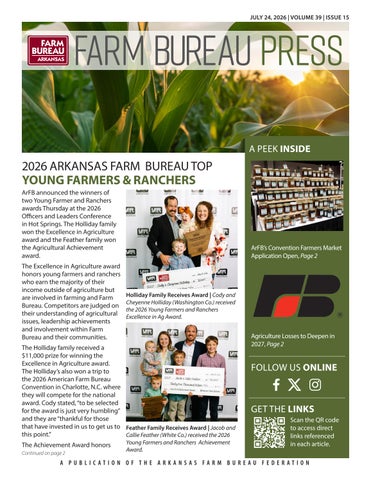
ArFB announced the winners of two Young Farmer and Ranchers awards Thursday at the 2026 Officers and Leaders Conference in Hot Springs. The Holliday family won the Excellence in Agriculture award and the Feather family won the Agricultural Achievement award.
The Excellence in Agriculture award honors young farmers and ranchers who earn the majority of their income outside of agriculture but are involved in farming and Farm Bureau. Competitors are judged on their understanding of agricultural issues, leadership achievements and involvement within Farm Bureau and their communities.
The Holliday family received a $11,000 prize for winning the Excellence in Agriculture award. The Holliday’s also won a trip to the 2026 American Farm Bureau Convention in Charlotte, N.C. where they will compete for the national award. Cody stated, “to be selected for the award is just very humbling” and they are “thankful for those that have invested in us to get us to this point.”
The Achievement Award honors Continued on page 2

ArFB’s Convention Farmers Market Application Open, Page 2


Continued from page 1
young farmers and ranchers who are involved in full-time production agriculture and have excelled in their farming/ ranching operations.
The competitors also show exemplary leadership skills.
The Feathers received a $35,000 award as well as a trip to the 2026 American Farm Bureau Convention to compete for the national award. Jacob stated, “We are honored to win this event and that Farm Bureau made this available and we were able to participate.”
The Feathers plan to use the prize money to expand their pecan cracking and shelling facility.
Read more here.
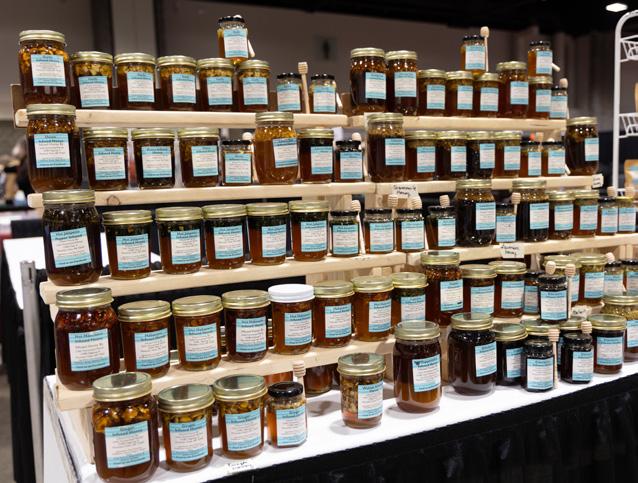
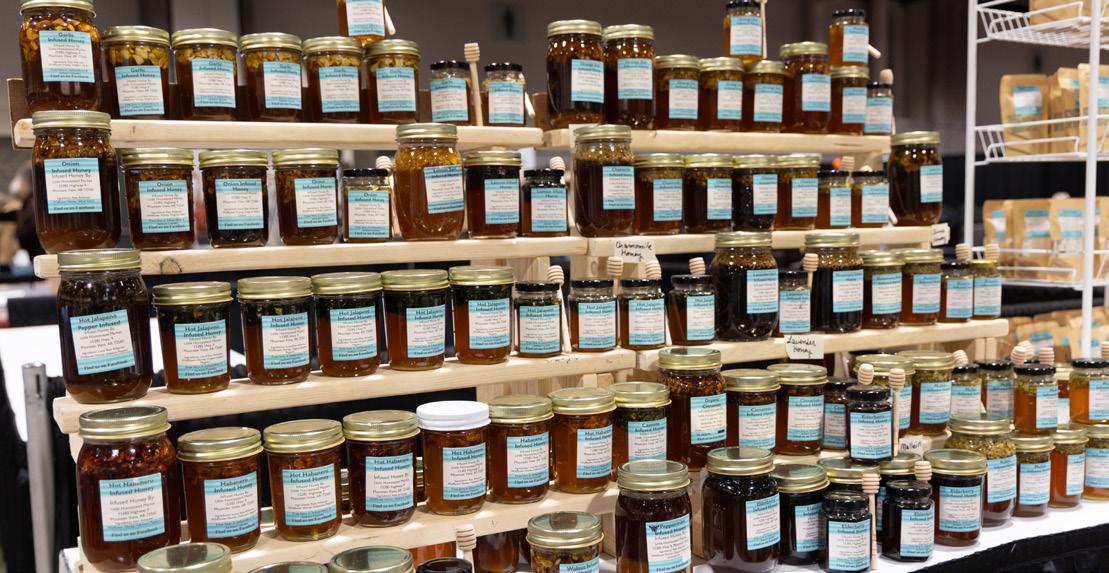
Arkansas Farm Bureau has announced the return of the Farmers Market at the 2026 ArFB State Convention and Trade Show! Entering its fourth year, the farmers market has become a popular feature of the convention, providing Arkansas farmers, food producers, artisans and small businesses with an opportunity to showcase and sell their products to convention attendees from across the state. Those interested can learn more and register here. The application window will close Aug. 28.
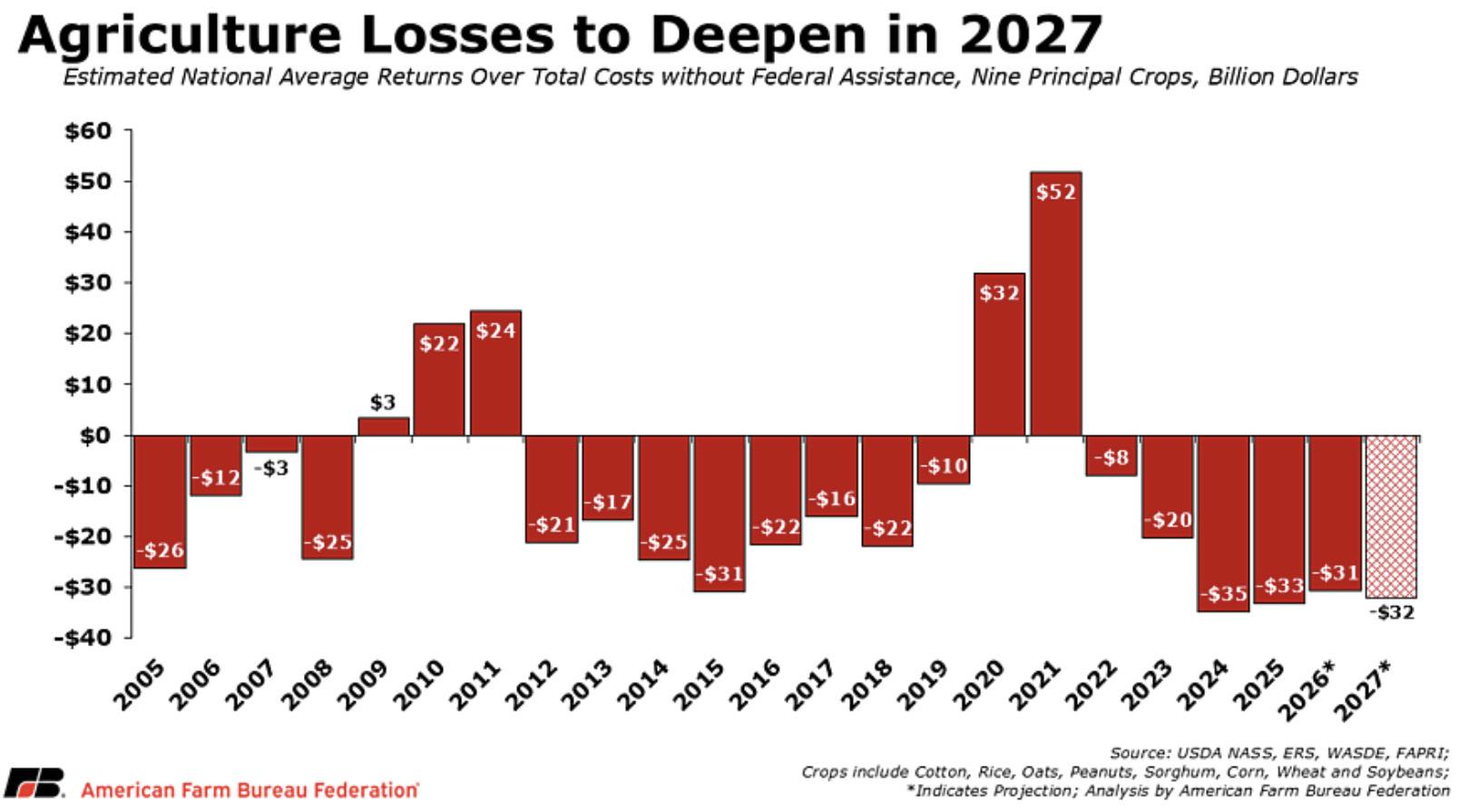
Crop farmers continue to face elevated production costs, lower commodity prices and tight margins with no relief on the horizon. AFBF analysis projects 2027 will mark a sixth year of negative returns over total costs for most major row crops. Specialty crop farmers are experiencing similar financial strain, facing expected below-breakeven prices and acreage reductions across major specialty crop sectors in 2026, even as limited public data make the full scale of losses difficult to measure. At the same time, fertilizer and fuel prices remain volatile, with the Iran conflict adding additional pressure to those markets.
Multiple years of high input costs, declining crop prices, trade uncertainty, global energy volatility and negative margins have weakened farm balance sheets and reduced working capital. Without additional support, more farmers will face difficult decisions about operating into the next crop year.
Near-term economic assistance is needed to help farm families offset losses and increased input costs intensified by geopolitical conflict.
Longer-term policy solutions are also needed to strengthen the farm economy beyond immediate assistance. Read more here.
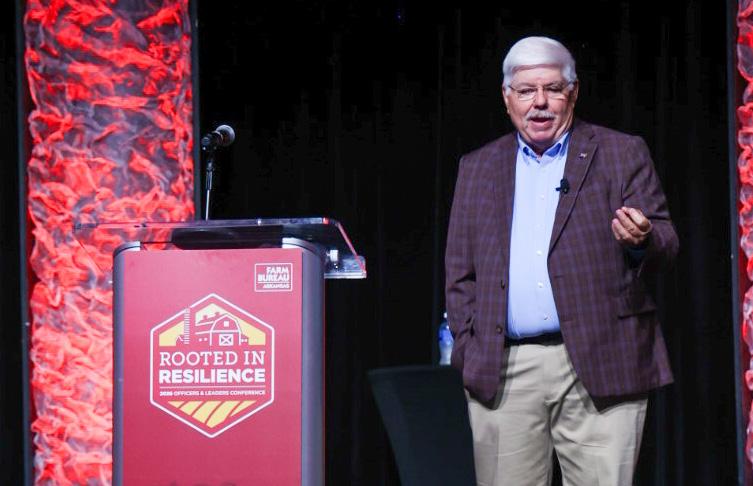
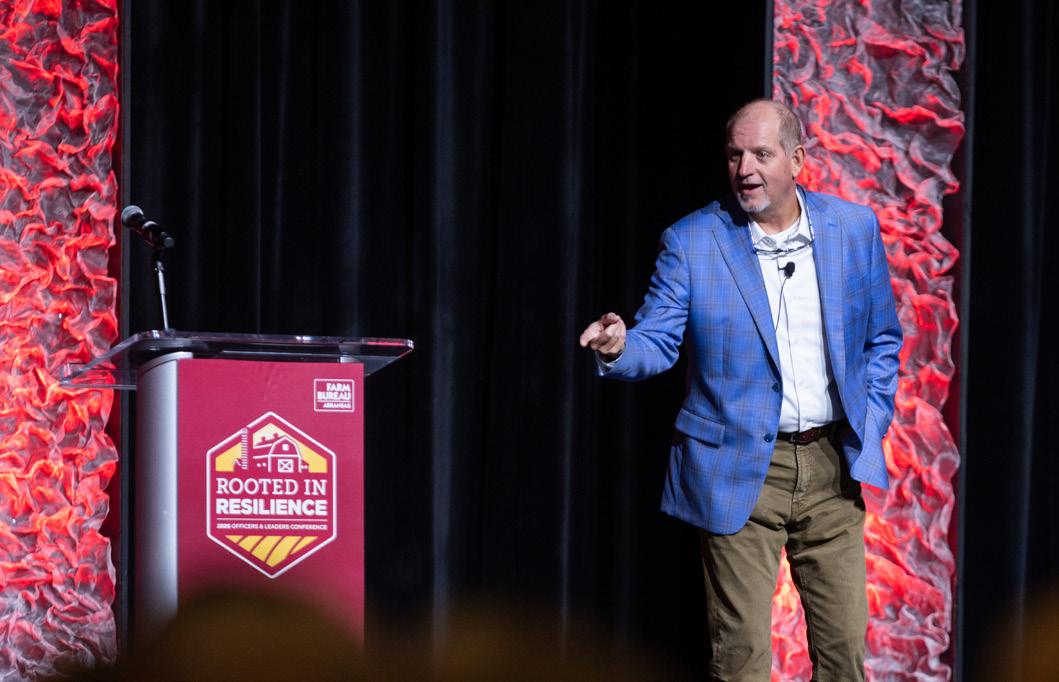
The 78th annual Officers and Leaders Conference wrapped up Friday, July 24 in Hot Springs. The two-day event offered attendees opportunities to build connections and expand their knowledge of agriculture innovations, policies, and advocacy.
A Thursday night Foundation Cookout was followed by an AgPAC reception featuring Congressman Rick Crawford’s band, Triple Nickel. They performed classic rock and country hits along with original songs. The conference concluded Friday with an inspiring message from Rev. Jason Franklin on what it means to be rooted in resilience. Click here to view the conference photos. See more about the annual conference below, and view the album here for all event photos!




as of July 22, 2026
Contact Brandy Carroll brandy.carroll@arfb.com
Tyler Oxner tyler.oxner@arfb.com
Rice futures are trending higher and prices made new 18-month highs this week. September set a new high of $14.40, and November traded as high as $14.82. Crop ratings declined this week, giving the market a boost. UDSA now says only 66% of Arkansas rice is in good to excellent condition. That is down from 76% just last week. Nationwide, 72% of the crop is in good to excellent condition, compared to 78% last week and 79% a year ago. Thanks to a dry spring, the crop is ahead of schedule, with 37% of Arkansas’s rice crop headed, compared with a five-year average of 28%. The July WASDE the first report to reflect the June 30 Acreage report. Projected all rice ending stocks of 30.9 million cwt and long grain ending stocks of 17.7 million cwt would reflect the lowest carryout since the 2019/2020 marketing year if realized.
Soybean futures have posted sharp gains, gapping higher on Monday after breaking out the top of a flag formation, suggesting the market has not yet found its top. Higher crude oil prices continue to support the oil side of the soy complex. Export demand has improved, also providing support. The July WASDE painted a mostly positive picture despite increased production. Beginning stocks for 26/27 were reduced by 10 million bushels, and exports were increased by 30 million bushels, completely offsetting the projected 40 million bushel increase in supply. Farmers have reported planting 85.365 million acres of soybeans in 2026,
up from 81.215 million in 2025. In Arkansas, farmers have seeded 3.2 million acres of soybeans, up from 2.59 million last year. That left both ending stocks of 310 million bushels and a projected on farm price of $11.40 unchanged.
It has been a wild ride recently for the corn market, with hot temperatures across the Corn Belt and Canadian smoke pushing prices in every direction. Fundamentally, the market has recovered above its expected average price for the year. Nearby basis remains strong, but that strength is absent in deferred positions as bear spreading pushes spreads back near 75% of full carry. While record yields are officially off the table, a total crop disaster is equally unlikely, leaving production balanced near normal levels. Meanwhile, flat open interest indicates a distinct lack of new buying entering the market, quickly dampening hopes for December corn to regain the $4.90 to $5.00 range. With soybeans and wheat completing their respective bull rallies, corn will lose outside grain support moving forward.
Cotton futures have seen some volatility recently after recently touching an eight-week high, but then closing lower. This signaled some trouble ahead for the market. Weak export sales added heavy pressure, with little sign that China’s trade efforts will spark resurgence in U.S. cotton purchases anytime soon. After posting the sharp retreat in prices, the cotton market is attempting to claw back above the 80-cent mark. Traders remain cautious given uncertain growing conditions across the Northern Hemisphere, while managed funds continue to hold a decent bullish position. Market participants are now looking ahead to the next weekly export sales report for fresh demand signals. Technically, December chart support holds at 77.75 cents, with upside resistance sitting around 81.75 cents.
As the wheat harvest wraps up, a distinct lack of cash movement has propelled futures prices significantly higher, with Chicago futures rallying $1.00 per bushel over the past two weeks and Kansas City gained even more. A major fundamental driver behind this surge is escalating Black Sea conflict, where Ukrainian attacks in the Azov Sea prompted Russia to cut off traffic through the Kerch Strait, a critical waterway for roughly a quarter of Russian wheat exports. Increased Russian strikes on Ukraine’s port infrastructure have further tightened supply concerns. From a technical view, there is no clear sign this rally has topped out. Open interest continues to rise alongside gains, signaling solid market participation, though a portion of that expanding position volume is likely tied to routine harvest hedging.
In the July WASDE, USDA lowered their 2026 beef production projections due to a slower rate of steer and heifer slaughter and lighter dressed weights through the end of the year. Pork production was also lowered on lower slaughter totals that more than offset higher projected dressed weights. Broiler and Turkey production estimates were raised on recent slaughter data and favorable margins, while egg production estimates were unchanged. Beef export projections for the second quarter were lowered on recent trade data but were unchanged for the rest of the year. Broiler export projections for the rest of the year were lowered on expected weakness in key markets, but price estimates remain unchanged.
Shaylee Wallace Barber shaylee@arfb.com