AUGUST 7, 2026 | VOLUME 29 | ISSUE 16
Farm Bureau Press A PEEK INSIDE
2026 COUNTY FARM BUREAU SCHOOL SUPPLY DRIVE
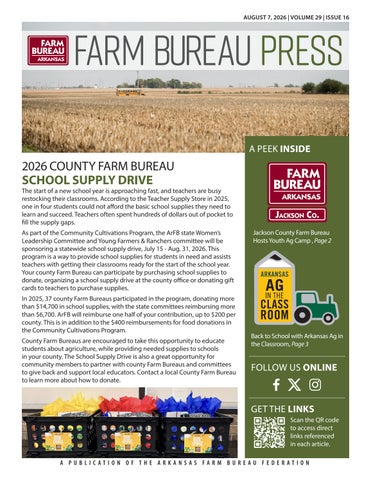
The start of a new school year is approaching fast, and teachers are busy restocking their classrooms. According to the Teacher Supply Store in 2025, one in four students could not afford the basic school supplies they need to learn and succeed. Teachers often spent hundreds of dollars out of pocket to fill the supply gaps. As part of the Community Cultivations Program, the ArFB state Women’s Leadership Committee and Young Farmers & Ranchers committee will be sponsoring a statewide school supply drive, July 15 - Aug. 31, 2026. This program is a way to provide school supplies for students in need and assists teachers with getting their classrooms ready for the start of the school year. Your county Farm Bureau can participate by purchasing school supplies to donate, organizing a school supply drive at the county office or donating gift cards to teachers to purchase supplies. In 2025, 37 county Farm Bureaus participated in the program, donating more than $14,700 in school supplies, with the state committees reimbursing more than $6,700. ArFB will reimburse one half of your contribution, up to $200 per county. This is in addition to the $400 reimbursements for food donations in the Community Cultivations Program. County Farm Bureaus are encouraged to take this opportunity to educate students about agriculture, while providing needed supplies to schools in your county. The School Supply Drive is also a great opportunity for community members to partner with county Farm Bureaus and committees to give back and support local educators. Contact a local County Farm Bureau to learn more about how to donate.
Jackson County Farm Bureau Hosts Youth Ag Camp , Page 2
ARKANSAS
Back to School with Arkansas Ag in the Classroom, Page 3
FOLLOW US ONLINE
GET THE LINKS Scan the QR code to access direct links referenced in each article. A PUBLICATION OF THE ARKANSAS FARM BUREAU FEDERATION
JACKSON COUNTY FARM BUREAU HOSTS YOUTH AGRICULTURE CAMP The Jackson County Farm Bureau Young Farmers & Ranchers and Women’s Leadership Committee recently hosted a three-day “All Things Ag” Summer Opportunity Camp at the Harris Foundation, giving students the opportunity to explore agriculture through hands-on learning experiences. Throughout the week, students received several Farm Bureau Ag Books of the Year and learned about crop production, hydroponics, dairy farming, soil health, plant science and the journey of agricultural products from farm to table. Activities included planting seeds, painting flower pots, making fruit pizza, churning butter and making ice cream in a bag. Farm Bureau members Dr. Bill Robertson, retired cotton agronomist with the UA Extension, and Carey Robertson of CWC Farm, shared their knowledge and passion for agriculture. Students also interacted with a variety of farm animals, milked a cow simulator and planted pumpkin seeds to grow at home. Ag Camp provided an engaging way for students to gain a greater appreciation for Arkansas agriculture and the farmers and ranchers who make it possible.
2
A PUBLICATION OF THE ARKANSAS FARM BUREAU FEDERATION
FIRST STUDENT ADMITTED TO A-STATE COLLEGE OF VETERINARY MEDICINE Katie Kasserman was recognized as the first student admitted to the Arkansas State University College of Veterinary Medicine. Billy Burchfield and Midwest Veterinary Supply helped celebrate the historic milestone by donating a stethoscope to Kasserman as she begins her journey. Kasserman is a Paragould native who earned her Bachelor of Science in Agriculture (Animal Science) from the University of Arkansas. Opening in Fall 2026, the College of Veterinary Medicine’s mission is to educate veterinarians and to advance the health and wellbeing of animals, people, and the environment in the state of Arkansas, the mid-South, and beyond. In alignment with the Arkansas State University mission, the College of Veterinary Medicine will educate leaders, enhance intellectual growth, and enrich lives. Learn more about the A-State Vet School here.
BACK TO SCHOOL WITH AG IN THE CLASSROOM As students head back to the classroom, Arkansas Ag in the Classroom reminds families and educators that agriculture is part of the school day in more ways than many realize. Common classroom items such as paper, pencils, crayons, glue and even some clothing and backpacks all rely on agricultural products. AITC offers educators a variety of free resources to help students make those connections through standards-based lesson plans, classroom materials, educational books, activities and grant opportunities. By bringing agriculture into the classroom, the program helps students better understand the important role farmers and ranchers play in providing the food, fiber and renewable resources used every day at school and beyond. Find resources here.
A PUBLICATION OF THE ARKANSAS FARM BUREAU FEDERATION
3
MARKET NEWS as of August 4, 2026 Contact Brandy Carroll
brandy.carroll@arfb.com
Tyler Oxner
tyler.oxner@arfb.com
Rice Rice futures appear to have made a top for the time being. The September contract topped at $14.44 and November at $14.82 after making new 18-month highs in late July. UDSA says 66% of Arkansas rice is in good to excellent condition. Nationwide, 71% of the crop is in good to excellent condition, steady since last week and down from 78% a year ago. Thanks to a dry spring, the crop is ahead of schedule, with 75% of Arkansas’ rice crop headed, compared with a 5-year average of 63%. The July WASDE is the first report to reflect the June 30 Acreage report. The decrease in production estimates is being partially offset by large beginning stocks and increasing imports. However, projected all rice ending stocks of 30.9 million cwt and long grain ending stocks of 17.7 million cwt would reflect the lowest carryout since the 19/20 marketing year if realized. Soybeans Soybean futures have moved sharply lower in recent days after setting a high of $12.56 in late July. The market has begun to focus on the supply side of the market. Farmers have reported planting 85.365 million acres of soybeans in 2026, up from 81.215 million in 2025. In Arkansas, farmers have seeded 3.2 million acres of soybeans, up from 2.59 million last year. 63% of the crop is rated good to excellent nationwide, and pod counts in 4
the Delta have experts predicting a record-setting yield. The July WASDE projected an average yield of 53 bushels/acre, but that is likely to increase to 55-56 bushels. If that comes to pass, we can expect to see further losses in futures, with the June low near $11.30 a likely target for bears. On the use side of the equation, things have been a bit better. Crush totals are solid and export sales for the next market year are the best they have been in 3 years, with China back in the market. Corn Just when you think corn futures appear to have topped, the market charts a new key reversal suggesting the market is poised to make another move higher. Harvest pressure will likely be a factor, as harvest is well underway in the Delta and will steadily move north. Early yield reports are surprisingly high at this point. As in soybeans, the market is focused on the supply-side of the equation for the time being. Weather models suggest that much of the crop will have adequate moisture through maturity. The demand side of the market is strong, though, providing some underlying support. Both domestic ethanol production and export sales are brisk, with current marketing year exports likely to exceed the current USDA projection. Sales for the next marketing year are also running ahead of projections. If the market does succumb to harvest pressure, a retest of the June low of $4.25 for December could come into play. Cotton Cotton futures are chopping along mostly sideways, with December finding resistance just below 83 cents and support below 78 cents. The market posted a bullish outside trading day on Monday
A PUBLICATION OF THE ARKANSAS FARM BUREAU FEDERATION
but will need to close above 82.74 cents to suggest additional upside potential. The Arkansas crop is in relatively good shape, with 76% rated good to excellent. There are bigger question marks elsewhere, with only 28% of the crop in Texas rated good to excellent, prompting concerns about abandonment of dryland acres in west Texas and elsewhere. Wheat Wheat futures have been on quite a rollercoaster ride the past few sessions. All contracts in both Chicago and Kansas City futures posted huge bearish key reversals, suggesting that the market has made a significant top. This should be seen as a pricing opportunity for any farmers with wheat left to sell, as there is little support left on the charts until you reach the June low, which is $5.74 for the September contract. Cattle Live cattle futures have been trending sharply lower for the past 5 weeks, but may be confirming a bottom, which is at $216.95 for the October contract. News that the U.S. will reopen imports of cattle from Mexico hit the market hard, but prices have begun to recover. The semi-annual USDA Cattle Inventory report showed the U.S. cattle herd as of July 1 was larger than the year earlier for the first time in eight years. Only by 200,000 head, but it is still significant to see an increase. The July 1 beef cow herd, though, was lower for the eighth consecutive year, and the smallest herd since USDA began the July 1 report in 1980.
EDITOR Shaylee Wallace Barber shaylee@arfb.com