Rising input costs tied to the conflict in the Middle East are adding strain to an already challenging farm economy. To better understand how global fertilizer market disruptions are affecting producers during spring planting, the American Farm Bureau Federation conducted a Fertilizer Availability Survey of farmers and ranchers across the country. More than 5,700 farmers responded to the survey, which was conducted April 4 through April 11.
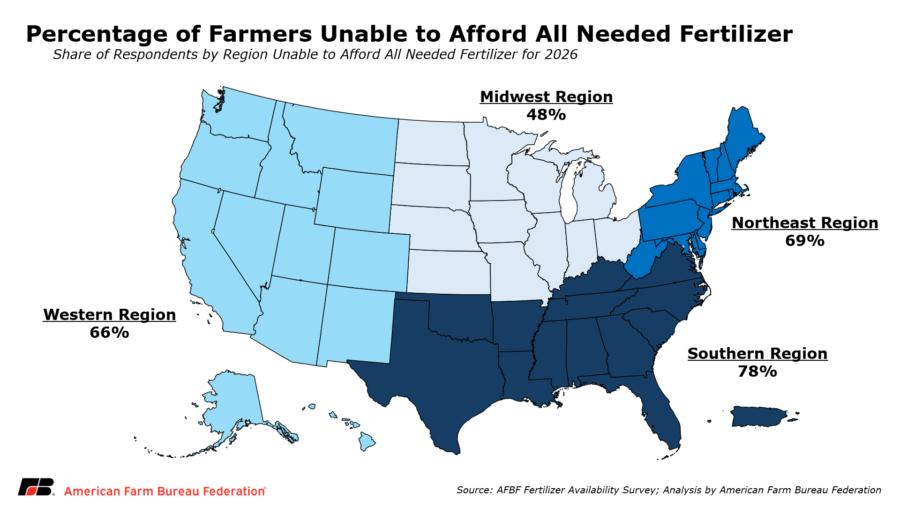
Farmers in the Southern region reported the greatest difficulty securing fertilizer, with 78% unable to afford all needed inputs this season. Producers in the Northeast and West also reported significant challenges, with 69% and 66%, respectively, unable to afford all required fertilizer, compared to 48% in the Midwest. When producers cannot afford full fertilizer application rates, they may reduce nutrient use or shift acreage decisions, both of which increase the risk of lower yields and reduced production potential in the 2026 crop year.
Read the full survey report here
Fertilizer Pre-Purchases in Arkansas, Page 3
8th Annual Arkansas Farm Bureau Foundation Trap Shoot, Page 2
ILLINOIS RIVER WATERSHED SETTLEMENTS REJECTED
A federal judge has denied proposed settlement agreements between Oklahoma and several poultry companies. According to the judge’s ruling, the settlements did not provide sufficient funding for cleanup, lacked meaningful limits on the use of poultry litter and failed to include penalties for violations.
As a result, the court’s previously issued plan, requiring cleanup, long-term oversight, and restrictions on litter application, remains in place while the case moves forward on appeal.
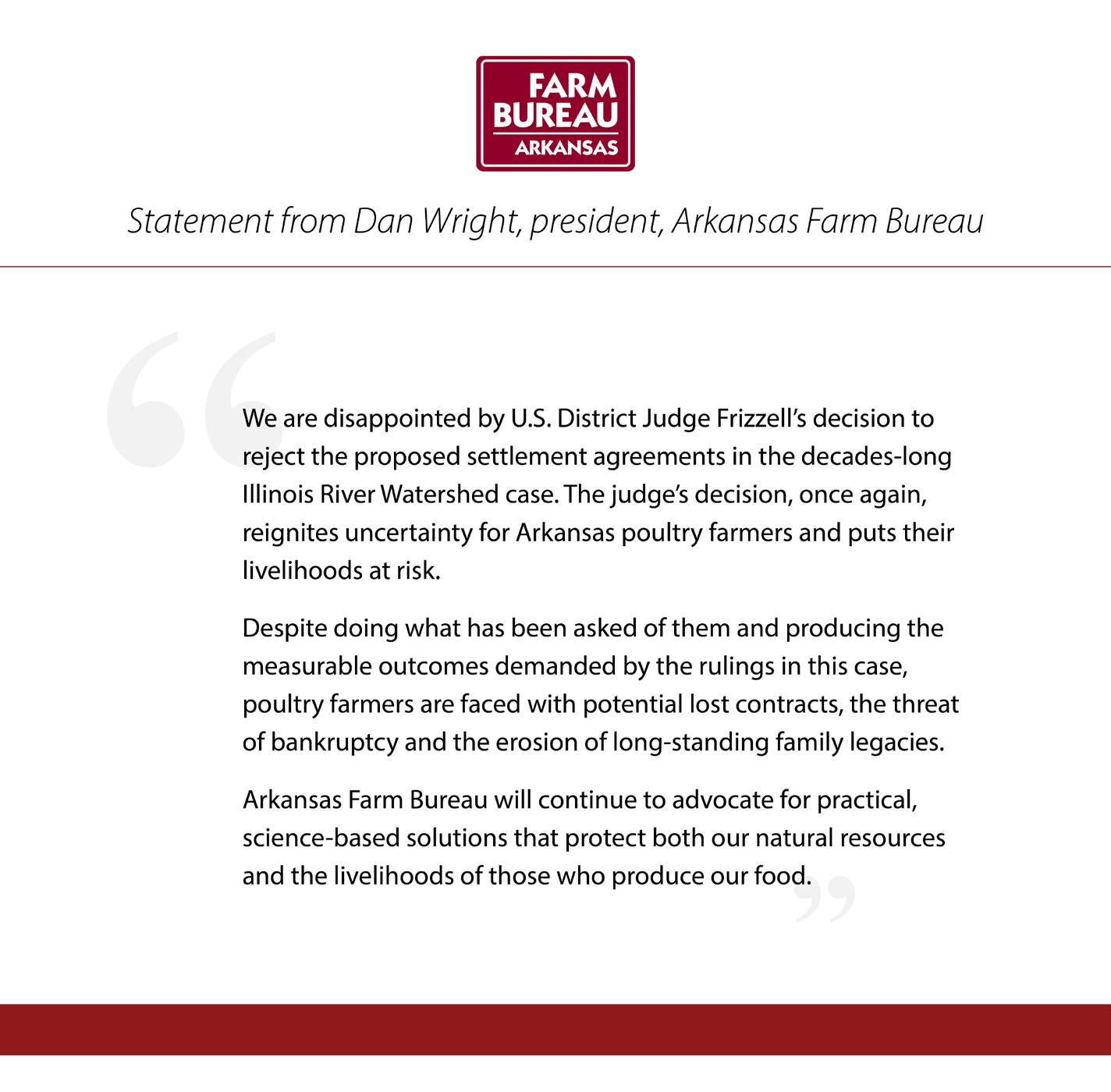
Arkansas Farm Bureau President Dan Wright said the decision “...creates uncertainty for Arkansas poultry farmers and puts their livelihoods at risk.” He added that farmers now face “potential lost contracts, the threat of bankruptcy, and the erosion of long-standing family legacies,” and emphasized the need for practical, science-based solutions moving forward.
ARKANSAS FARM BUREAU
ANNUAL TRAP SHOOT
The Arkansas Farm Bureau Foundation will be hosting its 8th annual trap shoot on Friday, June 5 at the Arkansas Game & Fish Foundation Shooting Sports Complex in Jacksonville, Arkansas.
Join us for the annual Aiming for the Future of Agriculture Trap Shoot in support of both the Arkansas 4-H Foundation and the Arkansas FFA Foundation. Supporting youth in agriculture is at the heart of the ArFB Foundation’s mission. Investing in the future of Arkansas agriculture is a shared vision among our organizations. Half of the net proceeds from this year’s shoot will directly benefit the Arkansas 4-H and Arkansas FFA Foundations, while continuing to support the goals of the ArFB Foundation.
Find more information about the 8th Annual Trap Shoot online.
FERTILIZER PRE-PURCHASES
TELL A DIFFERENT STORY IN ARKANSAS
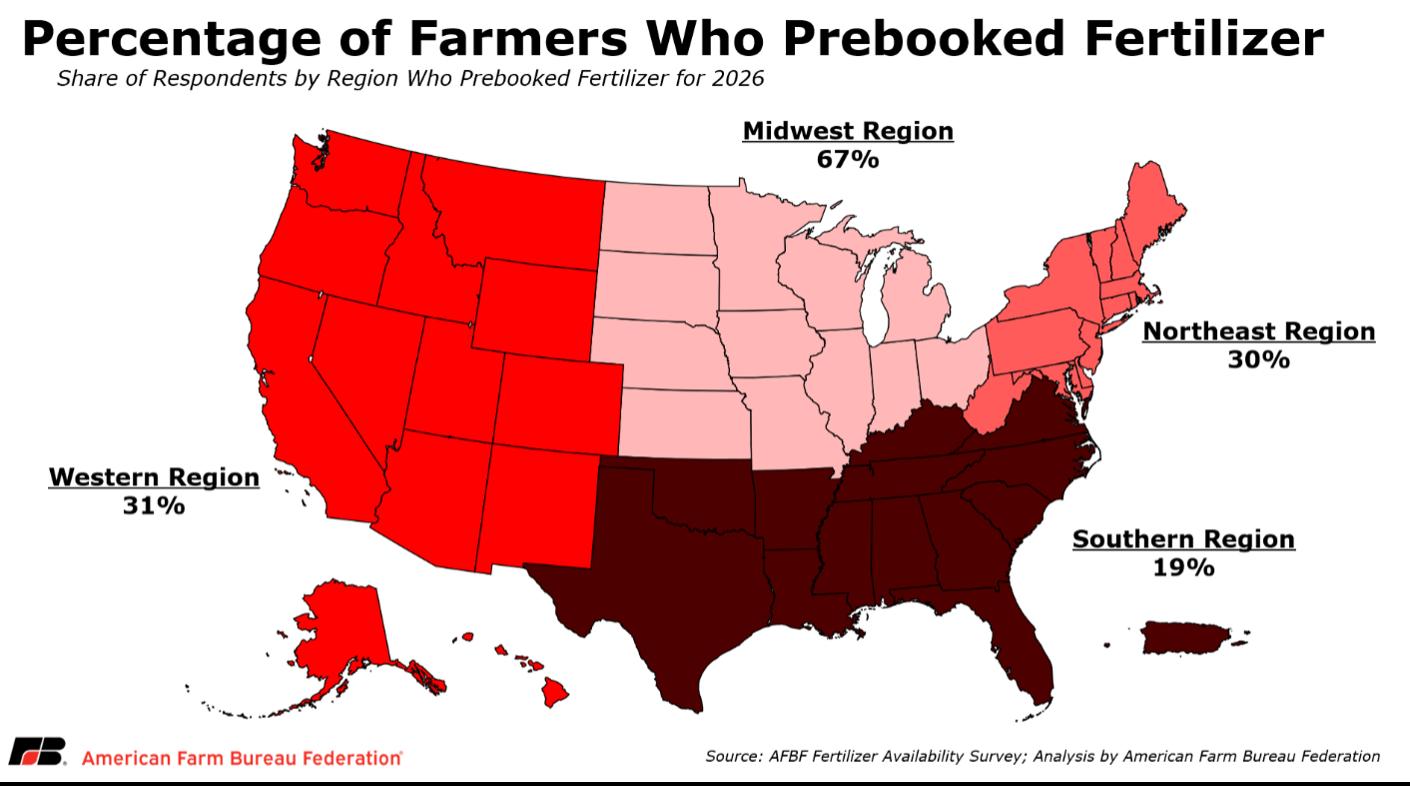
Arkansas farmers are heading into the 2026 growing season facing another year of elevated input costs and tight margins. The United States is the 3rd largest producer of fertilizer products in the world, but that production does not meet the full demand, and farmers must rely on imported products to raise a crop each year. Global supply chain and geopolitical challenges can have a tremendous impact on the price of agriculture inputs, and unrest in the Middle East has caused both fuel and fertilizer prices to skyrocket in 2026.
Middle Eastern countries are crucial suppliers of fertilizer, producing roughly 49% of global urea exports and 30% of global ammonia exports. These products move to the U.S. through the Strait of Hormuz. According to American Farm Bureau, Urea prices have increased 47% since February, and anhydrous ammonia has increased 30% in the same time period.
While administration officials have suggested that most fertilizer needs were secured ahead of recent price increases, new data from an American Farm Bureau Federation survey shows a very different picture on the ground, particularly in Southern states.
Read the full Ag Insider here.
SOY FOODS MONTH SPOTLIGHTS
HEALTH BENEFITS OF ARKANSAS’S TOP ROW CROP
Each Spring, Arkansas farmers plant approximately 3 million acres of soybeans, the state’s top row crop, generating $2 billion in annual economic impact. This April, the Arkansas Soybean Promotion Board is highlighting National Soy Foods Month to promote the benefits of soy once its products hit the grocery store shelves, as part of its celebration of 100 years of soybean production in the state.
“When you put soy foods and soy ingredients on your table, you’re supporting the farmers who are the backbone of Arkansas’s economy,” ASPB Chairman Brad Doyle of Poinsett County said.
Soy is one of the most nutritionally complete foods available, delivering all nine essential amino acids with minimal
MARKET NEWS
as of April 15, 2026
Contact
Brandy Carroll brandy.carroll@arfb.com
Tyler Oxner tyler.oxner@arfb.com
Rice
Rice futures rallied in early April to retest the March highs, but prices have retreated after failing to break through that resistance, which is just above $11.40 for most-active May. The selloff accelerated late last week after USDA released the April WASDE report. Both domestic use and export estimates were reduced, resulting in a 5 million cwt increase in the ending stocks estimate. Ending stocks are now pegged at 55.3 million cwt, up 1.4 million cwt from the 24/25 marketing year. While bearish for prices, this was not unanticipated, as the March 31 Rice Stocks Report showed rough rice stocks in all positions up 3% year over year, with 104 million cwt in storage across the country. Milled rice stocks were up a whopping 23% from a year ago at 7.71 million. While the current drought could have negative longer-term impacts, it is helping farmers make planting progress. As of April 12, Arkansas farmers had planted 40% of intended acres, twice the 5-year average of 20%. The March 1 Prospective Plantings report indicated the smallest Arkansas rice acres in 40 years at 1,001,000, but many expect that number to come in below that total, and perhaps the smallest acreage since allotments were lifted in the mid-1970s.
Soybeans
Soybean futures are showing some technical weakness after trading in a sideways to higher pattern since the sharp losses charted in mid-March. The market opened the week with an outside day down, suggesting that a retest of the March highs is not in the cards. That resistance is $12.30 for the May contract
and $11.75 for new crop November. Soybean oil, which has been providing strength in the soy complex, ended last week with a weekly key reversal down following a retreat in crude oil futures. May has nearby support at $11.40, and support for November begins near $11.35. As with rice, dry conditions this spring have resulted in an accelerated planting pace. Arkansas farmers have seeded 32% of soybean acres as of April 12, compared to a 5-year average of 12%.
Corn
The April WASDE report brought few surprises for U.S. corn. The domestic balance sheet was mostly unchanged. Feed and residual use remains projected at 6.2 billion bushels, matching the latest Grain Stocks report. Ending stocks are still estimated at 2.127 billion bushels, and the season-average farm price is unchanged at $4.15 per bushel. On the futures side, new-crop corn has been under some pressure but has started to stabilize in recent sessions. Prices found support as geopolitical concerns added uncertainty to global trade flows, while questions about potential shifts in global corn acreage have also offered support underneath the market. September futures have held firm near the $4.55 area after closing lower in seven of the past ten sessions. Technical signals suggest the market is approaching oversold territory, which could encourage short covering.
Cotton
The April WASDE report showed no major changes to the U.S. cotton balance sheet for the 2025/26 marketing year. The global outlook, however, leaned slightly bearish as production was raised by roughly 900,000 bales. At the same time, world imports were trimmed slightly, reflecting softer demand relative to supply. With production increasing faster than use, global ending stocks moved higher. Even with these fundamentals, cotton futures have continued to strengthen over the past two weeks, rallying nearly 550 points. The recent strength is being driven largely by growing concerns over drought conditions in key producing
regions, which has helped offset the more bearish global supply picture. From a technical standpoint, the market is now approaching resistance near 78 cents, which lines up with recent contract highs. On the downside, support is forming near 76 cents, a level that previously acted as resistance and could now provide a floor if the market pulls back in the near term.
Wheat
The April WASDE report carried a more bearish tone for wheat. In the United States, supplies increased due to higher import levels based on recent Census data, pushing total ending stocks up to 939 million bushels. That is about 10 percent higher than last year and marks the largest carryout since the 2019/20 marketing year. The global outlook added further pressure, with world supplies raised by 1.5 million metric tons to 1.103 billion, largely driven by larger production in the European Union and Russia. On the futures side, Chicago July wheat has been under pressure, breaking out of its recent sideways trading range between $6.00 and $6.20 with a gap lower last week. Prices have since attempted to stabilize, with initial support developing near the $5.80 level.
Livestock and Poultry
In the April WASDE, UDSA lowered their forecast for beef and pork production on reduced slaughter rates. Broiler production was raised on the recent pace of slaughter and heavier weights, and turkey production was raised on hatchery data.
Beef export projections for 2026 were lowered due to the slow pace of shipments thus far and the reduction of available supplies. Beef imports were raised again as demand remains strong. Cattle prices were unchanged from the March report, while hog and broiler prices were lowered.