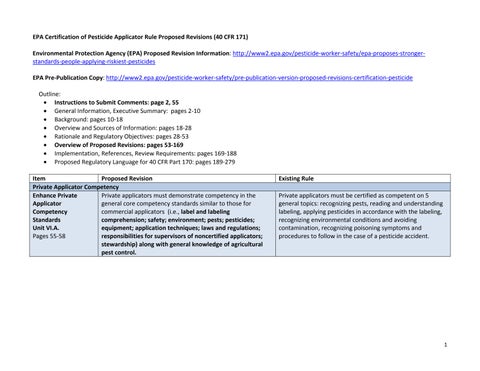
EPA Certification of Pesticide Applicator Rule Proposed Revisions (40 CFR 171) Environmental Protection Agency (EPA) Proposed Revision Information: http://www2.epa.gov/pesticide‐worker‐safety/epa‐proposes‐stronger‐ standards‐people‐applying‐riskiest‐pesticides EPA Pre‐Publication Copy: http://www2.epa.gov/pesticide‐worker‐safety/pre‐publication‐version‐proposed‐revisions‐certification‐pesticide Outline: Instructions to Submit Comments: page 2, 55 General Information, Executive Summary: pages 2‐10 Background: pages 10‐18 Overview and Sources of Information: pages 18‐28 Rationale and Regulatory Objectives: pages 28‐53 Overview of Proposed Revisions: pages 53‐169 Implementation, References, Review Requirements: pages 169‐188 Proposed Regulatory Language for 40 CFR Part 170: pages 189‐279 Item Proposed Revision Private Applicator Competency Enhance Private Private applicators must demonstrate competency in the Applicator general core competency standards similar to those for Competency commercial applicators (i.e., label and labeling Standards comprehension; safety; environment; pests; pesticides; Unit VI.A. equipment; application techniques; laws and regulations; Pages 55‐58 responsibilities for supervisors of noncertified applicators; stewardship) along with general knowledge of agricultural pest control.
Existing Rule Private applicators must be certified as competent on 5 general topics: recognizing pests, reading and understanding labeling, applying pesticides in accordance with the labeling, recognizing environmental conditions and avoiding contamination, recognizing poisoning symptoms and procedures to follow in the case of a pesticide accident.
1
Private applicators must either attend a training program covering the mandatory competency standards (Unit VI.A.) or pass a written exam.
Private applicator certification can be done by written or oral exam, or other method approved as part of the State certification plan.
Eliminate Non‐Reader No “non‐reader” option for persons who cannot read to obtain Certification for certification to use specific RUPs. Private Applicators Unit VI.C. Pages 62‐67 Categories for Private and Commercial Applicators Establish Application Establish categories for private and commercial applicators Method‐Specific performing: aerial application, soil fumigation, and non‐soil Categories for Private fumigation. and Commercial Applicator Certification Unit VII. Pages 67‐84 Establish Predator Add categories for private and commercial applicators: sodium Control Categories for fluoroacetate in livestock protection collars and sodium Private and cyanide delivered through M‐44 devices. Commercial Applicator Certification Unit VIII. Pages 84‐87 Exam and Training Security Requirements
States can offer an alternative, product‐specific certification process for persons who cannot read.
Strengthen Private Applicator Competency Gauge Unit VI.B. Pages 59‐62
No additional certification required to use certain application methods that may present higher risks if not conducted properly.
No predator control categories established in rule. Registration decisions and labeling for sodium fluoroacetate (Compound 1080) used in livestock protection collars and sodium cyanide delivered through M‐44 devices include specific competency standards and require applicators to be competent.
2
Security and Require candidates to present identification for initial and No requirement to present identification at exam or training Effectiveness of Exam recertification exams and training sessions. sessions. Competency for commercial applicators must be and Training determined on the basis of written examination. EPA policy Administration Codify policy requiring all exams to be closed book and requires that all certification exams be closed book and Unit IX. proctored. proctored. Pages 87‐94 Strengthen Standards for Noncertified Applicators Working Under the Direct Supervision of Certified Applicators Enhance Competence Noncertified applicators must receive annual training on safe Noncertified applicators must be competent to use RUPs. No of Noncertified pesticide application and protecting themselves and others specific training requirements. For specific applications, the Applicators from pesticide exposure (similar to WPS handler training). certified applicator must provide verifiable instructions Unit X.A. including detailed guidance for applying the pesticide. Pages 94‐106 Exemption from training requirement for those with valid WPS handler training and those who have passed the commercial core exam. Establish Noncertified applicator training can only be provided by one of The certified applicator provides required instructions. No Qualifications for the following: a currently certified applicator, a State‐ qualifications required other than certification. Training Providers designated trainer of certified applicators, or a person who Unit X.B. has completed a train‐the‐trainer course under the WPS. Pages 106‐109 Establish Supervising applicators must: Supervising applicators must demonstrate practical Qualifications for knowledge of supervisory requirements. For specific Be certified in the category in which they supervise Certified Applicators applications, supervising applicator must provide detailed applications. Supervising guidance for applying the pesticide properly and provisions Ensure noncertified applicators under their supervision Noncertified for contacting the certified applicator. have satisfied the training requirement. Applicators For specific applications, provide a copy of all applicable Unit X.C. labeling to the noncertified applicator and provide Pages 109‐117 specific instructions related to the application. Ensure means for immediate communication between the supervisor and supervisee are immediately available. Expand Commercial Require commercial applicators to maintain records of No commercial applicator recordkeeping required related to Applicator noncertified applicators’ training that include: the trained providing verifiable instructions to noncertified applicators. Recordkeeping to noncertified applicator’s printed name and signature, the date Include Noncertified of the training, the name of the person who provided the Applicator Training training, and the supervising commercial applicator’s name. Unit XI. Pages 117‐119 Minimum Age for Certified and Noncertified Applicators 3
Establish a Minimum Age for Certified Applicators Unit XII. Pages 120‐128
Persons must be at least 18 years old to be certified as a commercial or private applicator.
Establish a Minimum Persons must be at least 18 years old to qualify as a Age for Noncertified noncertified applicator using RUPs under the direct Applicators supervision of a commercial or private applicator. Unit XIII. Pages 128‐134 National Certification Period and Standards for Recertification National Certification Require all applicators to renew their certification (recertify) at Period least every 3 years. Unit XIV.A. Pages 134‐137 Recertification One continuing education unit (CEU) is 50 minutes of active Requirements training time. Unit XIV.B. Pages 137‐144 To renew their certification, commercial applicators must earn 6 CEUs covering core content and 6 CEUs per category of certification, or they must pass written exams for core and each category of certification.
No minimum age requirement.
No minimum age requirement.
States must ensure that applicators maintain a continuing level of competency and ability to apply pesticides safety and properly. States must ensure that applicators maintain a continuing level of competency and ability to apply pesticides safety and properly.
To renew their certification, private applicators must earn 6 CEUs covering the general private applicator certification requirements and 3 CEUs per category of certification, or they must pass written exams for general private applicator certification and each category of certification. Applicators must earn at least half of the required CEUs in the 18 months preceding the expiration of their certification. Revise State Certification Plan Requirements
4
State Plan Modification to Implement Proposed Changes Unit XV.3.i. Pages 144‐147
Certification plans must meet or exceed new standards and requirements.
Program Reporting and Accountability Unit XV.3.ii. Pages 147‐150
Reporting must include: For private and commercial applicators ‐ new, recertified, and total number of applicators holding certifications, by category and subcategory (if applicable). Any changes to the certification plan not previously evaluated by EPA. Any planned changes to the certification plan. Number, description and narrative discussion of enforcement actions taken for incidents involving RUPs.
Civil and Criminal Penalty Authority Unit XV.3.iii. Page 150
States must have authority to assess civil and criminal penalties for commercial and private applicators.
Certification plans must meet or exceed existing standards and requirements.
States, tribes, and territories may either adopt the proposed standards for noncertified applicator training or prohibit the use of RUPs by noncertified applicators working under the direct supervision of certified applicators. Reporting must include: Total number of applicators, private and commercial, by category, currently certified; and number of applicators, private and commercial, by category, certified during the last reporting period. Any changes in commercial applicator subcategories. A summary of enforcement activities related to use of restricted use pesticides during the last reporting period. Any significant proposed changes in required standards of competency. Proposed changes in plans and procedures for enforcement activities related to use of restricted use pesticides for the next reporting period. Any other proposed changes from the State plan that would significantly affect the State certification program. States must have authority to assess civil and/or criminal penalties for commercial and private applicators.
5
Commercial Applicator Recordkeeping Unit XV.3.iv. Pages 150‐151
RUP Dealer Recordkeeping Unit XV.3.v. Pages 151‐152
States must require commercial applicators to maintain records about RUP use including: Name and address of person for whom RUP applied Location of application Size of area treated Site to which RUP was applied Time and date of application Product name and EPA registration number of RUP applied Total amount of RUP applied per application and location Name and certification number of certified applicator and name(s) of any noncertified applicator that made the application under the direct supervision of the certified applicator. States must require commercial applicators to maintain records related to the qualifications of noncertified applicators working under their direct supervision. RUP dealer recordkeeping must include: Name and address of each person to whom the RUP was distributed or sold. The applicator’s certification number, issuing authority, certification expiration date, and categories of certification. The product name and EPA registration number of the RUP(s) distributed or sold in the transaction, and the State special local need registration number on the label of the RUP if applicable. The quantity of the pesticide(s) distributed or sold in the transaction. The date of the transaction.
State plans must include requirements for certified commercial applicators maintain for at least 2 years routine operational records containing information on kinds, amounts, uses, dates, and places of application of RUPs.
No federal requirement for RUP dealers to maintain records.
6
Certified Applicator Credentials Unit XV.3.vi. Pages 152‐153
Reciprocal Applicator Certification Unit XV.3.vii. Pages 153‐155 State Plan Maintenance, Modification, and Withdrawal Unit XV.3.viii. Page 155
Certified applicator credentials must include: The full name of the certified applicator. The certification, license, or credential number of the certified applicator. The type of certification (private or commercial). The category(ies), including any application method‐ specific category(ies) and subcategories of certification, in which the applicator is certified, as applicable. The expiration date of the certification. A Statement that the certification is based on a certification issued by another State, Tribe or Federal agency, if applicable, and the identity of that State, Tribe or Federal agency. Certification plans must specify whether, and if so under what circumstances, the state would issue reciprocal certifications. Reciprocal certifications subject to specific conditions. Codify policy that substantial modifications include: Deletion of a mechanism for certification and/or recertification. Establishment of a new private applicator subcategory, commercial applicator category, or commercial applicator subcategory. Any other changes that the Agency has notified the State, Tribal or Federal agency that the Agency considers to be are substantial modifications.
Federal Agency Certification Plans Establish Provisions Delete Government Agency Plan option from the regulation.
No federal requirements for what information must be included on documents used to verify an applicator’s certification.
No requirements for states to provide specific information on requirements and procedures for issuing reciprocal certification. States may not make substantial modifications to their certification plan without EPA approval. The regulation does not outline what constitutes a substantial modification. EPA policy states that substantial modifications include: Deletion of a mechanism for certification and/or recertification. Establishment of a new private applicator subcategory, commercial applicator category, or commercial applicator subcategory. Any other changes that the Agency has notified the State, Tribal or Federal agency that the Agency considers to be are substantial modifications.
Option to develop a single, federal government‐wide 7
for Review and Approval of Federal Agency Plans Unit XVI.A. Pages 158‐160
Codify existing policy to allow Federal agencies to develop their own plans for certifying applicators. Federal agency certification plans must meet or exceed the standards in the proposed regulation.
Government Agency Plan to certify federal employees applying RUPs. Government Agency Plan never developed. EPA policy allows Federal agencies to develop their own plans for certifying applicators, as long as the plan meets or exceeds the applicable standards in the regulation for State plans, and complies with requirements of the policy.
Certification in Indian Country Clarify Options for Three options for applicator certification programs in Indian Three options for applicator certification programs in Indian Establishing a Country: Country: Certification Program Tribes may enter into an agreement with EPA to recognize Tribes may utilize State certification to certify applicators in Indian Country certifications issued under other EPA‐approved (requires concurrence by the State(s) and an appropriate Unit XVII. certification plans (State, Tribal, or Federal); no State‐Tribal cooperative agreement) Pages 160‐164 concurrence from or agreement with State is needed Tribes may develop and implement a Tribal certification plan (requires Tribes to develop and submit an Tribes may develop and implement a Tribal certification plan (requires Tribes to develop and submit a Tribal appropriate Tribal certification plan to EPA for approval) certification plan that meets or exceeds the proposed EPA may administer a Federal certification plan for standards) applicators in Indian country EPA may administer a Federal certification plan for applicators in Indian country that meets or exceeds the proposed standards. EPA may include multiple tribes and geographic areas under a single plan. EPA‐Administered Plans Revise Provisions for EPA‐administered federal certification plans must meet the The current rule establishes requirements for EPA‐ EPA‐Administered proposed standards for State certification plans, including RUP administered certification in States or areas of Indian country Plans applicator certification, recertification, and noncertified without EPA‐approved certification plans in place, including Unit XVIII. applicator qualifications, as well as plan reporting and specific standards for certification and recertification of Pages 164‐165 maintenance requirements. pesticide applicators. Definitions – Unit XIX.A. Pages 165‐166 – (R)evised or (N)ew Application (N) The dispersal of a pesticide on, in, at, or around a target site. Application method The application using a particular type of equipment, mechanism, or device used in the application of a pesticide, including, but (N) not limited to, ground boom, air‐blast sprayer, wand, and backpack sprayer, as well as methods such as aerial, chemigation, and fumigation. Compatibility (R) The extent to which a pesticide can be combined with other chemicals without causing undesirable results.
8
Dealership (R) Fumigant (N) Fumigation (N) Indian country (N)
Indian Tribe (N) Non‐target organism (R) Noncertified applicator (N)
Personal protective equipment (N) Principal place of business (R) Toxicity (R) Use (N)
Any establishment owned or operated by a restricted use pesticide retail dealer where restricted use pesticides are distributed or sold. Any pesticide product that is a vapor or gas, or forms a vapor or gas upon application, and whose pesticidal action is achieved through the gaseous or vapor state. Application of a fumigant. (1) All land within the limits of any Indian reservation under the jurisdiction of the United States Government, notwithstanding the issuance of any patent, and, including rights‐of‐way running through the reservation. (2) All dependent Indian communities within the borders of the United States whether within the original or subsequently acquired territory thereof, and whether within or without the limits of a State. (3) All Indian allotments, the Indian titles to which have not been extinguished, including rights‐of‐way running through the same. Any Indian or Alaska Native Tribe, band, nation, pueblo, village, or community included in the list of Tribes published by the Secretary of the Interior pursuant to the Federally Recognized Indian Tribe List Act. Any plant, animal or other organism other than the target pests which a pesticide is intended to affect. Any person who is not certified in accordance with 40 CFR 171 to use or supervise the use of restricted use pesticides in the pertinent jurisdiction, but who is using restricted use pesticides under the direct supervision of a person certified as a commercial or private applicator certified in accordance with this part. Devices and apparel that are worn to protect the body from contact with pesticides or pesticide residues, including, but not limited to, coveralls, chemical‐resistant suits, chemical‐resistant gloves, chemical‐resistant footwear, respirators, chemical‐ resistant aprons, chemical‐resistant headgear, and protective eyewear. The principal location, either residence or office, where a person conducts a business of applying restricted use pesticides. A person who applies restricted use pesticides in more than one State or area of Indian country may designate a location within a State or area of Indian country as its principal place of business for that State or area of Indian country. The property of a pesticide that refers to the degree to which the pesticide and its related derivative compounds are able to cause an adverse physiological effect on an organism as a result of exposure. (1) Pre‐application activities, including, but not limited to: (i) Arranging for the application of the pesticide. (ii) Mixing and loading the pesticide. (iii) Making necessary preparations for the application of the pesticide, including responsibilities related to providing training, a copy of a label and use‐specific instructions to noncertified applicators, and complying with any applicable requirements under part 170 of this chapter. (2) Applying the pesticide, including supervising the use of a pesticide by a noncertified applicator. (3) Post‐application activities, including, but not limited to, transporting or storing pesticide containers that have been opened, cleaning equipment, and disposing of excess pesticides, spray mix, equipment wash waters, pesticide containers, and other materials contaminated with or containing pesticides. 9
Use‐specific instructions (N)
The information and requirements specific to a particular pesticide product or work site that are necessary in order for an applicator to use the pesticide in accordance with applicable requirements and without causing unreasonable adverse effects.
10