In Farm Bureau ArFB elects officers, board Randy Veach and Rich Hillman will continue as president and vice president, respectively, of Arkansas Farm Bureau following their re-election Dec. 4. Delegates also re-elected seven board members during the final day of the organization’s 81st annual convention at the Marriott Hotel and Convention Center in Little Rock. Veach, of Manila (Mississippi Co.), begins an eighth term as president. He is ArFB’s 10th president since its creation in 1935. Veach farms cotton, soybeans, rice, wheat, corn and milo in and around the community of Lost Cane near Manila. He is a third-generation farmer and he and his wife, Thelma, farm with their son Brandon. “My heart is with the farmers and ranchers of Arkansas,” Veach said. “This organization has a responsibility to advocate for and strengthen the interests of agriculture. Our job is to ensure that the men and women of agriculture can continue to deliver food, fiber and shelter to those
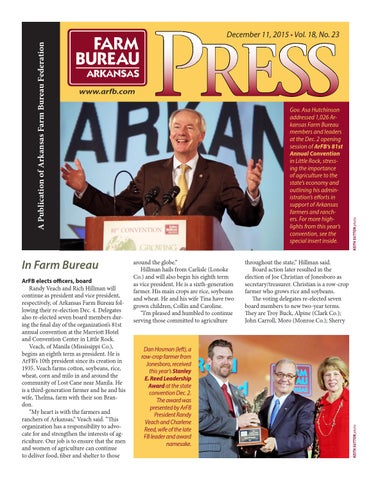
Gov. Asa Hutchinson addressed 1,026 Arkansas Farm Bureau members and leaders at the Dec. 2 opening session of ArFB’s 81st Annual Convention in Little Rock, stressing the importance of agriculture to the state’s economy and outlining his administration’s efforts in support of Arkansas farmers and ranchers. For more highlights from this year’s convention, see the special insert inside. around the globe.” Hillman hails from Carlisle (Lonoke Co.) and will also begin his eighth term as vice president. He is a sixth-generation farmer. His main crops are rice, soybeans and wheat. He and his wife Tina have two grown children, Collin and Caroline. “I’m pleased and humbled to continue serving those committed to agriculture
Dan Hosman (left), a row-crop farmer from Jonesboro, received this year’s Stanley E. Reed Leadership Award at the state convention Dec. 2. The award was presented by ArFB President Randy Veach and Charlene Reed, wife of the late FB leader and award namesake.
KEITH SUTTON photo
www.arfb.com
throughout the state,” Hillman said. Board action later resulted in the election of Joe Christian of Jonesboro as secretary/treasurer. Christian is a row-crop farmer who grows rice and soybeans. The voting delegates re-elected seven board members to new two-year terms. They are Troy Buck, Alpine (Clark Co.); John Carroll, Moro (Monroe Co.); Sherry
KEITH SUTTON photo
A Publication of Arkansas Farm Bureau Federation
December 11, 2015 • Vol. 18, No. 23
Jake Haak (center) of Gentry took first place in the 2015 YF&R Discussion Meet at ArFB’s annual convention. President Randy Veach (left) and Vice President Rich Hillman recognized Haak onstage. The prize was $7,000 toward the purchase of a Polaris allterrain vehicle courtesy of Southern Farm Bureau Life Insurance Co. and $2,500 from Farm Bureau Bank.
Craighead is top county again Craighead County is the state’s top county Farm Bureau organization for the third year in a row. ArFB President Randy Veach and Vice President Rich Hillman presented the President’s Award Dec. 3 to county President Josh Cureton at the organization’s 81st annual convention at the Marriott Hotel and Convention Center in Little Rock. Counties competing for the President’s Award must earn a Gold Star in each of 10 categories and be a top scorer in their respective membership category. The 10 Gold Star categories are membership acquisition, organization, public relations, commodity services, governmental affairs, women’s activities, Young Farmers & Ranchers
activities, member services, safety and youth. The other finalists for the President’s Award were Cross, Stone, Jackson and Conway counties. The Membership Retention Award went to Monroe County. This recognition goes to the county with the highest membership retention percentage in the state. Monroe County had a retention rate of 95.89 percent.
KEITH SUTTON photo
ROB ANDERSON photo
KEITH SUTTON photo
KEITH SUTTON photo
Felts, Joiner (Mississippi Co.); Mike Freeze, England (Lonoke Co.); Bruce Jackson, Lockesburg (Sevier Co.); Gene Pharr, Lincoln (Washington Co.) and Joe Thrash, Toad Suck (Faulkner Co.). Voting delegates also addressed a wide range of federal and state policy issues. Specifically, they defined Arkansas Farm Bureau’s positions related to burdensome federal regulations, regulation of drones by the Federal Aviation Administration, federal crop insurance programs, state road maintenance, international trade, GMO labeling, avian influenza, feral hog control and consumer awareness.
Washington Co. FB’s Women’s Committee won its eighth consecutive Outstanding County Women’s Program award. Querita Faddis accepted the award from President Randy Veach at the ArFB convention in Little Rock. The award honors a committee that exhibits exemplary support of its county organization, activities and goals.
Grant and Heather Keenen of Farmington won this year’s Young Farmers and Ranchers Excellence in Agriculture award. The award recognizes young farmers involved in agriculture but who get the majority of income off the farm. The Keenens work in the poultry and cattle industry and have a beef cattle, wheat, corn and soybean farm in Washington County.
ArFB Assistant Director of Education Andy Guffey (left) and Faulkner Co. FB President Chris Schaefers (right) presented the Outstanding Ag Educator Award to Rodney Wiedower of Greenbrier during the state convention in Little Rock. Wiedower’s program at Greenbrier High School includes 400 students in ag education and FFA.
In Arkansas Kudzu bugs spread According to the University of Arkansas Division of Agriculture, kudzu bugs, which have caused big problems for soybean growers across the South, have now been found in seven Arkansas counties. The insects have been seen only in kudzu patches in Ashley, St. Francis, Phillips and Poinsett counties, but have spread to soybean fields in Crittenden, Mississippi and Lee counties. This year, most soybean fields in Arkansas were far enough along when the bugs were found that no pesticide treatments were recommended. However, “Growers should be vigilant going into 2016 as the distribution of the kudzu bug continues to expand,” said UA Division of Agriculture entomologist Nick Seiter. “We do think we’ll find a few soybean fields next year that will need to be treated.” For more information on kudzu bugs, contact your county extension office, or download the fact sheet at www.uaex.edu/ publications/PDF/FSA-7084.pdf. Hundreds join conservation effort USA Rice, Ducks Unlimited and more than 40 other partners are celebrating their most recent milestone as part of the Sustaining the Future of Rice project and the Regional Conservation Partnership Program. The Natural Resources Conservation
Elsewhere
STEVE HIGNIGHT photo
GMOs gain support The Food and Drug Administration’s rejection of petitions to the White House for mandatory labeling of genetically modified organisms (GMOs) is “a victory for consumers and farmers alike,” according to American Farm Bureau Federation Presi-
At its monthly meeting in Fayetteville Nov. 19, the Washington Co. FB board of directors recognized Scott Davis (left) of Prairie Grove for his two years of service as county president. Porter Smith of Greenland, who succeeded Davis as president, presented the Washington County dairy farmer an engraved gavel as thanks for his leadership.
KEITH SUTTON photo
Services (NRCS) Environmental Quality Incentives Program, one of two programs used by the project, collected 334 applications when the sign-up period closed in October in Arkansas and Mississippi. The other conservation program used within the project is the NRCS Conservation Stewardship Program. The project includes implementation of conservation practices on working ricelands in the six primary rice-growing states using a $10 million investment from the NRCS and $6.8 million in private funds. USA Rice Vice President of Government Affairs Ben Mosely said, “These numbers have far exceeded our expectations, and we’re confident that with a deep pool of applicants in both states, we’ll be able to fund projects on the most environmentally sensitive rice-growing acres for the most effective results possible.” Applicants selected in this round of funding will be notified in early 2016, so they can begin implementing practices immediately.
On Dec. 10 in North Little Rock, the Wildy Family of Manila — (left to right) Annalyse, Paul and Bethany Harris; Tab, Taylor, Justin, Kristi, Blaine, Patty, Hayley, Blaire and David Wildy — were named the 2015 Arkansas Farm Family of the Year. The Wildys raise cotton, soybeans, wheat, peanuts and milo on 9,200 acres in Mississippi County. “I’ve never been more proud of my family,” said David Wildy. “It’s one of the most rewarding, most exciting and most humbling things that has been bestowed upon us as a family.” dent Bob Stallman. “This administration has long been a champion for nutrition, and this action recognizes how biotechnology is changing the way we grow food for the better. “Farmers and ranchers are producing more with fewer resources, without sacrificing nutrition or compromising food quality and safety,” Stallman continued. “The administration sees this and so does the nation’s leading authority on food safety.” On Nov. 19, the FDA also placed its stamp of approval on a genetically engineered (GE) animal product, AquAdvantage Salmon. The agency’s action “is a milestone for expanding farmers’ and ranchers’ ability to produce nutritious food critical to a healthy diet,” Stallman said. The FDA can only require additional labeling of foods derived from GE sources if there is a material difference — such as a different nutritional profile — between the GE product and its non-GE counterpart. In the case of the AquAdvantage Salmon, the FDA did not find any such differences. “Thanks to these decisions, consumers will continue to benefit from access to a variety of nutritious foods in the marketplace,” Stallman said. “Consumers have a right to know what’s in their food, but they should be given the facts — facts grounded in science. New voluntary guidance on labeling from the FDA will help companies provide more helpful information for those consumers looking to make the best
choices for their families.” USDA aims to help beginning farmers The U.S. Department of Agriculture has announced plans to prioritize $5.6 billion in funding during the next two years to help beginning farmers and ranchers get started. Deputy Secretary Krysta Harden said the action should increase participation in existing USDA programs aimed at new and beginning producers by 6.6 percent. USDA also announced the creation of a new website, newfarmers.usda.gov, that will show beginners how their operations might be eligible for government resources. The website was developed after feedback from new and beginning producers who were unfamiliar with what USDA programs could do for them. The site also contains general information such as how to formulate a business plan or file taxes as a new small-business owner. “What began seven years ago with the recognition that the rapid aging of the American farmer was an emerging challenge has transformed into a robust, transparent, tech-based strategy to recruit the farmers of the future,” Harden said. “No matter where you’re from, no matter what you look like, no matter your background, we want USDA to be the first stop for anyone who is looking to be a part of the story and legacy of American agriculture.” Editor Keith Sutton
chris.wilson@arfb.com
In the Markets
In the Market As of December 8, 2015 UA releases 2016 crop enterprise budgets The University of Arkansas Division of Agriculture has issued crop enterprise budgets for the 2016 production year. Budgets are available as a printed manuscript and as interactive files that allow users to change inputs and prices. Budget summaries present side-by-side comparisons for surface-irrigated, centerpivot-irrigated and non-irrigated crops. Inputs in the budgets are Cooperative Extension Service recommendations as determined by field trials from the Crop Research Verification Program (CRVP) for each crop. CRVP recommendations are profit maximizing inputs, and field scale CRVP yields typically exceed state average yields. Interactive budgets can be utilized to evaluate alternative costs and returns for optimal profit potential. Input decisions should be evaluated with an understanding that yield and revenue maximizing inputs are not necessarily the inputs for maximizing profit. County agents can provide information for Extension input recommendations. The 2016 crop enterprise budgets are available at www.uaex. edu/crop-budgets. New risk management tool for rice producers Margin Protection Insurance will be available for rice farmers in most counties in Arkansas to purchase beginning with the 2016 crop year. This is an area-based policy that can be purchased as a stand-alone policy or in conjunction with Yield Protection or Revenue Protection policies. It is designed to protect a grower’s expected margin, or the difference between expected revenue and specific expected costs, which include diesel, interest, urea, DAP and potash. To learn more about the product and receive an estimate of the premium costs for your farm, visit marginprotection.com.
Corn futures appear to be bottoming with March attempting to build support around $3.64. The market has been subject to fluctuations in the dollar, and recent weakness there has provided some underlying support for corn. However, weakness in crude oil continues to limit the upside. There were few changes to the monthly supply/demand balance sheet for corn. USDA did cut the export projection by 50 million bushels, but that was partially offset by a 25-million-bushel increase in projected corn for ethanol use. The net result was ending stocks up 25 million bushels to 1.785 billion bushels. The projected season average on farm price was unchanged at $3.35-$3.95.
Production was lowered to 469.3 million metric tons, down approximately 8.9 million tons from the preceding year. There is little support seen for January above the $10.50 level, while March is testing the $11 level. Wheat futures are attempting to consolidate above the recent contract lows. This market has lost over $1.50 since the market topped on the last day of June. The monthly supply and demand balance sheet was unchanged for U.S. wheat, leaving total carryout at 911 million bushels. Global supplies, however, were raised by 2.3 million on increased production (mostly in Canada) and a higher beginning stocks estimate. July is attempting to build support at the recent low of $4.80 1/2.
The recent rally in soybeans was fueled in large part by a sharp plunge in the value of the dollar. However, the dollar has recovered this week, and soybeans have turned lower again. Soy meal is leading the way downward, charting its lowest prices in four years. The monthly U. S. supply/demand report showed almost no changes, with the ending stocks estimate holding steady at 465 million bushels, the highest level since 20062007. However, South American growing regions have received favorable growing weather, and the market continues to speculate on whether or not that crop will come in above 100 million bushels. Resistance for March will begin at Monday’s high of $9.12. There isn’t much support above the recent lows near $8.50.
Cotton continues to trend higher. Strong export demand and problems with the harvest in the southern plains have given cotton a boost, as has the recent weakness in the value of the dollar. The supply/demand report pegged U.S. production at 13 million bales, down 250,000 bales from last month. That cut is due mainly to crop losses in North and South Carolina. Exports were reduced 200,000 bales based upon the smaller supply and lagging sales to date. Ending stocks are forecast at 3 million bales. Global production was reduced by 1.9 million bales, while ending stocks were down 1.7 million bales to 104.4 million. Technically, December has trendline support near 63 cents but bulls have an upside target of 66 to 66.5 cents.
Rice futures may be attempting to stabilize after the recent downturn which took more than $1.50 off the market in a matter of a few short days. The domestic cash market is quiet and export demand is slow as well, which is typically the case around the holidays. The monthly supply/demand report showed little change, with only a 1 million cwt decrease in imports into the U.S. and use unchanged. Exports were pegged at 98 million cwt, and ending stocks were cut to 38.8 million cwt. The average on-farm price for long grain remained $11.50 to $12.50. Global rice stocks are forecast to decrease for the third year in a row as consumption is expected to outpace production.
Both live and feeder cattle have been trading at or near contract low levels. Live cattle futures have charted some bullish signals in the past week or so, only to turn lower and negate those signals a day or two later. Cash prices have struggled, down $1-$2 on weaker beef prices and increased marketings. The price forecast remains weak, with USDA forecasting first quarter beef production to be up 4.4 percent.
CONTACT
Matt King 501-228-1297, matt.king@arfb.com
The 81st
ANNUAL ArFB CONVENTION
A
rkansas Farm Bureau’s 81st Annual Convention took place Dec. 2-4 at Little Rock’s Marriott Hotel and Convention Center. More than a thousand members from throughout the state showed up to attend educational conferences, hear from noted speakers and determine Farm Bureau positions on issues important to agriculture and rural Arkansas. The conference theme was “Growing for Tomorrow.” photos by KEITH SUTTON and ROB ANDERSON
Kevin Murphy, owner and founder of Food-Chain Communications, spoke about agriculture and the modern food system during Wednesday’s general session.
This large group of conference attendees from Miller County Farm Bureau posed for a photo between sessions. At top right, Washington Co. FB board member Heather Keenen of Farmington sang the national anthem to start the first general session on Wednesday. At right, Rebeckah Adcock, government affairs director with CropLife America, led a workshop on the EPA and its controversial WOTUS rule.
Arkansas Attorney General Leslie Rutledge spoke to Farm Bureau members about her office’s work combating metal theft, fighting fraud and “challenging the EPA’s overreaching and unlawful regulations.”
Lindsey Triplett of Conway, an agricultural business major at Arkansas Tech, was recognized by President Randy Veach and Vice President Rich Hillman as ArFB’s AgVocate of the Year. Farm Bureau Press Insert — Vol. 18, No. 23
Arkansas’ Secretary of Agriculture Wes Ward discussed U.S. trade issues in one of the many workshops held during the convention.
Janice Marsh (right), chair of ArFB’s state women’s committee, presented the committee’s Diamond Award to Roberta Golmon of Baxter Co. FB during the women’s luncheon.
81st ANNUAL ArFB CONVENTION
Randy Veach (left) of Manila and Rich Hillman (right) of Carlisle were re-elected as president and vice president, respectively, of Arkansas Farm Bureau. Georgia FB President Zippy Duvall (center), a candidate for AFBF President, spoke to members about his goals and visions for the national organization.
Above, Maria Eatmon (left) of Delight won the Youth Sweepstakes in the Sew with Cotton Contest. State Cotton Division chairman Terry Pollard presented her sewing machine award.
At left, Kristi Boswell, AFBF’s Director of Congressional Relations, presented a workshop on the need to secure a reliable and competent workforce for our nation’s farms and ranches. At bottom left, Dairy farmerturned-comedian Tim Moffett kept conference goers laughing with his unique brand of laid-back humor. Farm Bureau Press Insert — Vol. 18, No. 23