In Farm Bureau
ArFB promotes Bradley Zac Bradley of Bryant has been promoted to director of public policy at Arkansas Farm Bureau, where he will help manage lobbying and advocacy efforts. Bradley has spent the past year and a half as ArFB’s director of national affairs, responsible for the execution of federal and state legislative action plans as well as working with policy Bradley development and political education programs. He will maintain his focus on federal issues, while adding special issues and staff management to his role. A native of Little Rock, Bradley joined Farm Bureau in June 2014 from WalMart Stores, Inc. in Bentonville, where he worked in the governmental affairs arena. Bradley also worked in the Arkansas
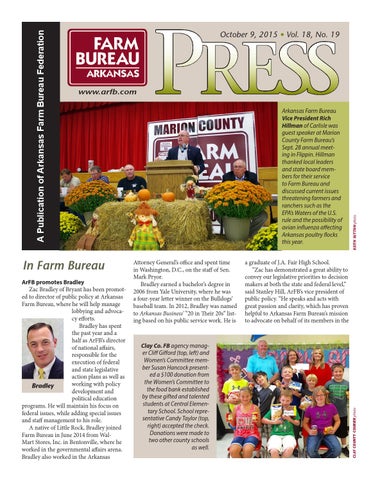
Arkansas Farm Bureau Vice President Rich Hillman of Carlisle was guest speaker at Marion County Farm Bureau’s Sept. 28 annual meeting in Flippin. Hillman thanked local leaders and state board members for their service to Farm Bureau and discussed current issues threatening farmers and ranchers such as the EPA’s Waters of the U.S. rule and the possibility of avian influenza affecting Arkansas poultry flocks this year. Attorney General’s office and spent time in Washington, D.C., on the staff of Sen. Mark Pryor. Bradley earned a bachelor’s degree in 2006 from Yale University, where he was a four-year letter winner on the Bulldogs’ baseball team. In 2012, Bradley was named to Arkansas Business’ “20 in Their 20s” listing based on his public service work. He is
Clay Co. FB agency manager Cliff Gifford (top, left) and Women’s Committee member Susan Hancock presented a $100 donation from the Women’s Committee to the food bank established by these gifted and talented students at Central Elementary School. School representative Candy Taylor (top, right) accepted the check. Donations were made to two other county schools as well.
KEITH SUTTON photo
www.arfb.com
a graduate of J.A. Fair High School. “Zac has demonstrated a great ability to convey our legislative priorities to decision makers at both the state and federal level,” said Stanley Hill, ArFB’s vice president of public policy. “He speaks and acts with great passion and clarity, which has proven helpful to Arkansas Farm Bureau’s mission to advocate on behalf of its members in the
CLAY COUNTY COURIER photo
A Publication of Arkansas Farm Bureau Federation
October 9, 2015 • Vol. 18, No. 19
President’s Leadership Council Nov. 9 is the deadline for receipt of President’s Leadership Council applications in the Little Rock office of Arkansas Farm Bureau. The council is a developmental program for men and women ages 25-45 who stand out from their peers and have a desire to grow and strengthen their leadership skills. Those accepted into the program will strengthen their knowledge of Farm Bureau and network with tomorrow’s leaders. Class size is limited to 20 individuals, with all costs, including travel, covered by Arkansas Farm Bureau. Participants will attend three two-day sessions in 2016, with the first planned for February. Applications are available at each county Farm Bureau office.
Dr. John Jennings, a professor in the Animal Sciences Department at UA’s Cooperative Extension Service, talked to participants at the Outdoor Recreation Business Workshop on Sept. 24 about winter foraging. The educational program at the Winthrop Rockefeller Institute on Petit Jean Mountain drew more than 60 participants and was sponsored in part by ArFB.
App versions of “The Steaks are High” and “Grocery Grab” are STEM-based games funded by the Beef Checkoff Program and geared toward students in grades 3-5. In addition to teaching nutrition and environmental facts, the apps also feature kid-friendly beef recipes. The My American Farm games are available on the iTunes store for iPhone and iPad, at Google Play for Android devices, on Amazon for the Kindle Fire and on www.MyAmericanFarm.org.
“All About Beef” app The American Farm Bureau Foundation for Agriculture has released a new educational app, “All About Beef,” funded in part by the Beef Checkoff.
UA photo
STEVE HIGNIGHT photo
KEN MOORE photo
WRI photo
legislative arena. “He has a commitment to Arkansas and our state’s farmers and ranchers, who collectively make up our state’s largest industry. We look forward to Zac’s expanded responsibilities. We are confident he can help our team define the best path forward with our legislative and regulatory work.”
Madison Co. FB held it’s annual meeting Oct. 3 in Huntsville. Seventy-six members and guests heard ArFB President Randy Veach address concerns facing the rural community. The membership also passed five resolutions it will forward to Arkansas Farm Bureau that will be considered for policy by the state organization in December.
Charles Dieffenbacher (center) of Texarkana recently was presented a plaque in appreciation for more than 50 years of service and dedication to Miller Co. FB and Arkansas Farm Bureau by county board members Bill Varner (left) and Duane Falls. Over the past half century, Dieffenbacher has served in many capacities, including president of Miller Co. FB.
Pam Bredlow (left) discussed the need for a waste tire disposal and recycling program with Stacy Edwards, recycling program manager for the Inter-District Waste Tire Management Program, and Evan Teague, director of environmental and regulatory affairs for Arkansas Farm Bureau at Bredlow’s Pulaski County farm Sept. 27.
In Arkansas Hall of Fame seeks nominations The Arkansas Agriculture Hall of Fame is seeking nominations from the public for its class of 2015. The nomination deadline is Nov. 6. The Agriculture Hall of Fame recognizes Arkansans who are or have contributed significantly to the state’s largest industry, while spotlighting their contributions to the state’s economic development. Since its first class was selected in 1987, 148 men and women have been inducted. Butch Calhoun, chairman of the Arkansas Agriculture Hall of Fame, says anyone can nominate a person believed worthy for the honor. “The history of Arkansas agriculture is filled with great men and women,” Calhoun said. “The role of the Arkansas Agriculture Hall of Fame is to honor worthy individuals who made a profound impact on Arkansas agriculture.” The Farm Bureau Center in Little Rock houses the Agriculture Hall of Fame, which is sponsored by the Arkansas State Chamber of Commerce and Arkansas Farm Bureau. Additional information and online nomination forms are available at www. arkansasaghalloffame.org. Forms also can be requested by calling MaLeta Stephens at 501-228-1470. The induction ceremony for the next class will be March 4, 2016, in Little Rock.
UAM photo
Members of the University of Arkansas-Monticello Collegiate Farm Bureau joined forces with the Drew Central FFA chapter recently to sign up new members for Arkansas Farm Bureau. “Young members are the future of Farm Bureau, and their interests and enthusiasm are vital inputs for the organization,” said Dr. Bob Stark, faculty adviser for the group.
GREGG PATTERSON photo
Farm-to-School workshops The Childhood Obesity Prevention Research Program at Arkansas Children’s Hospital Research Institute will host a series of USDA Regional Farm-to-School workshops in October and November to educate school personnel, farmers and community partners of the advantages of participating in a Farm-to-School program. The workshop will take place Oct. 15 at Southwest Research and Extension in Hope; Oct. 29 at University of Arkansas at Monticello, Nov. 5 at Arkansas State University in Jonesboro, Nov. 12 at North Arkansas College in Harrison and Nov. 19 at UA Cooperative Extension in Little Rock. Up to 50 participants can attend each session, and 10 travel scholarships are available to support attendance. The events are sponsored by the USDA Farmto-School Grant Program, Arkansas Cooperative Extension Office, Arkansas GardenCorps, Arkansas Farmers’ Market Association, Krebs Brothers Restaurant Store and Berries by Bill. Workshop participants will learn how to procure, market and prepare local foods in schools; hands-on culinary skills training for school cafeteria staff; business and production planning for farmers; and food safety for farmers and schools. Registration can be found by visiting archildrens.org/FarmToSchool. For questions, please contact Jenna Rhodes at 501-364-3360.
ArFB and the H.E.L.P. Committee granted a Make-A-Wish trip Oct. 1 to Hunter Linam. Hunter and his brother Archer (center) will be going to Legoland with their parents Bobby and Jessica (far right). H.E.L.P. Committee members involved in granting Hunter’s wish were (left to right) Allister Whitfield, Sarah Roberts, Kim Brown, Teresa Eslick, Cole Acklin and Shanna Mears.
Farmer hits mark for third year Desha County soybean farmer Matt Miles has broken the 100-bushel-per-acre barrier for the third year in a row, despite a departure from the atypical weather conditions that helped him and four other Arkansans pass the yield milestone during the last two growing seasons. Contest officials verified Miles’ yield at 108.77 bushels per acre from a single field that was grown and harvested specifically for the Arkansas Soybean Association’s “Grow for the Green Soybean Yield Challenge” contest. Entries must be harvested from a portion of a field ranging from 5-7 acres, and the soybean weight is corrected for moisture and foreign matter when calculating total yield per acre. “I made a lot of statements to the effect that it probably wouldn’t happen this year,” Miles said. “We really had no idea it would happen. But we cut a few fields we knew were pretty stout, and they were doing better than we expected. So as we got closer to the maturity of the contest field, I had an idea that it could possibly happen. But three weeks before we harvested, I would’ve told you there’s no way.” In January, a report from the U.S. Department of Agriculture put the 2014 Arkansas average soybean yields at 50 bushels per acre, a record in the state. The average takes into account growers across the state, but yields in the Delta tend to be much higher, due in part to soils particularly well
suited for the crop. For more information about the Grow for the Green contest, visit www.arkansassoybean.com.
Elsewhere Rice Outlook Conference The 2015 USA Rice Outlook Conference will be held Dec. 9-11 at the Sheraton New Orleans. The conference brings together rice farmers, millers, merchants and representatives of allied businesses from all rice-producing states and beyond. It features a trade show devoted to rice-related farm equipment, technology, products and services, and will include economic and political outlooks, the global rice outlook, a provocative look at the future of food and keynote speakers Mary Matalin and James Carville. Also on tap are state-by-state production and research reports, learning sessions, the 2016 weather outlook and more. The conference hotel is on Canal Street near New Orleans’ famed French Quarter. It’s a short walk to numerous restaurants and landmarks, and just steps to the historic Canal Street streetcar line. For more information, visit usarice.com or contact Jeanette Davis at jdavis@ usarice.com or 703-236-1447. Editor Keith Sutton
keith.sutton@arfb.com
In the Market As of October 6, 2015 TPP agreement reached On Oct. 5, officials signed the Trans Pacific Partnership (TPP) agreement. Negotiators have been working on the agreement since 2008, which is between the U.S. and 11 Pacific Rim countries (Australia, Canada, Japan, Malaysia, Mexico, Peru, Vietnam, Chile, Brunei, Singapore and New Zealand). According to the U.S. Department of Agriculture, these countries account for 42 percent of all U.S. agricultural exports, totaling $633 billion. While the text of the agreement has been approved, all agricultural groups, including Arkansas Farm Bureau and American Farm Bureau, are in the process of analyzing the impact of this agreement on individual commodities. According to the Trade Promotion Authority (TPA) that Congress granted to allow the President to negotiate TPP, the agreement will be made available for 60 days for review by the public. Congress will then have 30 days for a yes or no vote on TPP. When the TPP agreement had been signed, Arkansas Farm Bureau President Randy Veach released the following statement: “We are pleased the negotiations about the Trans Pacific Partnership have concluded. As a member of the USDA/USTR trade advisory committee, I know how challenging this process has been. “TPP offers a rare opportunity to open markets around the Pacific Rim that have been previously restricted. We are hopeful the details of the agreement will bear that out. “Almost all of the commodities we raise in Arkansas could experience some additional opportunities from this agreement.” Below are a few of the early reports from Politico on the impact the agreement will have on agricultural products produced in Arkansas. Poultry No reports yet as to the specifics of the agreement in regards to the Canadian market. The National Chicken Council
stated they hope to see the long-protected Canadian market finally opened. Japan and Vietnam will eliminate tariffs on poultry, while Malaysia will establish tariff-rate quotas for live chicks, poultry meat and eggs. Rice Preliminary reports indicate rice access would increase under a country-specific quota in which the U.S. would initially receive 50,000 tons for the first three years. The quota would reach a ceiling of 70,000 tons by the thirteenth year. Japan also agreed to reallocate some of its World Trade Organization import quota to medium-grain rice, which is exported to Japan primarily by the U.S., eventually giving the U.S. rice industry more than 100,000 annual tons in exports. In addition to market access into Japan, the U.S. will face increased competition in Mexico. The agreement will reduce duties on rice from Vietnam into Mexico. In 2014-15, the U.S. exported 602,100 MT of long-grain and 12,100 MT of short- and medium-grain rough rice, as well as 96,800 MT of long-grain and 5,300 MT of shortand medium-grain milled rice to Mexico. Beef The market was very concerned about improved access into the Japanese market. Preliminary reports from trade ministers indicate the current 38.5-percent tariff on U.S. beef into Japan would drop to 27.5 percent once the deal is in place. By year 10, the tariff would go down to 20 percent. By year 16, it would be 9 percent. Grains and Soybeans The U.S. Grains Council expects the TPP agreement to increase the output of all grain exports from the United States by 11 percent. Pork Japan is one of the United States’ largest trading partners for pork, and the goal of this agreement was to improve access for U.S. pork. Preliminary reports from trade ministers indicate that pork tariffs in Japan would drop from 4.3 percent to 2.2 percent. The weight-based tariff on pork would go from roughly $4 per kilogram to just over $1 per kilogram upon entry into force. By year 10, the tariff would dip to nearly 42 cents per kilogram. The National Pork Producers Council estimates the Trans-Pacific Partnership deal could lead
to the creation of more than 10,000 U.S. jobs from the expected increase in pork exports. Bernanke on interest rates The case made by some that the Federal Reserve System needs to embark on a course of four one-quarter point increases in short-term interest rates is not something former Fed Chair Ben Bernanke thinks the U.S. economy could tolerate. “That is not obvious. I don’t think everybody would agree to that,” Bernanke told CNBC, noting such a move would “kill U.S. exports with a very strong dollar.” The September Employment report was “mediocre” in Bernanke’s view and is a “negative” for the Fed’s strategy to begin raising short-term interest rates yet this year. As for those who argue that raising rates now would allow them to be lowered later, Bernanke simply said such a plan “doesn’t make any sense. If you raised rates too early and kill the economy, that doesn’t help you.” USDA report likely to keep market volatile On Oct. 9, the USDA will release the October Supply and Demand Report. While the market is bullish heading into the report, the wide range of trade expectations for this report leaves the market vulnerable to a bearish reversal. 2015-16 U.S. corn stocks are expected to be 1.534 billion bushels (1.339-1.750 billion bushels), compared with USDA’s current forecast of 1.592 billion. There is a lot of speculation that this number could go higher given the strong yields and potential increases in production. As for soybeans, traders are expecting 414 million bushels (300-475 million bushels) of U.S. soybean stocks in 2015-16. This compares to a current forecast of 450 million bushels. This number is more likely to come in near the high end of expectations given the USDA will likely keep production strong and could even lower the export forecast if sales remain down more than 30 percent from historical levels.
CONTACT • Matt King 501-228-1297, matt.king@arfb.com.