In Farm Bureau
Lambert joins ArFB Mark Lambert has been hired as assistant director of commodity activities and economics in the commodity and regulatory affairs department at Arkansas Farm Bureau. Lambert will coordinate the activities of the wheat and feed grains and forestry divisions, and serve as administrator of both the Arkansas Wheat Promotion Board and the Arkansas Corn and Grain Sorghum Board. He also will assist in economic analysis work Lambert in support of Farm Bureau’s advocacy and communications efforts. Lambert, a native of Stuttgart, previously served as sustainability coordinator at Riceland Foods Inc., where he helped develop a program to assist farmers with improving farm management and sustainability prac-
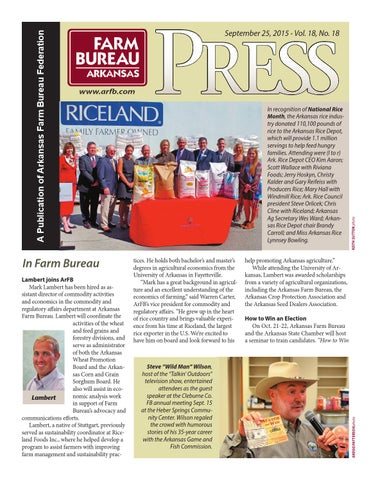
In recognition of National Rice Month, the Arkansas rice industry donated 110,100 pounds of rice to the Arkansas Rice Depot, which will provide 1.1 million servings to help feed hungry families. Attending were (l to r) Ark. Rice Depot CEO Kim Aaron; Scott Wallace with Riviana Foods; Jerry Hoskyn, Christy Kalder and Gary Reifeiss with Producers Rice; Mary Hall with Windmill Rice; Ark. Rice Council president Steve Orlicek; Chris Cline with Riceland; Arkansas Ag Secretary Wes Ward; Arkansas Rice Depot chair Brandy Carroll; and Miss Arkansas Rice Lynnsey Bowling. tices. He holds both bachelor’s and master’s degrees in agricultural economics from the University of Arkansas in Fayetteville. “Mark has a great background in agriculture and an excellent understanding of the economics of farming,” said Warren Carter, ArFB’s vice president for commodity and regulatory affairs. “He grew up in the heart of rice country and brings valuable experience from his time at Riceland, the largest rice exporter in the U.S. We’re excited to have him on board and look forward to his
Steve “Wild Man” Wilson, host of the “Talkin’ Outdoors” television show, entertained attendees as the guest speaker at the Cleburne Co. FB annual meeting Sept. 15 at the Heber Springs Community Center. Wilson regaled the crowd with humorous stories of his 35-year career with the Arkansas Game and Fish Commission.
KEITH SUTTON photo
www.arfb.com
help promoting Arkansas agriculture.” While attending the University of Arkansas, Lambert was awarded scholarships from a variety of agricultural organizations, including the Arkansas Farm Bureau, the Arkansas Crop Protection Association and the Arkansas Seed Dealers Association. How to Win an Election On Oct. 21-22, Arkansas Farm Bureau and the Arkansas State Chamber will host a seminar to train candidates. “How to Win
GREGG PATTERSON photo
A Publication of Arkansas Farm Bureau Federation
September 25, 2015 • Vol. 18, No. 18
Lynnsey Bowling of McCrory, the 2015-16 Miss Arkansas Rice, was on hand Sept. 21 for a ceremony at the State Capitol where Gov. Asa Hutchinson proclaimed September as Rice Month in Arkansas. Hutchinson told attendees he sees new opportunities for increased trade with Cuba and will promote rice and other products on a trade mission to the island nation later this month.
at http://bit.ly/1OZsr9a with a credit card. Teachers may provide a purchase order from their schools. The book features 32 pages of color photos and graphics, as well as a wall-sized map poster showing where various foods, livestock and crops are grown. Pocket-guide versions of the book also are available. “Food and Farm Facts” activity cards (for grades 4-6 and 7-12) are being developed by the American Farm Bureau Foun-
New books, pocket guides available American Farm Bureau Federation’s “Food and Farm Facts” book and pocket guides are now available to purchase online
KEITH SUTTON photo
KEITH SUTTON photo
MOLLIE DYKES photo
KIRK JORDAN photo
an Election” has been attended by successful candidates for many years in Arkansas. This seminar teaches how to evaluate a candidate and the electorate, build a campaign structure, raise money, enlist allies, create coalitions and get last-minute election-day voter attention. It was developed by American Farm Bureau, an organization noted for its understanding of the political process, with the help of professional political consultants and staff members of Democratic and Republican parties. The instructors are trained staff members of Farm Bureau. Video recording, a case study and a computer simulation will allow atendees to test techniques, tools and methods. The seminar will be held in the Bob Lamb Conference Room at the Arkansas State Chamber office at 1200 W. Capitol Ave. in Little Rock. It is limited to candidates, their spouses and campaign managers. The cost is $225 ($195 for spouses attending with a candidate). Space is limited so register early. The registration deadline is Oct. 16. For more information email jeff.pitchford@arfb.com or call 501-228-1625.
President Burnie Sharp (at the head table) presided over Columbia Co. FB’s annual meeting Sept. 10 at the Farm Bureau office in Magnolia. More than 20 people attended for a barbecue dinner and to elect new officers, hear committee reports and to decide on resolutions that will be submitted to Arkansas Farm Bureau for consideration at its state convention in December.
Kenneth Robertson (second from right) and his wife Helen received a plaque honoring Kenneth’s years of service to Farm Bureau during Hot Spring Co. FB’s annual meeting Sept. 21 in Malvern. On hand to congratulate Kenneth were (left to right) ArFB state board member Joe Thrash, Hot Spring Co. FB President Jeremy Allen and ArFB state board member Tom Jones.
The Craighead Co. FB Women’s Committee hosted a rice-tasting event Sept. 4 at Region’s Bank in Jonesboro. Two dozen rice dishes were served, including Ragen’s Rice-n-Wings Salad, which Miss Craighead County Rice Ragen Hodges served to (left to right) Mayor Harold Perrin, Branon Thiesse with the county extension office and Region’s Bank President Larry Worsham.
dation for Agriculture and will be available soon.
In Arkansas Preparing for avian influenza In preparation for the possible re-emergence of highly pathogenic avian influenza (HPAI) in Arkansas as wild birds begin to migrate south from Canada, the Arkansas Livestock & Poultry Commission and its industry partners have identified “Minimum Biosecurity Standards for Arkansas Poultry Growers.” These standards have been distributed to each county Farm Bureau office and also are available on the commission’s website, http://alpc.arkansas. gov. Biosecurity is the poultry industry’s first line of defense to all avian diseases, including HPAI. Rigorous implementation of biosecurity principles will be essential to preventing disease introduction into Arkansas and will be even more important if Arkansas has an outbreak of HPAI. The Arkansas Livestock & Poultry Commission has worked closely with the poultry industry to ensure these practices are applicable to a wide variety of production operations and to serve as a list of recommendations to farmers and associated personnel. Arkansas Farm Bureau is working closely with The Poultry Federation and Arkansas Livestock & Poultry Commission
GREGG PATTERSON photo
Howe named plant board chair The Arkansas State Plant Board (ASPB) has named Otis Howe of Little Rock as the new chairman to the ASPB board of directors. Howe replaces George Tidwell of Lonoke, who has been chairman of the board for the last 15 years. Howe is a field representative for DuPont Pioneer. He has served on the ASPB Board for 20 years. “Otis is a thoughtful leader. His calm, collected nature will serve the Arkansas State Plant Board, Arkansas citizens and the agricultural community well. When he speaks, people listen. We look forward to working under his leadership,” said ASPB Director Darryl Little. “We also appreciate the years of loyal, dedicated service from outgoing Chairman George Tidwell.” The ASPB board of directors is comprised
Randy and Linda Motley of Motley’s Tree Farm received recognition as Pulaski Co. FB’s Farm Family of the Year at the county annual meeting Sept. 10 at Sylvan Hills Church of Christ. The Motley’s run an agritourism operation on 15 acres that features a pumpkin patch, petting zoo, Christmas trees and a Christmas gift shop.
KEN MOORE photo
to keep our producer-members informed as to confirmed cases of HPAI. Although poultry companies will more than likely contact growers first about any possible outbreak, Arkansas Farm Bureau felt it necessary to inform poultry growers as well. Poultry growers who would like to receive updates on avian influenza can text the keyword ARFBAI to 88202 to be added to the text message group. Arkansas Farm Bureau will by no means be in front of The Poultry Federation or Arkansas Livestock & Poultry Commission on the issue, but wanted to be another outlet for information.
(Left to right) State Senator Larry Teague, Polk Co. FB agency manager Floyd Clark and Polk Co. FB President Allen Stewart commended the Bryan and Sonya Maye family of Hatfield for being named the Polk County Farm Family of the Year at the county’s annual meeting in Mena Sept. 21. The Mayes have been raising and showing show lambs for 18 years.
of 18 members appointed by the governor and represents various agricultural industries and associations across Arkansas, as well as the University of Arkansas. The ASPB board of directors promulgates regulations and administers enforcement for more then 30 laws that impact agriculture and the general public in the state, and has done so since 1917. Governor makes appointments On Sept. 11, Gov. Asa Hutchinson announced several appointments to various agricultural boards. Rich Hillman of Carlisle, vice president of Arkansas Farm Bureau, was reappointed to the Arkansas Rice Research and Promotion Board along with Bobby Hoard of Marianna and Marvin Hare of Newport. David Gairhan of Jonesboro was appointed to the same board. He replaces former ArFB state board member Mike Sullivan of Burdette. David Wallace of Crawfordsville, Blake Swears of Carlisle, Jackie Prince of Biscoe and Kenneth Clark of Newport were appointed to the Arkansas Wheat Promotion Board. Gary Sitzer of Weiner and Glynn Guenther of Sherrill were appointed to the Arkansas Soybean Promotion Board, and Ray Dillon of Little Rock was appointed to the Arkansas Forestry Commission.
Elsewhere Top five U.S. sorghum customers A report from the U.S. Grains Council (USGC) says China is the number one buyer of U.S. sorghum for the marketing year Sept. 1, 2014 to Aug. 31, 2015. China accounted for 98 percent of U.S. sorghum exports during that period, buying more than 326.8 million bushels. U.S. sorghum was introduced into China through a joint effort between the USGC and the United Sorghum Checkoff Program (USCP) in 2013. Since then, China has rapidly grown to become the top market for U.S. sorghum, and the USGC and USCP have continued their efforts to promote U.S. sorghum through missions, trade teams and customer servicing. Japan is currently the second-largest market for U.S. sorghum, importing 4.5 million bushels so far this marketing year. In this market, the USGC is working to promote white sorghum as a health food product by hosting tasting events, through targeted media advertisements and more. The list of top U.S. sorghum importers is rounded out with Mexico, Canada and South Korea. While these markets are relatively small for U.S. sorghum this year, the USGC will continue to monitor and foster these markets to build interest in the product. Editor Keith Sutton
keith.sutton@arfb.com
In the Market As of Sept. 21, 2015: Strong Chinese soy imports China imported nearly 286 million bushels of soybeans during August, a 29.01-percent increase from one year ago. Brazil and Argentina got 93.9 percent of this business. Of note, the U.S. came in at No. 5 on the list of sellers for the month. For the first eight months of the year, China has purchased 1.925 billion bushels MT of soybeans, a 9.81 percent increase from the year prior. The U.S. typically ramps up its soybean exports to China in the fourth quarter, but there is some talk that ongoing shipments from South America and China’s aggressive buys so far this year could result in the country purchasing fewer beans from the United States. Mixed reports for cattle market Last week’s Cattle on Feed Report was bullish for prices as the report was expected to show placements as of Sept. 1 at 100.2 percent of last year’s levels. Instead the report showed placements well below expectations at just 95 percent of year-ago levels. While this provided some brief support for prices, Wednesday’s cold-storage report confirmed slow demand concerns and is overshadowing supply. The report was expected to show frozen beef stocks around 440.1 million pounds for the end of August. Instead the report showed frozen beef stocks at 470.4 million pounds, which is a 36-percent increase from August 2014 and a 2-percent increase from the end of July. This bearish stocks report will continue to pressure prices as live cattle have lost more than $13 and feeders are down $20 since the first of September. Obama announces more regulatory changes with Cuba Certain U.S. businesses will now be permitted to open offices and bank accounts in Cuba, establish joint ventures
with some Cuban government entities and hire Cubans to work for them under major regulatory changes announced by the Obama administration last Friday. The move would further expand trade ties and chip away at the U.S. embargo. France joins EU countries opting out of GM crop cultivation France is to use a new European opt-out scheme to ensure a ban on the cultivation of genetically modified crops in the country remains in place. France, the EU’s largest grain grower and exporter, has asked the European Commission to exclude it from cultivation of nine GM corn strains. Under the EU opt-out deal passed in March, an individual country can seek exclusion from any approval request for GM cultivation in the bloc or from varieties already cleared as safe by the EU. Previously, Germany, Latvia and Greece also requested to opt out of growing certain GM crops. China still reviewing U.S. rice proposal Reports that a China/U.S. rice trade pact had been struck were premature. On a conference call last week, APHIS officials said they wanted to confirm there is no confirmation that the Chinese have agreed to the proposal APHIS sent them in early August. APHIS confirmed its counterpart in China, AQSIQ, has sent the U.S. draft protocol to an interagency review process. HSUS condemns ventilation shutdown The Humane Society of the United States is opposing the recently released U.S. Department of Agriculture policy for controlling avian influenza on commercial poultry production operations, which allows for the use of “ventilation shutdown.” The HSUS chief veterinary officer, Michael Blackwell, said, “Animals suffer immensely with any outbreak of an epidemic like avian influenza, and we shouldn’t compound the problems for birds by subjecting them to a particularly miserable and protracted means of euthanasia.”
USDA approves bird flu vaccine POLITICO reports Iowa-based Harrisvaccines has gained the Agriculture Department’s approval for a vaccine to target a virulent strain of bird flu that wiped out tens of millions of chickens and turkeys this year, and the company says it’s preparing to churn out millions of doses. Joel Harris, head of sales and marketing for the company, told POLITICO that USDA tests have shown the H5N2 vaccine is 95 percent effective on egg-laying hens and 93 percent effective on day-old chicks after one dose, surpassing the efficacy of a previous vaccine USDA had considered that was only about 60 percent effective. Sanders wants to “end subsidizing corporate agriculture” Democratic presidential candidate Bernie Sanders took a jab at agricultural subsidy programs in an interview with Mark Halperin, host of Bloomberg Politics’ “With All Due Respect,” that posted last Friday. Following the independent senator from Vermont’s suggestion that he would reduce defense spending, Halperin asked if there were “any domestic programs of significant size” where he would like to also make cuts. “I think we have got to end subsidizing corporate agriculture, for example,” Sanders answered, although he declined to identify any specific commodities or subsidy programs. “Most of the way I would look at it is, if you are into large corporate farming, you really do not need subsidies from the federal government. I am a supporter of family farms, not just dairy in my own state of Vermont. I would like to see a strengthened and resilient family farm situation in America, where people can maintain their family farms.”
CONTACT • Matt King 501-228-1297, matt.king@arfb.com.