In Farm Bureau Summer commodity meetings It’s time to mark your calendar for the 2015 Arkansas Farm Bureau summer commodity meetings. The date, place, time and coordinator for each meeting are listed below. (The times noted do not include registration.) Additional information about the meetings will be sent to county commodity chairmen at a later date. • Soybeans: June 2, Convention Center, Brinkley, 10 a.m. Matt King • Wheat & Feed Grains: June 2, Convention Center, Brinkley, 10 a.m. Ethan Branscum • Aquaculture: June 4, conference call, 1 p.m. Brandy Carroll • Beef Cattle: June 16, Lake Point Conf. Center, Russellville, 9:30 a.m. Travis Justice • Poultry: June 16, Lake Point Conf. Center, Russellville 9:30 a.m. Bruce Tencleve • Swine: June 16, Lake Point Conf. Center, Russellville, 9:30 a.m. Evan Teague • Dairy: June 17, Conference Call, 9
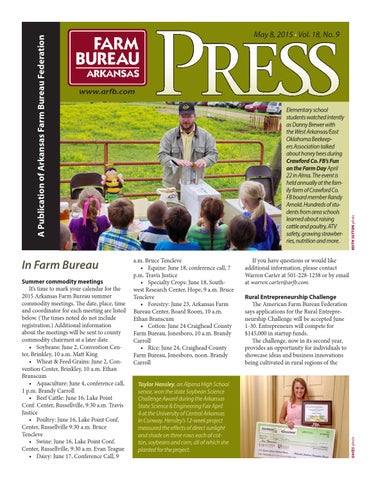
Elementary school students watched intently as Danny Brewer with the West Arkansas/East Oklahoma Beekeepers Association talked about honey bees during Crawford Co. FB’s Fun on the Farm Day April 22 in Alma. The event is held annually at the family farm of Crawford Co. FB board member Randy Arnold. Hundreds of students from area schools learned about raising cattle and poultry, ATV safety, growing strawberries, nutrition and more. a.m. Bruce Tencleve • Equine: June 18, conference call, 7 p.m. Travis Justice • Specialty Crops: June 18, Southwest Research Center, Hope, 9 a.m. Bruce Tencleve • Forestry: June 23, Arkansas Farm Bureau Center, Board Room, 10 a.m. Ethan Branscum • Cotton: June 24 Craighead County Farm Bureau, Jonesboro, 10 a.m. Brandy Carroll • Rice: June 24, Craighead County Farm Bureau, Jonesboro, noon. Brandy Carroll Taylor Hensley, an Alpena High School senior, won the state Soybean Science Challenge Award during the Arkansas State Science & Engineering Fair April 4 at the University of Central Arkansas in Conway. Hensley’s 12-week project measured the effects of direct sunlight and shade on three rows each of cotton, soybeans and corn, all of which she planted for the project.
KEITH SUTTON photo
www.arfb.com
If you have questions or would like additional information, please contact Warren Carter at 501-228-1238 or by email at warren.carter@arfb.com. Rural Entrepreneurship Challenge The American Farm Bureau Federation says applications for the Rural Entrepreneurship Challenge will be accepted June 1-30. Entrepreneurs will compete for $145,000 in startup funds. The challenge, now in its second year, provides an opportunity for individuals to showcase ideas and business innovations being cultivated in rural regions of the
UACES photo
A Publication of Arkansas Farm Bureau Federation
May 8, 2015 • Vol. 18, No. 9
STEVE HIGNIGHT photo
MARY HIGHTOWER photo
Dr. John Richeson, assistant professor for the Dept. of Agricultural Sciences at West Texas A&M, talked about cattle feeding during the Forage and Beef Cattle Conference April 21 at the Livestock & Forestry Research Station in Batesville. Dozens of attendees obtained information from event speakers they can use back on their farms.
Benton Co. FB’s Scholarship Committee met April 16 in Cave Springs to select this year’s recipients. Three scholarships were awarded after presentation to the full board. Committee members in attendance included (left to right) Susan Anglin; Dan Douglas, chairman; James Simpson; Jim Griffin; Anthony Griffin and Richie Stark.
The top 10 teams will be announced Oct. 15. This includes six teams that will win $10,000 in startup funds and four finalist teams that will win $15,000 in startup funds and compete in a live competition at AFBF’s 97th Annual Convention in Orlando, Fla., in January. For additional information, visit www. strongruralamerica.com/challenge.
must be an accepted or current student in a registered nursing program or a doctor of pharmacy program. They or their parents must be a member of Arkansas Farm Bureau. Other criteria to be considered by the selection committee are the applicant’s community involvement and their leadership abilities. The recipient will receive $1,000 and may reapply in subsequent years. The recipient will be notified July 10. The family of Nicky Hargrove established the scholarship fund to honor Hargrove’s years of service to Arkansas Farm Bureau and all of Arkansas agriculture. Hargrove was a rice, soybean and wheat farmer from Stuttgart. He served as president of Arkansas Farm Bureau from 19761986 and was inducted into the Arkansas Agriculture Hall of Fame in 1999. Hargrove died in 2011 at the age of 79, and his family wanted to find a way to honor the people who cared for him throughout his years of illness while also ensuring his name is never forgotten. “Over the years of fighting lung cancer, heart problems, diabetes and lymphoma, some of the most important people to Nicky and his family were the registered nurses and pharmacists who participated in his care,” said Lori Dabbs, Hargrove’s daughter. “In honor of these special people and in memory of Nicky, a scholarship was established through the Stuttgart Memorial Hospital Foundation.” Scholarship applications can be requested by emailing hargrovescholarship@gmail. com. Applications, along with a resume, are due by June 15 and should be mailed to 2001 S. Prairie, Stuttgart, AR, 72160.
In Arkansas Scholarship fund seeks applicants Nursing and pharmacy students are encouraged to apply now for a $1,000 scholarship offered through the Nicky Hargrove Memorial scholarship fund. Each applicant
KEN MOORE photo
JEFFERSON CO. FB photo
United States. It is the first national business competition focused exclusively on rural entrepreneurs working on food and agriculture businesses. “The inaugural challenge successfully identified rural entrepreneurs with innovative ideas, proving that great business ideas can germinate anywhere,” said American Farm Bureau Federation President Bob Stallman. “We’re excited to see the new crop of ideas our members will bring to the table this year.” New this year, competitors must have an idea for a business that is related directly or indirectly to food and agriculture. Businesses directly related to food and agriculture include farms or ranches, value-added food processing, food hubs, community-supported agriculture programs, farm-to-table restaurants and farmers markets. Businesses indirectly related to food and agriculture include support services such as crop scouting, agritourism, ag advertising agencies and ag tech companies that develop apps. Also new, Farm Bureau will endeavor to connect top scoring teams with resources for crowdfunding loans to help them jump-start their businesses. Again this year, competitors must be based in a rural community as defined by the U.S. Census Bureau. Competitors’ primary residences or businesses must be located in a county with less than 50,000 residents or a town with less than 2,500 residents.
Jefferson Co. FB Women’s Committee representatives Meredith Baker (left) and Susan Bitely (right) recently presented a $500 Ag in the Classroom Outdoor Classroom Garden Grant to Lighthouse Academy Charter School Principal Samuel Glover. The money will allow students at the school to plant an on-campus vegetable and flower garden.
Gov. Asa Hutchinson (second from right) spoke with members of Arkansas Farm Bureau’s public policy team — (left to right) Jeff Pitchford, Zac Bradley and Ross Dunn — outside the House chamber April 22 while the 90th session of the General Assembly was adjourning.The public policy team worked at the capitol throughout the session, which started Jan. 12.
Auction raises 4-H, judging team funds An online stallion service auction that benefited the 4-H equine program and the University of Arkansas horse judging team went so well that planning is underway for a second one. “We brought in $17,400, and for our first year we were pretty pleased with that,” said Mark Russell, assistant professorequine for the University of Arkansas System Division of Agriculture. “This is unique. We don’t know of any other 4-H program doing anything like this.” At auction were stud services to top cutting, western pleasure and halter stallions, all donated by their owners. The proceeds from the auction will fund scholarships to 4-H equine camps, purchase camp equipment and help support travel for the University of Arkansas’ horse judging team. “We’re looking to doing it again next year,” Russell said. “We have some of the same stallions committed and a few new ones too.”
STEVE HIGNIGHT photo
NRCS projects for cleaner waterways Targeted conservation work in the Mississippi River basin will unite the U.S. Department of Agriculture, farmers and local organizations to help clean waterways that flow into the nation’s largest river. USDA’s Natural Resources Conservation Service is investing $10 million this year in 27 new
More than 1,800 students from Washington, Benton and Madison county schools attended the 19th Annual Washington County Farm Friends Day at UA’s Pauline Whitaker Animal Science Center in Fayetteville. The April 23 event provided opportunities for the children to learn about farm animals, wool spinning, horseshoeing, composting, milking, poultry and much more.
UA photo
Donations in Hargrove’s memory may be made to Stuttgart Memorial Hospital Foundation. Mail checks to P.O. Box 1905, Stuttgart, AR, 72160 and write “Hargrove scholarship” in the memo line.
On April 28, the Arkansas Rice Research and Promotion Board (RRPB) presented UA’s Division of Agriculture a $2 million check to help construct a new Foundation Seed Facility in Stuttgart. RRPB chairman Marvin Hare (left) presented the check to Vice President for Agriculture Mark Cochran with help from former U.S. Sen. and Arkansas Gov. David Pryor, who leads the agriculture committee on the UA Board of Trustees. high-priority watersheds and 13 existing projects that will help improve water quality and strengthen agricultural operations. This investment is part of a commitment of $100 million over four years to address critical water-quality concerns in priority watersheds while boosting rural economies. “We know that when we target our efforts to the places most in need, we see stronger results,” Agriculture Secretary Tom Vilsack said. “These projects focus on watersheds in need, where we have opportunities to work with partners and farmers to get conservation work on the ground.” NRCS worked with state agencies, farmers and other partners to identify high-priority watersheds that align with established state priorities and have strong partnerships in place — and where targeted conservation on agricultural land can make the most gains in improving local and regional water quality. Conservation systems implemented in these areas will reduce the amount of nutrients flowing from agricultural land into waterways, curb erosion and improve the resiliency of working lands in the face of droughts and floods. This investment builds on $18.5 million already allocated to projects in the basin in fiscal 2015. These projects include nine in Arkansas: Caney Creek, Strawberry River, upper Cache River, middle Cache, Bayou Meto, Bayou Meto middle, Grand Prairie L’Anguille and lower Arkansas. They are funded through the agency’s Mississippi River Basin Healthy Watersheds Initiative, which uses funding from several farm bill
conservation programs to help farmers adopt conservation systems to improve water quality and habitat and restore wetlands. Since MRBI’s start in 2009, NRCS has worked with more than 600 partners and 5,000 private landowners to improve more than 1 million acres in the region. Through these partnerships, the initiative more than quadrupled the number of contracts addressing water-quality concerns in targeted project areas.
Elsewhere Netflix streaming “Farmland” The “Farmland” documentary, is now available for streaming on Netflix.com. With 57 million subscribers worldwide, Netflix is considered a premium destination for documentaries and is an opportunity to extend the reach of the movie across the U.S. and into Canada. “Farmland” provides viewers a firsthand glimpse inside the world of farming and ranching by depicting the lives of six young farmers and ranchers. In addition to streaming on Netflix, the film is currently screening on major college and university campuses across the nation. Additional campuses interested in holding a screening can submit requests at farmlandfilm.com. The film continues to be available for rent and purchase at Walmart retail locations nationwide, Walmart. com and via digital download on iTunes, Amazon Instant Video, Blockbuster On-Demand, Sony PlayStation, Vudu.com, Xbox and YouTube. Editor Keith Sutton
keith.sutton@arfb.com
In the Market As of May 5, 2015 TPA: Important to Arkansas Before finalizing trade negotiations, every president since 1974 has received Trade Promotion Authority (TPA) from Congress. TPA gives the president the authority to negotiate new trade agreements and allows Congress a simple yes or no vote on trade deals, with no process to offer amendments. Additionally, TPA allows for greater transparency into negotiations for Congress. TPA was most recently used to negotiate the Columbia, Panama and South Korea free trade agreements (FTAs). Each of these agreements improved market access for agricultural products, in particular beef and poultry exports to Korea; rice, soybean and corn products to Colombia; and the elimination of duties on grains and meats in Panama. It is becoming increasingly important for the U.S. to negotiate new trade agreements as countries around the globe are actively seeking improved market access. Currently the United States has 14 FTAs with 20 countries, compared to 406 FTAs that exist around the globe. Additionally, more than 200 FTAs are currently being negotiated outside the U.S. If the U.S. fails to negotiate additional agreements, we could be at a competitive disadvantage in the global marketplace. So why is TPA so important to Arkansas? In 2013, Arkansas exported $4.04 billion in agricultural products, with the top three products being soybeans ($948.6 million), rice ($906.8 million) and poultry ($645.9 million). That year, Arkansas produced $10.02 billion worth of agricultural products, meaning more than 40 percent of our production was exported. In addition to agricultural products, Arkansas also exported $6.9 billion
in non-ag products. That’s almost $11 billion in products exported from Arkansas. With 8.8 percent of Arkansas’ $124.2 billion gross domestic product dependent on foreign markets, trade continues to drive growth in the Arkansas economy. TPA is currently need to finish negotiations for the Trans Pacific Partnership (TPP), which would give Arkansas agriculture, as well as other Arkansas businesses, improved market access to 11 Pacific Rim countries: Australia, Brunei, Canada, Chile, Japan, Malaysia, Mexico, New Zealand, Peru, Singapore and Vietnam. Some of the benefits of TPP are improved access for U.S. poultry products into Canada, reduced tariffs from 38.5 percent to a reported 9 percent on U.S. meat products into Japan over the next 10-15 years, and a reduction in forest product tariffs that are currently as high as 40 percent in some countries. Congress is likely to consider TPA in the weeks before Memorial Day. TPA legislation has passed both the Senate Finance Committee and the House Committee on Ways and Means with bipartisan support. The bill is headed to the House to be considered on the floor. If passed, it would move action to the Senate. TPA would authorize this administration and the next to negotiate trade deals for three years and allows congressional approval for a three-year extension. While there is debate about whether approving TPA for the president’s use could lead to immigration reform measures being packaged along with a trade deal, the administration and the U.S. Trade Representative are on record saying that is not their intention. 2015 productions forecast coming May 12 Many commodity prices started the month of April with multi-month highs. However, by the end of the month, these same commodities had put in or were testing contract lows. Great weather during the last week of April allowed crop progress to catch
up and, in some instances, surpass the five-year average. The U.S. Department of Agriculture reported that more than a quarter of Arkansas’ rice was planted that week, and close to 40 percent of the nation’s corn crop. This proved bearish for markets and is pressuring prices lower. With crops catching up to historic averages, it is very likely the USDA will assume “normal” weather and forecast a strong trend yield in its Supply and Demand Report on May 12. These stronger yields will increase supplies and show stronger carryovers in 201516 for many crops. In the current market situation, this type of news could push new-crop corn and soybeans back to test and likely break contract lows at $3.64 and $9.27, respectively. Weakness in these crops, combined with large supplies in other crops, is likely to lead to further declines in all commodity prices. In addition to grains, cattle prices continue to trend lower as recent reports indicate improving supplies and larger stocks. Brazil gathering evidence to challenge U.S. farm programs Brazil, according to Reuters, is gathering evidence to show the U.S. has increased its subsidies for soybeans and corn growers, which could push prices lower in South America. The country plans to pressure Washington by questioning the new programs from the 2014 farm bill at the World Trade Organization’s ag committee meeting. Authorities in Brazil say they will likely have more evidence of price distortions caused by U.S. subsidies by early next year that they can use to challenge the U.S. in a possible trade dispute.
CONTACT • Matt King 501-228-1297, matt.king@arfb.com.