In Farm Bureau Veach applauds Senate action Arkansas Farm Bureau President Randy Veach of Manila took note of a U.S. Senate budget resolution that passed March 26, specifically the inclusion of two amendments impacting Arkansas agriculture. Veach was pleased to see an amendment that would require federal agencies to determine full economic impact of critical habitat designations and another that would provide financial support to efforts to help control avian influenza outbreaks that have been traced to migratory waterfowl. “Both of those items are front-andcenter issues for Arkansas agriculture,” said Veach. “We appreciate the fact that Sens. John Boozman and Tom Cotton were co-sponsors of those amendments. “Avian influenza outbreaks have been managed effectively at the state level, but the possibility of a major outbreak could spell disaster for our poultry growers in Arkansas and across the country. Last fall, at the request of Rep. Rick
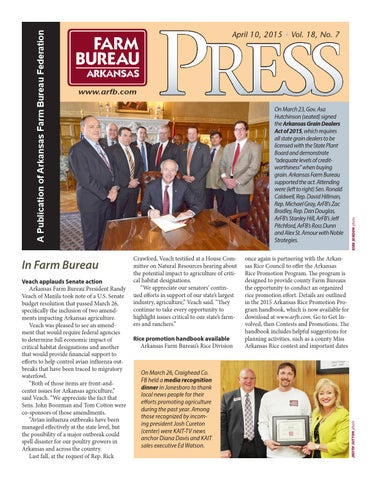
On March 23, Gov. Asa Hutchinson (seated) signed the Arkansas Grain Dealers Act of 2015, which requires all state grain dealers to be licensed with the State Plant Board and demonstrate “adequate levels of creditworthiness” when buying grain. Arkansas Farm Bureau supported the act. Attending were (left to right) Sen. Ronald Caldwell, Rep. David Hillman, Rep. Michael Gray, ArFB’s Zac Bradley, Rep. Dan Douglas, ArFB’s Stanley Hill, ArFB’s Jeff Pitchford, ArFB’s Ross Dunn and Alex St. Amour with Noble Strategies. Crawford, Veach testified at a House Committee on Natural Resources hearing about the potential impact to agriculture of critical habitat designations. “We appreciate our senators’ continued efforts in support of our state’s largest industry, agriculture,” Veach said. “They continue to take every opportunity to highlight issues critical to our state’s farmers and ranchers.” Rice promotion handbook available Arkansas Farm Bureau’s Rice Division
On March 26, Craighead Co. FB held a media recognition dinner in Jonesboro to thank local news people for their efforts promoting agriculture during the past year. Among those recognized by incoming president Josh Cureton (center) were KAIT-TV news anchor Diana Davis and KAIT sales executive Ed Watson.
KIRK JORDON photo
www.arfb.com
once again is partnering with the Arkansas Rice Council to offer the Arkansas Rice Promotion Program. The program is designed to provide county Farm Bureaus the opportunity to conduct an organized rice promotion effort. Details are outlined in the 2015 Arkansas Rice Promotion Program handbook, which is now available for download at www.arfb.com. Go to Get Involved, then Contests and Promotions. The handbook includes helpful suggestions for planning activities, such as a county Miss Arkansas Rice contest and important dates
JKEITH SUTTON photo
A Publication of Arkansas Farm Bureau Federation
April 10, 2015 • Vol. 18, No. 7
CLAY CO FB photo
“Learn About Livestock” banners The American Farm Bureau Foundation for Agriculture’s newest products, “Learn About Livestock” barn banners, were developed for use at fairs and livestock shows. The banners feature key information about major livestock species related to production, life cycle, the environment, how farmers care for animals and safety. Banners featuring information about dairy cattle, beef cattle, goats, sheep, pigs and poultry are available and are a great way to add an ag literacy component to a fair or livestock show. The banners can be ordered online at agfoundation.org (under Resources) or by emailing foundation@fb.org.
CLARK CO. FB photo
to remember. For additional information, contact ArFB’s Brandy Carroll at 501-2281268 or Chuck Wilson with the USA Rice Federation at 870-673-7541.
Karen Kirkpatrick, co-chair of the Clark Co. FB Women’s Committee, is pictured with numerous care blankets the committee donated recently to the Pregnancy Crisis Clinic in Arkadelphia. The donation will assist in the clinic’s efforts to provide parenting classes, post-abortion counseling and information about alternatives to abortion, such as adoption. huge increase in followers and engagement. Twitter has allowed ArFB to send out moment-by-moment updates during events such as the President’s Tour to Washington, D.C. and the YF&R and Women’s conferences. It also has served as an outlet for interacting with legislators and sharing the facts on major agriculture issues (i.e. Ditch the Rule) with a variety of audiences.
FB’s Twitter presence grows American Farm Bureau Federation’s Twitter presence continues to grow, recently garnering a year-over-year doubling in engagement among followers for special events such as the annual convention. AFBF has the most Twitter followers of any ag group. Outside of agriculture, the National Restaurant Association has 28,100 followers – 11,000 fewer than AFBF. With more than 2,600 followers, Arkansas Farm Bureau also has seen a
In Arkansas
STEVE HIGNIGHT photo
STEVE HIGNIGHT photo
Better broadband for rural Arkansas Agriculture Secretary Tom Vilsack an-
On March 23, at the county office in Jasper, Newton Co. FB board members Willa Sturdevant and Garland Matlock judged entries in the county’s agriculture safety poster contest. The first-place winners, all students at Deer Elementary, were second-grader Easton Cantrell, fourth-grader Wyatt Yates and fifthgrader Alexander Breedlove. All will compete in the state contest.
(Left to right, standing) Johnson County 4-H ambassadors Carley Allen of Ozone and Abby Sanders of Clarksville, and 4-H camp champion Samantha Sampley of Clarksville, attended the Johnson Co. FB board meeting March 26 in Clarksville. The students talked about their appreciation for the support the county has shown for 4-H activities throughout the year.
The Clay Co. FB Women’s Committee recently donated food to support Piggott Elementary’s Food for Kids backpack program, sponsored by the Arkansas Rice Depot. Pictured with some of the donated food items are (left to right) Women’s Committee member Sabrina Woolverton, PE’s Food for Kids coordinator Mona Scott and Women’s Committee member Debbie Pollard. nounced March 23 that the U.S. Department of Agriculture will fund a rural telecommunications infrastructure project that will improve broadband service in portions of rural Arkansas. Southwest Arkansas Telephone will receive a $25 million loan to upgrade portions of a fiber network and convert the remaining portions of a copper system to fiber to improve service for subscribers. Projects in Iowa and New Mexico also were funded. Since 2009, USDA investments in broadband include more than 500 projects for a total investment of $5.88 billion through the farm bill broadband program, Title II Infrastructure, Community Connect and Recovery Act programs. Law conference set for April 17 2014 farm bill implementation, estate planning for Midsouth agriculture, and wind energy and pipeline easement negotiations are part of the agenda for the second annual Mid-South Agricultural and Environmental Law Conference April 17. The conference will be hosted by the Agricultural and Food Law Consortium and be held at the Cecil C. Humphreys School of Law at the University of Memphis. Led by the National Agricultural Law Center, the Agricultural and Food Law Consortium is a national, multi-institution collaboration that develops and delivers authoritative, timely and objective agricultural and food law research and information to the nation’s agricultural community. “This is a great educational and
STEVE EDDINGTON photo
networking opportunity for attorneys, students and other ag professionals involved in Midsouth agriculture,” said Harrison Pittman, director of the National Agricultural Law Center at UA’s Division of Agriculture. “We have an outstanding lineup of speakers again this year, and the agenda is designed to bring practical knowledge on topics of immediate relevance to Midsouth agriculture.” For additional program information and to register, go to nationalaglawcenter. org/midsouthcle2015/.
Elsewhere
UA photo
Family farms important to ag Family-owned farms remain the backbone of our nation’s agriculture industry. USDA’s National Agricultural Statistics Service says that’s part of what it learned while sifting through tons of data from the latest Census of Agriculture. Census figures showed that 97 percent of the 2.1 million farms in the United States are family-owned operations. By definition, a family farm is any farm where the majority of the business is owned by the operator and individuals related to the operator, including through blood, marriage or adoption. Additional findings from the census include: • 88 percent of all U.S. farms are small family farms. • 58 percent of all direct farm sales to
Dr. Han-Seok Seo, a UA food scientist, judged entries in the recent North American Raspberry & Blackberry Association recipe contest at Fayetteville. UA students Joshua Andrews of Atlanta, Georgia (Chocolate Éclairs with Blackberry Mascarpone Filling) and Carlyn Oswald from Austin, Texas (Raspberry Dessert Enchiladas) won first and secondplace prizes, respectively.
Arkansas Farm Bureau President Randy Veach of Manila (left) and Vice President Rich Hillman of Carlisle visited the state capitol in Little Rock March 31 to thank legislators for their work during the 90th General Assembly. Rep. DeAnn Vaught (right) of Horatio (Sevier County) was among those they had the opportunity to meet with.
consumers come from small family farms. • 64 percent of all vegetable sales and 66 percent of all dairy sales come from the 3 percent of farms that are large or very large family farms. • 18 percent of principal operators on family farms in the U.S. started within the last 10 years. “Family farms produce food and fiber for people all across the U.S. and the world,” NASS Statistics Division Director Hubert Hamer said. “It’s due in part to information such as this from the Census of Agriculture that we can help show the uniqueness and importance of U.S. agriculture to rural communities, families and the world.” “Farmland” earns top honors Against strong competition, including Chipotle’s negative Farmed and Dangerous campaign, leading industry publication PR Week recently awarded its prestigious Arts, Entertainment and Media Campaign of the Year award to the consumer campaign surrounding “Farmland.” The James Molldirected documentary debuted in more than 170 theaters, sold more than 11,000 tickets – 84 percent above initial expectations – and with the assistance of U.S. Farmers and Ranchers Alliance partner organizations, has been screened more than 1,000 times. The film has also earned a 94 percent positive rating on review site
RottenTomatoes.com. The site, FarmlandFilm.com, garnered 322,280 unique visitors and helped attract more than 100,000 Facebook fans, and media efforts generated about 62 million impressions total. Surveys revealed that 53 percent of the primary target audience was aware of the documentary, and 46 percent were familiar with the USFRA – a 91 percent increase from 2013. New “My American Farm” game A new beef heritage game, “The Steaks Are High,” was recently launched on the myamericanfarm.org website. In this game, users pick an avatar character from the beef industry and explore the beef production process from cow-calf operation, to livestock auction, to stocker ranch, and finally to the feed yard. The game reinforces national learning standards for mathematics. It also introduces users and their families to how farmers and ranchers care for their animals and the environment. The game is supported by an online eComic lesson plan and activity sheet. “My American Farm” is an educational game platform launched in 2011 to engage pre-K through fifth-grade learners in agriculture. Today the free site offers 20 agriculturally themed games and more than 100 free educator resources, such as lesson plans, activity sheets and comics. Editor Keith Sutton
keith.sutton@arfb.com
In the Market As of April 8, 2015
Port fire could cause minor shipping delays Restrictions on truck access to the port of Santos in Brazil due to a fire at a nearby fuel storage facility will have some impact on grain exports, but shipments will only be delayed by a day or two, according to the port authority planning director. Santos handles a third of Brazil’s soybean exports and half its corn exports. China seeks cheaper alternatives to corn for animal feed China is actively seeking corn substitutes for animal feed due to lofty domestic corn prices and quota restrictions on imports. The country will likely import 40 percent more barley in 2014-15 at 7 MMT and is expected to double its sorghum purchases from year-ago to 8.1 MMT, according to China National Grain and Oils Information Centre. Meanwhile, an analyst with COFCO Futures Co. Ltd. says cheaper corn substitutes for feed such as sorghum, barley and dried distiller grains could displace 20 MMT of corn use in the country this marketing year. Chinese revise cotton price China set its 2015 target price for its new cotton subsidy program in the main cotton growing region of Xinjiang at 19,100 yuan ($3,080) per ton ($1.39 per pound), down 700 yuan (5 cents) from last year, according to the National Development and Reform Commission. Under the program, China’s government will pay growers the difference between the target price and the average market price for cotton. The lower target is not expected to impact output, but the fact that they are well above international prices reminds of challenges for those wishing to export to China.
Big decline in Indian cotton exports India’s cotton exports will likely fall 41 percent to a five-year low of 7 million bales for 2014-15, according to a government official who cites hefty global stocks of cotton and reduced Chinese demand. India’s textile commissioner said lower Indian cotton prices relative to international ones could lift sales to countries outside of China such as Bangladesh, Vietnam and Pakistan. U.S., Brazil near bilateral beef trade agreement The U.S. and Brazil are close to finalizing a bilateral beef trade agreement that will resolve Brazil’s longrunning attempt to export beef to the U.S. market, an official at Brazil’s Agriculture Ministry (MAPA) told Bloomberg BNA. “We now await U.S. publication of the final version of the agreement,” said a statement from MAPA. The agreement is said to be in its final stages. The accord will allow 14 Brazilian states to export fresh (chilled or frozen) beef, as opposed to processed beef — like canned corned beef — to the U.S. and allow the U.S. to likewise export fresh beef to Brazil. Both countries currently export only processed beef to each other. ERS: U.S. dairy herd likely to decline 2020-24 U.S. milk cow numbers are projected to rise through 2018, as high milk prices and lower feed costs provide favorable returns to producers. However, lower returns due in part to higher feed costs are expected to lead to yearto-year declines in cow numbers from 2020-24, according to new data from USDA’s Economic Research Service. At the same time, U.S. milk output per cow is projected to increase through the projection period, reflecting continued technological and genetic developments. Domestic commercial use of dairy products is expected to increase faster than the growth in U.S. population over the next decade.
Companies charged with wheat market manipulation The U.S. Commodity Futures Trading Commission (CFTC) charged Kraft Foods Group and Mondelez Global LL with wheat price maipulation. The CFTC says the companies bought $90 million of wheat futures (a six-month supply) in late 2011, with no intention to take delivery of the wheat and as part of a plan to draw down physical wheat prices. The companies pocketed more than $5.4 million as the market shifted prices in reaction to the massive position, according to CFTC. Energy and summer fuels outlook The Energy Information Administration predicted motorists would pay the lowest prices at the pump this summer since 2009. In its short-term energy forecast, the department calculated that the average national price for regular gasoline in the April-throughSeptember summer driving season would be $2.45 per gallon, compared with $3.59 a gallon over the same period last year. The report left both North Sea Brent and West Texas Intermediate crude oil price projections through 2016 unchanged, with Brent expected to average $59 per barrel in 2015 and $75 per barrel in 2016. Waters of the U.S. rule sent to OMB for review The Environmental Protection Agency has sent its Waters of the United States final rule to the Office of Management and Budget for interagency review, the last step before the rule is released as a final rule. The White House Office of Information and Regulatory Affairs received the proposed rule April 6.
CONTACT • Matt King 501-228-1297, matt.king@arfb.com.