In Farm Bureau Scholarship dinner and auction The public is invited to a dinner and auction May 6 in Arkadelphia to raise money for the Troy Buck Family Scholarship endowment. The endowment will provide annual scholarships for students studying agriculture at Southern Arkansas University in Magnolia. Sponsors, which include Arkansas Farm Bureau, Clark County Farm Bureau and Farm Credit of Western Arkansas, hope to raise $25,000 for the endowment this year. The buffet dinner, along with a live and silent auction, will be held at the Arkadelphia Recreation Center at 2555 Twin Rivers Drive. Individual tickets are $35 and can be purchased at the Clark County Farm Bureau office, 2702 Caddo St., Arkadelphia; Farm Credit of Western Arkansas, 2858 Walnut Street, Arkadelphia; Farm and Ranch Feed, 525 N. 1st St., Glenwood; Centerpoint High School, 755 Highway 8 East, Amity; Chambers Bank, 111 W. Thompson, Amity; and Farm Credit, 1722 E. 3rd St., Hope.
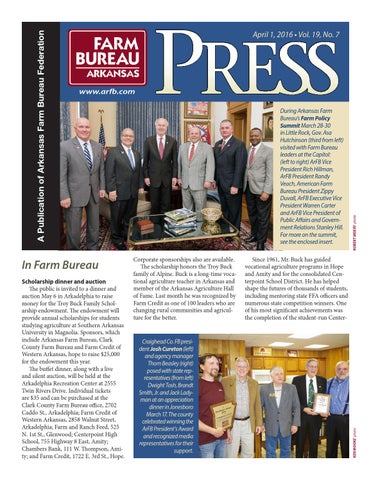
During Arkansas Farm Bureau’s Farm Policy Summit March 28-30 in Little Rock, Gov. Asa Hutchinson (third from left) visited with Farm Bureau leaders at the Capitol: (left to right) ArFB Vice President Rich Hillman, ArFB President Randy Veach, American Farm Bureau President Zippy Duvall, ArFB Executive Vice President Warren Carter and ArFB Vice President of Public Affairs and Government Relations Stanley Hill. For more on the summit, see the enclosed insert. Corporate sponsorships also are available. The scholarship honors the Troy Buck family of Alpine. Buck is a long-time vocational agriculture teacher in Arkansas and member of the Arkansas Agriculture Hall of Fame. Last month he was recognized by Farm Credit as one of 100 leaders who are changing rural communities and agriculture for the better.
Craighead Co. FB president Josh Cureton (left) and agency manager Thom Beasley (right) posed with state representatives (from left) Dwight Tosh, Brandt Smith, Jr. and Jack Ladyman at an appreciation dinner in Jonesboro March 17. The county celebrated winning the ArFB President’s Award and recognized media representatives for their support.
ROBERT MOERY photo
www.arfb.com
Since 1961, Mr. Buck has guided vocational agriculture programs in Hope and Amity and for the consolidated Centerpoint School District. He has helped shape the futures of thousands of students, including mentoring state FFA officers and numerous state competition winners. One of his most significant achievements was the completion of the student-run Center-
KEN MOORE photo
A Publication of Arkansas Farm Bureau Federation
April 1, 2016 • Vol. 19, No. 7
Gov. Asa Hutchinson, who grew up on a Benton County farm, helped celebrate National Ag Day March 15 in his home county. The event at Northwest Arkansas Community College in Bentonville celebrated the importance of agriculture to the region’s economy. Benton County FB was one of the sponsors, along with the Cooperative Extension Service.
ArFB President Randy Veach, (second from left) participated in a discussion about “Advancing the Dialogue on Agriculture in Cuba” during the Cuba Consortium held at the Winthrop Rockefeller Institute March 22. Veach visited Cuba last year as part of a delegation led by Gov. Asa Hutchinson. The consortium was created to help advance trade with the island nation.
“Caterpillar is excited to grow its partnership with Farm Bureau by offering discounts on additional products,” says Dustin Johansen, agriculture segment manager for Caterpillar. “Our goal is always to help members be more productive and better serve Farm Bureau members’ diverse needs.” The Cat 336F and 349F hydraulic excavators are built to keep production numbers up and owning and operating costs down, especially with the new $2,500 Farm Bureau incentive. Both machines’ engines meet U.S. EPA Tier 4 Final emissions standards while also providing outstanding
power, fuel efficiency and reliability. Both machines also feature a quiet operator environment and ground-level service points for easy routine maintenance. The Cat D6T track-type tractor features best-in-class versatility, productivity and resale value. It can handle a wide range of jobs, from dozing and ripping to scraper work and finish grading. As an additional incentive for Farm Bureau members, Caterpillar is offering $250 added savings on work tool attachments with the purchase of a new Cat machine. This deal provides members a low-cost way to properly equip their machines for any job. To take advantage of Caterpillar incentives, members can visit www.FBadvantage.com/Cat, enter their membership ID and zip code, download a certificate and present it to a Cat dealer at the time of purchase. The dealer will verify customer eligibility by matching the name and address on the certificate to the customer’s current driver’s license or state identification. The offer is transferrable to anyone living in the Farm Bureau member’s household. Residency must be verified for both the original customer and the transferee through a current driver’s license or state identification.
JACKSON CO. FB photo
VAN BUREN CO. FB photo
New Caterpillar discounts Caterpillar has expanded the reach of its Arkansas Farm Bureau member benefit program. Farm Bureau members can now save up to $2,500 thanks to the addition of hydraulic excavators and a medium tracktype tractor to the program. In addition, Farm Bureau members will now receive a $250 credit on work tool attachments purchased with a new Caterpillar machine.
KEN MOORE photo
KEITH SUTTON photo
point High School meat processing lab and school farm, which are considered among the jewels in Arkansas agricultural education. In 2000, Centerpoint’s vocational-agricultural program was named the Outstanding Ag Program in America. Honored three times as the state Agriculture Teacher of the Year, Buck also received the Pioneer Award from the Arkansas Department of Vocational Education in 1982. In 1992, under Buck’s guidance, the Amity FFA won the national Building our American Communities award for restoring the old school building and turning it into the Alpine Community Center. Buck serves as a member of the board of directors for Arkansas Farm Bureau and Farm Credit of Western Arkansas. In 2004, he received the Dan Pilkinton Award for Outstanding Service to Public Education by the Arkansas School Boards Association. For additional information, contact Justin Reynolds at 501-228-1217 or justin. reynolds@arfb.com.
Eli Lassiter, son of Brent and Mandi Lassiter of Newport, assisted the Jackson Co. FB Women’s Committee in judging the county’s 4-H Dairy Contest. Eli and assistant judge Ben Rutledge were tasked with selecting winners in the main course and party dish categories. The winners will move on to represent the county in the state dairy contest in Little Rock in June
Lori Rooney (left), a teacher at Southside High School in Bee Branch, poses with her students who won first place in a soup contest sponsored by the Van Buren Co. FB Women’s Committee. Their recipe for Spicy Thai Shrimp Soup was deemed to be the most creative and nutritious. The Women’s Committee started the contest in area schools to promote nutrition.
In Arkansas Arkansas teacher recognized Julie Hathcote, a teacher at Chenal
BENTON CO. FB photo
Specialty crop grants The Arkansas Agriculture Department is now accepting applications for funding through the U.S. Department of Agriculture’s Specialty Crop Block Grant Program. Grants administered through the program will help fund opportunities to enhance Arkansas’ specialty-crop industry. Arkansas specialty crops include fruits, vegetables, floriculture and nuts. Eligible applicants include non-profit organizations, local, state and federal government entities, for-profit organizations, and colleges and universities. To be eligible, project(s) must solely enhance the competitiveness of an Arkansas specialty crop, and they must benefit a specialty crop segment as a whole. Proposals may include projects such as research, promotion, marketing, nutri-
On May 14, Benton Co. FB Women’s Committee chair Darlene Holly (back, right) presented a donation from the committee to Decatur Elementary School principal Cary Stamps (back, left). The $200 raised by the women will be used to support the school’s Snack Pack Program, which provides healthy snacks for the children to eat at home.
KEN MOORE photo
Elementary School in Little Rock, is among 11 educators recently recognized by the American Farm Bureau Foundation for Agriculture for their exceptional efforts to encourage agricultural literacy. Hathcote and the other educators will each receive $1,500 scholarships to attend the National Agriculture in the Classroom Conference in Litchfield Park, Arizona, June 20-24. The Foundation, through the White-Reinhardt Fund for Education, sponsors the scholarships in cooperation with the American Farm Bureau Women’s Leadership Committee. Hathcote, a theme specialist at the school, was selected the 2015 Arkansas Ag in the Classroom Teacher of the Year.
On March 10, ArFB safety coordinator Jason Kaufman presented an ATV safety program to this group of students at Fountain Lake Elementary in Hot Springs. Garland Co. FB board members and the Women’s Committee participated and supplied the ATVs. The Women’s Committee is partnering with the school on a six-week “Down on the Farm” after-school program. tion, food safety and security, education, increased knowledge and consumption, improved efficiency and reduced costs of distribution systems, conservation, product development, good agricultural practices, good handling practices and good manufacturing practices. “Specialty crops are an important aspect and a growing segment of Arkansas’ agriculture industry,” said Arkansas Agriculture Secretary Wes Ward. “The Specialty Crop Block Grant Program ultimately benefits Arkansas specialty crop producers and allows for continued growth.” Arkansas’s allocation for fiscal year 2016 will be approximately $294,000. Applications must be submitted to the Arkansas Agriculture Department by May 4. Additional guidelines, and instructions on completing and submitting an application, are available at www.aad.arkansas.gov. For additional information, contact Christian Olson at 501-219-6324 or christian.olson@ aad.ar.gov. Feral hog control workshop The University of Arkansas Cooperative Extension Service will hold a free workshop on feral hog control from 6:30-9:30 p.m. April 12 at the Fordyce Civic Center, 300 Highway 79-167 Bypass. The workshop is funded by the Arkansas Forestry Association and the Natural Resources Conservation Service in cooperation with the University of Arkansas and the Arkansas Forest Resources Center. Attendees will learn about the natural history and biology of feral hogs, see trap demonstrations and learn trapping tricks and advice. Information concerning feral hog hunting and trapping regulations,
along with using trail cameras for feral hog surveillance, also will be discussed. To register, contact Keith Gresham at 870-352-3505 or email kgresham@uaex. edu. The registration deadline is April 5.
Elsewhere Foundation donation The Mosaic Company Foundation recently committed $600,000 over three years to support on-farm improvements for rice growers in Arkansas, Louisiana, Mississippi and Missouri. Through the USA Rice and Ducks Unlimited Rice Stewardship Partnership, producers in the Mississippi Alluvial Valley will have the opportunity to increase sustainability and profitability on their farms. The Mosaic Company Foundation’s interest in the program stems from a desire to promote nutrient stewardship at the producer level. On-farm improvements and management practices can greatly reduce the level of nutrients flowing into the Mississippi River. The Rice Stewardship Partnership has a practice list of 21 measures that protect and improve water quality. Many of these practices address nutrient management directly, and many others contribute to the management process. “Rice grown in the Mississippi Alluvial Valley supports the food security needs of families in America and abroad,” said Mark Kaplan, board president of The Mosaic Company Foundation. “Mosaic is pleased to support Ducks Unlimited as they improve nutrient stewardship and water quality practices in the lower Mississippi River Basin.” Editor Keith Sutton
keith.sutton@arfb.com
potential, likely some type of weather event that may or may not occur.
In the Market As of March 29, 2016 Report due March 31 As the March 31 Planting Intentions and Stock Reports approaches, producers have seen a sharp increase in soybean prices, while prices for corn, cotton and rice have shown significantly less strength. In a year where the U.S. Department of Agriculture is forecasting another decline in net farm income, producers continue to wait for prices to reach profitable levels. This is shaping up to be a year where producers will need a marketing plan that looks for base hits instead of home runs. Corn prices have potential While new crop corn prices have seen some upward movement since the beginning of March, prices seem to have hit ceiling around $3.90, and the market has not been able to sustain gains above this level. As we approach the March 31 reports, the market continues to move sideways as traders position themselves for the report. If this report were to be considered bullish, corn prices could see a good bump. Since corn has seen only a limited rally, a bullish report could push prices above $4. On the other hand, a mildly bearish report is not likely to have a major impact on prices as December corn is just 15 cents off contract lows of $3.73, which is strong support. While the acreage report is typically the big news the market is looking at, this year’s stock number may be even more important as slow exports have the potential to inflate stock numbers, which would cause the market to worry about large supplies. If this report is able to bump prices near or above $4, producers should consider booking some corn. While there are some analysts predicting corn will reach $4.40, even some up to $4.69 this year, the market will need more than just this report to reach this
Can soybean rally continue? New crop soybeans have seen more than 50 cents added to the price since the beginning of March. This is very surprising considering the current fundamentals where global stocks to use remain at almost 25 percent and U.S. stocks could likely balloon higher again in 2016-17. Most traders expect this year’s soybean acreage to come in near 2015 levels, where large supplies are forecast to cause stocks to increase 269 million bushels from 191 million bushels beginning stocks to 460 million bushels to end the year. So if production remains relatively flat in 2016, and the market doesn’t see a significant increase in demand, stocks could easily exceed 600 million bushels. In their preliminary estimate at the outlook conference, the USDA held stocks relatively flat in 2016-17 by increasing both export demand and domestic demand. So far this year, demand has not been robust. Soybean crush and exports continue to lag behind last year, and given the large supply of soybeans in South America, competition is likely to be fierce this fall for market share, particularly in China. Through last week’s export sales report, U.S. soybean sales for next year are down more than 36 percent compared to last year. The soybean market seems to have stalled just over $9.20 for new crop soybeans. The market will need some bullish news to keep gains coming. If soybeans see a bearish report, prices are likely in for a correction and would likely fall back near support at $8.90. The soybean market still has support from strong soy oil prices. However, with oil making up just 18 percent of a soybean’s content, there is a limit on how much soy oil can support prices longer term. Lower export tax likely to hurt corn and soybean prices The increases in Argentina corn
production come as the country’s new president has changed Argentina’s export tax structure. Corn export taxes of 20 percent have been repealed, along with wheat taxes of 23 percent and other grains and oilseeds. The only major commodity export tax that was not repealed in Argentina was the tax on soybeans and products. However, taxes were reduced on soybeans from 35 percent to 30 percent, and taxes on meal and oil were lowered from 32 to 27 percent. These reductions in export taxes are likely to cause soybeans and corn that Argentina farmers have had in stocks to begin to flow to the world market. The soybeans should begin moving soon, and the expectation is for the corn crop to come to the market in July and August, which will compete with corn from the southern U.S. and could have an impact on basis this fall. GDP signals subdued growth The U.S. economy expanded at a 1.4-percent pace in the fourth quarter of 2015, according to the third estimate for the quarter by the Bureau of Economic Analysis. The 1.4 percent compares to the 1.0-percent “second” reading and an initial figure of 0.7 percent. The U.S. economy expanded at a 2-percent pace in the third quarter. The upward revision still keeps U.S. GDP at 2.4 percent for 2015, signaling the economy continues to run at a relatively subdued pace as it comes out of the financial downturn. The stronger U.S. dollar remains a factor that is constraining U.S. economic growth. As for upcoming first quarter of 2016 data, which will be released April 28, some are already starting to temper their expectations.
CONTACT • Matt King 501-228-1297, matt.king@arfb.com.
2016 ARKANSAS FARM BUREAU FARM POLICY SUMMIT
M
ore than 90 Farm Bureau leaders from throughout the state attended ArFB’s first Farm Policy Summit held March 29-30 at the Embassy Suites Hotel in Little Rock. The meeting brought Arkansas farmers and ranchers together with members of the state’s Congressional delegation and national farm policy leaders to discuss the mounting challenges facing the agriculture economy. Farm Bureau traditionally takes its county leaders to Washington, D.C. every two years, but with the tight Congressional calendar this election year, Farm Bureau instead decided to bring the lawmakers and regulators to Arkansas • photos by KEITH SUTTON •
Congressman French Hill spoke in part about trade issues, noting, “340,000 jobs in this state are dependent upon trade.”
Above: American Farm Bureau President Zippy Duvall addressed summit attendees during dinner at Farm Bureau Center, saying, “Thank you, Arkansas Farm Bureau, for being what a Farm Bureau should be. Passionate. Energized. Good advisors.” Above right: Rep. Bruce Westerman told summit guests, “How we view land use, how we manage natural resources and how we strive to be good stewards makes me proud to be from Arkansas.” Right: Alan Bjerga with Bloomberg News told attendees, “In mainstream America, people still have a high perception of agriculture.”
Right: Ambassador Darci Vetter, Chief Agricultural Negotiator for the U.S. Trade Representative, discussed the importance of trade agreements to agriculture and the Trans-Pacific Partnership in particular. Bottom right: Leo Miranda, assistant Southeast Region director with the U.S. Fish and Wildlife Service, spoke about his goal of developing a trustful relationship between farmers and the agency that will benefit both conservation and agricultural efforts.
Above: Roby Brock (right), CEO of Talk Business & Politics, moderated a panel discussion about Arkansas politics featuring political strategists Bill Vickery and Jessica Sabin.
Right: Ron Curry, with the EPA discussed building a stronger relationship with the ag community and providing more clarity and education on regulations. Far right: Attendees heard an in-depth update on happenings in Congress from Trudy Wastweet, AFBF’s Director of Congressional Relations.
2016 ARKANSAS FARM BUREAU FARM POLICY SUMMIT
Left: Sen. Tom Cotton expressed opposition to the Waters of the U.S. rule, saying, “WOTUS will have implications not just for farmers, but for those who just want to put in a pool or do yard work.” Above: “The federal government owes agriculture: trade policy, risk management, regulatory relief, access to capital and energy policy,” Rep. Steve. Womack told Farm Bureau leaders.
Above: Among several topics addressed by Sen. John Boozman was foreign trade. “We’re not for free trade,” he said. “We’re for fair trade.”
Above: Rep. Rick Crawford spoke about the issue of trade with Cuba, saying, “We’re punishing U.S. producers and Cuba’s consumers by not allowing trade there.” Left: Richard Flournoy, with USDA’s Risk Management Agency discussed the crop insurance program and implementing the Farm Bill.