In Farm Bureau Pistole, Dykes join PR staff Arkansas Farm Bureau has hired Bryan Pistole as graphic design and editorial coordinator and Mollie Dykes as social media and public relations specialist. Both positions are within the organization’s Public Relations Department. Pistole has 23 years experience in print, video, web and related Pistole areas. He has run his own graphic design, video and events production company for the past 10 years and has worked in a variety of corporate positions, including branding specialist with Alltel/Fidelity Information Services, marketing and corporate communications specialist with Alltel and art director for Cranford Johnson Robinson Woods. He earned a bachelor’s degree in advertising from Harding University in 1991. His wife Starr works in
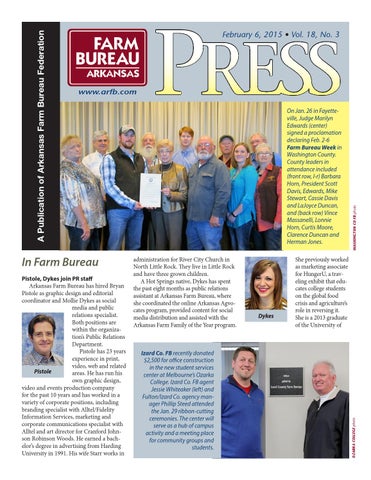
On Jan. 26 in Fayetteville, Judge Marilyn Edwards (center) signed a proclamation declaring Feb. 2-6 Farm Bureau Week in Washington County. County leaders in attendance included (front row, l-r) Barbara Horn, President Scott Davis, Edwards, Mike Stewart, Cassie Davis and LaJoyce Duncan, and (back row) Vince Massanelli, Lonnie Horn, Curtis Moore, Clarence Duncan and Herman Jones. administration for River City Church in North Little Rock. They live in Little Rock and have three grown children. A Hot Springs native, Dykes has spent the past eight months as public relations assistant at Arkansas Farm Bureau, where she coordinated the online Arkansas Agvocates program, provided content for social media distribution and assisted with the Arkansas Farm Family of the Year program.
Izard Co. FB recently donated $2,500 for office construction in the new student services center at Melbourne’s Ozarka College. Izard Co. FB agent Jessie Whiteaker (left) and Fulton/Izard Co. agency manager Phillip Steed attended the Jan. 29 ribbon-cutting ceremonies. The center will serve as a hub of campus activity and a meeting place for community groups and students.
Dykes
WASHINGTON CO FB photo
www.arfb.com
She previously worked as marketing associate for HungerU, a traveling exhibit that educates college students on the global food crisis and agriculture’s role in reversing it. She is a 2013 graduate of the University of
OZARKA COLLEGE photo
A Publication of Arkansas Farm Bureau Federation
February 6, 2015 • Vol. 18, No. 3
KEITH SUTTON photo
MILLER CO. FB photo
Arkansas, where she earned a degree in agricultural communications. She spent two years as a National Collegiate Agriculture Ambassador, presenting workshops on a variety of agriculture topics, and is a former state FFA officer. She interned with ArFB in 2012. “We are excited to have Bryan and Mollie working on our staff,” said Steve Eddington, Farm Bureau’s vice president of public relations. “Both possess strong skill sets and experience that will significantly strengthen our efforts to tell the story of Arkansas agriculture.”
Members and guests posed for a photo at the joint legislative breakfast held by the Miller, Sevier and Little River County Farm Bureaus Jan. 31 in Ashdown. Special guests included Rep. Mary “Prissy” Hickerson (standing, second from right) of Texarkana, Rep. Lane Jean (standing, left) of Magnolia and Sen. Jimmy Hickey (standing, second from left) of Texarkana.
Capitol Conversations On Jan. 23, Arkansas Farm Bureau launched “Capitol Conversations,” a new weekly video series to provide members insight on what’s happening under the dome. Updates featuring different legislators and government officials will be posted every Friday morning during the regular session of the 90th General Assembly. Rep. Dan Douglas of Bentonville, chairman of the House Agriculture, Forestry and Economic Development Committee, was featured in the first video. Week two featured Sen. Bruce Maloch from Magnolia, chairman of the Senate Rules, Resolutions and Memorials Committee. All the videos can be viewed online at www.arfb.com.
In Arkansas
KEITH SUTTON photo
STEVE HIGNIGHT photo
Century Farm program The Arkansas Agriculture Department is accepting applications for the 2015 Arkansas Century Farm program, which honors families who have owned and farmed the same land for at least 100 years. The program is voluntary and places no restrictions on the land. Since the program’s inception
Harrison Pittman, director of the National Agricultural Law Center at the University of Arkansas in Fayetteville, was keynote speaker at the luncheon following ArFB’s Presidents, Vice Presidents, Legislative and Information Chairmen Conference Jan. 29 in North Little Rock. Pittman discussed the scope of agricultural law as it relates to key issues of concern to ArFB members.
Twenty-five Washington and Benton co. FB leaders attended a legislative appreciation breakfast Jan. 31 at the Washington Co. FB office in Fayetteville. The five state legislators who attended, including Rep. Dan Douglas, shown speaking here, heard about Farm Bureau’s priority issues and a current scrap metal bill of concern to local Farm Bureau members.
Members of the Specialty Crops Division discussed a variety of current issues at Arkansas Farm Bureau’s winter commodity division meetings. All 12 commodity divisions met at the Jan. 28 gathering in North Little Rock to review ArFB policy and make recommendations to the state board of directors for implementation. More than 250 county Farm Bureau leaders attended.
in 2012, 240 farms have been certified as Arkansas Century Farms. To qualify, the same family must have owned the farm for 100 years by Dec. 31, 2015. The line of ownership from the original settler or buyer may be through children, grandchildren, siblings, nephews or nieces, including through marriage and adoption. The farm must be at least 10 acres of the original land acquisition and make a financial contribution to the overall farm income. Qualified applicants will be presented with a personalized metal sign and a certificate. Only the legal owners of the land may apply. “The family farm is an Arkansas tradition — a way of life for generations of hard-working folks and a precious resource for all,” said Gov. Asa Hutchinson. “In honoring those families who are part of this great tradition, the Arkansas Century Farm Program recognizes the historical relevance of the family farm and its important place in Arkansas’ future.” Nationally, more than 96 percent of all agricultural operations are family farms. Arkansas currently has more than 44,600 farms on 13.8 million acres with an average farm size of 309 acres. There is no cost to apply. Applications can be obtained from the Arkansas Agriculture Department by calling 501-683-4851 or from the department’s website at: www.aad. arkansas.gov/Pages/programs.aspx. Applications must be postmarked by May 31 to be eligible for designation in 2015.
Elsewhere Conservation Stewardship Program USDA’s Natural Resources Conservation Service is encouraging farmers, ranchers and forest landowners to submit applications by Feb. 27 for the Conservation Stewardship Program (CSP), which will make $100 million available this year. With the 2014 farm bill, CSP experienced many changes, including an expanded conservation activity list that will offer participants greater options to meet their conservation needs and protect the natural resources on their land. A checklist is available to help producers determine if the program is suitable for their operations. Applications are accepted year-round, but submissions before Feb. 27 are ensured consideration for this year’s funding. For more information, visit www. nrcs.usda.gov and click Financial Assistance. Boozman chairs ag subcommittee Senate Agriculture Committee Chairman Pat Roberts named U.S. Sen. John Boozman the chairman of the Senate Subcommittee on Commodities, Markets, Trade and Risk Management for the 114th Congress. “This subcommittee’s work is important to the well-being of our agricultural economy,” Boozman said. “I am honored that Chairman Roberts and my colleagues on the committee have entrusted me with this responsibility.”
POPE CO. FB photo
Pesticide clinics This month, the University of Arkansas Cooperative Extension Service will host pesticide application clinics across the Delta. The dates and locations are Feb. 17, Cotton Research Station, Marianna; Feb. 18, Northeast Arkansas Fairgrounds, Jonesboro; Feb. 19, Conway County Fairgrounds, Morrilton; and Feb. 20, Men’s Club Community Center, McGehee. All sessions will begin at 9 a.m. Lunch will be provided, followed by breakout sessions that conclude at 2:30 p.m. Producers and applicators alike are encouraged to attend to gain valuable information on how to be more productive and efficient in the field. The clinics are free, and there will be door prizes provided by several companies. For more information, contact Jason Davis at 501-749-2077 or jdavis@uaex.edu.
On Jan. 27, Benita Drew (left) and Ida Ruth Jones, members of Pope Co. FB Women’s Committee, shared “The Apple Orchard Riddle” by Margaret McNamara with first-grade students at Pottsville Elementary. A copy of this American Farm Bureau Foundation for Agriculture “Book of the Year” award winner was presented to the class for its library.
“I am pleased Sen. Boozman can continue his leadership on behalf of Arkansas’ farmers and ranchers,” Roberts said. “As chairman of the Subcommittee on Commodities, Risk Management and Trade, I am confident Sen. Boozman will fight to ensure the federal government is doing all it can to ensure producers succeed.” The subcommittee has jurisdiction over these issue areas: the production of agricultural crops, commodities and products; farm and ranch income protection and assistance, including safety net programs and farm credit; commodity price support programs; insurance and risk protection; freshwater food production; agricultural trade; foreign market development; and futures, options and derivatives. “As we move to reauthorize the Commodity Futures Trading Commission, help implement the new farm bill and push for free and fair trade agreements for American producers, this subcommittee will ensure the needs of the agricultural community are put first,” Boozman said. “Farmers, ranchers, and other end users did not cause the financial crisis, but unfortunately, they’re getting caught up in regulations that are aimed at large financial institutions. Farmers shouldn’t be unfairly subjected to the same regulations as speculators on Wall Street.”
Support for rural schools Public school districts in rural Arkansas communities can help prepare their students for academic and career success by applying for $2.3 million in math or science grants from America’s Farmers Grow Rural Education, sponsored by the Monsanto Fund. Between now and April 1, farmers can nominate a public school district in an eligible county to apply for a $10,000 or $25,000 grant. Nominated school districts then submit grant applications to compete for funds to enhance their math or science programs. Winners will be announced in August. Eligible counties in Arkansas include Arkansas, Ashley, Chicot, Clay, Craighead, Crittenden, Cross, Desha, Drew, Greene, Independence, Jackson, Jefferson, Lafayette, Lawrence, Lee, Lincoln, Lonoke, Miller, Mississippi, Monroe, Phillips, Poinsett, Prairie, Pulaski, Randolph, St. Francis, White and Woodruff. ”Grow Rural Education is our way to partner with farmers across rural America to provide top-quality education to students in their local communities,” said Michelle Insco, Monsanto Fund program officer. “Helping students acquire proficiency in math and science will assist in creating the next generation of problem solvers. For more information, visit www.GrowRuralEducation.com. Editor Keith Sutton
keith.sutton@arfb.com
In the Market As of February 3, 2015 Beef cattle inventory higher, cattle prices lower On Jan. 30, the USDA reported stronger-than-expected beef herd expansion and larger supplies for 2015. As of Jan. 1, the cattle herd was the largest in three years. Including the 2014 calf crop, it was more than 650,000 head larger than the average of trade expectation. With the Jan. 1 beef cow herd up 2.1 percent from a year earlier and heifer retention for beef cow replacement purposes up 4.1 percent, the stage seems set for a larger calf crop this year and again next year. This report will limit upside potential in cattle prices for most of 2015. The highs we saw in this market in November and December now become strong resistance for prices. China should let market play bigger role in grain price process Last year, China scrapped its state stockpiling program for soybeans and cotton, and one of the country’s top ag officials says the same needs to happen with grains. Chen Xiwen, who heads the Communist Party’s rural policy group, says the market should play a leading role in the formation of prices so farmers can produce based on the needs of the market. Chen’s comments come amid news that state stockpiler Sinograin purchased a record 125 MMT of grain for state reserves in 2014. “It’s a big problem where we should store new purchases this year because the silos in some areas are already full,” Chen said. Japan offers to cut beef, pork, expand rice access Japan is prepared to cut its high import tariffs on beef and pork and slightly ease tight restrictions on rice imports for U.S. producers in an effort to complete a Pacific trade deal,
according to Japanese media. Tokyo’s reported concessions come as talks accelerate with Washington to strike a bilateral deal as the core of an overdue agreement in the Trans-Pacific Partnership (TPP). Beef and pork are among the farm markets that Japanese Prime Minister Shinzo Abe has vowed to protect under the TPP. The others are dairy, wheat and sugarcane. Details on the U.S.-Japan meat trade negotiations are lacking. Japan reportedly is prepared to negotiate expanding “minimum access” quotas for rice, the nation’s staple food, now protected by tariffs of 778 percent for imports outside the minimum access framework. USTR’s Froman: U.S. may challenge China cotton subsidies via WTO U.S. Trade Representative Michael Froman this week said the U.S. could possibly challenge Chinese cotton subsidies at the World Trade Organization (WTO), but he stressed he has been largely looking at this issue in the context of creating new multilateral subsidies disciplines. The topic arose when Sen. Johnny Isakson asked Froman about what can be done to rein in China’s market-distorting actions. Of note, Froman said China, by some counts, could be considered the largest cotton subsidizer in the world. Lawmakers want Kerry to challenge Iraq on rice “We recognize Iraq’s prerogative to make these types of decisions, but it serves no purpose to discriminate against competitively priced U.S. rice in favor of rice produced elsewhere,” say 13 senators and 23 representatives in a letter sent to the Secretary of State in January. The Iraqi Grain Board, which oversees that country’s purchase of imported rice, in December spent about $47 million to buy 40,000 tons of Brazilian rice and 30,000 tons of Argentine rice. But Iraq could have saved roughly $3 million by instead buying U.S. rice at a price that was more than $40 per ton cheaper, according to the USA Rice Federation. Since this letter was sent, the U.S. lost on another Iraqi
rice tender last week. Sen. Caldwell addresses grain buyers Arkansas Sen. Ronald Caldwell, chairman of the Senate Ag Committee, talked to the Arkansas Farm Bureau Soybean Division last week regarding the potential grain buyer bill. He noted this will likely be a multi-session issue as the details of the bankruptcy have not been released. Caldwell noted the most pressing issue was to create some type of slow-pay system. He felt in visiting with his constituents that this type of system could have caught this problem much earlier. Additionally, he spoke about creating some type of licensing process and possibly audits. Interestingly, he did not mention an indemnity program or bonding being part of the current plan. Consultants raise Argentine corn estimate Pro Farmer’s South American consultant Dr. Michael Cordonnier raised his Argentine corn estimate by 1 MMT, to 22 MMT. Cordonnier left his Argentine bean crop estimate at 56 MMT this week, but he has a neutral to higher bias given the mostly favorable weather. For Brazil, Cordonnier left his soybean crop peg at 93 MMT and his corn crop forecast at 74 MMT this week, but he is leaning to the downside for both estimates. The USDA attaché in Brazil also lowered their soybean crop estimate to 93 MMT, which is 2.5 MMT below USDA’s current official estimate.
CONTACT • Matt King 501-228-1297, matt.king@arfb.com.