SITE
The 20-Year Site Test
Top States for Business 2026
Tariff Uncertainty Roars Back
Page 12
Page 30
Page 72
AND
FACILITY
PLANNING
Q3 2026
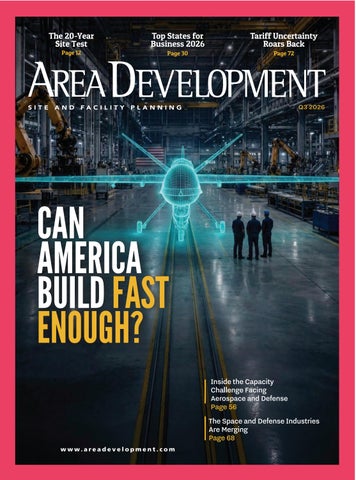
CAN AMERICA BUILD FAST ENOUGH? Inside the Capacity Challenge Facing Aerospace and Defense Page 56 The Space and Defense Industries Are Merging Page 68 w w w. a re a d e v e l o p m e n t . c o m
Cover 2026-Q3 Final.indd 1
9/14/26 9:33 AM
A site is only as great as the state it’s located in.
JobsOhio won’t just help you find the right site for your business. We’ll help you find the right environment for exceeding your project goals and timelines. From Ohio’s abundant world-class talent to ranking in the top 10 for economy, cost of living, and access to capital, there’s no better place for your business to grow and thrive. Factor in our #1 ranking for infrastructure, abundant energy, storied manufacturing legacy, and spirit of innovation, and it’s no wonder Ohio is America’s Top State for Business.
JOBSOHIO.COM
AGE Ohio’s 15-Year Bet on Speed and Infrastructure With surging demand, business-friendly legislation and billions in investment, Ohio is building the energy infrastructure that factories, data centers and advanced manufacturers need to grow By Area Development Staff
O
hio ranks No. 5 overall in Area Development’s 2026 Top States for Doing Business survey, with site consultants rating the state particularly well for water and wastewater capacity, logistics and transportation infrastructure, business incentives and workforce. Taken together, those results point to something larger than strength in a handful of categories. They reflect an economic development model Ohio has spent 15 years building around infrastructure, continuity and, increasingly, speed. For companies making major manufacturing and technology investments, the question is no longer simply what a state can offer. It is how reliably those assets can be turned into an operating facility. Ohio began making that structural bet in 2011. JobsOhio was established as a private nonprofit economic development organization, supported by revenue from the state’s liquor enterprise rather than annual taxpayer appropriations. The model was designed in part to create continuity outside normal political and budget cycles. That distinction matters in site selection. Governors and legislatures change. A semiconductor fab, aerospace manufacturing complex or life sciences campus can represent a 20or 30-year commitment. Companies increasingly need confidence that the development system supporting an investment will outlast the administration that recruited it.
The Other Advantage Is Speed
Anduril Industries provides an unusually visible test. The company announced its Arsenal-1 manufacturing complex in Pickaway County in January 2025. Roughly 18 months later, manufacturing was underway. The project is expected to create more than 4,000 jobs, making it the largest announced job-creation project in Ohio history.
The timetable illustrates what increasingly separates competitive locations: much of the site work has to happen before the company arrives. Ohio has invested in a statewide portfolio of development-ready sites, with infrastructure, due diligence and potential development constraints addressed ahead of demand. That allows permitting, utilities, workforce planning and local approvals to begin from a more advanced starting point. For site selectors, this is an increasingly important distinction. Incentives can narrow a financial gap, but they cannot recover a year lost to an unavailable site, an unexpected infrastructure requirement or a permitting bottleneck. Physical infrastructure remains central to that equation. Ohio combines one of the nation’s largest interstate networks with extensive freight rail capacity and access to a large share of the U.S. and Canadian population within a day’s drive. Its strong showing in Area Development’s water and logistics categories reflects assets that have become especially important as advanced manufacturing projects grow larger and more resource-intensive. Other rankings are beginning to reflect the same shift. CNBC named Ohio its No. 1 state for business in 2026, a year in which its methodology placed greater weight on infrastructure and incorporated permitting speed, grid capacity and readiness for emerging industries. But Ohio’s challenge now is sustaining the model as investment compounds. The state already has the nation’s third-largest manufacturing workforce and ranks highly with Area Development’s consultants on access to skilled labor and workforce training. At the same time, JobsOhio estimates employers could require another 540,000 engineers, technicians, AI
Image by Anduril
specialists and other skilled workers by the mid-2030s. That has prompted a new round of investment, including an experientiallearning initiative of up to $300 million, incentives to recruit out-of-state STEM talent and AI Ready Ohio, a statewide training and certification effort. The Ohio Discovery Corridor is similarly designed to connect universities, healthcare institutions and employers while expanding the state’s long-term STEM pipeline. The tension is instructive. A state can have a workforce advantage today and still need to invest aggressively to preserve it tomorrow. That may be the broader lesson from Ohio’s rise. State competitiveness is becoming less about possessing any single advantage than about whether sites, infrastructure, workforce and government can operate together at the speed of the investment. Ohio has spent 15 years building that system. The next question is whether other states can replicate it — or whether the real advantage is the time it took to compound.
This article was written for JobsOhio, which approved and paid for this post.
2
Adv - Jobs Ohio.indd 2
9/11/26 2:25 PM
OHIO IS AMERICA’S
JobsOhio takes the guesswork out of development. Our sites go through an unmatched authentication process, including rigorous due diligence, independent third-party verification, and state and federal concurrence — providing a higher level of confidence for companies looking to move quickly. It’s no wonder Ohio is ranked #1 for infrastructure, #1 for cost of business, and is America’s top state for business. Find your right site in Ohio.
jobsohio.com CNBC, America’s Top States for Business, 2026
Contents | Volume 61 Number 3 | Q3 2026 ANNUAL REPORT
Top States for Doing Business Which states are best positioned to win the next wave of investment? Area Development’s annual Top States for Doing Business ranking reveals the leaders — and looks beyond the final order to the workforce, infrastructure, costs, incentives and execution capabilities separating the strongest performers. page 30
FEATURES PAGE 24
PAGE 26
PAGE 50
Unwrapping the Gift Clause
Why Energy Parks Work
Constraints Money Can’t Solve
How incentive deals survive legal scrutiny — and avoid costly surprises.
Why power-first industrial parks are gaining a site-selection edge
Labor, utilities, and public resistance can kill even a well-funded project.
PAGE 52
PAGE 72
PAGE 74
A Primary Problem in Site Selection
Why Uncertainty Matters More than Tariffs
Rare Earths Move Downstream
The first site-selection question is whether the operation will fit.
Investment stalls when companies can’t tell which rules will last.
Critical minerals go from mines toward processing and production.
Printed in the USA. Copyright 2026 Area Development® magazine. All rights reserved. No part of this publication may be reproduced or transmitted in any form or by any means, electronic or mechanical, including photocopy, recordings, or any information storage or retrieval system, without permission. Area Development® magazine does not assume and hereby disclaims any liability to any person or company for any loss or damage caused by errors or omissions in the material herein, regardless of causation. The views and opinions in the articles herein are not those of the publishers, unless indicated. The publishers do not warrant, either expressly or by implication, the factual accuracy of the articles herein, or of any views or opinions offered by the authors of said articles. All images are sourced from Adobe Stock unless otherwise noted.
A Note on AI in Our Magazine At Area Development, we use AI tools to support—but not replace—our editorial process. We employ AI for copy editing, style checks, and condensing transcripts, always under human supervision. We do not use AI for independent fact gathering or unsupervised content creation. All reported content is reviewed by experienced editors to ensure accuracy, integrity, and journalistic quality.
Area Development® Site & Facility Planning (USPS 345-510) is published four times per year (Q1, Q2, Q3, and Q4) at St. Joseph, MI, by Halcyon Business Publications, Inc., 30 Jericho Executive Plaza– Suite 400W Jericho, NY 11753. Periodicals postage paid at Jericho, NY, and additional offices. Single copies, $20. Yearly subscription U.S. & Canada, $75; foreign, $95.
4
TOC Q3 2026.indd 4
9/14/26 1:57 PM
FEATURES PAGE 76
PAGE 78
Logistics, Labor, Land — In that Order
Steel Is Back
DEPARTMENTS 8 Editor’s Note Why defense and Top States go together
10 In Focus Missing competitive intelligence
12 In Focus Industrial searches increasingly start with logistics and labor.
New U.S. steel investment is reshaping domestic supply chains.
The 20-year test for sites
14 Market Report Rail and Intermodal SPECIAL SECTION: AEROSPACE AND DEFENSE
16 Policy Roundup Around the Midwest
18 Frontline
56 Defense Projects Are Everywhere Guest editor Jeff Troan leaned on his more than 30 years’ experience in the defense industry to help cover America’s military build-out. Projects abound, and they are looking for the right mix of labor, energy, and spirit.
Four innovative stories from the field: • Connecticut submarine workforce • Alabama cabinet re-org
66 Defense FDI Is a Bright Spot Foreign capital expands U.S. defense capacity.
• Brownsville’s space office • Monterey airports
22 First Person
68 Space and Defense Become One
Paul Furtado, COO of Prysmian North America
Both share talent and suppliers.
80 Last Word Give data centers a chance
70 Saving Boeing What one lost Boeing project taught a community.
POSTMASTER: Send address changes to Area Development, Circulation Department, 30 Jericho Executive Plaza– Suite 400W Jericho, NY 11753. Subscribers requesting address changes must provide both old and new addresses. © Copyright 2026 by Area Development® magazine. ISSN: 1048-6534. Printed in the U.S.A. Area Development® is a registered trademark of Halcyon Business Publications, Inc.
Q3 2026
TOC Q3 2026.indd 5
5
9/15/26 9:00 AM
AGE MONTGOMERY COUNTY, MARYLAND: THE HEART OF “SATELLITE VALLEY” With deep roots in satellite communications, proximity to federal agencies and laboratories, and a highly educated workforce, Montgomery County is positioning itself as a hub for space and defense growth By Montgomery County Economic Development Corporation
L
ocated just outside Washington, D.C., Montgomery County, Maryland — dubbed “Satellite Valley” by Intellian CEO Eric Sung — has the nation’s fourth-highest concentration of physical media and data-storage manufacturing. That, combined with an abundance of highly specialized talent, proximity to more than 18 federal agency headquarters and a high quality of life, makes the county an attractive location for space and defense companies, including Intellian, Thales Defense & Security, Lockheed Martin and AeroVironment. More than a strategic location, Montgomery County offers an environment where defense and aerospace companies can grow, innovate and connect with global markets. The roots of the county’s space and defense ecosystem stretch back decades. The former COMSAT Laboratories in Clarksburg helped establish the foundation of modern satellite communications technology and continues to influence the industry today. That legacy contributed to the growth of companies such as Intellian, which opened a $100 million U.S. Advanced Development Center in Rockville in 2015. For space and defense companies, access to professionals in engineering, computer science, data analytics and cybersecurity is often a deciding factor in where to grow. With 33 percent of adult residents age 25 and older holding an advanced degree, Montgomery County offers one of the nation’s most highly educated talent pools. Maryland ranks second in the nation for its concentration of residents with doctoral degrees, behind Massachusetts, while the broader Washington region is recognized as the sixth-best tech talent market in North America. Montgomery County is also home to higher education institutions including Montgomery College and the Universities at Shady Grove, which brings programs from nine public Maryland universities to one campus. These institutions work with local employers to help ensure graduates
Downtown Bethesda, Maryland.
develop skills aligned with current and future workforce needs. Talent is only part of the county’s competitive advantage. Space and defense companies also benefit from proximity to 36 federal laboratories, including the National Institute of Standards and Technology and the National Cybersecurity Center of Excellence, creating opportunities for research partnerships and collaboration. Montgomery County also offers a mix of urban centers, walkable downtowns and suburban communities that can help companies attract and retain talent. Its more than 1 million residents have access to more than 400 parks and trails, entertainment and cultural venues, public schools, health care, academic institutions and regional transportation. The local space and defense sector continues to grow. “As demand for advanced satellite connectivity continues to expand, we believe Montgomery County is
exceptionally well-positioned to remain a key hub for the industry,” said Hannah Shon, vice president and managing director, Americas, for Intellian. “Intellian intends to continue investing in and growing alongside this ecosystem.” As technology continues to evolve, Montgomery County is positioning itself to attract global companies developing next-generation communications systems, cybersecurity solutions, intelligence platforms and other advanced technologies while building on its established innovation ecosystem.
This article was paid for and written by Montgomery County Economic Development Corporation and approved by Area Development.
6
Adv - Montgomery Q3 2026.indd 6
9/14/26 10:26 AM
Editor’s Note Q3 2026
Money Was Never the Hard Part
T
he Navy needs about three attack submarines a year. It’s getting roughly one. The gap isn’t about engineering. It’s about buildings — the accumulated result of 50 years spent funding technology generously and the factories that produce it grudgingly. Jeff Troan, a site selection veteran of the defense industry, guest edited this issue’s special section around precisely that capacity problem — the plants, not the programs (The Defense Industrial Base, page 56). The contributors he enlisted are close to unanimous on what it takes to close it. No one starts with money. They start with labor, with speed, with power, and with whether a community can answer a hard question the first time somebody asks it. Labor, speed, power, responsiveness. That’s also, more or less, what our site consultants were grading when they ranked the states this year (Top States for Doing Business, page 30). Georgia’s 13th consecutive year at No. 1 isn’t a story about any single advantage. It’s a state without a weak link, where sites, permitting, utilities and workforce behave like one system instead of five agencies that occasionally return each other’s calls. Georgia doesn’t lead every column. It’s just in the top 10 of virtually all of them. Read the rest of the issue and the constraint keeps turning out to be the calendar rather than the capital. A grading plan can be reworked. A right-of-way across someone else’s
land cannot (Site Constraints That Money Alone Can’t Solve, page 50). Getting new power generation onto the grid now takes more than four years. Which is why the most competitive industrial sites are being judged on the power around them, not the acreage inside the fence (Skip the Industrial Park. Look for an Energy Park Instead, page 26). Steel makes the constraint impossible to hide. A new mill needs hundreds of megawatts and millions of gallons a day, which is why communities are being cut before anyone opens the incentive conversation (Steel Is Back, page 78). Federal policy isn’t helping the clock. A company can price a 30 percent tariff, but it can’t price a rate that may not survive the fiscal year, or the month, keeping an estimated $202 billion in global investment parked (Companies Can Plan for Tariffs. They Can’t Plan for Uncertainty, page 72). Closer to the ground, something newer is happening. Economic developers have started asking consultants to hold good projects until after a primary. Ten years ago that request would have been unthinkable. Today it tells a site selection team more about execution risk than any RFI response will (Site Selection’s Primary Problem, page 52). The money won’t disappear while the rules settle; it will go to whoever answers the hard questions first.
2026 EDITORIAL ADVISORY BOARD
Scott Kupperman Founder
KUPPERMAN LOCATION SOLUTIONS
Eric Stavriotis Vice Chairman,
Advisory & Transaction Services CBRE
Brian Corde Managing Partner ATLAS INSIGHT
Courtney Dunbar Site Selection & Economic Development Leader
Chris Volney Managing Director,
Lauren Berry Director, Location
BURNS & MCDONNELL
CBRE
MAXIS ADVISORS
Ramya Gowda Managing Director,
Matthew R. Powers Lead Site
Courtland Robinson Director of
NEWMARK
REDI SITE SELECTION
BRASFIELD & GORRIE
Bradley Migdal Executive Managing
Scott J. Ziance Partner and Economic Incentives Practice Leader
Dianne Jones Managing Director,
Global Strategy and Consulting
Director, Americas, Strategic Consulting
Americas Consulting
Selection Consultant
Amy Gerber Executive Managing
CUSHMAN & WAKEFIELD
CUSHMAN & WAKEFIELD
Marc Beauchamp President
Chris Chmura, Ph.D. CEO & Founder
Chris Schwinden Partner
Alan Reeves Senior Managing
Director, Business Incentives Practice
Alexandra Segers General Manager TOCHI ADVISORS
Dennis Cuneo Owner DC STRATEGIC ADVISORS
SCI GLOBAL
SITE SELECTION GROUP
J.C. Renshaw Head of Supply Chain
VORYS, SATER, SEYMOUR AND PEASE LLP CHMURA ECONOMICS & ANALYTICS
Director, Global Strategy Consulting NEWMARK
Analysis and Incentives
Business Development
Business and Economic Incentives
JLL
Joe Dunlap Founder & Advisor BLUEJ ADVISORS
Scott Canada President,
Mission Critical MCCARTHY
Consulting
SAVILLS
AREA DEVELOPMENT Publisher Dennis J. Shea dshea@areadevelopment.com Sydney Russell, Publisher 1965-1986 Events / Business Development Director Matthew Shea (ext. 231) mshea@areadevelopment.com Media / Accounts Director Justin Shea (ext. 220) jshea@areadevelopment.com
Editor editor@areadevelopment.com Staff and Contributing Editors Mark Schantz Steve Kaelble Circulation/Subscriptions circ@areadevelopment.com
Production Manager Jessica Whitebook jessica@areadevelopment.com Web Designer Carmela Emerson Art Director Victoria Corish Business/Finance Assistant Barbara Olsen (ext. 225) olsen@areadevelopment.com finance@areadevelopment.com
Halcyon Business Publications, Inc. President Dennis J. Shea Correspondence to: Area Development Magazine 30 Jericho Executive Plaza Suite 400W Jericho, NY 11753 Phone: 516.338.0900 Toll Free: 800.735.2732 Fax: 516.338.0100
8
D - Editor's Note Q3 2026.indd 8
9/14/26 11:30 PM
$250+ BILLION INVESTMENTS SINCE 2024
120+ LOUISIANA CERTIFIED SITES READY FOR DEVELOPMENT
Top 10 MANUFACTURING TALENT PIPELINE
Aerospace opportunity starts in Louisiana. As the future home of SpaceX operations and home to more than 60 years of NASA excellence at Michoud, Louisiana brings together the infrastructure, workforce and business environment companies need to move faster and grow.
Launch your business with us! Visit OPPORTUNITYLOUISIANA.COM
In Focus
Reading the Signals Most Companies Miss During Site Selection Understanding what’s being held back, and why, changes how you manage the relationship
By Brad Migdal, Executive Managing Director, Americas, Strategic Consulting, Cushman & Wakefield; David MacNamara, Counsel, Womble Bond Dickinson
C
ompanies spend enormous amounts of time evaluating labor markets, infrastructure, operating costs, taxes, incentives, and supply chains during a site selection process. Yet many overlook a factor that can have just as much influence on the outcome: the competitive dynamics surrounding the project itself. Every location decision unfolds inside a competitive environment. States compete against states. Regions compete against regions. Economic development organizations compete for attention, resources, and investment. Those dynamics shape everything from incentive packages to permitting timelines and infrastructure commitments. Yet many corporate teams evaluate opportunities based primarily on formal proposals and public information. What often remains less visible is how communities are responding behind the scenes — and how those responses should influence decision-making. Understanding those dynamics can provide a significant advantage.
Looking Beyond the Formal Proposal A site selection process generates far more information than appears in an RFI response or incentive proposal. Communities reveal priorities through their actions. Response times, executive involvement, utility engagement, infrastructure commitments, workforce partnerships, and permitting discussions all provide clues about how important a project is to a particular market. An incentive offer is only one signal among many. For example, a community that mobilizes utility providers, workforce agencies, and senior government officials early in the process may be demonstrating a level of commitment that exceeds what is reflected in an initial financial package. Conversely, an aggressive opening incentive proposal may not always indicate long-term flexibility or execution capability. Companies that evaluate only what is formally presented risk missing valuable context about how seriously a community is pursuing the project.
The Incentive Offer Is Rarely the Entire Story One of the most common mistakes in location decisions is treating an initial incentive proposal as a complete representation of what a state or community is willing to do. Economic development programs are generally public.
What is not public is how those programs are applied in practice. Many states retain flexibility within existing programs. Others can assemble additional support through workforce training, infrastructure improvements, permitting assistance, utility investments, or discretionary tools that may not appear in an initial response. Understanding the difference between a published program and a community’s actual capacity to support a project can materially affect the outcome of negotiations. Companies that ask only, “What has been offered?” may receive a different answer than companies that ask, “What else is possible?”
Competitive Position Matters Location decisions are often analyzed market by market. Equally important is understanding how each market views the competition. Communities make strategic decisions based not only on the merits of a project but also on their perception of competing locations. Their willingness to invest resources, accelerate approvals, or improve an offer can change as they gain a clearer understanding of the competitive landscape. For corporate decisionmakers, this creates an important challenge. Evaluating locations effectively requires
understanding not only what each community offers, but also how each community is behaving within the broader competition. That context can help explain why one state appears unusually aggressive, why another seems reluctant to commit, or why negotiations suddenly accelerate late in the process.
Asking Better Questions The strongest site selection teams treat competitive intelligence as a critical component of due diligence. In addition to evaluating costs, labor availability, infrastructure, and incentives, they seek to understand how communities are positioning themselves, where flexibility may exist, and what signals are emerging throughout the process. Questions such as these often produce valuable insights: How is each community demonstrating commitment beyond the formal proposal? What obstacles are likely to emerge during implementation? Where does additional negotiating flexibility appear to exist? Which signals suggest long-term partnership potential rather than shortterm pursuit? Answers to those questions rarely appear in spreadsheets. They emerge through experience, market knowledge, and ongoing engagement throughout the process.
10
D - In Focus Brad and David.indd 10
9/14/26 9:40 AM
CAPITAL OF QUANTUM
Maryland is where quantum innovation meets real-world impact. Home to the NSA, NIST, IonQ — the first publicly traded quantum computing company — and the University of Maryland’s pioneering quantum research labs, this is the epicenter of discovery and commercialization. Quantum breakthroughs born here are set to transform industries — accelerating drug development, securing digital infrastructure, and revolutionizing advanced manufacturing. If you’re building the future, build it in Maryland.
Join the Capital of Quantum.
business.maryland.gov/quantum
In Focus
Will This Site Still Work in 2045? Why long-term resilience—across climate, supply chains, and technology—is now part of the site selection decision
By Alexandra Segers, General Manager, Tochi Advisors
L
arge manufacturing investments are not short-term bets. A new plant represents capital deployed over years of construction and returns realized over decades of operation. The site that is selected today will be operated in conditions that cannot be fully predicted—and must be able to adapt to conditions that are not yet visible. This reality has changed how the best site selection processes are structured. Near-term feasibility—can we build here, can we operate here, can we staff here—remains necessary. But it is no longer sufficient. The question that disciplined decision-makers are adding is: will this site still work in 20 years?
Climate Risk Is a Site Condition Flooding, extreme heat, water scarcity, and intensifying storm events are no longer theoretical risks to be monitored at a distance. They are site conditions that must be evaluated during selection, because they affect operational continuity, insurance costs, and capital requirements over the life of an investment.
A site that is within a floodprone zone, or dependent on a water source under pressure from climate variability, or located in a region where cooling costs are projected to rise significantly, carries risk that is not visible in today’s operating costs but will be visible in tomorrow’s. Those risks compound over time and are expensive to hedge after the fact. Comprehensive environmental and climate risk assessment—not just current conditions, but 10- and 20-year projections—is now part of responsible site due diligence.
Supply Chains Are Not Permanent The supply chain configuration that makes a site attractive today reflects today’s trade routes, tariff structures, and sourcing relationships. All of those can change. Sourcing relationships that depend on specific transit routes become vulnerable when those routes are disrupted. The automotive sector has experienced this directly: supply chain models built on just-in-time logistics across multiple borders have been stress-tested repeatedly in recent years, and the results have driven significant rethinking of where components are sourced and how supply chains are structured. A site’s long-term viability depends in part on whether its supply chain position is resilient to these dynamics.
Technology Will Change the Facility’s Requirements The manufacturing processes that a facility is built to support will evolve. Automation levels will increase. Energy demands will shift. Digital infrastructure requirements will grow. The facility that was designed for 2025’s production model will be asked, in 2035 and 2040, to support processes that do not yet exist. Sites that can accommodate those changes will support that evolution. Sites that are maxed out at initial build, or that lack the utility and infrastructure capacity for future intensification, will create constraints exactly when the company needs flexibility. This is not an argument for over-building. It is an argument for selecting sites where growth is possible, not sites where the current configuration exhausts the available capacity.
The Automotive Industry as a Case Study in Disruption The transition to battery electric vehicles and hybrid technologies has forced every major automaker to reconsider not just what they build, but where they build it and how they build it. Component suppliers that were critical to internal combustion engine production are in different positions relative to EV production. The infrastructure requirements
for EV assembly—particularly around battery systems— differ meaningfully from traditional assembly. Companies that selected sites in the past decade with BEV transition in mind are better positioned than those that did not. The lesson is not specific to automotive—it is about the cost of being wrong about how an industry evolves, and the site selection decisions that either preserve optionality or foreclose it.
Resilience as a Site Selection Criterion The common thread running through climate risk, supply chain exposure, and technology evolution is resilience: the capacity of a site to absorb change and continue to support operations effectively. It’s not one single factor. Can the site absorb a significant weather event without extended downtime? Is the supply chain position defensible under a range of trade scenarios? Is the infrastructure flexible enough to support operational changes over time? Sites that score well on these dimensions are worth more than their near-term cost structures suggest. Sites that are optimized for today’s conditions but fragile in the face of change are worth less. For manufacturers making commitments measured in decades, the 20-year test is not a stretch goal. It is the standard.
12
D - In Focus Segers Q3 2026.indd 12
9/11/26 2:40 PM
Market Report
Why Rail Is Showing Up Earlier in Site Selection Conversations
Intermodal access is reemerging as a strategic consideration By Area Development Staff
F
or a long time, a company would identify a market, narrow a list of sites, evaluate utilities and workforce, and only then determine whether rail service might be beneficial. Increasingly, that sequence is reversing. Across logistics, manufacturing, and industrial real estate, rail and intermodal connectivity are appearing earlier in site selection discussions as companies reassess how freight moves through their networks. The shift isn’t being driven by nostalgia for rail transportation. It’s being driven by economics, resilience, and a growing recognition that transportation flexibility has become a competitive advantage. Nine months into 2026, one of the clearer lessons emerging from supply chain planning is that dependence on a single mode of transportation carries more risk than many companies previously assumed. JLL’s industrial and logistics research points to continued emphasis on network resilience and transportation optionality, particularly as occupiers seek greater flexibility in response to changing market conditions. Rather than optimizing around a single transportation strategy, companies are increasingly building networks capable of shifting between modes when necessary. That approach naturally elevates the role of intermodal infrastructure.
CBRE’s industrial outlook similarly highlights the growing importance of transportation access as occupiers evaluate long-term distribution strategies. While highway access remains critical, many large users are placing greater value on locations that offer multiple freight options, including rail service and proximity to intermodal facilities. The logic is straightforward. Rail can move large volumes more efficiently over long distances, reduce exposure to trucking capacity fluctuations, and create additional routing flexibility when supply chains are disrupted. Those advantages become more meaningful as companies manage increasingly complex domestic distribution networks. That is particularly relevant for manufacturers. As reshoring and domestic production investments continue to expand, transportation considerations are extending beyond outbound logistics. Companies are evaluating how raw materials, components, and finished goods move throughout the production process. In many cases, rail access can influence operating costs for decades after a facility opens. This is one reason economic developers and site selectors are seeing railroads become more active participants in the location process.
Rather than serving solely as transportation providers, rail operators are increasingly positioning themselves as development partners capable of evaluating site readiness, infrastructure requirements, and freight strategies early in the project lifecycle. The trend is also benefiting intermodal facilities. Cushman & Wakefield’s industrial research points to continued demand for markets with strong multimodal transportation capabilities, particularly those capable of connecting highway, rail, port, and air cargo infrastructure. For many occupiers, the value is not tied to a single transportation mode but to the flexibility created by having multiple options available. That flexibility is becoming more important as logistics strategies evolve. Companies continue to balance efficiency with resilience, reassess inventory placement, and diversify supply chains. As those decisions become more complex, transportation infrastructure increasingly serves as a strategic asset rather than a background consideration. Colliers’ industrial outlook reflects this broader focus on infrastructure quality and longterm operational performance. Markets that can demonstrate connectivity, capacity, and transportation redundancy are often better positioned to com-
pete for large-scale industrial investment. The implications extend beyond logistics. Rail access can influence site readiness, construction timelines, utility development, and future expansion opportunities. For large manufacturing projects, particularly those involving bulk commodities, energy-intensive operations, or high-volume freight movement, transportation infrastructure increasingly shapes the feasibility of a site itself. That is changing how companies evaluate locations. Instead of asking whether rail service is available, more occupiers are beginning to ask how transportation infrastructure fits into broader business continuity and growth strategies. The most competitive markets offer land, labor, and incentives, and they are demonstrating how transportation infrastructure supports longterm operational performance. The rail story emerging from 2026 is not that companies are abandoning trucks or dramatically changing freight patterns overnight. It is that transportation flexibility is becoming more valuable. And as companies plan for the next generation of supply chains, rail and intermodal connectivity are increasingly moving from the end of the site selection checklist to the beginning.
14
D - Market Report v1 with Andys final changes.indd 14
9/11/26 2:54 PM
our-future-together.xlsx A
B
C
D
E
F
Your spreadsheet has a crush on PRINCE WILLIAM, VIRGINIA
29
You keep re-sorting the shortlist. e same place keeps floating to the top. at’s chemistry.
Prince William
IT’S A MATCH
Sheet 1
pwcded.org/crush
Regional Policy Roundup
Changes in the Midwest That Every Site Selector Is Watching By Area Development Staff
T
he most consequential economic development stories rarely begin with a project announcement. More often, they start in statehouses, utility agencies, and regulatory bodies, where policymakers are making decisions that will shape a state’s competitiveness years before the next factory, distribution center, or data center breaks ground. Recent developments in Indiana, Ohio, Minnesota, and Illinois point to a common theme: the states gaining an advantage may not be the ones offering the biggest incentives, but the ones removing the most friction from the development process.
Indiana: The PostMegaproject Era? For much of the past decade, Indiana built a reputation as one of the nation’s most aggressive states for landing transformational projects. Electric vehicles, semiconductors, life sciences, advanced manufacturing, and data centers all flowed into the state, supported by an economic development strategy that prioritized speed, flexibility, and large-scale investment. Now lawmakers are taking a closer look at the machinery behind that success. State leaders have advanced and debated reforms that would increase oversight of the Indiana Economic Development Corporation,
strengthen regional development structures, and direct additional attention toward redevelopment and smaller communities. A forensic review of IEDC-affiliated entities has added momentum to broader discussions around transparency, governance, and accountability. The debate is about how economic development should be organized after a decade defined by recordsetting project wins. Why it matters: As more states land megaprojects, questions about governance, regional equity, and public accountability are likely to become more common. Indiana may simply be getting there first.
Ohio: Investing Below Ground Power dominates today’s infrastructure conversations, but Ohio continues to focus on another increasingly important economic development asset: water. The state continues directing significant funding toward water and wastewater infrastructure improvements, helping communities expand treatment capacity, modernize aging systems, and prepare for future industrial growth. The investments rarely attract the attention of a new factory announcement, yet they address one of the most common challenges facing large projects:
whether a community can deliver the utility capacity modern facilities require. For manufacturers, food processors, semiconductor facilities, and other waterintensive industries, the answer can determine whether a site remains viable. Why it matters: Utility capacity is becoming a siteselection issue. States that invest in water and wastewater infrastructure before demand arrives may find themselves better positioned to compete for the next generation of industrial projects.
lies less in the study itself than in what prompted it. States that once focused primarily on renewable generation are beginning to ask whether every available source of firm power should remain on the table. Why it matters: When policymakers begin discussing nuclear energy, they are often responding to concerns about future power adequacy. As industrial electricity demand continues to grow, those concerns are likely to become increasingly relevant.
Minnesota: A Nuclear Conversation Worth Monitoring
Illinois added a new tool aimed specifically at manufacturers investing in their facilities. The Advancing Innovative Manufacturing for Illinois Tax Credit, created under Public Act 104-0006, offers credits tied to capital improvements that modernize, automate or expand manufacturing operations. Eligible projects must invest at least $10 million, with credits ranging from 3 percent of qualified investment at the lower threshold to as much as 7 percent for projects exceeding $100 million. Why it matters: Unlike incentives built primarily around job creation, AIM puts significant weight on capital investment — giving manufacturers another reason to modernize existing Illinois facilities rather than build elsewhere.
Few issues have risen faster on economic development agendas than energy availability. Minnesota’s latest signal comes not in the form of a new power plant, but a question. This spring, state lawmakers authorized a study examining the potential role of nuclear energy in the state’s future energy mix. The study itself changes little today. What makes it notable is the concern behind it. As manufacturers, data centers, and electrification initiatives increase demand for power, states are beginning to reassess long-term generation strategies and the availability of firm, reliable electricity. Minnesota is among the latest to acknowledge that challenge. For site selectors, the significance
Illinois: Manufacturing Gets a Capital Credit
16
D - Regional Policy Round Up.indd 16
9/11/26 2:57 PM
KENTUCKY IS BUILT FOR
WHAT’S NEXT
A Skilled workforce. A Central Location. A World-Class Infrastructure. And a business environment built to help companies
INVEST. EXPAND. SUCCEED.
Frontline
Connecticut’s Submarine Boom Tests Its Workforce Pipeline By Area Development Staff
Collins & Jewell Co., a 90-person custom steel fabrication company, is located about 20 minutes from General Dynamics Electric Boat’s Groton shipyard and produces everything from training equipment and testing fixtures to shipboard components. Company President Chris Jewell describes the business as a “Swiss Army knife” for Electric Boat: Some assignments are as simple as the toothpick; others are as complicated as the scissors. But the two companies also recruit from the same limited pool of welders, fabricators and skilled manufacturing workers. “It’s a blessing and a curse at the same time,” Jewell said. “The challenge is we’re competing for the same workforce.” That competition is becoming more intense as the Navy’s submarine construction plans create decades of anticipated work for Electric Boat and the network of manufacturers surrounding it. Eastern Connecticut has spent years preparing for that growth, creating short-term training programs, restoring manufacturing instruction in high schools and bringing employers together to identify their shared workforce needs. The question now is whether that system can expand quickly enough without leaving smaller suppliers behind.
Training Pulled By Demand Between approximately 2006 and 2016, Eastern Connecticut lost about 3,000 manufacturing jobs, even as federal spending plans signaled that submarine construction would eventually require Electric Boat and its suppliers to hire substantially more workers. Unlike workforce programs that train people in anticipation of future openings, the Eastern Connecticut model is driven by direct employer requests. Participants must generally be unemployed or underemployed, and training is offered at no cost. The goal is not to turn a novice into a fully experienced tradesperson in several weeks. It is to provide roughly 70 percent of the skills required to enter the workplace, leaving employers to teach the remaining jobspecific knowledge through on-the-job training. About 80 percent of participants enter without previous manufacturing experience. Collins & Jewell receives about 400 applications and conducts roughly 200 interviews each year to hire 10 to 12 employees. Rather than limiting the search to experienced tradespeople, the company has hired former chefs, librarians, massage therapists and certified nursing assistants. “We’re a big believer in hire for character, train for skill,” Jewell said. Suppliers face a different equation. Large defense contractors can generally offer compensation and benefits that small manufacturers struggle to match. Jewell said his company must instead compete through workplace culture,
broader responsibilities and the visibility employees receive inside a smaller organization. “When you’re one of 90, you’re a bigger cog in the machine than when you’re one of 25,000,” he said. Eastern Connecticut has a relatively small and dispersed population. Transportation, housing and child care have consequently become workforce issues.
Bringing Shop Class Back Eastern Connecticut has therefore built more than a collection of disconnected training programs. It has created a pathway intended to move people from initial exposure to long-term manufacturing careers. But the submarine buildup is now testing every part of that pathway at once. Electric Boat must hire at scale. Suppliers must grow without losing workers to their largest customer. Schools must restore technical education, while communities address housing, transportation and child care. The work may be secure for decades. Finding enough people—and ensuring that companies of every size can retain them—is worth watching.
Is Alabama’s Next Competitive Advantage Government Itself? For decades, states have competed for industrial projects by improving sites,
expanding incentive programs, and building customized workforce training. Alabama decided to redesign the bureaucracy. Last year, the state enacted one of the country’s most sweeping workforce reorganizations, consolidating four separate agencies into a new Department of Workforce. The move didn’t create another training program or another advisory council. Instead, it fundamentally changed how employers interact with state government, making workforce development, apprenticeship programs, labor market data, STEM initiatives, and federal workforce programs available through a single agency. For corporate site selectors, that’s more than an organizational chart. It’s an attempt to remove friction from one of the most complicated parts of a location decision. “We were created for a centralized repository for all things workforce growth,” Alabama Workforce Secretary Greg Reed said. “To be the one-stop shop for business and industry.” The new department combines the former Department of Labor, Workforce Innovation and Opportunity Act (WIOA) programs previously housed within the Department of Commerce, workforce functions from AIDT, apprenticeship initiatives, STEM programming, and workforce data analysis under a single cabinet-level organization. The consolidation also brought together approximately 800 employees across 60 offices while establishing statewide leadership and seven regional workforce boards designed to tailor strategies to local industry needs.
18
D - Frontline Q3 2026.indd 18
9/14/26 10:25 AM
Frontline
Regional Problems Require Regional Solutions Instead of treating workforce shortages as a statewide issue, Alabama uses labor market data to identify occupation gaps by region and shares that information with community colleges, K-12 career technical education programs, and local employers. Whether Alabama’s restructuring ultimately becomes a model for other states remains an open question. But the state’s wager is clear. Economic developers have long focused on reducing the time required to permit sites, extend utilities, and prepare industrial land. Alabama is applying that same philosophy to government itself, betting that fewer bureaucratic handoffs can become a competitive advantage during site selection. If that proves true, the next generation of workforce competition may be less about launching another training program— and more about making state government easier for employers to navigate.
Why Brownsville Opened an Office for Space Economy Brownsville’s economic development office was accustomed to fielding questions from companies looking for sites, incentives and workers. Instead, people kept walking in to ask when the next rocket would launch.
The visitors, sometimes called “rocket watchers,” had come to South Texas to see SpaceX launch from Starbase. Their questions were not exactly the traditional work of an economic development organization. But their growing numbers pointed to something larger: Commercial space activity was beginning to reshape Brownsville’s tourism economy, small-business community and daily civic life. So Brownsville created an Office of Space Commerce. The new office is intended to handle the communityfacing side of the emerging space economy, including space tourism, small-business activity and public inquiries. That allows the city’s existing economic development organizations to remain focused on larger assignments such as company recruitment, supplier development and workforce strategy. “There was a need to have a dedicated person and a division specifically for some of the peripheral stuff,” said Gilberto Salinas, CEO of the Greater Brownsville Incentives Corp., the city’s Type A economic development organization. SpaceX began considering the region for a launch site about 15 years ago. At the time, Salinas said, Brownsville was still widely viewed as a small border city closely tied to the Mexican economy. Landing SpaceX offered a chance to change that trajectory. The city’s ambitions also extend beyond space. Saronic Technologies has selected the Port of Brownsville for a major autonomous shipbuilding operation, adding defense, artificial intelligence and advanced manufacturing to the region’s emerging industrial identity. The combination of SpaceX, Saronic and two
liquefied natural gas projects has left Brownsville preparing for growth on several fronts at once. For decades, Salinas said, one of the region’s most important exports was its own talent. Brownsville is now trying to reverse that pattern by giving younger workers and experienced professionals a reason to return. Against that backdrop, the Office of Space Commerce is less a traditional recruitment agency than an institutional response to the effects of the boom. It occupies the space between major industrial development and everyday community life: helping visitors navigate launches, connecting smaller businesses to new opportunities and giving the city a place to manage the activity growing around Starbase. “This is no longer the sleepy border town that people thought of back in the day,” Salinas said. “This is a place for innovation, where people can invent, design, launch their product.”
Building an Airport Network Before the Aircraft Arrive Most municipal airports compete individually for tenants, grants and investment. Along California’s Central Coast, four public-use airports are instead being planned as pieces of a single regional system — an approach economic developers believe could help shape how communities prepare for advanced air mobility.
The Monterey Bay Economic Partnership is coordinating planning across airports in Marina, Salinas, Watsonville and Hollister, backed by a $7.45 million grant from the state of California. “We already had activity happening at each of these airports,” said Lavera Alexander, MBEP’s chief growth officer. “The question became: How do we bring that activity together so we can learn from it and begin building the system we’ll ultimately need?” The four airports also present planners with intentionally different conditions. Some need substantial infrastructure upgrades, while others are already connected to an emerging aviation cluster that includes aircraft developers such as Joby Aviation, Archer Aviation, Wisk Aero and Reliable Robotics. “If you’ve seen one publicuse airport, you’ve seen one public-use airport,” Alexander said. “Each one has different needs, different assets, and different opportunities.” For economic developers, the effort is about more than preparing airports for a new class of aircraft. California’s investment is also intended to position the region for jobs, workforce development and private investment associated with an emerging aerospace industry. Widespread commercial adoption of advanced air mobility remains uncertain. But Monterey Bay’s experiment is beginning to answer a question communities may soon face regardless: What needs to be in place before the aircraft are ready? For the Central Coast, the answer begins with treating four very different airports as parts of the same system.
20
D - Frontline Q3 2026.indd 20
9/14/26 9:54 AM
T:8"
THE EVERYTHING BAGEL OF T:10.88"
THE BUSINESS WORLD. The right talent. The right location. The right customers. Middlesex County, NJ, has everything businesses need to thrive. Visit biz.DiscoverMiddlesex.com to schedule a meeting with an advisor in your industry.
MOVE HERE. THRIVE HERE.
1
2026_EDEV_Refresh_FullPage4C_Static__AD_8x10.88in.indd
Saved at
8-20-2026 11:33 AM
Job info
by
CL4T6RD037
Approvals
Built At Output At
7” x 10” None 8” x 10.88” None 8.25” x 11.13” 100% 100%
Scale Bleed Trim Viewing Live
1” 11.13” h x 8.25” w 10.88” h x 8” w 10.88” h x 8” w 10” h x 7” w
Job Client
from
Fonts & Images Art Director Copywriter Account Mgr Studio Artist Proofreader
= 1” 11.13” h x 8.25” w 10.88” h x 8” w 10.88” h x 8” w 10” h x 7” w
Notes None
Anh Le / Eric Whitaker
None None None None None
Fonts Proxima Nova (Regular, Bold, Extrabold) Images Middlesex County Logo_Four Color.eps (56.89%), 01-Middlesex-Prop-Bagel.psd (RGB; 338 ppi; 88.68%) Inks Cyan, Magenta, Yellow, Black, PMS 362 C, PMS 348 C, PMS 419 C
Printed At
None
First Person
Who’s Rebuilding the Grid? Following a major announcement in North Carolina and a recent acquisition, Paul Furtado, COO of Prysmian North America, explains how surging electricity demand is driving investment for the world’s largest cable manufacturer — and why workforce, speed-tomarket, and state responsiveness (including an unsolicited call from a sitting governor) determine where that capacity lands.
You’ve had a lot of traction recently, headlined by a major project announcement in North Carolina. What’s the bigger story behind it? Our growth in North America has been a significant story over the last couple of years. Not only have we grown organically — which is what you’re hearing about in North Carolina — but also through acquisitions. We just announced one a week and a half ago, called Adcor. It’s a good balance. We’re excited about North Carolina, but where we’re heading over the next three to five years is only the tip of the iceberg. What’s driving the need to add so much capacity right now? Very simply, it’s power — the need for electricity. You’ve heard it everywhere: data centers are the word of the year. We sit in the pole position; we’re the largest wiring and cable company in the world, and we’ll be the largest in North America as well. There’s tremendous demand right now, and it’s not just data centers — the power grid itself is aging. As technology advances, with drones, phones, and other gadgets that take a lot of power to run, that’s in our wheelhouse.
Many of your recent projects involve expanding existing operations. How do you decide between investing in an incumbent facility and starting with a greenfield site? We look at it from a completely 360-degree lens, at locations where we don’t have a presence and ones where we do. We’re in the middle of completing a new facility on our McKinney, Texas, campus — a 750,000-square-foot brandnew medium-voltage plant. So we do have a history of building new plants, not just investing in current ones. But in a lot of these cases, we’ve leaned primarily on existing facilities, where we have the know-how and the centers of excellence we’ve created across a lot of our plants in North America. It’s a lot easier to build on an existing footprint than to go to a different city or state and build from ground zero. It can be done — we’ve done it in the past — but the ramp-up cycle is steeper, and a lot of this right now is about speed. Our customers are demanding things now; sometimes they can’t wait three, four, five years. Where does workforce rank when you’re deciding where that next increment of capacity should go? It matters a lot, and it’s not really about
being close to customers — I don’t think our customers care where we produce the products, as long as they get it on time. Workforce, to me, is number one in our decision-making process. Can you find a qualified workforce that’s flexible and can be upskilled? Does the area have trade schools, community colleges — some future workforce we can tap into with the right skill set? It’s probably the number one factor, because manufacturing isn’t the most attractive industry to work in — not like it was 15 or 20 years ago. Is there a particular part of the workforce that’s hardest to find? Skilled trades — you hit it right on the head. It’s why we work with so many local technical colleges near our facilities. The demand isn’t just for electricians and mechanics; there are other skills too, as we move further into AI, automation, and PLC-driven equipment. Those skills just aren’t readily available, and the shortage plays a big factor in our future success. Part of it is generational — everybody wants their kids to have a better life than they had, so the younger generation has gone to college rather than into a plant. But these are incredible, rewarding careers, and we’ve tried as an organization to help educate people on that.
22
D - First Person Q3 2026.indd 22
9/14/26 9:58 AM
Are your North American customers asking for North American-made product specifically, or what’s really driving the push toward domestic production? I think there’s a shift — I’ve been in manufacturing almost 35 years, and I’m seeing more of a buy-American mindset taking hold. There were a lot of lessons learned from COVID; we were exposed as a country on supply chains, and there’s been a strong effort to reshore manufacturing and have more control over your supply chain. We’re seeing some of that in Canada too, where we also operate. That’s driving this mindset: making sure we’re not just providing supply-chain resilience, but becoming more vertically integrated, controlling what we can control — which by definition means bringing a lot more in-house, in the U.S., where we operate.
Prysmian operates across a large portion of the country. Do you see meaningful differences between states when you’re making an investment decision? I could talk to you for 30 minutes on this one alone. With more than 50 facilities in North America, we operate in close to half the states in the U.S. There are clearly states that are pro-business, and there are states that say they’re pro-business but don’t back it up with action. The states on our short list I’d call genuinely pro-business — not just in words, but in helping facilitate conversations, permitting, and approvals at the local and state level, to make sure their state wins. What does that kind of pro-business approach look like in practice? I’ll give you a specific example — I won’t name the state. A governor called me this past Monday to ask what we could do in his state to continue growing. He called me; I didn’t reach out to him. That’s
a pro-business mindset — someone who understands the importance of this, regardless of how big or small the project is. I told him there wasn’t anything specific happening in his state right now, but I appreciated the gesture; he didn’t have to make that call. We have governors who are front and center on this, and economic development teams and city councils that are more aggressive than others. Does that responsiveness affect where Prysmian ultimately puts capital? It’s extremely relevant to our decisionmaking, and we tend to decide on the states that are a lot more friendly to business — this isn’t a one-shot deal. We’re establishing roots here for the long run. It’s not about right now — it’s about what the state is going to do for us over the next 10 to 15 years. Are they going to be committed to us for the next expansion in that state? There are definitely more states that are pro-business than others.
Powering aerospace from the ground up.
Because readiness is built long before takeoff. Today’s aerospace companies need more than available land. They need an ecosystem built for innovation, manufacturing, testing and expansion. South Mississippi delivers military partnerships, year-round flight operations, a highly skilled workforce, strategic transportation assets and reliable power—all working together to keep projects moving forward.
Discover the power of building in Mississippi: f Reliable, affordable power f Established aerospace and defense ecosystem f Skilled workforce and military talent pipeline f Gulfport-Biloxi International Airport development site f Multimodal logistics with air, rail, highway and port access
Explore available sites
Q3 2026
D - First Person Q3 2026.indd 23
23
9/14/26 9:58 AM
Incentives
Unwrapping the Gift Clause
Why economic development incentives cannot be no-strings-attached By John Collins, Partner; Scott J. Ziance, Partner, Vorys, Sater, Seymour and Pease LLP
E
conomic incentive agreements are a cornerstone of state and local efforts to attract investment, create jobs and expand the tax base. They support projects across manufacturing, data centers, logistics, energy and other sectors, often establishing long-term partnerships between government and private industry.[1] But these agreements also carry legal risk. Because they involve public funds and private parties, they can raise constitutional questions under the “Gift Clauses” found in most state constitutions. These provisions generally restrict governments from using public money, credit or resources for private benefit. The Texas Supreme Court’s recent decision in JPMorgan Chase Bank, N.A. v. City of Corsicana and Navarro County brought those issues to the forefront. In May, the court held that an economic development agreement involving a shopping center was subject to the Gift Clause in the Texas Constitution. The ruling clari-
fied the boundaries of permissible incentives and provided guidance for developers, public officials and lenders.[2]
Origins of the Gift Clause
Gift Clauses, sometimes called anti-aid or anti-subsidy provisions, arose from 19th-century financial disasters involving speculative railroads and other ventures. Cities and counties often lent public credit or invested public funds without adequate oversight or restrictions. When projects failed, taxpayers were left with debt and little public benefit.[3] Ohio, for example, financed dozens of turnpikes, railroads and canals during the first half of the 19th century. Many were unprofitable, and some were fraudulent. The resulting debt and public anger helped inspire what critics called the “Plunder Law.”[4] Similar problems unfolded elsewhere. Local governments tried to attract railroad companies by backing construction loans, often without meaningful controls over how
Gander Mountain was the anchor tenant at the center of the Corsicana incentive dispute. The retailer closed in 2015, but the shopping center continued to generate tax revenue.
public funds were used. The resulting failures prompted states to adopt constitutional provisions barring public aid to private entities.[5] Although nearly every state has some form of Gift Clause, the language and legal tests vary. Arizona’s Constitution, for example, broadly prohibits any “donation or grant, by subsidy or otherwise” to private individuals or corporations. Texas also prohibits grants and loans of public funds to private entities but expressly permits expenditures for economic development. Court decisions have reflected those differences. In Turken v. Gordon, the Arizona Supreme Court struck down a $97 million payment by Phoenix to a developer for parking rights because the consideration received by the city was grossly disproportionate. In Lord v. City and County of Denver, the Colorado Supreme Court invalidated a subsidy for a railroad tunnel because the city did not retain meaningful control over its use or ensure an ongoing public purpose.[6] Other courts have upheld incentives. In Maready v. City of Winston-Salem, the North Carolina Supreme Court found that local grants to private companies served a public purpose by promoting job creation, economic growth and an expanded tax base. In State ex rel. Ohio County Commission v. Samol, the West Virginia Supreme Court upheld industrial revenue bonds for private manufacturing facilities because the resulting jobs and development served a public purpose.[7]
The JPMorgan Case
In 2003, the city of Corsicana and Navarro County offered a $16 million incentive package to attract Gander Mountain to a new shopping center. They pledged future sales tax revenue to support construction of the retailer’s flagship store, with additional incentives tied to other businesses in the center. The Corsicana Industrial Foundation, a nonprofit, received the funds and used them to repay a construction loan. Gander Mountain operated at the site for 11 years before closing in 2015. The shopping center continued to generate tax revenue, however, and another tenant moved into the former store.[8] After Gander Mountain closed, the city and county stopped making incentive payments, arguing that the public purpose behind the grants had ended. They then sued for a declaration that the agreements were unconstitutional because they lacked a continuing public purpose and adequate government controls. The trial court agreed, finding that Gander Mountain’s closure extinguished the public purpose and that the agreements lacked sufficient safeguards. An intermediate appeals court affirmed in a 2-1 decision.[9] The dissenting chief justice warned that the ruling could undermine economic development financing. If governments could invalidate agreements after years of performance, the dissent argued, lenders would be less willing to rely on pledged tax revenue, increasing borrow-
24
F - Gift Clause New.indd 24
9/14/26 10:02 AM
ing costs and reducing access to capital. That concern was echoed by the Texas Bankers Association in an amicus brief to the Texas Supreme Court. The association argued that allowing local governments to terminate agreements after years of performance would chill lending and make public incentives less reliable as collateral. The Texas Public Policy Foundation, Goldwater Institute, Texas Municipal League and Texas City Attorneys Association supported the city and county. They argued that economic development agreements must satisfy the Gift Clause and include sufficient safeguards for public funds.[10] The Texas Supreme Court reversed. It held that even though the Texas Constitution expressly authorizes economic development expenditures, those expenditures must still satisfy three requirements: They cannot be gratuitous, they must serve a legitimate public purpose, and they must remain subject to adequate government control.[11] The court rejected the idea that the agreement automatically lost its public purpose when Gander Mountain ceased to operate. The proper question, it said, is whether the public expenditure continues to promote economic development in a concrete and actual way, even if the resulting benefits differ from those originally anticipated. Because the shopping center continued to generate economic activity and tax revenue, Gander Mountain’s closure did not automatically end the agreement’s public purpose. The court also identified several controls that protected public funds. Payments did Footnotes [1] Walter Hellerstein and Dan T. Coenen, “Commerce Clause Restraints on State Business Development Incentives,” 81 Cornell Law Review 789, 790 (1996). [2] JPMorgan Chase Bank, N.A. v. City of Corsicana, No. 24-0102, 2026 Tex. LEXIS 414, 2026 WL 1261549 (Tex. May 8, 2026). [3] Timothy Sandefur, “The Origins of the Arizona Gift Clause,” 36 Regent University Law Review 1, 1-2 (2024);
Q3 2026
F - Gift Clause New.indd 25
not begin until the Gander Mountain store was completed and opened. Government contributions were placed in a separate account and could be used only to repay construction debt. And the amount of each payment was tied to a percentage of sales tax revenue actually generated within the shopping district.[12] The court reversed the summary judgment and remanded the case for further proceedings. On June 25, 2026, the city and county filed a motion for rehearing, arguing that the opinion created uncertainty about the Gift Clause’s requirements and analytical framework. At the time of this writing, that motion remains pending.[13]
Three Takeaways for Economic Developers 1. Understand The Applicable Law The JPMorgan decision highlights the importance of understanding the constitutional provisions and case law governing an incentive agreement. Before JPMorgan, the Texas Supreme Court had not analyzed Section 52-a of the Texas Constitution, which contains the economic developmentexception to the state’s Gift Clauses. More broadly, relatively little case law addresses modern incentives involving data centers, advanced manufacturing and energy projects.[14] Because each state uses different constitutional language and judicial tests, developers and end users should identify the applicable legal standards and risks at the outset. 2. Identify The Public Purpose An incentive agreement should
JPMorgan, 2026 Tex. LEXIS 414, at *14-15. [4] C.I.V.I.C. Group v. City of Warren, 88 Ohio St. 3d 37, 39-40, 723 N.E.2d 106 (2000); Clifford Thies, “The American Railroad Network During the Early 19th Century,” 22 Cato Journal 229, 241 (2002); Eugene O. Porter, “Financing Ohio’s Pre-Civil War Railroads,” Ohio History Journal 215-226 (July 1948); Sandefur, supra note 3, at 8. [5] Borgelt v. Austin Firefighters Association, 692 S.W.3d
288, 299 (Tex. 2024); David E. Pinsky, “State Constitutional Limitations on Public Industrial Financing,” 111 University of Pennsylvania Law Review 265, 280 (1963); Thies, supra note 4, at 243-44; Nicholas J. Houpt, “Shopping for State Constitutions,” 36 Columbia Journal of Environmental Law 359, 408 (2011). [6] Turken v. Gordon, 223 Ariz. 342, 348, 224 P.3d 158 (2010); Lord v. City and County of Denver, 58 Colo. 1, 143 P. 284 (1914).
clearly define the legitimate public purpose it is intended to serve, such as job creation, tax base expansion, capital investment or infrastructure development. The agreement should then tie public payments to the achievement of those outcomes. In JPMorgan, the court found that dedicating a portion of tax revenue to attract businesses and create jobs served the constitutional purpose of developing and diversifying the economy. Other courts have reached similar conclusions when the public purpose was clearly stated. In Blinson v. State, the North Carolina Court of Appeals upheld state and local incentives provided to Dell Inc. for a computer manufacturing facility in Forsyth County. The court found that the incentives were designed to stimulate economic activity, create and maintain jobs, and encourage investment in a strategically important industry.[15] 3. Draft with Precision JPMorgan also shows how heavily courts may rely on the wording of the agreement itself. The Texas Supreme Court noted that the city and county could have made continued payments contingent on Gander Mountain’s continued operation. They did not. Instead, the agreements tied payments to broader economic activity generated within the shopping district. A recent 5th U.S. Circuit Court of Appeals decision provides a useful contrast. In American Precision Ammunition, L.L.C. v. City of Mineral Wells, the city agreed to provide a manufacturer with a $150,000 “gift” and 10 years of tax abatements to induce relocation. [7] Maready v. City of Winston-Salem, 342 N.C. 708, 714, 467 S.E.2d 615 (1996); State ex rel. Ohio County Commission v. Samol, 165 W.Va. 714, 275 S.E.2d 2 (1980). [8] JPMorgan, 2026 Tex. LEXIS 414, at *3-8. [9] JPMorgan, 2026 Tex. LEXIS 414, at *9; Corsicana Industrial Foundation Inc. v. City of Corsicana, 685 S.W.3d 171, 187 (Tex. App.—Waco 2024), rev’d, No. 24-0102, 2026 Tex. LEXIS 414 (Tex. May 8, 2026).
Although other provisions called the payment a “grant” and limited its use to infrastructure, access, egress and utilities, the court found the $150,000 payment unconstitutional. It concluded that the tax abatements were the consideration offered in exchange for relocation, while the separate payment was intended as a gratuitous transfer.[16] The distinction underscores the importance of precise drafting. Agreements should clearly identify the obligations exchanged for public benefits, define how funds may be used and specify whether continued payments depend on a particular tenant, operator or performance measure. In closing, Gift Clauses remain an important check on public spending, even as governments use incentives to pursue projects far removed from the railroad ventures that inspired those provisions. As states and localities compete for data centers, manufacturing plants, energy projects and other capital-intensive investments, courts will continue applying historic constitutional language to modern development agreements. The JPMorgan decision shows that incentives need not fail simply because a project evolves differently than expected. But they must be nongratuitous, tied to a genuine public purpose and subject to meaningful government control. For developers, public officials and lenders, the lesson is straightforward: The strongest incentive agreements are the ones that define the public benefit, tie payments to measurable obligations and anticipate what happens when the original project changes.
[10] Brief of the Texas Bankers Association at 3-4; Brief of the Texas Public Policy Foundation at 3-4, 16-23; Brief of the Texas Municipal League at 5-7, JPMorgan Chase Bank, N.A. v. City of Corsicana, No. 24-0102 (Tex.). [11] JPMorgan, 2026 Tex. LEXIS 414, at *5-10, *30, *35-38. [12] JPMorgan, 2026 Tex. LEXIS 414, at *4. [13] Respondents’ Motion for Rehearing, JPMorgan Chase Bank, N.A. v. City of
Corsicana, No. 24-0102 (Tex. filed June 25, 2026). [14] JPMorgan, 2026 Tex. LEXIS 414, at *2 (noting that the Texas Supreme Court had not previously addressed Article III, Section 52-a). [15] Blinson v. State, 186 N.C. App. 328, 651 S.E.2d 268 (2007). [16] American Precision Ammunition, L.L.C. v. City of Mineral Wells, 90 F.4th 820, 824-32 (5th Cir. 2024).
25
9/11/26 3:40 PM
Energy
Skip the Industrial Park. Look for an Energy Park Instead
Executives must evaluate the energy ecosystem surrounding a site, not merely the utility service reaching the parcel By Freddie Sarhan, Chief Executive Officer, Sapphire Technologies
F
or decades, industrial site selection followed a familiar hierarchy. Companies looked for available land, transportation access, workforce, tax incentives, and proximity to customers or suppliers. Utilities mattered, of course, but power was often evaluated as one item on a broader checklist. If a site had sufficient service or a credible utility upgrade plan, the project could usually move forward. That assumption is becoming harder to defend. For power-intensive industries, the central site selection question is no longer simply whether electricity can be delivered. It is whether a site sits inside an energy ecosystem capable of supporting reliable operations, future expansion, and cost control over time. That is a different question, and it points toward a different model of industrial development. The cost of waiting for power is now a strategic risk. Lawrence Berkeley National Laboratory’s interconnection queue tracking shows that the median timeline from interconnection request to commercial operation has stretched to more than four years for recent projects, up from less than two years in the early 2000s. Projects that do move forward may also face significant upgrade costs. The next generation of competitive sites may not look like traditional industrial parks. They may look more like energy parks. An energy park is more than co-location, such as a data center built next to a power plant. Co-located generation is typically a one-to-one arrangement: one large load positioned near one generation asset, often to bypass grid constraints or reduce interconnection risk. An energy park is more integrated. It combines multiple generation resources, storage, large industrial loads, and a shared interconnection strategy into a coordinated energy system. In the strongest versions, it may include access to natural gas, renewables, batteries, substations, transmission, industrial water, fiber, and land for phased growth. Put simply, co-location answers one question: Where can this project get power now? An energy park answers a larger one: How can this site continue to grow as energy demand, reliability needs, and infrastructure constraints change? That distinction is becoming increasingly important for corporate real estate leaders, manufacturers, logistics operators, and site selection consultants. AI data centers may have forced the issue first, but they are not the only users affected by the shift. Advanced manufacturing, semiconductor fabrication, robotics, hydrogen, cold storage, and large-scale logistics facilities are all becoming more energy-intensive. Many of these industries also require
Aerial view of a combined-cycle power plant with cooling tower and substation.
high uptime, stable power quality, and the ability to expand without restarting a multiyear utility process. For site selectors, this means the evaluation framework needs to change. A powered site is not simply a parcel with utility service. It is a location with energy optionality, which can take several forms. A site near existing transmission and substations may offer faster access to grid capacity. A site near high-capacity natural gas infrastructure may support on-site generation or backup fuel strategies. A site with room for solar, storage, and future generation may support phased growth. A site connected to an industrial microgrid or energy park may reduce exposure to congestion, queue delays, and singlesource reliability risk. None of these attributes guarantees success, but together they create a fundamentally different risk profile than a traditional greenfield parcel waiting on future upgrades. This is why the emerging energy park model is important. It gives developers and end users a way to evaluate sites as energy systems, not just real estate. The model is still in its early stages, but examples are beginning to emerge. The National Academies has described energy parks as integrated hubs that co-locate generation, storage, and large-scale loads such as data centers and advanced manufacturing at a single point of interconnection. The appeal is practical: By locating supply and demand together, energy parks can reduce the need for new long-distance transmission and create a more coordinated path for bringing large loads online.
26
F - Look for Energy Park.indd 26
9/14/26 10:07 AM
When the world says it’s impossible, move to Arizona. There’s a special mix of talent, infrastructure, culture and pro-business support here that help organizations push the boundaries of what’s possible. Arizona meets big ideas with big support and even bigger opportunities for growth. From bedroom-based startups to global brands, Arizona is home to anyone with a dream and the drive to make it happen.
A Z C O M M E R C E . C O M
Energy
Hitachi and X Labs recently announced plans to collaborate on energy parks for AI data centers in North America, describing the model as a way to deliver gigawatt-scale power as a service and reduce power procurement constraints. While that example is focused on AI infrastructure, the underlying model is broader. It shows how energy, industrial demand, and development strategy are beginning to merge. Manufacturing examples point in the same direction. Hyundai Motor Group has announced plans for a major innovation hub in South Korea that combines robotics, AI, hydrogen energy, solar power, and smart city solutions. The exact structure is different from a U.S. industrial park, but the signal is relevant: Advanced industrial companies are increasingly thinking about computing, manufacturing, and energy infrastructure together rather than as separate planning categories. The takeaway is that energy infrastructure should move much earlier in the site selection process. A conventional site selection process might ask whether a utility can serve the project. A more advanced process asks different questions. What generation resources are already nearby? Is there access to a firm fuel supply? How constrained is the local transmission system? Can the site add behind-the-meter power or storage over time? Are there multiple energy sources, or is the facility dependent on one constrained node? Can future expansion be supported without triggering another long interconnection study? Does the surrounding infrastructure help manage reliability risk, or does it simply shift that risk to the operator?
These questions matter because power availability is no longer only an operating cost issue. It is now tied to project timing, resilience, customer commitments, and long-term competitiveness. A manufacturer that loses production because of unreliable energy does not simply pay a higher utility bill. It risks missed orders, damaged equipment, delayed shipments, and lost strategic capacity. A logistics operator that cannot electrify or automate on schedule may fall behind competitors. A semiconductor or robotics facility that cannot secure stable, expandable power may never reach full production. One point of contention developers should note: AI did not prove that the energy park model will work economically. In many cases, the economics remain challenging. What AI did prove is that the cost of relying on conventional infrastructure is not currently sustainable. That lesson will not remain confined to data centers as energy-intensive industries increasingly compete for limited resources. Whether the long-term economics make sense will take a back seat to the cost of staying in the game. The industrial parks of the 20th century were built around transportation. Rail access, highways, ports, and proximity to labor shaped where factories and logistics hubs grew. Those factors still matter, but the next generation of industrial growth will increasingly be shaped by energy architecture. Companies that understand this new dynamic will not simply ask where they can build. They will ask where the surrounding energy ecosystem gives them the greatest ability to operate, grow, and adapt.
28
F - Look for Energy Park.indd 28
9/11/26 11:30 AM
WHERE VISION MEETS VELOCITY
2026’s Top States for Business
Top States for Doing Business
Area Development’s annual ranking of America’s most competitive states
Georgia 2 Texas 3 Tennessee 4 North Carolina 5 Ohio 30
F - Top States for Business 2026 v02.indd 30
9/14/26 11:14 PM
6 SOUTH CAROLINA 7 ALABAMA 8 VIRGINIA 9 LOUISIANA 10 MICHIGAN 11 INDIANA 12 MISSISSIPPI 13 KENTUCKY
14 OKLAHOMA 15 ARIZONA 16 ARKANSAS 17 MISSOURI 18 FLORIDA 19 PENNSYLVANIA 20 ILLINOIS
How We Rank Area Development surveyed 50 leading site selection consultants across 20 location factors. States were ranked by the number of mentions in each category, then weighted according to the relative importance of those factors in Area Development’s annual site selection surveys. Q3 2026
F - Top States for Business 2026 v02.indd 31
31
9/14/26 11:14 PM
AGE ENERGY CERTAINTY IS THE NEW COMPETITIVE ADVANTAGE Georgia’s integrated utility model is designed to give companies greater confidence that power will be available when projects are ready to come online By Georgia Power
F
or decades, economic development conversations centered on familiar priorities: workforce, transportation, taxes and sites. Those factors remain essential, but today’s project landscape has introduced a new differentiator that increasingly determines where companies choose to invest: confidence in the electric grid. As manufacturers expand, supply chains electrify and energy-intensive industries such as artificial intelligence and data centers accelerate demand, businesses are asking a single fundamental question more than ever before: Can you reliably provide the power we need? For states competing for these types of transformative investments, the answer increasingly defines their competitive position. Georgia has emerged as one of the nation’s leading destinations for business investment because it pairs a strong economic development ecosystem with an electric grid built for long-term growth. At the center of that advantage is Georgia Power’s vertically integrated business model and constructive regulatory environment, which allow the company to plan decades ahead while maintaining reliability, affordability and resilience. Unlike utilities operating in deregulated markets, Georgia Power owns and manages its generation, transmission and distribution assets as an integrated system. This structure enables coordinated, long-term planning across the entire electric value chain rather than relying on multiple independent entities to make investment decisions. That integrated approach matters when companies are making multibillion-dollar location decisions. Whether supporting advanced manufacturers, life sciences companies, logistics operations or hyperscale data centers, businesses need confidence that electric infrastructure will be available when facilities are ready to come online. Georgia Power’s ability to forecast demand, invest proactively and coordinate infrastructure development gives site selectors and corporate decision-makers a higher degree of certainty throughout the project life cycle. In addition to Georgia Power’s internal structure, the state’s regulatory model encourages thoughtful, long-term investment in generation and grid infrastructure while maintaining transparency and oversight through the Georgia Public Service Commission. Rather than reacting to demand after it materializes, Georgia Power can plan for future growth through its Integrated Resource Planning process, which evaluates projected customer needs years in advance. This long-range approach has become increasingly valuable as electric demand growth reaches levels not seen in decades. The rapid growth of Georgia’s large-load manufacturing and digital infrastructure projects represents an important economic opportunity for the state, bringing substantial capital in-
An evening view of the Plant Vogtle nuclear power plant near Waynesboro, Ga.
vestment while supporting today’s increasingly digital economy. At the same time, serving these large customers requires careful planning to ensure continued reliability for every customer connected to the grid. Recognizing this evolving landscape, Georgia has implemented policies that ensure large-load customers — including data centers — pay the costs associated with the infrastructure necessary to serve their operations. Under rules approved by the Georgia Public Service Commission, these customers are responsible for the costs they impose on the electric system, including investments needed to reliably meet their demand. This approach is an important principle of sound utility regulation. Customers whose energy requirements drive new infrastructure investments are expected to bear those costs rather than shifting them onto residential households or existing commercial and industrial customers. The result is a framework that supports economic growth while protecting affordability. By aligning infrastructure costs with the customers creating the demand, Georgia can continue attracting large-scale investment without placing an undue financial burden on families or businesses already served by the system. It is an approach that balances economic competitiveness with responsible stewardship of the electric grid. For companies considering major investments, this creates confidence on multiple levels. Businesses know the utility can support their operational needs, existing customers benefit from continued affordability, and communities gain the economic advantages of new jobs, tax-base expansion and private investment. Energy certainty has become a strategic asset rather than an operational consideration. As competition for investment intensifies nationwide, communities that can offer reliable infrastructure, predictable energy planning and transparent regulatory policies will continue to set themselves apart. Georgia’s experience demonstrates that sustainable economic development depends not simply on having available megawatts, but on having the oversight, planning and investment framework to deliver them with confidence. This article was paid for and written by Georgia Power and approved by Area Development.
32
Adv - GEORGIA POWER.indd 32
9/14/26 10:28 AM
Power for Growth You need access to reliable, affordable energy. Thankfully, Georgia Power has been planning for growth for nearly 100 years. With your energy needs taken care of, your company can take advantage of our best-in-class engineering services, site selection support, and nationally recognized research team—all at no cost to you. Whatever it is you need, our team has what you need to power your growth. Learn more at SelectGeorgia.com.
2026’s Top States for Business
How the Rankings Break Down The overall ranking is built from 20 location factors. To better understand where states stand out, we grouped those factors into four strategic categories: workforce, sites and infrastructure, government execution, and cost and operating risk
T
he states at the top of
Sites, utilities and infrastructure
Some states offer exceptional infra-
Area Development’s
measures whether a state can
structure or execution. Others pair
2026 ranking do not win
translate theoretical capacity into a
deep technical talent with water,
on a single measure. They assemble
place where a company can actually
power or logistics advantages. Still
a broad operating proposition:
build and operate. Government re-
others remain formidable because
workers who can support increas-
sponsiveness and project execution
they make the economics work.
ingly technical production, sites
examines the machinery around
No category operates alone. A
that can move quickly, public part-
the deal: permitting, incentives,
low-cost site loses its advantage if it
ners capable of making decisions
coordination and speed. Cost, tax
cannot be energized. A strong labor
and a cost structure that remains
and long-term operating risk tests
market cannot rescue an unpredict-
competitive after a project is built.
whether the initial business case
able permitting process. And an
will hold up over time.
incentive package cannot compen-
That is why this year’s 20 location factors are best understood
The groupings also reveal why
sate for years of operating risk. The
in four groups. Workforce, talent
the overall leaders separate them-
overall ranking rewards states that
and innovation captures both im-
selves. Georgia, Texas, Tennessee,
reduce friction across the full life of
mediate hiring conditions and the
North Carolina and Ohio appear
an investment — from the first site
deeper systems that replenish skills,
repeatedly, but they do so through
search through construction, hiring
engineering capacity and research.
different combinations of strengths.
and long-term production.
01 Workforce, talent and innovation
03 Government responsiveness and project execution
02 Sites, utilities and infrastructure
04 Cost, tax and long-term operating risk
• Engineering Talent And Cluster Strength • Skilled Manufacturing Labor • Innovation And Research Ecosystem • Workforce Training • Labor Cost Competitiveness
• Water and wastewater capacity • Industrial sites and buildings • Site readiness • Energy availability and grid capacity • Logistics and transportation infrastructure
• Responsive state and local government • Speed to market • Business incentives • Permitting predictability • Regulatory environment
• Overall cost of doing business • Property tax environment • Corporate tax structure • Energy costs • Climate risk and resilience
34
F - Top States for Business 2026 v02.indd 34
9/14/26 11:15 PM
BUILT FOR THE WORLD STAGE.
STILL BUILDING WHAT’S NEXT.
Long before Georgia was recognized as the No. 1 State for Business, it built the foundation that earned it—fostering a business environment designed for speed, access, and long-term growth. More than a decade later, that same approach continues to attract investment from around the world. Companies from more than 40 countries benefit from Georgia’s skilled workforce, strong international connections, and the partnerships that help businesses grow and succeed. This is what momentum looks like. See what’s next at Georgia.org Georgia’s infrastructure is built for global business, anchored by the nation’s largest single-terminal container facility at the Port of Savannah. Photo courtesy of Georgia Ports Authority
2026’s Top States for Business
01 Workforce, talent and innovation Georgia, North Carolina and Texas lead across different combinations of skilled labor, engineering depth and innovation, while lower-cost states retain an advantage on labor costs and training.
VETERAN WHO LOVES POPCORN... LONG-TIME SAVANNAH BANANAS FAN
FIRST-TIME HOMEOWNER
ALMOST AS MUCH AS BEING A ROBOTICS TECHNICIAN
The talent everyone wants is in Savannah Savannah is redefining workforce development with innovative, forward-thinking solutions. We are delivering career-ready professionals, while attracting talent faster than anywhere in Georgia, and building the future workforce for what's next. Find out how Savannah is doing things differently.
SavannahWorkforce.com
36
F - Top States for Business 2026 v02.indd 36
9/14/26 11:16 PM
No single state dominates the workforce
equation. Instead, the rankings reveal several distinct forms of labor-market strength.
And can the operation carry those labor
leaders. Across the Southeast, Alabama,
costs at scale?
Mississippi, Arkansas, Kentucky and Ten-
The strongest states answer more than
Texas leads in engineering talent and
one of those questions. North Carolina
industry-cluster depth. Georgia ranks first
places in the top three for engineering tal-
nessee retain a different form of leverage through labor economics. The table suggests a regional split:
for access to skilled manufacturing labor.
ent, skilled manufacturing labor and innova-
Southeastern states dominate labor-cost
North Carolina leads in innovation and
tion. Georgia combines the No. 1 skilled-
competitiveness, while Midwestern states
research. Virginia tops workforce training,
labor ranking with top-six positions in
retain advantages in engineering and skilled
while Alabama holds the leading position in
engineering, training and innovation. Texas
manufacturing depth. Lauren Berry, Direc-
labor-cost competitiveness.
leads engineering strength and ranks fourth
tor, Location Analysis and Incentives at
for both skilled labor and innovation.
Maxis Advisors, sees the Midwest’s strength
That fragmentation matters because workforce has become shorthand for several different location questions. Can a company
Specialized advantages remain visible farther down the table. Michigan ranks
in the breadth of its industrial labor force. “There are a lot of factors that make
hire enough people for launch? Can it
second for engineering talent and sixth for
the Southeast a better choice, but the
recruit engineers and technical managers?
skilled manufacturing labor, reflecting the
Midwest is too often underrated for the
Is there a training system able to adapt as
depth of its industrial base. Massachusetts
depth of engineering and skilled manu-
processes change? Does the surrounding
and California rise on engineering and in-
facturing workforce,” said Berry.
cluster make specialized skills easier to find?
novation but disappear from the labor-cost
Site Ready. Talent Rich. Opportunity Driven. Flint & Genesee delivers development-ready sites, manufacturing talent, and access to key supply chain networks. This is where opportunity gets to work.
DevelopFlintandGenesee.org
Q3 2026
F - Top States for Business 2026 v02.indd 37
37
9/14/26 11:16 PM
2026’s Top States for Business
02 Sites, utilities and infrastructure Texas and Georgia set the pace across the infrastructure categories, while Tennessee combines strong site readiness with energy and logistics strength. Water capacity tells a different story, lifting Michigan, Ohio and Wisconsin.
For companies, the implication is not
Those results reflect a changing definition
sin. New York and Indiana round out
that one model is universally superior.
of a marketable site.
the top five. That list differs markedly
A research-heavy facility, a high-volume
Acreage and highway access remain
from the energy and logistics columns,
assembly plant, and an advanced materials
important, but large industrial projects
demonstrating why resource-intensive
operation will define workforce strength
increasingly begin with harder questions: Is
projects cannot rely on a state’s overall
differently. The real question is whether a
power available at the required load and on
reputation.
state can supply today’s employees while
the required schedule? Is water capacity real
Dewey Evans, Vice President at
continually replenishing the skills an
or merely planned? Have environmental,
Site Selection Group, said water can be
operation will need next.
geotechnical and utility issues been inves-
harder to solve than electricity because the
tigated? Can the site support construction
constraint is intensely local. “A community
without creating a new critical path?
may have aging infrastructure with no
Sites, Utilities, and Infrastructure
“Site readiness has really overtaken
clear path forward, and the funding can be
The infrastructure rankings draw a sharp line
talent as a priority,” said Monty Turner,
much harder to piece together for a water-
between states that have assets and states
Senior Vice President at Colliers. “I’m
treatment plant,” he said. As capacity is ab-
that can deliver them. Texas ranks first for
thinking not only about the availability of
sorbed in faster-growing markets, that can
industrial sites and buildings, energy avail-
sites or buildings, but the infrastructure
create an opening for parts of the Midwest
ability and grid capacity, and logistics and
to support them — including water and
with access to aquifers, surface water and
transportation infrastructure. Georgia leads
wastewater capacity.”
municipal treatment systems.
Water produces the most distinctive
Energy presents a different form of
measures. Tennessee places in the top three
geography in this group. Michigan ranks
uncertainty. Ramya Gowda, Managing
for sites, readiness, energy and logistics.
first, followed by Ohio and Wiscon-
Director, Global Consulting and Strategy,
site readiness and ranks second in three other
38
F - Top States for Business 2026 v02.indd 38
9/14/26 11:16 PM
THE RIGHT LOCATION. THE RIGHT CONNECTIONS. We believe business moves faster when you bring everyone to the table. So when you make a site visit to Mississippi, you’ll also make the right connections. From state and local leadership to utilities and workforce, you gain partners who work together to get you off the ground faster. It all starts with a conversation. Let’s talk. mississippi.org
2026’s Top States for Business
Newmark, said power is no longer a ques-
That coordination also distinguishes a
are answered, conflicts are surfaced and
tion reserved for later diligence. “Even
certified site from a truly executable one.
commitments become operating assets.
if the requirement is relatively small, we
A designation can document completed
Georgia leads both cooperative and
check power availability at the beginning,”
studies, but the value lies in whether the
responsive government and overall speed to
she said. “An industrial park may have
utility, community and state can turn that
market. It also ranks near the top for incen-
already allocated that power to another
preparation into firm commitments when
tives, permitting predictability and regula-
employer. It cannot be taken for granted.”
an actual load, building footprint and
tory environment. South Carolina shows a
operating schedule arrive.
similarly complete profile, leading permit-
Site-readiness programs are meant to compress those uncertainties. At their before a prospect appears and provide
Government Responsiveness and Project Execution
evidence about schedule, cost and risk.
Government responsiveness is sometimes
The broad leaders therefore offer more
best, they move due diligence forward
ting predictability and business incentives while placing second in responsiveness and speed. Tennessee and Alabama add depth across the same measures.
treated as a softer factor than labor, power
This is where the rankings begin to
than infrastructure in isolation: They co-
or logistics. The 2026 results suggest the
explain Georgia’s 13-year run at No. 1. Its ad-
ordinate the site, utilities, transportation
opposite. For companies managing large
vantage is not simply a collection of favorable
network and development process around
capital programs, responsive government is
inputs. It repeatedly scores well in the func-
a credible path to operation.
part of the project’s execution infrastruc-
tions that connect those inputs: coordination,
ture: It determines how quickly questions
decision-making, permitting and delivery.
03 Government responsiveness and project execution Georgia and South Carolina dominate the execution side of the ranking, leading on responsiveness and speed to market while also placing near the top for permitting and incentives. Tennessee and Alabama add depth across the same categories.
40
F - Top States for Business 2026 v02.indd 40
9/14/26 11:17 PM
ECONOMIC DEVELOPMENT PROGRAMS NCRR Invests -> Recruitment & Expansion Build Ready Sites -> Product Development Brownfields -> Site Redevelopment Microgrant -> Due Diligence (Industrial)
www.NCRR.com
2026’s Top States for Business
Larry Gigerich, Executive Managing
“Clients pick up quickly on whether things
Director at Ginovus, said companies
work smoothly in a community,” Gerzer
Cost, Tax and Long-Term Operating Risk
are looking earlier for predictability and
said. “When the state and local teams have
Cost leadership is more fragmented than
confidence that governmental entities will
worked things out before a project comes
the other parts of the ranking. Alabama
follow through. The best-performing states
in, you can see it. They are prepared, and
leads both overall cost of doing business and
have systems that move projects efficiently
the process runs smoothly.”
property-tax environment. Texas ranks first
That support can carry particular
for corporate tax structure and energy costs.
“Speed to market, predictability and
weight for foreign investors navigating
Michigan leads climate risk and resilience,
confidence in getting through the process
unfamiliar rules and institutions. When
followed by Ohio. The states appearing con-
without sacrificing proper review.
“Speed to market, predictability and confidence in getting through the process within a certain timeline are critically important.” — Larry Gigerich within a certain timeline are critically
many of the underlying economics are
sistently across the five measures — includ-
important,” Gigerich said. “Companies are
equal, Gerzer said, projects often go where
ing Tennessee, Georgia and North Carolina
taking longer to make a final location deci-
the support is strongest.
— do so without necessarily taking the top
sion. But once they pick a place and receive
Responsiveness is also being tested
spot in each column.
their internal approvals, they want to go.”
by organized opposition. Berry said
That pattern reflects the limits of
In practice, that requires more than
anti-growth sentiment that gathered
a single cost number. A project experi-
prompt email replies. Gigerich pointed to
around data centers is beginning to affect
ences cost through a stack of recurring
regular coordination between economic-
unrelated industrial projects, even in tra-
obligations: payroll, property tax, corpo-
development and environmental agencies
ditionally business-friendly markets. That
rate tax, energy, transportation and the
in Tennessee and South Carolina, realistic
broadens the meaning of business friendli-
expense of managing physical or regula-
permitting schedules and a governor’s office
ness: Favorable state policies matter only if
tory risk. The mix changes by operation.
willing to align agencies on strategically
a project retains a viable path through the
Property-intensive manufacturing may
important projects.
local jurisdiction where it will be built.
be highly sensitive to local assessments,
Sven Gerzer, Principal at Parker
Speed should not be confused
while an energy-intensive plant can see
Poe Consulting’s Location Solutions
with skipping scrutiny. Predictabil-
utility economics overwhelm modest
team, sees the distinction as early as
ity is frequently the more valuable
differences elsewhere.
the RFI. A strong state project manager
outcome. A credible timeline, a clear
understands the request, filters local
approval sequence and early disclosure
and Local Tax at Crowe Consulting, said
submissions and asks questions instead
of constraints allow a company to plan.
the tax structure becomes highly project-
of simply forwarding material. That
Uncertainty forces it to carry contingen-
specific once analysts account for the type of
preparation becomes even more visible
cies — or consider another location.
entity and the way states apportion income.
during a client visit.
Robby Burgan, Senior Manager, State
Recurring operating inputs are less abstract.
42
F - Top States for Business 2026 v02.indd 42
9/14/26 11:17 PM
2026’s Top States for Business
04 Cost, tax and long-term operating risk Cost leadership is more fragmented than the other categories. Alabama leads on overall cost and property taxes, while Texas tops corporate tax structure and energy costs. Climate resilience introduces an entirely different set of leaders, with Michigan and Ohio at the top.
“What never gets skewed is the cost of do-
Indiana, Wisconsin and Georgia lead that
That has become more difficult as states
ing business,” Burgan said. “If your power
measure, introducing a different mix of
adjust programs to new industries and
costs twice as much in New York as it does
states into the conversation. For projects
public concerns. Incentive requirements
in Alabama, that is going to be a signifi-
with long-lived assets, access to water,
for data centers, for example, are increas-
cant obstacle because you are comparing
exposure to extreme weather, insurance
ingly tied to power, wages and community
power to power. The same is true of water
availability and the cost of hardening fa-
benefits. Manufacturers are also complicat-
and other utilities. Those operating costs
cilities increasingly belong in the financial
ing traditional job-based programs as au-
are what companies are looking at.”
model. A location with a low opening cost
tomation allows companies to make major
may not remain the lowest-risk option over
equipment investments without adding
20 or 30 years.
large headcount.
Alabama’s position illustrates the power of a broadly competitive operating profile.
The rankings do not suggest that
It ranks first for overall cost and property
The same long view applies to incen-
taxes and remains among the leaders on
tives. South Carolina leads that category,
companies should trade immediate
energy. Texas pairs its tax structure with the
followed by Georgia, Alabama, Ohio and
economics for distant hypotheticals. They
No. 1 energy-cost ranking. Tennessee places
Tennessee. Burgan said South Carolina is
do suggest that low cost and low risk are
near the top for overall cost, property taxes
especially effective at setting the table: Com-
not synonyms. The strongest analysis tests
and corporate taxes. Those combinations
panies can see the available tools, understand
several futures: changes in load, wages, tax
can support a business case long after an
what the state is prepared to do and receive
treatment, insurance, resource availability
initial incentive period ends.
a collective package. But an award has value
and the physical conditions surrounding
only if it can be documented, approved and
the site. Incentives can improve the open-
realized on the company’s schedule.
ing economics, but labor, utilities, taxes
Climate resilience complicates the traditional cost map. Michigan, Ohio, 44
F - Top States for Business 2026 v02.indd 44
9/14/26 11:18 PM
• 75
85
26
•
Atlanta
NC
Charlotte
SC
20
•
16
GA
Charleston
Savannah LIBERTY COUNTY 95
•
10
Jacksonville
75
Strategic Investments. Limitless Opportunity. Liberty County has been creating opportunity since 1776, with a legacy deeply rooted in the American Revolution. Today, that same pioneering spirit drives strategic investments in infrastructure, workforce and business-ready sites that help companies succeed from day one. THE LIBERTY ADVANTAGE
95
FL
•
Strategically Located on I-95 — Between Savannah GA, and Jacksonville, FL
•
Connected to Two Major Ports — Easy access to the Port of Savannah and Port of Brunswick
•
Skilled Military Talent Pipeline — Powered by thousands of service members transitioning from Fort Stewart
•
Built to Keep Business Moving — Strong highway, rail, port and air connectivity
Tradeport West Business Center 1,224 Acres | GRAD Select Certified | Rail Served | 5 Miles to I-95 This premier industrial park offers manufacturers and industrial users a significant speed-to-market advantage. Strategically located along U.S. 17 with direct rail access and just five miles from I-95, Tradeport West is positioned for growth. Major infrastructure improvements are underway, including 7,000 feet of new access roadway scheduled for completion by year-end 2026, critical utility extensions, and site preparation across 170 acres.
MORE SITES. MORE OPPORTUNITY. Across Liberty County, businesses can find a diverse portfolio of available industrial sites and buildings designed to meet a range of operational needs. Whether you’re looking for a shovel-ready site, existing facility, or room for future expansion, Liberty County offers flexible options supported by robust infrastructure and strategic connectivity.
For more information contact: Malissa MacKay | 912-536-1808 | info@lcda.com | www.lcda.com
Sweet Land
of LIBERTY
2026’s Top States for Business
“As costs have become more similar and workforce markets in the Southeast have been tapped, the pendulum is beginning to swing back toward the Rust Belt.” — Dewey Evans
and operating exposure remain after an
from a property that has completed
of permitting and regulation follows
award expires.
preliminary studies to one with graded
as well.”
land, infrastructure in place and utili-
The opposite can also be revealing.
of competitiveness, but projects do not
ties capable of serving a defined load.
Turner said some places emphasize site
ultimately land in states. They land on
Those are very different propositions to
readiness in their marketing but provide no
individual sites, inside particular utility
a company working backward from an
meaningful program or public investment
territories, labor sheds and local jurisdic-
operating deadline.
behind it, leaving private developers to
State rankings provide a useful map
tions. That distinction has become more
Gerzer said clients increasingly distin-
absorb the work. Once a company discov-
consequential as the resources supporting
guish between sites that exist on paper and
ers that gap, it naturally begins questioning
industrial development grow tighter and
those where construction can actually begin.
what other promised advantages may prove
project schedules become less forgiving.
“We get a lot of concepts when we
A state may rank highly for power
do an RFI, not actual sites,” Gerzer said.
Utilities create another layer of lo-
availability even when the necessary capac-
“Clients prefer seeing a clear, pre-graded
cal variation. Power generation may be
ity cannot reach a particular site on the
site with everything in place rather than a
abundant across a state or region, but that
company’s timeline. A strong statewide
hilly forest and being told, ‘You could do
does not mean capacity is reserved at the
workforce can look very different within a
something here. Just imagine it.’”
industrial park, that a substation can be
less substantial under scrutiny.
delivered on time or that transmission
45-minute commute of the proposed facil-
Turner sees site readiness as a signal
ity. Permitting expectations set at the state
about more than the property itself. Com-
level can also collide with a local approval
munities willing to investigate sites and
process or organized opposition.
commit money to infrastructure often
existing building that initially appeared
demonstrate the same seriousness when
capable of meeting the company’s require-
tance of the rankings. It explains why
projects reach permitting and execution.
ments. The operation ultimately needed
breadth matters. The strongest states are
“If a state, region or community
only about 8 megawatts, but the team
That does not diminish the impor-
upgrades fit the project schedule. Gowda recalled a project seeking an
not simply collecting favorable assets; they
is truly driving site readiness, that is a
discovered during diligence that the power
are creating systems capable of translating
good indication of how ease of do-
was not actually available despite what the
those assets into project-level certainty.
ing business flows in that community,”
property’s marketing materials suggested.
Site readiness offers the clearest ex-
Turner said. “When leadership is fully
“It was taken for granted in the be-
ample. The term can describe everything
behind site readiness, typically the ease
ginning,” Gowda said. “As they moved into
46
F - Top States for Business 2026 v02.indd 46
9/14/26 11:18 PM
2026’s Top States for Business
the next steps, they realized the power was
What the Rankings Reveal
remains the country’s most consistently
not there, even though the brochure told a
The 2026 Top States for Doing Business
competitive region, but its success has
different story.”
ranking shows several viable paths to com-
tightened labor markets and absorbed
petitiveness — and a narrowing tolerance for
some of its most readily available sites
weak links.
and infrastructure. At the same time,
Water can be even more localized. Evans noted that electricity constraints gener-
Georgia’s 13th consecutive No. 1 finish
Midwestern states are converting long-
and financial solutions, even if those solutions
is the clearest example of breadth. The state
standing industrial assets — engineering
are expensive or time-consuming. Water
does not lead every measure, but it rarely falls
talent, water, transportation networks and
and wastewater capacity can depend on the
far behind. Its workforce, training, infrastruc-
manufacturing clusters — into a renewed
condition of one community’s infrastructure
ture, utilities and public agencies function as
location proposition.
and its ability to finance improvements.
parts of the same operating proposition. That
ally have recognizable technical, regulatory
“The Southeast has long been — and
“You may have aging infrastructure that
consistency gives companies confidence that
still is — where people think first when
has no clear path forward, and the funding
advantages promised during site selection will
they want to build a plant,” said Evans.
can be much harder to piece together for a
still be there during permitting, construction
“But as costs have become more similar and
water-treatment plant,” Evans said.
and hiring.
workforce markets in the Southeast have
That helps explain why Michigan,
The other leading states assemble
been tapped, the pendulum is beginning to swing back toward the Rust Belt.”
Ohio and Wisconsin stand out in the wa-
their own combinations. Texas pairs
ter rankings while the infrastructure tables
scale, engineering depth, sites, energy and
That does not mean the advantage
otherwise favor Texas and the Southeast.
logistics. Tennessee performs consistently
is simply moving from one region to an-
Access to water is only the beginning;
across infrastructure, execution and cost.
other. It means the field is becoming more
communities must also be able to treat it,
North Carolina combines workforce and
project-specific. A state that excels for an
move it and support the discharge require-
innovation strength with an increasingly
advanced manufacturing operation may
ments of the proposed operation.
mature delivery platform. Ohio’s top-five
not be the best answer for a water-inten-
Government execution is where
finish reflects a mix that includes water,
sive food plant, a research-driven facility or
these localized conditions are supposed
engineering talent, skilled labor, energy
a project facing an unusually compressed
to converge. Gigerich pointed to Tennes-
and incentives.
power schedule.
see and South Carolina, where economic
Below that tier, states distinguish
For decision-makers, the rankings are
development and environmental agencies
themselves through more concentrated
therefore a starting point, not a substitute
regularly meet to review active projects.
advantages. Michigan’s engineering base,
for project-level diligence. They identify
Those communication channels create
water position and resilience profile
where experienced site selection consul-
accountability and allow potential conflicts
remain powerful. South Carolina excels
tants repeatedly see strength. The next
to surface before they become schedule-
in project execution. Alabama combines
question is whether that strength exists at
threatening surprises.
competitive labor and operating costs
the particular site, utility territory, labor
with strong government performance.
shed and jurisdiction under consideration.
The best state teams also resist the temptation to promise an unrealistically
Virginia leads workforce training and also
The leading states are those most
fast path. Gigerich said companies gain
appears across talent, site readiness and
often judged capable of turning a proposal
more confidence from a credible timeline
regulatory measures.
into a functioning operation — and sus-
that agencies can meet than from an aggressive schedule that later collapses.
The rankings also capture a gradual shift in the industrial map. The Southeast
taining its business case without introducing a fatal surprise along the way.
48
F - Top States for Business 2026 v02.indd 48
9/14/26 11:19 PM
OUR BUSINESSES NEED MANUFACTURERS. YOU NEED BUSINESS. WHAT ARE YOU WAITING FOR? Real opportunity is waiting for manufacturers in Odessa, Texas. Our industries have immediate need for suppliers, so you can manufacture here and serve this area. Plus, easy access to Interstate Highways means easy distribution nationwide. We can’t wait to have you here. ONLY ODESSA
only-odessa.com
Scan to learn more
Construction
Site Constraints That Money Alone Can’t Solve The biggest threats to schedule are often the approvals, easements, and utility commitments
By Drew Overmiller, Vice President and Director of Engineering & Planning, JE Dunn Construction
M
any site challenges can be solved with additional capital. Poor soil can be over-excavated. New utility capacity can be built. Grading plans can be reworked. With enough budget, these constraints can usually be mitigated and absorbed into project economics. The more consequential constraints behave differently. They are not cost-bound; they are time-bound. And time is the one currency a project team cannot manufacture. Federal approvals, easements, wetlands jurisdiction, protected-area designations, utility service commitments, and agency review timelines all run on their own fixed, external clock. You can fund them, staff them, and push them, but you cannot compress them past a certain point. When one of those constraints surfaces during design, the schedule has often already been shaped and set. At that point, the site has started to shape the project for you. That distinction, cost-bound vs. time-bound, is a useful filter for separating sites that look comparable on a scoring tool or on paper but are not. Two sites can carry similar price tags, acreage, logistics, and incentives, and still sit months apart on a realistic construction start. The difference is rarely visible in the line items. It lives in the approvals, the interfaces, and the sequencing required to turn a selected site into an operating facility. Site selection tools have become highly effective at quantifying measurable factors like land cost, utility capacity, logistics, labor availability, and tax structure. That precision is valuable but incomplete. Some of the most schedule-critical risks do not translate cleanly into scores. A wetland delineation does not become a usable schedule assumption until the agency with jurisdiction confirms the boundary and the permitting path. A rightof-way that crosses third-party land is not fully resolved until that party agrees to terms. A federal nexus that triggers an environmental review is not a permitting note; it can become a gating condition for the entire project timeline. These issues are binary, external, and time-bound. They do not average out cleanly in a side-by-side comparison. A site can score well, win on the usual factors, and still carry a hidden encumbrance because the approvals were not evaluated as schedule inputs. The traditional sequence often reinforces this blind spot. A site is selected based on cost, incentives, logistics,
and labor. Design begins. Then, deeper into the process, a single approval, easement, or utility dependency emerges as the controlling factor. At that point, options narrow significantly because the window for alternative paths has closed. The solution is not to slow site selection; it is to ask better questions sooner. Instead of focusing only on cost and comparative scoring, project teams should ask: What must be true for this site to become operational on the required timeline? What approvals are required, by which agencies, and on what timelines? Which processes can run concurrently, and which are sequential? What utility commitments, access rights, or site preparations are prerequisites to starting construction? These questions create visibility. They allow owners and site selectors to evaluate not just whether a site is attractive, but whether it is executable within the business case. This perspective is most effective before a site is selected, when engineering and construction-grounded judgment can still inform the decision. This perspective complements the roles of the site selector and economic developer. The site selector owns the strategy and evaluation process. The economic developer owns local insights, relationships and incentives. An engineering and construction-grounded lens adds an integrated view of the full delivery path, connecting engineering, permitting, utilities, procurement, phasing, construction, commissioning, and operations readiness to understand where the real schedule begins and what must be resolved before the project can move with confidence. This approach is most valuable before the site is chosen, not after. It is the difference between selecting a site with eyes open and selecting one with your fingers crossed. Applied early, this approach does not slow decisions. It accelerates them by reducing late-stage surprises. It shifts time-bound risks from the back end of the process, where they create delays, into the front end, where they can inform better decisions. It allows teams to compare sites not just on cost and incentives, but on readiness to deliver. Ultimately, that is the objective: to move site selection into an execution-ready decision. Because while many site constraints can be solved with money, the most consequential time-bound constraints often cannot be compressed with money alone.
50
F - Constraints Money Can't Solve JE DUNN.indd 50
9/11/26 3:08 PM
Who Qualifies? Primary Employers are businesses that produce goods or services for
,
statewide national or international
,
:
markets which include Industrial Manufacturing Data centers Technology Research
& Development
Logistics Utility Institutional / Governmental
Greeley's Primary Employer Water Bank -
— for Qualifying Primary Employers.
The Lowest Effective Raw Water Cost in the Region
How Does It Work?
The Opportunity
-
Raw water dedication is often the single largest
,
cost variable in Front Range industrial site selection
-
with traditional solutions proving cost prohibitive
.
,
and complex To address this Greeley Water and Wingfoot Water Resources partnered in 2026 to
(
).
launch the Primary Employer Water Bank PEWB Their joint initiative provides qualifying Primary
,
Employers with a simple streamlined process to
,
secure raw water at the lowest price in the region
’ & sewer infrastructure to serve new industrial demand. Qualified Primary Employers, once approved, can purchase Raw Water Credits (RWCs) at up to 36% below the prevailing Cash-in-Lieu (CIL) fee. These RWCs are dedicated to the employer’s project and permanently attach to the land, ensuring substantial savings and long-term water security. The PEWB leverages Greeley s existing water rights portfolio and municipal water
helping attract businesses that create jobs and
.
drive regional economic growth
Regional Cost Comparison — Effective $/AF
Contact Us
$120,000 To request a Primary Employer designation
,
-
evaluation a project specific cost letter or an Economic Development Agreement framework
,
:
discussion contact
, derek.hannon@greeleygov.com | 970-336-4120 Derek Hannon Long Range Utility Planner
Wingfoot Water Resources, LLC
@talkot.com | 415-250-8389
$40,000
$0
Greeley s broader Economic Development team
,
Greeley
Cheyenne
Colorado
Greeley
PEWB
BOPU
Springs
2026 CIL
Utilities
(non-
)
PEWB
is available to coordinate on power
.
transportation and workforce topics
Issued jointly by the City of Greeley Water Enterprise and Wingfoot Water Resources, LLC.
$60,000
$20,000
,
Kyle Akin Director
'
)FA/$( tsoC retaW
$80,000
City of Greeley Water Enterprise
kyle
$100,000
Colorado
North Weld
Big
County
Thompson
Water District
NISP
(estimate)
Politics
Site Selection’s Primary Problem
More than ever, local economic development teams are asking consultants to delay projects until after the election, a move that would have been unthinkable a decade ago By Nelson Lindsay, Managing Principal, Parker Poe Consulting
A
community has a strong site. The incentive package is competitive. The economic development team is engaged and doing good work. And then, at the point where the process would normally be moving toward structuring a deal, the ED staff pulls the consulting team aside and says some version of: we love this project, we want this project — but can you hold off until after the primary? The first time that conversation happens, it is surprising. By the fifth or sixth time, it has stopped being surprising and started raising a more uncomfortable question about what kind of environment economic developers are now operating in.
What Has Changed
Coming up on thirty years in this business (first as a local economic developer, then at the state level, now as a consultant), the political dimension of a project has always been real. Navigating local politics, making sure the right people were in the room, helping elected officials understand what they were voting for: that was always part of the job, and it was workable. What is happening now goes beyond a difficult council member or a skeptical county commission. It is a community’s own economic development professionals signaling that beginning the
52
F - Primary Problem.indd 52
9/11/26 1:41 PM
TallahasseeLeon County Is Ready for Your Next Move Build, expand, and invest in a connected business ecosystem built for growth.
Talent Pipeline
Research & Innovation
Competitive Costs
Certified Sites
Put Tallahassee-Leon County on Your Shortlist
FL Capital Advantage
Politics
public approval process — for a good project, one that creates jobs and tax base and economic activity — could be a political liability for an incumbent facing a primary. The concern is that many types of projects are destined to draw opposition and give an opponent something to campaign against. That is a fundamental shift. For most of the modern era of economic development, wins were also political wins. Elected officials showed up at ribbon-cuttings because job creation was unambiguously good politics. The idea that a local official would want to delay the incentive approval process or announcement until after an election would have been nearly incomprehensible two decades ago. It is not incomprehensible now. It is a pattern, and it is showing up consistently enough that it warrants serious attention.
The Cost of the Ask
What asking a consulting team to hold a project actually creates is not always fully understood on the community side, and it is worth being direct about. Companies make location decisions on their own timelines, not on the political calendar of the communities they are evaluating. When a community asks for a delay, the consulting team has to go back to the client and explain that the preferred location needs more time. The client asks why. The answer — that the community’s elected officials are worried about the optics of beginning the approval process before an election — does not build confidence in having the project approved. It raises exactly the questions about political stability and execution certainty that companies are most sensitive to in the current environment. Sometimes the client waits. Sometimes the project moves to a second-choice location because the first-choice community asked for time it turned out the company did not have. Sometimes the process restarts entirely. Those communities lost projects they were positioned to win, and most of them never fully understood the reason. There is also a subtler cost. Every time a consultant is asked to manage a timeline around a political calendar, it creates a data point about that community’s operating environment. That data point gets filed away and affects how the community is perceived on the next project.
What Economic Developers Can Do
There is no clean solution here, because the root cause — the political polarization that has reached down to the local level and made economic development a contested issue rather than a shared one — is not something economic developers can solve unilaterally. But there are things that reduce exposure to this problem. The most important is the work that happens long before a project arrives. If elected officials and board members have a genuine, ongoing understanding of what economic development is and why it matters, there is less risk of being caught without political support when a project requires it. The communities that end up asking consultants to wait are often the ones that have not invested in that ongoing education, built through consistent communication rather than deal-by-deal advocacy.
Politicians once ran on economic development wins. Now, in some communities, they are running against them. When a timing constraint exists, the best approach is to surface it early. Disclosing a political timing complication in the first call is far more manageable than disclosing it six months in. A consulting team that knows there is an election in eight weeks and a clear path after that can work with that information. Vagueness about timing — or worse, discovering it late — is more damaging than the constraint itself. The distinction that matters most: there is a difference between a timing constraint (the primary is in eight weeks and the situation clears after that) and a support question (it is not clear whether leadership will back this project at all, regardless of when it is announced). The first is a scheduling problem. The second is a much more serious signal about the community’s competitive position, and the consulting team needs to know which one it is dealing with.
The Larger Shift
The pattern worth naming plainly is this: for most of the modern era of economic development, politicians ran on economic development wins. Now, in some communities, they are running against them. That is not universal. There are plenty of places where job creation is still political gold and elected officials still compete to be associated with major announcements. But the trend is real enough, and widespread enough, that it has to be factored into how economic developers do their jobs. Political savvy has always been part of this work. What it requires now is a different kind — one that accounts for the possibility that the biggest obstacle to landing a transformational project is not a competitor state, a site deficiency, or a utility capacity gap, but the political environment inside the community itself. Recognizing that early, managing it proactively, and being honest with consulting partners about what exists is almost as important a skill as anything else in the toolkit right now.
54
F - Primary Problem.indd 54
9/11/26 1:42 PM
ADVANCED MFG
DEFENSE
AEROSPACE
ST. TAMMANY, LOUISIANA Join our region’s growing advanced manufacturing, defense, and aerospace ecosystem and let St. Tammany, Louisiana be Your Home For Business. Strategically positioned where Greater New Orleans connects to the Gulf South at the intersection of I-10, I-12, and I-59 350+ development-ready acres across five strategic sites along the I-12 corridor 200,000 and 250,000-square-foot spec. buildings under construtction and in development
Aerospace and Defense
THE Defense Industrial Base
A new wave of aerospace and defense manufacturing is reshaping where companies build—and rewarding communities that can deliver skilled labor, modern infrastructure, and speed to market. By Jeff Troan, Partner & Senior Managing Director, Vista Site Selection
56
C - Cover Story - Jeff Troan - The Defense Industrial Base Rebuild-v4.indd 56
9/11/26 2:20 PM
T
he aerospace and defense sector is entering a new phase, one driven less by the development of new weapons systems than by the modernization of the infrastructure required to build them. For much of the past half century, the United States invested heavily in research, development, and military capability, and the results are difficult to ignore. The nation maintains a significant technological advantage across much of the aerospace and defense landscape, supported by the world’s largest defense budget and a robust network of prime contractors, subcontractors, research institutions, and federal laboratories. What receives less attention is the physical infrastructure supporting that ecosystem. The aerospace sector has some of the highest fixed-capital requirements of any industry — tight specifications and rigorous testing demand a constant stream of equipment purchases, upgrades, and maintenance — yet the industry has historically struggled to invest in facilities at the same rate it invested in technology. Annual funding appropriations from Congress limit the government’s ability to guarantee long-term production, while public companies operate under financial models that closely scrutinize fixed-capital expenditures. The result: many aerospace firms have spent decades extending the life of facilities that were never designed for today’s production requirements. It has been a common observation in aerospace circles that some of the finest military hardware in the world was being designed and constructed in some of the oldest facilities imaginable. The story is amusing, but it illustrates a broader reality: you can only repair, reconfigure, and repurpose aging facilities for so long before the infrastructure itself becomes a production constraint. That constraint is no longer theoretical. A recent U.S. Navy assessment found the submarine industrial base producing roughly one new attack submarine per year, against a requirement closer to three, as the Navy works to replace Ohio-class missile boats and Virginia-class attack submarines that are themselves decades old. The shortfall isn’t about engineering talent or demand — it’s about facilities and production capacity that haven’t kept pace with the mission. That reality is becoming increasingly important as defense contractors face growing pressure to expand production, accelerate delivery schedules, and compete against a new generation of aerospace and defense firms. The success of companies like SpaceX helped demonstrate that aerospace manufacturing doesn’t necessarily have to be conducted inside infrastructure inherited from the World War II or the Cold War, and a growing population of defense startups is now entering markets that historically belonged almost exclusively to large incumbent contractors — often backed by private capital, building production systems from scratch rather than adapting facilities designed for weapons systems generations removed from today’s requirements.
Q3 2026
C - Cover Story - Jeff Troan - The Defense Industrial Base Rebuild-v4.indd 57
57
9/11/26 2:20 PM
AGE BUILDING A WORLD-CLASS DEFENSE WORKFORCE IN VIRGINIA From accelerated manufacturing training in Danville to a massive maritime talent network in Hampton Roads, Virginia is building workforce pipelines designed to meet the defense industry’s growing demand for skilled labor By Virginia Economic Development Partnership
M
ore than 200 miles from the nearest ocean, the city of Danville may seem an unlikely source of maritime expertise. But it’s a specialization that has been years in the making. More than 20 years ago, the region began building the infrastructure to create a skilled-trades and manufacturing workforce pipeline, preparing the resources that would attract new industries to the rural area — just one way Virginia is meeting the demand for a skilled workforce capable of supporting aerospace and defense projects through innovative workforce pipelines. With federal support, Danville’s Institute for Advanced Learning and Research (IALR) developed the Accelerated Training in Defense Manufacturing (ATDM) program to help the U.S. Navy reach its demanding workforce needs. The ATDM pilot was designed to arm trainees, over the course of a 16-week program, with fundamental skills that allow them to walk into a defense manufacturing company and contribute on day one through more than 600 intensive hours of focused training. Students can graduate from tracks with multiple certifications. “Our goal is to reduce the time to talent,” said IALR President Telly Tucker. “Companies have told us we’ve saved them as much as two years [in training].” The program’s goal is to matriculate up to 1,000 students each year — and serve as a model for additional programs across the country that will help the Navy reach its workforce needs.
A National Center for the Maritime Industry The Hampton Roads Workforce Council (HRWC) in Norfolk is among the organizations helping coordinate these programs through the Hampton Roads Maritime Training System (HRMTS). The system is essential in bringing skill sets together to produce defense assets in what Shawn Avery, the council’s president and CEO, calls “the nation’s military metro.” He adds that Hampton Roads has “the largest
Rocket Lab employees guide aerospace hardware into position at the company’s launch complex in Accomack County on Virginia’s Eastern Shore, where the growing space sector is creating demand for specialized engineering and advanced manufacturing talent
concentration of shipbuilding and ship repair in the nation here with Newport News Shipbuilding and all of our repair yards.” With investment support from the Navy and its Submarine Industrial Base (SIB) Program Office, as well as other federal agencies, the HRMTS is connecting trainees from a range of regional programs, like IALR’s ATDM program, to jobs in the defense sector. The organization works with the region’s three community colleges — Tidewater, Virginia Peninsula and Paul D. Camp — on credit and noncredit maritime training. “We’re five years into this and producing about 5,000 to 6,000 people per year in this effort,” Avery said. “Within the next two to three years, we will have the capacity to produce up to 10,000 people per year in the maritime industrial base here in Hampton Roads.” The greatest demand has been for employees skilled in welding, electrical work, pipefitting, shipfitting and machining. Among other areas, the HRWC has aggressively expanded welding training, moving from meeting just 50 percent of demand five years ago to having one qualified welder for every open position today.
Welding is also the most popular program within IALR’s ATDM program. However, IALR is watching the Navy’s increased interest in nondestructive testing (NDT) and is exploring adding a track around electronics. NDT is a focus in Hampton Roads as well, with Australian company QMS establishing an office in Norfolk’s World Trade Center as it continues its search for a Newport News site to serve the maritime industry as part of the trilateral AUKUS partnership between the United States, Australia and the United Kingdom. At one time, it may have been difficult for individuals to demonstrate experience in designing, building and maintaining bleedingedge defense systems. But Virginia’s range of hands-on training opportunities is preparing individuals at every level for rewarding careers advancing innovative technology and the national security mission.
This article was paid for and written by Virginia Economic Development Partnership and approved by Area Development.
58
Adv - VEDP.indd 58
9/14/26 10:24 AM
Mission-Ready Talent
Starts in Virginia
Mid-Atlantic Regional Spaceport, Accomack County
Virginia boasts a mission-ready workforce for aerospace and defense companies, with the most cleared workers in the country and the most veterans exiting the service every year. Find the workforce, infrastructure, and ecosystem your company needs to thrive in Virginia.
Aerospace and Defense
That raises an interesting question. If you are responsible for a major weapons system program, who is more likely to receive the next production award: the contractor operating from an eighty-year-old facility that has been repeatedly modified to accommodate new technology, or the competitor producing in a modern factory specifically designed around current manufacturing requirements? Increasingly, the answer is forcing both heritage contractors and emerging firms to reevaluate where and how they manufacture — and it’s reshaping how production work gets funded and awarded. Much of
selection projects is labor availability and labor cost. The two criteria, however, are inversely related. As the quality of a region’s labor demographics improves, it attracts additional investment and population growth. Over time, that increased demand drives housing costs and wage rates higher, and communities that successfully attract aerospace investment can become victims of their own success. While many defense contracts are awarded on a combination of technical capability, past performance, and cost, the government generally prefers the lowest-cost
The defense industrial base is being rebuilt. The question is whether communities intend to be part of that future — or watch it happen somewhere else. today’s facilityinvestment flows through what are informally known as production facilitization contracts, which push capital down through prime contractors or directly to suppliers via federal grant-like programs. In a growing number of cases, production contracts that once required a two- to three-year competitive procurement are now awarded sole-source to incumbent producers, with pricing based on prior output — letting contractors use production rate to lower per-unit cost and free up capital for the facility investment that has lagged for decades. The result is a modernization cycle creating opportunities for communities across the country to attract aerospace and defense investment — particularly attractive projects, since they create what economists call core or base employment, importing revenue into a region while exporting product elsewhere, with multiplier effects across a broad range of supporting industries (more on that below). The challenge for communities is understanding what aerospace and defense firms actually need. Despite all the discussion surrounding incentives, technology, and geopolitics, site selection in aerospace remains driven by a surprisingly familiar set of criteria: labor, speed to market, infrastructure, and cost competitiveness. And among those variables, labor remains king.
Labor Availability, Labor Cost, and the New Geography of Aerospace
The primary consideration in virtually all aerospace site
solution that satisfies technical requirements and presents acceptable execution risk — meaning a contractor that enters a program with a structural labor-cost disadvantage begins in a difficult position. Modern site selection often begins with what is commonly referred to as a Black Hat analysis: determining what it costs a competitor to perform the work. Historically, this relied on public records, labor surveys, and a significant amount of educated guesswork. Today, advanced analytics and AI tools allow companies to develop a far more detailed understanding of workforce demographics, wage structures, commuting patterns, and labor-market conditions — and that competitor profile becomes a baseline. The company combines that baseline with internal forecasts of hiring requirements, labor categories, production rates, attrition assumptions, and anticipated contract awards to build a detailed picture of workforce demand over the next five to ten years. That workforce model becomes the foundation for any site-selection effort, and the results are often surprising. Historically, aerospace projects tended to gravitate toward a relatively small collection of well-known markets with established labor reputations. Those locations remain attractive from a workforce-quality perspective, but they frequently struggle to compete on cost. Modern analytical tools are opening the competitive landscape. When labor-market data is evaluated nationally, companies routinely identify five to ten previously overlooked labor sheds capable of supporting
60
C - Cover Story - Jeff Troan - The Defense Industrial Base Rebuild-v4.indd 60
9/11/26 2:21 PM
W her eAmer i ca’ sdef ense i ndust r yi sa l r e a dya tho me . Theexi s t i ngi nf r as t r uct ur epr ovesi t , wi t hl oweroper at i ngcos t s , s ki l l ed wor ker satt her eady, ands t r at egi cmi l i t ar ypar t ner s hi ps . Bygener at i ng $44bi l l i oni neconomi ci mpactl as tyear , t hes t at econt i nuest oas cend t ot het opoft hedef ens eeconomy. Andt her e’ sr oom t ogr ow.
Maj orMi l i t ar y I nst al l at i ons
ND
Lar gestand Fast est gr owi ng I ndust r yi nt he St at e
K+
Okl ahomansEmpl oyed i nOkl ahoma’ s Aer ospace& Def ense I ndust r i es
SCAN FOR MOREI NFO
Aerospace and Defense
1
Attack submarines built per year by the current industrial base
aerospace operations at a materially lower cost structure. Communities that may never have appeared on a traditional finalist list are suddenly finding themselves under serious consideration. That analysis typically runs at the four-digit level of the Standard Occupational Classification system rather than the six-digit level used to match an exact job title. The broader view paints a more useful picture of a region’s underlying workforce capacity, even though many of those workers will need adjacent-skills training to be production-ready. Companies generally look for labor sheds covering five to ten times the required headcount across most relevant categories, paired with a cost-of-living index modestly below the national average — a combination that tends to hold up against a Black Hat competitor analysis. The lesson for economic developers is an important one. A region does not need to be the most famous aerospace market in the country to compete successfully — it needs to demonstrate that it can provide a sustainable workforce advantage. That means workforce development can no longer be treated as a supporting activity; it is a primary economic-development function. Communities must produce skilled workers faster than industry demand consumes them, and build sufficient housing to prevent wage escalation from eroding competitiveness. Housing policy and workforce policy have become inseparable — developing a noncompetitive cost of living is one of the most effective ways to encourage core employment to migrate to another market. The strongest aerospace regions treat workforce development not as a short-term recruiting exercise, but as a long-term pipeline extending from local educational institutions to the factory floor. Workforce development addresses today’s shortages; workforce pipelining addresses tomorrow’s growth, and the distinction matters. The most successful programs begin before a facility opens its doors. Advanced workforce analytics now allow companies to compare projected hiring requirements against current and future labor-shed demographics with remarkable accuracy, creating an opportunity for workforce initiatives to begin twelve to eighteen months before occupancy — addressing labor deficiencies before production starts. Those programs generally perform best when they address four levels of development: dedication and aptitude, generalized educational training, proprietary process training, and on-the-job development. The exact mix varies by company, but the objective remains the same: ensuring the labor force is available when production begins. For aerospace manufacturers, that remains the single most important variable in the site-selection equation.
Speed to Market and Infrastructure
If labor remains the primary site-selection variable, speed to market has become the second. Many aerospace and defense manufacturers are being asked to increase production rates for both existing and emerging programs. Their current facilities are already rate constrained by age, layout, infrastructure limitations, or available labor. The logical solution is often a new facility. The challenge is that defense contractors frequently do not have the luxury of waiting several years for a site to navigate environmental reviews, zoning changes, entitlement processes, utility upgrades, and construction approvals — so communities that can accelerate that process possess a meaningful competitive advantage. Aerospace projects generally favor locations where uncertainty has already been removed from the development process: environmental reviews completed, wetland mitigation requirements identified, infrastructure capacity known, planning and zoning clearly defined, building permits moving on predictable schedules. The objective is not necessarily to make the process less rigorous — it’s to make it more predictable, because uncertainty is expensive. A contractor may be willing to invest significant capital in a new facility, but it becomes much harder to commit to a market when basic development questions can’t be answered with confidence. The strongest communities increasingly approach site readiness as a product: the site is entitled, utility capacity is understood, the transportation network is in place, and environmental risks have been addressed, so the contractor can focus on manufacturing rather than development risk. A good model is a community capable of moving a site from agricultural zoning to approved industrial development in weeks rather than months, while maintaining a predictable permitting and inspection process throughout construction. As aerospace manufacturers evaluate locations, they’re often comparing communities with similar labor characteristics and comparable incentive offerings — speed becomes the differentiator. Behind labor and speed sits a third requirement that is becoming increasingly important: infrastructure. Power availability has rapidly emerged as one of the most significant considerations in industrial development, as the explosive growth of data centers and advanced computing facilities absorbs capacity throughout much of the United States. Aerospace facilities are not among the largest consumers of power, but they require reliable power: as a general rule, a modern aerospace operation may need approximately two megawatts of service per 100,000 square feet of facility space, so a million-square-foot operation can require twenty megawatts of capacity backed by highly reliable service.
62
C - Cover Story - Jeff Troan - The Defense Industrial Base Rebuild-v4.indd 62
9/14/26 10:11 AM
GREAT FALLS, MONTANA WELCOMES
JANICKI
Christian Leinhauser | Business Attraction Director | 1-406-836-0136 | CLeinhauser@GrowGreatFalls.org | GrowGreatFallsMontana.org
Aerospace and Defense
Many aerospace operations require redundant systems supported by multiple substations or independent power sources, since production and testing interruptions are both expensive — reliability is often as important as capacity, and the objective is not merely obtaining power, but obtaining dependable power. This requirement is creating new opportunities for communities willing to think creatively about infrastructure. One emerging solution is the development of microgrids and dedicated generation assets within industrial parks: rather than relying exclusively on the traditional grid, facilities can create redundancy through local generation paired with conventional utility service, and increasingly, third-party providers are willing to finance and operate these systems through long-term power purchase agreements. The technologies vary — natural-gas generation, renewable energy systems, battery storage, and other emerging solutions are all entering the conversation — but the common denominator is reliability. Labor may get a community into the conversation. Site readiness may move it into the finalist round. Infrastructure increasingly determines whether a project can move forward at all.
Incentives, Competitiveness, and the Value of Core Employment
Business incentives are often described as the icing on the cake in the site-selection process. That may be true in some industries, but in aerospace and defense, incentives are often part of the cake mix — because aerospace manufacturing is an intensely competitive business, and a five to ten percent cost advantage can influence the outcome of a contract competition worth hundreds of millions or even billions of dollars over its life cycle. In a sector where margins are generally modest and contract awards are fiercely contested, seemingly small cost advantages matter. Fortunately, the aerospace and defense industry operates within a framework that aligns the interests of contractors, communities, and the federal government. Under the Federal Acquisition Regulation (FAR), many forms of state and local incentives ultimately flow through the contractor’s cost structure and benefit the government customer — so communities aren’t simply assisting a private company, they’re helping lower the cost of delivering capability to the warfighter. That makes aerospace incentives fundamentally different from many traditional economic-development discussions.The strongest incen-
OPPORTUNIT Y DOESN’T WAIT.
NEITHER SHOULD YOU.
See Available Sites: BIT.LY/CARYNC
Strategic investments in quality-of-life amenities, education, and infrastructure have made Cary the Research Triangle’s most move-in ready municipality — a hub for corporate HQs, top talent, and global connections. With world-class sports and culture venues,100+ miles of greenways and trails, plus, a national reputation for safety and innovation, Cary delivers readiness, reach, and results. DUKE UNIVERSITY
DURHAM
CHAPEL HILL
RTP
RDU AIRPORT
UNC-CHAPEL HILL
C ARY
RALEIGH
N.C. STATE UNIVERSITY
64
C - Cover Story - Jeff Troan - The Defense Industrial Base Rebuild-v4.indd 64
9/11/26 2:21 PM
tive programs aren’t designed to replace sound business fundamentals; they’re designed to eliminate competitive disadvantages. If a community has become a victim of its own success and housing costs have pushed wage rates beyond competitive levels, incentives can offset those structural challenges while longer-term workforce and housing solutions take shape. If workforce pipelines need expansion, incentives can support training partnerships. If infrastructure improvements are required, incentives can accelerate deployment. Viewed properly, incentives become a tool for improving competitiveness rather than simply lowering taxes. The reason communities are willing to make those investments is equally straightforward: aerospace and defense manufacturing creates the core or base jobs that economic developers covet most. These jobs import revenue into a region through payroll and contract spending while exporting product to customers elsewhere, producing a steady inflow of new dollars that supports activity throughout the local economy — moving through housing, retail, construction, professional services, restaurants, and healthcare. Economists can debate the precise mul-
tiplier, but the principle holds: strong manufacturing employment creates economic activity well beyond the walls of the facility itself. Without a healthy base-employment sector, communities often become dependent upon the fortunes of someone else’s economy. With it, they gain the ability to generate sustainable growth from within. That reality explains why virtually every community seeks manufacturing investment and why manufacturers devote so much effort to selecting locations that provide a durable competitive advantage. No single factor will decide the winners. Labor remains the foundation, speed to market reduces risk, infrastructure enables growth, and incentives help close the gap between a good location and a winning one. The communities that understand those relationships — and act on them before the project arrives — will be the ones best positioned to capture the next generation of aerospace and defense investment. The defense industrial base is being rebuilt. The question for communities is whether they intend to be part of that future, or watch it happen somewhere else.
3
Attack submarines the Navy needs per year to replace a decades-old fleet
Discover Monroe's available sites, workforce advantages, and growth opportunities at developmonroe.com
Manufacturing Hub Built for What’s Next Monroe is a nationally recognized Good Jobs, Great Cities destination. Monroe is located in the Charlotte region with access to major interstates, rail lines, international air travel, and key East Coast ports. Why Monroe? Location, Talent, Experience, Land Availability, and Support That Gives You the Competitive Edge.
Utility Advantage Monroe powers growth with owned and operated utilities including energy, water, and gas. From power to permitting, we’re a one-stop shop for developers.
Monroe is a Full-Service City for Development
Skilled Workforce A strong talent pipeline supported by advanced manufacturing training and regional education partners.
Monroe offers the resources and support businesses need to grow, with competitive operating conditions, available infrastructure, and a responsive team that is ready to support your expansion.
Business-Friendly Environment Competitive incentives, streamlined permitting, and dedicated support for new and expanding manufacturers.
Contact Teresa Campo, Director of Economic Development by calling (704) 282-4526 or email economicdevelopment@monroenc.org
Q3 2026
C - Cover Story - Jeff Troan - The Defense Industrial Base Rebuild-v4.indd 65
65
9/14/26 10:12 AM
Aerospace and Defense
Reshoring Gains Ground in Defense ... as broader efforts remain constrained by labor costs By Rosemary Coates, Executive Director, Reshoring Institute; President, Blue Silk Consulting
T
he reshoring momentum began more than 10 years ago, ignited by the 2012 presidential race between Barack Obama and Mitt Romney, during which both men criticized China for stealing American jobs, manipulating its currency, and committing human rights abuses. Reshoring experienced slow but steady growth over the next few years as companies began to consider bringing more manufacturing back to America. But the reshoring movement accelerated quickly after the COVID-19 pandemic exposed the enormous risks in global supply chains. Since 2020, reshoring has been on the agenda in boardrooms across America, where rethinking global manufacturing has become a consistent topic of discussion. But even with all the executive attention, the question remains: Is manufacturing really coming back? Reshoring is a popular idea and an obvious choice for American manufacturers, as long as businesses can make the economics work. That is, can a company compete on production costs with existing U.S. labor rates, which are often as much as 10 times higher than those in low-cost countries? In addition, companies must consider the complicated U.S. regulatory environment, environmental requirements and inconsistent government policy. Companies that can automate production through capital equipment expenditures and reengineer their processes have a chance to make the economics work. But companies that depend on significant labor to build their products may not be able to compete. Reducing labor costs and automating production are key to successfully manufacturing in America. While there has been slight and steady growth in manufacturing jobs over the past 15 years, various government policies, including tariffs and tax breaks, have not accelerated hiring as much as many had hoped. In the past two years, manufacturing job growth has been flat.
One Bright Spot: U.S. Defense Spending
One bright spot is manufacturing in the defense sector. The U.S. government is on track to spend $1.5 trillion on defense this year, and much of that will go to U.S. manufacturers or foreign companies that manufacture in the United States. Accelerated by the war with Iran, spending is expected to remain robust as the United States replenishes its weapons stockpiles. Federal Acquisition Regulations require a certain percentage of each product purchased to be manufactured in the United States. Because of this, industrial manufacturing in America is expected to grow.
Other Made-in-USA Requirements Attracting FDI
Other U.S. government spending programs require products to be manufactured in America. The Infrastructure Investment and Jobs Act, the CHIPS and Science Act, and the Inflation Reduction Act all include requirements to buy raw materials, parts, subassemblies and other goods made, or at least partially made, in America. These funded programs have driven some manufacturing back to the United States, along with a significant amount of foreign direct investment from companies seeking to participate in government-funded programs. For example, under the Infrastructure Investment and Jobs Act, specifically the Build America, Buy America Act, all iron, steel, manufactured products and construction materials used in federally funded public infrastructure projects must be produced in the United States. The CHIPS and Science Act requires companies receiving federal subsidies, grants or tax credits to build, expand or modernize semiconductor manufacturing and research facilities in the United States. This has driven billions of dollars in foreign direct investment from Samsung and TSMC, both of which are building semiconductor fabrication facilities in the United States with partial funding from the federal government.
Foreign Direct Investment in U.S. Manufacturing
The three major government-funded acts have also generated strong interest from foreign investors. Foreign companies in the aerospace sector have invested heavily in U.S. manufacturing to sell products to the federal government and meet U.S.-made content requirements.
66
F - Reshoring FDI DEFENSE NEW.indd 66
9/11/26 3:13 PM
Major foreign aerospace and defense corporations investing in U.S. manufacturing include European companies such as Airbus, BAE Systems and Safran, which operate extensive U.S. subsidiaries and supplier networks. Semiconductors, which are essential components of aerospace and defense products, are also being manufactured in the United States for the first time in decades. This focus on U.S. manufacturing benefits both foreign companies and manufacturing employment in America. Airbus, based in Europe, operates a major commercial aircraft final assembly and manufacturing facility in Mobile, Alabama, producing A320- and A220-family jets. The facility is supported by hundreds of millions of dollars in ongoing expansions. BAE Systems, based in the United Kingdom, invested $135 million to upgrade and expand its defense and precision-guided munitions manufacturing facilities in Texas and New Hampshire. Safran, based in France, operates multiple U.S. production and maintenance sites. The company is expanding its aerospace electrical systems maintenance, repair and overhaul facilities in Sarasota, Florida, and has opened advanced manufacturing operations for space propulsion in Colorado. Leonardo, based in Italy, manufactures helicopters through its U.S. subsidiary, Leonardo Helicopters, with substantial operations in Philadelphia. Samsung, based in South Korea, has invested in a semiconductor fabrication plant in Taylor, Texas. The company has described the
project as its largest-ever investment in the United States, with an initial value of $17 billion. Samsung said the facility would expand production of advanced logic chips and improve the supply of critical chips used in next-generation technologies. Taiwan Semiconductor Manufacturing Co. announced that the expansion of its Arizona site will include three new fabrication plants, two advanced packaging facilities and a major research and development center. TSMC’s total U.S. investment is expected to reach $165 billion, which the company has described as the largest foreign direct investment in U.S. history. The project received $6.6 billion in direct funding under the CHIPS Act.
The Outlook for U.S. Manufacturing
Momentum appears to be building for more foreign direct investment and domestic investment in advanced manufacturing in America. With the assistance of U.S. government funding, the attractiveness of manufacturing in the United States is at an alltime high. Efficiencies gained through automation, robotics and the deployment of artificial intelligence have also strengthened the case for manufacturing here. Even though job growth is likely to remain slow because of increased automation, investment by U.S. and foreign companies should provide a boost to the American economy.
#1 FOR RELIABILITY IN THE SOUTHWEST
*
Expand your business in Greater Phoenix.
PowerToGrowPhx.com
*Among electric utilities with more than 500,000 customers. Source: 2024 SAIDI, per eia.gov.
27EM081-002_FY27EconomicDevelopment_AreaDevelopmentQ3Ad_R1v2_PROD.indd 1
Q3 2026
F - Reshoring FDI DEFENSE NEW.indd 67
27EM081-002
8/27/26 9:31 AM
67
9/11/26 3:13 PM
Aerospace and Defense
Space and Defense Are Becoming One Industrial Ecosystem
Same technology. Same talent. Same supply chains. By Jim Kemp, President, Annum LLC; former Lockheed Martin Executive
T
he space industry and the defense industry have always had a close relationship, but for many years they were treated as different markets. Human spaceflight, science missions and commercial satellites were generally placed in one category, while military aircraft, weapons systems and other defense platforms were placed in another. That separation is becoming harder to maintain. The two industries are continuing to merge through shared technologies, engineering talent, suppliers and missions. Companies are combining launch capability with spacecraft production and operations. Defense companies are using space engineering experience to solve difficult problems in aircraft and missile programs. At the same time, communications, navigation, surveillance and missile-warning systems in orbit are becoming more important to national security. For companies and communities, space and defense should increasingly be viewed as parts of the same industrial ecosystem. The relationship between the two industries goes back to the beginning of modern rocketry. Early pioneers including Robert Goddard, Konstantin Tsiolkovsky and Hermann Oberth were interested in rockets as a way to carry scientific instruments and eventually reach the moon. World War II moved rocketry into an industrial and military phase through Germany’s development of the V-2 missile. After the war, space exploration and defense aerospace developed their own institutions, budgets and supplier networks. The industries appeared to move in different directions, but many of the underlying technologies remained similar. Today, those similarities are becoming more visible and more important. One example is the growing combination of launch vehicles, spacecraft and space-based services. SpaceX has demonstrated a business model in which launch capability supports a much larger satellite and communications operation. The launch vehicle provides access to space, but the larger revenue opportunity comes from the communications services delivered through the satellites placed in orbit. In that way, the launch vehicle is not necessarily the final product. It is the means of delivering the systems that support the larger business. Other companies are also bringing launch, spacecraft manufacturing, satellite operations and data services into the same organization. As this continues, the traditional lines between launch providers, satellite manufacturers, communications companies and defense contractors become less distinct. The overlap is also occurring within engineering organizations. In 2001, Lockheed Martin won the Joint Strike Fighter program, now known as the F-35. During the design of the aircraft, its large amount of computing and processing capability created a significant
increase in electrical demand. That demand, along with other advanced systems, contributed to the aircraft becoming overweight. Aircraft have always been sensitive to weight, but the space industry has historically been even more sensitive. The cost of placing each pound into orbit was so high that spacecraft designers spent a great deal of effort reducing weight wherever possible. Lockheed Martin brought engineers from its space operations into the F-35 weight-reduction effort. The spacecraft designers recommended the use of space battery technology along with other design approaches intended to save weight. Within a matter of months, the program was moving back toward its weight targets. The collaboration was not considered an obvious solution at first. The aircraft engineers believed they had to design to a tougher standard because a fighter jet must endure thousands of high-impact landings and operate in a wide range of environmental conditions. The space engineers pointed out that their systems also had to operate in extreme environments, including dramatic temperature changes, launch forces and radiation. There was another important difference. When an aircraft has a failure, it can often be recovered and examined. A spacecraft may never return, meaning engineers may not have the opportunity to physically inspect a failed component. Both groups eventually recognized that they were dealing with different versions of the same basic challenge. Each engineering team had experience that could help the other. Hypersonic systems provide another example of the overlap between space and defense. Hypersonic speed in missiles is not new. What is changing is the ability of these systems to maneuver, alter their flight path and potentially change targets while traveling at extreme speeds. That creates difficult problems involving temperature, shock, materials, aerodynamics and guidance. These are not new problems for the space industry. Spacecraft routinely travel at speeds greater than hypersonic weapons, particularly during orbital flight and atmospheric reentry. Space engineers have spent decades working with thermal protection, high-temperature materials, flight dynamics and control systems. Space engineers and traditional defense engineers have combined this experience to support a new generation of hypersonic systems. Technologies developed for spaceflight and reentry can now be applied to military vehicles operating within the atmosphere. The relationship between the industries has also become closer because space itself is now a contested military domain. In 2007, China destroyed one of its own satellites in orbit as a demonstration of its anti-satellite capability. The event showed
68
F - Space and Defense Overlap.indd 68
9/14/26 10:53 AM
the vulnerability of large, expensive satellites and the importance of space-based systems to military operations. Since then, the United States has placed more emphasis on resilience. One approach is to deploy larger numbers of smaller satellites instead of relying only on a limited number of highly capable spacecraft. A disaggregated constellation can make communications, surveillance and other capabilities more difficult to eliminate through a single attack. This change is bringing commercial space companies, traditional defense contractors and newer technology companies into the same procurement and supplier environment. Satellite manufacturing, launch services, secure communications, sensors, cybersecurity and data processing are increasingly connected parts of the defense industrial base. This convergence has important implications for economic development and corporate location strategy. A community with an existing defense industry may already have many of the assets required by space companies. Those assets can include aerospace engineers, cleared personnel, advanced-materials suppliers, precision machining, electronics manufacturing, secure facilities and relationships with federal agencies. The reverse is also true. A region with launch activity, satellite production, research universities or a commercial space cluster may already have capabilities that are attractive to defense companies. Communities should not automatically treat space and defense as unrelated recruitment categories. They should look at the technologies, workforce skills, infrastructure and supplier capabilities that can support both industries. A company producing parts for military aircraft may already have the precision manufacturing experience needed by a spacecraft company. A university working on propulsion or thermal materials may be relevant to both launch vehicles and missile systems. A workforce familiar with federal contracting and secure facilities can be useful across both markets. Federal defense budgets remain much larger than commercial space budgets, but the amount of space-related work inside the defense budget is increasing. At the same time, technologies developed by commercial space companies are moving more quickly into military applications. The space and defense industries will continue to have different customers, contracting processes and operating environments. They are not becoming completely interchangeable. Their overlap, however, has become too large for companies and communities to ignore. For regions that already have an established space or defense industry, the other market may represent a natural opportunity for growth. Q3 2026
F - Space and Defense Overlap.indd 69
69
9/11/26 3:18 PM
Aerospace and Defense
Twenty Four Hours to Save Boeing A tropical storm, a former phosphate mine and one unforgettable phone call helped shape one of the most consequential aerospace investments in South Carolina history
I
n the early months of 2003, while I was at the South Carolina Department of Commerce, we received an By Daniel Young, RFI from a consulting firm for Project Olympus. Director of What followed became one of the most remarkable Economic Development, site selection processes in South Carolina history. There Moore & Van Allen was a tropical storm. There were some calculated gambles. There were more than a few moments when we thought we were finished. Today, roughly 8,000 South Carolinians build some of the world’s most technologically advanced commercial aircraft in Charleston. It is one of only three places in the world where twin-aisle commercial aircraft are assembled. Project Olympus was ultimately revealed to be Boeing’s search for a final assembly site for the 787 Dreamliner. The requirements were extraordinary. The project needed roughly 250 acres adjacent to an airport capable of accommodating a fully loaded 747. It also required a demonstrated ability to transport oversized aircraft components from an ocean port to the assembly site by rail. Initially, South Carolina proposed the former Myrtle Beach Air Force Base. Transporting wing and fuselage sections would have required transferring cargo from an ocean-going vessel to a river barge before moving it down the Intracoastal Waterway. It was technically feasible, but hardly efficient. We suggested Charleston as an alternative but were told Boeing believed the runway was too short for a 747. The site would only work, we were told, if the state committed to extending the runway by 1,000 feet. That concern disappeared during Boeing’s first visit, when the project team watched three fully loaded 747s depart nearby Charleston Air Force Base on missions to the Middle East. The state already owned a short-line railroad serving the Port of Charleston, and extending it to the airport appeared achievable despite environmental challenges. This was before anyone had even discussed the Dreamlifter—the modified 747 cargo aircraft Boeing would eventually develop specifically to transport 787 components around the world. The greatest challenge wasn’t transportation. It was the site itself.
At the turn of the twentieth century, the property had been a phosphate strip mine. Aside from the jungle that had reclaimed it, the site looked much as it had when mining stopped decades earlier. Earthen mounds stood 10 to 15 feet high across the property. Water filled the trenches between them. And there were banana spiders. Big banana spiders. Walking more than a few yards without a machete was nearly impossible. Did I mention the banana spiders? Then came the weather. The engineering team evaluating the property was scheduled to arrive on a Sunday in September and tour the site Monday morning before flying to a competing location that afternoon. Instead, a tropical storm settled over Charleston that weekend. By Monday morning, water covered portions of the property, and the parking lot at the bottom of the site sat ankle-deep in floodwater. Despite the conditions, the Boeing team insisted on walking the site. The airport supplied four-wheel-drive trucks and rain gear, and off we went. Shortly after entering the property, a tree crashed down behind us, blocking our route back. The only way out was forward. Had the airport manager not delayed the team’s flight—and had the maintenance staff not produced sheets of plywood so everyone could cross a flooded drainage ditch—the project team likely would have missed its flight. Instead, they boarded the airplane soaked, covered in mud to their knees, and headed to the next state. Back in Columbia, we believed South Carolina had a compelling case. We were, and remain, a right-to-work state. Our workforce training system was among the nation’s best. The technical college system would eventually become one of the few organizations outside Boeing authorized to teach Boeing certification courses. None of that mattered if the site itself failed. After the project team’s debrief, I received a phone call from the consulting firm that has stayed with me ever since.
70
F - Saving Boeing.indd 70
9/11/26 1:54 PM
“You’ve got a problem with the site,” the consultant said. “If you don’t do something in the next 24 hours, you’re going to be eliminated.” He was a friend. Maybe he was bluffing. After that site visit, I wasn’t willing to take the chance. Around 11 p.m. that night, after saying a quick prayer, we sent an email committing the state to invest $30 million in wetlands mitigation and site preparation. The commitment worked. At least, it worked well enough to keep us alive. Boeing ultimately selected Washington for the 787’s initial final assembly line. On paper, we lost. But the story wasn’t over. Within a year, Vought Aircraft and Alenia announced plans to invest more than $500 million in a Charleston facility to manufacture two fully integrated sections of the 787 for shipment to Everett aboard the newly developed Dreamlifter. Boeing acquired the site in 2009, announced
a second 787 final assembly line later that year, and by 2020 had consolidated all 787 production in Charleston. The project we thought we had lost became the foundation of one of the world’s most important aerospace manufacturing campuses. Looking back, the biggest lesson wasn’t that persistence always wins. Sometimes it doesn’t. The lesson was that site selection is rarely a single decision or a single project. Relationships matter. Credibility matters. So does a willingness to solve problems even when the outcome is uncertain. Had we walked away after losing Olympus, Charleston might never have become Boeing’s home for the 787. Economic development often rewards communities that stay engaged long after they think the opportunity has passed. Sometimes the project you lose is the one that changes everything.
ST. LOUIS REGION:
WHERE PRIME SITES MEET POWERFUL ADVANTAGES Choose from thousands of acres of developer ready, strategically positioned real estate sites—supported by one of the nation’s most efficient freight networks and a workforce built for productivity. • #1 most efficient U.S. inland port district • 6 Class 1 railroads: Global Connectivity • 15% more productive manufacturing workforce than the national average • 6.5x more aerospace / 3.5x more animal food manufacturing employees than peer metros • $9 billion+ in infrastructure enhancements • Living costs 13.7% below national average For customized site selection support, contact Mary Lamie at (314) 982-1562 or MCLamie@TheFreightway.com
Q3 2026
F - Saving Boeing.indd 71
TheFreightway.com/Area
71
9/11/26 1:55 PM
Trade
Companies Can Plan for Tariffs. They Can’t Plan for Uncertainty
International interest in the U.S. remains strong, but shifting trade rules are delaying commitments and giving prepared communities time to improve their position By Ford Graham, Senior Vice President; Margaret Rockwell, Vice President, McGuireWoods Consulting’s National Infrastructure and Economic Development Team
W
e know you have heard this refrain before, but certainty matters in business. At its most basic level, an investment decision turns on certainty — the surest path to the lowest risk and the highest potential return. Incentive packages, permitting timelines and tariff levels all shape project economics. But before any project receives the green light, investors need confidence that the ground rules will not shift after the capital is committed. That confidence has been tested in the past year as rapidly changing U.S. trade policies and broader geopolitical unrest have complicated investment decisions in C-suites across the globe. A foreign company can build a supply chain around a 30 percent tariff. It can price it, hedge it and pass it through. What it cannot confidently build is a supply chain around a tariff that might be 30 percent today and something else entirely by the time the equipment arrives. Although based on the premise of encouraging a resurgence of manufacturing in America, the uncertainty resulting from America’s current trade policy is limiting economic momentum. Consider the first half of 2026, when the governing legal and policy framework shifted without warning, sometimes within hours and sometimes within weeks: On Feb. 20, 2026, the U.S. Supreme Court ruled 6-3 in Learning Resources Inc. v. Trump that the International Emergency Economic Powers Act does not authorize a president to unilaterally impose tariffs, invalidating a broad range of Trump administration tariffs that had relied on that authority and creating immediate uncertainty about future trade policy.
The same day, the administration announced a temporary 10 percent global tariff under Section 122 of the Trade Act of 1974, which took effect four days later, prompting further questions about the durability of the new tariff regime. Within two weeks, 24 states and two private importers filed suit in the U.S. Court of International Trade seeking to block the tariff. In May, the court agreed, ruling the 10 percent global tariff unlawful. However, the decision applied only to one state and the two private importers, leaving other importers subject to the tariff while the government appealed. The following day, the administration appealed to the U.S. Court of Appeals for the Federal Circuit, which on May 12 granted a temporary administrative stay of the ruling, preserving the tariff pending further review. In July, as the temporary 10 percent global tariff expired, the United States imposed new tariffs of 10 percent and 12.5 percent on goods from 60 trading partners, including the European Union and China, under a 1930s-era law. The administration argued that those countries had failed to curb imports produced with forced labor. These events of 2026 are a continuation of the policy whiplash that began with the April 2025 “Liberation Day” tariffs and has continued for more than a year. The International Chamber of Commerce, working with Oxford Economics, put a number on the economic loss. Its analysis estimated that policy uncertainty reduced business investment across 10 major economies by $202 billion in 2025, including the United States. The United States accounted for an estimated $74
72
F - Supply Chain Uncertainty Tariff.indd 72
9/14/26 10:19 AM
billion of that total — the largest nominal loss among the economies studied — even as an AI-driven investment boom partly masked the broader drag on investment. The problem is not whether a tariff is high or low. It is whether a company can rely on the rate long enough to make and execute a multiyear capital plan. At the same time, international interest in the U.S. market remains strong. The U.S. Bureau of Economic Analysis reports that new greenfield investment expenditures reached $13.8 billion in 2025, led by transportation and warehousing at $3.6 billion, computer and electronic product manufacturing at $2 billion, and chemicals at $1.8 billion, with Asia-Pacific investors contributing the largest share and Louisiana, Arizona, and Texas the top state destinations. International companies veer toward regions with strong ecosystems. Camoin Associates counted 463 foreign direct investment projects announced between October and December 2025 alone, representing $40.6 billion in capital investment. The Global Business Alliance’s preliminary first-quarter 2026 data shows the digital economy carrying the load, with data centers accounting for one-fifth of all announced greenfield project value and semiconductor investment surging 35 percent. It also confirms that the United States continues to lead as the largest cumulative market for international capital, ranking No. 1 for the 14th consecutive year in the Kearney FDI Confidence Index. The United Nations Conference on Trade and Development’s World Investment Report 2026 tells the same story: The U.S. remained the top foreign direct investment destination worldwide, although inflows fell from 2024. All of this shows that demand for America has not disappeared but has instead gone dormant, waiting for the rules to hold still. There is also a significant focus on the acquisition of existing U.S.-based enterprises, viewed as an easier path and safer bet for establishing a foothold in the U.S. market. This instinct to buy an existing platform rather than build a new one from the ground up is not new, but the increased use of this approach is a symptom of policy uncertainty. Acquisitions close on a known set of facts, while greenfield projects bet on facts that do not yet exist. And the trade architecture that would normally anchor those long-term bets is itself now subject to annual review. On July 1, 2026, U.S. Trade Representative Jamieson Greer announced that the United States had not agreed to renew the U.S.-Mexico-Canada Agreement in its current form. The agreement remains in effect, but the parties will return to annual joint reviews unless they subsequently agree to renew it. The posture throws additional uncertainty into the mix for international companies looking to invest in North America, not just for individual manufacturing projects but also for the vast existing supply chains needed to provide them with components and materials that currently depend on the cross-border flows made possible by the agreement. Rather than providing a renewed long-term framework on which companies can rely, the USMCA has entered a period of annual review, diminishing the certainty companies need to make long-term investments in North American factories, equipment and supply chains. A Rhodium Group analyst told The New York Times that the administration’s foreign policy is raising “fundamental doubts about the long-term trustworthiness of the U.S.” I nvestment in capital-intensive sectors such as semiconductors, energy and data Q3 2026
F - Supply Chain Uncertainty Tariff.indd 73
centers has continued to flow despite heavy policy fluctuation. But that reflects targeted incentives overriding uncertainty in a handful of strategically favored industries, not proof that uncertainty is costless. For every project that receives a subsidy, incentive or tariff shield, others quietly get shelved or redirected, which is exactly what the International Chamber of Commerce attempted to measure as a $202 billion cost. In our site selection work, foreign direct investment inquiries and desktop analyses remain active, but too few projects are advancing to the coveted next stage: on-the-ground visits to communities with foreign company representatives in tow. The encouraging takeaway is that international companies continue to evaluate the U.S. market even while policy uncertainty delays commitment. In turn, this planning lull gives local, regional and state economic development organizations, along with their elected officials, the opportunity to remove uncertainties and position their communities for the coming wave of international interest in the U.S. This includes documenting utility capacity and delivery timelines; completing environmental, geotechnical, title, zoning and permitting work; mapping local supply chains and vendor networks; strengthening the workforce pipeline; and developing clear permitting approval pathways. This period also represents an opportunity to reevaluate stale incentive programs and overly rigid incentive-matrix thresholds that can come across as disinterest. For foreign direct investment projects especially, it is important to designate a single project lead and build a dedicated team around that person to support the unique needs and information-gathering demands of international companies. Importantly, however, none of this groundwork does much good if it stays internal, filed away rather than translated into the kind of proactive, targeted outreach that puts a community on a site selector’s shortlist. Meanwhile, how a community treats existing foreign investors during this period of volatility will shape its reputation long after the current turmoil passes. Economic development organizations and elected officials that check in proactively, help existing foreignowned employers navigate tariff exposure and solve problems quickly send a clear signal to other companies weighing a U.S. location: This community will be the anchor in the storm, not another source of uncertainty. Foreign companies talk to each other, and a community known for standing by its existing investors during uncertainty will be the first call when those companies, or their peers, are ready to expand. Furthermore, the vendor-mapping work done during the current planning lull can be leveraged to help existing foreign employers identify domestic sourcing alternatives when cross-border costs or delays spike, reinforcing the same anchor-in-the-storm reputation with companies already on the ground. As trade policy becomes more predictable, whether by court order, statute or simple political fatigue, that $202 billion in deferred global investment will not simultaneously disperse. Projects under evaluation will first move to states and communities that can answer difficult questions quickly, document those answers and offer the clearest path from desktop analysis to construction. Federal policy may determine when the market moves, but local readiness will help determine where a project lands. 73
9/14/26 10:20 AM
Supply Chain
Rare Earths Move Downstream
The next wave of critical minerals investment is shifting from extraction toward processing, refining and advanced materials — creating a new set of site selection challenges along the way By Brett Tynes, Managing Director, Location Strategy & Workforce Analytics, Savills
where minerals can be extracted. It is looking for locations where those materials can be transformed. And those projects have some very specific requirements.
The Bottleneck Is In The Middle
Overhead view of a rare earth mining site.
C
ritical minerals have quickly gone from a relatively specialized corner of industrial development to one of the most active areas of the site selection market. What is particularly interesting, though, is where the activity is moving. For much of the past several years, the critical minerals conversation centered on mining. Where are the deposits? How quickly can new resources be developed? How dependent is the United States on overseas sources? Those questions still matter. But increasingly, the projects moving through the site selection pipeline are further downstream. They are separation facilities. Refining operations. Advanced materials plants. Magnet manufacturers. Recycling technologies capable of recovering critical materials from industrial waste streams. And, in some cases, companies attempting to build several of those steps into a single domestic supply chain. For site selectors, that changes the conversation considerably. The critical minerals industry isn’t simply looking for places
One of the misconceptions about critical minerals is that America’s primary vulnerability is the availability of raw material. That is only part of the problem. The larger challenge in many critical mineral supply chains is what happens after material comes out of the ground. Mining is followed by separation and refining before those materials can move into items like magnets, specialty components and ultimately finished products. While the United States and allied nations have meaningful mining capacity, much of the world’s processing capability remains concentrated overseas. That makes the middle of the supply chain strategically important. From a site selection standpoint, it also makes it increasingly active. We are seeing companies focused specifically on separation and refining, while others are pursuing more vertically integrated strategies that connect processing directly to advanced materials or magnet manufacturing. That distinction matters because these projects don’t necessarily need to locate next to a mine. Feedstock may come from domestic mining operations, but it may also arrive from Australia, South America or other allied markets. As a result, proximity to the mine is often less important than access to the broader industrial supply chain.
Follow the Feedstock
For many of these projects, the first location question is straightforward: How does the material get in? That puts ports, rail, inland waterways and established freight infrastructure high on the list of location considerations. If a separation facility expects to receive feedstock from multiple sources — including international suppliers — locating close to a major port can be more valuable than locating near a single domestic mine. The same logic applies to rail and barge access. These operations can handle substantial volumes of material, and transportation costs can accumulate quickly when heavy feedstocks or finished metals have to travel long distances. It helps explain why regions with established industrial logistics infrastructure are attracting attention. The Gulf Coast is a good example. Louisiana and southeast Texas combine deepwater ports, rail,
74
F - Critical Minerals Tynes .indd 74
9/14/26 10:21 AM
inland waterway access and a mature industrial base. They also offer another advantage that can matter considerably for critical mineral processing: proximity to chemical suppliers. Separation and refining are industrial processes. They require inputs beyond electricity and feedstock, and locating within an existing chemical and process-manufacturing ecosystem can reduce both cost and execution risk. For site selectors evaluating these projects, the infrastructure surrounding the site can therefore matter as much as the site itself.
Power Remains The Gating Factor
The bigger challenge, however, is power. That isn’t unique to critical minerals. Almost every advanced manufacturing project today is confronting the same problem. What makes critical minerals difficult is the combination of power requirements and extremely aggressive schedules. Many of the companies in this sector have spent years developing technologies at pilot or demonstration scale. Federal priorities and private capital are now pushing those companies toward commercial deployment much faster. That means projects that once had relatively flexible development horizons are suddenly looking for facilities capable of operating within the next several years. Finding the right industrial site is only the beginning. The more consequential question is whether the required electrical capacity can actually be delivered on the project’s schedule. In many markets, the answer is increasingly difficult. Utilities may require several years to complete major upgrades. Transmission constraints can extend timelines further. Even otherwise attractive industrial sites can quickly fall out of consideration once realistic power delivery dates are understood. Site selectors also have to contend with an unusual competitive dynamic. Critical minerals projects are entering the market at the same time as hyperscale data centers, semiconductor facilities and other power-intensive advanced manufacturing investments. Those industries are often pursuing many of the same large, well-served industrial sites. That competition makes early utility diligence essential. A site that appears ideal based on acreage, transportation and labor can become irrelevant very quickly if power arrives three years after the project needs to be operational.
Existing Buildings Can Suddenly Matter
Those timelines are also changing the traditional greenfield-versusbrownfield calculation. The perfect greenfield site may no longer be the best site if it requires several years of infrastructure development. For companies facing aggressive commercialization schedules, existing industrial buildings and previously developed sites can become much more attractive. A facility with usable electrical infrastructure, industrial zoning and existing utility connections may provide a substantial schedule
advantage even if the building itself requires modification. That doesn’t mean existing facilities are automatically preferable. Critical mineral processing operations can have highly specific layouts, environmental requirements and utility demands. But speed to market is forcing companies to evaluate trade-offs differently. In a traditional site search, an imperfect building might be eliminated because a custom greenfield facility would provide a better long-term operational solution. Today, the question is increasingly whether the company can afford to wait for that solution.
Clustering Comes Next
The next phase of the critical minerals site selection story will likely be clustering. Once separation and refining capacity begins operating domestically, downstream manufacturers have a reason to move closer. Magnet manufacturers can reduce transportation costs by locating near processed material. Component suppliers can locate near magnet producers. Defense, automotive and advanced manufacturing companies gain access to shorter and more transparent supply chains. The result begins to resemble industrial ecosystems that site selectors already understand well. Automotive manufacturing followed a similar pattern. Large assembly investments attracted successive tiers of suppliers, logistics providers and specialized service companies. Critical minerals could develop the same way. The difference is that the anchor project may not be the largest or most recognizable facility in the chain. A separation or refining operation may ultimately influence the location of several downstream investments. That makes the early projects particularly important to watch.
A Different Kind of Industrial Map
Critical minerals are therefore beginning to create an industrial geography that looks different from the one many people expected. It will not necessarily mirror America’s mineral deposits. Some processing clusters will form around ports. Others may emerge around chemical and metals industries. Some will grow near downstream defense or advanced manufacturing customers. Regions with strong power infrastructure will have an advantage almost regardless of where the original feedstock originates. For companies evaluating these projects, the lesson is not simply that critical minerals are attracting more investment. It is that the supply chain itself is becoming a location strategy. The industry is moving from a conversation about extraction toward one about processing, infrastructure and downstream manufacturing. And as that happens, site selectors will increasingly find themselves working not just on individual facilities, but on the early pieces of industrial ecosystems that are still taking shape. Critical minerals may come out of the ground. The next generation of projects will be decided by what happens after they do. 75
F - Critical Minerals Tynes .indd 75
9/11/26 2:03 PM
Industrial
Logistics, Labor, Land — In That Order
Typically, three factors determine whether a site survives first-pass evaluation in a serious location search. By Grayson Scott, Senior Associate, Industrial Consulting; Benjamin Harris, Head of Industrial Consulting, Cushman & Wakefield
munity goodwill, or favorable real estate pricing changes that outcome. Understanding what those threshold questions actually are — and the order in which they matter — is the foundation of a disciplined location evaluation framework.
Logistics: The Non-Negotiable First Filter
E
very site selection engagement eventually arrives at a moment of triage. A long list of candidate locations — sometimes dozens, occasionally more than a hundred — must be reduced to a workable short list. The criteria that govern that reduction are not equally weighted, and they are not applied simultaneously. Some factors are threshold requirements: if they are not met, the site is out, regardless of performance on every other dimension. Others are optimization variables: factors along which tradeoffs can be made and compensating strengths considered. In industrial and manufacturing site selection, the threshold factors often resolve to the big three: logistics, labor, and land. A site that cannot affirmatively answer the fundamental questions in each category does not advance, and no amount of incentive support, com-
Logistics is evaluated first because it is the cost category that most directly determines whether a location is financially viable for a specific operation. As a structural matter, transportation represents 45 to 75 percent of total operating expense for many industrial operations. No other location-dependent cost category is remotely comparable in magnitude. A site that fails the logistics screen is not an expensive option — it is a structurally unviable one. The logistics evaluation is not primarily about whether highways, ports, or rail are present. It is about whether the specific transportation and volumetric flows required by the operation — inbound raw materials or inventory, outbound finished goods or fulfilled orders — can be executed at a cost that supports the business model. A site may have excellent interstate access and still fail the logistics screen if it is positioned on the wrong side of its primary customer geography. Conversely, a site with apparently modest infrastructure may pass if it sits inside the optimal transportation zone for the operation’s actual freight flows. The logistics screen is also where service time requirements are applied. As customer expectations for delivery speed have compressed, the geographic constraints on viable locations have tightened correspondingly. Operations that need to serve a customer base with same-day or next-day commitments face a fundamentally different logistics constraint than those operating on two-to-four day windows. Establishing which constraint applies to a given project is a prerequisite to any meaningful logistics evaluation.
Labor: Quality Before Quantity
Once the logistics screen has established which geographies are viable, the labor evaluation determines which specific markets within those geographies can support the operation. The nature of the labor question has shifted significantly over the past decade in ways that most location evaluation frameworks have not fully absorbed. Aggregate labor force size — how many workers are in the market — is a less determinative factor than it once was. Markets with large available workforces but mismatched skill profiles are consistently
76
F - Grayson Scott Logistics 2 Page.indd 76
9/11/26 3:22 PM
passed over in favor of markets with smaller but better-matched labor pools. This is particularly pronounced for operations with meaningful automation content, where the relevant workforce is composed of engineers, technicians, and maintenance specialists rather than production workers, and where the total headcount requirement may be modest but the skill specificity is high. The labor evaluation that serves a modern location decision needs to address several dimensions that a simple workforce availability analysis does not capture. Skill profile alignment — whether the market has workers with the specific technical competencies the operation requires, not just workers in the general industry category — is the primary question. Workforce trajectory, including age distribution, net migration trends, and the depth of the training pipeline, determines whether the labor market that exists today will still exist in years five through ten of the facility’s operating life. And wage trends, relative to the operation’s labor cost model, determine whether the market’s current cost position is sustainable. What the labor evaluation does not include, at the threshold screening stage, is a detailed analysis of demographic subgroups, DEI metrics, or cultural fit indicators. Those considerations exist and are real, but they are optimization variables — factors that influence which market among viable options is selected — not threshold requirements. A market does not fail the labor screen because of cultural or political characteristics. It fails because it cannot supply the workforce the operation needs.
Land: Site Readiness as a Competitive Variable
Land, in the context of this framework, is shorthand for the full bundle of site-specific requirements: acreage, configuration, infrastructure availability, permitting status, and schedule to operational readiness. A site that has land but lacks power, water, or road access at the required capacity is not a viable site — it is a viable site in progress, with a timeline and a cost attached to closing the gap. Site readiness has become an increasingly determinative factor in location decisions for a specific reason: the supply of fully prepared sites contracted sharply during the post-COVID project surge, and has not fully recovered. The pipeline of sites that were in various stages of development in 2019 and 2020 was largely absorbed by the accelerated project activity of 2021 through 2023. The sites that replaced them are, in many markets, at earlier stages of readiness than what was available before. For companies running active location searches, this means that the land evaluation now routinely includes a schedule analysis that it did not previously require. A site that will meet all specifications in 18 months is a materially different option than one that is ready in 60 days, and the project timeline determines which of those is a viable candidate. Sites that are ready — permitted, infrastructure-connected, with a defined cost basis — command a premium in the current environment precisely because their scarcity has increased. The power dimension of the land evaluation deserves specific note. Automation has changed the power requirements of industrial facilities significantly, and the expectation that future facilities will be more automated than current ones has changed how power capacity and reliability are weighted in site evaluation. A site that can accom-
A site that fails the logistics screen is not an expensive option — it is a structurally unviable one.
modate today’s load requirement but has no pathway to expansion when automation intensity increases is a site with a built-in operational constraint. The land evaluation should account for not just current power availability but headroom for the power profile the facility is likely to need five to ten years from now.
Where Incentives Fit — and Where They Don’t
Incentives are optimization variables, not threshold factors. They influence which site among viable options is selected, and they can tip close decisions. They do not and cannot compensate for deficits in logistics, labor, or land. This is not a theoretical position. It is an observed pattern across a large number of location decisions. The projects that have been won by communities with compelling incentive packages but structural logistics, labor, or land deficiencies — projects where the incentive was large enough to produce a favorable short-term NPV comparison despite an unfavorable cost structure — are disproportionately represented in the population of projects that underperform their announced projections within three to five years of operation. Colloquially, incentives are the cherry on top of a sundae, but in reality we really want the ice cream (logistics, labor, and land). For corporate real estate and site selection teams, the implication is straightforward: evaluate locations against the three threshold factors first, without reference to incentive availability, and then evaluate incentive packages among the sites that survive the screen. A site that passes logistics, labor, and land and also offers a compelling incentive package is a strong candidate. A site that fails any of the three threshold factors and offers a compelling incentive package is a distraction. The discipline required to hold that sequence — to decline to advance a site that fails a threshold factor regardless of its incentive appeal — is the practical test of whether a location evaluation framework is actually being applied or just described. 77
F - Grayson Scott Logistics 2 Page.indd 77
9/11/26 3:22 PM
Site Selection
Steel Is Back—and Infrastructure Is Deciding Where New Mills Locate
Not that many communities are positioned to compete By Tommy Kurtz, Managing Director, Avident Advisors
blast furnace operations that defined the industry for most of the twentieth century. These mills use recycled scrap steel and direct reduced iron as feedstocks and produce significantly lower emissions than traditional operations. That technological shift has transformed where steel projects can locate. Historically, steel production clustered around iron ore deposits, coking coal supplies, and Great Lakes transportation corridors. The geography was dictated by raw material access. Today’s projects follow a different logic: access to electricity, natural gas, port infrastructure, rail connectivity, and proximity to the industrial customers consuming the finished product. That evolution has opened significant new geographies for steel investment. Arkansas, Mississippi, Alabama, Louisiana, and Texas have emerged as particularly active markets, joining long-established steel centers throughout the Midwest. The Gulf Coast in particular combines the port infrastructure, natural gas supply, and large industrial customer base that modern electric arc furnace and DRI operations require.
Why Infrastructure Has Become the Deciding Factor
F
or most of the past two decades, American steel was not at the top of anyone’s site selection priority list. The industry modernized, ownership consolidated, and production shifted — but the sector attracted less attention than semiconductors, electric vehicles, or advanced manufacturing. That is changing, and the scale of the change is worth understanding clearly. A convergence of forces — manufacturing reshoring, federal infrastructure spending, automotive investment, energy development, and data center construction — is creating renewed and sustained demand for domestically produced steel. Steelmakers are evaluating new electric arc furnace mills, direct reduced iron facilities, and downstream processing operations at a pace not seen in years. Multiple large projects remain active in site selection pipelines right now, and the pipeline shows no sign of slowing. For site selection consultants and corporate real estate teams evaluating locations for steel-adjacent investment, the important thing to understand about this new wave of projects is that they look almost nothing like the steel investment of a generation ago — in their technology, their geography, and above all in their infrastructure requirements.
A Different Industry
The steel facilities attracting investment today are built around electric arc furnace technology rather than the traditional integrated
The critical variable in steel site selection today is not incentives, workforce, or even geography in the traditional sense. It is infrastructure — and specifically the ability to deliver power, water, and rail access at the scale these projects require, on a timeline that matches the project’s development schedule. A typical large electric arc furnace facility requires hundreds of megawatts of electricity and millions of gallons of water per day. Some projects exceed two billion dollars in capital investment. Those requirements are eliminating communities from consideration before incentive discussions begin — not because the communities lack willingness or political support, but because their utility infrastructure simply cannot support the load. The power challenge is compounded by the same dynamic affecting every energy-intensive industrial sector: data centers, semiconductor fabs, and advanced manufacturers are competing for the same grid capacity in the same geographies. Communities that can guarantee a power delivery timeline measured in months rather than years have become genuinely scarce, and steel projects are competing for access to them alongside every other major industrial user. Water is the less-discussed constraint but increasingly the binding one. Many communities have available land and adequate power potential but have not done the engineering work to understand what their water and wastewater systems can realistically support for a major industrial user. For a steel project evaluating a community, the question is not whether water is present — it is
78
F - Steel is Back.indd 78
9/11/26 3:23 PM
whether preliminary engineering has been done to establish what the system can deliver, at what cost, and on what timeline.
steel as in every capital-intensive sector right now, the infrastructure question is coming first.
The Reshoring Tailwind
What makes the current steel investment cycle different from previous cycles is the durability of the underlying demand. This is not a single policy program or a short-term tariff effect. It is a structural shift in how manufacturers think about their supply chains. As domestic production expands across vehicles, appliances, construction products, energy equipment, aerospace components, and industrial machinery, the demand for North American steel grows with it. Companies that spent years optimizing for global supply chain efficiency are now rebuilding for resilience, proximity, and reduced geopolitical exposure. Steel is the input that underlies nearly all of that manufacturing activity, and the case for domestic supply has not been stronger in decades. Federal infrastructure spending is adding another layer of sustained demand. Large investments in transportation, energy transmission, and industrial construction all require significant steel inputs over multi-year timelines. That demand visibility is one reason the pipeline of steel projects currently in evaluation is as deep as it is.
The Ecosystem Effect
One dimension of steel investment that often gets underweighted in site selection analysis is the downstream ecosystem it generates. Several newer steel campuses have attracted clusters of processors, metal fabricators, service centers, and manufacturing operations seeking proximity to production. The result is an industrial clustering effect similar to what develops around automotive assembly plants or semiconductor fabs. For a site selection team evaluating a location for a steel facility or a steel-adjacent manufacturer, that ecosystem potential is worth factoring into the long-term site strategy. A region that lands a major EAF mill is a region that will be fielding calls from downstream processors and fabricators for years afterward. The infrastructure investment required to attract the anchor project pays compounding dividends as the cluster develops. The communities best positioned for this next cycle of steel investment are not necessarily those offering the largest incentive packages. They are the ones that have done the foundational infrastructure work — power capacity confirmed, water systems engineered, rail access documented — and can demonstrate it with specificity and confidence when a project comes to the table. In
Green Steel Is Not Dead Political priorities may have shifted. Steelmaking strategies largely have not. Investment in lower-emissions steel production continues moving forward across North America despite the changed federal policy environment. Hydrogen-based steelmaking, direct reduced iron technologies, and renewable energy integration remain active areas of investment. The reason is straightforward: the pressure for cleaner steel originates from customers, investors, and global markets — not from Washington. Automotive manufacturers, appliance producers, construction firms, and multinational corporations are increasingly evaluating the carbon footprint of their supply chains. That customer-driven pressure creates durable incentives for steelmakers to reduce emissions regardless of which administration is in office. Direct reduced iron has emerged as the most consequential near-term development. DRI facilities use natural gas — or potentially hydrogen — to reduce iron ore before it enters steel production, lowering emissions while improving flexibility. Several major DRI projects have been announced or expanded along the Gulf Coast, where natural gas supplies and port infrastructure already exist. Many industry observers view DRI as the bridge between today’s steel industry and a lower-carbon future. Hydrogen remains the longer-term variable. Production costs, infrastructure limitations, and electricity requirements continue creating adoption hurdles, but pilot projects and commercial-scale investments are advancing.
Statement of Ownership, Management and Circulation. Publication Title: Area Development. Publication Number: 345-510. Filing Date: 10/1/2026. Issue Frequency: 4x. Number of issues published annually: 4. Annual Subscription Price: $75. Complete mailing address of known office of publication: 30 Jericho Executive Plaza, Suite 400W, Jericho, NY 11753. Contact person: Dennis J. Shea. Telephone: (516) 338-0900. Publisher name: Dennis J. Shea. Owner: Halcyon Business Publications, Inc. 30 Jericho Executive Plaza, Suite 400W, Jericho, NY 11753. Stockholders owning or holding 1% or more of total stock: President Dennis J. Shea, Secretary Randi S. Shea. Directors: Justin M. Shea and Matthew L. Shea. 30 Jericho Executive Plaza, Suite 400W, Jericho, NY 11753. Known bondholders, mortgagees and other security holders owning or holding 1% or more of total amount of bonds, mortgages, or other securities: None. Publication title: Area Development. Issue date for circulation data below: Q2 2026. Extent and nature of circulation: corporate real estate executives. Average number of copies of each issue during preceding 12 months: Total number of copies: 42,247. Legitimate paid/requested distribution: Outside country paid/requested mail subscriptions stated on PS 3541: 21,129. In-county paid/requested mail subscriptions stated on PS 3541: 0. Sales through dealers and carriers, street vendors, counter sales, and other paid/requested distribution outside USPS: 0. Requested copies distributed by other mail classes through USPS: 0. Total paid/requested circulation: 21,129. Non-requested distribution: Outside county non-requested copies stated on PS 3541: 20,102. In-county non-requested copies stated on PS 3541: 0. Non-requested copies distributed through USPS by other classes of mail: 0. Non-requested copies distributed outside the mail: 300 office copies. Total non-requested distribution: 20,402. Total distribution: 41,531. Copies not distributed: 716. Total: 42,247. Percent paid/requested circulation: 51.25%. Number of copies of single issue published nearest to filing date: Total number of copies: 42,230. Legitimate paid/requested distribution: Outside county paid/requested mail subscriptions stated on PS 3541: 21,331. In-county paid/requested mail subscriptions stated on PS 3541: 0. Sales through dealers and carriers, street vendors, counter sales, and other paid/requested distribution outside USPS: 0. Requested copies distributed by other mail classes: 0. Total paid/requested circulation: 21,331. Non-requested distribution: Outside county non-requested copies stated on PS 3541: 19,769. In-county nonrequested copies stated on PS 3541: 0. Non-requested copies distributed through USPS by other classes of mail: 0. Non-requested copies distributed outside the mail: 300 office copies. Total non-requested distribution: 20,069. Total distribution: 41,400. Copies not distributed: 830. Total: 42,230. Percent paid/requested circulation: 50.38%. Publication of Statement of Ownership for a requester publication is required and will be printed in the Q3 2026 issue of this publication. I certify that all information furnished on this form is true and complete: Dennis J. Shea, Publisher.
Q3 2026
F - Steel is Back.indd 79
79
9/11/26 3:24 PM
Last Word
The Case for Saying Yes to Data Centers
Legitimate concerns and big rewards abound with these megaprojects By Dennis Cuneo, former Senior Vice President, Toyota Motor North America; Owner, DC Strategic Advisors
L
ike many of you, I have been following the developing debate over data centers, one of the few issues today generating something approaching bipartisan consensus. Across the political spectrum, Americans are expressing concern about the rapid expansion of these facilities and their demands on electricity, water and local infrastructure. Data centers, of course, are hardly new. They have been essential to the digital revolution for decades. Long before generative artificial intelligence emerged, data centers made cloud computing possible, enabled streaming services, supported e-commerce and powered much of the digital economy. What generative AI has changed is the scale and urgency of the demand. AI requires extraordinary computing power, and the facilities needed to provide it are becoming larger, more expensive and more consequential. States and communities have responded in very different ways. Some have aggressively recruited data center investment, viewing it as a catalyst for economic growth. Others have blocked projects or imposed development moratoriums. The principal concerns are familiar: enormous electricity consumption, significant water usage and, in some cases, noise and other impacts on nearby neighborhoods. Louisiana offers an interesting case study. Meta’s planned $50 billion AI data center in Richland Parish is one of the largest economic development projects in the state’s history. Supporters see a transformational investment that will generate thousands of construction jobs, substantial tax revenue, infrastructure improvements and long-term opportunities in one of Louisiana’s most economically challenged regions. Critics have raised legitimate questions about the project’s unprecedented electricity demand, its environmental impact and whether existing utility customers could ultimately bear some of the cost of the infrastructure required to support it.
I am quite familiar with the site Meta selected. About 20 years ago, when I led site selection for Toyota’s North American manufacturing operations, we evaluated the property as a potential location for a new automobile assembly plant. At the time, we identified several significant deficiencies that prevented the site from being competitive. Many of those shortcomings were subsequently addressed by the state, making the property far more attractive for large-scale industrial development. In my opinion, this project makes a great deal of sense for this part of Louisiana. The region has spent more than two decades trying to attract a major industrial investment, and the economic benefits are already becoming evident. Local tax revenues have increased substantially. Teachers in Richland Parish are expected to receive bonuses of approximately $50,000 each. Property values have risen, local businesses are benefiting from the influx of workers and investment, and some young people who previously left
the region in search of employment are returning home. The site also has advantages that many competing locations do not. Unlike large parts of the western United States, this region of Louisiana has abundant water. Entergy, the regional utility, is investing billions of dollars in new infrastructure, including natural gas-fired generation, transmission lines, substations and battery storage. The project will also benefit from the region’s abundant natural gas resources, which can provide the reliable, around-the-clock electricity an AI data center of this scale requires. That does not mean the project should escape scrutiny. Developments of this magnitude almost always generate debate over incentives, tax abatements, infrastructure costs, community growth and the long-term economic value that remains after construction is complete. Northern Nevada had much the same debate when Tesla selected the region for its Gigafactory. Critics questioned the public incentives, infrastructure demands and lasting value of the project. A decade later, there is little doubt that the Gigafactory had a profoundly positive effect on the region’s economy and helped establish northern Nevada as a center for advanced manufacturing and battery technology. Just as railroads became the indispensable infrastructure of the Industrial Revolution, AI data centers are becoming indispensable infrastructure for the Intelligence Revolution. Communities that accommodate them thoughtfully are likely to attract investment, talent and new industries. Those that reject them outright risk the fate of towns bypassed by the railroad: declining competitiveness, lost opportunity and, in some cases, a slow economic fade. For full disclosure, AI — and the computing power of a data center somewhere — helped me prepare this column. Consider it Exhibit A.
80
D - Last Word Cuneo .indd 80
9/11/26 3:26 PM
THERE’S A LOT ON THE LINE. From maintaining the bottom line for small businesses to keeping the assembly line moving for our major industries, NV Energy is powering Nevada’s future. Our economic development experts work strategically to facilitate business location and expansion within Nevada. We can assist with pricing and renewable tariffs, site visits and provide the data critical to making an informed decision for business investment in Nevada. We know there’s a lot on the line. That’s why we’re always there to power it.
Learn more at nvenergy.com/econdev. Area Development Forum ad_2026-04.indd 1
4/17/2026 9:38:03 AM
THE STATE WHERE MOTHER NATURE HIT A HOLE-IN-ONE.
ARCADIA BLUFFS
MICHIGAN PURE OPPORTUNITY ®
With four Great Lakes and the longest freshwater coastline in the nation,
Michigan’s natural beauty is as pure as it gets. Enjoy Mother Nature year-round with world-class recreation, including 650 public golf courses. Pair that with Michigan’s business-friendly climate, a top 10 state for business four years running, and you get the best of both worlds in one state. Seize your opportunity at MICHIGANBUSINESS.ORG