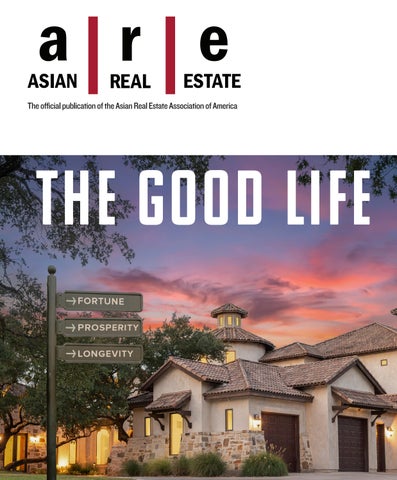
The official publication of the Asian Real Estate Association of America
the good life
The official publication of the Asian Real Estate Association of America
F A L L
2 0 2 6
October Issue
EXECUTIVE EDITOR Tr a c y M o o r e CREATIVE DIRECTION Jazz Miranda CONTRIBUTORS Hope Atuel Jordan Fan
is a publication of the Asian Real Estate Association of America (AREAA), a national nonprofit trade organization dedicated to increasing sustainable homeownership in the AANHPI community. For more information, visit: areaa.org ©2026 by the Asian Real Estate Association of America. Reproduction in whole or part without permission is prohibited. Opinions expressed by individual authors are not necessarily the opinions held by AREAA. Office: Asian Real Estate Association of America 2333 Camino Del Rio South, Suite 210 San Diego, California 92108 contact@areaa.org Previous issues available online at: issuu.com/areaa For additional web-based content, please visit: areaa.org
CONTENTS 4
FA L L 2 0 2 6
06
Letter From the CEO
07
Founders’ Update
福
AREAA CEO Hope Atuel introduces the ancient trio at the heart of this issue’s Fu Lu Shou theme of fortune, prosperity and longevity, and asks one big question: What makes a good life?
More than two decades after its founding, Jim Park, John Yen Wong and Allen Okamoto revisit the spark that became AREAA, and how Fu Lu Shou represents something the community understood all along.
FU — GOOD FORTUNE: THE MANY BLESSINGS AND HAPPINESS LIFE BRINGS
08
Fortune Favors the Prepared
12
Ancient Designs For Modern Luxury
From “parachute kid” to AREAA’s incoming 2027 president, William Wang turned hardship into fortune, prosperity and longevity — and now he’s paying it forward.
Feng shui, Vastu Shastra and wabi-sabi are the hottest vocabulary in luxury real estate. Here’s how to spot them in a listing, and how to speak them fluently to buyers.
祿
LU — PROSPERITY: FINANCIAL AND PROFESSIONAL SUCCESS
18
A Higher Interest
20
Bringing the A-Game
壽
Hope Atuel profiles Cerita Battles, the Chase mortgage executive who turned homeownership into ministry.
Meet AREAA’s 2026 A-List winners, and learn the hard-won secrets behind the top producers’ success.
SHOU — LONGEVITY: HEALTH AND LONG LIFE
28
Health Is Wealth
31
Happiness Habits
Longevity is the new luxury, but for many AANHPI families, the cost of staying well can come at the expense of the equity in their homes.
Two AREAA Past Presidents, Tim Hur and Amy Kong, share the daily habits that keep a real estate career successful, long-lasting and sane.
34
National Sponsors
35
National Board
AREAA salutes the partners who keep our mission moving.
Meet the leaders steering AREAA into its next chapter.
What makes a good life? Letter From the CEO In Chinese tradition, Fu, Lu and Shou — the three deities who personify good fortune, prosperity and longevity — offer one answer. These three attributes have been celebrated as symbols of a good life since the Ming Dynasty and continue to resonate with us today. Greek philosophers such as Aristotle also debated the good life. For him, it could be found through the golden mean, the desirable middle between too much and too little. In simpler terms, it is about finding balance. In this issue, we explore the presence and balance of Fu, Lu and Shou in the lives of AREAA members and in the homes and communities we serve. What we found is that these attributes are not merely bestowed upon us or left to chance. They are consciously cultivated through intentional choices and activities that bring greater happiness, build financial security and support a long, healthy life. Just as important, they are revealed in how we respond to opportunity, care for ourselves and one another. Fu represents blessings or fortune. In some Chinese cultures, Fu can also represent spiritual peace or shalom. In other words, Fu can be the manifestation of divine grace in our lives. I so much desire Fu to rain in my life — for blessings, good fortune and divine grace all at the same time. Laura Story’s song “Blessings” reminds me that we naturally seek peace, comfort and protection for those we love, even though grace may come to us in forms we do not expect. It is human nature to seek the good life. I see this understanding of Fu in William Wang, AREAA’s incoming 2027 national president, featured in this issue, whose journey from an immigrant childhood to national leadership shows that fortune must be recognized, met with preparation and shared with others. We also explore how feng shui, Vastu Shastra, wabi-sabi and other ancient Asian design traditions are shaping modern luxury design around family, harmony and well-being. Lu stands for prosperity. For many Asian Americans, myself included, homeownership is the cornerstone of the American Dream and the mark of a prosperous life. It is the engine that powers wealth creation across generations. We see that spirit of Lu in our 2026 A-List, whose honorees generated more than $7.3 billion in transaction volume. Just as important, many are using that success to lead, advocate and expand homeownership opportunities for AANHPI families. 6
FA L L 2 0 2 6
Shou, or longevity, is the dominant attribute in my life. For the past two decades, my circadian rhythm has brought me to the point of consciousness at about 4:30 a.m. without mechanical prompting. The American Heart Association recommends 150 minutes of weekly moderate cardiovascular exercise to maintain a healthy heart and to reduce the risk of type 2 diabetes, so three to four times a week, I head to the pool at about 5:15 a.m. to clock in my cardio time. I bring the same discipline to my daily diet. I start with a healthy serving of fruit in the morning, followed by green and leafy vegetables at lunch, with a goal of eating three to five servings of fruits and vegetables every day for optimal health and wellness. Don’t get me wrong: I will occasionally splurge on a bag of cheesy Doritos or enjoy a calorie-laden Oberweis ice cream when I am in Chicago. I suppose that is Aristotle’s golden mean at work: making healthy choices without denying ourselves the occasional pleasure. No, I do not aim to be a centenarian. I only aspire to live a life marked by abundant health. But longer lives also bring financial realities. In this issue, we look at how health care, caregiving and the cost of aging safely at home can lead AANHPI families — including my own — to draw upon the wealth in their homes in times of financial strain brought about by health challenges. We also explore how thoughtful planning and home design can help us remain safe, healthy and independent as we age. Taken together, the stories in this issue remind us that the good life is not measured by wealth or years alone. It is found in the blessings we recognize, the prosperity we build and share, and the health that allows us to enjoy both. I hope this issue inspires you to consider what Fu, Lu and Shou mean in your own life.
Hope Atuel Chief Executive Officer, AREAA
Founders' update When the three of us founded AREAA more than two decades ago, we weren't thinking about ancient philosophy. We were thinking about access, about the AANHPI families being shut out of homeownership and about an industry that didn't yet have room for professionals who looked like us. But as we consider the principle of Fu Lu Shou for our 2026 National Convention, this ancient principle seems strikingly relevant in our modern landscape. First, it's worth noting that this term comes from Chinese tradition. But just as AREAA encapsulates the entirety of the AANHPI community, we've watched members from South Asian, Southeast Asian, Pacific Islander, Korean, Japanese, Filipino and countless other heritages beyond pursue that same fortune, prosperity, and longevity. While the language may change, the underlying instinct doesn't: build something good, build it to last and make sure it reaches further than you did. That's not a Chinese idea or an Asian idea. It's a human one that Chinese tradition simply gave a name to, and one nearly every culture within AANHPI carries in its own form.
Allen Okamoto Founding Chairman/ Chairman Emeritus
Fu, or fortune, is what brought each of us into this work in the first place. None of us set out to build a national organization. We saw a gap: AANHPI families being underserved, misunderstood or outright excluded by the real estate industry, and we saw each other. That's fortune in its truest sense: not luck that falls into your lap, but the people who show up at the right moment and the willingness to recognize them when they do. Lu, or prosperity, is what we built next, deliberately, over years of unglamorous work. Local chapters. National partnerships. Advocacy that actually moved policy. Prosperity for an organization like ours was never about a single win. It was about compounding small, steady gains until an entire community had more access than it did the year before.
John Yen Wong Founding Chairman/ Chairman Emeritus
Shou, or longevity, is the part we think about most now. AREAA's mission is bigger than any one person or leader. It's our legacy that builds a better world for our children and our children's children. Every chapter president, every member closing a deal for a first-time AANHPI buyer and every young professional stepping into leadership today — that's longevity in action. It's about making sure what we started keeps moving forward. We're proud of what AREAA has become. But prouder still that Fu Lu Shou, a principle with roots in one culture, has turned out to describe something the entire AANHPI community already understood.
Jim Park Chairman Emeritus
Fortune Favors
8
FA L L 2 0 2 6
s the prepared William Wang has never waited for opportunity to knock. AREAA’s 2027 national president on pushing through hardship, seizing his chances — and making sure others get theirs. By Jordan Fan Every morning at 5:30, William Wang is already awake, a coffee in hand and a 5-kilometer run ahead of him. The early hour is uncomfortable. The run is hard. And that is exactly the point. “I know if I can get up and embrace challenge, then I can handle any of the obstacles that my day might throw at me,” he says.
福 Fu — Fortune Born in China, Wang immigrated to the United States at age 10, speaking no English. Opportunity, however, needed no translation. A state-owned enterprise had sent his father, a geologist and engineer, to help launch a business exporting non-ferrous metals, including copper and other materials used to build modern infrastructure. His mother worked in finance. At the time, their expertise commanded far more in the United States than in China. For his parents, the move opened doors. For Wang, it meant growing up fast. Settled in Arcadia, California, Wang’s days stretched from school in the early morning well into the evening, cycling through a rotation of after-school tutoring programs. His parents traveled frequently back and forth to China, and he only saw them every few months. Wang was part of a small community of what has famously been termed "parachute kids" — children of transitioning immigrant families, largely on their own. Many of his peers struggled, he says, but his parents countered the distance with structure. He credits the relentless schedule his parents built for him, and his own drive to keep busy, with keeping him on a different path. The years of tutoring paid off: He graduated high school at 15 to attend college.
William Wang as a child with Mom and Dad.
Wang graduated in 2008, just in time for the financial crisis to turn banking into one of the toughest job markets in a generation. After being turned down at more than a dozen interviews, he finally landed a position as a bank teller, earning close to minimum wage. It was not exactly a corner office. It was, however, a foothold — an inauspicious start in an industry where, at the time, Asian American professionals were rarely represented in mainstream banks.
The bank celebrated receiving its charter at the same time he and his wife, Sandy, welcomed a daughter. The arrival of one new venture alongside another changed his calculus, and becoming a father ultimately persuaded him to retire from banking after 18 years. Retirement, as it turned out, was more of a restructuring. Investors and former clients kept calling, so Wang established his family office, Wang & Associates, where he serves investors as Fractional CFO. He also joined United Midwest Savings Bank (UMWSB), continuing to help business owners secure SBA financing. William Wang during his first job as a bank teller.
Five years later, his fortunes began to shift with an introduction to AREAA. In 2013, still new to business development and admittedly shy, Wang was introduced to the organization through his local chapter and asked to help host a seminar. That single connection opened a door — referrals, relationships and opportunities that, he says, materially changed the course of his career. The experience shaped Wang’s pragmatic view of fortune: It is not something owed to him, but an opportunity that must be recognized and then met with preparation.
祿 Lu — Prosperity
Prosperity, for Wang, has never been only personal. He speaks pointedly about the "bamboo ceiling" faced by Asian American professionals in corporate finance — a barrier he says receives far less attention than the glass ceiling. In his own career, he responded by advocating aggressively for himself, changing roles roughly every three years whenever he believed he had outgrown a position but was not being offered the advancement he earned. Through AREAA, that same instinct has become a broader mission: narrowing the gap between AANHPI business owners and homebuyers and the financial resources they're often unaware they qualify for, whether that's a lower interest rate, a smaller down payment or access to capital. His underlying belief is straightforward: Opportunity rarely arrives unprompted. You must seek it out, and when possible, help others see it, too.
Once inside banking, Wang made himself difficult to overlook. Early in his career, he made a habit of routinely arriving before his colleagues and staying after they left — not because anyone required it, he says, but because consistency was the clearest way to prove himself. When his bank offered a bonus for employees who signed 100 new credit card applications in two months, Wang turned his evenings into a second shift, canvassing malls and shopping centers door to door. Rejection, to him, was simply part of the math. Over a nearly two-decade career, Wang built his expertise in commercial lending — arranging working capital and other financing for midsize businesses, often with real estate at the center. He later earned his MBA at USC, where he connected with future partners and went on to co-found a de novo community bank in Southern California. He helped raise its capital, establish its government lending programs and oversee them as head of commercial and government lending. William Wang and family. 10
FA L L 2 0 2 6
壽 Shou — Longevity Wang’s path from local volunteer to AREAA's national president wasn't part of a long-laid plan. Over nearly a decade, he built a reputation as someone the organization could count on. A familiar presence at AREAA events throughout Southern California, he stepped up in 2023 as president of AREAA’s Greater Los Angeles Chapter. That year was rewarding, demanding and eventful enough that, by its end, Wang was ready to reclaim some time for his family and the bank he had helped build. Once again, Wang found himself in demand just as he was preparing to slow down. At a golf tournament, a conversation led to an invitation to help out at the national level after a colleague resigned. What was meant to be a one-year commitment grew into a larger role. As AREAA’s national vice president, Wang spent the year traveling across the country to meet members and chapter leaders. Those travels widened his view of the organization. Wang was deeply impressed by the dedication and resourcefulness that sustained AREAA for two decades, but he also saw how unevenly sponsorships, funding and support were distributed among different chapters. A trip to Washington, D.C., where he met with policymakers alongside other AREAA leaders, cemented his commitment to the organization’s national work. Now preparing to serve as AREAA’s 2027 national president, Wang has set a focused agenda: strengthen the relationships and resources already connecting its chapters, build stronger bridges between institutions and the communities AREAA serves and use his platform to keep pushing against structural barriers — the bamboo ceiling among them — that AANHPI professionals continue to face. It is a long view of the role, measured less by a single term than by the kind of durable, compounding impact that outlasts it: ensuring that AREAA’s work continues opening doors for generations to come. As Wang puts it, “Fortune isn't just what happens to you — it's what you're prepared to do with it, and who you choose to share it with.”
William Wang as a child with Grandfather and Father.
福
12
FA L L 2 0 2 6
FU — GOOD FORTUNE: THE MANY BLESSINGS AND HAPPINESS LIFE BRINGS
福 FU — GOOD FORTUNE
Ancient Designs For Modern Luxury
Walk through a new luxury development today and you might hear a sales agent mention the placement of the front door relative to the staircase, or the exact compass direction the kitchen faces. Ten years ago, that would have sounded eccentric. Today, it's often the first thing a buyer asks about. Feng shui, Vastu Shastra, wabi-sabi, and a handful of other design traditions from across Asia and the Pacific are showing up in high-end architecture with more frequency, and more seriousness, than they have in decades. For AREAA's members, this matters beyond aesthetics. These are principles many AANHPI families have lived by for generations, and agents who can speak to them fluently have a real edge with buyers who are actively looking for that vocabulary.
By Jordan Fan
Feng Shui: Energy as a Design Language Feng shui, the Chinese practice of arranging space to encourage the flow of positive energy, has influenced Western real estate quietly for years. What's changed is that buyers now ask about it outright: how the entryway is oriented, whether the staircase faces the front door, whether a floor plan lets light and air move through the home instead of pooling in dead corners. In luxury listings, this translates into specific, buildable choices. Curved walkways instead of a straight shot to the front door. Water features positioned to symbolize wealth flowing in, not out. Primary suites tucked away from a direct sightline to the entrance. Developers who once treated these as odd requests from a niche buyer pool are now designing with them from the start, partly because the underlying goals — light, flow, a sense of calm — are things most buyers want regardless of background.
福 FU — GOOD FORTUNE
Vastu Shastra inspired design
Vastu Shastra: India's Architecture of Balance Vastu Shastra, India's traditional system of architecture, dates back to the Atharvaveda and organizes a home around five elements: earth, water, fire, air and space. It dictates things like which direction a kitchen should face and why the center of a home should stay open rather than boxed in by walls. Luxury developers in South Asian markets have started bringing on Vastu consultants alongside their architects, not as a courtesy add-on but as part of the original design brief. The results show up as deliberately angled entrances, open central courtyards and kitchens oriented to catch morning light. Marketing materials for these properties now list Vastu compliance right next to square footage and finishes, treating it as a genuine selling point rather than a footnote. For interior designer, Tina Ramchandi, Vastu Shastra is highly relevant to her business practice, even when the term does not come up. “My South Asian clients don’t come into the room discussing Vastu Shastra, but there’s an implied assumption that I can meet their cultural needs.” She stresses that these principles apply to clientele of any background. "Not everyone has the cultural terminology, but we can all perceive good energy when we walk into our home." 14
FA L L 2 0 2 6
Wabi-Sabi inspired design
Wabi-Sabi: The Beauty of Imperfection Feng shui and Vastu are both about energy and orientation. Wabi-sabi, the Japanese philosophy behind a lot of what's now being called "quiet luxury," is doing something almost opposite: pushing back against the flawless, catalog-perfect finish that's defined luxury interiors for years. Wabi-sabi finds beauty in asymmetry and age. A liveedge wood slab. A hand-thrown ceramic bowl with an uneven glaze. A lime-washed wall that shows the plasterer's hand instead of a dead-flat paint job. You can see it in the shift away from polished marble toward reclaimed, hand-scraped oak, and in the pairing of wabi-sabi with biophilic design, bringing in natural light, greenery and raw materials that tie a home back to the landscape around it. A design philosophy rooted in Japanese tradition is now shaping how a lot of the luxury market defines good taste, full stop.
Beyond the Big Three Feng shui, Vastu and wabi-sabi get the most attention right now, but they're really just the most visible pieces of a much broader AANHPI design vocabulary finding its way into high-end architecture:
•
Engawa-style transitional spaces, drawn from traditional Japanese homes, are appearing as covered indoor-outdoor verandas that blur where the interior ends and the garden begins.
•
Multigenerational floor plans, long the norm in many AANHPI households, are now being marketed as a premium feature instead of a workaround, complete with private suites, separate entrances and dedicated living space for aging parents or adult children.
•
Courtyard-centered layouts, drawing on Chinese siheyuan architecture and design traditions across Southeast Asia, are bringing privacy and natural light into the center of a home rather than pushing outdoor space to the edges of a lot.
Courtyard-centered inspired design
Why This Matters for AREAA's Members
Engawa-style inspired design
Buyers are asking sharper, more specific questions about orientation, material and flow, and the agents who can answer them without reaching for a search engine are the ones building trust fastest. That's true whether the client is AANHPI or not. There's a bigger point underneath all of this, too. A home's value was never just its finishes or its square footage. It's whether the place actually supports the people living in it, their peace of mind, their prosperity and their connection to family, now and for whoever lives there next. Luxury architecture is only now catching up to something AANHPI communities have understood for a long time. For AREAA's members, that's not a new skill to learn. It's a fluency a lot of them already have.
Multigenerational home
16
FA L L 2 0 2 6
祿
LU — PROSPERITY: FINANCIAL AND PROFESSIONAL SUCCESS
祿 LU — PROSPERITY
A Higher Interest Cerita Battles climbed from bank teller to mortgage executive, using every rung to bring homeownership within closer reach of underserved families. Now retired from Chase, she has left the title — but not the mission. By Hope Atuel
Cerita Battles may be newly retired, but she is nowhere near finished delivering her message. The financial services career she began at a teller window in 1989 eventually put her in charge of Chase’s national community and affordable lending strategy. Now another kind of lectern has her at center stage: the pulpit at St. Paul AME Church in her hometown of St. Augustine, Florida. It’s not just any pulpit. The Rev. Dr. Martin Luther King Jr. spoke at St. Paul during the city’s pivotal 1964 civil rights campaign, when the church served as a center for organizing, training and sustaining the movement. At St. Paul, faith has long traveled beyond Sunday worship into public life — a tradition that mirrors Battles’ own. To Battles, the pulpit and the mortgage office were never as far apart as they might appear. An ordained minister and pastor’s assistant at St. Paul, she describes her work as “marketplace ministry” — using her gifts and position to serve people where she finds them. Helping families, especially those long outside of the financial system, find greater stability and opportunity through homeownership has always been part of that service. The apostle Paul advised Timothy to be ready “in season and out of season.” Battles spent 37 years taking that instruction to work. I first saw that combination of purpose and persistence up close in 2012, after an exhausting week hosting AREAA’s National Convention at the Bellagio Hotel in Las Vegas. Our meeting was brief. Battles went straight to the point: the expo hall. Exhibitors had invested heavily to be there, she told me, and AREAA needed to keep attendees moving through the space so that investment delivered value. That conversation lasted minutes, but its effect lasted years. I have been intentional about expo hall traffic ever since, thanks to her prodding. That exchange was a small display of the professional muscle Battles had spent decades building: spot who was not being served, say so plainly, and press for a better result. She learned banking at every altitude, moving through lending, product management, business development and mortgage-production leadership. Her mortgage career took root during an eight-year stretch at Chase. She later moved into senior banking positions at Bank of America and then Wells Fargo, where she became senior vice president and head of retail diverse segments for home mortgages. In 2020, she returned to Chase as head of community and affordable lending, where she led the bank’s community and affordable lending strategy nationwide.
18
FA L L 2 0 2 6
Battles called the return a homecoming — one that came with a national mandate to address historic barriers to homeownership among minority and underserved communities. As the titles grew, so did her reach. One mentor gave her a useful check on that ascent: “You rent your title; you own your character.” Battles took the titles seriously, but she never confused them with the point: helping families find stability, a stake in their community and generational wealth to grow and pass on. Homeownership was personal long before it became her professional mission. On Chase’s Beginner to Buyer podcast, she recalls that her mother initially rented while raising her as a single parent. After remarrying a man whose parents had owned their own home, her mother bought one, too. That purchase changed her family’s possibilities. Her parents later tapped their equity to start a business that was still thriving 30 years later. Battles soon bought her own home at 34; one of her younger sisters did so at 26. “All I know is that because my parents owned, I owned,” Battles said. That is generational wealth in its most human form: first comes the home, then come possibilities. Battles has spoken about structuring her own home so that her daughter, sister and the generations after them will always have a place to live — an asset they can keep, rent, borrow against or pass forward. At Chase, that conviction became institutional strategy. Battles’ work there focused on obstacles she’d encountered throughout her career: limited savings for down payments and closing costs, unequal access to credit and financial education, and too few trusted connections between lenders and the communities they hoped to serve.
message of financial stewardship through homeownership at multicultural industry gatherings. And while retirement may change the stage she appears on, it has not altered what comes next. “I believe we were created to serve God and His people with whatever gift or within whatever capacity God has afforded us to work in,” she says. “All of it is ministry.” As for what form it takes, Battles says she is open to her next ministerial assignment, whether it’s “pastoring, strategic consulting, writing or being an awesome wife and mother to Ron, Myka, and our little min pin Boogie Broadway.” Battles is clear about the legacy she leaves behind. “I’m proud and grateful for the relationships, opportunities and strategies I was able to build that will remain sustainable within this industry,” she says. For AREAA members, she has a parting charge: “There is one thing that God will never create any more of — and that is land,” she says. “So He tells us to ‘Go and Possess it!’ Therefore, AREAA, continue to remain true to your mission to increase homeownership within the segments and communities you serve. That’s your God-given assignment, individually and collectively.” I have not yet made it to St. Augustine to hear my friend Cerita Battles preach. But I will, soon — and I have been on the receiving end of a Cerita Battles message before. If history serves, I know I’ll leave inspired, and with more good work to do.
The results showed up beyond the mission statements. By early 2024, Chase had expanded the Homebuyer Grant that Battles oversaw to more than 15,000 communities. More than 8,600 buyers had received a combined $43.1 million through the program. That scale is what professional muscle looks like at the institutional level: the ability to move more than an audience. When I interviewed Battles on stage in 2024 about her decorated career, she shared how years of tenacity had taken her from teller to executive, and how her husband and newly graduated daughter keep her grounded, reminding her of her calling as a wife and a mother. She also called her career rise “passion with a purpose.” That purpose still has a voice. Public speaking is one of Battles’ many gifts, and she uses it to communicate her passion for serving others and uplifting the communities that need it. In the last two decades, Battles has shared her
Cerita Battles and Jim Park at AREAA's 2021 National Convention.
祿 LU — PROSPERITY
bringing the a-game At AREAA, nothing captures prosperity quite like our A-list. Sponsored by Bank of America, it is more than a representation of monetary success: it spotlights the top producers who’ve grown into leaders in their respective communities. To find out how they built wildly successful real estate businesses, AREAA spoke with two of 2026’s best: #1 individual producer Cecily Cao and top team producer Ken DeLeon.
20
FA L L 2 0 2 6
Cecily Cao RE/MAX One Realty Moorestown, NJ
#1 Top Individual Producer by Sides (236 Sides)
If you could send one sentence back in time to yourself the day before you got into this industry, what would it say? Build a strong system, surround yourself with great people, and trust that consistency, meaningful relationships and genuine care for others will take you further than you ever imagined. What's a piece of "good luck" in your career that, looking back, you almost didn't recognize as luck at the time? I’ve always been willing to take risks to capture the opportunities, but I consider my greatest fortune to be the integrity I live by and my constant desire to learn, grow and improve. Has your definition of “prosperity” changed as you’ve progressed through your real estate career? Absolutely. Earlier in my career, prosperity was easier to measure in numbers — sales, income, awards and production. Those things still matter because they represent hard work and results, but today my definition is much broader.
Now prosperity means having a business built on trust and referrals, the freedom to make choices for myself and my family and the ability to create opportunities for others. What would you say is your number 1 skill that has brought you to the top of AREAA’s A-list? My number one skill is earning my clients’ trust. I’ve built that trust through consistent hard work, strong ethical standards and always putting my clients’ best interests first. To me, success in real estate is not just about closing a transaction — it’s about building relationships that last. How do you manage both long-term and short-term goals? My short-term goal is to build a sustainable business through meaningful relationships while still making time for my family. My long-term goal is to give back — to the community and the organizations that are important to my visions. We all have limited time and endless responsibilities, so I’ve learned to focus on priorities, knowing they will change at
different stages of life. Most importantly, I believe we have to take care of our health, manage stress and find peace along the way. How do you use your position of success to inspire and lead others? As an immigrant from Taiwan, I came to the U.S. to pursue my education. I became a professor, and later built my career in real estate. I hope my journey inspires newer agents — especially those from immigrant and multicultural backgrounds — to embrace their language, culture and unique life experiences, because what may seem like differences can become some of their greatest strengths.
Ken DeLeon DeLeon Realty, Inc. Palo Alto, CA
#1 Top Team Producer by Volume ($956,738,594)
If you could send one sentence back in time to yourself the day before you got into this industry, what would it say? Focus upon your clients’ goals over your own goals, and your success will be guaranteed. What's a piece of "good luck" in your career that, looking back, you almost didn't recognize as luck at the time? I lost my first listing appointment due to not having enough experience. I pivoted in my first five years to focus exclusively on buyers, and then my career thrived. Buyers will judge you on enthusiasm and expertise, whereas sellers focus upon experience. By pivoting towards buyers, I became the top buyer’s agent in Silicon Valley, and eventually, as my buyers turned into sellers, I became a listing agent. So failing at my first listing appointment, in hindsight, accelerated my focus upon buyers, and that led to my ultimate success. Has your definition of “prosperity” changed as you’ve progressed through your real estate career? I have undergone a lot of “tragedies” in my life, including losing my sister, being hit by a speeding car while walking on 22
FA L L 2 0 2 6
the sidewalk with my father and beating cancer several times. Each setback filled me with greater insight and wisdom. I realize that we cannot control life events, but our reaction, positive or negative, determines the outcome. By always being positive, I have optimized my recovery, and I know that overcoming these hardships has made me wiser and I am living a more fulfilling life where I appreciate everything. My definition of prosperity is no longer financial; I just focus on the happiness and health of my family (I have a large one, with six children) and friends. Life is a beautiful self-fulfilling prophecy. Envision the life you want, and it will come. What would you say is your number 1 skill that has brought you to the top of AREAA’s A-list? I am the best dancer around! Kidding aside, the chaos of my dancing style does help me navigate the ever-changing market. I love public speaking, and I do a lot of seminars. I am very analytical, and this helps me do a neighborhood-byneighborhood analysis, predicting the rate of appreciation of each neighborhood. Overall, I am an exceptionally brilliant person and great agent. But the skill that I am most known for is my humility! I can out-humble anyone.
How do you manage both long-term and short-term goals? Evolution is the goal of life, and goals are necessary to achieve growth. I create short-term goals to fuel my passions and long-term planning to take over and grow my market share. How do you use your position of success to inspire and lead others? I do a lot of public speaking at real estate conferences, sometimes to over 2,000 agents at a time. I discuss my life "tragedies" and how I use these setbacks as a catalyst to greater growth and insights. Overcoming hardships build the resilience and self-growth necessary for self-love. It is simply actualizing your potential, and it is adversity that gives you the tools necessary to expedite evolution. So, fail fast and fail forward to become the greatest you can be!
祿 LU — PROSPERITY
TOP 10 BY 2025 INDIVIDUAL SIDES
RANK
NAME
COMPANY
LOCATION
SIDES
1
Cecily Cao
RE/MAX One Realty
Moorestown, NJ
236
2
Artemisa Boston
eXp Realty
West St. Paul, MN
183
3
Stephanie Vitacco
Equity Union Real Estate
Los Angeles, CA
162.4
4
Li Li
B Square Realty
Queens, NY
109.5
5
Julie Gritton
Coldwell Banker Premier
Lewes, DE
101.7
6
Peter Fife
Coldwell Banker Northland
Prescott, AZ
95.5
7
Blair Myers
Blair Myers Real Estate
Macon, GA
95
8
Karen Yip
Yip Premier Real Estate
Columbia, SC
74.5
9
Tina Guerrieri
RE/MAX Central
Blue Bell, PA
70
10
Christopher Karas
Compass
Scottsdale, AZ
68
To view the complete list visit areaa.org/alist or scan QR code
祿 LU — PROSPERITY
TOP 10 BY 2025 INDIVIDUAL VOLUME
RANK
NAME
COMPANY
VOLUME
1
Christopher Karas
Compass
Scottsdale, AZ
$190,500,700
2
Stephanie Vitacco
Equity Union Real Estate
Los Angeles, CA
$187,659,075
3
Li Li
B Square Realty
Queens, NY
$115,924,813
4
Tracy Allen
Coldwell Banker Realty
Honolulu, HI
$109,348,000
5
Dittany Zhang Seltzer
Sunoom Realty
Los Angeles, CA
$68,140,245
6
Samantha Huang
Corcoran Icon Properties
San Francisco, CA
$60,910,953
7
Peter Fife
Coldwell Banker Northland
Prescott, AZ
$52,839,850
8
Artemisa Boston
eXp Realty
West St. Paul, MN
$50,984,258
9
Ellie Yung
Coldwell Banker Realty
Irvine, CA
$50,174,626
10
Ruth Eden Manzano Javier
Five Star Realty Inc.
Kapolei, HI
$48,282,174
To view the complete list visit areaa.org/alist or scan QR code 24
LOCATION
FA L L 2 0 2 6
TOP 10 BY 2025 TEAM SIDES
RANK
TEAM NAME
TEAM LEAD
COMPANY
LOCATION
SIDES
1
The Yeatman Group
Kyle Yeatman
Long & Foster Real Estate
Midlothian, VA
747
2
Caliber Group
Zachary Lazo
Compass
Seattle, WA
407
3
Pinnacle Team
Viet Le
eXp Realty
Oakdale, MN
340
4
The Moy Group
Danielle Moy
@properties Christie's International Real Estate
Orland Park, IL
214.5
5
Momentum Realty
Michael Ramos
Momentum Realty
San Francisco, CA
187
6
Bethoney Shen
Michael Bethoney
Nest Seekers International
Manhattan, NY
183
7
Tim Hur and Helen Nguyen Team
Tim Hur
Point Honors and Associates, Duluth, GA Realtors
178
8
Li Team
Nancy Li
Keller Williams
Henderson, NV
161.4
9
HPT Realty Team
Mindy Luong
HPT Realty & Finance
Westminster, CA
157
10
Darlene Streit Team
Darlene Streit
Sotheby's International Realty, Inc.
Santa Fe, NM
152
祿 LU — PROSPERITY
TOP 10 BY 2025 TEAM VOLUME
RANK
TEAM NAME
TEAM LEAD
COMPANY
LOCATION
1
DeLeon Team
Kenneth DeLeon
DeLeon Realty, Inc.
Palo Alto, CA
$956,738,594
2
Caliber Group
Zachary Lazo
Compass
Seattle, WA
$396,808,670
3
The Yeatman Group
Kyle Yeatman
Long & Foster Real Estate
Midlothian, VA
$371,675,593
4
Team Foster Skillman
Moya Skillman
Compass
Seattle, WA
$355,222,315
5
Darlene Streit Team
Darlene Streit
Sotheby's International Realty, Inc.
Santa Fe, NM
$255,460,987
6
Sybarite Realty
Phil Chen
Christie's International Real Estate Sereno
Burlingame, CA
$237,073,639
7
Bethoney Shen
Michael Bethoney
Nest Seekers International
Manhattan, NY
$208,409,785
8
The Shulkin Wilk Group
Jared Wilk
Compass
Wellesley, MA
$199,575,287
9
8 Blocks Real Estate
Mei Ling
8 Blocks Real Estate
Santa Clara, CA
$183,949,998
10
The Condo Advisory
Marcus Lee
Compass
San Francisco, CA $167,184,799
To view the complete list visit areaa.org/alist or scan QR code 26
VOLUME
FA L L 2 0 2 6
壽
SHOU — LONGEVITY: HEALTH AND LONG LIFE
壽 SHOU — LONGEVITY
Health Is Wealth Longevity is the new luxury. But for many AANHPI families, staying well can mean tapping the wealth in their homes. By Hope Atuel
For most families, a home represents security. But for a growing number of AANHPI households, it also represents something else: a medical safety net that can be drawn upon when health care costs exceed what savings alone can cover. 28
FA L L 2 0 2 6
The Real Numbers Behind Aging and Caregiving at Home Zoom in on what "healthcare costs" look like at the household level, and the picture becomes even clearer:
What the Data Shows A new life-cycle study from the Urban Institute, AANHPI Homeownership and Wealth-Building Trajectories, offers the first comprehensive look at how AANHPI households build, use and pass on wealth anchored in homeownership. The findings paint an encouraging long-term picture: AANHPI homeownership rates climbed from 52 to 63 percent over the past three decades, one of the largest gains of any group, and median home equity grows substantially over time, from roughly $180,000 within the first five years of ownership to more than $340,000 by years six through 10. But the same report surfaces a more sobering pattern beneath that growth. As AANHPI households build equity, many are forced to tap it, and healthcare is one of the primary reasons why. The report finds that AANHPI households who extract home equity tend to have higher incomes but comparatively low liquid savings, making the home itself, rather than a cash cushion, a potential fallback resource when a major expense hits. In years when families extract equity, spending on family support more than doubles and education spending nearly triples relative to non-extraction years, indicating just how much of that equity is going toward caring for others rather than discretionary spending. Healthcare needs sit squarely among those pressures, placing AANHPI households among the groups most likely to lean on home equity to cover medical costs. In other words, for many AANHPI families, homeownership doesn’t just build wealth for the future. It's actively subsidizing health and caregiving costs in the present, often years before that wealth would otherwise have been tapped.
•
Falls send more than 3 million older adults to the emergency room each year, with the average hospital stay following a preventable fall costing roughly $35,000.
•
Home modifications can prevent nearly half of those falls, but the modifications themselves aren't cheap: a single stair lift typically runs $3,000 to $10,000 installed, a walk-in shower conversion $5,000 to $12,000, and a full accessible bathroom remodel $15,000 to $30,000 or more.
•
Insurance frequently classifies these modifications as "adaptive equipment" rather than medically necessary care, which means many of these costs land squarely on the homeowner, out of pocket.
•
Only 13 percent of adults over 75 can afford a nursing home, pushing more families toward in-home care as the only financially viable option, even though fewer than 2 percent of U.S. homes are equipped for safe aging.
•
One in three family caregivers has left their job to provide care, and 57 percent shift to part-time work, both of which compound the financial strain at exactly the moment healthcare costs are rising.
Layered together, these numbers tell a consistent story: Aging and caregiving at home are costly, often not covered by insurance and increasingly paid for by home equity rather than savings or medical coverage.
The Luxury Market Takes the Long View The need to plan for longer lives at home is beginning to register in the luxury market. Sotheby’s International Realty’s 2026 Mid-Year Luxury Outlook identifies “longevity-driven living” as a force reshaping global luxury real estate. As life expectancy rises, older buyers looking to age in place and younger buyers seeking to future-proof their homes are increasingly prioritizing single-story layouts, curbless bathrooms, main-floor suites, slipresistant surfaces, advanced air- and water-filtration systems and even integrated telehealth. The report also points to rising multigenerational living among affluent families to accommodate aging relatives and build a legacy.
壽 SHOU — LONGEVITY Across generations, the report says, these buyers are “thinking in decades, not moments,” and investing in homes that will remain relevant over time and across generations. The economics surrounding that shift are substantial: The global longevity market is projected to grow from $5.3 trillion in 2023 to $8 trillion by 2030, while wellness real estate has more than doubled in five years and is expected to surpass $1.1 trillion by 2029. Nearly 38 percent of real estate professionals working in the $10 million-and-above segment said aging in place is becoming a greater consideration for buyers.
49 days, all while Atuel worked full time, learned unfamiliar terms like Medigap, became her parents' durable power of attorney, and provided in-language interpretation in Tagalog because no formal language support existed. Atuel connects her personal story directly to the structural gap this article's data illustrates: Nearly 60 million Americans already live in multigenerational households, four times more than in 1971, and AANHPI communities have long led that trend, with one in eight AANHPI adults serving as a caregiver. Yet housing policy and home design have not caught up to that reality. As she writes, current housing policy centers on affordability and supply, but rarely asks whether the homes being built can actually support the lives families are living inside them.
Why This Matters for Real Estate Professionals This is a pattern many AREAA members are already seeing play out with clients: Homeowners, particularly multigenerational AANHPI families, are refinancing or extracting equity, not to buy a second property or fund a renovation, but to install a stair lift, widen a doorway or cover a parent's hospital stay.
AREAA CEO Hope Atuel and Family.
A Personal Account: AREAA CEO Hope Atuel's Story The Sotheby’s report captures what longevity planning can look like when it begins decades in advance. For many families, however, these decisions arrive only when a health crisis makes them urgent. That was the case for AREAA CEO Hope Atuel. In her recent op-ed, “One in Five Americans Will Be Over 65 by 2030, and Many Will Need In-Home Care. We're Not Ready,” Atuel writes candidly about serving as caregiver to her father, who at 88 is undergoing chemotherapy for colorectal cancer, while also having cared for her mother through advanced liver cancer before her passing in 2023. Atuel describes draining nearly $30,000 from her own savings to retrofit her family's home: grab bars, zero-step entries, a stair lift, heated bidets, shower valves with anti-scalding shutoffs, recessed lighting to eliminate trip hazards. As she puts it plainly, insurance deemed all of it "adaptive equipment" and not medically necessary, which meant it was out of pocket. Her mother's final months alone involved five hospitalizations totaling 30
FA L L 2 0 2 6
Understanding this dynamic changes how real estate professionals can serve their clients. It means recognizing when a client's questions about home equity lines of credit might be rooted in a caregiving need rather than an investment goal. It means being conversant in aging-in-place features (step-in showers, first-floor primary suites, wide hallways) not as luxury upgrades, but as essential, sometimes urgent, home requirements. And it means understanding that for many AANHPI families, a home's value isn't only what it's worth on paper. It's also what it can provide when a family member's health depends on it. Real estate professionals who understand these costs will better secure Shòu 壽 for their clients.
happiness habits Two AREAA Past Presidents, Amy Kong and Tim Hur, Answer Real Estate's Biggest Wellness Questions By Jordan Fan
Ask most real estate professionals what it takes to succeed, and you'll hear about hustle: early mornings, late-night calls, weekends spent at open houses, a phone that never really goes off. It's a career built on availability, and for many AANHPI agents and brokers, that drive is often inherited, a cultural inheritance of resilience passed down from parents and grandparents who worked relentlessly to build a life in a new country. But there's a second, quieter inheritance that deserves just as much attention: the deep, longstanding value AANHPI culture places on wellness, not as indulgence, but as the very thing that makes a long, meaningful career possible. This is the essence of Shou (longevity), the last of the three pillars of Fu Lu Shou. Fortune and prosperity mean little without the health and stability to enjoy them over time. And in an industry that runs on relationships built over years, sometimes decades, longevity isn't just a personal goal. It's a professional strategy. We spoke with two AREAA past presidents, Amy Kong and Tim Hur, about how they sustain themselves physically, mentally and spiritually in a career defined by unpredictability.
壽 SHOU — LONGEVITY This isn't just reflected in the successful careers of both of these individuals; physiological research has long shown that regular aerobic activity, walking chief among them, measurably lowers cortisol, regulates energy and increases sleep quality and hormone health.
The Mind and Spirit Behind the Hustle How do you keep mentally and spiritually healthy while under the same pressure?
Part of AREAA's 2021 National President Amy Kong morning routine includes a cup of coffee alongside time spent in scripture.
Staying Physically Grounded How do you keep physically healthy while working sporadic and occasionally hectic hours? For Amy Kong, physical wellness starts with a simple but often-neglected principle: Don't wait. Regular checkups and consulting a doctor the moment something feels off, rather than putting it aside, is a habit she treats as non-negotiable. She's honest about the reality of the job, too. Meeting schedules shift constantly, meals sometimes get skipped entirely and structured exercise can feel impossible some weeks. Her solution has been flexibility without abandoning the habit altogether, following workout videos online when a gym schedule won't cooperate and building generous travel buffers between inperson meetings so unexpected calls don't derail the entire day. Those hectic stretches, she notes, only happen once in a while, because the structure she's built around her calendar keeps most days manageable. Tim Hur takes a different but equally structural approach: accountability through relationship. He and his husband, Brandon, have a set schedule with a trainer and hold each other accountable. For Tim, the value isn't just the workout itself; it's the standing appointment on the calendar, and the fact that someone else is holding him to it.
32
FA L L 2 0 2 6
For Amy, that grounding comes from faith. She points to Ecclesiastes 3:1-8, which begins, "There is a time for everything, and a season for every activity under the heaven," which provides her with patience and assurance. She also cites Matthew 6:26, "Look at the birds of the air; they do not sow or reap or store away in barns, and yet your heavenly Father feeds them. Are you not much more valuable than they?" These verses are touchstones that help her release the anxieties of the day, let go of negativity that might slow her down and stay grounded in her purpose. Tim's approach is task-oriented, so that he is always focused on success. He describes having to actively force himself to quiet his own thought process, otherwise his mind wanders and his anxious energy takes over. It's a discipline he's candid doesn't come naturally, but one he stresses successful individuals must practice.
Routine as an Anchor Have you found that creating a routine helps you manage the chaos of life? If so, what is that routine? Amy's mornings follow a consistent rhythm: quiet time, a shower, and a cup of coffee alongside time spent in scripture. She writes down her prayers and, in her words, leaves her "troubling concerns to God." This knowledge and security gives her the confidence to conduct her business with others with love and respect. As she says in her standard optimistic fashion, "Nothing to worry about!" Tim calls his routine a must, not a preference. His set schedule with his trainer is one of the only pockets of his day where he steps fully away from email, calls and texts, helped along by the fact that his trainer simply won't let him check his phone mid-session.
What's Underrated, What's Overrated
breakup, a stretch of overwhelming stress, before it becomes a lasting habit. In both cases, Tim and Amy recognize that a life of wellness is only created by force of habit, through repeated, deliberate action.
What's a wellness routine or behavior that you think is underrated? What about overrated?
These responses are reflected in scientific data as well. The Harvard Study of Adult Development, one of the longest-running studies on health and happiness ever conducted, has followed its original participants for more than 85 years. It found that the strength of a person's close relationships, more than income, fame, or even genetics is the single strongest predictor of a long, healthy life. For an industry built on trust and relationships with clients, that finding hits close to home: The same connective tissue that sustains a career may be exactly what sustains the person building it.
Amy reiterates her earlier point. Quiet time, she says, is the most underrated habit of all, the deliberate pause that resets her in a career that otherwise rewards nonstop motion. What's overrated, in her view, is talking about mindset without ever acting on it; without action, she says, reflection alone is wasted time. Tim, more lightheartedly, admits that high-intensity group classes like CrossFit or Barry's simply aren't for him, even as he acknowledges plenty of friends swear by them, a reminder that the "right" wellness routine looks different for everyone.
Why This Matters for the Industry It would be easy to treat wellness as a personal, private matter, separate from the business of real estate. But the two are more connected than they appear. This industry rewards longevity. The agents who build the deepest client relationships, the strongest referral networks, and the most durable reputations aren't necessarily the ones who worked the hardest in any single year, they're the ones who stayed in the business long enough for trust to compound. Burnout doesn't just cost an individual their health; it costs the relationships, institutional knowledge and community trust that take years to build and that AANHPI communities, in particular, depend on when navigating major financial decisions like buying a home. In many ways, the wellness instincts embedded in AANHPI culture, proactive health management, quiet reflection, leaning on family and community rather than going it alone, are exactly the instincts this industry needs more of. Not as a break from the hustle, but as the foundation that makes a long, sustainable career and a long, meaningful legacy, possible in the first place.
AREAA's 2022 National President Tim Hur
Where Wellness Begins Who in your life promotes physical, mental, and spiritual wellness within you?
As Amy and Tim's routines make clear, wellness isn't onesize-fits-all. It might look like scripture and quiet mornings, or a trainer and a protected hour of silence. What matters is building a structure, whatever it looks like, that lets you show up not just for this year's clients, but for the ones you'll serve 20 years from now. That's Shou. Not just a long career, but a long, well-lived one.
For Amy, it's her husband Ray, who walks with her, eats with her, talks with her and lifts her burdens when she needs it most. Ray, Amy states, is the best thing in her life that she could ever ask for. While Tim acknowledges the many positive people in his life, for him, motivation ultimately comes from within. For many, Tim states, this drive is catalyzed by motivation by hardship — a
34
FA L L 2 0 2 6
PEARL
RUBY
EMERALD
DIAMOND
JADE
N AT I O N A L S P O N S O R S
2026 EXECUTIVE COMMITTEE
Bryan Ahn
William Wang
Jamie Tian
Gary Lai
2026 President
2026 Vice President
Immediate Past President
2026 Treasurer
Henry Choi
Allen Okamoto
John Yen Wong
Jim Park
2026 Secretary
Founding Chairman/ Chairman Emeritus
Founding Chairman/ Chairman Emeritus
Chairman Emeritus
Hope Atuel CEO/Executive Director
20 26 D E LEGAT E BOARD
Manolito Acebedo
Greater East Bay Chapter President
Shirley Chen
Tri-County Chapter President
Julie Du
Phoenix Chiang
Membership Services Committee Vice-Chair
Michael Fong
Dallas/Fort Worth President
Policy Committee Vice-Chair
Eriko Ishii
Harmony Jones
Houston Chapter President
Christina Ko
Central New Jersey Chapter President 36
Brenda Barrett
Greater Denver Chapter President
FA L L 2 0 2 6
Las Vegas Chapter President
Amy Kong
2021 National President
Chantal Camarillo Mortgage Committee Vice-Chair
Miriam Crispin Chapter Services Committee-Chair
Matthew Goldman
Greater Orlando Chapter President
Paula Keung
Northern New Jersey Chapter President
Nini Le
Atlanta Chapter President
Ann Chang
Peter Chang
theEDGE Committee Vice-Chair
Greater Los Angeles Chapter President
Peter De Jong
Clemente De La Torre
Membership Services Committee Chair
Wendy Holt
LA Coastal Chapter President
Mir Khan
North Los Angeles Chapter President
Tim Hur
2022 National President
Dan King
Vancouver Chapter President
Presidential Appointee
Kayla Lee
Jocelyn Lomahan
Luxury Committee Vice-Chair/NY Manhattan Chapter President
Chapter Services Committee Vice-Chair
Francis Lopez
Silicon Valley Chapter President
Lyllian Nguyen
Bobby Luu
DC Metro Chapter President
Minh Nguyen
Rhys Morris
Kevin Nally
Ventura County Chapter President
Columbus Chapter President
Theresa Nguyen
Kurt Nishimura
Atiquer Rahman
Greater Philadelphia Chapter President
Greater Tampa Bay Chapter President
Lisa Reeves
Angelic Rodriguez-Navarro Greater Central Valley Chapter President
Commercial Committee Chair
Yoon Saechao
Alice Shroeder CA Orange County Chapter President
Policy Committee Chair
Conan Soohoo
Doug Sutherland
Judy Sykes
Paul Tecson
Sarah Thorp
Kashyap Trivedi Greater Chicago Chapter President
Charlotte Metro Chapter President
Griffin Tso
San Diego Chapter President
Aloha Hawaii Chapter President
Jade Tucker
San Antonio Chapter President
2023 National President
Greater Seattle Chapter President
Portland Chapter President
Mortgage Committee Chair/ Boston Chapter President
Presidential Appointee
Frances Nguyen
Inland Empire Chapter President
Paul Tye
theEDGE Committee Chair
Greater Miami Chapter President
Melissa Sofia
Twin-Cities Chapter President
Connie Van
Greater Sacramento Chapter President
20 26 D E LEGAT E BOARD
May Vang
Greater Milwaukee Chapter President
Harvey Young
SF Penninsula Chapter President
38
FA L L 2 0 2 6
Terring Wang
Commercial Committee Vice Chair
Soo Yu
Presidential Appointee
Sharon Wilson
Greater Birmingham Chapter President
Diana Zhang
Luxury Committee Chair
Richie Wong Boston Chapter Delegate
Jean Zhou
Brooklyn Chapter President
Andrew Wu
New York East Chapter President
SAVE THE DATE
AREAA NATIONAL CONVENTION October 28-30, 2027 Intercontinental Hotel, San Diego ™
™