September 2026
Full Color Online Edition:
. . . e Insid
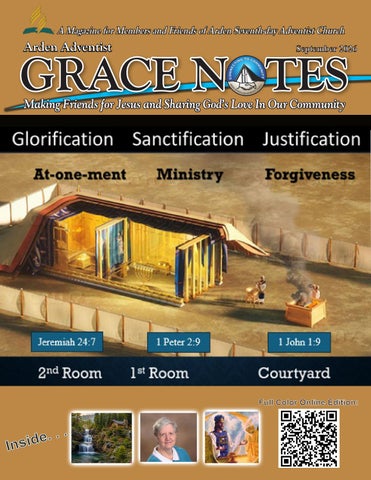
The Sanctuary: A Place of Refuge hen we hear the word sanctuary, we often think of W the room where we gather for worship. We speak in quiet voices when we enter the sanctuary. We listen to Scripture, sing hymns, pray, and hear the Word of God proclaimed. It is a sacred place, set apart for meeting with God. But the word sanctuary also carries another beautiful meaning. A sanctuary is a place of safety, refuge, or protection. It is somewhere a frightened person can run, where the weary can rest, and where those in danger can find shelter. That meaning helps us understand the sanctuary God instructed Israel to build in the wilderness. After delivering the Israelites from slavery in Egypt, God told Moses, “Let them make Me a sanctuary, that I may dwell among them” (Exodus 25:8). God’s desire was not merely to give Israel a religious building. He wanted to live in the midst of His people. The sanctuary stood at the center of Israel’s camp. Every tribe arranged its tents around it. This was a visible reminder that God was to be at the center of Israel’s life. Their identity, security, worship, and future all depended upon His presence. Yet the sanctuary taught more than the truth that God wanted to be near His people. Through its sacrifices, priests, furnishings, ceremonies, and holy days, the sanctuary presented a picture of the gospel. The sanctuary was, in many ways, the gospel told through symbols. Sin had separated humanity from God. Adam and Eve had once enjoyed open fellowship with their Creator, but after their disobedience, they hid from His presence. Shame, fear, guilt, and death entered the human experience. The sanctuary revealed how God would overcome that separation and bring His children home. When an Israelite sinned, the person brought an innocent animal to the sanctuary. The worshiper placed a hand upon the animal’s head, symbolically transferring guilt to the sacrifice. The animal died in the sinner’s place. This was a painful lesson. Sin is not harmless. It
brings death. Forgiveness is free to the sinner, but it is never without cost. And every sacrifice pointed forward to Jesus. John the Baptist identified Christ with the language of the sanctuary when he declared, “Behold! The Lamb of God who takes away the sin of the world!” (John 1:29). Jesus was innocent, yet He willingly took our guilt upon Himself. At the cross, He suffered the death that sin had brought upon us so that we might receive the life that belonged to Him. The sanctuary altar pointed to Calvary. But the gospel does not end with the death of the sacrifice. The sanctuary also included the ministry of the priest. The priest represented the people before God and carried the blood of the sacrifice into the sanctuary. This pointed forward to the continuing ministry of Christ. Jesus is not only our sacrifice; He is also our High Priest. The book of Hebrews tells us that He ministers for us in the heavenly sanctuary and that “He is also able to save to the uttermost those who come to God through Him” (Hebrews 7:25). Because Jesus lives, we have an Advocate. Because Jesus ministers for us, we do not face our guilt alone. Because Jesus has entered God’s presence on our behalf, we may approach the throne of grace with confidence. The furnishings of the sanctuary also pointed to Christ. The bread on the table reminded Israel that God sustained His people. Jesus later declared, “I am the bread of life” (John 6:35). The lampstand filled the sanctuary with light. Jesus said, “I am the light of the world” (John 8:12). The altar of incense represented the prayers of God’s people rising before Him. Through Christ, our prayers are welcomed into heaven. The ark of the covenant contained God’s law, reminding Israel that His government is founded upon righteousness. Yet above the law was the mercy seat, showing that mercy is available to those who have broken the law. At the center of the gospel, justice and mercy meet. The sanctuary tells us that God does not ignore sin, excuse evil, or pretend that guilt does not matter. Instead, He deals with sin fully through the sacrifice of His Son. At the cross, God remained just while also becoming the Justifier of everyone who believes in Jesus. —————————————————————————-
Continued on page 14…
Page 2 | www.ArdenAdventist.org
Be Full of Compassion and Forgiveness Be kind and compassionate to one another, forgiving each other, just as in Christ God forgave you. Ephesians 4:32 NIV “He should have known better.” “What was he thinking?” “I know I wouldn’t have done such a thing.” It’s easy to get upset when people make a mistake that affects us. It’s easy to hold a grudge or remind them of their mistake when a similar event happens. Describe a time when someone did something for which you could not forgive them. ______________________________________________ Describe a time when you made a mistake, and someone just wouldn’t let it go. _____________________________________________________ But everybody makes mistakes. Nobody is perfect - not your teacher, not your parents, not the police officer, and not you. So we should give people grace. We should put ourselves in their shoes and think of the times we have been forgiven. We have an awesome example to follow concerning this. God forgives us every time we screw up and come to Him and ask forgiveness. Describe a major mistake that you made for which you know God forgave you? ________________________ ________________________________________________________________________________________ The Bible says we should show compassion to one another. Our hearts should not be hard but rather be able to feel the hurt or embarrassment of others. We should not want to add to their feelings of shame or regret by harboring an unforgiving attitude towards them. Granted some things are hard to forgive, but most things can be easily forgiven if we focus our hearts in the right place. Think of a time when you made a mistake and the person most involved forgave you instantly and never brought it up again. How’d that make you feel? __________________________________________________ How do you think you would search your heart and find the compassion to forgive someone who wronged you so hurtfully? ______________________________________________________________________________ Let’s pray: Father God, we thank You that You have unending grace for us, that we can come to You and receive forgiveness with the goal of sinning no more. Help us to have the same heart as Jesus – full of compassion and understanding. We ask these things in Jesus’ name, Amen. Name People who Have Forgiven You 1. ______________ 2. _________________ 3. ______________ 4. _________________ 5. ______________ 6. _________________
How Many of These People Are Your Close Friends? ___________________________________________
Page 3 | www.ArdenAdventist.org
Jesus and the Festivals
by Clarence Small
he sukkot (booth) was nearly finished. Grandpa Joseph (Mt. 13:55) and Benjamin were carrying the last bundles of palm branches up the steps to the roof of their house, when Joseph suggested, “Why don’t we stop for a minute and get something to drink.” Benjamin thought that was a great idea. Some cool grape juice would taste wonderful. And he would have the opportunity to ask Grandpa some questions. “Grandpa,” he said, “Tell me more about Uncle Jesus. Did He celebrate the festivals like we do?” “Ah, Benjamin,” Joseph replied, leaning against the house. “I remember the first Passover your Great-Uncle Jesus attended the temple in Jerusalem, before the Romans destroyed it. He was so taken with the sacrifices that He didn’t notice when the family went home to Nazareth. Father Joseph and Mary had to go back to find Him. He was in the temple, talking to the scholars about what it all meant. I think that may have been the first time He realized what Passover meant to Him. You remember that the Baptizer called Him the Lamb of God, don’t you?” “Yes, Grandpa.” Benjamin repeated from memory. “John said, ‘Behold the Lamb of God who takes away the sin of the world!’” “And so we believe that Passover foreshadowed the Messiah’s death on the cross for our sins,” Grandpa explained. “There’s a parallel between all the festivals and what your Uncle Jesus did for us through His death and resurrection. We, as a family, have chosen to keep the festivals – just like our ancestors – to commemorate your Uncle’s continuing ministry for us. We know most Gentile Christians don’t observe the festivals, but that’s fine. They understand the significance.” Grandpa Joseph paused to drink again. “Remember, Benjamin, how I taught you that, when there is a repeated pattern in the Scriptures, there is often significance? Seven is an often repeated pattern. Seven days of creation culminating in the Sabbath. Seven annual feasts, culminating in seven days of rest, which Moses calls sabbaths. I believe the ministry of your Uncle Jesus has seven parts which correspond to the seven feasts. Here, let me show you.” Grandpa drew thirteen vertical lines in the dust of the roof with his staff. “We celebrate seven annual feasts. The first is Passover on the fourteenth day of Abib, the month we consider the first of
T
our year.” Grandpa drew a circle in the dust between the first and second line. “Passover actually starts on the tenth day, when the lamb is chosen. The lamb is killed and roasted on the fourteenth day, and the Passover meal is eaten that evening. “Now, we know that the lamb and its blood were used to protect the children of Israel from the avenging angel when they left Egypt. As John said, ‘Jesus is the Lamb Who takes away sin,’ (Jn. 1:29) protecting us from the angel of death at the end time. Our friend, Paul, put it this way, ‘For indeed Christ, our Passover, was sacrificed for us.’ (1 Cor. 5:7) So, Benjamin, Passover not only pointed back to the escape from Egypt, it also pointed forward to your Uncle Jesus’ sacrificial death on the cross, the first of His priestly ministries on our behalf.” Benjamin nodded. “I know that part, Grandpa.” “Good,” Grandpa said. “But that was not His only action, and not the only festival. The Festival of Unleavened Bread immediately follows Passover and is connected to it. Remember that we eat unleavened bread for seven days. What does this have to do with what Jesus does for us?” Benjamin shrugged his shoulders. “Well, your Uncle Jesus Himself told us, ‘Beware of the leaven of the Pharisees.’ (Mt. 16:6) Paul explained it this way, ‘Therefore purge out the old leaven, that you may be a new lump, since you truly are unleavened. For indeed Christ, our Passover, was sacrificed for us.’ (1 Cor. 5:7) Paul’s talking about sin. If we accept that Jesus died in our place, like the Passover lamb, then He begins removing sin from our lives, just as we get rid of the old leaven in our homes. I believe that the week of unleavened bread shows us that this process takes time.” “That makes sense to me so far, Grandpa,” Benjamin interjected. “I see how the symbols point to what Uncle Jesus does for us. What’s next?” “Next is the Feast of First Fruits. Coming after spring harvest puts it near Passover. The year Jesus was crucified, Passover was Thursday or Friday night, depending on who was figuring things out. Anyway, Jesus died on Friday, and rose from the dead on Sunday. First Fruits is celebrated the day after the Sabbath following Passover – the day Jesus rose. “So Jesus is the First Fruit and our guarantee of resurrection. But when He arose, so did many others, who were taken to heaven when He ascended. (Mt. 27:51-53) So, Jesus brought to the Father not just Himself, but a whole sheaf of First Fruits. These spring festivals clearly point to His work of salvation here on this earth.” “It’s these next ones that I don’t understand,” Benjamin said, pushing the dirt with his feet. “Okay, let’s try to understand the prophetic parts of the festivals – based on similarities that seem obvious to followers of your Uncle Jesus. Let’s move from the spring feasts to the feast I consider the hinge of the feasts.” Grandpa Joseph drew a circle in the dust between the third and fourth
Page 4 | www.ArdenAdventist.org
lines. “It’s the center of the seven, and it changes the focus from the direct acts of Jesus for individual followers to His actions on behalf of the church. These actions still affect individuals, but they have a wider impact.” Grandpa looked at Benjamin. “Do you understand?” Benjamin shook his head. “Okay. Let’s try them one at a time. The hinge event is the Feast of Weeks, usually called Pentecost, because it is seven weeks after the day following First Fruits. That makes it fifty days later. See?” Grandpa, starting at the first circle, counted two weeks plus four weeks plus one more week to the second circle. “This is essentially at the end of all the spring harvests,
and is a day of thanksgiving. On Pentecost the year Jesus was resurrected, the Holy Spirit was first poured out on His disciples in Jerusalem, and there was a tremendous harvest of followers, about three thousand. “This marked the beginning of a new type of ministry. No longer would Jesus Himself be the primary teacher of the Kingdom. The Holy Spirit would be the Teacher, leading His disciples forward with the Gospel. I believe this transition continues until near the end of time.” Grandpa tapped the ground for emphasis. “Pentecost marked the beginning of what I call the Era of the Church. That means that instead of Christ solely seeking followers, the Church now seeks them on Jesus’ behalf. Do you remember what I told you about the Spirit?” “Yes, Grandpa,” Benjamin answered. “You said that, as a Christ follower, I can have a direct connection to Uncle Jesus, helping me know how to live exactly as He did. The Spirit will help me remember things I need to remember, and will guide me to make good decisions. So is that why Pentecost is important, because it reminds me of how much the Spirit helps me?” “And how much your Uncle Jesus loves you, Benjamin,” Grandpa asserted. “Pentecost hinges between Jesus’ death and resurrection as illustrated by Passover, Unleavened Bread, and First Fruits, and moves us to the work of the Church and Spirit in bringing followers to know Jesus – leading to the final works of Jesus at the end of time. We haven’t seen these works yet. I believe the fall festivals point ahead to what Jesus will do to close His work before He comes.”
Benjamin stared at the lines and circles in the dust, trying to imagian what might come in the future. “The first of the fall feasts is the Feast of Trumpets.” Grandpa drew a circle between the seventh and eighth lines. “There are two reasons to blow trumpets: one – to call out the army or the people, and the other – to announce a feast day. (Num. 10:9-10) I believe both apply. Jesus said that a judgment is coming, to see who has chosen to follow him and who has not. (Jn. 5:22-29) At the end of that judgment, your Uncle Jesus promised to return from His work in heaven and bring His reward with Him – to bring the faithful into His kingdom. (Jn. 14:1-3) “It seems to me that God’s people should announce to the world that Jesus is coming again, that a time of judgment is near, and that it’s time to get ready. Ezekiel warned that the watchmen must warn of coming trouble, or be found guilty. (Eze. 33:1-11) I believe that is what the Feast of Trumpets represents. While this may be a specific time in history, I think you and I can learn that we – as followers of Jesus – must warn others of the approaching judgment.” “Ten days following the Feast of Trumpets is the Day of Atonement. You remember how the Priest went into the Most Holy before the Temple was destroyed to make atonement for the people? I believe that’s a symbol of the work Jesus does for us. We know that, as sinners, we are not worthy to stand before God. (Rm. 3:23) But we also know that when we accept the sacrifice of your Uncle Jesus on the cross, God will give us the gift of eternal life. (Rm. 6:23) “So, a time will come that, when God looks at each person, He will either still see their sins, or He will see Jesus standing in the sinner’s place. That will take place at some point. Then sin, evil, death, and the accuser himself will also be gone. And those who chose to follow your Uncle Jesus will finally be with Him forever. I believe that is what the Day of Atonement represents.” Benjamin realized he had been holding his breath – and let it out slowly. “Which brings us to the Feast of Tabernacles, the last feast, the Sabbath of all the feasts. Benjamin, that’s why you and I are on the roof of our house – to build a booth to remind us that God led Israel through the wilderness to give them rest in the promised land. Someday, your Uncle Jesus will come for His people to take them to the new promised land, to an eternal Sabbath rest. (Heb. 4:1-10) That’s the Feast of Tabernacles we prepare for. “But not today, Benjamin. Today we had better get back to work and finish this booth before your Grandmother comes up to check on us!” Benjamin laughed, picking up the remaining pile of palm fronds. “Thank you, Grandpa, for explaining the Feasts to me. And you’re right. We’d better get busy.”
Page 5 | www.ArdenAdventist.org
Journey to Ifugao By Marc Scalzi
he year was 1986 and I had just finished a degree in religion and nursing at LLU (Loma Linda University). I was planning to enroll in a Masters in Public Health degree at the LLU School of Health. Having been a student missionary, I was really interested in the world of missions. One afternoon a young man knocked on our door, introduced himself as Clyde Morgan, and asked if we might be interested in a new type of mission assignment. A group of students at Andrews University, through prayer and encouragement from Dr. Gottfried Oosterwal, had formed an organization named Adventist Frontier Missions (AFM). Their sole purpose was to send missionaries to unreached people groups around the world that had not been reached by the Gospel. At that time the phrase “unreached people groups” was fairly new in the SDA (Seventh-day Adventist) Church, and I had no idea it represented over half the world’s population, with 3-4 billion people at its core. Clyde asked us, “Would you be interested in pioneering the first project for this new group?” The concepts were new, the challenges were great, and God spoke to our hearts and worked out some miracles to let us know He wanted us to go to the unreached. Early in 1987, God supplied the funds, and my wife, 2 children, and I set off for the northern Philippines, to look at several groups that were considered unreached by the SDA message. We had little training in church planting and frontier mission work, and we had no idea of what lay ahead of us as a family. We were certain of only four things: 1) God had called us. 2) The task was far bigger than we could ever handle. 3) His promises could not fail. 4) The future was secure in His hands. As we landed in the Philippines in April 1987, we didn’t even know what people group we would try to reach. However – like Abraham – we journeyed forward in faith, and God led us to the Cordillera Mountains of Northern Luzon, the home of a people group known as the Ifugao. Back then, the Ifugao were an animistic group with many different practices and customs. They had learned to terrace the steep mountain slopes and use gravity to water their special rice crops. The town of Banaue is often called the
T
eighth wonder of the world, because if you stretched out those terraced walls, they would reach half way around the world! They were also famous for their beautiful wood carvings and weavings that were sold throughout the country. At one time they had been notorious as headhunters! Though civilization had changed their life, they still maintained many traditions that were uniquely their own. How were we to reach these precious people with the gospel and make Jesus a special part of their lives? It wouldn’t take long to find out. We met a family, living on the road to our home, with a little girl whose leg was almost black with necrosis. We asked what had happened, and the mother told us she had taken the girl to the local clinic, and they had tried all kinds of medicine on her with little to no results. We asked if she would bring her to our home so we could try some simple hot and cold water treatments on the leg. She agreed, and with much prayer we began a series of hydrotherapy treatments on her leg. Twice a day the mother would bring her and we would visit. We also gave her some good nutrition and hygiene, and in a matter of three weeks the leg was almost as good as new! As a result, her mother became one of our best friends. She asked why we had come to live among her people? We told her that the God of heaven loved her and her people. He wanted them to know about His special gift of love in sending His Son to die for them and was preparing a place for them in heaven. She asked if she could invite some of her neighbors and study with us about this wonderful Father God. As a result, three of our neighbors were baptized and formed the foundation of the SDA church in Banaue. From there the word spread about our health work, and we were invited to another village to conduct some health clinics. As I did the health clinics, my wife would bring picture felts and tell stories to the children. Eventually the adults would join in and friendships were made, and the next set of converts came from the village of Tamaan. From there the work seemed to grow almost on its own. A group of students at Philippine Union College heard of our work and came to help us. Several student missionaries also came to help in the new Ifugao areas. The Lord truly blessed and today there are numerous churches and companies throughout the province of Ifugao. It is no longer just a name of another unreached people group. They are family and we are looking forward to spending eternity with them in God’s kingdom! Many of the youth we worked with years ago are serving as teachers, nurses, and pastors. We give God all the praise and glory for what He has accomplished! We thank those who sacrificed in helping to send us out and praise God that their sacrifices were not in vain. The Ifugao will be among those who walk through those pearly gates!
Page 6 | www.ArdenAdventist.org
as we learn from Jesus more and more . . . about everything.” “You told them, Pawpaw.” “Yes, but . . .” “You told them . . . You lived it.” Mark paused and smiled at the memories of visiting people with his grandfather. “Remember Mrs. Johnson? The one you would take me with you to visit and we brought her tomatoes . . . and sometimes chard? The bible worker The New Earth eventually studied with her. And Mr. Tyler . . . the . . . the . . . shoe repairman?” ark awoke and heard soft crying. At first he thought Pawpaw smiled and nodded. “Yeah, the cobbler . . . who it was his mother. She sometimes awoke in the never came to church.” night and realized that she missed her husband – Mark’s Mark laughed. “Yes, the cobbler, who never came to our father. But this was closer to his room, just down the hall. church. You went back to his shop to pay him $1.25 when Pawpaw’s room (aka Albert Groot, his grandfather). Mark you realized he had undercharged you. And we heard that quietly slipped down the hall to his grandfather’s door he did start going to church with his wife.” Mark shook which was partially opened. He looked in. his head. “You told them. Pawpaw.” Pawpaw was sitting up in bed, his eyes closed, his hands Pawpaw sighed. “But I wanted to be there to tell our folded, resting on his open Bible. He gradually looked up people to be faithful, to endure. I wanted to tell them that as he became aware that Mark Jesus is preparing us to be was standing in the doorway, ambassadors for Him throughout hand resting on the doorknob. the universe. That on the Earth Pawpaw reached for a tissue made new we will be living the from the box near his bed. relationship with Him in the way “I’m sorry I woke you,” he we were always intended to do.” said, dabbing at his cheeks. Mark rolled the desk chair up Mark scratched his nose next to the bed. He reached out with his thumb. “I don’t think and took his Pawpaw’s hand in his. so, Pawpaw. I think God “You did, Pawpaw. You told me. woke me.” And I will tell my children. And Pawpaw momentarily they will tell . . . well, I don’t know flashed a knowing smile and whom they will tell . . . if, by then, nodded. “Yes, I suppose He there will even be time to tell might have.” anyone else.” “What’s wrong, Pawpaw. Pawpaw placed his left hand on What’s got you so upset?” top of Mark’s. “Yes, Mark you will tell them.” Pawpaw’s smile vanished, replaced by a trembling lip. Mark added, “And Matthew will tell them.” “I’m going to miss Jesus’ 2nd Coming, Mark.” Pawpaw responded quickly, patting Mark’s hand. “Yes, “Is that so very important?” Mark asked more directly Matthew will tell them. But Matthew will be a practical than he intended. scientist. And he will talk in practical terms, the ‘what’ Pawpaw’s smile twitched at his grandson’s gentle and the ‘how.’ You will tell them the ‘why.’” challenge. “It’s disappointing.” Mark thought about his recent session with his college “Yes, I suppose it is.” Mark walked in and sat in advisor. He and Abby had spent a whole weekend Pawpaw’s desk chair. discussing and praying over his strong conviction that he Pawpaw let out a deep breath. “I wanted to be there to was being called, not as a teacher, but as a pastor. And it encourage the people to be faithful, to persevere through was Mark’s turn to release a deep sigh. that very difficult time. I wanted to explain what was “I suppose I will.” Mark looked deeply into his happening and let them know that heaven is real and Pawpaw’s eyes. “Let me pray for you, Pawpaw, for a worth waiting for.” long, healthy life to be able to tell those who need to hear “You did tell them, Pawpaw.” it from you. Then, you can pray for me to have the “But I wanted to tell them that heaven is not just sitting strength that only comes from the Holy Spirit to do the on a cloud. It’s real.” Pawpaw raised his hands in a gesture same.” of appeal. “I wanted to tell them that we will be real “Thank you, Mark. And I would love to pray for you – people with real bodies and brains. We will think and do, again.” plan and build. We will have the intelligence God gave They both bowed their heads and closed their eyes. humans originally. We will have increased understanding
28 Fundamentals: #28
M
Page 7 | www.ArdenAdventist.org
, MD, MPH
How Old Are You? his is a beautiful spot, George. The mountain stream right here, just off the deck. And the view of the lake. Martha and I are so grateful that you and Ruth invited us to come with you.” George looked up from his tablet. “The agency said we would love it.” He continued reading and pecking away. Herb tried to peer over at what George was typing. “What are you doing? Work stuff?” “No.” George chuckled, even as he continued reading. “I’m filling out one of those questionnaire things about health habits and lifestyle. Ya’ know, adding years to your age for bad stuff or subtracting years for good stuff – what it says about how long you will live.” Herb settled back in his deck chair, waving a hand dismissively. “I never do those things. Waste of time.” “I don’t know. Seems like they have some fairly reputable people discussing the answers.” “Naw. I don’t do them.” George ignored his friend’s dismissal. “Like this one about walking.” Herb closed his eyes. “I already walk. Learned how as an infant.” “Not like that, you ninny.” George laughed aloud. “It’s about exercise walking. Wants to know if you walk briskly, or sort of normal, or slowly.” He looked up. “I remember walking with our pastor during a retreat. He said to Ruth, ‘Wow! You sure set a fast pace, don’t you.’” Herb nodded. “Yep. I’ve seen her out walking with her friends. She really goes.” “It’s become a habit, you know.” Herb bent his attention back to his tablet, flipping back to an earlier entry. “Anyway, this thing, this survey or whatever – it’s about how old you are by your age and how old you are by your physical and mental status. It says that middle-aged folk – that’s you and me, bro – walking briskly can increase their life expectancy to 85-86 years old. Those who walk slowly can expect to get to 65-70 years old.” Herb was listening and thinking. “I want to see the grandkids graduate from their master’s programs. Teddy’s gonna be a physical therapist, you know.”
“T
George noticed the pensive tone of voice and looked over at his best friend. “Yeah, me, too.” Then he returned to his tablet. “Anyway, it says if you walk briskly, you can subtract up to 20 years from your age, if you are a male.” He glanced at his friend. “You are a male, right?” “Last time I checked.” “Thought so.” George smiled but refrained from any follow-up comment. “But I really got surprised.” “By what?” “Well, they mention lots of stuff that can affect your health – how long you might live. Stuff like eating fiber.” “Martha fixes all the food at our house. And she makes sure we get our fiber.” George nodded, still staring at his tablet. “Then you can subtract four years.” “That’s a bunch.” George nodded again. “Yep, that was a big one. But other things that I thought would have a big effect – like stress, smoking, alcohol – ” “I don’t drink. Never have.” “Yep, I know. As I said, things like stress, smoking, alcohol, even being overweight – they all had only a small effect on longevity. The biggies were fiber, like I said, and diabetes – ” Herb winced. “That’s me, at least, according to my doctor. He says I could fix that if I dropped thirty pounds and started walking.” George glanced at his friend and slowly rubbed his forehead, then averted his eyes so as not to get caught staring. “Yeah. Diabetes makes you older – real quick. That was one of the biggies – and having a positive outlook on life. It was as big a deal as the fiber.’ Herb cocked his head. “Whadda you mean?” “How do you view life? Is the glass half empty or half full?” George flipped through several screens on his tablet. “Didn’t expect that big an impact just from our ability to view life with . . . with . . .” Herb slowly closed and opened his eyes in thought. “The word is resilience.” He paused. “It’s a fancy word for hope. Read that somewhere.” George contemplated Herb’s last comment, appreciating his friend even more. “But the really big surprise was the walking at a good pace – just walking. It had more impact than any of the others.” He rubbed his forehead again. “Except the diabetes.” Herb gazed at his friend. “Maybe – when we get home – you and I could do some of that brisk walking?” George smiled and nodded. “I think we can make that happen.”
Page 8 | www.ArdenAdventist.org
TUSCAN BEAN STEW Here’s a bright and flavorful stew with an Italian flair. Cooks in Tuscany traditionally slow-cook beans in a clay pot called a fagioliera, a vessel that became popular after Columbus brought beans to Europe from the Americas, along with tomatoes and potatoes. So this is actually a New World recipe! There’s no need to clean up a clay pot; stovetop cooking will bring out these marvelous flavors just as well. More beans and vegetables can be added to the leftovers (if there are any) for a delicious never-ending soup. PREP INSTRUCTIONS: Yield: 8 (1 cup) servings Prep Time: 10 minutes Cook Time: 25 minutes Total Time: 35 minutes
RECIPE INGREDIENTS: 2 cups yellow onions, diced
1/4 teaspoon crushed red chili flakes
1/4 cup carrots, diced
1 tablespoon fresh rosemary, minced
2 cups, canned diced tomatoes in juice
1/4 teaspoon ground bay leaf
1/2 cup kidney beans, drained and rinsed
1 tablespoon dried oregano
1 cup garbanzos, drained and rinsed
2 tablespoons tomato paste
1 cup cannellini beans, drained and rinsed
1/2 teaspoon kosher salt
2 cups low sodium vegetable broth
1 tablespoon ground paprika
1/4 cup parsley, chopped INSTRUCTIONS: Follow the prep technique next to each ingredient. In a stock pot, sauté the onions and carrots with the herbs and spices in a little water to create steam and release their flavor. Fold in the tomatoes, beans and broth, and bring to a soft boil for 5 minutes. Lower to simmer and cook 20 to 25 minutes. Remove from heat and add fresh parsley. NUTRITIONAL DATA: calories 125.18, fat 0.96g, sat fat 0.13g, cholesterol 0mg, sodium 488.82mg, carbohydrates 23.17g, fiber 7.72g, sugars 4.98g, protein 6.42g Created by Chef Edwin Cabrera, Copyright © AdventHealth from CREATION Life | Jan 31, 2025 Page 9 | www.ArdenAdventist.org
The Books of Moses is hand was old, but still steady as he slowly H inscribed the words onto the sheepskin scroll. “Sh’ma Yis'ra'eil Yahweh Eloheinu Yahweh echad: Hear, O Israel: The LORD our God, the LORD is one….” Carefully laying down the inked stylus, Moses dropped his hand to his lap. He stared off toward the corner of the tent, not seeing so much what was in front of him, but rather people and events of memory, some from earlier today, others from decades past. He seemed to be looking out at the congregation of Israel, the children and grandchildren of that first generation from Egypt, who had died over the past 40 years. Moses knew his own time was almost up; he would be the last, and only Caleb and Joshua would remain. Joshua must take the lead and, once the presence of God moved, guide the people in following Yahweh across the Jordan into the land He promised. Earlier that day the people had listened thoughtfully as Moses instructed them. He had much to say, and planned to give them pieces of wisdom over approximately 40 days. But Moses knew it was important not just to speak, but to write out what he needed to say, so that Joshua could refer back to it in days to come; also other leaders, judges and kings, years into the future. God had been clear. As people remembered who He was and what He had done, giving Him honor through service born of love, they would be happy and successful. If they forgot, and turned to false gods, their lives would become unhappy and hard, as they replaced principles of goodness with selfishness, greed, and violence. If they would read, repeat, and make a copy for each new leader, of the very things Moses was writing now, they could keep the knowledge and worship of God alive and vital, ensuring good lives for generation after generation.
Moses thought back to his earlier writings. In his mind’s eye, he could see the desolate mountains beyond Midian, and the flocks of his father-in-law, which he took into the seeming wilderness for weeks at a time, foraging for food and water. It was during these quiet nights, with only the sheep and the bright stars for company, that Moses was impressed to write an account of creation and God’s chosen family up through the story of Joseph and Egypt. He remembered gazing up at the blazing stars and the baking sun. He could feel his hand moving over 40 years ago, writing: “And Elohim said, ‘Let there be lamps in the sky expanse, to separate day from night, and let them be signs for appointed times, and for days and years….” Moses knew his ancestor Abraham had gazed upon the stars, struggling to imagine a progeny that might be as vast as the children of Israel were now. And Moses assumed that writers and poets in centuries to come would also find the starry night sky a source of inspiration and praise. Now he could also see a tent for Yahweh rising from the Hebrew camp under the imposing mountain of God in the Sinai or Horeb wasteland. Not only had God Himself inscribed His ten sayings, but at His instruction, Moses also wrote plans for the tabernacle, based on the heavenly model he was shown from the mountain. He also wrote out other instructions, as well as the story of how Yahweh rescued Israel from Egypt. God’s tablets were placed within the Ark of the Covenant; all of Moses’ scrolls were stored outside the Ark. No doubt what he was writing now would be placed with these earlier works. Moses sighed. How he would like to see the “land of milk and honey” for himself, to complete the journey. But he knew it was almost time for his own rest, just as his wife Zipporah and his siblings Miriam and Aaron had been laid to sleep and remembered by the camp before moving on toward Canaan. But before that, Moses would finish his instruction and his scroll. His eyes went back to the parchment. He flexed his hand twice, then reached again for the stylus: “Hear, O Israel: The LORD our God, the LORD is one. Love Yahweh your God with all your heart, with all your soul, with all your strength….”
Page 10 | www.ArdenAdventist.org
SUSTAINABILITY (June 19, 2026)
Breathe deeply now, and let your heart grow quiet as you turn from sins forgiven. “By this we shall know that we are of the truth, and reassure our hearts before Him whenever our hearts condemn us; for God is greater than our hearts, and He knows everything” (1 John 3:19-20). It’s not the voice of God that drives you on to fear, or rush, or labor past your strength. We dare not make the Spirit own our anxiousness or lack of peace. God is always on the side of what gives life, builds hope, and moves us even one small step toward balance. His grace is meant to keep us breathing, as well as for our saving. The day that Jesus wants to bring us healing is the day that we are living, not only when our destinies are weighed. “I have come that they may have life, and have it to the full” (John 10:10). His grace is for today and always. So stay in grace. – Bill Knott Page 11 | www.ArdenAdventist.org
╪╪╪╪╪╪ BIBLE RAILROAD TRACKS ╪╪╪╪╪╪ Insert a four-letter word around each of the letters in the diagram. Each word is entered clockwise, with one of the letters in the correspondingly numbered square, not necessarily the first letter of the word. When all the words are entered properly, the letters reading across the center rows will reveal a scripture verse. The first word, REST, has been entered for you. The first three letters of the message are THE. The heavy lines indicate ends of words. And words not ending in one row are continued in the next row.
1
2
3
4
5
6
7
8
O
|I
O
A
I
A
A
9
10
11
12
13
14
15
16
G
C
U
L
T
N
R
D
17
18
19
20
21
22
23
24
O
D
G
L
I
K
D
S
R T H E|
|
S
A
1 REST
7 STUN
13 WOOD
19 LION
2 LARK
8 EONS
14 BANG
20 CORN
3 ODDS
9 RODE
15 FARE
21 VANE
4 SCUM
10 IRAQ
16 ACNE
22 GLIA
5 SPAS
11 LOTS
17 BULB
23 NONE
6 SION
12 STOW
18 NAIL
24 ELSE
Psalm 103:8 Page 12 | www.ArdenAdventist.org
Sanctuary
by Daniel Reynolds
anctuary. The very word evokes thoughts of peace, S comfort, and security. It is a place of safety – a place of refuge. In Old Testament times, God established designated sanctuary cities where people could flee for protection. Upon successfully reaching their destination, I can only imagine the immense relief and peace that must have washed over them, knowing that their journey was over and that they had reached a place of refuge. David, while escaping the wrath of Saul, found sanctuary among the mountains and caves of the wilderness. Those rugged places became his refuge and place of solace and protection. Elijah also experienced the wilderness as a place of refuge. He hid beside the Brook Cherith and later fled into the wilderness when threatened by the wrath of Queen Jezebel. In those lonely places, God met him, sustained him, and gave him the strength to continue his mission. Even Jesus recognized the importance of seeking quiet places. He often rose early in the morning and went into nature to commune with His Father. Ellen G. White describes this practice: “The early morning often found Him in some secluded place, meditating, searching the Scriptures, or in prayer. From these quiet hours He would return to His home to take up His duties again, and to give an example of patient toil” (The Desire of Ages, p. 90). Christ’s time spent in solitude and nature undoubtedly refreshed and strengthened Him for the work that lay before Him. The quietness of creation provided a setting in which He could listen, pray, reflect, and commune with His Father. If Jesus Himself sought such moments of solitude, perhaps we should consider how much we need them as well. In more modern times, when the Waldensians lived high in the Italian Alps, they too found refuge in the
wilderness. Fleeing persecution when the laws of the land dictated worship practices contrary to Scripture and their consciences, they sought safety among the rocky crags and high alpine meadows. Along with their Bibles, they carried a deep faith that had been strengthened by their closeness to God amid those natural surroundings. An excellent historical account of the Waldensians, History of the Waldenses by J. A. Wylie, describes these lofty mountains as “the sanctuary and citadel of primitive faith” (p. 11). The mountains surrounding them were not merely a hiding place from persecution; they became a sanctuary—a place where faith was preserved and where God's presence was experienced in a profound way. There have certainly been times in my own life when I have felt most connected with God while in the wilderness. It may be the early-morning fog rolling over a placid lake while I hear the shrill call of a loon. It may be standing on top of a lofty mountain, surveying the grandeur and wonders of creation. It may be sitting beside a thundering waterfall and feeling the cool mist upon my face. Or perhaps it is simply watching fireflies twinkle at dusk while listening to the summertime chorus of crickets. It is in these moments that I often feel closest to God—in the silent and still moments, when the distractions of everyday life seem to fade away and time itself appears to stand still. Chris Rice, a Christian music artist, sings one of my favorite songs, filled with beautiful, nature-inspired imagery: “Let me off and wander, Robin song and thunder, Surrounding me with stained glass leaves that change with every breeze. Out here in the stillness, I find my house of worship." There is something about nature that speaks to the soul. The towering trees remind us of strength and endurance. The changing seasons remind us that life moves in cycles and that difficult seasons do not last forever. A sunrise speaks of new beginnings, while a sunset reminds us to pause and give thanks. The vastness of the night sky reminds us of the greatness of the Creator and, at the same time, of the intimate care He has for each one of us. The glorious sanctuary of nature was created to keep our hearts in tune with Jesus.
Page 13 | www.ArdenAdventist.org
Nov. 1-6 -- Reaping Meeting -"What the Bible Really Says" - Pastor Rich
Upcoming Church Activities:
Maskelony
Six weeks -- Thursdays, Aug. 27-Oct. 1 -- Anxiety/Depression Relief Workshop --
CLC Building at 7pm. Materials will be provided. ————————————————————— Continued from page 2….
Sept. 11-20 -- Regional State Fair -SDA Booth needs more workers. Please contact Linda Duncan to volunteer.
Sept. 12 -- Blood Drive at the Arden SDA Church -- 9am to 1 pm -Donors can give blood every two months. Our last drive garnered 26 units, somewhat below average. If we give 30 units, the church receives a $500 gift.
Oct. 14-17 -- Southern Union Pathfinder Camporee at Camp Kulaqua in Florida -Our Pathfinder Club will be attending. Look for a report in the November GN.
This is why the sanctuary truly is a place of refuge. Our refuge is not found in hiding our failures, defending our behavior, comparing ourselves with others, or trying to earn God’s acceptance. Our refuge is found in Christ. When we are guilty, we may run to Jesus. When we are ashamed, we may run to Jesus. When we are frightened by our weakness, our past, or the judgment to come, we may run to Jesus. The sanctuary teaches us that there is a way back to God. That way is not built upon our goodness, but upon Christ’s sacrifice. It does not depend upon our ability to save ourselves, but upon His ability to save completely. God told Israel to build a sanctuary because He wanted to dwell among them. The gospel announces something even greater: through Christ, God not only dwells among His people; He also desires to dwell within them. Paul writes, “Do you not know that you are the temple of God and that the Spirit of God dwells in you?” (1 Corinthians 3:16). The sanctuary is more than an ancient tent, a collection of rituals, or an interesting subject of biblical study. It is a picture of God’s heart. It tells us that the holy God desires to live with sinful people, and that He has provided everything necessary to make that fellowship possible. In Jesus, there is forgiveness. In Jesus, there is access to God. In Jesus, there is cleansing, light, nourishment, mercy, and life. In Jesus, there is sanctuary—a place of safety, refuge, and protection for every sinner who comes to Him.
Page 14 | www.ArdenAdventist.org
Arden Seventh-day Adventist Church Is a Safe Place to Grow.
Our family focus this month is dedicated to Lorraine Hansen, a long-time member of the Arden Church family who passed away in June 2026. We honor her by repeating this Family Focus from early 2021. Lorraine has been a member of the Arden Seventh-day Adventist church for seventeen years (twenty-two years at her death). Lorraine was born and raised in Kankakee, Illinois, fifty miles from Chicago. Raised on a small farm, Lorraine grew up enjoying many animals, riding horses, and having dogs and cats. One younger brother, Harold, accidently drowned while attending summer camp at sixteen years old. While traveling on a train to the camp, he met a pastor who led him to give his life to Christ. He told the pastor he wanted to be baptized on his return. Though his death was devastating, hearing about Harold’s encounter with the pastor gave his family comfort and peace. Lorraine attended public grade school and high school, then attended Emmanuel Missionary College (now Andrews University). Except for a $100 check she received anonymously, she worked her way through college, graduating with a degree in Medical Technology. She did a twelve month internship at Hinsdale Adventist Hospital (just north of Chicago). She began her career working at a medical clinic back in Kankakee, Illinois, then worked at the Hinsdale Adventist Hospital for many years. Arden church member Owen Spencer was her boss! One of Lorraine’s aunts was a Seventh-day Adventist, sharing Ellen G. White books with her during her childhood and teen years. Lorraine was baptized at the Hinsdale Seventh-day Adventist church as a teenager. She came into the church “intellectually,” but after working near Chicago and having some “hard knocks” in her life, she was re-baptized. During this time she heard that the Illinois Conference wanted Bible instructors. Having taken Bible courses, she was hired as a Bible Instructor for eleven years. When Lorraine’s aunt and uncle resided in western North Carolina, she lived with them while traveling as a Bible instructor. When her parents moved to this area and bought land, Lorraine moved across the street from them, living there since 1980. During her mother’s illness with cancer, Lorraine stayed closer to home, volunteering at Fletcher Hospital (now Advent Health Hendersonville). She was hired by Fletcher Hospital. When Owen and Sandy Spencer moved to this area, Owen was again her boss! Lorraine retired when she was sixty-five. She joined Adventist Singles Ministries at the Arden Church. Traveling on mission trips two to three times per year, Lorraine accompanied them on over thirty mission trips to many countries. She loved Chile and Bulgaria the most and still has friends there. Lorraine’s hobbies include caring for animals, especially large dogs. Over the years she has had many dogs and some horses. She has a foster dog now and enjoys his furry company. Because Lorraine’s mother was a member of the Fletcher SDA Church, Lorraine joined the Fletcher church. When she heard that the Arden SDA Church went on mission trips, Lorraine transferred her membership to the Arden church in 2004. She has given Bible studies for many years, sometimes doing them by mail. Because of her disability, she began a phone ministry and enjoys calling missing church members and encouraging others on the phone. She enjoys DeWayne Butcher’s Sabbath School class. We were so very happy to have Lorraine Hansen as part of the Arden Church family. Page 15 | www.ArdenAdventist.org
Our Purpose is, by God’s Grace, to reflect His character in our community, to demonstrate a quality of life that will attract all to be reconciled to Jesus Christ, and to encourage people to become His loving, maturing disciples.
Grace Notes Editorial Staff: Max Hammonds ..................................Editor Chris Small ...................................Columnist Jean Davey....................................Columnist Gloria Allen .................................... Reporter Pen Braister-Sturgis ........................ Reporter Sara McCord................................... Reporter Dan Reynolds ................................. Reporter Arizona McCord ..... Reporter & Proofreader Chris Small ....................... Special Graphics Jim & Carolyn Sullenberger.....Proofreaders Nolan Darnell ............ Mailing Management Shirley Wallstrom ........Circulation Manager Whitney Barron .....................Layout Design Comments, suggestions and praises are always welcome. Please email or contact the church office. Services each Saturday morning: Sabbath School Bible Study, 9:30 a.m. Worship Service, 10:45 a.m. Location: 35 Airport Road, Arden, NC 28704 Located on Highway 280, (Airport Road), 1.5 miles east of I-26 exit 40, and a quarter mile west of Highway 25. Church Office: Office Manager: Sharlene Bliven Office Secretary: Summer Cronin Telephone: (828) 684-6700 Email: office@ardenadventist.org Website: www.ardenadventist.com Office Hours: Mon.-Thurs.,9 a.m. to 2 p.m. Arden Adventist Pastoral Staff: Senior Pastor: Eric Bates, D. Min. Email: ebates@carolinasda.org Associate/Youth Pastor: Rich Maskelony, M .Div.
Email: rmaskelony@carolinasda.org Grace Notes is published monthly by the Arden Seventh-day Adventist Church. Subscription is free by calling or emailing the office. †Do you have questions about what Adventists believe? Would you like to become a member of the Seventh-day Adventist Church? Would you like to study the Bible? You are invited to attend a Pastor’s Bible Study Class. Please call for location and time. All are always welcome. † Disclaimer—The contents of Grace Notes, such as text, graphics, images, and other material contained in this magazine of the Arden Seventh-day Adventist Church are for informational purposes only. It is not intended to be a substitute for professional medical advice, diagnosis or treatment. Always seek the advice of a qualified healthcare provider, who is knowledgeable and experienced in the use of specific medical or Lifestyle Medicine interventions, or about questions you may have regarding a medical condition. Never disregard professional medical advice, or delay in seeking it, because of information published in this magazine. Neither Grace Notes nor the Arden Seventh-day Adventist Church recommend or endorse any specific tests, products, procedures, opinions, or other information that may be mentioned in published articles. Reliance on any information provided is solely at your own risk. If you have a medical emergency, call your healthcare provider or 911 immediately.
Arden Adventist
GRACE N TES A Magazine for Sharing God’s Love In Our Community
Arden Seventh-day Adventist Church 35 Airport Road Arden, North Carolina 28704 (828) 684-6700 If you no longer wish to receive Grace Notes, or if your address has changed, please contact us.
NONPROFIT ORG U.S. Postage PAID Permit No. 80 Arden, NC 28704