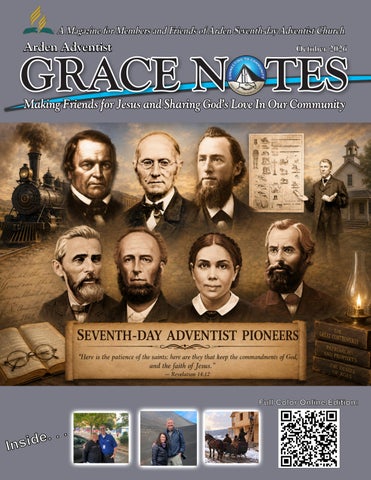
October 2026
Full Color Online Edition:
. . . e Insid
When God Comes Looking for a Discouraged Disciple ome of the most important people in Seventh-day Adventist history were not particularly imposing figures. John Norton Loughborough was certainly one of them. Only five feet four inches tall, Loughborough was small in stature, but his influence on the emerging Adventist movement was enormous. Born in 1832, Loughborough began preaching while still a teenager. After accepting the Sabbath message in 1852, he threw himself into ministry and eventually became an evangelist, missionary, administrator, author, and one of our church's earliest historians, his ministry spanning more than seventy years. Loughborough was also an innovator. In 1854, he and fellow evangelist Merritt Cornell conducted the first tent evangelistic meetings among Sabbath-keeping Adventists. While previously used by Millerite preachers, Loughborough and Cornell helped make the tent a major tool of Adventist public evangelism. Instead of waiting for an invitation into a church building, they took the message directly into a town, erected a large tent, advertised meetings, and invited the community to come and hear. It was simple, portable, and remarkably effective. But the most encouraging chapter of Loughborough's story is not one of his successes. It is the story of when he almost quit. Waukon By 1856, Loughborough was exhausted and deeply discouraged. Ministry had taken its toll. Money was scarce, the work was difficult, and the future seemed uncertain. He and his wife moved to Waukon, Iowa, where several other Adventist believers and workers had settled. Among them was another future giant of Adventist history, J. N. Andrews. Instead of preaching, Loughborough began working with his hands. Farming proved difficult, so he found carpentry work. Instead of traveling from community to community preaching the Advent message, he was now helping construct buildings in a small Iowa town. Then something remarkable happened. James and Ellen White became convinced that these discouraged workers needed encouragement. It was December. Winter weather had descended across the Midwest. The sensible
S
thing would have been to wait until spring. They didn't. Accompanied by two other believers, they set out for Waukon by horse and sleigh. Rain turned to snow. Roads became increasingly difficult. Their journey even required crossing the frozen Mississippi River. Yet they pressed forward. They believed there were discouraged servants of God who needed someone to come looking for them. When James and Ellen White's sleigh pulled alongside the surprised Loughborough, Ellen greeted him with the words: “What doest thou here, Elijah?” It was a pointed biblical reference. In 1 Kings 19, the prophet Elijah had fled into the wilderness, exhausted, discouraged, and convinced that his work had come to an end. God found him there and asked, “What doest thou here, Elijah?” The parallel was unmistakable. Loughborough, like Elijah, had reached a place where discouragement had caused him to step away from the work God had called him to do. Ellen White's question was not simply a rebuke. It was also an invitation: This is not where your story is supposed to end. That visit became a turning point. Loughborough recognized God's call to return to ministry. He left Waukon and resumed the work that would occupy the rest of his long life. What would have been lost if discouragement had written the final chapter of John Loughborough's story? He would later help pioneer the Adventist work in California, serve as a missionary in England, hold numerous leadership positions, and write important histories, preserving the stories of the early Adventist movement. But in 1856, he couldn't see any of that. He could only see Waukon. And that is where his story becomes ours. Sometimes we make permanent conclusions during temporary seasons of discouragement. We assume because something is difficult that God must be finished with us. We mistake exhaustion for calling. We interpret a closed door, a disappointing result, a painful relationship, or a season of spiritual dryness as evidence that our best days are behind us. Loughborough's story reminds us: Don't judge the rest of your story by the chapter you are living right now. Maybe there are moments when God asks us the same question: “What doest thou here?” How did you end up so discouraged? When did you begin believing that you no longer had anything to offer? When did disappointment convince you to settle somewhere God never intended you to remain? Sometimes the most spiritual thing we can do is allow God to call us out of our Waukon.
Continued on page 14…
Page 2 | www.ArdenAdventist.org
Treat God as Your Most Treasured Relationship For where your treasure is, there your heart will be also. Matthew 6:21 NKJV If we care for someone, we cherish the time we can spend together. We try to stay connected to these friends and family members, to strengthen our relationship. If we neglect our relationships, they weaken and aren’t much of a relationship at all. Name people’s friendships you cherish. ______________________________________________ Name friendships that have lessened. ________________________________________________ Our relationship with God is similar. We can’t ignore it for a long time and expect it to stay strong. True – God never leaves us nor forsakes us, but all relationships require time and effort. The more time we spend with Him and the more we rely on Him, the closer we will be to Him. How does time spent in prayer, in His word, and talking to others about God strengthen your relationship with Him? ___________________________________________________________ Why do you think you feel close to God at some times and not so close at other times? ________ ______________________________________________________________________________ Our relationship with God is our most prized possession. Being able to communicate directly with the God of the universe makes all other communication dim by comparison. Since it is so important and unique to us, we should hold it above all other relationships. We should not go a day without spending special time with our Savior, confiding in Him, asking for His guidance. Our relationship with God will determine how we live our lives and the attitude we carry with us. It will shape our character and affect every other relationship we have.
List the general topics about which you feel comfortable talking to God. _______________________________ _______________________________ _______________________________ _______________________________ _______________________________ _______________________________ _______________________________ _______________________________ Page 3 | www.ArdenAdventist.org
Remembering Where We Came From: The Heritage of Seventh-day Adventism by Dan Reynolds
very family has a story. Some family stories are filled with joyful celebrations and treasured memories; others include hardship, disappointment, sacrifice, and difficult seasons. Yet even the difficult chapters are important because they help us understand who we are and where we came from. The same is true of a church family. Seventh-day Adventists are part of a relatively young Christian denomination, but our spiritual heritage is rich with stories of people who searched the Scriptures, followed their convictions, endured disappointment, sacrificed possessions and comfort, and gave their lives to proclaim the gospel. Our pioneers were not perfect people. They made mistakes, disagreed with one another, misunderstood some things, and sometimes had to learn difficult lessons. Yet their story is ultimately a story of God's providence—a story of ordinary people seeking to follow an extraordinary God. As Adventists, we have a particular reason to remember our history. Our movement did not begin with the establishment of a denomination, a conference office, or a church building. It began with a grassroots movement of people studying the Bible and becoming convinced that the return of Jesus Christ was near. At the center of that story stands one of the most important dates in Adventist history: October 22, 1844. Understanding what happened on that date, especially what happened afterward, can help us understand not only where our church came from, but also something about the character of Christian faith itself. A Movement Born From Bible Study The roots of Adventism reach back to the early nineteenth century and particularly to the preaching and Bible study of William Miller. Miller was a Baptist farmer and lay preacher who became deeply interested in the prophecies of Daniel and Revelation. Through two years of intense study, he became convinced that the 2,300-day prophecy of Daniel 8:14 pointed toward the nearness of Christ's Second Coming. Initially, he resisted the impression that he needed to share what he had been studying, but the impression became stronger. Finally, in 1831, he made a bargain with God and within half an hour he received an invitation to preach in a neighboring town. His message was simple and urgent: Jesus
E
was coming again, and people needed to prepare themselves for His return. Miller's preaching spread rapidly throughout the United States. Thousands of people became interested in what came to be called the Advent or Millerite movement. Miller initially believed that Christ would return sometime around 1843 or 1844. As further study took place, October 22, 1844, became the date many Advent believers expected Christ to return. The anticipation was intense. People preached, studied, prayed, and prepared themselves for what they believed would be the greatest event in human history. Among those who accepted the message was a young girl named Ellen Harmon, whose family was deeply affected by the Advent awakening. Then October 22 arrived. The sun came up and then the sun went down, and Jesus did not come. The day that believers had expected to mark the end of earthly history became known as the Great Disappointment. Imagine the emotional weight of that moment. People had preached about Christ's return, had reorganized their lives, sacrificed financially, and looked forward to seeing their Savior. Now they were still on earth. Some became bitter, some abandoned their faith, and others mocked those who had expected Christ's return. Yet a small group responded differently. Instead of simply throwing away everything they had believed, they went back to the Bible. Their question was not merely, "Why didn't Jesus come?" but rather, "Where did we misunderstand the prophecy?" That decision became one of the defining characteristics of the emerging Adventist movement. October 22, 1844, and the Adventist Understanding of the Sanctuary The significance of October 22, 1844, therefore, is not that Jesus returned on that date. He did not. Rather, the date became important because of what the disappointed believers discovered as they continued to study Scripture. They eventually concluded that their prophetic calculation had been correct, but their understanding of the event was mistaken. The prophecy of Daniel 8:14 declares, "Unto two thousand and three hundred days; then shall the sanctuary be cleansed." The early Advent believers had assumed that the cleansing of the sanctuary referred to the earth being cleansed at Christ's Second Coming. Further Bible study led them to understand the sanctuary prophecy in relation to Christ's ministry in the heavenly sanctuary and to the biblical Day of Atonement. This date, October 22, 1844, marked the beginning of a new, significant phase of Christ's heavenly ministry rather than His return to earth. This became one of the foundational teachings of Seventh-day Adventism. The experience of 1844 also established a principle that continues to be important to Adventists today: when our
Page 4 | www.ArdenAdventist.org
expectations and our understanding are challenged, we must willingly return to Scripture. The pioneers did not respond to disappointment by giving up. They searched the Bible again. They prayed, compared Scripture with Scripture, and allowed their understanding to develop. That is an important lesson for every Christian. Sometimes God does not immediately remove our disappointment. Instead, He uses the experience to lead us into a deeper understanding of His Word and His work. The Great Disappointment was a painful chapter in the story of Adventism, but God used that painful experience to help shape a movement that would eventually carry the Advent message around the world. Young People in the Adventist Story Adventist history highlights the important role played by young people. At the time of the Great Disappointment, James White was 23 years old. Ellen Harmon was 16. John Nevins Andrews was 15, Uriah Smith was 13, and George Butler was only 10. These young people, together with older pioneers, such as Joseph Bates, became part of the developing movement that birthed the Seventh-day Adventist Church. This fact should encourage young people in our churches today. The pioneers did not wait until they were old before deciding that God could use them. They studied, prayed, wrote, preached, traveled, sacrificed, and served while they were young. They had much to learn, they made mistakes along the way, but they were willing to place their abilities in God's hands. Their example also reminds older generations that young people should not be viewed as just the future of the church. They are part of the church today. A healthy church gives young people opportunities to study, serve, lead, witness, and discover God's calling. A healthy church also needs the mentoring, patience, and wisdom that the older generations bring. The Adventist movement itself provides a powerful historical example of what can happen when young people take their faith seriously. Why History Matters One might reasonably ask, "Why should we spend so much time studying history? Why not simply read the Bible, believe in Jesus, and move forward?" The answer is that history gives us perspective. It helps us to understand God's leading, recognize our identity, learn from mistakes, and appreciate the sacrifices that made our present opportunities possible. First, history helps us remember God's faithfulness. At times, the pioneers experienced profound disappointment, financial difficulties, illness, disagreements, uncertainty, and opposition. They did not have an easy journey. When we encounter difficulties in our own lives or churches, remembering those who have gone before us can remind us that hardship does not mean God has abandoned us. Faithfulness is often demonstrated most clearly when
circumstances are difficult. Second, history teaches us humility. Adventist history includes mistakes. The Millerites misunderstood the event associated with October 22, 1844. Early believers held ideas that sometimes needed correction. Leaders disagreed. Some decisions proved unwise. Studying our history honestly, we discover that God has worked through imperfect people. That should give us hope. God has never required His people to be flawless before He can use them. At the same time, our history should encourage us to learn from previous mistakes rather than repeat them. A church that knows its history has the opportunity to become wiser. Third, history gives us identity. Every generation needs to understand not only what it believes but why it believes it. Adventists are not simply Christians who happen to worship on Saturday. Our heritage includes a distinctive understanding of the Sabbath, the Second Coming, the sanctuary and Christ's heavenly ministry, the three angels' messages, Christian health, education, publishing, religious liberty, and worldwide mission. Understanding how these convictions developed helps us appreciate them rather than treating them as traditions that have always existed without explanation. Fourth, history protects us from spiritual amnesia. The Bible repeatedly calls God's people to remember what He has done. Israel was told to remember the Exodus. The disciples were called to remember Christ's words and actions. Throughout Scripture, remembering is closely connected with faithfulness. When people forget God's leading, they become vulnerable to losing their sense of purpose. The same principle applies to the church. If Adventists forget why the movement began, we can easily become focused on maintaining institutions rather than fulfilling a mission. We can preserve traditions without understanding their purpose. We can know the vocabulary of Adventism without understanding the passion that gave those words meaning. Someday another generation will look back at the Adventists of our time. What will they say about us? Will they say that we preserved the buildings, repeated the stories, and protected the traditions? Or will they say that we knew our history, learned from those who went before us, trusted God in difficult times, and faithfully carried the Advent hope into the future? May we remember where we came from—not merely to admire the past, but to understand the present and prepare for the future. May the stories of those who went before us strengthen our faith, deepen our gratitude, and renew our commitment to the mission God has entrusted to His church. And above all, may the history of God's leading remind us that the God who led His people in the past is still leading His people today. Jesus is coming again. That was the hope of the pioneers, and it remains our hope today.
Page 5 | www.ArdenAdventist.org
From Darkness to Light: Robert Fisher By Gloria Allen hen was the last time you invited a child to church? Did you claim that child for Jesus? When Robert, age seven, accompanied a childhood friend to church, he made a lifelong friend with Jesus that day, as both boys were baptized in the nearby river. But as the years passed and the child became a man, the relationship faded with no further nurturing. His mother headed west to California; his dad remained in South Carolina. Flights between the two destinations and frequent moves among 13 different schools highlighted life's instability. Although math and science grabbed Robert's interest, he never learned to read. By age 16 he lunged rebelliously into every negative avenue he could find. Desiring acceptance, he succumbed to strong impulses pulling him toward wrong associates that brought him face-to-face with lifedestroying habits, drugs, alcohol, sexual exploits, gambling, and other mind-numbing corruptions. For more than 28 years, Robert, adrift and enslaved by Satan, haunted the streets of Asheville, wandering aimlessly without purpose or direction. Barely alive one night at a crack house in South Carolina, May 30, 2018, he climbed atop his miserable frame bed and desperately cried out, "Jesus! Jesus!" Rest assured, Jesus answered that prayer. Upon the recommendation of his sister, Robert contacted Faith Home, a rehab facility in Greenwood, S.C., where he found Christian acceptance and guidance for the journey that brought him freedom and new life. Amazingly, Robert applied his mind to reading the Bible provided and soon discovered that indeed he could read it. Was it a gift of the Holy Spirit? Just possibly it was. Assigned night watch duty, he regularly passed by the three crosses mounted in the chapel garden. He began to hear the voice of God speaking forgiveness to his heart. New songs of joy inhabited his praise as he memorized scripture. Soon he was asked to transfer to another facility. Perplexed at being kicked out, he then realized he was being tasked with greater responsibility, joining the fundraising arm of the ministry where he handled the disposition of deceased individuals' possessions.
W
Growing in grace, meditating on the attributes of God, learning to call God "Father," interfacing with the Holy Spirit, brought him to tears, to a spiritual intimacy that came to feel much like parental bonding as he realized that his previous life had been deeply centered around demons. Completing two semesters at Fruitland Baptist College brought growth, but eventually Satan used medical issues to bring Robert to homelessness again. Landing at the Hendersonville Rescue Mission with anxiety, panic and depression eventually led Robert to hospitalization and the help that brought him back from the brink of death. It was while learning to walk again that Robert met Pen. "Do you remember me? You gave me warm soup. I surely appreciated your kindness!" Such was the introduction Pen Braister-Sturgis, Arden Church Homeless Ministry Coordinator, recalls when Robert, a uniformed city bus driver, introduced himself to her. She braced herself for a complaint, but instead he related how he'd stepped out of the darkness of homelessness and addiction into God's grace of light and truth. After 14 years of distributing lunches to Asheville's homeless population, Pen relished the joy of meeting a former homeless citizen, especially one who eagerly accepted her invitation to attend the Arden church. Robert now relishes the beauty of holiness, feeling again the innocence of forgiveness. Whereas he used to be harassed by witchcraft and the presence of evil, God is moving in his life, stirring up joy, inspiring impulses toward kindness. He brags on Jesus, admonishing others to "Be still and know that I am God," claiming Jesus as the one who fights life's battles for us when we allow Him to, while Satan only wants to bait us into arguments and death scenarios. God's blessing enables Robert to live in Candler, N.C., on a gorgeous mountainside that resembles the Austrian Alps from “The Sound of Music” fame. Daily he drives and sets up the mobile clinic for the Blood Connection of Asheville while seeking the larger purpose for which God has saved both his body and mind. Welcome Robert to church. He's not a stranger in our midst. Rather God has brought him into fellowship with our church family for a very special blessing. "Do you not know that the unrighteous will not inherit the kingdom of God? Do not be deceived. Neither fornicators, nor idolators, not adulterers, nor homosexuals, nor sodomites, not thieves, nor covetous, nor drunkards, not revilers, not extortioners will inherit the kingdom of God. And such were some of you. "But you were washed, but you were sanctified, but you were justified in the name of the Lord Jesus and by the Spirit of our God." 1 Corinthians 6:9-11.
Page 6 | www.ArdenAdventist.org
finished, “And I don’t know what it means.” General laughter skittered across the group. “It means just what it says,” Rosa said with a Hispanictinged accent, “a revelation, a revealing.” “Great beginning.” Mark was also laughing. “This class is participatory. Jump in, if you have something to contribute. I’ll worry about avoiding class chaos.” Mark scooted back on his stool. “Second question: What is the book of Revelation about? Look at chapter one and verse one.” The room went quiet until Hub (Hubert) hesitantly spoke up, “It says it’s the revelation of Jesus Christ.” An Academy Story Mark pointed at the reluctant respondent. “Spot on, Hub. And we want to keep this always in the center of our focus. ark Nelson walked across the campus of Grayson Jesus – front and center – always. Adventist Academy toward the academic building. In “You are doing quite well . . . so, let’s try something a bit his valise were the notes for his classes on this first day of the more difficult. Work together in groups of two. Hub and new school year. In his heart were the names and faces of Rosa, take verse 3. Through how many activities will the students who would be his responsibility for the next nine person receiving Jesus’ message get a blessing? Carl and months. Ned, look at verses 4 and 5, grace and peace come from At 9:15 am Mark stood in front of his Senior Bible Honors how many heavenly beings? Gil (Gilbert) and Greg, in Class. “Good morning. My name is Mark Nelson.” He verse 4, how many phrases are there that describe the relaxed and sat on the high stool he frequently used when Father God? Gretchen and Penny, in verse 5, how many teaching. “Most of you know me from last year’s Junior phrases describe Jesus Christ? You have ten minutes to Bible Class . . . and some quite come up with the answer.” The well from the basketball court.” small groups began to hum with Two guys shared a quiet chuckle, quiet conversations. to which Mark nodded and smiled. Twelve minutes later, with Bible “All of you requested to take this in hand, Mark spoke, “Hub, class and I personally approved Rosa, how many activities to get your request based on your a blessing?” Rosa said, “Three.” previous Bible class grades.” “Carl and Ned, my basketball Mark nodded in the direction of buddies, How many heavenly fraternal twins, Greg and Gretchen beings?” Ned placed a restraining Hemphill. “I also reviewed the hand on Carl’s arm, then spoke. transcripts of our two new students “Three.” A nod of appreciation – Greg and Gretchen. Yes, they are passed from Mark to Ned. twins. Born at the same time, but Mark turned to Gil and Greg. not the same gender.” Greg looked “How many phrases describe the around and waved to everyone. Father?” Gil looked at Greg, Gretchen only smiled. “So . . . all eight of you are here to received a nod, and said, “Three.” try something new . . . an honors class that will require you Mark considered Gretchen and Penny for a moment. to do your own individual study to help us all understand “How many descriptions of Jesus?” As he surmised, Penny our topic.” spoke with a glance at Gretchen. “Three.” Mark stood, picked up the outline for the class study, and Mark said, “Good committee work.” Then he read aloud, began placing course outline papers on each desk. “You “Verses 5 and 6: To Him who loves us, and released us will get out of this class what you put into it. The topic: from our sins by His blood, and He has made us to be a ‘How to Prepare for the Last Days’ came from a question kingdom, priests to His God and Father. Three phrases.” He by a Sophomore student last year.” Mark returned to his closed his Bible. “And how many words are emphasized in stool and faced the class. “The answer is quite simple, but the last verse of 1 Corinthians 13?” the simple answer would only raise more questions. So, Ned spoke reverently, “Faith, hope, and love. Three.” we’ll search for a more complete answer. “How many functional sections are there in the “Let’s begin – as your outline suggests – by looking at Wilderness Sanctuary?” Greg looked at Gretchen, then the Bible book describing last day events: the book of spoke confidently. “The courtyard, the 1st Apartment, and Revelation.” Eight students quickly found their Bibles and the 2nd Apartment. Three sections.” turned to Revelation 1. “Note the title. What’s the Greek Mark observed the twin’s interaction, then said, “Why? title of the book and what does the word mean?” Why always three?” Carl’s hand shot up as he blurted out, “Apocalypse!” Then The room went silent.
Preparation for the Last Days
M
Page 7 | www.ArdenAdventist.org
, MD, MPH
Breakfast and the School Brain
By Dr. Neil Nedley, MD
note from a teacher reads: He is bright, and he does well early in the day, but by mid-morning he drifts. He stops raising his hand. He asks me to repeat the instructions. If you are the parent reading that note, your mind goes to the usual suspects. Screens. Sleep. Attention problems. What almost never comes up is the simplest question available: what did he eat at seven o'clock that morning? According to a USDA analysis of national dietary survey data, about 83% of American children and adolescents eat breakfast on a given day. But that figure hides a steady slide: roughly 96% of children ages 2 to 5 eat breakfast, about 84% of children ages 6 to 11, and only about 72% of adolescents ages 12 to 19.1 More than one in four American teenagers is not eating breakfast, and the drop-off arrives at exactly the moment school gets harder, mornings get earlier, and the day starts demanding sustained concentration. A systematic review published in Advances in Nutrition examined 45 studies on breakfast and cognition in children and adolescents. On school performance, this review and an earlier one in Frontiers in Human Neuroscience found consistent evidence that habitual breakfast consumption and school breakfast programs are associated with better academic performance, with the clearest signal in mathematics and arithmetic grades.2,3 A review from the Department of Pediatrics at the University of California, Davis, summarized the wider literature this way: eating breakfast is important to learning, memory, and physical well-being in both children and adults. The benefits catalogued there included more efficient problem solving, improved attention span, greater verbal fluency, better scholastic scores, improved memory, better attitude, reduced stress, better mood, and improved creativity.4 In a study published in Appetite, schoolchildren were tested on computerized measures of attention and memory before breakfast and then at intervals across the morning, under four conditions: two whole-grain cereal breakfasts, a glucose drink, and no breakfast at all. Attention and memory declined across the morning in the glucose drink condition and the no breakfast condition. Those declines were significantly reduced by the cereal breakfasts rich in complex carbohydrates.5
A
The sugar-only breakfast did no better than eating nothing at all. A child who drinks something sweetened on the way to school has technically eaten breakfast, and arrives at their desk with roughly the same disadvantage as the child who ate nothing. A fast-releasing, sugar-heavy breakfast produces a steep rise in blood glucose followed by a steep fall. A slower-releasing breakfast built on whole grains, legumes, nuts, seeds, and whole fruit delivers the same fuel on a gentler slope. It’s not the number of calories, but how rapidly they are released that determines how a child thinks at ten in the morning. What a brain-supporting breakfast actually looks like is simple, and cheaper than the cereal aisle would suggest. Build on a whole grain. Old-fashioned oats, whole grain toast, or cooked whole grains. Steel-cut and rolled oats release their fuel slowly. Instant flavored packets are largely sugar. Add protein and healthy fat. Nuts, nut butter, seeds, or legumes. This is what flattens the curve and carries a child to lunch. Use whole fruit, not juice. Berries, a banana, or an apple. The fiber in whole fruit is exactly what juice has had removed. What is actually in the "healthy" options? Many breakfast cereals, flavored yogurts, granola bars, and smoothie drinks marketed to children carry a dessert's worth of sugar. Make breakfast a real meal. There is long-standing wisdom in eating substantially in the morning and lightly at night, and it aligns with how the body handles fuel across the day. Can’t make breakfast? Move bedtime earlier. A rushed morning is the most common reason breakfast gets dropped. Prepare it the night before, so the decision is already made when nobody has the energy to make it. Start with something small and portable rather than insisting on a full plate. And eat with them when you can. Children copy what they see far more reliably than they follow what they are told. Nothing in a capsule substitutes for a real breakfast, adequate sleep, and protected attention. If you do one thing this fall, do the breakfast. 1. Hoy MK, Sebastian RS, Murayi T, Goldman JD, Moshfegh AJ. Breakfast Consumption by U.S. Children and Adolescents: What We Eat in America, NHANES 2017-March 2020. Food Surveys Research Group Dietary Data Brief No. 58. USDA Agricultural Research Service; April 2024. 2. Adolphus K, Lawton CL, Champ CJM, Dye L. The effects of breakfast and breakfast composition on cognition in children and adolescents: a systematic review. Advances in Nutrition. 2016;7(3):590S612S. 3. Adolphus K, Lawton CL, Dye L. The effects of breakfast on behavior and academic performance in children and adolescents. Frontiers in Human Neuroscience. 2013;7:425. 4. Mathews R. Importance of breakfast to cognitive performance and health. Perspectives in Applied Nutrition. 1996;3(3):204-212. 5. Wesnes KA, Pincock C, Richardson D, Helm G, Hails S. Breakfast reduces declines in attention and memory over the morning in schoolchildren. Appetite. 2003;41(3):329-331.
Page 8 | www.ArdenAdventist.org
Southwestern Salad By Evelisse Capo, PharmD, DipACLM
This fresh salad has it all: black beans, corn, peppers, lime, garlic, red onion, and cilantro. And it’s dairy-free and gluten-free! Delicious for all.
Prep: 15 mins Total: 15 mins Yield: 10 servings Gluten Free Low Sugar Nut Free Soy Free
Ingredients
2 – 15 oz cans of black beans • ¼ cup rice vinegar • ½ cup finely chopped red onion • Juice of 1 lime or lemon • 1 red or yellow bell pepper, diced • 2 garlic cloves, minced • 2 tomatoes, diced • 2 tsp cumin • 2 cups frozen corn, thawed • 1 tsp coriander • ¾¾ C chopped fresh cilantro (optional) • ½ tsp crushed red pepper flakes, or a pinch of cayenne •
Instructions • • • •
1. Drain and rinse the beans and place them in a large salad bowl. 2. Add the onion, peppers, tomatoes, corn, and cilantro. 3. In a small bowl combine rice vinegar, garlic, lemon or lime juice, and seasonings and pour over salad. 4. Toss gently to mix.
This recipe is from the following source: https://nutrritionalstudies.org/recipes/salad/southwestern-salad/ Page 9 | www.ArdenAdventist.org
A Fletcher Academy Fieldtrip very autumn, I get the opportunity to take a class of high school students from Fletcher Academy on a week-long 2,000-mile trip focused on history, literature, and religion. We typically pass through 11-13 states, from North Carolina to New Hampshire and upstate New York. For Bible class, we’ve visited the Museum of the Bible, a Holocaust memorial, the home of Joseph Bates, and historic churches associated with religious history and the freedom of religion. Literature has taken us hiking by Walden Pond, visiting a church graveyard on Broadway in New York City, climbing stairs in the Old Manse where the Emersons looked through the windows upon the very first conflict of the American Revolution, and analyzing Abraham Lincoln’s most famous speech right in Gettysburg where he first gave it. American history includes all of these plus visiting the Freedom Trail in Boston, the 9/11 Memorial, Plymouth Plantation, Fort McHenry (birthplace of the Star Spangled Banner), Independence Hall, and the Smithsonian Museums. That and more happens over the course of just a few days. I love the excitement on the students’ faces and their talking about the places they enjoy most. Some love the interactive Old Testament experience at the Bible Museum; others think the battlefields are cool. Some will say the best part is hanging with friends; others like exploring new cities and states that they’ve never seen before. Personally, I’m thankful for colleagues who make the trip enjoyable, from our collaborative planning to the time spent together on the road. On the bus we get to know each other more and hear stories from our varied experiences. On certain nights, in certain years we the staff have stayed awake beyond our own “lights out,” to continue a discussion about the Bible, about making our faith real, or about our work and our families. Certainly, some surprises occur on a trip this long. What will it be this time? A gigantic traffic delay around New York City? A student who’s late to a meeting spot as staff anxiously worry if that person is lost? A road mishap that changes travel plans? An injured individual who must be taken to the hospital? Two friends who have a sudden falling out? It’s always interesting to see how long we can remain calm, drawing upon emotional resources in a tough moment, reaching for kindness instead of complaints, gaining grace from Jesus to carry us through. Several years ago we got stranded for hours with an unexpected stop. I was really proud of the students who, instead of complaining, played games, sang songs, and
E
made fun in a difficult situation. Interestingly, now alumni, they still remember it as one of their favorite memories of that trip! One of my favorite stops (partially because of the amazing lunch they feed us!) is the first Sabbath-keeping Advent church in Washington, New Hampshire. We typically have Sabbath School and a worship service here, then drive on to the William Miller Farm and Ascension Rock between Whitehall, New York, and Fairhaven, Vermont. It’s amazing to think back on the stories of these Adventist pioneers who were so human, yet so fervent about their faith, going through periods of doubt or disappointment, just as we do, loving Jesus and wanting to be like Him and with Him. I’m thankful for Rachel Oakes, a Baptist, who “kept after” Pastor Frederick Wheeler in the Washington Church (then a part of the Christian Connexion). She introduced the concept of the Seventh-day Sabbath to the Advent believers. And Charles Fitch, who, only months after losing two sons to death, made multiple trips in one day to a cold Lake Erie to baptize new believers, became sick, and passed away himself only eight days before what his family hoped would be the date of Jesus’ coming. Or William Miller himself, who came to see that like the faithful steward in Jesus’ parable, he did not need to set a date for the Master’s return, but resolved simply to be ready and joyful to meet Him “today,” and every day. And the Adventist pioneers who opposed slavery, gave sacrificially, risked their lives and health to help others, and encouraged people to treat their bodies with the best temperance and health care available to them at the time. Our class usually stands in the cemetery outside the Washington Church building or sits on Ascension Rock to contemplate these examples. Here, we eat bread and drink juice, just as countless Christians have done for hundreds of years, remembering the Lord’s death and celebrating His grace until His return. It is a solemn and joyful moment. Finally, we return home. Our bodies are tired, but our minds are abuzz with memories made, knowledge gained, and faith renewed. Then I’ll begin planning for the next year, with yet another class, and so the cycle goes on . . . CHRIS SMALL is a history and Bible teacher at Fletcher Academy, and co-host of the “inBible Community” Podcast and Study, which you can find on Spotify, Apple, or your favorite podcast source.
Page 10 | www.ArdenAdventist.org
THE GRIP OF GRACE Aug 6, 2026 If grace was as fragile as many believe it to be, we could never be truly confident that our lives have been fully redeemed and deeply restored. We would always be unsure of what God wants us to be most certain of: “For as the heavens are high above the earth, so great is His steadfast love toward those who fear Him; as far as the east is from the west, so far He removes our transgressions from us” (Psa 103:11-12). Our fears and doubts about the durability of grace don’t begin to change the ways God loves us. Our anxieties that the great Lover of our souls will be as fickle and unsteady as we are merely deprive us more time in His grip, more joy in His presence, and more certainty in His promise: “God did not send the Son into the world to condemn the world, but in order that the world might be saved through Him” (John 3:17). Trust the arms that grip us at our worst, and the Love that will not let us go. And stay in grace. -Bill Knott
Page 11 | www.ArdenAdventist.org
BIBLE ALPHABET STEW Insert a different letter of the alphabet into each of the 26 empty boxes to form words of five or more letters reading across. The letter you insert may be at the beginning, the end, or in the middle of the word. Each letter of the alphabet will be used only once. Cross off each letter in the list as you use it. Not all the letters in each row are used to form the word. All words are in Revelation 2 & 3 (NASB). Clue: the City. Use the Bible text only after going through the entire list. Example: In the first row across we have inserted the letter X to form the word EXCEPT.
ABCDEFGHIJKLMNOPQRSTUVWXYZ R E P I N E X C E P T U S P S Y N A G G U E S T S (Philadelphia) Rev.3:9 R C O V E R O M E S T Y (Philadelphia) Rev 3:12 M A Z U R E E N T E R S (Ephesus) Rev. 2:5 W E S T R A E Z E B E L (Thyatira) Rev. 2:20 CO N VE S E L S M I R (Thyatira) Rev. 2:27 A S T RE N T H E N U S (Sardis) Rev. 3:2 B E W E A R U T M O S T (Ephesus) Rev. 2:3 ) A B EG I N I N G O T S (Laodiceans) Rev. 3:14 P E RDE A H E B R E W (Smyrna) Rev. 2:10 B S C E N E T H E R A X (Laodicea) Rev. 3:16 A S S T U M L I N G O T (Pergamum) Rev. 2:14 H I M B R O E N C O R E (Thyatira) Rev. 2:27 P T O L E R T E N C E S (Thyatira) Rev. 2:20 C O R B A N E A L O U S (Laodicea) Rev. 3:19 F A B C E N U R E D G E (Ephesus) Rev. 2:3 S P E R S E E R A N C E (Philadelphia) Rev. 3:10 P OM I S E A B L E S T (Laodicea) Rev. 3:17 P H L E M B O C K E R S (Pergamum) Rev. 2:14 C O N J E R S A L E M E (Philadelphia) Rev. 3:12 A B S C O N E S S E N C (Sardis) Rev. 3:5 M A E S T R U I C K L Y (Pergamum) Rev. 2:16 B L E E T S O R D E R S (Pergamum) Rev. 2:12 E N F A I T F U L C U M (Smyrna) Rev. 2:10 P S Y R E M M B E R U S (Ephesus) Rev. 2:5 V I N G A R E N T S E S (Sardis) Rev. 3:4
Page 12 | www.ArdenAdventist.org
13 Years and Counting
by Pen Braister-Sturgis
hen things aren’t right, we bring our broken W pieces to the Sanctuary. The worries and prayers for family – human members or furry members – we bring to the Sanctuary for solutions, for comfort, for reassurance. Such is the case for this family. Our family has a cat and a dog. And if there is one thing we all agree on, we love our dog, Molly. So, you can imagine how sad I was in December when Molly got really sick. Coming home from work one Wednesday, I was surprised when Molly didn’t come to the door to greet me, as she usually did. She loves it when we have visitors, so much so that a friend calls her “The Welcome Committee.” “Where’s Molly?” I asked Jerry when I walked through the house and couldn’t see her anywhere. “I’m not sure,” he said. “She’s not feeling all that great. She’s somewhere in the house.” After looking throughout the house, I finally found Molly in our living room, hiding in the corner. She looked like she was in a lot of pain and shaking terribly. When I tried to pick her up, she yelped, scaring me to death. Whatever pain she had was in her tummy area. All evening, we tried giving her food and water, but she refused to eat or drink. Even the word ‘treat’ didn’t excite her like it normally did. We had a special prayer that evening for Molly, asking Jesus to heal her tummy and make her well again. My older sister called that evening, right before going to her church for prayer meeting. Knowing what a prayer warrior (someone who likes praying for everyone) she was, I asked her to pray at the Romanian church for Molly to get better. “I can’t do that,” she said. “We don’t pray for dogs at church.” “Well don’t tell them she’s a dog, tell them she’s part of my family,” I told her. “Molly’s really sick. She won’t
eat anything, she’s hiding from us, and she yelped when we tried to pick her up.” “How old is Molly?” she asked me. “She just turned 13 years old,” I answered. “Well, that’s the problem right there,” she exclaimed. “She’s old. That’s 91 people years old. She’s dying!” “She can’t be dying,” I told her. “I’m not ready for my sweet dog to die! I want her to live to be 18 years old, like the dog we had when I was growing up.” “From everything you’re telling me, I think she’s dying,” my sister said. “Have you taken her to the vet?” I said we were taking Molly to the vet the next morning and begged her again to pray at the prayer meeting for her. When she hesitated to agree, I finally told her, “If you don’t pray for my dog and she dies, I’m going to . . .” Can you believe it? Having to beg someone to pray for your dog. “What is this world coming to?” I thought to myself. We stayed up most of the night with Molly. She barely moved from her spot in the corner. We prayed for her again to have Jesus heal her. Next morning, it was obvious her condition was getting worse. Every time we came near her, she ran away from us, as though we were her enemies and she wished we would go away. She yelped when we put her in the pet carrier to take her to the vet. On arriving there, the kind vet looked very worried when she tried to examine Molly’s tummy. She yelped for the vet, too. The fees for the visit, x-rays, and meds were going to cost close to $700, and we told the vet we couldn’t afford that. The vet told us that with Molly’s advanced age (advanced is another word for old) she could have a number of things wrong with her and advised us to try to give her the pain medications that she prescribed for Molly. She told us that really sick dogs act just like Molly was acting, and some of these signs were possible signs she might die. So, she sent us home with pain meds and told us to call her back if Molly got worse. She hoped she would make it through the weekend. She gave us her personal cell number and asked us to call if anything happened to Molly. Driving home, I was crying, completely heartbroken. We couldn’t afford the expensive tests or whatever treatment Molly needed, and the vet looked like she didn’t expect Molly to survive the weekend. The best we could hope for was to give her the pain meds and make sure she was comfortable. (To be continued next month.)
Page 13 | www.ArdenAdventist.org
Nov. 15 -- Bags of Love Craft Sale -Upcoming Church Activities: Oct. 14-17 -- Southern Union Pathfinder Camporee at Camp Kulaqua in FL -Our Pathfinder Club will be attending. Look for a report in the November GN.
Nov. 1-6 -- Reaping Meeting -"What the Bible Really Says" Pastor Rich Maskelony
————————————————————— Continued from page 2…
————————————————————— Continued from page 15… Dennis enjoys traveling to many parts of the world to photograph nature and wildlife. His latest trips have been to Iceland, Alaska, and Kenya. He really enjoys music, playing the trumpet and singing. After relocating to this area, Tami and Dennis visited several SDA churches. At Arden, they immediately sensed that this church felt like home. They have met many new friends, especially in DeWayne Butcher’s Sabbath School class, and appreciate the fellowship and wonderful worship services. Dennis has served in other churches as an elder, Sabbath School teacher, and musician. They both look forward to being an active part of the church body here at Arden. We are so happy to welcome Dennis and Tami Starkey to the Arden Church family!
There is another lesson in this story. Sometimes God sends encouragement through people. James and Ellen White could have written Loughborough a letter. Instead, they crossed a winter landscape to find him. There may be someone in your life who is living in their own Waukon right now—discouraged, withdrawing, wondering whether they still matter. A telephone call, a visit, a meal together, a handwritten note, or simply the words, “I've been thinking about you,” may accomplish far more than you realize. Galatians 6:2 tells us, “Bear one another's burdens, and so fulfill the law of Christ.” Sometimes, representing “the church” means going through the snowstorm – to do whatever. And if you are the discouraged one, remember John Loughborough. A five-foot-four preacher who once thought his ministry was essentially over. God knew better. Your Waukon may not be the end of your story either.
Page 14 | www.ArdenAdventist.org
Arden Seventh-day Adventist Church Is a Safe Place to Grow. Our Purpose is, by God’s Grace, to reflect His character in our community, to demonstrate a quality of life that will attract all to be reconciled to Jesus Christ, and to encourage people to become His loving, maturing disciples.
Our family focus this month features Dennis and Tami Starkey, who joined the Arden Seventh-day Adventist Church in August. Dennis was born in Kansas City, Missouri to an SDA (Seventh-day Adventist) family. When he was two years old, he and his family relocated to Phoenix, Arizona where he was baptized in 1969 in the Glendale SDA Church. He has two younger brothers and one younger sister. Dennis attended Thunderbird Adventist Academy in Scottsdale, Arizona and received his B.A. degree from Southern Adventist University in 1979 in Broadcast Communications, doing news broadcasts on several local stations. He graduated from Loma Linda University School of Dentistry in 1983. After three years of private practice, Dennis joined the US Air Force for four years, working as a dentist at Kirtland Air Force Base in Albuquerque, New Mexico. In 1992, he completed his endodontic residency at the Medical College of Georgia in Augusta. Dennis joined a friend’s dental practice in the metro Atlanta area, where he worked as an endodontist until his retirement in 2020. Tami was born in Newark, Ohio. She and her family moved every four years due to her father’s job changes. She has one older brother and one younger sister. Tami’s family was Italian/Catholic. When she was a little girl, the son of a neighbor asked if he could watch a television program on Wednesday evenings. His family did not have a television. The family’s father was a Seventh-day Adventist pastor. The mother befriended Tami and her mother. She and her mom began attending the SDA church on Saturday and Catholic Mass on Sunday. After moving again in 1972, Tami, aged fourteen, and her mom were baptized at the Cascade SDA Church in Atlanta, Georgia. Tami attended public schools through high school, receiving her Nursing Degree in 1979 from Southern Adventist University. Tami had three aunts in her family who were also nurses. Tami worked as a nurse for twelve years, first at the Loma Linda University Hospital in Oncology and Psychology, then as charge nurse in the medical-surgery unit at Phoenix General Hospital in Albuquerque, then in outpatient surgery at the Medical College of Georgia. Tami and Dennis met at Southern Adventist University through Dennis’ friend who was Tami’s roommate. On Dennis’ birthday, the roommate asked Tami to help make cookies for him. They appeared in his dormitory mailbox and the romance began. They were engaged after three months and married six months later remaining so for 47 years! They have two children – Melissa and Brian – and three grandchildren – Fitzilliam, five, Frances, three, and Margot, ten months. They have lived in Phoenix, Arizona; Loma Linda, California; Albuquerque, New Mexico; Augusta, Calhoun, and Marietta, Georgia; and, most recently, Dayton, Ohio for four years to be near their daughter and family. Their son lives in Irvine, California. Their son-in-law began working at Advent Health Hendersonville in the fall of 2025, inviting Dennis and Tami to join them in December. Tami’s hobbies are all about family, being near her family and helping with the grandchildren. Dennis also loves family time. They also enjoy traveling annually with a group to many different countries in Europe, planning a fall trip to southwestern England and Wales. They also love vacationing in the Colorado mountains and on the beaches of Cancun, Mexico. ___________________________________________________________________ Continued on page 14… Page 15 | www.ArdenAdventist.org
Grace Notes Editorial Staff: Max Hammonds ..................................Editor Chris Small ...................................Columnist Jean Davey....................................Columnist Gloria Allen .................................... Reporter Pen Braister-Sturgis ........................ Reporter Sara McCord................................... Reporter Dan Reynolds ................................. Reporter Arizona McCord ..... Reporter & Proofreader Chris Small ....................... Special Graphics Jim & Carolyn Sullenberger.....Proofreaders Nolan Darnell ............ Mailing Management Shirley Wallstrom ........Circulation Manager Whitney Barron .....................Layout Design Comments, suggestions and praises are always welcome. Please email or contact the church office. Services each Saturday morning: Sabbath School Bible Study, 9:30 a.m. Worship Service, 10:45 a.m. Location: 35 Airport Road, Arden, NC 28704 Located on Highway 280, (Airport Road), 1.5 miles east of I-26 exit 40, and a quarter mile west of Highway 25. Church Office: Office Manager: Sharlene Bliven Office Secretary: Summer Cronin Telephone: (828) 684-6700 Email: office@ardenadventist.org Website: www.ardenadventist.com Office Hours: Mon. - Thurs., 9 a.m. to 2 p.m. Arden Adventist Pastoral Staff: Senior Pastor: Eric Bates, D. Min. Email: ebates@carolinasda.org Associate/Youth Pastor: Rich Maskelony, M .Div.
Email: rmaskelony@carolinasda.org Grace Notes is published monthly by the Arden Seventh-day Adventist Church. Subscription is free by calling or emailing the office. †Do you have questions about what Adventists believe? Would you like to become a member of the Seventh-day Adventist Church? Would you like to study the Bible? You are invited to attend a Pastor’s Bible Study Class. Please call for location and time. All are always welcome. † Disclaimer—The contents of Grace Notes, such as text, graphics, images, and other material contained in this magazine of the Arden Seventh-day Adventist Church are for informational purposes only. It is not intended to be a substitute for professional medical advice, diagnosis or treatment. Always seek the advice of a qualified healthcare provider, who is knowledgeable and experienced in the use of specific medical or Lifestyle Medicine interventions, or about questions you may have regarding a medical condition. Never disregard professional medical advice, or delay in seeking it, because of information published in this magazine. Neither Grace Notes nor the Arden Seventh-day Adventist Church recommend or endorse any specific tests, products, procedures, opinions, or other information that may be mentioned in published articles. Reliance on any information provided is solely at your own risk. If you have a medical emergency, call your healthcare provider or 911 immediately.
Arden Adventist
GRACE N TES A Magazine for Sharing God’s Love In Our Community
Arden Seventh-day Adventist Church 35 Airport Road Arden, North Carolina 28704 (828) 684-6700 If you no longer wish to receive Grace Notes, or if your address has changed, please contact us.
NONPROFIT ORG U.S. Postage PAID Permit No. 80 Arden, NC 28704