








As our nation approaches its 250th anniversary, this July carries a deeper sense of reflection.
Two hundred and fifty years ago, a group of imperfect but courageous men signed a declaration that would alter the course of history. They announced to the world that liberty was not merely a privilege granted by kings or governments, but a gift rooted in the Creator Himself. The idea was revolutionary then—and in many ways, it still is today.
This milestone invites us not merely to celebrateAmerica, but to thoughtfully reflect upon the providence of God in the life of our nation. Scripture repeatedly reminds us that God is actively involved in the affairs of nations. Daniel declared that God “removes kings and raises up kings.” Paul preached that God Himself determines “the appointed times and the boundaries” of nations. History is never merely political. Behind the visible movements of people and governments, the hand of Providence is quietly at work.
When we look honestly atAmerica’s story, it is difficult not to recognize moments where God provided extraordinary opportunities for the advancement of liberty and faith. Long beforeAmerica became known for economic strength or military influence, it became known as a refuge.
Across Europe, many believers lived under systems where church and state were dangerously intertwined. Conscience was controlled. Worship was regulated. Dissent could be punished. Men and women longed for a place where they could seek God freely according to conviction rather than coercion.
history includes injustice, prejudice, slavery, violence, greed, and deep moral failures.At times we have defended liberty nobly; at other times we have denied it to others. Honest patriotism does not ignore these realities.
But neither should failure cause us to abandon the ideal itself.Adream does not lose its worth simply because imperfect people across party lines struggle to live up to it.
The dream that people should be free…
Free to worship…
Free to speak…
Free to live according to conscience…
Free to pursue truth without fear…
—that dream remains worthy of pursuit.
As followers of Christ, we should care deeply about both truth and liberty because genuine faith cannot be forced. God Himself does not compel worship through coercion. He invites. He calls. He convicts hearts through love and truth.
This is one reasonAmerica’s role in history matters so much. Religious liberty created fertile ground for the spread of the Gospel. Churches were planted. Mission movements expanded. Scripture was preached openly. Great awakenings swept across the land. Ministries—including our own movement—were able to flourish because freedom allowed the Word of God to move with fewer restraints.
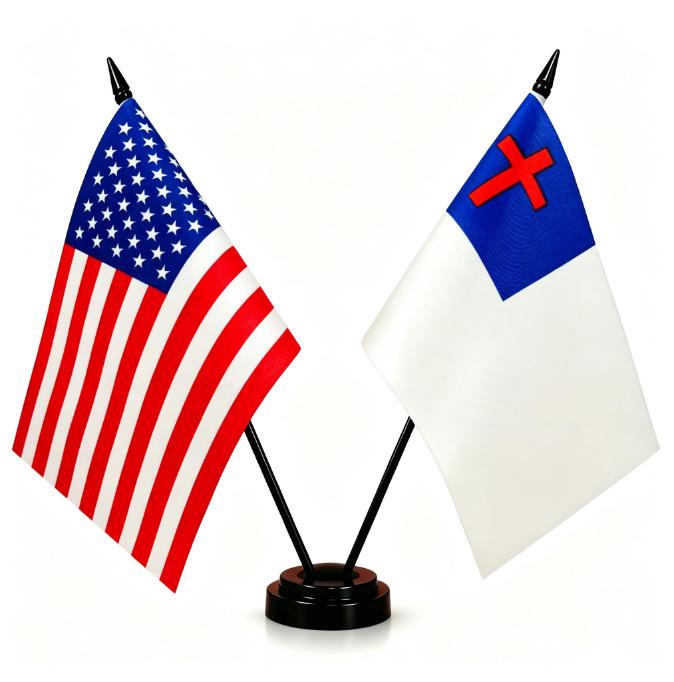
As we approachAmerica’s 250th birthday, gratitude is appropriate. So is humility.
Freedom is never permanently guaranteed. Every generation must decide what kind of nation it will become. Liberty survives only where character, truth, responsibility, and virtue are valued.Afree society cannot endure indefinitely if it loses its moral foundation.
That is why spiritual renewal matters more than political slogans. Laws can influence behavior temporarily, but only God can transform hearts. Revival has always strengthened nations more deeply than outrage ever could.
In His providence, God opened a door. This land became a place where religious liberty could take root in ways the world had rarely seen before. Imperfectly? Certainly. Incompletely? Without question.Yet something remarkable still emerged—a nation built upon the conviction that human rights come not from government, but from God.
The Founding Fathers did not agree on every matter of theology or politics. They were flawed individuals living in a fallen world, just as we are.And yet many shared the profound belief that freedom required morality, virtue, and accountability before God.
As Christians, we can acknowledge both the greatness and the brokenness of our national story.America has never fully achieved the ideals expressed in its founding documents. Our
Perhaps the greatest way Christians can love their country is not simply through celebration, but through faithful living. When believers embody integrity, compassion, humility, courage, forgiveness, and truthfulness, they become salt and light within the nation where God has placed them.
So this July, as fireworks light the skies and flags wave across our communities, let us remember more than history alone. Let us thank God for His providence. Let us pray for our nation with honesty and hope. Let us pursue the ideals of liberty and justice with humility.And let us remember that while we are grateful citizens of this nation, our highest allegiance belongs to another Kingdom.
Hebrews tells us thatAbraham was “looking forward to the city that has foundations, whose architect and builder is God.” That city remains our ultimate hope. Until then, may we live faithfully, prayerfully, gratefully, and courageously in the land where God has placed us asAmerica approaches this historic 250th anniversary.

By Michael W. Campbell (edited for length)
The influx of immigrants in the late nineteenth century sparked attempts to promote Sunday observance across America. Earlier regional laws existed, including banning transportation of mail on Sunday (1829) and travel (1840s). AftertheCivilWar,theseeffortswereonceagainrevivedwith greatervigortoenforcegreaterconformityamongimmigrants groups.
In 1863, such efforts toward legislation took tangible form when a group met to establish the National Reform Association (NRA). This group petitioned the government to formalize America’s status as a Christian nation. They further sought to enshrine such language into a Constitutional amendment. They believed that the Civil War was God’s punishment for the lack of references to Him in the Constitution, and even more explicitly, Christian elements in national law.
The NRA’s most potent tactic, state “blue laws,” pushed Sunday sacredness and hearkened back to Puritan ideals. These statute books included extremely strict Sunday legislation that outlawed business transactions, labor, and even some forms of recreation (such states as Arkansas and Tennessee even threatened to punish parents of children caught playing on Sunday.)
included extensive fines designed to ruin family members financially, along with imprisonment and chain gang labor. It was reported: “In both Henry and Rhea counties, Tennessee, the chain-gang had fallen into disuse because it was found to be unprofitable, and it was revived specifically for the punishment of Seventh-dayAdventists.”
Early Adventist leader, J. H. Waggoner, along with William C. White (Ellen White’s son) were arrested in 1882 while operatingthePacificPressforbreakingSundaylaws.In1909, Ellen White warned her son from making any rash or precipitous moves. “Satan is doing his best to block the way of the progress of the message. He is putting forth efforts to bring about the enactment of a Sunday law, which will result in slavery in the Southern field and will close the door to the observance of the true Sabbath.”
Such persecution strengthened legislative efforts toward a national Sunday law. The National Reform Association, the American Sabbath Union, and the Women’s Christian Temperance Union were among the populists efforts for national legislation. In 1888 U. S. Senator Henry W. Blair introduced a proposed “National Sunday Law” (Senate Bill 2983) “to secure to the people the enjoyment of the first day of the week, commonly known as the Lord’s Day, as a day of rest.”

Seventh-day Adventists strongly disagreed with this approach to the public role of religion and kingdom theology. They also quickly discovered that, with their commitment to the seventh-day Sabbath, they could not avoid persecution. Ellen White, a church co-founder, had warned that persecution of God’s faithful Sabbathkeepers would usher in the last events of world history. Her husband, James White, had warned that “The ‘remnant’ of the seed of the woman (Rev. 12:17), the last church before the second advent, would be persecuted for keeping the ‘commandments of God’ and having the ‘testimony of Jesus.’”
AlthoughmanyofthesePuritanlawshadbecomedefunct,as Adventism spread through the American South, some Adventists were arrested for working on their farms on Sunday. Historian Dennis Pettibone reports that of the 538 Adventist members in the South in 1885, during the next 11 years more than 100 of them were arrested for Sunday labor. What became clear is that the law enforcement was working aggressively to repulse Adventist expansion. Persecution
Adventists responded by publicizing the persecution and agitating against the proposed legislation. They opposed all Sunday laws, not just for themselves, but also for others, including Jews, atheists, and the nonreligious. A. T. Jones, testified before congressional committees. They established the American Sentinel, forerunner of Liberty magazine and the National (now expanded to International) Religious Liberty Association. They articulated their views against Sunday legislation, which most of all was centered on their convictions about religious liberty. Adventism upheld the idea of human freedom and that God and His moral government provided freedom of choice.
EllenWhite urgedAdventists to vote against politicians who favored Sunday laws. She also urged restraint and urged that members not be defiant against existing Sunday laws lest they inflame tensions from “religious zealots” that might hinder “missionary work.”
The history of the Adventist fight against Sunday laws has renewedsignificancetodayinview oftherecentproposals for a “uniform day of rest,” spearheaded by the conservative think tank The Heritage Foundation.
Calls for Sunday rest have a much more complex origin in American history than most people realize. When noticing such a movement, Americans should not remain passive or silent, but work to defend the constitutional principle of religiouslibertyforall,regardlessoftheirbeliefsornonbelief.
Campbell, Michael W., Liberty, March-April, 2026, page 28-30. See this article for all references quoted.
3 | www.ArdenAdventist.org

by Max Hammonds
In 1776 Britain’s American colonists in the New World declared that “all men are created equal, that they are endowed by their Creator with certain inalienable rights . . . to which the Laws of Nature and of Nature’s God entitle them. . . And for the support of this Declaration, with a firm reliance on the protection of divine Providence, we mutually pledge to each other our Lives, our Fortunes and our sacred honor.” With a determined belief in these words, they (the Founding Fathers) fought a successful six-year war for independence from one of the strongest military forces, the British Empire. Twenty-one years later (1787) these same independentminded colonists hammered out a governing document – The Constitution of the United States – to establish the first nation on earth attempting in reality what had previously been only a philosophical, social, and political ideal.
Where did these ideas of a system of government based on independence of conscience, equality of citizens, and fraternity of mutual support originate?
To discover the beginnings of such thinking, we return to 1529 and the Second Diet (gathering) at Speyer. At the First Diet the Princes of each German province had been given by the Holy Roman Emperor the freedom tochoosewhichtheologytheircitizens would follow, Catholicism or the teachings of Martin Luther and his colleagues. This freedom had ended armed conflict between Catholic and Lutheran provinces and given civil tolerance to Lutheran believers. Now at the Second Diet of Speyer that freedom was being taken away. Lutheranism was to be confined to the provinces where it already existed and not to be allowed to spread further.
Reformation theologians, preachers, and teachers.
Previously, through the Medieval years, the religious/ political framework that predominated in the Christian world regarding access to God and to the Truth is illustrated by the diagramontheleft.God(G)andTruth(T)wererecognizedas knowable. The Church (C) and the state (s) were recognized as co-dependent entities. The Church dominated in that she had the superiority of spiritual access to God. The state existed to regulate and enforce social/civil behavior, but was subservient to the Church in upholding and enforcing the dictates and edicts of the Church. The individual (i) had no inherent rights. Access to God or to the Truth – civil or religious – was passed down to or withheld from the individualbytheChurchorthestateastheauthoritiesthought appropriate. The Church provided legitimacy to the civil authorities, and the civil authorities provided the power of enforcement for the Church’s edicts and decrees.
However, Luther (and the Reformers) taught that the Bible declared all people to have been created by God. Therefore, theyhaveequalstatusbeforeGod(Gal.3:29;Col.3:11).They are all accountable to God to carry out the duties of whatever offices to which they are assigned – “the priesthood of all believers” – for servanthood to the benefit of the community (Ephesians 2:10, 2 Peter 2:9). Prelates, rulers, and citizens were all equally accountable to the secular laws and authorities for civil behavior. But all were accountable to God, and to no other, for following their own conscience in regard to God’s directives – civil or religious.

Although Luther was ambiguous in defining how such a government would be structured or function, Melanchthon and Calvin were more directive in recognizing the impracticality of a pure democracy in managing a large political entity. They recommended the more practical approach of elected representatives being responsible to their constituency to represent them.
Theprincesprotested.Thatword–protest–originallymeant to speak for – pro (for) test (to speak). They “spoke for” their constituencies that, in matters of religion, each individual should have the right to choose for themselves, unfettered by the opinions of either Pope or Prince. The word “Protestant” originated with these princes, formulating the idea that 1) the power of the individual conscience is above the dictates of the state and 2) the authority of the Word of God is above the dictates of church leadership. Any decree, law, or regulation attempting to abolish or limit either of these two concepts was to be “protested” against. These two concepts – religious freedom and political self-determination – were conclusions drawn from the teachings of Martin Luther, Calvin, Melanchthon, Zwingli, the Anabaptists and other
These concepts were further developed by John Locke, an English political philosopher, into the religious/political structure illustrated in the diagram on the right. God (G) and the Truth (T) about the physical world and spiritual concepts are discernable. But the Protestant concept of Man as being createdbyGodandintimatelyresponsibletoGodelevatesthe individual (I) and his/her conscience to a position above the State and the Church. Individuals seek to determine their civil duty and right morals from the Bible and through “nature and nature’s God.”
The State (S) exists to protect and support the rights of the individual as a citizen, to provide political/civil stability, and to take corrective action for the safety of the individual according to agreed upon civil laws. The Church exists to support and protect the rights of an individual as a member, to provide for a stable, enduring church structure, and to take corrective, redemptive action for the safety of the individual
according to God’s revealed guidance in the Bible. The State and Church are equal in their responsibility for their own sphere of concern. They work separately with equality and in mutual respect for each other. But they both serve the individual. In this model, the rights of the individual against both Church and State are protected and derived from the duties that he or she owes to God. This is the political expression of the Protest-ant view of the rights and responsibilities of the individual derived from the Reformation concept of the “priesthood of all believers.”
These Protest-ant governing concepts struggled to find a foothold in Europe. Throughout the 1500’s and 1600’s, religious/political wars raged across the continent. Protestant principles were taught in Germany, France,Austria, England, and Scotland. Many monarchs were convinced of the correctness of Protestant theology, but few were willing to govern their monarchies according to the concepts of freedom of conscience and equality of believers and citizens in a representative government.
Except for the Netherlands. After the Eighty Years War of liberation from Spain, the Dutch established a government that recognized the freedom of conscience and the right of private religious judgment. With religious freedom and relief frominvolvementincontinualreligiouswars,theNetherlands lived in religious peace and in secular prosperity 100 years before any other European nation.
In America, despite the Puritan struggle for religious tolerance in England, when they came to the New World, these Calvinistic Puritans were considerably less tolerant of those who held different religious views, especially as to the church being completely separate from and uncompromised by affiliation with the civil authorities (Luther’s original ideal, before experiencing struggles with radicals and insurrectionists.)
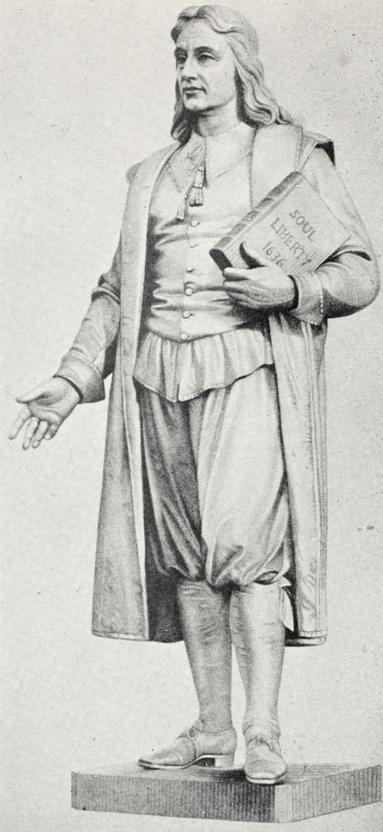
As a result Roger Williams was banished from the Massachusetts Bay colony for holding such beliefs. After surviving a winter living with the Narraganset and other friendly Indians, Roger Williams and his friends settled in what became Providence, Rhode Island. Their government in this new colony had full religious freedom, requiring no declaration of any religious oath. They were committed to “subject ourselves in active or passive obedience, to all such orders or agreements as shall be made for the public good, in an orderly way, by the major assent of the present inhabitants . . . only in civil things” (first written governmental agreement, 1638). But in their religious life, in 1640 they wrote: “We agree . . . to hold forth, liberty of conscience.” In Rhode Island, their civil rights were not
dependent on their religious affiliations, unheard of in other colonies of the time.
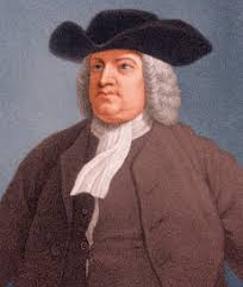
However, Rhode Island was far to the north. Their governmental methods had little impact on the colonies further south. But in the Middle Colonies, William Penn established Pennsylvania with a commitment to similar principles of religious diversity with no religious requirements to participate in secular government. As a result, Pennsylvania prospered religiously and secularly.
These two forays into true religious freedom and representative government by those governed still represented a minority of the colonies in the middle 1600’s. It would be another 100 years before these ideas would spring to life in the convention that produced the Constitution of the United States and the Bill of Rights.
Within these 100 years the writings of John Locke expanded the Protestant idea that the dignity of Man created in God’s image requires him/her to act responsibly, both civilly and spiritually. Likewise, he/she must act to meet the needs of his/her fellow citizens who might be struggling without creating dependency and squelching that person’s own responsible behavior.
Later in these intervening years, the First Great Awakening – under Jonathan Edwards, George Whitefield, and the Wesleys – brought a renewed commitment to the Protestant idea of a personal decision to seek a relationship with God. This reawakened zeal gave rise to the growth of the Baptist, Methodist, Presbyterian, and Congregational Churches and caused the Protestant ethic to impact political thought.
Thus, the Princes at Speyer by their Protest-ant stance eventually spawned the framing of the Constitution of the United States and the Bill of Rights. These documents represented the emergence of the secular implications of Luther’s “priesthood of all believers.” These ideas and their development through the experimentations of Rhode Island and Pennsylvania and the writings of political thinkers produced the practical formation of a representative form of government and the rights of conscience protected from infringement by the majority.
ThisarticlewaswrittenwiththehelpofNicholasMiller’sbook,500Years of Protest and Liberty and Warren Throckmorton’s article The Williams Way or the Winthrop Way? in Liberty magazine, Mar/Apr 2026.

Stan,theoldestseniorofthecollegebasketballgang,passed the second pizza to Rob and Ivan, both juniors. Then Steve, a sophomore, held the cardboard platter as Mark, the younger senior, took his third piece and put two pieces on the plate of Matthew, Mark’s brother and only freshman in the group. Rob watched with mild envy when Matt returned to the table and touched his older brother on the shoulder, as they exchanged glances.
Rob nodded and lightly rubbed his forehead. “You guys are lucky to have each other.”
Matt paused, momentarily furrowing his brow, then sat across from Rob. “Oh. Why is that?”
“I don’t . . . I don’t have a brother. He was killed in a car crash four years ago.”
Ivan turned and bonked Rob on the shoulder. “Hey, roomie, you never told me that!”
Rob flashed a weak smile, quickly picking up his fork. “Yeah. Well, we don’t talk about it much . . . outside the family.”
The post-game dinner became suddenly silent.
Stan set down his pizza, gazing at his friend. “We’re family, Rob.”
Rob slowly twisted his fork, over and over. “Why do we die? We weren’t supposed to.”
Steve spoke quickly, “Easy question first. We live in a sinful world.”
“That’s as far as we get in my family.” Rob attempted another smile. “So . . .why is it sinful?”
In fact, God knows that you will be like gods, knowing what He knows.’”
Matthew picked up the narrative, “Implying that 'this fruit will make you the same as God' even though they were already like God, made in His image..” Even though they werealreadylikeHim,madeinHisimage.”Matthewlooked around the table. “That’s what we always want . . . to be independent . . . to be our own boss.”
Stan looked puzzled. “How do you two know this stuff?”
Matthew nodded to Mark, who spoke for them both. “Our Pawpaw taught us.”
Then Rob spoke again. “But Mom and her sister, Aunt Paula, always ask, ‘Where do they go?’”
Mark turned to him. “And what do you say?”
“I donno.” Rob shrugged.
“Andnow,ladiesandgentlemen.”Mattannounced,pulling his handkerchief from his pocket. “The old ‘Breath and Dirt’ trick.” He wrapped his left hand, pulling two corners of the handkerchiefupandaroundeachsideofhismiddleknuckle. “Behold, the rabbit.” Matt wiggled his covered, grouped fingers so that his hand looked like a rabbit nibbling. Suddenly, Matt whipped off the handkerchief, displaying his left hand and the handkerchief in his right hand. “My left hand represented the breath inside the rabbit. My handkerchiefrepresentedthedirtwrappedaroundtherabbit. Breath and dirt – what we are made of. When they are separated, the breath goes back to God.” He lay his hand on the table. “And the dirt goes back to the ground.” He put away his handkerchief. “But where did the rabbit go?”

“Bible Class 101, bro.” Ivan spread both hands to the group. “Our first parents chose to believe the lie – ‘you will not surely die.’And all of us have followed in their footsteps.”
Steve reached for the last pizza piece. “And every civilization since has wanted to live forever, and not die.”
Mark looked at Matthew. “He has also set eternity in their heart.” Matt nodded.
Ivan laughed. “Except for the existentialists who saw no point in living.”
Steve returned the laughter. “Yeah. And they were a happy lot.”
“Anyway,” Mark interjected, while smiling, “The crisis was –to believe or not to believe God. The lie goes, ‘You won’t die.
Stan nodded and lightly applauded. “The rabbit no longer exists. Good trick; good lesson.”
Mark said, “And neither do we, when we die. Not until the resurrection.”
Rob looked confused. “But Aunt Paula talks to him.”Again silence.
“I heard her talking.”
Markspokequietly.“Didyousee anyone?”
“No.”
“Why not?” Mark pressed.
“Because he’s asleep.” Rob, crying, chewed on his knuckles as Ivan held him around the shoulder.
“Good for you.” Mark was calm, but firm. “I’m sorry to push so hard. But you really want to leave that stuff alone.”
Steveaskedquietly,“Howcomeyouguysknowalotabout this?”
Matthew and Mark exchanged meaningful glances, then Matthew spoke. “We lost our father in a bridge accident several years ago. He was a steeplejack, working on bridges.”
“We had several conversations with our Mom and our Pawpaw, her father, about what to expect from the enemy and how to handle it,” Mark added. “Like some things in life, some things in death are pretty serious.”

by GloriaAllen
Decades ago, I tried to teachAmerican Government to teens. I'd passed college government, so this English teacher was qualified to teach high school government, or so my principal rationalized. But at year’s end, when seniors seemingly would not graduate with the grades I’d turned in, he informed me that I'd failed miserably. Humility happened; but mercy reigned. No senior forfeited graduation, and I retained my job.
So, when asked to opine on spiritual and personal values implicit in the 250 years ofAmerica's national existence, I was challenged. Other than voting regularly, celebrating 4th of July with fireworks, and joining in the pleasure of patriotic holidays with military music, crack riflemen and drill teams, I didn't think much about our nation's significance.
Pondering words and phrases clearly not in my everyday vocabulary, I began to research: unalienable rights, pursuit of happiness, all men created equal, limited government, government of, by, and for the people. How do I explain these concepts to young people today, to immigrants, even to elderly peers? Are these words worth hanging a flag for? Have I taken them for granted while enjoying the blessings ofAmericaeducation, growing into adulthood with conveniences, security, plenty, moving freely from place to place, worshipping, befriending/marrying whomever I chose, etc.?
1765 – William and Mary,Yale, Princeton, Columbia, Philadelphia (now Univ of PA), and Rhode Island (now Brown University). By 1770, the thinkers who became our Founding Fathers, were unimaginably learned men capable of reading the Bible in Greek, Hebrew and Latin and comprehending the principles of moral conduct.
According to Robert Curry, author of Common Sense Nation, "TheAmerican Founding that resulted is still today the most radical attempt to establish a regime of liberty in the entire history of mankind." Not only were the colonists diligent in educating the young in biblical, common-sense values, but they also addressed the realities of everyday life, especially property ownership. Our founders rejected Old World orders, recognizing one set of laws for royalty, another for the ruling class, and yet another for the rabble (as French philosophers deemed everyone else). Elevating the dignity of each human life – "government of, by, and for the people" – became the prevailing rule.
"All men are created equal" translates to all men are born with equal rights, not with equal biology. Especially pertinent, each human has both unalienable and alienable rights. In 18th century usage, alienable meant transferable, capable of being sold, exchanged or bequeathed, and referred to real property, goods, and products of human labor. It is significant that George Washington was a surveyor before he ever addressed military or presidential duties.

My husband Ted, at age 19, pondered a mailbox flyer: "The United States in Prophecy?" Delving into Scripture he unearthed the deep revelation that God indeed brought into existence a new nation that welcomed the persecuted precisely when they most needed refuge – subjects fleeing religious intolerance, oppression, unending poverty, class immobility, and ignorance.
In the 1600s our land welcomed Puritan Pilgrims and adventurers alike. But it wasn't easy. Having built homes, cleared land, and survived the early formative decades, succeeding generations soon filled the ranks of ministers, professors, historians, lawyers, physicians, soldiers, governors, judges, merchants, farmers, and landowners. Amazingly, within less than two decades, Harvard, a training school for Puritan clergy, had taken shape, succeeded by six other institutions of higher learning by
The unalienable rights are bestowed by our Creator by virtue of our being human. Rightfully protected by government, life, liberty and the pursuit of happiness cannot be transferred, sold or exchanged. In reality, there are innumerable unalienable rights, i.e., to move about, to pursue an occupation, start a business, invent, experiment, speak, write, work hard, or be lazy. Only a few are enumerated in our Constitution and the Bill of Rights. In fact, the ninth amendment states: "The enumeration in the Constitution, of certain rights, shall not be construed to deny or disparage others retained by the people."And thus, we have “limited” government.
Having fled European shores, the colonists, by applying common sense principles in the absence of mandated controls of kings, popes, and feudal lords, were able to structure prosperous, happy, hopeful lives in the New World. They managed to break free of the idea that they were “subjects”, in order to imagine themselves “citizens” of a new nation, a nation founded on the premise that the citizens themselves are the sovereigns who hold the reigns of authority and power.
By signing the Declaration of Independence, pledging to each other their lives, their fortunes, and their sacred honor, our Founding Fathers documented proof of their own treason, punishable by death. Thank God they signed! Thank God for courage and sacrifice.As we wave the flag and light the sparklers, let's celebrate this signature event as the gigantic, historical Big Bang that it is!

, MD, MPH
The American Institute for Cancer Research has a multiplicity of information available to educate the public on how to boost the odds of avoiding cancer. This report is a summarization of the information available on their website: aicr.org.
Around 40% ofAmericans will be diagnosed with cancer in their lifetime. Only one in ten of these cancers are genetically caused. The rest are lifestyle driven. Some cancers, like most skin cancers, are easily treated when recognized in the early stages. But most cancers making the news are deadly and are to be avoided. The following are ten known strategies for minimizing the risk of contracting cancer.
#1 – Stop smoking, inhaling, chewing tobacco in any of its forms. Tobacco use is the leading cause of cancer in the UnitedStates.Tobaccoislinkedto90%ofalllungcancersas well as cancers of the bladder, cervix, colon, esophagus, kidney, larynx (voice box), liver, mouth, pancreas, pharynx (upper airway), and stomach. Mixing alcohol with tobacco radically increases the risk, especially in the mouth and throat.
#2 – Be a healthy weight and avoid weight gain in adult life. This is the most important thing to do to prevent cancer, after not smoking. Fat cells produce a protein called cytokines which cause inflammation, increasing the risk of at least 12 types of cancer. Maintain a healthy weight by eating foods with fewer calories and more nutrition. Eat smaller portions at each meal, using smaller plates and bowls and eating more slowly. Burn off the calories with physical activity.
of these foods ensures a cancer-fighting combination of nutrients. Whole grains and beans contain protein, fiber, and healthy fats. Use the NewAmerican Plate model – 2/3 plantbased foods; 1/3 or less animal-based food.
#5 – Limit the consumption of “fast foods” and processed foods high in fat, starches, or sugars. These foods are high in calories and low in nutrients for quick weight gain, leading to increased risk for cancer.
#6 – Limit red meat consumption to no more than 12-18 ounces per week and avoid processed meats altogether. Red meat is associated with increased risk of colorectal cancer. Think of animal protein as a side dish, a condiment to the plant-based diet. Processed meat is high in saturated fat, salt, and chemical additives. These choices carry high risk.
#7 – Limit sugar-sweetened soft drinks and other sugary beverages. They cause weight gain and obesity leading to cancers of the breast, colon and rectum, uterus, esophagus, gall bladder, kidney, liver, mouth and throat, ovary, pancreas, prostate, and stomach. Limit 100% fruit juice intake to no more than 6 ounces each day.
#8 – Cancer risk from alcohol is consistent, whether from beer, wine, or distilled liquor. Alcohol damages DNA and contains high quantities of calories. Even one small glass of alcohol a day increases the risk of some cancers. Protect the liver and digestive tract and reduce weight by ordering club soda, non-alcoholic beer or wine, unsweetened tea or sparkling water.

#9 – Do not use supplements –pills, capsules, tablets, or liquids –to prevent cancer. They don’t offer the same benefits as foods that containthesamevitamins,minerals, amino acids, or phytochemicals. Isolated nutrients may not work with the healthy compounds in whole foods. In special circumstances, talk to a health provider before taking supplements. For nutrients, rely on whole grains, vegetables, fruits, and beans.
#10 – Mothers, breast feed the baby,ifyoucan.Itisbetternutritionforthebabyandprotects theinfantfrominfectionanddisease.Breastfeedingdropsthe levels of some cancer-related hormones in the mother, lowering her risk of developing breast cancer.
#3 – Be physically active, with moderate activity at least 150 minutes per week. Activity burns the calories to help maintain a healthy weight. Walking 30 minutes a day, 5 days a week is an excellent way to decrease cancer risk as well as decrease the risk of cardiovascular disease and diabetes. It’s never too late to start being active. Be sure to include exercises for strength, balance, and flexibility.
#4 – Eat a diet rich in whole grains, vegetables, fruits and beans as part of the daily diet. The high fiber, vitamins and minerals,andphytochemicalsofthesefoodsdecreasetherisk of cancer of the GI tract from top to bottom. A wide variety
EXTRA: After a cancer diagnosis, these same guidelines work to prevent the recurrence of cancer.
This short summary only touches the information available in a booklet called “Ten Ways to Protect Yourself Against Cancer.” Although it is currently out of stock, go on line to aicr.org to access more scientifically proven ways to decrease the risk of cancer.
Since 1983, the American Institute for Cancer Research has funded research and published discovered information to understand and to make know to the public the causes and the steps to prevent, fight, and survive cancer.

Fill in the answers to the clues by using the syllables in the Syllable Box. The answer to each clue is the name of a book of the Bible. UseAI, a Bible dictionary, or the table of contents of your Bible. The number of syllables to answer each clue is shown in parentheses. The number of letters in each answer is indicated by the number of dashes. Each syllable will be used only once.
SYLLABLE BOX
A AH AH ANS AS BA BAK CLE CO CUS DEU
DI DUS E E E E EC EL EN ES EX GEN HA
I IEL JER JOSH KUK LA LAM LE MI MY O
O O ON REV RIN SAM SI SIS TA TER TES THER THI TION TIONS U U VIT ZEK
1. Cries of grief (4) __ __ __ __ __ __ __ __ __ __ __ __
2. Star (2) __ __ __ __ __ __
3. God saves (3) __ __ __ __ __ __
4. Whom God will strengthen (3) __ __ __ __ __ __ __
5. He who wrestles (3) __ __ __ __ __ __ __ __
6. God establishes/upholds (4) __ __ __ __ __ __ __ __
7. Who comes from a high place (4) __ __ __ __ __ __ __ __ __ __ __
8. Pertaining to the Levites (4) __ __ __ __ __ __ __ __ __
9. An unveiling (4) __ __ __ __ __ __ __ __ __ __
10. Beginning (3)
11. Speak to an assembly, preacher (5) __ __ __
12. Going out, leaving (3) __ __ __ __ __ __
13. Second law (5) __ __ __ __ __ __ __ __ __ __ __
14. Name of God (3) __ __ __ __ __ __
15. Worshiper of God (4) __ __ __ __ __ __ __



I can do all things through Christ who strengthens me.
Philippians 4:13 NKJV
There will be times in our lives when we feel overwhelmed, and the tasks before us will seem too much to bear. We will doubt our ability to persevere through challenges and trials. But we, through Christ, are much stronger than we think we are.
Describe something in your past that was difficult, and you weren’t sure how you were going to get through it.
Living through challenges often gives us strength and wisdom we would not have otherwise acquired.About with cancer can strengthen our faith, teach us patience, and give us a new appreciation for life.Astruggle in a relationship can make it stronger once resolved.Achallenge at work or school can teach us how to handle a similar situation in the future. Hard situations and challenges are opportunities to grow and learn.
In the difficult experience you described, what wisdom did you learn which you have applied in new situations?
We need not be afraid of getting through the challenge, but instead rely heavily on God who is going through the storm with us. We may have to walk through the rain, but He can supply the rain gear. We may need to cross the river, but He can supply the boat.
In what way did God assist you in getting through your difficult experience? _____________________________
Most people never reach their full potential, in part, because they doubt their strength and underestimate their ability to succeed. The singer, actor, preacher, and athlete all had to get out of their comfort zone and sing their first song, act in their first play, preach their first sermon, and sign up for their first team. For every individual, every task was new the first time they did it. Don’t let inexperience stop you from getting experience and learning new tasks.You can do it!
Share something that you would like to do but haven’t due to a lack of courage or feeling inadequate.
How can your relationship with God help you when you face such a challenge? ___________________________


Our family focus this month features Derrick and Holly Borton. Holly has been a member of the Arden SDA Church all her life and Derrick moved his membership to our church after they were married.
Derrick was born and raised as a Seventh-dayAdventist in the Dominican Republic andlivedthereforthreeyears.HisparentsworkedfortheSDACollege–nowknown as the Dominican Adventist University. On returning to the States, they moved to Berrien Springs, Michigan where he grew up. He has three older brothers and one younger brother. He was baptized in a Spanish SDAchurch on June 29th, 1991.
Holly was born at the Fletcher Hospital (which became Park Ridge Hospital and is now known as AdventHealth Hendersonville) in Western North Carolina and was raised as a Seventh-day Adventist also. She has one older sister and one younger brother. She was baptized at the Arden SDA Church on August 25, 1990. Her grandparents were Nathan and Louise Benson who were beloved members atArden.
Derrick attended Great Lakes Adventist Academy and then graduated from Blue Ridge Community College specializing in plumbing. He worked for several years building houses with his father-in-law Bill Worthen and his father-in-law Nathan Benson. He then transitioned to plumbing and has worked in this field for twenty years. He is currently working for M.B. Haynes Plumbing company and has been with them for six years.
Holly attended Captain Gilmer Christian School and Fletcher Academy, followed by classes for several years at Andrews University. She worked for many years for PPS Access Screening, a company doing background checks for people applying to work in nuclear power plants to ensure they are safe to work in these facilities.
Derrick and Holly met when Holly and her sister were sharing an apartment and her sister began dating Derrick’s best friend. Derrick and Holly dated for one and a half years and have been married for twenty-two years. They have four children. Quintin is seventeen years old; Lilly is thirteen; Jacob is ten; and Logan is nine.
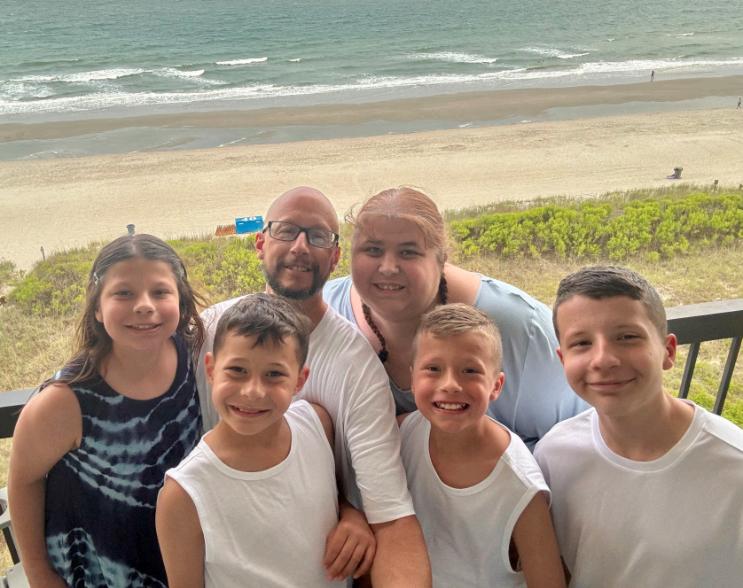
For both Derrick and Holly, their hobbies include special time with their children and find it a joy to explore the beauty ofWestern North Carolina together as a family. Holly also loves reading. Derrick, being from the Dominican Republic, has traveled to Puerto Rico many times with his parents. When he was younger, they drove to California. Holly also delightedly remembers going to California and driving from San Francisco to JoshuaTree National Park. She also has enjoyed going to the beach, traveling to Florida, and visiting Gatlinburg, Tennessee over the years.
Derrick and Holly both really liked all of the programs for children at the Arden SDA church. He attends the Sabbath School taught by Richard Hodges and Bruce Herbert.DerrickandsonQuintinhavebeenvotedinforthe2026-2028termasSocial Committee members. Derrick also served several years as a deacon. In her younger years, Holly attended Pathfinders at the Arden SDA Church. She traveled with the Pathfinders to Friendship Camporee and was on the Drill Team.
We are so happy to have Derrick, Holly, and their children as part of the Arden church family!
Arden Seventh-dayAdventist Church Is a Safe Place to Grow.
Our Purpose is, by God’s Grace, to reflect His character in our community, to demonstrate a quality of life that will attract all to be reconciled to Jesus Christ, and to encourage people to become His loving, maturing disciples.
Grace Notes Editorial Staff:
Max Hammonds..................................Editor
Chris Small...................................Columnist
Jean Davey....................................Columnist
GloriaAllen....................................Reporter
Pen Braister-Sturgis........................Reporter
Sara McCord...................................Reporter
Dan Reynolds.................................Reporter
Arizona McCord.....Reporter & Proofreader
Chris Small .......................Special Graphics
Jim & Carolyn Sullenberger.....Proofreaders
Nolan Darnell............Mailing Management
Shirley Wallstrom........Circulation Manager
Whitney Barron.....................Layout Design
Comments, suggestions and praises are always welcome. Please email or contact the church office.
Services each Saturday morning: Sabbath School Bible Study, 9:30 a.m. Worship Service, 10:45 a.m.
Location: 35Airport Road,Arden, NC 28704 Located on Highway 280, (Airport Road), 1.5 miles east of I-26 exit 40, and a quarter mile west of Highway 25.
Church Office:
Office Manager: Sharlene Bliven Office Secretary: Summer Cronin Telephone: (828) 684-6700
Email: office@ardenadventist.org
Website: www.ardenadventist.com
Office Hours: Mon., Wed., Thurs.,9 a.m. to 3 p.m.
ArdenAdventistPastoralStaff: SeniorPastor:EricBates,D.Min. Email:ebates@carolinasda.org
Associate/YouthPastor:RichMaskelony,M.Div. Email:rmaskelony@carolinasda.org
Grace Notes is published monthly by the Arden Seventh-day Adventist Church. Subscription is free by calling or emailing the office. †Do you have questions about what Adventists believe? Would you like to become a member of the Seventh-day Adventist Church? Would you like to study the Bible? You are invited to attend a Pastor’s Bible Study Class. Please call for location and time. All are always welcome.
† Disclaimer—The contents of Grace Notes, such as text, graphics, images, and other material contained in this magazine of the Arden Seventh-day Adventist Church are for informational purposes only. It is not intended to be a substitute for professional medical advice, diagnosis or treatment. Always seek the advice of a qualified healthcare provider, who is knowledgeable and experienced in the use of specific medical or Lifestyle Medicine interventions, or about questions you may have regarding a medical condition. Never disregard professional medical advice, or delay in seeking it, because of information published in this magazine. Neither Grace Notes nor the Arden Seventh-day Adventist Church recommend or endorse any specific tests, products, procedures, opinions, or other information that may be mentioned in published articles. Reliance on any information provided is solely at your own risk. If you have a medical emergency, call your healthcare provider or 911 immediately.


Arden Seventh-day Adventist Church 35 Airport Road Arden, North Carolina 28704 (828) 684-6700
If you no longer wish to receive Grace Notes, or if your address has changed, please contact us.




Serving size: 1 cup
Servings per recipe: 9
Prep Time: 40 minutes
• 1 Tbsp. high heat oil
• 1 Red onion, small and chopped
• 2 Cloves garlic
• 1 Tbsp. chili powder
• 1/2 Tsp. salt
• 1/4 Tsp. paprika
• 1 15oz. Can chopped tomatoes
• 26 oz. Veggie broth
• 1/2 Cup red pepper, pureed (use 1 large red pepper)
• 1/2 Cup carrot, pureed (use 2 medium carrots)
• 4 Tbsp. flaxseed meal
• 1 15 oz. Can beans of your choice
In a small pot, add chopped bell pepper and carrots. Steam until soft. Add steamed veggies to a blender with just enough water to blend into a puree. Set aside. In a large soup pot, sauté onion in high heat oil until soft. Add garlic, chili powder, salt and paprika and toast together for about one minute. Stir in the tomatoes, broth, purees, and flax seed. Stir well and bring to a boil; add beans and reduce to a simmer for 15 to 20 minutes until the flavors marinate together. Serve immediately.
From the Loma Linda University Health “Live It in the Kitchen”

It seems, at first, a profoundly foolish question: “Do you want to be healed?”
Jesus once asked it of a paralyzed man who for 38 years had lingered beside a legendary pool.
The answer feels self-evident: who wouldn’t instantly reach out for healing, for wholeness, for a mended body and the restoration of fractured relationships?
But Jesus knows how tenderly we caress our wounds; how suffering weaves itself into our core; how grief and bitterness pulse with dark, compelling energy. So He lingers before He heals, honoring the sacred freedom He gave to every soul: “Do you want to be healed?” (John 5:6). “Do you want to live beyond your pain? Do you want to live without rehearsing narratives of those who injured you, or why your bitterness is justified?”
It was not an easy question then; it never is an easy question now. Yet Jesus asks again, for His grace is neither hurried nor forced. Will we be remade, renewed, restored? Or will we settle again onto familiar broken ground, grimly content to recount the ancient wounds that now define us?
Grace passes by your mat today. The question stirs your waiting place, echoing around your pool.
Take the hand that reaches for you. Respond with faith yes, even trembling faith and grace will lift you to your feet.
Then stay in it. -Bill Knott