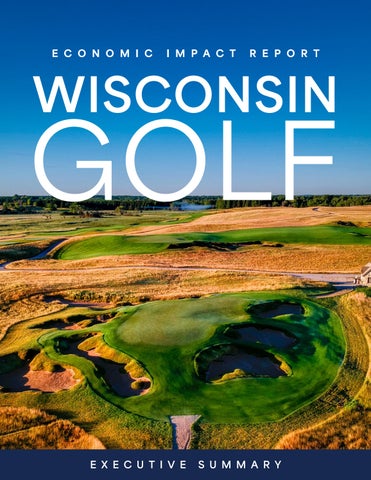
E C O N O M I C
I M P A C T
R E P O R T
WISCONSIN
GOLF E X E C U T I V E
S U M M A R Y
$6.44B
The Wisconsin golf industry generated $3.37 billion in direct economic activity, driving a
TOTAL ECONOMIC OUTPUT
total economic impact of $6.44 billion across the state when indirect and induced effects
$3.37B
are included. As a major driver of jobs and tourism, the industry supports 56,595 jobs, contributes $2 billion in wages, and returns
DIRECT ECONOMIC IMPACT
over $288 million in state and local taxes — strengthening Wisconsin’s economy while sustaining the communities, landscapes, and outdoor spaces that make the state unique.
WISCONSIN ECONOMIC HIGHLIGHTS Wisconsin spans 65,498 square miles and is home to nearly 6 million residents. Long recognized for its leadership in manufacturing, agriculture, and dairy, the state has grown a presence in advanced manufacturing, technology, and tourism. Wisconsin is home to eight Fortune 500 companies, reflecting a forward-thinking business environment and diverse statewide economy that is evolving while grounded in natural beauty and the community values the state is known for. Golf is flourishing in Wisconsin. With a total economic output of $6.44 billion, the golf industry outpaces the combined impact of several iconic recreational industries — from craft beer, wine, and local spirits to the seasonal boost generated by Packers home games — which together total nearly $5.0 billion. This scale reflects golf’s quiet yet far-reaching role across Wisconsin’s communities, lifestyles, and natural landscapes.
Economic Impact of Golf for Wisconsin
Total Impact Employment
56,595 Jobs
Wages and Benefits
$2.0 Billion
State and Local Taxes
$288 Million
The Wisconsin Golf Market Wisconsin’s ecological diversity spans rolling hills, open plains, river corridors, farmlands, urban neighborhoods, and the shorelines of Lake Michigan and Lake Superior. These varied landscapes support wildlife, offer community recreation areas, and showcase the natural beauty that defines Wisconsin’s outdoor heritage. With more than 500 golf courses — from municipal layouts to renowned destinations like Whistling Straits, Erin Hills, Mammoth Dunes, Sand Valley, and Blackwolf Run — Wisconsin golf is purposefully cultivating a portfolio of premier golf competitions and by hosting major championships in both smaller markets and urban areas, it is effectively distributing economic benefits and reinforcing its brand as a versatile, comprehensive, and welcoming golf destination. Major events including the Ryder Cup, U.S. Open, U.S. Women’s Open, U.S. Senior Open, PGA Championship, and other professional tournaments continue to elevate the state’s reputation. Wisconsin ranks ninth nationwide in total golf courses, with 11 courses on prestigious Top 100 lists, including Golf Digest’s ranking of “America’s 100 Greatest Public Golf Courses” which features Whistling Straits and Erin Hills in the Top 10.
Key Wisconsin Golf Facts: 11.24 million rounds played in 2023 (+7.1% vs PY). 538,000 on-course golfers in 2023. 528 golf courses, 449 facilities (87% public, 13% private), with 63 municipal facilities. 33 stand-alone driving ranges and 43 resort facilities. Affordable public golf: 55% of public facilities charge under $50, while 36% fall into the $50–$70 range and 9% exceed $80.
Golf Facility Inventory — State of Wisconsin Number of Facilities 9-Hole
138
18-Hole
262
27+Hole
48
Total
449
Stand-Alone Driving Ranges
33
Resort Facilities
43
Wisconsin offers a welcoming mix of affordable, accessible courses for players of all ages. Historic public venues like Brown Deer Park — where Tiger Woods made his PGA Tour debut — and the 1930s-era Lawsonia Links highlight the state’s architectural heritage and long-standing commitment to community golf. These iconic courses, along with many municipal and classic parkland layouts, preserve multi-generational access while honoring Wisconsin’s rich recreational history.
WISCONSIN GOLF INDUSTRY SUMMARY OF ECONOMIC IMPACT
2023 Economic Impact of the Golf Sector
State of Wisconsin ($ Millions)
Core Segments
Direct Impact
Total Output
Total Jobs
Labor Income
Golf Facility Operations*
$1,583.9
$3,118.8
32,178
$1,009.5
Capital Investments
$306.9
$629.1
4,395
$235.0
Golf-Related Supplies**
$156.8
$262.6
2,141
$73.3
Tournaments & Associations
$49.5
$94.2
742
$32.9
Charitable Events
$166.4
$173.9
140
$9.2
TOTAL CORE SEGMENTS
$2,263.6
$4,278.6
39,597
$1,359.8
Enabled Segments
Direct Impact
Total Output
Total Jobs
Labor Income
Golf Tourism
$902.7
$1,721.5
14,678
$535.1
Golf-Related Residential Construction
$206.6
$441.2
2,320
$143.5
TOTAL ENABLED SEGMENTS
$1,109.4
$2,162.7
16,998
$678.6
GOLF ECONOMIC IMPACT
$3,373.0
$6,441.3
56,595
$2,038.4
FISCAL IMPACT (LOCAL AND STATE TAXES)
$288.4
* Revenue from golf facility operations including on-course merchandise sold. **Total retail sales do not include on-course merchandise sold. ***Jobs reflect incremental employment from larger charitable tournaments; smaller event staffing is captured under Facility Operations. ****Segment totals may not sum precisely due to rounding.
GOLF INDUSTRY SEGMENTS Direct Impact from Core Segments Charitable Giving Community support is at the heart of Wisconsin golf. Every surveyed golf facility in Wisconsin hosted at least one charitable event in 2023, contributing to more than 9,000 total events, both golf and non-golf, raising $166 million for Wisconsin nonprofits. Beneficiaries included the Geneva Lake Conservancy, Lakeland Star Academy, the Howard Young Foundation, the Solberg Foundation, local women’s clubs, schools, and service groups like the Lions Club, among many others.
Tournaments & Associations Direct impact from major tournaments and associations was nearly $50 million in 2023 — Wisconsin is a premier destination for professional golf, hosting two highly successful major spectator tournaments in 2023 including the 43rd U.S. Senior Open Championship at SentryWorld in Stevens Point and the American Family Insurance Championship at University Ridge in Madison, in addition to the 2025 U.S. Women’s Open at Erin Hills, continuing to cement Wisconsin’s place at the forefront of the sport. Wisconsin has hosted a total of four PGA Championships, the U.S. Open, U.S. Senior Open, U.S. Women’s Open, the 2021 Ryder Cup, and was home to the PGA Tour’s Greater Milwaukee Open for 42 years. There were more than 125 golf-related associations identified in Wisconsin that drive the sport’s growth, health, and development with gross receipts over $28.5 million. Major associations include the Wisconsin State Golf Association, PGA Section, Wisconsin Golf Course Superintendents Association chapter, Wisconsin Badger Chapter of CMAA, and the Wisconsin Golf Course Owners Association. Several smaller Wisconsin organizations were awarded Make Golf Your Thing grassroots grants, promoting inclusion and growth in the game — including Milwaukee Area Youth Golf Academy, Inc., which provides mentorships; NEXT 18 Inc., a nonprofit using golf and mindfulness to support veterans and first responders; and The Caddie & Leadership Academy of SE WI, which offers teens paid opportunities and leadership development.
Golf Facility Operations Total consumer spending at golf facilities for green fees, memberships, golf shop retail sales, driving range fees, lessons, restaurant (F&B) sales, and additional activities totaled $1.6 billion in 2023. Golf facility operations supported 32,178 total jobs. Wisconsin golf facilities embed community-minded practices directly into their operations — hosting school competitions, supporting junior golf and First Tee programs, maintaining on-course assets like bluebird houses, honeybee hives, and native prairie areas, managing retention ponds for neighborhood runoff, offering space for research and turfgrass education, and incorporating tree-planting and wood-reuse efforts that strengthen local environmental stewardship.
Capital Investments 52% of Wisconsin golf courses launched or continued large-scale capital projects that were not included in regular operating expenses. Wisconsin golf facilities invested $306.9 million in capital improvements in 2023 including new buildings and structures (48%), course renovations (16%), and irrigation systems (13%). Capital investments supported 4,395 total jobs.
Golf-Related Supplies Wisconsin golf retail generated $89.6 million in retail margins from $212.8 million in golf apparel, equipment, and shoe sales in 2023. Of this, $81.3 million was driven by offcourse retail outlets, while on-course golf shops accounted for the remaining $131.6 million in sales (included in total consumer spending within facility operations). 31 golf-related manufacturers and service providers were identified in Wisconsin, including golf architects and construction companies, equipment and apparel manufacturers, accessories, and golf course management companies. Golf-related companies contributed $75.5 million to the Wisconsin economy in 2023 and supported more than 2,100 jobs encompassing retail, manufacturing, marketing, and corporate management roles. Companies that call Wisconsin home include Prestwick Golf Group, manufacturer of high-end club furnishings with significant national and global reach; Pride Sports, the world’s largest producer of golf tees, and Watertronics, global supplier of pumping solutions based in Hartland, Wisconsin, to name a few. Many Wisconsin golf facilities partner with local producers — such as Two Guernsey Girls Dairy, Farmer Bob, Nueske’s, Superior Fresh, and Goehring’s Meat — for fresh meats, dairy, fish, and seasonal produce, while featuring craft beverages from Lion’s Tail, Eagle Park, New Glarus, Third Space, Badger State, and Good City breweries. These local partnerships support Wisconsin agriculture, small businesses, and local community impact.
Tournaments & Associations
Education
Giving
Health & Wellness
Tourism
Community & Sustainability Capital Investment Golf Facility Operations
Golf-Related Supplies
Real Estate
On-Course
Carts & Equipment Clubhouse Core Segments
Enabled Segments
Direct Impact from Enabled Segments Golf Tourism
Golf travel and tourism is a significant driver for the Wisconsin economy — contributing $902.7 million in direct impact in 2023 while supporting 14,678 jobs including induced and indirect activities such as transportation, lodging, meals, and other entertainment. Wisconsin golf tourism generated 1.8 million golf trips, including overnight and daytrips of more than 50 miles within the state in 2023.
Golf Real Estate
Golf courses within, or in immediate proximity to, residential communities enhance real estate value in Wisconsin, driving direct economic and fiscal contributions totaling $256 million. This impact is driven by two key factors: Golf-related residential construction. New residential construction in and around golf communities added significant value to the state’s housing stock, generating $206.6 million in direct spending within the construction industry. This investment, which includes the development of single-family homes and condominiums, supported 2,320 jobs through direct, indirect, and induced spending. Net gain to local tax jurisdictions from value premiums. The presence of a golf course provides a quantifiable premium to the value of homes in golf course communities, adding an estimated 20% to their value. This premium generated a fiscal contribution of $49.4 million in local property tax revenue in 2023, helping to fund schools, municipal services, city and county streets, and public safety for Wisconsin communities.
COMMUNITY & ENVIRONMENTAL SUSTAINABILITY IMPACTS Golf in Wisconsin promotes health, wellness, and environmental stewardship while strengthening local communities. Walking 18 holes can cover five miles — and even riding covers two to three — supporting cardiovascular health, boosting immunity, and improving mood and cognition, while the game continues to expand youth engagement, inclusion, and accessibility across the state.
A Welcoming Place for All Youth engagement is nearly universal across Wisconsin golf, with 97% of surveyed facilities supporting at least one youth-development program. This includes widespread participation in junior golf (97%), scholastic golf (35%), and Wisconsin First Tee programs (44%), underscoring the industry’s deep commitment to developing young players and life skills. Wisconsin courses actively welcome new players, with 37% offering beginner-focused programs and 30% participating in caddie development initiatives, creating multiple entry points into the game. More than half of surveyed facilities offer programs for veterans and military families (51%) through initiatives like PGA HOPE and adaptive golf programs, while 60% support senior golf initiatives, offering inclusive events and therapeutic recreation to expand access and promote wellness throughout life stages. The Wisconsin PGA Junior Foundation expands access to youth golf in Wisconsin through its statewide junior tours — approaching 150 events each year — and its player-development programs. Since 2000, the Foundation has awarded more than $520,000 in college scholarships to dedicated junior golfers across the state — helping to ensure cost does not limit access to the sport. More than 30 Wisconsin courses participate in Youth on Course through the Wisconsin State Golf Association, providing affordable access to junior golfers statewide with rounds for $5 or less. Courses contribute broadly to community life by hosting charity tournaments, fire-department fundraisers, church outings, scholarship events, farmers markets, family nights, and local festivals, while donating rounds, tee times, and financial support to groups such as the Caddie School for Soldiers, local chambers of commerce, and area nonprofits — helping ensure golf remains welcoming and deeply connected to Wisconsin communities. Wisconsin golf supports deep community roots and commitment to sustainability, offering broad access to the game while caring for the state’s landscapes and natural resources.
Sustainability & Environmental Stewardship Wisconsin’s 528 golf courses provide 73,000 acres of greenspace across the state supporting wildlife habitats, air quality, water filtration, flood mitigation, and urban cooling. About 1 in 7 Wisconsin golf courses support shared-use or environmental stewardship initiatives — including multi-use access (14%) such as walking trails, birding, winter activities like cross-country skiing or snowshoeing, or designated natural areas for community enjoyment and stewardship-focused programs such as Audubon International and wildlife-habitat efforts — strengthening their role as community-oriented greenspaces. The Wisconsin Best Management Practices (BMPs) Guide at wisconsingolfbmp.org provides facilities with standardized practices to promote water quality and conservation, habitat protection, and responsible land use, ensuring long-term environmental sustainability. Wisconsin golf courses function as valuable green infrastructure, with turfgrass, native roughs, wetlands, and water features helping to reduce the demand for public stormwater systems. Their trees and landscaped areas also filter air pollutants, contributing to cleaner, healthier ecosystems and communities.
Water Conservation +90% use irrigation control systems and devices to monitor and reduce water use. ~70% have converted maintained turf areas to native plants, grasses, or ground covers. 61% incorporate drought resistant or native plants in non-play areas.
Energy Conservation 94% use LED lighting. +60% use occupancy sensors and scheduled lighting. +50% of courses surveyed use variable frequency drives (VFDs) at pump stations.
Waste Management & Recycling Waste diversion refers to the share of total waste that is kept out of landfills by redirecting materials into recycling, composting, or other recovery streams. Repurposing fryer oil and golf balls supports a circular economy demonstrating closed loop thinking that extends product lifecycles and fosters community goodwill. Additional top waste diversion measures used:
95% Mixed Recycling: Captures the largest mass of materials.
80% On-Site Composting: Organic debris composted into soil amendments.
The industry is demonstrating how golf can deliver ecological value while enhancing community well-being, resilience, and green infrastructure across the Badger State’s urban and rural landscapes.
88%
of courses surveyed use three or more water conservation best practices.
90%
of courses have applied three or more energy conservation BMPs.
90% Nearly
of courses have adopted three or more wastereduction BMPs.
Produced by the Wisconsin Golf Alliance
Research and Reporting