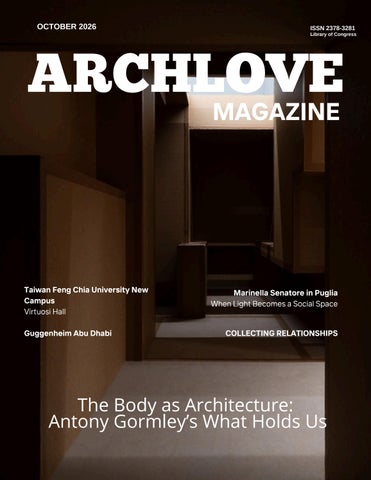
OCTOBER 2026
ISSN 2378-3281
Library of Congress
ARCHLOVE MAGAZINE
Taiwan Feng Chia University New Campus Virtuosi Hall Guggenheim Abu Dhabi
Marinella Senatore in Puglia When Light Becomes a Social Space COLLECTING RELATIONSHIPS
The Body as Architecture: Antony Gormley’s What Holds Us
ARCHLOVE
Publisher Vincenzo Viva Sales LLC Group
Editor in chief Raffaele Quattrone
Editorial Contact arch.love.magazine.byviva@gmail.com
Editorial Offices 213 William Hilton Pkwy #21361 Hilton Head Island SC 29925 USA
ISSN 2378-3281 Registered Library of Congress ISSN Publisher Liaison Section 101 Independence Ave., S.E. Washington DC 20540-4284
Cover Photo Antony Gormley, INNERCITY, 2026, cardboard, 15 figures, variable dimensions, Courtesy: the artist and GALLERIA CONTINUA, Copyright: © the Artist Photo: Ela Bialkowska, OKNO Studio
PAGES 7
THE BODY AS ARCHITECTURE:
15
TAIWAN FENG CHIA UNIVERSITY NEW CAMPUS
21
PARCO SCULTURE TODINI
27
MARINELLA SENATORE IN PUGLIA
33
AMAZONIA
39
SHIRIN NESHAT
44
COLLECTING RELATIONSHIPS
Antony Gormley’s What Holds Us
Virtuosi Hall
Where Art Learns to Inhabit the Landscape
When Light Becomes a Social Space
The art of being in transit
and the American Dream of Being Seen
50
GUGGENHEIM ABU DHABI
54
WHAT SHOULD WE LEARN WHEN MACHINES CAN LEARN?
57
THE STRENGTH OF FRAGILITY
63
DESIGNING TIME
FROM THE DIRECTOR WHAT HOLDS US TOGETHER?
Architecture is often described through what it builds, art through what it makes visible, design through the objects and systems it creates. Yet perhaps what matters most lies somewhere in between: in the relationships they make possible. This issue of Archlove begins with a body. In Antony Gormley’s What Holds Us, the human figure becomes architecture, while architecture becomes a reflection on support, vulnerability and dependence. From there, an unexpected thread runs through the entire magazine: the idea that nothing meaningful exists in isolation. At Feng Chia University in Taiwan, architecture dissolves into landscape and learning becomes an ecosystem of encounter. At Parco Sculture Todini, art enters into dialogue with nature. In Puglia, Marinella Senatore transforms light into a social space capable of gathering people without enclosing them. And with Guggenheim Abu Dhabi, even the geography of contemporary art can be imagined not around a single centre, but as a constellation of different perspectives. The same question extends beyond physical space. What does it mean to know when machines can learn? Perhaps the answer lies not in competing with technology, but in protecting what connects knowledge to human experience: critical thought, imagination, intuition and responsibility. Even fragility can then be understood not simply as weakness, but as an acknowledgement that we depend upon others, places and systems of care. Finally, space is also time. The way we design cities determines the hours we can devote to ourselves and to others. Designing space therefore means designing relationships — and, ultimately, designing time. Across different geographies and languages, the projects in this issue suggest that architecture, art and design matter not only for the forms they produce, but for the connections they allow us to create. Perhaps the most important spaces are not those we build around ourselves, but those we build between ourselves.
Raffaele Quattrone Editor-in-Chief
6
Antony Gormley, INNERCITY, 2026, cardboard, 15 figures, variable dimensions, Courtesy: the artist and GALLERIA CONTINUA, Copyright: © the Artist Photo: Ela Bialkowska, OKNO Studio
The Body as Architecture: Antony Gormley’s What Holds Us AT GALLERIA CONTINUA IN SAN GIMIGNANO, ANTONY GORMLEY TRANSFORMS THE HUMAN BODY INTO ARCHITECTURE, QUESTIONING THE FRAGILE STRUCTURES—PHYSICAL, SOCIAL AND EMOTIONAL—THAT ALLOW US TO INHABIT THE WORLD.
7
Antony Gormley, Pack, 2024. Cast iron, 156 x 40 x 67.5 cm. Courtesy: the artist and GALLERIA CONTINUA, Copyright: © the Artist Photo: Ela Bialkowska, OKNO Studio
Antony Gormley, INNERCITY, 2026, cardboard, 15 figures, variable dimensions, Courtesy: the artist and GALLERIA CONTINUA, Copyright: © the Artist Photo: Ela Bialkowska, OKNO Studio
Architecture begins with the body. Before walls, rooms, I want us to accept its intimacy as the threshold to infinity.” streets or cities, there is the space we occupy simply by It is an idea that radically changes the way we might existing: a physical boundary between interior and understand architecture. If the body is already a place, exterior, intimacy and exposure, self and world. This architecture does not simply surround us: it begins from us. elementary relationship lies at the heart of Antony This proposition finds its most ambitious expression in Gormley’s What Holds Us, presented at Galleria Innercity (2026), a monumental installation occupying the Continua in San Gimignano from 9 May to 13 entire former cinema theatre of Galleria Continua. Fifteen September 2026. Rather than treating sculpture as an enormous “body buildings” constructed from cardboard autonomous object placed within architecture, Gormley transform the space into an unexpected urban landscape. reverses the relationship. Bodies become buildings, Visitors move between these structures as they might move buildings become extensions of bodies, and the gallery through streets, passages or narrow urban corridors. Some itself becomes part of a complex system of support, remain closed and inaccessible; others can be entered, resistance, passage and dependency. “I have always requiring the visitor to bend or crawl into their interiors. The considered the body principally as a place rather than an experience continuously alters the conventional relationship object,” Gormley explains. “The unknowable and between observer and artwork. One does not stand before constantly changing nature of the body is the universe Innercity. One enters its spatial logic. closest to us.
09
Antony Gormley, TOGETHER, 2025. Clay, 154.6 x 87.2 x 290.9 cm (24 slabs). © the artist and GALLERIA CONTINUA Photo: Ela Bialkowska, OKNO Studio
Antony Gormley, INNERCITY, 2026, cardboard, 15 figures, variable dimensions, Courtesy: the artist and GALLERIA CONTINUA, Copyright: © the Artist Photo: Ela Bialkowska, OKNO Studio
10
Antony Gormley, What Holds Us, 2026, exhibition view GALLERIA CONTINUA, San Gimignano. Courtesy: the artist and GALLERIA CONTINUA, Copyright: © the Artist and GALLERIA CONTINUA, Photo: Ela Bialkowska, OKNO Studio
Antony Gormley, 2026 © the artist and GALLERIA CONTINUA Photo: Ela Bialkowska, OKNO Studio
The human figure, one of the central elements of They are simultaneously individual and collective, intimate Gormley’s practice, has effectively expanded until it has and monumental, shelters and obstacles. They suggest that become inhabitable. Anatomy has turned into urbanism. every architecture negotiates the same fundamental The body is no longer represented inside space: it conditions as the human body: protection, vulnerability, produces space. openness, separation and contact. This transformation opens an intriguing reflection on The material chosen for Innercity makes this reflection even contemporary cities. Urban environments are commonly more compelling. The monumental structures are made understood as concentrations of bodies, infrastructures, from cardboard, one of the most ordinary materials of buildings and flows. Yet density does not necessarily contemporary life. Associated with packaging, produce connection. We may inhabit the same building transportation, online commerce and global logistics, without knowing one another, share the same street cardboard belongs to an economy of circulation rather than without encountering each other, move through crowded permanence. It arrives, protects something temporarily and transport systems while remaining psychologically is discarded or recycled. Yet here it becomes architecture. isolated. Gormley’s body buildings make this The apparent contradiction is crucial. Human beings have contradiction physical. They are simultaneously individual historically built architecture partly to resist time. Stone, and collective, intimate and monumental, shelters and brick and concrete promise stability; monuments attempt to obstacles. transform memory into matter. Cardboard promises almost nothing. 12
Its vulnerability remains visible. It can bend, tear, collapse and disappear. Gormley therefore constructs an imaginary city from a material that refuses the traditional architectural fantasy of permanence. The result is not simply a critique of contemporary consumption. It is also an invitation to reconsider what makes a structure meaningful. Perhaps architecture does not derive its significance exclusively from its ability to endure. Perhaps its value can also emerge from the relationships, experiences and forms of awareness it generates while it exists. This question of support extends throughout What Holds Us. At the entrance to the exhibition, basalt Blockworks depend upon the fourteenth-century walls of the gallery to remain upright. The traditional architectural relationship between body and structure is reversed. Instead of the human figure supporting architecture like a classical caryatid, these sculptural bodies need architecture to sustain them. Their apparent solidity conceals dependence. Elsewhere, monumental terracotta Slabworks combine bodies in precarious configurations that resemble a house of cards. Each element depends upon another. Remove one and the entire structure risks collapse. Architecture here becomes an image of social existence. It is difficult not to recognise ourselves within these precarious systems. Contemporary culture frequently celebrates autonomy: the independent individual, the self-sufficient subject, the person capable of constructing his or her own identity and destiny. Gormley proposes another possibility. What if dependency is not a failure of autonomy but one of the fundamental conditions of existence? Buildings depend upon foundations. Cities depend upon infrastructures. Bodies depend upon environments. Human beings depend upon one another. In this sense, What Holds Us is as much about relationships as it is about sculpture. Material plays an essential role in constructing this argument. Basalt, terracotta, iron, concrete and cardboard coexist throughout the exhibition, creating an almost archaeological sequence of human relationships with matter. Stone evokes geological time and origins; clay retains the memory of touch; iron carries the history of industry; concrete belongs to the modern city; cardboard speaks directly to the logistics and consumption systems of the present.
Gormley describes sculpture as a language of matter: “As a sculptor, I speak in the language of stuff: matter, in the belief that all matter has meaning.” The exhibition consequently asks us to look again at materials that architecture and everyday life often encourage us to take for granted. Matter is never neutral. Every material contains histories of extraction, production, labour, movement and transformation. Buildings may appear static, but the materials from which they are constructed connect them to landscapes, economies and human networks extending far beyond their walls. This sensitivity becomes particularly significant in San Gimignano. Few locations could provide a more powerful counterpoint to Gormley’s temporary cardboard architecture. The Tuscan town is defined by stone, medieval towers and the extraordinary persistence of structures that have survived centuries of social transformation. Galleria Continua itself occupies a former cinema within this historic fabric. Inside it, Gormley constructs another city—temporary, vulnerable and deliberately unstable. Two ideas of architecture therefore confront each other. One seeks duration; the other accepts impermanence. One is inherited from history; the other belongs unmistakably to contemporary circulation. Yet the opposition is less absolute than it first appears. The medieval walls themselves have survived precisely because generations have maintained, transformed and reinterpreted them. Permanence is never entirely passive. Even the most solid architecture survives through relationships of care. The title What Holds Us therefore acquires a broader architectural and existential meaning. Significantly, Gormley insists that there is no question mark. “It could be an assertion rather than a question,” he says. “What I am suggesting is that the first thing that holds us is our bodies and the second is our connections to place and others.” The distinction matters. The exhibition is not simply asking what prevents us from falling. It identifies support as one of the fundamental structures of human experience. Gravity holds us to the earth. Our bodies contain us.
15
Architecture shelters us. Cities organise our movements. What Holds Us ultimately suggests that architecture Places give spatial form to memory. Relationships should perhaps be understood less as the production of connect individual lives to something larger than stable objects and more as the creation of relationships. themselves. None of these systems operates Between body and space. Between one body and another. independently. Between matter and time. Between the individual and the Gormley sees sculpture as a way of returning us to this environment. physical awareness. “I believe in sculpture’s ability to Gormley’s fragile city of cardboard may eventually reinforce our firsthand physical experience and then to disappear, while the stone towers of San Gimignano help us recognise the relationships that support us remain. Yet permanence alone does not determine what whether they be persons or places.” sustains human life. Sometimes the most important In an increasingly dematerialised culture, this insistence structures are precisely those we cannot monumentalise: upon firsthand experience feels particularly significant. trust, proximity, memory, dependency, attention and Digital environments allow us to communicate without care. physical proximity and to move through images without The body itself proves this every day. It is vulnerable, encountering their material reality. Gormley instead temporary and constantly changing, yet it remains the brings attention back to weight, gravity, mass, enclosure, first architecture through which we experience everything resistance and scale. His exhibition cannot be fully else. understood through an image. It requires a body moving Perhaps before asking how we should build the cities of through space. the future, we should therefore return to the simplest Perhaps this is where sculpture and architecture meet architecture we already inhabit. most profoundly. The human body. Both organise encounters between bodies and matter. Both determine distances, thresholds and possibilities of movement. Both can protect or exclude. And both remind us that space is never merely empty.
Antony Gormley, INNERCITY, 2026, cardboard, 15 figures, variable dimensions, Courtesy: the artist and GALLERIA CONTINUA, Copyright: © the Artist Photo: Ela Bialkowska, OKNO Studio
TAIWAN FENG CHIA UNIVERSITY NEW CAMPUS – VIRTUOSI HALL L’Arca di Ulisse
Can a university building cease to be simply a building and become an extension of the landscape? This question seems to lie at the heart of Virtuosi Hall, the new campus of Feng Chia University in Taichung, Taiwan, designed by Kengo Kuma & Associates. Completed in 2025 and covering 14,677 square metres, the project proposes an idea of the campus far removed from the conventional separation between architecture and nature: here, the ground rises, folds, becomes a roof and gradually transforms into architecture. Located on the edge of Taichung’s old town, the new campus is conceived as an inhabitable landscape. Kengo Kuma, whose work has long explored ways of softening the boundary between architecture and its environment, approaches the project through a process of gradual transformation.
Greenery is not simply added to the building as decoration or as an obvious response to contemporary concerns about sustainability. Instead, it becomes the medium through which the transformation of the ground into built space can be perceived. Architecture appears to emerge from the earth without interrupting its continuity, turning the roof itself into a new topography. This principle takes on particular significance in a building dedicated to education. The university is interpreted not as a sequence of enclosed volumes designed to accommodate specific functions, but as a territory to be explored. Studying, meeting, pausing and moving become actions that contribute to defining the space itself. The campus is not merely a container for the academic community: it is the environment through which that community creates relationships. Behind this apparently natural fluidity lies a complex geometry.
Behind this apparently natural fluidity lies a complex geometry. In plan, too, the project moves away from the rigidity of orthogonal axes, introducing diagonal lines that intersect to generate courtyards, openings and constantly shifting perspectives. The traditional courtyard typology is therefore preserved while simultaneously being questioned. Historically, the courtyard tends to establish a clearly defined interior separated from the outside world; at Virtuosi Hall, viewpoints multiply and boundaries become deliberately more ambiguous. The result is an architecture that changes according to the position of the observer. The diagonals prevent an immediate, frontal reading of the complex, encouraging movement instead and producing overlapping views, unexpected perspectives and visual connections between different areas of the campus. There is no single privileged position from which the building can be fully understood. To comprehend it, one has to move through it.
This choice also suggests a different understanding of contemporary educational space. The hierarchy of rooms and the monumentality that have historically characterised many university buildings give way to an open, porous and relational system. The courtyard is no longer simply a centre towards which everything converges, but one of many nodes within a network of possible routes. Architecture therefore accompanies an idea of learning that is increasingly less confined to the classroom and increasingly connected to exchange, interaction and encounter. The dominant presence of vegetation further dissolves the perception of the building as an autonomous object. Seen from outside, the campus seems to belong more to the logic of a park than to that of an institutional complex. It is a strategy consistent with a significant aspect of Kengo Kuma’s architectural research: the progressive dissolution of built mass and the search for a more sensitive relationship between body, material and environment.
In the Taiwanese project, however, this investigation acquires an additional dimension. The objective is not merely to bring architecture closer to nature, but to use landscape as a means of constructing a different collective experience. Greenery becomes surface, pathway, roof and social space; the ground is no longer simply the plane on which a building stands, but the material from which the building itself seems to emerge. With two levels above ground and one below, Virtuosi Hall avoids any aspiration towards monumental verticality. Its strength lies instead in its horizontal extension and its ability to establish continuity. It is an architecture that prefers to be crossed rather than contemplated, experienced rather than observed from a distance.
At a time when universities and educational institutions are reconsidering not only their teaching models but also the spaces through which communities are formed, the new Feng Chia University campus suggests an intriguing possibility: to imagine the architecture of learning as an ecosystem. No longer a machine organised to separate functions and people, but a territory capable of encouraging connections. Perhaps this is ultimately the project’s most compelling quality. At Virtuosi Hall, nature does not simply surround architecture, nor does architecture merely occupy the landscape. The two seem to be constantly transforming into one another. The ground becomes building, the building becomes garden, and the campus becomes, even before it is a place for learning, a shared landscape.
Matteo Attruia, VITE, 2026, installation view, Parco Sculture Todini, Todi. Foto Clikkami
PARCO SCULTURE TODINI
WHERE ART LEARNS TO INHABIT THE LANDSCAPE
There are landscapes that seem to ask architecture and art for restraint. Places where adding something new does not simply mean occupying an empty space, but entering an existing system of relationships: between geography and memory, agriculture and culture, human presence and natural rhythms. The Umbrian countryside surrounding Todi is one of those places. It is within this context, at Tenuta Todini in Collevalenza, that the first edition of Parco Sculture Todini has taken shape. Curated by Massimo Mattioli, the project begins with two site-specific installations by Matteo Attruia and Silvia Ranchicchio and is conceived as something that will evolve over time, gradually welcoming new artists and works into an ongoing conversation between contemporary art, landscape and territory. This idea of gradual growth may ultimately be one of the project’s most interesting qualities. A sculpture park can easily become a collection of objects distributed across a natural setting.
Here, however, the landscape is not treated as a neutral backdrop. It becomes material, context and interlocutor. Matteo Attruia’s VITE, positioned at the entrance to the estate, begins with language. A single Italian word contains two possible worlds. Depending on the article we mentally place before it, vite can refer to the grapevine, la vite, or to lives, le vite. The ambiguity becomes spatial. The vine belongs physically and culturally to the territory, to its agricultural landscape and identity. But the plural meaning expands the work towards the multitude of lives inhabiting the same ecosystem: human and non-human presences connected through relationships that are often invisible but essential. The landscape therefore completes the artwork. This is perhaps one of the most compelling possibilities of site-specific art: an artwork does not necessarily have to describe a place in order to belong to it. Sometimes it is enough to activate what is already there.
Matteo Attruia, VITE, 2026, installation view, Parco Sculture Todini, Todi. Foto Clikkami
Matteo Attruia, VITE, 2026, installation view, Parco Sculture Todini, Todi. Foto Clikkami Matteo Attruia, QUISOSTARE, 2026, neon, Barricaia Cantina Todini, Todi. Foto Clikkami
If VITE works through language, Silvia Ranchicchio’s Tempus Mirabilis works through perception. Approximately three metres long and created in polished steel, the environmental sculpture unfolds as a fluid, undulating form whose geometry recalls the surrounding hills and, more abstractly, the passage of time. Its polished surface captures sky, grass, light, vegetation, colours and people. As these elements change, the sculpture changes with them. Morning produces one work, sunset another. The seasons rewrite it. A visitor approaching temporarily becomes part of its image. The artwork never fully belongs to itself. It borrows its appearance from the world. There is something deeply architectural in this relationship. Tempus Mirabilis does not imitate nature, nor does it disappear through camouflage. Its polished steel is unmistakably artificial. Instead, it establishes a tension between natural and manufactured matter.
Its presence is clear, yet its surface continuously surrenders itself to its surroundings. Oriented towards Todi, the sculpture also creates a visual connection between the estate and the historic city in the distance. Its form can become a seat, transforming sculpture into a place where the body may stop, observe the horizon, listen to silence or watch the changing light. This apparently simple possibility changes the nature of the encounter. The artwork does not ask: look at me. It seems instead to suggest: look from here. That shift—from object to experience—is crucial to understanding what a contemporary sculpture park can become. The surrounding agricultural landscape makes the question of time particularly powerful. These are places constructed through repetition: planting, growth, harvesting, pruning, waiting and beginning again. Their architecture is temporal before it is spatial.
Matteo Attruia, QUISOSTARE, 2026, neon, Barricaia Cantina Todini, Todi. Foto Clikkami
Art entering such a landscape must inevitably confront This may be where the project finds its most rhythms very different from those of the exhibition contemporary dimension. For centuries, Western culture system. Inside a gallery, exhibitions open and close has constructed landscapes through the human gaze: according to predetermined calendars. Outdoors, time nature became something to frame, represent, organise, belongs equally to weather, vegetation, changing light cultivate or possess. Today, confronted with and human presence. A sculpture is never experienced environmental instability, that position is increasingly under identical conditions. difficult to sustain. Landscape can no longer be The title Tempus Mirabilis seems to acknowledge understood simply as what exists outside us. precisely this possibility: wonder is not necessarily We are inside it. produced by spectacle but by becoming attentive to The two inaugural works at Parco Sculture Todini transformation. articulate this condition through different languages. This relationship with time is also embedded in the Attruia uses a word capable of transforming vegetation philosophy behind the park. Luisa Todini has described into a reflection on interconnected lives. Ranchicchio uses art, wine and land as realities that emerge through “time, a reflective surface that cannot exist visually without care and the ability to imagine the future.” It is an continuously receiving the environment around it. unexpectedly precise definition of what connects cultural One work asks us to reconsider what we call life. The production and cultivation. other asks us to reconsider what we see. Both require waiting. Both depend upon a relationship Together they suggest a model for the relationship between intention and circumstances. And both ultimately between contemporary art and nature based less on involve care. he opening of Parco Sculture Todini occupation than on reciprocity. expanded this dialogue through a live-painting And perhaps this is precisely what makes the beginning performance by Greek artist Miltos Manetas, inspired by of Parco Sculture Todini significant. Its importance will the estate’s educational farm and its animals, rescued and not ultimately depend on how many sculptures populate cared for after situations of neglect. The gesture the estate, but on whether the project can preserve this established another connection between artistic practice delicate relationship as it grows. and the living environment, while evoking the Franciscan A sculpture park does not need to become an outdoor sensitivity towards other creatures. museum. It can become something else: a place where art Here again, landscape is understood not merely as helps us recognise relationships that were already present scenery but as coexistence. but had become invisible. Between land and time. Between human beings and other forms of life. Between an object and the light that touches it. In this Umbrian landscape, contemporary art does not need to compete with nature. Its most radical gesture may simply be to teach us how to look at it again.
Matteo Attruia, QUISOSTARE, 2026, neon, Barricaia Cantina Todini, Todi. Foto Clikkami
MARINELLA SENATORE IN PUGLIA WHEN LIGHT BECOMES A SOCIAL SPACE
There are places where an artwork is simply installed, and others where it seems to have been waiting for the place in which it eventually appears. Masseria Torre Maizza, surrounded by olive groves in the landscape of Puglia’s Valle d’Itria, belongs to the second category. Here, light is more than a physical phenomenon. It belongs to the cultural and emotional memory of southern Italy: religious celebrations, village festivals, processions and the temporary architectures of the luminarie that transform streets and squares into places of gathering. It is within this landscape that Marinella Senatore’s We Rise by Lifting Others, on view from 29 May to 8 September 2026, acquires particular resonance. Senatore’s first solo exhibition in Puglia brings together six works throughout the property, with the monumental luminous architecture We Rise by Lifting Others positioned at the entrance to the estate.
Yet the project raises a question that extends beyond the presence of contemporary art within a hotel: what happens when art encounters hospitality? Contemporary art increasingly inhabits spaces outside museums and galleries. Hotels, restaurants, airports and private buildings have become places for displaying and commissioning art. But the presence of an artwork does not automatically transform a place into a cultural space. The more interesting possibility arises when art changes the way we experience that place. At Torre Maizza, the relationship is particularly meaningful because hospitality is already based on encounter. To welcome someone means allowing another person, temporarily, to inhabit a space. Art introduces another form of hospitality: an invitation to inhabit an image, an idea or another way of seeing.
Senatore’s luminous architectures emerge from the southern Italian tradition of the luminarie, but her work moves decisively beyond folklore. These structures occupy a fascinating territory between architecture and ornament, craftsmanship and sculpture, ritual and spectacle. Historically associated with religious and popular celebrations, they temporarily transform ordinary public space. A street becomes a place of wonder; a square becomes a place where a community gathers. Senatore recognises in this tradition something extraordinarily contemporary: the possibility of creating a shared space through light.
Light, in her work, therefore becomes a social device. It attracts bodies without enclosing them. It establishes a centre without constructing walls. People approach, stop, meet and photograph themselves beneath it. Unlike the traditional monument—solid, permanent and often connected to an institutional narrative—the luminaria creates an ephemeral community. It gathers rather than occupies. This idea becomes particularly powerful in We Rise by Lifting Others. The phrase proposes a simple relationship between individual and collective growth: we rise because others rise with us.
Independence gives way to interdependence; individual achievement becomes inseparable from relationships, solidarity and care. Placed within the landscape of an ancient masseria, the words acquire further meaning. The masseria itself historically embodies a network of relationships between land and labour, cultivation and dwelling, private and collective life. Around it, centuries-old olive trees introduce a temporality radically different from the accelerated rhythms of contemporary existence. Senatore’s intervention does not erase this history. It activates it. This is one of the most compelling aspects of the project. Site-specificity is often understood in physical terms, as the adaptation of an artwork to a particular architecture or landscape. But places are also composed of memories, rituals and social practices. The language of the luminarie already belongs to Puglia. Senatore takes that inherited vocabulary and allows it to produce new meanings.
Tradition, here, is not something to preserve unchanged. It becomes material for imagining the present. The scale and position of the central installation further complicate the relationship between art and hospitality. Although located within Torre Maizza, its light extends visually beyond the boundaries of the property and into the surrounding landscape. An artwork concerned with community refuses, symbolically at least, to remain private. Light crosses the boundary before we do. Guests encounter Senatore’s works not according to the controlled temporality of a museum visit, but within everyday actions: arriving, walking, talking, eating, resting and leaving. One does not necessarily decide to “go and see” the artwork. One lives beside it, and gradually it enters memory. This is perhaps where the relationship between art and hospitality becomes most interesting.
A hotel is not hospitality simply because it contains rooms, just as an exhibition is not culture simply because it contains artworks. What matters is the quality of the relationships that these spaces make possible. At night, the architecture of the Masseria recedes into darkness and another architecture emerges—one made of light. We Rise by Lifting Others. For some visitors it may remain a sentence; for others, a memory, an image or an association with someone they love. Senatore does not impose a single interpretation. Instead, she creates a space in which different experiences can coexist. And perhaps this is why light is such an appropriate material for thinking about community. It is immaterial, impossible to possess and capable of travelling beyond the physical boundaries we construct. It does not ask us to own a space. It asks us to share it.
Marinella Senatore, We rise by lifting others, 2026. Installation view. Courtesy of Masseria Torre Maizza. All pictures by Mazen Jannoun
AMAZONIA: THE ART OF BEING IN TRANSIT
What happens when an artist stops looking for a place in which to make an artwork and begins instead to move through places, allowing encounters, landscapes and unexpected events to determine what the artwork might become? Perhaps the most interesting aspect of Sergio Racanati’s AMAZONIA: relatos de abundancia begins precisely here. Not with the Amazon as a subject. Not even with Colombia as a destination. But with movement itself. Developed through a journey across La Guajira and Magdalena, the project takes the conventional idea of an artist residency and opens it up. There is no studio to return to every evening, no single institution defining the boundaries of the experience, no fixed geographical centre. Instead there are Santa Marta, Minca, Palomino, Riohacha, Uribia and Barranquilla. There are roads. Landscapes. Conversations. Communities. There is the experience of continually arriving somewhere and, shortly afterwards, leaving again. Racanati calls this a diffused residency. It is more than a geographical definition. It describes a way of making art.
The history of art is filled with journeys. Artists have always travelled in search of landscapes, images, cultures and experiences. Yet travelling and being in transit are not necessarily the same thing. Travel usually presupposes a destination. Transit accepts instability. For Racanati, this instability becomes productive. During his residency in Colombia, the artist deliberately places himself within changing contexts, moving between natural and anthropised landscapes and encountering different social and cultural realities. The studio, in a sense, disappears. Or perhaps it expands until it coincides with the territory itself. The distinction is important because it changes the relationship between artist and place. The landscape is no longer simply something positioned in front of the artist waiting to be represented. It becomes an active participant in the creative process. Racanati describes the work emerging from this experience as fluid, mutable and porous: something capable of regenerating itself through interactions with specific historical, political, social and cultural conditions. The artwork therefore does not precede the journey. It emerges from it.
Contemporary artistic production often begins long before an artist reaches the place where a project will eventually be presented. Concepts are defined. Budgets prepared. Production schedules established. Outcomes anticipated. There are good reasons for this. Art is also a professional system involving institutions, deadlines and responsibilities. But something can easily disappear within this process. The unexpected. AMAZONIA: relatos de abundancia attempts to preserve precisely that possibility. A diffused residency requires the artist to accept a certain degree of vulnerability. Moving continuously means repeatedly losing familiarity with one’s surroundings. Every new place requires another process of orientation. The artist cannot entirely control what will happen. And this becomes part of the work. Rather than arriving with an image to be produced, Racanati gathers fragments: encounters, voices, landscapes, observations, audiovisual notes. The resulting film develops gradually through this accumulation.
The process resembles an archive whose categories have not yet been established. First comes experience. Only afterwards comes the attempt to understand how those experiences might belong together. Colombia offers an extraordinary temptation to the image-maker. The Caribbean Sea. The Sierra Nevada. Tropical vegetation. Desert landscapes. Colours capable of becoming almost immediately cinematic. Yet beauty can also become a trap. A landscape transformed into a postcard stops asking questions. One of the most striking observations surrounding Racanati’s research comes from curator Manuela Gandini, who describes his images as uncompromising precisely because nothing has been staged. The luxuriant vegetation remains visible. But so do plastic, packaged snacks and contraband petrol. Beauty and contradiction occupy the same frame. This is perhaps where AMAZONIA becomes particularly relevant. There is no attempt to construct an untouched paradise existing outside globalisation. Such a place probably no longer exists.
Instead, Racanati encounters territories in which ancestral knowledge, indigenous cultures, tourism, consumption, colonial histories and contemporary economic systems continuously overlap. The landscape is beautiful because it is complex, not because it is pure. Every territory crossed during the residency carries a different story. Santa Marta opens onto the Caribbean while carrying centuries of journeys and conquests. Minca rises into the Sierra Nevada, apparently slowing the rhythm of time. Palomino sits between sea and mountains, where AfroColombian, indigenous and more recent communities coexist. Riohacha occupies a strategic geographical position between the Caribbean and the desert of La Guajira, its history connected first to pearls and later to other forms of extraction and commerce. And then there is Uribia. Often described as Colombia’s indigenous capital, it lies in an area where water scarcity makes everyday life difficult and where questions surrounding land and territorial rights remain crucial. Moving through these places means encountering landscapes that cannot be separated from their histories. A mountain is never only a mountain. A road is never merely a road.
A coastline contains movements of people, goods and power. Landscape becomes an archive. The project also establishes a dialogue between the Mediterranean and indigenous cosmopolitics. At first they appear to belong to distant worlds. Yet AMAZONIA is interested precisely in what might happen when different systems of knowledge are allowed to encounter one another without necessarily being reduced to a common language. Through interviews and collaborations with cultural and political figures, activists and indigenous artists from the Colombian Amazon, Racanati constructs the film as a space of multiple voices. This raises one of the most delicate questions facing contemporary artistic practice. How can an artist enter another community without simply transforming it into material? There is no easy answer. But perhaps the diffused residency offers one possible position. Do not remain outside. Do not pretend to become an insider. Remain in transit. Listen. Allow the encounter to change the work.
Among the experiences recorded in Racanati’s travel Instead, the audience encountered something closer to its diary is a visit to a historic cacao plantation near emerging consciousness: a moodboard created through a Buritaca, in the Sierra Nevada. It might appear to be a special editing of audiovisual notes collected during the small episode within a much larger journey. Colombian residency. Fragments rather than conclusions. Instead, it contains something essential. A plant This seems entirely consistent with the project. introduces another temporality into the artistic process. Showing an unfinished work means allowing the public to It grows according to rhythms that cannot simply be enter the process before its meaning has completely accelerated. It depends on soil, water, climate and human settled. The material moves between visual and ethnocare. Knowledge accumulates through generations. anthropological observation and political reflection, At Finca Mira Mar, cacao becomes more than an bringing environmental, social and economic questions agricultural product. It opens onto a relationship between into the same evolving constellation. The film remains people and land based on attention and continuity. open. And perhaps openness is its most coherent form. For an artist constantly moving from one place to Eventually, however, movement produces an object. another, encountering this radically different sense of The research will culminate in an artist film that will time creates an interesting tension. Transit meets enter the permanent collection of MAN – Museo d’Arte rootedness. Movement meets cultivation. Perhaps both are di Nuoro. There is something fascinating in this forms of knowledge. One requires leaving. The other transition. An experience created through displacement, requires remaining. encounters and temporary relationships becomes The first public presentation of AMAZONIA: relatos de something preserved. The ephemeral becomes an archive. abundancia took place at Fondazione Pistoletto – The journey enters a museum. Yet what the museum Cittadellarte during Arte al Centro. What Racanati acquires can never completely contain what happened presented was not the finished film. during the journey. There will always be something outside the frame. A conversation that was never recorded. A road travelled without filming. A person encountered unexpectedly.
The sensation of entering a landscape for the first time. The time spent waiting. Perhaps this invisible residue is part of every artwork. For decades we have discussed the artist as author, producer, researcher, activist, anthropologist, archivist. AMAZONIA: relatos de abundancia suggests another possibility. The artist as a porous presence. Someone who enters a situation without pretending to remain unchanged by it. Someone capable of producing precisely because they are willing, temporarily, to lose their position at the centre. It is a subtle but significant shift. The question is no longer simply: What can I make from this place? It becomes: What can happen to my work because I have been here? And perhaps, ultimately: What can happen to me? In this sense, Racanati’s journey through Colombia is not simply the preliminary research for a film. The journey is already the work. Everything that follows is its trace.
AMAZONIA: relatos de abundancia, Sergio Racanati, 2026, production image for the essay film; winner of the Italian Council (14th edition), promoted by the Directorate-General for Contemporary Creativity, Ministry of Culture; courtesy of Sergio Racanati.
Do U Dare! is an exhibition at Palazzo Marin in Venice featuring a film trilogy by visual artist and filmmaker Shirin Neshat, Italy
SHIRIN NESHAT AND THE AMERICAN DREAM OF BEING SEEN
America has long been a promise: the possibility of leaving somewhere else and beginning again, of changing one’s language, social condition, perhaps even one’s identity, and becoming someone else. To arrive, to change, to become, to finally be recognized. It is precisely within the distance between this promise and its fulfillment that Shirin Neshat places Do U Dare!, her new trilogy of films presented at Palazzo Marin in Venice on the occasion of the 2026 Venice Biennale. Curated by Ilaria Bernardi and Bartolomeo Pietromarchi, the project begins with the story of Nasim Aghdam, an Iranian woman who grew up in the United States after her family left Iran because of persecution connected to their Bahá’í faith. Yet the story Neshat tells is not only Iranian. It is profoundly American, because it speaks about one of the desires around which contemporary America seems to have constructed a new version of its dream: to be seen. Nasim grew up in California, but arriving in the United States did not mean the end of exile.
She gradually lost her connection with her Iranian roots without succeeding in building an equally strong sense of belonging to American society. She remained somewhere in between, in a symbolic territory Neshat knows intimately. Iranian and American, Eastern and Western, artist and filmmaker, Neshat has built a fundamental part of her practice around the tensions generated by encounters between different cultural systems. In Do U Dare!, however, exile is no longer simply the distance between Iran and the United States; it becomes a condition within America itself. The first film is set in an immigrant neighborhood in Brooklyn, where Nasim moves through a community marked by poverty, bureaucracy, exclusion and cultural alienation. America continues to promise that anyone can become somebody, but what happens to those who remain invisible? This question runs through the entire project and introduces a distinction that has become increasingly crucial in our time: the difference between visibility and recognition.
To be visible means to appear; to be recognized means to feel that our presence has value for someone else. Neshat then takes Nasim to Wall Street, moving from the margins of the immigrant city to the symbolic center of global capitalism. Buildings, clothes, money and possibilities change, but loneliness does not necessarily disappear. Nasim becomes a performer and, for a moment, the crowd stops and looks at her. Someone sees her, listens to her, is moved by her presence. Alongside the traditional American dream of economic prosperity, another dream seems to have emerged: the dream of visibility. For generations, success was represented by recognizable symbols — a home, a job, a car, a family, the possibility that one’s children might live better than their parents. Today another form of mobility exists: the mobility of attention. Social media have radically democratized access to the public sphere. We can produce our own image, construct our identities and potentially move from anonymity to fame. Nasim understood this.
She created videos in which she sang, danced, performed different characters and continuously reinvented herself. But above all, she could be watched. Her videos reached millions of views, revealing one of the paradoxes at the heart of contemporary visibility: if everyone can speak, who will be heard? If everyone can show themselves, who will actually be seen? When her YouTube account was shut down, Aghdam interpreted the decision as censorship; in 2018 her reaction culminated in an act of violence at YouTube’s headquarters, after which she took her own life. Political censorship and the moderation policies of a private platform are obviously different phenomena, yet their distance opens another question that Neshat’s work makes impossible to ignore: who controls our ability to be visible today? Once the gatekeepers of the public sphere were recognizable — publishers, editors, producers, television networks, cultural institutions. Today part of that power is invisible, embedded in platforms and algorithms.
It is no longer always necessary to prevent someone from speaking; sometimes it is enough for no one to see them. In the third film, Neshat enters Nasim’s private space. Here the body, and above all the female body, becomes central. For Neshat the body has never been neutral: it is where culture, religion, desire and power become visible. Yet Nasim’s body inhabits a system different from the Iranian one. It is not hidden but exposed, sexualized, aestheticized and transformed into an image. Two apparently distant cultures can therefore exercise pressure on the female body through opposite strategies: one may demand that it be concealed, the other may continuously ask it to reveal itself. In both cases a fundamental question remains: who owns the image of that body? It is here that Nasim Aghdam’s story ceases to be exceptional — not in the violence of its ending, which remains extreme and irreducible, but in the desire that precedes it: the desire to be recognized. Our age has transformed this profoundly human need into an economic system.
Followers, likes, views and engagement translate the gaze of others into numbers. We are increasingly asked not simply to live, but to become narrators and producers of our own lives. Perhaps it required an artist such as Shirin Neshat, simultaneously inside and outside America, to tell this story. She looks at the West knowing the East and at Iran knowing America, resisting any simplistic opposition between freedom and control, belonging and exclusion. The three films translate this instability into images, moving from black-and-white social realism toward increasingly magical and surreal dimensions. And finally the title returns: Do U Dare! Do you dare? At first the question seems directed at Nasim: how far are you willing to go for someone to look at you? But gradually it turns toward America, and perhaps toward us. Do we dare to look beyond the images we consume every day? To recognize a person behind a profile, a life behind a number, a loneliness behind a performance? The great American promise has always been the possibility of becoming somebody. Shirin Neshat adds an inevitably contemporary question: what happens when, in order to feel like somebody, we need others to keep looking at us? Shirin Neshat. Do U Dare! Palazzo Marin, Venice 9 May – 6 September 2026 Curated by Ilaria Bernardi and Bartolomeo Pietromarchi
Artworks from Pieroni – Stiefelmeier Collection, 2026, Installation view, Villa Pacchiani, Santa Croce sull’Arno (PI) Credit Gino Di Paolo. Courtesy Villa Pacchiani
COLLECTING RELATIONSHIPS
TOWARDS A GENEALOGY OF THE CONTEMPORARY
Jannis Kounellis and Jimmie Durham, Deposizione, 2006 – Credit Marco Fedele di Catrano
What remains of an artistic era once the exhibitions have closed, galleries have moved elsewhere, artists have followed different paths, and what once seemed radically new has entered the history books? The artworks remain, of course. But not only the artworks. Encounters remain. Conversations, friendships, disagreements and shared intuitions remain. The people who believed in an artist before their work had received definitive recognition remain, as do the places where certain ideas were given the opportunity to emerge and the relationships through which those ideas circulated. Perhaps this is the perspective from which we should approach Works from the Pieroni-Stiefelmeier Collection: A Glimpse into the Genealogy of the Contemporary, curated by Alessandro Cocchieri and presented at Villa Pacchiani in Santa Croce sull’Arno until 27 September 2026. The collection developed by Mario Pieroni and Dora Stiefelmeier raises a fundamental question: what does it really mean to collect contemporary art? The most immediate answer involves ownership. To collect means to acquire, preserve and catalogue, removing an object from dispersion and placing it within a larger whole.
Yet here that definition seems insufficient. Collecting becomes a way of participating in art history while that history is still happening. Every collection inevitably tells us something about the person who created it. Behind every choice there is a gaze, and in this sense a collection is never neutral: it is a position. In the case of Pieroni and Stiefelmeier, the collection resembles less a catalogue than a map constructed over time, in which artworks coexist with encounters, projects, conversations and intellectual complicities. Vito Acconci, Carla Accardi, Marco Bagnoli, Mirosław Bałka, Bizhan Bassiri, Gianfranco Baruchello, Jimmie Durham, Bruna Esposito, Cristina Iglesias, Jannis Kounellis, Joseph Kosuth, HH. Lim, Felice Levini, Sol LeWitt, Luigi Ontani, Giulio Paolini, Remo Salvadori, Maurizio Savini and Ettore Spalletti could easily be read as a sequence of significant names in recent art history. But that would probably be the least interesting way to read them. What matters is not only who is present, but what happens in the space between one artist and another. It is precisely there that a possible genealogy begins.
Artworks from Pieroni – Stiefelmeier Collection, 2026, Installation view, Villa Pacchiani, Santa Croce sull’Arno (PI) Credit Gino Di Paolo. Courtesy Villa Pacchiani
We are accustomed to telling history through sequences: one movement replaces another, one generation reacts against the one that preceded it, a new sensibility challenges the dominant one. Yet art rarely moves in a straight line. It develops through contaminations, returns, deviations and anticipations. Ideas disappear and resurface decades later; artists separated by geography and culture arrive at similar questions through completely different paths; an artwork can establish a more intense dialogue with something created thirty years earlier than with the works produced around it. Significantly, the exhibition at Villa Pacchiani does not impose a chronological reading upon the collection, but privileges resonances, affinities and counterpoints. This is where the word “genealogy” acquires its most interesting meaning. A genealogy is not simply a chronology: it searches for relationships, identifies proximities and deviations, and allows us to understand how certain questions travel across different periods and languages while continually changing their form. There is also a particular responsibility involved in collecting contemporary art. When we preserve something belonging to the past, we already know, at least partly, the place history has assigned to it.
With contemporary art, this privilege disappears. Those who encounter an artist in the present cannot know what will become of their work twenty or fifty years later. To collect contemporary art therefore means living with uncertainty. It means choosing before history has chosen. And it is precisely this condition that can transform the collector, in certain cases, from a buyer into an active participant within the cultural field. Supporting an artist means contributing to the possibility that their work can continue to exist, be exhibited, discussed and placed in relation to other practices. The economic dimension cannot be ignored, but reducing collecting to the market would be equally simplistic. Some collections are built by pursuing value; others eventually document something much more elusive: a history of encounters. Looking at a collection through its relationships also reminds us that no artwork is ever truly born alone. Behind it there is an artist, but also a cultural environment, interlocutors, gallerists, curators, collectors, critics and institutions. There are exhibitions seen, books read, cities travelled through and apparently insignificant conversations that sometimes change the direction of an artistic practice. Art history is not made solely of masterpieces, but also of the ecosystems that allowed those masterpieces to emerge.
Mario Pieroni and Dora Stiefelmeier_Roma-1984 with Moravia_ph. Enrica Scalfari
Felice Levini, 1986_Oltre-lo-steccato - Credit Attilio Maranzano
To collect, then, is also to resist disappearance. Museums select, archives select, collectors select, and art history itself selects. A private collection can therefore gradually become something that exceeds the private dimension from which it originated and enter collective memory. When artworks are exhibited again, they no longer tell only the stories of the artists who created them; they also reveal the gaze of those who brought them together and the historical moment in which those encounters took place. Perhaps, then, we should stop imagining a collection simply as a room filled with artworks and think of it instead as a constellation. The stars we observe in the sky are extraordinarily distant from one another: we are the ones who connect them through imaginary lines and transform them into a figure. A collection works in much the same way.
The artworks maintain their autonomy, their individual histories and their irreducible differences, but someone, by bringing them together, draws lines between them. Some of those lines are immediately visible; others emerge only many years later. Works from the Pieroni-Stiefelmeier Collection invites us to look precisely at those distances and at the relationships that allow us to cross them. Perhaps this is what it means to construct a genealogy of the contemporary: not to establish definitively where we come from, but to recognise, within the seemingly incoherent disorder of the present, the relationships through which someone, one day, will attempt to tell our history.
Works from the Pieroni-Stiefelmeier Collection: A Glimpse into the Genealogy of the Contemporary Villa Pacchiani, Santa Croce sull’Arno Until 27 September 2026 Curated by Alessandro Cocchieri
Artworks from Pieroni – Stiefelmeier Collection, 2026, Installation view, Villa Pacchiani, Santa Croce sull’Arno (PI) Credit Gino Di Paolo. Courtesy Villa Pacchiani
GUGGENHEIM ABU DHABI A NEW GEOGRAPHY OF ART
Some museums are created to preserve collections; others, even before opening their doors, seem destined to alter the cultural geography of a city. Guggenheim Abu Dhabi clearly belongs to the second category. Scheduled to open on 11 December 2026, almost twenty years after the project was first announced, the museum arrives at a moment when Abu Dhabi has changed, the international art system has changed and, above all, it has become increasingly difficult to continue telling the story of modernity from an exclusively Western perspective. Perhaps this long interval is precisely what makes Frank Gehry’s project particularly interesting today. When it was first conceived, bringing one of the great names of Western museum culture to the Gulf could be interpreted as another manifestation of globalisation. Today the question appears almost reversed: it is no longer simply what the Guggenheim can bring to Abu Dhabi, but what Abu Dhabi might change in the way the Guggenheim — and, more broadly, the Western museum — tells the history of art. The first encounter is inevitably with the architecture. Courtesy of Guggenheim Abu Dhabi
Gehry has conceived Guggenheim Abu Dhabi on Saadiyat Island, at the meeting point between land and sea, as a monumental and apparently irregular composition of volumes, surfaces and enormous sculptural cones. Yet it would be reductive to interpret these forms solely through the spectacular architectural language associated with Gehry. The cones also contribute to the environmental functioning of the building, providing natural ventilation and shade and establishing a relationship between contemporary architectural imagination and the specific conditions of climate, light and geography. Inside, thirty galleries are organised around a central atrium, while terraces and extensive outdoor exhibition areas extend the museum towards the surrounding landscape. The scale reveals the ambition of the project, but does not fully explain its significance. The inevitable comparison is Bilbao. When Gehry’s Guggenheim opened there in 1997, it rapidly became the symbol of architecture’s ability to transform the image and even the economy of a city. Abu Dhabi, however, begins from radically different conditions. Here the museum is not expected to regenerate a declining industrial territory.
With the Guggenheim, this concentration becomes even more significant. We are not looking at a single iconic building expected to become the symbol of a city, but at the deliberate construction of a cultural ecosystem. Abu Dhabi is not simply creating a destination for cultural tourism; it is positioning itself as one of the places where, over the coming decades, part of the global narrative of art may be produced, discussed and rewritten. This is where architecture encounters a much broader question. For much of the twentieth century, the history of modern and contemporary art was constructed around a small number of centres — Paris, New York, London and, to a different extent, Berlin — while much of the rest of the world appeared through peripheral, national or regional categories.
Courtesy of Guggenheim Abu Dhabi
Over recent decades, this structure has been profoundly questioned. Artists, curators, biennials and museums have demonstrated that modernity was never produced by a single centre, but through circulation, migration, contamination and exchange. Guggenheim Abu Dhabi seems to position itself precisely within this change of perspective. Its collection, developed since 2009 and focusing on art from the 1960s to the present, has an explicitly transnational ambition. Rather than proposing a simple chronological sequence, the museum intends to establish connections through themes including abstraction, popular culture, territory, language and narrative. The difference is significant. To organise a museum through relationships rather than succession means questioning the very idea of a single history of art and imagining multiple histories taking place simultaneously.
An artist working in Beirut can enter into dialogue with one in New York, Tokyo, Dakar or Buenos Aires not because they belong to the same school or movement, but because their works respond to common questions, transformations and tensions. The museum becomes less like a textbook and more like a map. There is also a question of perspective. Guggenheim Abu Dhabi joins New York, Venice and Bilbao within the international constellation of the Solomon R. Guggenheim Foundation, while seeking to develop an identity connected to the history and cultural position of the Emirates. This may prove to be its most important challenge, because a global museum does not become truly global simply by collecting artists from many countries. It becomes global when it changes the point from which the world is observed. Abu Dhabi occupies a geographical position historically crossed by commercial and cultural routes connecting Asia, Africa, the Middle East and Europe. To assume this position as a point of observation could produce relationships very different from those through which we have traditionally read modernity. The museum could therefore contribute not simply to expanding the canon, but to changing its structure: no longer one centre surrounded by countless peripheries, but a constellation of centres capable of producing different and sometimes contradictory narratives. This approach also appears in the way the museum imagines its visitors. Interconnected routes through different periods, geographies and themes replace, at least conceptually, the idea of a single obligatory itinerary. Instead of saying this is the history you must know, the museum seems to propose: these are some of the relationships through which you might understand the present. Gehry’s architecture supports this idea. Atrium, galleries, cones, terraces and outdoor spaces form a sequence in which the experience is not limited to observing artworks. The museum itself becomes a spatial experience, a system of possibilities. Inevitably, a project of this scale also raises questions. What does it mean to build a major international museum today? How can local identity coexist with a global cultural brand? How can internationalisation avoid becoming another form of homogenisation?
And who decides which artists, works and narratives represent a genuinely global history of contemporary art? No building can answer these questions alone. The answers will come through exhibitions, acquisitions, commissions, research, education and the institution’s ability to become a genuine space for cultural exchange. Because a museum today is no longer simply a container for masterpieces. It is a cultural infrastructure. It produces knowledge, constructs hierarchies, generates visibility and contributes to the way a society represents itself and others. When Guggenheim Abu Dhabi finally opens its doors, international attention will inevitably focus on Gehry’s architecture. Its monumental cones will be photographed from the sea, from above and from its terraces, rapidly becoming part of Abu Dhabi’s visual identity. But perhaps the most interesting question will begin precisely when we stop looking only at the building. Because the real project of Guggenheim Abu Dhabi may not be the architecture itself. It may be the map that architecture attempts to draw: a map in which New York, Venice and Bilbao do not disappear, but cease to be the only points from which the world is observed; a map in which the Gulf is no longer simply a destination for international culture, but one of the places where that culture is produced, interpreted and put back into circulation. Whether this promise will be fulfilled can only be judged over time. But Guggenheim Abu Dhabi already embodies an important recognition: the geography of contemporary art is no longer the one we inherited from the twentieth century. Perhaps the museum of the twenty-first century no longer needs to tell the world from a centre. It needs to learn how to tell it through its connections.
WHAT SHOULD WE LEARN WHEN MACHINES CAN LEARN?
Matteo Nasini, Centro arti visive Pescheria, Pesaro, 2018
What does it mean to know something in the age of artificial intelligence? And what should we teach young people when machines are increasingly capable of performing operations that, until recently, we considered expressions of human intelligence? These questions were at the centre of an encounter held a few weeks ago at the Scuola Grande di San Giovanni Evangelista in Venice, where the cultural association SOPHIA NOVA – L’UNITÀ DEL SAPERE presented the national premiere of L’enigma umano: il sapere e la sua ombra (The Human Enigma: Knowledge and Its Shadow), an audiovisual poem conceived as the starting point for an interdisciplinary reflection on the future of knowledge. The screening was followed by a conversation bringing together perspectives that are too often kept apart: mathematics, theology, art history, economics and philosophy. Participants included mathematician Giuseppe Longo, Director of Research at the CNRS at the École Normale Supérieure in Paris; theologian Giorgio Bonaccorso; art historian Sara Longo; cultural economist Pierluigi Sacco, who joined by video; and philosopher Francesco Chillemi, founder of SOPHIA NOVA. What emerged was not simply another debate about the opportunities and dangers of artificial intelligence.
The more radical question concerned the idea of knowledge itself. AI is rapidly transforming the ways in which we learn, work, produce and communicate, but perhaps its most profound consequence is that it forces us to ask what, exactly, we mean when we speak of human intelligence. Giuseppe Longo identified a crucial risk: if we define human intelligence according to the operations machines are able to perform, we inevitably reduce our understanding of what it means to be human. The problem is therefore not whether machines will become more efficient at performing certain tasks — they already are — but whether we will gradually reshape education around the model of the machine. For decades, education has increasingly been asked to provide measurable skills, specialised competences and professional functions. But what happens when many of those functions can be automated? The question shifts from what a person can do to what a person can understand, imagine and create. This is where the dialogue between disciplines becomes essential. Mathematics cannot explain the world alone, just as philosophy, art, economics or science cannot exist in complete intellectual isolation.
Specialisation has made extraordinary advances possible, but it has also fragmented knowledge into territories that increasingly struggle to communicate with one another. And a fragmented understanding of reality becomes particularly problematic when the reality we are trying to understand is itself extraordinarily interconnected. From this premise comes PAIDEIA, the educational project presented by SOPHIA NOVA in Venice. Its name deliberately returns to the ancient Greek concept of paideia: education not merely as the acquisition of information, but as the integral formation of the person. Designed primarily for secondary-school students, PAIDEIA is conceived not as an alternative to existing curricula but as a transdisciplinary laboratory capable of connecting them. Its method begins with a contemporary question and then moves backwards in time, immersing students in the cultural, artistic, philosophical, mathematical and scientific context of another historical period. Instead of simply being told what happened, students are confronted with a real problem from that time without being given its solution. History therefore ceases to be an accumulation of information about a completed past and becomes an instrument through which to understand the present. Virtual reality, artificial intelligence and other digital technologies may support the experience, but technology is not the destination. It becomes a tool for creating connections. This distinction is fundamental. Perhaps the most inadequate response education could offer to the AI revolution would be to attempt to compete with artificial intelligence on its own terrain. A school based predominantly on memorisation, repetition and the execution of standardised procedures risks preparing human beings precisely for the activities that machines can perform increasingly well. The alternative proposed in Venice is to place at the centre of education those capacities that resist such reduction: critical reflection, intuition, imagination, relationships, responsibility and invention. These should not be understood as secondary or decorative “soft skills”, but as central forms of human intelligence. Art becomes particularly important from this perspective. An artwork does not simply transmit information. It creates relationships between perception, memory, intuition, history and experience. It can hold contradiction without necessarily resolving it.
Philosophy asks questions whose value does not disappear because an answer can be generated instantly. Science advances not only through accumulated data but through hypotheses, errors, imagination and changes of perspective. Even economics, when understood beyond calculation, confronts questions about behaviour, value, choice and society. The unity of knowledge proposed by SOPHIA NOVA does not therefore mean erasing the differences between disciplines. On the contrary, it means allowing those differences to become productive. The point is not to know less about individual fields, but to understand more clearly the relationships between them. This may also be one of the great educational challenges posed by artificial intelligence. For the first time, we are approaching a world in which access to answers may become almost instantaneous while the ability to formulate meaningful questions becomes increasingly precious. Knowing something can no longer mean simply possessing information. It means understanding where that information comes from, recognising its limits, connecting it to other forms of knowledge and deciding what to do with it. In this sense, the central question raised at the Scuola Grande di San Giovanni Evangelista extends far beyond technology. What kind of human beings should education help to form? If schools are conceived primarily as places where students acquire functions that society requires, AI inevitably appears as a competitor. But if education is understood as the space in which a person learns to think, question, imagine, relate and assume responsibility, the relationship changes completely. Artificial intelligence then becomes one instrument among others within a much larger human process. Perhaps the real challenge is not to teach young people how to remain more intelligent than machines. It is to prevent our idea of intelligence from becoming so narrow that we begin to resemble them. The future of education may therefore depend less on how much artificial intelligence we introduce into schools than on how clearly we are able to redefine what we want schools to protect and cultivate. PAIDEIA begins from a simple but ambitious proposition: to restore connections between forms of knowledge in order to restore complexity to the person. Because the question raised by AI is ultimately not only what machines will be able to do. It is what, once they can do it, we will choose to become.
THE STRENGTH OF FRAGILITY Fabio Bix, WOR(L)DS – frammenti di un discorso amoroso, installation view ex Carcere Sant'Agostino, Savona. Courtesy CONNEXXION. Ph Michele Alberto Sereni
We have learned to hide fragility. Contemporary society rewards efficiency, performance, speed and the ability to adapt. To be fragile appears almost as a failure: something to overcome, conceal or compensate for. But what if fragility were not the opposite of strength? What if, precisely because it belongs to the human condition, it could become a form of awareness and even an instrument of change? This was the question running through Elegia della fragilità (Elegy of Fragility), the fourth edition of CONNEXXION, the contemporary art festival curated by Livia Savorelli and held in Savona from 18 to 26 September 2026. Spread across the city — from the Pinacoteca Civica to Villa Cambiaso and the former Sant’Agostino prison, temporarily reopened to the public through the festival — CONNEXXION approached contemporary art not simply as something to be exhibited but as a device for creating relationships between works, places and communities. The choice of fragility as the central theme could hardly be more timely.
We inhabit a culture in which strength is continuously performed: economically, politically, physically and digitally. Individuals are asked to remain productive, responsive and visible, while vulnerability is often interpreted as inadequacy. Elegia della fragilità proposed the opposite perspective. Fragility is not an exception to the human condition. It is one of its fundamental characteristics. The exhibition developed partly from the reflections contained in Roberto Gramiccia’s Teoria della Fragilità. Alla ricerca di un potere nascosto, published in 2026, in which fragility is considered not only as an individual or social condition but also as a potentially active force. This distinction is essential. There is a passive fragility that can produce resignation, isolation and powerlessness, but there can also be an active fragility: one that recognises its own vulnerability and transforms it into awareness, empathy and resistance. Contemporary art occupies an interesting position within this tension because it does not necessarily resolve fragility. It can expose it, inhabit it and make it visible.
Max Magaldi, Vainglory, installation view Cappella ex Carcere Sant'Agostino. Courtesy CONNEXXION. Ph Michele Alberto Sereni
The artists invited to CONNEXXION approached the The platforms that promised to democratise communication subject through installations, performances and participatory and connect individuals across physical distances have also practices, while the festival extended beyond conventional created economies based on attention, behavioural data and exhibition spaces to involve associations, communities and permanent visibility. We are more connected and, inhabitants of the territory. Particularly significant was the simultaneously, increasingly confronted with loneliness and return of the former Sant’Agostino prison as the festival’s social isolation. We have access to almost unlimited principal venue. A place historically associated with information while becoming dependent on infrastructures confinement became temporarily accessible again through whose mechanisms remain largely invisible to us. art, introducing a spatial dimension to the idea of Technology does not eliminate fragility; it transforms it. vulnerability itself. Architecture is never neutral in such a This is perhaps one of the most interesting ideas to emerge context. Walls, corridors and cells retain traces of previous from Elegia della fragilità: vulnerability cannot simply be functions, and placing contemporary artworks within them engineered out of human existence. Every attempt to inevitably establishes a dialogue between individual bodies eliminate one limit seems capable of producing another. and systems of control, between memory and the present. The question therefore becomes not how to stop being But the idea of fragility explored by CONNEXXION also fragile, but how to inhabit fragility without allowing it to opened onto another question: our relationship with become submission. Here the participatory dimension of technology. Human beings have always developed forms of CONNEXXION acquires particular importance. Martina techne to compensate for their limitations. Technology Fontana’s Moire, developed in collaboration with residents allows us to travel further, communicate faster, remember of the RSA Santuario, and Francesca Catellani’s Le Luci di more and overcome many of the vulnerabilities of the body. Zinöa, created through encounters with long-term Yet the paradox is increasingly evident: the instruments inhabitants of the Zinola neighbourhood, shifted attention created to make us less fragile can produce new forms of away from the autonomous artwork towards processes of dependence and vulnerability. Digital culture is perhaps the listening, memory and relationship. clearest example. Matteo Mandelli, The Algorithm Creed, installation view Pinacoteca Civica di Savona. Courtesy CONNEXXION. Ph Michele Alberto Sereni
Martina Fontana, Cocoon, installation view Pinacoteca Civica di Savona. Courtesy CONNEXXION. Ph Michele Alberto Sereni
Martina Fontana, Tempo di non resistenza, installation view ex Carcere Sant'Agostino, Savona. Courtesy CONNEXXION. Ph Michele Alberto Sereni
These projects suggest another possible definition of Elegia della fragilità attempted a similar operation: not strength: not independence, but interdependence. Western celebrating weakness, but making vulnerability visible in culture has often constructed autonomy as an ideal order to ask what kind of political, social and cultural condition. To be strong means not to need anyone. Yet possibilities might emerge from recognising it. Perhaps our human existence tells another story. We are born obsession with strength has made us misunderstand fragility. dependent on others, we construct identities through A crack is usually interpreted as evidence that something is relationships and communities, and at different moments about to break. But a crack is also an opening: the point of our lives we inevitably need care. Recognising this through which something outside can enter, through which condition does not diminish the individual. It places the one surface can encounter another. Art has always worked individual within a network of responsibilities. This is within such openings. It interrupts certainty, destabilises where the word “elegy” in the title of the festival established meanings and makes visible what systems of becomes particularly evocative. An elegy traditionally efficiency prefer to leave outside the frame. CONNEXXION emerges from loss, but it also transforms loss into ended on 26 September, but the question it posed remains language. It gives form to something that might otherwise open. In a society increasingly organised around remain private or invisible. performance, technology and the illusion of individual selfsufficiency, perhaps the most radical gesture is not to pretend that we are invulnerable. It is to recognise that we are fragile — and to ask what we can build from there.
Monica Carrera, Exercise on Foucault, installation view ex Carcere Sant'Agostino, Savona. Courtesy CONNEXXION. Ph Michele Alberto Sereni
DESIGNING TIME
SETTLEMENT LINES AND THE GEOGRAPHY OF SHARED LIVING
In a previous article we looked at the room as a system of At intervals calibrated to the scale of the body — not of coded relationships, where every artifact prescribes the automobile — the citizen finds what is necessary. Not a distances, postures, and possibilities of encounter. Let us rigid grid, not a zoning that drastically separates life and now step over the threshold. Let us bring the same gaze work, but a trace of guarantees: here the educational outside, to a different scale: that of the inhabited territory. facility, here the health one, here the space of public Because what holds true for the living room holds true, reading, here the node of mobility exchange. A silent with even greater force, for the city. Space does not merely choreography of responses, distributed on a human scale. accommodate us: it organizes us. And the way we choose A line, on its own, however, risks evoking other images: to distribute our facilities — where we place a school, a that of the assembly line, of the conveyor belt, of the health center, a library, a square, a transport hub — is productive sequence in which identical objects pass through neither a technical question nor a competence reserved for a identical stations. This is where green space comes in. few specialists. It is a declaration about the kind of life we When Nikolai Milyutin, in his Sotsgorod of 1930, consider possible, about the hours each of us will be able to designed the linear city as a sequence of bands — devote to ourselves and to others, about the relationships a residential, productive, of services — he interposed territory makes plausible or improbable. There is an old between them vegetal corridors, breathing spaces that idea worth recalling as an archetype of spatial thinking: the prevented the functions from touching and contaminating settlement line. A way of conceiving the city, or rather the one another. continuum between city and countryside, as an ordered sequence of thresholds.
Le Corbusier, in the same decade, took up and transformed The intimate scale of the bench where one is recognized. that intuition in the Ville radieuse. Regardless of the design The personal scale of the small shop where one is called by outcomes, the archetype remains: a well-conceived name. The social scale of the artifact serving the settlement line is never bare. It is crossed and surrounded neighborhood. The public scale of the infrastructure by green spaces, air corridors, areas of pause. Greenery is connecting to what lies further away. When one of these the element that distinguishes a sequence of thresholds from scales fails — because the facility has moved, contracted, a productive chain. It introduces chance, uncalibrated time, been replaced by an equivalent reachable only by car — the possibility of unplanned encounter. It transforms the what is lost is not only a function: a distance is lost, and line from a mechanical device into a breathing organism. with it a possible form of sociality. Without greenery, the rationalization of services would Every way of organizing space is also, beneath the surface, produce only a cold efficiency; with greenery, it produces a form of protection. There is a protection that closes — quality of inhabiting. that selects, that pushes away, that calculates access — and To reason in lines is, first of all, a way of respecting a protection that opens, that keeps needs at a breathable people's time. When facilities are arranged according to a distance from responses. Settlement lines crossed by coordinated logic, the time each citizen spends to reach greenery are the spatial face of the second: they do not them contracts; when, on the contrary, they cluster in some protect us from the world, they protect the time of areas and thin out in others, that time dilates, and collective inhabiting it. resources multiply to respond to the same demand through Recognizing these grammars means consciously choosing redundant duplications. It is a question of economy, but not the geography of our lives. The next time we walk through only in the financial sense: the economy of human time, a neighborhood with attention, we will not merely be which remains the least renewable resource of all. A evaluating an aesthetic arrangement or a practical coordinated territory gives back hours to those who inhabit convenience. We will be reading an implicit theory of it; a fragmented territory consumes them, without anyone possible relationships, a decision — often made by others, noticing until it is too late. Edward Hall taught us that long before us — about how much time each of us will relationships live in measurable distances: intimate, have to devote to ourselves and to others. To conceive a personal, social, public. These distances are not exclusive settlement line, or to notice that a line has been broken, is properties of rooms: they are rewritten on the territory, and the most concrete and collective form of design: the one a well-calibrated settlement line keeps all the scales active. that does not furnish the room, but the shared time of those who inhabit it.
FOUNDER’S PAGE
The company established by Vincenzo Viva had modest beginnings in 2011 on the East Coast of the USA. It initially focused on construction but has since diversified into several other industries, including commercial and industrial cleaning, furniture sales, magazines, tourism, real estate, and finally M&A and sales business consulting, with a global presence.
www.vincenzovivasalesllcgroup.international +19147745252