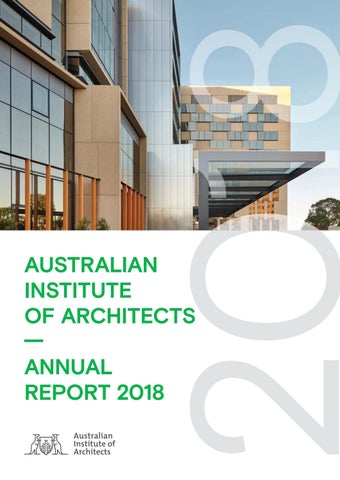
AUSTRALIAN INSTITUTE OF ARCHITECTS ANNUAL REPORT 2018
FROM THE COVER
2018 – SIR ZELMAN COWEN WINNER Bendigo Hospital by Silver Thomas Hanley with Bates Smart – Winner of the Sir Zelman Cowen Award for Public Architecture at the 2018 National Architecture Awards.
A WORLD-CLASS HEALTHCARE FACILITY FOR A GROWING REGIONAL COMMUNITY The reimagined Bendigo Hospital is the largest regional hospital development in Victoria, delivering a local world-class healthcare facility for a growing regional community. Integrating sustainable thinking into all design elements, the result is a welcoming, holistic and positive environment that promotes wellbeing. The well-documented power of nature in healing environments was integral to the design approach with landscaped courtyards, green roofs, indigenous gardens and views embracing the landscape characterising this vital civic building which is also home to important community facilities, including a childcare centre and 128 serviced apartments for family and staff. Employing a holistic framework considering the needs of patients, staff and the community, Bendigo Hospital offers a tranquil and caring environment through the integration of architecture, landscaping, health planning and evidence-based design. Photography: Peter Clarke and Shannon McGrath
2
AUSTRALIAN INSTITUTE OF ARCHITECTS_ ANNUAL REPORT 2018
CONTENTS PART ONE About Us
Who We Are
4
National President’s Report
6
Chief Executive Officer’s Report
8
Your Leaders
10
Membership
12
Respected Leadership
14
Advocacy with Impact
20
Direct Member Value
24
Strong and Viable Institute
28
Chapter Reports
29
Special Project - Venice Biennale
38
Part One is correct as at 31 March 2019
PART TWO 39
2018 National Architecture Awards: Monaro Mall Canberra Centre, Mather Architecture. Image: Dianna Snape
Financial Report
AUSTRALIAN INSTITUTE OF ARCHITECTS_ ANNUAL REPORT 2018
3
ABOUT US GOAL To make the world a better place through architecture
VISION A strong architectural profession that inspires clients and promotes community and the public interest through exceptional design and an ethical approach to the built environment
MISSION To develop and promote a strong architectural profession and be the public voice for architecture
The Australian Institute of Architects is the peak body for the architectural profession in Australia, representing more than 11,000 individual members and almost 2000 practice members around the country and abroad. Established as a national memberbased association in 1930, we support members at all stages of their careers, from students and graduates to registered practitioners, from those working in affiliate industries and
4
AUSTRALIAN INSTITUTE OF ARCHITECTS_ ANNUAL REPORT 2018
academia to those who have retired from practice and remain committed to the profession. Through the delivery of dedicated and tailored continuing professional development, awards and recognition programs to promote best practice outcomes and targeted advocacy to all levels of government on behalf of the profession and consumers, we strive for better, safer and more sustainable communities for all Australians.
WHO WE ARE 11,000+
INDIVIDUAL MEMBERS ARCHITECTS, GRADUATES, STUDENTS, ACADEMICS, AFFILIATES, RETIRED PRACTITIONERS
~2000
PRACTICE MEMBERS SOLE PRACTITIONERS, SMALL, MEDIUM AND LARGE PRACTICES
9
CHAPTERS
1
VISION
1
UNITED VOICE FOR THE PROFESSION
2018 National Architecture Awards: Nightingale 1, Breathe Architecture. Image: Kate Longley AUSTRALIAN INSTITUTE OF ARCHITECTS_ ANNUAL REPORT 2018
5
NATIONAL PRESIDENT’S REPORT The 2019 Annual General Meeting marks the commencement of the Australian Institute of Architects’ 90th year, a milestone we will celebrate in 2020. In 1929, the majority of the existing state architectural bodies came together to strengthen their voice, establishing a national presence. Formally registered in 1930, the Royal Australian Institute of Architects began its important mission of advocating for the profession and our communities. Here we are 89 years later continuing this legacy. This year we have progressed our vision to enable a strong and inspiring architecture profession, with a focus on design and community outcomes. Through research and increased public advocacy - especially in the areas of procurement, material safety, better planning, sustainability and housing affordability – the Institute is focused on raising the collective voice of our members. This year’s Annual Report offers a brief overview of the efforts we have made – and continue to make – to strengthen our profession on behalf of you, our 11,000 members. In 2018, we raised our public profile and awareness by championing issues of national importance. We will continue to advocate to the Commonwealth and state and territory governments, the importance of ensuring public safety in construction with the full and immediate implementation of the Shergold Weir Building Confidence report. When the Building Ministers’ Forum met this year - after failing to agree on these recommendations in 2018 – we called on them publicly to take decisive action. We also believe we are acting in the best interests of the community when we call for more affordable housing options. As architects, we see leading examples of what can be achieved when we put our minds and hearts to social good. We hosted a breakfast for politicians and policymakers at Parliament House to highlight these housing issues for all Australians, inviting industry colleagues PowerHousing Australia and Master Builders Australia to join the conversation.
6
AUSTRALIAN INSTITUTE OF ARCHITECTS_ ANNUAL REPORT 2018
Turning the spotlight on consumers and small business, we took a lead in exposing the unwarranted challenges members were facing with architect-administered contracts. Drawing from data collected in a dedicated member survey, our submission to the banking Royal Commission outlined the negative impact bank lending practices are having on projects and the profession. We continue to liaise with the Australian Banking Association in order to educate and hopefully change lending practices. Further advocacy through research was delivered this year with our Expressions of Interest and Requests for Tender for Architectural Services research project with best practice guidelines developed for members and our clients. A national survey on novation is also underway to further our research into the procurement of architecture. It is essential that we are valued as thought leaders of the industry and evidence-based research provides a platform for us. As 2019 marches on, we as an Institute will continue to oppose the demolition of Denton Corker Marshall’s Australian War Memorial Anzac Hall. This, and our voice against the use of the iconic sails of the Sydney Opera House for inappropriate advertising, highlights how we as architects can inspire the community and protect the public interest. I am proud to have represented you as the National President for 2018. It has been a great opportunity to take a broad perspective on the many issues we face as professionals. Thank you to the Board and National Council for their tireless commitment to the organisation in this period of transformation - it has been a busy and rewarding time.
AS ONE VOICE, WE CAN PROVIDE THE SKILLS, INSIGHTS AND KNOWLEDGE TO ADVANCE US AS A PROFESSION AND THE COMMUNITY
RAISING OUR PUBLIC PROFILE AND AWARENESS BY CHAMPIONING ISSUES OF NATIONAL IMPORTANCE We are very pleased to welcome Julia Cambage as our new Chief Executive Officer, who will continue to build the Institute’s capacity and influence with her strategic mindset and leadership. She leads a dedicated team within the Institute, who have a renewed focus on services and advocacy for you, our members. Finally, thank you to you, our members, for your support, engagement and feedback. The volunteer effort you contribute underpins the Institute’s voice. I know incoming National President Helen Lochhead will continue to deliver strong leadership and continue our goal to make the world a better place through architecture. Working together, with one voice, we have the expertise, skills, insights and knowledge to advance the profession and serve the community, through our built environment. Thank you. Clare Cousins 79th National President
AUSTRALIAN INSTITUTE OF ARCHITECTS_ ANNUAL REPORT 2018
7
CHIEF EXECUTIVE OFFICER’S REPORT After almost 90 years representing Australia’s architecture profession, the Institute has entered a new and exciting phase. Years of planning and effort have gone into the development of a strategic vision for your membership organisation. Now we are delivering on it. With the backing of more than 11,000 members across Australia and overseas, we are absolutely committed to developing and strengthening your profession and being its public voice. Since joining the Institute in February, I have been impressed at the significant efforts expended on policy. We have a well-defined vision and a growing policy platform and are building the structures to back it up. In order to continue to provide the best member benefits, we need to ensure optimal internal structures, processes and management systems for dynamic service delivery. When we have effective procedures in place, we are better placed to efficiently distribute the member services that are at our core. We are dedicated to assisting and advancing our members: architects and those dedicated to the profession including students, graduates, affiliates and academics.
AS YOUR INSTITUTE, WE WILL CONTINUE TO ADVOCATE FOR BEST PRACTICE AND ENSURE YOUR VOICE IS HEARD ON POLICY Images courtesy: Red Brick Media
8
AUSTRALIAN INSTITUTE OF ARCHITECTS_ ANNUAL REPORT 2018
Our focus is on maintaining and enhancing our value to you through a professional, diverse, resourced and collegiate workforce. To this end, we have revised and renewed the important information available for continuing professional education. The updated Acumen Practice Notes provide almost 800 up-to-date documents to facilitate best practice design, business skills and project management. I thank the Acumen Content Review Panel, Digital Transformation Steering Group, National Practice Committee and our staff for their ongoing effort and energy in preparing and distributing these resources. The updated Acumen portal on our website lays out these notes in an easy-to-use way that can be searched or saved. In December, we incorporated almost 200 Environment Design Guide notes into the Acumen portal in its own dedicated Environment section – making Acumen an even more comprehensive practice tool. I commend them to you. After delivering on this project, we have now set about transforming the overall website to ensure it best reflects our strategic vision. Our brand is also being refreshed. Over many years, new programs and services have been developed across the country often with their own identity and no synergy with the Institute’s core brand – resulting in a complex environment for staff and members. We have undertaken a review and over the coming months you will notice a more consistent and streamlined brand that better reflects the profession we proudly support. As your Institute, we will continue to advocate for best practice and ensure your voice is heard on policy. We will also keep on championing our profession’s achievements and innovations to inspire the public and highlight the best of our industry. As National President Clare Cousins outlines in her report, we have raised the issues of public safety in construction, affordable housing, sustainability, urban planning, fairness for architecture small businesses, and heritage protection. We have prosecuted these arguments through thought leadership, and used traditional and social media channels to engage. We have been an important element of the national built environment professional landscape since 1930. We are proud of our place in history and our achievements. However, we need to constantly ensure we remain relevant to the needs of you, our members, and the wider community.
Images courtesy: Red Brick Media
WE WILL KEEP ON CHAMPIONING OUR PROFESSION’S ACHIEVEMENTS AND INNOVATIONS TO INSPIRE THE PUBLIC AND HIGHLIGHT THE BEST OF OUR INDUSTRY This quarter will be a significant time for the Institute, as many of these changes roll out. We are also preparing to relaunch the Client Architect Agreements to create streamlined and efficient business practices for members. The Australian Standards reference service will be hosted on a new digital platform to provides users (A+ members) with greatly enhanced functionality and facilitate improved compliance performance. As 2019 continues, I look forward to getting to know more members and thanking them personally for their ongoing efforts. In our mission to develop and promote architects I endeavour to collaborate with other groups. This will amplify our message and boost our policy promotion efforts. Together we will be the public voice for high-quality architecture and built environment that improves the life of individuals, communities and the nation. Julia Cambage Chief Executive Officer
AUSTRALIAN INSTITUTE OF ARCHITECTS_ ANNUAL REPORT 2018
9
YOUR LEADERS BOARD OF DIRECTORS
Mr Richard Kirk LFRAIA Immediate Past President
Ms Clare Cousins FRAIA National President
Prof Helen Lochhead FRAIA President Elect
Ms Vanessa Bird FRAIA National Council Elected Director
Mr Andrew Broffman RAIA Interim Independent Director
10
AUSTRALIAN INSTITUTE OF ARCHITECTS_ ANNUAL REPORT 2018
Mr Justin Hill FRAIA National Council Elected Director
Ms Genevieve Overell Independent Director
Ms Giselle Collins Independent Director
NATIONAL COUNCIL
Mr Paul Trotter FRAIA Qld President
Mr Philip Leeson FRAIA ACT President
Ms Kathlyn Loseby FRAIA NSW President
Mr Tony Giannone FRAIA SA President
Mr Shamus Mulcahy RAIA Tas President
Mr Peter Hobbs RAIA WA Chapter President
Ms Samantha Cotterell RAIA International Chapter Chair
Ms Jenny Culgan RAIA NT President
Ms Amy Muir RAIA Vic President
Thom McKenzie RAIA EmAGN President
BOARD MEMBERS ALSO ON COUNCIL Ms Clare Cousins FRAIA National President Ms Gina Engelhardt SONA President
Ms Alice Hampson FRAIA Nationally Elected Councillor
Mr Angelo Candalepas FRAIA Nationally Elected Councillor
Mr Richard Kirk LFRAIA lmmediate Past President Prof Helen Lochhead FRAIA National President Elect
EXECUTIVE TEAM
Ms Vanessa Bird FRAIA Nationally Elected Councillor Mr Justin Hill FRAIA Nationally Elected Councillor
Ms Julia Cambage Chief Executive Officer
Mr Barry Whitmore – Chief Financial Officer and Company Secretary
Ms Kim Hilliard – General Manager Chapter Operations
Mr Michael Linke – General Manager Membership Services
Ms Libby Hasler – General Manager People and Culture
Mr Ian Kynaston Chief Information Officer
AUSTRALIAN INSTITUTE OF ARCHITECTS_ ANNUAL REPORT 2018
11
MEMBERSHIP 2018 11,138 1948 4%
INDIVIDUAL MEMBERS A+ PRACTICES
INCREASE IN ARCHITECT MEMBERS
8
Affiliates
7% Students
66% Architects
12
INCREASE IN TOTAL MEMBERS NEW FELLOWS
The Institute has experienced a strong growth in almost all member categories over the past year, with some fluctuation in student numbers resulting from changes to price and structure.
7%
Graduates
9% 4%
INCREASE IN AFFILIATE MEMBERS
54
NEW LIFE FELLOWS
MEMBERSHIP BY TYPE
20%
9%
INCREASE IN GRADUATE MEMBERS
AUSTRALIAN INSTITUTE OF ARCHITECTS_ ANNUAL REPORT 2018
To better support our next generation of practitioners and design professionals, we’ve introduced an appropriate cost-structure for our student members for 2019, with the annual SONA membership now priced at an affordable $30. This more accessible price point has resulted in a significant increase in student membership for 2019, providing opportunity for more students to engage early with the profession and get a headstart in their career. In the interest of collaboration and inclusion, we've opened up eligibility for membership to students in architecture related courses across Australia. SONA membership now also provides students from disciplines such as landscape architecture, engineering, planning, interior design or urban and environmental design, invaluable exposure to the profession.
NT 63 MEMBERS (1%)
INTERNATIONAL 506 MEMBERS (5%)
MEMBERSHIP BY LOCATION
QLD 2001 MEMBERS (18%)
WA 1012 MEMBERS (9%)
NSW 3206 MEMBERS (29%) SA 650 MEMBERS (6%) VIC 3091 MEMBERS (28%)
ACT 306 MEMBERS (3%) TAS 303 MEMBERS (3%)
In 2018, we launched a membership review with the aim of revising our membership categories, fees and benefits to provide more aligned value for our members. Following early consultation with members of National Council, Chapter Councils and the National Practice Committee, an invitation was sent to all members to participate in an online survey, seeking feedback on what products and services they value, their reasons for belonging to the Institute and expectations for how the Institute can support members throughout their careers. The results of this engagement will be used to develop a new structure and value proposition which will be presented to the membership for adoption in the second half of 2019. These are just some of the steps we’re making to ensure we remain relevant and inclusive for the diverse range of members that constitute our profession, and we look forward to sharing more as work on our membership review progresses.
TO ENSURE WE REMAIN RELEVANT AND INCLUSIVE FOR THE DIVERSE RANGE OF MEMBERS THAT CONSTITUTE OUR PROFESSION AUSTRALIAN INSTITUTE OF ARCHITECTS_ ANNUAL REPORT 2018
13
RESPECTED LEADERSHIP ↑20%
INSTAGRAM FOLLOWERS
↑38%
LINKEDIN FOLLOWERS
180,000+
FACEBOOK ENGAGEMENTS
160,000+ TWITTER IMPRESSIONS
72,000+
TOTAL INSTAGRAM FOLLOWERS
34%
OPEN RATE EMAIL COMMUNICATIONS VS INDUSTRY AVERAGE 20%
3.4%
EMAIL CLICK THROUGH RATE VS INDUSTRY AVERAGE 2.8%
14
AUSTRALIAN INSTITUTE OF ARCHITECTS_ ANNUAL REPORT 2018
At the Institute, we’re growing the status and reputation of architects as leaders in all aspects of the built environment, planning and design.
MOST POPULAR INSTAGRAM POST
We’re collaborating with like-minded groups to amplify our voice, getting the right policies in place for a better Australia.
9O+
MEETINGS WITH ALLIED INDUSTRY BODIES
To this end, we’ve worked with PowerHousing Australia and Master Builders Australia to deliver our united message on housing affordability to the heart of national policy decision-making, Parliament House. We launched a public campaign to support the protection of the Australian War Memorial’s Anzac Hall and the Sydney Opera House. We’re also responding to members’ desire for more feedback with regular newsletters and advocacy alerts. Through our chapter and national gender equity committees and taskforces, we continue to champion for equity and diversity within the architectural profession. Our various mentoring initiatives provide popular one-on-one and group opportunities for our students, graduates, emerging architects and those re-entering the workforce as well as our established professionals who enjoy sharing their experiences and learnings.
130+
MOST POPULAR TWITTER POST
MENTORS
200+
MENTEES
AUSTRALIAN INSTITUTE OF ARCHITECTS_ ANNUAL REPORT 2018
15
NATIONAL AWARDS
975
PROJECTS ENTERED
Championing the outstanding achievements of our profession is one of the Institute’s core functions and most satisfying tasks.
69
Our rigorous, peer-reviewed awards programs highlight the depth and breadth of excellence in Australia’s architecture profession.
SHORTLISTED ENTRIES
12
The projects, spanning residential, commercial, public space architecture and more, provide an annual showcase of the best in the field.
NAMED AWARDS
Innovations are shared and leaders are made in the national, chapter and regional awards series.
20
The resulting media coverage also highlights these achievements to a broad audience.
NATIONAL AWARDS
In 2018, 975 projects were entered into the Awards, an Institute record. This yielded a national shortlist of 69. There were 12 named award winners, 20 national awards and eight national commendations.
8
NATIONAL COMMENDATIONS 1_
National Jury Chair Richard Kirk said the winners demonstrated the transcendent nature of architecture on its surroundings. ‘Projects at this level are all accomplished but it was those that could demonstrate their value broadly, beyond the limits of the brief and the confines of the site, which were nationally recognised,’ he said. ‘Most impressive were projects that established new design benchmarks and whose influence can be of value to the broader community, leading to positive change in our built environment.’
1_ Optus Stadium, HASSELL COX HKS. Image: Peter Bennetts
2_
2_ Australian Embassy Bangkok, BVN. Image: John Gollings
16
AUSTRALIAN INSTITUTE OF ARCHITECTS_ ANNUAL REPORT 2018
The Institute thanks the national jury for its consideration and efforts. The 2018 national jury was KIRK Director Richard Kirk, Victorian Government Architect Jill Garner, Architecture Media Editorial Director Katelin Butler, Charles Wright Architects Director Charles Wright, and BNV Principal Kevin O’Brien.
3_
4_
3_ Cabbage Tree House, Peter Stutchbury Architecture. Image: Michael Nicholson 4_ Gold Coast Sports and Leisure Centre, BVN. Image: John Gollings 5_ Northshore Pavilion, AOG Archetal. Image: Christopher Frederick Jones 6_ Aquatic Centre, Liquid Blue Architects. Image: Angus Martin Photography
CHAPTER AWARDS
5_
7_ Sorrento Visitor Centre, Workshop Architecture. Image: John Gollings
3200+
ATTENDEES CELEBRATING THE BEST IN LOCAL ARCHITECTURE
203
CHAPTER AWARD WINNERS
The National Awards followed on from each Chapter’s state and territory ceremonies, with 203 projects from around the country and overseas progressing to national judging.
6_
These events were enjoyed by over 3200 attendees, including members, guests, media, allied professionals and government representatives, extending the reach of the Institute’s coverage, and showcasing local architectural talent to local audiences through extensive traditional media reporting and social media coverage.
7_ AUSTRALIAN INSTITUTE OF ARCHITECTS_ ANNUAL REPORT 2018
17
NATIONAL PRIZES
1_
In 2018, the Institute’s highest individual honour - the Australian Institute of Architects Gold Medal - was awarded to Emeritus Professor Alec Tzannes AM for his exceptional body of work across a broad spectrum of architectural practice and his exemplary service and leadership within the profession, academia and related fields. A range of national prizes were bestowed to leaders within the profession from students to esteemed practitioners, recognising the outstanding contributions of members across all areas of architecture and practice.
2_
GOLD MEDAL Alec Tzannes AM LFRAIA – Tzannes (NSW)
NATIONAL PRESIDENT’S PRIZE Prof Rob Adams AM LFRAIA – City of Melbourne (Vic)
PAULA WHITMAN LEADERSHIP IN GENDER EQUITY PRIZE
3_ 4_
Melonie Bayl-Smith FRAIA – Bijl Architecture (NSW)
NATIONAL EMERGING ARCHITECT PRIZE Christina Na-Heon Cho RAIA – Cox Architecture (Qld) Monique Woodward RAIA – WOWOWA Architecture (Vic)
WILLIAM J MITCHELL INTERNATIONAL CHAPTER PRIZE Dr Liu Thai Ker FRAIA – Morrow (Singapore)
1&2_ Gold Medal: Alec Tzannes AM LFRAIA 3_ National President’s Prize: Professor Rob Adams AM LFRAIA 4_ National Emerging Architect Prize: Christina Na-Heon Cho 5_ Dulux Study Tour: Berlin 6_ Dulux Study Tour: London
5_
18
AUSTRALIAN INSTITUTE OF ARCHITECTS_ ANNUAL REPORT 2018
6_
7_ Student Prize for the Advancement of Architecture
AWARDS
8_ Student Prize for the Advancement of Architecture: Troy Borg 9_ Dulux Study Tour: Berlin 10_ Dulux Study Tour: Milan 11_ Dulux Study Tour
7_
STUDENT PRIZE FOR THE ADVANCEMENT OF ARCHITECTURE Troy Borg – RMIT (Vic)
STUDENT PRIZE FOR THE ADVANCEMENT OF ARCHITECTURE COMMENDATION
8_
Paul Violett – University of Queensland (Qld)
DULUX STUDY TOUR Kim Bridgland RAIA – Edition Office (Vic) Leah Gallagher RAIA – Kin Architects (Qld) Jason Licht RAIA – Cumulus Studio (Tas) Joseph O’Meara RAIA – BVN (NSW) Dirk Yates RAIA – Speculative Architecture (Qld)
9_
PUBLIC ENGAGEMENT AND PROMOTION OF ARCHITECTURE
The Institute continues to engage with the broader community in events designed to grow the appreciation and respect for the profession, showcasing the best works architects can produce.
10_
The Open House programs in Tasmania, Victoria, Queensland and Western Australia attracted thousands of architecture and design enthusiasts to public and private buildings in their states. Other popular collaborations included the Festival of Architecture and Design in SA; Design Canberra Festival; Solar House Day in Canberra; and MPavilion in Victoria, many featuring Institute-led tours, talks and public forums promoting architecture, generating significant media coverage, public exposure and goodwill.
11_
AUSTRALIAN INSTITUTE OF ARCHITECTS_ ANNUAL REPORT 2018
19
ADVOCACY WITH IMPACT 162
MEETINGS WITH POLICYMAKERS FROM LOCAL, STATE/TERRITORY AND FEDERAL GOVERNMENTS
112
SUBMISSIONS, LETTERS AND PRESENTATIONS TO ALL LEVELS OF GOVERNMENT
310
MENTIONS IN AUSTRALIAN NEWSPAPERS
2
BUILDING MINISTERS’ FORUMS – PARTICIPATION
The Age | 25 January 2018
QUALITY FEARS AS TOWERS HIT RECORD HIGH Vanessa Bird said apartment living close to work, transport and infrastructure was “more sustainable than continually releasing green field sites further and further away from services” but that the finished product was lacking. Vanessa Bird, Victorian President
The Mercury | 6 March 2018
HOBART DESERVES A CLEAR VISION We need quality development to maintain and enhance the natural and built environment that makes our state so special and attractive to visitors. Jennifer Nichols, Executive Director Tasmania
20
AUSTRALIAN INSTITUTE OF ARCHITECTS_ ANNUAL REPORT 2018
49
MEDIA RELEASES
1
VOICE
ADVOCACY HAS BEEN A KEY FOCUS FOR THE INSTITUTE, ENSURING THE RESPECTED VOICE OF THE ARCHITECTURE PROFESSION IS HEARD
The Advertiser | 20 June 2018
DON’T TAKE FOR GRANTED WORLDCLASS REPUTATION Different states have different policies around how much green space they should have, or how to access public transport – if we are truly serious about creating healthy, liveable cities, we need to come up with some agreement (on policies).
The Australian | 21 March 2018
ENERGY-EFFICIENT FLATS ‘WAY OF THE FUTURE’ Too many Australian homes continue to be built to a standard well below the level of energy performance and sustainability of which we are capable. They are creating a legacy of higher-cost and poorly performing building stock for generations to come.
Mario Dreosti, SA President
Herald Sun | 29 June 2018
NOW FOR THE EXTENDED FAMILY HOME Amy Muir said this shift in the design of the family home had been “governed by our ageing population, and the inability for the younger generation to access the housing market”.
Richard Kirk, National President
Amy Muir, Victorian President
Sydney Morning Herald | 6 April 2018
The Australian | 9 August 2018
HAPPY MEDIUM: NEW HOUSING CODE ALLOWS FAST TRACK ON TERRACES
ARCHITECTS PRESS MINISTERS FOR GREENER AND SAFER CODE
Some of the biggest conflicts at the moment are where we have multi-residential [development] smashing right up against suburban development, and the idea of a missing middle can be a good way of transitioning between one scale and another.
The Grenfell tragedy demonstrated, in the starkest and most distressing way, the dire and indeed fatal consequences of not properly regulating and enforcing compliance with the highest standards of building construction.
Andrew Nimmo, NSW President
Richard Kirk, Immediate Past President
The Australian | 7 May 2018
The Australian | 17 August 2018
STATE LASHED FOR LACK OF UNIT DESIGN GUIDELINES In the next 10 years, almost 60 per cent of the population will be living in apartments. The challenge for the next generation of these towers is how to get the quality improved so there’s greater diversity. Richard Kirk, National President
REQUIEM FOR DARWIN: GOVERNMENT ARCHITECT PREDICTS ‘GHOST TOWN’ KILLED BY BUREAUCRATS We don’t have a population problem. We have a conceptual problem about how we address population growth through design. Alec Tzannes, 2018 Gold Medallist
AUSTRALIAN INSTITUTE OF ARCHITECTS_ ANNUAL REPORT 2018
21
Advocacy has been a key focus for the Institute this year, ensuring the respected voice of the architecture profession is heard on relevant public policy matters.
The Australian | 20 August 2018
ARCHITECTS SLAM MINISTERS OVER CLADDING FORUM Best-practice regulation and compliance with the National Construction Code is critical or the whole industry’s reputation, and the hundreds of thousands of jobs it supports will be jeopardized. Richard Kirk, Immediate Past President
The West Australian | 22 August 2018
DESIGN FOR GOOD PLANNING Design WA is long overdue, and we urge Planning Minister Rita Saffioti to expedite it to provide certainty to the industry, and to protect the role of design in shaping the future of our communities. Suzanne Hunt, WA President
AAP | 1 November 2018
WAR MEMORIAL OVERHAUL GETS GO-AHEAD Bringing in the bulldozers to destroy such an investment - of effort, of culture and at the end of the day, taxpayer dollars - is a colossal waste and mark of disrespect. Clare Cousins, National President
Many important issues were raised throughout 2018 as part of our mission to increase the public standing of the role, skills and knowledge of architects.
ISSUES We continue to be a passionate advocate of public safety in construction, affordable housing, sustainability, effective urban planning, ensuring equity for architects running small businesses and the protection of our built environment heritage.
SAFETY One of the most important advocacy areas has revolved around safety, amid ongoing fallout from Melbourne’s Lacrosse Tower fire in 2014 and the Opal Tower building defects in late 2018 in Sydney. In these high-profile issues, the Institute has maintained the position that safety must be prioritised in any solution. To this end, the Institute supported the immediate and full rollout of the 24 recommendations contained in the Building Confidence report by Peter Shergold and Bronwyn Weir. This includes registration and training of all parties in the construction process, ensuring fire authorities are involved, certification for high-risk products, and the collection and sharing of information. The Institute’s leadership attended multiple Building Ministers’ Forums to press these positions.
HERITAGE Australian Financial Review | 2 November 2018
WAR MEMORIAL A PRIORITY: STOKES The apparent secrecy surrounding the plans, which were reportedly being explored since 2015, together with the complete lack of consultation is hugely disturbing. Clare Cousins, National President
The Institute has taken a front-and-centre role in championing Australia’s significant built environment heritage. In October, when the Sydney Opera House’s globally iconic sails were used as a billboard to advertise horseracing, we condemned this exploitation of Australia’s most famous building. In addition, we condemned the Australian War Memorial’s wasteful and inappropriate proposal to demolish the award-winning Anzac Hall in its $500 million refurbishment. Together with other prominent voices, the Institute will continue to advocate #HandsoffAnzacHall.
AFFORDABLE HOUSING AND SUSTAINABILITY The Institute continues to advocate strongly for better urban planning, housing affordability and sustainability. Drawing on the profession’s unique perspective, we’ve advocated for incentives for the nascent Build-To-Rent sector, while championing better planning and design, together with increased funding for social housing. 22
AUSTRALIAN INSTITUTE OF ARCHITECTS_ ANNUAL REPORT 2018
To further highlight the issue, the Institute hosted a breakfast at Parliament House in early 2019 for MPs, Senators and sector leaders, with Clare Cousins leading an expert panel comprising Nicola Lemon, Chair of PowerHousing Australia and Denita Wawn, CEO of Master Builders Australia.
Email: Advocacy Update – Banking Royal Commision Australian Institute of Architects
The Institute will continue to press for increased sustainability measures in property and national policy in order to harness the long-lasting opportunities for progress within the built environment.
BANKING ROYAL COMMISSION Finally, the unfair financial position of architect-administered contracts when applying for construction loans was raised directly with Australian Banking Association chief executive officer Anna Bligh and in a submission to the Hayne Royal Commission.
At a chapter level, the Institute was also very active on a range of policy areas through public statements, over 90 submissions and almost 150 meetings with government officials. Under our current Strategic Plan, we recognised that the collective voice of architects – backed by evidence and research - is an effective vehicle for better policy engagement. To be influential, the Institute must be heard. As we enter 2019, we will continue to engage with policymakers, politicians and other stakeholder groups at all levels of government, pressing these issues and ensuring the architecture profession remains a respected and significant voice.
2018 National Architecture Awards: Main Beach, Virginia Kerridge Architect. Image: John Gollings
IF MORE ARCHITECTADMINISTERED CONSTRUCTION LOANS WERE APPROVED, IT WOULD ENSURE THAT MORE BUILDINGS ARE CONSTRUCTED TO THE HIGHEST STANDARD, DESIGNED AND OVERSEEN BY QUALIFIED ARCHITECTS, WHICH WOULD, ON THE WHOLE, OFFER GREATER CONSUMER PROTECTION. Clare Cousins, Joint submission to Royal Commission AUSTRALIAN INSTITUTE OF ARCHITECTS_ ANNUAL REPORT 2018
23
DIRECT MEMBER VALUE
ACUMEN PRACTICE NOTES In 2018, we strengthened our commitment to the ongoing professional education and training of architects and launched the revitalised Acumen Practice Notes online portal. These resources and strategies provide up-to-date information to facilitate best-practice design, business skills and project management. This was a major project, and we thank all stakeholders for their input into these notes. Over 800 notes are available on a range of topics relevant to the practical challenges and realities faced by working architects. Helpful case studies also give insights into previous projects, from the perspective of peers. Later in the year, these practice notes were boosted with an Environment section, providing design notes on the sustainability of the built environment, and incorporating almost 200 notes from our popular Environment Design Guide. As well as providing up-to-date contemporary guides, Acumen Practice Notes is easy to access, with searchable and savable content in a user-friendly layout. Content on the portal is reviewed regularly by the Institute’s dedicated Knowledge Services editorial team. Member representatives on the Acumen Content Review Panel (ACRP) and the Institute’s various technical advisory groups, including the National Practice Committee, Chapter Practice Committees and National Access Working Group, also continue to advise on the material.
24
AUSTRALIAN INSTITUTE OF ARCHITECTS_ ANNUAL REPORT 2018
800
ACUMEN PRACTICE NOTES
205 298 76
PRACTICE NOTES
PROJECT NOTES
RESOURCE NOTES
204
ENVIRONMENT NOTES
38
7
UPDATED NOTES AND NEW NOTES IN 2018
CONTRACTS AND AGREEMENTS
BENCHMARKING
In 2018, we released the latest edition of Australian Building Industry Contracts (ABIC), developed in partnership with Master Builders Australia. Highlights of ABIC 2018 include:
Institute membership continues to provide access to comparison website, benchmarking.com.au, which provides tailored insights into individual business performance against the wider industry.
•
New provisions to clarify who owns demolished and unfixed materials on site;
•
New provisions to clarify rights and obligations associated with owner-supplied materials;
•
Amendments which clarify deposit arrangements under residential contracts;
•
Further improvements to clarify payment arrangements and obligations with reference to Security of Payment legislation; and
•
Improved formatting.
We are proud to be launching a revised Client and Architect Agreement with an accompanying short form version in April 2019.
AUSTRALIAN STANDARDS Direct access to Australian Standards through SAI Global’s Australian Standards quick reference service is a popular benefit for A+ members. Throughout 2018, substantial work was undertaken by the Institute to redevelop the digital platform, providing greatly enhanced functionality including the ability to identify where standards are referenced in the National Construction Code. The new platform is due for release in the first half of 2019.
The annual benchmarking survey is now in its sixth year and is growing in popularity with architecture firms.
A SNAPSHOT OF THE PROFESSION
25%
average growth rate for the architecture industry over the past five years
63%
expect to see >10% increase in revenue in 2019
20%
anticipated decrease in 2019 in multi-residential work compared with 2017 expectations is offset by expected increases spread across residential, aged care, local government and health projects
CLIENT BASE
3% 5%
Heritage
3% Urban Design
26%
Small Projects
7%
Resi single
Interiors
16% Public
19% Resi multi
21% Commercial
2018 National Architecture Awards: Barangaroo House, Collins and Turner. Image: Rory Gardiner AUSTRALIAN INSTITUTE OF ARCHITECTS_ ANNUAL REPORT 2018
25
CPD The Institute values ongoing professional development and education and encourages architects to engage with their colleagues through learning. In order to fulfil our members’ professional development requirements, we design and deliver a comprehensive suite of online and face-to-face CPD and education opportunities. The National Seminar Series is a selection of high-quality practical briefings delivered across Australia, covering the competency standards of design, documentation, project delivery and practice management. Institute Chapters also hosted their own events for professional development, including the New South Wales Regional Conference which was held in October 2018. The Institute’s online learning platform offers 24/7 access to more than 70 premium on-demand courses, accessed by thousands of architecture professionals at their convenience. New courses in 2018 ranged from Architecture, Urban Anxiety and Cultural Divergence, to Understanding the Changes to the National Construction Code, Getting the Right Fit: From Briefing to Specification, and Safety in Design. Institute members can also access an extensive range of curated third party CPD delivered via our Refuel CPD provider network. Our comprehensive Practice of Architecture Learning Series supported over 400 graduates nationally preparing for the registration exams as well as architects re-entering the workforce after a break. 26
AUSTRALIAN INSTITUTE OF ARCHITECTS_ ANNUAL REPORT 2018
240+ 9300+ 70+
CPD EVENTS
ATTENDEES
CONTINUUM COURSES AVAILABLE ONLINE 24/7/365
406
PALS PARTICIPANTS
NATIONAL CONFERENCE – EDGE
MORE THAN
1000 6 5
DELEGATES INTERNATIONAL SPEAKERS
AUSTRALIAN SPEAKERS
2
DAYS
In 2018, we presented our annual flagship event, the National Architecture Conference. Under the banner of Edge, the conference delved into the ability of architecture to impact people’s quality of life across homes, cities, regions, and the environment.
Edge featured renowned, engaging and expert architects from Australia and abroad. Presenters included:
Attended by more than 1000 delegates from across the country, the two-day program provided a forum for discussion, learning and networking. Curated by leading Australian architects Brett Saville FRAIA, Barry Lee FRAIA and Wei Jien FRAIA, the Gold Coast-based conference heard from internationally renowned speakers and Australian champions of the industry. Wolf Prize-winning architect Moshe Safdie presented the keynote address on the history of densification in China and South East Asia, outlining how there has been a ‘dramatic deterioration of the public realm’. This highlighted the broad overview architects can offer on social issues and achieved strong media coverage. China-based Roberto Bannura revealed the techniques his firm employs in the modelling phase and discussed how architecture can respond to the challenges of rapid growth. Borja Ferrater, a founding partner of the Office of Architecture in Barcelona in Spain, explained how the edges of urban environments were their own ecosystems. Formal and informal CPD points were available at the conference.
•
Director, Bark Architects Australia, Lindy Atkin
•
Partner, Steven Holl Architects China, Roberto Bannura
•
Founder and Managing Director, Bunnag Architects Thailand, ‘Lek’ Mathar Bunnag
•
Director, Susan Dugdale and Associates Australia, Sue Dugdale
•
Architect, Partner Office of Architecture in Barcelona (OAB) Spain, Borja Ferrater
•
Partner, MGS Architects Australia, Eli Giannini
•
CEO, BVN New South Wales, James Grose
•
Co-Directors, MOREAU KUSUNOKI ARCHITECTES France, Nicolas Moreau + Hiroko Kusunoki
•
Director, Spaceagency United Kingdom, Sarah Manning
•
Principal, Safdie Architects USA, Moshe Safdie
•
Professor of Urban Transport and Public Health, University of Melbourne Australia, Prof Mark Stevenson
In 2019, the Institute is looking forward to hosting the Collective Agency National Conference in Melbourne, to be curated by Monique Woodward and Stephen Choi. The 2019 Conference will examine professional aspirations with a celebration of projects inside and outside of architecture enabling contribution and empathy. A range of over 30 international and Australian speakers has been secured.
AUSTRALIAN INSTITUTE OF ARCHITECTS_ ANNUAL REPORT 2018
27
STRONG AND VIABLE INSTITUTE We will be providing training and induction for these new organisational structures, enabling our staff to deliver efficient projects faster, and within budget. We’re focused on delivering a strong and viable Institute to continue to represent members and advocate for a better world through architecture.
Your Institute is staffed by dedicated professionals who are committed to furthering the goals and vision of the architecture profession.
Following the successful first-year implementation of our Strategic Plan, we’re now reviewing our internal processes and governance to ensure that member interests remain at the core of all we do.
Our advocacy and education rely on the ongoing resilience of the organisation, underpinned by contemporary business practices.
We’re guided by our vision of an enduring architecture profession that actively uses its member knowledge and expertise to promote the value of architecture to the public. To do that, we’re ensuring we maintain our communications capacity to be that strong voice. We're currently reviewing our structures, developing charters and updating our terms of reference and operational guidelines for: •
National Council and National Committees
•
State/Territory Chapters and State/Territory Committees
•
Board of Directors and Sub-committees
These governance changes will enable us to improve our engagement with members and to maintain a strong focus on achieving our strategic goals.
220+
COMMITTEE AND COUNCIL MEETINGS DRAWING ON THE EXPERTISE OF MEMBERS TO ADVISE AND SUPPORT OUR VARIED INITIATIVES AND PROVIDE OPPORTUNITY FOR PEER-TO-PEER ENGAGEMENT
28
AUSTRALIAN INSTITUTE OF ARCHITECTS_ ANNUAL REPORT 2018
We want to attract and retain the best people for these jobs and have introduced new ways to do so. Our employee value proposition – the benefits our people accrue as a result of their efforts, skills and experience – has been overhauled. We’ve introduced reward and recognition programs, flexible working environments, learning and development programs and talent management strategies, with an ongoing commitment to gender equity.
OUR STREAMLINED BRAND We’ve streamlined our brand to better reflect our role as the peak body for the architectural profession. With countless products, services and groups across the organisation, it’s easy for our brand to lose focus, so we’ve set about reaffirming our core values and purpose through our visual identity – creating a brand that makes members proud. You’ll start to see this brand in action throughout 2019, starting with this Annual Report. Our crest, reflecting our proud history, is the masterpiece and is now accompanied by a refreshed and simplified colour palette and font. Our pivotal member groups, such as EmAGN and SONA will now be more clearly aligned with the Institute while many of our programs and services will be easier to identify.
CHAPTER REPORTS
ACT With its dynamic group of members and staff, the ACT Chapter is proud to have delivered a suite of activities of national and local significance which promote the importance of architecture and the profession to the community and key decision-makers. Delivered since 1961, the 2018 prestigious Griffin Lecture on architecture was delivered by self-acclaimed design nerd Tim Ross at the National Press Club. The lecture was televised nationally by ABC TV and available on iView. The Contemporary Australian Architecture Speaker Series, held in partnership with the National Gallery of Australia, continues to bring issues at the forefront of architectural design to architects and non-architects alike. Headline speakers included Richard Hassell of WOHA Singapore, with more than 1000 people attending. Our Solar House program is very popular, including ‘architect speed-dating’, a public exhibition, lectures and sell-out weekend bus tours. The Chapter sponsored and participated in Design Canberra, which celebrates design and architecture throughout November. Our engagement with government throughout the year continued, involving policy advice and submissions on housing diversity and densification, housing affordability, apartment quality, development application processes, the City and Gateway Draft Urban Design Framework, and Stage Two of the ACT Light Rail Project. Led by our President, our members also presented at parliamentary inquiries and we held a President’s Lunch with the ACT Minister for Building Quality Improvement. Our committees are the cornerstone of our policy activity. Notably, the booklet getDEEP was launched by our Diverse Equitable Employment and Practice taskforce in March. We were appalled at the news that award-winning Anzac Hall is to be demolished as part of the Australian War Memorial’s $500M expansion plans and in response, we have supported an Institute campaign to stop this proposed action through meetings with local MLAs and media coverage. We’ve increased our social media through platforms such as Instagram, Facebook and Twitter and continue to passionately support our members and the architecture profession.
AUSTRALIAN INSTITUTE OF ARCHITECTS_ ANNUAL REPORT 2018
29
CHAPTER REPORTS
INTERNATIONAL 2018 was a year of major milestones and new beginnings for the International Chapter and its growing membership. After many years of hard work by national and international members, 2018 proved to be a most successful and historic year for the Institute. At the May 2018 Annual General Meeting, members voted unanimously to recognise the former International Area Committee as the newest Institute chapter. With this came a concerted effort by Chapter Councillors and Institute staff to work diligently to establish the operational framework for the chapter and build member awareness through an increased program of member engagement activities, including enhanced communication and social media activities – all of which is aimed at driving membership value and growth. The Chapter successfully expanded its member engagement, with two Boarding Pass events in Dubai, and others in London and Singapore. The 2018 International Chapter Architecture Awards and the William J Mitchell International Chapter Prize were also successfully delivered and celebrated in July at a gala event co-hosted by the Australian High Commissioner, Bruce Gosper at his Singapore residence. Awarded every two years, the prestigious William J Mitchell International Chapter Prize in 2018 was presented to Dr Liu Thai Ker FRAIA, in recognition of his significant contribution to global architecture. The awards event coincided with the annual face-to-face meeting of Chapter Council, which was attended by National President, Clare Cousins and General Manager Chapter Operations, Kim Hilliard. During the two-day meeting, councillors discussed strategies to drive our international presence and engagement as well as agreeing on several actions to build broader awareness of the Institute, more actively engaging with members and to promote programs such as the annual Architecture Awards to recognise and celebrate the achievements of Institute members. To further support the Institute’s intent to broaden its reach and influence internationally, development of a comprehensive International Engagement Strategy aligned to the Institute’s Strategic Plan 2018-2020 continued. Finally, our sincere thanks are warmly extended to members who have committed their time and energy in support of the establishment of the Institute’s newest chapter.
30
AUSTRALIAN INSTITUTE OF ARCHITECTS_ ANNUAL REPORT 2018
. . . MEMBERS VOTED UNANIMOUSLY TO RECOGNISE THE FORMER INTERNATIONAL AREA COMMITTEE AS THE NEWEST INSTITUTE CHAPTER
CHAPTER REPORTS A full calendar of CPD, awards, member events, committee engagement and a regional conference alongside an active advocacy program kept the NSW Chapter very busy throughout 2018.
NSW
Governance work undertaken in 2017 to reinvigorate the Chapter’s committee system began to bear fruit and the arrival of several new staff members saw the team grow in skills and experience. Through our public advocacy we worked to advance key issues for the profession and our built environment. With a number of significant buildings in the state including the Powerhouse Museum under threat, architectural heritage featured strongly on the agenda, with Chapter President Andrew Nimmo spearheading a highly effective campaign around the misuse of the World Heritage listed Sydney Opera House sails for advertising. The Heritage Committee also contributed significantly to the Government Architect NSW’s (GANSW) Design Guide for Heritage, which forms part of the Better Placed policy suite developed to establish a baseline for good design in NSW. In addition, we made a number of submissions on other Better Placed documents and partnered with GANSW to gain input from our regional members into the Urban Design for Regional NSW guide. Poor procurement practices that compromise IP, moral rights, fair pay, design integrity, build quality and value outcomes increasingly formed the focus of our advocacy for the profession. We engaged with state and local government towards improving these practices, and the NSW Procurement Taskforce provided valuable input into the national research project that will form that basis of our procurement policy as we continue this work into 2019. The NSW Chapter continued to lead the drive for gender equity within our profession. This year the Architects Male Champions of Change developed a set of guidelines for practices to help them advance equity in their own workplaces. We also continued to deliver on our commitment to ensuring a highly skilled and relevant profession through a revitalised CPD program that will continue to evolve through 2019 – a year whose significant milestones will include the 75th anniversary of the Architecture Bulletin.
1_
1_ 2018 NSW Architecture Awards: Winner Sustainable Architecture – International House Sydney, Tzannes. Image: Ben Guthrie 2_ 2018 NSW Architecture Awards: Medallion Winner – Joynton Avenue Creative Precinct, Peter Stutchbury Architecture. Image: Michael Nicholson
2_ AUSTRALIAN INSTITUTE OF ARCHITECTS_ ANNUAL REPORT 2018
31
CHAPTER REPORTS
NT 2018 was an active year for the Northern Territory Chapter, ensuring we supported our members working across the Territory. Our advocacy work continued throughout 2018, with significant policy consultation being undertaken by the Northern Territory Government. Chapter submissions included Alice Springs Central Area Plan Stage 2, Barneson Boulevard submission, Darwin CBD car parking plan, National Aboriginal and Torres Strait Islander Art Museum submission, Climate Change, A Vibrant City Plan (Darwin) and the Planning Reform Phase 1 report. The NT Chapter also continued to Lobby for the NT Government Architect position, as well as continuing to work closely with the department on procurement issues and contracts involving architects. The Chapter delivered a range of CPD and networking events in 2018, including parking and placemaking masterclasses; internal wall and ceiling solutions in high humidity; interior design compliance for managing interiors in earthquake zones; a session on flooring solutions for industrial, commercial and residential buildings; internal and external blind linkages for heat management, as well as the Emerging Architect winner tour, and hosting the Institute’s Gold Medal Tour, which were topped off with the 2018 NT Architecture Awards.
32
AUSTRALIAN INSTITUTE OF ARCHITECTS_ ANNUAL REPORT 2018
CHAPTER REPORTS
QLD The Queensland Chapter delivered over 117 CPD events in 2018, engaging 4320 participants over the year – a significant increase on activities in previous years. The 2018 Awards season included a sold-out event at the QT hotel on the Gold Coast as part of the National Architecture Conference, and for the first time, included a public exhibition of all the entrants hosted at the home of the Queensland Government, 1 William Street. Growth has been seen in the Chapter’s SONA activities, with successful delivery of programs such as ‘Hire me’ and ‘Portfolio night’, delivered in both Brisbane and the Gold Coast. The National Architecture Conference was held on the Gold Coast in 2018, and the Queensland Chapter supported the event through the development of the fringe program, including tours of local residential and public buildings. As always, being able to see projects firsthand and speak with the local architects proved incredibly popular with visiting architects from across Australia and overseas. On an advocacy front, the Chapter has been heavily involved in discussions with the Queensland Department of Housing and Public Works in regards to the state’s response to non-conforming building products - in particular combustible cladding. Work has also been done to design and deliver grassroots programs to reach out on a community level. 2018 saw the Chapter introduce two sold-out ‘Speed Date an Architect’ events, co-hosted with the Museum of Brisbane. The concept allows members of the public to meet an architect in an informal setting, allowing members of the public to discuss design issues, have their renovation questions answered and get advice on new builds.
AUSTRALIAN INSTITUTE OF ARCHITECTS_ ANNUAL REPORT 2018
33
CHAPTER REPORTS
SA 2018 was an active and interesting year for the SA Chapter. The state election in March brought a change of government and significant public service staff changes. The Chapter engaged with the relevant incoming government members and strengthened relationships with key departments. On an advocacy front, 2018 saw our ongoing engagement with the planning reform process, our participation in the review of government procurement and our contribution to the review of professions included in the state’s preferred migration program. The response to the Productivity Commission’s Inquiry into Government Procurement has contributed to the expansion of the scope to include capital works. The Institute’s position on accreditation of professionals under the Planning Development and Infrastructure Act has also been recognised. The SA Chapter also monitored the proposed merger of UniSA and Adelaide University, which would have resulted in the amalgamation of the two architecture programs. While the merger did not proceed, both programs received new Heads of School/Program in 2018 and UniSA is embarking on a major restructure. The Chapter has maintained a productive relationship with both universities during this time of change. Key programs for 2018 were ArchiED, which continued to be trialled in schools while the collateral was being finalised. Designers for Diversity was also very active, holding a very successful seminar and finalising the practice survey. We thank our members who have so actively supported these programs.
34
AUSTRALIAN INSTITUTE OF ARCHITECTS_ ANNUAL REPORT 2018
CHAPTER REPORTS
TAS 2018 was a productive and successful year for the Tasmanian Chapter, with a strong focus on industry and public engagement. The Chapter met with members of the Tasmanian Government and local political parties, along with several of the City of Hobart Councillors. We’ve also continued to strengthen existing relationships with other industry organisations, along with the University of Tasmania, ensuring the Institute provides a strong voice in shaping the future of the state. The relationship with the Tasmanian Government was strengthened by their financial support of the 2018 Open House program. The event, which in 2018 was in its sixth year, once again exceeded expectations, with a total of 19,819 visits to 66 buildings across the city (including 238 individual building tours) and was made possible by over 200 building owners and custodians, volunteers and architects. The wider program of events of the Institute’s architecture and design month also included public forums, talks, walking tour and an exhibition. The event was also extended to Launceston in September, in partnership with Junction Arts Festival. Across 16 buildings, walking tours and Tim Ross’ Design Nation Live show, over 1600 people participated in the event. Our CPD program has been enhanced by the installation of livestream equipment, facilitated by funding from the Department of Justice. This has increased the accessibility of the program, enabling members in regional and remote areas of Tasmania to access these seminars, and resulting in an increase in attendance. The 2018 Awards program built on the success of 2017 with a total of 43 entries – the largest number received to date. The Awards dinner attracted 180 guests to a unique setting within a greenhouse, with exhibitions in Launceston and Hobart, and excellent digital reach, media coverage and People’s Choice voting.
STRENGTHENING EXISTING RELATIONSHIPS TO ENSURE THE INSTITUTE PROVIDES A STRONG VOICE IN SHAPING THE FUTURE OF THE STATE
AUSTRALIAN INSTITUTE OF ARCHITECTS_ ANNUAL REPORT 2018
35
CHAPTER REPORTS
VIC In 2018, we’ve seen considerable activity across the Victorian Chapter, with many members going above and beyond to make a difference, with advocacy remaining a key focus for our members. As part of a Chapter objective to provide a united front, we joined forces with Open House, the Australian Institute of Landscape Architects (AILA) and the Planning Institute of Australia (PIA) to host a debate on the Federation Square/Apple store issue, and bookended the year with a submission in support of Federation Square’s inclusion in the Victorian Heritage Register. In March, Institute representatives presented the Chapter’s Fishermans Bend review as part of a record 59-day planning panel prior to the October release of the final framework and planning controls. In the lead up to the 2018 state election, we again joined with AILA and PIA for a pre-election discussion summarising our respective election platforms. This was followed by meetings with the three major political parties seeking their commitment to key priority areas to assist our members with their voting choices prior to the state election. It has been encouraging to see a reinvigorated Large Practice Forum contributing to the national survey by the Institute on the novation procurement process carried out through their discussions, data collection and anecdotal evidence. Another Large Practice Forum outcome has been the Chapter submission on the City of Melbourne’s review of Amendment C308. Consultations continue between the Institute and government around the proposed amendments to Better Apartment Design Standards and how we can best support the establishment of rules and guidelines for an evolving built environment. The Chapter has also been well represented as contributors to the Cladding Stakeholder Reference Group. The Chapter was pleased to have the opportunity to work closely with Creative Victoria and industry partners such as the Design Institute of Australia, AGDA and the Australian Fashion Council on the Hong Kong Business of Design Week. We promoted Melbourne’s architectural capability on a global stage while standing firm on our position not to endorse the program unless a minimum 30 per cent female representation was achieved. In other Chapter activities, the Victorian Awards program achieved record 268 entries. A new initiative at Victorian Chapter level was the introduction of an Awards jury 36
AUSTRALIAN INSTITUTE OF ARCHITECTS_ ANNUAL REPORT 2018
graduate program, allowing participants to be mentored by experienced architects selected as jury members. The Chapter continued with a comprehensive Continuing Professional Development (CPD) program including expansion into regional areas. Other highlights included our popular constructive mentoring program and broader SONA and EmAGN offerings with forums, CPD and networking events.
CHAPTER REPORTS
WA 2018 has a been an extremely busy and productive one for the Western Australian Chapter, working with positive engagement to connect with the community, politicians, universities, and most importantly working closely with our built environment partners – the OGA, MBA, Consult Australia, Engineers Australia, PIA AILA, AUDRC, Property Council, Department of Housing and the City of Perth. Our strongest focus in WA has been to increase our advocacy efforts, raising public awareness on issues that affect our profession and the built environment, while increasing our profession’s profile and arguing loudly for better outcomes for our community, the built environment and ultimately for our profession. Targeted and strategic lobbying and media engagement have helped us to raise the profile of our profession. This allowed us to affect real change in WA’s public policy direction on issues including procurement, affordable housing, local government reform and the embedding of the first stage of the suite of Design WA policies the Apartment Design Policy – in the Western Australian planning system. In addition, we’ve successfully supported the retention of the Office of the Government Architect in recognition of their important role in the structure of government. Our increased focus on advocacy now sees us being engaged continually for advice and guidance by government. Our relationship with WA’s architectural schools (UWA and Curtin) continues to grow. We’ve also strengthened our relationship with the University of Notre Dame, which launches its new Masters of Architecture in 2019. We also congratulate Curtin University for its recent accreditation of the first completely online architectural course in Australia. The opportunity to also engage with our SONA representatives and the inspirational EmAGN group led by President Amanda Hendry has been a highlight for the team. We acknowledge the support, engagement and guidance of our valued members, and we thank all those who have volunteered on committees and advisory groups throughout the year. Supporting our members and working closely with them ensures our profession is in good hands.
OUR INCREASED FOCUS ON ADVOCACY NOW SEES US BEING ENGAGED CONTINUALLY FOR ADVICE AND GUIDANCE BY GOVERNMENT AUSTRALIAN INSTITUTE OF ARCHITECTS_ ANNUAL REPORT 2018
37
VENICE BIENNALE 26 MAY – 25 NOVEMBER 2018
275,000
VISITORS TO THE 16TH INTERNATIONAL ARCHITECTURE EXHIBITION
95,000
VISITORS TO AUSTRALIA’S EXHIBITION
The Institute has been coordinating Australia’s presence at the International Architecture Exhibition in Venice since 2006. In 2018, our seventh exhibition, Repair, by Melbourne architects Baracco+Wright (Louise Wright and Mauro Baracco) and collaborating artist Linda Tegg, made a powerful sociological statement to a global audience. On entering the Pavilion, visitors found over 10,000 native Australian grassland plants arranged inside and outside of the Pavilion’s granite structure. This field of vegetation, titled Grasslands, allowed visitors to enter a physical dialogue between architecture and the endangered plant community – with just one per cent of these threatened species left in their native Australian environment.
Repair focused on architecture that integrates built and natural systems to effect repair of the environment, and in so doing, mend or improve other societal, economic and cultural conditions. On their bid to demonstrate what is at stake when we occupy land, Mauro Baracco said: ‘What was particularly important in conceiving of and executing this project, was the notion of taking care and taking one’s time,’ Baracco explains.
This ambitious feat featured a further two components including Skylight– a custom designed lighting installation, simulating the sun’s 24-hour energy cycle and sustaining the plants inside the Pavilion, based on Australian time and sunlight patterns.
Skylight was complemented by Ground – a video series projected on 5 x 8-metre screens inside the Pavilion, showcasing 15 architectural projects that unpack diverse iterations of repair. The exhibition attracted the attention of numerous media outlets locally and internationally including: •
The Financial Times UK •
Domus
•
Wallpaper
•
The Australian
•
Dezeen
•
Australian Financial
•
Designboom
•
Monocle
Review •
The Age
‘This was deliberately not a short process; from the seeding of these plants eight months ago in San Remo, nurturing them to life, and ultimately realising the installation in Venice, we wanted to demonstrate that by showcasing a deep sense of care in our process – and by being mindful of the land we occupy as architects – we could hopefully invite our profession (and the broader public) to think about the opportunity that lies in doing so also.’ Images: Rory Gardiner and Alexander Mayes
38
AUSTRALIAN INSTITUTE OF ARCHITECTS_ ANNUAL REPORT 2018
FINANCIAL REPORT THE ROYAL AUSTRALIAN INSTITUTE OF ARCHITECTS LIMITED and CONTROLLED ENTITIES ACN: 000 023 012
Directors’ Report
40
Auditor’s Independence Declaration
45
Directors’ Declaration
46
Statement of Profit or Loss and Other Comprehensive Income
47
Statement of Financial Position
48
Statement of Changes in Equity
49
Statement of Cash Flows
51
Notes to the Financial Statements
52
Independent Auditor’s Report
80
GENERAL INFORMATION The financial statements cover The Royal Australian Institute of Architects Limited as a consolidated entity consisting of The Royal Australian Institute of Architects Limited and the entities it controlled at the end of, or during, the year. The financial statements are presented in Australian dollars, which is The Royal Australian Institute of Architects Limited’s functional and presentation currency. The Royal Australian Institute of Architects Limited is a not-for-profit unlisted public company limited by guarantee. The financial statements were authorised for issue, in accordance with a resolution of directors, on 11 April 2019. The directors have the power to amend and reissue the financial statements.
2018 National Architecture Awards: Darling Harbour, HASSELL. Image: Brett Boardman AUSTRALIAN INSTITUTE OF ARCHITECTS_ ANNUAL REPORT 2018
39
THE ROYAL AUSTRALIAN INSTITUTE OF ARCHITECTS and CONTROLLED ENTITIES (ACN: 000 023 012)
THE ROYAL AUSTRALIAN INSTITUTE OF ARCHITECTS LIMITED and CONTROLLED ENTITIES
For the year ended 31 December 2018 ABN: 72 000 023 012 For the Year Ended 31 December 2018 Directors’ Report
The Directors of The Royal Australian Institute of Architects Limited present their report, together with the financial statements, of the consolidated entity, being The Royal Australian Institute of Architects Limited (“the Company”) and its controlled entities (“the Group” or “consolidated entity”) for the year ended 31 December 2018. Directors The following persons were Directors of The Royal Australian Institute of Architects Limited during the whole of the financial year and up to the date of this report, unless otherwise stated: Names
Qualifications & other appointments
Special responsibilities
C Cousins FRAIA GAICD Hon AIA
B Arch (RMIT) Director, Clare Cousins Architects Director, Nightingale 4.0 Director, Duckett Acquisition Collective Pty Ltd Company Directors Course Diploma AICD
Professor H M Lochhead FRAIA MPIA AILA FAICD
B Sc (Arch) (Hons) B Arch (Hons) (Sydney) MSAUD Columbia University Company Directors Course Diploma AICD Loeb Fellow, Harvard GSD Dean, Faculty of the Built Environment UNSW Director, Australian Institute of Architecture Foundation Limited Director, The Anganwandi Project B Des Studies (QLD) B Arch (Hons1) (QLD) Director, Richard Kirk Architect Director, South Bank Corporation
President from 15 May 2018 Acting Chief Executive Officer 7 August 2018 resigned 17 September 2018 President Elect from 16 May 2017 to 15 May 2018 Chair- People and Culture Committee to 15 May 2018 Member – Finance, Audit and Risk; Investment; and People & Culture Committees Member – Digital Transformation Steering Group President Elect from 15 May 2018 National Council Elected Director from 21 March 2013 to 15 May 2018
R L Kirk LFRAIA Hon AIA
V L Bird FRAIA
B.Arch (Hons) Director, Architecture Media Pty Ltd
J J Hill FRAIA MSIA
B.Arch (Hons) Director, Kerry Hill Architects Pty Ltd Director, Kerry Hill Architects Pte. Ltd. Director, Asialink Investments Pte. Ltd. Director, Theatreworks [Singapore] Ltd. M Arch (Illinois) BA Soc (George Mason) MA Soc (Brandeis) Managing Director, Tangentyere Design
A V Broffman RAIA
40
AUSTRALIAN INSTITUTE OF ARCHITECTS_ ANNUAL REPORT 2018
Immediate Past President from 15 May 2018 Acting National President 7 August 2018 to 17 September 2018 President from 16 May 2017 to 15 May 2018 President Elect from 13 May 2016 until 16 May 2017 Member – Finance, Audit and Risk; and Investment Committees National Council Elected Director from 15 May 2018 Chair, Digital Transformation Steering Group National Council Elected Director from 15 May 2018
Independent Director from 15 May 2018 National Council Elected Director from 16 May 2017 to 15 May 2018 Chair – People and Culture Committee 40
THE ROYAL AUSTRALIAN INSTITUTE OF ARCHITECTS and CONTROLLED ENTITIES (ACN: 000 023 012)
THE ROYAL AUSTRALIAN INSTITUTE OF ARCHITECTS LIMITED and CONTROLLED ENTITIES
For the year ended 31 December 2018 ACN: 000 023 012 For the Year Ended 31 December 2018 Directors’ Report (continued) Names
Qualifications & other appointments
Special responsibilities
G M Collins CA GAICD
B Econ (Sydney) Chartered Accountant Company Directors Course Diploma AICD Chair, Larrakia Darwin Hotel Pty Ltd Non-Executive Director, Hotel Property Investments Ltd Director, IBL Limited Non-Executive Director, Generation Life (subsidiary of ASX: GDG)
Independent Director from 26 October 2016 Chair – Finance, Audit and Risk Committee Member- Investment Committee Member – Digital Transformation Steering Group
G M Overell FAICD FIPAA
BA LLB (Monash) Grad Dip Fin Mgt (New England) Company Directors Course Diploma AICD Associate ASCPA Director, Government Advisory Deutsche Bank Australia AG Independent Chair, Audit Committee of the Victorian State Revenue Office Non-Executive Director, Starlight Children’s Foundation and Member, Audit & Risk Committee Chairman, Victorian Opera Non-Executive Director, Melbourne Primary Care Network B Arch (Hons) M Arch (UNSW), Dip LD (UNSW) Dip Env St (Macquarie) Director, CRC for Low Carbon Living Ltd Director, Ken Maher Consulting Pty Ltd Director, The Quay Partnership Pty Ltd Director, Silken Blue Pty Ltd Director, HASSELL Populous JV Management Pty Ltd Director, IBL Limited Director, ACT City Renewal Authority
Independent Director from 26 August 2016 Chair – Investment Committee Member – Finance, Audit and Risk Committee
Company Directors Course Diploma AICD MBA (Hons) (Chicago) BA (Victoria University, NZ) B Com (Victoria University, NZ) Director, Sarah Richardson Consulting Director, ACT Public Cemeteries Authority Director, UniSport Australia Director, Job Centre Australia Finance, Audit & Risk Committee MemberPharmaceutical Society of Australia
Independent Director from 27 August 2016 to 15 May 2018 Retired 15 May 2018 Member – People & Culture Committee
K J Maher LFRAIA FAILA Hon AIA
S Richardson FGIA GAICD FAMI
Immediate Past President from 16 May 2017 to 15 May 2018 Retired 15 May 2018 President from 13 May 2016 to 16 May 2017
AUSTRALIAN INSTITUTE OF ARCHITECTS_ ANNUAL REPORT 2018
41
41
THE ROYAL AUSTRALIAN INSTITUTE OF ARCHITECTS and CONTROLLED ENTITIES (ACN: 000 023 012)
THE ROYAL AUSTRALIAN INSTITUTE OF ARCHITECTS LIMITED and CONTROLLED ENTITIES
For the year ended 31 December 2018 ACN: 000 023 012 For the Year Ended 31 December 2018 Directors’ Report (continued) Company Secretary
Matt McDonald FCA FCIS B Com (NSW) Grad Dip CSP (GIA) MLS (UTS) held the role of Company Secretary from September 2017. He has been a qualified Chartered Secretary since 2003 and is a Fellow of the Institute of Chartered Secretaries and the Governance Institute of Australia. Principal Activities During the year the principal activities of the Group were to operate as the peak provider of membership, professional development and policy advocacy services for the Australian architecture profession and through IBL Limited, to act as an insurance broker, risk advisor, underwriting agent, claims manager and portfolio manager for Australian architects and other professionals. The Group also owns 50% of Architecture Media Australia Pty Ltd whose principal activities are publishing and events management with a focus on the built environment. Core activities The Group’s core activities are grouped into six areas that collectively support the Institute’s mission to develop and promote a strong architectural profession and be the voice for architecture. Professional Leadership Education, coordination of specialist groups, gender and diversity, students, mentoring and social justice initiatives. Advocacy National and Chapter policy solutions, government engagement, research, campaigns and influence. Practice Resources Practice Notes relevant to the profession, Environment Design Guide, access to professional business resources including HR, legal advisors, standards, contracts, benchmarking and calculators. Continuous Learning National online and Chapter delivered formal continuing professional development opportunities and the National Architecture Conference. Networking and Community Emerging architects, informal continuing professional development, networks and timely, relevant information delivered to members. Awards, Recognition and Promotion Awards, prizes, individual recognition and promoting the contribution the profession makes to our built environment and the community. Strategic goals The Group’s three-year goals for 2018 to 2020 are: 42
For architecture to be a well-regarded and highly relevant profession; To provide strong governance guiding the profession; To be a respected advocate with a clear policy agenda; To have strong member engagement and loyalty; To provide indispensable member services; and To be a vibrant, high capacity Institute AUSTRALIAN INSTITUTE OF ARCHITECTS_ ANNUAL REPORT 2018
42
THE ROYAL AUSTRALIAN INSTITUTE OF ARCHITECTS and CONTROLLED ENTITIES (ACN: 000 023 012)
THEthe ROYAL INSTITUTE2018 OF ARCHITECTS LIMITED and CONTROLLED ENTITIES For yearAUSTRALIAN ended 31 December ACN: 000 023 012 For the Year Ended 31 December 2018 Directors’ Report (continued) Pathways for achieving our three-year goals To achieve these three-year goals, the Group has adopted the following four key outcome areas: 1.0 Respected leadership 1.1 Promote the value of our profession 1.2 Support and uphold education standards 1.3 Lead the profession – facilitate and assist specialised bodies within the profession 1.4 Champion social and environmental justice in the built environment 2.0 Advocacy with impact 2.1 Clear agenda and priorities 2.2 Research capacity that underpins policy and perception campaigns 2.3 Advocacy and campaign capacity 2.4 Strategic political interaction across all three levels of government 3.0 Direct member value 3.1 Revitalise practice toolsets to provide relevant and up-to-date resources 3.2 Revitalise CPD to deliver a relevant best practice curriculum 3.3 Realign membership structure 4.0 Strong and viable Institute 4.1 Positive values-led internal culture 4.2 Strong brand aligned to our mission 4.3 Effective communication capacity 4.4 Modern business performance and measurement 4.5 Strong governance and alignment with the profession Additional information regarding the Institute’s 2018-2020 Strategy can be found at www.architecture.com.au/aboutus/institute-strategy Meetings of Directors Board meetings and Board Committees (1 Jan 2018 – 31 December 2018):
Investment Committee Meetings
Board Meetings
Names V L Bird A V Broffman G M Collins C Cousins J J Hill R L Kirk H M Lochhead K J Maher G M Overell S Richardson
Attended 12 14 17 18 11 17 13 5 18 5
Held 12 18 18 18 12 18 18 6 18 6
Attended
Held
Finance, Audit & Risk Committee Meetings
People and Culture Committee Meetings
Attended
Attended
Held
10
10
9
10
1
1
Held
7 5
7 5
8 5
8 5
5
7
6
8
7
7
8
8
Held: represents the number of Board meetings or meetings of relevant Board committees held whilst in office as a Director. AUSTRALIAN INSTITUTE OF ARCHITECTS_ ANNUAL REPORT 2018
43
43
THE ROYAL AUSTRALIAN INSTITUTE OF ARCHITECTS and CONTROLLED ENTITIES (ACN: 023 012) THE 000 ROYAL AUSTRALIAN
INSTITUTE OF ARCHITECTS LIMITED and CONTROLLED ENTITIES
For ended 31 December 2018 ACN:the 000year 023 012 For the Year Ended 31 December 2018 Directors’ Report (continued) Other members of the Board Committees are: Andrew Gillon is an external member of the Investment Committee; Elisa Clements is an external member of the People and Culture Committee; Sarah Richardson continued as a member of the People and Culture Committee since retiring from the Board 15 May 2018; and CEO Jennifer Cunich (resigned 3 August 2018) and Interim CEO Judith Slocombe AM (appointed 18 September 2018) were members of all Board Committees: – the Investment Committee; the Finance, Audit & Risk Committee; and the People and Culture Committee, during their respective tenures as CEO and Interim CEO. Review of operations The profit attributable to members of the consolidated entity for the year, after income tax expense, was $2,167,813 (2017: $3,741,215). Contribution in Winding Up The Company is incorporated under the Corporations Act 2001 and is a Company limited by guarantee. If the Company is wound up, the constitution states that each member is required to contribute a maximum of $15 each towards meeting any outstanding obligations of the entity. At 31 December 2018, the total amount that members of the company are liable to contribute if the Company is wound up is $170,190 (2017: $165,600). Lead Auditor’s Independence Declaration A copy of the lead auditor’s Independence Declaration as required under section 307C of the Corporations Act 2001 is set out immediately after this Report. This Report is made in accordance with a resolution of directors, pursuant to section 298(2) (a) of the Corporations Act 2001. On behalf of the Board of Directors:
C Cousins FRAIA GAICD Hon AIA President & Director
G M Collins CA GAICD Director Dated: 11 April 2019 Melbourne, Victoria 44
AUSTRALIAN INSTITUTE OF ARCHITECTS_ ANNUAL REPORT 2018
44 2018 National Architecture Awards: Baron Water, GHD Woodhead. Image: Trevor Mein
THE ROYAL AUSTRALIAN INSTITUTE OF ARCHITECTS and CONTROLLED ENTITIES (ACN: 000 023 012)
For the year ended 31 December 2018
RSM Australia Partners Level 21, 55 Collins Street Melbourne VIC 3000 PO Box 248 Collins Street West VIC 8007 T +61(0) 3 9286 8000 F +61(0) 3 9286 8199 www.rsm.com.au
AUDITOR’S INDEPENDENCE DECLARATION As lead auditor for the audit of the financial report of The Royal Australian Institute of Architects Limited and controlled entities for the year ended 31 December 2018, I declare that, to the best of my knowledge and belief, there have been no contraventions of: (i)
the auditor independence requirements of the Corporations Act 2001 in relation to the audit; and
(ii)
any applicable code of professional conduct in relation to the audit.
RSM AUSTRALIA PARTNERS
J S CROALL Partner
Dated: 11 April 2019 Melbourne, Victoria
AUSTRALIAN INSTITUTE OF ARCHITECTS_ ANNUAL REPORT 2018
THE POWER OF BEING UNDERSTOOD
45
THE ROYAL AUSTRALIAN INSTITUTE OF ARCHITECTS and CONTROLLED ENTITIES (ACN: 000 023 012)
THE ROYAL AUSTRALIAN INSTITUTE OF ARCHITECTS LIMITED and CONTROLLED ENTITIES
For the year ended 31 December 2018 ACN: 000 023 012 For the Year Ended 31 December 2018 Directors’ Declaration
In the opinion of the Directors of The Royal Australian Institute of Architects Limited (the Company): (a)
the financial statements and notes of the Group, comprising the Company and its controlled entities for the year ended 31 December 2018, set out on pages 47 to 79, are in accordance with the Corporations Act 2001, including: (i) giving a true and fair view of the Company’s and the Group’s financial position as at 31 December 2018 and of their performance for the financial year ended on that date; and (ii) complying with Australian Accounting Standards (including the Australian Accounting Interpretations) Reduced Disclosure Requirements and the Corporations Regulations 2001;
(b)
there are reasonable grounds to believe that the Company and Group will be able to pay their debts as and when they become due and payable.
Signed in accordance with a resolution of the Board of Directors, made pursuant to section 295(5)(a) of the Corporations Act 2001. On behalf of the Board of Directors:
C Cousins FRAIA GAICD Hon AIA President & Director
G M Collins CA GAICD Director
Dated: 11 April 2019 Melbourne, Victoria
46
AUSTRALIAN INSTITUTE OF ARCHITECTS_ ANNUAL REPORT 2018
46
THE ROYAL AUSTRALIAN INSTITUTE OF ARCHITECTS and CONTROLLED ENTITIES (ACN: 000 023 012)
For the year ended 31 December 2018
THE ROYAL AUSTRALIAN INSTITUTE OF ARCHITECTS LIMITED and CONTROLLED ENTITIES ACN: 000 023 012 Statement of Profit or Loss and Other Comprehensive Income for the Year Ended 31 December 2018
Notes 4(a)
Revenue Share of net (loss)/gain of associates (after dividend income) accounted for using the equity method Employee benefits expense Occupancy expenses Marketing expenses Administration expenses Operations expenses Depreciation and amortisation Interest expense Net gain/(loss) on financial assets measured at fair value through profit and loss Net gain/(loss) on revaluation of investment Profit/(loss) before income tax Income tax (expense) / benefit Profit/(loss) after income tax expense for the year attributable to the members of The Royal Australian Institute of Architects Limited Other comprehensive income Items that will be reclassified subsequently to profit or loss: Net fair value gain on available for sale financial assets Items that will not be reclassified subsequently to profit or loss: Revaluation of land and buildings (net of tax) Revaluation of land and buildings (effect of changes in tax rate) Movements in fair value of financial assets Other comprehensive income for the year, net of income tax Total comprehensive income for the year attributable to the members of The Royal Australian Institute of Architects Limited
Consolidated 2018 2017 $ $ 25,586,821 23,903,836
12
(371,675)
5
(13,053,465) (1,115,042) (7,180) (2,244,232) (5,294,877) (799,612) (159,952)
Parent 2018 2017 $ $ 16,146,411 14,887,947
387,881 (11,825,254) (1,030,386) (15,582) (2,634,509) (4,639,513) (623,307) (161,533)
(1) (7,643,577) (787,040) (7,180) (1,616,255) (5,193,311) (677,723) (279,952)
(6,455,330) (727,287) (15,666) (1,921,399) (4,515,790) (501,055) (281,533)
3(f)
(158,389)
4(b)
2,382,397 (214,584)
463,000 3,824,633 (83,418)
(58,628) 848,278
469,887 1,242,717
2,167,813
3,741,215
789,650
1,712,604
6
-
-
-
237,327
-
-
2,328,393
-
113,445
3,067
-
-
-
1,806,500
113,445
-
-
3,067
113,445
2,568,787
113,445
1,809,567
2,281,258
6,310,002
903,095
3,522,171
The accompanying notes form part of these financial statements
AUSTRALIAN INSTITUTE OF ARCHITECTS_ ANNUAL REPORT 2018
47
THE ROYAL AUSTRALIAN INSTITUTE OF ARCHITECTS and CONTROLLED ENTITIES (ACN: 000 023 012)
For the year ended 31 December 2018
THE ROYAL AUSTRALIAN INSTITUTE OF ARCHITECTS LIMITED and CONTROLLED ENTITIES ACN: 000 023 012 Statement of Financial Position as at 31 December 2018
Notes ASSETS Current Assets Cash and cash equivalents Trade and other receivables Inventories Other assets Total current assets Non-Current Assets Investments in associate accounted for using the equity method Property, plant and equipment Investment property Intangible assets Deferred tax assets Other financial assets Total non-current assets TOTAL ASSETS LIABILITIES Current Liabilities Trade and other payables Loans and borrowings Provisions Other liabilities Total current liabilities Non-Current Liabilities Loans and borrowings Deferred tax liabilities Provisions Total non-current liabilities TOTAL LIABILITIES NET ASSETS EQUITY Reserves Retained earnings TOTAL EQUITY
Consolidated 2018 2017 $ $
2018 $
2017 $
8 9 10 11
20,586,831 2,418,133 10,273 567,827 23,583,064
16,498,463 3,917,804 11,577 450,361 20,878,205
12
809,707
1,181,382
13 14 15 16 17
30,380,791 2,800,000 303,668 809,204 4,298,394 39,401,764 62,984,828
31,022,404 2,800,000 24,730 1,207,288 4,861,416 41,097,220 61,975,425
288,898 396,777 335,167 28,676,840 34,771,591
28,185,551 208 739,455 350,541 29,275,756 34,066,478
18 19 20 21
10,025,703 1,720,602 2,059,170 13,805,475
10,644,209 1,652,552 2,493,416 14,790,177
1,308,322 3,000,000 572,350 4,880,672
1,423,035 3,000,000 489,873 4,912,908
19 16 20
5,400,000 1,940,120 225,414 7,565,534 21,371,009 41,613,819
5,400,000 2,237,063 215,624 7,852,687 22,642,864 39,332,561
5,400,000 1,247,883 33,724 6,681,607 11,562,279 23,209,312
5,400,000 1,361,328 86,025 6,847,353 11,760,261 22,306,217
22
12,228,299 29,385,520 41,613,819
12,906,578 26,425,983 39,332,561
11,197,767 12,011,545 23,209,312
11,084,322 11,221,895 22,306,217
The accompanying notes form part of these financial statements
48
Parent
AUSTRALIAN INSTITUTE OF ARCHITECTS_ ANNUAL REPORT 2018
3,858,307 1,803,245 10,273 422,926 6,094,751 27,655,998
2,524,159 1,951,408 11,577 303,578 4,790,722 1
AUSTRALIAN INSTITUTE OF ARCHITECTS_ ANNUAL REPORT 2018
49
Balance at 31 December 2018
508,639
-
508,639 508,639 -
The accompanying notes form part of these financial statements
29,385,520
2,167,813
26,425,983 791,724 27,217,707 2,167,813
Balance at 1 January 2018 Net reversal of revaluation of financial assets on adoption of AASB 9 Adjusted Opening Balance at 1 January 2018 Profit after income tax expense for the year Other comprehensive income for the year, net of tax - Revaluation of land and buildings (effect of changes in tax rate) Total comprehensive income for the year
-
3,741,215 508,639
508,639 -
$
General Reserves
22,684,768 3,741,215
$
26,425,983
2
Notes
Retained Earnings
Balance at 31 December 2017
Balance at 1 January 2017 Profit after income tax expense for the year Other comprehensive income for the year, net of tax - Net gain arising on revaluation of available-for-sale assets - Revaluation of land and buildings (net of tax) - Movements in fair value of financial assets Total comprehensive income for the year
Statement of Changes in Equity for the year ended 31 December 2018
ACN: 000 023 012
THE the ROYAL AUSTRALIAN INSTITUTE2018 OF ARCHITECTS LIMITED and CONTROLLED ENTITIES For year ended 31 December
(ACN: 000 023 012)
THE ROYAL AUSTRALIAN INSTITUTE OF ARCHITECTS and CONTROLLED ENTITIES
3,067
-
794,791 (791,724) 3,067 -
794,791
237,327 3,067 240,394
554,397
$
Consolidated Financial Assets Reserve
11,716,593
113,445 113,445
11,603,148 11,603,148 -
49
41,613,819
113,445 2,281,258
39,332,561 39,332,561 2,167,813
39,332,561
237,327 2,328,393 3,067 6,310,002
2,328,393 2,328,393 11,603,148
33,022,559 3,741,215
$
Total
9,274,755 -
Asset Revaluation Reserve $
50
AUSTRALIAN INSTITUTE OF ARCHITECTS_ ANNUAL REPORT 2018
Balance at 31 December 20 18
The accompanying notes form part of these financial statements
12 ,011 ,545
789,650
11 ,221 ,895 789,650
Balance at 1 January 2 01 8 Profit after income tax expense for the year Other comprehensive income for the year, net of tax - Revaluation of land and buildings (effect of changes in tax rate) Total comprehensive income for the year
3,06 7
-
3,06 7 -
3,06 7
3,067 3,067
1,712,604
1 1,19 4,70 0
113,445 113,445
1 1,08 1,25 5 -
1 1,08 1,25 5
1,806,500 1,806,500
9 ,274,755 -
Asset Revaluation Reserve $
Parent
-
Financial Assets Reserve $
9,509 ,291 1,712,604
$
11 ,221 ,895
N otes
Retained Earnings
Balance at 31 December 20 17
Balance at 1 January 2 01 7 Profit after income tax expense for the year Other comprehensive income for the year, net of tax - Revaluation of land and buildings (net of tax) - Movements in fair value of financial assets Total comprehensive income for the year
Statement of Changes in Equity for the year ended 31 December 2018
ACN: 000 023 012
THE ROYAL AUSTRALIAN INSTITUTE OF ARCHITECTS LIMITED and CONTROLLED ENTITIES
For the year ended 31 December 2018
(ACN: 000 023 012)
THE ROYAL AUSTRALIAN INSTITUTE OF ARCHITECTS and CONTROLLED ENTITIES
23 ,2 09 ,3 12
22,3 06,21 7 789,650 113,445 903,095
22 ,3 06 ,2 17
1,806,500 3,067 3,522,171
18 ,784 ,046 1,712,604
$
Total
THE ROYAL AUSTRALIAN INSTITUTE OF ARCHITECTS and CONTROLLED ENTITIES (ACN: 000 023 012)
For the year ended 31 December 2018
THE ROYAL AUSTRALIAN INSTITUTE OF ARCHITECTS LIMITED and CONTROLLED ENTITIES ACN: 000 023 012 Statement of Cash Flows for the Year Ended 31 December 2018 Consolidated 2018 2017 $ $
Note Cash flows from operating activities: Receipts from customers and members (inclusive of GST) Payments to suppliers and employees (inclusive of GST) Interest received Interest paid Dividend received Cash received from subsidiary for income tax contribution Income tax paid Net cash provided by / (used in) operating activities Cash flows from investing activities: Payments for property, plant and equipment Payment for intangible assets Proceeds from sale of investments Net cash (outflows) / inflows from investing activities Net increase in cash and cash equivalent held Cash at beginning of financial year Cash and cash equivalent at end of financial year
Parent 2018 $
2017 $
27,576,239
25,005,678
15,135,028
14,266,995
(24,751,522) 227,122 (159,952) 1,270,826
(19,874,717) 269,862 (161,533) 525,789
(16,834,635) 37,514 (279,952) 2,481,190
(14,611,058) 18,723 (281,533) 1,400,171
1,242,669 -
540,733 -
(161,633)
13 15
8
-
4,001,080
5,765,079
1,781,814
1,334,031
(163,379) (288,898) 539,565
(460,086) -
(158,768) (288,898)
(402,580) -
87,288
(460,086)
(447,666)
(402,580)
4,088,368 16,498,463
5,304,993 11,193,470
1,334,148 2,524,159
931,451 1,592,708
20,586,831
16,498,463
3,858,307
2,524,159
The accompanying notes form part of these financial statements.
2018 National Architecture Awards: Macquarie University Incubator, Architectus. Image: Brett Boardman
51
AUSTRALIAN INSTITUTE OF ARCHITECTS_ ANNUAL REPORT 2018
51
THE ROYAL AUSTRALIAN INSTITUTE OF ARCHITECTS and CONTROLLED ENTITIES (ACN: 000 023 012)
For the year ended 31 December 2018
THE ROYAL AUSTRALIAN INSTITUTE OF ARCHITECTS LIMITED and CONTROLLED ENTITIES
ACN: 000 023 012 Notes to the Financial Statements for the Year Ended 31 December 2018 1.
General Information
The Royal Australian Institute of Architects Limited (“the Company”) is a not-for-profit public company limited by guarantee and is domiciled in Australia. The registered office of the Company is 41 Exhibition Street Melbourne Victoria 3000. The consolidated financial statements of the Company as at and for the year ended 31 December 2018 comprise the Company and its subsidiaries (together referred to as “the Group” and individually as “Group Entities”) and the Group's interest in associates. During the year the principal activities of the Company were to operate as the peak provider of membership, professional development and policy advocacy services for the Australian architecture profession and for IBL Limited (100% owned subsidiary), to act as an insurance broker, risk advisor, underwriting agent, claims manager and portfolio manager for Australian architects and other professionals. The financial statements include separate financial statements of The Royal Australian Institute of Architects Limited and consolidated financial statements of the Group. For the purposes of preparing the financial statements, the Company is a not-for profit entity. The financial statements were authorised for issue by the directors on 11 April 2019. 2.
Adoption of New and Revised Accounting Standards and Interpretations
The Group has adopted all of the new or amended Accounting Standards and Interpretations issued by the Australian Accounting Standards Board ('AASB') that are mandatory for the current reporting period. Any new or amended Accounting Standards or Interpretations that are not yet mandatory have not been early adopted. The following Accounting Standards and Interpretations are most relevant to the consolidated entity: AASB 9 Financial Instruments The Group has adopted AASB 9 from 1 January 2018. The standard introduced new classification and measurement models for financial assets. A financial asset shall be measured at amortised cost if it is held within a business model whose objective is to hold assets in order to collect contractual cash flows which arise on specified dates and that are solely principal and interest. A debt investment shall be measured at fair value through other comprehensive income if it is held within a business model whose objective is to both hold assets in order to collect contractual cash flows which arise on specified dates that are solely principal and interest as well as selling the asset on the basis of its fair value. All other financial assets are classified and measured at fair value through profit or loss (FVTPL) unless the entity makes an irrevocable election on initial recognition to present gains and losses on equity instruments (that are not held-for-trading or contingent consideration recognised in a business combination) in other comprehensive income ('OCI'). Despite these requirements, a financial asset may be irrevocably designated as measured at fair value through profit or loss to reduce the effect of, or eliminate, an accounting mismatch. For financial liabilities designated at fair value through profit or loss, the standard requires the portion of the change in fair value that relates to the entity's own credit risk to be presented in OCI (unless it would create an accounting mismatch). New simpler hedge accounting requirements are intended to more closely align the accounting treatment with the risk management activities of the entity. New impairment requirements use an 'expected credit loss' ('ECL') model to recognise an allowance. Impairment is measured using a 12-month ECL method unless the credit risk on a financial instrument has increased significantly since initial recognition in which case the lifetime ECL method is adopted. For receivables, a simplified approach to measuring expected credit losses using a lifetime expected loss allowance is available. Impact of adoption AASB 9 was adopted using the modified retrospective approach and as such comparatives have not been restated. The table below shows the classification of financial assets under AASB 139 and AASB 9 as at 1 January 2018:
52
AUSTRALIAN INSTITUTE OF ARCHITECTS_ ANNUAL REPORT 2018
52
THE ROYAL AUSTRALIAN INSTITUTE OF ARCHITECTS and CONTROLLED ENTITIES (ACN: 000 023 012)
THE ROYAL AUSTRALIAN INSTITUTE OF ARCHITECTS LIMITED and CONTROLLED ENTITIES
THEthe ROYAL INSTITUTE2018 OF ARCHITECTS LIMITED and CONTROLLED ENTITIES For yearAUSTRALIAN ended 31 December THE ROYAL AUSTRALIAN INSTITUTE OF ARCHITECTS LIMITED and CONTROLLED ENTITIES ACN: 000 023 012 ACN: 000 023 012 ACN: 000 023 012 Notes to the Financial Statements for the Year Ended 31 December 2018 Notes to the Financial Statements for the Year Ended 31 December 2018 Notes to the Financial Statements for the Year Ended 31 December 2018 2. 2. 2.
Adoption of New and Revised Accounting Standards and Interpretations (continued) Adoption of New and Revised Accounting Standards and Interpretations (continued) Adoption of New and Revised Accounting Standards and Interpretations (continued) AASB 139 AASB 139 Classification AASB 139 Classification Classification
AASB 9 AASB 9 Classification AASB 9 Classification Classification
AASB 139 AASBamount 139 $ Carrying AASBamount 139 $ Carrying Carrying amount $
Financial assets Financial Trade andassets other receivables Financial assets Loans and Receivables Amortised cost Trade and other receivables (Note 9) Loans and Receivables Amortised cost Trade and other receivables (Note Loans andfor Receivables Amortised cost Listed 9) Investments (Note 17) Available Sale FVTPL (Note 9) Listed Investments (Note 17) Available for Sale FVTPL Managed Investment Listed Investments (Note 17) Available FVTPL Available for for Sale Sale FVTPL Managed Investment Portfolio (Note 17) Available for Sale FVTPL Managed Investment Portfolio (Note 17) Available for Sale FVTPL Portfolio (Note 17) The impact of adoption on opening retained profits as at 1 January 2018 was as follows: The impact of adoption on opening retained profits as at 1 January 2018 was as follows: The impact of adoption on opening retained profits as at 1 January 2018 was as follows: Other financial assets, at fair value (AASB 9) Other financial assets, at fair value (AASB 9) Other assets, at fairprofits value (AASB Impactfinancial on opening retained as at 19)January 2018 Impact on opening retained profits as at 1 January 2018 Impact on opening retained profits as at 1 January 2018
3,917,804 3,917,804 3,917,804 2,455,695 2,455,695 2,455,695 1,512,010 1,512,010 1,512,010
AASB 9 AASB 9 amount $ Carrying AASB 9 amount $ Carrying Carrying amount $ 3,917,804 3,917,804 3,917,804 2,455,695 2,455,695 2,455,695 1,512,010 1,512,010 1,512,010 1 January 2018 1 January $ 2018 1 January 2018 $791,724 $791,724 791,724 791,724 791,724 791,724
The impact of the new Accounting Standards compared with the previous Accounting Standards on the current reporting The impact of the new Accounting Standards compared with the previous Accounting Standards on the current reporting period is as follows: The impact of the new Accounting Standards compared with the previous Accounting Standards on the current reporting period is as follows: New Previous Difference period is as follows: New Previous Difference $ $ $ New Previous Difference $ $ $ $ $ $ Other Financial Assets 4,861,416 4,861,416 Other Financial Assets 4,861,416 4,861,416 Financial Assets Reserve 3,067 794,791 (791,724) Other Financial Assets 4,861,416 4,861,416 Financial Assets Reserve 3,067 794,791 (791,724) Retained Earnings 27,217,707 26,425,983 791,724 Financial Assets Reserve 3,067 794,791 (791,724) Retained Earnings 27,217,707 26,425,983 791,724 Retained Earnings 27,217,707 26,425,983 791,724 AASB 15 Revenue from Contracts with Customers AASB 15 Revenue Contracts with Customers The company has from adopted AASB 15 from 1 January 2018. The standard provides a single comprehensive model for revenue AASB 15 Revenue from Contracts with Customers The company has adopted AASB 15 from 1 January 2018. The standard provides a singletocomprehensive model revenue recognition. The core principle of the standard is that an entity shall recognise revenue depict the transfer of for promised The companyThe hascore adopted AASBof15 from 1 January 2018. The standard provides a singletocomprehensive model for revenue recognition. principle the standard is that an entity shall recognise revenue depict the transfer of promised goods or services to customers at the an amount that reflects the consideration torevenue which the entity expects to beof entitled in recognition. The core principle of standard is that an entity shall recognise to depict the transfer promised goods or services togoods customers at an amount that reflects the consideration to which the entityrecognition expects to model be entitled in exchange for those or services. The standard introduced a new contract-based revenue with a goods or services togoods customers at an amount that reflects the consideration to which the entityrecognition expects to model be entitled in exchange for those or services. The standard introduced a new contract-based revenue with a measurement approach that is based on an allocation of the transaction price. This is described further in the accounting exchange for those goodsthat or services. Theanstandard introduced a new contract-based revenue recognition model with a measurement approach is based on allocation of the transaction price. This is described further in the accounting policies below.approach Credit riskthat is presented separately as anofexpense rather than adjusted revenue. with measurement is based on an allocation the transaction price. This is against described furtherContracts in the accounting policies below. Credit risk in is an presented separately as financial an expense ratherasthan adjusted against revenue. Contracts with customers are presented entity's statement of position a contract liability, a contract asset, or a policies below. Credit risk in is an presented separately as financial an expense ratherasthan adjusted againsta revenue. Contracts with customers are presented entity's statement of position a contract liability, contract asset, or a receivable, depending on in theanrelationship betweenofthe entity's performance and theliability, customer's payment. Customer customers are presented entity's statement financial position as a contract a contract asset, or a receivable, depending on the between the entity's performance andcapitalised the customer's payment. Customer over acquisition costs and costs to relationship fulfil a contract can, subject to certain criteria, be as an asset and amortised receivable, depending on the relationship between the entity's performance andcapitalised the customer's payment. Customer over acquisition costs and costs to fulfil a contract can, subject to certain criteria, be as an asset and amortised the contractcosts period. acquisition and costs to fulfil a contract can, subject to certain criteria, be capitalised as an asset and amortised over the contract period. the contract period. Impact of adoption Impact adoption AASB 15of adopted using the modified retrospective approach and as such comparatives have not been restated. There Impact ofwere adoption AASB 15 were adopted using the modified as such comparatives have not been restated. There was no impact on opening retained profits retrospective as at 1 Januaryapproach 2018. and AASB were adopted using the modified was no15impact on opening retained profits retrospective as at 1 Januaryapproach 2018. and as such comparatives have not been restated. There was no impact on opening retained profits as at 1 January 2018. Significant Accounting Policies 3. Significant Accounting Policies 3. Significant Accounting Policies 3. The principal accounting policies adopted in the preparation of the financial statements are set out below. These policies The principal accounting policies in the preparation of otherwise the financial statements are set out below. These policies have been consistently applied to adopted all the years presented, unless stated. The accounting policies in the preparation of otherwise the financial statements are set out below. These policies haveprincipal been consistently applied to adopted all the years presented, unless stated. have been consistently applied to all the years presented, unless otherwise stated. Basis of Preparation Basis of Preparation Basis offinancial Preparation These statements are general purpose financial statements that have been prepared in accordance with Australian These financial statements are general purpose financial statements that haveissued been by prepared in accordance with Australian Accounting Standards Reduced Disclosure Requirements and Interpretations the Australian Accounting Standards These financial statements are general purpose financial statements that haveissued been by prepared in accordance with Australian Accounting Standards Reduced Disclosure Requirements and Interpretations the Australian Accounting Standards Board (“AASB”) and the Corporations Act 2001. Accounting Standards Disclosure Requirements and Interpretations issued by the Australian Accounting Standards Board (“AASB”) and theReduced Corporations Act 2001. Board (“AASB”) and the Corporations Act 2001. AUSTRALIAN INSTITUTE OF ARCHITECTS_ ANNUAL REPORT 2018
53 53 53
53
THE ROYAL AUSTRALIAN INSTITUTE OF ARCHITECTS and CONTROLLED ENTITIES (ACN: 000 023 012)
THE ROYAL AUSTRALIAN INSTITUTE OF ARCHITECTS LIMITED and CONTROLLED ENTITIES
For the year ended 31 December 2018 ACN: 000 023 012
Notes to the Financial Statements for the Year Ended 31 December 2018 3.
Significant Accounting Policies (continued)
Basis of Preparation (continued) Historical cost convention The consolidated financial statements have been prepared on the historical cost basis except for the following which are measured at fair value: Investment properties have been measured at fair value Land and buildings used by the Group have been measured at fair value Financial instruments where movements in fair value are accounted for as profits or losses are measured at fair value The methods used to measure fair value are discussed further at Note 3(m). Use of Estimates and Judgements The preparation of financial statements requires the use of certain critical accounting estimates. It also requires management to exercise its judgement in the process of applying the company’s accounting policies. The areas involving a higher degree of judgement or complexity, or areas where assumptions and estimates are significant to the financial statements, are as detailed below. Estimates and underlying assumptions are reviewed on an ongoing basis. Revisions to accounting estimates are recognised in the period in which the estimates are revised and in any future periods affected. Key estimates - Profit share on insurance policies and contingent assets Under agreements with its underwriters, IBL Limited is entitled to receive commission based on the ultimate profitability of the portfolio of insurance policies which it manages. The profitability is contingent upon the value of future claims under those policies. IBL Limited may receive an interim profit commission two years after the close of an underwriting year. Based on external actuarial assessment, the Directors of IBL Limited have determined that profit commission revenue should only be recognised after an acceptable probability of sufficiency has been satisfied, and that the final profit commission calculations will be performed five years after the close of an underwriting year. In the current year, $2,059,170 has been recognised by IBL Limited as deferred profit commission, representing $1,088,208 received in respect of the 2012/2013 year and $970,962 for the 2011/2012 year. The deferral of this commission reflects IBL Limited’s assessment that the probability of sufficiency threshold has not been met. Contingent assets are also recognised per Note 24 in relation to these matters where IBL Limited has not yet satisfied itself that an asset can be recognised as at the date of these consolidated financial statements. The Directors of the Company have also given consideration to this policy and the basis of estimation and identification of contingent assets in connection with the preparation of these consolidated financial statements and have noted that, while this approach is arguably conservative, it appears to be compatible with the “constraint” provisions of AASB15 “Revenue from Contracts with Customers.” Basis of Consolidation The consolidated financial statements incorporate the financial statements of the Company and Group. Control is achieved when the Company:
has power over the investee is exposed, or has rights, to variable returns from its involvement with the investee, and has the ability to use its power to affect its returns.
The Company reassesses whether it controls an investee if facts and circumstances indicate that there are changes to one or more of the three elements of control listed above. When the Company has less than a majority of the voting rights of an investee, it has power over the investee when the voting rights are sufficient to give it the practical ability to direct the 54
AUSTRALIAN INSTITUTE OF ARCHITECTS_ ANNUAL REPORT 2018
54
THE ROYAL AUSTRALIAN INSTITUTE OF ARCHITECTS and CONTROLLED ENTITIES (ACN: 000 023 012)
THE ROYAL AUSTRALIAN INSTITUTE OF ARCHITECTS LIMITED and CONTROLLED ENTITIES
For the year ended 31 December 2018 ACN: 000 023 012
Notes to the Financial Statements for the Year Ended 31 December 2018 3.
Significant Accounting Policies (continued)
Basis of Consolidation (continued) relevant activities of the investee unilaterally. The Company considers all relevant facts and circumstances in assessing whether the Company's voting rights in an investee are sufficient to give it power, including:
the size of the Company's holding of voting rights relative to the size and dispersion of holdings of the other vote holders potential voting rights held by the Company, other vote holders or other parties rights arising from other contractual arrangements, and any additional facts and circumstances that indicate that the Company has, or does not have, the current ability to direct the relevant activities at the time that decisions need to be made, including voting patterns at previous shareholders' meetings.
Consolidation of a subsidiary begins when the Company obtains control over the subsidiary and ceases when the Company loses control of the subsidiary. Specifically, income and expenses of a subsidiary acquired or disposed of during the year are included in the Consolidated Statement of Profit or Loss and Other Comprehensive Income from the date the Company gains control until the date when the Company ceases to control the subsidiary. When necessary, adjustments are made to the financial statements of subsidiaries to bring their accounting policies into line with the Group's accounting policies. All intragroup assets and liabilities, equity, income, expenses and cash flows relating to transactions between members of the Group are eliminated in full on consolidation. Changes in the Group's ownership interests in existing subsidiaries Changes in the Group's ownership interests in subsidiaries that do not result in the Group losing control over the subsidiaries are accounted for as equity transactions. The carrying amounts of the Group's interests and the non-controlling interests are adjusted to reflect the changes in their relative interests in the subsidiaries. Any difference between the amount by which the non-controlling interests are adjusted and the fair value of the consideration paid or received is recognised directly in equity and attributed to members of the Company. When the Group loses control of a subsidiary, a gain or loss is recognised in profit or loss and is calculated as the difference between (i) the aggregate of the fair value of the consideration received and the fair value of any retained interest and (ii) the previous carrying amount of the assets (including goodwill), and liabilities of the subsidiary and any non-controlling interests. All amounts previously recognised in other comprehensive income in relation to that subsidiary are accounted for as if the Group had directly disposed of the related assets or liabilities of the subsidiary (i.e. reclassified to profit or loss or transferred to another category of equity as specified/permitted by applicable AASBs). The fair value of any investment retained in the former subsidiary at the date when control is lost is regarded as the fair value on initial recognition for subsequent accounting under AASB 139 and, when applicable, the cost on initial recognition of an investment in an associate. Associates An associate is an entity over which the Company has significant influence and that is neither a subsidiary nor an interest in a joint venture. Significant influence is the power to participate in the financial and operating policy decisions of the investee but is not control or joint control over those policies. The results of associates are incorporated in these financial statements using the equity method of accounting. Under the equity method, an investment in an associate is initially recognised in the Statement of Financial Position at cost and adjusted thereafter to recognise the Company’s share of the profit or loss and other comprehensive income of the associate. When the Company’s share of losses of an associate exceeds the Company’s interest in that associate (which includes any long-term interests that, in substance, form part of the Company’s net investment in the associate), the Company discontinues recognising its share of further losses. Additional losses are recognised only to the extent that the Company has incurred legal or constructive obligations or made payments on behalf of the associate.
AUSTRALIAN INSTITUTE OF ARCHITECTS_ ANNUAL REPORT 2018
55
55
THE ROYAL AUSTRALIAN INSTITUTE OF ARCHITECTS and CONTROLLED ENTITIES (ACN: 000 023 012)
THEthe ROYAL INSTITUTE2018 OF ARCHITECTS LIMITED and CONTROLLED ENTITIES For yearAUSTRALIAN ended 31 December ACN: 000 023 012 Notes to the Financial Statements for the Year Ended 31 December 2018 3.
Significant Accounting Policies (continued)
(a)
Comparatives
When required by Australian Accounting Standards, comparative figures have been adjusted to conform to changes in presentation for the current financial year. Where the Group has retrospectively applied an accounting policy, made a retrospective restatement or reclassified items in its financial statements, an additional Statement of Financial Position as at the beginning of the earliest comparative period will be disclosed. (b)
Cash and Cash Equivalents
Cash and cash equivalents includes cash on hand, deposits held at call with financial institutions, other short-term, highly liquid investments that are readily convertible to known amounts of cash (such as term deposits with original maturities under 3 months) and which are subject to an insignificant risk of changes in value and bank overdrafts. (c)
Property, Plant and Equipment
(i) Recognition and measurement Land and buildings are shown at fair value, based on periodic, but at least triennial, valuations by external independent valuers, less subsequent depreciation for buildings. Any accumulated depreciation at the date of revaluation is eliminated against the gross carrying amount of the asset and the net amount is restated to the revalued amount of the asset. All other property, plant and equipment assets are stated at historical cost less accumulated depreciation and accumulated impairment losses. Historical cost includes expenditure that is directly attributable to the acquisition of the assets. (ii) Subsequent costs Subsequent costs are included in the asset’s carrying amount or recognised as a separate asset, as appropriate, only when it is probable that future economic benefits associated with the item will flow to the Group and the cost of the item can be measured reliably. All other repairs and maintenance are charged to the Consolidated Statement of Profit or Loss and Other Comprehensive Income during the financial period in which they are incurred. (iii) Revaluation Increases in the carrying amounts arising on revaluation of land and buildings are credited to revaluation reserves in shareholders' equity. To the extent that the increase reverses a decrease previously recognised in the Consolidated Statement of Profit or Loss and Other Comprehensive Income, the increase is first recognised in profit and loss. Decreases that reverse previous increases of the same asset class are first charged against revaluation reserves directly in equity to the extent of the remaining reserve attributable to the asset class; all other decreases are charged to the Consolidated Statement of Profit or Loss and Other Comprehensive Income. (iv) Depreciation Land, including leasehold land, is not depreciated. Depreciation on other assets is calculated using the straight-line method to write off the net cost of each item of property, plant and equipment over their expected useful lives as follows: Freehold buildings 40 - 50 years Leasehold buildings 50 years Plant, equipment, furniture and fittings 3 - 15 years The residual values, useful lives, and depreciation methods are reviewed, and adjusted if appropriate, at each reporting date. 56
AUSTRALIAN INSTITUTE OF ARCHITECTS_ ANNUAL REPORT 2018
56
THE ROYAL AUSTRALIAN INSTITUTE OF ARCHITECTS and CONTROLLED ENTITIES (ACN: 000 023 012)
For yearAUSTRALIAN ended 31 December THEthe ROYAL INSTITUTE2018 OF ARCHITECTS LIMITED and CONTROLLED ENTITIES
ACN: 000 023 012 Notes to the Financial Statements for the Year Ended 31 December 2018 3.
Significant Accounting Policies (continued)
(c)
Property, Plant and Equipment (continued)
(iv) Depreciation (continued) An item of property, plant and equipment is derecognised upon disposal or when there is no future economic benefit to the company. An asset’s carrying amount is written down immediately to its recoverable amount if the asset’s carrying amount is greater than its estimated recoverable amount (note 3(i)). Gains and losses on disposals are determined by comparing proceeds with the carrying amount. These are included in the Consolidated Statement of Profit or Loss and Other Comprehensive Income. When revalued assets are sold, it is Group’s policy to transfer the amounts included in the asset revaluation reserve in respect of those assets to retained earnings. (d)
Intangible Assets
Intangible assets are initially carried at cost. Following the initial recognition, intangible assets are carried at cost less any accumulated amortisation and any accumulated impairment losses. The useful lives of intangible assets are assessed to be either finite or indefinite. Intangible assets with finite lives are amortised over the useful life and assessed for impairment when there is an indication that the intangible asset may be impaired. The amortisation period and the amortisation method for an intangible asset with a finite life are reviewed at least each financial year-end, and the amortisation expense is recognised in the profit and loss. Amortisation of intangible assets is calculated using the straight-line method to write off the net cost of each item of intangible asset over their expected useful lives as follows: Software 5 years (e)
Investment Property
An investment property, comprising a strata office floor is held by IBL Ltd to generate long term rental yields. The Group also has commercial tenants occupying parts of several properties that are otherwise used by the Company for its own activities. All tenant leases are negotiated and contracted on an arm’s length basis. The investment property is carried at fair value. Fair value approximates market value and is assessed annually by the directors and determined at least triennially by independent property valuers. Changes to fair value are recorded in the Consolidated Statement of Profit or Loss and Other Comprehensive Income. (f)
Financial Instruments
Recognition Financial instruments are initially measured at cost or fair value on trade date, which includes transaction costs when the related contractual rights or obligations exist. Subsequent to initial recognition these instruments are measured as set out below. Amortised cost and effective interest method The effective interest method is a method of calculating the amortised cost of a debt instrument and of allocating interest income over the relevant period.
57
AUSTRALIAN INSTITUTE OF ARCHITECTS_ ANNUAL REPORT 2018
57
THE ROYAL AUSTRALIAN INSTITUTE OF ARCHITECTS and CONTROLLED ENTITIES (ACN: 000 023 012)
THEthe ROYAL INSTITUTE2018 OF ARCHITECTS LIMITED and CONTROLLED ENTITIES For yearAUSTRALIAN ended 31 December ACN: 000 023 012 Notes to the Financial Statements for the Year Ended 31 December 2018 3.
Significant Accounting Policies (continued)
(f)
Financial Instruments (continued)
Debt instruments at fair value through other comprehensive income (Debt FVTOCI) Financial assets at fair value through other comprehensive income (FVTOCI) include equity investments which the consolidated entity intends to hold for the foreseeable future and has irrevocably elected to classify them as such upon initial recognition. Financial assets at fair value through profit and loss (FVTPL) Financial assets at FVTPL are measured at fair value at the end of each reporting period, with any fair value gains or losses recognised in profit or loss to the extent they are not part of a designated hedging relationship. The net gain or loss recognised in profit or loss includes any dividend or interest earned on the financial asset and is included in the “Net gain/(loss) arising on financial assets measured at FVTPL” line. Financial liabilities Non-derivative financial liabilities are recognised at amortised cost, comprising original debt less principal payments and amortisation. Impairment of financial assets The Group recognises a loss allowance for expected credit losses on financial assets which are measured at amortised cost. The measurement of the loss allowance depends upon the Group's assessment at the end of each reporting period as to whether the financial instrument's credit risk has increased significantly since initial recognition, based on reasonable and supportable information that is available, without undue cost or effort to obtain. Where there has not been a significant increase in exposure to credit risk since initial recognition, a 12-month expected credit loss allowance is estimated. This represents a portion of the asset's lifetime expected credit losses that is attributable to a default event that is possible within the next 12 months. Where a financial asset has become credit impaired or where it is determined that credit risk has increased significantly, the loss allowance is based on the asset's lifetime expected credit losses. The amount of expected credit loss recognised is measured on the basis of the probability weighted present value of anticipated cash shortfalls over the life of the instrument discounted at the original effective interest rate. In all other cases, the loss allowance is recognised in profit or loss. A financial asset is assessed at each reporting date to determine whether there is any objective evidence that it is impaired. A financial asset is considered to be impaired if objective evidence Indicates that one or more events have had a negative effect on the estimated future cash flows of that asset. An impairment loss in respect of a financial asset measured at amortised cost is calculated as the difference between its carrying amount, and the present value of the estimated future cash flow discounted at the original effective interest rate. An impairment loss in respect of an available-for-sale financial asset is calculated by reference to its fair value. (g)
Impairment of Non-Financial Assets
All non-financial assets are reviewed for impairment whenever events or changes in circumstances indicate that the carrying amount may not be recoverable. An impairment loss is recognised for the amount by which the asset's carrying amount exceeds its recoverable amount. 58
AUSTRALIAN INSTITUTE OF ARCHITECTS_ ANNUAL REPORT 2018
58
THE ROYAL AUSTRALIAN INSTITUTE OF ARCHITECTS and CONTROLLED ENTITIES (ACN: 000 023 012)
THEthe ROYAL INSTITUTE2018 OF ARCHITECTS LIMITED and CONTROLLED ENTITIES For yearAUSTRALIAN ended 31 December ACN: 000 023 012 Notes to the Financial Statements for the Year Ended 31 December 2018 3.
Significant Accounting Policies (continued)
(g)
Impairment of Non-Financial Assets (continued)
Recoverable amount is the higher of an asset's fair value less costs of disposal and value-in-use. The value-in-use is the present value of the estimated future cash flows relating to the asset using a pre-tax discount rate specific to the asset or cashgenerating unit to which the asset belongs. Assets that do not have independent cash flows are grouped together to form a cash-generating unit. Recoverable amount not possible to estimate Where it is not possible to estimate the recoverable amount of an individual asset, the Group estimates the recoverable amount of the cash-generating unit to which the asset belongs. (h)
Employee Benefits
Short-term benefits Short term employee benefits are defined as employee benefits that are expected to be settled wholly before twelve months after the end of the annual reporting period. Liabilities for employee benefits for wages, salaries, annual leave, long service leave, and any contracted bonuses represent present obligations resulting from employees’ services provided or achievements accomplished to reporting date and are calculated at discounted amounts (where relevant) based on remuneration wage and salary rates that the Group expects to pay as at reporting date including related on-costs, such as workers compensation insurance and payroll tax. Other long-term employee benefits The Group’s net obligation in respect of long-term employee benefits is the amount of future benefit that employees have earned in return for their service in the current and prior periods plus related on-costs; that benefit is discounted to determine its present value, and the fair value of any related assets is deducted. The discount rate is the yield at the reporting date on Commonwealth Government bonds that have maturity dates approximating the terms of the Group’s obligations. Where contracted long-term employee benefits exist, a provision equal to the proportional value pertaining to the current year is made in anticipation of the long-term achievement. The value of the benefit is undiscounted in terms of present value since there is no significant difference over the time frame involved. (i)
Provisions
A provision is recognised if, as a result of a past event, the Group has a present legal or constructive obligation that can be estimated reliably, and it is probable that an outflow of economic benefits will be required to settle the obligation. Provisions are determined by discounting the expected future cash flows at a pre-tax rate that reflects current market assessments of the time value of money and the risks specific to the liability. (j)
Leases
Leases are classified as finance leases when the terms of the lease transfer substantially all the risks and rewards incidental to ownership of the leased asset to the lessee. All other leases are classified as operating leases. Company / Group as lessor Rental income from operating leases is recognised on a straight-line basis over the term of the relevant lease. Initial direct costs incurred in negotiating and arranging an operating lease are added to the carrying amount of the leased asset and recognised on a straight-line basis over the lease term. AUSTRALIAN INSTITUTE OF ARCHITECTS_ ANNUAL REPORT 2018
59
59
THE AUSTRALIAN INSTITUTE ARCHITECTS andand CONTROLLED ENTITIES THE ROYAL ROYAL AUSTRALIAN INSTITUTE OFOF ARCHITECTS LIMITED CONTROLLED ENTITIES (ACN: 023 012) THE 000 ROYAL AUSTRALIAN
INSTITUTE OF ARCHITECTS LIMITED and CONTROLLED ENTITIES THE INSTITUTE OF ARCHITECTS LIMITED and CONTROLLED ENTITIES ACN: ROYAL 000 023AUSTRALIAN 012
For ended 31 December 2018 ACN:the 000year 023 012 ACN: 000 023 012 Notes to the Financial Statements for the Year Ended 31 December 2018 Notes to the Financial Statements for the Year Ended 31 December 2018 Notes to the Financial Statements for the Year Ended 31 December 2018
3. Significant Accounting Policies (continued) 3. Significant Accounting Policies (continued) 3. Significant Accounting Policies (continued) (j) Leases (continued) (j) Leases (continued) (j) Leases (continued) Company / Group as lessee Company / Group as lessee Lease payments between finance expenses and reduction of the lease obligation to achieve a constant rate Company / Groupare as apportioned lessee Lease payments areremaining apportioned between finance expenses reduction the lease obligation to achieve rate of interest on the balance of the liability. Financeand expenses areof recognised immediately in profitaorconstant loss, unless Lease payments areremaining apportioned between finance expenses and reduction of the lease obligation to achieve aorconstant rate of interest on the balance of the liability. Finance expenses recognised immediately in profit loss,general unless they are directly attributable to qualifying assets, in which case they areare capitalised in accordance with the Group’s of interest on the remaining balance of the liability. Finance expenses are recognised immediately in profit or loss, unless they attributable to qualifying assets, in which case they are capitalised in accordance withare the Group’s general policyare ondirectly borrowing costs. Contingent rentals are recognised as expenses in the periods in which they incurred. they attributable to qualifying assets, in which case they are capitalised in accordance withare the Group’s general policyare ondirectly borrowing costs. Contingent rentals are recognised as expenses in the periods in which they incurred. policy on borrowing costs. Contingent rentals are recognised as expenses in the periods in which they are incurred. Operating lease payments are recognised as an expense on a straight-line basis over the lease term, except where another Operating are recognised as an expense onina which straight-line basis over the lease except another systematiclease basis payments is more representative of the time pattern economic benefits from theterm, leased asset where are consumed. Operating lease payments are recognised as an expense onina which straight-line basis over the lease term, except where another systematic basis is more representative of the time pattern economic benefits from the leased asset are consumed. Contingent rentals arising under operating leases are recognised as an expense in the period in which they are incurred. systematic basis is more of the timeare pattern in which economic from the leasedthey asset are consumed. Contingent rentals arisingrepresentative under operating leases recognised as an expensebenefits in the period in which are incurred. Contingent rentals arising under operating leases are recognised as an expense in the period in which they are incurred. In the event that lease incentives are received to enter into operating leases, such incentives are recognised as a liability. The In the event that lease incentivesis are receivedastoaenter into operating leases, such arebasis, recognised a liability. The aggregate benefit of incentives recognised reduction of rental expense on aincentives straight-line exceptaswhere another In the event that lease incentivesis are receivedastoaenter into operating leases, such incentives arebasis, recognised aswhere a liability. The aggregate benefit of incentives recognised reduction of rental expense on a straight-line except another systematic basis is more representative of the time pattern in which economic benefits from the leased asset are consumed. aggregate benefit incentives is recognised a reduction rentaleconomic expense on a straight-line another systematic basis is of more representative of theastime pattern inofwhich benefits from thebasis, leasedexcept asset where are consumed. systematic basis is more representative of the time pattern in which economic benefits from the leased asset are consumed. Income Taxes (k) Income Taxes (k) Income Taxes (k) Income tax expense / income comprises current and deferred tax. Income tax expense / income is recognised in profit or Income tax to expense / income and deferred tax. inIncome expense / income is recognised in profit or loss except the extent that itcomprises relates to current items recognised directly equity,tax in which case it is recognised in equity. Income tax to expense / income and deferred tax. inIncome expense / income is recognised in profit or loss except the extent that itcomprises relates to current items recognised directly equity,tax in which case it is recognised in equity. loss except to the extent that it relates to items recognised directly in equity, in which case it is recognised in equity. Current tax is the expected tax payable or receivable on the taxable income or loss for the year, using tax rates enacted or Current tax is enacted the expected payabledate, or receivable on the taxable income or in loss for theofyear, usingyears. tax rates enacted or substantively at thetax reporting and any adjustment to tax payable respect previous Current tax is enacted the expected payabledate, or receivable on the taxable income or in loss for theofyear, usingyears. tax rates enacted or substantively at thetax reporting and any adjustment to tax payable respect previous substantively enacted at the reporting date, and any adjustment to tax payable in respect of previous years. Deferred tax assets and liabilities are recognised for temporary differences at the tax rates expected to be applied when Deferred and liabilities are are recognised temporary at the rates expected to be applied when the assetstax areassets recovered or liabilities settled, for based on thosedifferences tax rates that aretax enacted or substantively enacted, Deferred tax assets and liabilities are recognised for temporary differences at the tax rates expected to be applied when the assets except for:are recovered or liabilities are settled, based on those tax rates that are enacted or substantively enacted, the assets except for:are recovered or liabilities are settled, based on those tax rates that are enacted or substantively enacted, except for: When the deferred income tax asset or liability arises from the initial recognition of goodwill or an asset or liability in a When the deferred income tax asset or liability and arises from recognition of goodwill or neither an assetthe or liability in a transaction that is not a business combination that, at the the initial time of the transaction, affects accounting When the deferred income tax asset or liability and arises from the initial recognition of goodwill or neither an assetthe or liability in a transaction that is not a business combination that, at the time of the transaction, affects accounting nor taxable profits; or transaction that is not combination and that, at the time of the transaction, affects neither the accounting taxable profits; or a business nor When the taxable difference is associated with interests in subsidiaries, associates or joint ventures, and the nor taxable profits;temporary or When temporary difference is associated with interests subsidiaries, jointnot ventures, timing the of taxable the reversal can be controlled and it is probable that in the temporaryassociates differenceorwill reverseand in the the When the taxable temporary difference is associated with interests in subsidiaries, associates orwill jointnot ventures, and timing of the reversal can be controlled and it is probable that the temporary difference reverse in the the foreseeable future. timing of the reversal can be controlled and it is probable that the temporary difference will not reverse in the foreseeable future. foreseeable future. A deferred tax asset is recognised to the extent that it is probable that future taxable profits will be available against which A deferred tax asset is recognised to the extent thattax it isassets probable that futureattaxable profits will be and available against to which the temporary difference can be utilised. Deferred are reviewed each reporting date are reduced the A deferred tax asset is recognised to the extent that it isassets probable that futureattaxable profits will be and available against to which the temporary be utilised. Deferred arewill reviewed each reporting are reduced the extent that it isdifference no longer can probable that the relatedtax tax benefit be realised. Deferred tax date assets relating to the future the temporary be utilised. Deferred tax assets arewill reviewed at each reporting and are reduced to the extent isdifference no available longer can probable that the related benefit be realised. Deferred tax date assets relating to theyears future value ofthat tax itlosses to the Group have been tax booked in the current year because their realisation in future is extent is no available longer probable that the related tax benefit willcurrent be realised. Deferredtheir tax assets relating to theyears future value ofthat tax itlosses to the Group have been booked in the year because realisation in future is now virtually certain due to the expected financial performance of the Group. value of tax losses available to the Groupfinancial have been booked in the current year because their realisation in future years is now virtually certain due to the expected performance of the Group. now virtually certain due to the expected financial performance of the Group. The income tax liability of the Group is determined by applying the mutuality concept, whereby the Group is not liable to pay The income tax liability of the income Group isitdetermined applying the mutuality the Group liable to pay tax on otherwise assessable has derivedbyfrom membership fees concept, and otherwhereby transactions with is itsnot own members The income tax liability of the income Group is determined by applying the mutuality concept, the Group liable to pay tax on otherwise has derived otherwhereby transactions with is itsnot own members pursuant to its notassessable for profit objectivesit in relation to from thosemembership persons and fees their and interests. tax on otherwise assessable income it has derived from membership fees and other transactions with its own members pursuant to its not for profit objectives in relation to those persons and their interests. pursuant to its not for profit objectives in relation to those persons and their interests. Relevance of tax consolidation to the Group Relevance of tax consolidation to the Group Relevance of tax consolidation to the Group The company and its wholly-owned Australian resident entities have formed a tax-consolidated group with effect from The company wholly-owned Australian resident entities havedate. formed tax-consolidated with effect fromgroup 1 January 2004and anditsare therefore taxed as a single entity from that Theahead entity withingroup the tax-consolidated The company and itsare wholly-owned Australian resident entities havedate. formed ahead tax-consolidated group with effect fromgroup 1 January 2004 and therefore taxed as a single entity from that The entity within the tax-consolidated is The Royal Australian Institute of Architects Limited. Tax expense/income, deferred tax liabilities and deferred tax assets 1 January 2004 and are Institute thereforeoftaxed as a single entity that date. Thedeferred head entity theand tax-consolidated group is The Royal Australian Architects Limited. Taxfrom expense/income, tax within liabilities deferred tax assets is The Royal Australian Institute of Architects Limited. Tax expense/income, deferred tax liabilities and deferred tax assets 60
60
AUSTRALIAN INSTITUTE OF ARCHITECTS_ ANNUAL REPORT 2018
60 60
THE ROYAL AUSTRALIAN INSTITUTE OF ARCHITECTS and CONTROLLED ENTITIES
THE ROYAL AUSTRALIAN INSTITUTE OF ARCHITECTS LIMITED and CONTROLLED ENTITIES THE ROYAL AUSTRALIAN INSTITUTE OF ARCHITECTS LIMITED and CONTROLLED ENTITIES
(ACN: 023 AUSTRALIAN 012) THE000 ROYAL INSTITUTE OF ARCHITECTS LIMITED and CONTROLLED ENTITIES
ACN: 000 023 For ended 31 December 2018 ACN:the 000year 023 012 012 ACN: 000 023 012 Notes Notes to to the the Financial Financial Statements Statements for for the the Year Year Ended Ended 31 31 December December 2018 2018 Notes to the Financial Statements for the Year Ended 31 December 2018
3. Significant Accounting Policies (continued) 3. Significant Accounting Policies (continued) 3. Significant Accounting Policies (continued) (k) Income Taxes (continued) (k) Income Taxes (continued) (k) Income Taxes (continued) Relevance of tax consolidation to the Group (continued) Relevance of tax consolidation to the Group (continued) Relevance of tax consolidation to the Group (continued) arising from temporary differences of the members of the tax-consolidated group are recognised in the separate financial arising from temporary differences of the members of the tax-consolidated group are recognised in the separate financial statements the members of the tax-consolidated the separategroup taxpayer groupinapproach by reference arising fromof differences of the members group of theusing tax-consolidated are within recognised the separate financial statements oftemporary the members of the tax-consolidated group using the separate taxpayer within group approach by reference to the carrying amounts in separate financial statements of each taxpayer entity and the group tax values applying under statements of the members of the tax-consolidated group using the separate within approach by reference to the carrying amounts in the separate financial statements of each entity and the tax values applying under tax the consolidation. Current tax liabilities and assets andstatements deferred tax assets arising from the unused tax losses and relevant to carrying amounts in the separate financial of each entity and tax values applying under tax consolidation. Current tax liabilities and assets and deferred tax assets arising from unused tax losses and relevant credits of theCurrent members of the tax-consolidated group aretax recognised by the Company (as head entity in the tax consolidation. tax liabilities and assets and deferred assets arising from unused tax losses and relevant tax credits of the members of the tax-consolidated group are recognised by the Company (as head entity in the tax-consolidated group). tax credits of the members of the tax-consolidated group are recognised by the Company (as head entity in the tax-consolidated group). tax-consolidated group). Due to the existence of a tax funding arrangement between the entities in the tax-consolidated group, amounts are Due to the existence of a tax funding arrangement between the entities in the tax-consolidated group, amounts are recognised payable to receivable the Companybetween and each member the group in relation to group, the tax contribution Due to theas of or a tax fundingby entitiesof tax-consolidated are recognised asexistence payable to or receivable byarrangement the Company and eachthe member ofinthethe group in relation to the taxamounts contribution amounts paid or payable between the by parent entity andand theeach othermember members of the tax-consolidated group incontribution accordance recognised as payable to or receivable the Company of the group in relation to the tax amounts paid or payable between the parent entity and the other members of the tax-consolidated group in accordance with the arrangement. amounts paid or payable between the parent entity and the other members of the tax-consolidated group in accordance with the arrangement. with the arrangement. (l) Determination of Fair Values (l) Determination of Fair Values (l) Determination of Fair Values When an asset or liability, financial or non-financial, is measured at fair value for recognition or disclosure purposes, the fair When an asset or liability, financial or non-financial, is measured at fair value for recognition or disclosure purposes, the fair value isanbased the price that would be received istomeasured sell an asset or value paid to a liability in an orderly transaction When asset on or liability, financial or non-financial, at fair fortransfer recognition or disclosure purposes, the fair value is based on the price that would be received to sell an asset or paid to transfer a liability in an orderly transaction between market participants at would the measurement date; and assumes that to thetransfer transaction will take place either: in the value is based on the price that be received to sell an asset or paid a liability in an orderly transaction between market participants at the measurement date; and assumes that the transaction will take place either: in the principal market; or in the absence of measurement a principal market, inand the most advantageous market. will take place either: in the between market participants at the date; assumes that the transaction principal market; or in the absence of a principal market, in the most advantageous market. principal market; or in the absence of a principal market, in the most advantageous market. Fair value is measured using the assumptions that market participants would use when pricing the asset or liability, Fair value is measured using the assumptions that market participants would use when pricing the asset or liability, assuming act in their economic best interests. non-financial assets, the use fair value measurement is based on its Fair valuethey is measured using the assumptions that For market participants would pricing the asset or liability, assuming they act in their economic best interests. For non-financial assets, the fair when value measurement is based on its highest and bestactuse. Valuation techniques that are For appropriate in the circumstances and measurement for which sufficient data assuming they in their economic best interests. non-financial assets, the fair value is based onare its highest and best use. Valuation techniques that are appropriate in the circumstances and for which sufficient data are availableand tobest measure fair value, techniques are used, maximising the use ofinrelevant observable inputs and minimising the useare of highest use. Valuation that are appropriate the circumstances and for which sufficient data available to measure fair value, are used, maximising the use of relevant observable inputs and minimising the use of unobservable inputs. fair value, are used, maximising the use of relevant observable inputs and minimising the use of available to measure unobservable inputs. unobservable inputs. Assets and liabilities measured at fair value are classified into three levels, using a fair value hierarchy that reflects the Assets and liabilities measured at fair value are classified into three levels, using a fair value hierarchy that reflects the significance of the inputs used atin fair making Classifications are areviewed each reporting date and Assets and liabilities measured valuethe aremeasurements. classified into three levels, using fair valueat that reflects the significance of the inputs used in making the measurements. Classifications are reviewed athierarchy each reporting date and transfers between levels are determined based on a reassessment of the lowest level of input that is significant to and the significance of the inputs used in making the measurements. Classifications are reviewed at each reporting date transfers between levels are determined based on a reassessment of the lowest level of input that is significant to the fair valuebetween measurement. transfers levels are determined based on a reassessment of the lowest level of input that is significant to the fair value measurement. fair value measurement. For recurring and non-recurring fair value measurements, external valuers may be used when internal expertise is either For recurring and non-recurring fair value measurements, external valuers may be used when internal expertise is either not available or when the valuation deemed to be significant. External valuers areused selected on market knowledge For and non-recurring fair is measurements, external valuers may be whenbased internal expertise is either not recurring available or when the valuation isvalue deemed to be significant. External valuers are selected based on market knowledge and reputation. Where there is a significant change in fair value of an asset or liability from one period to another, an not available or when the valuation is deemed to be significant. External valuers are selected based on market knowledge and reputation. Where there is a significant change in fair value of an asset or liability from one period to another, an analysis is undertaken, whichis includes a verification of value the major inputsorapplied theonelatest valuation and ana and reputation. Where there a significant change in fair of an asset liability in from period to another, analysis is undertaken, which includes a verification of the major inputs applied in the latest valuation and a comparison where applicable, with external sources of data. analysis is undertaken, which includes a verification of the major inputs applied in the latest valuation and a comparison where applicable, with external sources of data. comparison where applicable, with external sources of data. (m) Revenue and Other Income (m) Revenue and Other Income (m) Revenue and Other Income Revenue is measured at the fair value of the consideration received or receivable. Amounts disclosed as revenue are net of Revenue is measured at the fair value of the consideration received or receivable. Amounts disclosed as revenue are net of returns, trade allowances andfair duties taxes paid. Revenue is recognised for the major business activities as follows: Revenue is measured at the valueand of the consideration received or receivable. Amounts disclosed as revenue are net of returns, trade allowances and duties and taxes paid. Revenue is recognised for the major business activities as follows: returns, trade allowances and duties and taxes paid. Revenue is recognised for the major business activities as follows: (i) Sales of goods (i) Sales of goods (i) Sales of goods Revenue from the sale of goods in the course of ordinary activities is measured at the fair value of the consideration Revenue from the sale of goods in the course of ordinary activities is measured at the fair value of the consideration received or receivable, netgoods of returns, trade discounts andactivities volume rebates. Revenue recognised when persuasive Revenue the sale of in the course of ordinary measured at the is value of the consideration received from or receivable, net of returns, trade discounts and volume isrebates. Revenue isfairrecognised when persuasive evidence exists that the significant risks and rewards of ownership have been transferred to the buyer, recovery of the received or receivable, of returns, traderewards discounts and volume rebates. Revenue is torecognised persuasive evidence exists that the net significant risks and of ownership have been transferred the buyer,when recovery of the consideration is probable, the associated costs and possible return of goods can be estimated reliably, there is not evidence existsisthat the significant risks andcosts rewards ownership have to the buyer, recovery the consideration probable, the associated and of possible return of been goodstransferred can be estimated reliably, there of is not continuing management involvement with the goods, and the amount ofof revenue can bebemeasured reliably. consideration is probable, the associated costs and possible return goods can estimated reliably, there is not continuing management involvement with the goods, and the amount of revenue can be measured reliably. continuing management involvement with the goods, and the amount ofAUSTRALIAN revenueINSTITUTE can be OF measured reliably. ARCHITECTS_ ANNUAL REPORT 2018 61 61 61
61
THE ROYAL AUSTRALIAN INSTITUTE OF ARCHITECTS and CONTROLLED ENTITIES (ACN: 000 023 012)
THE ROYAL AUSTRALIAN INSTITUTE OF ARCHITECTS LIMITED and CONTROLLED ENTITIES
THEthe ROYAL INSTITUTE2018 OF ARCHITECTS LIMITED and CONTROLLED ENTITIES For yearAUSTRALIAN ended 31 December ACN: 000 023 012 ACN: 000 023 012 Notes to the Financial Statements for the Year Ended 31 December 2018 Notes to the Financial Statements for the Year Ended 31 December 2018 3. 3.
Significant Accounting Policies (continued) Significant Accounting Policies (continued)
(m) Revenue and Other Income (continued) (m) Revenue and Other Income (continued) (ii) Services (ii) Services Revenue from services rendered is recognised in the Consolidated Statement of Profit or Loss and Other Comprehensive Revenue from the services rendered the Consolidated Profit or Lossprovided and Other Income when relevant serviceis isrecognised provided. in Monies received in Statement advance ofofservices being areComprehensive recorded as a Income when the relevant service is provided. Monies received in advance of services being provided areofrecorded as a liability in the Consolidated Statement of Financial Position and recognised in the Consolidated Statement Profit or Loss liability in the Consolidated Statement of Financial Position and recognised in the Consolidated Statement of Profit or Loss and Other Comprehensive Income when the service is provided. and Other Comprehensive Income when the service is provided. (iii) Provision of insurance & risk management services (IBL Limited) (iii) Provision of insurance & risk management services (IBL Limited) Commission is recognised in the month of receipt of the premium from the customer. Profit commissions on underwriting Commission is recognised the month of receipt of the from the customer. Profitand commissions on underwriting agreements are recognisedinwhen the right to receive thepremium profit commission is established when the amounts can be agreements are recognised when thecommissions right to receive profit commission is established and when the amounts can be reliably measured. Provisional profit on the underwriting agreements are recognised at amounts estimated by reliably measured. Provisional profit commissions on underwriting agreements are recognised at amounts estimated by independent actuarial assessment. independent actuarial assessment. (iv) Membership subscriptions (iv) Membership subscriptions Revenue from the membership subscriptions is recognised in profit or loss in proportion to the membership year or period Revenue from the membership subscriptions is recognised profit or loss in proportion to to thewhich membership yearare or carried period at the reporting date. Subscription fees received prior to theincommencement of the period they relate at the reporting date. Subscription fees received prior to the commencement of the period to which they relate are carried forward in Statement of Financial Position as unearned income. forward in Statement of Financial Position as unearned income. (v) Dividend Income (v) Dividend Income Dividend revenue is recognised on the date that the Group’s right to receive payment is established. Dividend revenue is recognised on the date that the Group’s right to receive payment is established. (vi) Rental income (vi) Rental income Rental income from the investment property and surplus office space is recognised as income on a straight-line basis over Rental income the term of thefrom lease.the investment property and surplus office space is recognised as income on a straight-line basis over the term of the lease. (vii) Interest income (vii) Interest income Interest income is recognised when it is probable that the economic benefits will flow to the Group and the amount of Interest is recognised when it is probable the economic flow totothe andoutstanding the amountand of revenue income can be measured reliably. Interest income isthat accrued on a timebenefits basis, bywill reference theGroup principal revenue can be measured reliably. Interest income is accrued on a time basis, by reference to the principal outstanding and at the effective interest rate applicable, which is the rate that exactly discounts estimated future cash receipts through the at the effective rate asset applicable, is the rate thatamount exactly on discounts estimated future cash receipts through the expected life of interest the financial to thatwhich asset’s net carrying initial recognition. expected life of the financial asset to that asset’s net carrying amount on initial recognition. (viii) Other revenue (viii) Other revenue Other revenue is recognised when the right to receive the revenue has been established. Other revenue is recognised when the right to receive the revenue has been established. (n) Goods and Services Tax (GST) (n) Goods and Services Tax (GST) Revenues and expenses are recognised net of the amount of goods and services tax (GST), except where the amount of GST Revenues arefrom recognised net ofauthority. the amount of goods and servicesthe tax GST (GST), except where the amount of GST incurred isand notexpenses recoverable the taxation In these circumstances, is recognised as part of the costs of incurred is not recoverable from the taxation authority. In these circumstances, the GST is recognised as part of the costs of acquisition of the asset or as part of the expense. acquisition of the asset or as part of the expense. 62
AUSTRALIAN INSTITUTE OF ARCHITECTS_ ANNUAL REPORT 2018
62 62
THE ROYAL AUSTRALIAN INSTITUTE OF ARCHITECTS and CONTROLLED ENTITIES (ACN: 000 023 012)
THE ROYAL AUSTRALIAN INSTITUTE OF ARCHITECTS LIMITED and CONTROLLED ENTITIES
THEthe ROYAL AUSTRALIAN INSTITUTE OF ARCHITECTS LIMITED and CONTROLLED ENTITIES For year ended 31 December 2018 ACN: 000 023 012 ACN: 000 023 012 Notes to the Financial Statements for the Year Ended 31 December 2018 Notes to the Financial Statements for the Year Ended 31 December 2018 3. 3.
Significant Accounting Policies (continued) Significant Accounting Policies (continued)
(n) (n)
Goods and Services Tax (GST) (continued) Goods and Services Tax (GST) (continued)
Receivables and payables are stated with the amount of GST included. The net amount of GST recoverable from, or payable Receivables andauthority payables isare stated with the amount included. net amount of GST recoverable or payable to, the taxation included as a current assetof orGST liability in theThe Consolidated Statement of Financialfrom, Position. to, the taxation authority is included as a current asset or liability in the Consolidated Statement of Financial Position. Cash flows are included in the Consolidated Statement of Cash Flows on a gross basis. The GST components of cash flows Cash included the Consolidated Statement of Cash Flows gross basis. The GST components cash flows arisingflows fromare investing andinfinancing activities which are recoverable from,onorapayable to, the taxation authority areofclassified as arising from investing and financing activities which are recoverable from, or payable to, the taxation authority are classified as operating cash flows. operating cash flows. Commitments and contingencies are disclosed net of the amount of GST recoverable from, or payable to, the tax authority. Commitments and contingencies are disclosed net of the amount of GST recoverable from, or payable to, the tax authority. (o) Trade and Other Payables (o) Trade and Other Payables These amounts represent liabilities for goods and services provided to the Group prior to the end of the financial year These represent for goods nature and services to theatGroup prior to theand end are of the year which amounts are unpaid. Due toliabilities their short-term they provided are measured amortised cost notfinancial discounted. which are unpaid. Due to their short-term nature they are measured at amortised cost and are not discounted. amounts are unsecured and are usually paid within 30 days of recognition. amounts are unsecured and are usually paid within 30 days of recognition.
and and The The
Trade payables include broking creditors which are recorded as a liability at the date of inception of a policy. In the event that Trade payablescharged include broking creditors whichthe are liability recordedtoasthe a liability at the date of inception of isa policy. In the event the premium to clients is not paid, corresponding broking creditor extinguished under that the the premium charged to clients not paid, the liability the corresponding broking creditor is extinguished provisions of the Financial ServicesisReform Act 2002. Brokingtocreditors are settled either within 90 days following theunder monththe in provisions the Financial Services Reform Act 2002. Broking creditors are settled within 90 days on following the month in which theofpremium is received or within 90 days of the inception of theeither policy depending the terms of the which the premium is under received or the within days of the inception of the policy depending on the terms of the underwriting agreement which policy90is issued. underwriting agreement under which the policy is issued. (p) (p)
Current and Non-Current Classification Current and Non-Current Classification
Assets and liabilities are presented in the Consolidated Statement of Financial Position based on current and non-current Assets and liabilities are presented in the Consolidated Statement of Financial Position based on current and non-current classification. classification. An asset is classified as current when: it is either expected to be realised or intended to be sold or consumed in the Group's An assetoperating is classified as current when: it is either expected realiseditorisintended or consumed the Group's normal cycle; it is held primarily for the purposetoofbetrading; expectedtotobe besold realised within 12inmonths after normal operating cycle; it is held primarily for the purpose of trading; it is expected to be realised within 12 months after the reporting period; or the asset is cash or cash equivalent unless restricted from being exchanged or used to settle a the reporting period; or the asset is cash or cash equivalent unless restricted from being exchanged or used to settle a liability for at least 12 months after the reporting period. All other assets are classified as non-current. liability for at least 12 months after the reporting period. All other assets are classified as non-current. A liability is classified as current when: it is either expected to be settled in the Group's normal operating cycle; it is held A liability for is classified as current when:it itisisdue either expected be settled in the after Group's operating it is isheld primarily the purpose of trading; to be settledtowithin 12 months the normal reporting period; cycle; or there no primarily for the purpose of trading; it is due to be settled within 12 months after the reporting period; or there is no unconditional right to defer the settlement of the liability for at least 12 months after the reporting period. All other unconditional right toasdefer the settlement of the liability for at least 12 months after the reporting period. All other liabilities are classified non-current. liabilities are classified as non-current. Deferred tax assets and liabilities are always classified as non-current. Deferred tax assets and liabilities are always classified as non-current. (q) (q)
Bequest Funds Held in Trust Bequest Funds Held in Trust
The Company holds Bequest Funds in trust for beneficiaries for whom the Company acts as a trustee. These funds are not to be The Company holds Bequest in trust for whom Company as athe trustee. These funds are not to be used for the payment of any Funds other debt or for for beneficiaries any purpose other thanthe a purpose foracts which specific bequest allows. used for the payment of any other debt or for any purpose other than a purpose for which the specific bequest allows. As at 31 December 2018 the total of such amounts held by the Company was $2,293,809 (2017: $2,294,109); which is not As at 31 December 2018 the total of suchofamounts by the washeld $2,293,809 recognised in the Consolidated Statement Financialheld Position as Company the funds are in trust. (2017: $2,294,109); which is not recognised in the Consolidated Statement of Financial Position as the funds are held in trust.
AUSTRALIAN INSTITUTE OF ARCHITECTS_ ANNUAL REPORT 2018
63 63
63
THE ROYAL AUSTRALIAN INSTITUTE OF ARCHITECTS and CONTROLLED ENTITIES (ACN: 000 023 012)
For the year ended 31 December 2018
THE ROYAL AUSTRALIAN INSTITUTE OF ARCHITECTS LIMITED and CONTROLLED ENTITIES ACN: 000 023 012 Notes to the Financial Statements for the Year Ended 31 December 2018 Consolidated
Parent
2018 $
2017 $
2018 $
2017 $
21,562,719 1,507,644 456,292 514,889 196,590 1,270,826 77,861 25,586,821
20,259,772 1,101,497 618,296 380,057 528,894 300,394 525,789 189,137 23,903,836
11,626,048 1,567,644 456,292 358,722 37,514 2,100,191 16,146,411
11,042,838 1,161,497 380,057 369,598 18,723 1,781,173 134,061 14,887,947
4.(a) Revenue Revenue from operating activities Revenue from services Subscriptions and licensing income Release of Claims Funding Facility Funds Revenue from sale of goods Rental revenue Interest income Dividend income Other revenue Total Revenue
4.(b) Other gains and losses Net fair value gain on revaluation of investment property
5.
-
463,000 463,000
-
-
Profit / (Loss) for the Year Profit / (Loss) before tax for the year is derived after the following: Interest and finance charges paid / payable Superannuation expense
64
AUSTRALIAN INSTITUTE OF ARCHITECTS_ ANNUAL REPORT 2018
159,952 952,279
161,533 877,352
279,952 557,656
281,533 489,828
2018 National Architecture Awards: Gibbon Street, Cavill Architects. Images: Christopher Frederick Jones
64
THE ROYAL AUSTRALIAN INSTITUTE OF ARCHITECTS and CONTROLLED ENTITIES (ACN: 000 023 012)
For the year ended 31 December 2018
THE ROYAL AUSTRALIAN INSTITUTE OF ARCHITECTS LIMITED and CONTROLLED ENTITIES ACN: 000 023 012 Notes to the Financial Statements for the Year Ended 31 December 2018 Consolidated 2018 2017 $ $ 6.
Income Tax
(a)
Income tax recognised in profit or loss:
(b)
2017 $
Current tax Movement in deferred tax Under (over) provided in prior years
214,584 -
1,221,555 -
(1,190,955) 342,677 -
(1,120,119) 1,015,539 -
Prior year tax losses not previously recorded as deferred tax asset now brought to account Effect of change in tax and mutuality rate Income tax expense/(benefit)
214,584
(1,138,137) 83,418
(848,278)
(1,138,137) (1,242,717)
The prima facie tax on profit from ordinary activities before income tax is reconciled to the income tax expense Profit/(loss) before income tax expense 2,382,397 3,824,633 (58,628) 469,887 Income tax using the Group's domestic tax rate of 30% (2017-30%) Tax effect of amounts which are not deductible (taxable) in calculating taxable income Mutual income and expenses Deductions allowable for tax purposes Non-deductible expenses Non-assessable income Under / (over) provided in prior years Effect of change in tax rate Tax credits and offsets applied Prior year tax losses not previously recorded as deferred tax asset now brought to account Income tax expense/(benefit) attributable to entity The applicable weighted average effective tax rates are:
(c)
Parent 2018 $
Income tax recognised directly in equity: Net deferred tax debited to equity
714,719
(229,020) (1,209) 86,290 (2,701) (65,311) 30,968 (319,152) -
1,147,390
(17,588)
140,966
128,840 (4,159) 45,416 (19,414) 51,390 (127,909)
(229,020) (345,670)
128,841 (268,181)
36,071 (292,071)
(106,207)
(1,138,136)
214,584
83,418
9.01%
2.18%
(113,445)
946,358
(848,278)
(1,138,136) (1,242,717)
n/a (113,445)
n/a 625,500
65
AUSTRALIAN INSTITUTE OF ARCHITECTS_ ANNUAL REPORT 2018
65
THE ROYAL AUSTRALIAN INSTITUTE OF ARCHITECTS and CONTROLLED ENTITIES (ACN: 000 023 012)
For the year ended 31 December 2018
THE ROYAL AUSTRALIAN INSTITUTE OF ARCHITECTS LIMITED and CONTROLLED ENTITIES ACN: 000 023 012 Notes to the Financial Statements for the Year Ended 31 December 2018 Consolidated 2018 2017 $ $ 7.
2017 $
Auditors' Remuneration Auditors of the parent entity - Auditing the financial report - other services Auditors of the controlled entities - Auditing the financial report - Other non-audit services
8.
Parent 2018 $
41,000 4,000 45,000
38,000 19,000 57,000
41,000 4,000 45,000
38,000 19,000 57,000
47,000 5,000 52,000
45,000 5,000 50,000
-
-
20,586,831
16,498,463
3,858,307
2,524,159
9,604,710 4,315,635
6,963,839 1,579,639
2,858,307 1,000,000
2,524,159 -
6,666,486 20,586,831
7,954,985 16,498,463
3,858,307
2,524,159
Cash and Cash Equivalents Cash and cash equivalents The above figures are reconciled to cash at the end of the financial year as shown in the statement of cash flows as follows: Cash at bank and cash on hand Short term deposits with financial institutions Cash balances held in the insurance broking accounts
(a) (b)
(a) The effective interest rate on short-term bank deposits was 2.40% (2017: 2.00%). (b) Insurance broking accounts are restricted funds which are passed to the underwriters.
9.
Trade and other receivables Trade receivables Less: provision for impairment of receivables
2,433,133 (15,000) 2,418,133
3,942,804 (25,000) 3,917,804
Receivable from Subsidiary
2,418,133
3,917,804
692,228 (15,000) 677,228
1,126,017 1,803,245
417,679 (25,000) 392,679
1,558,729 1,951,408
Trade receivables are non-interest bearing and are generally on 30 day terms. Carrying value approximates fair value due to the short-term nature of the receivables. A provision for impairment of receivables is made when there is objective evidence that a trade receivable is impaired. No expense has been recognised for the current year for specific debtors for which such evidence exists.
66
AUSTRALIAN INSTITUTE OF ARCHITECTS_ ANNUAL REPORT 2018
66
THE ROYAL AUSTRALIAN INSTITUTE OF ARCHITECTS and CONTROLLED ENTITIES (ACN: 000 023 012)
For yearAUSTRALIAN ended 31 December THEthe ROYAL INSTITUTE2018 OF ARCHITECTS LIMITED and CONTROLLED ENTITIES ACN: 000 023 012 Notes to the Financial Statements for the Year Ended 31 December 2018 Consolidated 2018 2017 $ $
10.
Parent 2018 $
2017 $
Inventories Finished goods
10,273
11,577
10,273
11,577
567,827
450,361
422,926
303,578
809,707
1,181,382
Finished goods are stated at the lower of cost or net realisable value. 11.
Other assets Prepayments
12.
Investments Accounted for Using the Equity Method Associated companies
-
1
Interests are held in the following associated companies:
Name
Principal Activities
Direct Interest Unlisted: Architecture Media Pty Ltd (a) Architecture Media Holdings Pty Ltd (b)
Publishing Australia Investments Australia
Name
Country of Incorporation
Report Date Ownership Interest 2018 2017
30/06/2018 30/06/2018
Consolidated Carrying Amount of Investment 2018 2017 $ $
50% 0%
50% 50%
Parent Carrying Amount of Investment 2018 2017 $ $
Direct Interest Unlisted: Architecture Media Pty Ltd (a) Architecture Media Holdings Pty Ltd (b)
Balance at beginning of the financial year Share of profits after income tax Dividends received/receivable Disposal of Architecture Media Holdings Pty Ltd (b) Balance at end of the financial year
809,707 809,707
1,181,381 1 1,181,382
-
1 1
Consolidated 2018 2017 $ $ 1,181,382 828,185 728,326 787,881 (400,000) (1,100,000) (34,684) (1) 1,181,382 809,707
67
AUSTRALIAN INSTITUTE OF ARCHITECTS_ ANNUAL REPORT 2018
67
THE ROYAL AUSTRALIAN INSTITUTE OF ARCHITECTS and CONTROLLED ENTITIES (ACN: 000 023 012)
For the year ended 31 December 2018
THE ROYAL AUSTRALIAN INSTITUTE OF ARCHITECTS LIMITED and CONTROLLED ENTITIES ACN: 000 023 012 Notes to the Financial Statements for the Year Ended 31 December 2018 12.
Investments Accounted for Using the Equity Method (continued) Movements during the Year in Equity Accounted Investments in Associated Companies (continued) (a) Control of Architecture Media Pty Ltd (AM) was not achieved in the 31 December 2018 year. In the current year, the Company equity accounted for their investment in Architecture Media Pty Ltd based on audited results for the 6 month period to 30 June 2018 and unaudited results for the 6 month period to 31 December 2018. The company does not believe that the use of unaudited information has led to a material misstatement in the financial report for either year. (b) The Royal Australian Institute of Architects Limited disposed of its interest in Architecture Media Holdings Pty Ltd in February 2018 with no consideration.
Consolidated 2018 2017 $ $ 13.
2018 $
2017 $
Property, Plant and Equipment Freehold Land and Buildings At valuation Accumulated depreciation
Leasehold Land and Buildings At valuation Accumulated depreciation
Plant, equipment, furniture and fittings & leasehold improvements At cost Accumulated depreciation
Capital Works in Progress At cost
Total Property, Plant and Equipment At cost At valuation Accumulated depreciation
68
Parent
22,127,548 (422,669) 21,704,879
22,127,548 22,127,548
19,835,000 (361,173) 19,473,827
19,835,000 19,835,000
7,350,000 (104,294) 7,245,706
7,350,000 7,350,000
7,350,000 (104,294) 7,245,706
7,350,000 7,350,000
4,152,188 (2,875,430) 1,276,758
4,197,433 (2,708,577) 1,488,856
3,405,157 (2,622,140) 783,017
3,369,569 (2,425,018) 944,551
153,448
4,305,636 29,477,548 (3,402,393) 30,380,791
56,000
4,253,433 29,477,548 (2,708,577) 31,022,404
153,448
3,558,605 27,185,000 (3,087,607) 27,655,998
56,000
3,425,569 27,185,000 (2,425,018) 28,185,551
AUSTRALIAN INSTITUTE OF ARCHITECTS_ ANNUAL REPORT 2018
68
AUSTRALIAN INSTITUTE OF ARCHITECTS_ ANNUAL REPORT 2018
69
Opening balance Add: Additions Add: Write back of accumulated depreciation Less: Disposals / impairment Less: Depreciation expense Balance at 31 December 2018
Balance at 1 January 2017 Opening balance Add: Additions Add: Write back of accumulated depreciation Add: Fair value revaluation gains Less: Disposals / impairment Less: Depreciation expense Balance at 31 December 2017 300,000 (62,000) 7,350,000
2,375,000 (296,500) 22,127,548
(422,669) 21,704,879
(104,294) 7,245,706
-
7,350,000 -
62,000
440,562
22,127,548 -
7,050,000 -
$
$
19,608,486 -
Consolidated Leasehold Land and Buildings
Freehold Land and Buildings
153,448
(30,268) (262,686) 1,276,758
(30,268) (789,649) 30,380,791
31,022,404 163,379 14,925
56,000 97,448 -
1,488,856 65,931 14,925
502,562
27,987,454 460,086
$
Total
2,675,000 (4,577) (598,121) 31,022,404
-
56,000
$
Capital works in progress
56,000
(4,577) (239,621) 1,488,856
-
1,328,968 404,086
$
Plant, equipment, furniture and fittings & leasehold improvements
(361,173) 19,473,827
19,835,000 -
1,835,000 (235,000) 19,835,000
235,000
18,000,000 -
$
Freehold Land and Buildings
(104,294) 7,245,706
7,350,000 -
300,000 (62,000) 7,350,000
62,000
7,050,000 -
$
Parent Leasehold Land and Buildings
13. Property, Plant and Equipment (continued) Reconciliation of the carrying amounts of property, plant and equipment at the beginning and end of the current and previous financial year
Notes to the Financial Statements for the Year Ended 31 December 2018
ACN: 000 023 012
For ROYAL the year ended 31 INSTITUTE DecemberOF 2018 THE AUSTRALIAN ARCHITECTS LIMITED and CONTROLLED ENTITIES
(ACN: 000 023 012)
THE ROYAL AUSTRALIAN INSTITUTE OF ARCHITECTS and CONTROLLED ENTITIES
(25,732) (212,047) 783,017
944,551 61,320 14,925
(192,407) 944,551
-
790,378 346,580
$
Plant, equipment, furniture and fittings & leasehold improvements
153,448
56,000 97,448 -
56,000
-
56,000
Capital works in progress
69
(25,732) (677,514) 27,655,998
28,185,551 158,768 14,925
2,135,000 (489,407) 28,185,551
297,000
25,840,378 402,580
$
Total
THE ROYAL AUSTRALIAN INSTITUTE OF ARCHITECTS and CONTROLLED ENTITIES (ACN: 000 023 012)
For yearAUSTRALIAN ended 31 December THEthe ROYAL INSTITUTE2018 OF ARCHITECTS LIMITED and CONTROLLED ENTITIES ACN: 000 023 012 Notes to the Financial Statements for the Year Ended 31 December 2018 Consolidated 2018 2017 $ $ 14.
2017 $
Investment Property Balance at 1 January Revaluation Balance at 31 December
15.
Parent 2018 $
2,800,000 2,800,000
2,337,000 463,000 2,800,000
1,435,702 (1,132,034) 303,668
1,417,328 (1,392,598) 24,730
-
-
Intangible Assets Software At cost Accumulated amortisation Total Intangible Assets
1,263,460 (974,562) 288,898
1,245,086 (1,244,878) 208
Reconciliation of the carrying amounts of intangible assets at the beginning and end of the current and previous financial Software Opening balance 24,730 49,915 208 11,855 Add: Additions 288,898 288,898 Less: Amortisation expense (9,960) (25,185) (208) (11,647) Closing balance 303,668 24,730 288,898 208
16.
70
Deferred Tax Assets and Liabilities Net deferred tax liabilities Deferred tax liability comprises temporary differences attributable to: Fair value gain adjustments 1,686,237 Investment property 240,000 Other 13,883 Total 1,940,120
1,969,360 240,000 27,703 2,237,063
1,247,883 1,247,883
1,361,328 1,361,328
Net deferred tax assets Deferred tax assets comprises temporary differences attributable to: Property, Plant & Equipment 15,037 428,318 Provisions & Accruals Change in value of investments 59,519 306,330 Tax losses recognised Other 809,204 Total
16,403 446,675 64,930 660,190 19,090 1,207,288
90,447 306,330 396,777
79,265 660,190 739,455
AUSTRALIAN INSTITUTE OF ARCHITECTS_ ANNUAL REPORT 2018
70
THE ROYAL AUSTRALIAN INSTITUTE OF ARCHITECTS and CONTROLLED ENTITIES (ACN: 000 023 012)
For yearAUSTRALIAN ended 31 December THEthe ROYAL INSTITUTE2018 OF ARCHITECTS LIMITED and CONTROLLED ENTITIES ACN: 000 023 012 Notes to the Financial Statements for the Year Ended 31 December 2018 Consolidated 2018 2017 $ $ 16.
Parent
2018 $
2017 $
Deferred Tax Assets and Liabilities (continued) Gross Movements Net deferred tax asset and liability The overall movement in the deferred tax account is as follows: Opening balance at 1 January (1,029,777) Credited/(charged) to the income statement (214,583) Credited/(charged) to equity 113,444 Closing balance at 31 December (1,130,916)
(83,419) (946,358) (1,029,777)
(621,874) (342,676) 113,444 (851,106)
(118,971) 122,597 (625,500) (621,874)
1,361,327 (113,444) 1,247,883
735,827 625,501 1,361,328
Deferred Tax Liabilities The movement in deferred tax liabilities for each temporary difference during the year is as follows: Fair value gain adjustments Opening balance at 1 January Credited/(charged) to the income statement Credited/(charged) to equity Closing balance at 31 December
1,969,359 (263,122) 1,706,237
1,023,001 946,358 1,969,359
Other Opening balance at 1 January Credited/(charged) to the income statement Credited/(charged) to equity Closing balance at 31 December
27,703 (13,820) 13,883
20,301 7,403 27,704
-
-
Freehold land and buildings Opening balance at 1 January Credited/(charged) to the income statement Credited/(charged) to equity Closing balance at 31 December
240,000 (20,000) 220,000
101,100 138,900 240,000
-
-
1,940,120
2,237,063
Total Deferred Tax Liabilities
2018 National Architecture Awards: Northshore Pavilion, Anna O’Gorman Architect. Image: Christopher Frederick Jones
1,247,883
1,361,328
71
AUSTRALIAN INSTITUTE OF ARCHITECTS_ ANNUAL REPORT 2018
71
THE ROYAL AUSTRALIAN INSTITUTE OF ARCHITECTS and CONTROLLED ENTITIES (ACN: 000 023 012)
For the year ended 31 December 2018
THE ROYAL AUSTRALIAN INSTITUTE OF ARCHITECTS LIMITED and CONTROLLED ENTITIES ACN: 000 023 012 Notes to the Financial Statements for the Year Ended 31 December 2018 Consolidated 2018 2017 $ $ 16.
Parent 2018 $
2017 $
Deferred Tax Assets and Liabilities (continued) Deferred Tax Assets The movement in deferred tax assets for each temporary difference during the year is as follows:
72
Plant and Equipment Opening balance at 1 January Credited/(charged) to the income statement Credited/(charged) to equity Closing balance at 31 December
16,403 (1,366) 15,037
16,403 16,403
-
-
Provisions and Accruals Opening balance at 1 January Credited/(charged) to the income statement Credited/(charged) to equity Closing balance at 31 December
446,674 (18,356) 428,318
513,424 (66,750) 446,674
79,264 11,183 90,447
144,110 (64,845) 79,265
Change in value of investments Opening balance at 1 January Credited/(charged) to the income statement Credited/(charged) to equity Closing balance at 31 December
64,930 (5,411) 59,519
133,675 (68,745) 64,930
-
-
Tax losses recognised Opening balance at 1 January Credited/(charged) to the income statement Credited/(charged) to equity Closing balance at 31 December
660,190 (353,860) 306,330
472,747 187,443 660,190
Other Opening balance at 1 January Credited/(charged) to the income statement Credited/(charged) to equity Closing balance at 31 December
19,090 (19,090) -
8,153 10,938 19,091
Total Deferred Tax Assets
809,204
1,207,288
660,190 (353,860) 306,330
396,777
472,747 187,443 660,190
739,455
AUSTRALIAN INSTITUTE OF ARCHITECTS_ ANNUAL REPORT 2018
72
THE ROYAL AUSTRALIAN INSTITUTE OF ARCHITECTS and CONTROLLED ENTITIES (ACN: 000 023 012)
For the year ended 31 December 2018
THE ROYAL AUSTRALIAN INSTITUTE OF ARCHITECTS LIMITED and CONTROLLED ENTITIES ACN: 000 023 012 Notes to the Financial Statement for the Year Ended 31 December 2018 Consolidated 2018 2017 $ $ 17.
Parent 2018 $
2017 $
Other financial assets Available for sale financial assets comprise: Huatai Insurance Agency and Consultant Service Ltd (a) Principal activities are insurance broking, loss adjusting and Lloyds marine agent. IBL Limited has a 12.5% interest Cost (i) Impairment
Listed Investments, at fair value Managed Investment Portfolio, at fair value
Security Deposits Investments in subsidiaries and associates, at cost (b) Lease Asset Other investments (b)
1,178,358 (367,000) 811,358
1,178,358 (367,000) 811,358
-
-
3,431,386 3,431,386
2,455,695 1,512,010 3,967,705
-
-
15,374
-
52 50,483 5,115 4,298,394
52 61,812 5,115 4,861,416
330,052 5,115 335,167
15,374 330,052 5,115 350,541
(a) Huatai Insurance Agency and Consultant Service Ltd is an unlisted Company based in China. The Chinese business and regulatory environment differs significantly from the operations of the Australian market making direct comparison difficult. There are limited buyers, potentially only the other shareholders, and no formal valuation technique is included in the shareholders agreement. As a result of these issues, fair value cannot be determined reliably. (b) Non-current other investments are in the ordinary issued capital of various entities. There are no fixed returns or fixed maturity date attached to these investments. Investments in equity instruments that do not have a quoted market price in an active market and whose fair value cannot be reliably measured are measured at cost (and assessed annually for impairment) in the absence of reliable fair value information.
18.
Trade and Other Payables CURRENT Unsecured liabilities Trade and sundry creditors Accrued expenses Revenue in advance Make good provision
8,613,261 983,439 426,027 2,976 10,025,703
9,281,869 957,688 404,652 10,644,209
397,413 481,906 426,027 2,976 1,308,322
550,736 467,647 404,652 1,423,035
(a) The average credit period on purchases of goods and services is between 30 and 90 days. No interest is charged on trade payables outstanding. The Group has financial risk management policies in place to ensure that payables are paid within the credit timeframe.
73
AUSTRALIAN INSTITUTE OF ARCHITECTS_ ANNUAL REPORT 2018
73
74
AUSTRALIAN INSTITUTE OF ARCHITECTS_ ANNUAL REPORT 2018
19.
AUD AUD
Currency Nominal interest rate 2.42% 4.00%
2020 2019
Year of Maturity
20,285,500 20,285,500
5,400,000 5,400,000
5,400,000 5,400,000
5,400,000 5,400,000
20,285,500 20,285,500
5,400,000 5,400,000
5,400,000 5,400,000
5,400,000 5,400,000
Consolidated 2018 2017 $ $
Parent
20,285,500 20,285,500
5,400,000 3,000,000 8,400,000
3,000,000 5,400,000 8,400,000
3,000,000 5,400,000 8,400,000
2018 $
74
20,285,500 20,285,500
5,400,000 3,000,000 8,400,000
3,000,000 5,400,000 8,400,000
3,000,000 5,400,000 8,400,000
2017 $
(a) The bank bill and undrawn bank overdraft facilities are secured by mortgages over the 41 Exhibition Street, Melbourne, Hughes Street, Potts Point, and Manning Street, Potts Point properties. (b) Land and buildings includes freehold and leasehold properties.
First Mortgage Land and buildings Total non-current assets pledged as security
Bank bill acceptance/discount facility Other interest bearing borrowings owed to a controlled entity
Terms and Conditions of outstanding loans were as follows:
Terms and Conditions
CURRENT NON-CURRENT
At amortised cost Other interest bearing borrowings owed to a controlled entity Commercial bills - secured Total interest bearing borrowings
Loan and Borrowings
Notes to the Financial Statement for the Year Ended 31 December 2018
For the year ended 31 December 2018 ACN: 000 023 012
(ACN: 000 023 012) THE ROYAL AUSTRALIAN INSTITUTE OF ARCHITECTS LIMITED and CONTROLLED ENTITIES
THE ROYAL AUSTRALIAN INSTITUTE OF ARCHITECTS and CONTROLLED ENTITIES
THE ROYAL AUSTRALIAN INSTITUTE OF ARCHITECTS and CONTROLLED ENTITIES (ACN: 000 023 012)
For the year ended 31 December 2018
THE ROYAL AUSTRALIAN INSTITUTE OF ARCHITECTS LIMITED and CONTROLLED ENTITIES ACN: 000 023 012 Notes to the Financial Statement for the Year Ended 31 December 2018
Consolidated 2018 2017 $ $ 20.
Parent 2018 $
2017 $
Provisions CURRENT Employee benefits (a) NON-CURRENT Employee benefits
1,720,602
1,652,552
572,350
489,873
225,414 1,946,016
215,624 1,868,176
33,724 606,074
86,025 575,898
(a) The provision for employee benefits classified as 'current' includes accrued annual leave and long service leave. For long service leave it covers all unconditional entitlements where employees have completed the required period of service and also those where employees are entitled to pro-rata payments in certain circumstances, including termination of employment. However, based on past experience, the Group does not expect all employees to take the full amount of accrued long service leave or require payment within the next 12 months.
21.
Other Liabilities CURRENT Deferred underwriting profit commission
22.
2,059,170 2,059,170
2,493,416 2,493,416
-
-
Reserves The amounts and movements in reserves are included in the Consolidated Statement of Changes in Equity. (a) General Reserve The general reserve funds are set aside for the future expansion of the IBL Limited business. (b) Financial Asset Reserve In prior years, the financial assets reserve recorded revaluations of financial assets. Where a revalued financial asset was sold, that portion of the reserve which related to that financial asset and was effectively realised, was recognised in profit or loss. Where a revalued financial asset was impaired, that portion of the reserve which related to that financial asset was recognised in profit or loss. In current year, due to the adoption of AASB 9, the variation of the fair value of financial assets is recorded in profit or loss. The cumulative gain/loss in prior years has been transferred to retained earnings. (c) Asset Revaluation Reserve The Asset Revaluation Reserve is used to record increments and decrements on the revaluation of non-current assets, as described in note 3(d). Deferred tax has been provided for on the net increment resulting from the revaluation and takes into the consideration the individual tax position of each non-current asset.
75
AUSTRALIAN INSTITUTE OF ARCHITECTS_ ANNUAL REPORT 2018
75
THE ROYAL AUSTRALIAN INSTITUTE OF ARCHITECTS and CONTROLLED ENTITIES (ACN: 000 023 012)
For the year ended 31 December THE ROYAL AUSTRALIAN INSTITUTE2018 OF ARCHITECTS LIMITED and CONTROLLED ENTITIES ACN: 000 023 012 Notes to the Financial Statement for the Year Ended 31 December 2018 Consolidated 2018 2017 $ $ 23.
Parent 2018 $
2017 $
Operating Lease Commitments (a) Leases as lessee Non-cancellable operating lease rentals are payable as follows: - no later than 12 months 304,093 - between 12 months and 5 years 635,397 - greater than 5 years 57,315 Minimum lease payments 996,805
279,150 860,292 90,602 1,230,044
132,223 432,479 57,315 622,017
127,528 414,933 90,602 633,063
The Group leases office premises under operating leases. The leases typically run for an initial period of between 2 and 5 years, with an option to renew the lease after that date, with the exception of the 7 year lease of the Company's office premises in Adelaide. Lease payments are increased annually to reflect market rentals. (b) Leases as lessor The group leases out its investment properties and surplus office space under operating leases. Non-cancellable operating lease rentals are receivable as follows: Payable - minimum lease payments 475,225 343,072 337,677 - no later than 12 months 486,297 1,335,431 737,295 979,921 - between 12 months and 5 years 949,580 134,917 134,917 - greater than 5 years Minimum lease payments receivable 1,945,573 1,080,367 1,452,515 1,435,877
24.
Contingent Liabilities and Contingent Assets Contingent Liabilities The company is involved in a legal dispute in which damages against the company have been claimed. The information usually required by AASB 137 Provisions, Contingent Liabilities and Contingent Assets is not disclosed on the grounds that it can be expected to prejudice the outcome of the matter. The directors are of the opinion that it is not necessary to recognise a provision for any amount that may be payable as a result of this claim. The company had no contingent liabilities as at 31 December 2017. Contingent Asset Under agreements with its underwriters, IBL is entitled to receive a profit commission based on the ultimate profitability of the portfolio of insurance policies which it manages. As such, the amount of profit commission receivable as a result of policies already written under agreement is contingent upon the amount of future claims under those policies up until the time that the final profit commission calculation is made and becomes ultimately due and payable by the underwriter. However IBL Limited will recognise interim profit commissions based on achieving an acceptable probability of sufficiency as calculated with the assistance of a professional actuarial consultant.
76
AUSTRALIAN INSTITUTE OF ARCHITECTS_ ANNUAL REPORT 2018
76
THE ROYAL AUSTRALIAN INSTITUTE OF ARCHITECTS and CONTROLLED ENTITIES (ACN: 000 023 012)
For yearAUSTRALIAN ended 31 December THEthe ROYAL INSTITUTE2018 OF ARCHITECTS LIMITED and CONTROLLED ENTITIES ACN: 000 023 012 Notes to the Financial Statement for the Year Ended 31 December 2018 25.
Related Party Transactions (a) Identification of related parties (i) Wholly owned group Information relating to controlled entities is set out in Note 27. (ii) Directors and Management personnel The consolidated entity has a related party relationship with its subsidiaries (see note 27), associates (see note 12), remuneration to key management personnel (refer note 26), and the Australian Institute of Architects Foundation. During the financial year, the Company paid a premium in respect of a contract insuring current councillors and directors and officers of the Company against certain liabilities. The Company has not included details of the nature of the liabilities covered or the amount of the premium paid in respect of the Directors and Officers Liability Insurance contract as such disclosures are prohibited under the terms of the contract. The insurance policies outlined above do not contain details of the premiums paid in respect of individual councillors, directors and officers of the Company. (b) Transactions with key management personnel, councillors or directors The following transactions between related parties are on normal commercial terms and conditions no more favourable than those available to other parties unless otherwise stated. Parent
Consolidated 2018 2017 $ $ (c) Transactions with related parties Payment for consulting fees to Terry Ibbotson
22,000
2018 $
47,233
Payment to IBL Limited for transactions below: Insurance Premiums Subsidiary fees Interest on commercial loan Reimbursement of expenses/provision of services
-
-
Receipt from IBL Limited for transactions below: Income tax contribution paid Dividends received Agency Fees
2017 $
-
-
-
186,810 33,801 120,000 416
177,263 6,098 120,000 415
-
-
1,242,668 1,000,000 60,000
540,734 1,381,000 60,000
8,655
36,120
8,655
36,120
Receipt from Architecture Media Pty Ltd for transactions below: Dividends received 1,100,000
400,000
1,100,000
400,000
Payment to Architecture Media Pty Ltd for transactions below: Reimbursement of expenses/provision of services
77
AUSTRALIAN INSTITUTE OF ARCHITECTS_ ANNUAL REPORT 2018
77
THE ROYAL AUSTRALIAN INSTITUTE OF ARCHITECTS and CONTROLLED ENTITIES (ACN: 000 023 012)
For the year ended 31 December 2018
THE ROYAL AUSTRALIAN INSTITUTE OF ARCHITECTS LIMITED and CONTROLLED ENTITIES ACN: 000 023 012 Notes to the Financial Statement for the Year Ended 31 December 2018 Consolidated 2018 2017 $ $ 25.
2017 $
Related Party Transactions (continued) (d) Loans to/from related parties Loan receivable from IBL Limited Loan receivable from Australian Institute of Architects Foundation Loan payable to IBL Limited (e) Receivable from and payable to related parties Dividend receivable from IBL Limited Receivable from IBL Limited Receivable from Architecture Media Pty Ltd Payable to IBL Limited
26.
Parent 2018 $
95,241 -
805 -
95,241
-
677,727
-
95,241 3,000,000
95,241 3,000,000
2,345
500,000 724,355 805
881,000 11,427 2,345
-
36,000
23,101
Key management personnel disclosures The following were key management personnel of the Group at any time during the reporting period, and unless otherwise indicated were key management personnel for the entire period. RAIA IBL Limited V Bird - appointed on 15 May 2018 G M Collins - appointed on 19 April 2018 A V Broffman (Independent Director) J Cunich - resigned as at 15 May 2018 G M Collins (Independent Director) T W Ibbotson C Cousins K J Maher - appointed on 15 June 2018 J Hill - appointed on 15 May 2018 J R Moore R L Kirk P JR Nash H M Lochhead E W Passaris K J Maher S G Purser (Managing Director) G M Overell (Independent Director) S Richardson (Independent Director) - resigned on 15 May 2018 J Cunich (Chief Execu ve Officer) - resigned 3 August 2018 C Cousins (Acting Chief Executive Officer) - appointed on 7 August 2018 and resigned 17 September 2018 J Slocombe (Interim Chief Execu ve Officer) - appointed on 18 September 2018 M McDonald (Chief Financial Officer) Compensation In accordance with the Constitution of The Royal Australian Institute of Architects Limited, National Council has resolved to pay Directors’ fees to Independent Directors only. The aggregate compensation made to Independent Directors and other members of key management personnel of the company is set out below: Aggregate compensation
78
1,757,844
1,666,694
836,790
837,051
AUSTRALIAN INSTITUTE OF ARCHITECTS_ ANNUAL REPORT 2018
78
THE ROYAL AUSTRALIAN INSTITUTE OF ARCHITECTS and CONTROLLED ENTITIES (ACN: 000 023 012)
For the year ended 31 December 2018
THE ROYAL AUSTRALIAN INSTITUTE OF ARCHITECTS LIMITED and CONTROLLED ENTITIES ACN: 000 023 012 Notes to the Financial Statement for the Year Ended 31 December 2018 27.
Subsidiaries
Name of entity IBL Limited
28.
Class of Shares
Country of Incorporation
Ordinary
Australia
Equity holding 2018 2017 100%
100%
Subsequent Events No matter or circumstance has arisen since 31 December 2018 that has significantly affected, or may significantly affect the company’s operations, the result of those operations, or the company’s state of affairs in future financial years.
29.
Company Details (a) Registered Office The registered office of the Company is Level 1 41 Exhibition St Melbourne VIC 3000 (b) Principal Place of business The principal place of business is Level 1 41 Exhibition St Melbourne VIC 3000
2018 National Architecture Awards: Monash University, LTB, John Wardle Architects. Images: Trevor Mein
AUSTRALIAN INSTITUTE OF ARCHITECTS_ ANNUAL REPORT 2018
79
THE ROYAL AUSTRALIAN INSTITUTE OF ARCHITECTS and CONTROLLED ENTITIES (ACN: 000 023 012)
For the year ended 31 December 2018
RSM Australia Partners Level 21, 55 Collins Street Melbourne VIC 3000 PO Box 248 Collins Street West VIC 8007 RSM Australia Partners
+61(0) 3 9286VIC 8000 Level 21, 55 CollinsTStreet Melbourne 3000 F +61Street (0) 3 West 9286VIC 8199 PO Box 248 Collins 8007
RSM Australia Partners T +61(0) 3 9286 8000 www.rsm.com.au F +61(0)VIC 3 9286 8199 Level 21, 55 Collins Street Melbourne 3000 PO Box 248 Collins Street West VIC 8007 www.rsm.com.au
INDEPENDENT AUDITOR’S REPORT To the Members of The Royal Australian Institute of Architects Limited INDEPENDENT AUDITOR’S REPORT
To the Members of The Royal Australian Institute of Architects Limited
T +61(0) 3 9286 8000 F +61(0) 3 9286 8199 www.rsm.com.au
Opinion Opinion We have audited the financial report of The Royal Australian Institute of Architects Ltd (the Company) and its We have audited the financial report of The Royal Australian Institute of Architects Ltd (the Company) and its statement of financial position as at 31 controlled entities (the Group), which consolidated INDEPENDENT AUDITOR’S REPORT controlled entities (the comprises Group), whichthe comprises the consolidated statement of financial position as at 31 and other comprehensive income, the consolidated December 2018, the consolidated statement of profit or loss December 2018, the consolidated statement of profit or loss and other comprehensive income, the consolidated To the Members of The Royal Australian Institute of Architects Limited statement of changes in equity and theinconsolidated cash flows forflows the year andand notes statement of changes equity and the statement consolidatedof statement of cash for thethen year ended, then ended, notes to the financial statements, including asignificant summary ofaccounting significant accounting the directors' declaration. policies,policies, and theand directors' declaration. to the financial statements, including a summary of Opinion
In financial our opinion,report the accompanying financial in accordance with the Company) Corporations Act 2001, Weour have audited of The Royal ofis Architects Ltd (the its In opinion, thethe accompanying financial report of Australian the report GroupofInstitute istheinGroup accordance with the Corporations Actand 2001, including: controlled entities (the Group), which comprises the consolidated statement of financial position as at 31 including: December 2018, the consolidated statement profit and other comprehensive the consolidated a true andoffair viewor of loss the Group's financial position as at income, 31 December 2018 and of its (i) giving a true and financial fair view of the Group's financial position as for at the 31 December 2018 and of its for the year then of ended; statement(i)of giving changes in equity and theperformance consolidated statement cashand flows year then ended, and notes to the financial statements, including a summary of significant accounting policies, and the directors' declaration. financial performance for the year then ended; and (ii) complying with Australian Accounting Standards – Reduced Disclosure Requirements and the Corporations Regulations 2001. In our opinion, the accompanying financial report of the Group is–inReduced accordance with the Requirements Corporations Act Disclosure and2001, the with Australian Accounting Standards (ii) complying including: Corporations Regulations 2001. Basis for Opinion
conducted our audit in accordance with Australian Auditing Standards. Our responsibilities under those and fair view of the Group's financial position as at 31 December 2018 and of its (i) giving aWetrue standards are further described in the Auditor's Responsibilities for the Audit of the Financial Report section of Basis for Opinion financialourperformance the year then report. We arefor independent of the ended; Group inand accordance with the auditor independence requirements of the We conducted our Corporations audit in accordance with Australian Auditing Standards. Our responsibilities under those Act 2001 and the ethical requirements of the Accounting Professional and Ethical Standards Board's theCode) AuditDisclosure of are therelevant Financial Report of with Accounting Standards –forReduced Requirements andfinancial the (ii)arecomplying standards furtherAPES described in ofthe Auditor's Responsibilities 110 Australian Code Ethics for Professional Accountants (the that to our audit ofsection the our report. We are independent of the Group infulfilled accordance theresponsibilities auditor independence Corporations report inRegulations Australia. We 2001. have also our otherwith ethical in accordancerequirements with the Code. of the Corporations Act 2001 and the ethical requirements of the Accounting Professional and Ethical Standards Board's We confirm that the independence declaration the are Corporations 2001,audit whichofhas given to that relevantAct to our thebeen financial APES 110Opinion Code of Ethics for Professional Accountants (therequired Code)by Basis for the directors of the Company, would be in the same terms if given to the directorswith as atthe theCode. time of this auditor's in accordance report in Australia. We have also fulfilled our other ethical responsibilities We conducted our report. audit in accordance with Australian Auditing Standards. Our responsibilities under those
standards are further described in the Auditor's Responsibilities for the Audit of the Financial Report section of We confirm that the We independence declaration required by obtained the Corporations Act 2001, which has been given to believe that evidence we have is sufficient appropriate torequirements provide a basis our our report. We are independent ofthe theaudit Group in accordance with the auditor and independence offor the the directors as at the time of this auditor's opinion. the directors of the Company, would be in the same terms if given to Corporations Act 2001 and the ethical requirements of the Accounting Professional and Ethical Standards Board's report. APES 110 Code of Ethics for Professional Accountants (the Code) that are relevant to our audit of the financial Other Information report in Australia. We alsoarefulfilled our other responsibilities accordance with the Thehave directors responsible for the ethical other information. The otherininformation comprises theCode. information included We believe that theinaudit evidence we have is sufficient and2018, appropriate to include provide basis report for our the Group's annual report for obtained the year ended 31 December but does not theafinancial and opinion. auditor's reportdeclaration thereon. We confirm that the the independence required by the Corporations Act 2001, which has been given to
the directors of the Company, would be in the same terms if given to the directors as at the time of this auditor's Our opinion on the financial report does not cover the other information and accordingly we do not express any Other report. Information form of assurance conclusion thereon. The directors are responsible for the other information. The other information comprises the information included in the Group's annual report for the year ended 31 December 2018, but does not include the financial report and We believe that the audit evidence we have obtained is sufficient and appropriate to provide a basis for our the auditor's report thereon. opinion. THE POWER OF BEING UNDERSTOOD Our opinion on the financial report does not cover the other information and accordingly we do not express any Other Information AUDIT | TAX thereon. | CONSULTING form of assurance conclusion The directors are responsible for the other information. The other information comprises the information included RSM Aust ralia Part ners is a member of t he RSM net work and trades as RSM. RSM is t he t rading name used by t he members of t he RSM net work. Each member of t he RSMreport net work is anfor independent consulting firm which practices in it s own right. The RSM net work isdoes not it self anot separat include e legal entit y in any jurisdiction. in the Group's annual theaccounting yearandended 31 December 2018, but the financial report and RSM Aust ralia Part ners ABN 36 965 185 036 the auditor's report thereon. Liability limited by a scheme approved under Professional Standards Legislation
Our opinion on the financial report does not cover the other information and accordingly we do not express any THE OF BEING UNDERSTOOD formPOWER of assurance conclusion thereon. AUDIT | TAX | CONSULTING RSM Aust Aust ralia ralia Part Part ners ners is is aa member member of of tt he he RSM RSM net net work work and and trades trades as as RSM. RSM. RSM RSM is is tt he he tt rading rading name name used used by RSM by tt he he members members of of tt he he RSM RSM net net work. work. Each Each member member of of tt he he RSM net net work work is is an an independent independent accounting accounting and and consulting consulting firm firm which which practices practices in in itit ss own own right. right. The The RSM RSM net net work RSM work is is not not itit self self a a separat separat e e legal legal entit entit yy in in any any jurisdiction. jurisdiction. RSM Aust Aust ralia ralia Part Part ners ners ABN ABN 36 36 965 965 185 185 036 036 RSM
Liability limited limited by by a a scheme scheme approved approved under under Professional Professional Standards Standards Legislation Legislation Liability THE POWER OF BEING UNDERSTOOD
80
AUDIT | TAX | CONSULTING AUSTRALIAN INSTITUTE OF ARCHITECTS_ ANNUAL REPORT 2018
RSM Aust ralia Part ners is a member of t he RSM net work and trades as RSM. RSM is t he t rading name used by t he members of t he RSM net work. Each member of t he RSM net work is an independent accounting and consulting firm which practices in it s own right. The RSM net work is not it self a separat e legal entit y in any jurisdiction.
THE ROYAL AUSTRALIAN INSTITUTE OF ARCHITECTS and CONTROLLED ENTITIES (ACN: 000 023 012)
For the year ended 31 December 2018
In connection with our audit of the financial report, our responsibility is to read the other information and, in doing so, consider whether the other information is materially inconsistent with the financial report or our knowledge obtained in the audit or otherwise appears to be materially misstated. If, based on the work we have performed, we conclude that there is a material misstatement of this other information, we are required to report that fact. We have nothing to report in this regard. Responsibilities of the Directors for the Financial Report The directors of the Company are responsible for the preparation of the financial report that gives a true and fair view in accordance with Australian Accounting Standards – Reduced Disclosure Requirements and the Corporations Act 2001 and for such internal control as the directors determine is necessary to enable the preparation of the financial report that gives a true and fair view and is free from material misstatement, whether due to fraud or error. In preparing the financial report, the directors are responsible for assessing the ability of the Group to continue as a going concern, disclosing, as applicable, matters related to going concern and using the going concern basis of accounting unless the directors either intend to liquidate the Group or to cease operations, or have no realistic alternative but to do so. Auditor's Responsibilities for the Audit of the Financial Report Our objectives are to obtain reasonable assurance about whether the financial report as a whole is free from material misstatement, whether due to fraud or error, and to issue an auditor's report that includes our opinion. Reasonable assurance is a high level of assurance, but is not a guarantee that an audit conducted in accordance with the Australian Auditing Standards will always detect a material misstatement when it exists. Misstatements can arise from fraud or error and are considered material if, individually or in the aggregate, they could reasonably be expected to influence the economic decisions of users taken on the basis of this financial report. A further description of our responsibilities for the audit of the financial report is located at the Auditing and Assurance Standards Board website at: http://www.auasb.gov.au/auditors_responsibilities/ar3.pdf. This description forms part of our auditor's report.
RSM Australia Partners
J S CROALL Partner Dated: 11 April 2019 Melbourne, Victoria AUSTRALIAN INSTITUTE OF ARCHITECTS_ ANNUAL REPORT 2018
81
82
AUSTRALIAN INSTITUTE OF ARCHITECTS_ ANNUAL REPORT 2018
Bendigo Hospital by Silver Thomas Hanley with Bates Smart – Winner of the Sir Zelman Cowen Award for Public Architecture at the 2018 National Architecture Awards. Images: Shannon McGrath and Peter Clarke
AUSTRALIAN INSTITUTE OF ARCHITECTS_ ANNUAL REPORT 2018
83
AUSTRALIAN INSTITUTE OF ARCHITECTS ANNUAL REPORT 2018