ANNUAL REPORT 2017
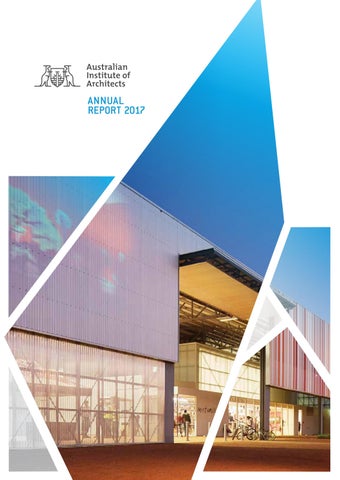
FROM THE COVER A COMMUNITY REVITALISED THROUGH CREATIVE DESIGN Following the region’s mining peak, the town of Newman, located 1200km from Perth in the East Pilbara, had a vision to revitalise into a key regional centre within the Pilbara. Home to the successful Martumili Artists collective, a network of artists and their families from seven Indigenous communities across the East Pilbara, the town and its occupants had outgrown their existing gallery and preparation space. A modest brief for a new exhibition gallery and artists facilities was ingeniously interpreted by Officer Woods Architects who placed the local Martu people at the heart of the design process, creating a world-class facility that delivered beyond expectation and further strengthened the town’s cultural identity. The result is an iconic building that celebrates the local culture, utilises creative solutions to reduce ongoing running costs for the occupants and provides a home for artists and their families that reflects their traditional lifestyle. The new East Pilbara Arts Centre is a community hub that represents immediate and genuine sustainability for the Martu people through cultural transmission and economic independence. This awardwinning facility reinforces the notion that culture supported by strong social and physical infrastructure, leads to stronger, healthier communities.
East Pilbara Arts Centre by Officer Woods Architects. Winner of the Sir Zelman Cowen Award for Public Architecture at the 2017 National Architecture Awards. Photographer: Robert Frith
CONTENTS AUSTRALIAN INSTITUTE OF ARCHITECTS ANNUAL REPORT PART ONE Introduction
4
Governance
6
National President’s Report
8
Chief Executive Officer’s Report
10
Membership
12
Strategic Plan
13
Professional Leadership
14
Advocacy
16
Practice Resources
17
Continuous Learning
18
Networking and Community
20
Awards, Recognition and Promotion
22
Chapter Reports
26
*All information contained in Part One correct as at 31 March 2018
PART TWO Financial Report
35
GOAL To make the world a better place through architecture
VISION A strong architectural profession that inspires clients and promotes community and the public interest through exceptional design and an ethical approach to the built environment
MISSION To develop and promote a strong architectural profession and be the public voice for architecture
4
Australian Institute of Architects
Annual Report | 2017
YOUR STRONG VOICE FOR ARCHITECTURE The Australian Institute of Architects is the peak body for the architectural profession in Australia, supporting over 11,000 members around the country and abroad.
With a proud history spanning more than 150 years, the Institute is uniquely positioned to champion the needs of the profession and Australian communities. The Institute provides respected leadership, executes advocacy with impact, delivers direct member value and promotes a lasting legacy by building a strong and viable Institute for future generations. Through our core activities we provide services for members at all stages of their career, from students and graduates to registered practitioners, from those working in affiliate industries to those who have retired from practice. The Institute is supported by a comprehensive governance model. Our Board of Directors comprises nationally-elected members as well as expert Independent Directors, and sits alongside our member-elected National Council with representatives from each state and territory. As the public voice for architecture, the Institute’s expert executive team, together with the Board, National Council and members around the country, is working with key stakeholders to promote a strong architectural profession benefitting all our communities.
Australian Institute of Architects
Annual Report | 2017
5
GOVERNANCE BOARD OF DIRECTORS
6
Mr Richard Kirk LFRAIA
Ms Clare Cousins FRAIA
National President
President Elect
Mr Ken Maher LFRAIA
Prof Helen Lochhead FRAIA
Mr Andrew Broffman RAIA
Immediate Past President
National Council-elected Director
National Council-elected Director
Ms Genevieve Overell
Ms Sarah Richardson
Ms Giselle Collins
Independent Director
Independent Director
Independent Director
Australian Institute of Architects
Annual Report | 2017
NATIONAL COUNCIL Mr Philip Leeson FRAIA ACT President
Mrs Jenny Culgan RAIA NT President
Mr Paul Trotter FRAIA Queensland President
Mr Mario Dreosti FRAIA SA President
Ms Yvette Breytenbach RAIA Tasmanian President
Ms Suzie Hunt FRAIA WA President
Mr Thom McKenzie RAIA EmAGN President
Mr Troy Borg SONA President
Mr Andrew Nimmo RAIA NSW President
Ms Amy Muir RAIA Victorian President
Mr Adrian FitzGerald FRAIA Nationally-elected Councillor
BOARD MEMBERS ALSO ON COUNCIL
Ms Vanessa Bird FRAIA Nationally-elected Councillor
Mr Justin Hill FRAIA Nationally-elected Councillor
Mr Richard Kirk LFRAIA National President
Mr Ken Maher LFRAIA Immediate Past President
Ms Clare Cousins FRAIA President Elect
Prof Helen Lochhead FRAIA Nationally-elected Councillor
EXECUTIVE TEAM Jennifer Cunich Chief Executive Officer
Dean Katsavos Legal Counsel
Kim Hilliard General Manager – Member Engagement
Ian Kynaston Chief Information Officer
Matthew McDonald Director Shared Services Photographer: Kelly Chen
Australian Institute of Architects
Annual Report | 2017
7
NATIONAL PRESIDENT’S REPORT The Institute’s 2017 Annual Report provides a unique insight into what has been a period of significant achievement, transformation and renewal for the Institute. The report covers a time of concerted effort as we have worked to build our capacity as champions of the architectural profession. As I have noted previously, what is visible on the surface is only the tip of the iceberg. This document offers a glimpse beneath the surface, revealing the extent to which we have strengthened (and in some cases completely rebuilt) our systems, policies and processes. Harnessing the insights and feedback of the Institute’s membership as well as the expertise of our executive team, Board, National Council and National Committee Chairs we have shaped a vision for the Institute that will continue to strengthen the architectural profession in Australia. Our new Strategy 2018-2020 sets out a clear and compelling vision for our profession that recognises the unique contribution architects make in promoting the public interest, and serving the community and clients through design and an ethical approach to delivering a sustainable built environment. The very tangible benefits for members of our strategic plan will become increasingly apparent throughout the course of 2018, not least with the release of the hugely improved Acumen Practice Notes product. Not only have we embarked upon a comprehensive update of the content, we have also reconceived the digital platform - from a member perspective. You will discover a streamlined, highly effective operating system with additional, practical features that significantly enhance and simplify the user experience. A display of frequently viewed notes and proformas, the ability to create your own personalised gallery of ‘favourites’ - this is just some of the added functionality it will offer.
8
Australian Institute of Architects
Annual Report | 2017
NATIONAL PRESIDENT’S REPORT
Revitalising practice toolsets is a key priority in the Institute’s Strategy 2018-2020 and we are proud to already be delivering on this significant commitment to the membership. But of course, our leap forward on the technology front doesn’t end there. We are now putting the finishing touches on the biggest overhaul of the Institute’s core technology in the organisation’s history. We have interconnected all offices to a single platform and provided staff with the tools they need to service you. In line with our strategic plan this digital transformation will continue over coming years as we progress updates to the website, membership and communications systems. Together, these tools will support a heightened research and advocacy capability - another core commitment of our strategic plan in action. The Institute’s ability to influence policy outcomes on issues critical to the profession was on clear display in 2017. At both the local and national level our expert advice has helped shape the direction of government policy. From energy to non-conforming building products, planning to procurement, our submissions have helped to inform government and ensure their focus on the public interest when it comes to articulating the importance of making our cities and towns equitable and sustainable. Our National Policy Review Committee continues work to refresh the Institute’s policies and expand on the work already completed in 2017. Engagement from members plays a vital role in this and we are deeply appreciative of the time and expertise regularly contributed. Without the dedication and commitment from our members who volunteer their time, many of the services the Institute provides could not happen.
This engagement was also evident in our 2017 Institute elections which attracted a great number of candidates and a significant increase in the number of members voting. Deepening the Institute’s relationship with the profession and continually increasing the value of the services we provide is the guiding principle underlying each of the priorities we have mapped out for the next three years. Celebrating excellence and success across the profession, and showcasing the benefits architecture brings to communities in our cities, towns and regions is what the Institute’s Awards program is all about. The program provides an opportunity to recognise industry leadership and highlight new and innovative directions in our profession. The 2017 program was a terrific success, securing among other things a record level of media coverage, which helps communicate the value of our work to a broader audience. A key priority for next year will be repositioning the highly successful awards and prizes around enhancing professional profile. This aligns with our other initiatives aimed at improving our CPD offering and providing even more support and opportunities to the next generation of our profession. The Institute is now in a strong and stable financial position and we’ve seen a 12 per cent increase in membership over the past two years to March end. We are becoming stronger and are growing our value offering as a partner in your practices and careers. I encourage you to read on to discover more detail on each of these initiatives and many more. For my part, it has been a great privilege to serve as President during this incredibly productive period for the Institute as we have embedded the transformative governance changes supported by our members and set off down a path that will deliver a legacy of lasting benefit for the profession. Richard Kirk LFRAIA, Hon AIA 78th National President
Harnessing insights and feedback, we have shaped a vision for the Institute that will continue to strengthen the architectural profession. Australian Institute of Architects
Annual Report | 2017
9
CHIEF EXECUTIVE OFFICER’S REPORT On behalf of the Institute, I am extremely proud to present this year’s Annual Report. It chronicles the significant progress we have made over the past 12 months on our journey to strengthen the organisation, sharpen our advocacy and better support our members. The high point of the year was the launch of our new, three-year strategy. This strategic plan draws its strength from the wealth of expert input contributed by our Board, National Council, Committees, members and staff throughout its development. The clear framework and core priorities it outlines have been instrumental in refocusing our work as we have set about delivering on our commitments to the membership. The rollout of value-adding initiatives for our members has well and truly started and will continue to ramp up as we move through the year. This work is particularly timely, given our early focus on redeveloping the membership structure and building our advocacy capacity. With two states, Victoria and New South Wales, as well as the Federal Government, heading to the polls in the course of the next 18 months, the groundwork we are laying now will pay dividends in our pre and postelection advocacy. Increasingly, we are seeing issues of importance to the profession rising in prominence on the agenda of government at all levels. The design of our growing cities, debates on density and population, the future of housing, reform to planning systems and new directions in energy and sustainability are among the areas where architects can and should be shaping policy. The Institute has a long and proud history, whose legacy makes ours a respected voice in circles of policymaking influence. With the continued backing of our members, we will further grow an appreciation of the value architects bring to the table in these and other discussions.
The Institute has a long and proud history, whose legacy makes ours a respected voice in circles of policymaking influence. 10
Australian Institute of Architects
Annual Report | 2017
CHIEF EXECUTIVE OFFICER’S REPORT
At the same time as we are drawing on the expertise of our members to advance the interests of the profession we are also doing more to deliver in the other direction – to improve and add to the tools and services that enhance your practices. The National Practice Committee recommenced operations in 2017 and is already adding enormous value, alongside the National Policy Review and National Education Committees. The National Committee for Gender Equity is another whose work is driving a better future for the profession, particularly among our cohort of emerging architects. We are very grateful to all members who dedicate their time sitting on our committees. Our most exciting new project for members is without doubt the upgrade of Acumen Practice Notes. Both in terms of content and functionality, this project is a stand-out example of the type of enhanced members tools and services the Institute will be providing as we improve our member value offering.
A new monthly staff newsletter is allowing us to share insights from our chapters around the country. The appointment of a senior human resources advisor is another important milestone. Our next objectives are to start planning for the website and membership redevelopment. All systems are go in the staged rebuilding of our technology platforms. We have also overseen a significant turnaround in the Institute’s finances. This is no mean feat and something we have applied ourselves to diligently, knowing that a stronger, better resourced Institute will allow us to expand the professional leadership and services that prioritise your needs as practitioners.
Jennifer Cunich Chief Executive Officer
Of course, the effectiveness of the Institute as a partner and advocate for the profession also rests in large part on the team of people responsible for delivering the services that matter most to our members. Whether it is administering CPD or our outstanding awards program, the Institute’s staff are the engine room driving our activity and that’s why I am pleased to showcase some of the many initiatives we have undertaken to support them. The redevelopment of our internal digital infrastructure was not only about reducing risk but about increasing capacity and making it easier for staff to support the membership in their day to day operations. Up-to-date PCs, better laptops and modern software all backed by scheduled maintenance and 24/7 support are making a very practical difference to our staff in their daily work environment. A stable network and betterconnected organisation are delivering efficiencies and reducing the frequent frustrations that come when the technology we rely on so heavily intermittently fails. At the same time, we are also stepping up our internal communications and collaboration.
Australian Institute of Architects
Annual Report | 2017
11
MEMBERSHIP The Institute comprised more than 11,000 members as at December 31, 2017 (including all categories). During the 12 month period ending December 31, 2017, architect (Member Level 1) membership increased by five per cent, a result assisted in part by the extension of Acumen Practice Notes to nonA+ members. In honour of individual members’ ongoing contributions and support for the profession, the Institute elevated 13 members to Fellow and 14 members to Life Fellow during 2017. Graduate membership experienced an overall ten per cent growth during the two-year period ending December 31, 2017. A+ Practice Membership remained constant during 2017 at just over 2000 practices. There was, however, an increase in the number of A+ practices in the larger 6-20, 21-50 and 51+ employee brackets. This resulted in a six per cent increase in individuals with A+ membership for the 2017 calendar year and an overall increase of 11 per cent over the 24-month period ending December 31, 2017.
12
Australian Institute of Architects
Annual Report | 2017
Student member numbers remained constant during 2017; the category stabilised after historical fluctuation caused by changes to the pricing model. Affiliate membership experienced substantial growth in 2017 with an increase of 13 per cent over the 12 months. This membership category has experienced a growth of 22 per cent over a two-year period. During 2017, the membership team conducted a successful campaign to highlight the value of membership along with the opportunities available through the member rewards program. Members who renewed early for 2017 were recognised with a complimentary Continuum course. This benefit was retained for the 2018 membership renewal process.
STRATEGIC PLAN The Institute launched its three-year strategic plan in December 2017 following a consultative process involving the Board, National Council, Committee chairs, Institute management, staff and the broader membership. The Strategy 2018-2020 sets out a clear mission for the Institute to develop and promote a strong architectural profession and be the public voice for architecture. It prioritises the delivery of six strategic goals with measurable indicators of achievement, enabling enhanced transparency and accountability to the membership we represent. Defining our work around core activities assists the Institute to maintain focus and effectively allocate resources to critical programs. It puts the Institute firmly on an exciting path to successfully support our members and the profession in 2018 and beyond. Work on our 2018 priorities is already well underway. We have invested in the necessary resources required to drive our education and branding goals, we have redeveloped key member practice tools and delivered them via the digital transformation project, we have begun work on a simplified membership system aligned with our refreshed vision. Organisational transformation is underway with improved finance reporting and forecasting tools, strong collaboration driven by leading edge IT and the roll out of a series of People and Culture initiatives which will unlock our staff and management potential. We look forward to delivering on subsequent 2018 priorities; the development of advocacy capacity, enhancing our menu of CPD products and streamlining our communication channels to ensure members receive a flow of critical and timely information. The strategic plan provides a road map for the organisation extending beyond this year. Completion of 2018 milestones will enable the Institute to capitalise on success and maintain focused momentum. The full Strategy 2018-2020 is available from our website, summary versions can be obtained from your local chapter office. Australian Institute of Architects
Annual Report | 2017
13
PROFESSIONAL LEADERSHIP The Institute provides active leadership across a broad range of areas, championing and building the profession against the context of 21st century opportunities and threats. A future-proof architectural profession requires leading tertiary schools underpinned by a strong learning framework. The Institute plays an instrumental role in the development of the procedure used to accredit architectural programs across the country. We have fulfilled this responsibility since the inception of professional accreditation in Australia, and we will continue to advocate for international educational best-practice. The Australia and New Zealand Architecture Program Accreditation Procedure (ANZ APAP) has been jointly administered by the Institute and the Architects Accreditation Council of Australia (AACA) since 2013. Following an extensive review process, ANZ APAP concluded in 2017 and a new accreditation procedure commenced Jan 1, 2018 administered by the AACA. This new procedure is overseen by an Accreditation Management Committee with nominees from each of the five major stakeholders: the Institute, AACA, Architect Registration Boards, Association of Architecture Schools of Australasia and Australian Deans of the Built Environment and Design. The Institute’s representative, Dean Wood has been appointed Chair. Dean Wood (WA) is also chair of the Institute’s National Education Committee. The Committee continues to provide expert advice across pre-tertiary, tertiary, post-tertiary, Continuing Professional Development and mentoring activities.
14
Australian Institute of Architects
Annual Report | 2017
The Institute provides essential leadership within the profession, providing coordination and building alliances. Through the Institute’s Chief Executive Officer, National Policy Advisor and member representatives, the Institute participates in the following national groups: Australian Sustainable Built Environment Council; International Union of Architects; City Deals Reference Group; Australian Greentag Advisory Committee; Australian Building Codes Board – National Construction Code Committee; Accreditation Management Committee; Australian Construction Industry Forecasts; NatHERS Software Technical Advisory Committee – Department of Environment and Energy; NABERS Steering Committee – Stakeholder Member; Official Residences Advisory Committee; Government Smart Cities Group; and Standards Australia Council and their technical sub-working groups. At a chapter level, Executive Directors, Chapter Presidents and member representatives participate regularly in government committees, steering groups, taskforces, advisory panels and industry forums covering the full spectrum of built environment issues. A key priority for the Institute is fostering and supporting diversity within the architectural profession. Throughout 2017, the Institute’s National Committee for Gender Equity highlighted issues of gender equity and celebrated the achievements of women in architecture; articles were published through media channels including the Institute website, ArchitectureAU and Parlour. The Committee is co-chaired by Kellie McGivern (WA) and Michael Smith (Victoria). The NSW Chapter’s Architects Male Champions of Change program released their first progress report last year. The report detailed the actions of the group since its establishment in 2015 and provided extensive commitments to ensure a diverse and productive workforce.
PROFESSIONAL LEADERSHIP
During 2017, Gender Equity Taskforces were established in Victoria, Queensland and WA and ACT (Diversity Equitable Employment Practice Taskforce) Chapters. South Australia established their Gender Equity Taskforce in 2016, the NSW Taskforce has operated since 2012. A new award, the Paula Whitman Leadership in Gender Equity Prize, was launched by the Institute in 2017. The prize recognises exceptional leadership and an outstanding contribution to the advancement of gender equity in architectural practice, education and governance. The inaugural recipient was Queensland architect, Catherine Baudet. The Australian Institute of Architects Foundation is the Institute’s philanthropic entity. The Foundation supports the profession through aligned engagement and fund-raising activities. In 2017, the Foundation’s Droga Architect in Residence program completed another successful research and engagement agenda. Mexican Canadian Dr Alberto Pérez-Gómez delivered a six-part lecture series during May and June visiting Adelaide, Canberra, Sydney, Perth, Brisbane and Melbourne. From July to October, Martin Ostermann and Lena Kleinheinz from German practice Magma Architecture facilitated two week-long university workshops for post-graduate architecture students, one in Perth with the University of Western Australia and the second with the University of Sydney. These workshops were complemented by a series of talks taking place in Sydney, Melbourne and Perth. In 2017, the Foundation also held an Art & Architecture weekend for patron engagement along with regular patron dinners at the Droga Apartment in Sydney. The Institute promotes opportunity and excellence via a small number of targeted scholarships. These include the Philip Yeats Bisset Scholarship (Queensland) awarded for overseas study of architecture and planning of buildings; the Jennifer Taylor (Dunbar) Travelling Fellowship, an annual travelling fellowship for Queensland graduates of architecture; and the Jack Hobbs McConnell Travelling Fellowship (South Australia) awarded to graduates of architecture who have displayed excellence in architecture and funding independent overseas study.
The Institute recognises the social importance of our heritage, as embodied in the built environment. We seek to protect culturally significant buildings; including them on state and territory registers, championing the preservation of specific buildings and via advocacy which supports relevant legislative change. As part of this commitment, the NSW Chapter maintains and develops the State’s architectural collection and archive with the assistance of a NSW Government Office of Environment and Heritage Grant. We are also committed to developing and expanding talent within the profession. Through a variety of chapter-led programs, the Institute provides tailored mentor and mentee opportunities for students, emerging practitioners, those returning to the workforce and established architects. These mentoring programs comprise organised events and activities as well as support the establishment of ongoing relationships between mentors and mentees. The Institute’s Student Organised Network for Architecture (SONA) supports our future architectural professionals. SONA initiatives provide opportunities for the establishment of practical skills and the development of networks and avenues promoting long-term engagement and career progression. In 2017, local SONA events delivered across the country included masterclasses with industry leaders, networking activities in collaboration with the Institute’s Emerging Architects and Graduates Network (EmAGN), portfolio workshops, speaker series and office/practice crawls. SONA SuperStudio is a weekend-long national competition that connects students with mentors to respond to hypothetical real-world architectural problems. In 2017, more than 160 students participated in the competition, gaining practical experience and the chance to win prizes including tickets to key Institute events and future mentoring opportunities with renowned architecture firms.
Australian Institute of Architects
Annual Report | 2017
15
ADVOCACY As the peak body for the architectural profession, the Institute is a key advocate for issues affecting the built environment. The Institute delivers strong political advocacy backed by evidence-based policies and strategies. In 2017, there was a renewed focus on advocacy and policy engagement across all levels of the organisation. Along with formal submissions and feedback opportunities, we have focused on relationship building to maximise the impact of our advocacy endeavours. We recognise that, to be truly effective, we first need to be heard. Only then can we play our role in positively shaping Australia’s future. Throughout 2017, over 50 formal submissions were made on behalf of the Institute to local, state/territory and federal government departments including national contributions to the Senate Inquiry into non-conforming building products and the Independent Review by Dr Finkel into the Future Security of the National Electricity Market. To further support the Institute’s new federal policy initiatives, a National Policy Review Committee was established in May, chaired by National Councillor Adrian FitzGerald. This committee is tasked with driving the Institute’s policy agendas and reviewing current policies. The following national policies were revised in 2017: Affordable Housing Policy, Indigenous Housing Policy, Multi-Residential Housing Policy, and Work Experience and Internships Policy. In March, then National President Ken Maher hosted a Parliamentary Briefing on housing affordability at Parliament House in Canberra to examine the issues of density, design and the challenges ahead. The briefing was attended by more than 50 Members of Parliament, Senators and their staff including the Assistant Minister to the Treasurer, the Hon. Michael Sukkar MP.
At a chapter level, Executive Directors and Chapter President’s proactively engaged with government ministers and staff from their respective Premier’s and Chief Minister’s Offices; Planning, Transport and Infrastructure departments; and Government Architect Offices, among others. Key issues addressed included procurement policies, regulatory requirements, apartment standards, key local developments, mandatory CPD for architects, reuse of existing buildings, Indigenous housing, and design guidelines. Working directly with all levels of government, authorities and other industry groups has proven to be a constructive strategy, which has improved relationships and led to better outcomes. As a result, our collective voice is becoming more influential and authorities actively seek our input. At both state / territory and national levels, the Institute is represented in the media, commenting publicly on key issues. This collective engagement strategy saw a number of wins for the profession including the adoption of Institute recommendations in the Senate Economics Reference Committee’s interim report on aluminium composite cladding, changes to NSW’s Environmental Planning and Assessment Act to incorporate ‘good design and amenity of the built environment’, and withdrawal of proposed amendments to Australian Standards 4122 with new amendments drafted in consultation with the Institute and other relevant bodies. 2017 also saw the introduction of the Institute’s Advocacy Update, keeping members up-to date on national and local policy issues.
The Institute’s advocacy activities are strongly supported by the many members around the country who volunteer their time and expertise through chapter and national committees, working groups and as Institute representatives on external advisory panels. 16
Australian Institute of Architects
Annual Report | 2017
PRACTICE RESOURCES The Institute provides a range of resources for members and the profession to facilitate best-practice design, project and business management. Acumen, the Institute’s online Practice Notes portal, provides up-to-date advisory material relevant to managing an architectural practice and projects. The service offers over 650 ‘on-demand’ notes with more content under development. Previously an included benefit for A+, Graduate and select Affiliate members, full Acumen access was extended to all Member Level 1s and Affiliate Level 1s in 2017. A successful pilot program with the Architects Registration Board of Victoria facilitated complimentary introductory Acumen Practice Notes access for newly registered non-member architects in Victoria. Content on the portal is regularly reviewed by the Institute’s dedicated Knowledge Services editorial team and member representatives on the Acumen Content Review Panel (ACRP) and the Institute’s various technical advisory groups including the National Practice Committee and National Access Working Group. In 2017 there were over 100 new and updated notes. As part of broader digital upgrades across the organisation, development work took place during 2017 resulting in a completely revised Acumen Practice Notes platform featuring a user-friendly layout, mobile and web responsive design, and enhanced search functionality. The new platform will launch in April 2018, providing the ‘go-to’ practice advisory service for the profession and broader built environment community.
The Institute’s Environment Design Guide (EDG) resource received new and updated content with topics ranging from Passivhaus to BIM and building performance simulation. In September, EDG was launched in the Sustainability Collection of international scholarly platform JSTOR, a digital library of academic journals, books, and primary sources. JSTOR is a recommended platform on Google Scholar. Redevelopment of the EDG platform is part of the digital transformation project. A+ members also receive access to a host of additional practice tools including direct access to Australian Standards through our partner SAI Global, HR and Legal advisory services via HR+ and complimentary professional Benchmarking conducted by Benchmarking.com.au. Discounted Benchmarking was also available to all non-A+ members, providing valuable business insights and tailored advice delivered by expert external consultants. Uptake for this service doubled in 2017. The Australian Building Industry Contracts (ABIC), jointly published by the Institute and Master Builders Australia, underwent a significant revision. The new suite of contracts launched early 2018 and included comprehensive amendments, new provisions and improved formatting. The Institute’s National Practice Committee, chaired by President Elect Clare Cousins and supported by the Chapter Practice Committees, continues to provide ongoing technical advice and guidance. In 2017, the Queensland Practice Committee developed an Architects Fee Guide which will be launched nationally in 2018.
Australian Institute of Architects
Annual Report | 2017
17
CONTINUOUS LEARNING The Institute is committed to lifelong learning. To support members and the profession in meeting their Continuing Professional Development (CPD) requirements, we provide a comprehensive menu of leading learning options. These include premium interactive face-to-face events, ‘always available’ online learning tools, and a curated network of third party providers.
FEATURED SPEAKERS Praxis featured award-winning, emerging and specialist local speakers and panellists joined by acclaimed international keynote speakers from across Europe and Asia including:
The Institute’s flagship CPD event is the two-day National Architecture Conference. The Conference is the profession’s largest annual gathering and Australia’s premier architectural conference, attended by over 1100 delegates in 2017. Held at the brand-new Sydney Convention Centre and curated by Immediate Past President Ken Maher and Helen Lochhead, the 2017 Conference, Praxis, featured 10 domestic speakers, 7 international speakers and a Super Session held with the Planning Institute of Australia. Conference delegates were able to claim up to 16.5 formal points. The NSW Chapter’s Country Division Conference was held in Coffs Harbour with over 90 attendees. The three-day program was tailored to architects and professionals practicing in regional areas. During 2017, the Institute ran more than 160 face-to-face formal CPD events in metro and regional locations. This included the successful five-part National Seminar Series with events in Perth, Adelaide, Melbourne, Hobart, Launceston, Sydney, Brisbane and livestream option providing convenient viewing for members around the country and abroad.
18
Australian Institute of Architects
Annual Report | 2017
Winy Maas, MVRDV, The Netherlands Rahul Mehrotra, RMA Architects, India Eva Castro, Plasma Studio, China Vo Trong Nghia, Vo Trong Nghia Architects, Vietnam Sheila O’Donnell, O’Donnell + Tuomey, Ireland John Tuomey, O’Donnell + Tuomey, Ireland Anupama Kundo, Anupama Kundo Architects, Spain
CONTINUOUS LEARNING
Chapter-run CPD covered a full suite of topics relevant to various stages of architectural practice and specialities. These events addressed Design, Documentation, Project Delivery and Practice Management, the four units of competency defined within the National Standard of Competency for Architects which is administered by the Architects Accreditation Council of Australia. The Institute offers 24/7 CPD via Continuum, our dedicated online learning platform. Continuum contains around 80 premium on-demand courses, accessed by thousands of architecture professionals at their convenience.
New courses added in 2017 include The Anatomy of a Leak, the National Construction Code, BIM + Sustainability, Contract Administration, Passive Houses and ArchiTECHNOLOGY. Institute members can also access an extensive range of curated third party CPD delivered via our Refuel program. The Institute’s Practice of Architecture Learning Series (PALs) supports graduates of architecture as they transition to registration, by providing extensive training and mentoring ahead of the Architectural Practice Examination. PALS, a face-to-face program, runs in most states and territories with courses aligned to their respective Registration Board exam timetables.
The conference presents an opportunity to obtain professional development and creative stimulation The information and the way it was presented was really relevant and quite inspiring Speakers were excellent, format was really good The mix of speakers and topics was good. A good mix of project-based and theory/idea-based talks
Photographer: Boaz Nothman
Australian Institute of Architects
Annual Report | 2017
19
NETWORKING AND COMMUNITY Architecture is a collaborative and collegiate profession. Through diverse and regular activities, the Institute seeks to nurture and foster this distinguishing quality across all career stages and pathways.
Chapters in collaboration with their EmAGN committees host a range of informal events throughout the year from bar tours to scavenger hunts as well as combined events with established practitioners that promote the transfer of knowledge.
Chapters run a full calendar of networking events throughout the year to bring members and allied professionals together and provide informal CPD opportunities. Events include informal networking drinks, Life Fellow gatherings, President functions and End of Year parties, collaborations with allied bodies as well as special interest talks and forums including the successful Small, Medium and Large Practice Forums across the country.
Regi(fru)stration is specifically designed to encourage graduates to take the next step and become a registered architect. The program provides a relaxed forum, run by most chapters, in which many of the ‘myths’ surrounding the process are dispelled.
The Institute’s Emerging Architects and Graduates Network (EmAGN) provides access to networking and tailored resources to support and encourage professionals in the early stages of their career. Development of networks is particularly important as graduates of architecture and newly-registered architects look for opportunities with established practices or seek to start their own.
20
Australian Institute of Architects
Annual Report | 2017
The Institute’s Emerging Architect Prize recognises outstanding contributions by emerging practitioners to architectural practice, education, design excellence and community involvement, which advances the profession’s role within the public arena. Awarded in each chapter, and supported by Corporate Partner AWS, the prize culminates with the National Emerging Architect Prize which in 2017 was awarded to Anthony Balsamo from South Australia.
NETWORKING AND COMMUNITY
One of the Institute’s most coveted opportunities is the Dulux Study Tour (DST), open to all architects and graduates of architecture (up to 10 years from graduation). Run in collaboration with Corporate Partner Dulux, the DST rewards five recipients for their contribution to architectural practice, education, design excellence and community involvement. The recipients participate in a ten-day international study tour which, in 2017, visited Barcelona, London and Prague. The Institute provides valuable programs to the architectural profession with the support of our Corporate Partner community. The Institute would like to acknowledge the continuing support of Principal Corporate Partner BlueScope; Supporting National Corporate Partners Brickworks, Dulux, Bondor and AWS; Supporting Corporate Partners Smeg, Knauf, Wood Solutions and Central Innovation; Media Partner Architecture Media and Insurance Partner Planned Cover.
Developing strong relationships to provide valued programs to the architectural profession.
Australian Institute of Architects
Annual Report | 2017
21
AWARDS, RECOGNITION AND PROMOTION Delivering exceptional programs that recognise and promote members achievements is central to the Institute’s role as the profession’s peak body. The Institute’s peer-reviewed awards and prizes programs, exemplify best-practice architectural innovation, providing qualitative examples of how architecture can deliver outstanding outcomes. Our National Architecture Awards program is the largest program of its kind in the southern hemisphere. In 2017 a total of 983 entries were received from around the country and overseas, the largest field in almost four decades since the national awards program began. In the middle of the year, each Chapter hosted their state/territory Architecture Awards ceremonies, collectively attended by more than 3600 members, guests, media, allied professionals and government representatives. In addition, excellent media coverage was received nationally and internationally covering all stages of the chapter programs – regional awards, exhibitions of entries, People’s Choice Awards, shortlists and winners. Following the Chapter Architecture Awards, 205 entries progressed to the national round having received a Chapter Award. The national jury led by Immediate Past President, Ken Maher, shortlisted and visited 72 with final honours bestowed on 44 projects with some projects receiving multiple honours.
22
Australian Institute of Architects
Annual Report | 2017
From buildings to the masterminds behind them, the Institute’s local and national Prizes programs support and recognise individuals and groups across practice, research, academia, social justice, tertiary study and post-tertiary development. Victorian architect, Peter Elliott AM was the recipient of the 2017 Gold Medal, the Institute’s highest honour awarded for ‘his exceptional contribution through design, through architectural education, through leadership within the profession and through promotion of architecture within the community’. 2017 also saw the launch of the Paula Whitman Leadership in Gender Equity Prize with Queensland architect Catherine Baudet the inaugural recipient. In addition to well attended public Chapter Awards Exhibitions around the country, the Institute participated in a variety of public engagement activities collaborating with allied bodies to maximise exposure. Collaborations included the hugely popular Open House program in Tasmania, Victoria, Queensland and WA; the Festival of Architecture and Design in SA; Design Canberra Festival; Solar House Day in Canberra; and MPavilion in Victoria, many featuring Institute-run tours, talks and public forums promoting architecture.
AWARDS, RECOGNITION AND PROMOTION
2017 NATIONAL PRIZES GOLD MEDAL Peter Elliott AM – Peter Elliott Architecture and Urban Design (Vic)
NATIONAL PRESIDENT’S PRIZE Professor Michael Keniger – Bond University (Qld)
PAULA WHITMAN LEADERSHIP IN GENDER EQUITY PRIZE Catherine Baudet – Ferrier Baudet Architects (Qld)
AWS NATIONAL EMERGING ARCHITECT PRIZE Anthony Balsamo – Walter Brooke and Associates (SA)
BLUESCOPE STEEL GLENN MURCUTT STUDENT PRIZE James Hargrave (NSW)
STUDENT PRIZE FOR THE ADVANCEMENT OF ARCHITECTURE Timothy Randall (Vic)
DULUX STUDY TOUR Claire Scorpo – Claire Scorpo Architects (Vic) Imogene Tudor – Sam Crawford Architects (NSW) Alberto Quizon – CHROFI (NSW) Morgan Jenkins – Morgan Jenkins Architecture (Qld) Louisa Gee – Partners Hill (Qld)
Australian Institute of Architects
Annual Report | 2017
23
2017 NATIONAL ARCHITECTURE AWARDS COMMERCIAL ARCHITECTURE
INTERIOR ARCHITECTURE
The Harry Seidler Award – The EY Centre by fjmt (NSW)
The Emil Sodersten Award – Indigo Slam by Smart Design Studio (NSW)
National Award – Willinga Park by Cox Architecture (ACT) National Commendation – NewActon Nishi by Fender Katsalidis Architects (ACT)
EDUCATIONAL ARCHITECTURE The Daryl Jackson Award – East Sydney Early Learning Centre by Andrew Burges Architects in association with the City of Sydney (NSW) National Award – Albert Park College Environmental Arts Hub by Six Degrees Architects (Vic) National Award – St Joseph’s Nudgee College Hanly Learning Centre by m3architecture (Qld) National Award – UQ Forgan Smith Building – TC Beirne School of Law and Walter Harrison Library Refurbishment by BVN (Qld)
ENDURING ARCHITECTURE National Award – 17 Wylde Street by Aaron M Bolot (NSW)
HERITAGE The Lachlan Macquarie Award – Albert Park College Environmental Arts Hub by Six Degrees Architects (Vic) National Award – Juanita Nielsen Community Centre by Neeson Murcutt Architects Pty Ltd in association with City of Sydney (NSW) National Award – 100 Harris Street by SJB (NSW) National Commendation – Captain Kelly’s Cottage by John Wardle Architects (Tas) National Commendation – Embassy of Sweden by Guida Moseley Brown Architects (ACT)
National Award – UQ Forgan Smith Building – TC Beirne School of Law and Walter Harrison Library Refurbishment by BVN (Qld) National Commendation – Canberra Airport – International by Guida Moseley Brown Architects (ACT) National Commendation – The Gipson Commons, St Michael’s Grammar School by Architectus (Vic)
INTERNATIONAL ARCHITECTURE The Jørn Utzon Award – Amanemu by Kerry Hill Architects (Japan) Australian Award – SkyVille @ Dawson by WOHA (Singapore)
PUBLIC ARCHITECTURE The Sir Zelman Cowen Award – East Pilbara Arts Centre by Officer Woods Architects (WA) National Award – Juanita Nielsen Community Centre by Neeson Murcutt Architects Pty Ltd in association with City of Sydney (NSW) National Award – The Globe by Brian Hooper Architect and m3architecture (architects in association) (Qld) National Award – Sunshine Coast University Hospital by Architectus Brisbane and HDR Rice Daubney as Sunshine Coast Architects (Qld) National Commendation – Act for Kids Child and Family Centre of Excellence by m3architecture (Qld)
RESIDENTIAL ARCHITECTURE – HOUSES (ALTERATIONS & ADDITIONS) The Eleanor Cullis-Hill Award – Captain Kelly’s Cottage by John Wardle Architects (Tas) National Award – Annandale House by Welsh + Major Architects (NSW) National Award – Burleigh Street House by ME (Qld) National Award – Jac by panovscott (NSW) National Commendation – Dornoch Terrace House by James Russell Architect (Qld)
24
Australian Institute of Architects
Annual Report | 2017
AWARDS, RECOGNITION AND PROMOTION
RESIDENTIAL ARCHITECTURE – HOUSES (NEW) The Robin Boyd Award – Tamarama House by Durbach Block Jaggers Architects (NSW) National Award – Cape Tribulation House by m3architecture (Qld) National Award – Coogee House by Chenchow Little (NSW)
URBAN DESIGN
National Award – Mitti Street House by James Russell Architect (Qld)
The Walter Burley Griffin Award – Frank Bartlett Library and Moe Service Centre by fjmt (Vic)
National Commendation – Dark Horse by Architecture Architecture (Vic)
National Award – The Goods Line by ASPECT Studios with CHROFI (NSW)
National Commendation – Rose House by Baracco+Wright Architects (Vic)
COLORBOND® AWARD FOR STEEL ARCHITECTURE
RESIDENTIAL ARCHITECTURE – MULTIPLE HOUSING The Frederick Romberg Award – Tropology for DHA by Troppo Architects (NT)
The COLORBOND® Award – Arts West, University of Melbourne by ARM + Architectus (Vic)
PEOPLE’S CHOICE AWARD Winner – Tent House by Sparks Architects (Qld)
National Award – Crown 515 by Smart Design Studio (NSW)
2017 NATIONAL JURY
National Commendation – RMIT Bundoora West Student Accommodation by Richard Middleton Architectst (RMA) (Vic)
Ken Maher (Chair) – Immediate Past President of the Australian Institute of Architects; Fellow, HASSELL; Honorary Professor, UNSW Sydney
SMALL PROJECT ARCHITECTURE
Lawrence Nield – Northern Territory Government Architect; Professor of Architecture, University of Newcastle
The Nicholas Murcutt Award – Lizard Log Amenities by CHROFI (NSW)
Sue Dugdale – Director, Susan Dugdale and Associates
National Award – North Bondi Amenities by Sam Crawford Architects with Lymesmith (NSW) National Commendation – The Piano Mill by Conrad Gargett (Qld)
Peter Maddison – Director, Maddison Architects; Host, Grand Designs Australia Melissa Bright – Founding Director, MAKE architecture
SUSTAINABLE ARCHITECTURE The David Oppenheim Award – Central Park Sydney by Tzannes and Cox Richardson and Foster + Partners (NSW) National Award – 88 Angel St by Steele Associates Architects (NSW) National Commendation – Gen Y Demonstration Housing Project by David Barr Architect (WA) National Commendation – Mt Alvernia College Anthony and La Verna Buildings by m3architecture (Qld)
Photographers: Masao Nishikawa, Brett Boardman, John Gollings, Simon James, Trevor Mein, Kelly Chen and Simon Whitbread
Australian Institute of Architects
Annual Report | 2017
25
CHAPTER REPORTS AUSTRALIAN CAPITAL TERRITORY The ACT Chapter has vibrant and engaged volunteers who alongside chapter staff, focused on community and government engagement in 2017. We hosted a number of outward focused events to engage the Canberra community, allowing us to promote architecture and architects. One of our longest standing events, celebrating its 30-year anniversary, is our Contemporary Australian Architecture Speaker Series held in partnership with the National Gallery of Australia, reaching audiences of around 280 per event. Our Solar House program is hugely successful in reaching non-architects. Canberra holds a design festival in November, which attracts an audience of around 95,000 and the Chapter hosted 14 events during the festival, showcasing architecture to a diverse range of people. We not only reach a domestic audience, we also reach a national audience through television and radio coverage for the Griffin Lecture, which has been delivered since 1961, and a session broadcast on ABC RN Big Ideas program on housing diversity and affordability. Engagement with government throughout the year involved regular meetings with parliamentary members, Ministers and public officials on procurement, planning, housing affordability and diversity, and the introduction of design review panels. Finally, our ACT Chapter ‘Year of Housing’ saw the release of our housing choices website to contribute to the ongoing discussion of housing diversity in the ACT.
26
Australian Institute of Architects
Annual Report | 2017
CHAPTER REPORTS | INT
INTERNATIONAL Among the backdrop of great changes across the Institute, 2017 saw the ongoing development of exciting changes for international members. To further align the International Area Committee with the broader organisation and to better serve international members, preliminary actions were taken to have the group formally recognised as a chapter of the Institute. Members of the International Area Committee and staff worked to develop the necessary petition which received overwhelming support from international members as well as the development of the International Chapter Charter for submission to National Council, the culmination of years of work by staff and members. The motion was unanimously supported by National Council with anticipated formal ratification at the Institute’s 2018 Annual General Meeting. In May, to welcome the Institute’s 2017 Dulux Study Tour winners, the Institute with the support of Dulux jointly hosted an event at the Royal Institute of British Architects in London. The event was well attended by international members and provided an excellent opportunity to share work and ideas in a relaxed format. The 2017 International Chapter Architecture Awards were announced in July at a special Boarding Pass event in Singapore, coinciding with the Committee’s annual face-to-face meeting. The Awards were presented by National President Richard Kirk with a welcome by HE Bruce Gosper, Australian High Commissioner to Singapore. The Awards acknowledged the work of members residing outside Australia as well as domestic members undertaking commissions overseas. To further support the formal establishment of the International Chapter, extensive work continued in the development of a comprehensive International Engagement Strategy for the Institute. The strategy, to be completed in 2018, capitalises on the contributions current members have made in supporting and advancing Australian architecture globally and provide ongoing direction in line with the Institute’s Strategic Plan.
Australian Institute of Architects
Annual Report | 2017
27
CHAPTER REPORTS | NSW
NEW SOUTH WALES Much was achieved in the NSW Chapter in 2017, which in many ways was a reset that can be summarised under four key themes: governance, member engagement, advocacy and gender equity. In restructuring the chapter’s committee system we completed an important piece of governance work. This included the preparation and endorsement of consistent Terms of Reference, and the implementation of an expression of interest process, open to all members. This process will assist in providing fresh insights and a renewed vigour to our key advisory committees. In 2017 Practice Forums, of the Small, Medium and Large varieties were established. Along with the Country Division and the Newcastle Division, these membership groups provide significant networking opportunities and a feedback loop to Chapter Council for what members see as important for the profession. We also commenced work on retuning our relationship with Sydney’s Practice Networks. Our public advocacy has continued though our many written submissions, and we have seen good results, including the insertion of ‘good design’ as an Object of the NSW Environmental Planning & Assessment Act. Another important initiative has been the establishment of the Procurement Taskforce, whose role is to gather information on current procurement practices; and then influence how architecture is procured going forward through direct engagement. Work will continue in this space over 2018. The NSW Chapter continues to lead in the drive for gender equity within our profession. The Architects Male Champions of Change released their first progress report in 2017 and will continue their work in the year ahead. 2018 will be about seeing the results of our reset, with a comprehensive calendar of events planned that involves a renewed focus on CPD, our numerous awards programs, and a rejuvenated Architecture Bulletin. Above all, we are setting ourselves up to be the respected leader and strong advocate that the membership has prioritised through our new Strategy 2018-2020.
28
Australian Institute of Architects
Annual Report | 2017
CHAPTER REPORTS | NT
NORTHERN TERRITORY 2017 was an active year for advocacy with significant policy consultation being undertaken by the Northern Territory Government. Chapter submissions included Darwin City Deal Stage 2-3; Alice Springs plan – Alice Live; Planning System Reform Stage One; Museum strategies; Planning for a vibrant future; Greening the CBD Barneson Boulevard and beyond; Procurement processes and time lines; City Deals and Casuarina Foreshore. We also participated in multiple surveys including the Darwin and Palmerston 10 Year Museums Master Plan and Towards a Digital Strategy. The Chapter hosted multiple CPD and networking events with the standout event being a series on Inspiring Women in Leadership in the industry. This had great attendance with a similar format being replicated for 2018 events. We had local council elections in 2017 and we hosted a debate with candidates in Darwin. We gave fair time to all nominated people and had great feedback from media and the broader community. Students from Charles Darwin University participated in tutorials hosted by members as well as a walking tour of the Darwin CBD. The NT Chapter had a new Event Partner come on board with Laminex and we look forward to working with them in 2018 on future programs. We would also like to thank our other NT Partners QS Services, Irwinconsult, Action Sheetmetal, Gerflor, dormakaba, Brilliant Kitchens and Interiors and the Northern Territory Government.
Australian Institute of Architects
Annual Report | 2017
29
CHAPTER REPORTS | QLD
QUEENSLAND 2017 saw a new team come together in the Queensland Chapter, bringing a fresh perspective and a renewed focus on member engagement. Mell Greenall came on board as the chapter Executive Director and joining Courtney Fair as the chapter’s longstanding Awards Officer, Joyce Liu joined as CPD Officer, Madelynn Jenkins as Member Services and Gemma Hayward as Administration officer. The chapter renewed its commitment to CPD delivering monthly events both in Brisbane and the six regional hubs growing our face-to-face engagement and actively working towards growing an inclusive community for Queensland architects. On an advocacy front 2017 saw the chapter working closely with the Queensland Government on the state procurement policy released in September. This policy has seen a significant shift in the government procurement ethos away from cost-based procurement to one of value. This is a significant win for architects and should lead to better procurement outcomes for those working with government. In addition, we have worked with the Department of Housing and Public Works to review AS4122 and have contributed significantly to the development of a short form consultancy contract which is to be released for use in 2018. Furthermore, we have representatives on the state government’s Non-Conforming Building Products review panel and the Queensland Building Construction Commission Stakeholder Panel, to ensure we have a voice with the regulator for the Queensland Non-Conforming Building Product Legislation and the New Building Industry Fair Payment Act. The 2017 Queensland State Election saw the chapter proactively approach major parties for a policy position statement on four key areas including procurement, the role of the Government Architect, high-density housing and master planning. Responses were received from Labor, Liberals and One Nation. The re-election of the Labor party to power has ensured that the chapter can further develop its already strong relationship with the Department of Housing and Public works and the Department of Infrastructure and Planning ensuring a strong voice for the profession.
30
Australian Institute of Architects
Annual Report | 2017
CHAPTER REPORTS | SA
SOUTH AUSTRALIA The SA Chapter enjoyed an active and productive 2017. With the state election set for March 2018, the SA Chapter responded to increased political activity by participating in and responding to discussions regarding development of the new planning system, government procurement and delivery of an extensive program of STEM projects within schools.
The Education Task Group developed the resources for ArchiED, a program to support architects presenting in primary and secondary schools. It provides a framework within which architects can deliver presentations relevant to the specific needs of the school. Initial presentations delivered in 2017 were well received.
Key achievements were the rewriting of the proposed amendments to AS4122, support for practices engaged in the STEM projects and amendments to the draft design guidelines. Adelaide City Council also engaged in a very open and proactive consultation regarding the revision of the Encroachment Policy, with the final document reflecting the feedback provided by the SA Chapter. Advocacy for 2017 culminated in issue of the SA Chapter’s election policy statement to key candidates, with responses received from the Liberal and Labor parties and the Greens.
The third Festival of Architecture and Design (FAD) was delivered as part of Open State, an initiative of the SA Government to promote debate and community engagement in decision making. The Tremma creative team’s theme focused on the importance of social exchange in the development of future cities and 38 events explored this within a local and global context. Tremma also designed and delivered an installation at the Open State site in Victoria Square.
The SA Chapter worked with the ACA and Consult Australia on a number of these issues, providing strong and consistent messaging from the consulting sector. We also supported the Architecture Practice Board of SA in successfully advocating for mandatory CPD, with the process for amending the Act commencing in early 2018.
Later in October the SA Chapter relocated to new premises on Leigh St. The space has excellent natural light, great views and a central location. The workspace, meeting and training facilities have been well received by staff and members. It has already provided an excellent venue for Chapter Council, CPD events, networking functions and the jury presentations for the 2018 SA Awards program. We look forward to delivering a full and dynamic program over the coming year.
The SA SONA group was also very active, ensuring that local programs continued to engage students in debate and provide contact with the profession. SA SONA Reps Stephanie Clutterbuck and Andrew Lymn-Penning, along with SONA Exec Chantelle Fry, were also instrumental in the delivery of Super Studio in 2017. Initially proposed for SA only, they established the theme, wrote the brief and developed the collateral, enabling national delivery of this key SONA program.
Australian Institute of Architects
Annual Report | 2017
31
CHAPTER REPORTS | TAS
TASMANIA The Tasmanian Chapter began 2017 with the challenge of finalising and then rolling out a new CPD program, funded by the Department of Justice. The program came together well, offering seminars for architects and members of the broader industry. Attendances have been steadily rising and the 2018 program is now close to being finalised. The chapter has continued to work on strengthening advocacy at a state level, with meetings with the Liberal Government, Labor Opposition and the Greens, as well as regulatory authorities and other industry organisations, to optimise our influence and ability to effect change in the industry. This approach is paying dividends, with the Institute’s standing in Tasmania noticeably improving in the past two years. The chapter continues to provide written submissions where appropriate. Our community engagement has also increased, with two public forums held during 2017 to discuss priorities and planning for Hobart’s future. The Tasmanian Chapter continues to build on the success of Open House Hobart (OHH). The 2017 event was our biggest ever, and attracted record crowds, with approximately 14,500 people visiting 59 buildings, joining almost 200 tours and more than a dozen events engaging with the city, heritage built environment and design. The 2017 Awards Program was a great success, with 35 entries – the largest number of entries in some time. The Awards dinner attracted 200 guests, with good attendances at the Launceston and Hobart exhibitions and excellent digital reach, media coverage and People’s Choice voting. The chapter continues to offer a mentoring scheme and two work experience schemes to support graduate and student members, along with networking events such as practice forums for all members, the President’s lunch and Christmas parties in Launceston and Hobart.
32
Australian Institute of Architects
Annual Report | 2017
CHAPTER REPORTS | VIC
VICTORIA The overarching motivation for the Victorian Chapter’s activity is our members’ benefit. With this in mind, the Victorian Chapter Councillors held a strategy workshop in early 2017 focusing on determining the top priorities to finish 2017 with some clear outcomes and achievements. Our membership focus has aimed to strengthen our member forums by feeding learnings into CPD, education and practice notes. With the success of the Small and Medium Practice Forums (MPF) in Victoria, we have shared our forum model with all states and hosted NSW representatives at the April MPF.
Other high points in a full 2017 Victorian Chapter calendar included the EmAGN forums and CPD events which attracted superb numbers; and of course, the annual Awards exhibition and dinner. In other award news, two Victorian architects were recognised in the 2017 Queen’s Birthday Honours. The late Stephen Ashton was posthumously appointed a Member of the Order of Australia (AM), and Karl Fender received a Medal of the Order of Australia (OAM).
Whilst the Large Practice Forum has not shared the same success, there has been considerable work spent putting together a framework to reinvigorate this key group and this will be a key priority for 2018. Advocacy remains a key focus and we continue to meet with the Victorian Building Authority on cladding compliance issues and the promotion of and regulations for all practitioners. Engagement with the government on the development of Apartment Design Standards continues and in December the Chapter responded to the Planning Review Panel with a submission addressing the draft Fishermans Bend Framework. There have been considerable efforts to increase the Institute’s profile by partnering with allied organisations who will cross promote our message. One highlight was working as part of an advisory group with Creative Victoria, The Design Institute and other aligned associations following the successful selection of Melbourne as the official partner city for the 2018 Business of Design Week. In November, we partnered with MPavilion, an event hub and meeting place that provides opportunities for engaging Melbourne in conversation about architecture and design. As part of the 2017 program of events the Institute held three Friday night debates showcasing representatives from SONA, EmAGN and established architects.
Australian Institute of Architects
Annual Report | 2017
33
CHAPTER REPORTS | WA
WESTERN AUSTRALIA The priority for WA in 2017 was to become more targeted and louder with its advocacy – to be seen and heard as a leader and to deliver more practical outcomes. This approach saw the chapter gain added traction in all parts of the media including through Channel Ten’s ‘Australia by Design’ series and in newspaper columns dedicated to issues like procurement. Considerable time was spent with Members of Parliament and senior Government officials to raise awareness about built environment issues and how architects can assist. All have been receptive, especially the Minister for Housing and Shadow Minister for Planning. On each occasion, the President and Executive Director leave behind a pack of material containing our national and state adopted policies, research on affordable housing in WA, the chapter’s joint submission on public procurement to a powerful State Government Commission of Inquiry and copies of our magazine, The Architect. A significant achievement was participating in the Hilton Design Competition, an initiative of the Department of Communities, along with the Government Architect and City of Fremantle, to bring good design to social housing and demonstrate cooperation between government and the professions. The chapter also continued its successful event collaboration ‘Future Opportunities in the Built Environment’ series with the Australian Institute of Building, Consult Australia, Engineers Australia and Master Builders and will do so again next year. The strong relationship with the Architects Registration Board continued, this year looking at the onerous re-registration requirements for those returning to work after more than two years away. There was a good hearing from the Board and the matter was raised with the responsible minister. Indeed, WA is one of the worst performing states on several measures of gender equality. The chapter began a new event series called ‘Work Women Wisdom’, open to females with an architectural degree, to enable conversation about shared experiences on things like work options, managing a work life balance, feelings of isolation and concerns about career trajectory after time away.
34
Australian Institute of Architects
Annual Report | 2017
FINANCIAL REPORT FINANCIAL STATEMENTS Finance Summary
35
Directors’ Report
37
Auditor’s Independence Declaration
42
Directors’ Declaration
43
Statement of Profit or Loss and Other Comprehensive Income
44
Statement of Financial Position
45
Statement of Changes in Equity
46
Statement of Cash Flows
48
Notes to the Financial Statements
49
Independent Auditor’s Report
88
Australian Institute of Architects
Annual Report | 2017
35
FINANCIAL SUMMARY STRONGER RESULTS, A STRONGER FINANCIAL POSITION We are pleased to report significant improvements in the financial result of the Institute and its owned and associated businesses for the 2017 financial year and an even better improvement in the value of Net Assets and Equity. The following financial statements and Directors’ and Auditor’s reports thereon contain considerable detail about those matters, however we wish to highlight the following ‘headline’ matters:
AN INSTITUTE THAT IS LIVING WITHIN ITS MEANS AND IS POSITIONED FOR GROWTH While top line ‘Parent’ trading revenues in 2017 are broadly similar to those reported in 2016 the Institute has further reduced its costs of sales, staff costs and some key overheads while simultaneously building key capacity and capability and managing risks. The profit from the Institute’s own operations exceeded budget and combined with increased dividends from both IBL Limited and Architecture Media Pty Limited to increase cash reserves by nearly $1 million compared to those held at the end of 2016, and approximately $2.5 million compared to 2015 holdings. Furthermore, the Institute invested over $400,000 in making improvements to its premises and plant and equipment, with very substantial sums also budgeted for those purposes in 2018 that will be fully funded from the Institute’s own resources. The net value of the Institute’s property portfolio increased by $2.1 million over the course of the year to $27.2 million and the Institute has now completed the reset of its $8.4 million in associated borrowings from Current to Non-Current Liabilities, while also reducing the interest rate (and therefore outright cost) of that debt. We enjoy an excellent banking relationship with ANZ and have successfully completed all our annual facility compliance requirements for 2018. Receivables increased over the 2017 year because of increased dividends and intragroup tax payments owed by IBL Limited at year end. Trade creditors and accruals increased because of unearned income relating to the 2018 Venice Biennale and multiyear corporate partnerships income and better management of working capital. 36
Australian Institute of Architects
Annual Report | 2017
The Institute collects its debts more quickly than it has done in the past, has minimal credit risk and has established much improved relationships with its suppliers. In overall terms, the Institute increased its Net Assets and Equity by over $3.5 million during the 2017 year and has improved the value and risk profile of all material assets and liabilities.
GROWING AND PROFITABLE INVESTMENTS IN STRATEGIC AND VALUABLE BUSINESSES IBL Limited has achieved extremely strong results in the 2017 year from both its core insurance broking and associated business lines and from returns on its significant investment holdings and gains in the value of its own property holdings. Architecture Media has also completed a very successful year with impressive profits achieved in each of its three core business segments and is continuing to refine its strategy to deliver further growth and the best return on capital and leadership investments. The increased dividends received by the Institute from both entities in 2017 are commensurate with the performance of these key equity investments and strategic partnerships. The consolidated profit of the Group after eliminating those returns on Institute investments and other intragroup transactions grew in 2017 by more than $3.1 million compared to 2016 and combined with other increases in asset values not booked directly as profit to increase Net Assets and Equity by over $6.3m.
TRANSPARENT AND RELEVANT REPORTING The above results have been delivered and disclosed while also booking the necessary changes to prior period accounts that are described in both the Directors’ Report and Note 30 to the financial statements, with commensurate improvements to the transparency of accounting disclosures relating to the Institute’s significant Bequest trustee obligations. The Directors have also closely worked with RSM, our new auditors, to ensure that these financial reports are as clear as possible and employ plain language where appropriate, while of course remaining fully compliant with the requirements of the Corporations Act and the Accounting Standards.
THE ROYALAUSTRALIAN AUSTRALIAN INSTITUTE OF ARCHITECTS and CONTROLLED THE ROYAL INSTITUTE OF ARCHITECTS and CONTROLLED ENTITIESENTITIES (ABN: 72 000 023 012)
ABN: 72 000 023 012 For the year ended 31 December 2017 For the Year Ended 31 December 2017 Directors’ Report The Directors of The Royal Australian Institute of Architects Ltd present their report together with the financial statements of the consolidated entity, being The Royal Australian Institute of Architects Ltd (“the Company”) and its controlled entities (“the Group” or “consolidated entity”) for the year ended 31 December 2017 and the Independent Auditor’s Report thereon. Directors The following persons were Directors of The Royal Australian Institute of Architects Ltd during or since the end of the financial year to which this report relates.
Years on Board 4
Names R L Kirk LFRAIA Hon AIA
Qualifications & other appointments B Des Studies (QLD) B Arch (Hons1) (QLD) Director, Richard Kirk Architect Director, South Bank Corporation
Special responsibilities President from 16 May 2017 President Elect from 13 May 2016 until 16 May 2017 Member – Finance, Audit and Risk & Investment Committees
C Cousins FRAIA
B Arch (RMIT) Director, Clare Cousins Architects Director, Nightingale 4.0 Director, Duckett Collective Pty Ltd
President Elect from 16 May 2017 Chair- People and Culture Committee
1
K J Maher LFRAIA FAILA Hon AIA
B Arch (Hons) M Arch (UNSW), Dip LD (UNSW) Dip Env St (Macquarie) Director, CRC for Low Carbon Living Ltd Director to December 2017, Landcom (Soc) trading as Urban Growth NSW Director, Ken Maher Consulting Pty Ltd Director, The Quay Partnership Pty Ltd Director, Silken Blue Pty Ltd Director, HASSELL Populous JV Management Pty Ltd Director to December 2017, IBL Limited Director, ACT City Renewal Authority
Immediate Past President from 16 May 2017 President from 13 May 2016 to 16 May 2017
4
G M Collins CA GAICD
B Econ (Sydney) Chartered Accountant Graduate, AICD Chair, Aon Superannuation Pty Limited Chair, Larrakia Darwin Hotel Pty Ltd Non-Executive Director, Hotel Property Investments Ltd B Sc (Arch) (Hons) B Arch (Hons) (Sydney) MSAUD Columbia University Dip (Aust Institute of Company Directors) Loeb Fellow, Harvard GSD Dean, Faculty of the Built Environment UNSW Director, Australian Institute of Architecture Foundation Limited
Independent Director Chair – Finance, Audit and Risk Committee Member- Investment Committee
2
National Council Elected Director
4
Professor H M Lochhead FRAIA MPIA AILA FAICD
1
Australian Institute of Architects
Annual Report | 2017
37
THE ROYAL AUSTRALIAN INSTITUTE OF ARCHITECTS and CONTROLLED ENTITIES (ABN: 000 023 012) THE 72 ROYAL AUSTRALIAN
INSTITUTE OF ARCHITECTS and CONTROLLED ENTITIES
For year023 ended ABN:the 72 000 012 31 December 2017 For the Year Ended 31 December 2017 Directors’ Report (cont’d) A V Broffman RAIA
M Arch (Illinois) BA Soc (George Mason) MA Soc (Brandeis) Managing Director, Tangentyere Design BA LLB (Monash) Grad Dip Fin Mgt (New England) Company Directors Diploma AICD Associate ASCPA Director, Government Advisory Deutsche Bank Australia AG Independent Chair, Audit Committee of the Victorian State Revenue Office Non-Executive Director, Starlight Children’s Foundation and Member, Audit & Risk Committee Company Directors Diploma AICD MBA (Hons) (Chicago) BA (Victoria University, NZ) B Com (Victoria University, NZ) Director, Sarah Richardson Consulting Director, ACT Public Cemeteries Authority Director, UniSport Australia Director, Job Centre Australia Finance, Audit & Risk Committee MemberPharmaceutical Society of Australia
National Council Elected Director
2
Independent Director Chair – Investment Committee Member – Finance, Audit and Risk Committee
2
Independent Director Member – People & Culture Committee
2
J W Clements LFRAIA
B Arch, B Arts (Deakin) Director, Jackson Clements Burrows
Immediate Past President from May 2016 to May 2017 Retired 16 May 2017
6
P J Griffiths FRAIA
RIBA Exam Polytechnic London Director, Griffiths Architects
Hon Secretary from March 2016 to August 2016 Retired 16 May 2017
5
G M Overell FAICD, FIPAA
S Richardson FGIA GAICD FAMI
Company Secretary Matt McDonald FCA FCIS B Com (NSW) Grad Dip CSP (GIA) MLS (UTS) was appointed as Company Secretary on 21 September 2017. He has been a qualified Chartered Secretary since 2003 and is a Fellow of the Institute of Chartered Secretaries and the Governance Institute of Australia. Principal Activities During the year the principal activities of the Company was to operate as the peak provider of membership, professional development and policy advocacy services for the Australian architecture profession and for IBL Limited to act as an insurance broker, risk advisor, underwriting agent, claims manager and portfolio manager for Australian architects and other professionals. The Company also owns 50% of Architecture Media Australia Pty Ltd whose principal activities are publishing and events management with a focus on the built environment.
2
38
Australian Institute of Architects
Annual Report | 2017
THE ROYAL AUSTRALIAN INSTITUTE OF ARCHITECTS and CONTROLLED ENTITIES (ABN: 000 023 012) THE 72 ROYAL AUSTRALIAN
INSTITUTE OF ARCHITECTS and CONTROLLED ENTITIES
For ended ABN:the 72 year 000 023 012 31 December 2017 For the Year Ended 31 December 2017 Directors’ Report (cont’d) Core activities The Group’s core activities are grouped into six areas that collectively support the Institute’s mission to develop and promote a strong architectural profession and be the voice for architecture. Professional Leadership Education, coordination of specialist groups, gender and diversity, students, mentoring and social justice initiatives. Advocacy National and Chapter policy solutions, government engagement, research, campaigns and influence. Practice Resources Practice Notes relevant to the profession, Environment Design Guide, access to professional business resources including HR, legal advisors, standards, contracts, benchmarking and calculators. Continuous Learning National online and Chapter delivered formal continuing professional development opportunities and the National Architecture Conference. Networking and Community Emerging architects, informal continuing professional development, networks and timely, relevant information delivered to members. Awards, Recognition and Promotion Awards, prizes, individual recognition and promoting the contribution the profession makes to our built environment and the community. Strategic goals The Group’s three-year goals for 2018 to 2020 are:
For architecture to be a well-regarded and highly relevant profession; To provide strong governance guiding the profession; To be a respected advocate with a clear policy agenda; To have strong member engagement and loyalty; To provide indispensable member services; and To be a vibrant, high capacity Institute
Pathways for achieving our three-year goals To achieve these three-year goals, the Group has adopted the following four key outcome areas: 1.0 Respected leadership 1.1 Promote the value of our profession 1.2 Support and uphold education standards 1.3 Lead the profession – facilitate and assist specialised bodies within the profession 1.4 Champion social and environmental justice in the built environment
3
Australian Institute of Architects
Annual Report | 2017
39
THE ROYAL AUSTRALIAN INSTITUTE OF ARCHITECTS and CONTROLLED ENTITIES (ABN: 000 023 012) THE 72 ROYAL AUSTRALIAN
INSTITUTE OF ARCHITECTS and CONTROLLED ENTITIES
For ended ABN:the 72 year 000 023 012 31 December 2017 For the Year Ended 31 December 2017 Directors’ Report (cont’d) 2.0 Advocacy with impact 2.1 Clear agenda and priorities 2.2 Research capacity that underpins policy and perception campaigns 2.3 Advocacy and campaign capacity 2.4 Strategic political interaction across all three levels of government 3.0 Direct member value 3.1 Revitalise practice toolsets to provide relevant and up-to-date resources 3.2 Revitalise CPD to deliver a relevant best practice curriculum 3.3 Realign membership structure 4.0 Strong and viable Institute 4.1 Positive values-led internal culture 4.2 Strong brand aligned to our mission 4.3 Effective communication capacity 4.4 Modern business performance and measurement 4.5 Strong governance and alignment with the profession Additional information regarding the Institute’s 2018-2020 Strategy can be found at www.architecture.com.au/aboutus/institute-strategy Directors’ Meetings The number of Directors' Meetings (including Meetings of Committees of Directors) held during the year and the number of Meetings attended by each Director are as follows:
Board Meetings
Investment Committee Meetings
Finance, Audit and Risk Committee Meetings
Names R L Kirk C Cousins K J Maher H Lochhead A Broffman G Overell S Richardson G Collins J W Clements P J Griffins
A 10 8 10 7 8 10 12 11 3 4
B 12 8 12 12 8 12 12 12 4 4
A 8
B 11
A 6
B 7
11
11
6
7
7
7
A - Number of Meetings attended. B - Number of Meetings held during the time the Director held office during the year. Andrew Gillon is an external member of the Investment Committee and the CEO, Jennifer Cunich, is also a member of both the Investment Committee and the Finance, Audit & Risk Committee Results The profit attributable to members of the consolidated entity for the year, after income tax expense, was $3,741,215 (2016: restated profit $640,843). The 2016 result was restated because of the following two matters: 4
40
Australian Institute of Architects
Annual Report | 2017
THE ROYAL AUSTRALIAN INSTITUTE OF ARCHITECTS and CONTROLLED ENTITIES THE 72 ROYAL AUSTRALIAN (ABN: 000 023 012)
INSTITUTE OF ARCHITECTS and CONTROLLED ENTITIES
ABN:the 72 000 012 31 December 2017 For year023 ended For the Year Ended 31 December 2017 Directors’ Report (cont’d) Bequest Funds In 2016, acting on advice from its then auditors, Deloitte Touche Tohmatsu, the Company amended the way that it accounted for Bequest Funds received which consequently required a restatement of the 2015 financial result. Previously the Company had not recognised Bequest Funds received as revenue, but they were included in Cash at Bank and Reserves starting from the 2015 year. In the 2017 year the current Directors, management and auditors of the Company concluded that the Bequest Funds should not be disclosed as assets of the Company as the future economic benefits associated with the Funds (which are held in trust by the Company) will flow to external parties, e.g. scholarship recipients. The Bequest Funds have therefore been derecognised from both Cash at Bank and Reserves as a prior period restatement to the 2016 comparative balances in the financial statements. Further information regarding this change may be found in Note 30 to the Financial Statements. Intercompany Accounts During the course of the 2017 audit the current Directors and management of the Company became aware of historical errors in the booking of intercompany transactions between the Company and IBL Limited dating back a number of years. These errors also impacted consolidated results. To the best of our knowledge these errors were not previously detected or communicated by the previous auditor. The effect of these adjustments is that intercompany balances within the Group and parent and consolidated Net Assets and Retained Earnings are now correctly presented for both the 2016 and 2017 years in these financial statements. Contribution in Winding Up The Company is incorporated under the Corporations Act 2001 and is a Company limited by guarantee. If the Company is wound up, the constitution states that each member is required to contribute a maximum of $15 each towards meeting any outstanding obligations of the entity. At 31 December 2017, the total amount that members of the company are liable to contribute if the Company is wound up is $165,600 (2016: $165,495). Lead Auditor’s Independence Declaration A copy of the lead auditor’s Independence Declaration as required under section 307C of the Corporations Act 2001 is set out immediately after this Report. This Report is made in accordance with a resolution of Directors, pursuant to section 298(2) (a) of the Corporations Act 2001. On behalf of the Board of Directors:
R L Kirk LFRAIA President & Director
C Cousins FRAIA President Elect & Director Melbourne Dated:
10 April 2018 5
Australian Institute of Architects
Annual Report | 2017
41
THE ROYAL AUSTRALIAN INSTITUTE OF ARCHITECTS and CONTROLLED ENTITIES (ABN: 72 000 023 012)
For the year ended 31 December 2017
AUDITOR’S INDEPENDENCE DECLARATION As lead auditor for the audit of the financial report of The Royal Australian Institute of Architects Limited for the year ended 31 December 2017, I declare that, to the best of my knowledge and belief, there have been no contraventions of: (i)
the auditor independence requirements of the Corporations Act 2001 in relation to the audit; and
(ii)
any applicable code of professional conduct in relation to the audit.
RSM AUSTRALIA PARTNERS
J S CROALL Partner Dated: 10 April 2018 Melbourne, Victoria
6
42
Australian Institute of Architects
Annual Report | 2017
THE ROYAL AUSTRALIAN INSTITUTE OF ARCHITECTS and CONTROLLED ENTITIES THE ROYAL AUSTRALIAN INSTITUTE OF ARCHITECTS and CONTROLLED ENTITIES (ABN: 72 000 023 012)
ABN: 72year 000 023 012 31 December 2017 For the ended For the Year Ended 31 December 2017 Directors’ Declaration In the opinion of the Directors of The Royal Australian Institute of Architects Ltd (the Company): (a)
the financial report of the Group comprising the Company and its controlled entities for the year ended 31 December 2017, set out on pages 8 to 51, are in accordance with the Corporations Act 2001, including: (i) giving a true and fair view of the Company’s and the Group’s financial position as at 31 December 2017 and of their performance for the financial year ended on that date; and (ii) complying with Australian Accounting Standards (including the Australian Accounting Interpretations) Reduced Disclosure Requirements and the Corporations Regulations 2001;
(b)
there are reasonable grounds to believe that the Company and Group will be able to pay their debts as and when they become due and payable.
This declaration is made in accordance with a resolution of the Board of Directors, made pursuant to s.295 (5) of the Corporations Act 2001. On behalf of the Board of Directors:
R L Kirk LFRAIA
C Cousins FRAIA
President & Director
President-Elect & Director
Melbourne VIC Dated: 10 April 2018
7
Australian Institute of Architects
Annual Report | 2017
43
THE ROYAL AUSTRALIAN INSTITUTE OF ARCHITECTS and CONTROLLED ENTITIES (ABN: 72 000 023 012)
THEthe ROYAL INSTITUTE OF ARCHITECTS LTD and CONTROLLED ENTITIES For yearAUSTRALIAN ended 31 December 2017 ABN: 72 000 023 012 Statement of Profit or Loss and Other Comprehensive Income for the Year Ended 31 December 2017 Parent
Consolidated 2017 Notes Revenue Cost of Sales Gross Profit Other gains and (losses) Share of net loss of associates accounted for using the equity method Employee benefits expense Occupancy expenses Marketing expenses Administration expenses Operations expenses Other expenses Depreciation and amortisation Interest expense Net gain/(loss) on revaluation of investment Profit/(loss) before income tax Income tax (expense) / benefit Profit attributable to members
4(a)
4(b)
$ 23,903,836 (4,310,759) 19,593,077 387,881
5 4(b) 6
Other comprehensive income Items that will be reclassified subsequently to profit or loss: Net fair value gain on available for sale financial assets Items that will not be reclassified subsequently to profit or loss: Revaluation of land and buildings (net of tax) Movements in fair value of financial assets Other comprehensive income for the year, net of income tax Total comprehensive income attributable to members
2016 $ 25,625,220 (6,052,636) 19,572,584 181,663
2017
2016
$
$
14,887,947 15,575,833 (4,310,759) (4,922,293) 10,577,188 10,653,540 (314,725)
(193,635)
(11,825,254) (12,353,030) (1,030,386) (967,760) (15,582) (79,957) (2,634,509) (3,752,075) (328,754) (805,756) (74,721) (623,307) (658,554) (161,533) (174,108) 463,000 3,824,633 694,651 (83,418) (53,808) 3,741,215 640,843
(6,455,330) (727,287) (15,582) (1,921,483) (205,031) (501,055) (281,533) 469,887 1,242,717 1,712,604
-
(7,038,497) (754,505) (24,340) (2,007,045) (349,455) (526,412) (297,531) (658,970) 687,096 28,126
237,327
90,040
-
2,328,393 3,067
4,039,579 -
1,806,500 3,067
4,039,579 -
2,568,787
4,129,619
1,809,567
4,039,579
6,310,002
4,770,462
3,522,171
4,067,705
The accompanying notes form part of these financial statements
8 44
Australian Institute of Architects
Annual Report | 2017
THE ROYAL AUSTRALIAN INSTITUTE OF ARCHITECTS and CONTROLLED ENTITIES (ABN: 72 000 023 012)
THEthe ROYAL INSTITUTE OF ARCHITECTS LTD and CONTROLLED ENTITIES For yearAUSTRALIAN ended 31 December 2017 ABN: 72 000 023 012 Statement of Financial Position as at 31 December 2017
Notes ASSETS Current Assets Cash and cash equivalents Trade and other receivables Inventories Other current assets Total current assets Non Current Assets Investments in associated accounted for using the equity method Property, plant and equipment Investment property Intangible assets Deferred tax assets Other financial assets Total non-current assets TOTAL ASSETS LIABILITIES Current liabilities Trade and other payables Loans and borrowings Short-term provisions Other liabilities Total current liabilities Non-current liabilities Loans and borrowings Deferred tax liabilities Other long-term provisions Total non-current liabilities TOTAL LIABILITIES NET ASSETS EQUITY Issued capital Reserves Retained earnings TOTAL EQUITY
Parent
Consolidated 2017 2016 $ $
2017 $
2016 $
8 9 10 11
16,498,463 3,917,804 11,577 450,361 20,878,205
11,193,470 3,489,688 3,307 391,468 15,077,933
2,524,159 1,951,408 11,577 303,578 4,790,722
1,592,708 883,856 3,307 228,359 2,708,230
12
1,181,382
828,185
1
1
13 14 15 16 17
31,022,404 2,800,000 24,730 1,207,288 4,861,416 41,097,220 61,975,425
27,987,454 2,337,000 49,915 1,144,403 4,421,357 36,768,314 51,846,247
28,185,551 208 739,455 350,541 29,275,756 34,066,478
25,840,378 11,855 616,857 347,099 26,816,190 29,524,420
18 19 20 21
10,644,209 1,652,552 2,493,416 14,790,177
7,987,987 5,400,000 1,639,357 2,493,416 17,520,760
1,423,035 489,873 1,912,908
981,271 8,400,000 534,138 9,915,409
19 16 20
5,400,000 2,237,063 215,624 7,852,687 22,642,864 39,332,561
1,144,403 158,525 1,302,928 18,823,688 33,022,559
8,400,000 1,361,328 86,025 9,847,353 11,760,261 22,306,217
735,827 89,138 824,965 10,740,374 18,784,046
12,906,578 26,425,983 39,332,561
10,337,791 22,684,768 33,022,559
11,084,322 11,221,895 22,306,217
9,274,755 9,509,291 18,784,046
22
The accompanying notes form part of these financial statements
9 Australian Institute of Architects
Annual Report | 2017
45
46
Australian Institute of Architects
Annual Report | 2017
-
-
Total comprehensive income for the year
-
Ba lance at 31 December 2017
26,425,983
3,741,215
-
3,741,215
464,357
508,639
-
508,639
-
-
-
-
508,639 -
508,639
794,791
240,394
3,067
-
237,327
554,397 -
11,603,148
2,328,393
-
2,328,393
-
9,274,755 -
9,274,755
-
90,040 554,397
4,039,579
-
-
4,039,579
90,040
-
-
5,235,176
$
Asset Revaluation Reserve
-
-
$
Consolidated Financial Assets Reserve
$
General Reserves
The accompanying notes form part of these financial statements
-
Total comprehensive income for the year
-
-
-
Other comprehensive income - Net gain arising on revaluation of available-forsale assets - Revaluation of land and buildings (net of tax)
- Movements in fair value of financial assets
-
-
Profit for the year
22,684,768
-
Ba lance at 1 January 2017
22,684,768
-
(39,168)
640,843
Ba lance at 31 December 2016
Impairment of controlled entity
-
-
Other comprehensive income - Net gain arising on revaluation of available-forsale assets - Revaluation of land and buildings (net of tax)
640,843
-
Profit for the year
22,083,093
-
$
Retained Earnings
Ba lance at 1 January 2016
$
Issued Capita l
Statement of Changes in Equity for the year ended 31 December 2017
ABN: 72 000 023 012
For the year ended 31 December 2017
THE ROYAL AUSTRALIAN INSTITUTE OF ARCHITECTS LTD and CONTROLLED ENTITIES
(ABN: 72 000 023 012)
THE ROYAL AUSTRALIAN INSTITUTE OF ARCHITECTS and CONTROLLED ENTITIES
39,332,561
6,310,002
3,067
2,328,393
237,327
33,022,559 3,741,215
33,022,559
(39,168)
4,770,462
4,039,579
90,040
640,843
28,291,265
$
Total
10
Australian Institute of Architects
Annual Report | 2017
47
Total comprehensive income for the year Balance at 31 December 2017
- Movements in fair value of financial assets
Balance at 1 January 2016 Loss for the year Other comprehensive income - Revaluation of land and buildings (net of tax) Total comprehensive income for the year Balance at 31 December 2016 Balance at 1 January 2017 Profit for the year Other comprehensive income - Revaluation of land and buildings (net of tax) 28,126
1,712,604 -
9,509,291
-
3,067 3,067
3,067
-
-
-
-
-
The accompanying notes form part of these financial statements
- 11,221,895
1,712,604
-
-
-
9,481,165 28,126
$
$ -
Retained Earnings
Issued Capital
Statement of Changes in Equity for the year ended 31 December 2017
-
11,081,255
1,806,500
-
1,806,500
22,306,217
3,522,171
3,067
1,806,500
1,712,604 -
18,784,046
4,067,705
4,039,579 9,274,755
4,039,579
14,716,341 28,126
$
Total
4,039,579
5,235,176 -
Parent Financial Asset Assets Revaluation Reserve Reserve $ $
AUSTRALIAN INSTITUTE OF ARCHITECTS LTD and CONTROLLED ENTITIES
For the yearABN: ended 31 December 2017 72 000 023 012
(ABN: 72 000 023 012) THE ROYAL
THE ROYAL AUSTRALIAN INSTITUTE OF ARCHITECTS and CONTROLLED ENTITIES
THE ROYAL AUSTRALIAN INSTITUTE OF ARCHITECTS and CONTROLLED ENTITIES (ABN: 72 000 023 012)
THEthe ROYAL INSTITUTE2017 OF ARCHITECTS LTD and CONTROLLED ENTITIES For yearAUSTRALIAN ended 31 December ABN: 72 000 023 012 Statement of Cash Flows for the Year Ended 31 December 2017 Note Cash flows from operating activities: Receipts from customers and members (inclusive of GST) Payments to suppliers and employees (inclusive of GST) Interest received Interest paid Dividend received Cash received from subsidiary for income tax contribution Net cash provided by / (used in) operating activities
Consolidated 2017 2016 $ $
25,005,677
Parent 2017 $
28,193,838
(19,874,717) (26,405,138) 269,862 141,983 (161,533) (174,108) 525,789 476,260
2016 $
14,266,995
14,946,511
(14,611,058) (16,439,039) 18,723 37,995 (281,533) (297,531) 1,400,171 1,400,172
-
-
540,733
-
5,765,079
2,232,835
1,334,031
(351,892)
(460,086) -
(102,863) 1,990,381
(402,580) -
(38,626) 1,990,381
(460,086)
1,887,518
(402,580)
1,951,755
-
(34,962)
-
(34,962)
-
(34,962)
-
(34,962)
5,304,993 11,193,470
4,085,391 7,108,079
931,451 1,592,708
1,564,901 27,807
Cash flows from investing activities: Payments for property, plant and equipment Proceeds from sale of investment property Net cash (outflows) / inflows from investing activities
13
Cash flows from financing activities Repayments of borrowings Net cash (outflows) / inflows from financing activities Net increase in cash and cash equivalent held Cash at beginning of financial year Cash and cash equivalent at end of financial year
8
16,498,463
11,193,470
2,524,159
1,592,708
The accompanying notes form part of these financial statements.
12 48
Australian Institute of Architects
Annual Report | 2017
THE ROYAL AUSTRALIAN INSTITUTE OF ARCHITECTS and CONTROLLED ENTITIES (ABN: 72 000 023 012)
THEthe ROYAL INSTITUTE OF ARCHITECTS LTD and CONTROLLED ENTITIES For yearAUSTRALIAN ended 31 December 2017 ABN: 72 000 023 012 Notes to the Financial Statements for the Year Ended 31 December 2017
1.
General Information
The Royal Australian Institute of Architects Ltd (“the Company”) is a not-for-profit public company limited by guarantee and is domiciled in Australia. The registered office of the Company's is 41 Exhibition Street Melbourne Victoria 3000. The consolidated financial statements of the Company as at and for the year ended 31 December 2017 comprise the Company and its subsidiaries (together referred to as “the Group” and individually as “Group Entities”) and the Group's interest in associates. During the year the principal activities of the Company was to operate as the peak provider of membership, professional development and policy advocacy services for the Australian architecture profession and for IBL Limited, to act as an insurance broker, risk advisor, underwriting agent, claims manager and portfolio manager for Australian architects and other professionals.
2.
Adoption of New and Revised Accounting Standards and Interpretations
The Group has adopted all the new or amended Accounting Standards and Interpretations issued by the Australian Accounting Standards Board (“AASB”) that are mandatory for the current reporting period. No new or amended Accounting Standards or Interpretations that are not yet mandatory have been adopted early, however consideration has been given to the likely implications of the changes to AASB15 “Revenue from Contracts with Customers” that will take effect for not for profit entities from 1 January 2019 in so far as they are expected to relate to the recognition of policy commissions by IBL Limited – refer Key Estimates in Note 3. 3.
Significant Accounting Policies
Statement of Compliance These financial statements are general purpose financial statements that have been prepared in accordance with Australian Accounting Standards Reduced Disclosure Requirements and Interpretations issued by the Australian Accounting Standards Board (“AASB”) and the Corporations Act 2001. The financial statements include separate financial statements of The Royal Australian Institute of Architects Ltd and consolidated financial statements of the Group. For the purposes of preparing the financial statements, the Company is a not-for profit entity. The financial statements were authorised for issue by the directors on 10 April 2018. Basis of Preparation The consolidated financial statements have been prepared on the historical cost basis except for the following which are measured at fair value: - Investment properties have been measured at fair value - Land and buildings used by Group Entities have been measured at fair value - Financial instruments where movements in fair value are accounted for as profits or losses are measured at fair value - Assets classified as available for sale have been measured at fair value The methods used to measure fair value are discussed further at Note 3(m). Functional and Presentation Currency These consolidated financial statements are presented in Australian Dollars, which is the Company's functional currency and the functional currency of the Group.
13 Australian Institute of Architects
Annual Report | 2017
49
THE ROYAL AUSTRALIAN INSTITUTE OF ARCHITECTS and CONTROLLED ENTITIES (ABN: 72 000 023 012)
THEthe ROYAL INSTITUTE2017 OF ARCHITECTS LTD and CONTROLLED ENTITIES For yearAUSTRALIAN ended 31 December ABN: 72 000 023 012 Notes to the Financial Statements for the Year Ended 31 December 2017 Use of Estimates and Judgements The preparation of financial statements in conformity with Australian Accounting Standards requires management to make judgements, estimates and assumptions that affect the application of accounting policies and the reported amounts of assets, liabilities, income and expenses. Actual results may differ from these estimates. Estimates and underlying assumptions are reviewed on an ongoing basis. Revisions to accounting estimates are recognised in the period in which the estimates are revised and in any future periods affected. Information about significant areas of estimation of uncertainty and critical judgements in applying accounting policies that have the most significant effect on the amount recognised in the financial statements are described in the following notes: Note 13 – Valuation of land and buildings Note 14 – Valuation of investment property Note 16 – Utilisation of tax losses Note 20 – Provisions Key estimates - Profit share on insurance policies and contingent assets Under agreements with its underwriters, IBL Limited is entitled to receive commission based on the ultimate profitability of the portfolio of insurance policies which it manages. The profitability is contingent upon the value of future claims under those policies. IBL Limited may receive an interim profit commission two years after the close of an underwriting year. Based on external actuarial assessment, the Directors of IBL Limited have determined that profit commission revenue should only be recognised after an acceptable probability of sufficiency has been satisfied, and that the final profit commission calculations will be performed five years after the close of an underwriting year. In the current year, $2,493,416 has been recognised by IBL Limited as deferred profit commission, representing $1,088,208 received in respect of the 2013 year and $970,962 for the 2012 year and $434,246 received for the 2011 year. The deferral of this commission reflects IBL Limited’s assessment that the probability of sufficiency threshold has not been met. Contingent assets are also recognised per Note 24 in relation to these matters where IBL Limited has not yet satisfied itself that an asset can be recognised as at the date of these consolidated financial statements. The Directors of the Company have also given consideration to this policy and the basis of estimation and identification of contingent assets in connection with the preparation of these consolidated financial statements and have noted that, while this approach is arguably conservative, it appears to be compatible with the “constraint” provisions of AASB15 “Revenue from Contracts with Customers” that will take effect for not for profit entities from 1 January 2019. The accounting policies set out below have been applied consistently to all periods presented in these consolidated financial statements, and have been applied consistently by the Group Entities. Basis of Consolidation The consolidated financial statements incorporate the financial statements of the Company and Group Entities (including structured entities) controlled by the Company and its subsidiaries. Control is achieved when the Company:
has power over the investee is exposed, or has rights, to variable returns from its involvement with the investee, and has the ability to use its power to affect its returns.
The Company reassesses whether it controls an investee if facts and circumstances indicate that there are changes to one or more of the three elements of control listed above. When the Company has less than a majority of the voting rights of an investee, it has power over the investee when the voting rights are sufficient to give it the practical ability to direct the relevant activities of the investee unilaterally. The Company considers all relevant facts and circumstances in assessing whether the Company's voting rights in an investee are sufficient to give it power, including:
the size of the Company's holding of voting rights relative to the size and dispersion of holdings of the other vote holders potential voting rights held by the Company, other vote holders or other parties rights arising from other contractual arrangements, and 14
50
Australian Institute of Architects
Annual Report | 2017
THE ROYAL AUSTRALIAN INSTITUTE OF ARCHITECTS and CONTROLLED ENTITIES (ABN: 72 000 023 012)
THEthe ROYAL INSTITUTE OF ARCHITECTS LTD and CONTROLLED ENTITIES For yearAUSTRALIAN ended 31 December 2017 ABN: 72 000 023 012 Notes to the Financial Statements for the Year Ended 31 December 2017 Basis of Consolidation (cont’d)
any additional facts and circumstances that indicate that the Company has, or does not have, the current ability to direct the relevant activities at the time that decisions need to be made, including voting patterns at previous shareholders' meetings.
Consolidation of a subsidiary begins when the Company obtains control over the subsidiary and ceases when the Company loses control of the subsidiary. Specifically, income and expenses of a subsidiary acquired or disposed of during the year are included in the consolidated Statement of Profit or Loss and Other Comprehensive Income from the date the Company gains control until the date when the Company ceases to control the subsidiary. When necessary, adjustments are made to the financial statements of subsidiaries to bring their accounting policies into line with the Group's accounting policies. All intragroup assets and liabilities, equity, income, expenses and cash flows relating to transactions between members of the Group are eliminated in full on consolidation. Changes in the Group's ownership interests in existing subsidiaries Changes in the Group's ownership interests in subsidiaries that do not result in the Group losing control over the subsidiaries are accounted for as equity transactions. The carrying amounts of the Group's interests and the non-controlling interests are adjusted to reflect the changes in their relative interests in the subsidiaries. Any difference between the amount by which the non-controlling interests are adjusted and the fair value of the consideration paid or received is recognised directly in equity and attributed to members of the Company. When the Group loses control of a subsidiary, a gain or loss is recognised in profit or loss and is calculated as the difference between (i) the aggregate of the fair value of the consideration received and the fair value of any retained interest and (ii) the previous carrying amount of the assets (including goodwill), and liabilities of the subsidiary and any non-controlling interests. All amounts previously recognised in other comprehensive income in relation to that subsidiary are accounted for as if the Group had directly disposed of the related assets or liabilities of the subsidiary (i.e. reclassified to profit or loss or transferred to another category of equity as specified/permitted by applicable AASBs). The fair value of any investment retained in the former subsidiary at the date when control is lost is regarded as the fair value on initial recognition for subsequent accounting under AASB 139 and, when applicable, the cost on initial recognition of an investment in an associate. Associates An associate is an entity over which the Company has significant influence and that is neither a subsidiary nor an interest in a joint venture. Significant influence is the power to participate in the financial and operating policy decisions of the investee but is not control or joint control over those policies. The results of associates are incorporated in these financial statements using the equity method of accounting. Under the equity method, an investment in an associate is initially recognised in the Statement of Financial Position at cost and adjusted thereafter to recognise the Company’s share of the profit or loss and other comprehensive income of the associate. When the Company’s share of losses of an associate exceeds the Company’s interest in that associate (which includes any long-term interests that, in substance, form part of the Company’s net investment in the associate), the Company discontinues recognising its share of further losses. Additional losses are recognised only to the extent that the Company has incurred legal or constructive obligations or made payments on behalf of the associate (a)
Comparatives
When required by Australian Accounting Standards, comparative figures have been adjusted to conform to changes in presentation for the current financial year. Where the Company and/or Group has retrospectively applied an accounting policy, made a retrospective restatement or reclassified items in its financial statements, an additional Statement of Financial Position as at the beginning of the earliest comparative period will be disclosed.
15 Australian Institute of Architects
Annual Report | 2017
51
THE ROYAL AUSTRALIAN INSTITUTE OF ARCHITECTS and CONTROLLED ENTITIES (ABN: 72 000 023 012)
THE ROYAL AUSTRALIAN INSTITUTE OF ARCHITECTS LTD and CONTROLLED ENTITIES For the year ended 31 December 2017 ABN: 72 000 023 012 Notes to the Financial Statements for the Year Ended 31 December 2017
(b)
Cash and Cash Equivalents
Cash and cash equivalents includes cash on hand, deposits held at call with financial institutions, other short-term, highly liquid investments that are readily convertible to known amounts of cash (such as term deposits with original maturities under 3 months) and which are subject to an insignificant risk of changes in value and bank overdrafts. Bequest Funds held in trust accounts controlled by the Company are not treated as cash and cash equivalents. (c)
Inventories
Inventories are measured at the lower of cost and net realisable value. The cost of inventories is based on the first-in firstout principle, and includes expenditure incurred in acquiring the inventories and bringing them to their existing location and condition. Net realisable value is the estimated selling price in the ordinary course of business, less the estimated costs of completion and selling expenses (d)
Property, Plant and Equipment
(i) Recognition and measurement Land and buildings are shown at fair value, based on periodic, but at least triennial, valuations by external independent valuers, less subsequent depreciation for buildings. Any accumulated depreciation at the date of revaluation is eliminated against the gross carrying amount of the asset and the net amount is restated to the revalued amount of the asset. All other property, plant and equipment assets are stated at historical cost less accumulated depreciation and accumulated impairment losses. Historical cost includes expenditure that is directly attributable to the acquisition of the assets. (ii) Subsequent costs Subsequent costs are included in the asset’s carrying amount or recognised as a separate asset, as appropriate, only when it is probable that future economic benefits associated with the item will flow to the Group and the cost of the item can be measured reliably. All other repairs and maintenance are charged to the statement of profit or loss and other comprehensive income during the financial period in which they are incurred. (iii) Revaluation Increases in the carrying amounts arising on revaluation of land and buildings are credited to revaluation reserves in shareholders' equity. To the extent that the increase reverses a decrease previously recognised in the statement of profit or loss and other comprehensive income, the increase is first recognised in profit and loss. Decreases that reverse previous increases of the same asset class are first charged against revaluation reserves directly in equity to the extent of the remaining reserve attributable to the asset class; all other decreases are charged to the Statement of Profit or Loss and Other Comprehensive Income. (iv) Depreciation Land including leasehold land is not depreciated. Depreciation on other assets is calculated using the “straight-line” method to allocate their cost or revalued amounts, net of their residual values, over their estimated useful lives, as follows: - Freehold buildings 40 - 50 years - Leasehold buildings 50 years - Plant, equipment, furniture and fittings 3 - 15 years The assets’ residual values, useful lives, and depreciation methods are reviewed, and adjusted if appropriate, at each reporting date. An asset’s carrying amount is written down immediately to its recoverable amount if the asset’s carrying amount is greater than its estimated recoverable amount (note 3(i)). Gains and losses on disposals are determined by comparing proceeds with the carrying amount. These are included in the Statement of Profit or Loss and Other Comprehensive Income. When revalued assets are sold, it is Group policy to transfer the amounts included in the asset revaluation reserve in respect of those assets to retained earnings. 16 52
Australian Institute of Architects
Annual Report | 2017
THE ROYAL AUSTRALIAN INSTITUTE OF ARCHITECTS and CONTROLLED ENTITIES (ABN: 72 000 023 012)
THEthe ROYAL INSTITUTE2017 OF ARCHITECTS LTD and CONTROLLED ENTITIES For yearAUSTRALIAN ended 31 December ABN: 72 000 023 012 Notes to the Financial Statements for the Year Ended 31 December 2017 (e)
Intangible Assets
Intangible assets are initially carried at cost. Following the initial recognition, intangible assets are carried at cost less any accumulated amortisation and any accumulated impairment losses. The useful lives of intangible assets are assessed to be either finite or indefinite. Intangible assets with finite lives are amortised over the useful life and assessed for impairment when there is an indication that the intangible asset may be impaired. The amortisation period and the amortisation method for an intangible asset with a finite life are reviewed at least each financial year-end, and the amortisation expense is recognised in the profit and loss. Intangible assets with an indefinite useful life are tested for impairment annually either individually or at the cash-generating unit level. Such intangibles are not amortised. The useful life of an intangible asset with an indefinite life is reviewed each reporting period to determine whether indefinite life assessment continues to be supportable. If not, the change in the useful life assessment from indefinite to finite is accounted for as a change in an accounting estimate and is thus accounted for on a prospective basis. (f)
Investment Property
An investment property, comprising a strata office floor is held by IBL Ltd to generate long term rental yields. The Company also has commercial tenants occupying parts of several properties that are otherwise used by the Company for its own activities. All tenant leases are negotiated and contracted on an arm’s length basis. Investment property is carried at fair value. Fair value approximates market value and is assessed annually by the directors and determined at least triennially by independent property valuers. Changes to fair value are recorded in the Statement of Profit or Loss and Other Comprehensive Income.
(g)
Financial Instruments
Recognition Financial instruments are initially measured at cost or fair value on trade date, which includes transaction costs when the related contractual rights or obligations exist. Subsequent to initial recognition these instruments are measured as set out below. Financial assets at fair value through profit and loss (FVTPL) A financial asset Is classified in this category if acquired principally for the purpose of selling in the short term or if so designated by management and within the requirements of AASB 139: Financial Instruments: Recognition and Measurement. Derivatives are also categorised as held for trading unless they are designated as hedges. Realised and unrealised gains and losses arising from changes in the fair value of these assets are included in profit or loss in the period in which they arise. There were no derivative instruments held during the year. Loans and receivables Loans and receivables are non-derivative financial assets with fixed or determinable payments that are not quoted in an active market and are stated at amortised cost using the effective Interest rate method, less any impairment. Held-to-maturity investments These investments have fixed maturities, and it is the Group Entity’s intention to hold these investments to maturity. Any held-to-maturity investments held by the Group Entity are stated at amortised cost using the effective interest rate method. There were no held-to-maturity instruments during the year. 17 Australian Institute of Architects
Annual Report | 2017
53
THE ROYAL AUSTRALIAN INSTITUTE OF ARCHITECTS and CONTROLLED ENTITIES (ABN: 72 000 023 012)
THEthe ROYAL INSTITUTE2017 OF ARCHITECTS LTD and CONTROLLED ENTITIES For yearAUSTRALIAN ended 31 December ABN: 72 000 023 012 Notes to the Financial Statements for the Year Ended 31 December 2017 (g)
Financial Instruments (cont’d)
Available-for-sale financial assets Available-for-sale financial assets include any financial assets not included in the above categories. Available-for-sale financial assets are reflected at fair value where possible. Investment in equity Instruments that do not have a quoted market price in an active market and whose fair value cannot be reliably measured are measured at cost in the absence of reliable fair value information. Gains and losses arising from changes in fair value are taken directly to equity, except for impairment losses, interest calculated using the effective interest method, and foreign exchange gains and losses on monetary assets, which are recognised in profit or loss. Where the investment is disposed of or is determined to be impaired, the cumulative gain or loss previously accumulated in the investments revaluation reserve is reclassified to profit or loss. Financial liabilities Non-derivative financial liabilities are recognised at amortised cost, comprising original debt less principal payments and amortisation. Fair value Fair value is determined based on current bid prices for all quoted investments. Valuation techniques are applied to determine fair value for all unlisted securities, including recent arm's length transactions, industry-specific valuation norms, the assessment of future maintainable earnings prepared by an appropriately qualified independent valuer, reference to similar instruments and option pricing models. Impairment of financial assets A financial asset is assessed at each reporting date to determine whether there is any objective evidence that it is impaired. A financial asset is considered to be impaired if objective evidence Indicates that one or more events have had a negative effect on the estimated future cash flows of that asset. An impairment loss in respect of a financial asset measured at amortised cost is calculated as the difference between its carrying amount, and the present value of the estimated future cash flow discounted at the original effective interest rate. An impairment loss in respect of an available-for-sale financial asset is calculated by reference to its fair value. Financial assets are tested for impairment on an individual basis. All impairment losses are recognised in profit or loss. Any cumulative loss in respect of an available-for sale financial asset recognised previously in equity is transferred to profit or loss. An impairment loss is reversed If the reversal can be related objectively to an event occurring after the impairment loss was recognised. For financial assets measured at amortised cost and available-for-sale financial assets that are debt securities, the reversal is recognised in profit or loss. For available-for-sale financial assets that are equity securities, the increase is recognised directly in other comprehensive income.
18 54
Australian Institute of Architects
Annual Report | 2017
THE ROYAL AUSTRALIAN INSTITUTE OF ARCHITECTS and CONTROLLED ENTITIES (ABN: 72 000 023 012)
THEthe ROYAL INSTITUTE2017 OF ARCHITECTS LTD and CONTROLLED ENTITIES For yearAUSTRALIAN ended 31 December ABN: 72 000 023 012 Notes to the Financial Statements for the Year Ended 31 December 2017 (h)
Impairment of Assets
Impairment determination At each reporting date, the Group reviews the carrying values of its tangible and intangible assets to determine whether there is any indication that those assets have been impaired. If such an indication exists, the recoverable amount of the asset, being the higher of the asset's fair value less costs to sell and value in use, is compared to the asset's carrying value. Any excess of the asset's carrying value over its recoverable amount is expensed to profit or loss unless the relevant asset is carried at fair value, in which case the impairment loss is treated as a revaluation decrease. Where an impairment loss subsequently reverses, the carrying amount of the asset is increased to the revised estimate of its recoverable amount, but only to the extent that the increased carrying amount does not exceed the carrying amount that would have been determined had no impairment loss been recognised for the asset in prior years. A reversal in impairment loss is recognised immediately in profit or loss unless the relevant asset is carried at fair value, in which case the reversal of the impairment loss is treated as a revaluation increase. In assessing value in use, the estimated future cash flows are discounted to their present value using a pre-tax discount rate that reflects current market assessments of the time value of money and risks specific to the asset for which the estimates of future cash flows have not been adjusted. Fair value less costs to sell is the amount obtainable from the sale of an asset in an arm's length transaction between knowledgeable, willing parties, less disposal costs. Recoverable amount not possible to estimate Where it is not possible to estimate the recoverable amount of an individual asset, the Group estimates the recoverable amount of the cash-generating unit to which the asset belongs. (i) Employee Benefits Short-term benefits Short term employee benefits are defined as employee benefits that are expected to be settled wholly before twelve months after the end of the annual reporting period. Liabilities for employee benefits for wages, salaries, annual leave, long service leave, and any contracted bonuses represent present obligations resulting from employees’ services provided or achievements accomplished to reporting date and are calculated at discounted amounts (where relevant) based on remuneration wage and salary rates that the Group expects to pay as at reporting date including related on-costs, such as workers compensation insurance and payroll tax. Other long-term employee benefits The Group’s net obligation in respect of long-term employee benefits is the amount of future benefit that employees have earned in return for their service in the current and prior periods plus related on-costs; that benefit is discounted to determine its present value, and the fair value of any related assets is deducted. The discount rate is the yield at the reporting date on Commonwealth Government bonds that have maturity dates approximating the terms of the Group’s obligations. Where contracted long-term employee benefits exist, a provision equal to the proportional value pertaining to the current year is made in anticipation of the long-term achievement. The value of the benefit is undiscounted in terms of present value since there is no significant difference over the time frame involved.
19 Australian Institute of Architects
Annual Report | 2017
55
THE ROYAL AUSTRALIAN INSTITUTE OF ARCHITECTS and CONTROLLED ENTITIES (ABN: 72 000 023 012)
THEthe ROYAL INSTITUTE2017 OF ARCHITECTS LTD and CONTROLLED ENTITIES For yearAUSTRALIAN ended 31 December ABN: 72 000 023 012 Notes to the Financial Statements for the Year Ended 31 December 2017
(j)
Provisions
A provision is recognised if, as a result of a past event, the Group has a present legal or constructive obligation that can be estimated reliably, and it is probable that an outflow of economic benefits will be required to settle the obligation. Provisions are determined by discounting the expected future cash flows at a pre-tax rate that reflects current market assessments of the time value of money and the risks specific to the liability. (k)
Leases
Leases are classified as finance leases when the terms of the lease transfer substantially all the risks and rewards incidental to ownership of the leased asset to the lessee. All other leases are classified as operating leases. Company / Group as lessor Rental income from operating leases is recognised on a straight-line basis over the term of the relevant lease. Initial direct costs incurred in negotiating and arranging an operating lease are added to the carrying amount of the leased asset and recognised on a straight-line basis over the lease term. Company / Group as lessee Lease payments are apportioned between finance expenses and reduction of the lease obligation to achieve a constant rate of interest on the remaining balance of the liability. Finance expenses are recognised immediately in profit or loss, unless they are directly attributable to qualifying assets, in which case they are capitalised in accordance with the Group’s general policy on borrowing costs. Contingent rentals are recognised as expenses in the periods in which they are incurred. Operating lease payments are recognised as an expense on a straight-line basis over the lease term, except where another systematic basis is more representative of the time pattern in which economic benefits from the leased asset are consumed. Contingent rentals arising under operating leases are recognised as an expense in the period in which they are incurred. In the event that lease incentives are received to enter into operating leases, such incentives are recognised as a liability. The aggregate benefit of incentives is recognised as a reduction of rental expense on a straight-line basis, except where another systematic basis is more representative of the time pattern in which economic benefits from the leased asset are consumed. (l)
Income Taxes
Income tax expense / income comprises current and deferred tax. Income tax expense / income is recognised in profit or loss except to the extent that it relates to items recognised directly in equity, in which case it is recognised in equity. Current tax is the expected tax payable or receivable on the taxable income or loss for the year, using tax rates enacted or substantively enacted at the reporting date, and any adjustment to tax payable in respect of previous years. Deferred tax is recognised using the balance sheet method, providing for temporary differences between the carrying amounts of assets and liabilities for financial reporting purposes and the amounts used for taxation purposes. Deferred tax is not recognised for the following temporary differences: the initial recognition of assets or liabilities in a transaction that is not a business combination and that affects neither accounting nor taxable profit, and differences relating to investments in subsidiaries and jointly controlled entities to the extent that they probably will not reverse in the foreseeable future. Deferred tax is measured at the tax rates that are expected to be applied to the temporary differences when they reverse, based on the laws that have been enacted or substantively enacted by the reporting date. A deferred tax asset is recognised to the extent that it is probable that future taxable profits will be available against which the temporary difference can be utilised. Deferred tax assets are reviewed at each reporting date and are reduced to the extent that it is no longer probable that the related tax benefit will be realised. Deferred tax assets relating to the future value of tax losses available to the Group have been booked in the current year because their realisation in future years is now virtually certain due to the expected financial performance of the Group. 20 56
Australian Institute of Architects
Annual Report | 2017
THE ROYAL AUSTRALIAN INSTITUTE OF ARCHITECTS and CONTROLLED ENTITIES (ABN: 72 000 023 012)
THEthe ROYAL INSTITUTE2017 OF ARCHITECTS LTD and CONTROLLED ENTITIES For yearAUSTRALIAN ended 31 December ABN: 72 000 023 012 Notes to the Financial Statements for the Year Ended 31 December 2017 (l)
Income Taxes (cont’d)
The income tax liability of the Company is determined by applying the mutuality concept, whereby the Company is not liable to pay tax on otherwise assessable income it has derived from membership fees and other transactions with its own members pursuant to its not for profit objectives in relation to those persons and their interests. Relevance of tax consolidation to the Group The company and its wholly-owned Australian resident entities have formed a tax-consolidated group with effect from 1 January 2004 and are therefore taxed as a single entity from that date. The head entity within the tax-consolidated group is The Royal Australian Institute of Architects Ltd. Tax expense/income, deferred tax liabilities and deferred tax assets arising from temporary differences of the members of the tax-consolidated group are recognised in the separate financial statements of the members of the tax-consolidated group using the separate taxpayer within group approach by reference to the carrying amounts in the separate financial statements of each entity and the tax values applying under tax consolidation. Current tax liabilities and assets and deferred tax assets arising from unused tax losses and relevant tax credits of the members of the tax-consolidated group are recognised by the Company (as head entity in the tax-consolidated group). Due to the existence of a tax funding arrangement between the entities in the tax-consolidated group, amounts are recognised as payable to or receivable by the Company and each member of the group in relation to the tax contribution amounts paid or payable between the parent entity and the other members of the tax-consolidated group in accordance with the arrangement. (m)
Determination of Fair Values
A number of the Group’s accounting policies and disclosures require the determination of fair value, for both financial and non-financial assets and liabilities. Fair values have been determined for measurement and/or disclosure purposes based on the following methods. Where applicable, further information about the assumptions made in determining fair values is disclosed in the notes specific to that asset or liability. (i) Non-derivative financial liabilities Fair value is calculated based on the present value of future principal and interest cash flows, discounted at the market rate of interest at the reporting date. For finance leases the market rate of interest is determined by reference to similar lease agreements. (ii) Investment property Fair value, which is determined for disclosure purposes, approximates market value and has been determined annually by directors and triennially by independent property valuers. It represents the amount at which the property could be exchanged between a knowledgeable willing buyer and the Group in an arm’s length transaction at the date of valuation. The investment property held by IBL Limited was revalued based on an independent property valuation in late 2017. (iii) Land and buildings Land and buildings are measured at fair value. Fair value approximates market value and is determined by independent property valuers, at a minimum, every three years. The floors owned and occupied by the Group in the 41 Exhibition Street Melbourne building were revalued by the Directors of the Company as at 31 December 2017 using relevant information obtained by IBL Limited for the valuation of the investment property held by that Group Entity in that same building. The remaining land and buildings of the Group were revalued by reference to an updated independent valuation report received in June 2017.
21 Australian Institute of Architects
Annual Report | 2017
57
THE ROYAL AUSTRALIAN INSTITUTE OF ARCHITECTS and CONTROLLED ENTITIES (ABN: 72 000 023 012)
THEthe ROYAL INSTITUTE OF ARCHITECTS LTD and CONTROLLED ENTITIES For yearAUSTRALIAN ended 31 December 2017 ABN: 72 000 023 012 Notes to the Financial Statements for the Year Ended 31 December 2017 (m)
Determination of Fair Values (cont’d)
(iv) Available for sale financial assets Certain investments held by the Group are classified as being available-for-sale and are stated at fair value. Gains and losses arising from changes in fair value are recognised directly in equity. For listed equity securities, quoted bid prices in an active market are used to determine fair value. For private equity investments, estimated future income approach is used to determine fair value. In this approach the discounted cash flow method is used to determine the present value of the expected future economic benefits to be derived from the ownership of these investees. (n) Revenue and Other Income Revenue is measured at the fair value of the consideration received or receivable. Amounts disclosed as revenue are net of returns, trade allowances and duties and taxes paid. Revenue is recognised for the major business activities as follows: (i) Sales of goods Revenue from the sale of goods in the course of ordinary activities is measured at the fair value of the consideration received or receivable, net of returns, trade discounts and volume rebates. Revenue is recognised when persuasive evidence exists that the significant risks and rewards of ownership have been transferred to the buyer, recovery of the consideration is probable, the associated costs and possible return of goods can be estimated reliably, there is not continuing management involvement with the goods, and the amount of revenue can be measured reliably. (ii) Services Revenue from services rendered is recognised in the Statement of Profit or Loss and Other Comprehensive Income when the relevant service is provided. Monies received in advance of services being provided are recorded as a liability in the Statement of Financial Position and recognised in the Statement of Profit or Loss and Other Comprehensive Income when the service is provided. (iii) Provision of insurance & risk management services Commission is recognised in the month of receipt of premium from the customer. Profit commissions on underwriting agreements are recognised when the right to receive the profit commission is established and when the amounts can be reliably measured. Provisional profit commissions on underwriting agreements are recognised at amounts estimated by independent actuarial assessment. (iv) Membership subscriptions Revenue from the membership subscriptions is recognised in profit or loss in proportion to the stage of completion of the transaction at the reporting date. The stage of completion is determined by reference to the membership year or period. Subscription fees received prior to the commencement of the period to which they relate are carried forward in Statement of Financial Position as unearned income. (v) Investment Income Revenue from distributions from controlled entities is recognised by the parent entity when they are declared by the controlled entities. Dividend revenue from associates and other investments is recognised on the date that the Group’s right to receive payment is established.
22 58
Australian Institute of Architects
Annual Report | 2017
THE ROYAL AUSTRALIAN INSTITUTE OF ARCHITECTS and CONTROLLED ENTITIES (ABN: 72 000 023 012)
THEthe ROYAL INSTITUTE OF ARCHITECTS LTD and CONTROLLED ENTITIES For yearAUSTRALIAN ended 31 December 2017 ABN: 72 000 023 012 Notes to the Financial Statements for the Year Ended 31 December 2017 (n)
Revenue and Other Incomes (cont’d)
(vi) Rental income Rental income from the investment property and surplus office space is recognised as income on a straight-line basis over the term of the lease. (vii) Dividend and interest income Dividend income from investments is recognised when the shareholders’ right to receive payment has been established (if it is probable that the economic benefits will flow to the Group and the amount of income can be measured reliably). Interest income from a financial asset is recognised when it is probable that the economic benefits will flow to the Group and the amount of revenue can be measured reliably. Interest income is accrued on a time basis, by reference to the principal outstanding and at the effective interest rate applicable, which is the rate that exactly discounts estimated future cash receipts through the expected life of the financial asset to that asset’s net carrying amount on initial recognition. (viii) Management service income Income from management service rendered is recognised in the statement of profit or loss and other comprehensive income when the relevant service is provided. (ix) Other revenue Other revenue is recognised when the right to receive the revenue has been established. All revenue is stated net of the amount of goods and service tax (GST). (o) Goods and Services Tax (GST) Revenues and expenses are recognised net of the amount of goods and services tax (GST), except where the amount of GST incurred is not recoverable from the taxation authority. In these circumstances, the GST is recognised as part of the costs of acquisition of the asset or as part of the expense. Receivables and payables are stated with the amount of GST included. The net amount of GST recoverable from, or payable to, the taxation authority is included as a current asset or liability in the statement of financial position. Cash flows are included in the statement of cash flows on a gross basis. The GST components of cash flows arising from investing and financing activities which are recoverable from, or payable to, the taxation authority are classified as operating cash flows. (p) Trade Creditors Liabilities are recognised for amounts to be paid in the future for goods and services received, whether billed to the Group or not as at the date reported. Trade creditors include broking creditors which are recorded as a liability at the date of inception of a policy. In the event that the premium charged to clients is not paid, the liability to the corresponding broking creditor is extinguished under the provisions of the Financial Services Reform Act 2002. Broking creditors are settled either within 90 days following the month in which the premium is received or within 90 days of the inception of the policy depending on the terms of the underwriting agreement under which the policy is issued. 23 Australian Institute of Architects
Annual Report | 2017
59
THE ROYAL AUSTRALIAN INSTITUTE OF ARCHITECTS and CONTROLLED ENTITIES (ABN: 72 000 023 012)
THEthe ROYAL INSTITUTE OF ARCHITECTS LTD and CONTROLLED ENTITIES For yearAUSTRALIAN ended 31 December 2017 ABN: 72 000 023 012 Notes to the Financial Statements for the Year Ended 31 December 2017 (q) Current and Non-Current Classification Assets and liabilities are presented in the Statement of Financial Position based on current and non-current classification. An asset is classified as current when: it is either expected to be realised or intended to be sold or consumed in the Group's normal operating cycle; it is held primarily for the purpose of trading; it is expected to be realised within 12 months after the reporting period; or the asset is cash or cash equivalent unless restricted from being exchanged or used to settle a liability for at least 12 months after the reporting period. All other assets are classified as non-current. A liability is classified as current when: it is either expected to be settled in the Group's normal operating cycle; it is held primarily for the purpose of trading; it is due to be settled within 12 months after the reporting period; or there is no unconditional right to defer the settlement of the liability for at least 12 months after the reporting period. All other liabilities are classified as non-current. Deferred tax assets and liabilities are always classified as non-current. (r) Bequest Funds Held in Trust The Company holds Bequest Funds in trust for beneficiaries for whom the Company acts as a trustee. These funds are not to be used for the payment of any other debt or for any purpose other than a purpose for which the specific bequest allows. As at 31 December 2017 the total amounts held by the Company on trust was $2,294,109 (2016: $2,171,244).
24 60
Australian Institute of Architects
Annual Report | 2017
THE ROYAL AUSTRALIAN INSTITUTE OF ARCHITECTS and CONTROLLED ENTITIES (ABN: 72 000 023 012)
THEthe ROYAL INSTITUTE OF ARCHITECTS LTD and CONTROLLED ENTITIES For yearAUSTRALIAN ended 31 December 2017 ABN: 72 000 023 012 Notes to the Financial Statements for the Year Ended 31 December 2017 Consolidated 2017 2016 $ $
Parent 2017 $
2016 $
11,042,838 1,161,497 380,057 369,598 18,723 1,781,173 134,061 14,887,947
10,854,678 1,941,711 550,851 292,118 37,995 1,400,172 498,308 15,575,833
4.(a) Revenue Revenue from operating activities Revenue from services Subscriptions and licensing income Release of Claims Funding Facility Funds Revenue from sale of goods Rental revenue Interest income Dividend income Other revenue Total Revenue
20,259,772 1,101,497 618,296 380,057 528,894 300,394 525,789 189,137 23,903,836
22,306,590 1,022,648 550,851 460,701 141,983 574,317 568,130 25,625,220
4.(b) Other gains and losses Net fair value gain on revaluation of investment property Net loss from disposal of subsidiary
5.
463,000 463,000
337,000 (155,337) 181,663
-
(314,725) (314,725)
Profit / (Loss) for the Year Profit / (Loss) before tax for the year is derived after the following: Cost of Sales Interest and finance charges paid / payable Superannuation expense
4,310,759 161,533 877,352
(6,052,636) 174,108 897,888
4,310,759
4,922,293
281,533 489,828
297,531 519,049
25 Australian Institute of Architects
Annual Report | 2017
61
THE ROYAL AUSTRALIAN INSTITUTE OF ARCHITECTS and CONTROLLED ENTITIES (ABN: 72 000 023 012)
THEthe ROYAL INSTITUTE2017 OF ARCHITECTS LTD and CONTROLLED ENTITIES For yearAUSTRALIAN ended 31 December ABN: 72 000 023 012 Notes to the Financial Statements for the Year Ended 31 December 2017 Consolidated 2017 2016 $ $
Parent 2017 $
2016 $
6.
Income Tax
(a)
Income tax recognised in profit or loss:
(b)
Current tax (1,120,119) (575,388) 326,377 1,015,539 124,491 Movement in deferred tax 1,221,555 (36,370) Under (over) provided in prior years Prior year tax losses not previously recorded as deferred tax asset now brought to account (1,138,137) (236,199) (1,138,137) (236,199) Effect of change in tax and mutuality rate 53,808 (1,242,717) (687,096) Income tax expense/(benefit) 83,418 The prima facie tax on profit from ordinary activities before income tax is reconciled to the income tax expense as follows: Profit/(loss) before income tax expense Income tax using the Group's domestic tax rate of 30% (2016-30%) Tax effect of amounts which are not deductible (taxable) in calculating taxable income Mutual income and expenses Deductions allowable for tax purposes Non-deductible expenses Non-assessable income Under (over) provided in prior years Gain on sale of investment property Tax credits and offsets applied Prior year tax losses not previously recorded as deferred tax asset now brought to account Income tax expense/(benefit) attributable to entity The applicable weighted average effective tax rates are:-
(c)
7
Income tax recognised directly in equity: Net deferred tax debited to equity
3,824,633
694,651
469,887
(658,970)
1,147,390
208,395
140,966
(197,691)
128,840 (4,159) 45,416 (19,414) 51,390 (127,909)
(338,545) 43,821 115,807 (32,657) 375,000 (81,814)
128,841 (268,181)
(338,545) 46,254 (288,820)
(106,207)
3,714 375,000 (50,809)
(1,138,136)
(236,199)
(1,138,136)
(236,199)
53,808
(1,242,717)
(687,096)
83,418 2.18%
946,358
7.75%
n/a
(90,179)
625,500
n/a
(124,800)
Auditors' Remuneration Auditors of the parent entity - Auditing the financial report - Additional payment for prior year audit - other services Auditors of the controlled entities - Auditing the financial report - Other non-audit services
38,000 19,000 57,000
76,000 42,000 7,000 125,000
38,000 19,000 57,000
76,000 42,000 7,000 125,000
45,000 5,000 50,000
48,720 11,590 60,310
-
26
62
Australian Institute of Architects
Annual Report | 2017
THE ROYAL AUSTRALIAN INSTITUTE OF ARCHITECTS and CONTROLLED ENTITIES (ABN: 72 000 023 012)
THEthe ROYAL INSTITUTE OF ARCHITECTS LTD and CONTROLLED ENTITIES For yearAUSTRALIAN ended 31 December 2017 ABN: 72 000 023 012 Notes to the Financial Statements for the Year Ended 31 December 2017 Consolidated 2017 2016 $ $ 8
Parent 2017 $
2016 $
Cash and Cash Equivalents Cash and cash equivalents The above figures are reconciled to cash at the end of the financial year as shown in the statement of cash flows as follows: Cash at bank and cash on hand Short term deposits with financial institutions (a) Cash balances held in the insurance broking accounts (b) Balances as per Statement of Financial Position
16,498,463
11,193,470
2,524,159
1,592,708
6,963,839
5,194,885
2,524,159
1,592,708
1,579,639
2,163,628
7,954,985 16,498,463
3,834,957 11,193,470
2,524,159
1,592,708
(a) The effective interest rate on short-term bank deposits was 2.00% (2016: 2.45%). These deposits have an average maturity of 90 days (2016: 90 days). (b) Insurance broking accounts are restricted funds which are passed to the underwriters. 9
Trade and other receivables Trade receivables
3,942,804
3,491,990
417,679
287,817
Less: provision for impairment of receivables
(25,000) 3,917,804
(2,302) 3,489,688
(25,000) 392,679
(2,302) 285,515
Receivable from Subsidiaries
3,917,804
3,489,688
1,558,729 1,951,408
598,341 883,856
Trade receivables are non-interest bearing and are generally on 30 day terms. Carrying value approximates fair value due to the short-term nature of the receivables. A provision for impairment of receivables is made when there is objective evidence that a trade receivable is impaired. No expense has been recognised for the current year for specific debtors for which such evidence exists.
10
Inventories Finished goods Finished goods are stated at the lower of cost or net realisable value.
11
11,577
3,307
11,577
3,307
450,361
391,468
303,578
228,359
Other assets Prepayments
27 Australian Institute of Architects
Annual Report | 2017
63
THE ROYAL AUSTRALIAN INSTITUTE OF ARCHITECTS and CONTROLLED ENTITIES (ABN: 72 000 023 012)
THEthe ROYAL INSTITUTE2017 OF ARCHITECTS LTD and CONTROLLED ENTITIES For yearAUSTRALIAN ended 31 December ABN: 72 000 023 012 Notes to the Financial Statements for the Year Ended 31 December 2017
12
Consolidated 2017 2016 $ $
Investments Accounted for Using the Equity Method
Associated companies
1,181,382
Parent 2017 2016 $ $
828,185
1
1
Associated companies Interests are held in the following associated companies:
Name
Principal Activities
Country of Incorporation
Report Date
Ownership Interest 2017 2016 % %
Consolidated Carrying Amount of Investment 2017 2016 $ $
Parent Carrying Amount of Investment 2017 2016 $ $
Direct Interest Unlisted: Architecture Media Architecture Media Holdings Indirect Interest RAIA International Insurance Brokers Ltd
Publishing Australia Investments Australia
Insurance brokers
Hong Kong
30/06/2018 30/06/2018
31/12/2018
50%
50%
1,181,381
793,500
50%
50%
1
1
1
1
34,684
-
-
828,185
1
1
-
50%
-
1,181,382
-
-
(a) Movements during the Year in Equity Accounted Investments in Associated Companies
Balance at beginning of the financial year Share of profits after income tax Dividends received/receivable Disposal of RAIA International Insurance Brokers Ltd (i) Balance at end of the financial year
Consolidated 2017 2016 $ $ 828,185 1,021,819 787,881 206,367 (400,000) (400,000) (34,684) 1,181,382 828,185
Control of Architecture Media Australia Pty Ltd (AM) was not achieved in the 31 December 2017 year. In the current year, the Company equity accounted for their investment in Architecture Media Australia Pty Limited based on audited results for the 6 month period to 30 June 2017 and unaudited results for the 6 month period to 31 December 2017. The company does not believe that the use of unaudited information has led to a material misstatement in the financial report for either year. (i) IBL disposed of its interest in RAIA International Insurance Brokers Limited on 23 October 2017 for consideration of HKD259,180 ($42,492), which is still receivable as at 31 December 2017.
28 64
Australian Institute of Architects
Annual Report | 2017
THE ROYAL AUSTRALIAN INSTITUTE OF ARCHITECTS and CONTROLLED ENTITIES (ABN: 72 000 023 012)
THEthe ROYAL INSTITUTE2017 OF ARCHITECTS LTD and CONTROLLED ENTITIES For yearAUSTRALIAN ended 31 December ABN: 72 000 023 012 Notes to the Financial Statements for the Year Ended 31 December 2017 Consolidated 2017 2016 $ $ 13
Parent 2017 $
2016 $
Property, Plant and Equipment Freehold Land and Buildings At valuation Accumulated depreciation
Leasehold Land and Buildings At valuation Accumulated depreciation
Plant, equipment, furniture and fittings At cost Accumulated depreciation
Capital Works in Progress At cost
22,127,548 22,127,548
19,752,548 (144,062) 19,608,486
19,835,000 19,835,000
18,000,000 18,000,000
7,350,000 7,350,000
7,050,000 7,050,000
7,350,000 7,350,000
7,050,000 7,050,000
4,197,433 (2,708,577) 1,488,856
3,855,623 (2,526,655) 1,328,968
3,369,569 (2,425,018) 944,551
3,022,988 (2,232,610) 790,378
56,000
-
56,000
-
4,253,433 29,477,548
3,855,623 26,802,548
3,425,569 27,185,000
3,022,988 25,050,000
(2,708,577)
(2,670,717)
(2,425,018)
(2,232,610)
31,022,404
27,987,454
28,185,551
25,840,378
Total Property, Plant and Equipment At cost At valuation Accumulated amortisation / depreciation
29 Australian Institute of Architects
Annual Report | 2017
65
66
Australian Institute of Architects
Annual Report | 2017
Closing Balance Balance at 31 December 2017
Less: Depreciation/Amortisation expense
Less: Disposals / impairment
Add: Fair value revaluation gains (losses)
(62,000) 7,350,000 7,350,000
22,127,548
22,127,548
-
(296,500)
-
300,000
62,000
440,562
2,375,000
-
7,050,000
7,050,000
(44,000)
-
19,608,486
Opening balance
Add: Additions Add: Write back of accumulated depreciation
19,608,486
(304,950)
1,750,000
132,000
729,712
1,303,068
5,212,000 -
17,880,656 -
$
$
Closing Balance Balance at 31 December 2016
Less: Depreciation/Amortisation expense
Less: Disposals / impairment
Add: Fair value revaluation gains (losses)
Balance at 1 January 2016 Opening balance Add: Additions Add: Write back of accumulated depreciation
Consolidated Leasehold Land and Buildings
Freehold Land and Buildings
1,488,856
1,488,856
(4,577) (239,621)
-
1,328,968 404,086 -
1,328,968
(99,284) (264,876)
-
1,590,265 102,863 -
$
Plant, equipment, furniture and fittings
27,987,454 460,086 502,562
-
56,000
56,000
-
-
31,022,404
31,022,404
(4,577) (598,121)
2,675,000
27,987,454
(99,284) (613,826)
3,053,068
24,682,921 102,863 861,712
$
Total
-
-
-
-
56,000 -
$
Capital works in progress
19,835,000
19,835,000
(235,000)
1,835,000
18,000,000 235,000
18,000,000
(243,279)
1,303,068
16,210,499 729,712
$
Freehold Land and Buildings
7,350,000
7,350,000
(62,000)
300,000
7,050,000 62,000
7,050,000
(44,000)
1,750,000
5,212,000 132,000
$
Parent Leasehold Land and Buildings
13 Property, Plant and Equipment (cont’d) Reconciliation of the carrying amounts of property, plant and equipment at the beginning and end of the current and previous financial year
Notes to the Financial Statements for the Year Ended 31 December 2017
For the year ended 31 December 2017 ABN: 72 000 023 012
THE ROYAL AUSTRALIAN INSTITUTE OF ARCHITECTS LTD and CONTROLLED ENTITIES
(ABN: 72 000 023 012)
THE ROYAL AUSTRALIAN INSTITUTE OF ARCHITECTS and CONTROLLED ENTITIES
944,549
944,549
(192,407)
-
790,378 346,578 -
790,378
(214,339)
-
966,091 38,626 -
$
Plant, equipment, furniture and fittings
56,000
56,000
-
-
56,000 -
-
-
-
-
-
Capital works in progress
30
28,185,549
28,185,549
(489,407)
2,135,000
25,840,378 402,578 297,000
25,840,378
(501,618)
3,053,068
22,388,590 38,626 861,712
$
Total
THE ROYAL AUSTRALIAN INSTITUTE OF ARCHITECTS and CONTROLLED ENTITIES (ABN: 72 000 023 012)
THEthe ROYAL INSTITUTE2017 OF ARCHITECTS LTD and CONTROLLED ENTITIES For yearAUSTRALIAN ended 31 December ABN: 72 000 023 012 Notes to the Financial Statements for the Year Ended 31 December 2017 Consolidated 2017 2016 $ $ 14
2016 $
Investment Property Balance at 1 January Disposals Revaluation Balance at 31 December
15
Parent 2017 $
2,337,000 463,000 2,800,000
2,000,000 337,000 2,337,000
-
2,175,000 (2,175,000) -
Intangible Assets Software At cost Accumulated Depreciation Total Intangible Assets
1,417,328 1,417,328 (1,392,598) (1,367,413) 24,730 49,915
1,245,086 1,245,086 (1,244,878) (1,233,231) 208 11,855
Reconciliation of the carrying amounts of intangible assets at the beginning and end of the current and previous Software Opening balance 49,915 94,645 11,855 36,652 Less: Depreciation/Amortisation expense (25,185) (44,730) (11,647) (24,797) Closing balance 24,730 49,915 208 11,855
31 Australian Institute of Architects
Annual Report | 2017
67
THE ROYAL AUSTRALIAN INSTITUTE OF ARCHITECTS and CONTROLLED ENTITIES (ABN: 72 000 023 012)
THEthe ROYAL INSTITUTE OF ARCHITECTS LTD and CONTROLLED ENTITIES For yearAUSTRALIAN ended 31 December 2017 ABN: 72 000 023 012 Notes to the Financial Statements for the Year Ended 31 December 2017 Consolidated 2017 2016 $ $ 16
Parent 2017 $
2016 $
Deferred Tax Assets and Liabilities Net deferred tax liabilities Deferred tax liability comprises temporary differences attributable to: Fair value gain adjustments Investment property Other Total
1,969,360 240,000 27,703 2,237,063
1,023,002 101,100 20,301 1,144,403
1,361,328 1,361,328
735,827 735,827
Net deferred tax assets Deferred tax assets comprises temporary differences attributable to: Property Plant & Equipment Provisions & Accruals Change in value of investments Tax losses recognised Other Total
16,403 446,675 64,930 660,190 19,090 1,207,288
16,403 513,427 133,675 472,747 8,151 1,144,403
79,265 660,190 739,455
144,110 472,747 616,857
(118,971) 122,597 (625,500) (621,874)
(355,478) 111,708 124,800 (118,970)
Gross Movements Net deferred tax asset and liability The overall movement in the deferred tax account is as follows: Opening balance at 1 January Credited/(charged) to the income statement (83,419) Credited/(charged) to equity (946,358) Closing balance at 31 December (1,029,777)
(90,179) 90,179 -
Deferred Tax Liabilities The movement in deferred tax liabilities for each temporary difference during the year is as follows: Fair value gain adjustments Opening balance at 1 January Credited/(charged) to the income statement Credited/(charged) to equity Closing balance at 31 December
1,023,001 946,358 1,969,359
Other Opening balance at 1 January Credited/(charged) to the income statement Credited/(charged) to equity Closing balance at 31 December
20,301 7,403 27,704
20,302 20,302
-
-
Investment Property Opening balance at 1 January Credited/(charged) to the income statement Credited/(charged) to equity Closing balance at 31 December
101,100 138,900 240,000
101,100 101,100
-
-
2,237,063
1,144,403
Total Deferred Tax Liabilities
1,113,180 (90,179) 1,023,001
735,827 625,501 1,361,328
1,361,328
860,627 (124,800) 735,827
735,827
32 68
Australian Institute of Architects
Annual Report | 2017
THE ROYAL AUSTRALIAN INSTITUTE OF ARCHITECTS and CONTROLLED ENTITIES (ABN: 72 000 023 012)
THEthe ROYAL INSTITUTE2017 OF ARCHITECTS LTD and CONTROLLED ENTITIES For yearAUSTRALIAN ended 31 December ABN: 72 000 023 012 Notes to the Financial Statements for the Year Ended 31 December 2017 Consolidated 2017 2016 $ $ 16
Parent 2017 $
2016 $
-
-
Deferred Tax Assets and Liabilities (cont'd) Deferred Tax Assets The movement in deferred tax assets for each temporary difference during the year is as follows: Plant and Equipment Opening balance at 1 January Credited/(charged) to the income statement Credited/(charged) to equity Closing balance at 31 December
16,403 16,403
Provisions and Accruals Opening balance at 1 January Credited/(charged) to the income statement Credited/(charged) to equity Closing balance at 31 December
513,424 (66,750) 446,674
647,615 (134,188)
Change in value of investments Opening balance at 1 January Credited/(charged) to the income statement Credited/(charged) to equity Closing balance at 31 December
133,675 (68,745) 64,930
133,675
Tax losses recognised Opening balance at 1 January Credited/(charged) to the income statement Credited/(charged) to equity Closing balance at 31 December
472,747 187,443 660,190
299,284 173,463
Other Opening balance at 1 January Credited/(charged) to the income statement Credited/(charged) to equity Closing balance at 31 December
8,153 10,938 19,091
Total Deferred Tax Assets
1,207,288
22,312 (5,909) 16,403
513,427
144,110 (64,845) 79,265
-
133,675
472,747
472,747 187,443 660,190
10,294 (2,143)
-
8,151 1,144,403
739,455
205,866 (61,756) 144,110
-
299,284 173,463 472,747
616,857
33 Australian Institute of Architects
Annual Report | 2017
69
THE ROYAL AUSTRALIAN INSTITUTE OF ARCHITECTS and CONTROLLED ENTITIES (ABN: 72 000 023 012)
THEthe ROYAL INSTITUTE OF ARCHITECTS LTD and CONTROLLED ENTITIES For yearAUSTRALIAN ended 31 December 2017 ABN: 72 000 023 012 Notes to the Financial Statement for the Year Ended 31 December 2017
Consolidated 2017 2016 $ $ 17
Parent 2017 $
2016 $
Other financial assets Available for sale financial assets comprise: Huatai Insurance Agency and Consultant Service Ltd Principal activities are insurance broking, loss adjusting and Lloyds marine agent. IBL Limited has a 12.5% interest Cost (i) Impairment
1,178,358 (367,000) 811,358
1,178,358 (367,000) 811,358
-
-
Listed Investments, at fair value
2,455,695
2,088,296
-
-
Managed Investment Portfolio, at fair value
1,512,010 3,967,705
1,436,935 3,525,231
-
-
Security Deposits Investments in subsidiaries and associates at cost Lease Asset Other investments
15,374
15,000
15,374
15,000
52 61,812 5,115 4,861,416
52 67,669 2,047 4,421,357
330,052 5,115 350,541
330,052 2,047 347,099
Note (a)
(a) Non current other investments are in the ordinary issued capital of various entities. There are no fixed returns or fixed maturity date attached to these investments. Investments in equity instruments that do not have a quoted market price in an active market and whose fair value cannot be reliably measured are measured at cost (and assessed annually for impairment) in the absence of reliable fair value information. (i) This is the case with IBL's investment in Huatai Insurance Agency and Consultant Service Ltd. Huatai Insurance Agency and Consultant Service Ltd is an unlisted Company based in China. The Chinese business and regulatory environment differs significantly from the operations of the Australian market making direct comparison difficult. There are limited buyers, potentially only the other shareholders, and no formal valuation technique is included in the shareholders agreement. As a result of these issues, fair value cannot be determined reliably. 18
Trade and Other Payables CURRENT Unsecured liabilities Trade and sundry creditors Accrued expenses Revenue in advance
9,281,869 957,688 404,652 10,644,209
6,388,507 1,344,927 254,553 7,987,987
550,736 467,647 404,652 1,423,035
468,574 258,144 254,553 981,271
(a) The average credit period on purchases of goods and services is between 30 and 90 days. No interest is charged on trade payables outstanding. The Group has financial risk management policies in place to ensure that payables are paid within the credit timeframe.
34
70
Australian Institute of Architects
Annual Report | 2017
THE ROYAL AUSTRALIAN INSTITUTE OF ARCHITECTS and CONTROLLED ENTITIES (ABN: 72 000 023 012)
THEthe ROYAL INSTITUTE OF ARCHITECTS LTD and CONTROLLED ENTITIES For yearAUSTRALIAN ended 31 December 2017 ABN: 72 000 023 012 Notes to the Financial Statement for the Year Ended 31 December 2017 19
Loan and Borrowings Consolidated 2017 2016 $ $ At amortised cost Other interest bearing borrowings owed to a controlled entity Commercial bills - secured Total interest bearing borrowings
CURRENT NON-CURRENT
Parent 2017 $
2016 $
5,400,000 5,400,000
5,400,000 5,400,000
3,000,000 5,400,000 8,400,000
3,000,000 5,400,000 8,400,000
5,400,000 5,400,000
5,400,000 5,400,000
8,400,000 8,400,000
8,400,000 8,400,000
Terms and Conditions Terms and Conditions of outstanding loans were as follows: Consolidated 2017 2016 $ $ Currency Nominal Year of interest Maturity rate Bank bill acceptance/discount facility AUD 2.19% 2018 Other interest bearing borrowings AUD 4.00% 2018 owed to a controlled entity
First Mortgage Freehold land and buildings Total non-current assets pledged as security
Parent 2017 $
2016 $
5,400,000
5,400,000
5,400,000
5,400,000
5,400,000
5,400,000
3,000,000 8,400,000
3,000,000 8,400,000
20,285,500 20,285,500
18,300,000 18,300,000
20,285,500 20,285,500
18,300,000 18,300,000
(a) The bank bill and undrawn bank overdraft facilities are secured by mortgages over the 41 Exhibition Street, Melbourne, Hughes Street, Potts Point, and Manning Street, Potts Point properties. (b) Land and buildings includes freehold and leasehold properties.
35 Australian Institute of Architects
Annual Report | 2017
71
THE ROYAL AUSTRALIAN INSTITUTE OF ARCHITECTS and CONTROLLED ENTITIES (ABN: 72 000 023 012)
THEthe ROYAL INSTITUTE OF ARCHITECTS LTD and CONTROLLED ENTITIES For yearAUSTRALIAN ended 31 December 2017 ABN: 72 000 023 012 Notes to the Financial Statement for the Year Ended 31 December 2017
19
Consolidated 2017 2016 $ $
2017 $
Parent 2016 $
600,000
500,000
600,000
500,000
5,400,000 6,000,000
5,400,000 5,900,000
3,000,000 5,400,000 9,000,000
3,000,000 5,400,000 8,900,000
600,000
500,000
600,000
500,000
600,000
500,000
600,000
500,000
1,652,552
1,639,357
489,873
534,138
215,624 1,868,176
158,525 1,797,882
86,025 575,898
89,138 623,276
2,493,416 2,493,416
2,493,416 2,493,416
Loan and Borrowings (cont'd) (c) Financing arrangements Unrestricted access was available at balance date to the following lines of credit: Credit standby arrangements Total facilities Bank overdrafts Other interest bearing borrowings owed to a controlled entity Bank bill acceptance/discount facility
Unused at balance date Bank overdrafts Other interest bearing borrowings owed to a controlled entity Bank bill acceptance/discount facility 20
Provisions CURRENT Employee benefits NON-CURRENT Employee benefits
21
Other Liabilities CURRENT Deferred underwriting profit commission
-
-
36 72
Australian Institute of Architects
Annual Report | 2017
THE ROYAL AUSTRALIAN INSTITUTE OF ARCHITECTS and CONTROLLED ENTITIES (ABN: 72 000 023 012)
THEthe ROYAL INSTITUTE OF ARCHITECTS LTD and CONTROLLED ENTITIES For yearAUSTRALIAN ended 31 December 2017 ABN: 72 000 023 012 Notes to the Financial Statement for the Year Ended 31 December 2017 22
Reserves The amounts and movements in reserves are included in the Statement of Changes in Equity on pages 10 and 11. (a) General Reserve The general reserve funds are set aside for the future expansion of the IBL Limited business. (b) Financial Asset Reserve The financial assets reserve records revaluations of financial assets. Where a revalued financial asset is sold, that portion of the reserve which relates to that financial asset and is effectively realised, is recognised in the statement of profit or loss and other comprehensive income. Where a revalued financial asset is impaired, that portion of the reserve which relates to that financial asset is recognised in the Statement of Profit or Loss and Other Comprehensive Income. (c) Asset Revaluation Reserve The Asset Revaluation Reserve is used to record increments and decrements on the revaluation of non-current assets, as described in note 3(d). Deferred tax has been provided for on the net increment resulting from the revaluation and takes into the consideration the individual tax position of each non-current asset.
23
Operating Lease Commitments (a) Leases as lessee Non-cancellable operating lease rentals as payable as follows: Payable - minimum lease payments - no later than 12 months - between 12 months and 5 years - greater than 5 years Minimum lease payments
Consolidated 2017 2016 $ $ 329,071 344,123 887,173 411,681 170,981 1,387,226 755,804
Parent 2017 2016 $ $ 177,449 204,570 441,814 72,295 170,981 790,245 276,865
The Group leases office premises under operating leases. The leases typically run for an initial period of between 2 and 5 years, with an option to renew the lease after that date, with the exception of the 7 year lease of the Company's office premises in Adelaide. Lease payments are increased annually to reflect market rentals. None of the leases include contingent rentals. (b) Leases as lessor The group leases out its investment properties and surplus office space under operating leases. Non-cancellable operating lease rentals are receivable as follows: - no later than 12 months - between 12 months and 5 years Minimum lease payments
397,098 479,032 876,130
422,412 734,153 1,156,565
259,550 123,522 383,072
290,336 241,095 531,431
37 Australian Institute of Architects
Annual Report | 2017
73
THE ROYAL AUSTRALIAN INSTITUTE OF ARCHITECTS and CONTROLLED ENTITIES (ABN: 72 000 023 012)
THEthe ROYAL INSTITUTE OF ARCHITECTS LTD and CONTROLLED ENTITIES For yearAUSTRALIAN ended 31 December 2017 ABN: 72 000 023 012 Notes to the Financial Statement for the Year Ended 31 December 2017 24
Contingent Liabilities and Contingent Assets Contingent Liabilities There are no contingent liabilities as at 31 December 2017. Contingent Asset Under agreements with its underwriters, IBL is entitled to receive a profit commission based on the ultimate profitability of the portfolio of insurance policies which it manages. As such, the amount of profit commission receivable as a result of policies already written under agreement is contingent upon the amount of future claims under those policies up until the time that the final profit commission calculation is made and becomes ultimately due and payable by the underwriter. However IBL Limited will recognise interim profit commissions based on achieving an acceptable probability of sufficiency as calculated with the assistance of a professional actuarial consultant.
38 74
Australian Institute of Architects
Annual Report | 2017
THE ROYAL AUSTRALIAN INSTITUTE OF ARCHITECTS and CONTROLLED ENTITIES (ABN: 72 000 023 012)
THEthe ROYAL INSTITUTE OF ARCHITECTS LTD and CONTROLLED ENTITIES For yearAUSTRALIAN ended 31 December 2017 ABN: 72 000 023 012 Notes to the Financial Statement for the Year Ended 31 December 2017 25
Related Party Transactions (a) Identification of related parties (i) Wholly owned group Information relating to controlled entities is set out in Note 27. (ii) Directors and Management The consolidated entity has a related party relationship with its subsidiaries (see note 27), associates (see note 12), remuneration to key management personnel (refer note 26), and the Australian Institute of Architects Foundation. During the financial year, the Company paid a premium in respect of a contract insuring current councillors and directors and officers of the Company against certain liabilities. The Company has not included details of the nature of the liabilities covered or the amount of the premium paid in respect of the Directors and Officers Liability Insurance contract as such disclosures are prohibited under the terms of the contract. The insurance policies outlined above do not contain details of the premiums paid in respect of individual councillors, directors and officers of the Company. (a) Transactions with key management personnel, councillors or directors The following transactions between related parties are on normal commercial terms and conditions no more favourable than those available to other parties unless otherwise stated. Consolidated Parent 2017 2016 2017 2016 Type of transaction Related Party $ $ $ $ Consulting fees paid to Terry Ibbotson Terry Ibbotson 47,233 30,000 (c) Other related party transactions Insurance Premiums ICT consultancy support Rent & other property costs Agency fees Interest on commercial loan Income tax contribution paid Dividends received from subsidiaries Reimbursement of expenses/provision of services Subsidiary fees received Service level agreement Reimbursement of expenses/provision of services
Dividends
Donations
IBL Limited IBL Limited IBL Limited IBL Limited IBL Limited IBL Limited IBL Limited
-
-
177,263 60,000 120,000 540,734 1,381,000
734,755 1,000,000
-
415
-
-
6,098 -
859,062
25,035
36,120
25,035
400,000
400,000
-
IBL Limited IBL Limited Archicentre Pty Limited Architecture Media Pty Limited 36,120 Architecture Media Pty Limited 400,000 Australian Institute of Architects Foundation -
400,000
91,660
-
192,433 25,000 62,612 60,000
-
91,660
(d) Loans and other amounts due to/from related parties IBL Limited - loan payable (refer Note 19) IBL Limited - loan receivable from IBL Limited - dividend receivable IBL Limited - debtor IBL Limited - interest prepayment IBL Limited- creditor Architecture Media Pty Ltd- debtor Australian Institute of Architects Foundation - loan receivable
2,345 95,241
74,535
3,000,000 677,727 881,000 11,427 23,101 2,345 95,241
3,000,000 98,341 500,000 5,500 110,000 74,535 39
Australian Institute of Architects
Annual Report | 2017
75
THE ROYAL AUSTRALIAN INSTITUTE OF ARCHITECTS and CONTROLLED ENTITIES (ABN: 72 000 023 012)
THEthe ROYAL INSTITUTE OF ARCHITECTS LTD and CONTROLLED ENTITIES For yearAUSTRALIAN ended 31 December 2017 ABN: 72 000 023 012 Notes to the Financial Statement for the Year Ended 31 December 2017 26
Key management personnel disclosures The following were key management personnel of the consolidated entity at any time during the reporting period, and unless otherwise indicated were key management personnel for the entire period. Directors of the RAIA
IBL Limited Key Management Personnel
J W Clements - until 16 May 2017 K J Maher R L Kirk P J Griffiths - until 16 May 2017 H M Lochhead C Cousins A V Broffman G M Overell S Richardson G M Collins
J R Moore S G Purser E W Passaris P JR Nash T W Ibbotson K J Maher (Directors of IBL Limited representing the Company) J Cunich (Directors of IBL Limited representing the Company)
RAIA Key Management Personnel J Cunich (Chief Executive Officer) T Hayes (Chief Financial Officer) - until 31 March 2017 I A Wilson ( Company Secretary) - until 22 September 2017 M A McDonald (Company Secretary) from 21 September 2017 Key Management Personnel remuneration includes the following expenses: Consolidated 2017 2016 $ $ Short-term Employee Benefits Post-employment Benefits Termination Benefits Total Key Management Personnel Remuneration
27
Parent 2017 $
2016 $
1,544,349 122,345 -
1,799,984 149,187 180,516
767,440 69,611 -
932,037 100,000 180,516
1,666,694
2,129,687
837,051
1,212,553
Subsidiaries Class of Shares
Name of entity IBL Limited Architecture Australia Pty Ltd
Ordinary Ordinary
Country of Incorporation Australia Australia
Equity holding 2017 100% 100%
2016 100% 100%
40 76
Australian Institute of Architects
Annual Report | 2017
THE ROYAL AUSTRALIAN INSTITUTE OF ARCHITECTS and CONTROLLED ENTITIES (ABN: 72 000 023 012)
THEthe ROYAL INSTITUTE OF ARCHITECTS LTD and CONTROLLED ENTITIES For yearAUSTRALIAN ended 31 December 2017 ABN: 72 000 023 012 Notes to the Financial Statement for the Year Ended 31 December 2017 28. Financial Risk Management (a)
Categories of financial Instruments
Fair value
Consolidated 2017 2016 $ $ Financial Assets Cash and cash equivalents Loans and receivables Available for sale financial assets
Financial Liabilities Trade and other payables Interest bearing loans and borrowings
(b)
Parent 2017 $
2016 $
16,498,463 3,917,804 4,861,416 25,277,683
13,358,131 3,489,688 4,421,305 21,269,124
2,524,159 1,951,408 350,541 4,826,108
1,592,708 883,856 347,099 2,823,663
10,644,209 5,400,000 16,044,209
7,987,987 5,400,000 13,233,808
1,423,035 8,400,000 9,823,035
981,271 8,400,000 9,381,271
Interest Rate Risk
Interest rate risk arises from the possibility that changes in interest rates will affect future cash flows or the fair values of financial instruments. The Group’s exposure to the risk of changes in market interest rates relates primarily to the Group’s cash at banks and shortterm deposits that earn floating interest rates based on the daily bank deposit rates. The carrying value of the cash at banks and short-term deposits approximates their fair values. Trade receivables are non-interest bearing and are generally on terms of 30 to 90 days. Interest rate sensitivity analysis As of 31 December 2017, the Company's consolidated borrowings consisted of $5,400,000 borrowed at a variable rate under commercial bills. A change in interest rates impacts the interest incurred and cash flows, but does not impact the net financial instrument position. If the interest rate on the commercial bills increase by 1%, the increase in annual interest expense would decrease future earnings before taxation and cash flow by approximately $54,000.
41 Australian Institute of Architects
Annual Report | 2017
77
THE ROYAL AUSTRALIAN INSTITUTE OF ARCHITECTS and CONTROLLED ENTITIES (ABN: 72 000 023 012)
THEthe ROYAL INSTITUTE OF ARCHITECTS LTD and CONTROLLED ENTITIES For yearAUSTRALIAN ended 31 December 2017 ABN: 72 000 023 012 Notes to the Financial Statement for the Year Ended 31 December 2017 28. Financial Risk Management (cont’d) (c) Price risk – equity (investments by IBL Limited) Equity price risk is the risk that the fair value of equities decreases as the result of changes in the levels of equity indices and the values of individual stocks. To limit this risk the Group diversifies its portfolio. The majority of the investments are of a high quality and are publicly traded on the ASX. The price risk for both listed and unlisted securities is immaterial in terms of a possible impact on profit and loss or total equity and as such a sensitivity analysis has not been completed.
The Group is exposed to fluctuations in foreign currencies by IBL Limited’s holding in investments in available-for-sale Huatai Insurance Agency and Consultant Service. This investment is held for strategic rather than trading purposes and as such IBL Limited does not actively trade this investment. (d) Liquidity risk Liquidity risk is the risk that the Group will be unable to meets its payment obligations when they fall due. The Group uses a number of strategies to minimise this risk including cash forecasting to project any pressures, maintenance of standby credit facilities and ensuring credit risk is minimised. The following tables detail the Groups' contractual maturities of non-derivative financial assets and liabilities. The tables have been drawn up based on the undiscounted cash flows of financial assets and liabilities based on the earliest date on which the Company can be required to pay or receive the cash flow. The table includes both interest and principal cash flows.
42 78
Australian Institute of Architects
Annual Report | 2017
Australian Institute of Architects
Annual Report | 2017
79
0%
Trade and other receivables
Total Financial Liabilities
Total Financial Assets Financial Liabilities: Interest bearing loans and borrowings Trade and other payables
2.45%
1.92%
2.65%
0%
2.65%
0%
0%
-
-
Weighted Average Effective Interest Rate 2017 2016 % %
Financial Assets: Investments accounted for using the equity method Available for sale Cash and cash equivalents
Consolidated
(d) Liquidity risk (cont’d)
28. Financial Risk Management (cont’d)
-
-
-
-
16,498,463
-
16,498,463
2017 $
2016 $ -
-
-
-
11,193,470
-
11,193,470
At Call
-
-
-
-
-
3,917,804
3,917,804
2017 $
2016 $
-
-
-
-
-
3,489,688
3,489,688
1 ‑ 3 Months
Notes to the Financial Statement for the Year Ended 31 December 2017
ABN: 72 000 023 012
-
-
-
-
-
10,644,209
10,644,209
2017 $
2016 $
-
-
-
-
13,387,987
7,987,987
5,400,000
3 ‑ 6 Months
THE ROYAL AUSTRALIAN INSTITUTE OF ARCHITECTS LTD and CONTROLLED ENTITIES
For the year ended 31 December 2017
(ABN: 72 000 023 012)
THE ROYAL AUSTRALIAN INSTITUTE OF ARCHITECTS and CONTROLLED ENTITIES
5,400,000
-
5,400,000
5,960,445
-
4,779,063 -
1,181,382
2017 $
-
-
-
5,164,774
-
4,336,589 -
828,185
2016 $
6+ Months
16,044,209
10,644,209
5,400,000
26,376,712
3,917,804
4,779,063 16,498,463
1,181,382
2017 $
828,185
2016 $
13,387,987
7,987,987
5,400,000
19,847,932
3,489,688
4,336,589 11,193,470
Total
80
Australian Institute of Architects
Annual Report | 2017
Financial Assets: Cash and cash equivalents Trade and other receivables Total Financial Assets Financial Liabilities: Interest bearing loans and borrowings Trade and other payables Total Financial Liabilities
Parent
(d) Liquidity risk (cont’d)
2.45% 0%
3.54% 0%
3.36%
0%
2016 %
1.38% 0%
2017 %
Weighted Average Effective Interest Rate
28. Financial Risk Management (cont’d)
-
-
2,524,159 2,524,159
2017 $
2016 $
-
-
1,592,708 1,592,708
At Call
Notes to the Financial Statement for the Year Ended 31 December 2017
ABN: 72 000 023 012
-
-
1,951,408 1,951,408
2017 $
5,400,000
5,400,000
883,856 883,856
2016 $
1 ‑ 3 Months
2016 $
-
-
-
-
1,423,035 981,271 1,423,035 981,271
2017 $
3 ‑ 6 Months
THE ROYAL AUSTRALIAN INSTITUTE OF ARCHITECTS LTD and CONTROLLED ENTITIES
For the year ended 31 December 2017
(ABN: 72 000 023 012)
THE ROYAL AUSTRALIAN INSTITUTE OF ARCHITECTS and CONTROLLED ENTITIES
-
8,400,000
8,400,000
2017 $
-
3,000,000
3,000,000
2016 $
6+ Months
1,423,035 9,823,035
8,400,000
2,524,159 1,951,408 4,475,567
2017 $
2016 $
44
981,271 9,381,271
8,400,000
1,592,708 883,856 2,476,564
Total
THE ROYAL AUSTRALIAN INSTITUTE OF ARCHITECTS and CONTROLLED ENTITIES (ABN: 72 000 023 012)
THEthe ROYAL INSTITUTE2017 OF ARCHITECTS LTD and CONTROLLED ENTITIES For yearAUSTRALIAN ended 31 December ABN: 72 000 023 012 Notes to the Financial Statements For the Year Ended 31 December 2017 28. Financial Risk Management (cont’d) (e)
Fair value of financial instruments
The fair values of financial assets and financial liabilities are determined as described in the relevant accounting policies at Note 3. The Directors consider that the carrying amounts of financial assets and financial liabilities recorded in the financial statements at cost or amortised cost approximates their fair values. (f)
Significant Accounting Policies
Details of significant accounting policies and methods adopted, including the criteria for recognition, the basis of measurement and the basis on which income and expenses are recognised, in respect of each class of financial asset, financial liability and equity instruments are disclosed in Note 3 to the financial statements. (g)
Fair value hierarchy
The following table provides an analysis of financial assets that are measured subsequent to initial recognition at fair value, grouped into Levels 1 to 3 based on the degree to which the fair value is observable. Level 1 fair value measurements are those derived from quoted prices (unadjusted) in active markets for identical assets or liabilities. Level 2 fair value measurements are those derived from inputs other than quoted prices included within Level 1 that are observable for the asset or liability, either directly (i.e. as prices) or indirectly (i.e. derived from prices) Level 3 fair value measurements are those derived from valuation techniques that include inputs for the asset or liability that are not based on observable market data (unobservable inputs).
Australian Institute of Architects
45
Annual Report | 2017
81
THE ROYAL AUSTRALIAN INSTITUTE OF ARCHITECTS and CONTROLLED ENTITIES (ABN: 72 000 023 012)
THEthe ROYAL INSTITUTE2017 OF ARCHITECTS LTD and CONTROLLED ENTITIES For yearAUSTRALIAN ended 31 December ABN: 72 000 023 012 Notes to the Financial Statements For the Year Ended 31 December 2017 28. Financial Risk Management (cont’d) (g)
Fair value hierarchy (cont’d)
Level 1
Level 2
Total
$
$
$
Financial assets- 31 De cembe r 2017 Quoted equities
3,716,547
-
3,716,547
Property, plant and equipment
-
29,477,548
29,477,548
Investment Property
-
2,800,000
2,800,000
3,716,547
32,277,548
35,994,095
Level 1
Level 2
Total
$
$
$
Total
Financial assets- 31 De cembe r 2016 Quoted equities
2,912,936
-
2,912,936
Property, plant and equipment
-
25,050,000
25,050,000
Investment Property
-
2,000,000
2,000,000
27,050,000
29,962,936
Total
2,912,936
29. Subsequent Events There are no adjusting or significant non-adjusting events that have occurred between the reporting date and the date of this report. 30. Prior year restatements There have been two prior year restatements with respect to the 31 December 2016 year: 1. Bequest Accounting In 2016, acting on advice from its then auditors, Deloitte Touche Tohmatsu, the Company amended the way that it accounted for Bequest Funds received which consequently required a restatement of the 2015 financial result. Previously the Company had not recognised Bequest Funds received as revenue, but they were included in Cash at Bank and Reserves starting from the 2015 year. In the 2017 year the current Directors, management and auditors of the Company concluded that the Bequest Funds should not be disclosed as assets of the Company as the future economic benefits associated with the Funds (which are held in trust by the Company) will flow to external parties, e.g. scholarship recipients. The Bequest Funds have therefore been derecognised from both Cash at Bank and Reserves as a prior period adjustment to the 2016 comparative balances in the financial statements. The prior period error has been corrected by restating the affected financial statement line items for the prior periods:
82
Australian Institute of Architects
Annual Report | 2017
46
THE ROYAL AUSTRALIAN INSTITUTE OF ARCHITECTS and CONTROLLED ENTITIES (ABN: 72 000 023 012)
THEthe ROYAL INSTITUTE OF ARCHITECTS LTD and CONTROLLED ENTITIES For yearAUSTRALIAN ended 31 December 2017 ABN: 72 000 023 012 Notes to the Financial Statements For the Year Ended 31 December 2017 30. Prior year restatement (cont’d) 2. Intercompany transactions During the course of the 2017 audit the current Directors and management of the Company became aware of historical errors in the booking of intercompany transactions between the Company and IBL Limited dating back a number of years. These errors also impacted Consolidated results. To the best of our knowledge these errors were not previously detected or communicated by the previous auditor. The effect of these adjustments is that intercompany balances within the Group and parent and consolidated Net Assets and Retained Earnings are now correctly presented for both the 2016 and 2017 years in these financial statements. Statement of Profit or Loss and Other Comprehensive Income:
Consolidated
Revenue Administration expenses Profit/(loss) before income tax Profit/(loss) attributable to members Other comprehensive income Total comprehensive income/(loss) attributable to members
Parent Revenue Administration expenses Profit/(loss) before income tax Profit/(loss) attributable to members Other comprehensive income Total comprehensive income/(loss) attributable to members
Previously reported 2016 $ 26,225,220 (3,597,896) 1,448,830
Restatement 1 $ (600,000)
Restatement 2
Restated 2016
$
(600,000)
(154,179) (154,179)
$ 25,625,220 (3,752,075) 694,651
1,395,022 4,129,619
(600,000) -
(154,179) -
640,843 4,129,619
5,524,641
(600,000)
(154,179)
4,770,462
16,175,833 (1,852,866) 95,209
(600,000) (600,000)
(154,179) (154,179)
15,575,833 (2,007,045) (658,970)
782,305 4,039,579
(600,000) -
(154,179) -
28,126 4,039,579
4,821,884
(600,000)
(154,179)
4,067,705
Australian Institute of Architects
47
Annual Report | 2017
83
THE ROYAL AUSTRALIAN INSTITUTE OF ARCHITECTS and CONTROLLED ENTITIES (ABN: 72 000 023 012)
THEthe ROYAL INSTITUTE2017 OF ARCHITECTS LTD and CONTROLLED ENTITIES For yearAUSTRALIAN ended 31 December ABN: 72 000 023 012 Notes to the Financial Statements For the Year Ended 31 December 2017 30. Prior year restatement (cont’d) Statement of Financial Position:
Consolidated
84
Previously reported 2016 $
Restatement 1
Restatement 2
Restated 2016
$
$
$
ASSETS Curr ent Assets Cash and cash equivalents Total Current Assets Trade and other payables Net assets
13,358,131 17,242,594 7,833,808 35,341,399
(2,164,661) (2,164,661)
EQUITY Reserves Retained earnings Total Equity
(2,164,661)
154,179 (154,179)
11,193,470 15,077,933 7,987,987 33,022,559
12,502,452 22,838,947 35,341,399
(2,164,661) (2,164,661)
(154,179) (154,179)
10,337,791 22,684,768 33,022,559
Parent ASSETS Current Assets Cash and cash equivalents Trade and other receivables Total Current Assets Net assets
3,763,952 1,038,035 5,033,653 21,109,469
(2,171,244) (2,171,244) (2,171,244)
(154,179) (154,179) (154,179)
1,592,708 883,856 2,708,230 18,784,046
EQUITY Reserves Retained earnings Total Equity
11,439,416 9,670,053 21,109,469
(2,164,661) (6,583) (2,171,244)
(154,179) (154,179)
9,274,755 9,509,291 18,784,046
Australian Institute of Architects
Annual Report | 2017
48
THE ROYAL AUSTRALIAN INSTITUTE OF ARCHITECTS and CONTROLLED ENTITIES (ABN: 72 000 023 012)
THEthe ROYAL INSTITUTE2017 OF ARCHITECTS LTD and CONTROLLED ENTITIES For yearAUSTRALIAN ended 31 December ABN: 72 000 023 012 Notes to the Financial Statements For the Year Ended 31 December 2017 30. Prior year restatement (cont’d) Statement of Cash Flows:
Consolidated
Cash flow from operating activities Proceeds relating to Trust Funds Net cash provided by operating activities Parent Cash flow from operating activities Proceeds relating to Trust Funds Net cash provided by /(used in) operating activities
Previously reported 2016 $
Restatement 1 $
Restatement 2 $
600,000
(600,000)
-
2,832,835
(600,000)
-
600,000
(600,000)
-
248,108
(600,000)
-
Australian Institute of Architects
Restated 2016 $
2,232,835
(351,892)
49
Annual Report | 2017
85
86
Australian Institute of Architects
Annual Report | 2017
Bequest Reserves Balance at 1 January 2016 Funds transfer from bequest reserve Transfer to bequest reserve (revenue) Balance as at 31 December 2016
Retained earnings Balance at 1 January 2016 Profit for the year Transfer to bequest reserve Impairment of controlled entity Balance as at 31 December 2016 (154,179) -
(1,585,358) 20,697 (600,000) (2,164,661)
(20,697) 600,000 2,164,661
-
-
-
-
Consoli dated Restatement Restatement 1 2 $ $
(600,000) 600,000 -
Consoli dated Restatement Restatement 1 2 $ $
1,585,358
Previously reported 2016 $
22,083,093 1,395,022 (600,000) (39,168) 22,838,947
Previously reported 2016 $
Statement of Changes in Equity:
30. Prior year restatement (cont’d)
For the Year Ended 31 December 2017
Notes to the Financial Statements
ABN: 72 000 023 012
Restated 2016 $
-
-
-
-
22,083,093 640,843 (39,168) 22,684,768
Restated 2016 $
2,164,661
600,000
(20,697)
1,585,358
Previously reported 2016 $
9,487,748 782,305 (600,000) 9,670,053
Previously reported 2016 $
THE ROYAL AUSTRALIAN INSTITUTE OF ARCHITECTS LTD and CONTROLLED ENTITIES For the year ended 31 December 2017
(ABN: 72 000 023 012)
THE ROYAL AUSTRALIAN INSTITUTE OF ARCHITECTS and CONTROLLED ENTITIES
(154,179) -
(2,164,661)
(600,000)
20,697
(1,585,358)
-
-
-
-
Parent Restatement Restatement 1 2 $ $
(6,583) (600,000) 600,000 -
Parent Restatement Restatement 1 2 $ $
50
Restated 2016 $
-
-
-
-
9,481,165 28,126 9,509,291
Restated 2016 $
THE ROYAL AUSTRALIAN INSTITUTE OF ARCHITECTS and CONTROLLED ENTITIES (ABN: 72 000 023 012)
THEthe ROYAL INSTITUTE OF ARCHITECTS LTD and CONTROLLED ENTITIES For yearAUSTRALIAN ended 31 December 2017 ABN: 72 000 023 012 Notes to the Financial Statements For the Year Ended 31 December 2017
31. Company Details (a)
Registered Office
The registered office of the Company is: Level 1 41 Exhibition Street Melbourne VIC 3000
(b)
Principal Places of Business
The principal places of business are: Level 1 41 Exhibition Street Melbourne VIC 3000 2A Mugga Way Red Hill ACT 2603
Australian Institute of Architects
51
Annual Report | 2017
87
INDEPENDENT AUDITOR’S REPORT To the Members of The Royal Australian Institute of Architects Limited Opinion We have audited the financial report of The Royal Australian Institute of Architects Ltd (the Company) and its subsidiaries (the Group), which comprises the consolidated statement of financial position as at 31 December 2017, the consolidated statement of profit or loss and other comprehensive income, the consolidated statement of changes in equity and the consolidated statement of cash flows for the year then ended, and notes to the financial statements, including a summary of significant accounting policies, and the directors' declaration. In our opinion, the accompanying financial report of the Group is in accordance with the Corporations Act 2001, including: (i) giving a true and fair view of the Group's financial position as at 31 December 2017 and of its financial performance for the year then ended; and (ii) complying with Australian Accounting Standards – Reduced Disclosure Requirements and the Corporations Regulations 2001. Basis for Opinion We conducted our audit in accordance with Australian Auditing Standards. Our responsibilities under those standards are further described in the Auditor's Responsibilities for the Audit of the Financial Report section of our report. We are independent of the Group in accordance with the auditor independence requirements of the Corporations Act 2001 and the ethical requirements of the Accounting Professional and Ethical Standards Board's APES 110 Code of Ethics for Professional Accountants (the Code) that are relevant to our audit of the financial report in Australia. We have also fulfilled our other ethical responsibilities in accordance with the Code. We confirm that the independence declaration required by the Corporations Act 2001, which has been given to the directors of the Company, would be in the same terms if given to the directors as at the time of this auditor's report. We believe that the audit evidence we have obtained is sufficient and appropriate to provide a basis for our opinion. Other Information The directors are responsible for the other information. The other information comprises the information included in the Group's annual report for the year ended 31 December 2017, but does not include the financial report and the auditor's report thereon. Our opinion on the financial report does not cover the other information and accordingly we do not express any form of assurance conclusion thereon. 52
88
Australian Institute of Architects
Annual Report | 2017
In connection with our audit of the financial report, our responsibility is to read the other information and, in doing so, consider whether the other information is materially inconsistent with the financial report or our knowledge obtained in the audit or otherwise appears to be materially misstated. If, based on the work we have performed, we conclude that there is a material misstatement of this other information, we are required to report that fact. We have nothing to report in this regard. Responsibilities of the Directors for the Financial Report The directors of the Company are responsible for the preparation of the financial report that gives a true and fair view in accordance with Australian Accounting Standards – Reduced Disclosure Requirements and the Corporations Act 2001 and for such internal control as the directors determine is necessary to enable the preparation of the financial report that gives a true and fair view and is free from material misstatement, whether due to fraud or error. In preparing the financial report, the directors are responsible for assessing the ability of the Group to continue as a going concern, disclosing, as applicable, matters related to going concern and using the going concern basis of accounting unless the directors either intend to liquidate the Group or to cease operations, or have no realistic alternative but to do so. Auditor's Responsibilities for the Audit of the Financial Report Our objectives are to obtain reasonable assurance about whether the financial report as a whole is free from material misstatement, whether due to fraud or error, and to issue an auditor's report that includes our opinion. Reasonable assurance is a high level of assurance, but is not a guarantee that an audit conducted in accordance with the Australian Auditing Standards will always detect a material misstatement when it exists. Misstatements can arise from fraud or error and are considered material if, individually or in the aggregate, they could reasonably be expected to influence the economic decisions of users taken on the basis of this financial report. A further description of our responsibilities for the audit of the financial report is located at the Auditing and Assurance Standards Board website at: http://www.auasb.gov.au/auditors_responsibilities/ar3.pdf. This description forms part of our auditor's report.
RSM AUSTRALIA PARTNERS
J S CROALL Partner Dated: 10 April 2018 Melbourne, Victoria
53
Australian Institute of Architects
Annual Report | 2017
89
architecture.com.au