22
ДĀRAT AS-SULAYF, ΚIBRĪ: DOCUMENTATION AND HERITAGE MANAGEMENT PLAN
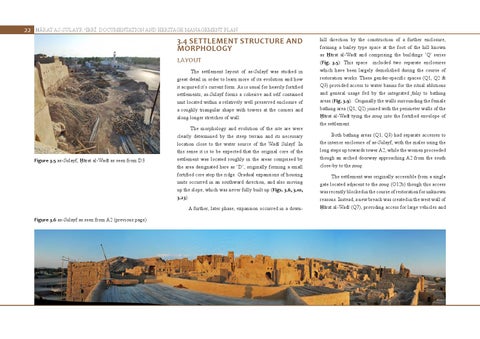
3.4 Settlement structure and Morphology Layout The settlement layout of as-Sulayf was studied in great detail in order to learn more of its evolution and how it acquired it’s current form. As is usual for heavily fortified settlements, as-Sulayf forms a cohesive and self contained unit located within a relatively well preserved enclosure of a roughly triangular shape with towers at the corners and along longer stretches of wall.
Figure 3.5 as-Sulayf, Дārat al-Wadī as seen from D3
The morphology and evolution of the site are were clearly determined by the steep terrain and its necessary location close to the water source of the Wadī Sulayf. In this sense it is to be expected that the original core of the settlement was located roughly in the areas comprised by the area designated here as ‘D’, originally forming a small fortified core atop the ridge. Gradual expansions of housing units occurred in an southward direction, and also moving up the slope, which was never fully built up (Figs. 3.6, 3.10, 3.23). A further, later phase, expansion occurred in a down-
Figure 3.6 as-Sulayf as seen from A2 (previous page)
hill direction by the construction of a further enclosure, forming a bailey type space at the foot of the hill known as Дārat al-Wadī and comprising the buildings ‘Q’ series (Fig. 3.5). This space included two separate enclosures which have been largely demolished during the course of restoration works. These gender-specific spaces (Q1, Q2 & Q3) provided access to water basins for the ritual ablutions and general usage fed by the integrated falaj to bathing areas (Fig. 3.9). Originally the walls surrounding the female bathing area (Q1, Q2) joined with the perimeter walls of the Дārat al-Wadī tying the souq into the fortified envelope of the settlement. Both bathing areas (Q1, Q3) had separate accesses to the interior enclosure of as-Sulayf, with the males using the long steps up towards tower A2, while the women proceeded though an arched doorway approaching A2 from the south close-by to the souq. The settlement was originally accessible from a single gate located adjacent to the souq (O12b) though this access was recently blocked in the course of restoration for unknown reasons. Instead, a new breach was created in the west wall of Дārat al-Wadī (Q7), providing access for large vehicles and