Number 2372
PERTH, WA: JANUARY 13 — 19, 1984 ADDRESS 26 John Street, Perth, WA, 6000 PO Box 50, Aberdeen Street, Perth, WA, 6000
PRICE 40 cents
TELEPHONE: (09) 328 1388
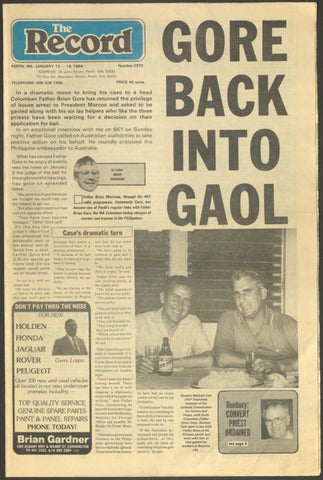
In a dramatic move to bring his case to a head Columban Father Brian Gore has returned the privilege of house arrest to President Marcos and asked to be gaoled along with his six lay helpers who like the three priests have been waiting for a decision on their application for bail. In an emotional interview with me on 6KY on Sunday night, Father Gore called on Australian authorities to take positive action on his behalf. He roundly criticised the Philippine ambassador to Australia. What has caused Father Gore to be angry at events was the news on January 5 the judge of the bail for the eight months hearings, h as gone on extended leave. "We came out of gaol because we thought we could help our lay helpers to get out. "But after eight months it had had the opposite effect. "They have now become • hostages," Father Gore said. O n the day the j udge's departure was announced, the prosecutor went to t he bishop and offered him a deal : F ather Gore and O 'Brien would go h ome and the six laymen could come out on house arrest. "In no way will we accept that. "We want the decision on bail to be given and they just won't give it
Fated
MM. NIORINSON
ri
Father Brian Morrison, through his 6KY radio programme, Community Care, has become one of Perth's regular links with Father Brian Gore, the WA Columban facing charges of murder and treason in the Philippines.
Case's dramatic turn because they know a d ecision of bail is a decision of dismissal. "A decision of no bail means we have got to go hack to prison. "They do not want the priests in prison because nobody believes we are guilty. "We are staying at the house of the provincial commander of Negros
DON'T PAY THRU THE NOSE FOR NEW
HOLDEN HONDA JAGUAR ROVER
Gerry Logan
PEUGEOT Over 300 new and used vehicles all located in our new undercover premises including —
TOP QUALITY SERVICE GENUINE SPARE PARTS PAINT & PANEL REPAIRS PHONE TODAY!
Brian Gardner
CNR ALBANY HWY & WHARF ST.CANNINGTON PH 451 2333. A/H 293 3384
GORE BACK N1"O 01.
and they do not know what to do with us. -We have asked to be returned to gaol and it seems they do not want to. " We have really put them in a spin," he said. Father Gore said the case involved politics at the highest level. "The whole population knows we are not guilty. "The military knows we are not guilty. "They are faced with the political decision of what to do with us. "They can liquidate us. "They can give us bail — they can deport us. "Which option they will choose we do not know," he said. If the Australian government is concerned, it is now time to do somethng, Father Brian Gore said in a live interview from the Philippines on Sunday night. "Idon't want any pussyfooting around. There has been a lot of wrist slapping in diplomatic circles which has achieved nothing," said Father Gore, commenting he had told his brother to get in touch with Mr Hayden, Minister for Foreign Affairs and possibly Mr Hawke the Prime Minister. "Australian government overtures to the Philippines government have been completely ignored. The protests from Austra-
h a have had no consequence on the case in our estimation. "I told Senator Tate if he wants to do something he has to do it in the economic field. He said he was prepared to do so. "If the Australian government and people are s ympathetic, as they really are, let them do something which has guts about it," he said.
Senator Michael Tate (ALP Tasmania) member of the Catholic Commission for Justice and Peace, with Perth Columban Father Brian Gore. Senator Tate spent a day with Father Brian at his Oringao parish and went with him to visit gaoled lay workers in Bacolod city.
Sunbury: CONVERT PRIEST ORDAINED
Prelate calls for family study A ustralian Catholic hospitals p rovided more than 2,800,000 possible bed days for the year ended June 30, 1983. T his was revealed in the first occupancy survey taken on Australian Catholic hospitals, compiled by the A ustralian Catholic Health Care A ssociation Secretariat. A ssociation executive director, Mr Joe Pavone, said the survey, of a limited sample of Australian Catholic hospitals, gave some indication of the extraordinary service they gave to the Australian people. Actual occupied bed days for the period were shown as 2,181,282. Surgical procedures totalled 154,766 and births 29,054 according to the survey. A limited sample survey covering 6 2.2 per cent of Catholic nursing home beds indicated the number of bed days of service for the same period a s more than 1,425,000. M r Pavone said the Australian C atholic Health Care Secretariat, established in October, 1982, spent most of the past year reviewing and negotiating changes in the Federal Medicare Implementation Committee plans. Mr Pavone said the secretariat was particularly concerned some smaller Catholic hospitals would suffer under the Medicare hospital categorisation plans. "It appears the three -category system does not sufficiently provide f or an appropriate range that would include some medical and psychiatric h ospitals, medical and surgical hospitals and some excellent smaller surgical hospitals," he said.
Archbishop Foley praised Charismatic Renewal at the opening of their conference in the Perth Concert Hall and urged them to study what the Church was teaching about family life today. "Any contact with the Renewal has convinced me of its wonderful effectiveness in developing a personal faith in Jesus Christ as Lord and Saviour, a deepening of prayer life a nd a union with the Father in Christ," the archbishop said.
He said the effect was visible i n the way people lived their lives, allowing Christ's mind to take possession and not modelling themselves on the world a round them. Archbishop Foley recalled his words on the night of his installation when he defined the Church as a community of the disciples of the Lord Jesus, united with Him by faith and baptism and gifted by Him in various ways for the shared pilgrimage we make through history. "It is important for us to recognise the unity and the many gifted nature of the Church,- he s aid. He said that St Paul learnt on the road to Damascus that Christians and the Lord O PTOMETRISTS a re one. Phone 444 3543 175 Scarborough Beach Road "This was not merely an interior unity. "He belonged to a comR F- \AiLLIS. W A 0 A Optometrist munity of real people and although he had spiritual revelations he went up to Jerusalem to find Peter.
Willis & Elliott MT HAWTHORN
Initiative
* **********************************
•* BATHROOMS . . . BEAUTIFUL • Remodel that old bathroom • •
"He used his initiative in his activity but he was ready to submit his plans • Add to the Church gathered in PRESTIGE and Value Jerusalem. I pray that all t o your home the gifts in the Church • may flourish and we may • remain one in Christ at the same time." • A rchbishop Foley asked his audience to • pray for him, to challenge him if they so felt, to .*********************************1 work with him to build up the Church and not to misuse their gifts to cause division in the ranks of the Church. Turning to the theme of the conference: Evangelisation Through Family Life he said the potential of the Christian family for good in its own members and in society is almost unlimited.
BOUCHER JONES PLUMBERS R ear 211 Newcastle St 328 6558 I328 6955
Healthy SPECIALLY FILTERED
684 ALBANY HIGHWAY, EAST VICTORIA PARK TELEPHONE 361 3164
2
"Without a health family it is hard for any person to be whole, to come to know the love of God, and very hard for any society to build a structure that will be fruitful for the life of their members.
The Record, January 13 — 19, 1984
Visible in their lives He praised the document on the Christian Family that Pope John Paul had issued after meeting bishops at the Synod of the Family. "I wonder how many of you have read what the Church has said about Christian marriage. He said the theme of the conference gave him joy because "it will force you to go back and think not only of principles but how to apply those principles to life in a sound and fruitful way. He said he had received some letters expressing concern on aspects of the conference theme and of the structure of life in the Bethel community. "I suggest they may not have fully understood the vision of that family life or its mode of life. "As you listen to Kevin Horgan and Suellen you will have the opportunity to hear from them how they have enriched their OWR marriage within the Bethel community. "I believe we should listen and draw strength and faith from their generosity and readiness to share. "On the other hand, we should realise there is not but one model of family life. So many things create variation within it: personality cultural background etc. "We need to see the essence and then we can see the variety that flows from it. A rchbishop Foley pointed out St Paul in his letter to the Ephesians had spoken first of the mystery of all being called to live in Christ and having made that clear, he had no difficulty of speaking of marriage as it was at that time. If the obedience of the wife to the husband was in reverence to Christ, a balance would be found no matter what the culture, Archbishop Foley said.
1 He said Pope John Paul had taken up the same theme during his Holy Year addresses to pilgrims in St Peter's Square.
The pope, he said, had pointed out difference between the times of St Paul and the present day. "Nevertheless the first
moral principle in Ephesians remains the same and produces the same results in today's world," he said.
Changing Australia reviewed The second of three programmes dealing with the 1983 Social Justice Statement C hanging Australia w i l l be shown on C hannel Nine this S unday evening at 10.30pm immediately after the movie. Produced on the initiative of the WA Christian Television Association of which t he Catholic Church is a member, the three programmes are being shown nationally as an ecumenical follow-up to the statement which in 1983 for the first time was jointly sponsored by the Catholic, Anglican and Uniting churches. The WA group was able to secure the use of the Perth Channel Nine and Seven studios for Anglican Television of Sydney to send a crew to Perth to produce the three half hour programmes. The first programme shown last Sunday night dealt with the topic Australia As It Is and featured several prominent Western Australians commenting on the statement.
Second in TV series
The second programme is titled The Good News and the third programme to be shown on Sunday January 22 is titled The Visions of The Future. The series will also be
available for parish, school or individual use on Beta and VHS video cassette. Further details are available from the Christian Television Association, 10 Pier Street, Perth.
111111‘11"1"111rWIVIIIMPWWIW‘11/11WVIVIVIIIVIN 1
The Daughters of Charity NEED YOUR HELP f or their work for the development of the underprivileged
U RGENTLY NEEDED Clothing, clean, wearable, — house-hold goods — nick-nacks — ornaments, jewellery, etc. Deliver to
534 William Street, Highgate For Truck to call — Phone 328 4403 Country goods marked "donation. ' free on rail to Kewdale Rail Terminal
41\AIIMIILAI\A\Alk.4111..ALAIlkalwAILAIIIIkAbrillh4\411141k.
Gospel basis Let God's spirit within be for the hope a teacher in family life Father Soulsby exhorted Christians to "let God's Spirit within you be your living teacher". After God, the next most important educator was ourselves, he said. "We all need to be constantly evangelising ourselves."
"We have a lot of failure and a lot of guilt inside of us. If we're honest we know Satan has taken up residence inside of us at times and has bound us up. "That makes us relate on a superficial basis because we don't want our inner self to be shown.
lir KEN WILSON
The 1981 exhortation by Pope John Paul II to "strenghthen and support family life" became a realityfor more that 2500 Christians during a conference and healing Mass held last week. The conference theme, "Evangelisation through the Christian family", allowed those who attended to see real hope for f amily life if it is based on the Gospel. A rchbishop Foley, encouraged Christian famii n his opening ad- lies to realise they had a dress (see separate mission to evangelise others. Quoting a papal document. story page 2), encour- he said, "The family has been aged those attending established by God as an t he conference to intimate community of life discover God's will and love. f or them as hus- "The family has the mission to guard, reveal and combands, wives, childmunicate love so as to reflect ren or single. God's love for man and Christ's love for the Church He encouraged people to and His bride. pursue God's Word in their "With love as a starting everyday lives. pointing, a family must: The conference was notable in many ways as it produced • form a community of the first local keynote speaker persons; at a Catholic charismatic • serve life; conference organised by the • participate in the development of society; WA movement. Husband and wife Kevin • share in life and mission of and Suellen Horgan and the Church." Quoting Pope Paul VI, Mr support speakers Pat Callahan, Veronica Shakhovskoy, Horgan said: "One cannot and Greg Diamond along fail to stress the evangelising with Marist Father Jack action of the family in the Soulsby, presented a broad evangelising apostolate of spectrum of ways Christian the laity. "The family has well defamilies can relate and grow served the term domestic with each other. Subjects covered included church. "Families evangelise other "Being a Christian Man"; "Being a Christian woman": families as well as them"Being a Christian wife and selves." Mr Horgan said it was mother"; "Being a Christian husband and father"; "Ado- important for Catholics, lescence to adulthood" and particularly, to realise the "Children from infancy to r ichness of wisdom the Church has and to seek adolescence". In his opening address, Mr practicalities of that wisdom. "We are living in an age Horgan spoke on the Commission of Jesus and the need where the world is increasing for Christian familes to its influence on Christians," embrace what Jesus taught Mr Hogan said. "We all should realise a lot in a full and positive way. He exhorted Christian. of what society has to offer families "everywhere" to is in direct opposition to review their lives to see where what God is offering. "God has told us He comes God was given priority. "It is a challenge by Jesus first in our lives. Can we to knuckle down and study answer Him 'yes' in every to become husbands, wives, area of our life?" Mr Horgan said following parents, and so on," he said. "For most of us, our prep- God's direction brought aration to become channels rewards "beyond your imagof God's creation as hus- ination". bands and wives, was scant." The fruits of being a followMr Horgan said the Church er of God removed the laid clear guidelines for tension and power struggle Christian families particular- produced by unclear roles of ly in statements by popes in husband and wife. Parents needed to be examthe last two decades. He said Pope John Paul II ples to their children to
Scissors, Saws, Secateurs, Shears. Sharpened and Set
Harry Armstrong Pty. Ltd. 4 QUEEN STREET — 321 4390
LOCKSMITHS
Locks Door Closers and Safe Overhauled and Serviced CAR and ALL TYPES OF KEYS CUT Immediate Service
Mr Pat Callahan led a workshop during the conference involving two of his four children on the subject of infancy to adolescence. He said all Christian parents needed to realise God wanted them to bring up their children to reflect Him. That represented a major challenge in today's society. "Our society is not totally Christian so as parents we cannot always rely on it to help us," he said. "We are told we should let our children do their own thing and make up their own mind. "God tells us differently. "He says parents are in charge of their families and will answer to Him for the way they bring their children to Him." Mr Callahan said it was important for parents to spend quality rather than quantity time with their children. Our every action with our children should be a constant washing over them with God's love — even when they do wrong. "You don't love the wrong but you always love the child," he said. Mr Diamond (24), a physiotherapist, who spoke on adolescence to adulthood, said there was no generation gap in God's people. "The Lord showed me I couldn't live the life I was leading and profess to be a Christian," he said. "He showed me I couldn't love my parents or brothers and sisters the way He wanted me to if 1 didn't take notice of Him. "By accepting God into my life, I have been able to confer the honour, respect and dignity on my family which they deserve. "My relationship with my father has been transformed in what I can only describe as one of God's miracles in my life."
S atan makes us feel fearful and guilty. "In contrast, embracing the Holy Spirit in our lives enables us to see Satan's lies and build up our self worth which God planted wrthin us when we were created. "It allows us to see we are basically good people. Now and again we fail and t here is a lot of good m oving in the wrong direction." C hristians needed to become "joy germs" to the world realising that
spreading God's Word was normal and having a personal relationship with Jesus was normal. " Every action we do should be open to the holy Trinity inside each one of us," Father Soulsby said. "If you believe that you will pass it on to others."
F ather Soulsby said it was important for parents to constantly feed their children with positives to counter and eliminate the constant harassment of Satan.
BOWRA & O'DEA Funeral Directors •
Four Generations of the O'Dea Family have been proud to serve the Catholic Community since 1888 (a period of 95 years). Bowra & O'Dea is still a wholly owned Catholic Family Company, directed by Joe O'Dea (Snr.) and Joe (Jnr.), 4111111110.•
establish a Christian culture so that God became a normal part of family life. Mrs Horgan said each day "must be a full response to know God, love Him and serve Him." That meant loving ourselves, our neighbours and spreading the Good News. God'scommandment(Matthew 28: 18-20) to make disciples of all nations was given to every man, woman and child to fulfil God's plan. That did not just mean far off mission fields.
"Perth is a mission field." Mrs Horgan said. "It is my mission field as a wife and a mother. Mrs Horgan said she had recognised God had given her husband a commission to be responsible for their family. "I liken my husband to C hrist who loved the Church," she said. "He is no longer a rival with whom I live. "While I saw him as a rival. he couldn't love as Christ loved the Church."
PERTH: 68 Stirling Street. 328 7299 BALGA: 502 Wanneroo Road. 349 0100 CANNINGTON: 1307 Albany Highway. 458 5017
Quality Service and Facilities, provided 24 hours of everyday, at all above Funeral Chapels. The Record, January 13 — 19, 1984
3
Record The affairs of teachers' associations have never been considered so far to be the stuff of education but judging by the preposterous statements coming out the Australian Teachers Federation conference in Adelaide this week Australians had better go back to the classroom and find out where their education is lacking. There are already decisive battles going on in NSW and Victoria as right and left factions look for teacher union control but last week's outburst from Adelaide shows that the issue is far more than union politics and is a blatant claim by some teachers for a monopoly control of the taxpayers' education purse and the purpose for which it is spent. A s if carried away by his own totalitarian rhetoric the ATF president Mr Van Davey had no qualms in demanding the money he said was being handed out to private and church institutions, ---- the pupils and the fact that it was being spent on their education apparently being irrelevant to his claim. In a plea worthy of some 1984 foray into mind control he lamented that the teachers' campaign against state aid was not succeeding because of lack of press coverage and the lack of a nationwide campaign by teacher and parent bodies, a campaign that no doubt he and his cohort would dearly like to direct. There have always been opponents to state aid and their arguments have been dressed up in a number of disguises but the arrival of new commissar -like figures in the guise of teachers reveals a fantasy of power and monopoly in which parents, politics or economics don't exist or matter even less. The anti -state -aid faction in the last century could shelter conveniently behind the skirts of the prevailing Protestant bigotry in an unholy alliance believing that if the Catholics were out of sight as far as school were concerned, they were out of mind. It was a bluff not unlike that still perpetuated in the United States under the guise of the separation of Church and State. Elementary education rights can be overlooked so that sectarian feathers will not be ruffled. The secularists and the humanists cheer their democratic hearts out loudly from the sidelines. A s the sectarian excuse began to wear a bit thin in Australia politicians, of all parties particularly under the pressure of P and F and other groups, were pragmatic enough to put an end to a situation where a Catholic or other independent pupil was entitled to not even a pencil or sheet of paper if they did not submit to the government system. These facts of reality of course were not likely to be mentioned in a cosily funded government classroom from which a pupil entered a cosily funded training programme to take up a cosily funded tenure in teaching. There would not have been many politicians in the past 20 years who were not sufficiently astute to tell their audiences that independent schools are in fact saving governments quiet a bit of taxpayers' money because the private schools are educating Australian citizens for a fraction of the government cost. That some parents feel strongly about their children's education is lost on those who have never had to dip into their pockets to test their feelings. Thus current opposition to state aid from certain teaching sections has reached new heights of ocker disrespect for parents who are sufficiently motivated to vote with their feet and their wallets about how they feel towards today's education. Phony bleatings about the non-existent divisiveness of private education pale against the real divisiveness that will occur if these emerging teacher activists pursue their fantasy that they have a divine right to the treasury when it comes to education. This was no more illustrated in the other enlightening revelations at Adelaide which pushed for a range of parenting rights and financial considerations for homosexual and lesbian teachers. This type of talk has got nothing to do with discrimination. It is the new wave of superiority that tells the public it will like what it gets and that the enlightenment in the teaching profession will decide what is good for us. Understandably, educational sectors are bristling indignantly at popular suggestions that value is not being had universally for the education dollar. More money may solve some of the prevailing deficiences but it will not dampen the disquiet being felt about the directions some teachers want to take their profession.
Convert priest to be ordained St Therese of Lisieux, St Ignatius of Loyola and St John of God have all played a big part in the Catholic pilgrimage of Rev William Holmes and will be specially mentioned in his first Mass after his ordination in St Patrick's cathedral, Bunbury on January 22. R ev William Holmes, a married convert to Catholicism and at one time an Anglican priest was ordained deacon by Bishop Quinn last week and after his ordination will be attached to St Patrick's on special ministry. St Therese of Lisieux crossed his vision when he studied a religious education course on modern church prophets including St Therese and his enquiries on her led him to the Carmelite monastery in Launceston where he found four of the sisters were l ike himself, former Anglicans, including the prioress, a former doctor f rom New Zealand. St Ignatius of Loyola is a firm friend after he and his wife Marjorie did the Spiritual E xercises of St Ignatius with Father Greg Boyle SJ in Melbourne. St John of God surfaced when he was a patient in that hospital in Subiaco in 1 975 and he asked for some information. "Within five seconds a sister had the latest biography of the saint in my hands," he said. "St Therese has a parallel with St Ignatius who wanted to see God in all things, especially simple mundane things. "But here was this very intelligent young girl, this very spoilt young girl with this tremendous confidence in God, who virtually lost her faith and went through this crisis of faith when she was dying. "I found I had a lot in common with this spiritual journey, something I was going through at the time. "I have never been to Lisieux but I have told Carmelites at Launceston, Kew and at Dardanup where I will be saying my first Mass: When you go to a Carmel you experience Lisieux."
William Holmes was born and educated in M elbourne and studied for the Anglican ministry The ATF claims to represent 165,000 teaching in Adelaide where he was members in Australia. If the Adelaide opinions are ordained in 1968 after supposed to represent the feelings of those teachers, w hich he served in and the financial battle lines are those they wish to Gambier, KojonMount have drawn, the profession can hardly appeal to its up Latrobe in Tasand idealism as the only criterion by which to be judged. mania. His wife Marjorie • • is a Western Australian. f4 :.26 John Street Perth WA 6000 • Correspondence They and their son • The Editor. The Record, PO Box 50 Aberdeen Street, Perth. 6000 Philip were received into • Advertising the Catholic Church in Vanguard Service Telephone 328 1388 • registered for posting as a newspaper Category "A" 1979 at the Carmelite (11) • • Produced in WA Launceston monastery Printed and published weekly by Edward van Heemst Vicar General late the by • 26 John Street Perth • • • Established 1874 • of Hobart, Monsignor • I Bernard Rogers. 4 The Record, January 13 19,1984
Deacon William Holmes
The forthcoming ordination of Rev William Holmes as a married Catholic priest is an individual case and not a precedent established by the diocese of Bunbury Bishop Quinn said this week. "It is providential perhaps that Father Bernie Dwyer knew William Holmes personally from the days when they were together in the Kojonup area and was able to make the suggestion the diocese apply to Rome for the dispensation," Bishop Quinn said. Bishop Quinn explained that in August 1982 when he took charge of the diocese, he confirmed the application to Rome. It had already been made by his predecessor Bishop McKeon who had applied after discussing the matter with the priests of Bunbury and the Diocesan Pastoral Council, Bishop Quinn said the factors influencing the application were that there was a need for clergy in the Sunbury diocese, that the candidate was personally recommended by Father Dwyer and that the applicant was already a C atholic when his ordination was proposed. He said initially it was suggested William Holmes be ordained as a permanent married deacon but on the advice of priests it was decided to ask Rome for a dispensation for ordination to the priesthood. The application was also influenced by the fact permission had recommenced in some American dioceses after having been suspended for some time. "I was delighted when the matter went forward because I had seen the three married priests working in Perth archdiocese. "I knew they fitted into the apostolate very well, were happily accepted by the whole community," Bishop Quinn said. "The Banbury community is aware of what took place in
Bishop Quinn
Perth so there was no major problem introducing this idea of a married priest to them." Bishop Quinn said before such a step was taken, the matter was put to the Bishops of Australia. This happened in all four previous cases of ordination of married men. He said there was no concerted plan to widen the practice in Australia and the Bishops' Conference simply endorsed the decision of a particular bishop after hearing the move would be acceptable in the diocese. Bishop Quinn said one of the conditions of such ordinations is candidates have adequate Catholic study and Rev William Holmes had already done those studies in Melbourne before making his application. Another condition was such a priest may not exercise his ministry for any length of time outside the national territory in which he was ordained. A further condition asks his understanding in the case of the death of his wife he will not be permitted to re-marry. "I don't think this step affects the celibate situation, and I don't see it as a move to abolish celibacy or to encourage the lessening of the celibate tradition," Bishop Quinn said. "Rome has insisted we set this as an individual and personal dispensation. "We could not say to anyone else who was thinking of asking for ordination after conversion that a similar dispensation would be given. "Rome considers case by case and the dispensation is available only to former clergy. "The reason is their faith has made them make this traumatic decision in their lifestyle. "We feel that if we can support them in this faith commitment to the Church, then this is a good thing to do," Bishop Quinn said.
1.•••••••
William Holmes says he and his wife, formerly a practising Methodist, m ade the decision together. It had taken them a long time. The day of their reception was significant, January 25, the feast of the Conversion of St Paul. They then moved to Melbourne where he was a part time lay theology s tudent at Clayton becoming later a full time student for Bachelor of Theology while his wife worked on the tutorial staff at St Vincent's Hospital. "I became a Catholic firstly because it was the Lord Himself who asked me to make this move, and also because as an
Anglican priest I had come to that sad stage where I was at a spiritual standstill. — My turn to the Catholic Church was not sudden because for years I had that attraction. S ince becoming a Catholic. I have not been disappointed. "I have come closer and closer to the Lord as a result of my conversion. "Thomas Merton has said all of one's life is an ongoing conversion. "1 believe that in the Catholic Church there is greater spiritual security and order. I also felt that there were the spiritual tools with which better to serve the people of God. "Catholics seemed to me to have a firmer founda-
tion in their faith. "I noticed this particularly in my hospital visitation as an Anglican priest. "I admired the unity of the Catholic Church despite its obvious diversity. "This is due obviously to the office of the papacy which I regarded with much respect. "But essentially, my conversion is to do with love. "Certainly it was a romance, even a passion which I had never felt in the Church of my birth. "As a Catholic I could understand the concept of martyrdom which I could not as an Anglican. "I am thinking of modern day martyrs, the many unsung, unknown
martyrs moreso than the famous and it is something I feel I could subscribe to myself. "I remembered at all time Newman's emphasis on the conscience which made him a convert. "That it happens half way through one's life is irrelevant. "It can happen in one's teens as with Therese." Deacon Holmes said w hen he became a Catholic in 1979 the moves towards ordaining former Anglicans in the U nited States was unknown. Although he hoped for Catholic ordination he had received no promise. He knew other applicants to Rome had been turned down since three were ordained in Perth in 1970.
One of the most significant Catholic n ews stories in 1983 was the Church a nd the bomb — in the United States, and in Western Europe. It was the year the US bishops i ssued their pastoral letter on nuclear d eterrence, but statements on the s ubject also came from the Dutch, West German, Irish, British, Belgian, F rench and Japanese bishops.
US pastoral year's top news story
White House and Pentagon "leaks" this week indicate
the US is producing eight new nuclear warheads each
Pope John Paul H spoke out on nuclear arms i ssues several times, and his secretary of state, Cardinal Agostino Casaroli, delivered a major speech on the topic during a visit to the United States. The head of the Vatican's Congregation for the Doctrine of the Faith, Cardinal Joseph R atzinger, addressed the issue at length in an interview with a West German national news m agazine. P ope John Paul from the worldwide resources opened 1983 with a of NC News New Year's Day plea to world leaders "to work in common" for a "progressive reduction in armaments, nuclear or conventional." Disarmament cannot be "unilateral," he said, but must be done by "the powers which confront one another... in equal measure." Two weeks later he addressed the same topic in his annual beginning-of the -year meeting with the Vatican ambassadors of governments around the world He urged governments to engage in disarmament negotiations, "forcing t hemselves to achieve, without delay, the maximum reduction. '" Close on the heels of the papal please came a January 1 8 - 1 9 meeting of Vatican, US and European Church representatives in Rome to discuss, behind closed doors, the controversial second draft of the US pastoral, which had been releasedthe previous October. wilim•Ww11•=11111111•1
Although critics of the pastoral sought to portray the meeting as a highpowered Vatican -European effort to reverse its direction, confidential o fficial reports on the m eeting, which were leaked to the press in March, put it in a different light. Those reports showed the critiques by European Churchmen and Vatican officials were essentially t he same as criticisms offered by members of the US hierarchy in discussing the draft two months earlier. In the main, these were aimed not at changing the basic directions of the document but at finetuning it and clarifying the difference between basic moral principles of Catholic teaching and the pruden-
day. Estimates say in two years, the US will have a total of 29,000 warheads deployed in America and around the world.
defence pol icy "on the their own war and peace presupposition that it is pastoral and released it m ade unnecessary as April 27. Copies in English, translated by the German r apidly as possible.ThecardinalalsoarticulatBishops' Conference, beed the Holy See's position g64 came avai lable in the in defending the right of United States in early May. 1 T he West German bi- bishops' conferences not Ot44 only to reiterate general shops clearly took a differChurch teachings but to go ent approach than their US c ounterparts in many beyond that and apply Est. 1910 t hose teachings to conways, most notably in their crete situations and condidecision not to enter into tions in their own country. an explicit moral debate At the end of May a long over specific questions of (Opposite Cargill St. State School) analysis of nuclear morality nuclear policy or strategy. appeared in Civilta CattoliThey also devoted more ; 41; ca, a Rome -based Jesuit space and emphasis than m agazine whose main the US bishops slid to the editorials and articles are threat of Soviet domination 190 understood to reflect Vati- 44( and the political goals of can thinking. nuclear deterrence, and The writer, Italian Jesuit t hey expressed greater Father Giuseppe Derosa, scepticism about the total a n editorialist for the pacifist option as a choice magazine, agreed with the for individuals. US bishops' conclusions, In the face of the Soviet quoted substantially from t otal itarian threat, the the US pastoral, and said West German hierarchy his analysis was suggested a presumption that document in favour of the morality of the policies of free, demoIn June the Dutch bishops added their views on cratic governments, while n uclear deterrence by the US bishops were clearly criticalof specific policies publishing their own pastoral letter. Although it currently in place, notably was a far shorter letter, the inclusiion of a nuclear f irst use option in US less than 10,000 words long, its spirit, thrust and NATO "flexible response" defence policy. • Cont page 6 But in fundamentals of moral evaluation of nuclear deterrence pol icy, the West German and US p astorals were closely parallel. Both insisted deterrence c ould be accepted only under strict moral conditions, among them the only immmediate goal could be preventing war, not waging it, that any "quest for (nuclear) superiority- was a morally unacceptable policy, and that nuclear deterrence policy must h ave as its final goal politically negotiated progressive disarmament. B ecause they did not enter into detailed analysis of nuclear policy, the West German bishops' statement was only half the Wool Broker length of the 45,000-word US document. The woolgrowers own selling organisation. Another notable developEST 1959 ment in May was the appearance of a lengthy interview with GermanFor further details contact: born Cardinal Joseph Ratzinger, prefect of the John LOUGHLIN Vatican's Congregation for the Doctrine of the Faith, General Manager by Der Spiegel, a West AH 337 3121 G erman national news magazine. HEAD OFFICE AND MAIN STORE: In the eight -page inter23 Cockburn Road, South Fremantle 6162 view Cardinal Ratzinger Telephone 335 4244 defended the US bishops' Postal Address: P.O. Box 18, South Fremantle 6162 condemnation of the first use of nuclear weapons 31 Campbell Road. Albany and said they were right in Telephone 41 4886 Postal Address: P.O. box 876, Albany accepting only a temporary role of a first-use threat in an11111111•1111
744Raxativeis,26***.eNewezvi*4
FUNERALS
MEAD SON & CO. PTY. LTD. Albany Highway, Victoria Park Phone 361 6191 - 361 3482 OTHER DISTRICTS
t ial application of those teachings to specific nuclear questions. "The basic thrust of the document wi l l remain intact. During the meeting, in fact, there was great support for that," Archbishop (now Cardinal) Joseph Bernardin of Chicago, chairman of the drafting committee, said after the Vatican meeting. The third draft of the US pastoral, released in early A pri l , started another round of stormy headlines and national debate, comparable to those provoked t he previous June and October with the distribution of the first two drafts of the letter. Long before the May 2-3 Chicago meeting at which they finally voted on the pastoral, approving it by a 238-9 margin, the bishops had already achieved one of the chief aims of the pastoral, to make the moral dimensions of the nuclear deterrence issue an integral part of the public debate on the subject. Nor was the debate over the US pastoral confined to the United States.
*Very Fresh •Very Tasty •Ver
In West Germany, where the bishops were at work o n their own pastoral, sucessive drafts of the US document were translated into German and widely distributed and debated. In France, when Father Gerard Defois, secretary g eneral of the French Bishops' Conference, was quoted by a Paris daily to t he effect the January Vatican meeting had been a confrontation between US and European bishops, it created a national stir. He wrote several articles a nd letters in the next month, repudiating the newspaper article as a misrepresentation of his views and praising the US bishops for their "valuable" leadership and "courage" in addressing the issues.
When the US bishops f inally met May 2-3 in Chicago to amend and vote on the pastoral, a record 450 journalists, or nearly t wo reporters for every bishop, registered to cover the meeting. The most substantive changes that the body of bishops made in the final document clearly strengthened their opposition to any nuclear policies or strategies that might allow f or first use of nuclear weapons, massive nuclear r etaliation to a nuclear attack, or the concept of ' limited" nuclear war. Meanwhile the West German bishops had finished the final touches on
A rmadale & Districts Phone 398 2208 Scarborough Mt. Lawley Northern Districts Phone 444 3217 Burrendah Bull Creek Mt. Pleasant Phone 332 6401 0AW . .WW. WM_
WOOLGROWERS tor Prompt sale TOP returns AUCTION THROUGH
111111/COP
The Record, January 13 — 19, 1984
5
Year's top HAVE YOUR SAY news story Stand and from JF HARDING, Dianella,
major conclusions were virtually identical to those reached by the US bishops. One of the few significant differences was the greater prominence the Dutch bishops gave to the potential role of the peace movement in creating the political and moral climate in the world for disarmament. In July the Japanese and Irish bishops added their voices to the chorus of opposition to the arms race. The Irish bishops called p ermanent reliance on nuclear deterrence "insane" and declared that current nuclear stockpiles "far exceed any rational estimate of what deterrence requires." Citing the same "strict conditions" that the US, German and Dutch bishops had said must be met for a nuclear deterrence policy to be morally justifiable, the Irish hierarchy said if elements of a nation's deterrence policycould not meet those criteria, the c ountry would have a "strict moral obligation" to take steps, unilaterally if necessary, to change its policies
The bishops of Japan, the only country to have suffered a nuclear attack, c alled for a halt to al l f urther testing, deployment or production of nuclear weapons, the abolition of all existing nuclear weapons, and the establishmentof nuclear -free zones in EastAsia and other parts of the world. The Canadian bishops, while not issuing a pastoral of their own, in July congratulated the US bishops f or issuing a statement t hat was "thoughtful, courageous and prophetic" and a "milestone in mankind's search for peace." A s deployment of US nuclear tactical missiles in NATO countries of Western Europe approached, the Belgian bishops in July defended the deployment of those missiles as a legitimate option if disarmament talks failed, but t hey urged "new and r epeated initiatives. so that the present disarmament talks succeed" and make deployment unnecessary. The Catholic bishops of Scotland that same month joined leaders of other churches in their country to ask the British government to engage in "serious debate" on the planned deployment of "a whole new generation of nuclear arms" in Britain. As the first Euromissiles began to arrive in Great Britain in November, the bishops of England and Wales issued a statement accepting the principle of nuclear deterrence as an interim policy on the way toward disarmament, but sharply questioning the seriousness of the government's commitment to disarmament in light of the decision to deploy the missiles.
6
The French bishopswere the only ones to strike a significantly different note in the growing tide of antinuclear statements by Catholic bishops. In a statement approved by a nearly unanimous v ote in November, the F rench bishops agreed with others that nuclear deterrence must be "a t emporary response, to halt a limited situation which we must get out of as soon as possible," but the major thrust of their document was to defend the legitimacy of nuclear deterrence "under current circumstances." While France is one of the world's five major nuclear powers, it is not a member of the NATO alliance. Its independent nuclear force is far inferior to that of the Soviet Union and could only be used for defensive purposes as a deterrent a gainst superior Soviet power — a fact that Cardinal Ratzinger had taken pains to point out when he was interviewed by Der Spiegel six months earlier. The French statement focused on the threat of t otalitarian domination and warned that signs of w eakness or capitulation by the West could provoke the very aggression that n uclear deterrence is designed to prevent. Citing Soviet domination as the alternative, they called the French nuclear deterrent the lesser evil, "without pretending that this begets a good." In the course of 1983 Pope John Paul II made no major analytical statements about the morality of nuclear deterrence but spoke on a number of o ccasions about the dangers of the arms race and about the incentive that "the frightening spectre of nuclear holocaust" should give to peace efforts. In October the pope wrote to US President Reagan and Soviet President Yuri Andropovurgingcontinuation of arms reduction negotiations. In November, when the Soviet Union broke off negotiations on mediumrange negotiation, Cardinal Casaroli announced the Holy See's readiness "to make a mediation attempt t o encourage dialogue between the superpowers in favour of peace." The papal secretary of s tate also del ivered a major speech during a visit to San Francisco in November, in which he outlined the Church's position on the moral principles g overning questions of war, peace and self-defence. In the speech he warned that use of the world's nuclear arsenals would be a "type of col lective murder -suicide," said that the arms race has given "dramatic urgency" to the search for world peace, a nd declared that the potential evils of nuclear war call for a "revision of traditional principles of evaluation" of war.
Sir, Hearing a recent preacher ask if it was not time we stood to be counted on issues that really matter I a m sure we practising Catholics are at the conquest by stealth upon our Christian values occurring under our very eyes. I recal l so vividly the herculean efforts of the late Terry Daly and his tiny band of dedicated men and women who, with little support from people who should have known much better, courageously and t irelessly fought the efforts of the late Dr Hislop to legalise abortion on demand into the State — today by back door methods it is a fact of life. The same saintly man, encouraged by a minority of clergy and religious, and surrported by his tiny band of workers, most of whom long since gone to their e ternal reward, battled a gainst Marxism within the Trade Union movement and within the political life of the nation.
T hese stood up to be counted against the attack of the anti -Christ against the right of the parent to be the prime educator of their children, andoftheresponsibility of the Government of the day to provide adequate funds, without strings, for every parent to educate their children at a school of their choice.
They stood up to be counted in demands upon the Government to provide an adequate and proper defence of this great Australian nation, and to use for the benefit of all mankind t he mineral resources provided therein by the Almighty. They demanded our doors be opened to our Asian brothers and sisters, instead of the lop -sided
European migration system operating from early
times, and were ever astute and mindful of the Marxist stalking horse so painfully obvious to those who have cleared their minds and vision from woolly-minded thinking to this reality. Today, in the year of Orwell's projected 1984, we find ourselves at the cross-roads. Are our Christian values really worth fighting for, or are we to submit without a yelp to the "conquest by stealth" of the anti -Christ? A s our elected leaders stagger on, bowing to the entrenched unelected left leaning pressure groups, and insulting our ASEAN neighbours and friends and allies of old, can we as c ommitted Christians forming a substantial part
Because of the combination of an expanded news coverage and associated production difficulties, priority in future will be given to double-spaced typewritten or handprinted letters of 150 words or less. Letters must include a name and address, not necessarily for publication, and be at The Record office by Monday morning the week of publication. of the nations populace, continue to act like the Ostrich of old? Perhaps the Federal Government will have the hypocritical audacity to inflict yet another election on us in 1984 as they permit their over -superannuated colleagues to stand f or election for a three year
term and resign within bulls roar of their previous c ommitment Perhaps there is still just time to salvage something f or posterity from our Christian way of life if we i nform our minds and "stand up to be counted as Father suggested
Flo exuded air of peace and confidence
I first met Flo Hummerston outside St Pats Church in Havelock St, West Perth when I was stationed there in 1957. S he stopped to chat a fter Mass. S he was a lady who exuded an air of peaceful confidence. She did not come across a s dominating or overbearing. She has been called a -battle axe" but that was f rom her battle against people putting a public swimming pool in King's Park. the only other time I saw h er in person was 26 years later when I was called to administer the last rites to her in Craig wood Nursing Home, C omo where she was dying at the age of 94. I had heard of her in the years between but had little knowledge of the wide scope of her activities. She now emerges as a truly remarkable Catholic woman. She spelt out in her life a great deal of what the Vatican Council said about the apostolate of the laity. She was born into the HaymanfamilyinFremantle in 1889, baptised in Fremantle church and a ttended St Joseph's convent. She married Vic Hummerston who was a fitter and turner by trade and who proved to be a great support to her. They had one daughter Emily. While they were living in the South West, probably before 1920, the story is told that Mrs Hummerston asked Emily, then seven years of age, why she always walked home f rom school with the same children. Emily said that nobody else would play with them because they were poor
The Record, January 13 — 19, 1984
be counted
by Father JIM O'BRIEN and their father was dying f rom tuberculosis. Next day the manager of the local timber mill had a call from Florence to get help for the wife and six children of the dying man. This kind of action became almost a way of life f or Florence Hummerston. She responded to needs as she experienced them From the South West t hey moved to Swan bourne to run a garage near the railway station. Emily died about that time at the age of 18. F lorence was broken hearted but soon gave herself more fully to the needs of people wherever she encountered them. She and Victor moved to Sherwood Court, giving her a base in the heart of the city. It was during that time she attended Mass at St Pats, Havelock St. Eventually they moved to Williams Rd, Nedlands.
Flo Hummerston
• Continued page 16. ,.••••••••.-
Death of bishop's mother
Bishop Healy received news this week of the death of his mother and has left for Ireland to c elebrate her funeral Mass on Thursday in St Brigid's Church, Coone, County Kilkenny. The late Margaret Healy met many Western Australians in 1975 when she travelled to Perth for the
episcopal ordination of Bishop Healy. Her husband, the late Patrick Healy, died in 1967. One of a family of eight she had other close links with WA through four of her brothers and sisters who lived in the Osborne Park area and who are now all deceased: Mrs
Elizabeth Poole, Mrs Anne Healy, Mr Mike Somers and Mrs Rose Smullen. Assisting at the funeral Mass in Kilkenny will be Bishop Healey's three brothers and three sisters. The bishop expects to return to Australia at the end of the month. May she rest in peace.
DATELINE. . . overseas news roundup r i ROME — Pope John Paul has Lipraised the efforts of Sici l ian bishops to fight the Mafia and has decried the barbarous violence which continues on the Italian island of Sicily despite strong criticism by the Church. -Certain acts of barbarous violence, which provoke sorrow, astonishment and dismay, offend human dignity," the pope said in a speech to 1 500 Sicilians on pilgrimage to the Vatican for the Holy Year of Redemption. He called on the people of Sicily to assume a position of love in the face of hatred and violence and to have an authentic mobilisation of conscience in order to oppose the Mafia. I
I NEW YORK — For the second consecutive year, the US bishops' pastoral on war and peace was chosen a s the top story of the year in NC News' annual poll of editors. Pope John Paul was the leading newsmaker, as he has been every year since his election in 1 978. C ardinal Joseph Bernardin of Chicago, chairman of the bishops' c ommittee which prepared the war and peace pastoral, was the secondhighest newsmaker, as in 1983. The new Code of Canon Law which t ook effect on November 27 was r anked the second -highest story, f ollowed closely by tensions between t he Vatican and the US Church.
Problems in selecting leaders
LII El El BEIRUT — The Maronite Catholic of Lebanon have called f or respect for the rights of all Lebanese. The bishops' statement urged unity f or Lebanon, its institutions and its people, and defined Lebanon as "part of the Arab world." Their statement said the people in Lebanon and its citizens who had migrated had the right to participate in the political, social and national life of the country.
n fl
DRINK DRIVE A SIN BOSTON: Massachusetts r eligious leaders have issued a statement reminding people that drunken driving "is not only a social problem and a crime, it is essentially a sin before God." The statement, signed by Catholic, Protestant, Orthodox and Jewish leaders, pointed out the religions' common commitment to the sanctity of life. "More than 200 men, women and children are killed annually in Massachusetts because of this form of alcohol abuse," the leaders said.
The Catholic Pastoral Institute of W.A. offers a Diploma in Religious Education Studies on the c ompletion of a number of units in Theology and Religious Education. The units are offered in conjunction with the
W.A. COLLEGE OF A DVANCED EDUCATION VATICAN CITY (NC) — The
Priest tried MOSCOW (NC) — A Lithuanian Catholic priest has been found guilty of "anti-state activities," reported lass, the Soviet news agency. The trial of Father Sigitas Tamkyavichus, 44, lasted three days and took place in the Lithuanian capital of Vilna. lass said the priest was sentenced, but did not say how long the term was. The offense carries a maximum penalty of seven years in jail. lass had said that Father Tamkyavichus, pastor of a church in the town of Kibartai, had slandered the state in sermons and used church money to fund underground publications on human rights violations. Father Tamkyavichus was the second Lithuanian priest to be convicted in 1983 on the charges. In May, Father Alfonsas Svarinskas was sentenced to seven years. lass said that Father Tamkyavichus had sent "defamatory material" to Western news agencies, including Vatican Radio, R adio Free Europe and Radio Liberty. F athers Tamkyavichus and Svarinskas are members of the Committee for the Defense of the Rights of Believers, which monitors religious freedom in the Soviet Union.
Work for 150 people B ELFAST, (NC) — Ardoyne is one of the m anypoorneighbourhoods of Belfast where there is a look of helplessness, harassment and despair on many of the thin, p rematurely aging faces of its inhabitants, reflecting the economic hardships a nd rel igious and political strife in Norther Ireland. But this gloomy situation did not deter Passionist
ELLIOTT & ELLIOTT OPTICIANS AND OPTOMETRISTS C ontact LENS CONSULTANTS
PERTH PICCADILLY ARCADE PERTH 154 WILLIAM STREET
Bric-a-brac 274 5560 10am to 6pm every day
Catholic Pastoral Institute of W.A.
ri
GLASGOW - The Presbyterian 1 Church of Scotland has made a c olour film promoting Cathol ic vocations for the priesthood. A udio Visual Productions, an agency of the Church of Scotland, was c ommissioned to make the film by the Parents' Association of St Mary's College, the national Catholic junior seminary. "The Church of Scotland team has done a very professional job for us and we are delighted with the video," said Phil McSherry, chairman of the parents' association.
CASH FOR OLD FURNITURE
321 8151 321 5304
C OTTESLOE 19 NAPOLEON STREET 384 5605 FREMANTLE 30 MARKET STREET 335 2602
Church seeks spirituality when it looks for bishops — But when candidates are being considered to head the archdioceses of New York and Boston, Church officials a lso must look for people to exercise leadership on a national and international level, according to a Vatican official familiar with the process for choosing bishops. Father Voorhes a staff member of the Vatican Congregation for Bishops, the agency responsible f or recommending candidates to Pope John Paul II said traditionally the leaders of the Boston and New York archdiocesses become cardinals and e xercise special leadership because of the secular and religious importance of the two areas. R egardless of whom the US bishops elect as their president, recent presidents of the United States have chosen to consult with the archbishop of New York on everything from Church State relations to refugee problems, said Father Voorhes. N ew York also is complex, because the archbishop plays an important role internationally through groups such as Catholic R elief Service and the Catholic Near East Welfare Association, overseas relief agencies headquartered in New York, he said.
Community trust fund Father Myles Kavanagh, pastor of Holy Cross parish. He and several parishioners began a trust fund in 1976 for "the purpose of starting the processofliftingand integrating the Ardoyne community into the social and economic life of the city." Seven years later the Flax Trust is providing work for 150 people and hopes to provide a few hundred more jobs in 1984. "We decided to give the trust a name which would identify it with neither side in the sectarian divide. What is more neutral and appropriate here than Flax Trust? Flax is the fibre from which linen has been made for centuries in Ulster. The words 'linen' and 'Belfast' are associated all over the world and it was the linen industry which last century made the region one
of the most prosperous in the industrial world," said Father Kavanagh. One sturdy Victorian linen mill, for a long time standing empty like its neighbours was purchased by the trust in 1979. Divided into several units, the building now provides 20 small firms with space to develop. Approximately 150 people are now employed in the mill, manufacturing, designing and marketing products ranging from sweaters to computer software. The trust also runs a youth centre for 400 young people, a nursery school and a community centre. The wellequipped catering division provides meals in the mill restaurant, provides training in caterings skills and runs a "meals-on-wheels" programme for the homebound.
at Under-Graduate, Graduate and Post-Graduate level. They are offered on all campuses depending on the particular demand for one or more of them. Most Under-Graduate and Graduate level units are available in the external and/or regional mode. UNDER -GRADUATE LEVEL UNITS — are suitable for a) Diploma of Teaching b) Diploma of Teaching (Conversion) c) Diploma of Education d) ADAAS (Associated Diploma of Applied As & Sciences) GRADUATE LEVEL UNITS — are suitable for a) Bachelor of Education b) Graduate Diploma in Religious Education Studies POST-GRADUATE LEVEL UNITS — are suitable for a) Post Graduate Diploma in Education Studies b) Master of Education The above courses are desirable qualifications for aspiring and qualified teachers teaching or wishing to teach in Catholic Schools and for those working in the Catholic Apostolate. For more details, contact —
Academic Assistant, Catholic Pastoral Institute, 52 Ruislip Street, LEEDERVILLE W.A. 6007 Phone (09) 381 5100
DEATH A Part of Life
"New York demands a man who is sensitive to the poor, especially to minorities, and who at the same time can relate well to the middle and upper classes," Father Voorhes added. Boston, a major educational centre, demands a man "academically gifted and well-prepared," he said. "This is the age of dialogue, so the bishops have to be able to listen, especially to the priests and to the Religious," he said. Boston, beset by struggles between blacks and whites and among its several ethnic groups. "needs a reconcilier.
A seminar sponsored by
,162162xer
'O
ea.
Redemptorist Retreat Hoilse Saturday Feb. 4 9.45 a.m. to 4 p.m. Admission gratis. Lunch provided
Speakers include: Miss joy Brann Hospice Co-ordinator Educator
Rev Dr Douglas MacAdam Medical Director Hospice Palliative Care Service
Fr John Ryan Royal Perth Hospital Chaplain
Rev Michael Dewsbury Fremantle Hospital Chaplain
Mr Gerard Smith Education Officer, Bowra & O'Dea
The seminar will interest not only members of the general public but also nurses and those caring for the sick and elderly. Inquiries welcome to:
Mr Gerard Smith 328 7299 (office) 341 7142 (a/h)
Bookings close January 16
.469:44099"4059:40.9%:69,,
Roy Galvin &Co. 2 29-233 William Street Perth Telephone 328 8544
PLUMBING MATERIALS B ATHROOM FIXTURES S EPTIC TANK — DRY WELLS The Plumbing Supply Specialists'
The Record, January 13 — 19, 1984
7
KNOW Y OUR F AITH
Daily life among the broken poor
Ifirst heard of Dorothy Day 10 years ago.I— a Protestant then — had gone to work for a Catholic agency. ThereImet friends who spoke of this older woman, a convert to Catholicism, and her "radical personalism." S he was a cofounder with Peter Maurin of the Catholic Worker Movement. I hey told me about her journey; her unconventional youth, her intellectual search, her daughter's baptism and her own coming to faith, her fidelity to the church, her unwavering commitment to pacifism and her long and steady years of service to the poor. My friends gave me books about Miss Day and, more important, they introduced me to her own writing in The Catholic Worker. Since then I have not missed an issue of that modest newspaper which still sells for a penny a copy as it did in 1933. Each month in that p aper's pages I read about current concerns. R Ecent issues carried articles on Nicaragua, t he Middle East and capital punishment. Often the paper publishes early writings of Miss Day, along with t he tongue -twisting, mind-expanding "easy essays" of Peter Maurin. My favourite articles are the simple journals of life in the city or on the Catholic Worker farm. These articles recount the funny and frustrating
PATHWAYS OF THE $111 IT "The Christ of the Breadline" is one of the most famous works of Fritz Eichenberg of Peace Dale, R.I. Many of Eichenberg's works have appeared on the pages of the Catholic Worker, a modest newspaper started by Dorothy Day and Peter Maurin which still sells for a penny a copy as it did in 1933.
Washington parish from service in India or Latin America. There were also the J esuit Volunteers: bright, energetic and well-educated young adults from privileged backgrounds who came to live simply, in common, and to work in soup kitchen or free clinic or shelter. Some later would enter church ministry; most would return to their homes and go on with their careers. But all would be, in the words of the Jesuit Volunteer Corps. "ruined for life" the poor always on their minds. And there were Catholics from another parish across the city. Physically only a few miles apart, the communities were separated by light years of human experience. But man\ wealthy and powerful people shared their money, time and talent as lawyers, artists, physicians, because they believed that the people of our parish were their sisters and brothers. Some worshiped with us regularly, perhaps, like E ichenberg, seeing Christ more clearly when he is surrounded by the least ones. A nd there were the parishioners themselves. None werre wealthy; most were struggling. Yet they were alert to the needs of others and generous in their response. Few had heard of Dorothy Day. But all would have understood her — and she would
have felt at home among them. I saw Miss Day once, a t the International Eucharistic Congress in Philadelphia in 1976. It was an odd situation: the awkward, handsome woman, simply dressed, a poweful voice in an aging body, speaking in a huge building to a vast crowd about the infinite value of a single person — even a seemingly useless, unattractive person. Many heard her message. We learned from her of an uncompromising search for truth, a commitment to the Gospel, a grateful attentiveness to life's small blessings and a need to seek Christ among the poor. Prayer is what motivates and sustains Father Marvin Mottet in his ministry to Washington, D.C. 's inner-city poor and in his work as director of the U.S. bishop's Campaign for Human Development. The priest said he views himself as "a contemplative in the world," whose work for justice flows in part from the prayerful reading of Scripture and reflection on "the terrible injustices people are suffering today, what is causing them and howIcan best respond. By reading and reflecting on Scripture in this way, Father Mottet believes people begin to develop values which can lead them to direct service of the poor and action for social change. "You have to do mental gymnastics to miss the option for the poor that exists throughout Scripture," he said. "The Old Testament prophets emphasised that society would he judged by how it treated its weakest members. "Jesus identified with the poor and he lived in solidarity with them. That's the way we are going to be judged: 'As often as you diditfor one of my least brothers, you did it for me. Father Monet also pointed to the social teachings of the Church, beginning with Pope Leo X111's 1891 encyclical "On the Condition of Labor." The documents of this social teaching see action on behalf of justice as a mandatory dimension of Christian preaching, he indicated. "But it is the Eucharist that "Is the centre of everything. At Mass, you hear the wordof Godfrom which you get encouragement, strength anddirection. You are nourished by the Eucharist. And you bring the offering of your life before the altar." Without the essential element of prayer, Father Mottet said, people who work with the poor run the risk of becoming burned out. "You just have to have quiet time to listen to the Lord in Scripture and in the Eurcharist. You can't survive any other way."
Demanding spirituality ft is a handsome, striking face which looks out from the photograph which confronts me whenI sit at my desk. She must have been in her mid-70s when it was taken. The broadness of the forehead, the prominence of the cheekbones, the tranquil set of the mouth and the generous distance between the eyes all suggest a quick intelligence and a deeply feminine, intuitive, even maternal wisdom. But the eyes are the most arresting; they seem to take in a great deal, like the eyes of a contemplative. There is potential challenge in them too. They look like they could narrow quickly, shifting the tone of a gaze from an inviting warmth to an icy accusation. Inches away from Dorothy Day's portrait there is a woodcut of St. Jerome which her good friend, Ade Bethune, carved long ago. Jerome, also a writer, scowls over his scripture translation. He is at work for God but quick to anger; not to be trifled with, not to be approached from the wrong side, but fascinating. The pictures belong together.Iknew Miss Day only through other people — my wife, my close friends, the people with whom I once worked and lived in a Catholic Worker house in Davenport, Iowa. Miss Day was always, and will always be — perhaps because of that indirect acquaintance -- a presence as haunting and multifaceted as her face in that photograph. She was experienced by those dear to me in a variety of relations, but always the woman of prayer, who spoke with a disconcerting authority. When Margaret, my wife, opened a Catholic 8
By Michael Garvey Worker house in the early 1970s (where we later met), Miss Day wrote encouraging and kindly letters exhorting her not to be too hard on herself, to appreciate her limits, to enjoy the life. A few months later, however, when the two of them were introduced, Margaret was dressed down for not having written enough, for not publishing a newsletter and for not taking enough time for prayer. M argaret returned from the meeting shaken, furious at Miss Day and determined to write more often, to publish a newsletter and to take enough time for prayer. For Miss Day, prayer -- keeping company with God — was the indispensable ingredient. Prayer would transform the days. Prayer, she thought, would not alleviate the sufferings of the oppressed but might shame the oppressor in us so that we would renounce an oppressive society upheld by fear and greed. Those who would commandeer Miss Day's witness, putting it to the service of a spirituality which makes no demands, misunderstand her life. For her, no
The Record, January 13 — 19, 1984
Travelling light the easy way Father Marvin Mottet likes to tell the story of an elderly woman he once saw walking in Washington, D.C. The woman, he said, was wearing three heavy coats and had her remaining possessions crammed into three shopping bags. Finding it impossible to carry all three at once, she would set one bag down, carry two of them for a distance and then go back and pick up the third. She repeated this procedure over and over. For Father Mottet, w ho heads the U.S. bishops' Campaign for Human Development, this 20th-century story can be drawn on to illus-
By Patricia David d etails of daily life among the broken poor. M ost issues of the paper are graced with art by Fritz Eichenberg or Rita Corbin or others. Often the art speaks to me even more than all the words. I recall especially a warm table scene in which Jesus breaks bread with 12 street people. Miss Day broke bread with the poor for many, many years. The friend who first told me about Miss Day gave me his own copy of my favourite picture several years later when I joined the Catholic Church. Eichenberg's famous "Christ of the Bread Line" shows several people huddled in heavy clothes against the cold. Their faces are hidden in shadow, but the stooped forms suggest lifetimes of weary w aiting. Among the silent poor is one man, shabby but erect, a light about his head: Emmanuel, God with us. The gift proved prophetic. Several years later I joined the staff of an inner-city parish. We had a real live bread line — and many of the poor. Our work was inspired by the example of Miss Day. I worked most closely with Jesuit Father Horace McKenna who was an early associate of hers. He later did pioneering work in the black community in southern Maryland before beginning his legendary ministry in Washington, D.C. There were other Jesuits, equally committed, who came to the
Compiled by NC NEWS SERVICE
spirituality, no approach to God, could result in simply carrying on business as usual. She used to say that Christianity and the customary way of making do were mortally opposed to one another. The integrity of a human life was determined by the choices one makes — and her choice cost her everything. For her, Christianity changed everything. Knowledge of the high cost of Christianity inspired her famous remark when someone suggested she might one day be canonised:"I don't want to be dismissed that easily,"she said. That remark reflects her humility and sense of what sanctity really implies, as well as her fear of the ways sentimentality could accompany praise of her by others. But she won't be dismissed easily. The disconcerting thing about Dorothy Day is that she is very much like anyone reading this: by turns generous, unreasonable, prayerful, humble, petty, gloomy, cheerful and autocratic. An enormously talented but otherwise unremarkable North American. A simple daughter of the Church who simply chose to live in Christ.
Dorothy Day was a 20th century woman of prayer. Her life influenced many people in unforgettable ways. For her, prayer and action on behalf of the world's poorest people were intimately related. Patricia Davis tells how the work of Miss Day influenced her life. Ms Davis writes about her work in a Washington, D.C., parish where the poorest of the poor appeared in the soup kitchen every day. The work brought many people together who, from then on, were "ruined for life," as Ms Davis explains it. She is on the staff of the U.S. bishops' Laity Secretariat. Cynthia Liebhart visited at Catholic Worker house in Washington, D.C., in preparing her article for our pages this week. She interviews Father Marvin Mottet, executive director of the U.S. bishops' Campaign for Human Development. Ms Liebhart is on the Know Your Faith staff. Michael Garvey reminisces about the life of Dorothy Day in his article. Garvey has coauthored a book about Miss Day titled "The Dorothy Day Book." He is on the staff of Notre Dame University's Office of Information Services. And, Father John Castelot writes about every Christian's vocation to discipleship, a vocation that can be lived out whether one is a homemaker, a career woman, a technician, a student — whatever. The call of Jesus is addressed to all, he writes
"Her faith gave Dorothy Day humility, a nd her humi l ity taught her the need for courage. She sought courage in the lives of t he saints, and she loved those lives, craving their adventure and light. "(Margaret Quigley and Michael Garvey in "The Dorothy Day Book") "But poverty is my vocation, to live as simply and poorly as I can, and never to c ease talking and writing of poverty and destitution. Here a nd everywhere. 'While there are poor. I am of them. While men are in prison, I am not free,' as Debs said and as we often quote." (Dorothy Day, quoted in "The Dorothy Day Book," by Margaret Quigley and Michael Garvey).
SAimr)EROME
"Following the example of Christ in the desert.. (Dorothy Day) made her choice irrevocably to live for the rest of her life with the poverty and the long loneliness of her own uniqueness, her own
exceptional mission. Her decision to do so cost her more than any of us will ever know in terms not only of loneliness, but of misunderstanding, sheer human ignorance or malice, and what must have been for most of her life a terrifying sense of f uti l ity."(Mons. G eorge G. Higgins, speaking during a January 1981 memorial Mass for Dorothy Day)
'To say that Dorothy Day was, is and will continue to be a sign of how God is speaking to us today is not to indulge in maudlin rhetoric or sentimental piety.. . Though Dorothy would object to my saying so, that fact is however that for
millions of men and women and for the Church itself she was a true sign of God after the example of Christ H imself."(Mons. G eorge G. Higgins, speaking during a January 1981 memorial Mass for Dorothy Day) "The Dorothy Day Book," edited by Margaret Quigley and Michael Garvey. Templegate Publ ishers, S pr ingf ield, 111.1982. $9.95. This is an easy-to-read book that offers short samplings from the writings of Dorothy Day, as well as quotations from her favourite reading. It includes many fine illustrations from the woodcuts of Ade Bethune.
By Cindy Liebhart trate a sad truth about the way many people go through fife — burdened with extra baggage they really can't carry but don't want to give up. " As Christians, we cannot easily escape the call to a life of simplicity and service to the poor found in stories throughout the Gospels,"he said. "I don't see how we can live the Gospel without trying to live some sort of voluntary poverty. That's the way Jesus lived — in solidarity with the poor without even an extra pair of sandals." Father Mottet lives out this call at St. Francis Catholic Worker House in Washington, D.C's inner city. His "family" is made up of society's outcasts — the hungry, the homeless, the alcoholics, the mentally ill, the ex -convicts and former prostitutes. In that house. the "least of these," the people Jesus talked about, take flesh every night at a wobbly supper table or in front of a makeshift altar. Father Mottet first embraced the Catholic Worker lifestyle 10 years ago in Davenport, Iowa. After much reading and prayer, his decision was a response to the Second Vatican Council's challenge to find ways of living the Gospel in t oday's world. "It's the hardest thing I've ever done, but it's also one of the best," he said. "As Pope Paul VI said, people listen more willingly to witnesses than to teachers. Sometimes our lifestyle keeps us from preaching with conviction."
Giving up material possessions was the least difficult adjustment for Father Mottet. Giving up privacy and time were harder sacrifices. He acknowledges that not everyone is called to his particular lifestyle. But he believes "every Christian is called to some form of poverty, detachment, simplicity. "In our closed homes and closed cars we isolate ourselves from the poor. "Father Mottet said. "We very often don't see" how many people really are living on the margins of society.
invest or don't invest, the way we purchase or don't purchase." In families, for example, Father Mottet thinks a spirit of poverty can be fostered by an open and compassionate attitude toward poor people, minorities, the mentally ill, the elderly; by "the attitude that the extra coat in your closet is for your neighbour"; b y associating with causes and organisations concerned with justice and the welfare of the poor; even by choosing jobs which do not require compromising one's principles. Becoming active for the first time in serving the poor can be a frightening and uncomfortable experience, Father Mottet said. Efforts are not always met with friendly faces. "It is important that people get rid of their fear," gaining the experience they need gradually, he said. This might mean beginning to volunteer regularly in a soup kitchen, a Catholic Worker house or a neighbourhood centre.
"But as Catholics, we must realise we are members of a universal family in which most of our brothers and sisters are poor. We are a church of the poor. This realisation must effect everything we are and do — our lifestyle, how we vote, the way we
Father Mottet said that by increasing the time spent with them, romantic notions about the poor disappear and fear is replaced by "a healthy anger and sense of urgency. When you're around the hungry and homeless and hurting people all the time, you get to know them as they really are and you get a more realistic idea of what solutions might be. Most of all, you don't blame the victims."
matter of vocation
The mother caring for her family, with all that entails, is praying. The father working faithfully to support his loved ones is praying. The single person contributing to society in a variety of ways is praying. They all are serving. To serve is to pray. It is a question of living one's vocation. And actually there is only one v ocation, the call to discipleship, the call to follow in the steps of Jesus. This call is addressed to all. In Luke's Gospel, Jesus states the conditions for disipleship: "Whoever wishes to be My follower must deny his very self, take up his cross each day and follow in My steps. Whoever would save his life will lose it and whoever loses his life for My sake will save it. What profit does he show who gains the whole world and des-
By Father John J Castelot
t roys himself in the process? "If a man is ashamed of Me and My doctrine, the Son of Man will be ashamed of him when He comes in His glory and that of His Father and His holy angels. (Luke 9:23-26) "There are different gifts but the same Spirit. There are different ministries but the same Lord; there are different works but the same God who accomplishes all of them in everyone. To each person the manifestation of the Spirit is given for the common good -but it is one and the same Spirit who produces all these gifts. distributing them to each as He wills. The body is o ne and has many members, but all the If this call, this vocation, goes out to all, then obviously it is possible to live it in any of the
many states of life in which people find themselves: the married state,
SAINVEROME :11 •
white-collar or bluecollar worker, the professional, the technician: All have a vocation to live the Christian life just as they are and in the exercise of their roles in life.
It is a call to strive to live according to gospel standards. O ne is never more Christlike than when one serves. This is truly to deny oneself.
t he single state, the widowed state. The homemaker, the career woman, the father, the
Of course, if this service is to be prayer and not just humanitarianism, it must be Christian service. This does not mean that one has to be constantly aware that what is being done is done out of love for Christ and for fellow human beings. But one should start each day by reflecting, however briefly, on the members, many though they are, are one body; and so it is with Christ." (1 Corinthians 12:4-7, 11-12)
call to love and service. This will give the day, with its multiple duties and interpersonal relationships, a definite Christian motivation and orientation. This will colour everything in surprising ways. And it will keep Christ very close to the level of consciousness, so much s o that He will frequently break through to remind us that we are working for and with Him: serving as He served, loving as He loved and, in the process, praying as He prayed.
" The fact is that whether you eat or drink — whatever you do — you should do all for the glory of God — just as I try to please all in any way I can by seeking. not my own advantage. but that of the many, that they may be saved. Imitate me, as I imitate Christ." (1 Corinthians 10:31,33)
The Record, January 13 — 19, 1984
9
KNOW Y OUR F AITH
Daily life among the broken poor
Ifirst heard of Dorothy Day 10 years ago.I— a Protestant then — had gone to work for a Catholic agency. ThereImet friends who spoke of this older woman, a convert to Catholicism, and her "radical personalism." S he was a cofounder with Peter Maurin of the Catholic Worker Movement. I hey told me about her journey; her unconventional youth, her intellectual search, her daughter's baptism and her own coming to faith, her fidelity to the church, her unwavering commitment to pacifism and her long and steady years of service to the poor. My friends gave me books about Miss Day and, more important, they introduced me to her own writing in The Catholic Worker. Since then I have not missed an issue of that modest newspaper which still sells for a penny a copy as it did in 1933. Each month in that p aper's pages I read about current concerns. R Ecent issues carried articles on Nicaragua, t he Middle East and capital punishment. Often the paper publishes early writings of Miss Day, along with t he tongue -twisting, mind-expanding "easy essays" of Peter Maurin. My favourite articles are the simple journals of life in the city or on the Catholic Worker farm. These articles recount the funny and frustrating
PATHWAYS OF THE $111 IT "The Christ of the Breadline" is one of the most famous works of Fritz Eichenberg of Peace Dale, R.I. Many of Eichenberg's works have appeared on the pages of the Catholic Worker, a modest newspaper started by Dorothy Day and Peter Maurin which still sells for a penny a copy as it did in 1933.
Washington parish from service in India or Latin America. There were also the J esuit Volunteers: bright, energetic and well-educated young adults from privileged backgrounds who came to live simply, in common, and to work in soup kitchen or free clinic or shelter. Some later would enter church ministry; most would return to their homes and go on with their careers. But all would be, in the words of the Jesuit Volunteer Corps. "ruined for life" the poor always on their minds. And there were Catholics from another parish across the city. Physically only a few miles apart, the communities were separated by light years of human experience. But man\ wealthy and powerful people shared their money, time and talent as lawyers, artists, physicians, because they believed that the people of our parish were their sisters and brothers. Some worshiped with us regularly, perhaps, like E ichenberg, seeing Christ more clearly when he is surrounded by the least ones. A nd there were the parishioners themselves. None werre wealthy; most were struggling. Yet they were alert to the needs of others and generous in their response. Few had heard of Dorothy Day. But all would have understood her — and she would
have felt at home among them. I saw Miss Day once, a t the International Eucharistic Congress in Philadelphia in 1976. It was an odd situation: the awkward, handsome woman, simply dressed, a poweful voice in an aging body, speaking in a huge building to a vast crowd about the infinite value of a single person — even a seemingly useless, unattractive person. Many heard her message. We learned from her of an uncompromising search for truth, a commitment to the Gospel, a grateful attentiveness to life's small blessings and a need to seek Christ among the poor. Prayer is what motivates and sustains Father Marvin Mottet in his ministry to Washington, D.C. 's inner-city poor and in his work as director of the U.S. bishop's Campaign for Human Development. The priest said he views himself as "a contemplative in the world," whose work for justice flows in part from the prayerful reading of Scripture and reflection on "the terrible injustices people are suffering today, what is causing them and howIcan best respond. By reading and reflecting on Scripture in this way, Father Mottet believes people begin to develop values which can lead them to direct service of the poor and action for social change. "You have to do mental gymnastics to miss the option for the poor that exists throughout Scripture," he said. "The Old Testament prophets emphasised that society would he judged by how it treated its weakest members. "Jesus identified with the poor and he lived in solidarity with them. That's the way we are going to be judged: 'As often as you diditfor one of my least brothers, you did it for me. Father Monet also pointed to the social teachings of the Church, beginning with Pope Leo X111's 1891 encyclical "On the Condition of Labor." The documents of this social teaching see action on behalf of justice as a mandatory dimension of Christian preaching, he indicated. "But it is the Eucharist that "Is the centre of everything. At Mass, you hear the wordof Godfrom which you get encouragement, strength anddirection. You are nourished by the Eucharist. And you bring the offering of your life before the altar." Without the essential element of prayer, Father Mottet said, people who work with the poor run the risk of becoming burned out. "You just have to have quiet time to listen to the Lord in Scripture and in the Eurcharist. You can't survive any other way."
Demanding spirituality ft is a handsome, striking face which looks out from the photograph which confronts me whenI sit at my desk. She must have been in her mid-70s when it was taken. The broadness of the forehead, the prominence of the cheekbones, the tranquil set of the mouth and the generous distance between the eyes all suggest a quick intelligence and a deeply feminine, intuitive, even maternal wisdom. But the eyes are the most arresting; they seem to take in a great deal, like the eyes of a contemplative. There is potential challenge in them too. They look like they could narrow quickly, shifting the tone of a gaze from an inviting warmth to an icy accusation. Inches away from Dorothy Day's portrait there is a woodcut of St. Jerome which her good friend, Ade Bethune, carved long ago. Jerome, also a writer, scowls over his scripture translation. He is at work for God but quick to anger; not to be trifled with, not to be approached from the wrong side, but fascinating. The pictures belong together.Iknew Miss Day only through other people — my wife, my close friends, the people with whom I once worked and lived in a Catholic Worker house in Davenport, Iowa. Miss Day was always, and will always be — perhaps because of that indirect acquaintance -- a presence as haunting and multifaceted as her face in that photograph. She was experienced by those dear to me in a variety of relations, but always the woman of prayer, who spoke with a disconcerting authority. When Margaret, my wife, opened a Catholic 8
By Michael Garvey Worker house in the early 1970s (where we later met), Miss Day wrote encouraging and kindly letters exhorting her not to be too hard on herself, to appreciate her limits, to enjoy the life. A few months later, however, when the two of them were introduced, Margaret was dressed down for not having written enough, for not publishing a newsletter and for not taking enough time for prayer. M argaret returned from the meeting shaken, furious at Miss Day and determined to write more often, to publish a newsletter and to take enough time for prayer. For Miss Day, prayer -- keeping company with God — was the indispensable ingredient. Prayer would transform the days. Prayer, she thought, would not alleviate the sufferings of the oppressed but might shame the oppressor in us so that we would renounce an oppressive society upheld by fear and greed. Those who would commandeer Miss Day's witness, putting it to the service of a spirituality which makes no demands, misunderstand her life. For her, no
The Record, January 13 — 19, 1984
Travelling light the easy way Father Marvin Mottet likes to tell the story of an elderly woman he once saw walking in Washington, D.C. The woman, he said, was wearing three heavy coats and had her remaining possessions crammed into three shopping bags. Finding it impossible to carry all three at once, she would set one bag down, carry two of them for a distance and then go back and pick up the third. She repeated this procedure over and over. For Father Mottet, w ho heads the U.S. bishops' Campaign for Human Development, this 20th-century story can be drawn on to illus-
By Patricia David d etails of daily life among the broken poor. M ost issues of the paper are graced with art by Fritz Eichenberg or Rita Corbin or others. Often the art speaks to me even more than all the words. I recall especially a warm table scene in which Jesus breaks bread with 12 street people. Miss Day broke bread with the poor for many, many years. The friend who first told me about Miss Day gave me his own copy of my favourite picture several years later when I joined the Catholic Church. Eichenberg's famous "Christ of the Bread Line" shows several people huddled in heavy clothes against the cold. Their faces are hidden in shadow, but the stooped forms suggest lifetimes of weary w aiting. Among the silent poor is one man, shabby but erect, a light about his head: Emmanuel, God with us. The gift proved prophetic. Several years later I joined the staff of an inner-city parish. We had a real live bread line — and many of the poor. Our work was inspired by the example of Miss Day. I worked most closely with Jesuit Father Horace McKenna who was an early associate of hers. He later did pioneering work in the black community in southern Maryland before beginning his legendary ministry in Washington, D.C. There were other Jesuits, equally committed, who came to the
Compiled by NC NEWS SERVICE
spirituality, no approach to God, could result in simply carrying on business as usual. She used to say that Christianity and the customary way of making do were mortally opposed to one another. The integrity of a human life was determined by the choices one makes — and her choice cost her everything. For her, Christianity changed everything. Knowledge of the high cost of Christianity inspired her famous remark when someone suggested she might one day be canonised:"I don't want to be dismissed that easily,"she said. That remark reflects her humility and sense of what sanctity really implies, as well as her fear of the ways sentimentality could accompany praise of her by others. But she won't be dismissed easily. The disconcerting thing about Dorothy Day is that she is very much like anyone reading this: by turns generous, unreasonable, prayerful, humble, petty, gloomy, cheerful and autocratic. An enormously talented but otherwise unremarkable North American. A simple daughter of the Church who simply chose to live in Christ.
Dorothy Day was a 20th century woman of prayer. Her life influenced many people in unforgettable ways. For her, prayer and action on behalf of the world's poorest people were intimately related. Patricia Davis tells how the work of Miss Day influenced her life. Ms Davis writes about her work in a Washington, D.C., parish where the poorest of the poor appeared in the soup kitchen every day. The work brought many people together who, from then on, were "ruined for life," as Ms Davis explains it. She is on the staff of the U.S. bishops' Laity Secretariat. Cynthia Liebhart visited at Catholic Worker house in Washington, D.C., in preparing her article for our pages this week. She interviews Father Marvin Mottet, executive director of the U.S. bishops' Campaign for Human Development. Ms Liebhart is on the Know Your Faith staff. Michael Garvey reminisces about the life of Dorothy Day in his article. Garvey has coauthored a book about Miss Day titled "The Dorothy Day Book." He is on the staff of Notre Dame University's Office of Information Services. And, Father John Castelot writes about every Christian's vocation to discipleship, a vocation that can be lived out whether one is a homemaker, a career woman, a technician, a student — whatever. The call of Jesus is addressed to all, he writes
"Her faith gave Dorothy Day humility, a nd her humi l ity taught her the need for courage. She sought courage in the lives of t he saints, and she loved those lives, craving their adventure and light. "(Margaret Quigley and Michael Garvey in "The Dorothy Day Book") "But poverty is my vocation, to live as simply and poorly as I can, and never to c ease talking and writing of poverty and destitution. Here a nd everywhere. 'While there are poor. I am of them. While men are in prison, I am not free,' as Debs said and as we often quote." (Dorothy Day, quoted in "The Dorothy Day Book," by Margaret Quigley and Michael Garvey).
SAimr)EROME
"Following the example of Christ in the desert.. (Dorothy Day) made her choice irrevocably to live for the rest of her life with the poverty and the long loneliness of her own uniqueness, her own
exceptional mission. Her decision to do so cost her more than any of us will ever know in terms not only of loneliness, but of misunderstanding, sheer human ignorance or malice, and what must have been for most of her life a terrifying sense of f uti l ity."(Mons. G eorge G. Higgins, speaking during a January 1981 memorial Mass for Dorothy Day)
'To say that Dorothy Day was, is and will continue to be a sign of how God is speaking to us today is not to indulge in maudlin rhetoric or sentimental piety.. . Though Dorothy would object to my saying so, that fact is however that for
millions of men and women and for the Church itself she was a true sign of God after the example of Christ H imself."(Mons. G eorge G. Higgins, speaking during a January 1981 memorial Mass for Dorothy Day) "The Dorothy Day Book," edited by Margaret Quigley and Michael Garvey. Templegate Publ ishers, S pr ingf ield, 111.1982. $9.95. This is an easy-to-read book that offers short samplings from the writings of Dorothy Day, as well as quotations from her favourite reading. It includes many fine illustrations from the woodcuts of Ade Bethune.
By Cindy Liebhart trate a sad truth about the way many people go through fife — burdened with extra baggage they really can't carry but don't want to give up. " As Christians, we cannot easily escape the call to a life of simplicity and service to the poor found in stories throughout the Gospels,"he said. "I don't see how we can live the Gospel without trying to live some sort of voluntary poverty. That's the way Jesus lived — in solidarity with the poor without even an extra pair of sandals." Father Mottet lives out this call at St. Francis Catholic Worker House in Washington, D.C's inner city. His "family" is made up of society's outcasts — the hungry, the homeless, the alcoholics, the mentally ill, the ex -convicts and former prostitutes. In that house. the "least of these," the people Jesus talked about, take flesh every night at a wobbly supper table or in front of a makeshift altar. Father Mottet first embraced the Catholic Worker lifestyle 10 years ago in Davenport, Iowa. After much reading and prayer, his decision was a response to the Second Vatican Council's challenge to find ways of living the Gospel in t oday's world. "It's the hardest thing I've ever done, but it's also one of the best," he said. "As Pope Paul VI said, people listen more willingly to witnesses than to teachers. Sometimes our lifestyle keeps us from preaching with conviction."
Giving up material possessions was the least difficult adjustment for Father Mottet. Giving up privacy and time were harder sacrifices. He acknowledges that not everyone is called to his particular lifestyle. But he believes "every Christian is called to some form of poverty, detachment, simplicity. "In our closed homes and closed cars we isolate ourselves from the poor. "Father Mottet said. "We very often don't see" how many people really are living on the margins of society.
invest or don't invest, the way we purchase or don't purchase." In families, for example, Father Mottet thinks a spirit of poverty can be fostered by an open and compassionate attitude toward poor people, minorities, the mentally ill, the elderly; by "the attitude that the extra coat in your closet is for your neighbour"; b y associating with causes and organisations concerned with justice and the welfare of the poor; even by choosing jobs which do not require compromising one's principles. Becoming active for the first time in serving the poor can be a frightening and uncomfortable experience, Father Mottet said. Efforts are not always met with friendly faces. "It is important that people get rid of their fear," gaining the experience they need gradually, he said. This might mean beginning to volunteer regularly in a soup kitchen, a Catholic Worker house or a neighbourhood centre.
"But as Catholics, we must realise we are members of a universal family in which most of our brothers and sisters are poor. We are a church of the poor. This realisation must effect everything we are and do — our lifestyle, how we vote, the way we
Father Mottet said that by increasing the time spent with them, romantic notions about the poor disappear and fear is replaced by "a healthy anger and sense of urgency. When you're around the hungry and homeless and hurting people all the time, you get to know them as they really are and you get a more realistic idea of what solutions might be. Most of all, you don't blame the victims."
matter of vocation
The mother caring for her family, with all that entails, is praying. The father working faithfully to support his loved ones is praying. The single person contributing to society in a variety of ways is praying. They all are serving. To serve is to pray. It is a question of living one's vocation. And actually there is only one v ocation, the call to discipleship, the call to follow in the steps of Jesus. This call is addressed to all. In Luke's Gospel, Jesus states the conditions for disipleship: "Whoever wishes to be My follower must deny his very self, take up his cross each day and follow in My steps. Whoever would save his life will lose it and whoever loses his life for My sake will save it. What profit does he show who gains the whole world and des-
By Father John J Castelot
t roys himself in the process? "If a man is ashamed of Me and My doctrine, the Son of Man will be ashamed of him when He comes in His glory and that of His Father and His holy angels. (Luke 9:23-26) "There are different gifts but the same Spirit. There are different ministries but the same Lord; there are different works but the same God who accomplishes all of them in everyone. To each person the manifestation of the Spirit is given for the common good -but it is one and the same Spirit who produces all these gifts. distributing them to each as He wills. The body is o ne and has many members, but all the If this call, this vocation, goes out to all, then obviously it is possible to live it in any of the
many states of life in which people find themselves: the married state,
SAINVEROME :11 •
white-collar or bluecollar worker, the professional, the technician: All have a vocation to live the Christian life just as they are and in the exercise of their roles in life.
It is a call to strive to live according to gospel standards. O ne is never more Christlike than when one serves. This is truly to deny oneself.
t he single state, the widowed state. The homemaker, the career woman, the father, the
Of course, if this service is to be prayer and not just humanitarianism, it must be Christian service. This does not mean that one has to be constantly aware that what is being done is done out of love for Christ and for fellow human beings. But one should start each day by reflecting, however briefly, on the members, many though they are, are one body; and so it is with Christ." (1 Corinthians 12:4-7, 11-12)
call to love and service. This will give the day, with its multiple duties and interpersonal relationships, a definite Christian motivation and orientation. This will colour everything in surprising ways. And it will keep Christ very close to the level of consciousness, so much s o that He will frequently break through to remind us that we are working for and with Him: serving as He served, loving as He loved and, in the process, praying as He prayed.
" The fact is that whether you eat or drink — whatever you do — you should do all for the glory of God — just as I try to please all in any way I can by seeking. not my own advantage. but that of the many, that they may be saved. Imitate me, as I imitate Christ." (1 Corinthians 10:31,33)
The Record, January 13 — 19, 1984
9
Heredity pointed to the probability of Geoff Tilley
Captain Geoffrey Harold Tilley, head of the Maritime Studies Department of the Fremantle Technical College and scion of an old Fremantle sea-going family, was born at the port on April 12, 1928. He was educated at the Sacred Heart convent at Fremantle, CBC Fremantle, St Ildepkonsus College at New Mortis and A quinas. He went to sea in 1946 as a merchant navy apprentice officer and workedhis way up through the commissioned ranks t o obtain the coveted master foreign-going ships certificate in 1957 before he had turned 29. He left the merchant service to join the Fremantle Stevedoring Co, which was owned by the Fisher family who were prominent Catholics in South Australia, and resigned from the company as managing superintendent
Three generations of tradition set course for career Heredity pointed to the probability that young Geoff Tilley would carve out a career for himself at sea. Towards the end of the last century, grandfather Alfred Ernest came from Tasmania to start a boat-building business and launch service at Fremantle. Father Harold will be remembered by many Western Australians as the cheery skipper of the Emerald and the Zephyr. Under the stern but sage direction of his father, the boy Geoff's innate love of the sea was bolstered by practical instruction in the ins and outs of boat-handling. One of the memories of his early teens is being smuggled by his father in the boot of the old Chev car onto the guarded wartime wharf at Frementle so that he could operate a 60-foot launch for eight hours ferrying supplies and personnel between the harbour and the ships anchored in Gage Roads to give the regular skippers a chance to get some rest.
But formal education also had to take its place, and Geoff recalls with pleasure to spend a short period as the five happy years he spent stevedoring and terminals at St Ildephonsus College at manager of the State New Norcia. This period left him with a Shipping Service. A fter having joined the lasting admiration for the Brothers, whom he Maritime Studies Depart- Marist describes as unique in the ment of the Fremantle individual study they made of Technical College, which the character and characterhe now heads with 19staff istics of each of their pupils. under his control, he 'While the brother was in spent two years studying the classroom,- he says, and working simultane- -there was occasionally ously to obtain his some high-spirited behaviour by the pupils. teacher's certificate. "But if he had to leave the All told, he had 14 years room for any reason, there at sea and 14 years as a was immediate and susstevedor — some of the tained si lence until he latter periodas the youngreturned. e st and highest -paid stevedore at Fremantle.
Today's People
A regular feature By BOB BOYLE 'This was evidence of the deep sense of self-discipline and responsibility that they imbued in us. I've imitated their means of doing this with benefit to my pupils in my own teaching career."
While he was in the merchant service, he used to spendhis leaves ashore in various places learning t o fly aeroplanes and qualified for his A Class pilot's licence in 1950. Geoff and his wife Kathleen (nee Flynn, daughter of the late Dr Flynn of Bunbury) have five daughters aged from 31 to 21.
10
The Record, January 13 — 19, 1984
For Geoff there have been a number of other later-life spin-offs of his New Norcia days. For example, when he was sacristan there he was serving on the altar while the Lord Abbot confirmed some Aboriginal boys. Geoff sponsored one of these boys, who took the confirmation name of Geoffrey in his honour. Years later Geoff was second mate of the State Ship Kabbarli when it used to call at Kalumburu mission with stores. Invariably Geoffrey, the Aboriginal lad he had sponsored who was now a grown man, came to the ship
bearing some sort of gift to mark the happy reunion. On one occasion Geoffrey did not turn up, and a mission priest explained what had happened. According to Aboriginal custom, Geoffrey had been betrothed to a girl he had never seen who lived several hundred miles down the coast On hearing an Aboriginal man in her neighbourhood had been making advances to her, Geoffrey had armed himself with a couple of spears and set off on the long tramp overland to settle the matter. He wounded the amorous one in the leg as custom decreed and walked all the way back to Kalumburu — still without having laid eyes on the girl who was to be his bride. He was away on this mission when the ship called in. While Geoff was an officer on the Kabbarli, a frequent passenger was the eye specialist, Father Frank Flynn, for whom he often served Mass on the ship. Bishop Jobst was another northern identity with whom he struck up a lasting friendship about this time. The bishop flies his own aeroplane and is fully aware of his reputation as something of an unconventional pilot. G eoff's wife Kathleen knows that flying with His Lordship is high adventure, and has forbidden her husband — a qualified air pilot himself — ever to do so. One evening in the north Geoff received from the bishop an inescapable invitation to fly with him on the morrow. I mmediately he put through a phone call to Perth to his friend, AMP representative Bernie Buncle, and arranged for a $500,000 accident policy to be taken out for the event. Later that evening when Bernie rang Kathleen to ascertain Geoff's second Christian name, she got out of him his reason for wanting to know. The flight passed off without incident and, somewhat shame-faced after they had landed safely, Geoff mentioned to the pilot he had a confession to make. The bishop misunderstood
him and thought he wanted to partake there and then of the sacrament of penance. "It's a bit late now," he said, "you should have done that before we took off." When Geoff explained that his confession related to the fact that he had taken out a $500,000 accident policy f or the flight, the bishop laughed and replied: -You needn't have bothered — I always cover my passengers with a $500,000 policy " On returning home Geoff was sternly reprimanded by Kathleen for having flown with the bishop, and it was some time before he discovered how she had found out. Later, she laughingly told him: -You know — if you'd crashed on that flight I would have been a millionaire." But let's get back to earlier days. Geoff's father, Harold, gave him the use of the old launch Ripple and ensured he wasthoroughly insturcted in every facet of its operation. But after all this teaching, there was one proviso — if anything went wrong with the boat, the lad had to fix it himself. Geoff often went out alone in the Ripple for days at a time fishing beyond Carnac Island, and on these occasions the f ix -it -yourself rule was relaxed. He was instructed by Harold that twice a day — shortly after sunrise and before sunset — he had to flash his mirror towards the signal station at Fremantle as a message that all was well. The officer on duty at the station would then ring Harold to report this fact. One day a worried duty officer reported to Harold the late afternoon signal had not been received and there was no sign of the boat. Immediately, Harold dispatched a rescue launch to the Carnac area. It turned out the packing in the tail shaft of the Ripple had blown out. The engine could not be started because the fly-wheel was immersed in water. The furiously -bailing Geoff was losing the battle with the in-pouring sea and the launch was not far from sinking. The boat had driftedbehind Carnac out of the vision of the signal station watchers.
The extra bailing hands provided by the timely arrival of the rescue craft crew enabled the water level to be lowered so the point of the leak could be located and remedied It had been a pretty close shave for the youngster. The Ripple figures, too, in Geoff's Aquinas College history The senior lads were narked because the brothers had forbidden them to invite any girls to the school sports. Geoff and some of his mates started a long series of arrangements to thwart the ban. Acting under instructions, groups of girls gathered at the appointed times on the j etties at Mosman Bay, Claremont, Nedlands and Como. The Ripple, skippered by Geoff, called at each of the jetties and took the girls aboard. The 23 -foot venerable launch chugged up the Canning and landed its giggling passengers at the Aquinas boatshed whence they made their way up through the bush to the oval. 'The brothers were outflanked,- Geoff laughs, "they had covered every other entrance, but they had neglected their seaward defences." Being the aquatic soul that he is, it is perhaps only natural he rowed in the Aquinas Head-of -the-River crew. And a year later — in 1946 — he was aboard other sorts of craft as a merchant navy apprentice officer starting the long hard struggle up the qualification and promotion ladder. Four years later he passed the exams for second mate on foreign-going vessels; two years later he qualified as a foreign-going first mate; and two years after that he achieved the coveted qualification — from Liverpool, the source of so many great captains — of foreign-going master. Thus, at 28, he was entitled to captain any merchant ship in the world. His actual job then was as a first officer, and he realised that at his age it would be many years before he would be given command of a ship because, as he puts it, in the merchant service you have to wait for senior promotion
making a career at sea.
until the fellow in front of you dies or retires. So, after 14 years, he left the sea. But before that happened he was involved in a nasty incident that nearly cost him his life. He was in the last year of his apprenticeship serving on the River Burdekin. She was alongside the wharf at Newcastle, NSW, one night in November, 1949. He awoke in his bunk to a rain of blows and immediately jumped up to defend himself — a task for which he was well fitted because he'd had plenty of experience as a boxer. In short-order he flattened the intruder, who turned out to be a seaman from another ship in the harbour and
whose reason for attacking him he never discovered. He propped the bloodspattered seaman on the settee and turned to the wash basin to wet a cloth to dresstheassailant'sbattered face. Apprentice officers carried knives as part of their work attire, and his was in its sheath lying on the table. Glancing in the mirror above the wash basin, he saw the injured one quietly removing the knife from its sheath. As he turned to defend himself, the attacker rushed him and knifed him in the face. Then followed an epic struggle which moved along alleyways and from cabin to cabin. "No matter how good you
are," Geoff comments, "you can't beat a man with a knife if he's anywhere near as good as you." This turned out to be the case. The attacker had succeeded in slashing Geoff's body in several places in the process of taking a substantial hiding when he plunged his knife desperately into Geoff's lower back and fled. Geoff collapsed as he gave chase. He was placed on a wooden slab, lowered overboard by the ship's winch to the waiting ambulance and rushed to the Newcastle hospital. His left kidney had been cut in half and had to be removed. His life hung in the balance for some time, but slowly he
"Very bizarre things are going on in Australian foetal research — it is past the time to stop." American obstetrician Dr Bernard Naonce thanson, director of the largest abortion clinic in the Western World, said this from New York.
recovered. In the critical stage not long after the major surgery that had been necessary, he proposed marriage to Kathleen, the nurse who had f lown from Perth to his bedside with his parents. "It must have been the effects of the anaesthetic," he jokes. When he had pretty well recovered from his injuries, he used to sneak out of the hospital to a nearby airfield to complete the necessary flying hours and pass the examination for his pilot's licence. You can't keep a good man down. Now the ebullient Geoff devotes his dynamism to supervising the insturction of young people in the arts and sciences necessary for those who venture on the cruel sea.
He was reacting to the A ustral ian National Health and Medical Research Council's guidelines for foetal experimentation. In other comment: • Archbishop Rush, president of the Australian E piscopal Conference and chairman of its Doctrine and Morals Committee, recalled what the A ustralian Bishops had said in their strong statement on abortion in 1980 — "statistically the most dangerous place for an Australian in 1980 is a mother's womb." • The Medical Guild of St Luke describes the ethics comittee's report as "a p rofound disappointment" and one which it is impossible to accept does not "involve a condoning of deliberately induced abortion". • The Australian Medical A ssociation's Queensland president, Professor David Weedon, said as a g eneral principle the association accepted the National Health and Medical Research Council's recommendations, but would not necessarily be doing so in this case. The National Health and Medical Research Council (NH and MRC), the Federal Government's main advisory body on health, has approved the use of human foetal tissue for medical research and transplantation. The approval came after a lengthy inquiry by the NH and MRC's ethics committee, which laid down guidelines. These stipulate foetuses, of spontaneous and induced abortions, can be used only if under 20 w eeks gestation and weighing less than 400 grams, and that the consent of at least the mother be compulsory. Chairman of the NH and MR C's ethics committee, Professor Dick Lovell, announcing the guidelines, said the ethical aspect of the use of foetal tissue was important because research was being carried out in Australia on the possibility of pancreatic islet cell transplantation for the treatment of diabetes. The greater potential for the growth of foetal cells also allowed scope for their use in the treatment of Parkinson's Disease and cancer research. Criticism of the decision has centred on the abortionfactorandthesacredness of human life at whatever stage of development. Barbara Mead spoke by telephone with Dr Nathanson in his New York consulting rooms. He became an adament anti-abortionist and prolife campaigner through his growing conviction
'Statistically the most dangerous place for an Australian ... is a mother's womb' — Bishops' Statement on Abortion, May 1980.
The womb.. Australia's most dangerous place
•
from RAY OWEN and BARBARA MEAD in Brisbane
The guidelines laid down by the National Health and Medical Research Council's ethics committee state that for the purposes of medical research on a separated pre -viable foetus: • The pre -viable state should be so defined as to prevent inadvertent withholding of life-sustaining treatmentfrom a separated foetus that may, in fact, be viable. ( "Pre-viable" is defined in an NH and MRC press release as "showing signs of life, but not having the capacity to survive after separation from its mother". ) • The foetus should be available for research only 3 5 a result of separation by natural processes or lawful means. • The dissection of the foetus should not be carried out while there is any sign of life. • Research procedures should not be performed in the immediate area in which clinical procedures are carried out. • Those concerned with research involving the use of tissue from a foetus should have no part in the management of either the mother or in deciding if the foetus is pre -viable. For all research on the foetus, other conditions include: • Approval of research protocols by ethics committees. • Consent of the mother and wherever practicable, that of the father. • If foetal cells are to be stored, grown in tissue culture or transplanted, consent should be obtained for this specifically. • Functions of the attending clinician and the research worker must be separated.
that in aborting he was destroying human life — a conviction helped by evidence of the developng science of foetology. He said that the use of foetal tissue for experimentationwasnotpermitted in the US, Canada or Europe. "Australians are virtually c annibalising aborted babies — this is nothing less than foetal farming," Dr Nathanson said. "This sort of thing, using foetal tissue for medical experiments, is not permitted in Canada, it is not permitted anywhere in Europe and it certainly is not permitted here in America. "The United States laws are stringet Regulations
demand any experiment on a foetus must demonstrably be for the betterment of foetal health — that is, for the benefit of that particular foetus. "Obviously, this does not refer to miscarried babies. No experiments are permitted in the US on aborted foetuses or foetal tissue. " Australians are not properly informed about what is happening there in foetal research "I am deeplyconcerned — and angry — that people a re misinformed and misled by semantic acrobatics. "A foetus is a baby — a developing human child. To abort that child is wrong." he said.
The Record, January 13 — 19, 1984
11
range of conditions such as She said that hospice care muscular dystrophy, child places a high priority on leukaemia, air-ways dis- control of the distressing eases, empysema which can symptoms, such as using benefit from the palliative the latest techniques to get A forthcoming public "Bowra and O'Dea are to pain under control but also service. care seminar Death A Part of be complimented because making sure that at the between distinguishes She Minimum $4. 20 words. Closes am Wednesday. Mo phone adverts. Dying ought to attract this opportunity to provide same time the person can known is condition that any the general public who e ducation is a valuable live a quality of life. the death about bring will IN N1EN1ORIAM are concerned with the service to the community." I 11.-ANKS BUILDING of the person as against "For too long the person topic of dying as well as Referring to the courses TRADES HEAPS: (Margaret) In frail aged when a who is dying has not been being G rateful Thanks to the professional care- with which she has been is dying but is not able to live a quality of life, Sacred Heart of Jesus losing memory of our dear person involved at WAIT since PAINTING quality work M other of Perpetual Aunty and Nanna whose givers who want to terminally ill and there is to maintain an optimum at the right price. John Miss Brann said: Succour and St Jude A S anniversary occurs on Jan- improve their knowledge 1978 a specific disease to involvement in life" she not Freakley. Phone 361 4349. uary 13. Eternal rest grant in this field. "Mr and Mrs Citizen are said. alleviate. This is the view of Miss now being given the opporThank you Saint Jude for unto her, 0 Lord, and let Electrical Contractor 5 all prayers answered also perpetual light shine upon Joy Brav who will be tunity to feel comfortable, J.V. D'Esterre Vivian St, many thanks to Saint her. May she rest in peace. the opening speaker at to stand in the corner and Rivervale. 30 yrs expe- Peter of Allcantra Marthe seminar commencing c hat over a cup of tea SITUATIONS rience, expert, efficient. lene at 9.45 am at the Re- instead of paying $50 to W ANTED reliable. Ring 362 4646, deMptorist Retreat make an appointment to after. hours 385 9660. Thanks to Most Sacred African and Negro Gospel Saturday talk about a natural human H ouse on PROPERTY Improve- Heart of Jesus for prayers S ongs Quartet for mar- February 4. feeling." ments Service all types of answered May thy name riages, parties, concerts, Miss Brann has had wide free and is Admission other and be praised and glorified services church w indows and doors xperience in dealing with e be ookings should b installed: walls and ceilings t hroughout the world e ntertainment. Phone terminally ill and in the the 7760 made with Bowra and I ace a with Rod Evans now 0 , 27 and always, Amen 4 5 8 9 9 3 removed; wooden pergo384 3752. O'Dea (328 7299) who course of an impressive las; general repairs. Phone Judith Mitchell GENTLEMAN retired are sponsoring the se- career in nursing education BAK ELA - looks a horse with a lot of ability 341 2946. In thanksgiving to the healthy good appearance minar. she introduced in 1979 the judging on his fast finishing 4th, first up in WA at Carpenter: Reg fixer, Most Sacred Heart of seeks any interesting em- Miss Brann believes that first study units on Death Ascot on Saturday. Bakela had three starts in New casual -- temw ork for builders or Jesus for favours re- ployment t here are many people and Dying to the School of Zealand for a 4th and two seconds. Bakela will be part-time city or owner builders. Ph me ceived on the 29th. Miri- porary at WAIT and also country. Clerical Back- concerned that the subject Nursing more suited over a longer journey. for a quote, 3905824. All am course on palliative first the of dying has been isolated ground but willing to learn. guaranteed areas, MAN NA K U has returned to racing in fine style for Sacred Heart of Jesus, Have car phone. Please ring from the mainstream of our nursing in 1981. workmanship. veteran trainer "Abo" Jordan. After winning a welter society, that there are many m ay your name be advertiser 3644131 first up, he flew home to be beaten a half head by p raised and glorified people afraid of dying and A( COM MOD.t N Home Cleaning Care Hanging In the A.J. Scahill Stakes at the last day of t hroughout the world fear prevents them Products So your shop- whose A VAILABLE now and forever, Amen ping at home for free from living a full life. t he Ascot Summer Carnival. This galloper has always Have a lovely holiday, My grateful thanks to you demonstration Phone She is also concerned that shown ability and will win more races this time in. stay in a Jim Hassell f or prayers answered 3 39 6108 before 7 30 many professional careA UK put the writing on the wall with a sound lovely furnished home 3 Ivy. am Will go Country or givers have to work in a performance to finish 4th to Stop At The Top on Metro Areas mins from Perth for next health system which is Saturday. Auk shot to the lead in the straight but his Most Sacred Heart of to nothing, a mere $7 a Jesus may your name be Selling part time or full totally geared to the saving condition gave way on him. He will be much harder to day each, $5 a day for praised and glorified or prolonging of life but beat at his next start, especially at the provincials. make money time You can pensioners or whatever throught the world now in selling cleaning pro- which has not focused on CASSHONEY returned to his best form with an you can afford. We give andforever In thanksgivducts. Small outlay under the quality of life. effortless win at Bunbury on Wednesday. After disapall the hest food and ing for many favours $ 50 00 Enquire 339 Following her talk on A pointing at his previous start when he was unplaced received Molly. N egies. S20 to your Quality of Living for the 6108 before 7 30 am. for the first time in his career. Casshoney showed that parish and priest. J. Dying Patient Miss Brann with his runs spaced out more he will always be a force Lilleyman, 51a Lake 0 Holy St Jude, apostle Photographer for parties, anticipates questions in a nd martyr, great in 21sts, weddings, reunMonger Drive, Wemb- virtue t o be reckoned with. and rich in mira- ions, functions, groups or t wo fields with which she ley, 450 5301. experience, has had wide cles, near kinsman of individual photographs. CENTRECARE grief and the hospice palliJesus Christ, faithful You can be cured and intercessor of all who Will do Metro and Country ative care service. r equires a 339 reas. Book now a kept well if you get a copy invoke your special pathat the anticipaShe says am. of Jason Winter's famous tronage in times of need. 6108 before 7 30 tory grief experienced by She is currently employed book "Killing Cancer" To You I have recourse both patient and the family by the Cancer Foundation EDDINGS $4.99 with a free diet f rom the depth of my before death occurs is a of WA and is involved in This position requires an ability to relate to peoheart and humbly beg chart, for one week only, For that Special Day add subject that has hardly t he Queenslea Hospice ple. with a pleasant outgoing personality. Good at 406 William Street or you to whom God has harmony to the occasion been touched. which is hoped will be a t yping and spelling skills are essential. Ability to ring 381 9672. Leave your given such great power to by having vocal guitarist model for other hospitals operate 'Plug and Cord' Board an advantage. On the other hand at the come to my assistance. address and we will send Help me in my present Marie Wallace sing for many seminars she has to follow in establishing A ge: 18 to 21 years. Salary: Public Service Award. both COD $4.99. Thank and urgent petition. In you and your guests in given there has been a need this service. Closing date: 20th January, 1984. t he church Phone 275 God daily for these great return I promise to make t o give counselling to While much attention is Please apply in writing to the Director, Centregifts. your name known and 3870 people who have nursed paid to cancer Miss Brann care, 25 Victoria Square, Perth. cause you to be invoked. grief for up to 20 years but says that the aim of the SITUATION three Our Fathers, HOLIDAYS Say have never felt comfortable palliative service is to look V ACANT t hree Hai l Marys and National Catholic Education talking about the subject. at the programme in terms Busselton Beach Resort Glorias. Publication must Mature "People need not only of needs and not diagnosis. t wo weeks accomodation be promised. St Jude, H ousemother: Commission (N.C.E.C.) Therefore there are a wide available Februaryluxury pray for us and all who married couple with no information but re-assuto children two than more rance that will take off a lot f aci l i t ies Phone invoke your aid. Amen. (This novena never fails). live in and care for up to six of the unnecessary fear and 385 8777 children. Exc. brick home, anxiety that is in our With thanks B.B. salary and conditions. Refs EUROPE / LOURDES society" she said. nec. Key Personnel Pty Ltd, 1984. Depart Perth 29 FOR SALE 55 William Street Perth. Ph: August Return 22 Sep322 2488. tember, including 21 day THANKS European Tour, Airport ' The successful applicant for the position of ANTIQUE, brass bound Hotel/ Airport Transfers A dministrative Assistant to the Executive-Secretary Wanted - Female Child St Jude Pray for all who family bibles, with lithoand 5 nights accommodashould be available to take up appointment no Care Worker for part time honour and invoke your tion in London. Cost graphs and explanatory live in position. Award aid. (Publication must be later than the beginning of April, 1984. notes. About 120 years old. RACE ONE: 1 Local $3132.00 per person share The N.C.E.C. is responsible to the Australian rates. Contact Superin- promised.) Thanks Pat. Ace, 2 Watchem Boy, 3 Episcopal Conference twin. Bookings close 30 $ 175 ono. Ring (09) tendent, P.O. Box 104. and acts at the national level April 1984. Contact The 272 3771 any day after View St. North Perth. Prayer to St Jude 0 Holy Ripper's Pick. on behalf of Catholic Education. A close knowl6.30pm. marapostle and Jude. St Flight Shop, tel. 367 6500 edge of, and commitment to, the Catholic educaa6006. tyr. great in virtue and rich R ACE TWO: 1 Lady tion Marcia. system are to be presumed in an application Temlock, 2 Alfred's in miracles, near kinsman OBERAMMERGAU in- 400 Industrial carpet tiles f or the position. THANKS faithful Jesus Christ, of Rush, 3 White Foot Lass. cluding tickets to Passion for sale. Apply 328 6022. The Administrative Assistant will be required to Most Sacred Heart of Jesus intercessor of all who R ACE THREE: 1 Dark Play and 9 day tour of Gerwork closely with the Executive-Secretary who may your name be praised invoke your special patron Sierra, 2 Up The Woods, undertakes a range of tasks which include: many! Austria, depart Perth 7 August, 1984. ACCOMMODATION and glorified throughout in time of need. To you. I 3 Prairie Rebel. • research, policy determination and data W ANTED this world now and forever. have cause from the depth Ticket valid one year. Tracollection, Amen. (Say nine times a of my heart and humbly RACE FOUR: 1 Starvelling Singapore Airlines. • liaison with national education authorities you to whom God has beg ston Disco, 2 Nero S topover Singapore BUNBURY -- full board day for nine consecutive and parent organizations, allowed. Limited seats required for lad beginning days and promise publica- given such great power to W olfe, 3 Dynamite • consultation with state Catholic Education available. Bookings close apprenticeship Phone tion.) Thanks to the Sacred come to my assistance. Duke. C ommissions, present in my me now Help 29 February 1984. Cost (09)291 6900. Heart from Kate and Jason. • negotiations with the Commonwealth R ACE FIVE: 1 Vacant Prayer to St Jude 0 Holy and urgent need and grant $2208.00 per person share government and government arncies. twin. Contact The Flight St Jude, apostle and mar- my earnest petition. In Site, 2 Gothic, 3 Supreme Remuneration of up to $30,000 will be negomake promise to Supportive I return caring family Carmen. S hop, tel. 367 6.500 tyr, great in virtue and rich tiated according to qualifications and experience. wanted to board during in miracles, near kinsman your name known and Marcia. Applications, together with a curriculum vitae R ACE SIX: 1 Tema's term thirteen year old of Jesus Christ, faithful cause you to be invoked. and the names and addresses of three referees, country boy entering gifted intercessor of all who ( Say 3 Our Fathers. Hail Joy, 2 System Six, 3 Gil- should be marked "Administrative Assistant" and students programme at invoke your special patron Marys and Glorias. This lie's Jewel. addressed to the Chairman, N.C.E.C., G.P.O. Box PUBLIC Swanbourne Senior High in time of need. To you, I novena never fails. Publi- R ACE SEVEN: 1 Lei- 173, Canberra. A.C.T. 2601 by February 17, 1984. NOTICE School. Phone: 448 7739. have cause from the depths cation must be promised.) trim Again, 2 Dangerous of my heart and humbly Maria. Adios, 3 Supa Trak. C ATHOLIC SOUTH you to whom God has Most Sacred Heart of beg ACCOMMODATION R IVER SINGLES ACE EIGHT: 1 R given such great power to Jesus, may your name be V ACANT with good old-fashioned hospitality CLUB: (No divorcees). c ome to my assistance. praised and glorified Involved, 2 Flying Gen20 to 35, Sat 26th Nov. c ountry -style accommodation at most era, 3 Bin Jo. Help me now in my present Pizza Hut; 3rd Dec, WEMBLEY. Girl/Guy and urgent need, and grant throughout the world, now a ffordable and forever. Amen. (Say R ACE NINE: I Hot house party; 10th Dec. tariff $16 b & b Non my earnest petition. In nine times a day for nine Risk, 2 Matt's Marouda, house. share 3 b/rm Greyhound at Canning• HEARTY BREAKFAST return I promise to make ton. A popular night smoker. Ex. locality close your name known and consecutive days and 3 Jack of Billa. • MORNING PAPER publication). P ARKING FACILITIES promise park. city, church, among club members. shops, • REFRIGERATOR cause you to he invoked. Thanks to the Sacred R ACE TEN: 1 Spicy Enquiries Mike 3981539, etc. Own room, furn pro• TEA & COFFEE FACILITIES (Say three Our Fathers, Heart for prayers ans- Gem. 2 Arthur Daley, 3 Glynn 3623025. 2 48 HAY STREET, EAST PERTH, 325 2092 vided. Phone James 3877490 Hail Marys and Glorias.) wered. Rosie Rosemarie. Black Shogun.
RECORD CLASSIFIED WHAT'S ON A DVERTISEMENTS
ROD'S ON
Receptionist-TelephonistTypiste
ADMINISTRATIVE ASSISTANT Based in Canberra
CARLTON HOTEL
12
The Record, January 13 - 19, 1984
Over 200 people attended a special youth mass recently staged by Antioch members from the Subiaco parish. Sharon Lloyd and Sarah Hammond led the singing with the music provided by David Boddicka, Patrick Shanahan and Paul McGinty.
Above right Samantha Purnell and Alicia /cock
Above. Bill and Dorothy Harris.
Above: Left to right — Paul Grassio and David Clear
Left to right — David Boddicka, Patrick Shanahan, Sharon Lloyd, Sarah Hammond, Paul McGinty.
IN.\
Freeway frenzy causes some anxious times
‘ Ntstv
YOUTH OFFICE
FATHER JEGOROW
328 9878
CPV 328 8136 VCW 328 9667 WS 320 4071
TVCS
I read recently that fewer than 7% of Australia's drivers are under 20 years of age, yet nearly a quarter of the drivers killed in traffic accidents and as many of those injured are teenagers. I'd say the most exciting time for teenagers (and most worrying for parents), is learning to drive a car. Driving and all it entails must be one of the most controversial family topics. The sixteen year old can't wait to get behind the wheel, full of
confidence and enthusiasm - Parents seize u p inside at the t hought of their youngsters joining the freeway frenzy. Parents have got reason to be anxious. Years of love and care can be tragically destroyed, with a split second error by an inexperienced driver, or the carelessness of others. Parents know that experience can only be gained by practice and that sooner or later the novice must take to the road.
It's a bit of a catch 22'. Some common teenage driving errors seem to be impatience and frustration when caught behind slow moving traffic and the subsequent lethal manoeuvering in a bid to escape; taking their e yes off the road; retaliating with high beam when victimised by an oncoming driver who refuses to dim his lights and of course, the most lethal — drinking and driving. People tell me that despite the films, lectures and talks the
most memorable way t o impress upon y oung people the tragedy of careless driving is a visit to a police yard with its debris of crashed vehicles. Seeing the shattered glass, the twisted w reckage and the blood stained panels first hand is a memorable experience. Perhaps as memorable is a 20 minute chat to the local ambulance driver who is usually t he first person to arrive at the horrific scene.
Justremember,experience is what life is all about, especially on the roads. Impatience may be the death of y ou and that's not s omething worth dying for.
CASH FOR OLD FURNITURE Bric-a-brac 2-4 556o 10am to 6pm every day
The Record, January 13 — 19, 1984
13
Friends And Sisters, by Sandy Asher, published by Lions, $3.50. For the first time since midsummer, Denise has a which I did for whatever friend. She'd always been community newspaper, much more involved in theatre or ballet company solving the world's prob- would have me. lems than in the frenetic In high school.Iwrote the boys-and-fashions scene of senior class play which her school friends. parodied, and perhap.s. But she is curious about insulted, most of thefaculty Ruthie, this sad, strange. and administration. They new girl who, haunted by let me graduate anyway. her parents' nightmare past Ihave only good things to in Nazi Germany, finds say about my stay at Indidifficulty in coping with the ana University, the best of present. With a crisies so these is of course thatImet close to her, Denise is at a my husband. Harvey. loss to know how to help. there." Sandy Asher was born She is now special instrucand brought up in Philadel- tor in creative writing at phia."Allmy best memories Drury College, Springfield of that time centre on and is working on her _fifth writing, acting and dancing, young adult novel.
4 4 Its. I 4 4 kS, I 4 4
What kind of yoke is this?
What you have to say
West; Anthony Kinshela, of Dear Captain Bob, Yesterday I just returned Geraldton; Sharon Arnett, home from a 2 week holiday o f Girrawheen; Alison Bateman. of Beverley; in Mandurah. We spent Christmas there Ricky Bergin, of Coolgardie; and among my Christmas Tania Belovedet, of Bedford: presents were a dress, desk Stella Bignell, Northam; set, electronic game and a K atie Cooper, of Bova: Elizabeth Cumbo, of Nolbook. The weather was just right lamara; Claire Duffy, of for the beach and we spent Joondana; David Cooper, of Coolbellup; Suyin Chan. most of our time there. I hope you like the picture of Wembley Downs; Nataand answer to last weeks sha Vance, of Lockridge: disciples and some of the v.ent out to them because puzzle I sent in. FelicitySmith,ofKelmscott: poorest and least educated they were poor. They were Stephanie Mayne Ashley Monck, of Bateman: peasants. Jesus felt a wave people no one else cared Bedford Greg Hilton, of Hamilton of discouragement flow much about. Hill; Allison Meehan, of over Him. Bunbury; Adam Briggs, of Jesus stretched out His Then He stopped. He arms to them. "Come to Dear Captain Bob, South Fremantle; Paul looked upward and raised Me:He said to them. "all I hope you had a happy Gere, of Noranda; Robert his arms in prayer. Instead you who are weary and find Christmas. I will tell you loppolo., of Carine; Kathryn of complaining about what life hard. I will refresh You." some things that I got for Neville, of Willetton; Maryanne Lanigan, of Woodlooked like failure. Jesus As He greeted them, He Christmas. praised and thanked God, pointed to a pair of oxen I got a cricket set from lands; David Macquarie, of w hom He knew as His Koorda; Gary Meredith, of pulling a heavy cart. A mum and dad. My sister Father. Beacon; Ben Millar, of wooden yoke pressed heav- gave me a stapler and from Midvale; Emily McLean of He continued to pray. ily on their shoulders. It my other sister I got a book Mount "Father, I know that You Lawley; Daniel reminded Jesus of the heavy and comics. Ravenscroft, of Bassendean; have given Me everything. burdens His poor friends Mike Crannigan. Nicholas Tangney, of LesNo one knows Me like You had to Floreat Park. carry. murdie; Cathy Tang, of do, Father. And no one Greenwood; R. Wall, of knows You the way I, Your "Take My yoke and put it Inglewood; Ashely Wiese, of Son, do except those I tell on your shoulders," He told Dear Captain Bob, them. "Learn from Me, I would like to wish you Highbury; Pauline Walsh, about you." A s Jesus finished His because I am gentle and and all other members a Jerramungup; Melanie prayer, His disciples and humble of heart. You will happy Christmas and a safe Wiley. of Hillarys; Helen Luberda, of Esperance; some of the poor people find rest. For the yokeIgive and exciting New Year. came toward Him. He loved you is easy and the burden My smaller brother Shane Emma Rose, of Sorrento; them very much. His heart is light." says thankyou for the books Catherine Bianchini; Phillip you sent him he was thrilled Hudson, of Burrendah. to receive two lovely books. Ihave enclosed two colouring-in pictures — I enjoy Congratulations to this doing different pictures. We will be going to swim- week's winners — Stephanie ming lessons during the Mayne, of Bedford and school holidays also I hope Robert loppolo, of Carine to visit my Auntie Lucy on were first with their entries their farm at Pemberton. in our puzzle and colouring competitions. Books, courJason DellaFranca. tesy of William Collins have Waroona. been sent out to them both.
Jesus wanted to be alone. He needed to think and to pray. So He walked out of the noisy village into the quiet countryside. As He walked alone, Jesus thought of what was happening to Him and His work. He remembered the huge crowds of people that came to listen to Him. Months ago people flocked from the towns and villages just to be near Him. Now the atmosphere was changing. Jesus felt a twinge of sadness and disappointment.
He sat down in the shade of a tree. He thought of how the leaders of the people at first came with the crowds to hear His teachings. But some quickly turned away from Him. They argued with Him in public and plotted against Him in Breaking Up, by Frank Willmott, published by secret. Fontana. Jesus stood up and started A lec my dad looked and then into teaching. to walk again. His work of straight at me: "No one has Disillusionment set in in t eaching seemed to be the right to own someone 1981: "I saw other teacher's failing. The only people else. choose the public service who seemed interested in When you want to own mentality; use departmental His teachings were his few someone, it's because you regulations as an excuse not don't want to see them to get too involved — too change. You enjoy them as close to students." It was at they are. But human beings this time that he wrote the like to go through changes first draft of Breaking Up as — to discover new feelings a way of getting his ideas and experience new things across, to make those — and people. No one has teachers aware of the needs the right to try and stop of kids under stress. them because they reckon they own them. They ha- Finally he left teaching ven't got a friend any more and started writing full they've got a prisoner." time. His ambition is to M ark Wheeler never write adolescent fiction and looked at relationships like thinks that too much is held that, but now he begins to hack in faction for this age notice signs of change all group. "I'm horrified to see around him in the close children having their childcomfort of his home and hoods .stolen from them. It family. is .frightening to see eight In his diary he tracks the year old girls as models, a year when the order of the commercial world directed Wheeler family life alters. at manipulating the young. Frank Willmott was horn in 1948 in Melbourne, This same world turns where he lives now with his round and keeps them in wife and daughter, Chloe. the dark on real issues — A lthough his father ex- they are used and abused pected him to leave .school and at the same time kept in As Jesus finished His prayer, His desciples and the poor people came toward Him. early and go into the rail- the dark. I want to try to He loved them very much. His heart went out to them because they were poor. ways, he went to university redress this balance." They were people no one cared much about. 14 The Record, January 13 — 19, 1984
Winners
MEMBERS
Jokes
Welcome to our new members, Kerrie Beech, of Bob: "Ihad afunny dream Tenterden and Erin Greene, last night." of South Hedland and Ann Mum: "Did you, dear?" Wringe of Kalgoorlie. Bob:"Idreamed thatIwas awake, and whenIwoke up Ifound that I was asleep." BIRTHDAYS Happy birthday to Arlton Jimmy was caught by his D'Souza, of Morley; Susan mother. "And what do you Dilley, of Coolup; Yvette think you're up to?" she Dawson, of Narrogin; Paul asked. Hulbert, of Morley; Justin "I'm up to my seventh jam Ilifee, of Thornlie; Vanessa tart, "said Jimmy, "but Jackson, of Brentwood; they're only little ones, Mark Jones, of Kambalda Mum!"
A look at books
Time for a Catholic sensibility Sex and Sensibility; Dr H. P. Dunn; E. J. Dwyer; 130 pp; $7.95 (plus postage). Reviewed by Colin H. Jory in The Catholic Weekly, Sydney.
This is a sex education book written by one who has the gravest reservations about what currently passes for sex education.
Catholic faith illuminates and guides his professional activities, giving him, above all, a profound sense of what sustains and what violates the dignity of the human person in regard to sexuality. It is a forthright book, a He refuses to divorce fact Catholic book, a wry and and morality: he has set out eminently sensible book Its to instruct, and he instructs wisdom will be endorsed by on both. He writes lucidly, all honest Catholic married explaining much in few couples, and will scald the w ords. consciences of dishonest He does not go into obsesones. sive detail on anything; yet Dr Pat Dunn is a New there is little that a curious Zealand obstetrician and young person might want to gynaecologist. From this know which he does not work it is clear that his explain, while much of what
he says will be found illum- false and debasing when past generation? inating by those of any age. w rongfully awakened Why are our children not I hope that Dr Dunn's t hrough fornication or allowed to know that chastity is a profoundly important book marks the beginning of adultery? a revolution — a long Why are our children being feature of any good person's overdue revolution of tried led to believe that they can consciousness of self? and proven Christian sexual programme their own sexual Why should Buddhist, morality against the destruc- natures, picking and choos- Mohammedan and Hindu tive nonsense currently ing what this or that sexual children be allowed to learn being peddled by infantile act will signify for them on this, while children of Christians are shielded from such adults trying to build their this or that occasion? sexual fairyland future with Why have the educational knowledge lest it should the lives of other people's gurus been allowed to de- make them feel guilty? prive children of the truth C ongratulations to Dr children. Why is it taboo to tell about human sexuality, and Dunn for giving a voice to children that the sexual act is of masculine and feminine genuine Catholic sensibility a marital act, and always dignity, which have enriched in regard to sexuality. I carries with it a complex of t heir parents' lives and recommend his book to marital emotions which are marriages and those of every everyone.
H.P.
tit .s.. 1•Rt to4.
Man from
Vatican treasures
a far country Old Glory, by Jonathan Raban, published by Flamingo, $9.95. Reviewed by Roslyn Ross. I think I can safely say that Jonathan Raban and I are now on a firstname basis. Having tramped through the glaring grime and glitter of Arabia and sailed the length of the mighty Mississippi I feel we have shared enough to drop the formalities. I'm not sure I like old John all that much. He's a complex kettle of fish and doesn't give much of himself away. Probably can't spare it! (He w ouldn't think that was f unny). But he does make a great travelling companion. His eyes and ears are greedy for all the sights and sounds that the grand old maid has to offer. He is trying desperately t o grab a childhood dream and place it firmly in reality. But the dream is as elusive as the ' walleyes' . . . 'those narrow fish, of sharkish build, canine teeth and large, muscled fins that grew as big as salmon.' There are glimpses of t he dream, flashing t antalisingly in the sunlight on the river. . . all too soon obscured by the sudden r ain, drifting fogs, reckless winds and soulless tows that take turns at the river. We 'treed squirrels' in Wisconsin, and people inlowa,prayedincountless churches and ate in lonely, God-forsaken bars. We crashed pig r oasts and picnics,
„7-114,„
. erful, ,dygRofid ,74 • '.1•N,2ti, barbecues and parties; ate in the grand homes of New Orleans and faced damage, even death in Morgan City. I have to admit that Jonathan took all the risks, did all the work. Ijust went along for the ride. I envied him his ability to see so much in the world around, but accepted with humble gratitude his offer to tag along. I could only sit and w atch as he peered voraciously into the tiny towns that sat wearily along the river, asking, sometimes querulous, sometimes wistful if they had made up their minds yet to live or to die. He burrowed into the hearts and minds of the p eople littering the banks of the Mississipi, stealing their hopes and fears and scurrying back to the safety of his boat to lock them in his notebook. His was a pirate quest, for most of the long and lonely journey. From time to time he stopped t o salvage, glancing nervously into his own self, his own reasons for sailing a ridiculous little aluminium boat down one of the longest and least forgiving rivers in the world. For Jonathon it was the fulfilment of a childhood dream. A dangerous adventure that, bringing the fantasies of
an eight -year -old to fruition. But the author survives both the experience and the journey in style and writes a marvellously observant and descriptive account of his lonely pilgrimage. His ability to fill a brush with words and paint a graphic picture of all he sees and feels make his books such a delight. As we rocked gently in the swamp that stopped both our journey and that of the river itself, it was time to look back at thousands of miles, thousands of m emories and give thanks to the man who could make such an epic voyage and bring it to vivid life with the turn of a page. Jonathon Raban was born in Norfolk in 1942. Before becoming a fulltime writer in 1969, he worked as a university lecturer in English literature. His other books include Soft City (1974) and Arabia Through The Looking Glass (1979). Hehas written plays for radio, television and the stage. He reviews regularly for the Sunday Times and the New York Times Book Review and is a frequent broadcaster on radio and television. He is a member of the Committee of Management of the Society of Authors and a Fellow of the Royal Society of Literature.
‘t •
Man From A Far Country, by Mary Craig, published by Hodder & Stoughton, $5.95. "On 18th May 1920 a son was born to Karol Wojtyla and his wife Emilia in the town of Wadowice in Southern Poland. On 20th June the child was baptised Karol Jonf in the town's six hundred year old church, and the fact was duly noted in the baptismal register . . ." So begins this volume, a portrait of Pope John Paul II. Virtually unknown outside Poland, the first pope from an Iron Curtain country and the youngest for more than a century, John Paul II has endeared himself to people everywhere. In this intimate biography, Mary Craig reveals tha man behind the gentle yet strong face of the pope, covering the papal journeys, the encyclical letters, and the assassination attempt which so cruelly threatened the life of the man whose message throughout has been one of peace. If you want to know this remarkable man a little better, this book will take you some way toward it. Mary Craig is the author of Blessings.
Real Values Social Analysis, by Joe Holland and Peter H enriot Blackburn, published by Dove C ommunications, $4.95. Reviewed by Father John W. Doyle, SJ, Dean of St John Fisher College, University of Tasmania. The crisis of our society is clearly much more radical than economic and political disorder. It is a crisis of culture, a moral crisis of personal responsibility. Recent social encyclicals have made it equally clear that we are all obliged, as part of the mission we received at Baptism, to change our society by founding it anew on human dignity. We need, therefore, to understand what the situation is now, in our own or in other communities. We need to know how it has come about and how it is changing. We need to know how we can intervene to direct change in the right way. Our social analysis therefore depends greatly on the values we hold; for it is by these that we have to judge past and present, and to direct the future. Having seen and judged, we are obliged to act, immediately and effectively. We must foster what is good and replace what is bad. Nor are these tasks we can leave to the expert and the poweful. Still less can we entrust them to ideologues of Left or Right. They are tasks we must undertake ourselves, within our own communities and with the resources these provide. Enlarged and revised after two years' use, Social A nalysis examines diverse models of change and development, as well as the three stages of "industrial capitalism" -- laissez-faire, welfare and national security. Clearly and simply written, it thus provides an excellent introduction to social action, which begins with what the authors call pastoral strategies.
The Vatican And Its Treasures: A pictorial h istory and guide, e dited by Maurizio Fagiolo del'Arco, published by The Bodley Head, 20 pounds sterling. Reviewed by G eorge Bul l in The Universe. At first sight this book looks a treasure: printed and bound in Italy by Mondadori; translated by James Ramsay; on 300 nice, thick pages; contributions by a "team of Italian scholars". 400 photographs. many in colour, and about the art and history of the Vatican. But the book fails on several scores. Locations of many of the illustrations are lacking. The index is emaciated. The captions of the pictures are curt. Moreover, the illustrations only too often face a text which deals with quite other periods of time. A hint of what may lie behind these solecisms comes with the spelling of the "Holy Sepulcher".
t41111111111111111111111111111111111111111111111111111104 ,.. ..
:__
: Sex and Sensibilit : H. P. Dunn
K t.St.S., F.R.C.S., F.R.C.O.G., F.R.A.C.S. Dr pat Dunn practises as an obstetrician and gynaecologist in Auckland. Nev. Zealand He has seven children, two dogs and a boat. He is a Knight of St Sylvester. Pope. Fellow of the Royal College of Surgeons (England), Fellow of the Royal College of Obstetricians and Gynaecologists, Fellow of the Royal Australasian College of Surgeons He is the Founder -President of the Family Rights Association co-Founder of the Society for the Protection of the Unborn Child Observing the present marital and sexual disaster situation in society he points out that this is a new phenomenon which can be corrected if people would only get back to the ethical standards which were almost universa, only a generation ago. Many young people have been led to believe that it is impossible to go into marriage or indeed any premarital relationship, without ready access to contraception, sterilization and abortion. He demonstrates convincingly that not only is this view completely wrong but also that it brings with it distress and trouble for individual marriages and for society. There is only one way in marriage and that is to keep to the design of the Creator If we follow the way of love. purity and iustice our sexual lives will be successful . Today many people cannot see how a person with these Catholic views can possibly practise obstetrics and gynaecology. He explodes this popular fallacy with a certain uncompromising logic and vigour There never has been a marriage manual quite like this one It will cause current sexologists and the Family Planning Association acute attacks of high blood pressure but it will restore the confidence o; all the good salt-of-the-earth young married couples in the community • Available from Catholic Book Centres or direct from the Publisher. Please order by completing the Order Form below and sending it to E. J. DWYER (AUSTRALIA) PTY LTD, P.O. Box 492, DARLINGHURST, N.S.W. 2010 Please send me copies of SEX AND SENSIBIt $7.95 per copy r I Cheque enclosed _] Charge to my ace
at
Add 75c per copy fOr Postage and packing Name A ddrec, Postcode
The Record, January 13 — 19, 1984
15
President Marcos hasa cordon sanitaire around him and he does not know what i s going on Father Gore said in a spirited plea for protests from abroad. "The only thing that can get through to him is pressure from abroad, by letter and by telegram. "I have contacted Mr Hayden and I have told him I want immediate action because o ur l ives are in danger, because our status at the moment is very delicate.
"We say we are not under house arrest; they say we are. We are in the military compound here at Bacolod and nobody knows what to do with us. "There is no legal precedent for the situation. It's never happened before. "Our house arrest is above the law.
"I think the judge wi l l never be back; he lives on another island and he is going home either because of a breakdown or because he is being pressured out. "We are at a critical stage because they have to make
some decision: to liquidate us, to give bail, to deport us or to free us."• FatherMorrisoninterjected at this point to say that never before had he heard Father Gore speak of the possibility of liquidation. "They have to do something because we have r ejected the privilege of house arrest that we realise now was beneficial to them. "After eight months they have used house arrest as a way of postponing the case and we have really taken them by surprise by rejecting the privilege. By presenting ourselves to the provincial commander
we have shown we are not f ugitives and are waiting f or the president's decision. "The commander says he cannot give the decision because he did not grant the presidential privilege of house arrest.
VAN:& "We say we have returned the privilege and therefore it no longer exists. "We will no longer abide by the conditions, one of which is that we will not speak with the foreign media. Referring to the party the commander gaveon Father Gore's 40th birthday on January 6, he said:
"We have very good conditions, an air-conditioned r oom and we are wel l cared for. "Now if we are multi murderers why are we given this special treatment. "We say we do not want this special treatment. "If we are accused of this horrible crime with the threat of a death sentence let us be with our fellow accused six lay leaders who are only the minors in this case. "We are the majors as per the accusation," Father Gore said.
President Marcos is isolated from events
Ambassador under fire Rally for help
The Filipino priest on charge with Columban Fathers Gore and O'Brien is "very mad" with the PhilippineAmbassador to Austral ia, Father Gore said at the end of his 24 minutes live interview on 6KY with
Father Brian Morrison. "He has asked for t he ambassador's removal because he h as been grossly negligent in reporting to the Philippines' government the feelings of the A ustralian people about the case.
"He says the ambassador would not represent the Philippines' government in Australia because he has not been able to relay the true feelings of A ustralians about the stupidity and ludicrousness of this case. Father Morrison said he and Howard Sattler of 6KY had sent telegrams to convey tothe ambassador their feelings about the ludicrous situation. "We got a verbal message that there wes no oppression in the country, that there was nothing wrong," said Father Morrison, Father Gore was unimpressed: "Ask him if it takes eight months for a
decision on bail to be given.
"This is not an ordinary little old case," Father Gore continued. "Three Catholic priests along with six lay people a re accused of a very s erious crime. This is regarded by the people as a test case of the credibility of the Philippines judicial system in our island and in the whole of the Philippines. "If we priests who have tremendous standing and moral leadership in the country are treated like this and are obviously regarded as falsely accused by the whole population, how much harder is it for the ordinary people? "Tell the Philippines ambassador he should come home and see what is really going on," said Father Gore urging Australians to demonstrate o utside the Canberra embassy. "Let him know things are serious," he said.
Hummerston tribute. . Their home became an open house to people in trouble and those who worked with Florence in many different areas of need. S he became a close friend of the parish priest of Nedlands, Mons Moss who frequently called as he did on so many of his parishioners. Through her community involvement she became State President of Women's Service Guilds in 1937 and her ability as a leader and organiser became widely known. During World War II she was active in the formation of the Women's Land Army. She formed and was State Commander of the Women's Australian National Service, running canteens and recreation
16
centres and providing general support to people in the armed services. She saw that children of soldiers, away on active service, were in danger of n eglect if the mother became ill.
Her answer was to start a home away from home for such children and so Wanslea was founded. A top executive in one of Perth's TV companies was to write a note to her many many years later, saying — "You gave me a great start." His start was in Wanslea. She became Perth's first woman city councillor in 1951 and at one stage even stood for mayor. O ne organisation in which she was deeply involved was the League
of Home Help but she met hungry men in Forrest Place and decided more should be done to help people at home. She started Meals on Wheels.
Victor stayed at home a nd looked after the garden. Florence really appreciated his support. She would be out at meetings sometimes till midnight. On her return home Victor would be there ready to make a cup of tea. He died about 10 years ago. F lorence was a life member of the Children's Protection Society. Her active interest in protecting children was illustrated to me when I recently got in touch with Mrs Stan Costello.
The Record, January 13 — 19, 1984
She told me her mother, the late Ruby Hutchinson, had often worked with Florence Hummerston and she herself had not only met Florence, but had driven her about on some of her excursions. On one occasion Florence had been told by a nurse children were being badly treated at Claremont mental home by being accommodated with adults. Mrs Costello waited in the car while Florence knocked on the door at Claremont and demanded to see the children. Eventually she gained entrance and set about righting what she thought was wrong. For a long time, she was state president of the Tuberculosis and Chest
Association and attended their meetings until towards the end of her life. Even when she went into hospital at the age of 94, she said she hoped her stay would be short because there was so much to do. The life of this great lady pleads for biographer. She was granted an OBE through the government. She is only the third person in our history to receive the Freedom of the City of Perth. When Western Australia came to commemorate 150 years, it singled out 150 women who had helped make the history of those years: their stories were collected in a special book. One of those women was Florence Helen Hum-
merston. Only about 130 people attended herfuneral Mass at Nedlands and burial at Karrakatta last Thursday but they included representatives from the State Government and Opposition in Mr Terry Burke and Mr Bill Hassell. The former Premier, Sir Charles Court, a former Lord Mayor, Sir Fred Chaney, the Mayor of Nedlands Mr David Cruikshank attended. The present Lord Mayor was represented by Bertha Beecroft and several Perth City Councillors were there to honour this great lady. At the graveside I mentioned to Sir Charles Court his use of the word "compassion" in describing her character. He re-
sponded "She was a doer not a talker." The West Australian of January 2 gave a most unusual headline to an article about Florence — "A life devoted to charity". Mistakenly the "West" said she died peacefully at her Nedlands home. She did die peacefully, but it was at Craigwood Nursing Home in Como. The "West" honoured her and rightly so. It quoted two memorable sayings from Florence:
"I believe everything I take on will be a success."... and... "You're wasting time talking. Get out there and do it."