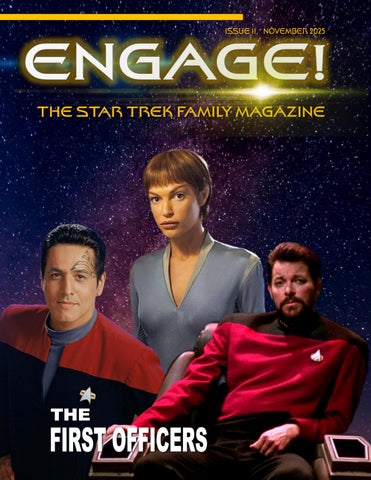
ENGAGE! Magazine
1
2
ENGAGE! Magazine ENGAGE! Magazine
2
ISSUE 11 — NOVEMBER 2025
Managing Editor Mark Sickle Senior Editor Jenni Grubbs Editors Cassie Brandt Stephanie Craven Jean DeBellis Gina Diamante Christopher Edler Denise Felder Mona Mehas Kevin R. Plummer Tara Polen Samantha Rense Stephanie L. Smith Bart Stavisky Susan Trudeau Shari Widmeyer Consulting Editor Laurie Ulster Submissions Manager Lisa Sickle
Contributors Melissa A. Bartell Bobby Linn Mona Mehas Stephen Mirkin Carrie Schwent Jennifer Whiteside Research Reesa Lawton
A Starfleet ship is only as good as its crew. Arguably one of the most important positions aboard the ship, aside from its captain, is the First Officer. Standing as a bastion of support whilst simultaneously acting as the sounding board, and sometimes conscience, for a commanding officer is hard enough. The First Officer’s more important duty, I would argue, is to the crew serving below him or her. All Department Heads must report to them, and the safety and wellbeing of all crew fall squarely within the wheelhouse of the First Officer. No other role aboard the ship bears more weight and responsibility than the First Officer. The captain must rely on him for strength, guidance, counsel, encouragement and finally, to carry out his or her orders. In addition, the First Officer is accountable for making sure that the entire crew is trained properly and ready to carry out their assignments at a moment’s notice. On the flip side, the First Officer is tasked with making sure everyone from the captain on down to the most junior ensign, enlisted man or civilian family member are kept safe and healthy. We have seen so many First Officers now in Star Trek — from Spock’s blunt assessment of any situation to Ransom’s preoccupation with the weight room. From Riker’s blind devotion for serving Picard to T’pol often impeding Archer’s ambitions (largely due to her experience with the Vulcan service). It takes all kinds — but the First Officer’s part is such an important one, we decided to dedicate this issue to them. — Mark Sickle Founder & Host Star Trek Family
CONTACT US
We are truly interested in receiving feedback from our readers and fellow fans! Really love an article that appears in our magazine? Truly disagree with someone’s take on a topic? How are we doing? Do you have suggestions for features, articles, etc.?
Have you always wanted to write about your love for Star Trek? We are always looking for volunteer writers to join our team! Send us an email at the ‘Contact Us’ link at left!
“Star Trek and all related marks, logos and characters are solely owned by CBS Studios Inc. This fan production is not endorsed by, sponsored by, nor affiliated with CBS, Paramount Pictures, or any other Star Trek franchise, and is a noncommercial fan-made e-zine intended for entertainment use only. No commercial exhibition or distribution is permitted. No alleged independent rights will be asserted against CBS or Paramount Pictures.” ** The Star Trek Family is a free, not-for-profit global fan organization.
3
ENGAGE! Magazine ENGAGE! Magazine
3
•
Editor’s Log
2
•
Name The First Officer 38
•
Fan Art
39
•
Limericks
40
•
Word Search
43
•
Next Issue
45
All of the Articles in the Contents are linked — click the images or page numbers to view. We added this icon at the end of every article — it will return you to the Table of Contents!
ENGAGE! Magazine ENGAGE! Magazine
4
4
ENGAGE! ENGAGE! Magazine Magazine
55
ENGAGE! ENGAGE!Magazine Magazine
66
7
ENGAGE! Magazine
would last with Mr. Spock as By definition, the num- that the Number One. Going forward,
ber one is not a prime number. Yet, in the Star Trek universe, it is. When I say it is, it refers to the prime need for a Number One. Who is the one who is there to question the captain’s orders? Who is the one to reassure the crew that everything is going to be OK? Who is the one to step in if the captain is captured, crazed or, in the worst case, killed? Who is the one to ensure that a calm, cool person is ready, willing and able to provide for the survival of the crew and ship? It must be the prime example of a person worthy of being Number One. In the history of Star Trek, there have been a number of persons who have filled the position of Number One. Going back to the original Star Trek series and the first pilot episode entitled “The Cage,” the Number One was a woman. She was a woman without a name other than “Number One.” What is significant is that it was 1965, a year before NOW, the National Organization for Women, was founded. Gene Roddenberry had the forethought to have a woman as second in command of the Enterprise over what would have been the norm, having a man in that position. When Capt. Pike is taken by the Talosians, who is there to take command and use all the power of the Enterprise to free him? When she is also captured by the Talosians, she is willing to give her life to prevent herself from being enslaved. Her actions cause the Talosians to free the crew, as we were too savage a race to use for their plans. In the end, as we all know, the pilot was redone into the form
males would be the choice of a Number One in subsequent series until Enterprise appeared on TV. Since this months issue of ENGAGE! is about the First Officers, or Number Ones, I would like to make my case as to why T’Pol is, in my humble opinion, the best example of a Number One. A claim can be made for why others in this position could be your candidate for the No. 1 of Number Ones. Mr. Spock was Capt. Kirk’s Number One. His cool Vulcan demeanor was the perfect foil to Kirk’s suave, sometimes take-noprisoners style of command. He was Kirk’s best friend, and maybe that was needed to get the job done. Riker was the next to be in the second seat on a ship called Enterprise in a Star Trek series. He was the one who took the chances, who was a bit more outgoing than the stern Capt. Jean-Luc Picard. No matter what the situation was, he would offer Picard his true opinions of the situation so that the captain could make the right decisions. For Capt. Kathryn Janeway, it was Chakotay who was there for her in all situations. Even though she had Tuvok as her Number One to begin with, and he being a Vulcan like Spock, she enlisted Chakotay to be her Number One for the length of their journey back to Earth. Not an original member of the crew and a leader of the Maquis, he offered Capt. Janeway a different point of view to advise her on decisions that she needed to make.
When Enterprise first appeared on television on Sept. 26, 2001 (35 years after the premiere of TOS on TV), the creators of the series, Rick Berman and Brannon Braga, chose not to have a designated Number One on board the NX-01. In a major change in the relationship between the Vulcans and Earthlings, the Vulcans were presented as holding back humanity from the reaches of deep space. On its first mission, the NX-01 was sent to return a Klingon to his home world of Qo’noS with one provision: a Vulcan was to accompany the crew. The one tapped to fill this role was Sub-Commander T’Pol. From the moment she boarded the NX-01, she was not a welcome guest, let alone a respected crew member. Capt. Jonathan Archer treated her as a potential spy, someone likely to report directly to the Vulcan High Command, and someone he felt was rooting for the mission to fail. From the moment she held her nose at the smell of Porthos (of Porthos!), she was made to be a problem for Capt. Archer and the crew. Yet, when Capt. Archer was injured in the shootout on
8
ENGAGE! Magazine
Rigel X or when he was left behind on the Suliban Helix, it could have been the time for T’Pol to “pull the plug” on the mission and return to Earth. Yet, she chose to do the right thing, saving Capt. Archer and completing the mission to return Klaang so that the secrets he contained in his blood could help the Klingons. As the series progressed, T’Pol would be tested in ways that only made her character stronger and more of a member of the crew. She would suffer her own issues with health, and she had an on-again, off-again relationship
with Chief Engineer Trip Tucker. When she appeared in underwear in the Decon chamber, viewers of the series would consider her looks as the reason for her appearance in the show (as did some for Seven of Nine on Voyager). Yet, it was the writers who took the time to expand her character and for her to become the trusted adviser and second-incommand of the Enterprise. There were enough times in the four seasons of Enterprise to show that she was a worthy Number One to Capt. Archer. She was always there, right up to the end of the series, comforting the captain as he spoke before the signing of the charter of the United Federation of Planets. The last thing she says to Capt. Archer is, “You look very heroic.” In return, Archer hugs her, showing the respect that they had for each other, that they were true friends. In the end, what makes a great Number One? That person needs to overcome adversity and
some distrust, build upon issues that might arise with the captain of a starship, and be the loyal and trustworthy person whom a starship’s crew relies upon. A case can be made for every Number One that has appeared on a Star Trek series up to and including Capt. Pike’s original and current Number One on Strange New Worlds, that being Una Chin-Riley. Yet, I feel that T’Pol made the most of her character’s advancement, and she is my choice for the prime number of Number Ones. STEPHEN MIRKIN: I first learned about science fiction the moment I was able to reach the on/off knob on my parents’ black-and-white TV set. Being born in 1956, I was there on Sept. 8, 1966 to watch the first episode of Star Trek. Since then, I have watched every TV series and every movie, and I only look forward to the next great Star Trek moment.
99
ENGAGE! ENGAGE!Magazine Magazine
(Click the graphic to find yours!)
ENGAGE! ENGAGE!Magazine Magazine
1010
11
ENGAGE! Magazine
The Away Team Evolution On Star Trek: The Next Generation, Commander William T. Riker stands at the intersection between diplomacy and action, intellect and instinct. As first officer of the Enterprise-D, he embodies Starfleet’s dual identity — the explorer and the soldier, the scientist and the strategist. Yet Riker’s most defining trait may not be his loyalty to Capt. JeanLuc Picard or his swagger on the bridge, but his near-constant position away from it. By design and temperament, Riker leads from the field. When The Next Generation launched in 1987, it inherited a rich storytelling template from The Original Series. In TOS, Captain Kirk himself beamed down with his “landing party,” taking the captain’s chair of adventure into every crisis. That choice gave the original show its visceral immediacy — Kirk on the ground meant stakes were high. But TNG evolved the idea for a new era: It separated command from risk. The “away team” structure preserved the adventure but reflected Starfleet’s professionalization. The captain would stay aboard the flagship, managing diplomacy and strategy, while the first officer — Riker — would em-
body that command in person. This innovation served both drama and character. It let TNG be simultaneously cerebral and kinetic, with Picard as philosopher-captain and Riker as the arm and heart of the mission. Picard could negotiate peace treaties and debate the Prime Directive from orbit, while Riker took the audience down to the dirt, the danger and the diplomacy of the unknown. Instinct and Adaptation Riker thrived in that space between protocol and improvisation. His authority wasn’t based on formality but on presence. He commanded by confidence — by walking into a new environment, absorbing it, and adjusting faster than anyone else. In “A Matter of Honor,” when he participates in an officer exchange and joins a Klingon crew, he adapts within hours. He learns their customs, eats their food, and, crucially, respects their hierarchy without losing himself. It’s a masterclass in leadership under alien conditions: observe, adapt, lead. Sometimes, though, adaptation meant enduring discomfort — moral, cultural or personal. In “Angel One,” Riker must navigate a matriarchal world where men are considered subordinate. Outfitted in a deliberately provocative local costume, he balances diplomacy with dignity, challenging gender expectations without insulting his hosts. The episode may date itself visually, but its underlying test for Riker — how to uphold Federation values in a culture built on inequality — remains
compelling. He doesn’t dominate or dictate; he reasons, listens, and finds a path through contradiction. For a commander who often leads by instinct, “Angel One” forces him into patience, humility and cultural intelligence. Across seven seasons, these missions built a portrait of a leader who acts before he doubts, but never before he understands. When he faces moral compromise in “The Pegasus,” Riker’s experience on those away teams shows: Leadership isn’t only about surviving danger — it’s about carrying the weight of your own choices. That tension between instinct and ethics defines him. The Dual Command Riker’s contrast with Picard deepens this understand-
ing. Picard represents the Federation’s intellect — diplomacy, restraint and the careful parsing of every consequence. Riker embodies its courage — decisiveness, improvisation and the willingness to act in incomplete certainty. Together, they form a complete command system: Picard’s moral compass steering Riker’s forward momentum. It’s no accident that when Picard needs someone to represent him in the field, Riker is always the choice. The away team device also
12 12
ENGAGE! Magazine ENGAGE! Magazine
served the ensemble. It allowed characters like Data, Worf and Geordi La Forge to interact directly with alien cultures under Riker’s guidance, creating layers of chemistry and tension that deepened both the missions and the crew relationships. Riker’s leadership gave those moments shape — the calm authority that kept a landing
party cohesive even when things went sideways. Command as Philosophy Riker’s maneuvers, then, are more than tactical. They’re philosophical. They show that command is not just a position, but a posture — forward-leaning, engaged, human. He meets every situation with curiosity and cour-
age, trusting his instincts because he’s done the work to earn them. In a show defined by intellect and ethics, Riker ensures there’s still muscle in the mission — not the reckless bravado of the past, but the confident stride of a leader who knows that exploration, like command, requires both head and heart. He may not always sit in the captain’s chair, but when the transporter beam fades and the ground steadies beneath his boots, Riker is the embodiment of what Starfleet is meant to be: prepared, adaptable and unafraid to take the first step. MELISSA A. BARTELL: Melissa A. Bartell is a writer, podcaster, voice actor, improviser and kayak junkie currently living on Florida's Nature Coast. She has one husband, two dogs and only one kayak (so far). Find her at MissMeliss.com or on social media: Bluesky | Facebook | Instagram | Mastodon
13 13
ENGAGE! ENGAGE!Magazine Magazine
ORDER YOUR COPY TODAY!
ENGAGE! ENGAGE!Magazine Magazine
1414
15
ENGAGE! Magazine
it can be understood, inte- forward into every subsequent In a franchise filled with age; grated, and directed. His strength command decision he makes.
decisive captains and swashbuckling explorers, Commander Saru stands apart. His leadership is not built on daring or charm, but on intellect, empathy, and the deliberate act of thinking before he acts. If Starfleet’s captains represent the heart of exploration, Saru is its mind — and, increasingly, its conscience. Where others leap, Saru measures. Where others command by force of personality, he commands by presence. From the beginning of Star Trek: Discovery, his journey reframes what it means to lead in Starfleet. In the 23rd-century chaos of war, temporal displacement, and moral uncertainty, Saru’s stillness becomes absolutely revolutionary.
From Fear to Philosophy When Discovery introduces him, Saru is defined by fear — literally. As a Kelpien, he belongs to a species bred as prey on his home world of Kaminar. Kelpiens evolved with heightened threat awareness, their “threat ganglia” alerting them to danger. That biology makes Saru cautious, but also extraordinarily perceptive. He notices details others overlook, reads emotional currents like an empath, and senses risk before logic identifies it. Early on, that instinct makes him seem anxious, even timid. Under Captain Gabriel Lorca, whose ruthlessness borders on cruelty, Saru’s caution reads as weakness. But Lorca’s brutality becomes the forge in which Saru’s philosophy of command takes shape. He learns that fear need not be banished to act with cour-
is not the absence of fear but the sheer mastery of it. That distinction becomes clear in the episode “Choose Your Pain.” When Saru temporarily assumes command during the Klingon War, he measures himself against Starfleet’s greatest captains. His anxiety is not insecurity but self-interrogation: can a being who has always run from predators truly lead others into danger? The answer, hard-won over multiple crises, is yes — because Saru’s caution is not paralysis, it is calculation. He acts only after considering every variable, and once he does, his decisions are immovable. By “Si Vis Pacem, Para Bellum,” when an alien planet amplifies his fear into aggression, Saru’s internal struggle surfaces physically. The episode literalizes the tension between instinct and intellect that defines him. Once freed, he acknowledges what happened not as shame but as insight: awareness without reflection is perilous. That lesson carries
The Counterbalance to Chaos If Lorca sharpened Saru’s caution, Michael Burnham refined his empathy. Burnham’s command style is passionate, improvisational, and often rule-breaking — a legacy of both her Vulcan upbringing and her human heart. She acts first and apologizes later, driven by conviction that the right thing is worth the risk. Saru is her counterweight. He sees the same truths she does but insists on structure. Their partnership becomes a study in duality: impulse and reason, heat and light. Burnham’s defiance challenges Saru to trust intuition; Saru’s deliberation teaches Burnham to pause. Together, they create a balance reminiscent of Spock and Kirk, or Riker and Picard — the necessary dialogue between thought and action that defines great Starfleet command teams. Their friction early in the series feels personal because it is: Saru resents Burnham’s mutiny in
16
ENGAGE! Magazine
“The Vulcan Hello,” which he perceives as betrayal of Starfleet’s ideals. Yet his eventual forgiveness reveals his capacity for growth. Saru’s empathy expands with his understanding. He comes to see that following rules is not always the same as serving principles. By the time the Discovery jumps into the 32nd century, Saru and Burnham have moved beyond opposition into complement. When one falters, the other steadies the course. That evolution peaks in “The Sound of Thunder,” when Saru returns to Kaminar and confronts the Ba’ul, the species that oppressed his people. Where a younger version of him might have sought vengeance, Saru instead pursues liberation through knowledge. He dismantles an ancient lie not with violence but with truth, freeing his world by understanding it. That moment crystallizes his leadership philoso-
phy: awareness, tempered by compassion, is the most powerful weapon in Starfleet’s arsenal. Later, when Saru temporarily commands the Discovery, his bridge becomes a study in composure. He does not dominate the room; he centers it. His authority is quiet, based on mutual respect and trust. Even when Burnham returns to the captain’s chair, Saru’s loyalty is not subservience but partnership. He leads beside her, not beneath her. The Evolution of Command Saru’s measured style does more than define his character — it broadens the vocabulary of Star Trek leadership itself. From Kirk to Pike, Starfleet captains have tended toward the bold: charismatic figures who lead by daring and instinct. Picard intellectualized that model, embodying the philosopher-captain whose diplomacy carries as much weight as his
orders. Janeway and Sisko, each in their own way, merged intellect with passion. Saru adds a new dimension: leadership as mindfulness. He listens before he speaks. He weighs emotion and logic equally. He sees vulnerability not as a flaw but as information. His command is analytical but never cold, cautious but never detached. It’s an evolution of the same thoughtful command tradition that once kept Picard on the bridge while Riker led the away team — but here,
17
ENGAGE! Magazine
the thinker is in the field, guiding others through crisis by the steadiness of his mind. In that sense, Saru is the mirror opposite of Burnham’s impulsive heroism. Where she often embodies the Federation’s drive to explore, Saru embodies its discipline to endure. His leadership is the connective tissue that lets the Discovery and her crew survive its most extreme circumstances — from the Mirror Universe to the far-future Federation’s collapse. When others lose faith, Saru restores it by modeling calm. His presence is not overtly theatrical, yet its impact is profound: he slows the narrative tempo, reminding both crew and audience that moral clarity requires time. Even his physicality conveys this philosophy. Doug Jones’ performance — all elongated posture, deliberate movements, and expressive eyes — turns Saru’s alien physiology into a kind of meditation. Every gesture feels intentional. Every pause carries weight. The body that once trembled in fear now radiates control. Through him, the show literalizes the transformation from instinc-
tive survival to conscious leadership. As Discovery moves into its later seasons, Saru’s story becomes less about overcoming fear and more about teaching others to coexist with it. His mentorship of younger officers, his diplomatic missions on behalf of the fractured Federation, and his quiet advocacy for understanding across species all reflect the same core belief: progress requires empathy as much as courage. When he eventually steps back from daily command to serve as a Federation ambassador, the transition feels inevitable — the culmination of a career built not on glory but on grace. Thought as Heroism Star Trek has always celebrated the act of thinking — of questioning, reasoning, and choosing the moral path even when it’s the hardest one. Saru embodies that ethos more completely than any modern Starfleet officer. He represents a maturity of leadership that the 21stcentury viewer recognizes: reflective rather than reactive, patient rather than performative.
His heroism lies not in his ability to fight but in his capacity to understand. He brings the same discipline to diplomacy that others bring to battle, and in doing so, he redefines courage. It’s not the absence of fear, nor even its conquest, but the ability to move forward with full awareness of it — to act with integrity when instinct screams otherwise. Saru’s thinking command complements Burnham’s passionate one, just as intellect has always complemented instinct throughout Trek’s history. Together, they illustrate that exploration is not a race toward discovery but a conversation with it — one that requires both the daring to leap and the wisdom to look first. In the end, Saru proves that a commander’s greatest strength may not be speed, strategy, or even charisma. It may be the courage to pause. To think clearly. To lead with the mind open and the heart steady. In the silence between impulse and action, Saru reminds us that thought itself can be an act of faith — and that in Starfleet, as in life, the most enduring kind of bravery is the kind that listens. MELISSA A. BARTELL: Melissa A. Bartell is a writer, podcaster, voice actor, improviser and kayak junkie currently living on Florida's Nature Coast. She has one husband, two dogs and only one kayak (so far). Find her at MissMeliss.com or on social media: Bluesky | Facebook | Instagram | Mastodon
ENGAGE! ENGAGE!Magazine Magazine
1818
ENGAGE! ENGAGE!Magazine Magazine
1919
20
ENGAGE! Magazine
as Captain Michael ous and traditional, Chapel is footIn the Star Trek franchise, Discovery Burnham’s brother. Here he loose and fancy free. Unfortunate-
everyone knows who Spock is. Honestly, even folks who are not fans of the show know a little about Spock. I watch a YouTube program about the founding of Appalachia. The host is a man about my age, a retired professor. In a recent episode he said, "As Spock would say, Fascinating.” I love all Star Trek and all versions of Mr. Spock. The actors have portrayed him similarly in many basic ways but different in many others. I’ll compare the three here, from third to first. These opinions are totally my own, and not those of Engage! or anyone else who works on the journal.
3. Ethan Peck Why am I starting with No. 3? Because I look at this Spock as the precursor to the others. This is young Spock, struggling more with his emotional human half than in other versions. We see him first in
seems to be more aloof, much like a brooding teenager, than later in Strange New Worlds. The writers of SNW and Ethan Peck certainly stepped up to allow Spock to be a more well-rounded person. In Strange New Worlds, Spock has a love affair with Christine Chapel. Although he has been engaged to T’Pring, a fellow Vulcan, since childhood, the proximity and allure of the attractive blonde nurse is undeniable. I believe Chapel helps open Spock up to his human side where T’Pring isn’t able to do that, nor does she appreciate it. T’Pring is more seri-
ly (or fortunately, depending on how we feel about it) it is just those aspects of the nurse that lead to the demise of her and Spock’s relationship. She leaves to study with Roger Korby and that’s the end of her and Spock. Where Spock’s love life picks up is with La’An Noonien-Singh. They have hot chemistry that is off the charts. What begins as dance lessons with this descendant of Khan quickly becomes a full-blown affair.
2. Zachary Quinto In the Kelvin Universe movies, this Spock is involved with Nyota Uhura, the communications officer on the Enterprise. At first, we see them stealing alone time in a turbo lift or hallway. Later they don’t hide their love. Even though the timeline is similar to that of Strange New Worlds, I still consider Spock’s emotional development as a growth from Chris-
21
ENGAGE! Magazine
job of showing, while trying not to show, emotion.
1. Leonard Nimoy
tine and La’An. They kiss in front of Kirk and others. Spock gifts Uhura with a special necklace made from an element from his world. Spock discovers that he and his shipmates are in a different reality where Ambassador Spock is a well respected elder. The older Spock helps to establish “New Vulcan” after Vulcan is destroyed. Young Spock seeks advice from his older self on dealing with Khan. It’s interesting that he is involved with a different NoonienSingh in this iteration. Later, when he learns of the Ambassador’s death he sees his own death date. Who would not be thrown at learning this? Quinto does an amazing
The quintessential Spock. The one most people think of when they remember Spock. Nimoy embodies the character the longest – The Original Series, The Animated Series, eight TOS movies, and two Kelvin movies. It’s no wonder he is everyone’s Spock. Although most of these iterations of Star Trek occur in the same chronological time period, Nimoy gives us a more mature, in control Spock. I am the type of person who needs to make everything fit. So, in my head canon, this is Spock after all his failed relationships of the past. Christine Chapel left him for Roger, but we don’t know yet what happens to end his romances with La’An and Nyota. But end they must, for this version of Spock is more mature, more careful to guard his emotions, perhaps more damaged by the losses. In The Original Series, we see Spock
involved with other women but it’s usually because he’s compromised in one way or another. To add injury to insult, T’Pring rejects him for another man. It’s no wonder Spock is stoic. I am not choosing which actor does the best job or which version of Spock I prefer. In my eyes, all three men do an excellent job of portraying one of our iconic idols. Live long and prosper.
MONA MEHAS: Mona Mehas (she/her) is a retired disabled teacher in Indiana, USA. Twice nominated for a Pushcart Prize (Paddler Press 2023, TV63 Project, 2025) and Best New Poet (Lucky Jefferson 2024). Mona’s work has appeared in multiple publications and online museums. She helps edit a small press, works with an online Star Trek fan magazine, and is Indiana Co-Leader for Authors Against Book Bans. Mona is editing her second novel while perpetually distracted by her next chapbook. https://linktr.ee/monaiv https://monamehas.net
https://bsky.app/profile/ monaiv.bsky.social
ENGAGE! ENGAGE!Magazine Magazine
2222
23
ENGAGE! Magazine
On May 8, 2024, Wil Wheaton shared a post from his blog that hit me right in the core of my being. This line especially: “Star Trek is bigger than any single one of us, and it has the power to change the world.” That is the simple truth. Star Trek inspires those who will let it. It inspires us to be better people in so many ways. To make space for those who are different from us. To care for those in need. To care for the Earth. To reach for the stars. I wouldn’t be who I am without Star Trek. My dad had me watch TNG with him from “Encounter at Farpoint” until he died three years later. After he died, I kept watching, because it was like having a piece of him with me again. And as I watched, the characters for TNG helped shape my ideals and priorities. I saw that Black people had a place in the future from watching Geordi and Guinan. Very little other sci-fi at the time showed people who looked like me in positions of authority, if there were any Black people at all. But Geordi worked his way up to Chief Engineer, and Guinan was the trusted advisor to two captains and the whole crew. I saw women in positions of authority,
Beyond the characters and their interactions, though, is the core tenet of Star Trek — hope.
from Chief Medical Officer to counselor to captain to admiral. They weren’t dismissed because of their gender, and if someone did something for them that required greater strength, it was usually Worf or Data, who did that for any of the human crew anyway. In Captain Picard, I saw a man in the position of ultimate authority on the Enterprise, but he wasn’t autocratic in his mannerisms. He listened to the advice of his senior staff, and even junior members of the crew. He showed compassion, dignity, and diplomacy. He showed that just because you can beat someone to a pulp, doesn’t mean that you have to. But Picard didn’t back down from a fight when a fight was needed. He just knew that there were
24
ENGAGE! Magazine
more ways to resolve things than physical violence. Between him and Riker, I had father figures to look up to, men who showed me that physical strength isn’t the be all and end all of what it means to be a man. Beverly Crusher and Deanna Troi showed me two different types of caregivers. And they showed that just because those were their roles on the ship, it didn’t mean that they would back down from a fight, either. My mom raised me on her own after my dad died, so I saw our family reflected in the relationship between Beverly and Wesley. And being an above average kid in many respects, I understood some of what Wesley was going through. Troi’s compassion and wisdom has always taken my breath away. To feel what she feels, to know what she knows, and still have so much love for the people around her? There is immense strength to that. Beyond the characters and their interactions, though, is the core tenant of Star Trek — hope. There is always hope. There is always a light in the darkness, a path through the brambles, a way to move forward and do better. Tied into that is the idea behind IDIC, Infinite Diversity in Infinite Combinations. We are each unique, and that uniqueness deserves its place in the universe.
There are many ways in which the characters of TNG inspire us. They show us compassion, love, empathy, understanding and so much more.
JENNIFER WHITESIDE: My dad gave me the gift of Star Trek when I was young, and I'm forever grateful for it. I share a love of chocolate with Deanna Troi, and my sense of justice has been greatly informed by Captain Picard.
Stay tuned to StarTrek.com for all the great events celebrating the 60th Anniversary of Star Trek!
VISIT OFFICIAL SITE
ADVERTISEMENT
$89.95
(Click the image above to get yours TODAY)
25 25
ENGAGE! Magazine Magazine ENGAGE!
ORDER ART PRINTS HERE
ENGAGE! Magazine Magazine ENGAGE!
26 26
27
ENGAGE! Magazine
Names
matter. They carry echoes, shadows and histories, even when the person wearing the name doesn’t know it. Sometimes a name is a promise. Sometimes it’s a burden. And sometimes it’s a signal across centuries, like a call and response that was never supposed to happen but does anyway. Sayyida al Hurra’s name meant “the free woman.” She was born Lalla Aicha bint Ali ibn Rashid al-Alami in 1485 in Morocco. By the time she took the throne of Tétouan after her husband’s death, the name Sayyida al Hurra had become both a title and a declaration. She was the free woman. The noble lady. The one who owed allegiance to no man. She ruled not as a placeholder or regent, but in her own right. She governed the city, commanded fleets, and wielded political alliances like weapons. She struck a partnership with the famed Ottoman corsair Barbarossa, and together they turned the Mediterranean into a stage for their power. Her ships raided Portuguese and Spanish vessels, reclaiming wealth stolen from North Africa, and striking fear into colonial powers that had assumed the sea belonged to them. In a world where women were expected to remain invisible — domestic, cloistered, silent — she carved her name across the waves. Not as a wife. Not as a consort. As herself. Freedom was never handed to Sayyida al Hurra. She seized it, ship by ship, raid by raid, decree by decree. Centuries later, in a television studio in 1960s Los Angeles, another woman bore a name that
also meant freedom. Nyota Uhura, the communications officer on the starship Enterprise. Her surname came from the Swahili word uhuru — “freedom.” Her first name, Nyota, meant “star.” Freedom, among the stars. When Nichelle Nichols first appeared on screen in that red uniform, calm and authoritative at the communications console, she was a revelation. A Black woman not in the background, not a maid or a comic foil, but a respected officer on the bridge of a starship, working alongside men of every race and nationality. At a time
when segregation was still raw and civil rights marches filled the streets, her presence on Star Trek was more than casting. It was a statement. Martin Luther King Jr. famously urged Nichols not to leave the show when she considered quitting, reminding her that she was shaping the image of what the future could look like. And she stayed — not just as a performer, but as a symbol. Uhura was proof that the future was wide enough for women, for Black women, for voices that had been excluded for too long. Sayyida al Hurra ruled the seas. Nyota Uhura navigated the stars. Both were free women who claimed spaces where the world didn’t expect to see them. And maybe that’s why their names feel like a call and response across centuries. One woman staring down colonial empires with cannons, the other calling through the darkness and connecting people with her voice. One a queen commanding fleets, the other an officer commanding language itself, translating chaos into order, holding her crew together with words.
28
ENGAGE! Magazine
Both of them remind us that freedom isn’t something handed down politely. It isn’t permission, or a token seat at the table. It’s something fought for, taken, and lived in.. The parallels between sea and sky are older than either woman. Mariners have always looked to the stars for guidance. Conquerors, dreamers, and wanderers have always compared the unknown ocean to the uncharted cosmos. The sea is a mirror for the sky, and the sky is a mirror for the sea. Sayyida al Hurra’s fleets cut across one, while Uhura’s voice bridged the other. Both women commanded liminal spaces — places that belong to no one and everyone, places that promise freedom and danger in equal measure. And both carried names
that told the world exactly who they were: free women. In our own moment, their stories intertwine as more than trivia. They are reminders of possibility. When I hear Sayyida al Hurra’s name, I hear the echo of resistance — a woman who refused to be silenced, who claimed her right to rule, who struck fear into empires. When I hear Nyota Uhura’s, I hear the promise of representation — a woman who stood on the bridge of the future, showing us all that freedom could mean equality, visibility, dignity – belonging. Sea and stars. Corsair queen and starship queen. And perhaps it isn’t only coincidence, but a hidden continuity — as if Uhura were, in some imagined genealogy, the descendant of Sayyida al Hurra herself, a free wom-
an of the seas reborn among the stars, carrying forward the legacy of command, defiance, and freedom in a new frontier. MELISSA A. BARTELL: Melissa A. Bartell is a writer, podcaster, voice actor, improviser and kayak junkie currently living on Florida's Nature Coast. She has one husband, two dogs and only one kayak (so far). Find
her at MissMeliss.com or on social media: Bluesky | Facebook | Instagram | Mastodon
ENGAGE! Magazine ENGAGE! Magazine
29 29
ENGAGE! Magazine ENGAGE! Magazine
30 30
31
ENGAGE! Magazine
In the vast expanse of space, aboard the starships of Star Trek, few roles are as crucial, or as demanding, as that of the First Officer. Serving as the captain’s right hand, the First Officer is responsible not only for executing the captain’s orders but also for ensuring the smooth operation of the ship and its crew, often acting as the vital bridge between leadership and rank-and -file. On the U.S.S. Enterprise-D, that role is embodied by Commander William T. Riker, a charismatic, tactical, and fiercely loyal officer who balances authority with approachability. Riker is known for his strategic mind, diplomatic skill, and his signature readiness to take command when duty calls. More than just secondin-command, Riker serves as the moral compass and tactical backbone of the crew, reinforcing the values of Starfleet while also carving out his own identity among legends. His leadership style, laced with confidence, wit, and a deep sense of responsibility, makes him one of the most iconic and respected First Officers in science fiction history. With all these traits in mind, one has to ask why someone of his status and drive would turn down his own command not once but at least three times. The Rise of William T. Riker When we meet Riker in Star Trek: The Next Generation’s pilot, “Encounter at Farpoint,” he is a young, ambitious officer with a reputation for following protocol and a strong record in command simulation scenarios. He is
brought aboard the Enterprise-D by Captain Jean-Luc Picard, who specifically requests a First Officer capable of standing up to him, a “yes-man” need not apply. Riker fulfills this brief and then some. Over seven seasons and four feature films, he serves with distinction, frequently taking the conn during crises, commanding away missions, and even assuming temporary command of the Enterprise itself when circumstances demand it. He's charming, capable, and clearly command material. From the outset, Riker demonstrated an exceptional capacity to lead, not merely by following orders, but by challenging them, when necessary, always with the best interest of the crew and mission in mind. His early days aboard the Enterprise were marked by a willingness to take calculated risks and a refusal to back down in the face of danger. While his loyalty to Captain Picard was unwavering, Riker never lost
sight of his long-term goal. He was driven not by ego, but by a deep-seated desire to shape his own legacy among the stars. Time and again, Riker was offered his own command, yet he chose to remain on the Enterprise, valuing the experience and mentorship under Picard, and recognizing the unique importance of the ship’s mission. Commander Riker’s journey is a compelling study in leadership, ambition, and restraint, proof that the path to greatness isn't always a straight line, but rather one that is forged through trust, patience, and readiness when the moment finally comes. Opportunities To Be Captain of His Own Ship Riker has been offered his own command on several occasions. His first chance came in the season 2 episode “The Icarus Factor” which was a deep space exploration vessel the U.S.S. Aries. This was a prestigious opportunity
32
ENGAGE! Magazine
for a young officer, and many expected him to accept, however Riker declines the offer. He realizes that the Arie mission is more about charting unexplored territory than true leadership and he also questions whether he’s ready to leave the unique environment and leadership of the Enterprise. His complicated relationship with his father, who delivers the offer, also factors into his decision. His second opportunity and probably the most significant missed opportunity, was when he was offered the U.S.S. Melbourne in the season three finale “Best of Both Worlds.” Melbourne was one of the fleets more advanced starships. However, it comes at a critical moment, during the Borg Invasion. Riker initially declines, feel-
ing that his place is on the Enterprise during the crisis. Ironically, the Melbourne is later destroyed by the Borg at the Battle of Wolf 359, meaning that Riker’s decision was likely to save his life. Throughout TNG, it’s mentioned multiple times, by captains and admirals, that Riker is “long overdue” for his own command. His service record is stellar, and Starfleet repeatedly sees him as command ready. In fact, Riker develops a bit of a reputation for turning down commands, which becomes a topic of conversation and even mild criticism among his peers. It wouldn’t be until the events of Star Trek Nemesis that we hear the Riker accepts a command posting on the U.S.S. Titan. It is at this point that Riker feels
that he can now fulfill his lifelong ambition and go on to have a stellar career right up to the events of Picard Riker was offered at least three ships before finally deciding to finally take the chair. Why would he wait so long to accept? What was he waiting for? What was the thought process that drove his decision making for him. A lot of factors went into Riker’s decision making: Loyalty Over Ambition Riker’s repeated decisions to turn down command reflect a core aspect of his personality: his loyalty to Captain Picard, the crew, and the mission of the Enterprise. His bond with Picard is particularly meaningful. From the outset, the two form a complementary partnership, Picard brings gravitas and diplomacy; Riker adds instinct, action, and approachability. They function almost like two halves of the same captain. In “The Best of Both Worlds,” when Riker is in Ten Forward with Troi, he confides in her that he is unsure about whether he wants his own command” At that moment, Picard is missing, presumed captured by
33
ENGAGE! Magazine
the Borg. Riker assumes command of the Enterprise and leads a desperate, heroic defense. But even in command, he feels the absence of Picard deeply, and his primary focus is rescuing his captain, not taking his place. His refusal isn't cowardice. It's clarity. Learning From the Best A recurring theme in Riker’s arc is his desire to keep learning. While Starfleet encourages upward movement, Riker sees value in mastering his current post before advancing. In “The Icarus Factor” Riker explains to his estranged father: “I know it’s unusual for someone to decline their own command. But this isn't just any ship. This is the Enterprise. I belong here.” It is the phrase “I belong Here” that really resonates here. Riker is not viewing command as just a goal by itself. He knows that he is serving on the Flagship with
a captain that is his own right the best person to learn from and follow by example. And he’s right. As First Officer, Riker is in the ideal position to influence, lead, and protect the ship and its crew. He's also free to take bold action, often serving as a more kinetic counterbalance to Picard’s deliberative style. In short, he’s still leading, just not in the traditional sense. The Maturity of Command Another interpretation of Riker’s decisions is that he understands the weight of command better than most. He has seen what it means to bear the responsibility of an entire crew’s lives. He’s served under a captain who embodies the moral and intellectual complexity required for command. And he’s also seen commanders fail, hesitate, or fall (e.g., Captain Jellico in “Chain of Command,” or even his own younger self in “Second Chances”).
It’s possible Riker holds himself to a higher standard than Starfleet requires. He doesn’t want a ship simply because he’s earned it on paper. He wants to be the right captain at the right time for the right mission. That kind of restraint is rare, and deeply admirable. The Family Dynamic: Crew as Community William Riker’s decision not to accept the promotion to Captain, particularly in Star Trek: The Next Generation and Star Trek: Nemesis, is deeply tied to his personal values, sense of duty, and most importantly — his "family dynamic" aboard the USS Enterprise. Riker’s relationship with the crew of the Enterprise isn’t just professional, it is a deeply personal one. The bridge crew functions just like a close-knit family. For Riker, Picard is not only his captain and superior officer, but also a mentor and father figure. The other senior officers, Troi, La-
34
ENGAGE! Magazine
Forge, Data, Worf, and Dr. Cruser are all close colleagues that he implicitly trusts with his life. And he shares emotional bonds through years of service together. Accepting a promotion would mean leaving behind that core dynamic — essentially leaving his "family" for a new post where he would have to build rapport from scratch. For Riker, the emotional cost of severing those ties weighed heavily. His sense of loyalty to the crew, and to the mission they share, was stronger than his personal ambition. In addition to Riker feeling to his first family so to speak, he has always thrived in the Enterprise’s culture, after all, he helps create it. He’s in his element, bridging the gap between command and crew, a mentor to junior officers, and a trusted counselor to Picard. His role as First Officer gives him a unique balance of authority and connection. Pro-
motion to Captain would shift his identity, he would no longer be part of that intimate, familiar crew dynamic. He would have a more isolated command role, which for Riker was less appealing. Riker’s decision not to take command was not only due to his professional and close family dynamic with his people but I believe that the decision is also subtly influenced by his personal relationships, notably with Deanna Troi. Their bond, explored across multiple seasons, is deeply intertwined with their professional lives on the Enterprise. Choosing to remain ensures the continuity of those relationships in both a personal and professional context. Promotion could disrupt this balance. Riker’s choice reflects his leadership style he values collaboration, mentorship, and connection over prestige. His reluctance to promote reflects a belief that
command is not just about rank, but about the right fit for the mission and for personal fulfillment. He values being part of something bigger rather than chasing personal glory. The Mentor Role: Leading Without the Chair One of Riker’s most subtle strengths is his ability to lead from behind. He mentors junior officers, navigates diplomatic encounters, commands away missions, and stands as an emotional anchor for the crew. His role on the Enterprise gives him room to lead in multiple directions — upward to Picard, downward to the crew, and outward to Starfleet. As First Officer, Riker serves as bridge between Captain Picard and the rest of the crew. His responsibilities are not just operational; they are personal and developmental. He mentors junior officers in ways that go beyond
35
ENGAGE! Magazine
formal training. It’s also worth noting that by staying in place, Riker helps maintain continuity of leadership, something that’s deeply valuable in dangerous or uncertain times. When the Borg attacks, when Q intervenes, when Romulans threaten peace, Riker is the one keeping the bridge crew grounded. Riker as a Mentor As First Officer, Riker serves as a bridge between Captain Picard and the rest of the crew. His responsibilities are not just operational; they are personal and developmental. He mentors junior officers in ways that go beyond formal training: For example: He guides officers like Ensign Ro, Data (in some of his social decisions) and even LaForge in decision making during critical missions. He also provides advice and support to crew members facing
ethical dilemmas, personal crises, or stress from Starfleet life, such as Troi and other junior officers by helping to navigate career and personal growth. He had become a role model due to his confidence, and compassionate leadership style. Many of the crew respect and emulate their balance of risk taking and care for their safety. This creates a sense of responsibility, staying aboard the Enterprise allows him to have a bigger impact than commanding a ship independently. His decision reflects a selfless leadership philosophy: he prioritizes the growth and well-being of his crew over personal ambition. Mentorship is not purely professional for Riker, it’s personal. Over years of working together, he has formed emotional bonds with officers like Troi, Worf, Data, and La Forge. He knows their strengths, weaknesses, and poten-
tial in ways that a new posting would make impossible to replicate. Leaving the Enterprise would sever these connections and reduce his ability to nurture those relationships. Choosing Impact Over Title Riker’s decision not to accept promotion is thus tied to his understanding of leadership. He sees leadership as influence and growth, not just rank. On Enterprise, he has a unique platform to mentor, guide, and support others, a role he believes he can’t replicate elsewhere. In other words, being a Captain might give him authority, but staying allowed him to have an impact on others’ lives, which he values more. There are several examples as to what Riker’s mentorship to his crew. First, in “The Measure of a Man”, Riker is assigned as opposing counsel to prove that Data is not sentient, and while he does
36
ENGAGE! Magazine
has changed. Later, in Star Trek: Picard, we see Riker continuing to exemplify leadership, whether stepping back into a command role during a crisis (Picard Season 1, Episode 10) or choosing family and peace over perpetual duty.
a very good job of trying to prove that the tension showcases his understanding of mentorship. He is torn between following orders and respecting Data’s growth. He clearly views Data as more than a machine and sees his guidance and protection as part of his responsibility to the crew. Leaving would mean relinquishing the mentorship role. Another crew member he mentors is Lt. Worf. Throughout the series Riker has often advised Worf with struggles to balance his Klingon heritage and Starfleet ideals, to help him reconcile Klingon honor and Starfleet ethics. By staying aboard Enterprise, he ensures continuity in Worf’s development. He would not be able to provide that guidance elsewhere. There are also several junior officers throughout the series that have benefited from Riker’s leadership and guidance. Riker often takes time to coach younger officers in Starfleet procedure, ethics, and decision making. His presence allows junior officers to grow fast-
er and become more competent. Riker always seems to put a higher value on building the next generation than personal career advancement. Riker and Picard: The Trust Factor Perhaps the most important reason Riker stays is trust, both the trust Picard places in him and the trust Riker has in his captain. The two share a mutual respect that borders on familial. Picard empowers Riker with real authority, often letting him take over without micromanaging. In return, Riker doesn’t seek to outshine Picard, he complements him. Eventually, He Does Move On Eventually, Riker does accept command of the USS Titan following the events of Star Trek: Nemesis. But by that point, the timing is right. He has served long enough to feel ready; the crew is moving on; his arc has matured. He leaves Enterprise not out of ambition, but because the mission
Conclusion: Leadership Redefined William T. Riker challenges the conventional Starfleet narrative of career progression. By choosing to remain First Officer for as long as he did, Riker redefines leadership, not as a ladder to climb, but as a responsibility to be earned and wielded wisely. He teaches us that ambition tempered by wisdom is not a weakness; it’s a strength. And perhaps most importantly, he reminds us that sometimes, staying where you're needed most is the boldest move of all. Riker may have eventually accepted the captain's chair, but it was his time as Number One that defined him and redefined how we understand command. In choosing not to lead from the front, he led from the heart. MICHAEL MARTIN: I’ve been a Star Trek fan since I was a kid. I grew up on The Next Generation, fell in love with Deep Space Nine and Voyager. It was one of the few shows that my father and I would watch together and still share the love for the franchise today. The show’s ideals, hope, unity and moral courage have always meant something real to me. It gives me great pleasure to see where humanity can go and what can be achieved.
3737
ENGAGE! ENGAGE!Magazine Magazine
(Touch the Transporter to Engage!)
38
ENGAGE! Magazine
1. Enterprise_________________________________________ 2. Enterprise NX-01___________________________________ 3. Protostar__________________________________________ 4. Enterprise_________________________________________ 5. Okinawa & Saratoga________________________________ 6. Discovery________________________________________ 7. Relativity_________________________________________ 8. DS9 & Defiant_____________________________________ 9. Defiant___________________________________________ 10. Cerritos__________________________________________ 11. Sutherland________________________________________ 12. Titan A __________________________________________ 13. Discovery________________________________________ 14. Pagh, Hood, Enterprise D & E________________________ 15. Discovery________________________________________ 16. Equinox__________________________________________ 17. Protostar_________________________________________ 18. Voyager A & Dauntless______________________________ 19. Credence_________________________________________ 20. Kelvin___________________________________________ 21. Discovery________________________________________ 22. Ibn Majid________________________________________ 23. Cerritos__________________________________________ 24. Enterprise & Bradbury______________________________ 25. Enterprise G______________________________________ 26. Voyager__________________________________________ 27. Enterprise D______________________________________ 28. Enterprise C______________________________________ 29. Voyager__________________________________________ 30. Cerritos__________________________________________ 31. Stargazer_________________________________________ Answers on Page 37
Boimler Shelby George Kirk Burke Ducane Sisko Rios Spock Ficket Una-Chin Riley Moshe Worf Riker Hobson Musiker Saru Kira Nerys Adreek Tysess Hansen Chakotay Decker Ransom Rayner Burnham Mariner T'Pol Cavitt Gwyndala Holmes Tilly
ENGAGE! ENGAGE! Magazine Magazine
39 39
4040
ENGAGE! ENGAGE!Magazine Magazine
A first officer will never flinch They can take charge of the ship in a pinch They all have their Captain's back And will defend from attacks They make sure things run without a hitch
Explore the final frontier and you'll see Beings and planets beyond all your dreams. Some kind, and some not Each will give all they've got To live long and prosper we all agree.
Carrie Schwent
41
ENGAGE! Magazine
We've been put in a bad situation This journey will not be a vacation I thought we needed the help It turned out bad for my health Got in too deep sending her information
4242
ENGAGE! ENGAGE!Magazine Magazine
Like that bird I must be traveling on The path I was on, turns out it was wrong My father's path is not mine I must leave that life behind First this planet, then I'll see what's beyond
ENGAGE! Magazine
43
ENGAGE!Magazine Magazine ENGAGE!
4444
4545
ENGAGE!Magazine Magazine ENGAGE!
ANSWER KEY 1. Una Chin Riley 2. T’Pol 3. Gwyndala 4. Decker 5. Sisko 6. Rayner 7. Ducane 8. Kira Nerys 9. Worf 10. Boimler 11. Hobson 12. Hansen 13. Burnham 14. Riker 15. Saru 16. Burke 17. Adreek 18. Tysess 19. Fickett 20. George Kirk 21. Tilly 22. Rios 23. Mariner 24. Spock 25. Musiker 26. Cavitt 27. Shelby 28. Holmes 29. Chakotay 30. Ransom 31. Moshe
Send us feedback! ENGAGESubmissions@yahoo.com WANT TO VOLUNTEER AS A WRITER? toboldlygo78@yahoo.com
ENGAGE! Magazine
46