ENGAGE SUMMER 2026
A PUBLICATION OF ARK ANSAS COMMUNITY FOUNDATION Exploring Issues from the Community Foundation’s Aspire Arkansas Report
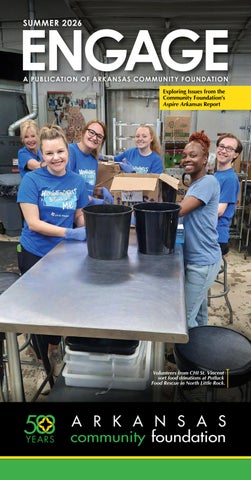
Volunteers from CHI St. Vincent sort food donations at Potluck Food Rescue in North Little Rock.
50
C E L E B R AT I N G
YEARS
50TH ANNIVERSARY GRANTEES: 47 Nonprofits Receive Total of $1 Million Arkansas Community Foundation is celebrating 50 years. What began in March 1976 with a convening of Arkansas community leaders at the Jacques and Suzanne restaurant in Little Rock has grown into a statewide network championing local leadership for local solutions. I continue to be inspired by visionaries like Mary McLeod, Norma Weiser, Martha Ann Norton, Pat Lile, and our dear friend, Heather Larkin, who led the organization with such grace and vision – and helped us go from an idea in a restaurant, to granting more than $600 million and building our assets under management to more than $1 billion. Our dedicated staff continues to build on this legacy in service to our home state. The first half of 2026 has been filled with significant milestones for the Foundation. In January, we granted a total of $1 million to 47 nonprofits in celebration of our 50th anniversary and in April we celebrated with a Summit. This issue of ENGAGE introduces you to a few of the 50th anniversary grant recipients and the amazing work they are doing in Arkansas. In my first six months as President and CEO, I have been honored to visit many communities throughout the state and see the impact of the work that you make possible—and plan to visit more. THANK YOU for the many ways that you support our mission as we continue to build on a very proud 50-year legacy while positioning for future growth and impact. Because of you, we are perfectly positioned to celebrate 50 years and to launch into 50 more. I am honored to join you in this journey.
Arkansas Community Foundation kicked off its 50th anniversary year on January 21, 2026, by granting a total of $1 million to 47 nonprofits across Arkansas. These grants were informed by statewide Aspire Arkansas data and selected with the expertise and leadership of staff and local offices. •
Legacy grants were awarded to nine organizations receiving $50,000 each. These nine grants celebrate nonprofits with a proven record of statewide or regional impact.
•
Rising nonprofit grants were awarded to nine organizations receiving $30,000 each. These nine grants highlight new, emerging organizations shaping Arkansas’s future through innovative approaches and impact.
• Twenty-nine $10,000 grantees were each selected by the Foundation’s local affiliate boards to meet the most pressing needs in their communities. The grantees represent a cross-section of Arkansas—from rural to urban communities—and address topics including education, food security, health, childcare, workforce development and more. In the spirit of trust-based philanthropy, grantees were empowered to use funds where most needed and did not have reporting requirements. “Every grant tells a story of impact, whether it’s helping students succeed, improving health outcomes or addressing food insecurity,” Linsley Kinkade, Chief Program Officer, said. “By combining statewide data with local insight, we’re ensuring that these anniversary investments create lasting value across Arkansas.” A full list of nonprofits receiving these grants is available at arcf.org/grantees.
With deep appreciation, PRESIDENT AND CEO: Jessica Hughes Ford CHIEF COMMUNICATIONS OFFICER: Tina V. Hall
Jessica Hughes Ford
COMMUNICATIONS SPECIALIST: Katy Bland CONTRIBUTORS: Richard Atkinson, Megan Brown, Caroline Holt, Christie Lindsey, Steve Rogus, Chris Wyman
2
E N GAG E SU M M E R 2 0 26
3
Q&A: CHRIS WYMAN, POTLUCK FOOD RESCUE $50,000 Legacy Grant
Tell us about your mission. At its core, Potluck’s mission is simple: good food should feed people, not landfills. Potluck safely recovers surplus food from grocery stores, restaurants, farms, caterers, distributors, schools and community partners, then moves that food quickly to trusted agencies serving people facing food insecurity. What makes Potluck effective is our ability to adapt. Food rescue is not static work. It changes by the day, sometimes by the hour. A donation appears unexpectedly. A freezer goes down. A school needs weekend food. A caterer has surplus prepared meals. A rural partner needs cold storage before they can accept more fresh food. Potluck is built to respond quickly, evolve when needed and move food through the community before opportunity becomes waste. We operate in the space between surplus and need, making sure food already present in our community reaches people with dignity, speed and care. We are agile because the need is urgent. We are adaptive because communities are different. And we are committed because wasted food is not just an environmental issue. It is a missed opportunity to nourish people.
4
E N GAG E SU M M E R 2 0 26
How did the grant help you achieve your mission? The grant was especially meaningful because it did more than support current operations. It helped Potluck leverage additional matching support, creating momentum at a critical time for our organization. That investment strengthened our ability to respond to immediate food recovery needs while also advancing larger conversations around expansion, sustainability and the Potluck Food Rescue App powered by Food Rescue Hero. Without that support, our timeline for expansion discussions around the Potluck App would likely have been pushed much later into the year. Instead, the grant helped us act when action was most needed. In food rescue, timing matters. This grant also helped support the practical infrastructure that makes food rescue possible. Potluck purchases pans and food-safe supplies so restaurants and caterers can donate prepared food without taking on additional financial strain. We also help community partners access the proper equipment they need to receive, store, transport and distribute food safely and successfully.
How can people learn about you? Visit potluckfoodrescue.org, follow us on social media, or reach out to schedule a conversation or tour. Individuals can volunteer through the Potluck Food Rescue App, help at No Cost Markets, assist with warehouse sorting, support community distributions or connect us with potential food donors and partner agencies. Businesses, restaurants, caterers, farms, grocery stores, schools and institutions can partner with us as food donors. Funders and community members can support the operating costs that make rapid food recovery possible, including transportation, staffing, volunteer coordination, cold storage, technology, food-safe supplies and food safety infrastructure.
5
Q&A: MEGAN BROWN, HOPE FOUND NEA $30,000 Rising Nonprofit Grant
Tell us about your mission. Our mission at Hope Found NEA is to end human trafficking by creating awareness, educating communities and coordinating services for victims and survivors. Through prevention education, advocacy and community collaboration, we work to bring hope, healing and restoration to those affected by trafficking and exploitation in Northeast Arkansas.
Q&A: CHRISTIE LINDSEY, PHOENIX YOUTH AND FAMILY SERVICES $50,000 Legacy Grant
Tell us about your mission. Phoenix Youth and Family Services provides safe paths and support for youth and families across the Arkansas Delta. For years, we have worked to break down barriers to resources and opportunity. In 2024, we expanded our mission to serve anyone facing insecurity in their daily lives. We believe everyone deserves a chance to live with dignity and contribute to their community.
How did the grant help you achieve your mission? Arkansas Community Foundation gives us more than just financial resources. It gives us the room to innovate as a small nonprofit. This support allows us to take risks and scale the programs that we know are working. It helps us prove that local solutions are the most effective way to create lasting change in Southeast Arkansas.
We are treating health and workforce readiness as a major economic driver for our region and are building a pilot program to demonstrate that when our people are healthy and trained, they can transform the rural economy. We are also working to bring this model to the attention of state leaders to ensure it becomes a permanent resource for the Delta.
How do people learn about you? Visit phoenixyouth.com or follow us on social media. We are celebrating 30 years of Phoenix, and it feels like we are gaining new momentum to serve. Investing in one another remains the true secret to this region’s growth. Securing a stable, empowered future for every Delta family is the only goal that matters to us.
6
E N GAG E SU M M E R 2 0 26
How did the grant help you achieve your mission? We were absolutely thrilled and honored to be selected to receive this grant. The Foundation grant has allowed us to continue expanding our prevention and education programming while also increasing our ability to serve more individuals affected by human trafficking across Northeast Arkansas. This funding helps us strengthen both prevention efforts and direct survivor support in meaningful and lasting ways.
How can people learn about you? Visit hopefoundnea.org to learn about our mission, request a community presentation or training, explore volunteer opportunities, stay updated on fundraisers and events and view our current needs. People can follow us on Facebook and Instagram to stay connected and engaged with our work in the community. Hands of Hope monthly donors also receive one of our Hope Found tote bags.
7
HONORING HEATHER LARKIN
Q&A: RICHARD ATKINSON, OZARK OPPORTUNITIES
After 27 years of dedicated service, Heather Larkin retired as President and CEO of Arkansas Community Foundation at the end of 2025. Larkin was honored at the Foundation’s 50th Anniversary Summit on April 16, 2026. “We stand on the shoulders of those who came before us,” Larkin said, specifically mentioning Mary McLeod, David Roosevelt, Norma Weiser, Martha Ann Norton and Pat Lile. “I have always honored their work, and I hope that I have done justice to their legacy.”
$50,000 Legacy Nonprofit Grant
Tell us about your mission. We partner with organizations, families and individuals to provide services and empowerment opportunities for those with limited means. We meet people where they are with empathy and compassion and help them overcome barriers, increase stability and build resilience. Our impact is greatest when we work alongside families, community partners and our team to build lasting change. The four central strategies we use to combat the causes and conditions of poverty in our service area include: Early Childhood/Family Education (infant/toddler and pre-K classrooms); Family Development (Healthy Families America/home visiting program); Direct Services (utility assistance and emergency and stability services); and Community Development/Innovative Approaches (homelessness and health initiatives).
8
E N GAG E SU M M E R 2 0 26
How did the grant help you achieve your mission? As a nonprofit, we are funded completely by grants and donations. There are many new and emerging needs that are not included in the core funding we receive from the programs we run. For example, when we need diapers for a family in our Healthy Families program, we must pull those funds from outside the core funding. The Foundation funds will fill the gap for much needed and necessary items that families need to stay safe and healthy and will ensure we are able to remove barriers to their success. How can people learn about you? Visit ozarkopp.org and our Facebook and Instagram pages. We have offices in Mountain Home, Harrison, Marshall and Clinton where people can meet our outreach staff and discuss direct services or referrals.
The Community Foundation announced the creation of the Heather Larkin Leadership Endowment, which was established with more than $90,000 in donations made in honor of Larkin’s service. Foundation staff also presented Larkin with a framed 1878 map of Arkansas created by George Cram. “We hope that this map will be a reminder of the roads we have travelled together and the paths that your legacy will continue to pave and inspire in the future,” Corey Moline, Chief Financial Officer, said. “What an honor it has been to be a part of this foundation. Words cannot express my gratitude,” Larkin said. “When you have given all you can give to a place–and really to a movement like the foundation–and you step away, you have a chance to really comprehend not what you gave but what you have received back, and I am overwhelmed.” Don Greenland, who served for nine years on the state board, shared, “I have personally known Heather for more than 20 years. I consider Heather an exceptional person, peer, friend, citizen, philanthropist and leader. “Under her leadership at Arkansas Community Foundation, hundreds of nonprofit organizations throughout Arkansas have benefited, enabling them to achieve their mission and enhance the lives of thousands of Arkansans. She is highly respected not only in Arkansas, but throughout the country. “Heather, we will miss you, but we also are grateful for the legacy that you leave. Because of you, we are perfectly positioned to celebrate 50 years and launch into 50 more.”
9
WILLIAM MORRISS CONTINUES FAMILY TRADITION OF SERVICE IN TEXARKANA William Morriss has helped shape philanthropy in the Texarkana area for more than four decades. His dedication has now earned statewide recognition as the recipient of the Lugean Chilcote Award, presented by Arkansas Community Foundation’s Board of Directors to honor exceptional service to the organization. Morriss’s journey with the Community Foundation began in 1985 at a Rotary Club meeting in Texarkana. Martha Ann Jones Norton, the Foundation’s executive director at the time, spoke to the Rotarians about the possibility of creating a local community foundation presence in Texarkana. Attorney Bill Roberts enlisted Morriss as a founding board member of the new Texarkana Area Community Foundation in July 1986. “I think back to our humble beginnings in 1986,” Morriss said. “Zero assets, six board members, no local executive director and few options to grow quickly. The heads of hair were all dark. We had energy, desire and ideas. Arkansas Community Foundation gave us guidance and direction, the Walton Family gave us matching opportunities, and by golly we went to work.
All it takes is a little communication and discussion to unlock the possibilities. —WILLIAM MORRISS, Recipient of Lugene Chilcote Award While Morriss has dedicated decades of service through many organizations, he believes Arkansas Community Foundation provides a uniquely effective way for donors to maximize their charitable impact. “It is fantastic to have the vessel of the Foundation to allow many to join together to match the reach and impact of private foundations. The flexibility and the many options allow donors to do almost anything they can even think of to do in the philanthropic arena.”
“From ground zero, we’ve been able to get our total assets over $10 million with around $100,000 being spun off for grants each year. Over the 40 years, we have granted out more than $6.2 million to community nonprofits.
He points to the Foundation’s wide variety of giving opportunities— including scholarships, donor advised funds and designated funds—as examples of how individuals can create meaningful and lasting charitable legacies while addressing the causes that matter most to them. His leadership and dedication have not gone unnoticed by those who work alongside him.
“The community has been very good to our family, and my parents were very insistent that the three brothers give back to our community,” Morriss said. “Following their footsteps was ingrained in us. They were constantly involved with major projects for the good in the Texarkana area with time, talents and resources.”
“I value William as a friend, board member and generous businessman making Texarkana’s nonprofit community thrive,” said Ken Cox, executive director of Texarkana Area Community Foundation. “I feel fortunate to get to work with him. The Texarkana affiliate is in existence and successful largely due to his 40 years of service.”
That commitment has extended to several nonprofits. In addition to Rotary, Morriss remains active at Williams Memorial United Methodist Church, where he was “born and raised.” Scouting also has played a significant role. Morriss, his father and both brothers achieved the rank of Eagle Scout, and three generations of the family have served as council president. He also praised the United Way of Greater Texarkana with its “great mission of helping so many people through so many nonprofits and programs.”
For Morriss, however, the true reward lies not in awards or recognition but in witnessing the lasting difference that philanthropy can make in people’s lives.
10
E N GAG E SU M M E R 2 0 26
“If we won’t do great things for the people of this state or this area, who will? It’s been a thrill of great satisfaction to work hard, side by side with other citizens over the last 40 years+ to help make life better for those around us.”
11
5 Allied Drive, Suite 51110, Little Rock, AR 72202
Little Rock. AR Permit No. 3141
PAID
Non-Profit Org. U.S. Postage