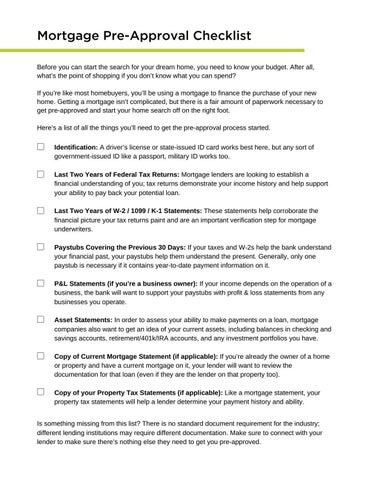
Mortgage Pre-Approval Checklist Before you can start the search for your dream home, you need to know your budget. After all, what’s the point of shopping if you don’t know what you can spend? If you’re like most homebuyers, you’ll be using a mortgage to finance the purchase of your new home. Getting a mortgage isn’t complicated, but there is a fair amount of paperwork necessary to get pre-approved and start your home search off on the right foot. Here’s a list of all the things you’ll need to get the pre-approval process started. Identification: A driver’s license or state-issued ID card works best here, but any sort of government-issued ID like a passport, military ID works too. Last Two Years of Federal Tax Returns: Mortgage lenders are looking to establish a financial understanding of you; tax returns demonstrate your income history and help support your ability to pay back your potential loan. Last Two Years of W-2 / 1099 / K-1 Statements: These statements help corroborate the financial picture your tax returns paint and are an important verification step for mortgage underwriters. Paystubs Covering the Previous 30 Days: If your taxes and W-2s help the bank understand your financial past, your paystubs help them understand the present. Generally, only one paystub is necessary if it contains year-to-date payment information on it. P&L Statements (if you’re a business owner): If your income depends on the operation of a business, the bank will want to support your paystubs with profit & loss statements from any businesses you operate. Asset Statements: In order to assess your ability to make payments on a loan, mortgage companies also want to get an idea of your current assets, including balances in checking and savings accounts, retirement/401k/IRA accounts, and any investment portfolios you have. Copy of Current Mortgage Statement (if applicable): If you’re already the owner of a home or property and have a current mortgage on it, your lender will want to review the documentation for that loan (even if they are the lender on that property too). Copy of your Property Tax Statements (if applicable): Like a mortgage statement, your property tax statements will help a lender determine your payment history and ability. Is something missing from this list? There is no standard document requirement for the industry; different lending institutions may require different documentation. Make sure to connect with your lender to make sure there’s nothing else they need to get you pre-approved.
Successful House-Hunting Checklist Buying a home is an emotional experience. There is something unmistakable about standing in the living room of a property and realizing that you are, in fact, home. But, this emotional reaction to a house can sometimes overwhelm our more logical and objective processes when it comes to househunting, which makes a successful house-hunting checklist even more important. Take a moment and fill out the checklist below; then, whenever you visit (or even consider) a new property make sure it meets all your required criteria before you start making emotional decisions about it.
How many bedrooms does my new home need to have to meet my or my family’s needs? _____________ How many bathrooms does my new home need to have to meet my or my family’s needs? _____________ What is the minimum number of square feet my new home needs to have to meet my or my family’s needs? _________________ What are the five things my new home absolutely must have to be considered an option?
What are the five things that would be nice to have in a new home, but aren’t necessities?
What are the three things that would disqualify a home from consideration?
Now that you know a little more about what your next home must or mustn’t have, use this checklist whenever visiting (or considering) a new home to see if it is worth considering further.
This home satisfies all of my must-haves. This home avoids all of the things I’ve identified as deal-breakers.
This home has the following from my “would be nice” list: ______________________ ______________________ ______________________ ______________________ ______________________
Based on my experience so far with this home, I’m ready to: Schedule a (another) showing Request more information Write an offer Consider the home as a possibility in the future Eliminate the home from consideration
Open House Attendance Checklist Open houses are a great way to check out homes, but if you’re visiting an open house without your buyer’s agent, it’s easy to forget to ask some important questions. Here are the most important questions you need to ask whenever you’re visiting an open house.
“May I Please See the Property Seller’s Disclosure Statement?” The SDS will give you insight into the physical condition of the property, including the legal disclosure of any sort of water, fire, or other damage that may have been concealed by remodeling. “When were the heating / cooling systems last serviced or inspected? Were they found to be in good working order?” A seller’s disclosure statement isn’t required to tell you about service history. If a working furnace requires a visit every other month from a tech to keep it that way, you’ll want to know. “What improvements have been made to the property since the seller purchased it?” Though most agents are happy to share the upgrades and improvements made to a property, they aren’t required to do so. Asking about remodeling and renovation projects is also a great way to get information on whether the work was done by licensed professionals or by the homeowner themselves. “What is the age of the current roof?” A standard SDS requires a seller to share whether or not there are defects or leaks in a roof, but not always the age of the roof. Most roofs have an estimated 20-year lifespan, so even a functioning roof that happens to be 17 years old may wind up being a capital expense in a few years. “What is the age of the current septic system?” Verification of a working septic system is important, but the age of the infrastructure is important too. Like a roof, the mechanicals in a septic system won’t last forever, and problems here often go undetected until it’s too late because they’re buried underground. An old septic system is worth inspecting prior to moving forward with a purchase to make sure you know what you’re working with. “May I please have the contact information for the HOA?” If the home you’re considering is a part of an HOA, make sure you request a copy of the HOA bylaws as well as review any membership information they have. HOAs are typically not too expensive in terms of the money they charge, but they can be a level of control that many homeowners aren’t prepared for. If the home you’re considering is part of an HOA, make sure you know your rights and responsibilities therein.
“Have there ever been incidents involving flooding in the home?” A standard SDS requires homeowners to disclose if there were water issues as a result of leaks, natural disasters, or water entering the home from the outside in any way. However, it does not require a homeowner to disclose an incident like a bathtub being left running; something that could cause equal damage. “Has there been an inspection recently conducted on the property? If so, may I see a copy of it?” Some homeowners will actually get a home inspection prior to listing the home for sale in an attempt to fix anything that might come up in the inspection process. Though a home seller isn’t required to provide this report to a buyer, it never hurts to ask!
Contract to Closing Checklist
Congrats! You’ve found the home of your dreams; it’s time to get you to the closing table. A lot needs to happen during the 30-45 days between a property going under contract and when you’re able to close on the home. Here’s a breakdown of what you need to do and when.
As Soon As You Are Under Contract: Submit your contract to your mortgage lender, verify there’s no other contract-related paperwork they need from you to begin the approval process Schedule a home inspection Immediately pause any plans for major purchases that would involve changes to your credit Stop all major credit card spending
Three Weeks Before Closing Order an appraisal (this is usually done through your bank, but you’ll need to pay for it upfront) Begin the title search process to verify the property’s title is free of encumbrances (this is something you can coordinate with your Realtor to order through your title company of choice) Confirm your plans to vacate your existing property Book any moving services necessary Check-in with your mortgage lender on the process of your loan approval
Two Weeks Before Closing Lock in your home insurance for your new home Verify the removal of home insurance for your existing property effective on your estimated closing date (if necessary) Verify the transfer of your utility service to your new home effective on your estimated closing date (if necessary) Check-in with your mortgage lender on the progress of your loan approval
One Week Before Closing Schedule a final walkthrough of your new property prior to closing Confirm you’re clear to close with your lender Confirm your closing date with your Realtor and the Closing Company, verifying that it meets any mandatory waiting periods between receiving a clear to close and closing Order any certified checks necessary for down payments, direct payments to sellers for furnishings, etc.
The Day of Closing - Don’t Forget to Bring: Photo IDs for anyone signing paperwork Required certified checks Activated homeowner’s insurance policy A new keychain