SECONDARY PROSPECTUS
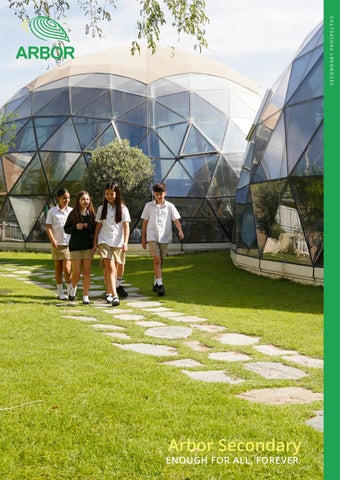
Arbor Secondary
ENOUGH FOR ALL, FOREVER.
2
SCHOOL PROSPECTUS
CONTENTS
T H E A R B O R D I F F E R E N C E
4
W E LCO M E TO A R B O R
6
W H AT M A K E S A N A R B O R I S T ?
8
O U R C U R R I C U LU M
10
PA S TO R A L C A R E
14
O U R L E A R N I N G E CO LO G Y
16
I N D I V I D UA L I S E D S U P P O R T
17
W H AT I S E CO L I T E R A C Y ?
18
G LO B A L I M PA C T
20
B E YO N D T H E C L A S S R O O M
22
STRENGTH OF WILL, HEART AND MIND
24
A S E N S E O F B E LO N G I N G
26
3
SCHOOL PROSPECTUS
The Arbor Difference Welcome to Arbor School, and thank you for considering us for your child’s secondary education. Choosing a secondary school matters. These are the years when young people begin to understand more clearly who they are, what they are capable of and where their interests might take them. They need to be known well, challenged academically and given opportunities to develop the confidence and independence they will need beyond school. At Arbor, we take academic achievement seriously. Our students follow a rigorous British curriculum, with a broad range of pathways as they progress through Secondary School. Alongside GCSEs, we offer Level 2 BTEC qualifications, with A Levels and Level 3 BTECs available in Sixth Form. We want every student to find the right level of challenge and the right pathway for them, while achieving outcomes that keep their future choices open. But a good education must do more than prepare young people for qualifications. 4
Arbor was founded with a very particular purpose: to give young people the knowledge, skills and understanding to engage with the world they are inheriting. Environmental and ecological education, including Ecoliteracy, is therefore not an addition to our curriculum; it is part of how our students learn to think. Through our curriculum, our Global Impact Certificate and the extraordinary learning environments across our campus, students are encouraged to ask difficult questions, make connections between disciplines and apply their learning to genuine problems. That approach has received international recognition, with Arbor named the 2025 winner of the World’s Best School Prize for Environmental Action. I am enormously proud of that achievement, but more important to me is what sits behind it: students and staff who genuinely believe they can make a difference and a school community prepared to turn those beliefs into action.
Secondary school should also be a place where young people discover things about themselves that cannot be measured by an examination grade. Sport, the arts, leadership, service, enrichment, friendships and the opportunity to try something new all matter. So does getting things wrong occasionally, learning from it and having adults around you who care enough to hold you to high standards. Our ambition is for students to leave Arbor with excellent qualifications, but also with curiosity, confidence and a strong sense of purpose. There are many excellent schools in Dubai. Arbor is deliberately different. I hope this prospectus gives you a sense of why, and I warmly invite you to visit us and see our Secondary School for yourself.
G.Thornley GEMMA THORNLEY Principal Arbor School
5
THE ARBOR DIFFERENCE
6
SCHOOL PROSPECTUS
THE ARBOR DIFFERENCE
Welcome to Arbor Secondary Arbor Secondary combines the rigour and ambition of a British curriculum with our distinctive approach to Ecoliteracy and realworld learning. We want every student to achieve highly, discover where their strengths and interests lie, and develop the confidence and independence to make informed choices about their future. Our mission sits at the heart of everything we do: “To provide an education that connects our community with the natural world and inspires us to imagine and build a future in which all may flourish.” Secondary is an important stage in a young person’s education. From the transition into Year 7 through to GCSEs and preparation for Sixth Form, students are challenged and supported to become increasingly independent. We have high expectations in the classroom, while recognising
that a successful education extends well beyond exam results. Personalised pathways are central to our approach. Our responsibility is to know students well and provide the right balance of challenge and support. Strong relationships between students, teachers, tutors, pastoral teams and families underpin this, while students take increasing ownership of their learning and the choices that shape their future. Academic ambition remains fundamental. We want students to achieve excellent outcomes that keep future pathways open and right for them. Alongside this, they develop the ability to think critically, communicate confidently, collaborate effectively and respond thoughtfully to the challenges they encounter. Arbor Secondary is also a community. Students are encouraged to contribute to school life, support one
another and recognise the impact of their choices on the people and world around them. This is reflected in what we ask of every Arborist: Think deeply Embody kindness Act consciously It is a privilege to lead Arbor Secondary and work alongside our students, families and staff. We want students to look back on their time at Arbor not simply as preparation for what comes next, but as an experience that helped shape who they are. I look forward to welcoming you to Arbor Secondary and giving you the opportunity to experience our school for yourself.
Yours sincerely,
T.Moriarty MR. TOM MORIARTY Head of Secondary Arbor School
7
SECONDARY PROSPECTUS
What Makes an Arborist? An ecoliterate curriculum that connects students to the natural world Individualised care built around every learner's needs and passions Ethical leadership grounded in integrity, courage and service Diverse opportunities across academic, creative and vocational pathways Boundless possibilities for every student to thrive and flourish Personalised pathways shaped by strengths, interests and future goals Purpose-driven learning rooted in real-world challenges A deep sense of connectedness across our whole community Passion and curiosity nurtured in every classroom A global vision for a sustainable, equitable future
8
TEN REASONS WHY
Leading to Arborists who...
THINK D E E P LY
E M B O DY KINDNESS
AC T CO N S C I O U S LY
9
SECONDARY PROSPECTUS
An Ecological School Grounded in the National Curriculum for England Explore relationships between people, communities and natural systems, developing an understanding of how choices can have wider impacts. Ask questions, investigate ideas and apply critical thinking and problem-solving to meaningful real-world contexts. Consider different perspectives, build positive relationships and understand the importance of kindness in the choices we make. Develop the confidence and independence to make informed choices, take purposeful action and contribute positively to communities.
10
THE ARBOR CURRICULUM
“One looks back with appreciation to the brilliant teachers, but with gratitude to those who touched our human feelings. The curriculum is so much necessary raw material, but warmth is the vital element for the growing plant and for the soul of the child.” CARL JUNG
PERSONALISED PAT H WAY S We provide an individualised education, with a broad range of curriculum pathways across academic, technical and vocational subjects. Through a wide choice of options, including GCSEs, A Levels and BTECs, students can build a pathway around their strengths, interests and future aspirations..
K E Y S TA G E 3
K E Y S TA G E 4
Years 7 – 9
Years 10 – 11
A broad curriculum combining strong academic foundations with creative, sporting and interdisciplinary learning. Ecoliteracy is embedded throughout, alongside National Curriculum for England subjects, Arabic, Islamic Studies and UAE Social Studies. In Year 9, concept-based, inquiry-led learning develops critical thinking, independence and prepares students for their Key Stage 4 choices.
Personalised pathways combining core subjects with options reflecting students’ strengths, interests and future aspirations, including academic, creative, vocational and sports. Courses provide increasing challenge and build towards GCSE examinations at the end of Year 11. Alongside their chosen subjects, students complete Level 1 of Arbor’s Global Impact Certificate.
K E Y S TA G E 5 Years 12 – 13 Students choose from A Levels, International A Levels and BTECs, or combine qualifications to create a personalised pathway. Alongside academic study, our Branching Out programme provides opportunities for enrichment, leadership and service. While dedicated futures guidance supports students with university applications, career exploration and their next steps beyond Arbor.
11
SECONDARY PROSPECTUS
W H AT I S T H E DIFFERENCE BET WEEN GCSE AND IGCSE? The GCSE and the IGCSE are very similar and are accepted as ‘equivalent’ qualifications by the top universities, sixthform colleges, and other independent schools around the world. The main difference between a GCSE and an IGCSE qualification is the inclusion of coursework as an assessed component within an iGCSE (e.g. science practical or English writing tasks), whereas GCSE subjects are largely assessed through final exams at the end of the two – year course. Subject teachers choose the course most suitable to their curriculum area.
W H AT A R E G C S E S O R IGCSES? The GCSE, or ‘General Certificate of Secondary Education’ is taken at the end of a British National Curriculum Secondary education before students move into Sixth Form. It is one of the most highly regarded qualifications globally and are internationally recognised.
12
MOE/KHDA We follow the MOE and KHDA requirements regarding the study of Arabic and Islamic Studies. Arab students will study Arabic through secondary and sixth form. Non-Arab students will stop studying Arabic after Year 10. Muslim students will continue with Islamic studies across the school.
W H I C H CO U R S E IS FOR ME? When choosing subjects, students should think about the following: What do they enjoy? What are they good at? What do they require for future A Level choices and beyond? Do they have a balance of subjects that demonstrate a wide skill set?
ALEVELS
GCSE results are an important step in a student’s academic journey, they will affect which qualifications and subjects students take next, eligibility for their chosen university and course, and even future career prospects.
The International A Level is designed for students outside of the UK, while the standard A Level is primarily taken by students in the UK but some course are able to be taken globally. The International A Level is designed to be accessible to students all around the world, and it is recognised by universities and employers globally.
Most students will do at least eight I/GCSEs at the Arbor School, including the core subjects of English, Mathematics, Global Perspectives and dual or triple science. In addition to this, students will select from a wide range of options including humanities, languages, creative, practical, and expressive subjects, alongside Arabic and Islamic Studies or Moral, Social and Cultural Studies where applicable.
The International A Level is also different in terms of the content covered. While the content is broadly similar to the standard A Level, the International A Level is specifically designed to be more internationally focused. This means that the syllabus covers topics that are relevant to students from different countries, cultures, and backgrounds. In addition, the International A Level syllabus may include more options for students to choose from,
giving them more flexibility to tailor their studies to their individual interests.
BTEC BTEC stands for Business and Technology Education Council, which is the name of the governing body that oversees the qualification. BTECs are specialist work-based courses that primarily involve practical learning, but there are also some theoretical elements. The main differences are in the way students learn in the process of gaining them. BTECs are heavily practical, whereas A Levels are more theorybased. However, both are accepted by most universities as the standard 18-unit extended BTEC level 3 diploma is equivalent to three A Levels. A BTEC Diploma at Sixth Form is equivalent to two A Levels and occupies two option choices. Another key difference is assessment: International A Level courses are often modular, allowing students to complete work before examinations and potentially re-sit elements, while A Levels are more exam-focused and BTECs are coursework-based. Students can choose International A Levels, BTECs, or a blended option of both.
E X A M D AT E S GCSE and A Level exams are completed annually in May – June, with coursework deadlines spread throughout the two years.
At the Arbor School we have an experienced team, including our Futures Counsellor, to support our students with their option choices and pathways. To support parents and students to make informed choices, we have a series of information evenings and events over the course of the academic year.
This will include: Option Evenings for parents and students to meet with staff for further discussions. An options booklet will be shared, detailing all the different option choices with an overview of content and assessment criteria.
Taster sessions give students the opportunity to experience different subjects before making their choices.
THE ARBOR CURRICULUM
H O W D O W E H E L P YO U S E L E C T YO U R PAT H WAY ?
Opportunities to meet with our Futures Counsellor, gain work experience and visit universities support students in exploring future pathways.
13
SECONDARY PROSPECTUS
A Journey of the Head, Hands and Heart
Pastoral Care Pastoral care is central to the Secondary experience at Arbor. Strong relationships ensure students are known as individuals and receive the care, guidance and support they need throughout their time at school. Our personalised pastoral programme combines a strengthsbased and restorative approach with clear expectations. Students are supported to reflect, understand themselves
14
and others, and develop increasing confidence and independence. Tutor groups are purposefully small, enabling Form Tutors to know students well and provide individual attention. They work closely with our counselling team, Thrive Team, Medical Care Team and Assistant Head (Pastoral Care), creating a strong network of support around each student. Every student should feel
safe, known and valued, with someone they can turn to when they need support. I N C LU S I O N We are committed to providing students with additional needs a safe and caring environment which inspires learning and personal growth. An adapted and bespoke curriculum supports students with a variety of needs as they study alongside their peers, at their own level. Through innovative use of space and resources, students are supported to become lifelong learners, with our Thrive Team working closely alongside subject teachers to ensure every student can access school life with confidence.
PA S TO R A L PROGRAMME
The Form Tutor plays a crucial role in setting expectations for all our students by creating a positive learning environment, establishing excellent relationships, and encouraging a collaborative approach aligned to Arbor values.
Students see their form tutor twice a day – in the morning and afternoon, allowing for close relationships and regular check-ins to occur. Tutors also deliver a full tutor lesson once a week. During these times they follow a thoughtful and enriching programme which includes Relationship, Social and Health sessions, Positive Education Curriculum as well as additional lessons in Moral and Social Education.
Students are tutored in small groups, meaning Form Tutors will have a thorough insight into students’ academic progress and social development. They maintain high expectations across behaviour, attendance, punctuality and uniform. Form Tutors are also be the first point of contact between home and school for any curriculum or pastoral queries. Parents are invited to meet their child’s tutor at the start of term, with regular communication continuing throughout the year.
We combine our individual knowledge of students with research-based, explicit pastoral curriculum to teach students the key concepts of wellbeing so they can live healthy, fulfilling lives. These sessions allow our students to gain the skills needed to help them flourish. Assemblies are held weekly to deliver the theme of the week and create a sense of community and belonging.
RHSE PROGRAMME The Secondary Relationship Health and Social Education programme reflects the school’s values and ethos and encourages respect for others. It is adapted to suit the changing needs of our students as they progress through school, and our tutors and pastoral team pay close attention to the individuals within their groups.
CARE AND SUPPORT
THE ROLE OF A F O R M T U TO R
The focus of the programme is on open and supportive sessions where every student is encouraged to contribute and feel safe and welcome. We encourage dialogue between tutor and students to speak, assert opinions, or ask questions. Three core key themes are addressed: Health & Wellbeing, Relationships, and Living in the Wider World, which is taught over the three terms. Our aim is to equip students with the knowledge and skills that will help them outside of their academic studies to become valued members of the community.
15
SECONDARY PROSPECTUS
Our Learning Ecology Our learning ecology is shaped by how teachers and students work together, the strategies used in the classroom and the questions that drive learning. This pedagogical approach combines expert teaching with active inquiry, encouraging students to think deeply and become increasingly independent learners. STUDENT SHAPED
INQUIRY
Cognizance
Teachers carefully consider how much ownership students take within the learning process, from exploring key questions and shaping their learning to reflecting on their progress and understanding.
Inquiry is an active approach to learning that begins with questions developed by the teacher, the student or collaboratively. Through inquiry, students explore ideas, make connections and deepen their understanding, developing the skills and attributes to become critical, reflective, empathetic and empowered learners.
Collaboration
This varies according to the subject, task and needs of the learner. As students become more independent, the teacher’s role evolves from direct instruction towards facilitation and guidance, encouraging students to take increasing responsibility for their learning. 16
Communication Contextualization Critical Thinking Creativity Curiousity With the overall goal of nurturing critical, reflective, empathetic and empowered learners.
OUR LEARNING ECOLOGY
“It seems to be that the natural world is the greatest source of excitement; the greatest source of visual beauty; the greatest source of intellectual interest. It is the greatest source of so much in life that makes life worth living.“ D AV I D AT T E N B O R O U G H
Individualised Support Alongside our pastoral systems, teachers work closely with the Thrive Team to ensure students can access individualised support where needed. ACCOMPLISHED LEARNERS AND SCHOLARS Students identified as accomplished learners or scholars are supported through a learning plan, with stretch and challenge in the classroom alongside opportunities to participate in workshops, seminars and networking events. Every scholarship recipient is supported by a mentor with experience relevant to their area of interest, providing guidance, insight and opportunities for personal growth. Accomplished learners and scholars will be encouraged to
take on leadership roles in ecofocused student organisations, community service projects, or other initiatives. For more details and to apply, please visit www.thearborschool.ae/ scholarships
ADDITIONAL NEEDS Students with additional needs are supported through inclass interventions, additional teaching support and adapted curriculum pathways where appropriate.
ensure all students have a path to success. Our Arbor Support Network brings together Form Tutors, Heads of Year, Assistant Heads of Pastoral and our counselling team so that every student’s wellbeing, behaviour and academic progress are monitored through a consistent, tiered approach — from universal, everyday support through to targeted, planned interventions where a sustained concern requires additional care.
The Thrive Team works closely with teachers to ensure students feel safe and supported and can access learning in a way that reflects their individual needs. In-house counsellors, EAL/ELL teachers, and an educational psychologist offer a high level of expertise. This team of specialists help determine any additional needs or diagnosis to
17
SECONDARY PROSPECTUS
“To develop a complete mind, study the science of Art, study the Art of Science. Learn how to see, Realise that everything connects to everything else.” LEONARDO DA VINCI
Ecoliteracy Ecoliteracy is the knowledge, skills and character needed to understand how people, communities and natural systems are connected, and how they can flourish together now and in the future. It empowers learners to identify challenges, think critically, take meaningful action and contribute positively to environmental and social change. Ecoliteracy is woven through every stage of learning at Arbor, developed through three interconnected lenses that guide how students engage with the natural world and their role within it:
FEEL Building empathy, awareness and meaningful connections to people, communities and the natural world.
18
THINK Developing understanding, curiosity and critical thinking about the systems that sustain life.
ENGAGE Applying learning through action, responsibility and contribution to positive environmental and social change.
SIX KEY CONCEPTS These concepts form the foundation of students’ environmental understanding and are explored through Science, Geography and our bespoke Ecoliteracy curriculum: Climate Science, Climate Justice, Ecosystems & Biodiversity, Resilience & Building, PostCarbon Economies, and Sustainable Lifestyles.
SIX CHARACTER VIRTUES Alongside these concepts, students explore six character virtues that underpin our mission and support their wellbeing and social and emotional development: Wisdom, Courage, Humility, Justice, Temperance and Transcendence. These virtues are taught explicitly across our pastoral programme, helping students recognise moral strengths in themselves and others, and to understand how these strengths connect to the wider work of building a sustainable, equitable future.
ECOLITERACY
K E Y S TA G E 3 Students are introduced to ecoliteracy through our Community Impact Certificate, an interdisciplinary programme built around concept curriculum, termly showcase events, and service learning and action exhibitions. Across the year, students explore termly concepts including Social Systems, Ecological & Field Work Connections, Economic Innovation, Tourism & Recreation, Conflict & Inspiration, and Marine & Energy. Through fieldwork, inquiry projects and authentic action, students develop systems thinking, collaboration, empathy and a genuine sense of responsibility
for the world around them, alongside the confidence to take meaningful action within their communities.
K E Y S TA G E 4 Ecoliteracy continues through Global Perspectives and our Global Impact Certificate Level 1, where students combine service-learning, enterprise, recreation and the arts through student-led sustainability projects, focused on Passion, Purpose and Perception. Students build an evidence portfolio and present their learning to an authentic audience, deepening their understanding of global citizenship and their role in creating positive change.
K E Y S TA G E 5 Students build on this foundation through an advanced programme aligned to the United Nations Sustainable Development Goals and Competencies for Education for Sustainable Development, investigating issues they are passionate about while creating meaningful, lasting impact within their communities and beyond. Many students also choose to extend their ecoliteracy learning through the Extended Project Qualification, undertaking independent, in-depth research into a topic of genuine personal interest.
19
SECONDARY PROSPECTUS
Global Impact Certificate Our unique programme for developing global citizenship, ecoliteracy and purposeful action. Through service, research, inquiry and reflection, students apply their learning to real-world challenges and create meaningful impact within their communities and beyond. Service and action learning takes four forms across the programme: Direct Service, working directly with people, communities or the environment; Indirect Service, supporting causes through fundraising, donations or community initiatives; Advocacy Service, raising awareness and encouraging positive action; and Research Service, investigating issues and using evidence to inform solutions.
LEVEL 1 Students combine servicelearning, enterprise, recreation and the arts through studentled sustainability projects focused on Passion, Purpose and Perception. They build an evidence portfolio and present their learning to an authentic audience, developing their understanding of global citizenship and their capacity to create positive change.
LEVEL 2 An advanced programme that develops global citizenship, ecoliteracy and sustainable thinking. Aligned to the United Nations Sustainable Development Goals and Competencies for Education for Sustainable Development, it enables students to investigate issues they are passionate about while creating meaningful impact. As part of our Branching Out Programme, students select pathways aligned to
20
their interests, strengths and aspirations. Alongside these experiences, they complete a service-learning project, build an evidence portfolio and reflect on their personal growth, leadership and contribution to their community.
L EVEL 3 Students may also choose to complete the Extended Project Qualification, an internationally recognised qualification that develops advanced research, critical thinking, reflection and academic writing skills — capabilities that are increasingly valued as students move on to competitive university courses and future careers. Working independently with the support of a supervisor, students undertake an in-depth investigation into a topic of their choice, developing skills highly valued by universities and future employers.
Students choose from four project pathways: a Dissertation, a 5,000–6,000-word academic essay with a clear argument; an Investigation, a 4,000–5,000word data-driven report based on practical research; a Performance, a live or recorded performance with a 1,500– 3,000-word analytical evaluation; or an Artefact, the creation of a physical or digital product with a 1,500–3,000-word written explanation. Throughout the programme, students submit a project proposal, maintain a detailed activity logbook, attend regular supervisor meetings and deliver a final assessed presentation in Year 13.
21
G L O B A L I M PA C T C E R T I F I C AT E
22
SECONDARY PROSPECTUS
BEYOND THE CLASSROOM
Beyond the Classroom ARBOR ENRICHMENT EXPERIENCE (AEX) Our whole-school approach to enrichment is designed to help every student discover interests, develop strengths and pursue meaningful opportunities beyond the classroom. Through a wide range of activities, experiences and leadership opportunities, students explore new passions, build confidence and contribute positively to the school community across seven strands: Arbor COMPETES, structured physical challenge and sporting competition that builds resilience and teamwork; Arbor EXPLORES, curiosity-led experiences that build confidence and encourage discovery; Arbor PERFORMS, opportunities to express ideas and talents through performance and presentation; Arbor INQUIRES, academic enrichment that deepens thinking beyond the classroom; Arbor INSPIRES, leadership, service and entrepreneurship
opportunities that develop purpose and responsibility; Arbor CREATES, hands-on opportunities to design, make and innovate; and Arbor EXTENDS, stretch pathways that take learning further into leadership, partnerships and real-world experiences. Activities take place before school, during lunch and after school, and students are encouraged to participate in a broad range of opportunities across sport, performing arts, innovation, outdoor education, leadership, service and academic enrichment.
RESIDENTIALS AND TRIPS
with an enrichment week each year in which Years 7–9 are encouraged to take part. Each experience is carefully designed to support our curriculum and values, with a focus on leadership skills, ethical values and adventurous challenges, whilst keeping a keen eye on environmental justice and sustainability. All students participate in at least one scheduled field visit each year, applying classroom learning in authentic ecological sites. Additional opportunities through curriculum enrichment and extracurricular activities bring learning to life beyond the traditional classroom.
Learning at Arbor extends far beyond the school gates. Through day trips, residential experiences and fieldwork opportunities, students are encouraged to explore new environments, challenge themselves and develop a deeper understanding of the world around them. We offer a range of residential opportunities, including international residentials,
23
SECONDARY PROSPECTUS
Positive Education Positive Education underpins relationships, communication and pastoral care across the school. Rooted in Positive Psychology, it helps students move beyond simply feeling “okay” towards higher levels of wellbeing, resilience and flourishing. Through a strengths-based approach, we help students develop the skills, habits and mindset needed to thrive both in school and beyond.
CHARACTER STRENGTHS We use the VIA Character Strengths survey with our students, emphasising the identification and development of each student’s individual strengths and positive qualities. This approach encourages students to discover their unique talents, character strengths and abilities,
24
enabling them to harness their potential and thrive both in the classroom and beyond it. There are plenty of spaces in the student planner to explore strengths in more detail, and lessons feature a strengths-based ideology as well as aspects of positive emotions, growth mindset, resilience and positive relationships. We endeavour to help students explore their values, passions and interests, enabling them to find meaning and purpose in their lives. THE POSITIVE EDUCATION CURRICULUM Delivered through weekly tutor-led lessons, our Positive Education curriculum supports emotional intelligence, resilience and positive relationships, alongside mindfulness, gratitude and growth mindset.
In Sixth Form, this extends to leadership, goal setting and stress management, preparing students for the challenges and opportunities that lie ahead.
KOMODO
Komodo is our dedicated wellbeing platform, empowering students to complete regular check-ins and reflect on their wellbeing. These surveys give our pastoral team the insight needed to identify concerns early, respond proactively, provide targeted support, and give every student a regular voice.
STRENGTH OF WILL, MIND AND HEART
STRENGTH OF WILL
STRENGTH OF HEART
STRENGTH OF MIND
Interpersonal strengths that help us relate to other people in positive ways
Intrapersonal strengths that help us achieve our goals
Intellectual strengths that help us wonder, reason, and create
Creativity
Kindness
Bravery
Curiosity
Social Intelligence
Perseverance
Self-regulation
Teamwork
Appreciation
Humility
Leadership
Hope
Perspective
Gratitude
Zest
25
SECONDARY PROSPECTUS
A Sense of Belonging All students and staff belong to one of four school Houses. Houses are allocated on entry to the school based on existing numbers in each House, with siblings generally placed in the same House. Students develop a strong sense of identity and belonging within their House. House Captains, Vice Captains and Sports Captains lead assemblies and organise their House teams for the various competitions. During the year there are a variety of inter-house competitions; these can be academic, sporting,
creative, cultural or linked to community service. Competitions bring together students within year groups and across different ages, helping build a strong sense of House identity across the school. Students can earn House points through their learning, positive behaviour, acts of kindness and contribution to school life. Students and staff wear their House shirts every Friday, further strengthening their sense of belonging. The names of the houses have been chosen to reflect the diverse leaders of environmental action and social change.
Houses and Leadership
OUR HOUSES ARE:
(DR. JANE)
GOODALL
(SIR DAVID)
ATTENBOROUGH
(KEN)
YEANG
(ISATOU)
CEESAY
Class Representatives Year Group Representatives Student Council
We believe leadership is not defined by a title, but by the choices students make every day. Through a wide range of leadership opportunities, students are encouraged to develop confidence, responsibility, teamwork and service, while making a positive contribution to the school community. Student leaders receive training through the Student Leadership
26
Challenge®, helping them develop the skills, mindset and character strengths needed to lead with purpose and integrity.
Eco Council Wellbeing Council Thrive Council House Leaders
Students can become involved in a range of leadership groups:
Global Awareness Council Innovation Council Sports Captains Library Council
27
HOUSES AND LEADERSHIP
Arbor School Al Furjan, Dubai, UAE +971 4 581 4100 reception@thearborschool.ae www.thearborschool.ae