ARBOR DAY FOUNDATION OAK SOCIETY
NOVEMBER/DECEMBER 2026
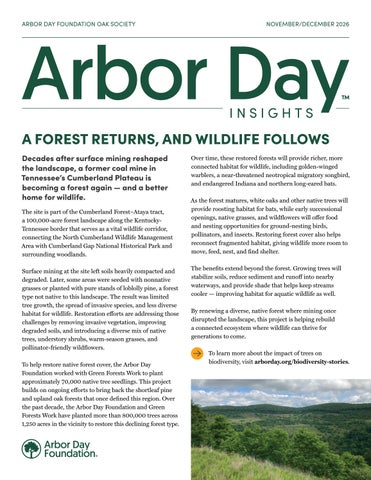
A FOREST RETURNS, AND WILDLIFE FOLLOWS Decades after surface mining reshaped the landscape, a former coal mine in Tennessee’s Cumberland Plateau is becoming a forest again — and a better home for wildlife. The site is part of the Cumberland Forest–Ataya tract, a 100,000-acre forest landscape along the KentuckyTennessee border that serves as a vital wildlife corridor, connecting the North Cumberland Wildlife Management Area with Cumberland Gap National Historical Park and surrounding woodlands. Surface mining at the site left soils heavily compacted and degraded. Later, some areas were seeded with nonnative grasses or planted with pure stands of loblolly pine, a forest type not native to this landscape. The result was limited tree growth, the spread of invasive species, and less diverse habitat for wildlife. Restoration efforts are addressing those challenges by removing invasive vegetation, improving degraded soils, and introducing a diverse mix of native trees, understory shrubs, warm-season grasses, and pollinator-friendly wildflowers. To help restore native forest cover, the Arbor Day Foundation worked with Green Forests Work to plant approximately 70,000 native tree seedlings. This project builds on ongoing efforts to bring back the shortleaf pine and upland oak forests that once defined this region. Over the past decade, the Arbor Day Foundation and Green Forests Work have planted more than 800,000 trees across 1,250 acres in the vicinity to restore this declining forest type.
Over time, these restored forests will provide richer, more connected habitat for wildlife, including golden-winged warblers, a near-threatened neotropical migratory songbird, and endangered Indiana and northern long-eared bats. As the forest matures, white oaks and other native trees will provide roosting habitat for bats, while early successional openings, native grasses, and wildflowers will offer food and nesting opportunities for ground-nesting birds, pollinators, and insects. Restoring forest cover also helps reconnect fragmented habitat, giving wildlife more room to move, feed, nest, and find shelter. The benefits extend beyond the forest. Growing trees will stabilize soils, reduce sediment and runoff into nearby waterways, and provide shade that helps keep streams cooler — improving habitat for aquatic wildlife as well. By renewing a diverse, native forest where mining once disrupted the landscape, this project is helping rebuild a connected ecosystem where wildlife can thrive for generations to come. To learn more about the impact of trees on biodiversity, visit arborday.org/biodiversity-stories.
“
It’s a serene, calming environment. It’s a place where I come to de-stress and take a load off. You become one with nature. RAMON ODIO
GROWING ROOTS IN MIAMI GARDENS Miami Gardens is home to Ramon Odio and his family. It’s where he and his wife bought their first home, where their children have grown up, and where they’ve built a life together. For more than 13 years, Snake Creek Trail has been woven into that life. It’s where Ramon runs and cycles, clears his mind after a busy week, and spends time with his children. “On the weekends, I spend time with the kids here — having conversations and catching up on what’s going on in school,” Ramon said. “I think that’s something they could look back on when they’re older and remember, ‘Hey, I walked with Dad on a trail. I saw this bird, I saw this butterfly.’ It’s good memories.” Now, a new chapter is taking root along the trail.
As part of Miami-Dade County’s Million Trees Miami initiative, the Arbor Day Foundation recently partnered with local leaders to plant approximately 200 trees along Snake Creek Trail, helping create a cooler, healthier, and more welcoming space for the community. “It’s a serene, calming environment,” he said. “It’s a place where I come to de-stress and take a load off. You become one with nature.” The new trees are already helping strengthen the trail’s ecosystem, bringing back pollinators like bees and butterflies that support neighborhood gardens and fruit trees. “A lot of us have coconut trees, mangoes, and our own gardens,” he said. “Bringing back the pollinators helps increase our crops, in a sense.”
Just as importantly, the trail has become a place where neighbors connect. “A lot of the residents in the community are elderly now. Their family members have moved away, and they’re alone,” he said. “This has become a meeting place where you can greet them, say hi, check on them, see how they’re doing. It helps bring a little more cohesiveness to the community.” In a city where summer heat often keeps people indoors, the growing tree canopy is making that connection easier by creating cooler, more comfortable places to gather. “With trees that create the shade and the shrubbery, it helps cool down the weather and creates a shaded area,” he said. “It’s phenomenal.” For Ramon, planting trees has always been about more than shade. When his son was born, he planted a coconut tree. When his daughter was born, he planted a cashew tree. Each one marks a milestone in his family’s story and serves as a reminder that the things we nurture today can benefit future generations. “It’s like a connection to where we’re at,” he said. “If you take care of it, it blossoms and produces fruit for the future.”
Your leadership and support make this work possible. To discuss how to expand your impact, please reach out to development@arborday.org. 3
EVERY TREE HAS A STORY Trees connect us — to place, to memory, and to one another. From backyard favorites to neighborhood landmarks, people from across the country are sharing the trees that hold special meaning in their lives. These trees have witnessed childhood adventures, family traditions, and quiet resilience, offering shade, comfort, and a sense of belonging along the way. Celebrating trees and the stories rooted in each of them brings our community together and reflects the heart of our mission.
GAIL W. | WINSTON-SALEM, NC “I have loved many trees in my lifetime. I started young with my swing tree. We lived in a tiny town in northern Indiana, in an old metal-roofed farmhouse sitting right on a two-lane highway. Several old shade trees surrounded our house, but there was one that I was most fond of. A tree that supplied me with many hours of thrilling fun. I was an active child, running, jumping, hanging from monkey bars. I had a grandfather who could fix and build anything — Grandpa Fedick. I asked him if he could shimmy up that tree in the backyard and rig up a long rope that I could use to jump out of the tree and swing on. He did, providing me with my own personal outdoor gym. I have found a photo that gives you a glimpse of my swing tree at the back of our house with my mother swinging from that tree.”
LISA S. | FOUNTAIN INN, SC “I love going into the woods near my home with my cat. We walk, sit, watch the birds, and soak up the sun streaming through the trees. We have a few trees we like to sit under and on. It’s a place I feel relaxed and grounded, a place to escape and rejuvenate my soul.”
Visit arborday.org/ celebrate to tell us about a tree you love.
Arbor Day Foundation | 211 N. 12th St. | Lincoln, NE 68508 50144101