BY
IN THIS ISSUE:
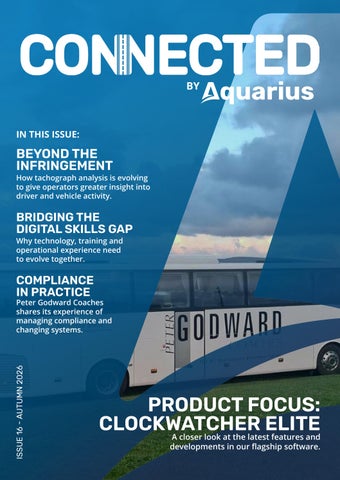
BEYOND THE INFRINGEMENT
How tachograph analysis is evolving to give operators greater insight into driver and vehicle activity.
BRIDGING THE DIGITAL SKILLS GAP Why technology, training and operational experience need to evolve together.
COMPLIANCE IN PRACTICE
ISSUE 16 - AUTUMN 2026
Peter Godward Coaches shares its experience of managing compliance and changing systems.
PRODUCT FOCUS: CLOCKWATCHER ELITE
A closer look at the latest features and developments in our flagship software. PAGE 1
CONTENTS
ISSUE 16 - AUTUMN 2026
WELCOME
2
Managing Director Mark Johnston welcomes readers to the Autumn issue of CONNECTED, with a focus on the bus and coach sector ahead of Euro Bus Expo and RTX Scotland.
BRIDGING THE DIGITAL SKILLS GAP
3-5
NEWS ROUND UP
7-8
THE NEW FACE OF AQUARIUS ONLINE
9-10
CUSTOMER SPOTLIGHT: COMPLIANCE IN PRACTICE
11-13
PRODUCT FOCUS: CLOCKWATCHER ELITE
15-16
VIEWPOINT: WHEN YOUR REPUTATION ARRIVES BEFORE YOU DO
17-18
CUSTOMER NEWS
19-20
INDUSTRY NEWS & UPDATES
21-22
COMPLIANCE: BEYOND THE INFRINGEMENT
23-24
Chris Cuffe explores why technology and training need to evolve together, helping operators build digital confidence while retaining valuable operational experience. The latest Aquarius news and industry events, including the Motor Transport Awards, Decarbonisation Summit, FORS Conference, Euro Bus Expo and RTX Scotland. Liz Haselden introduces our refreshed website, designed to make it easier for operators to explore our software, understand Connected Compliance and access support.
Andrew Church of Peter Godward Coaches shares his experience of managing driver compliance, changing systems and the importance of supporting and educating drivers. A closer look at our flagship tachograph analysis software, its expanding capabilities and how Licence Check supports more connected driver compliance.
Subir Gupta considers the influence of customer recommendations and why trust, service and reputation remain so important when choosing technology. Celebrating customer achievements, industry awards, fleet investments and community initiatives from across the Aquarius customer network. The latest DVSA vehicle defect statistics, National Coach Week and developments affecting international operators, including the EU’s Entry/Exit System and the launch of our new Schengen Planner. Marc Caplin explores how tachograph analysis is evolving beyond identifying infringements, helping operators understand the circumstances behind driver and vehicle activity and make more informed decisions.
Get in touch with our team: Customer Support: 0330 333 8788 Sales Team: 0330 333 8789
PAGE 1
WELCOME Welcome to the Autumn issue of CONNECTED. As we head towards the end of another busy year, our attention is turning to Euro Bus Expo at the NEC in November, where we’re looking forward to catching up with customers, partners and operators from across the bus and coach sector. Passenger transport has always been an important part of our business, and while the operating environment may be different to road haulage, many of the compliance challenges are very familiar. Drivers’ hours still need to be managed, tachograph data needs to be downloaded and analysed, and operators need confidence that they can demonstrate compliance when required. That gives this issue a particular bus and coach focus, but the conversations within it extend right across road transport. In our Compliance feature, Marc Caplin looks beyond the infringement to consider how tachograph analysis is changing and why having the right context can be just as important as identifying the initial alert. We also hear directly from Andrew Church of Peter Godward Coaches in our Customer Spotlight, who gives a very honest account of managing compliance day-to-day, changing systems and the importance of supporting and educating drivers when things go wrong.
Alongside these features, you’ll find our latest industry and customer news, a closer look at ClockWatcher Elite and some of the latest developments across Aquarius, including our new Schengen Planner and refreshed website. For those attending Euro Bus Expo, we look forward to welcoming you to Stand 164. We’ll also be returning to RTX Scotland later in November, following the successful launch of the event in Glasgow last year. And, as always, to all our customers and readers, thank you for your continued support. We hope you enjoy the latest issue of CONNECTED.
Mark Johnston
Managing Director
On page 4, Chris Cuffe explores a very different but increasingly important challenge for the industry: the digital skills gap. As transport operations become more technology-led, how do we ensure people with different levels of digital confidence can use that technology effectively, while retaining the enormous operational knowledge and experience already within our sector?
PAGE 2
ISSUE 16 - AUTUMN 2026
BRIDGING THE DIGITAL SKILLS GAP: WHY TECHNOLOGY AND TRAINING NEED TO EVOLVE TOGETHER By Chris Cuffe, Consultant at Aquarius IT Transport operators are becoming increasingly sophisticated in the way they use technology. Across the industry, businesses are looking to bring previously separate areas of driver, vehicle and compliance management together, consolidate data and gain a clearer view of what is happening across their operations. This is a positive shift. Bringing information together can reduce duplication, make everyday tasks easier and help operators identify issues sooner. As technology evolves, however, the way we introduce people to that technology needs to evolve too. Recent research from recruitment specialist Blue Arrow has raised the prospect of a future digital skills gap within logistics, highlighting the demographic profile of the sector alongside the increasingly digital nature of transport operations. The industry insight paper, Logistics Workforce Sustainability: Why Workforce Demographics Could Shape the Future of UK Logistics, authored by transport consultant Kirsten Tisdale, highlights an ageing workforce across a number of transport occupations and considers what this could mean for both digital skills and the longer-term sustainability of businesses.
PAGE 3
It also draws an interesting distinction between larger and smaller logistics organisations. In smaller companies, back-office teams are more likely to include family members, long-serving employees and former drivers with decades of valuable operational experience. In larger third-party logistics businesses, planning and management teams may include more school leavers, apprentices and early-career professionals entering office-based roles with digital skills. For me, this raises an important point. The answer isn’t simply to divide the workforce into those who are digitally skilled and those who aren’t. People learn differently. Different people, different starting points Someone can be extremely confident with technology but still need time to understand how a new system fits their particular role and operation. Equally, somebody with decades of transport experience may not want or need to understand every function available to them from day one. What they need is to understand how the technology can help them do their job more effectively. That distinction is important.
As transport technology becomes more sophisticated, we shouldn’t assume that more functionality automatically means more complexity for the user. Good technology should do the opposite. It should take complex information and make it easier to understand, manage and act upon. This is particularly relevant as operators increasingly look to consolidate data and systems. Tachograph analysis, driver compliance, licence checking, vehicle maintenance, reporting and auditing can no longer be viewed as completely separate activities. Bringing information together can give operators much greater visibility across their business and help them identify issues and make data-informed decisions more efficiently. However, the real value of that technology can only be realised if the people using it understand what it can do for them. Rethinking onboarding This is why I believe onboarding and training need to be considered an important part of digital transformation. A major part of my role at Aquarius is helping new users become comfortable and confident with our software, and experience has taught me that effective training is never a one-size-fits-all activity. Before delivering any session, I always start with the individual. What is their role? What experience do they have with technology? What are they hoping the software will help them achieve? Delivering the same prescriptive training to a whole room is an outdated approach. Where practical, I prefer to work with smaller groups of people in similar roles, concentrating on the functions and processes most relevant to their day-to-day responsibilities.
They can then return with practical, real-world questions that no pre-planned training agenda could necessarily anticipate. The objective isn’t to simplify the technology itself. It is to make the process of adopting and getting the most from that technology more manageable. Overcoming the confidence gap Even when people receive identical training, their confidence levels can vary considerably. Some employees quickly become the informal ‘tech lead’ within their business, while others naturally turn to that person whenever they need help. While having a confident and knowledgeable colleague can be valuable, it can also create a hidden business risk. If too much knowledge becomes concentrated in one person, what happens when that individual changes roles or leaves the organisation? Suddenly, the business can find itself facing a skills gap that it hadn’t necessarily anticipated. This is why I believe training needs to build confidence and capability across the wider team, rather than relying on a handful of people to become the experts. Conversely, I frequently see people with limited IT experience achieve a real ‘eureka’ moment once they realise the system isn’t creating extra work for them. It’s actually helping them do their daily job more easily. Those moments are particularly rewarding because you can see someone’s confidence grow as they begin to understand what the technology can do for them. Connecting the operational ecosystem The real objective of onboarding isn’t to turn everyone into software experts. It’s to give people the knowledge and confidence to use the tools available to them effectively. This is also where connected technology can make a difference.
Whether I’m delivering training on-site, where we can discuss the software within the context of their actual operations, or remotely via Teams, I’ve found that shorter, more focused sessions often produce the best results.
At Aquarius, we’re increasingly helping operators bring compliance, defect reporting, asset maintenance, document management and time tracking together within one software environment.
There is a simple reason for that. We don’t want people to feel overwhelmed.
Having that shared structure can make it easier for employees to become familiar with different areas of the system, develop their skills and take on new responsibilities.
Smaller groups create a more comfortable environment for asking questions, while focused sessions give people the opportunity to put what they’ve learned into practice before moving on to the next stage.
Combined with effective training, it can also help businesses reduce their reliance on individual employees and build greater resilience across their teams. PAGE 4
For operators, the benefits extend beyond simply having information in one place. When employees understand how different parts of an operation connect, they are better equipped to recognise issues, share information and make informed decisions.
ISSUE 16 - AUTUMN 2026
Combining digital skills with operational experience There is also a much wider opportunity for the industry. Some people entering the sector through apprenticeships, early-career and technologyled roles may bring different digital skills, while established transport professionals can bring decades of operational knowledge and experience. Neither is a substitute for the other. A person can understand technology instinctively but still need to learn why a particular compliance issue matters. Equally, an experienced transport professional may understand immediately what a piece of information is telling them but benefit from technology that makes finding, analysing and reporting that information faster and easier. The opportunity is to bring those strengths together.
teams. Combined with knowledge sharing and ongoing training, it can help organisations retain valuable operational experience as their workforces change. Technology is only part of the answer None of this means that every transport professional needs to become an IT expert. Quite the opposite. Technology should work hard behind the scenes so that the person using it can concentrate on what they do best. For software providers, that means developing technology around the realities of transport operations. Our responsibility, however, shouldn’t end when the software is installed. Good onboarding, ongoing training and knowledgeable, personal support all have a role to play in helping customers realise the full value of their technology. This becomes even more important as operators move towards more connected ways of working. If a business is bringing together driver, vehicle and compliance information, the value doesn’t simply come from having all that data in one place. It comes from people understanding what the information is telling them and being able to use it to support better decisions. That is where technology, training and operational experience need to work together. Bringing people with us The logistics workforce will undoubtedly continue to change, just as the technology supporting it will continue to evolve. For an industry thinking seriously about recruitment, retention and succession, digital skills therefore deserve to be part of the conversation. However, I don’t think the answer is simply to recruit more digitally skilled people.
There is a succession benefit here too, particularly for smaller businesses where important processes and operational knowledge may rest with a relatively small number of experienced employees. As the Blue Arrow research highlights, understanding where succession weaknesses exist is an important part of longer-term workforce sustainability. Technology can support that process by helping businesses establish consistent ways of working and making information more accessible across PAGE 5
We also need to make sure the technology we introduce is intuitive, that training reflects the needs of the people using it and that support remains available when they need it. Digital transformation should build on the enormous depth of knowledge and experience already within our industry while giving new and existing employees the tools and confidence to take it forward. Ultimately, successful digital transformation depends on more than what technology can do. It depends on making sure people have the confidence, knowledge and support to get the very best from it.
Connected compliance Driven by experience Powered by people
Our technology-led fleet management solutions are built to drive your operation forward by helping to enhance safety standards, improve communication, and streamline operations - so that your teams can work smarter and make informed data-driven decisions that result in company wide operational efficiencies and profitability.
This level of data integration: Reduces administration Saves time and costs Improves safety and service Streamlines company-wide communications
Book a consultation: www.aquariusit.com
0330 333 8789 sales@aquariusit.com
PAGE 6
NEWS ROUND UP
ISSUE 16 - AUTUMN 2026
CELEBRATING 40 YEARS OF THE MOTOR TRANSPORT AWARDS We were delighted to join the road transport industry in London for the landmark 40th Motor Transport Awards, celebrating the people and businesses making an outstanding contribution across the sector. It was a particularly proud evening for our own Liz Haselden, who took to the stage to present the Service to Industry Award to Andrew Malcolm MBE of The Malcolm Group, recognising his significant contribution to road transport. The 40th anniversary celebrations included a surprise appearance from Michael McIntyre as MC and guest speaker, while the evening also brought the news that long-standing Motor Transport Editor Steve Hobson is preparing to retire after almost two decades at the helm.
DECARBONISATION PROGRESS IN FOCUS AT SUMMIT In October, the team joined industry colleagues at the Motor Transport Decarbonisation Summit in Birmingham to hear about the latest progress towards a more sustainable future for road transport. The event highlighted how conversations around decarbonisation are evolving, with growing evidence from real-world industry trials helping operators make more informed decisions about their future strategies. With an engaging speaker line-up and practical case studies, the summit provided valuable insight into the progress being made and the challenges still facing the industry.
Congratulations to all this year’s finalists and winners, including the Welch Group and Darcica Logistics who are featured on our customer news pages.
SAFETY IN FOCUS AT INVERGOLD The Aquarius team joined operators, transport managers and industry experts at the Invergold Transport Conference at the National Motorcycle Museum in September.
JOINING IN THE CONVERSATIONS AT THE UK BUS SUMMIT Our Compliance Manager Marc Caplin represented Aquarius at the UK Bus Summit in Liverpool, joining representatives from across the sector to hear the latest thinking on the challenges and opportunities shaping the future of bus transport. It was also a great chance for Marc to catch up with Laura Hadzik of JMW Solicitors (pictured), who chaired one of the day’s discussions in her role with Women in Bus & Coach. PAGE 7
Under the theme ‘Safety by Choice or Safety by Chance?’, the conference discussed some of the biggest challenges facing road transport, from vehicle roadworthiness and driver management to enforcement, compliance and road safety. The event provided a useful forum for sharing knowledge and hearing directly from those managing transport operations every day.
NAVIGATING THE DIGITAL ROAD AHEAD AT FORS We also joined operators and industry colleagues at the FORS Annual Conference at the ICC Birmingham, where the 2026 theme, ‘Navigating the digital road ahead’, put the spotlight on the changing role of technology within road transport. The programme explored developments shaping the future of the sector and how digital tools are changing the way fleets, drivers and compliance responsibilities are managed.
COME AND SEE US AT EURO BUS EXPO We’re heading back to the NEC Birmingham this November for Euro Bus Expo 2026, where we’ll be on Stand 164. Taking centre stage will be ClockWatcher Elite, our tachograph analysis and driver compliance software, alongside Asset Maintenance, with both solutions DVSA-accredited for Earned Recognition. We’ll also be demonstrating our DVLA-approved Licence Check functionality and the Aquarius App, including two developments particularly relevant to international coach operations. Our new Schengen Planner (see more on page 22), within Time & Attendance, helps operators and employees keep track of time spent within the Schengen Zone and their position against the 90/180-day rule. Visitors can also see Clandestine Check, which enables drivers to digitally record vehicle security checks based on the Border Force checklist. Whether you’re an existing customer wanting to catch up with the team or would like to see the software in action, come and see us.
A GREAT DAY FOR A GREAT CAUSE It hasn’t all been conferences and exhibitions. Our Technical Support Manager Ian Hudson swapped technical support for the golf course recently, joining our friends over at Operator and Driver Support Services for a charity golf day in support of Wigan Youth Zone. It was a fantastic day on the green while helping to raise funds for a brilliant local charity supporting young people across Wigan. Well done to Ian and everyone involved!
AQUARIUS RETURNS TO RTX SCOTLAND Following the success of the inaugural RTX Scotland last year, we’re looking forward to returning to the SEC Glasgow for the second edition of the show on 18-19 November 2026. Bringing together Scotland’s road transport community, RTX Scotland provides an opportunity to catch up with customers and industry colleagues and hear about developments from across the sector. Scotland is an important market for Aquarius, with our software used by operators across a diverse range of sectors, including seafood logistics, waste and recycling, construction, oil and energy, coach and bus touring, and general haulage. We look forward to seeing you in Glasgow!
PAGE 8
ISSUE 16 - AUTUMN 2026
THE NEW FACE OF AQUARIUS ONLINE By Liz Haselden, Director of Marketing & Operations, Aquarius IT We’ve launched a completely refreshed Aquarius website, designed to better reflect who we are today, how our software has developed and the growing range of ways we can help transport operators manage their driver, fleet and compliance responsibilities. If you’ve visited our website recently, you may have noticed things look a little different. Our previous website had served us well for the last four to five years, but during that time Aquarius has changed considerably. Our software and product capabilities have expanded significantly, with new functionality introduced across driver and vehicle management. It was important that our website reflected those changes too. The result is a more contemporary, technology-led site that feels much more closely aligned with the look and feel of our software, while making it easier for visitors to find information about our products and for customers to access the support they need. Built around the needs of operators and customers One of the biggest priorities for the new website was making it easier to understand what our software does and how it can help with the
PAGE 9
practical, day-to-day responsibilities of running a transport operation. The site brings together ClockWatcher Elite, Asset Maintenance and the Aquarius App, alongside information covering tachograph analysis, driver compliance, licence checking, fleet and asset maintenance and digital driver processes. Rather than looking at these areas in isolation, the new site also makes it easier to see how different elements of an operation can work together. A clearer view of connected compliance The new website also explains our Connected Compliance approach more clearly, reflecting the way our software has developed over recent years. For us, Connected Compliance is about helping operators bring together different areas of driver, vehicle and operational management through connected software, data and systems. That can mean linking tachograph analysis with licence checking and digital driver processes, or bringing driver and vehicle information together to give operators a clearer picture of what’s happening across their business. API integration extends this further, enabling Aquarius technology to connect with other business-critical platforms used by operators. Importantly, it doesn’t mean every customer has to use everything.
Our software is designed to be flexible, allowing operators to choose the functionality that meets their individual requirements and add further capabilities as their needs change or their operation grows. Easier access to information and support The website has also been designed to create a more joined-up experience for existing Aquarius customers. Alongside clearer information about our products and functionality, it integrates more closely with our customer support functions, making it easier for users to access the information and assistance they need. This was an important part of the redevelopment. As the range of Aquarius products and functionality has grown, we wanted the website to make it simpler for customers to find what they need and access support when they need it. Built for the future The launch isn’t the end of the website’s development either. The website will continue to develop as we introduce new functionality and as the needs of transport operators change. Most importantly, it gives customers and prospective customers a much clearer picture of Aquarius today. Take a look around the new website and let us know what you think.
“This wasn’t simply about giving the website a fresh new look. We wanted it to feel much more closely aligned with our software, both visually and functionally, while bringing together the products, information and support we have been developing over several years.” Mark Johnston, Managing Director, Aquarius IT
PAGE 10
ISSUE 16 - AUTUMN 2026
CUSTOMER SPOTLIGHT
COMPLIANCE IN PRACTICE Marc Caplin, Compliance Manager at Aquarius IT, speaks to Andrew Church, Head of Commercial Operations at Peter Godward Coaches.
Operating a modern coach fleet involves far more than simply keeping vehicles on the road. From drivers’ hours and tachograph management to licence checking, Driver CPC and vehicle compliance, the responsibilities sitting with transport management teams are considerable. Peter Godward Coaches has been part of the coach industry for almost 60 years. Founded in October 1967 by Peter Godward and his father as G+G Coaches, the business started with a petrolengined OB Bedford. Around 1981, it became Peter Godward Coaches, with Peter’s son John joining the family business in 1994.
Today, the company operates a fleet of 12 vehicles from its depot in Basildon, Essex, undertaking a wide variety of coach work across the UK, Europe and Scandinavia. Following Peter’s death in 2024, the family business continues under the ownership of his wife Anita and son John Godward, supported by Head of Commercial Operations and Transport Manager Andrew Church, and Finance Manager Mark England. Last year, during an audit process and subsequent review of its compliance systems, Peter Godward Coaches moved to Aquarius IT following discussions with the DVSA and road transport legal specialists JMW Solicitors. The business now uses ClockWatcher Elite, eSIGN, Licence Check, Defect Reporting and Clandestine Check. In this issue of CONNECTED, Andrew gives us an insight into what managing compliance actually looks like day-to-day, why he sees infringements as an opportunity to educate rather than simply criticise, and his experience of changing compliance systems.
PAGE 11
Q: People outside the industry often underestimate how much responsibility sits with transport management teams. What does compliance management actually look like day-to-day for you? A: One of the major parts of my role over the past 12 years has been managing every single driver’s working time, driving, other work and rest or break periods, and ensuring it is all correctly recorded on their tachograph card every minute of every single day. It used to take a huge amount of time, but as a Transport Manager it’s one of the legal responsibilities I take extremely seriously. It’s not only about making sure it gets done, but making sure it is done correctly every time and that each driver understands their professional responsibilities as well. But the responsibility doesn’t stop there. I also oversee vehicle speed monitoring, driving licence checks and increased monitoring frequencies for drivers with points. I manage Driver CPC compliance too, ensuring drivers complete their 35 hours of training every five years and that the courses are relevant to the type of work we do across the UK, Europe and Scandinavia. Alongside all of that comes managing tachograph card swaps throughout duties, ensuring tachograph units are calibrated correctly, functioning properly, displaying the correct date and time and, importantly, ensuring there has been no tampering with any equipment. Then there’s also the people side of the role including staff holidays, sickness and general driver welfare. It’s a huge operational responsibility. PAGE 12
Q: You’ve spoken openly about how compliance isn’t just about catching infringements. What do you mean by that?
ISSUE 16 - AUTUMN 2026
A: Mistakes can happen. Something as simple as forgetting to switch the unit to break mode can create an infringement, even for good drivers. When things do go wrong, there’s usually tea, biscuits - not the chocolate ones though! - and a conversation about how it happened, why it happened and what could have been done differently to prevent it. For me, it’s never just about the infringement itself. It’s about education, learning and improving for the future. Drivers need to understand why compliance matters and feel supported rather than simply monitored or criticised. That creates a much stronger compliance culture across the operation. Q: How important are connected systems and operational visibility in helping manage compliance effectively? A: Over the past 12 years I’ve used four different analysis systems, but none of them provided the level of detail and clarity that allows me to manage drivers’ hours and compliance as effectively as Aquarius.
Having everything connected in one platform has completely changed the game operationally. The system is clear as day, incredibly detailed and has given me back valuable time to focus on other compliance areas. The transition itself was a big factor as well. Changing compliance systems can feel daunting, especially when you’ve been using another platform for a long time, and there were definitely moments in those first few weeks where I wondered whether we’d made the right decision. What made the difference was the level of support we received. The Aquarius team took the time to understand how we worked, answered questions quickly and helped us through the learning curve until everything clicked. That relationship and ongoing support gave us the confidence to stick with it, and we’re very glad we did. Since moving over, infringements are zero, overspeeds have stopped because issues can be identified and dealt with immediately, and overall compliance management has become significantly stronger. It doesn’t feel like we’re just using software; it feels like we have a partner that’s invested in helping us maintain high standards of compliance.
PAGE 13
MAKE LICENCE CHECKING PART OF YOUR AQUARIUS SYSTEM We’re always looking for ways to make compliance simpler for our customers, and our Licence Check service is another way we can help. The integration with ClockWatcher Elite and the Aquarius App, brings driving licence checks into your familiar system to manage all your driver compliance information. With just one log in and no need to manage licence checks elsewhere - you can see everything together in your Driver Hub. It’s really easy to get started. There are no minimum requirements, and because Licence Check is already integrated into the Aquarius software, getting set up is straightforward. We’ll help you through the process and get everything switched on. Once enabled, you can: Check driving licence data directly with the DVLA Schedule ongoing licence checks and set frequencies based on driver risk Receive alerts for endorsements or changes in licence status Manage and record driver consent through a simple step-by-step process Keep licence data connected with the rest of your driver compliance records Everything connected. Everything in one place. The whole process is designed to be simple, automated and auditable - helping you stay on top of licence checking without creating more admin for your team. Interested in adding Licence Check? Just get in touch with the team. We can talk you through how it works, answer any questions and get you up and running.
Book a consultation:
0330 333 8789 sales@aquariusit.com
PAGE 14
ISSUE 16 - AUTUMN 2026
PRODUCT FOCUS
FOR THOSE WHO DON’T KNOW CLOCKWATCHER ELITE… (WHERE HAVE YOU BEEN FOR THE LAST 20 YEARS?) We might be biased, but after more than 20 years as part of Aquarius, it’s sometimes easy to forget that not everyone knows ClockWatcher Elite.
shortened to, but haven’t seen what it can actually do - here’s the introduction.
So, for those who don’t - or perhaps know it as ClockWatcher, or simply Elite as it’s sometimes
ClockWatcher Elite is our comprehensive tachograph analysis and driver compliance software for HGV, bus and coach operators.
AT A GLANCE
day-to-day management, internal reviews and audit preparation.
Tachograph Analysis Analyse driver card and vehicle unit data, monitor drivers’ hours and Working Time, identify infringements and maintain the records needed to manage tachograph compliance. Dashboards & Alerts See the information that requires attention, monitor activity across your operation and configure alerts around your own requirements. Reporting Access detailed compliance and management reports for individual drivers and vehicles, or across the fleet, supporting
PAGE 15
Timeline Comparison View driver and vehicle activity visually and chronologically, providing another way to examine the detail behind the data when a closer review is required. Central Driver Hub Bring key driver information together in one place, including driver records, time and attendance, CPC training, licence information, medical details and infringement history. Flexible Remote Downloading Feed tachograph data directly into ClockWatcher Elite using
It takes the data generated by your drivers and vehicles and gives you the tools to manage it – from tachograph analysis, drivers’ hours and infringements, in line with the Road Transport Directive, through to reporting, driver records and wider compliance management.
Aquarius remote downloading or compatible third-party systems, reducing manual downloads and keeping data up to date. Secure 24/7 Access Give authorised members of your team secure access to the information they need, wherever they are working, with two-factor authentication providing an additional layer of security. Multi-user, Multi-site Whether you operate from one location or across multiple depots, ClockWatcher Elite provides a centralised view of driver compliance across the business.
MORE THAN A STANDALONE SYSTEM ClockWatcher Elite can be used as a standalone tachograph analysis and driver compliance solution, or as part of the wider Aquarius driver and fleet management platform. The system is scalable, so operators can start with the functionality they need and add further solutions as their requirements or operation grows. The Aquarius App connects drivers and operational teams with the office, enabling a growing range of tasks and information to be managed digitally while out on the road. Operators can also add eSIGN, Asset Maintenance, Defect Reporting, Time & Attendance, Document Management and Licence Check, extending the platform across wider areas of driver, vehicle and fleet management. This flexibility helps future-proof your investment, with additional functionality available when and where it is needed.
BRINGING LICENCE CHECK INTO CLOCKWATCHER ELITE One of the latest developments in ClockWatcher Elite is the integration of Aquarius Licence Check, bringing DVLA licence checking directly into the software operators already use to manage driver compliance. Rather than managing checks separately, operators can now access licence details alongside their existing driver records, providing greater visibility and reducing manual administration. The functionality enables users to check licence data directly with the DVLA, schedule future checks according to driver risk and receive alerts when something changes. Driver consent can also be managed and recorded through a simple step-by-step process. With everything brought together in one place, operators have a clearer, more efficient way to manage this important compliance responsibility. Simple. Automated. Auditable. There are no minimum requirements, and our team will help you get everything set up.
SEE CLOCKWATCHER ELITE IN ACTION
Find out more or speak to the Aquarius team about adding Licence Check to ClockWatcher Elite.
Whether you’ve never used ClockWatcher Elite, it’s been a while since you last looked at what Aquarius has to offer, or you’re an existing customer only using some of its functionality, a personalised demonstration can show you what else is available and focus on the areas most relevant to your operation. Click here to see how ClockWatcher Elite can support your operation.
PAGE 16
ISSUE 16 - AUTUMN 2026
VIEWPOINT
WHEN YOUR REPUTATION ARRIVES BEFORE YOU DO By Subir Gupta, Sales Manager, Aquarius IT The way transport operators buy technology has changed. There was a time when the sales conversation was often the starting point. A supplier introduced its business, explained its software and demonstrated what it could do. Today, that conversation frequently starts much earlier – and often without the supplier being involved at all. Operators can research systems online, speak to colleagues, ask consultants for their views and, perhaps most importantly, talk directly to other transport businesses about the technology they use and their experience of the company behind it. Sometimes that recommendation travels with the person. We’ve had Transport Managers move to a new company and introduce Aquarius into their new operation because they’d used the software in a previous role. In those situations, somebody who already knows the system effectively becomes its advocate within another business. And recommendations can come from unexpected places. On one occasion, an online enquiry arrived at nearly midnight after a conversation with one of our customers at an industry awards dinner. By the time somebody speaks to a salesperson, they can therefore already have a surprisingly welldeveloped view of the business. We saw another very clear example of that at the CV Show and RTX this year. Several people arrived at the Aquarius stand telling us they had “heard
PAGE 17
great things” about the company before we’d even spoken. Others had been specifically directed to us by an existing customer who had recommended that they come and see the system for themselves. From a sales perspective, that’s interesting because the introduction has effectively happened before the first conversation begins. Trust before technology Technology purchasing in road transport isn’t simply about comparing lists of features. Systems such as tachograph analysis, driver compliance and fleet management software can become embedded in an operator’s day-today processes. The information they hold and the way they are used can have a direct bearing on how effectively that business manages its responsibilities. Changing supplier can therefore be a significant decision. A demonstration can show what software does and a salesperson can explain its functionality. But neither can replicate the reassurance that comes from another operator who has already made that decision and can talk about their experience firsthand. That is why I think peer recommendation carries particular weight in our industry. Transport is a highly connected sector. Operators talk to each other; people move between businesses and consultants work across multiple
fleets. Experiences - good and bad - travel quickly, whether through social media groups, WhatsApp chats, local meet-ups, industry events or simply conversations between colleagues. For a technology provider, reputation is often being built in conversations you aren’t part of. A different sales conversation Aquarius has benefited from customer recommendation for many years. Our approach has never been built around large-scale cold calling; growth has come much more through the strength of the software, long-term customer relationships and people being prepared to recommend us to other operators.
But reputation is largely created afterwards. It’s built through somebody’s experience of using the software, how a business responds when they need help and whether what was promised during the sales process matches the reality of being a customer. You can’t manufacture genuine advocacy, and you certainly can’t demand it. When a customer recommends Aquarius to another operator, they are effectively putting some of their own credibility behind that introduction. We should never underestimate that.
What I find interesting now is how visible that has become at the beginning of the sales process. There is an important difference between somebody approaching us and asking “Who are Aquarius?” and somebody saying “I’ve heard about Aquarius - show me what you do.” This second scenario still needs the person to understand the software, ask the right questions and decide whether it suits their operation. A recommendation doesn’t make that decision for them. What it does provide is a degree of confidence at the outset. Somebody they trust has already had a positive enough experience to put our name into the conversation. That gives us a strong introduction - but it also gives us something to live up to. Growth creates its own test We’ve welcomed many new customers to Aquarius over the last 12 months, across different sectors and fleet sizes. Commercially, that’s clearly positive. But growth brings another challenge: can you maintain the experience and relationships that helped you grow in the first place? The recommendations we’ve benefited from haven’t come only from large fleets. Smaller operators, owner-drivers and industry consultants have also introduced Aquarius to others because of their own experience of working with us. So, growth can’t simply be measured by the number of new customers coming through the door. An equally important measure is whether, a year or several years later, those customers would still be prepared to recommend you. The customer experience is the marketing Marketing can create awareness. A demonstration can generate interest. A sales conversation can establish whether the product and the operator are a good fit.
Looking ahead to November With Euro Bus Expo and RTX Scotland both coming up in November, we’ll have another opportunity to see how many operators already know something about Aquarius before they reach our stand whether through another customer, an industry colleague, a consultant or simply our reputation within the sector. And if somebody arrives because another operator or industry colleague has already suggested they speak to Aquarius, that tells us something important. For me, that’s not simply a sales lead. It’s a measure of the reputation a business has built when it isn’t in the room.
PAGE 18
ISSUE 16 - AUTUMN 2026
CUSTOMER NEWS DOUBLE SUCCESS FOR WELCH GROUP
ANGLIA FREIGHT JOINS EAST COAST TRUCKERS CONVOY
Congratulations to Welch Group, who celebrated a double win at the 2026 Motor Transport Awards.
A huge well done to Anglia Freight, who took part in the 39th East Coast Truckers Convoy on Sunday 30 August, helping to give 88 disadvantaged and disabled young people a memorable day out.
The team took home the Future Fleets Award, recognising its work in developing and adopting cleaner, more sustainable fleet technologies. Welch Group also received the Partnership Award alongside the British Antarctic Survey, recognising their collaboration and the work involved in supporting operations in one of the world’s most challenging environments. A brilliant achievement for everyone involved.
The annual convoy saw trucks travel from Norwich to Pleasurewood Hills in Lowestoft, before returning through Great Yarmouth, where crowds gathered to wave them through. Organised by East Coast Truckers Children’s Charity, the convoy is a long-standing East Anglian tradition, bringing together drivers, volunteers and local communities to create a special experience for the children involved. Well done to everyone at Anglia Freight for being part of such a fantastic event!
NEW TALENT DEVELOPMENT AWARD FOR DARCICA It was also a successful evening at the 2026 Motor Transport Awards for Darcica Logistics, who were named winners of the New Talent Development Award. The award recognises the company’s commitment to developing people and creating opportunities for new talent within the transport and logistics sector. A great result for the Darcica team and recognition of the work being done to invest in the next generation of the industry.
PAGE 19
RATHO COACHES KEEPS THE ROYAL EDINBURGH MILITARY TATTOO MOVING Ratho Coaches was once again behind the scenes at the Royal Edinburgh Military Tattoo this summer, providing transport for the crew and performers throughout the 2026 season. From rehearsals through to the final performance, the Ratho team helped keep everyone moving safely and smoothly during one of Scotland’s most famous annual events. Congratulations to the Ratho Coaches team on another successful Tattoo season!
CROPLEY COACHES MAKES ITS TV DEBUT! A familiar coach made an unexpected appearance on Channel 4 this summer, when Cropley Coaches spotted one of its vehicles in an episode of Dover 24/7: Britain’s Busiest Port.
HODGE’S COACHES INVESTS £1.36 MILLION IN FLEET EXPANSION Hodge’s Coaches is investing £1.36 million in new PSVAR-equipped vehicles this year, with the first additions to its fleet already arriving. The Sandhurst-based operator has welcomed two new Mercedes Tourismo coaches, bringing its Tourismo fleet to 11 vehicles. Two new 74-seater Scania MOBIpeople coaches are also in production in Portugal, with the vehicles set to join the fleet in the coming weeks.
The coach appeared in the background of Series 2, Episode 6, with the team reckoning it was filmed during their Disneyland Paris day trip in 2025. As Cropley Coaches joked on social media, they didn’t even need to audition for their television debut!
The investment will bring additional passenger capacity, accessibility and safety features, with the new Scania coaches also offering increased luggage space for school residential trips, airport transfers and longer journeys. An exciting period of growth for the Hodge’s Coaches team, and we look forward to seeing the new additions out on the road!
OWEN GRIFFIN GETS THE CONVERSATION MOVING WITH NEW PODCAST! There’s a new voice in UK haulage! Owen Griffin, Managing Director of Griffins Group Ltd, has launched his very own podcast, What The Truck! With the first episode now available and more guests lined up, Owen is getting the conversation rolling on all things UK haulage. We wish Owen every success with his new venture and look forward to tuning in! Listen to What The Truck on Spotify
PAGE 20
ISSUE 16 - AUTUMN 2026
INDUSTRY NEWS
TYRE CONDITION TOPS LATEST DVSA HGV AND PSV DEFECT DATA Tyre condition remains the most commonly recorded mechanical defect at roadside inspections for both HGVs and PSVs, according to the latest vehicle enforcement data published by the DVSA. The figures, covering enforcement activity in Great Britain from October 2025 to June 2026, include roadside and operator premises checks, defect and offence severity, maintenance assessments and the most common reasons for vehicle prohibitions.
For the latest quarter, April to June 2026, tyre condition accounted for 7.62% of HGVs inspected at roadside, followed by exhaust emissions at 2.48%, security of body at 2.31% and brake systems and components at 2.00%. For PSVs, tyre condition was also the most commonly recorded defect at 6.29%, followed by brake systems and components at 2.58%, seat belts and supplementary restraint systems at 2.13%, and doors and PSV passenger doors at 1.91%.
The figures highlight the importance of regular vehicle checks, effective defect reporting and good maintenance records for operators across both sectors. Aquarius Asset Maintenance and Defect Reporting can help with this, giving operators a digital way to manage maintenance schedules, report defects and keep the relevant records in one place. The full vehicle enforcement statistics are available here on GOV.UK.
NATIONAL COACH WEEK CELEBRATES THE COACH SECTOR National Coach Week took place from 12–18 October 2026, celebrating the people, businesses and operators who keep the UK moving and highlighting the contribution coaches make to everyday life. Led by the RHA and open to the whole industry, this year’s campaign ran under the theme ‘Coaches Make... Happen’, showcasing the role coaches play across education, tourism, sport, festivals, holidays and more. Throughout the week, operators, drivers, passengers and industry partners were encouraged to share their own stories, photos and videos, while the RHA continued engaging with politicians and stakeholders to raise the profile of the sector and the issues affecting operators.
PAGE 21
The Road Haulage Association has described the differing approaches as creating a “regulatory patchwork” for international operators, with drivers potentially facing different processes depending on the country through which they enter or leave the Schengen Area.
EES ROLLOUT CREATES NEW CHALLENGES FOR INTERNATIONAL OPERATORS The phased introduction of the EU’s new Entry/Exit System (EES) is creating a changing picture for UK operators travelling into Europe. While EES is designed to replace manual passport stamping with a digital system recording the entry and exit of non-EU nationals travelling into the Schengen Area, implementation has not been uniform across Europe. At the time this issue of CONNECTED goes live, nine Schengen countries - France, Germany, Italy, Belgium, the Netherlands, Greece, Malta, Portugal and Switzerland - have reportedly delayed the full introduction of biometric checks, while Spain has moved ahead with implementation.
For operators undertaking regular international work, it adds another consideration to journey planning and the management of drivers travelling between the UK and Europe.
EES AND THE 90/180-DAY RULE ARE TWO DIFFERENT THINGS The changes surrounding EES should not, however, be confused with the separate Schengen 90/180day rule. For UK drivers travelling into the Schengen Area, the rule generally allows individuals to spend up to 90 days within any rolling 180-day period. For operators whose drivers regularly undertake international work, keeping track of that time can be challenging. Unlike drivers’ hours, this isn’t something that can simply be managed through tachograph analysis. Time spent within the Schengen Area can include days when an employee isn’t driving including holidays and rest days - so operators and employees need another way of keeping track.
KEEPING TRACK WITH SCHENGEN PLANNER To help make that easier to manage, we’ve introduced a new Schengen Planner within Time & Attendance. The Planner enables trips to be recorded by country and gives both the employee and transport office visibility of the number of days used within the rolling 180-day period. Because it sits within Time & Attendance, it can also take account of other relevant time spent within the Schengen Area, including holidays and rest days, helping to provide a more complete picture than tachograph data alone. For coach operators travelling regularly into Europe - and HGV operators undertaking international work - that provides a practical way to keep track of where individual employees stand against the 90/180-day limit.
PAGE 22
ISSUE 16 - AUTUMN 2026
COMPLIANCE
BEYOND THE INFRINGEMENT - HOW TACHOGRAPH ANALYSIS IS EVOLVING By Marc Caplin, Compliance Manager, Aquarius IT For many years, tachograph analysis has largely been associated with one thing: identifying infringements. Has a driver exceeded their daily driving time? Have they taken the correct break? Has sufficient daily or weekly rest been recorded? Those questions remain fundamental to effective compliance management, and they always will. But increasingly, the conversations I have with operators go beyond simply identifying that something has happened. The real question is often: why? That distinction matters. An infringement or anomaly is the starting point. Understanding the circumstances behind it is what enables a transport manager to decide what needs to happen next. And that is where I believe tachograph analysis is evolving. From identification to understanding Traditional tachograph analysis is very good at identifying exceptions. The software processes the data, applies the relevant rules and highlights activity that requires attention. But transport operations don’t take place in perfect conditions. Drivers encounter delays. Vehicles move around yards. Cards are inserted and removed. Vehicles are swapped. Manual entries are made. Data can be incomplete, and sometimes what initially appears to be straightforward becomes much less so when you look at the surrounding activity. That is why context is becoming increasingly important.
PAGE 23
Take missing mileage as an example. A vehicle unit download may show that a vehicle has moved without a driver card inserted. The immediate question is obvious: who was driving? Historically, answering that could involve looking through different records, comparing vehicle and driver data and trying to piece together a sequence of events. But the information needed to understand what happened may already exist within the tachograph data. By looking at driver card insertion and ejection times alongside vehicle activity and movements, an operator can begin to build a much clearer picture. If one driver’s card is ejected and the vehicle subsequently moves a short distance before another driver’s card is inserted, that chronology provides important context. It doesn’t automatically tell the operator why the vehicle moved or who was responsible. What it does do is provide more information with which to review the event. Seeing the data differently This thinking has influenced the continued development of ClockWatcher Elite. One example is Timeline Comparison, which enables operators to view driver and vehicle activity visually and chronologically. Rather than looking at individual pieces of information in isolation, users can compare activity across a timeline and examine what was happening around a particular event. That might mean comparing card insertion and
ejection with vehicle movement, reviewing activity before or after an infringement, or examining periods where the recorded data raises a question. The aim isn’t for the software to make a judgement. It’s to make the relevant information easier to see and interrogate. For experienced transport managers, that distinction is important. They understand their operation, their drivers and the circumstances surrounding a particular journey. What they need from the technology is the ability to access and examine the information that can help them establish what happened. Development driven by real operations Some of the most useful developments in compliance software come from conversations with the people using it every day.
Compliance software should provide the evidence and tools needed to support informed decisionmaking, rather than attempt to make those decisions on behalf of the operator.
Transport managers don’t necessarily describe what they need in terms of software functionality.
It is also why context matters. The more clearly information can be presented and compared, the easier it becomes for transport teams to review what happened and determine whether further action is required.
They tell us about a problem.
Technology and experience
They might explain that a particular type of activity takes too long to review, that information has to be checked in several different places or that they need a clearer way of understanding what happened around a particular event.
As tachograph analysis becomes more sophisticated, technology can help operators interrogate data in greater detail and bring relevant information together more effectively.
Those conversations are valuable because they start with the operational challenge rather than the technology.
Transport managers and compliance teams still bring the operational knowledge, experience and judgement needed to understand what the data means within their own business.
From there, our development team can consider whether the data already available can be presented or connected in a way that makes that task easier. Not every problem can or should be solved by software. But where technology can remove unnecessary manual work, improve visibility or make existing information easier to examine, it can give transport teams more time to concentrate on the decisions that require their experience and judgement.
But software remains a tool.
Our role is to continue developing technology that gives them clearer visibility of that information and practical tools to help them manage it. Tachograph analysis has moved a long way beyond simply producing a list of infringements. Increasingly, its value lies in helping operators understand the activity behind the data - and giving them the information they need to decide what happens next.
Why independence matters There is another important principle behind effective tachograph analysis: the software should identify and present the information without making assumptions about what happened. An alert may indicate that something requires attention, but there can be many reasons behind the data. The role of the software is to help the operator identify the relevant activity and examine the available information so they can establish the circumstances for themselves. That independence is important.
PAGE 24
BY
www.aquariusit.com