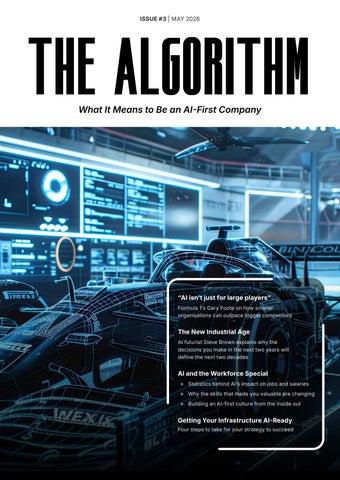
ISSUE #3 | MAY 2026
The Algorithm What It Means to Be an AI-First Company
“AI isn’t just for large players” Formula 1’s Gary Foote on how smaller organisations can outpace bigger competitors
The New Industrial Age AI futurist Steve Brown explains why the decisions you make in the next two years will define the next two decades
AI and the Workforce Special » Statistics behind AI’s impact on jobs and salaries » Why the skills that made you valuable are changing » Building an AI-first culture from the inside out
Getting Your Infrastructure AI-Ready Four steps to take for your strategy to succeed
ARTICLE 01
“AI isn’t just for large players. In many cases, it’s more powerful for the smaller ones.”
04
ARTICLE 02
AI and Jobs: The Story Behind the Statistics
08
ARTICLE 03
The Skills That Make You Valuable Are Changing
12
ARTICLE 04
Inside Aptean AppCentral’s Role-Based AI Workspaces
15
ARTICLE 05
How To Build an AI-First Culture From the Inside Out
16
ARTICLE 06
“When artificial general intelligence comes, you are turning the dial up to 11.”
18
ARTICLE 07
Four Steps To Get Your Infrastructure AI-Ready
20
ARTICLE 08
Deep Dive On: AI in Healthcare Asset Management
2
The Algorithm
22
Fear Is the Biggest Barrier to AI Adoption Artificial intelligence (AI) promises unprecedented opportunities for manufacturers and distributors, but it also introduces something many leaders are reluctant to admit: fear. Fear of falling behind, fear of getting it wrong, fear of not knowing where to start. And yet, doing nothing carries more risk than taking a first step. The truth is that adopting AI doesn’t require perfection, and it doesn’t demand total certainty. Progress comes from experimenting, learning, and applying the lessons you learn to the next challenge. The organisations gaining real traction with AI are not the ones avoiding mistakes; they’re the ones learning from them fastest. An open mindset will become even more important as AI reshapes the way we work. Roles will expand, workflows will change, and new tools will emerge at extraordinary speed. Success will depend on leaders staying focused on business problems and building environments where AI can operate with clarity, trust, and purpose. To explore these principles further, we spoke with Gary Foote, former CIO of the Haas F1 team. His perspectives on AI, culture, and performance offer insights that apply far beyond Formula 1. We were also fortunate to welcome AI futurist Steve Brown to our most recent UNITE AI Summit. Steve believes that we are in an infrastructure-building phase equivalent to the early internet, and that organisations must do groundwork now to be ready for when AI that operates at human level across the full range of cognitive tasks arrives. We hope you enjoy these insights and more in this latest edition of The Algorithm. TVN Reddy CEO, Aptean
The Algorithm
3
ARTICLE 01
“AI isn’t just for large players. In many cases, it’s more powerful for the smaller ones.”
Formula 1 has pioneered the use of data to drive competitive advantage. Now, the sport is accelerating into its next era: AIenabled decision-making, on and off the track. Gary Foote—who was CIO of the TGR Haas F1 Team for a decade and is now CIO of GM Performance Power Units—spoke to customers at Aptean Connect, our UK conference, about AI transformation in Formula 1. We sat down with him after to discuss how F1 is integrating AI and what lessons every industry can take from the world’s most data-intensive sport.
4
The Algorithm
Formula 1 has always been technologically advanced, but you’ve described a major shift in the importance of data over the last decade. What’s changed? When I started in F1 in 2008, technology was complementary. It helped performance and reliability, but the car could still run even if systems failed. That’s no longer true. Today, the sport relies so heavily on data and digital systems that unless all of those zeros and ones are saying the right thing at the right time, the car won’t start. Formula 1 cars now carry 250–300 sensors, generating 1–1.5 million data points every second. We supplement those with virtual sensors—mathematical models that combine multiple real sensors to give us insights we can’t measure physically, like corner-exit grip or real-time tyre degradation. The amount of information available has exploded, and that’s changed everything about how teams operate.
Why is it difficult for organisations to take full advantage of the data they collect, and how can AI address this challenge? Users—whether F1 teams or other industries—tend to look at a small portion of their data estate and ignore the rest, because humans have a bandwidth limitation. CFOs, engineers, and strategists all gravitate towards the subset they understand or can manage. But behind that is a massive data set they’re not looking at.
Here, AI becomes indispensable. Once you generate data, you need something to interpret it. AI is the only realistic way to identify patterns, highlight anomalies, or point you towards something you weren’t looking at. But AI’s ability to produce immediate insights doesn’t mean the team can absorb it immediately. The trick is understanding the hierarchy: what must be acted on live, what is about future performance, and what builds strategic understanding. Data prioritisation is critical because we can only assimilate so many insights at once. In the world of F1, there are safety-critical values—temperatures, pressures, gearbox behaviour—that must be seen immediately. If halfway around the lap a gearbox pressure starts rising, you need to retire the car before anyone watching on TV even realises something’s wrong. A huge amount of data is pulled from the car after running and analyzed later. That “longer-term” insight is just as important to prepare for the next race or even next season.
The Algorithm
5
It’s easy to see AI’s potential for optimising equipment and machinery, but are there other, untapped areas where it can strengthen performance? AI can help to understand and enhance people performance. Formula 1 has spent 70 years optimising the car and the drivers. But race results hinge on the whole team: 80 to 100 people at the track, plus operations centres around the world. Their performance matters too. We can now analyse things like jet-lag profiles, sleep patterns, nutrition, workload cycles, and individual changes to maximise performance from the entire workforce, not just the drivers. You’re only as fast as your slowest corner, and AI helps identify why that corner is slower and what could fix it. It might reveal that a crew member is great on the first pit stop but fatigues on stop two, so you can swap them with someone else during the race. That’s the level of detail teams need to stay competitive.
6
The Algorithm
Using AI to enhance human performance can raise concerns for employees. How do you manage that side of AI adoption? The fear is real: Many people worry that if AI can do part of their job, their business won’t need them anymore. You need a culture of optimism to replace this. We’re nowhere near a world where AI can be left to make decisions without human judgement. Especially in risk-heavy environments like F1. AI is incredibly useful for providing an opinion, but the responsibility still lies with a person. We need people to use their expertise and intuition to check the AI’s recommendation. No strategist, engineer, or operator will get an AI answer and say, “I don’t trust it, but I’ll go with it anyway.” That’s not how it works.
AI removes the crummy parts of people’s jobs so they can do higher-value work. That’s as true in F1 as in any business. Haas faced some initial resistance to AI programmes because the team employs extremely intelligent people who use proven methods. So we had to build digital trust. We looked for areas that AI could make an immediate impact, like HR. When the HR team saw that an AI tool could produce a good job description, they became champions. Suddenly the HR Director was telling the Technical Director how valuable AI is. That’s how trust spreads.
Can AI level the playing field between large and small organisations? AI is a genuine level-setter. Haas is one of the smaller F1 teams, and every dollar spent on technology is a dollar not spent on the car, so efficiency is incredibly important.
With AI moving so quickly, what do you think the next few years will look like? The pace of change is astonishing. Four months ago, I asked ChatGPT to show me what a future F1 car might look like. It generated something silly, with neon lights and charging ports. I asked again a few days ago with the same prompt, and it produced something that looks very close to current regulations. That’s how fast the technology is advancing. In the next few years, I think we’ll see huge developments in the AI-driven interpretation of simulation data, human performance optimisation, and remote collaboration using mixed reality tools. Through all of it, AI will remain an enhancer of decisions, an accelerator of innovation, a converter of data into insight, and ultimately a source of competitive advantage—in sport and in business.
If AI can gain 20% efficiency from five people, it’s essentially getting a sixth person for free. That’s a message senior leaders understand immediately, and it’s one of the reasons we invested early. AI isn’t just for large players. In many cases, it’s more powerful for the smaller ones.
The Algorithm
7
ARTICLE 02
AI and Jobs: The Story Behind the Statistics The numbers on AI and employment are in. And they tell a story of growing opportunity, uneven rewards, and a widening gap between the organisations building AI-capable teams and those cutting headcount while hoping for the best.
Two years into the generative AI era, the data on its workforce impact is starting to tell an interesting story. But it’s not the story many expected. Goldman Sachs estimated that widespread AI adoption could eventually displace 6–7% of the U.S. workforce, and that projection may yet prove right over time. However, the evidence accumulating through 2025, from both the United States and the United Kingdom, suggests something more nuanced is happening. The headline numbers are, in many respects, encouraging. PwC’s 2025 Global AI Jobs Barometer found that industries more exposed to AI saw revenue per employee grow at three times the rate of less exposed sectors, with wages rising twice as fast.
8
The Algorithm
In the UK, KPMG reports that more than half of workers using AI have observed increased efficiency, quality of output, and innovation, with 45% reporting greater revenue-generating activity. Two-thirds of UK workers are now intentionally using AI on the job. McKinsey’s global survey found that 64% of organisations say AI is enabling their innovation. By any measure, AI is delivering value—and delivering it quickly. Yet the benefits of AI enablement are accruing unevenly, and the knock-on effects on hiring, skills, and workplace culture tell a more complicated tale.
AI Skills Hold Premium Value The most striking finding in recent data is the extraordinary value the labour market is placing on AI skills. PwC finds that workers with AI fluency now command a 56% wage premium. Meanwhile, skills for AI-exposed roles are changing 66% faster than elsewhere. This is not a gentle drift; it is the market repricing human capability. For individuals, this is an invitation to learn and to be rewarded handsomely for doing so. As Stephanie Choi of Samsung puts it, AI “can open—not close—new skills, new passions, and, ultimately, new career paths.” For employers, it is both an opportunity and a strategic imperative. Companies that invest in developing AI fluency across their workforce stand to capture considerable gains. Those that do not will find their best people poached and their remaining teams falling behind.
Some of the world’s largest employers are already putting weight behind AI training programmes. Walmart has made AI certifications free across all functions, for example. In the words of Allianz’s chief people officer, Bettina Dietsche, “Upskilling in AI and data savviness isn’t about training employees; it’s about empowering everyone to foster a culture of innovation, technical excellence, and efficiency.” The challenge is pace. If skills in AI-exposed roles are evolving 66% faster than the norm, even well-intentioned training programmes face a moving target. Companies need to think about learning as a continuous capability, built into how work is done rather than bolted on after.
The dominant corporate response so far has been encouraging. Globally, training existing staff is by far the preferred approach to AI integration. ONS data shows that 33% of UK businesses using AI are reskilling their workforce, while McKinsey finds similar patterns internationally.
Entry Level Roles Are Narrowing Mass job losses as a result of AI have not materialised as many employees feared. ONS research shows that only 10% of UK businesses using AI have automated or replaced roles, and a mere 7% expect headcount to fall from planned adoption. McKinsey’s global data shows similar findings: while 32% of organisations expect some workforce reduction, 43% expect no change, and 13% anticipate growth. But something subtler is happening at the entry level, and it warrants serious thought from anyone responsible for long-term talent strategy. A Stanford research study has found that employment among younger workers in AI-exposed U.S. sectors has contracted by 6% since ChatGPT’s launch, while employment among older workers in the same sectors has risen by 7%.
UK vacancy data tells a similar story: Job advertisements in the 20 British sectors most exposed to AI have fallen by 47% since mid-2022, compared with 26% in less exposed sectors. This is not a reason for alarm, but it is a reason for deliberate action. If AI absorbs the tasks that once educated junior staff on the job, organisations must think creatively about how the next generation of professionals will develop. The companies that solve this challenge—designing new apprenticeship models and rethinking how early-career workers learn alongside AI— will build a significant long-term advantage over those that allow their talent pipeline to atrophy.
The Algorithm
9
The Over-Reliance Risk AI adoption is moving fast; in some cases, faster than organisations have fully reckoned with. KPMG found that 39% of workers feel they cannot complete their work without AI, and 44% are concerned about being left behind if they do not use it. That enthusiasm is, in many ways, a good sign. It suggests AI is proving genuinely useful. There is, however, a consideration worth flagging. The same KPMG research reveals that 45% of workers are relying on AI to perform tasks rather than learning how to do those tasks themselves. 18% report increased workload stress, and 29% say AI has increased compliance and privacy risks. Isabelle Kokoschka of Allianz argues for emphasising “human-centric skills such as critical thinking and analytical skills alongside digital and AI, because AI adoption must go hand in hand with responsible decision-making.” The goal should be ensuring that AI amplifies human capability, rather than substituting it. Organisations that pair rapid AI deployment with investment in domain expertise and professional judgement will build teams that are both more productive and more resilient. Those that treat AI as a shortcut to headcount reduction risk finding, a few years on, that they have optimised away the very capabilities that make their people valuable.
Leaders Set the Tone Perhaps the most actionable finding to date comes from Boston Consulting Group: The share of employees who feel positive about generative AI rises from 15% to 55% when supported by strong, visible leadership. That percentage swing should be pinned to the wall of every executive office, as it means the cultural success or failure of AI adoption is a leadership variable. The stakes are high. BCG also found that 46% of employees at companies furthest along in AI-driven redesign worry about job security, compared with 34% at less advanced organisations. Leaders and managers are more anxious than frontline staff. People who have seen what AI can do up close are recalculating their own roles, and that is an entirely reasonable response.
10
The Algorithm
The answer is not to minimise those concerns but to channel them. Doug McMillon’s approach at Walmart— acknowledging that AI will change every job while simultaneously investing in universal access to AI training—offers a good model for response. It combines honesty about the scale of change with a tangible commitment to helping people thrive within it. When employees feel supported, they move from resistance to engagement. Yet there is still a significant gap between intent and execution. Just 13% of employees report AI agents being deeply integrated into their daily workflows, and only a third say they understand how these tools work. For all the boardroom enthusiasm, most organisations are still in the early stages of embedding AI into culture and processes.
Capturing the AI Advantage Industry statistics paint a picture of a technology delivering genuine and growing value to those who engage with it thoughtfully. Industries that embrace AI are outperforming those that do not. Workers with AI skills are being richly rewarded. Organisations that support people through this transition are seeing returns in efficiency, innovation, and revenue. The companies that will capture the greatest share of value are those that treat AI adoption as a whole-organisation endeavour, rather than a technology project. That means protecting the talent pipeline so that entrylevel workers develop alongside AI rather than being displaced by it. It means investing in continuous learning at a pace that matches the speed of change.
It means building cultures where AI amplifies expertise rather than replacing it. And it means leaders being present, honest, and personally committed to helping their teams adapt. None of these tasks is simple. But the evidence is compelling. Three times the revenue growth per employee. A 40-point swing in employee sentiment. These are not marginal differences; they are the early signs of a competitive divide that will only deepen.
The Algorithm
11
ARTICLE 03
The Skills That Make You Valuable Are Changing
By Jenny Peng, CTO, Aptean
For 30 years, I’ve built my career on technical expertise. But AI has made me question whether the skills that got me here are still the ones I need to lead effectively. As a CTO, I’m learning that helping people adapt to new definitions of value is harder, and more important, than any technical challenge.
The good news is that once experienced engineers understand AI as a tool that amplifies rather than replaces their expertise, they become the most effective ambassadors. Because they have the context, the judgment, and the experience to know when AI is right and when it’s wrong—and that’s invaluable.
When you’ve spent decades writing code, admitting that expertise might be less relevant is unsettling. So, I’m not surprised that senior engineers are struggling with the transition to AI-led practices more than anyone else. The architects and technical leads—the people who are proudest of what they know—are making the biggest leap. Meanwhile, junior developers and new hires embrace AI without hesitation because they don’t have years of ingrained practice to unlearn.
The Manager’s Role Is Evolving
I’ve heard senior engineers say they can review code faster than any AI. And they’re right; individually, they can. But AI can review 20 check-ins simultaneously while a person works on one. It’s a matter of scale.
12
The Algorithm
There’s a McKinsey report I reference often that says employees are more ready for AI than their managers. That tracks with what I’ve observed across many organisations. Managers traditionally existed to explain things to employees, assign work, review progress, and make decisions about priorities. But AI is changing every one of those functions. Employees can get explanations from AI. They can automate task management. They can gain insights that used to require managerial interpretation.
So, what’s left? Strategy, context, and relationships: the things that can’t be automated. But that’s a different job than most managers signed up for, and it requires a different skillset. The managers who recognise this early and lean into change are becoming more valuable. They’re focusing on coaching, strategic thinking, and creating the conditions for their teams to experiment and learn. They’re asking better questions instead of providing all the answers. But being a good manager in the AI era requires letting go of the control and oversight model that has defined management for decades. That’s uncomfortable work, and some people embrace it faster than others. I focus on helping leaders understand what their new role looks like. Once they see their peers succeed with a different approach, momentum builds. The key is creating enough early examples that others can learn from.
Are We Reaching the End of Single-Function Roles? The nature of work is evolving faster than job descriptions can keep up. Take quality assurance (QA) as an example. AI can run regression tests, identify edge cases, and flag issues faster and more comprehensively than manual processes. But that doesn’t eliminate the need for quality expertise. The question becomes: How do we embed quality thinking throughout development rather than treating it as a separate phase? We’re moving away from organising around narrow specialisation—one person writes code, another designs the interface, a third tests it, a fourth documents it—towards smaller, multi-functional teams where people combine skills. AI fills some gaps, but human judgement remains essential. What’s exciting is the emergence of entirely new roles. We need people who can train AI agents, refine prompts, and design workflows. And we need people who understand how to curate data, because throwing everything into a repository doesn’t make AI smarter; it makes it more confused. At Aptean, we’re creating positions that didn’t exist two years ago. In two more years, there will be roles we haven’t imagined yet. The challenge isn’t just adapting to change; it’s staying curious about what becomes possible.
The Workforce We’re Hiring Thinks Differently As we redesign roles and redefine expertise, we’re also bringing in a generation of engineers with fundamentally different expectations about what skills matter. The next generation isn’t just comfortable with AI taking over tasks; they expect it. I have a 16-year-old son. When I was his age, getting a driver’s license was the pinnacle of independence. He has no interest. He told me, “Mum, I don’t need to learn how to drive. Driving isn’t cool. I’m waiting for autonomous vehicles.” He figures he’ll just need to know how to stay safe as a passenger. That attitude—the willingness to let go of skills that previous generations considered essential—is what the workforce of the future looks like. Every professional needs to ask: Which of my skills are like driving in a world of autonomous vehicles? Which ones am I holding onto because they used to matter, not because they still do?
For AI adoption to advance, organisations need to find your early adopters—the people who are intellectually curious and willing to experiment—and let them lead the way. When others see their peers succeed, they start asking how to do it themselves. That’s when transformation accelerates. You can’t convert everyone at the same pace, and that’s fine. Some people need to see multiple examples before they’re ready to experiment. Others want detailed explanations of how something works before they’ll try it. The key is creating enough proof points that people can find an entry point that works for them.
The Algorithm
13
Discomfort Is Part of Growth Whenever I feel uncomfortable as a leader, I remind myself that discomfort means I’m learning. It means I’m in unfamiliar territory, which is exactly where I need to be when the technology is evolving this fast. I tell my interns the same thing when they start. I say: “I expect you to teach me something.” And I mean it. For the first time in decades, we’re on more equal footing when it comes to AI. I don’t have decades more experience than they do—no one does. We’re all figuring this out together. That’s liberating, but it’s also challenging for people who’ve built their careers on being the expert in the room. For CTOs like me who are used to having the answers, AI is testing us in ways other technologies haven’t. The workforce implications of AI go deeper than automation or efficiency. They challenge fundamental assumptions about expertise, career progression, organisational structure, and adding value in a professional context. Skills will evolve. Roles will transform. And the destination is a place none of us can see clearly yet.
14
The Algorithm
But here’s what I’ve learned: The organisations that embrace this transition—that let their people experiment, that redesign roles when old structures stop working, that see uncertainty as part of growth—will lead. Those that wait for certainty will spend their energy catching up to changes someone else pioneered. The future belongs to the people willing to question what they know, learn what they don’t, and rebuild their expertise for a world that hasn’t finished taking shape. Jenny Peng is chief technology officer at Aptean, where she leads technology strategy and AI adoption across the company’s enterprise software portfolio. She recently launched The CTO’s Playbook for Building Enterprise AI, which is available to download now.
ARTICLE 04
Inside Aptean AppCentral’s Role-Based AI Workspaces
Most companies recognise AI’s potential, but adoption at the team and individual levels is cautious. People either worry AI threatens their role or simply don’t see how it’s relevant to their task load. The fundamental challenge is that different people need different insights and support to do their jobs. What a CFO needs from AI is different from what a plant manager needs, and a single dashboard serves neither of them well. Generic AI tools give everyone access to everything, but that in reality means most people can’t find the features most useful to them. Aptean’s Role-Based AI Workspaces , embedded within AppCentral, are designed around a different premise: that the right information, delivered to the right person at the right moment, is worth more than a flood of information. Role-based workspaces make AI’s outputs specific to the individual’s responsibilities, so that intelligence is highly relevant and immediately actionable. Within AppCentral, each workspace is configured to specific roles—CFO, COO, plant manager, service lead, and so forth—and opens with an AI-driven daily digest tailored to that person’s priorities. Users can ask questions in plain language using the GenAI Query tool, drill into anomalies without waiting for an analyst to run a report, and delegate tasks directly from the workspace with full accountability and follow-through tracking.
Of course, for many industry professionals, the most important moments in the day don’t happen at a desk. That’s why AppCentral workspaces are mobile and voice-enabled, facilitating decision-making on the shop floor, in transit, and between meetings. While role-based views could easily fragment an organisation’s grip on data, the governed KPI layer within AppCentral prevents this from happening. Finance, operations, and customer data are unified into a single source of truth, so each person sees what is relevant to their role without losing consistency across functions. Every AI-assisted action can be reviewed, approved, or adjusted, with clear explanations and audit trails to keep experts in control.
Explore AppCentral's Role-Based AI Workspaces at aptean.com. Explore AppCentral →
The Algorithm
15
ARTICLE 05
How To Build an AI-First Culture From the Inside Out By Iain Crawford, Senior Director of Revenue Operations, Aptean
My introduction to AI at Aptean came before most people in the business had even heard the term. I was brought in by our senior team to build a machine learning (ML) model that could predict whether a lead was going to convert. The sales development team were drowning in leads and didn’t have the time to work out which ones were worth pursuing. Our ML model filtered through those leads and let them focus on the best opportunities. That early experience taught me something I’ve carried into every AI project since: Technology works best when it solves an actual problem for an actual person. Abstract AI strategies don’t change behaviour; tangible wins do. Real Change Can’t Be Imposed When it comes to embedding AI across an organisation, I’m a firm believer that it has to come from the bottom up. You can’t mandate your way to an AI culture. Instead, you need to put AI tools in people’s hands, show them what’s possible, and then get out of the way. At Aptean, we’ve done this by giving everybody in our organisation access to our AppCentral platform. And we’ve trained teams to build their own AI agents through a programme of workshops.
16
The Algorithm
Before each session, I send attendees a preparation sheet asking them to come with four or five ideas: what they want the agent to do, what outcomes they’re looking for, and what systems or data it might need to connect to. People arrive with everything from ambitious ideas about automating complex workflows to simple requests. One person wanted to automate the process of reconciling monthly invoices from six different billing codes. It would save them three hours a month, which doesn’t sound dramatic, but if our teams can build five agents that each save three hours a month, suddenly we’ve recovered more than two working days. The Lightbulb Moment I always open a workshop the same way. I ask everyone to share a story about how they’ve used AI before: ChatGPT, Copilot, whatever it might be. Most people have an anecdote, and it establishes that AI isn’t foreign territory. Then we build something together, live, on screen. I start with something fun. For example, if I know someone in the room loves Friends, we’ll build an agent that responds like Joey. We put it on the big screen, ask it questions, laugh at it. The point isn’t the agent; it’s showing people that you can make these tools personal, playful, and completely your own. From there, we move on to something useful.
By the end of the session, I split the room into small teams and ask each group to build an agent and present it back: what it does, why they built it, how they built it, and show us a live demo. That bit is my favourite part, as it’s the lightbulb moment. And when someone messages me two weeks later to say they’ve built something new and want my feedback, I know we’ve achieved what we set out to do. Anyone Can Build an Agent A lot of the people coming through our workshops have no technical background whatsoever. That used to be a barrier, but it isn’t anymore. Using Aptean’s Intelligence Studio isn’t like writing code. If you’ve used PowerPoint, Visio, or any workflow tool, you can find your footing quickly. And we’ve made sure that every session is hands-on.
The things that are repetitive, time-consuming, and frankly nobody’s favourite part of the job. In my own role, I’ve gone further than that. I’ve built not a team, but a hierarchy. A lead agent receives a task, assigns it to whichever member of the agent team is best suited, a validator checks the output, and the result comes back to me. I can spend my time on the things that need judgement, relationships, and experience. We use what we sell, and that’s the biggest difference between how Aptean approaches AI versus many other technology vendors. Using AppCentral ourselves, every day, for real work, means we understand what it’s capable of and how to get the best out of it. We’re not speculating about what AI can do for our customers. We know, because it’s already doing it for us.
One of the best examples I can give is a colleague from our creative team—not a technical person by any stretch—who got completely absorbed during a session and ended up building his own agent essentially creating a version of himself that he could put to work. If someone whose entire skill set is built around creativity can do that, anyone can. With AI, Every Person Has Their Own Workforce The vision I keep coming back to for Aptean is that every person in our business should have their own small AI workforce; four or five agents, each specialised in something, that they can call on to handle the work that doesn’t need a human.
The Algorithm
17
ARTICLE 06
“When artificial general intelligence comes, you are turning the dial up to 11.” Steve Brown has spent his career at the frontier of technology: as a futurist at Intel, then at Google DeepMind, and now advising organisations across industries on what AI means for the future of their businesses. He joined Aptean’s UNITE 2025 AI Summit as part of a panel discussion on agentic AI. We spoke with Steve after about how this moment is different from every previous technology wave, and why the decisions companies make now will matter far more than most leaders currently appreciate.
11
You’ve described what’s happening with AI as a new industrial age. That’s a bold claim. What’s the basis for it?
There have been waves of AI development for decades. What makes this wave different from the previous ones?
A new industrial age tends to be defined by one of two things. Either a new wonder material—stone, iron, bronze, silicon—or a general-purpose technology whose cost heads down towards zero. Electricity is the clearest example of the second type; we use it without thinking about the cost, and it powers everything.
The convergence of two things that haven’t existed together before. The first is reasoning capability. Until very recently, every AI system, no matter how impressive it seemed, used exclusively what psychologists call System One thinking.
What we’re seeing now is that the cost of general-purpose intelligence is following the same trajectory. It won’t be free, but it will reach the point where organisations deploy it extensively and continuously without treating it as a premium resource. Eric Schmidt, the former CEO of Google, describes AI as the most significant development in maybe a thousand years in human society. I think he’s right, and it’s happening in our lifetimes.
18
0
The Algorithm
If you ask someone what’s two plus two, they know the answer immediately. That’s System One; reflexive recall. System Two is slow, methodical, logical thinking. The kind you need to work through a complex problem step by step. Until about a year ago, all AIs used System One only. Newer models now have genuine reasoning ability: they can break a complex challenge into components, work through them methodically, and arrive at a considered answer. The second thing is the agent architecture that wraps around that reasoning capability. Perception, memory, planning, and action modules allow AI to operate autonomously over extended periods, using tools, calling external systems, and learning from its own performance. That combination of reasoning plus agency is what makes this wave fundamentally different from everything that came before.
You’ve argued that the decisions organisations make about agents in the next year or two will matter more than most leaders currently appreciate. Why? There are clear parallels between the internet build-out and what’s happening now with AI. The most valuable company on the planet in 2000 was Cisco, because they made the routers and switches that were the infrastructure of the Internet. Wind forward to today, and it’s Nvidia, because they make the GPUs needed to build out the infrastructure of intelligence. We are in that infrastructure-building phase right now. At some point we will reach artificial general intelligence (AGI): AI that operates at a human level across the full range of cognitive tasks. When that happens, every agent you have embedded in your workflows will immediately inherit that human-level intelligence. If you have done the work of putting agents throughout your business, when AGI comes, you are turning the dial up to 11 on your entire operation at the moment the technology makes the leap. But only if you’ve done the work. The organisations that have spent the intervening years integrating agents into their processes, cleaning their data, and building the infrastructure are the ones that will capture that inflection point. The ones that waited will be scrambling to close a distance that has become very large very fast.
You say AI will fundamentally change how businesses reach their audiences online. What do you mean by that? Search is largely going to be done by agents on behalf of their human users. Shopping is going to go that way too. What that means is that most web traffic in the future—and when I say the future, I mean just a few years from now—is going to be agents searching the web for information on behalf of their humans. For anyone with a website, that means you now need two front doors. One where the information is organised for human eyes, and one which is optimised for agents; structured data that makes it easier for them to get the information they need. Organisations that have only ever thought about the human front door may find that a significant portion of their prospective audience never sees it.
Where do most organisations go wrong when they start their AI journey? The organisations that get into trouble are the ones who go looking for AI use cases and then try to retrofit a business rationale—technology in search of a problem. The ones that succeed ask a different question: What are we trying to achieve, and how does AI help us get there faster or better? From that foundation, everything else follows naturally: which processes to examine, which agents to deploy, and which data to organise first. If you have data scientists and data engineers in your organisation, give them a lot of love. They are the people who will determine whether your AI strategy produces real results or expensive disappointment. You can learn more about Steve’s work by visiting www.stevebrown.ai and reading his new book, The AI Ultimatum: Preparing For a World of Intelligent Machines and Radical Transformation.
The Algorithm
19
ARTICLE 07
Four Steps To Get Your Infrastructure AI-Ready Most organisations are trying to run before they can walk with AI, investing in tools and strategies while the underlying infrastructure is nowhere near ready to support them. These four steps will help you lay the foundation for your AI programmes.
1
Get Off On-Premise Most organisations running on-premise infrastructure made that decision five to ten years ago. The business case was sound at the time, but it does not hold up now. On-premise systems require dedicated IT resources to maintain and cannot be updated continuously, which is precisely what AI tooling requires. More fundamentally, they were architected in isolation. Each system was designed independently, so the data they generate stays local and siloed. Moving to the cloud removes the maintenance burden, delivers continuous improvement without downtime, and—critically—creates the connected environment in which data can move freely between systems. That connectivity is the precondition for AI.
20
The Algorithm
2
Make Data Visible Across Your Entire Organisation Cloud migration is not guaranteed to solve a data visibility problem. Many organisations move to the cloud and carry their fragmentation with them, so operational information never reaches a system capable of analysing it. AI cannot learn from data it cannot see. Google Cloud’s research across more than 500 global technology leaders identifies data quality as the greatest challenge in AI adoption. Your goal should be creating a single, connected data environment, which leverages open APIs, integrations between core systems, and a company-wide agreement that data belongs to the business, not individual departments.
From On-Premise to Cloud: Quest Technology’s Journey Quest Technology is a California-based technology management firm handling everything from managed services and data centres to infrastructure and cabling. Stephanie Buckmaster has run the company’s operations for nearly three decades and was the driving force behind Quest’s move to Aptean’s cloud ERP earlier this year. “I got tired of the ongoing maintenance; the patching, the server migrations, the constant upgrades. I wanted somebody else, completely off-site, to handle all of that so it didn’t affect us day to day,” Buckmaster shared.
3
Build AI-Specific Security Controls Conventional cybersecurity was designed for a world before AI. It was not built to monitor model behaviour, manage the data access patterns of autonomous agents, or defend against prompt injection (a form of manipulation specific to large language models). Deploying AI without addressing these risks leaves your organisation exposed. Enhanced security controls need to be in place before AI is deployed. Organisations without large internal IT teams may find this one of the strongest arguments for working with a cloud platform provider with a continuously maintained infrastructure and current compliance certifications.
4
“In the cloud, the system is as fast, if not faster, and for our remote users around the world, access is so much simpler. Once we got through our own security challenges, the rest of the transition has been really good.”
Appoint Someone To Own Change Infrastructure is not only technology. The organisations that struggle most with AI adoption are those that treated it as an IT programme rather than an organisational one. Systems get deployed; people work around them. Processes change on paper; behaviour does not change on the floor. Earlier in this issue, Gary Foote described culture as the defining variable in AI adoption. And our CTO, Jenny Peng, observed that senior engineers—the people with the most expertise—need to make the biggest leap. Both experts point to the same conclusion: Someone needs to own the human side of AI transformation, and it needs to be taken as seriously as technical innovation. Your AI leaders need board-level visibility, the ability to communicate clearly about what is changing and why, and the patience to bring people along at different speeds.
The Algorithm
21
ARTICLE 08
Deep Dive On: AI in Healthcare Asset Management AI promises to anticipate failures across healthcare infrastructure. But delivering on that promise requires a data foundation most providers currently lack, says James MacPherson, Regional Director APAC, Aptean.
22
Equipment whispers before it screams. Long before an MRI scanner goes offline or a pathology lab’s refrigeration unit fails, there are signals something’s wrong: anomalies in energy consumption, subtle deviations in runtime data, or sensor readings that diverge fractionally from the baseline. However, most healthcare asset management systems have not been built to read them.
Healthcare Facilities Are Data Rich But Insight Poor
AI can change this. Deployed within an enterprise asset management (EAM) platform that draws on continuous, integrated data flows, AI can identify the precursors to failure weeks or months before the event, giving operational teams time to intervene.
According to KPMG, 57% of healthcare facilities report that flaws in their foundational enterprise IT systems disrupt operations every week. Information is fragmented across departmental systems, held in spreadsheets, or carried in the institutional memory of staff.
61% of global healthcare leaders have already identified AI and automation as operational priorities, KPMG data has found. McKinsey estimates that 55% see infrastructure management as the domain where generative AI holds its greatest near-term value. And yet, across much of the sector, AI-powered asset management remains aspirational.
AI solves these problems by identifying patterns across simultaneous data streams. It learns from experience, refines models over time, and improves its forecasts as new information arrives. But feed it incomplete asset registers and patchy maintenance records, and its outputs will reflect those limitations. And, in healthcare, an unreliable forecast is not a minor inconvenience—it is a risk to patients, staff, and communities.
The Algorithm
Healthcare organisations generate vast volumes of operational information. Maintenance histories, procurement records, IoT sensor telemetry, compliance documentation, incident reports—the list goes on. What typically does not exist is a single system holding all that data.
Infrastructure Issues Need Boardroom Attention Unplanned maintenance is expensive, and funds earmarked for strategic capital investment are routinely absorbed by reactive failures. AIdriven forecasting, grounded in high-quality integrated data, offers a path out of that cycle. It directs capital to where it delivers the greatest clinical and financial value, rather than where the most recent crisis demands it. The challenge for healthcare leaders is resisting the instinct to treat AI as a technology problem to be handled by an IT department. It is a data governance challenge that requires executive ownership, cross-functional integration, and a willingness to audit the quality of information that existing systems hold.
EAM Is the Integration Layer That Makes AI Viable The solution is not to delay AI adoption until perfect data materialises. It is to invest in the integration infrastructure that makes reliable, accurate data sharing possible. An EAM platform provides that backbone, connecting facilities, finance, engineering, and clinical systems into a unified framework where information from IoT sensors, building management tools, and maintenance systems is standardised and updated continuously. With that foundation in place, AI can generate decisiongrade intelligence: early fault detection, evidence-based repair-versus-replace decisions, and long-range capital forecasts with the credibility to influence investment strategies. There’s considerable strategic value to prioritising AI in healthcare asset management. A minor HVAC fault in a surgical facility is not, on its own, a catastrophic event. But left undetected, it can compromise theater sterilisation, trigger rescheduling across surgical lists, and cascade through patient care pathways at considerable clinical and financial cost. AI-powered EAM can detect that temperature anomaly before it escalates, enabling a planned intervention rather than an emergency response. This is the difference between infrastructure management as a maintenance function and as a clinical governance imperative. Hospitals Can’t Afford Surprises: The Executive Guide to Healthcare Enterprise Asset Management is Aptean’s latest ebook. Download your free copy now.
The Algorithm
23
Coming Up in the Next Issue Headline Findings from Aptean’s Global AI Survey Revealed
»
Spotlight on AI in Transportation and Logistics
Check Out Our Previous Issue View Issue →
Copyright © Aptean 2026. All rights reserved.
»
Plus More Expert Insights