STUDENT ACCOMMODATION

2023 Volume 7, Issue 1
March
THE OFFICIAL JOURNAL OF APSAA
PP324494/0062 SETTING OURSELVES UP FOR SUCCESS IN 2023


CELEBRATING OVER 25 YEARS OF BUSINESS IN 2023 Continuing to thank you for your support ABC COMMERCIAL LIVING - AUSTRALIAN BEDDING COMPANY T: 02 6262 3260 INFO@AUSBEDCO.COM.AU WWW.ABCCOMMERCIALLIVING.COM.AU Your one stop shop for all of your Commercial Accommodation needs. Mattresses - Manchester - Lounges - Bedroom Furniture - Joinery - Kitchenware Electrical - Dining - Office - Outdoor Furniture & much more The Complete Fit-out Specialists For Student Accommodation
APSAA HOME OFFICE PO Box 7345 Beaumaris VIC 3193
T: 03 9586 6055
F: 03 9586 6099
E: admin@apsaa.org.au
ADVERTISING
APSAA Office
T: +61 3 9586 6055
E: manager@apsaa.org.au

DESIGNER
DISCLAIMER
This journal is copyright and all rights are reserved. Apart from any use as permitted under the copyright Act 1968, no part may be reproduced without prior written permission. All reasonable efforts have been made to obtain permission to use copyright material reproduced. Every effort has been made to obtain accurate information for this publication. The views expressed in this journal are those of the authors and do not necessarily reflect those of APSAA.
ACKNOWLEDGEMENT OF COUNTRY
Australia:
APSAA acknowledges Aboriginal and Torres Strait Islander people as the Traditional Owners of Country throughout Australia. We recognise Aboriginal and Torres Strait Islander people’s continuing connection to lands, waters and communities; and we pay our respect to them and their cultures and to Elders past, present and emerging.
Aotearoa | New Zealand:
APSAA honours Te Tiriti o Waitangi | The Treaty of Waitangi as Aotearoa | New Zealand’s founding document and recognises the special place of Māori in Aotearoa as mana whenua.
CONTENTS Student Accommodation March 2023 3
Contents
Perry Watson Design
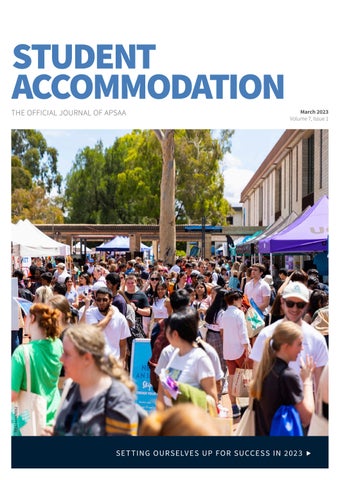
38 23 FEATURES New starters in the industry 14 Students are not a homogenous group, so why do we continue to build accommodation in this way? 20 The emergence of Student Accommodation in 2023 23 University of Canberra introduces no-alcohol rooms — proving a hit with students 28 Where do you live? Incorporating Traditional Place names as part of everyday business 30 Global Housing Training Institute returns in 2023 32 APSAA Bootcamp is new in 2023 35 APSAA Collaborating with organisations globally to improve student accommodation 37 2023: New year, new students, new student leaders pictorial 38 NEWS President’s Welcome 4 From the Editor 5 Industry Movements 5 APSAA Aotearoa Update 6 APSAA Asia Update 8 Professional Development Committee Update 12 IAC Committee Update 13 Cover: University of Canberra O week market day, 2023
Marion Bayley APSAA President; CEO, Deakin Residential Services


President’s Welcome
Welcome to the March 2023 edition of Student Accommodation
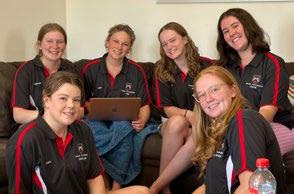



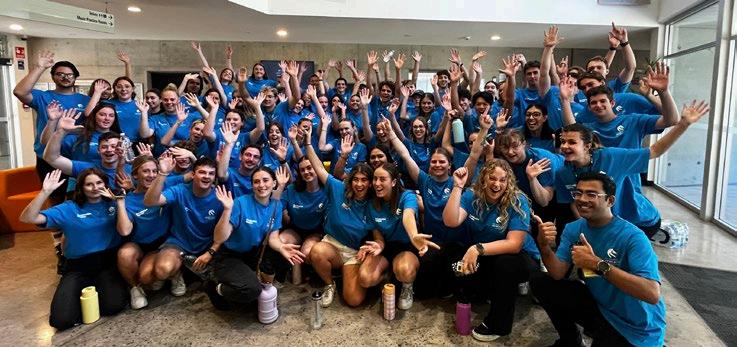
It is without doubt my favourite time of year seeing the connections made, the nervous joy on the faces of so many residents and knowing this is the start of a chapter for all of them, a journey that wouldn’t be the same without the professionals that give tirelessly within our industry in order to see residents succeed. The images from our member institutions and organisations are a testament to this and I hope you can take some time post check in and orientation to reflect on the impacts you are already making in young people’s lives.
As our industry responds to the media attention around the accommodation crisis in Australia and statisticians like Bernard Salt (previous APSAA Keynote speaker) are predicting that in 10 years the biggest generation will be those that are school leaver age (overtaking millennials) there is certainly a push for more investment and in several cities more provision of student accommodation beds.
The generation that are currently checking in and orientating at our various institutions and organisations have a key focus on personal safety and convenience but also a sense of engagement and connectivity. They research what they want before they make a decision and are not afraid to challenge unsustainable and disposable practices or products, which gives us all something to think about in our strategic direction and decision making.
This edition explores and demonstrates the many reasons and drivers behind why so many of you are passionate about our industry, whether it’s the commercial outcomes or the student experience and successes, there is something for all of you so a heartfelt congratulations to Simone and the Communications and Engagement team once again for producing our journal.
Best wishes, Marion

NEWS 4 www.apsaa.org.au
Mascot at Newcastle University
Moving into UniLodge Tupuānuku @UC
Move in day at St John’s College
St. Catherine’s College move-in 2023
House Coordinators at Aquinas
New year, new students – more photos on page 38
Simone Gallo APSAA Board Member, National Manager, Student Accommodation, Australian Catholic University
From the Editor
Through this edition, themed “Setting ourselves up for success”, we welcome people new to student accommodation and hear about what drew them to our industry. Our first edition of Volume 7 for 2023 is packed full of interesting new initiatives and stories from counterparts in Australia, the UK, New Zealand, and Asia.
Having a better understanding of these issues can assist you to know what might be around the corner for your business. To be forewarned is to be forearmed. We also share interesting research from the new Student Accommodation Council of the Property Council of Australia which was published late last year.
With this edition of Student Accommodation, we say goodbye to Jacob Waitere as editor. During his tenure he has championed
INDUSTRY MOVEMENTS
important issues such as the role of indigenous people, sustainability, and the management of COVID-19 within our industry. On behalf of the new committee, we want to take this moment to thank him. We are committed to continuing his good work and using the Journal as a medium to engage, champion, celebrate and challenge the industry to better outcomes for our residential students and the communities we exist within.
We aim to keep it “tickety-boo” as he says…
The 2023 Communications and Engagement Committee is led by myself and Sam Johnstone of Deakin Residential Services. We are lucky to be joined by Rachel Overton of University of Canberra, Kate Stock of UniLodge, and Jess Rokobaro of University of Newcastle. With new committee member Alice Draffin of St John’s College joining this year.
If you would like to be a contributing writer or would like to hear more about a particular aspect of the industry, please let us know by emailing manager@apsaa.org.au.
Simone Gallo
Having a better understanding of these issues can assist you to know what might be around the corner for your business. To be forewarned is to be forearmed.
AUSTRALIA
Ormond College, University of Melbourne
• Areti Metuamate has been appointed Vice Master and College Dean.
St Andrew’s College, University of Sydney
• Rob Leach has been appointed Principal.
St John’s College, University of Queensland, Brisbane
• Nicholas Spinks has been appointed Dean of Admissions and Careers.
University of Newcastle
• Natalie Perfitt has joined Student Living as General Manager.

University of Tasmania
• Casey White has been appointed Director, Student Engagement.
AOTEAROA | NEW ZEALAND
Wintec | Te Pῡkenga
Accommodation Services
(Student Residence Trust Aotearoa)
• Shruti Loganathan appointed to Residential Services Manager.
Unilodge, Canterbury
• Sneha Sathish appointed Residential Life Coordinator.
NEWS Student Accommodation March 2023 5
Aotearoa Update
 Kia Ora koutou katoa,
Here we are in 2023, and already through the first quarter. As is typical for this time of year the quarter has just flown by, but not without some interesting turn of events.
Auckland flood response
Auckland anniversary weekend, usually marked with sunshine and holidays, this year had some devastating rain and flooding. This flooding affected a number of buildings at the University of Auckland, Auckland University of Technology and Massey University – Albany campus. From water damage, elevators out, communications needing to be repaired our colleagues in Auckland came together to support their colleagues. This included emergency communications to residents, changing RA training plans, and rethinking move in day. Our admiration goes to all those affected by the floods.
Strong return to campus

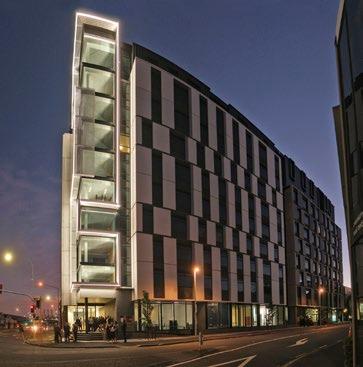
2023 has seen a strong bounce back in occupancy across Aotearoa. Move in days started in January and carried through to the end of February. Some centres have seen a strong return of International students, while in other areas Domestic enrolments have been strong. The University of Auckland opened their new 900 bed building, Carlaw Park – Stanley, which brings Carlaw Park Student Village to 1600 beds, the largest student accommodation residence in NZ. The University of Otago are also set to open a new building later this year as well.
NEWS 6 www.apsaa.org.au
Jacob Waitere Chair, Aotearoa Advisory Group; APSAA Vice-President; General Manager, Canterbury, UniLodge
Emeritus Professor Stuart McCutcheon (1955–2023)
Emeritus Professor Stuart McCutcheon, who died on 6 January aged 68, was a highly valued tertiary education leader in Aotearoa. Emeritus Professor McCutcheon was Vice-Chancellor of Waipapa Taumata Rau – University of Auckland from 2005 to 2020 and before that of Te Herenga Waka – Victoria University of Wellington from 2000 to 2004. Before becoming a Vice-Chancellor Emeritus Professor McCutcheon was a senior leader at Te

Kunenga ki Pūrehuroa – Massey University. While at the University of Auckland, Emeritus Professor McCutcheon endorsed and championed the development of large scale student accommodation projects, bringing online over 3000 new beds with a mixture of funding models, in addition to major capital works in academic areas. “Stuart was a smart, intelligent man who was a champion for outstanding student experiences.”

Code of Practice for Pastoral Care review
Campus’ around New Zealand would have found out the dates for their site visits for the review. We acknowledge that this will be a busy time for our colleagues as they consolidate their information. We wish all of our colleagues the very best and know that they have been working hard towards this for the last two plus years.
The year ahead
2023 is shaping up to be an exciting year for student accommodation. With a national election coming in October, new buildings coming online, and student growth looking positive there is a lot happening. We also would like to wish the University of Canterbury all the best for their 150th Anniversary celebrations. We also cannot wait to see you all at our annual Conference in Brisbane and our Annual Summit in Tw Whanganui-a-Tara | Wellington.
Kia Kaha, Kia Maia, Kia Manawanui, Jacob Waitere | Vice-President.
NEWS Student Accommodation March 2023 7
SPA A A AOTEAROASUMMIT WELLINGTON20 2 3 APSAA Aotearoa Summit 27 November 2023 | Te Whanganui-a-Tara
Wellington
“Stuart was a smart, intelligent man who was a champion for outstanding student experiences.”
|
Lee

APSAA Asia Update
It’s been almost 3 and a half years since I wrote about an overview of the Malaysian student accommodation industry, and an update for 2023 is most certainly due, especially coming out of the COVID-19 pandemic. We will begin with an introduction about the country, followed by a brief description of the main types of higher education institutions, and lastly an overview of student accommodation in Malaysia.
About Malaysia
Malaysia is the 3rd most prosperous country in the Southeast Asian region, after Singapore and Brunei. The largest city is Kuala Lumpur and the nation’s capital is Putrajaya. Geographically, it consists of two regions – West/Peninsular Malaysia and East Malaysia. Both are separated by the South China Sea and are bordered by Singapore,

Brunei, Indonesia, and Thailand. Malaysia has a strategic location along the Malacca Straits and the South China Sea. Malaysia has a multicultural, multi-ethnic, and multilingual population of 33.5 million people with 3 key ethnicities – Malay, Chinese and Indian peoples. Malaysia's official religion is Islam with about 60% of the population who are Muslim while 20% are Buddhist.

NEWS 8 www.apsaa.org.au
Daniel
APSAA Board Member; Director, The Purple House, Malaysia
A S I A N REGI O N A S IAN REG I O N
Kuala Lumpur City
Higher Education
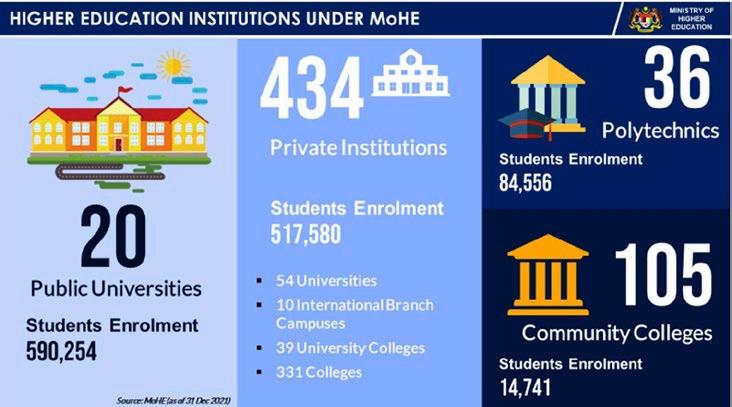
There are more than 1,100,000 students enrolled in Malaysia’s higher education institutions. About 600,000 are studying at public institutions, while about 500,000 are studying at private institutions. Over 170,000 international students are studying in Malaysia from 162 countries, including nearly 30,000 from mainland China, 10,000 from Indonesia, and about 7,000 from Bangladesh. The government aims to attract 250,000 international students by 2025. A significant portion
of international students are from Muslim countries, and many of them are enrolled in private higher education institutions.
The Malaysian higher education scene is broadly split into 4 main categories – public universities, private universities, university colleges and foreign branch campuses. Although public universities are spread across all 13 states, most private higher education institutions (including foreign branch campuses) are based in the west coast of Malaysia, mainly in the states of Kuala Lumpur, Selangor, Penang, Perak and Johor.
The Malaysian higher education scene is broadly split into 4 main categories – public universities, private universities, university colleges and foreign branch campuses. Although public universities are spread across all 13 states, most private higher education institutions (including foreign branch campuses) are based in the west coast of Malaysia, mainly in the states of Kuala Lumpur, Selangor, Penang, Perak and Johor.

Public Universities
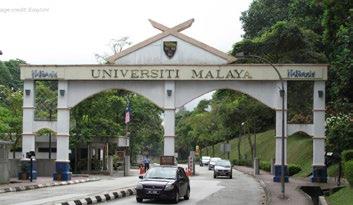
Public institutions are governmentfunded higher education institutions under the jurisdiction of the Malaysian Ministry of Higher Education. Public universities offer undergraduate and postgraduate programmes, pre-university foundation year and diploma courses. There are currently 20 such institutions.
Private Universities
As the name suggests, private universities are not government owned or managed but are privately owned institutions. They offer programmes at every level of study, and their courses are comparable to their public counterparts. Being fairly large institutions, these universities not only have bigger campuses and student facilities compared to smaller private institutions, but they also conduct extensive postgraduate research programmes and award degrees in their own names.
…continued next page
NEWS Student Accommodation March 2023 9
Sunway University
Source: Department of Statistics Malaysia
Universiti Malaya
APSAA Asia Update continued
Continued
Overview of Student Accommodation in Malaysia
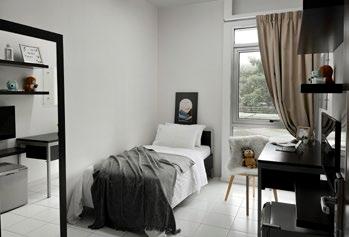

In general, the Malaysian student accommodation industry is in its infancy stage, and there is a genuine need to uplift the standards of student accommodation due to the large number of higher education students. The overwhelming majority of student accommodation providers are either higher education institutions or mom-andpop investors. There are a handful of private student accommodation operators, such as The Purple House, who are based in the urban areas of the state of Selangor.
University Colleges
Compared to private universities, university colleges usually have smaller campuses and lower student numbers. While private university colleges do offer programmes at all levels, they usually have fewer faculties and a stronger focus on undergraduate programmes than postgraduate ones. These institutions tend to partner with foreign and more established universities, creating a scenario whereby students have the flexibility to spend their academic terms either fully in Malaysia or spend a year abroad at the partner university’s home campus overseas.
International Branch Campuses

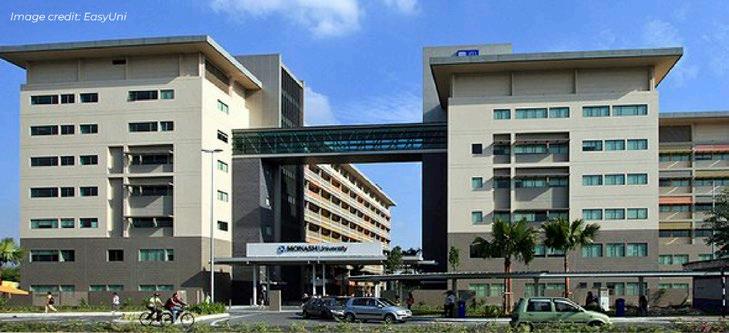
There are currently 10 foreign universities from Australia, the United Kingdom, Ireland, and China that have set up their branch campuses in Malaysia. These universities offer programmes identical in structure and content to those at their home campuses. There are four established Australian branch campuses in Malaysia –Monash University, Curtin University, Swinburne University of Technology, and University of Wollongong.
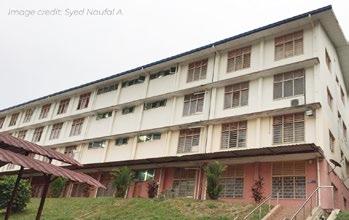
The most common type of on-campus student accommodation at public universities is 4-5 storey walk-up blocks of flats, with four to eight students per room. Some larger private institutions do provide purposebuilt student accommodation (PBSA) with single or twin rooms. The majority of off-campus accommodation for both public and private universities includes houses, condominiums or apartment units, and even small commercial buildings.
NEWS 10 www.apsaa.org.au
from previous page
INTI University College
Waterfront Residence
Monash University Malaysia
Malaysian student accommodation is usually sensitive to local cultural and religious customs. For example, gender segregation is quite common, and alcohol consumption is also prohibited at on-campus student accommodation around the country. Student residences where food catering is provided generally serve foods that are either halal or at least do not contain any pork or alcohol.
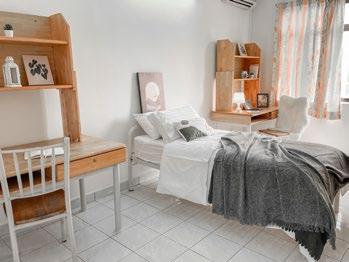
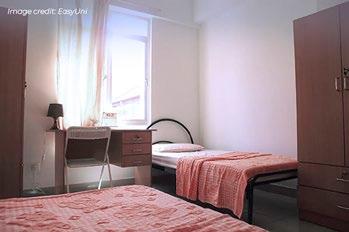
Some of the key challenges facing the Malaysian student accommodation industry include a lack of industry standards – which of course has a significant impact on the quality of student accommodation and the level of resident support. In addition, most higher education institutions are more focused on providing support for the general student population of their respective institutions, with many accommodation departments not being able to provide an adequate level of support for their residents.
Public universities are facing funding cuts, and with rising costs due to inflation, operating costs are expected to increase. While it is also true that private institutions are facing rising
Public universities are facing funding cuts, and with rising costs due to inflation, operating costs are expected to increase. While it is also true that private institutions are facing rising operating costs, funds for capital expenditures meant for new housing stock or even upgrades are now severely limited at public universities.
operating costs, funds for capital expenditures meant for new housing stock or even upgrades are now severely limited at public universities. Both public and private institutions are seeing a surge in demand for housing in early 2023 since students are eager to return to campus.
APSAA has a role to play in Malaysia and the Southeast Asian region. A strong APSAA presence will enable transfers of knowledge, best practices, and standards. This will in turn influence the local higher education institutions and private student accommodation providers to uplift living standards for all their student residents.
 Daniel Lee
NEWS Student Accommodation March 2023 11
Residential College, Universiti Malaya
Sun-U Residence
Sun-U Residence
Professional Development Committee Update

The Professional Development committee held its first meeting in January, to lock in the plan for 2023. As part of the Professional Development Program for 2023, we are excited to announce the launch of the new ‘Speaker Series’, to be held quarterly, live, and online.
Across 2023, the series will see subject matter experts deliver thought provoking presentations on the APSAA values: Inclusion, Excellence, Leadership, and Integrity.
In February to kick off the ‘Speaker Series’, our first presenter, was Multicultural Australia talking about Inclusion and Cultural Capability. Participants heard about identifying one’s own cultural lens; the reasons we need to move towards creating brave spaces; and going beyond
diversity to build inclusive teams, accountable workplaces, and culturally responsive service provision.
Watch out for the series that will continue in 2023: May – ‘Excellence’, August – ‘Leadership’ and in November – ‘Integrity’.
What a year it is shaping up to be. With thousands of international students returning to Australia, and coinciding with Sydney WorldPride, which will take place on the lands of the Gadigal, Cammeraygal, Bidjigal, Darug, Dharawal people who are the Traditional Custodians of the Sydney Basin, from 17 February to 5 March, there is no better time for our members to have inclusion and cultural capability forefront of mind. What a great time to be landing in Australia from overseas!
As we return not only to BAU post COVID, we have also returned to what I like to call LAU (Life as Usual) meaning we can meet face to face. Supplementing the new quarterly ‘Speaker Series’ a Networking Event will be held in June 2023, across the various Australian States and in regions where our international partners are located. Stay tuned for more information.
In closing, if you have introduced something amazing into your student college, house, village, or residence, then please let us know via email at manager@apsaa.org.au so it can be shared with your colleagues via the quarterly APSAA journal. Sharing knowledge helps us all connect, perform better, and become stronger as professionals.
Sue Fergusson
APSAA 2023 Speaker Series

NEWS 12 www.apsaa.org.au
Sue Fergusson APSAA PD Committee Chair, QLD State Operations Manager, Scape
The new ‘Speaker Series’ is part of the APSAA Professional Development Program.
Held quarterly, live and online, the series will see subject matter experts deliver thought provoking presentations on the APSAA values: Inclusion, Excellence, Leadership, and Integrity.
Rachel Overton IAC Committee Co-Chair, Associate Director, University of Canberra

IAC Committee Update
On behalf of the Industry Advancement Committee
(IAC), we would like to provide a brief update on what we have been doing and planning for semester 1.
Discussions have been taking place with the IAC Committee Members to decide what our focus is for 2023 and how we can best represent you.
Kate Stock IAC Committee Co-Chair, UniLodge Australia, QLD

Our priority is to ensure that we are responding to any queries or questions you have, so a significant focus will be placed on using the discussion forum, which can be found at the members discussion forum. Scan the QR Code to check it out. Or on the website at: https://www.apsaa.org.au/resources/ members-discussion-forum/

Secondly, we need to hear what you want from us? There are lots of issues in the sector currently including GST changes, Residential Tenancies Act, influx of returning Chinese residents and lack of accommodation, recruitment challenges, mental ill health challenges etc. What is currently causing you challenges and how we can best help you. Is it the same throughout Australasia, or different by state and continent?

To enable us to do this we will be producing a short survey to capture the views of Universities, Colleges, Purpose Built Student Accommodation, and private providers to see if the issues are the same across the board. What are the common themes and are there significant differences in the specific industry providers? Based on the top three topics, we plan to do further research to explore the issues in more detail to identify causes and possible solutions.
We will also be using this as a location to post any useful articles we have read, in case you have not seen the links on social media.
To do this we need your input, so when the survey is ready, which is likely to be late March we encourage you to
take the time to fill this in. We cannot represent you in an appropriate way, if you do not tell us what your challenges are and what you would like from us.
We also plan to send the survey to our partner organisations, to see if we can obtain international feedback to see what if any are the common threads.
Maybe this is an area you are interested in being involved in. If so, we would welcome more members to the IAC so please email manager@apsaa.org.au
We know semester 1 is a busy and often stressful time, so we wish you the best of luck. Please take care of yourselves and take the time to breathe and gather your thoughts. Look out for colleagues around you and remember the little things that make all the difference like ‘thank you, great job, I really appreciate your input with this, ok that didn’t go so well – how can we make it better next time …’. Remember we are in this together and we need to support each other as best we can.
Best wishes from Rachel and Kate.
NEWS Student Accommodation March 2023 13
Are you looking for staff? The AAPSA Jobs Board is a service available if you have a position to fill. Institution and Corporate members can post Job Opportunities to this page, and access is open to all job seekers. https://www.apsaa.org.au/member-resources/job-opportunities/
Photo: ©gettyimages.com.au/Lim Weixiang - Zeitgeist Photos
JOBS BOARD
New starters in the industry
We’re always happy to warmly welcome new faces to the student accommodation industry. With a wide range of roles and the satisfaction of contributing to great student outcomes, it’s not surprising that our new colleagues have joined us from a broad array of industries and backgrounds, bringing transferrable skills, fresh outlooks and new ideas. APSAA welcomes all our new colleagues, and we thank those who have shared their stories in this edition.
Tell us a little about yourself?
Hi, I’m Jess! I’m a Marketing Manager at UniLodge Australia at the Head Office in Brisbane. Brisbane has always been my base; I grew up here and formed my career in this city over the past 6 years to date. I have experience across both in-house marketing and marketing agency management roles, with specific passion for digital marketing, content, data, and creative strategy. My professional background lies in the Real Estate and non-for-profit industries, with personal interests in psychology and people – my skills have prepared me for the evolving Student Accommodation sector.
Outside my day to day behind the desk, I try to lead a balanced lifestyle with the people and things I love most. Food, friends, sport and the outdoors are key for me – on a perfect day you’d most likely find me with friends at the beach with a treat in-hand!

What drew you to the student accommodation industry?
I am passionate about supporting the learning and personal growth journeys of our young people into adulthood, to become positive and active participants within their own lives and their communities, in Australia and across the world.
The community aspect within the Student Accommodation industry and too at UniLodge is key to me. The impact of people and relationships during a person’s typical tertiary student years can be underestimated, and I love that I can support the growth of this aspect of the industry through marketing. UniLodge is also the largest and leading manager of student accommodation in Australia and New Zealand, so by joining the company I knew I’d have great opportunities, lots to learn and that I would be in the right place to be at the forefront of the sector.
How long have you been employed within the industry now?
I have been in the Student Accommodation industry for just under a year and a half now. I work with our on-site property teams to manage the Marketing for our UniLodge and Student Living properties in Brisbane,
Cairns, Townsville, Darwin, and Canberra in Australia and in Auckland, Christchurch, and Wellington in New Zealand.
What has been the most surprising thing you have learned since being in your new role?
I have been surprised and impressed at how passionate and close the Student Accommodation community and industry is. Having the chance to go to various sector specific events has allowed me to network with people across many roles and really get a feel for how much impact the industry has across young people in Australia and in the world. I am eager to see how this dynamic sector continues to grow and expand.
What excites you the most about the industry or your role?
It is great to be part of such a fast paced and evolving industry and I am excited to continue to build on our marketing strategies at UniLodge in support of its future development. I also love that there is so much potential within marketing to connect and positively impact the journeys of domestic and international students through the offerings at our properties and through useful marketing content.
MANAGEMENT, OPERATIONS AND FINANCE 14 www.apsaa.org.au
Jessica Pretorius
Marketing Manager, UniLodge Australia, Brisbane
Tell us a little about yourself?
I grew up in Melbourne where I did my Bachelor of Business, majoring in Management and Human Resources. Once I completed my degree, I started working in the professional services industry in an internal Human Resources role. After 5 years of working in HR, and with a nudge from COVID, I started my Masters in Counselling and moved to Geelong.


Anna Josland
What drew you to the student accommodation industry?
I was working in a HR role when I started my masters during COVID, with the idea of a career change once I had completed my studies. Whilst studying I developed a real interest in working with young people and wanted to be in a hands-on role that allowed me to have a tangible impact on the community I was working with. I didn't know much about the industry at the time, but I saw the role of Campus Life Officer advertised at Deakin Residential Services and was really excited about the opportunity. How long have you been employed within the industry now? It's been one year and I have loved every minute of it, and still have lots to learn about student accommodation!
What has been the most surprising thing you have learned since being in your new role?
I was really surprised and impressed with the number of events and support that residents have access to, especially during orientation weeks when they're making such a big transition.
What excites you the most about the industry or your role?
I love that every day is completely different! One day we are running leadership training with our Residential Leaders, and the next we could be out surfing with the residents down at Ocean Grove for an event. It really is so amazing and exciting that I get to interact with such a diverse range of residents, and I have learnt so much from them and our incredible young leaders.
I am and avid tragic Richmond fan and get to as many games as I can through the year if we aren’t going to the farm.
What drew you to the student accommodation industry?
Tell us a little about yourself?
My name is Fred Burns and I am happily married with one amazing little boy. Since completing high school I have been involved in the building industry through domestic, commercial and civil and thoroughly enjoyed everything I have learned thus far. We live locally in Mitcham, and I am born and bred in Melbourne. I have travelled extensively over the years which has given me enormous life experience which I am grateful for. We have recently purchased a little farm in Bonnie Doon which keeps us very busy on weekends and holidays but I thoroughly enjoy our time there. Also,
Working with a commercial builder for 8 years, we completed numerous government and privately owned education facilities and always felt this could be a good place to ply my trade on a different level. I was part of the maintenance team for Wesley College for 5 years however I enjoy organising and co ordinating works so took on a new role as maintenance Coordinator for Deakin Residential Services.
How long have you been employed within the industry now?
Although we had student accommodation for our Indigenous community as Wesley College, I can say that I have
only been involved now in the student accommodation industry for 12 months.
What has been the most surprising thing you’ve learned since being in your new role?
I can definitely say that I cannot believe how busy it has been since arriving. Our whole team have gone through a lot of changes, and I feel we are now going in a positive direction. I found there has been an incredible amount of work to catch up on to bring our facility up to a level that our students should expect.
What excites you the most about the industry or your role?
That would probably be completing the major upgrades to our campus to have it at a standard our entire team can be proud of. Once the major projects are completed, I feel the role can become a little less stressful and be more automated.
MANAGEMENT, OPERATIONS AND FINANCE Student Accommodation March 2023 15
Campus Life Officer at Deakin Residential Services, Geelong
Fred Burns
Maintenance Coordinator, Deakin Residential Services, Burwood
New starters in the industry
Continued from previous page
Reece Attrill
That’s when I realised that I want to work in a space where I can have positive impact, not only in the world but in people’s lives.
Tell us a little about yourself?
Growing up in Te Awamutu, a small town in New Zealand, I started my career as a chef. I quickly realised my personality was too big to stay locked away in kitchen, so I continued my passion within the hospitality industry and started managing fine dining restaurants around the country. In 2019, I was ready for a change in my environment and career, so I decided to ‘jump the ditch’ in search of something bigger.
What drew you to the student accommodation industry?
After not feeling fulfilled in my previous career, I started to ponder what career pathways I could explore in areas that I am passionate about. It was time for introspection…’what are some of the things that I’m passionate about?’
• being environmentally friendly and making a change
• mental health, having not only had my own experiences, but also working as a volunteer in LGBTQI spaces in my late teens/early 20’s, this was another passion.
• education and diversity, both are super important to me.
Scrolling through seek.com late one night I came across a role of Operations Supervisor at Scape. Reading the job ad I knew Scape’s values aligned with my own. After the interview I knew this was the industry I wanted to work in, and this was the role I wanted. I had barely made it home when I got the call offering the position, and not only has it ticked all those boxes since, but it has become so much more.
How long have you been employed within the industry now?
I have now been in the industry just shy of a year. Starting as an Operation Supervisor at Scape South Bank and then being promoted into the Operation Manager’s role when that opportunity became available, six months later.

What has been the most surprising thing you have learned since being in your new role?
My role at Scape is to not only provide great student accommodation in a safe and caring environment, but also to really support young adults as they go through probably some of the most challenging but also exciting years of their life….more introspection ‘I get great personal satisfaction out of being able to support and mentor people’.
What excites you the most about the industry or your role?
I feel that I can have real impact on shaping the leaders of tomorrow – not only the students who live in the building, but also the team I manage. The opportunity to be able to mentor younger people from all walks of life is exciting. I am also really interested in ‘leadership’ and read articles and books on leadership regularly. I’m really looking forward to being part of the industry as it continues to evolve.
MANAGEMENT, OPERATIONS AND FINANCE 16 www.apsaa.org.au
Operations Manager, Scape South Bank, Queensland
My role at Scape is to not only provide great student accommodation in a safe and caring environment, but also to really support young adults as they go through probably some of the most challenging but also exciting years of their life….more introspection ‘I get great personal satisfaction out of being able to support and mentor people’.
Tell us a little about yourself?
My name is Monique and I am based in Canberra full time. I have worked in the higher education industry for a few years now and I have a passion for helping students succeed in their studies and beyond. I graduated from the University of Canberra with a Bachelor of Human Nutrition with a major in Counselling and I am now studying an MBA. I aim to promote the importance of a healthy diet and frequent exercise on positive wellbeing, especially to students who are under high amounts of stress. Outside of work and study, I love swimming, playing basketball and watching Netflix with my three adorable ragdoll cats.

Monique Watts
Accommodation Coordinator, Australian Catholic University, Canberra
What drew you to the student accommodation industry?
During my undergraduate degree, I lived in student accommodation and gained a first-hand perspective on the impact the student accommodation experience has on residents. As mentioned earlier, I have a passion for helping students through their journey, whether this be directing them to counselling services or telling them where the best coffee hang outs are. The industry also gives me the opportunity to utilise my undergraduate degree through promoting healthy eating and exercise, on top of utilising the skills I am learning in the MBA. I also love a challenge!
How long have you been employed within the industry now?
Just over a month now – this time has flown by! I am loving each and every minute.
What has been the most surprising thing you have learned since being in your new role?
Expect the unexpected! Each day I can never predict what is going to pop up, my organisation skills have really come in handy.
What excites you the most about the industry or your role?
I am working in brand new student accommodation at the ACU Canberra campus, so I am super excited to be able to build a strong sense of community with the incoming cohort. Sitting at the front reception desk gives me the opportunity to see the students every day and check in if something isn’t right. Being able to see the students grow and develop lifelong friendships throughout their time here will also be extremely rewarding.
Tell us a little about yourself?
My name is Qistina, 27 years old and I work as a graphic designer. My passion lies in designing public communications through engaging visuals that satisfy the user’s experience. Previously, I’ve worked within the publishing industry as well as the e-commerce industry, which over the years has made me more passionate to further explore more communication-based projects that involve both designing and developing information through various media.

What drew you to the student accommodation industry?
As a designer, I took it as an opportunity to be exposed to different types of consumers by making observations and studying their behaviors, interests, and needs. Through this, I can challenge myself to produce a more visually effective system-based approach.
How long have you been employed within the industry now?
It's been a year since I’ve been employed in this industry.
What has been the most surprising thing you’ve learned since being in your new role? Effective engagement. It is very rewarding to know that your design entices people and that the message is well delivered. I’ve become more appreciative of my abilities,
and every successful result is a step for me to improve myself more on how I can further sharpen my communication competence with the targeted audience visually.
What excites you the most about the industry or your role?
To be able to build a sense of community within the student’s accommodation through design. One of the big projects that I did last year, was to design a wayfinding system for one of our clients. The whole creative process excites me as I am given the opportunity to give each residence its own personality. From multiple brainstorming, ideations, sketches and mockups, it is very satisfying to see the actual artwork come to life. With this, I hope that my wayfinding design reaches the audience in a way that not only it is eye-catching but also helpful, easy and effective for their use.
MANAGEMENT, OPERATIONS AND FINANCE Student Accommodation March 2023 17
Qistina Hisham
Graphic Designer at The Purple House, Selangor, Malaysia
New starters in the industry
Continued from previous page
Bré Ramsay-Orr
What drew you to the student accommodation industry?
Tell us a little about yourself?
I am delighted to have been appointed to this position at Emmanuel College, UQ. As a registered professional career development practitioner – specialising in employability capabilities and skillsets, I believe I am in exactly the right place, space and time to add meaningful value to students’ college experience.

My core ethos is to empower students to enhance their employability. I was drawn to the student accommodation industry, as I believe a residential college is a perfect environment to support empowerment through career development, ensuring students have the resources for achieving lifelong skills, successful post-secondary pathways and post-tertiary transitions.
How long have you been employed within the industry now?
I have been employed across the tertiary and secondary education sector for over 10 years, working indirectly with student accommodation throughout. Having this insight, I can comfortably say I am very happy to be now working directly in the industry.
What has been the most surprising thing you’ve learned since being in your new role?
The experience of what goes on behind the scenes in preparation for O Week. There is such fine-grained care and enormous heart brought by every person that contributes. There also seems to be an unspoken but unified understanding that all the preparation and careful consideration in itself is rewarding because it is going to make a student’s first day of college life or first day back home a positive and lasting memory.
What excites you the most about the industry or your role?
I am motivated by the opportunity to contribute to learning initiatives and innovative strategies that support Emmanuel’s contemporary services, meeting the community’s everchanging needs and adding value to the overall student experience.
Before Emmanuel, my relevant professional experience includes my role as Director of Student Futures at Canterbury College, a large multicultural and diverse secondary school and over 5 years in leadership positions at the Queensland Tertiary Admissions Centre (QTAC). I have undertaken postgraduate studies in career development, education, strategic leadership and learning design. I am also passionate about enabling opportunities for experiential learning platforms and communities of practice.
MANAGEMENT, OPERATIONS AND FINANCE 18 www.apsaa.org.au
Dean of Admissions & Career Development, Emmanuel College, The University of Queensland
My core ethos is to empower students to enhance their employability. I was drawn to the student accommodation industry, as I believe a residential college is a perfect environment to support empowerment through career development, ensuring students have the resources for achieving lifelong skills, successful post-secondary pathways and post-tertiary transitions.
I can comfortably say I am very happy to be now working directly in the industry.
Tell us a little about yourself?
I’m relatively (completely) new to the Student Accommodation industry after having spent 30 years in the Disability field in a variety of roles but predominately managing shared supported accommodation and respite facilities in both the Victorian Government and private sector. In my spare time I like to watch most sports but especially enjoy supporting the Geelong Cats in the AFL.
Adrian Carr
Accommodation Coordinator, Sport, Wellbeing and Residential Life Directorate, Australian Catholic University, Ballarat
I have two teenage girls that have taught me much, most especially patience.
What drew you to the student accommodation industry?

I knew very little about the Student Accommodation industry before researching for my current role with ACU. I was more attracted to the workplace via the recommendations of friends who work here. The recommendations were warranted and I have been enjoying my time immensely.
How long have you been employed within the industry now?

Almost 4 months.
What has been the most surprising thing you have learned since being in your new role?
The amount of work that occurs during Dec/Jan particularly in the Managed Residence space. I was hoping to have a teacher like holiday schedule.
What excites you the most about the industry or your role?
I am especially looking forward to having an impact on a student’s University experience and ensuring it is a time they look back on with positive memories.
MANAGEMENT, OPERATIONS AND FINANCE Student Accommodation March 2023 19
Students are not a homogenous group, so why do we continue to build accommodation in this way?

In the UK, time and time again, regardless of the conference agenda on offer, the presentation you choose to watch, or even the most recent Higher Education news article, the subject matter will likely be focused on the typical, so called average
undergraduate or postgraduate student. The student we’re all familiar with. The one who transitions from home for the first or perhaps second time and who brings with them a unique level of enthusiasm and energy to their new place of study.
20 www.apsaa.org.au
FACILITIES AND DEVELOPMENT
The undergraduate is viewed as wishing to make friends with ease while the slightly more mature, postgraduate student, is often deemed as more studious as they hunker down and work towards achieving an MA or PhD. Both housing requirements will of course slightly differ, but when we discuss students, we generally lump UGs and PGs together and assume they’re all single and ready to mingle.
The UK student accommodation market has responded well to the growing number of UG and PG students by building vast amounts of cluster flats suitable for students of similar ages to live in. However, bubbling beneath the surface is an entirely undocumented and growing concern. Students with families. It’s rarely discussed amongst the UK sector and often viewed as a problem for someone else (usually a university) to respond to and resolve.
As UK universities continue to focus on international recruitment, many students are now arriving in to the UK ready to engage in mainly taught postgraduate programmes of study. To understand the vast growth, recent international student migration statistics reveal a significant increase in the approval of student visas for Nigerian students. Rising from 5,914 in the third quarter of 2020 to 56,661 before the start of the 22/23 academic year (Wonkhe, 2022), a small cohort of these students are arriving with partners and children in tow and in some cases are pregnant or in the final trimester of pregnancy.
At present, purpose built student accommodation (PBSA), particularly in the private sector, does not cater for these students. If we’re honest, it’s not viewed as a profitable way to run student accommodation. Family accommodation is usually heavily subsidised by universities in a bid to make it an affordable option for all and when it comes to balancing the books, it rarely does. The range and amount available to students from UK universities varies from city to city with some failing to offer any at all. Others do their best to provide as much as they can. At the University of Leeds, in partnership with student housing charity Unipol, the provision of family accommodation is one of the largest in the country, but with long waiting lists and high demand, many students are unsuccessful in their attempt to access it.
Stories of students and their families taking their chances and arriving to the UK without accommodation are rife and a quick search online provides you with countless tales from those more experienced who, describing the situation as tedious, opted to live in expensive Airbnb’s for weeks while they scoured well known online agencies. While universities and students’ unions are doing their best to inform enquiring students in advance about the lack of availability, it appears that many are not deterred and are willing to try their luck even if that means living miles away from campus until something better is on the horizon.

Throw into the mix the lack of accommodation available for students generally in some cities (Manchester, Glasgow, Liverpool etc), the requirement for nursery or school spaces and suitable university facilities to support a potential influx of children and it appears that for some UK universities, there is a worrying simmering pot due to boil over any day now. A real infrastructure problem if you will.
How can the higher education and student accommodation sector do better? In the first instance, there are numerous calls for universities to have an improved understanding on whether there is physical space available for students to live in. If many are determined to increase their international student numbers, then evidence should be presented which clearly outlines the ease at which a student and their dependants can find a home and within commutable distance too. On the surface, this appears to be the most basic of requests from a university. One could assume this is always considered when universities are setting ambitious recruitment targets. However, colleagues may be surprised to learn that more often than not, departments are working in silo, making assumptions that accommodation is bountiful and not a problem anyone ever needs to worry about.
Student Accommodation March 2023 21 FACILITIES AND DEVELOPMENT
If the COVID pandemic taught the Higher Education sector anything, it’s that when push comes to shove, we can overcome an abundance of red tape and implement new policies and project outcomes quicker than previously thought. It forced us to be more creative in our thinking and find a solution to even the most complex of problems.
…continued next page
Continued from previous page
Surely there’s another way? If the COVID pandemic taught the Higher Education sector anything, it’s that when push comes to shove, we can overcome an abundance of red tape and implement new policies and project outcomes quicker than previously thought. It forced us to be more creative in our thinking and find a solution to even the most complex of problems. The private PBSA sector often has the ability to access capital quicker than its university counterparts and can commence and complete projects more swiftly than any university committee I’ve ever seen.
As a result, I fail to believe that there isn’t the scope or opportunity for an eagle-eyed and brave operator to provide a competitive family accommodation solution. One that financially benefits both student, their dependants and the operator. Private operators continuously advertise themselves as the university partner of choice, one which understands and responds professionally to the complexities of the student experience. Yet when it comes to supporting more complex versions of the “average student” (care experience, estranged, homeless, disabled, family requirements, etc.), more often than not it falls to a university to support and ultimately, resolve.
As student demographic trends shifts, we’re forced (and rightly so) to apply an intersectionality lens to our thinking. The time is now to start thinking up more
About the author: Rebecca O’Hare

Rebecca O’Hare is Assistant Director (Residence Life & Accommodation Office) at the University of Leeds, UK and recently completed an MA in Student Affairs in Higher Education where her research ‘Working in purpose built student accommodation: An Exploration into the Induction and Training Practices of Accommodation Managers & Deputy Accommodation Managers’ was awarded a distinction. She co-founded and co-hosts
Social Media Links
equitable family accommodation solutions if we wish to avoid a potential and looming crisis. Should local or national governments implement policies which require all PBSA operators to allocate an agreed percentage of their portfolio to families? Will we see the emergence of service level agreements between universities and private operators which ensure availability in private PBSA too? Who knows? The market is shifting, things are noticeably different now. The question is, who will be brave enough to take the first step and test the waters?
Rebecca O’Hare
References
Dickinson, Jim; Wonkhe (2022) – What is behind the remarkable rise in students coming from Nigeria to study [accessed online] – https://wonkhe. com/blogs/what-is-behind-the-remarkable-risein-students-coming-from-nigeria-to-study/
the Student Affairs podcast ‘Free Food, Free Drinks’ and previously, worked for global PBSA operator Campus Living Villages as their Head of Residence Life. Rebecca was previously the chair of the ACUHO-I Global Initiatives Network, a former member of the ASRA committee and was awarded the CUBO Residence Life professional award in 2019, the Class of 2020 Best Initiative award for wellbeing in 2019 and the BYTA Rising Star award in 2018
Twitter: https://twitter.com/Rebecca_ResLife
LinkedIn: https://www.linkedin.com/in/rebecca-o-hare/
Podcast: https://anchor.fm/freefoodfreedrinks
22 www.apsaa.org.au
FACILITIES AND DEVELOPMENT
Students are not a homogenous group, so why do we continue to build accommodation in this way?
As student demographic trends shifts, we’re forced (and rightly so) to apply an intersectionality lens to our thinking.
Johnsson
Executive
The emergence of Student Accommodation in 2023

For us working in the Student Accommodation industry, it has long been known as a vibrant, dynamic, and unique sector that underpins education, one of Australia’s most valuable export markets. In these times of extremely low vacancy rates in the overall rental market, it is also emerging as an increasingly important asset class to curtail cost of living.

An estimated 90% of students stay in accommodation that is not purpose built for the experience, sometimes under poor conditions. There is a need for more quality accommodation with appropriate frameworks to support the students and take pressure off the overall real estate rental market.
Further, as the population of Australia is ageing, the sector can support a targeted migration policy to attract bright, educated, and productive future citizens to improve Australia’s overall competitiveness.
All of this has been known to us, but unfortunately not widely understood. There has been a particular knowledge gap among government agencies which has curtailed the growth of the sector due to policy settings. At the most
basic level, the differences between our sector and other types of accommodation is simply not understood by decision makers which leads to counterproductive policy making. For those of you that have to respond to changes in RTA legislation in different states you can see those obvious flaws, as do investors when they make decisions around taxation prior to deciding where to develop their next building.
…continued next page
MANAGEMENT, OPERATIONS AND FINANCE
Tomas
Chief
Officer, UniLodge Australia.
Student Accommodation March 2023 23
Photo: ©gettyimages.com.au/Anchiy
The emergence of Student Accommodation in 2023
APSAA has long been active in the pursuit of supporting the sector, as has organisations such as SAA and IEAA, and recently the Property Council has formed a Student Accommodation Council to add further weight to the argument. With a strong membership group from all major owners and operators in Australia, the appointment of Torie Brown as Executive Director and chaired by Anouk Darling, the council draws from the Property Council’s national representation of property owners, developers and investors to help elevate the standing of our sector.
As part of the strategy to educate stakeholders outside the sector, the Student Accommodation Council commissioned a report to draw attention to the attributes of this asset class. The report is further calling for a coordinated approach across all levels of government to encourage investment, streamline development process and to attract and support students.
The report clearly defines the difference between purpose-built student accommodation and other types such as private rentals and homestays and lists the
service attributes of the sector with examples of student experiences. It also provides some industry data that in combination presents a compelling argument for support of the sector.
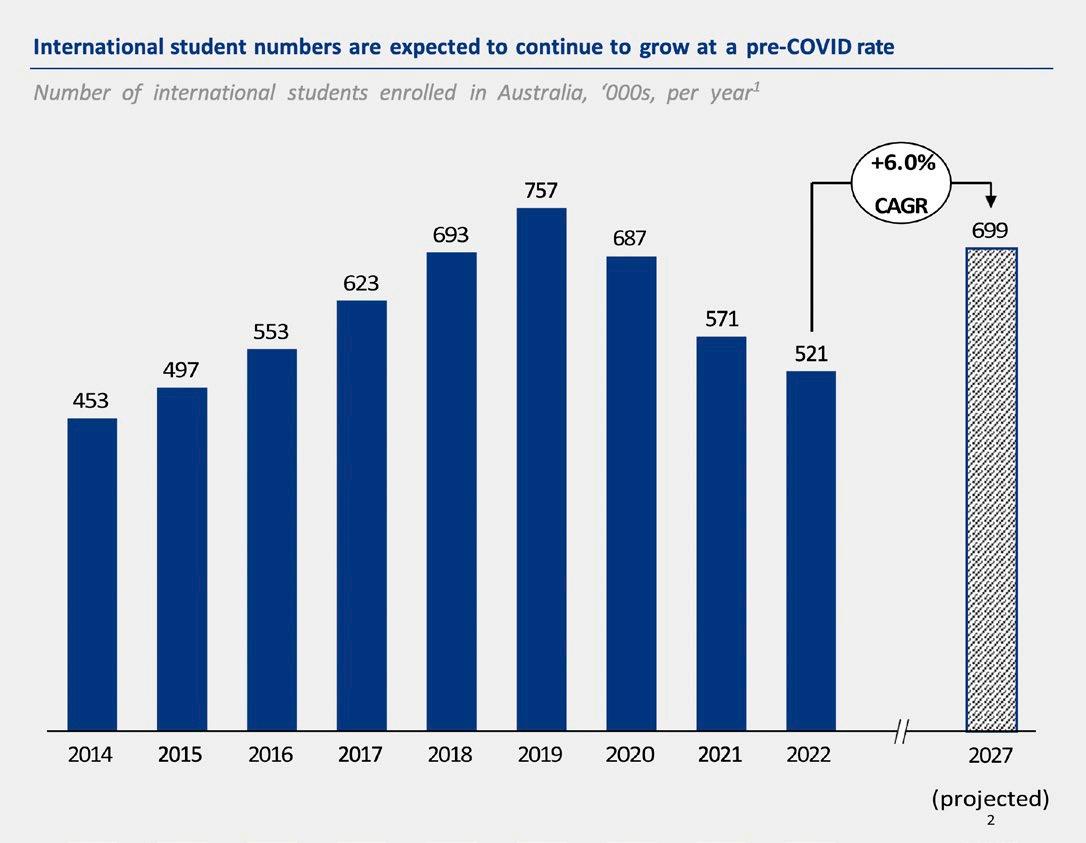
As the borders have opened up after a few years of interruption, the strength of the Australian Universities and the attraction of a fantastic lifestyle will again draw international students in large numbers to our shores.
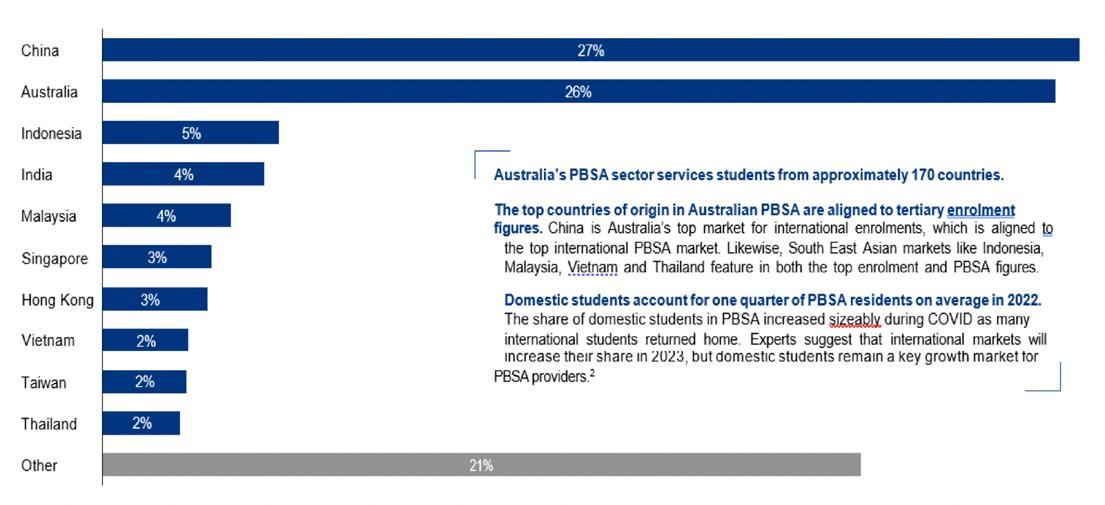
There is a wide spread of nationalities studying in Australia, but with a historically strong dominance by the Chinese market.
24 www.apsaa.org.au
MANAGEMENT, OPERATIONS AND FINANCE Continued from previous page
India is rapidly emerging as the middle class seeking quality accommodation. Australians still represent a large proportion which has been on the rise in recent years.
International students study the most in-demand degrees, with 16% staying after their studies, alleviating workforce shortages. Never before has the absence of international students been more obvious than over the COVID period, when the financial impact on businesses was felt as their spending ceased, as well as the lack of work force that had been previously
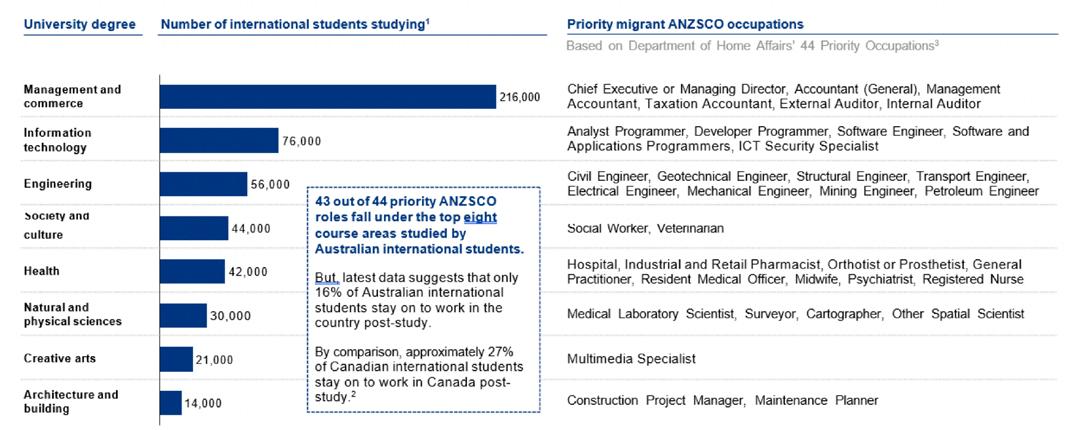
performed by students. Over the longer term, a higher proportion of educated migrants presents a great opportunity for Australia in pursuit of being ‘the clever country’.
PBSA accommodation provides vital housing supply for Australia’s cities and is essential in providing international students a smooth return to on-campus learning.
This additional housing supply allows international enrolments to continue growing without exacerbating existing rental shortages in the private housing market.
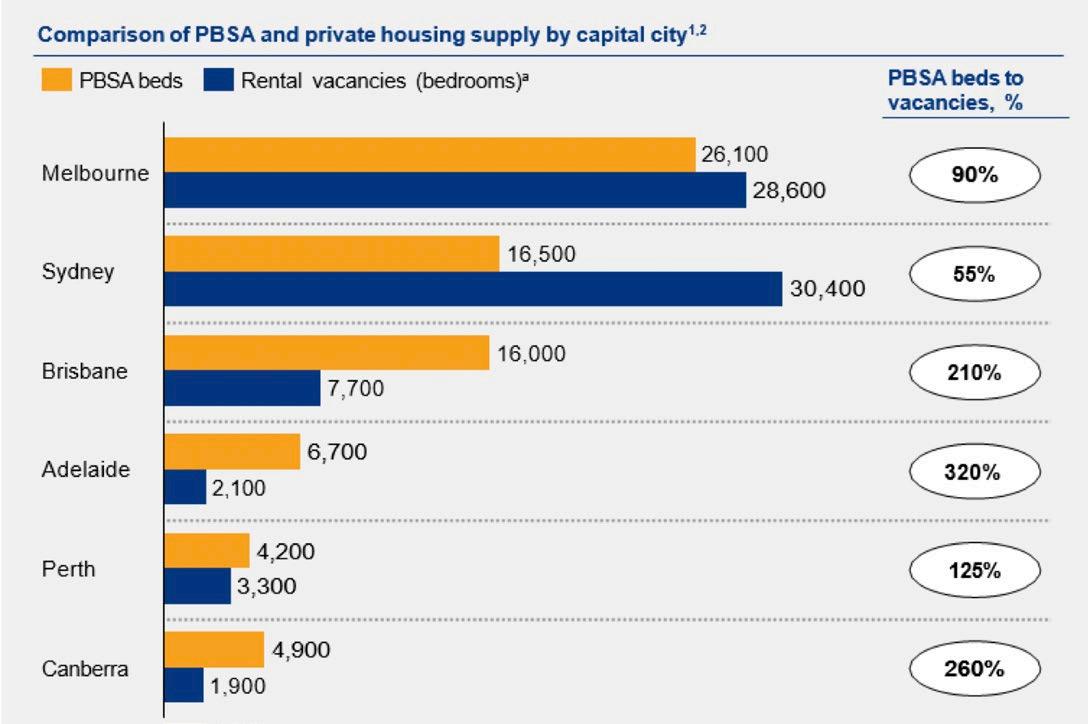
The effects are particularly evident in Canberra, Brisbane, and Adelaide, where the number of PBSA beds outnumbers estimated rental room vacancies by a factor of 2 or more.
In Sydney and Melbourne, PBSA bolsters rental supply by providing additional housing options which equates to around half of room vacancies in Sydney and 90% in Melbourne. Without PBSA, there could be significantly fewer vacancies in the private rental market. Shortages of student accommodation in other markets are a significant barrier for students, creating fear and uncertainty.
…continued next page
Student Accommodation March 2023 25 MANAGEMENT, OPERATIONS AND FINANCE
The emergence of Student Accommodation in 2023
Continued from previous page
Student accommodation shortages in the Netherlands, Ireland, and Canada are creating a housing crunch. For example, some Dutch universities have recently warned international students not to come to the country unless they have secured housing before arriving. Australia is tight overall, but we still have availability in Melbourne, for example.
“Once here, International students are the life-blood of our cities – they live shop, study, relax and play in CBD’s across the nation. Some travel across the world to study in Australia, others from one suburb over, but the impact they have on our education sector and capital cities is the same” Torie Brown, Executive Director – Student Accommodation Council.
The benefits of having a lively student cohort in our cities are numerous, they are;
• Adding vibrancy to our cities
• Activating spaces
• Supporting local businesses
• Creating cultural experiences
• Easing private rental shortages
• Alleviating workforce shortages
In supporting local businesses, PBSA residents spend almost as much each month as the average Australian resident, stimulating the local economy.
Australia now has a fantastic opportunity to capitalize on this demand, and
turbo charge the sector over the next decade, aligned with the objectives of the education sector. It does, however, require a coordinated approach. Some recommendations that will help stimulate the sector are;
1. Encourage foreign and domestic investment into the sector through harmonized tax policies and unified classification of PBSA.
2. Ensure that zoning and development approvals are transparent, accessible and prompt.
3. Identify PBSA as a unique asset class in zoning and RTA legislation.
26 www.apsaa.org.au
MANAGEMENT, OPERATIONS AND FINANCE
4. Strengthen pathways to employment and support returning students through after work visa and residency pathways.
5. Promote face-to-face contact hours and invest in support which positively influences students’ mental health.
6. Increase skilled migration caps to catch up with competing destinations such as Canada.
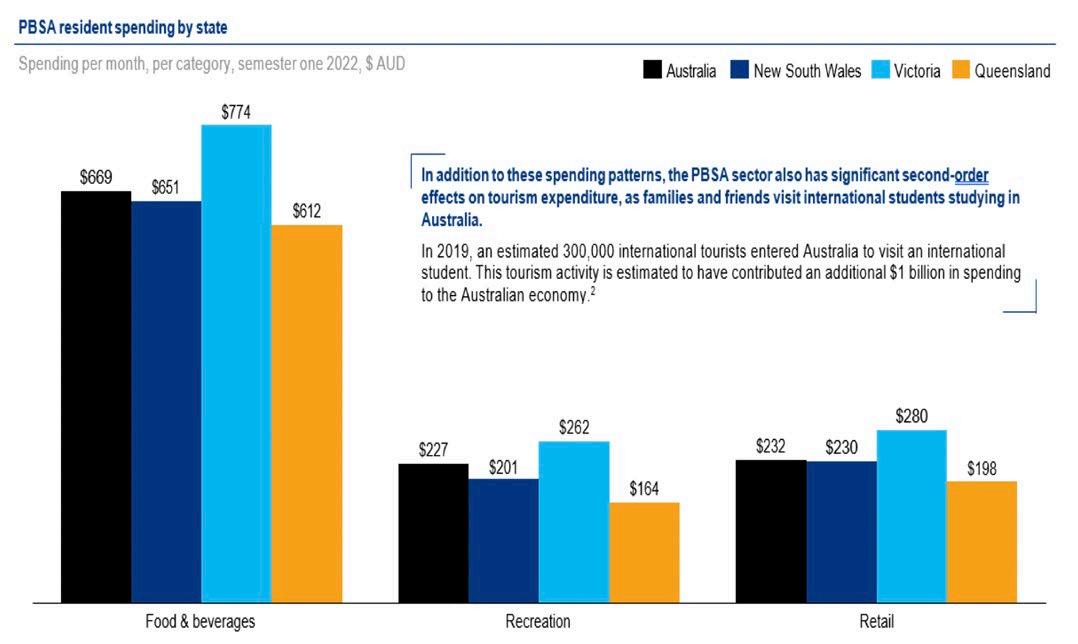
These initiatives require all levels of government to embrace, understand and promote the sector to firmly embed broader social, educational and economic objectives in policy settings.
As an industry, we can all promote our fantastic sector and engage with the various organisations such as APSAA and the Student Accommodation Council to further elevate Student Accommodation.
All indicators are for a bright future ahead, it is up to us all to make it so.
Tomas Johnsson
About the author: Tomas Johnsson
Tomas Johnsson joined UniLodge in 2018 as the CEO. He has 25 years’ experience in senior management roles in the tourism industry specialising in accommodation. Tomas is a past Board member of APSAA, a past Expert Member of the Council for International Education, and a member of the Property Council of Australia.

In 2022, bed numbers in PBSA developments are now more than double what they were in 2012, an annualised growth rate of 7.7%.
This means that a greater number of students now have the opportunity to live in close proximity to tertiary institutions and inner-city areas, providing a supportive, convenient,
and comfortable landing point for students moving from regional areas, another state, or another country.
PBSA as an asset class is set to experience further growth as total bed numbers edge closer to 100,000 by 2025, based on projects currently in planning or development stages.
Student Accommodation March 2023 27
MANAGEMENT, OPERATIONS AND FINANCE
University of Canberra introduces no-alcohol rooms — proving a hit with students

The University of Canberra values its residents’ feedback and where possible, tries to adapt student accommodation offerings to meet their needs. One new initiative for 2023 has proved even more popular with students than originally anticipated.

Rachel Overton, Associate Director of Student Accommodation at the University, had been investigating the possibility of implementing opt in “no-alcohol rooms” in the student residences for some time.
After extensive consultation, including with UniLodge, who manages accommodation at the University, it was agreed that no-alcohol rooms would go ahead in Semester One, 2023.
The response from students was overwhelmingly positive — with over 100 requests for placement on no-alcohol floors to date.
It is great that the University of Canberra is trialling no-alcohol floors as part of student accommodation on campus. Many young people chose not to drink due to health, reputational and other concerns, so it’s important that UC also provides for all to thrive during their studies.”
“Most residents choose accommodation based on facilities, cost and distance to campus. Not only as a place to study, but as a home away from home — where they will meet new friends and have fun,” Ms Overton said.
“We know that often, social activities include alcohol, so, it came as quite a surprise to us when some residents voiced a preference for no-alcohol rooms.”
“This was great to hear as it was something we had been discussing with stakeholders for some time, but we did not believe it would be this popular.”
Dr Jenny Weekes, Director of Medical and Counselling at the University, was an active stakeholder in the decision making. Jenny commented “The availability of non-alcohol accommodation areas supports students that don’t drink or choose not to drink. This forms part of a broader safety and wellbeing strategy for students.”
To enable ease of management, specific sections of the accommodation have been allocated in buildings and signage has been made prominent to advise other residents that they are now entering a no-alcohol zone. Information has also been shared with Duty Managers and security, who will support the implementation.
28 www.apsaa.org.au
MANAGEMENT, OPERATIONS AND FINANCE
First year student, Giselle Duncan said it was a great option to cater to different lifestyle preferences within the student population. “I think it is a great initiative. Everyone is different and personally I am not a big fan of drinking. It’s a great benefit to know that people who are intoxicated won’t be around and everyone around is of sober mind,” Ms Duncan said.
Atiel Assem is a student and resident and is pleased to see the flexibility offered by the University. “It is nice to know the University caters for such residents. It provides peace of mind for residents,” Mr Assem said.
Ashley Webster and Chi-Fang are both returning students who have chosen to move buildings to be in a no-alcohol area.
When asked what were there reasons for moving? Ashley Webster said “Alcohol free-less parties and less craziness, having [being] at uni for a while now. Gender inclusive, progressive lifestyle – live amongst likeminded people.”
Chi-Fang said they were looking forward to the benefits of more rest and also quiet around the area.
“If this proves successful, we will be keen to implement a no-alcohol floor into every building we own next year,” Ms Overton said.
Australian research found that young university students consume alcohol at more hazardous levels than other young adults.
https://onlinelibrary.wiley.com/ doi/full/10.1071/HE15086
In further measures to protect residents from risky drinking behaviour, the University partnered with the Alcohol, Tobacco and Other Drug Association ACT (ATODA) to implement the Drink in Check project which teaches students how to deliver the Alcohol Use Disorders Identification Test (AUDIT) to their peers.
Annie Bleeker the Project Lead for the Drink in Check project, said that many young people are choosing not to drink, so it is important that UC provides these options.
“It was amazing that there was so much interest from students wanting to participate in the Drink in Check program and help educate their peers about safer drinking guidelines and some of the harms associated with alcohol,” Ms Bleeker said.
This latest innovation in the creation of dedicated alcohol-free floors at our Bruce campus lodges, has been very well-received by residents and parents alike.
“It is great that the University of Canberra is trialling no-alcohol floors as part of student accommodation on campus. Many young people chose not to drink due to health, reputational and other concerns, so it’s important that UC also provides for all to thrive during their studies.”

The measures in place are a positive step forward for the University, exemplifying the benefits of prioritising student voice, and regularly seeking feedback on accommodation offerings.
“We’re very proud of the level of pastoral care we provide at UC, for the students in our campus residences,” said University of Canberra’s Interim Chief Operating Officer, David Barnett.
“It’s a model that has won wide praise and recognition in the sector. This latest innovation in the creation of dedicated alcohol-free floors at our Bruce campus lodges, has been very well-received by residents and parents alike.”
Rachel Overton
About the author: Rachel Overton
Rachel is a GHTI Graduate and a current APSAA Board member. At the University of Canberra (UC) Rachel is responsible for the contractual management, safety, security and pastoral care of residents living in student accommodation. Prior to working at UC, Rachel worked in education internationally for over 20 years, most recently as Director of Student Services, Lincoln College Group UK.

Student Accommodation March 2023 29
MANAGEMENT, OPERATIONS AND FINANCE
Where do you live? Incorporating Traditional Place names as part of everyday business
What began as an idea shared on social media by Gomeroi woman
Rachael McPhail has sparked conversations and changes across Australia. Not only was Rachel McPhail the catalyst for changing Australia Post’s address guidelines, but it is becoming increasingly common to see a dedicated Traditional Place name field in the address options for online businesses as well as in organisational mailing addresses.
Sparking conversations around Traditional Place names
Including a Traditional Place name is a meaningful way for organisations to acknowledge and honour the history and culture of the people/land/nation where
they are located. It is also an important conversation starter with staff, students, families, suppliers, and colleagues that can help and encourage more people to learn the Traditional Place names in their area. And it is an easy and accessible place to begin a journey towards wider projects such as a Reconciliation Action Plan.
What does the new format look like?
Wherever organisations use a mailing/ street address, they can follow the Australia Post guidelines to include a Traditional Place name: At Dunmore Lang College we acknowledge Dharug Country in the address information we give to students, suppliers and colleagues:

Organisation name: Dunmore Lang College
Traditional Place name: Dharug Country
Street Address: 130 – 134 Herring Road
Suburb: Macquarie Park
State and postcode: NSW 2113
30 www.apsaa.org.au
MANAGEMENT, OPERATIONS AND FINANCE
About the author: Alasdair Murrie-West
If people ask why or what this means, staff use that moment as an opportunity to explain by sharing one or more of our agreed “statements”:
• As a College, we feel recognising and including Traditional Place names is important.
• We feel it is an opportunity to recognise and include Aboriginal culture as part of our everyday actions.
• It is a mark of respect and gratitude for the land on which we are working and living.
• This is important for our community and especially for Indigenous staff and students.
• It is a visible and public recognition of the history and culture of the land where we work and live.
On a personal note, when I am ordering items online and there is no field for the Traditional Place name, I use the apartment/building info field, second address field, or just add it after Dunmore Lang College in the same field. I also use it as an opportunity to contact their help desk and ask if they know about the new Australia Post guidelines (sharing the website link) and ask them to add an extra field to their address information panel. I have only had positive responses and it has also started interesting conversations with people who genuinely want to know more about the why and how this works.
Useful resources:
As communities of students who will go on to shape the worlds around them, it is important that we lead by example providing information and practical guidance on how to incorporate reconciliation into our everyday work. While changing an address may seem like a small step, it is one that can have significant impact as it ripples out across our communities.
How to get started –finding where you are
In some parts of the country, the traditional owners are well-known and Traditional Place names are widely used so it is easy to identify whose country you are on, however in many places around Australia research is ongoing and it might not be so easy.
https://auspost.com.au/our-stories/community-stories/traditional-place-names/ rachael-mcphail-making-traditional-place-names-part-of-mailing-addresses https://auspost.com.au/business/business-ideas/selling-online/ how-to-add-traditional-place-names-at-checkout https://www.reconciliation.org.au/ https://www.reconciliation.org.au/acknowledgement-of-country-and-welcome-to-country/ https://aiatsis.gov.au/whose-country https://alc.org.au/land_council/ https://education.nsw.gov.au/about-us/strategies-and-reports/ourreconciliation-action-plan/resources/list-of-traditional-place-names
Alasdair has been Principal of Dunmore Lang College (Macquarie University) for ten years and has been involved in College leadership for over 20 years in Australia and Aotearoa NZ. Having grown up in a bicultural environment, he is committed to encouraging students and staff to engage with Aboriginal and Torres Strait Islander cultures in ways that inform and permeate our everyday ways of being.

It is also important to remember that in some regional areas one postcode might extend over several traditional lands, so it is important to do some extra research if this applies to your organisation or if you have regional campuses. Don’t let this put you off – this extra effort is not only informative but rewarding in itself.
If you are not sure which nation you are located within you can start by:
• Checking your local council websites as most include an Acknowledgement of Country on their home page.
• Looking at the searchable map on the AIATSIS website which also has an excellent range of other resources.
• Checking local Aboriginal and Torres Strait Islander Cultural Centres’ homepages or signage.
• Checking with the Aboriginal Land Council in your area (a list is available on the NSW Aboriginal Land Council website).
• Listening to your local ABC news as the newsreader/ presenter will say the land from where they are broadcasting.
• Check the Acknowledgement of Country on your partner university / education providers’ websites.
There is also an excellent resource on engaging with traditional owners available on the AIATSIS website (on the Whose country? page) to help frame your conversations.
Student Accommodation March 2023 31
MANAGEMENT, OPERATIONS AND FINANCE
Global Housing Training Institute returns in 2023
We are delighted that the Global Housing Training Institute (GHTI) is back and it will be held from 1620 April 2023 at Quest Docklands in Melbourne.

The Global Housing Training Institute is the only intensive professional development opportunity specifically for student accommodation professionals to be offered in the Asia Pacific region.
Befitting a global event, the GHTI 2023 faculty are an international group with each member bringing a broad range of experience in student accommodation.
GLOBAL HOUSING TRAINING INSTITUTE

16-20 April 2023
Quest Docklands
Melbourne, Australia
32 www.apsaa.org.au
NEWS
JACOB WAITERE
Faculty Co-chair
General Manager – Canterbury Portfolio, UniLodge; 2022-present.
APSAA Vice-President, ACUHO-I Ambassador & 2021-22 Global Initiatives Chair.
In his role at UniLodge, based in Canterbury NZ, Jacob oversees the delivery for resident services, residential life and overall operations for the portfolio. In addition to this he is a Senior Leader for Residential Life within UniLodge.

Throughout his 15+ years of working in Accommodation, Jacob has worked for universities, private operators, and private residential colleges across Aotearoa. Jacob has a bachelor’s degree in Education and English Literature. Jacob is also a chartered manager through the institution of Managers and Leaders, Australia-NZ and a professional member of the Institute of Directors NZ.
Jacob is the Vice-President of APSAA. Chair of the APSAA NZ Advisory Group, and Global Ambassador for ACUHO-I, having been a past Chair of many other committees and working groups. Before this Jacob served three years as President of NZATEAP. In 2018 Jacob was awarded the Fred Johnson award for Innovation and Excellence in NZ student Accommodation, and in 2022 won the ACUHO-I Roelf Visser award for Global initiatives. Jacob is passionate about indigenous student support, sustainability and operational effectiveness..
PAM SCHREIBER Faculty Co-chair
Assistant Vice President, Division of Student Life, Executive Director, Housing & Food Services, University of Washington; 2009-present.
ACUHO-I Past-President and Board member 2020–2022 and 2008–2009.
Currently serving as Assistant Vice President for Student Life and Executive Director of Housing & Food Services at the University of Washington, Pam Schreiber oversees housing and residential life, residential and retail dining, conference services, catering services and a campus debit-card program. The department also includes support functions for human resources, information technology, communications and marketing, financial services, and facilities services. In her 32-year career, she has participated in multiple housing capital projects, including the current expansion of housing and dining on the UW campus.

Pam holds a doctorate in education, specializing in adult education, from the University of Georgia. Her Master of Arts degree, in college student personnel, is from Bowling Green State University, and her Bachelor of Arts degree in social welfare is from the University of Wisconsin-Whitewater. She previously served on the NACUFS board as a guest trustee and serves as the President for the Association of College and University Housing Officers International in 2022.
CAMERON BESTWICK
Faculty
Manager, Student Accommodation, The University of Melbourne; 2019 to present. APSAA Board Member 2020-2022.
Cam Bestwick manages the Student Accommodation Unit at the University of Melbourne which provides more than 2,700 places on campus to students across six residential halls. He has had two careers in student housing spanning a period of 12 years. Cam began his “accidental career” in student housing as a student leader before working in residential life management, project management, operations management, and general management at The Australian National University (ANU), the National Association of Australian University Colleges (NAAUC), UniLodge Australia, The University of Sydney (USyd), and now at the University of Melbourne (UoM).
Cam has held multiple positions with APSAA, having previously been a member of the Board of Directors, the Chair of the Professional Development Committee, and a member of the Industry Advancement Committee. His formal qualifications include a graduate diploma in strategic communications from USyd, and a bachelor’s degree in business administration from the ANU.
Cam has particular experience with strengthening new halls developed by universities, having played a leadership role in the development, mobilisation, and/or early operations of 12 new or redeveloped residences at three different universities, in three different states.

NEWS Student Accommodation March 2023 33
Global Housing Training Institute returns in 2023
Continued from previous page
Here is a small sample of the feedback from 2018 GHTI participants:
IAN JONES
Faculty
Deputy Director of Accommodation and Commercial Services, The University of Sheffield, England, UK.
CUBO Board Member 2021 – present.
At The University of Sheffield Ian has responsibility for over £40M of turnover in operational activity across 6,500 student accommodation beds, residence life, retail catering, hotels, conference and banqueting, and delivered hospitality. Ian has over thirty years of experience in the HE sector, previously having worked at City University London, Royal Holloway University of London, and LSE.
Having started in catering management, Ian has experience across many areas of operational and strategic management including software implementation, finance, capital project management and PPP contract management. In recent years Residence Life has been a passion, and Ian led on the implementation of one of the first significant Residence Life operations in the UK, now recognised as a sector leading for more than a decade.

Ian is a board member of CUBO (College and University Business Officers) with the portfolio of national and international liaison. He has attended international study tours and conferences in the USA and Australia and is keen to both spread best practice and learn from colleagues around the world. Ian has presented and been a panel member at numerous conferences in the UK and Europe.
Ian qualified in hospitality management with the Institute of Hospitality and has an MBA with an organisational psychology focus from Sheffield Hallam University.
SHANNON STATEN
Ph.D., Faculty
Executive Director for University Housing and Childcare Centre, Florida State University
Dr. Shannon Staten has worked for the past 41 years in Higher Education. She currently serves as the Executive Director for University Housing (6700 residents) and Childcare Early Learning Program Centre (133 children) at Florida State University. She assists the Vice President of Student Affairs’ cabinet working with campus leaders to provide the best college experience possible. Before arriving at FSU in 2015, she was the Director for Housing at the University of Louisville. Her experiences in residential life, facility and financial management, staff development, and working with P3 models have given her a broad understanding of managing student housing.
Dr. Staten has provided developmental training for campus and corporate agencies, taught master level courses in Higher Education, presented programs, and published articles and book chapters. She has served on the executive boards of both regional and international organizations, and on local community boards. Her specialty areas include developing emergency action plans in residential environments; facility management; designing inclusive environments; and developing skill in time management, leadership, positive work environments, and office organization.

“I really cannot fault the content or delivery of the course. You all did an amazing job to cover the breadth of areas we need to be across in our industry. As a generalist I really appreciated the Core Competencies as a way of explaining all that we need to be across in a day. I have never seen this captured anywhere like this before.”
“I wasn't sure what to expect, but it is by far the most beneficial professional development I have ever received.”
“This experience meant so much to me personally, Thank you! I didn't realise that I needed it.”
“I was initially concerned that it would be US based training, however it was adapted to Australian and local issues were discussed.”
NEWS 34 www.apsaa.org.au
APSAA Bootcamp is new in 2023
APSAA’s brand new Bootcamp is an excellent opportunity for new professionals in student accommodation (less than 1-2 years' experience), to gain a broader understanding of the industry. Facilitated by industry professionals with a wealth of experience in both PBSA and university housing, participants will meet and interact with other colleagues, and gain exposure to and an understanding of APSAA industry guidelines.
To be held 4 & 5 December, 2023 at the Australian Catholic University’s Miguel Cordero Residence in Sydney. APSAA bootcamp consists of formal training, group activities and informal networking opportunities.

The facilitators will be:
APSA A SYDNEY2023 BOOT CAMP
JODIE HAZELL Operations Support Manager, Deakin Residential Services
A GHTI Graduate, Jodie is responsible for developing and implementing streamlined, efficient and consistent approaches to DRS operations across all locations. In addition, Jodie manages the operational support team, which has responsibility for key software systems, risk management, compliance and reporting obligations, and develops operating procedures that support operational teams.
With a Masters in Applied Management (Tourism) and over 20 years working in the accommodation sector both in hospitality and tertiary education sectors, she has extensive operational, revenue management and administrative experience.

RACHEL OVERTON
Associate Director Student Accommodation, University of Canberra
Rachel is a GHTI Graduate and a current APSAA Board member. At the University of Canberra (UC) Rachel is responsible for the contractual management, safety, security and pastoral care of residents living in student accommodation. Prior to working at UC, Rachel worked in education internationally for over 20 years, most recently as Director of Student Services, Lincoln College Group UK.
Rachel has extensive experience and training in pastoral care and has represented education on government panels for safeguarding, equality and diversity, mental health, Special Educational Needs and Disabilities (SEND) and prevent.

Rachel is passionate about education and student support and believes that every person entering accommodation has a right to a happy, safe and fun experience whilst living away from home.
JAMES HAWLEY General Manager, Deakin Residential Services
James is responsible for the leadership, management, and delivery of an integrated on and off campus accommodation service to students at Deakin’s Burwood campus including the daily operation of the residential complex along with marketing, recruitment, business, facility management, service and student support functions. James has worked in the student accommodation sector for over 10 years across both the UK and Australia.

NEWS Student Accommodation March 2023 35
…continued next page
4 & 5 DECEMBER 2023
AUSTRALIAN CATHOLIC UNIVERSITY | SYDNEY
APSAA Bootcamp is new in 2023
Global Housing Training Institute (GHTI) / APSAA Bootcamp Comparison
Is GHTI for you or is Bootcamp more suited to your current experience? Here is a more detailed explanation of which candidates are most suited to these PD opportunities.
APSAA PD Opportunities Comparison GHTI Bootcamp
Time Commitment
Experience
5 days 4 nights residential
>3 years experience or middle to senior management
2 days 1 night residential
<2 years experience or entry to mid level management
Faculty / Teaching Industry leaders from USA, Canada and Asia Pacific GHTI Alumni, senior leaders from member institutions
Curriculum Strategy, leadership, high level business acumen and advanced core competencies
Why attend?
Student Accommodation is your career of choice, candidate looking to develop or reach senior management positions
Student Experience, Management and Operations and Facilities giving overall student accommodation knowledge inline with industry best practice and guidelines

Have knowledge of one area of student accommodation and would like to know more and / or looking to develop a career in student accommodation
©
Simple,
accommodation fees
payors.
is not
NEWS 36 www.apsaa.org.au
2023 Convera Holdings, LLC. All rights reserved.
Convera is a global leader in providing foreign exchange products and services and payment solutions and does business in Australia through Western Union Business Solutions (Australia) Pty Limited trading as Convera (“Convera”) ABN 24 150 129 749 and AFSL 404092. Convera accepts payments and provides foreign exchange services on behalf of its educational institution clients and not as a payment service provider for student fast and affordable ways to pay
Convera
affiliated with The Western Union Company and plans to change its name to Convera Australia Pty Ltd in 2023. The Western Union Company or its affiliates own all rights in the Western Union name. 1035109741-2023-01
Easily track and manage your international residents’ payments
Simplify payments for your international students
to find out more
Streamline reconciliation and reporting
Scan
Continued from previous page
APSAA Collaborating with organisations globally to improve student accommodation
APSAA are proud to announce that we have successfully signed Affiliation Agreements for 2023-25 with the following organisations. The agreements set out the terms and understanding between APSAA and these organisations in regard to supporting each other to provide benefits to members and achieve joint objectives.
ACUHO-I The Association of College and University Housing Officers – International

ACUHO-I and APSAA, have had a long partnership. The two associations have successfully worked together to find innovative ways to serve the campus housing and residence life community. It is now recognized that APSAA have absorbed the activities of the NZ Association of Tertiary Education Accommodation Professionals (NZATEAP) and now represent the members of New Zealand as well, recognizing their territory and special character. This letter of agreement serves as the commitment from both associations and acknowledges the goodwill that has been established, particularly in the last year, to serve members of both associations and the campus housing and residence life profession.
CUBO College and University Business Officers UK

CUBO’s mission is to lead and promote excellence in the development of campus life, services, and the student experience.
CUBO aims include connecting members and support their professional development through events, training, research and the sharing of best practice; to support members to use their management skills and business acumen to deliver effective and sustainable services and commercial activities that enhance universities; to be the leading advocate for the delivery of high quality and innovative campus life activity; to work with organisations and businesses to deliver excellent, value for money services that support wider university missions.
ISANA NZ (International Education Assoc.)

ISANA NZ promotes professionalism and innovation in New Zealand’s international education sector. The members-based body champions student-centred policy and practice.
Its members include international programme directors, teachers, lecturers, student advisors, accommodation managers, lecturers, learning support advisors, chaplains and regional education managers, among others.
ISANA NZ has led the development of sector-specific credentials and professional pathways for international education practitioners in Aotearoa. As an incorporated trust with 200+ individual and institutional members, the association has advocated for and represented frontline practitioners since the early 2000s.
Universities NZ | Te Pōkai Tara (UNZ)

UNZ is the peak body for New Zealand's eight universities. UNZ ensure universities deliver high-quality education through robust quality assurance systems; co-ordinates international education policy; provides sector coordination, informs, and influences decision-making, and administers scholarships.
UNZ is a statutory body with statutory authority for the quality assurance of academic programs delivered in New Zealand’s universities and administering scholarships.
NEWS Student Accommodation March 2023 37
2023: New year, new students, new student leaders

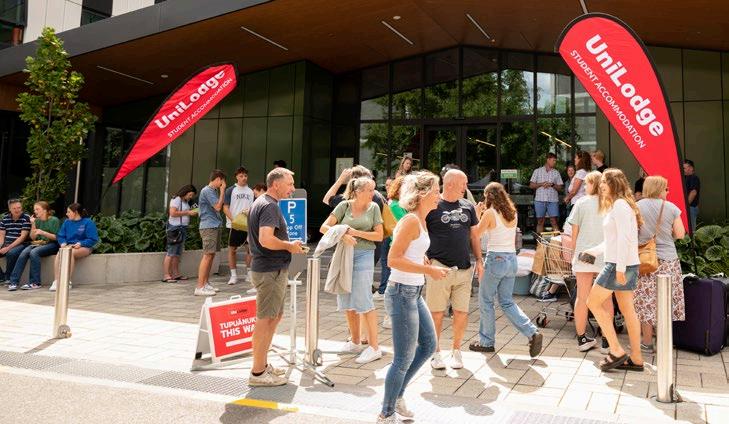
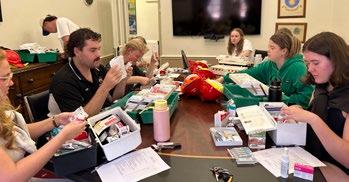


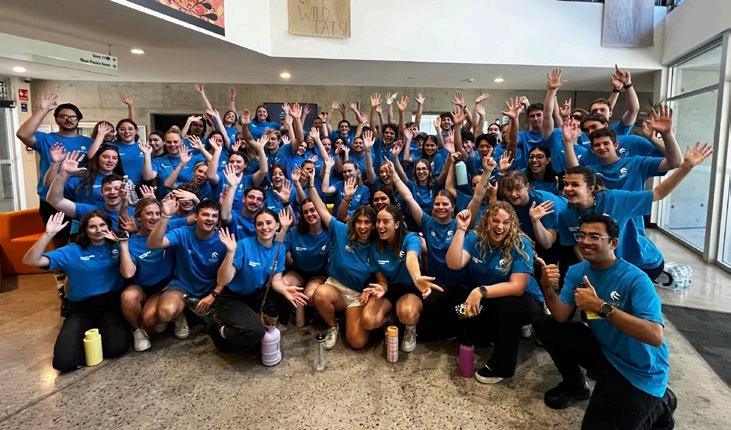
STUDENT EXPERIENCE AND WELLBEING 38 www.apsaa.org.au
Students gather in the West Wing at Newcastle University
Deakin Residential Services, Burwood check in day
Moving into UniLodge Tupuānuku @UC
Aquinas College Student Leaders at work
Newcastle University West Wing
Student leaders welcome students at St John’s College
Moving in to Tupuānuku
St. Catherine’s College move-in 2023
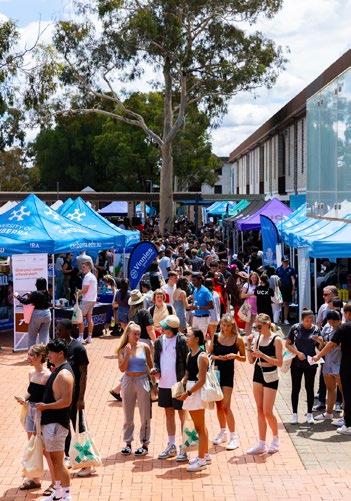
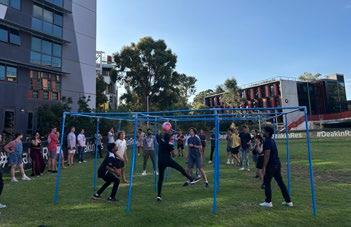



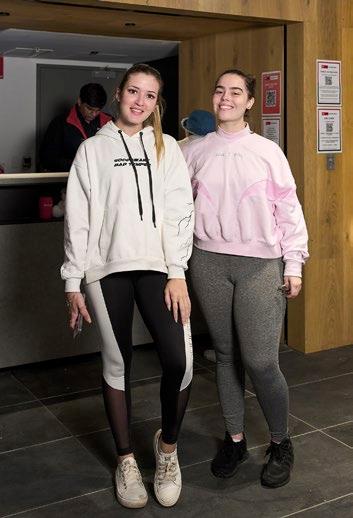

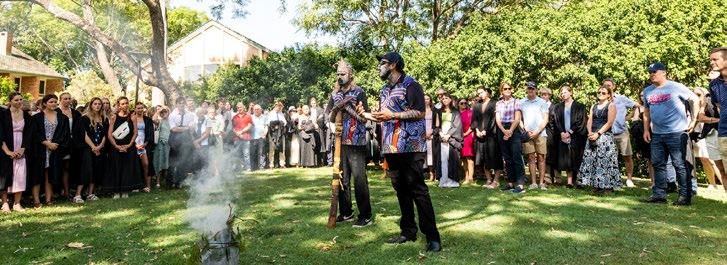

STUDENT EXPERIENCE AND WELLBEING
New faces of 2023 at St John’s College
University of Canberra O-week market day
Moving into UniLodge Ilam @UC
Deakin Residential Services, Burwood check in day
New students at UniLodge Melbourne Central
House Coordinators at Aquinas
St. Catherine’s College move-in 2023
St. Catherine’s College move-in 2023
UniLodge Melbourne Central move-in day
Welcome to Country Smoking Ceremony at St John’s College
Student Accommodation March 2023 Phone: +61 3 9586 6055 Email: admin@apsaa.org.au apsaa.org.au