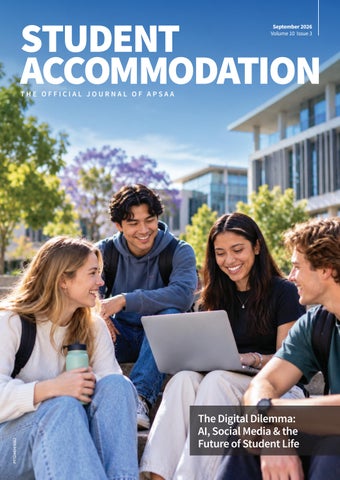
STUDENT ACCOMMODATION September 2026 Volume 10 Issue 3
PP324494/0062
THE OFFICIAL JOURNAL OF APSAA
The Digital Dilemma: AI, Social Media & the Future of Student Life
Visible & approachable
A calm after-hours presence that builds trust, maintains a safe and secure environment and identifies risk early.
RESIDENT SUPPORT OFFICERS
Excellence doesn’t clock off.
Selected for your community
Chosen for maturity, empathy, judgement and cultural fit — the right person for your environment.
Trained first responders
Welfare, mental health, GBV disclosures, medical incidents, security incidents, emergencies, conflict and de-escalation.
People-first safety. Made Constant.
An extension of your team
1300 725 241 | constant.com.au
Rethink what after-hours support can be
After-hours operations, escalation and structured reporting aligned to your systems, protocols and GBV Prevention & Response Plan.
ACT LIC: 17502525 | NSW LIC: 000103752 | QLD LIC: 4201411 | SA LIC: ISL 286519 | TAS LIC: 21785 | VIC LIC: 945-729-90S | WA LIC: SA/CA57652
Contents
C E L E B R AT I N G
YEARS
News President’s Introduction
4
Editor's Note
5
Committee Reports
6
Focus on Facilities
40
Features Artificial Intelligence and the Future of Learning in University Residential Communities* 8 One More Scroll – Doomscrolling, Procrastination and Student Wellbeing
10
35 Marketing to Digital Natives Without Being Allowed to Target Them Remembering Sean Brito-Babapulle, APSAA Past President
14
LAN Party at Lincoln College
15
Five Emerging Scams Targeting Students and What Accommodation Providers Can Do About Them
16 DISCLAIMER This journal is copyright and all rights are reserved. Apart from any use as permitted under the copyright Act 1968, no part may be reproduced without prior written permission. All reasonable efforts have been made to obtain permission to use copyright material reproduced. Every effort has been made to obtain accurate information for this publication. The views expressed in this journal are those of the authors and do not necessarily reflect those of APSAA.
12
The Regulatory Framework for Mitigating Online Harm in Aotearoa New Zealand: A Critical Review
Cultural change over compliance: Why real prevention takes more than just a policy
Reflections on ACUHO-I Campus Home. LIVE! 2026 28 Global Housing Training Institute
16
18
Policy-to-Practice Alignment in Residential Gender-Based Violence Prevention 22
ACKNOWLEDGEMENT OF COUNTRY Australia: APSAA acknowledges Aboriginal and Torres Strait Islander people as the Traditional Owners of Country throughout Australia. We recognise Aboriginal and Torres Strait Islander people’s continuing connection to lands, waters and communities; and we pay our respect to them and their cultures and to Elders past, present and emerging. Aotearoa | New Zealand: APSAA honours Te Tiriti o Waitangi | The Treaty of Waitangi as Aotearoa | New Zealand’s founding document and recognises the special place of Māori in Aotearoa as mana whenua.
26
29
From Seminary to Student Community – 180 Years of Christ College, Tasmania 30 College House Celebrates 175 Years
34
Three Decades Of Student Living: A Behind-The-Brand Reflection of the Evolution of Student Living, Marking 30 Years Of Unilodge
37
APSAA OFFICE PO Box 7345 Beaumaris VIC 3193 03 9586 6055 admin@apsaa.org.au ADVERTISING 03 9586 6055 manager@apsaa.org.au DESIGNER Woolley & Webb Creative COVER Image created by AI
Student Accommodation June 2026 3
President’s Introduction
TARA BAKER Head of Operations, Accommodation, University of Auckland; APSAA President; Aotearoa Regional Branch Vice Chair
Tēnā koutou katoa | Dear members,
O
ne of the things I really enjoy about our Journal is seeing just how broad our work in student accommodation has become, and this edition is a great example of that. Across these pages we explore AI, social media and online harm, scams, gender-based violence prevention, community building, facilities, professional development and the continuing evolution of our sector. We also celebrate some significant milestones and look back at how residential communities have changed over many years. At first glance, these may seem like very different conversations. But for me there is a fairly simple theme running through it all: the world our students are navigating is changing, and we need to keep evolving with it. Technology is probably one of the clearest examples of that. AI is already changing the way students learn and the way many of us work. Social media gives us incredible opportunities to connect, while also bringing challenges around wellbeing, safety, scams and online harm. The reality is that these things are already part of our students’ lives, so our role isn’t to have all the answers. It is to keep learning, stay curious and think about how we best support students as they work their way through them. The same is true when we think about safety and culture within our communities. There is a lot of focus across our sector at the moment on gender-based violence prevention and our obligations as accommodation providers. What comes through strongly in this edition is that good policy matters, but what really makes the difference is how that policy shows up in practice. Safe and respectful communities are built in the everyday moments: how we set expectations, how we have difficult conversations, how we respond when something happens and how confident 4 www.apsaa.org.au
our students are that they can come to us when they need help. And then there is connection. One of my favourite examples in this edition is the LAN party at Lincoln College. There is something quite nice about the reminder that community building doesn’t always have to be complicated. Sometimes it really can be a group of students, some gaming consoles and a few pizzas. Sometimes the simplest initiatives are the ones that work, because ultimately students don’t experience “community building programmes”. They experience relationships, conversations, shared experiences and whether or not they feel they belong. That probably captures something important about what we do. We can have great buildings, strong systems, good policies and well-designed programmes, but ultimately student accommodation is about people. It is about creating environments where students feel safe, supported, connected and able to develop their independence. The stories celebrating 180 years of Christ College, 175 years of College House and 30 years of UniLodge are also a great reminder of that. So much has changed across those years, and our sector will continue to change, but the importance of community and connection remains remarkably consistent.
challenges alone. Across our membership there is an incredible amount of knowledge and experience, and people are genuinely willing to share it. That doesn’t mean we will always have the same approach or the same answers, and I don’t think we should. There is real value in hearing how others are tackling an issue, challenging our own thinking and taking those ideas back to our own teams and communities. I hope there is something in this edition that makes you stop and think, something you can take back to your team, or perhaps something that starts a conversation with a colleague. And as always, thank you to everyone who has contributed to this edition and who continues to share their ideas, experiences and perspectives with our APSAA community. Ngā mihi, Tara Baker
One of the things I value most about APSAA is that we don’t have to work through these
“We can have great buildings, strong systems, good policies and welldesigned programmes, but ultimately student accommodation is about people. It is about creating environments where students feel safe, supported, connected and able to develop their independence.”
SIMONE GALLO National Manager Student Accommodation, Australian Catholic University; APSAA Board Member; APSAA Communications and Engagement Committee Chair
Editor’s Note We are living through one of the most significant periods of technological change in a generation.
A
rtificial intelligence is rapidly becoming part of how we work, study, communicate and make decisions, while social media continues to shape how young people connect with one another and experience the world around them.
outsource too much of our thinking to technology. Recent research across Australian universities suggests that students are already using generative AI extensively, often pragmatically, as part of their everyday study.
For those of us working in tertiary education and student accommodation, these changes are impossible to ignore.
digital lives: the endless scroll. Social media platforms are designed to capture attention, and the consequences for young people’s wellbeing are increasingly difficult to overlook. Australia’s world-first social media minimum-age framework represents a bold attempt to create greater protection for young Australians and give them more time to develop digital resilience.
AI presents extraordinary opportunities. It can reduce administrative burden, improve efficiency, personalise learning and help staff spend more time doing what matters most: supporting students and building communities. At the same time, we need to ask important questions about academic integrity, critical thinking, human connection and what happens when we
And then there is the other side of our
have as educators and accommodation professionals to help young people navigate an increasingly digital world. Technology will continue to evolve. Our challenge is to ensure that humanity keeps pace. Simone Gallo National Manager, Student Accommodation – Australian Catholic University; Communications & Engagement Committee Chair
This edition explores both sides of that conversation: the possibilities, the pitfalls and, importantly, the responsibility we
Industry Movements New Zealand Ruben Katigbak has taken on the role of Head of College at St Margaret’s in Dunedin Kim Todd has taken on the role of Deputy Head of College in charge of Wellbeing at St Margaret’s in Dunedin WA Jasmine Jensen joined UWA as Manager, Student Living Zac Leach appointed General Manager Portfolio, UniLodge Curtin
Rachel Lattimore joined Uni Hall as Deputy head of college (Rachel Lattimore moved into the Deputy Head of College role from Head of Wellbeing, University Hall) QLD Danielle Staines appointed General Manager, UniLodge JCU Halls of Residence, Townsville
The University of Newcastle has announced three internal appointments, with Josh Blacklock taking on the role of Senior Manager, ResLife Standards; Hannah Stark as Manager, ResLife Operations; and Ruby Checkley as Manager, ResLife Programs.
NSW Matt Ma has been promoted into a new role of Manager, Student Care and Accommodation at ACU. Student Accommodation June 2026 5
Committee Reports
Communications and Engagement Committee Report
T
hroughout 2026, the APSAA Communications and Engagement Committee has continued to strengthen the Association’s connection with its members through strategic communications, brand development and initiatives designed to support engagement across the student accommodation sector. The Committee’s focus throughout the year has been on improving the accessibility, consistency and impact of APSAA’s communications, while ensuring members remain informed, connected and engaged with the work of the Association. Significant progress has been made in refreshing member-facing communications, enhancing digital engagement and better positioning APSAA’s resources for both current and prospective members. One of the most significant developments during the year has been the transition of the APSAA Student Accommodation Journal to an online-only publication. This move reflects APSAA’s commitment to sustainability while also providing greater accessibility and flexibility for readers. The digital format enables broader distribution and easier access to content, while creating opportunities for more responsive publishing. The Journal remains one of APSAA’s flagship member publications, providing a platform for thought leadership, innovation, research and industry insights from across the Australasian student accommodation sector. Recognising the value of sharing the Journal with the broader sector in person, APSAA will also produce a small
6 www.apsaa.org.au
SIMONE GALLO National Manager, Student Accommodation, Australian Catholic University; APSAA Board Member; Communications and Engagement Committee Chair
print run of one edition to be distributed at the Association’s annual Conference. The Committee has also progressed a refresh of APSAA’s communications and marketing collateral, with a focus on creating greater consistency across member touchpoints. This has included the ongoing refinement of newsletter templates to improve readability, engagement and calls to action, alongside refreshed social media messaging designed to strengthen APSAA’s visual identity and storytelling. Work has also progressed towards reviewing APSAA’s website structure and content to better showcase the depth and breadth of resources available to members. This has included consideration of website navigation and exploring ways to improve the organisation and presentation of member resources. This work will continue as part of APSAA’s broader commitment to strengthening the member experience and ensuring its digital platforms remain intuitive and accessible. Supporting and amplifying the work of APSAA’s committees and branches has also remained an important focus. By providing greater visibility to initiatives, events, achievements and opportunities for member involvement, the Committee has helped strengthen awareness of the diverse work taking place across the Association and encouraged greater connection across APSAA’s growing network. Looking ahead, the Committee will continue to build on the momentum established
throughout the year. Priorities will include further enhancement of APSAA’s website and member resources, greater visibility of committee and branch activities, continued growth and engagement across social media channels and the ongoing refinement of member and stakeholder communications. The Committee will also continue to strengthen APSAA’s brand consistency across all platforms while expanding the Association’s communication capability to support advocacy and future media engagement opportunities. The achievements of the Communications and Engagement Committee throughout 2026 are a direct reflection of the creativity, enthusiasm and commitment of its members. Their collaborative approach continues to generate innovative ideas and outcomes that strengthen APSAA’s connection with its members and the broader student accommodation community. Special thanks are extended to Jess Rokobaro, Vice-Chair, for her leadership, energy and ongoing support throughout the year. As APSAA continues to grow and evolve, the Communications and Engagement Committee remains committed to ensuring that the Association’s communications are clear, engaging and connected, helping members stay informed while strengthening the sense of community at the heart of APSAA.
JODIE HAZELL
Professional Development Committee Report
T
he APSAA Professional Development Committee has continued to advance the Association’s commitment to professional learning, member connection and sector leadership throughout the first half of 2026. Guided by the Committee’s purpose of supporting APSAA Learning and strengthening professional capability across the student accommodation sector, the period has been marked by strong engagement, collaborative planning and the delivery of relevant learning opportunities for members. The year commenced with a successful Speaker Series session in March, Communicating with Residents in a Changing Digital World, featuring presentations on emerging digital engagement platforms and communication practices. The webinar attracted 133 registrations and 91 attendees, demonstrating the ongoing value members place on sector-specific professional development. Building on this momentum, the Committee delivered its second Speaker Series webinar in June, bringing together multiple presenters to share insights on contemporary sector challenges and opportunities. The session was expertly facilitated by Vice-Chair Wendy Fleming, with presentation materials and resources subsequently shared with participants to support ongoing learning and knowledge exchange. There are two more sessions scheduled on 26 August 2026 From Emergent Leader to Frontline Leader: Navigating Change as a Developing Leader leadership and 25 November 2026 titled Connecting APSAA and
Senior Manager, Business Improvement & Operations, University of Wollongong; APSAA Professional Development Committee Chair
the Higher Education Gender-based Violence Regulator. Communities of Practice remain an important component of the APSAA Learning program. The first Community of Practice for 2026 explored student scams and emerging risks facing residents and was well received by participants. The second Communities of Practice session was held on 11th August 2026 titled Preparing for a student death: A practical framework to guide your response on student deaths, led by James Atkinson. The third and final Community of Practice session for 2026 is scheduled for 20 October focusing on ‘Eating disorders in residential life’, led by Nicola Venditozzi. Alongside program delivery, the Committee has focused on strengthening planning, governance and member value. Initiatives progressed during the reporting period include development of a coordinated learning calendar, refinement of webinar approval processes to minimise scheduling conflicts, consideration of CPD recognition opportunities for member participation in APSAA initiatives. The Committee has also continued discussions regarding APSAA On Demand and the sharing of sector resources to maximise the impact of learning activities beyond live events.
As the Committee transitions into a new term, we would like to sincerely acknowledge the exceptional contribution of outgoing Chair Andrea Rohde and Vice-Chair Wendy Fleming. Through their leadership, dedication and commitment to APSAA Learning, they have played a pivotal role in strengthening the professional development program, fostering member engagement and creating opportunities for collaboration and shared learning across the sector. They have left big shoes to fill and we are very grateful and appreciative of their hard work. The Committee also welcomes a number of new members this term and we look forward to continuing to support APSAA’s strategic commitment to professional development, leadership, excellence and member value in the year ahead.
Looking ahead, the Committee has adopted a refreshed Annual Plan for 2026-27 focused on five key priorities: Deliver, Strengthen, Inform, Share and Enhance. These priorities will guide the delivery of speaker series events, communities of practice, member learning opportunities and professional development pathways across the coming year.
Student Accommodation June 2026 7
Artificial Intelligence and the Future of Learning in University Residential Communities*
ARETI METUAMATE Master and Head of Ormond College
University residential communities are about much more than just accommodation. They are places where people learn not only from their studies, but from one another. Every conversation over a meal, every discussion between students and staff, every student committee meeting, and every act of friendship contributes to the formation of the people our residents will become.
I
n recent months I have found myself thinking more and more about the topic that has increasingly dominated discussions in universities, workplaces and society more broadly: artificial intelligence. Recently, one of the world’s leading artificial intelligence companies, Anthropic, the creators of Claude, made headlines by suggesting that the pace of AI development may need to slow. Their concern is not simply that AI is becoming more powerful. Rather, it is that the technology is advancing so rapidly that society, governments and institutions may struggle to keep pace with the changes it brings. Whether or not one agrees with that assessment, it is striking that some of the people building these technologies are among those calling for caution. Like many people, I am excited by what artificial intelligence can do. AI is already helping people work more efficiently, analyse
information more effectively, and undertake tasks that once required significantly more time and effort. It has enormous potential to improve our lives. Someone I know who has done a lot of thinking about AI suggested to me that AI offers two significant benefits. First, it helps us with our thinking. Second, it helps us to be more efficient. I thought that was a useful way of putting it. Both seem highly desirable. If AI can help us test ideas, consider alternative perspectives, organise our thoughts more clearly and work more efficiently, that is surely a good thing. The challenge, however, is ensuring that helping us think does not become thinking for us. My concern is not about what AI might become, but what we might become if we stop exercising some of the very capabilities that education is designed to develop.
The process of learning is not simply about obtaining answers. It is about developing the habits of mind that enable us to ask good questions, wrestle with difficult ideas, think critically, solve problems, exercise judgement, and engage thoughtfully with the people and world around us. The question is not whether AI will become smarter. That is going to happen anyway. It is happening every single day. The question is whether we will continue to do the hard work required to become not just smarter, but wiser. There is a risk that, if we become overly dependent on technologies that can think, write and create on our behalf, we may lose some of the intellectual capabilities that previous generations had to develop for themselves. I am not sure whether that worries everyone, but it certainly worries me. We should absolutely embrace the opportunities that AI presents, but we should do so thoughtfully and with a clear understanding of what must never be outsourced. Chief among those things is our capacity to think for ourselves. Our minds grow and develop through effort. As one of my teachers used to say to me, the value of an essay is not the essay itself. The value is the thinking required to write it. We should also not assume that technological progress and human progress are the same thing. History shows us that new technologies can create enormous benefits while also presenting significant social and ethical challenges. As artificial intelligence becomes increasingly embedded in our institutions, businesses and daily lives, we will need to
8 www.apsaa.org.au
consider the kind of society we wish to build, not merely the technologies we are capable of creating. For those of us who lead university residential communities, this presents both an opportunity and a responsibility. Our role has never been simply to provide accommodation. It has been to help develop thoughtful, capable and ethical citizens. If AI changes the way students learn, then it inevitably changes the way we support that learning. Those of us working in university residential communities therefore have an important role to play—not by resisting technological change, nor by embracing it uncritically, but by helping students use these powerful tools in ways that enhance learning rather than diminish it. At Ormond College, this thinking has led us to establish an Advisory Group on AI and the Future of Learning, bringing together students, staff and external experts to consider how AI will shape higher education, student life and the development of future leaders. Its purpose is not simply to consider how AI can be adopted, but how it can be used responsibly while preserving the critical thinking, intellectual curiosity, creativity and human connection that remain at the heart of education.
More broadly, I believe institutions such as ours should not passively respond to technological change. We have a responsibility to engage with it, understand it, help shape it where we can, and ensure that it serves the development of people rather than the other way around. Ultimately, I suspect that the qualities that will matter most in the age of artificial intelligence are the very qualities that have
always mattered most: wisdom, judgement, integrity, empathy, courage, leadership, and the ability to bring people together in pursuit of a common purpose. These are profoundly human qualities. They cannot be automated, and they remain at the very heart of what university residential communities seek to develop. *This is an adapted version of a letter to Ormond College students.
Student Accommodation June 2026 9
One More Scroll – Doomscrolling, Procrastination and Student Wellbeing
ITAI AVISAR Campus Life Coordinator Deakin Residential Services
We have probably all done it. You pick up your phone to check one notification, reply to one message or take a quick break. Before you know it, 30 minutes have passed and you are deep into news stories, videos, comment sections or social media posts.
F
or students, this can easily become part of everyday life. So much of university already happens online, from classes and assessments to emails and staying connected with friends and family. When study, entertainment and communication all happen on the same device, a quick break can very easily turn into avoiding what needs to be done. This is where doomscrolling and procrastination can start to go hand in hand.
Why do we keep scrolling? Doomscrolling is usually described as repeatedly looking through negative or distressing content online, even when it makes us feel worse. It can also describe those times when we keep scrolling without any real purpose and suddenly realise how much time has passed. It is easy to say that people just need more self-control, but it is not that simple. Social media platforms are designed to keep our attention, and stress or uncertainty can make us want to keep searching for more information. Harvard Health explains that doomscrolling is connected to our natural instinct to look for possible threats. When we are already stressed or worried, searching for more information can make us feel informed or give us some sense of control. The problem is that the more negative content we see, the more unsettled we can feel. This can create a cycle where stress leads to scrolling, scrolling creates more stress and that stress makes us want to keep checking. 10 www.apsaa.org.au
For students dealing with assessments, finances, relationships, work and often living away from home for the first time, picking up a phone can also offer a quick escape from something that feels difficult. Writing the first paragraph of an assignment takes effort. Watching one more video does not. It may feel better in that moment, but the task is still waiting at the end.
When a break is not really a break There is nothing wrong with enjoying time online or using a phone to take a break. Technology helps students stay connected, find support, learn new things and keep in touch with people who may be far away. The issue is not simply how many hours someone spends looking at a screen. A better question is whether that screen time is starting to affect other parts of their life. The Australian eSafety Commissioner suggests looking at whether time online is interfering with sleep, study, work, relationships or physical and mental health. Some signs might include regularly losing track of time, struggling to focus, staying online much later than planned or pulling away from friends and activities. Doomscrolling can leave people feeling anxious, overwhelmed or mentally exhausted. According to Harvard Health, it can also contribute to headaches, muscle tension, neck and shoulder pain, trouble sleeping and spending long periods without moving. Research discussed by Harvard has also found links between doomscrolling and poorer wellbeing, lower satisfaction with life and becoming less engaged with work.
The effect on procrastination can be just as important. A student may start scrolling to avoid the stress of beginning an assessment. They then feel even more stressed because they have less time left to complete it. That increased stress can make the task feel even harder, sending them straight back to the same distraction. What started as a five minute break can quickly become another reason to feel behind.
Why this matters in student accommodation In student accommodation, we may notice the effects before we know what is causing them. A student might miss a morning class because they stayed awake scrolling. They might stop coming to events, spend less time with their fellow students or struggle to start tasks that previously felt manageable. Of course, we should not assume that every missed class, late assignment or untidy room is caused by someone’s phone. However, digital habits are now part of the bigger wellbeing picture and are worth talking about. Living in a residential community can also help. Doomscrolling often happens when someone is alone, stressed or feeling disconnected. Student accommodation gives students opportunities to step away from their screens and spend time with others through shared meals, events, sport, creative activities or even a quick conversation in a common area. The eSafety Commissioner also uses the term “phubbing”, which is when someone pays attention to their phone instead of the people
©gettyimages/Pressmaster
around them. In a residential community, this can quietly affect people’s sense of belonging. A student may be sitting in a shared space but still be disconnected from everyone in it. Over time, these missed interactions can make it harder to build relationships and may leave others feeling ignored or excluded. These moments of connection are not just an added extra within the residential experience. They can break up isolation, give students a proper mental reset and help them feel connected to the community around them.
Moving beyond “just put your phone down”
For students, this could mean: • Charging their phone away from the bed. • Choosing a set time to check news or social media. • Using focus mode while studying. • Starting with ten minutes of work before taking a break. • Leaving their phone behind when eating with others. • Choosing an offline activity that provides a proper break. • Studying alongside a friend for extra accountability.
Telling someone to simply put their phone down is unlikely to help. It can make the problem sound like a personal failure and ignores how strongly these platforms are designed to compete for our attention.
The aim is not to get rid of technology completely. That would be unrealistic and, in many cases, unhelpful. It is about helping students use it more intentionally instead of opening an app automatically whenever something feels difficult.
A better approach is to help students create small and realistic boundaries that make automatic scrolling less likely.
What can accommodation professionals do?
Harvard Health recommends keeping phones away from the bed, placing them out of reach while studying, switching off unnecessary notifications and using grayscale settings to make screens less appealing. The eSafety Commissioner also recommends checking screen time, setting app limits, taking regular breaks and finding a better balance between online and offline activities.
As accommodation professionals, we do not need to become experts in digital wellbeing. We can, however, make it something students feel comfortable talking about. Digital wellbeing could be included in orientation, wellbeing campaigns, studysupport programs and conversations about sleep. Residential Leaders can also encourage healthy habits through phone-free activities,
shared meals and events that give students a chance to be present and connect with others. We should also stay curious when a student seems disengaged or overwhelmed. Asking, “What has your routine looked like lately?” may lead to a much more helpful conversation than immediately focusing on what they have not completed. If scrolling is having a serious effect on a student’s sleep, study, relationships or mental health, it may also be appropriate to encourage them to seek professional support. Doomscrolling and procrastination are not completely new problems. Students have always found ways to avoid tasks that feel difficult. What has changed is that the distraction now travels everywhere with us, sits beside our beds and provides an endless stream of content designed to keep us watching. Supporting students is not about expecting them to have perfect habits or telling them to stop using their phones. It is about helping them notice when scrolling has stopped being a break and started getting in the way, and reminding them that sometimes the best next step is to put the phone down and reconnect with what is happening around them
Student Accommodation June 2026 11
Marketing to Digital Natives Without Being Allowed to Target Them:
SASCHA STONE Community Engagement Manager University Hall, UWA
How the Social Media Ban Is Reshaping Student Accommodation Advertising
Since the Australian Government legislated to ban under‑16s from platforms such as Facebook, Instagram, and TikTok, marketers in our sector have been forced to pivot. We’ve had to rethink what success looks like in paid advertising, adjust our content strategies, and reconsider who we can realistically reach. Initially, the impact was manageable. Even after the under‑16 ban came into effect, Meta still allowed advertisers to target users aged 16+. For student‑accommodation providers, this meant we could continue reaching Year 11 and 12 students — a critical audience for early decision‑making. But more recently, Meta has lifted its minimum targeted age from 16+ to 18+, and that shift has fundamentally reshaped how we reach the students who are making the earliest and most consequential decisions about their post‑school pathways. For those of us marketing university accommodation, the timing couldn’t be more challenging. Students begin exploring whether university is right for them as early as Year 10. And for regional and international students, access to accommodation isn’t just a preference — it’s often the deciding factor in whether university is even possible. This is the new reality. And it requires a new playbook.
Why the 18+ Targeting Restriction Is a Bigger Deal Than It Looks The student accommodation sector is uniquely exposed to this change because: • Students begin researching accommodation before they turn 18 • Regional families rely heavily on early information to plan logistics and finances • International students often make decisions 12–24 months in advance • Accommodation availability influences university choice, not always the other way around When platforms remove the ability to target 16–17 year olds, we lose access to the very audience that needs the most guidance. This isn’t just a marketing inconvenience — it’s a pipeline disruption.
Our 2026 UniHall Campaign: What We Learned in a Post18+ World As part of UniHall’s 2026 brand refresh, we launched paid brand campaigns on Meta and TikTok knowing we could no longer target the 16–17 year old cohort directly. Despite this, the early results (first 2 weeks) have been encouraging.
Meta (Instagram + Facebook) • Reach: 159,000 (≈98% of our reachable audience) • CPM: $2.47 (vs $6 planned) • Link clicks: 1,055
TikTok • Reach: 129,000 (≈67% of the reachable audience) • CPM: $3.18 (vs $4 planned) • Link clicks: 487
12 www.apsaa.org.au
©gettyimages/master1305
S
ocial media has become a cornerstone of the student accommodation marketing mix. It’s where future students discover campus life, compare living options, and build confidence about moving away from home. But the rules of the game have changed — and not in small ways.
Early application numbers for 2027 are strong, University Hall has received 40% of applications for accommodation at UWA and continues to retain its first preference standing among prospective UWA students. These numbers show that while we can’t target younger teens directly, we can still build
strong awareness among older teens, parents, and adjacent audiences.
This is where authenticity becomes your biggest asset.
But the real win came from organic performance:
What works best:
• A significant jump in followers
• Room tours filmed by residents
• Clear content winners emerging (student led, authentic, day in the life content)
• “What I wish I knew before moving to Perth” content
• Higher engagement on non paid posts
• Real stories from regional and international students
• More DMs from prospective students and parents This reinforces a critical insight: paid reach may be restricted, but organic influence is not.
What Other Colleges Can Do: Practical Workarounds That Actually Work
• Day in the life videos
If it looks like marketing, it fails. If it looks like a student sharing their life, it spreads. 3. Build a Student Creator Network This is the most effective workaround we’ve found. Students can:
Here are the strategies we’ve found most effective — and that other accommodation providers can adopt immediately.
• Create content
1. Build a Two Audience Strategy: Students AND Parents If you can’t target 16-17 year olds, target the people who influence them.
• Influence younger peers
Parents are: • Highly engaged • Actively researching • Concerned about safety, cost, and support • Not restricted by age based ad rules A dual audience approach ensures your message still reaches the household decision makers. 2. Use Organic Content to Reach Under 18s Indirectly The Meta decision applies to paid targeting, not organic discovery. 16-18 year olds can still: • Follow your account • See your content through explore feeds • Discover you via hashtags • Engage with student generated content
• Share their own experiences • Reach their own networks Peer to peer content bypasses the restrictions entirely because it’s not targeted advertising — it’s authentic storytelling. At UniHall, we have a highly engaged student leadership group, and our ambassadors to support us in this area. Fortunately, most of us in the student accommodation sector have spent years building strong owned channels and diversified marketing ecosystems. That groundwork is now paying off. With the tightening of under‑18 targeting restrictions, we can no longer rely on a single channel — especially not paid social — to carry the weight. This is where an integrated marketing communication approach becomes essential. When you can’t target younger teens directly, your ecosystem has to work together: SEO and search capture intent at the exact moment students and parents are actively researching; retargeting keeps warm audiences engaged after they’ve visited your website; email and SMS nurture
students who opt in and allow you to guide them through the decision‑making process; owned communities such as early‑interest lists help build long‑term relationships; and organic social and student‑generated content continue to reach younger teens indirectly through algorithmic discovery. Owned channels are becoming the sector’s insurance policy. Once a student opts in — whether they’re in Year 10, 11, or 12 — you’re no longer fighting platform restrictions. You can communicate consistently, build trust, and support them at their pace, not the platform’s. In short, the ban has made integrated marketing not just best practice, but a necessity. And for those who have invested in a broad, multi‑channel foundation, the transition is far smoother than it could have been.
The Takeaway: The Rules Have Changed, But the Opportunity Hasn’t The shift from 16+ to 18+ targeting on Meta has forced our sector to rethink how we reach future students. But it has also pushed us toward: • More authentic content • More student led storytelling • More strategic targeting • More diversified channels • More meaningful engagement The institutions that adapt fastest will be the ones students see — and ultimately choose. P.S. As a marketer, I am happy that young people are clever enough to work out how to get around the new government ban; however, as a mum of a 15 year old I am on board with the ban.
Student Accommodation June 2026 13
Remembering Sean Brito-Babapulle, APSAA Past President It is with deep sadness that we acknowledge the passing of Sean Brito-Babapulle, former President of AACUHO (now APSAA), who served from 2007 to 2009.
S
ean made a significant contribution to residential education and student accommodation throughout his career, supporting and shaping residential communities across Australia. He was a muchrespected member of our sector, generously sharing his knowledge and experience with colleagues and emerging professionals.
the Joe Massingham Award for Meritorious Service in 2013.
In recognition of his longstanding contribution to the sector, Sean was awarded
Our thoughts are with Sean’s family, friends and colleagues during this difficult time.
Sean leaves behind a lasting legacy through the many colleagues, students and residential communities whose lives he touched. He will be remembered with great respect and affection across our sector.
STUDENT ACCOMMODATION December 2025 Volume 9 Issue 4
THE OFFICIAL J
OURNAL OF APS
Contribute to future editions of the APSAA Student Accommodation Journal
Whether you are interested in contributing an article, proposing a topic, or sharing news such as staff movements or facility updates, we encourage you to get involved.
https://www.apsaa.org.au/memberresources/student-accommodationjournal/apsaa-journal-ideascontributions-and-updates/
STUDENT ACCOMMODATION March 2025 Volume 9 Issue 1
THE OFFICIAL J
Scan the QR code to submit your ideas or indicate your interest in contributing. All submissions are reviewed by APSAA, and contributors may be contacted for further information.
OURNAL OF APS
AA
Highlighting our people, charting our future PP324494/0062
14 www.apsaa.org.au
Supporting Resilient Residential Communitie s
PP324494/0062
APSAA welcomes topic suggestions, content ideas and sector updates for future editions of the Student Accommodation Journal.
AA
LAN Party at Lincoln College
CAROLYN MEE CEO/Head of College
As student accommodation providers continue to explore new ways to foster connection and community, one surprisingly creative, and highly popular, initiative has emerged from gaming culture: the LAN party.
A
t its core, a LAN (Local Area Network) party is simple. Students gather in a shared space, in this case, our dining hall, and bring along their gaming consoles, monitors, laptops and PCs. Ethernet cables are connected into shared network ports, allowing students to play multiplayer games directly against one another in real time. What began as a niche gaming event has quickly become one of the most anticipated nights on the college calendar. At Lincoln, these events, held once each semester on a Friday night, create an atmosphere that is energetic, inclusive and highly engaging. Students arrive with Nintendo Switches, Wii consoles and gaming laptops, setting up Mario Kart racing tournaments, FIFA competitions on the big
screen, alongside cooperative games such as Minecraft, Fortnite and Roblox. Friendly rivalries emerge, teams form organically, and students who may not have interacted before begin building genuine friendships through shared interests and experiences. Importantly, LAN parties are not just about gaming. They provide a social outlet that encourages students to engage with one another and participate in community life within a relaxed, low-pressure environment. For many students, particularly those new to college life, these events create an accessible and welcoming entry point into the broader residential community.
access and a few pizzas at midnight. Yet the return in student engagement, wellbeing and peer connection is substantial. At a time when student belonging matters more than ever, community building does not always need to look like a formal leadership program or organised workshop. Sometimes it looks like 50 students gathered around a screen for a last-lap Mario Kart finish, or teaming up with friends in a FIFA tournament late into the evening. Either way, the LAN Party at Lincoln College has become a much-loved tradition and a valued part of college life.
From an operational perspective, the events are low-cost to deliver, requiring little more than reliable internet infrastructure, power
Student Accommodation June 2026 15
Five Emerging Scams Targeting Students and What Accommodation Providers Can Do About Them
S
tudent accommodation providers are increasingly finding themselves on the frontline of sophisticated scams targeting residents. While international students are often particularly vulnerable because they may be unfamiliar with local systems and far from family support, these scams can affect any resident. Drawing on patterns reported across the student accommodation sector over the past twelve months, this article highlights five emerging scam types and practical steps providers can take to reduce risk and better support students.
1
Rent and Payment Demand Scams
Students receive urgent messages, often impersonating their accommodation provider, university, or a fake “official” payment portal, demanding immediate payment to avoid eviction, fines or legal action. Payment is typically requested through unusual channels, wire transfer, cryptocurrency or gift cards, rather than the provider’s normal payment system. In reported cases, students have transferred significant financial losses, one case was up to AU$200,000, and in another instance the student travelled interstate to meet the scammers in person, before realising the demand was fraudulent. What providers can do • Publish and consistently reinforce official payment channels across all resident communications, so any deviation stands out. • Never introduce a new payment method or account via unsolicited SMS, email or social media message. • Train frontline and finance staff to flag missed payments early and check in directly with the resident, rather than relying on the resident to raise it first. • Encourage residents to verify any unexpected payment request with the accommodation office before acting on it. 16 www.apsaa.org.au
2
AI-Generated Deepfake Sextortion
An offender makes contact through social media, builds AI-generated explicit imagery from photos taken from the student’s own accounts or phone, then threatens to distribute the material unless the student pays money or sends real images. These approaches are often fast-moving and highly distressing, and students may feel too ashamed to disclose quickly. What providers can do • Name deepfake and sextortion scenarios explicitly in student inductions and RA/ staff training, general “online safety” messaging is not specific enough for students to recognise this pattern. • Make disclosure easy and nonjudgemental; shame is the greatest barrier to a student reporting early. • Maintain a clear, rehearsed escalation pathway to police and ReportCyber, run in parallel with welfare support rather than after it.
3
Fraudulent Booking Agent Scams
An unofficial “agent” books accommodation using a genuine student’s real details, but pays using a stolen credit card, while separately collecting cash rent directly from the student. The fraud often does not surface until a month or more later, by which point thousands of dollars have typically changed hands and a chargeback has hit the provider. What providers can do • Add booking-verification questions to check-in: how did you book, how did you pay, and does your email match the booking record. • Return refunds only to the original payment method, never to a third party or an alternate account nominated after booking. • Maintain a list of known, legitimate booking
CHRISTIE TEMESI Regional General Manager, UniLodge; APSAA Board Member
channels and agents for each property, and treat unfamiliar intermediaries as a prompt for extra verification.
4
Authority Impersonation and “Virtual Kidnapping” Scams
Callers impersonate immigration officials, police or embassy staff, telling a student they face deportation, arrest or another serious consequence unless they isolate themselves and follow instructions exactly. Students have been kept on the phone for hours, cut off from contact with friends, staff or family, and coached to stay silent about what is happening. What providers can do • Educate students, particularly prearrival, that government agencies do not conduct enforcement action by phone or demand isolation or payment as a condition of avoiding arrest. • Train staff to recognise signs of prolonged phone-based coercion, a resident who hasn’t left their room, appears distressed, or has been on a call for an extended period. • Build a direct relationship with local police so escalation, including referral to specialist units where relevant, can happen quickly.
5
Fake Listing and Cloned Website Scams
Scammers clone a provider’s website, brand or social media presence, or create convincing listings using stolen photography of real properties, to collect deposits or personal documents from prospective students, often before the student has even left their home country, for accommodation that doesn’t exist or that the scammer has no right to let. This scam is increasingly reported across the wider student housing sector and does not require the scammer to ever contact the accommodation provider directly, which makes it harder to detect early.
©gettyimages/FG Trade
What providers can do • Monitor for look-alike domains, cloned websites and impersonating social media pages using your brand or property names. • Direct all prospective residents to a single verified booking URL, and repeat it consistently across every marketing and agent channel. • Brief partner universities, agents and pre-arrival communications to warn prospective students never to pay a deposit outside the official booking platform.
Building an Industry-Wide Response Individually, these scams can look like isolated incidents. Reported across the sector, they show clear and repeatable patterns, which is exactly what makes a shared, practical response possible. The following actions apply across all five scam types: • Keep residents and prospective residents informed on how to report anything suspicious to staff.
• Train staff to recognise disclosure patterns, not just the scams themselves. • Build verification steps into checkin and payment processes. • Always refund to the original payment source. • Pair welfare support with formal reporting, rather than treating them as sequential steps. • Report to police, Crime Stoppers, Scamwatch and ReportCyber, and share intelligence with other providers where possible, since scam patterns tend to move across properties and operators rather than stay contained to one. • The most effective responses are collaborative, involving accommodation providers, universities, law enforcement agencies, cyber security organisations and student wellbeing teams.
operational controls and creating an environment where students feel safe seeking help, providers can significantly reduce harm. Sharing knowledge across the sector will remain one of the most effective tools in staying ahead of rapidly evolving scams. References This article draws on scam patterns reported by accommodation providers across the Asia-Pacific student housing sector over the twelve months to July 2026, and on publicly available guidance from the resources listed below. Resources • Scamwatch (Australian Competition and Consumer Commission): national scam reporting and public information hub. https://www.scamwatch.gov.au/ • ReportCyber (Australian Cyber Security Centre): reporting portal for cybercrime, including image-based abuse and sextortion. https://www.cyber.gov.au/report • IDCARE: free identity and cyber support service for scam and fraud victims. https://www.idcare.org/ • Crime Stoppers Australia: anonymous crime reporting. https://www.crimestoppers.com.au/
No accommodation provider can eliminate scams entirely. However, by recognising emerging patterns, strengthening Student Accommodation June 2026 17
The Regulatory Framework for Mitigating Online Harm in Aotearoa New Zealand: A Critical Review
SONIA MAZEY Principal, Arcady Hall; APSAA Board Member
As in other countries, the number of New Zealand students experiencing online harm has surged in recent years to the extent that it has become ‘normalised’ among university students. (Tompson L and Tomkins, J 2025).
T
he kinds of abuse typically experienced by students include various financial scams, cyberbullying, harassment, cyberstalking, and image-based online, sexual abuse –non-consensual posting of intimate images (so-called ‘revenge porn’), including circulation of ‘deepfake’, AIgenerated sexualised images of recognisable individuals. However, in stark contrast to other jurisdictions such as Australia, the United Kingdom (UK) and the European Union (EU), New Zealand does not (yet) have comprehensive, statutory regulation of tech companies and social platforms. Instead, it relies on a combination of civil remedies, criminal law, and voluntary, industry-led self-regulation to mitigate online harm. Furthermore, regulatory responsibility is split across several organisations including the Department of Internal Affairs, the Police, the New Zealand Media Council, Netsafe, and the Advertising Standards Authority. This decentralised, fragmented, regulatory framework has evolved incrementally over time in response to new and emerging threats. However, there is now widespread acknowledgement among legal experts, advocacy groups, and policymakers of the inadequacy of this regulatory framework and mounting pressure on the government to align its regulatory approach in this sector more closely with those of Australia, the UK and the EU.
New Zealand’s Current Regulatory Framework: Limited Legislation and Light Touch Regulation New Zealand’s existing legal framework for addressing online harm comprises a patchwork of civil remedies and legislation 18 www.apsaa.org.au
developed over several years. Provisions of the Crimes Act 1961, for example, can be invoked in cases of online abuse, including blackmail, criminal harassment, incitement to suicide, and (since a 2006 amendment to the Crimes Act), posting intimate visual recordings of individuals. Meanwhile, the Privacy Act 2020, which regulates the collection, use, and disclosure of personal information, may also apply where biometric information is collected or circulated without permission (doxxing), or where individuals suffer privacy harm because of social media posts. Individuals may also bring civil proceedings in defamation for false online statements that damage their reputation. The Harmful Digital Communications Act 2015 The primary law for addressing social media abuse in New Zealand is the Harmful Digital Communications Act 2015 (HDCA). This legislation was introduced specifically to address the growth of cyberbullying, online harassment, revenge pornography, and other forms of harmful digital communication. The HDCA created both civil and criminal liability for harmful digital communications. The Act established 10 ‘communication principles’, which state, inter alia that digital communications should not disclose personal details, be threatening or intimidating, be grossly offensive, harass an individual, make false allegations, or encourage others to target a person. The HDCA also created Netsafe, New Zealand’s official, independent agency for investigating and resolving complaints from victims of harmful digital communications. However, Netsafe has no enforcement powers; if is unable to resolve a dispute through mediation and negotiation,
the complainant may apply to the District Court for a (civil) order against the offending individual or host platform requiring them to delete the harmful material, or to publish a public apology. Disobeying a District Court order is a criminal offence, punishable by up to six months in prison or a fine of up to $5,000 for individuals (and up to $20,000 for companies. Additionally, the HDCA introduced two new, criminal offences: Deliberately posting content that causes serious emotional distress to an individual; and sharing or threatening to share intimate photos or videos without explicit consent. These offences can result in prison sentences of two and three years respectively, and a $50,000 fine. Online platforms or groups that knowingly host and fail to remove such content face corporate fines of up to $200,000. Aotearoa New Zealand Code of Practice for Online Safety and Harms Complementing the HDCA, is the Aotearoa New Zealand Code of Practice for Online Safety and Harms, established in 2022 by Netsafe and TechNZ (a national membership association for the tech sector ecosystem). This is a voluntary, self-regulatory framework that commits participating technology companies—including Meta, Google, TikTok, Twitch, and X (formerly Twitter)—to mitigating seven key digital harms: misinformation, disinformation, hate speech, bullying/ harassment, graphic or violent content, incitement of violence, and child sexual exploitation. Signatories to the Code are required to report annually on their systems, policies and processes for enforcing the Code’s (aspirational) commitments., and the effectiveness of these tools. While the Code unites tech giants under a shared set of
principles and ensures consistent, transparent reporting, it lacks statutory teeth, and has been widely labelled by critics as a ‘window dressing’ effort by tech companies keen to avoid statutory regulation. The HDCA however, has had a significant impact. It established Netsafe as an accessible dispute-resolution body for victims of online harm and created criminal penalties for the most serious cases of cyberbullying and online harassment. In the financial year 2025, Netsafe received 26,100 online harm reports and assessed 6,404 complaints as meeting the legal thresholds of the HDCA. (Netsafe 2025). However, this legislation is also ‘structurally’ limited in key respects. First, it is reactive; it deals with harm only after it has occurred and then leaves it up to the victim – who may be traumatised – to seek redress. The legislation places no obligations on platforms themselves to prevent the creation or distribution of harmful content. Secondly the HDCA is based on an
individualised conception of harm and a high legal threshold for prosecution. A criminal offence under the Act requires proof that an identifiable perpetrator has posted a digital communication with the intention of causing harm to a specific individual – who must also be able to demonstrate they have indeed suffered serious harm because of this communication. In practice, it is often difficult for victims of online harm to provide this level of proof. Moreover, this ‘one-to-one’ framework does not capture newer patterns of online abuse, namely algorithmically encouraged, co-ordinated, mass harassment campaigns against specific communities or individuals e.g. racist or gender-based abuse. Designed in 2015 before offshore, international platforms became dominant and prior to the advent of generative AI tools/ deepfake technology, the HDCA has been left behind by technological innovation. In short, New Zealand’s limited, ‘regulation-lite’ approach for dealing with online harm is no longer fit for purpose.
Looking Ahead: The Reform Challenge Since 2021 there have been two, major parliamentary reviews of social media harm policies. The most recent review, undertaken by Education and Workforce Committee released its final report on youth online harm in March 2026. The report concluded that harm to young New Zealanders ‘is severe and requires urgent responses from Government, business and society alike’ (Education and Workforce Committee 2026, p.5). It noted that it is very difficult for New Zealand, as a small market to force global tech giants to comply with ‘unique’ national regulations. Rather, its best hope of regulating online platforms is to align itself more closely with other countries, particularly Australia, the UK and the EU, i.e. it should be a ‘fast follower’ internationally. More specifically, the Committee recommended a series of statutory interventions including the establishment of an empowered, independent national Student Accommodation June 2026 19
The Regulatory Framework for Mitigating Online Harm in Aotearoa New Zealand: A Critical Review regulator, strengthening the legal liability of tech companies for online harm, mandating platform algorithm transparency, restricting social media access for minors under 16, prohibiting ‘nudify’ apps, and making the distribution of non-consensual deepfake sexual imagery illegal. It is not yet clear whether these recommendations will result in significant change. Legislation to extend the definition of ‘intimate visual recording’ in both the Crimes Act 1961 and the HDCA to include AI generated, deepfake images is currently progressing through Parliament and there is widespread, cross-party support for this reform. However, while parties broadly agree on the need for this incremental legislative ‘catch-up’ reform, they have very different ‘policy frames’ when it comes to balancing state regulation and individual liberty more generally. These ‘policy frames’ reflect deep ideological divisions between new Zealand’s political parties. Whilst both the Labour and national parties are broadly supportive of stronger industry regulation and restricting underage social media access, other parties are not. The National Party’s governing coalition partners, (ACT and NZ First) for instance have both opposed the establishment of a national regulator and
Partner with us
under-16 social media bans citing concerns about censorship, threats to individual freedom of expression and state overreach. Meanwhile, the Green Party opposes an outright media ban for under-16s, arguing that prohibition is an ineffective strategy with unintended risks for vulnerable young people, who rely on online spaces for peer support. It advocates instead for stronger regulation of tech giants and banning of profit-driven algorithmic systems and data harvesting for commercial purposes. Reconciling these differing views will be a challenge for whoever is in government after this November’s general election – because the issue of escalating online harm, especially among children and young adults, is now firmly on the New Zealand political agenda. Whilst many New Zealanders believe regulatory change is necessary to address online harm, education is also an important tool. Within this context, student accommodation providers can play a key role. They can provide accessible information for students outlining how to spot common email phishing scams and advising them what to do if they have been scammed. They can also develop their own policies setting clear expectations regarding appropriate social media communications e.g. based on
Netsafe’s10 Communication Principles, and associated procedures for responding to complaints of online harm. Despite being tech savvy ‘digital natives’, current students are often ill-informed about the HDCA and other relevant legislation. Consequently, they are at risk of unwittingly committing an offence e.g. by sharing someone’s personal details, or posting derogatory remarks about a person, or sharing intimate photos of someone without consent. By being proactive in these ways, student accommodation providers can educate and encourage students to stay safe online. References Education and Workforce Committee, Final Report (2026), Inquiry into the harm young New Zealanders encounter online, and the roles that government, business and society should play in addressing those harms. New Zealand House of Representatives. Netsafe and NZTech, (2022), ‘The Code. Aotearoa New Zealand Code of Practice for Online Safety and Harms, https://technewzealand. org.nz/codes-of-practice/online-safety/ Mudgway, Cassandra (February 2026), ‘Deepfake Digital Harm and Exploitation Bill’, New Zealand Law Journal, pp.6-9. Netsafe, (2025), Year in Review July 2024 – July 2025. https://resource.netsafe.org. nz/Netsafe-2025-Annual-Review.pdf Tompson L and Tomkins, J (2025) ‘Assessing risky online behaviour in NZ university students’, Violence and Victims Vol.40, Issue 3.
APSAA industry partners have the opportunity to connect and collaborate with our growing membership across the region and leverage with affiliate associations around the globe. To meet the needs of both our members and sponsors, APSAA has evolved the way in which we facilitate advertising, communications and engagement activities. Through advertising in our quarterly industry journal, our monthly newsletter and webinar series, or through our website and social media platforms, advertisers will have the opportunity to engage meaningfully with stakeholders across the sector. These are unique and highly targeted opportunities that will put your brand front-and-centre for leaders and staff across the Student Accommodation Industry in the Asia-Pacific region.
20 www.apsaa.org.au
SAVE THE DATE
2027 APSAA Conference Seaworld Resort Gold Coast, Queensland
17-20 MAY 2027
Student Accommodation June 2026 21
Policy-to-Practice Alignment in Residential Gender-Based Violence Prevention:
LAUREN RYZNAR Dean, Philip Baxter College
A Case Study from UNSW Colleges Introduction
T
he introduction of the National Higher Education Code to Prevent and Respond to Gender-based Violence has significantly reshaped expectations across the Australian higher education sector. Universities are now required to move beyond awareness-raising approaches toward structured, trauma-informed and contextually embedded prevention education (Australian Government Department of Education, 2025a). This shift reflects a broader recognition that gender-based violence is shaped by institutional cultures, peer norms and social learning environments (McMahon et al., 2021; Henry, 2024). For student accommodation, this shift is particularly significant. Residential environments are not only places where students live, but where social norms, behaviours and expectations are rapidly formed. The transition into residential life is often compressed into a short period, with new students navigating independence, peer relationships and social pressures simultaneously (Stojanov et al., 2021). This creates both heightened risk and a critical window for early intervention. This article presents a case study of policy-to-practice alignment in residential gender-based violence prevention, focusing on the Consent Conversations workshop delivered within UNSW Colleges, designed by Learning Consent. Rather than evaluating participant outcomes, the article examines how policy expectations are translated into educational design, and what this reveals for accommodation providers seeking to implement the National Code in meaningful ways.
22 www.apsaa.org.au
Why Policy-to-Practice Translation Matters
into workshops, conversations and learning experiences that resonate with students.
Across the sector, there is increasing pressure to demonstrate visible action in response to gender-based violence. However, there is a risk that institutional responses become compliance-driven, focusing on delivery rather than educational quality (Htun et al., 2022). Policies may articulate strong commitments, but these do not automatically translate into coherent or effective programs.
Policy-to-practice translation, therefore, is not a technical process but an educational one. It requires interpreting policy intent, adapting it to local context and embedding it within the lived realities of students (Bowen, 2009). This case study examines how that translation occurs in practice, highlighting both strengths and areas for refinement.
In residential settings, this gap can be particularly pronounced. While policies emphasise prevention, trauma-informed practice and institutional responsibility, the challenge lies in translating these principles
Context: Prevention in Residential Settings Residential accommodation represents a distinct context for prevention work. Students live in close proximity, share social spaces and
develop peer norms quickly. Social activities, including those involving alcohol, often play a central role in early community formation. These dynamics can increase vulnerability to harmful behaviours, but they also create opportunities to shape expectations around respect, consent and accountability (Stojanov et al., 2021). UNSW Colleges had already developed a multi-stage prevention framework across the student lifecycle prior to the introduction of the National Code. The introduction of the Code created a timely opportunity to examine how well this existing framework aligned with the new national expectations and with UNSW’s broader policy settings (University of New South Wales, 2026). Within Colleges, this includes: • Pre-arrival online modules • In-person workshops for firstand second-year students • Targeted bystander intervention training for student leaders The Consent Conversations workshop is a key component of this framework. It is a 90-minute, scenario-based session delivered to new residents during Orientation Week (O-Week), prior to the commencement of major social activities. The timing is deliberate, positioning prevention as foundational to community life. The workshop combines facilitation by subject matter experts with small-group discussions led by Resident Mentors (staff who are also senior year students), aligning with evidence that peer-supported and interactive learning strengthens engagement (Mujal et al., 2021; DeFazio et al., 2024).
Consent Conversations Workshop Design The Consent Conversations workshop is designed as an interactive learning experience rather than a traditional training session. Its structure includes: • An opening segment that establishes purpose, expectations and discussion conditions • Framing of gender-based violence within residential life
• Safe discussion guidelines to support trauma-informed participation • A series of live acted scenarios depicting realistic social situations • Small-group discussions guided by structured questions • Information on support pathways and reporting options • A closing reflection reinforcing key messages The scenarios are central to the workshop. They depict situations involving unclear communication, peer pressure, intoxication and relational dynamics. Students are asked to interpret what is happening, discuss possible responses and reflect on how they might act in similar situations. Importantly, the workshop does not aim to provide simple answers. Instead, it engages students in navigating ambiguity, recognising that real-world situations are rarely clear-cut. This aligns with research highlighting the importance of scenario-based and discussiondriven learning in consent education (Hill & Crofts, 2021; Mainwaring et al., 2023).
Approach to Analysis This case study draws on a structured qualitative document analysis of workshop materials, facilitation design and relevant policy documents, including the National Higher Education Code to Prevent and Respond to Gender-based Violence and UNSW policy. Using a deductive frameworkbased approach (Gale et al., 2013), workshop components were examined against key policy expectations relating to prevention framing, trauma-informed practice, institutional responsibility and residential contextualisation. 1. How is prevention framed? 2. How is learning designed? 3. To what extent does the workshop reflect policy expectations? Rather than evaluating outcomes, the focus is on design coherence, whether the workshop represents a credible and aligned translation of policy into practice. This approach reflects qualitative document analysis methods commonly used in applied educational research (Bowen, 2009; Gale et al., 2013). Student Accommodation June 2026 23
Policy-to-Practice Alignment in Residential GenderBased Violence Prevention
Key Insights 1. Prevention is most effective when framed as a shared community responsibility A defining strength of the workshop is its framing of gender-based violence prevention as a collective responsibility within the residential community. Rather than presenting consent as an individual issue or personal choice, the workshop positions it within shared expectations of behaviour, peer accountability and institutional responsibility. This framing aligns with policy expectations that emphasise whole-of-institution approaches to prevention (Australian Government Department of Education, 2025a; University of New South Wales, 2026). It is reinforced through timing, discussion design and the integration of support pathways. 2. Scenario-based, discussion-driven learning engages students in complex social realities The workshop’s pedagogical approach is strongly dialogic. Students are actively engaged in interpreting scenarios, discussing perspectives and reflecting on possible responses. This reflects evidence that interactive and discussion-based learning is more effective than purely informational approaches in prevention education (Mujal et al., 2021; Villalonga-Aragón et al., 2023).
Scenario-based learning enables students to explore ambiguity, peer pressure and communication challenges, key factors influencing behaviour in real-world contexts (Mainwaring et al., 2023). 3. Embedding learning in the residential context strengthens relevance and impact A key feature of the workshop is its strong contextual alignment with residential life. Scenarios are drawn from common student experiences, increasing relevance and engagement. This aligns with research highlighting the importance of contextually embedded learning in higher education prevention programs (Stojanov et al., 2021). The inclusion of local support pathways further reinforces the connection between learning and lived experience, supporting help-seeking behaviour and institutional trust. 4. Trauma-informed practice extends beyond facilitation into program design The workshop incorporates trauma-informed elements such as safe discussion guidelines, opt-out options and clear communication of support pathways (Anderson et al., 2023). However, trauma-informed practice also extends to administrative processes, including how participation is communicated and
supported. This highlights the need for a whole-of-program approach to traumainformed design, consistent with broader sector guidance (Heard et al., 2024). 5. Translating understanding into behaviour requires more structured skill practice While the workshop effectively supports interpretation and discussion, opportunities for behavioural rehearsal are limited. Research suggests that developing confidence in responding to complex situations requires practice, not just awareness (Pfaff et al., 2024). Incorporating structured opportunities for students to practise communication and intervention strategies could strengthen the translation from understanding to action.
Implications for Practice This case study offers several practical insights for accommodation providers seeking to align prevention programs with the National Code: • Embed prevention early: Deliver programs at key transition points, such as Orientation Week. • Frame prevention as collective responsibility: Align messaging with institutional and community expectations. • Use scenario-based learning: Support engagement with real-world complexity. • Contextualise to residential environments: Tailor content to local dynamics. • Incorporate skill practice: Build behavioural confidence through rehearsal. • Align systems with traumainformed principles: Ensure clarity, accessibility and psychological safety. • Treat alignment as ongoing: Continuously review and adapt programs.
Conclusion Translating policy into practice in residential settings requires more than compliance. It requires thoughtful educational design, contextual awareness and a commitment to embedding prevention within community life. The Consent Conversations workshop demonstrates how policy-aligned prevention education can be operationalised through community framing, dialogic pedagogy and contextual relevance. At the same time, it highlights areas for ongoing refinement, particularly in strengthening behavioural 24 www.apsaa.org.au
skill development and ensuring that traumainformed principles extend across all aspects of program delivery. For accommodation providers, this case reinforces a key insight: policy becomes meaningful when it is translated into credible, locally grounded practice that students recognise as relevant to their everyday lives. References Anderson, R. K., Landy, M., & Sanchez, V. (2023). Trauma-informed pedagogy in higher education. Journal of Trauma Studies in Education, 2(2), 125–140. Australian Government Department of Education. (2025a). National higher education code to prevent and respond to gender-based violence. Bowen, G. A. (2009). Document analysis as a qualitative research method. Qualitative Research Journal, 9(2), 27–40.
first-year university students: Perspectives of students and staff of residential colleges. Kōtuitui: New Zealand Journal of Social Sciences Online, 16(2), 432–447. University of New South Wales. (2026). Preventing and responding to gender-based violence policy.
Villalonga-Aragón, M., Martí-Vilar, M., Merino-Soto, C., & Tantalean-Terrones, L. (2023). A scoping review of educational interventions to increase prosociality against gender-based violence in university bystanders. Social Sciences, 12(7), 406.
Bio
Lauren Ryznar is the Dean of Philip Baxter College within UNSW Accommodation, where she leads residential communities and contributes to student wellbeing and prevention initiatives. She began her career as a teacher before transitioning into higher education, guided by a belief that education plays a critical role in shaping how individuals relate to one another and contribute to their communities. Her work
focuses on fostering safe, respectful and inclusive residential environments through community building and behaviour change. Lauren is currently undertaking a Master of Counselling and Psychotherapy and a Master of Educational Leadership. This case study was developed as part of her studies, which focus on gender-based violence prevention and community-based change.
DeFazio, C., Moyers-Kinsella, S. I., Claydon, E. A., Hand, M. D., Lilly, C., Zullig, K. J., & Davidov, D. M. (2024). A scoping review of bystander-based sexual violence prevention training for college students in fraternities and sororities. International Journal of Environmental Research and Public Health, 21(6), 797. Gale, N. K., Heath, G., Cameron, E., Rashid, S., & Redwood, S. (2013). Using the framework method for the analysis of qualitative data in multidisciplinary health research. BMC Medical Research Methodology, 13, 117. Heard, E., Evans, C., Buckley, L., Hatchman, K., & Masser, B. (2024). Evaluating an online module for sexual violence prevention in a tertiary educational setting: An exploratory study. Health Promotion Journal of Australia, 35(1), 79–89. Henry, A. (2024). A snapshot of Australian university responses to campus sexual violence. Alternative Law Journal, 49(4), 262–268. Hill, K. M., & Crofts, M. (2021). Creating conversations about consent through an on-campus, curriculumembedded week of action. Journal of Further and Higher Education, 45(1), 137–147. Htun, M., Jensenius, F. R., Domínguez, M. S., Tinkler, J., & Contreras, C. (2022). Effects of mandatory sexual misconduct training on university campuses. Socius, 8, 1–15. Mainwaring, C., Gabbert, F., & Scott, A. J. (2023). A systematic review exploring variables related to bystander intervention in sexual violence contexts. Trauma, Violence, & Abuse, 24(3), 1727–1742. McMahon, S., Steiner, J. J., Snyder, S., & Banyard, V. L. (2021). Comprehensive prevention of campus sexual violence: Expanding who is invited to the table. Trauma, Violence, & Abuse, 22(4), 843–855. Mujal, G. N., Taylor, M. E., Fry, J. L., Gochez-Kerr, T. H., & Weaver, N. L. (2021). A systematic review of bystander interventions for the prevention of sexual violence. Trauma, Violence, & Abuse, 22(2), 381–396. Pfaff, J., Jönsson, S., & Muhonen, T. (2024). Bystander intervention programs focusing on sexual violence in academia: A scoping review. SAGE Open, 14(2), 1–16. Stojanov, Z., Treharne, G. J., Graham, K., Liebergreen, N., Shaw, R., Hayward, M., & Beres, M. (2021). Pro-social bystander sexual violence prevention workshops for
Have you heard about sextortion? Sexual extortion, or ‘sextortion’, is a form of online blackmail where someone threatens to share an intimate image or video unless you give in to their demands.
I
t often starts with something that feels completely normal — a direct message, a dating app match or someone flirting online. But once trust is built, the conversation can quickly turn into pressure, threats and blackmail. Sextortion can happen to anyone, but it’s increasingly affecting young people, particularly young men aged 18–24. If this happens to you, know that it’s not your fault, and you’re not alone. Don’t pay the blackmailer. Save evidence, report and block the account, and seek support. Blackmailers often move on when they realise they won’t get what they want. If an intimate image or video has been shared, eSafety can help get it removed. Learn more about the warning signs, what to do and where to get help: Everything you need to know about sextortion | eSafety Commissioner
If this has happened to you or someone you know,
help is available.
Scan for advice
eSafety.gov.au/spot-sextortion
Supporting students in tertiary settings: Tertiary institutions resources hub | eSafety Commissioner
Student Accommodation June 2026 25
Cultural change over compliance
ASHLEIGH MILNE Operations Lead Avyon Consulting
Why real prevention takes more than just a policy
O
n any given day, you’ll walk through the corridors of colleges or residences, catch glimpses of conversations between friends in the quad, watch people come together in the dining hall, or overhear the way people in your communities talk about their ‘home’. It is evident from these interactions how unique student accommodation is – the experience creates countless opportunities for connection but at the same time, as the research shows, can amplify risks relating to gender-based violence. It’s a critical topic you are all currently addressing, but an even more critical question needs to be asked – how do you achieve real, ongoing success when it comes to prevention? Simply implementing the National Code through policies and reporting process likely won’t be enough to see lasting shifts towards preventing genderbased violence. What you need is sustainable cultural change. Over the four-part webinar series hosted by APSAA recently, Avyon Consulting’s Kim Copeland and Gemma Edgar supported members in looking at the drivers for systemic change in gender-based violence prevention in student accommodation. Covering cultural norms, restorative practice, trauma-informed approaches and safety, trust and agency, this
article covers some of the key takeaways, practical applications and reflections from the presentations.
Create communities where safety and respect become the expected norm rather than an aspirational goal Too often institutions focus on visible measures, focusing on policies, campaigns, reporting systems and events, yet culture is determined by what happens beneath the surface. Whether your student accommodation has been around for 10 years or 100 years, ‘traditions’, party culture, power imbalances and social dynamics are common in these close-knit communities. Attitudes toward gender, sex, consent, lack of knowledge regarding respectful behaviour in communal living,and alcoholfueled environments contribute to the heightened risk of gender-based violence incidents. So, where does change start? The first webinar of the series positioned shifting the beliefs, assumptions and social norms that influence behaviour as a foundation of prevention. In practice when used, these prevention tools (among others) create a safer and more positive community culture:
“Together, safety, trust and agency create cultures where students feel valued, supported and capable of influencing their environment – the foundation of genuine culture change.” 26 www.apsaa.org.au
• Using community events to model respectful interactions • Empowering student leaders to reinforce positive norms • Consistent expectation setting and accountability when harm is caused • Clear communication of conduct expectations • Going beyond orientation, embedding consent, respect and safety messaging at all stages of the student journey • Noticing and not minimising concerning behaviour • Recognising subtle patterns rather than waiting for crises, ensuring we act early to support early intervention and prevention.
Restorative practice unlocks accountability and connection Restorative practice is more than a response tool. It is a relationshipcentred approach to building safer, more connected communities. An invaluable tool that, instead of focusing solely on rulebreaking or punishment, it asks people to understand the impact of their actions, take meaningful accountability, and actively participate in repairing harm. In doing so, it is important to understand and view behaviour as a form of communication. Approaching this with curiosity to understand rather than assumption is a key initial step staff should take when managing conduct and setting the tone for community culture. Research has shown that early, calm, and clear restorative responses can redirect behaviour and prevent escalation. How does this look in practice? Everyday tools such as restorative language, checkins, and community agreements help create environments where expectations are clear. When concerns arise, early intervention tools
like restorative conversations or reflection dialogues allow issues to be addressed before they escalate. It’s important to note that restorative practice does not replace formal safety systems – it complements them. By embedding restorative thinking into daily culture, institutions cultivate communities where accountability is shared, harm is addressed constructively and consistently and belonging becomes a protective factor for wellbeing. Combined, this contributes to the cultural change you desire.
Safety, trust and agency – the guiding framework for cultural change Safety, trust and agency form a mutually reinforcing framework for healthy, traumaaware communities. None can stand alone – each condition strengthens the others. Developed by Kim Copeland, this framework is essential to maintaining the culture you want to see in your communities. When culture shifts, it rarely happens through a single event. It usually slips through small moments that go unaddressed. That’s where these three core themes need to be your guiding principles. Safety – provides the baseline from which students can speak openly, seek help and report concerns without fear of dismissal or harm. As trauma-informed principles emphasise, people engage best when they feel safe and when we minimise uncertainty. In student accommodation, safety is about more than protection from physical harm. It involves creating an environment where students feel respected, included and connected, where diverse identities, backgrounds and beliefs are valued, and where people can participate authentically without fear of judgement, exclusion or discrimination. When students experience this broader sense of safety, they are more likely to engage with their community, develop meaningful connections and access support when they need it.
Trust – emerges when environments are consistent, predictable and reliable, and through repeated experiences of fairness, clarity and followthrough. It’s important to apply a traumainformed lens to this element of the framework, it reminds us that past experiences shape how individuals interpret systems and authority. Transparent processes, clear expectations and proportionate responses help students believe that institutional systems will treat them with dignity. Over time, this predictability builds relational trust – the kind that encourages helpseeking and early reporting. Agency – completes the framework. Student accommodation communities do not act on students, they act with them. Choice, voice and collaboration are central principles because they restore a sense of control often diminished by harmful
experiences. When students are invited into decisionmaking, community agreements and shared problemsolving, they experience empowerment rather than compliance. It’s when all three come together that culture really shifts.That’s where we see transparency – people understand what’s happening and why.That’s where we see real choice – within clear and safe boundaries. And that’s where we see collaboration – staff and students working together to shape the community. Together, safety, trust and agency create cultures where students feel valued, supported and capable of influencing their environment – the foundation of genuine culture change. And the most important step you should be taking to achieve real, ongoing success when it comes to genderbased violence prevention. Student Accommodation June 2026 27
JESS ROKOBARO
Reflections on ACUHO-I Campus Home. LIVE! 2026
General Manager, Student Living, Academic Division, The University of Newcastle; Communications and Engagement Committee Vice Chair
Global Trends and Opportunities for Student Housing Professionals Introduction The Association of College and University Housing Officers International (ACUHO-I) Campus Home. LIVE! 2026 conference, held from 21-24 June 2026 in Orlando, Florida, brought together student housing and residence life professionals from around the world to explore emerging trends, share best practices, and strengthen professional networks. Hosted at the Orlando World Center Marriott, the conference provided an engaging platform for learning, collaboration, and innovation within the campus housing / student accommodation sector. As one of the largest professional gatherings dedicated to higher education student accommodation, Campus Home. LIVE! attracted more than 1,000 attendees and over 100 exhibitors, highlighting its significance as a leading forum for advancing residential education and student accommodation practices globally.
Conference highlights The conference featured a comprehensive program of educational sessions, keynote presentations, networking events, preconference workshops, and an extensive industry exhibition. Delegates had opportunities to engage with peers, explore innovative products and services, and learn from thought leaders across multiple aspects of student accommodation operations. Throughout the event, several recurring themes emerged that are increasingly shaping the future of student accommodation. These included digital transformation, student wellbeing, community development, risk management, leadership capability, and the strategic contribution of residential living to student success and institutional outcomes. The conference program reflected a growing recognition that student accommodation 28 www.apsaa.org.au
extends beyond providing a place to live. Residential communities are now viewed as critical environments for fostering belonging, supporting wellbeing, enhancing retention, and contributing to the overall student experience. This shift was evident across both educational sessions and industry discussions.
Emerging trends
different institutions, regions, and countries. The diversity of perspectives reinforced the value of international collaboration in addressing common challenges and identifying innovative solutions. ACUHO-I’s global membership and commitment to professional exchange continue to create meaningful opportunities for sector-wide learning and improvement.
A key focus of many presentations was the increasing role of technology in enhancing both the resident experience and operational efficiency. Institutions are continuing to invest in digital solutions that streamline services, improve communication, strengthen security, and provide students with more convenient access to housing resources. These developments align with broader expectations of digitally connected student communities.
For professionals working within the AsiaPacific region, many of the themes explored at the conference closely align with current sector priorities, including student wellbeing, safety and security, housing technology, operational excellence, and creating thriving residential communities.
Student wellbeing and belonging also featured prominently throughout the conference. Housing professionals shared approaches to building inclusive communities that support students academically, socially, and emotionally. The integration of wellbeing initiatives into residential programming continues to be viewed as an important strategy for improving student outcomes and overall satisfaction.
GHTI provides a valuable opportunity for student accommodation professionals to engage in structured learning, share experiences with colleagues from across the Asia-Pacific region, and develop practical skills that can be immediately applied within their own residential communities. Much like Campus Home. LIVE!, GHTI fosters professional networks, encourages the exchange of ideas, and exposes participants to emerging trends and best practices in student housing.
Leadership development and staff capability were additional priorities. Discussions highlighted the need to equip current and future housing professionals with the skills required to navigate increasingly complex operating environments while maintaining a strong focus on student-centred service delivery.
International collaboration One of the greatest strengths of Campus Home. LIVE! was the opportunity for participants to learn from colleagues across
Professional development opportunities closer to home – APSAA’s Global Housing Training Institute (GHTI)
The program promotes collaboration across institutions and helps participants develop the leadership, operational, and strategic capabilities required to deliver exceptional student accommodation experiences. For accommodation professionals committed to continuous improvement and sector leadership, GHTI remains one of the premier development opportunities available within the Asia-Pacific region.
Global Housing Training Institute Building Capability Across the Student Accommodation Sector APSAA offers the only student accommodationspecific training program in the region, providing professionals with unique opportunities to develop their knowledge, skills and leadership capability within the sector. Based on international best practice, APSAA’s two flagship training program, Student Accommodation Essentials (SAE) and the Global Housing Training Institute (GHTI), support professionals at different stages of their career and provide practical, sector-specific learning opportunities. From 2026, APSAA will deliver these programs in alternate years, allowing each program to receive dedicated focus and providing a clear pathway for ongoing professional development. The next Global Housing Training Institute (GHTI) will take place from 29 November to 3 December 2026, with Student Accommodation Essentials (SAE) returning in 2027.
currently in middle management roles who aspire to progress into senior leadership, the Institute provides an opportunity to broaden knowledge, strengthen leadership capability and gain valuable perspectives from across the sector. Led by an international Faculty and delivered in partnership with ACUHO-I, the comprehensive program draws on international best practice and explores key areas of student accommodation operations, including Residential Life, occupancy, facilities, human resources, operations and current sector issues. Leadership development is embedded throughout the week, providing participants with the skills and confidence to take the next step in their professional journey.
Registration includes all learning sessions, accommodation and meals, with all attendees required to stay in the onsite accommodation. Join colleagues from across the student accommodation sector for this immersive, best practice-led learning experience and invest in the next stage of your professional development. Scan the QR code to register or find out more.
Global Housing Training Institute 2026 The Global Housing Training Institute (GHTI) is returning in 2026 and will be held at Deakin Residential Services, Burwood, Victoria, from Sunday 29 November to Thursday 3 December 2026. GHTI provides an exceptional professional development experience for advancing student accommodation professionals. Designed for those with a minimum of three years’ experience working in student accommodation, as well as individuals
Student Accommodation June 2026 29
From Seminary to Student Community
DANIEL ELVIN Head of Accommodation Operations, University of Tasmania; APSAA Board Member; Research and Knowledge Committee Vice Chair
180 Years of Christ College, Tasmania
I
n 2026, Christ College at the University of Tasmania marks 180 years since its foundation in 1846, a milestone that places it among the most enduring institutions in Australian higher education. Established originally for the training of the Anglican clergy and the gentlemen of the colony and now operating as a contemporary residential college within the University of Tasmania, Christ College offers a rare longitudinal view of how student accommodation can evolve in response to social change, institutional reform, and shifting student expectations. Its journey from colonial seminary to diverse residential community is not just a story of survival; it is a story of reinvention.
30 www.apsaa.org.au
Christ College was founded at Bishopsbourne in northern Tasmania and opened on 1 October 1846. The institution was conceived in the mould of Oxford and Cambridge, intended to provide the basis for university education in the colony while also preparing men for the priesthood. In this earliest form, Christ College was explicitly religious, male, and elite, an institution closely tied to the aspirations of both the Anglican Church and the colonial administration. A surviving 1849 drawing of the Bishopsbourne site captures something of this first identity: isolated, rural, and physically removed from the urban life that would later shape the institution’s future. Yet the College’s first phase was shortlived. The remote location, the economic realities of the colony, and ongoing financial pressures combined to undermine the original vision, and Christ College closed in 1856, only ten years after opening. This
first closure is a reminder that educational institutions do not exist outside their social and economic context. Even at this early stage, the sustainability of a collegiate model depended not only on ideals and tradition, but on accessibility, demand, and financial viability, issues that remain highly relevant to accommodation providers today. When Christ College reopened in Hobart in 1879, it did so in a very different context. The institution moved first to Macquarie Street and then to the Hobart High School premises on the Domain in 1885, but throughout this period it struggled to define its purpose. While there were efforts to provide some form of higher education, the College often operated more like a school competing in a crowded local market than as a true tertiary institution. The ambiguity of this period reflects a broader truth about legacy institutions: continuity of name does not always mean continuity of
JAKE STALKER Dean of Students, Sandy Bay Residential Communities, University of Tasmania
function. Christ College persisted, but it did so by changing shape. The creation of the University of Tasmania in 1890–1892 fundamentally altered the educational landscape. Christ College’s lease at the Domain was not renewed, the University moved into the High School buildings, and the College closed again. Importantly, there had been a proposal to restructure Christ College as the colony’s new university, but this was defeated amid denominational sensitivities and concern about Anglican influence over public education. In other words, Christ College’s future was shaped not only by educational policy, but also by questions of governance, inclusion, and public legitimacy. These are themes that still resonate in higher education and student housing: who is accommodation for, what values does it express, and how does it sit within the institution it serves? The next reinvention came in 1911, when Christ College reopened as the matriculation section of the Hutchins School, with associated hostel accommodation for theological and other students. By this stage, the College was no longer seeking to operate as an independent university-style provider. Instead, it was becoming something closer
to what the accommodation sector would now recognise as a support environment for education: a place tied to academic transition, residence, and student development. The Christ College Act of 1926 further reshaped its governance and assets, and by 1929 the College had moved into an enlarged site in Park Street. Following the Second World War, the Park Street site was extended to accommodate returned servicemen taking up supported university education, adding another layer to Christ College’s role as a place of transition, opportunity and reinvention. In 1933, it was formally affiliated with the University of Tasmania as the University’s
first residential college. This was arguably the defining transition in Christ College’s modern history: it ceased to be primarily a teaching institution and became a residential community connected to university life. This shift from provider of instruction to provider of residential community is particularly significant for APSAA readers. It highlights the way student accommodation has increasingly been recognised not as a peripheral university function, but as a central part of student success. Long before the modern language of “belonging,” “transition,” and “student experience”
Student Accommodation June 2026 31
From Seminary to Student Community
became commonplace, Christ College was moving toward a model in which residence, community, and academic support were intertwined. Its history demonstrates that accommodation has long served as more than shelter; it has been a mechanism through which institutions shape culture, identity, and educational persistence. The move to Sandy Bay in 1962 further embedded Christ College within the University’s contemporary identity. The Sandy Bay campus buildings, designed by architect Dirk Bolt, are now recognised as one of Tasmania’s most significant postwar architectural works. The Tasmanian Heritage Register describes Christ College as important both for its long association with the development of education in Tasmania and for its value as a major example of late twentieth-century architecture. Bolt’s design, with its courtyard forms and strong material language, gave physical expression to a new collegiate model, one centred not on ecclesiastical isolation, but on community, outlook, and campus connection. The College’s Anglican heritage also remained visible into the modern era, including a visit from Prince Charles in the 1970s, representing the Crown in its role as head of the Anglican Church and recognising Christ College’s historic links to theological education.
Architecture matters in the student accommodation sector because buildings communicate institutional priorities. At Christ College, the Sandy Bay environment signalled a move toward a modern residential experience: purpose-built, communal, and integrated into the life of the wider campus. A 1962 photograph in the University of Tasmania’s Special & Rare
Collections captures the early Sandy Bay form of the College and shows how decisively the institution had moved away from its nineteenth-century roots. It is an early visual marker of a transformation that was as cultural as it was physical. The later twentieth century brought further change. Christ College became co-educational, and in 1991 ownership and management passed from the Church of England to the University of Tasmania, while still preserving aspects of the institution’s Anglican heritage. By 2003, administration was being managed through University accommodation services, and in 2008 the College completed its first major refurbishment since the move to Sandy Bay. These changes reflect broader patterns across the sector: the secularisation of previously church-linked institutions, the professionalisation of accommodation management, and the growing expectation that residential environments be maintained as high-quality student living spaces rather than simply inherited estates. In 2026, Christ College presents as a very different institution from the one established at Bishopsbourne in 1846. It is now the largest of the three Sandy Bay residential colleges, with around 201 single rooms and accommodation options that support both domestic and international students. The
32 www.apsaa.org.au
College offers furnished rooms, communal kitchens, shared amenities, Wi-Fi access, security-controlled buildings, proximity to key university facilities, and scholarship opportunities supported through the ongoing work of the Christ College Foundation. The University describes it as combining “historic charm” with a “friendly community,” and that description is apt: Christ College today trades not on exclusivity or religious formation, but on connection, support, and an identifiable residential culture. A particularly important part of that contemporary story is the ongoing work of the Christ College Foundation. Led by alumni including Dr Marc Duldig, the Foundation helps keep former residents connected to the life of the College while also providing practical scholarship support for current students. In this way, the College’s history is not simply preserved in buildings, archives or anniversary milestones; it is carried forward through people. Former residents remain connected to the community, contribute to its future, and help ensure that today’s students can access the same sense of opportunity, belonging and support that has shaped Christ College across generations. In the Tasmanian context, residential colleges now go far beyond providing a room and a bed. A core part of our work is welcoming and supporting an increasingly diverse cohort of
students, including culturally diverse students, international students, regional students, and those who may be the first in their family to attend university. Meeting residents where they are means constantly reforming our practice to respond to the changing needs of students in 2026. Food insecurity, for example, has become a significant part of the accommodation landscape, and at Christ College this has required practical responses through food support, low-cost meals, and community-based programs that reduce both financial pressure and social isolation. Alongside this, the College has strengthened its focus on early connection and wellbeing, including a 1:1 process that supports first-year students as they transition into university life and navigate their own mental health and support needs. Each year brings new challenges in the accommodation context, but in many ways this work is a continuation of the broader story of Christ College: an institution that has endured because it has been willing to adapt, reform, and remain meaningful to the students of its time. For those of us working in student accommodation, that evolution is what makes Christ College especially compelling. Over 180 years, its core function has shifted from educating a narrow religious elite to supporting a broad and diverse student population through residence, community, and place-based belonging. That change
reflects three important shifts in the sector, but also in society more broadly. First, secularisation: colleges like Christ have moved from church-led formation to university-led communities that welcome students from many beliefs, cultures and backgrounds. Second, social change: today’s residential colleges must keep pace with the lives of young people as they actually are, including changing understandings of gender, sexuality, culture, mental health, belonging, alcohol, safety and identity. Third, studentcentred design: accommodation is no longer understood as simply where students sleep, but as a setting where they learn how to live with others, ask for help, build confidence and find their place. In a world that can feel increasingly divided, there remains something deeply powerful about the university college model: people from very different backgrounds living alongside one another, sharing meals, stories, responsibilities and traditions, and finding a common thread in the simple act of being part of a community. At the same time, the College’s history also reminds us that heritage matters. In the accommodation sector, there can sometimes be a tension between operational modernisation and institutional identity. Christ College shows that these are not mutually exclusive. Its story suggests that heritage can be an asset when it is interpreted well—not as a static tradition to be preserved untouched, but as a narrative framework that gives meaning to contemporary student life. The challenge is not simply to keep old institutions operating, but to ensure they continue to feel relevant, inclusive, and supportive for the students who live in them now. Celebrating 180 years therefore means more than marking longevity. It means recognising the capacity of a residential college to evolve across entirely different eras of higher education: colonial and contemporary, religious and secular, exclusive and inclusive, analogue and global. Christ College has changed because student needs, universities, and societies have changed. The fact that it remains a living residential community in 2026 is evidence not of historical accident, but of institutional adaptability. For the student accommodation sector, that may be the most important lesson of all. Enduring colleges do not survive by standing still; they survive by finding new ways to remain meaningful. Student Accommodation June 2026 33
College House Celebrates 175 Years
RICHARD TAYLOR Principal, College House
For 175 years, College House has been more than a place for students to live. It has been a community where lifelong friendships are formed, leaders are developed, traditions are cherished and every generation leaves its mark.
A
s alumni returned to College House, the Quad was quickly filled with conversations between old friends returned to College House. Many were visiting familiar spaces for the first time in years, and in some cases, decades. Conversations resumed as though no time had passed.
Former residents wandered the familiar grounds, paused outside their rooms and shared memories of life at College House. More than just marking the 175th anniversary of New Zealand’s oldest university residential college, the weekend celebrated a community whose influence extends
far beyond a student’s years in residence, shaping friendships, careers and lives across generations. The celebrations began with the current Principal, Richard Taylor, welcoming guests to the launch of Lifted Up – The Chapel of the Upper Room, a commemorative publication recognising the Chapel’s enduring place in the life of College House. The project was the culmination of years of work by distinguished alumnus Professor David Maidment, whose vision and leadership, alongside Archbishop Emeritus Sir David Moxon KNZM GCStJ, brought the publication to life. As editor, David brought together authors, clergy and contributors to preserve the Chapel’s history for future generations. An Authors’ Dinner followed, recognising the many contributors whose research, reflections and memories made the publication possible and the day concluded with a reflective Compline Service led by The Right Reverend Dr Peter Carrell, Sir David Moxon, the Reverend Dr John Fox and the Reverend Peg Riley, accompanied by alumnist Professor Dr Tim Bell (CNZM) on the organ. The service offered a quiet moment of thanksgiving and reflected the Chapel’s enduring place at the heart of College House. College House’s history stretches back to 1850, when the Canterbury Association resolved to establish Christ’s College alongside a collegiate for young men, reflecting the belief that education extended beyond the classroom and that community was central to developing character and leadership. As the University of Canterbury evolved, so too did College House. Following its independence from Christ’s College in
34 www.apsaa.org.au
SARAH HIGGINSON Assistant Principal, College House
1957, it relocated with the University to its purpose-built Ilam campus in 1966, where it continues to thrive today. The building’s spectacular Architecture, designed by Sir Miles Warren and Maurice Mahoney sits around its central quadrangle and the new campus created a modern home while preserving the traditions that continue to define College House.
College House has continued to evolve alongside changing student needs. Women were admitted in 1990, the same year the College appointed its first lay Principal. In 2007, Laraine Sharr became the first woman to lead College House. New facilities, including Hardie House, Beadel House, the Allan Pyatt Study Centre, Maidment House and the new Dining Hall, have strengthened
the College while ensuring it remains a vibrant home for today’s 159 residents. Saturday’s 175th programme celebrated both history and community. Alumni joined heritage tours, revisiting familiar spaces and sharing memories with current residents. For some, new buildings and spaces reflected the College’s continued evolution. For others,
Student Accommodation June 2026 35
College House Celebrates 175 Years
a familiar view across the Quad was enough to transport them back to their student days. One of the weekend’s highlights was the decade photographs. Alumni gathered with their contemporaries before joining together for a single all-generations photograph in the Quad by the impressive Golden Elm tree, a powerful reminder that while every generation experiences College House differently, each becomes part of the same continuing story. The celebrations continued with the 175th Anniversary Cocktail Soirée, where alumni reconnected over dinner, music and conversation. Richard Taylor, welcomed those attending followed by reflections from Sir David Moxon and Student Volunteer Army founder, Sam Johnston, presented on the alumni panel, highlighting the lasting influence of College House on their lives. Though separated by decades, their stories shared familiar themes of friendship, opportunity, personal growth and a lasting connection to the College House. On Sunday morning the Nine Lessons and Nine Carols once again placed the Chapel at the centre of College House celebrations. Led by Sir David Moxon, The Right Reverend Dr Peter Carrell and the Reverend Dr John Fox, the service gave thanks for those who have shaped the College over the past 175 years
36 www.apsaa.org.au
and those who will carry its traditions into the future. A celebratory brunch provided one final opportunity for alumni, students and friends to reconnect before farewells were exchanged.
extends well beyond lectures and laboratories. It is shaped around dining tables, in common rooms, through leadership, service, shared traditions and friendships that endure long after graduation.
Throughout the weekend, one message was clear. The legacy of College House is not only defined by its age or its architecturally significant buildings, but by the people who have lived, learned and grown within its community.
As today’s residents walk the same pathways, gather in the Dining Hall and continue traditions established generations before them, they become part of a story that is still being written. Perhaps that is College House’s greatest achievement: not simply that it has endured for 175 years, but that each new generation continues to find a place to belong while adding its own chapter to its story.
For 175 years, College House has demonstrated that university education
Three Decades Of Student Living
TOMAS JOHNSSON Chief Executive Officer, UniLodge
A Behind-The-Brand Reflection of the Evolution of Student Living, Marking 30 Years Of Unilodge
T
his year marks 30 years of UniLodge. Although I only joined the business in 2018, I’ve had the privilege of leading an organisation with a much longer history than my own. Over that time, I’ve come to realise that UniLodge’s growth story really reflects the journey of an industry that has transformed alongside Australia and New Zealand’s higher education sector. Thirty years ago, student accommodation was largely viewed as a practical necessity – somewhere for students to sleep while they studied. Today, it is recognised as essential higher education infrastructure, playing a critical role in student wellbeing, academic success and community connection. The journey from “housing students” to creating thriving student-living communities has reshaped universities, cities and the experiences of millions of students.
When Student Housing was an Afterthought (Pre-1974) Before the 1970s, student accommodation was not really a thing. Universities offered a
limited number of residential colleges and halls, largely built to serve local demand, while most students lived at home or found their own arrangements in shared houses and private rentals close to campus. Higher education itself was accessible to a relatively small proportion of the population, and housing was treated as a peripheral concern for institutions whose focus was firmly on teaching and research.
Opening the Door to More Students (1974–2000) Everything changed in the mid-1970s. The Whitlam Government’s abolition of university tuition fees in 1974 opened the door to a much broader cross-section of the population, and although the fully fee-free era ended with the introduction of the Higher Education Contribution Scheme (HECS) under the Hawke Government in 1989, the underlying trend of rising participation continued. HECS itself later evolved into the Higher Education Loan Program (HELP), reflecting successive governments’ efforts to balance access with sustainable funding.
As domestic enrolments climbed, Australia’s reputation as a destination for international education accelerated. The scale of that growth would ultimately reshape the accommodation sector. International student numbers in Australia grew from fewer than 200,000 in the early 2000s to more than 560,000 by 2024, creating unprecedented demand for safe, highquality accommodation close to campus. Similar trends emerged across New Zealand as international education became an increasingly important part of the tertiary sector and broader economy. Although UniLodge was still in early stages, the policy reforms and growth in student demand during this period created the conditions that would make specialist student accommodation both necessary and viable.
The Birth of PBSA (Early 2000s) This is where Australia’s modern purposebuilt student accommodation (PBSA) sector, and UniLodge’s own history, truly took shape. UniLodge was established in 1996 by Jane Hewitt in Sydney, before expanding into Melbourne, Brisbane, and across the Tasman with UniLodge Auckland City, early evidence of a strong growth model. In 2006, UniLodge commenced on campus operations with ANU, the beginning of a 20-year partnership. Around the same period, universities increasingly adopted Build, Own, Operate, Transfer (BOOT) partnership models. BOOT partnerships worked because each party brought something different. Universities contributed well-located land, investors funded development, and specialist operators like UniLodge created the resident experience. Together, they unlocked a generation of purpose-built accommodation that many universities couldn’t have delivered on their own. These partnerships built more than new
UniLodge Head-Office, Brisbane CBD
Student Accommodation June 2026 37
Three Decades Of Student Living
UniLodge Perth Central
UniLodge Auckland City
accommodation, they created opportunities for thousands of individuals to build careers dedicated to supporting students.
Few have witnessed this evolution more closely than Peter Bates, UniLodge’s Executive Chairman and former CEO.
Looking back now, it’s easy to forget that student accommodation wasn’t always considered an investment class. In the early years, it was largely viewed as a practical service universities needed to provide. Over the following two decades, however, purpose-built student accommodation emerged as a recognised asset class attracting institutional investment from around the world. By 2022, Australia had more than 76,000 PBSA beds, more than double the number available a decade earlier. Yet despite that growth, demand continued to outpace supply, reinforcing how essential student accommodation has become to the success of higher education.
Rapid Growth and Diversification (Late 2000s–2010s) The following years tested the model as much as it grew it. The Global Financial Crisis of 2008–09 tightened development funding across the property sector. The partnership structures developed during the previous decade proved their value. Universities contributed land, private capital funded development, and specialist operators shared delivery risk, allowing projects to continue when much of the property sector slowed. Government initiatives such as the National Rental Affordability Scheme (NRAS) also encouraged delivery of additional affordable housing stock during this period, with a
“When we started, we were simply trying to solve a genuine problem for universities and students. Looking back, it’s incredibly rewarding to see purpose-built student accommodation become recognised as an essential part of the higher education ecosystem. Watching that transformation firsthand has been one of the most rewarding parts of my career.” Peter Bates, Executive Chairman (Current), Former CEO (2006-2018)
38 www.apsaa.org.au
number of projects incorporating student accommodation. At the same time, the buildings themselves evolved dramatically. Traditional dormitorystyle accommodation gave way to selfcontained studios, shared apartments and purpose-built communities designed around the way students wanted to live. Study spaces, communal kitchens, fitness facilities, wellbeing programs and organised social activities became increasingly common. For perhaps the first time, accommodation providers were no longer simply managing buildings; we were creating environments designed to help students succeed academically, build friendships and develop independence.
Raising the Standard (2010s–Recent) As the sector matured, expectations extended far beyond delivering quality buildings. Operators became responsible not only for accommodation, but also for student wellbeing, safety, community development and increasingly complex compliance obligations. Residential life programs, wellbeing initiatives, mental health support, cultural inclusion, 24-hour assistance and structured community engagement became core components of the student experience. Across both Australia and New Zealand, regulatory frameworks and duty-of-care expectations
UniLodge Melbourne Central – Reception
evolved significantly, reflecting the growing recognition that accommodation plays an important role in student success. Then came the greatest test our sector has faced: COVID-19. Almost overnight, borders closed, campuses emptied and many residences lost the international students they were built to serve. Like everyone in our sector, we had to adapt quickly. What carried UniLodge through wasn’t simply our operating model; it was our people. Some of our teams remained on site supporting residents who couldn’t return home, often sacrificing time with their own families. Those experiences reinforced something I continue to believe today: student accommodation is ultimately a people business.
A Mature, Essential Sector (Now) Today, student accommodation is recognised as an essential part of the higher education ecosystem across Australia and New Zealand. What was once viewed as a support service has become a critical component of the student experience, helping students transition to independent living, build social connections, access support services and achieve their academic goals. The sector has matured into sophisticated partnerships between universities, investors and specialist operators, all working toward a common objective: helping students feel safe, supported and connected.
The legacy behind the numbers Looking back over the past 30 years, the most striking thing isn’t the number of buildings that have been developed or the amount of capital invested in the sector. It’s how fundamentally the purpose of student accommodation has changed. What began as providing a room for students has evolved into creating communities where people can thrive. Along the way, entirely new professions emerged – residential life, student wellbeing, community engagement and student experience – reflecting a broader understanding that accommodation can play a meaningful role in helping students succeed. In many ways, that transformation mirrors the journey of higher education itself: from focusing primarily on academic outcomes to recognising the importance of belonging, wellbeing and connection. Over the past 30 years, thousands of UniLodge team members have built communities, solved problems, celebrated successes, supported students through difficult moments and created experiences that many residents remember long after graduation. The values that underpin our organisation have remained remarkably consistent. Care, respect, trust and excellence. They’re not just words on a wall for us; they’re demonstrated every day by colleagues who genuinely want to make a positive difference in someone else’s life.
That commitment has helped build lasting partnerships with universities, earned the trust of our clients and, most importantly, created communities where students can feel safe, supported and connected.
Looking ahead As we celebrate this milestone, we also celebrate the teams across our sector who turn up every day with the same goal: to help residents feel at home. That’s always been a privilege of this industry, but also the greatest responsibility. We know the student accommodation sector will continue to evolve, just as it has over the past generation. Experience has shown us that buildings matter, but people matter more. Technologies will change. Regulations will evolve. New partnership models will emerge. Student expectations will continue to shift. Yet the fundamental purpose of our sector remains remarkably consistent: helping people feel at home while they pursue one of the most important chapters of their lives. If the story of the past 30 years has been the evolution from providing rooms to creating communities, then the opportunity ahead is to continue finding new ways to help students belong, thrive and succeed. That’s what I believe defines our sector at its best. That’s the legacy we’re proud to be part of, and the future we’re excited to help shape. Student Accommodation June 2026 39
WENDY FLEMING
Focus on facilities
Principal and CEO, St Ann's College; Professional Development Committee Vice Chair
The Journey to a New Build: Pre-Project Evaluation, Planning, and Documentation Overview of the Facility Abstract: This article examines the preliminary phases of a major redevelopment project undertaken by St Ann’s College, Adelaide. It outlines the institutional context, strategic drivers, stakeholder engagement processes, design development, and operational considerations that informed the project. The analysis highlights key lessons relevant to similar residential educational institutions embarking on capital expansion initiatives. St Ann’s College, affiliated with the University of Adelaide since 1939, formally commenced operations in 1947 following delays caused by the Second World War. Originally established as a women’s residential college accommodating 16 students, the institution was housed in a North Adelaide mansion donated by Sydney Wilcox, on condition that it was named in honour of his mother, Ann. As an independent, non-denominational institution, St Ann’s transitioned to a coeducational model in 1973, admitting male students for the first time. In 2026, the College accommodates 199 students and maintains affiliations with both the University of Adelaide and Flinders University.
Academic Excellence 40 www.apsaa.org.au
Enhance Student Experience
In the post-COVID-19 period, the College experienced sustained growth in applications, resulting in increasing waitlists. A review of the College’s Strategic Plan identified five key strategic priorities, which informed the decision to pursue a significant redevelopment and expansion project. Central to this decision was the College’s ongoing commitment to supporting students who relocate to access tertiary education. These priorities played a critical role in shaping the early planning phases of the redevelopment project.
Stakeholder Engagement and Project Narrative Development The initial phase of the project focused on identifying institutional needs, developing a redevelopment “wish list,” and articulating a compelling narrative to underpin the project. A critical component of this phase was the enhancement of stakeholder engagement. The College undertook a comprehensive initiative to strengthen stakeholder engagement and expand its supporter database. This process involved identifying key stakeholders and significantly enhancing communication channels,
Asset and Facilities
Governance
Collegians
including increasing the quality and scope of stakeholder data. One component of this engagement strategy was the production of a historical documentary capturing the experiences of former students across multiple decades, along with interviews with all living past Principals. In 2025, the College participated in Adelaide History Month, launching the documentary alongside a publicly available history tour of the original buildings on which the College was founded. These initiatives contributed substantially to strengthening alumni relations and engagement. Simultaneously, the College expanded its digital presence through social media platforms, providing regular updates on College activities, particularly focusing on the growing range of student-led clubs and committees. This approach not only increased stakeholder awareness but also demonstrated the evolution of the College’s physical environment and cultural practices over its 79-year history, reflecting broader societal changes. This proactive engagement strategy effectively prepared the College community for the forthcoming capital campaign, recognising that, as an independent institution, St Ann’s would be required to fully self-fund the redevelopment. Key stakeholder groups—including the College Council, Foundation, alumni (Collegians), students, and staff—were consulted to identify priorities for the redevelopment, including both essential requirements (“non-negotiables”) and aspirational elements (“wish list” items).
Feedback from these consultations was presented to the Executive of the College Council, further refining the project narrative and clarifying the rationale for redevelopment.
Project Development and Design To ensure continuity and contextual understanding, St Ann’s engaged Baukultur, an architectural firm with prior experience working on the site. Notably, one of the Baukultur architects was an alumnus of the College, facilitating effective translation of site-specific terminology and cultural context into the design process. The initial design incorporated several nonnegotiable elements, including: • A staff residence to accommodate the Dean on-site • Additional student rooms with ensuite facilities
• Dedicated facilities for cleaning staff, including amenities and chemical storage
• Expanded car parking capacity
Initial site constraints led to the development of an L-shaped building design. However, financial considerations necessitated design refinement. The revised design comprises a
• Communal facilities, including laundry, kitchenette, study areas, and lounge spaces
three-storey building incorporating undercroft and rear car parking, delivering 30 additional student rooms and 22 additional parking spaces. To maintain transparency and engagement, the College launched a dedicated project Student Accommodation June 2026 41
Focus on facilities Elevations & Materials website. The platform provided transparency West Elevations regarding redevelopment plans, philanthropic opportunities, and communicated key project milestones. While this approach enhanced stakeholder engagement and donor recognition, it also exposed the College to negative public commentary, including media and social media criticism of aspects of College.
7
2
1
1
© 2026 Baukultur
02
2026
10
Operational Considerations and Planning Challenges St Ann’s College 288 Melbourne Street
The redevelopment required careful planning to mitigate disruptions to ongoing operations. Anticipated impacts included a temporary reduction in accommodation capacity (loss of eight rooms) and decreased on-site parking (reduction of 15 spaces). Broader construction-related disruptions, including increased noise, traffic impacts on surrounding streets and upgrades to local power infrastructure affecting neighbouring properties, were identified and addressed during planning.
1 WEST ELEVATION 1 : 100
1
Powdercoat aluminium framed glazing
2
3
White lightweight aluminium cladding
Red brick fence running bond
7
White formliner concrete in vertical textured pattern
W
8 6
Sustainability
Glazed louvre
Exposed concrete columns and core
W b
Sustainability was an important consideration for the project, with five key areas: 1. Enhanced Thermal Envelope a. High performance double glazed windows to reduce heating and cooling requirements b. Maximise natural ventilation through strategic placements on windows and louvres c. Use operable awning windows and sliding doors for cross ventilation 2. Energy Efficient Systems a. Implement energy efficient applicants, LED lighting, smart technologies for energy management, including motion sensors and automated systems. b. Integrate solar panels to provide renewable energy
Elevations & Materials – West Elevations Project © 2021 Baukultur ABN 59 638 145 150 Indicative Only - Not For Construction
b. Incorporate drought resistant plants and irrigation systems that minimise water usage and promote sustainable outdoor spaces. 4. Locally Sourced, Sustainable Materials a. Prioritise materials that are locally sourced, have a low carbon footprint, are recyclable or made from recycled content b. Consider lifecyle of materials, ensuring durability and minimal environmental impact c. Restrict the palette of materials to those that are low maintenance 5. Indoor Environmental Quality
3. Water Conservation and Management
a. Provide adequate ventilation systems to ensure good indoor air quality and minimise the use of toxic materials
a. Use low-flow toilets, water taps and showerheads to reduce water consumption
b. Select non-toxic and low VOC paints, adhesives, finishes and furnishings to ensue a healthy indoor environment
c. Electric building services
42 www.apsaa.org.au
St Anns College
c. Maximise access to natural light through smart placement of windows and reduce the need for artificial lighting At the time of writing, development approval for the project remains under review.
Key Learnings Several critical insights emerged from the preproject and planning phase: • Clarity of Purpose: A well-articulated project narrative is essential, clearly linking redevelopment objectives to institutional needs and strategic priorities. • Early Stakeholder Engagement: Proactive and sustained “friendraising” significantly strengthens the foundation for future fundraising efforts. • Effective Communication: Regular, transparent, and targeted communication is vital to maintaining stakeholder trust and engagement.
4
5
3
10
Rev A
4000
ROOF 43.500 FFL
L02 36.300 FFL
3200
3200 13200
L03 39.500 FFL
L01 33.100 FFL
2800 4
5
Pale timber battens
Conclusion The redevelopment of St Ann’s College illustrates the complexity of planning and delivering capital projects within independent residential education settings. The integration of strategic planning, stakeholder engagement, and sustainability considerations demonstrates a holistic approach to institutional growth. The lessons derived from this case study provide valuable insights for similar organisations seeking to balance expansion with community engagement, operational continuity, and long-term sustainability. Please take a look at the progress: https://288.stannscollege.edu.au
Additionally, the redevelopment process highlighted the need for organisational adaptability. Staff were required to develop new capabilities. The organisation needs to have a structure in place to ensure that the ‘core business’ could continue simultaneously alongside the redevelopment.
9 10
White powdercoat balcony baluster
• Reputation Management: A proactive strategy to address and mitigate negative publicity is essential in large-scale projects, particularly those located within a residential neighbourhood rather than on a university campus. • Attention to detail: Careful consideration of detail throughout the planning process is crucial. Examining every updated plan in minute detail is essential to identify changes that may or may not have been discussed comprehensively.
30.300 FFL L00
White textured render
• Inclusive Participation: Providing opportunities for involvement across varying levels of financial capacity encourages broader community ownership of the project.
Soft native landscaping
30
38
Sheet
Title
Scale
SK_2001
ELEVATIONS WEST
1 : 100@A1
Rev
Date
Issue
Are you looking for staff? The APSAA Jobs Board is a fantastic, FREE service available if you have a position to fill. Institution and Corporate members can post Job Opportunities to this page, and access is open to all job seekers.
Photo: ©gettyimages.com.au – Jacob Wackerhausen
https://www.apsaa.org.au/member-resources/job-opportunities/ Student Accommodation June 2026 43
CARLY DAMEN
Focus on facilities
Director of Marketing and Communications St Hilda’s College at The University of Melbourne
They were meant to be the sounds of summer
S
tudents laughing, making memories and enjoying the long end of year break. Those were no doubt the sounds of summer echoing across the country and overseas – wherever our students found themselves once they finished their exams at the end of last year. Back here at 19-27 College Crescent, the sounds of summer were the same ones that arrive in late November each year – the sounds of hammers, drills and various other construction-related noises. Our 2025/2026 summer works program was one that we had been looking forward to for some time – the transformation of the Dining Hall basement, a.k.a The Basement Project!
(or even fleeting hobbies) lie in the performing arts space. When we introduced the project via our Quarter 4 alumni and parent newsletters last year, the above paragraphs were all in the present tense and we noted that the exact date for the official opening was yet to be finalised. Semester 1 of 2026 has now been and gone, and we still don’t have an official opening date. BUT, we are now excruciatingly close to being able to pull down the barrier fencing that has become part of the dining hall patio area decor, enjoy hearing the birds rather than the jackhammers and concrete cutters and begin the final fit out of the space so that the community can enjoy the space.
For much (if not all of its life), the basement had served the purpose of being a very handy storage space. But the time had come for it to have its moment in the spotlight as our newest student space!
We’ve learnt some important lessons with this project. Namely, no matter how thorough the planning, when you attack a basement that hasn’t been disturbed since its inception 60 odd years ago, you will run into some obstacles.
The plan was that from early 2026, our students would be able to enjoy a brand new multi-purpose space specifically designed to cater to those in the College whose passions
Those obstacles may include the demolition process taking longer than anticipated. Melbourne weather may wish to remind you that it likes to be unpredictable – and of
Entrance to the old incinerator room in the days before it was demolished
44 www.apsaa.org.au
It’s going to look very different soon
course water in a basement then needs help drying. And, as so many building projects are increasingly aware, delays in supply chains are almost always out of your control – particularly in a world where we are so interconnected. In exciting news – our lift is apparently very close to arriving in the country!
Last days as a storage space – almost cleaned out
The old incinerator – most of our residents for the last couple of decades wouldn’t have even known this was here!
This project has also been a reminder that a community can be incredibly resilient and patient when things don’t go quite to plan. While it hasn’t been ideal to have construction going on during the semester with students back on site, we have been able to make it work. Our residents have felt comfortable telling us when noise is impacting them and we have been able to work with the construction team to come up with solutions and timelines that are more aligned with the patterns of a typical student day. We’ve shared design renderings and talked about the project (and future
View looking down to the old passageway
The basement sees daylight!
projects) both formally and informally and this has meant that students are able to look forward to the end product rather than only worrying about the impact of the delays. The Basement Project is something our current student body and most recent alumni have been excited about for several years and we have greatly appreciated the input they’ve provided about what they hope to see in the space. This new venue isn’t just for the benefit of those in the community who get involved in the Arts. The space will also be available for the many Student Club activities that take place across the calendar.
And, perhaps most importantly, The Basement Project means the existing music/ band room can be relocated to a fit-forpurpose and sound-proofed underground venue. This will then enable us to get the ball rolling on the next student-focused project – the re-vamp of the much-loved Junior Common Room (JCR) which will include expanding into the space left by the old music room. By the time the next newsletter comes around, we will have finally opened the doors to the space and we look forward to showing it off!
Old storage rooms are gone!
Student Accommodation June 2026 45
ANTHONY SEWELL
Focus on facilities St Margaret’s College Laundry Project: Complete and Ready for Residents
O
ver the New Zealand summer period, St Margaret’s College was delighted to complete the redevelopment of our laundry facilities ahead of the 2026 student return on 14 February. This future-focused project has transformed a former bottleneck into a modern, efficient hub serving our 232 members. The expansion includes a structural steel beam that opened the layout, creating space for 15 brand-new washer stackers—exceeding our original target of 13—while maintaining a 1:1 washer-to-dryer ratio. This reduces the user load from 29 to just 16 residents per washer, effectively eliminating peak-time queues. Several late additions further enhanced functionality and sustainability: A sophisticated ventilation system disperses hot dryer air, improving comfort Sensor lighting conserves power overnight in this 24/7 facility
46 www.apsaa.org.au
A new sweeping path alongside the upgrade improves access and aesthetics Working in partnership with MS Designs, Fire Design Solutions, Stuarts Construction, and Direct Hospitality Supplies, the project progressed smoothly over the summer, finishing on time and within budget. This upgrade reflects our commitment to practical, resident-focused amenities. College members have returned to a laundry that is balanced, modern, and well-equipped for the demands of 2026. The new laundry has been well received, particularly by returning residents who remember the previous facilities. There has been a noticeable decrease in laundry-related issues, such as missing clothes and baskets, along with fewer complaints about machine wait times. The simplicity of machine operation has been especially appreciated. We are very pleased with the result, which stands as a testament to the quality work delivered by all contractors involved.
Deputy Head of College (Academic), St Margaret’s College, University of Otago
JESS ROKOBARO
Focus on facilities
General Manager, Student Living, Academic Division, The University of Newcastle; Communications and Engagement Committee Vice Chair
New build – University of Newcastle Newcastle CBD Time to opening – 9 months (revised) City Campus Student Accommodation – Project Update Construction progress update Despite some delays to façade deliveries, the City Campus Student Accommodation Project has continued to make strong progress over recent months, with significant milestones achieved across the building structure and internal fit-out works. Activity across the site has remained steady, with construction teams advancing multiple work fronts in preparation for the next phase of the project. Key achievements include • The building has now topped out, with the Level 10 western slab pour completed in late July, marking a significant structural milestone for the project. • The ground floor is taking shape, with services, framing and sheeting works well advanced. These areas are beginning to provide a clear indication of the finished arrival and communal spaces. • Levels 1 and 2 have progressed significantly, with framing, sheeting and services providing a clear view of the future student accommodation and shared living environments. • Bathroom pod installations have reached Level 3 and will continue throughout August and September, supporting the efficient progression of internal fit-out works across the tower. • Framing and services rough-in works are progressing across Levels 3, 4 and 5 in preparation for façade installation and subsequent interior finishing activities. • The Level 1 terrace has seen concrete pours completed, structural steel installed
and brickwork commenced, bringing this important student communal space another step closer to completion. • Minor refinements to joinery and other elements have been incorporated following prototype reviews and shop drawing assessments. These updates will help improve functionality, usability and the overall student experience within the building.
progressively enclosed while internal fit-out activities continue through to Level 8. The project team will also commence major rooftop services plant installations, supporting the building’s mechanical and electrical infrastructure. As construction transitions from structural works into the next phase of building completion, progress on student rooms, communal spaces and building services is expected to accelerate.
Looking ahead Over the coming months, works will focus on the installation of the building façade, allowing the structure to become Student Accommodation June 2026 47