STUDENT ACCOMMODATION December 2025 Volume 9 Issue 4
THE OFFICIAL JOURNAL OF APSAA
PP324494/0062
Supporting Resilient Residential Communities
A safer, healthier student experience — made Constant. Resident Support Officers (RSOs) deliver: A calm, approachable after-hours presence Accredited training in mental health and de-escalation Support for wellbeing and gender-based violence prevention Actionable insights that enhance safety and community outcomes
Talk to us about tailored RSO support today for the upcoming student intake. 1300 725 241 | constant.com.au ACT LIC: 17502525 | NSW LIC: 000103752 | QLD LIC: 4201411 | SA LIC: ISL 286519 | TAS LIC: 21785 | VIC LIC: 945-729-90S | WA LIC: SA/CA57652
Contents
News President’s Welcome
4
From the Editor
5
Communications and Engagement Committee Report
6
Research and Knowledge Committee Report
7
Aotearoa Regional Branch Report
8
Focus on Facilities
11
11
Introducing a New Sensory Space at University Hall
30
New Traditions Begin
34
The Power of Global Connections
36
APSAA 2025 RA Questionnaire
38
APSAA Self Care Photo Challenge
46
Features Building Belonging Off-Campus
19
Resilience Issues in Residential Communities
20
Managing Wellbeing and Understanding Vicarious Trauma in Student Accommodation 23
34 DISCLAIMER This journal is copyright and all rights are reserved. Apart from any use as permitted under the copyright Act 1968, no part may be reproduced without prior written permission. All reasonable efforts have been made to obtain permission to use copyright material reproduced. Every effort has been made to obtain accurate information for this publication. The views expressed in this journal are those of the authors and do not necessarily reflect those of APSAA.
The importance of suicide postvention planning in student residential settings 24 Culture by Design: Creating Values-Driven Communities in Student Accommodation
26
ACKNOWLEDGEMENT OF COUNTRY Australia: APSAA acknowledges Aboriginal and Torres Strait Islander people as the Traditional Owners of Country throughout Australia. We recognise Aboriginal and Torres Strait Islander people’s continuing connection to lands, waters and communities; and we pay our respect to them and their cultures and to Elders past, present and emerging. Aotearoa | New Zealand: APSAA honours Te Tiriti o Waitangi | The Treaty of Waitangi as Aotearoa | New Zealand’s founding document and recognises the special place of Māori in Aotearoa as mana whenua.
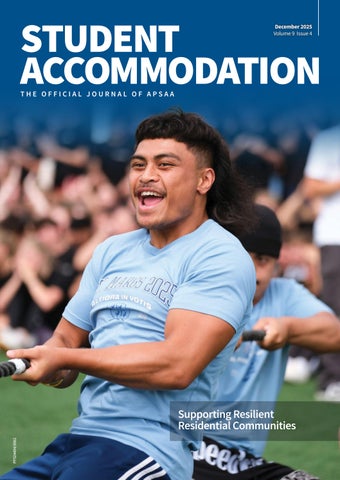
26 APSAA OFFICE PO Box 7345 Beaumaris VIC 3193 03 9586 6055 admin@apsaa.org.au ADVERTISING 03 9586 6055 manager@apsaa.org.au DESIGNER Perry Watson Design COVER Lipo Sii is a resident of St Margaret’s College, University of Otago, Dunedin. Lipo is the first in his family to attend university and is returning to St Margaret’s for his third year in 2026, because he values the family-like environment and support that the College and residential living offers.
Student Accommodation December 2025 3
President’s Welcome
JACOB WAITERE General Manager Portfolio – Canterbury, UniLodge Aotearoa; APSAA President
Tēnā koe. Welcome to the final edition of Student Accommodation for the year.
T
his December journal brings together the themes that feel most important as we head into the festive season. Alongside our regular updates, this edition carries a strong focus on wellbeing and mental health. We are fortunate to have a contribution from Headspace, a series on resilience from Martin Thomas, and reflections from across our membership that remind us how much care, connection and self compassion matter at this time of year. You will also find insights from the RA questionnaire that asked our student leaders how they look after their communities and how they look after themselves. Their responses are thoughtful, practical and show the growing maturity of student leadership in our sector. It is a timely reminder that wellbeing is not one size fits all and that the small moments often make the biggest difference. This year has been one of significant movement, both for APSAA and for our sector more broadly. Across Aotearoa and Australia, we are seeing growth in student accommodation infrastructure, new partnerships and renewed investment in our profession. In Aotearoa we have new PBSA developments progressing in Christchurch and further activity underway across the country. In Australia we are seeing new PBSA coming online in Perth and continued expansion in key regions. This growth reflects both the increasing demand for high quality accommodation and the essential role our members play in supporting thriving student communities.
4 www.apsaa.org.au
Across APSAA more broadly, we have also achieved a number of significant milestones this year, including: • The establishment of Regional Branch Committees resulting in record high involvement of volunteers in our Association • Canberra and New South Wales Summits • Amazing turnouts at our summits and regional networking: – Sydney, Canberra, Adelaide, Brisbane, Aotearoa, Melbourne and Perth • GHTI in Gatton, Queensland and Student Accommodation Essentials in Wollongong, New South Wales • Hundreds attending our webinars • A new Memorandum of Understanding with IASAS, with a joint webinar already completed • Ongoing work on the revised Sector Guidelines • Continued representation with Universities Australia on the National Student Safety Survey Thank you to everyone who has attended, presented, facilitated or supported these events. The strength of APSAA comes from the willingness of our members to share best practice, challenge ideas, and uplift each other. As we close out the year, I want to acknowledge the work of our committees, volunteers and contributors. Your energy, expertise and commitment ensure our profession stays connected and
forward looking. I also want to recognise the extraordinary work happening within your own communities. Student accommodation is a profession that asks much of us and you continue to rise to that responsibility with integrity and care. Finally, I want to wish you and your whānau a safe and restful holiday season. Please take the time you need to recharge and restore. Our work matters, but so too does looking after ourselves. Thank you for your support throughout the year. I look forward to seeing you all in 2026 for another year of community, connection and professional growth. Ngā manaakitanga
Jacob Waitere President | Tumukai APSAA
From the Editor
A
s we come to the end of another remarkable year, it’s worth pausing to reflect on just how far we’ve come as an association. In 2025, APSAA took significant steps in strengthening our community across the Asia Pacific, establishing new regional branches that have delivered more in-person networking events and full-day summits than ever before in our organisation’s history. These localised connections and professional development opportunities truly bring our vision to life, supporting and nurturing excellence within the student accommodation profession. This edition of the Journal focuses on a theme close to many of our hearts: building resilience, both in our students
SIMONE GALLO National Manager Student Accommodation, Australian Catholic University; APSAA Vice President; Communications and Engagement Committee Chair
be all-consuming. As we look back on a year of growth, challenge, and shared purpose, I hope you will take a moment to consider how you might incorporate a little extra self-care into the holiday period ahead. And as we return in the new year recharged and ready to welcome another cohort of bright, hopeful first-year students, I encourage you to carry those habits of care with you. By looking after yourself, you ensure you can bring your best, most energised self to the important work we are entrusted with. and in ourselves. I often say that working in student accommodation is a calling; a vocation rather than just a job. The work is meaningful and rewarding, but it can also
Thank you for everything you contribute to our community. Take care, rest well, and enjoy this final edition for the year.
Industry Movements VIC
WA Margarita Santana – Promoted to Village Manager, ECU Village (previously Operations Manager).
Mark Sampson – Departed role as Principal, University Hall, UWA, after nine years of service.
Sam Johnstone – Moved from Deakin Residential Services to Manager, Student Life at The Gordon TAFE.
Kashish Gambhir – Appointed General Manager, UniLodge Perth Central (previously Village Manager, ECU Village).
Michelle Marr – Appointed Interim Principal, University Hall, UWA for the next 12 months.
Trent Orchard – Commenced as General Manager, Geelong, Deakin Residential Services
Arunthini (Ari) Thinamani – Appointed Residential Life Coordinator, University Hall, UWA (previously Administration and Event Assistant).
Itai Avisar – Transitioned from Campus Life Officer to Senior Officer, Future Resident Engagement, Deakin Residential Services.
Student Accommodation December 2025 5
Committee Reports
SIMONE GALLO
Communications and Engagement Committee Report
Summary The Communications and Engagement Committee (CAE) has continued to champion APSAA’s strategic goals through intentional storytelling, member-driven content, and meaningful engagement across our key communication channels. This year, our focus has been on expanding APSAA’s visibility and influence, amplifying member voices, and ensuring that every piece of content we produce reflects the vibrancy and professionalism of our sector. From media engagement and social campaigns to the ever-popular Student Accommodation Journal, our communications have continued to showcase the expertise, care, and innovation that define our membership community.
Key Initiatives and Progress Media and Public Voice Building on the groundwork from last year, APSAA issued its first press release positioning the Association as a proactive, informed voice in the national conversation around student safety. Our statement of support for the Higher Education Code to Prevent and Respond to Gender-Based Violence marked an important milestone in strengthening APSAA’s public profile and advocacy presence.
Ongoing Communication Channels Student Accommodation Journal The Journal remains a cornerstone of APSAA’s communication strategy. Its refreshed glossy format has been widely praised, with each edition showcasing 6 www.apsaa.org.au
thought leadership, research, and member perspectives from across the region. The September issue—dedicated to the forthcoming National Code to Prevent and Respond to Gender-Based Violence, was a particular highlight, featuring insights from every corner of the sector as we prepare for a whole-oforganisation approach to student safety. E-Newsletters Our e-newsletters continue to thrive, with engagement and click-throughs consistently exceeding expectations. Members are particularly responsive to content that shares professional development opportunities, benchmarking insights, and sector updates. The growth in readership reflects the trust members place in APSAA as their go-to source for relevant, reliable information. Social Media Engagement continues to trend upward across all platforms. On LinkedIn, interaction rates remain strong, while Facebook and Instagram support broader community engagement and storytelling. The growing quality and consistency of our content demonstrate the Committee’s collective creativity and commitment to connection. Reflections and Acknowledgements 2025 has been a year of energy, creativity, and collaboration for the Communications and Engagement Committee. Our meetings are always full of fun, purposeful conversations where every member contributes generously—and often!
National Manager Student Accommodation, Australian Catholic University; APSAA Vice President; Communications and Engagement Committee Chair
A huge thank you to our new Vice-Chair, Jess Rokobaro (University of Newcastle), whose enthusiasm and ideas have added great momentum to the group, and to APSAA Manager, Annika Persson, whose skill and dedication bring all our collective efforts together. Annika’s work turns our raw ideas and draft content into the polished newsletters, media pieces, and Journal editions that so effectively represent our association. Most importantly, I want to acknowledge the entire Committee. You are what makes this group so rewarding to lead. Your energy, creativity, and commitment to supporting one another—and our members—continue to inspire me. I truly believe that sense of connection comes through in everything we publish. Looking Ahead In 2026, our focus will turn toward deepening APSAA’s impact by: • Measuring engagement across our communication channels to inform future content strategy; • Continuing to strengthen APSAA’s media and advocacy presence; and • Exploring new storytelling formats that highlight innovation, inclusion, and community within student accommodation. Together, we will keep amplifying the voices of our members and showcasing the collective expertise of our sector.
Professional Development Committee Report
2025 has been a fantastic year for the Professional Development Committee, with our webinars continuing to go from strength to strength. We’ve delivered a diverse range of topics to engage staff across every corner of the student accommodation sector.
in Mental Health. Sessions have focused on self-care, managing students with borderline personality disorder, and – coming soon – addressing genderbased violence and implementing the new National Code.
Our Speaker Series explored everything from supporting neurodiverse students and managing the impacts of natural disasters, to student-focused debt management and enhancing the resident experience through pre-arrival communication.
All webinars are recorded and available on demand via the APSAA website, with CPD points available for each session.
Recognising the growing need to address mental health concerns among residents, we launched the Community of Practice
Our professional development calendar has been further enriched by regional engagement groups, delivering faceto-face panels, workshops, and networking events across the country.
ANDREA ROHDE Deputy Principal, Flinders Living, Flinders University SA; APSAA Board Member; Professional Development Committee Chair
A heartfelt thank you to all our presenters for generously sharing their expertise – and to the Committee for their tireless work behind the scenes in making it all happen.
MARK POTGIETER
Research and Knowledge Committee Report
A
s we move toward the close of another academic year, the Research and Knowledge Committee is pleased to share an important milestone in our work to refresh and strengthen the APSAA Sector Guidelines. After eighteen months of drafting, consultation and refinement, the first full version has now been submitted to the APSAA Board for review. The Board has provided its feedback, and the committee will meet once more before the end of 2025 to incorporate these final suggestions. The revised document will then be resubmitted for approval in January 2026. Once endorsed, members will receive further updates on release timelines and next steps.
Proposed high level timeline for the APSAA Sector Guidelines • December 2025: Committee to meet and incorporate Board feedback • January 2026: Final draft submitted to the APSAA Board for approval • February to Apr 2026: Preparation of communication material and member resources • Mid 2026: Release of the approved guidelines to all APSAA members
Internationalisation Special Interest Group Update Earlier this year, the APSAA Board approved the formation of a Special Interest Group for Internationalisation, with oversight and membership from the Research and Knowledge Committee. This group is led by Greg Scott, Director Accommodation Service at the University of Canterbury and long-standing member of the committee. The Internationalisation Special Interest Group aims to support the APSAA Board and standing committees to identify and respond to emerging trends in international education, and to challenge the sector to embed international, intercultural and global perspectives in the delivery of student accommodation. This work has been informed by earlier member workshops, which emphasised the importance of understanding the international student journey and focusing on the stages where accommodation teams can create the greatest impact. The group will now take forward its initial activity plan following its meeting held on 13 October. Throughout our broader program of work, the committee has focused on ensuring the Sector Guidelines present clear principles
General Manager Accommodation Operations, The University of Sydney; APSAA Board Member; Research and Knowledge Committee Chair
that support consistent and high-quality practice across the sector. The guidelines provide a strong framework to support operators, universities and partners as expectations and responsibilities evolve. I want to extend my sincere thanks to every member of the Research and Knowledge Committee for your ongoing commitment and the considerable personal time you have devoted to this work. Your contributions reflect the strength of our volunteer community. I also want to acknowledge all APSAA committee members across Australia and New Zealand for your continued support and dedication. The collective effort across all committees ensures APSAA continues to grow, influence and uplift the sector year after year. As we wrap up another year of supporting our students and teams, I hope you each find time to rest and reconnect with family and loved ones. I look forward to seeing many of you at the Student Accommodation Essentials Workshop in Wollongong or at the APSAA Conference next year. Student Accommodation December 2025 7
Aotearoa Regional Branch Report
ABIGAIL FREDERIKSE Accommodation and Campus Life Manager, University of Canterbury NZ; APSAA Aotearoa Regional Branch Chair
As we approach the end of 2025 we can look back over a year of growth and change for our members in Aotearoa -New Zealand.
O
ur 2024/25 Chair Tara Baker has been elected to the APSAA Board of Directors, and whilst she will stay as a vital member of the group, I have stepped up from the role of Vice Chair to the Chair. I look forward to working with the existing and new members. It has been fantastic to see more of our NZ members in all the journals this year including Martin Thomas writing about residential wellbeing, and Lincoln University ‘s article on their programme of works to change their heating systems to address students desire to be more sustainable and to reduce carbonisation. We also had good representation at this year’s conference where colleagues presented and facilitated workshops. The conference
8 www.apsaa.org.au
focused on the new Australian National Code against gender-based violence providing data on the number of sexual harm cases which was sobering. Although our own Tertiary & International Leaners Code of Practice does not specifically address gender-based violence, we unfortunately have all seen the effects of sexual harm within student accommodation; it is a complex issue. Te Whare Tāwharau – The University of Otago has implemented a whole of campus approach to sexual violence prevention, a survivor led system which embeds the Tiriti O Waitangi principles- (The Treaty of Waitangi) partnership, participation, and protection.
school leavers applications from 2-20%. It has led to a lot of movement in offer acceptances and between institutions.
The application session has been dynamic this year and most New Zealand institutions have experienced an increase in domestic
With demand increases there are several new facilities in development planned to open in 2026 and 2027. Tupuārangi at
the University of Canterbury will provide 283 ensuite beds for first year students in February. There are also plans to increase non catered accommodation by 400-1000 beds within 5-8 years. Lincoln University will increase supply by 93 beds and are currently procuring a contractor to build a 250-bed hall. An additional 75 bedrooms in townhouses and modular buildings will be completed at University of Waikato in time for semester 1 2026. The refurbishment of O’Rorke hall has been completed at University of Auckland and are planning a 900-bed studio complex to open in 2027.
2025 Aotearoa Summit University of Waikato, 17 November 2025 The Aotearoa Summit took place in November. Over the last few years the yearly summit has been held in one of NZ’s bigger cities but this year we are delighted that University of Waikato hosted us. Jacob Waitere spoke about how the current Residential Assistant (RA) models are now not fit for purpose. As part of looking at a new way forward, UniLodge have been mapping students journey in accommodation to enhance their mana; for this they have used a very New Zealand concept of the Pōwhiri.
A pōwhiri is the traditional Māori welcome rich in symbolism, protocol, and cultural meaning. It recognises the coming together of two groups separated both physically and spiritually in a powerful expression of whanaungatanga (connection), Tiakitanga (guardianship) and manaakitanga (hospitality). It is a process of establishing relationships and affirming shared values. In partnership with the University of Canterbury, UniLodge will be implementing
a new hybrid model of Taurima (RA’s) and Residential life Assistants (RLA), with Taurima focusing on community building and events and RLA’s will conduct welfare checks and intentional conversation with residents. Chris Beard and Greg Scott discussed the expected 15,000 increase in the international student numbers in the coming years and how to support these students in their transition to accommodation and to Aotearoa (New
Student Accommodation December 2025 9
Aotearoa Regional Branch Report
Zealand). This included some great resources to help understand cultural differences and norms such as EAP Foundation that can analyse your communications to make them more accessible to international students. Martin Thomas continued from his workshop on student resilience issues from this year’s conference; this issue of the journal also has an article on his findings. The need for promoting a balance in students’ lives was the topic of Liz Koni and Jacqui Earland's prestation on their pastoral care model at St Margarets. This is based on the Te Whare Tapa wha, a holistic Māori model of health that views wellbeing as a meeting house with four walls, representing the four dimensions of health: taha tinana (physical health), taha hinengaro (mental and emotional health), taha whānau (family and social health), and taha wairua (spiritual health). Developed by Sir Mason Durie in 1984, the model emphasizes that all four dimensions are interconnected and must be in balance for a person to be healthy; if one wall is damaged or weak, the entire structure is affected. The last presentation was from Leah Tamaese from Ratonga Hauātanga Tauira | Student Disability Services (SDS) at the University of Auckland on neuro-affirming support, what does it really mean to be “sensory friendly” and how best do you support neurodivergent students with vastly different needs.
Rodney Arnold accepting his award with Jacob Waitere and Tara Baker
Fred Johnson Award for best practice/professional achievement in Aotearoa Rodney Arnold, University of Waikato The Summit was also an opportunity to present the APSAA Fred Johnson Award for Best Practice & Professional Achievement in Aotearoa to Rodney Arnold from the University of Waikato. Rod has dedicated over 20 years of service to Residential Life at Waikato University and was also an active Executive Member of NZAEAP for more than 10 of those years (including two terms as Vice President before our merger with APSAA). Throughout his tenure, Rod has selflessly contributed countless hours to the advancement of our industry in Aotearoa. With a background in Law, Rod has consistently been the go-to person for navigating the legal aspects of our work. His expertise has been invaluable, from advising on constitutional changes under NZATEAP to providing advice to our members during the NZ Parliamentary inquiry into Student Accommodation and the reintroduction of the Pastoral Care Code of Practice.
10 www.apsaa.org.au
The Fred Johnson Award for Best Practice and Professional Achievement in Aotearoa recognises members who have introduced an innovative or outstanding work practice, or who have provided exceptional service that delivers clear benefits to students or staff within their residence or to the wider industry. Recipients must be based in Aotearoa New Zealand. Fred Johnson served as Principal of University Hall at the University of Canterbury from the mid-1990s until his sudden passing at age 60 in 2001. During his tenure, Fred oversaw the development and expansion of University Hall, which opened in 1998. He helped establish a more community-centred residential experience—an approach that continues to shape the way halls of residence operate today. It’s been quite the year!! To the Aotearoa Regional Branch, I hope you have a restful Christmas break, you deserve it. Meri Kirihimete (Merry Christmas)
Focus on Facilities
MAREE WILSON Village Director, Griffith University Village
Griffith University Village
G
riffith University Village has reached an exciting new milestone in the delivery of its landmark student accommodation tower, with the project now topping out. This achievement marks a significant step in the development journey, as the new multi-storey residence moves closer to welcoming its first cohort of students in late 2026. Since construction began in August 2024, the project has been carefully managed to balance progress with the ongoing needs of our student community. The team at Built, working in partnership with Griffith University’s School of Engineering and Built Environment, has played an integral role in delivering this stage of the build. In a unique collaboration, students from Griffith’s engineering and built environment
programs have had the opportunity to engage directly with the project, gaining real-world insights into construction, design, and project management. This partnership has highlighted the development not only as a place to live, but also as a live learning environment. The new tower will add 460 beds to Griffith University Village, complementing the existing 517-bed community and delivering a range of modern living options including studios, two-bedroom apartments, and accessible units. Alongside this, residents will enjoy resort-style amenities such as a swimming pool, upgraded gym, expanded Village Green, contemporary study and collaboration spaces, and vibrant social areas. While the build progresses, our operational focus has remained firmly on enhancing
the student experience. Through our continued partnership with the Griffith University Student Guild, we have further developed our residential life program— providing engaging events, wellbeing initiatives, and opportunities to connect students with the broader campus. This focus on student experience has been critical to maintaining strong retention and ensuring our current residents continue to feel at home within the Village. Looking ahead, preparations for 2026 are well underway. Recruitment and retention efforts for the upcoming academic year have already commenced, with interest levels running high. To date, confirmed bookings for 2026 have reached 40%, underscoring both the strong reputation of Griffith University Village and the demand for high-quality, on-campus student accommodation. As we move towards completion, our priority remains clear: delivering a welcoming, supportive, and dynamic living environment where students can thrive academically, socially, and personally. With the tower now reaching its topping out milestone, we are proud to celebrate the progress made so far—and look forward to the opportunities ahead as we continue to grow and strengthen our partnership with Griffith University and the Student Guild. The future of student living at Griffith University Village is bright, and this development represents a key step towards building a community that is not only modern and sustainable, but also deeply connected to the student experience.
Student Accommodation December 2025 11
Focus on Facilities
DANIEL ELVIN
John Fisher College – Kitchen and Common Room Refurbishment – Update
Before images
Manager, Campus Accommodation, University of Tasmania
I
n June, we shared our plans for the refurbishment of the Kitchen and Common Room at John Fisher College. Since then, the project has progressed, albeit with a few more unexpected delays! The process began in 2024 with a comprehensive tender, followed by the selection of architects and builders. While construction was originally scheduled to begin in early June, unforeseen issues pushed the start date to late July. As highlighted in our previous article, engaging with our residential community has been a priority throughout this journey. Our Dean of Students has played a key role in maintaining open communication with residents, helping to manage expectations around noise, access, and the temporary use of another college’s kitchen and common spaces.
Artists renders of what finished product will look like
12 www.apsaa.org.au
Current work in progress
Our 2025 RES Survey reinforced the importance of this project. Residents at John Fisher College highlighted that the existing facilities were in need of improvement, describing the space as
uninviting and not truly functional. This feedback has validated our efforts and reaffirmed the need for a space that fosters connection, comfort, and usability.
Now, as we approach the end of the year, we’ve encountered a few hiccups meaning the new space won’t be ready for our 2025 residents. However, before the current contracts conclude, we plan to organise a walkthrough with the builder so residents can see the transformation underway. The improvement in amenity and atmosphere is remarkable. What was once a cold, utilitarian space, used only for cooking, will soon become a warm, welcoming hub for connection and community.
Student Accommodation December 2025 13
Focus on Facilities
ANDREW EUNSON
New Fire Pit Sparks Connection at King’s College
I
n 2025, King’s College unveiled its new Fire Pit, a purpose-built outdoor gathering space designed to foster connection, conversation, and calm. More than just a new architectural feature, it represents the College’s deepening commitment to student wellbeing in an increasingly fast-paced, digital world.
flames, the warmth in the air, and the natural stillness invite people to speak openly, or simply sit in silence. In a world that often prioritises productivity, the Fire Pit encourages presence. Conversation flows more naturally, and moments of quiet feel not awkward but welcome.
For thousands of years, fire has brought people together. It has offered warmth, safety, and a natural space for storytelling and reflection. At King’s, this timeless ritual has been thoughtfully reimagined to support the needs of today’s students. The Fire Pit now provides residents and associates with a welcoming, screen-free space to unwind, reconnect, and be present.
Storytelling, whether about childhood adventures, personal struggles, or dreams for the future, remains at the heart of the experience. The Fire Pit has quickly become a place for honesty, laughter, reflection, and connection. Importantly, it is also a place students can truly call their own. Whether used for spontaneous late-night chats, quiet contemplation, or relaxed post-event gatherings, the Fire Pit is inclusive, unstructured, and open to all.
“Fire has always created space for conversation and community,” says Deputy CEO and Director of Collegians’ Experience, Andrew Eunson. “We wanted to build a place where students could slow down and truly engage with one another, and that’s exactly what’s happening.” The benefits of sitting by a fire go far beyond tradition. The gentle flicker of
“We hope it becomes a timeless part of college life,” Andrew adds. “A place where stories are shared, friendships are formed, and memories are made.” Designed and constructed by the College’s Property and Facilities Manager, Chris
Property and Facilities Manager, Chris Houston, working with a resident during construction
14 www.apsaa.org.au
At the end of construction
Deputy CEO and Director of Collegians’ Experience
Houston, the Fire Pit was created to feel both intentional and effortless, seamlessly integrated into the landscape while offering a sense of retreat. “I wanted the space to be calming and open,” says Chris. “A place that feels natural but also draws people in. The idea was to encourage students to pause, talk, and just be themselves.” With seating arranged in a semi-circle, the design also makes the most of King’s spectacular setting, allowing students to sit facing out over the Brisbane River as they gather around the fire. In reviving this ancient ritual, King’s College offers its community something increasingly rare: a place of stillness, belonging, and genuine connection. In doing so, the Fire Pit has already become one of the most meaningful places on campus, a space where the simple act of sitting together can have a lasting impact.
King’s College is located along the scenic Brisbane River near The University of Queensland’s St Lucia campus. Since 1912, King’s has empowered over 10,000 Collegians to achieve academic excellence, grow as leaders, and build lifelong connections. King’s offers a welcoming home for students from across Australia and around the world, providing a rich, fully supported co-residential experience. To learn more about King’s College, visit www.kings.uq.edu.au
Residents gather around the new firepit at the beginning of Semester 2, 2025
MELISSA YEO
A New Chapter in UWA Accommodation
T
he University of Western Australia will open its first Purpose-Built Student Accommodation (PBSA) on campus in 2028, adding 847 beds across 671 apartments to the Live at UWA portfolio. For more than a century, UWA’s accommodation offering has centred on the five Residential Colleges with their vibrant university community; where students receive academic support, enjoy nutritious
meal plans, and participate in social and cultural activities, alongside Crawley Village’s postgraduate and family housing. This new development introduces a third pillar: a PBSA model that provides students with a modern, independent living option while retaining a strong connection to campus life. From a strategic perspective, this project represents more than additional capacity. It marks a portfolio diversification strategy,
Program Manager (Accommodation & Commercial Services)University of Western Australia
creating a middle-ground option between the highly structured, all-inclusive college model and the independence of private rentals. This differentiation is intended to better align accommodation with the varied expectations of UWA’s growing and diverse student body. The 14-storey building also demonstrates UWA’s commitment to sustainability leadership, targeting a 5-Star Green Star rating with electrification, rooftop solar, sustainable waste management, and a 20% reduction in upfront carbon emissions. This PBSA signals how UWA seeks to broaden her accommodation mix to address market demand while enhancing the student experience through differentiated products. Rather than duplicating existing offerings, the project creates new pathways for students seeking a balance — whether they’re looking for all-inclusivity, independence, or something in between.
Artist's render of Hampden Road looking north vie. Plus Studio: Attributing drawings/imagery
Student Accommodation December 2025 15
Focus on Facilities
MARITZA KLOPPERS
O’Rorke Hall: A Beloved Student Home Gets a Modern Makeover
L
ocated at 16 Mount Street in central Auckland, O’Rorke Hall has been a vibrant part of University of Auckland student life since the late 1980s. For decades, it has housed around 366 first-year students, providing not just a place to stay but a place to belong. But after years of use, the hall was due for an upgrade to match the evolving needs of modern students. Since 2022, a carefully planned refurbishment has been underway — bringing fresh life to this iconic residence while preserving its unique community spirit.
A Legacy of Community Living O’Rorke’s signature “pod-style” layout groups residents into clusters sharing bathrooms
Sudy Pods
and communal lounges, fostering strong connections between students. Its central location close to campus and downtown Auckland makes it a top choice for firstyears eager to dive into university life.
Poutaki Wharenoho | Resident Manager, Waipapa Taumata Rau | University of Auckland
Dining Hall
Voices from O’Rorke Emma, a current resident, shares: “Living here during the refurbishment has been a bit noisy at times, but it’s exciting to see the changes. The new rooms feel so much brighter and more welcoming.” Tom adds: “The pod system makes it easy to make friends, and with the upgrades, the communal areas are becoming great places to hang out after classes.”
Creating Spaces That Bring Students Together Beyond individual rooms, the hall’s dining area is being transformed into a vibrant social hub with flexible seating and multiple servery stations, encouraging students to gather beyond mealtimes. Outdoor courtyards and laundry facilities are also being refreshed, completing the building’s transformation into a modern, community-focused home.
16 www.apsaa.org.au
Before
Looking Ahead By the end of 2025, O’Rorke Hall will be fully revitalized — blending its rich history with contemporary comforts. For incoming students, it will remain a welcoming, social, and central home base for their first year at the University of Auckland.
Courtyard
After
Renovating a fully occupied building has been challenging, but the staged approach means students continue to live, learn, and connect throughout the transformation.
honouring tradition while embracing the future. It’s not just a place to sleep, but a space where lifelong friendships are formed and university memories are made.
O’Rorke Hall’s Journey O’Rorke stands as a shining example of how university accommodation can evolve —
Before
After
Student Accommodation December 2025 17
Focus on Facilities
JESS ROKOBARO
New build – University of Newcastle, Newcastle CBD Time to opening – 12 months
General Manager, Student Living, Academic Division
On the ground: site progress Technical coordination has progressed strongly, with building services workshops held with engineers and subject matter experts to refine the technical requirements of the building and ensure integrated planning across all disciplines. In early December, Student Living team members and the project team will assess the full suite of internal finishes to ensure all options have been considered and the physical products meet expectations. A site visit will occur concurrently, giving stakeholders an opportunity to view the latest progress on the ground. On site, substructure works and in-ground services installation continue to advance. Lift pit excavation has progressed significantly, supported by active dewatering systems that enable safe and effective work within the deeper sections of the structure.
Looking ahead The project is now approaching its next major construction milestones. The ground floor slab pour is planned for late 2025, marking a key transition point from the foundational stages to vertical construction. The building’s upper floor structure is scheduled to commence in early 2026, signalling the beginning of significant above-ground progress. We look forward to sharing further updates as the development continues to rise and take shape in the Newcastle CBD.
18 www.apsaa.org.au
Building Belonging Off-Campus
MELISSA YEO Program Manager (Accommodation & Commercial Services) University of Western Australia
UWA’s PBSA Partnerships
A
s student enrolments grow across Australian universities, PurposeBuilt Student Accommodation (PBSA) partners are becoming an increasingly important part of the student experience. At the University of Western Australia (UWA), we have been exploring how to move from transactional arrangements to genuine collaboration with our PBSA colleagues in Perth City. Over the past three years, UWA’s engagement with PBSA providers has shifted from limited interaction and general referrals, to embedding them into our broader accommodation, wellbeing, and student engagement frameworks and aspirations.
Building Collaboration A key mechanism has been quarterly forums, UWA’s Student Accommodation and Community directorate brings together internal divisions, affiliated residential colleges and external PBSA providers. Guided by six key themes — enhancing connections with UWA departments, fostering shared responsibility for the student experience, raising awareness of sector trends and interdependencies, sharing data and solutions, promoting collaborative engagement, and creating
space for professional development — these sessions aim to become a platform for meaningful collaboration. The result has been conversations that go beyond logistics into meaningful exchange. For example, workshops on wellbeing and first-year experience have surfaced shared challenges among stakeholders— from international student transitions and language barriers to life skills and confidence building. These conversations have also sparked opportunities to adapt existing UWA programs and inductions to support a wider cohort of students. Conversation on the university’s aspirations to grow and support student equity initiatives have opened to a larger conversation of how accommodation providers can support such initiatives.
Embedding PBSA into Student Wellbeing In partnership with UWA Student Life directorate, our wellbeing model has expanded beyond campus. What was once an internal staff–student resource now extends to partner PBSA providers across Western Australia. This ensures providers have access to referral pathways, knowledge of support services, and direct channels to connect with UWA, enabling more coordinated care for students.
Fostering Belonging for Off-Campus Students Together with PBSA partners, UWA has also piloted initiatives to strengthen community among students living in Perth City. Recent and upcoming workshops — from elevator pitch practice to networking skills — are designed to connect students across different PBSA buildings and link them back to campus life. The goal is to create a PBSA Perth City student network, reducing isolation and fostering belonging among students living off campus.
Reflection By extending collaboration, wellbeing frameworks, student engagement initiatives and UWA’s aspirations to better service our student community to PBSA providers, UWA is reshaping how off-campus accommodation connects back to campus life. For UWA, this model acknowledges the value of moving from transactional to truly collaborative relationships for the betterment of the student experience.
Student Accommodation December 2025 19
Resilience Issues in Residential Communities
MARTIN THOMAS General Manager, Hatch Student Living
Executive Summary Resilience is a growing concern in tertiary student communities, with accommodation staff reporting far more behaviours linked to a lack of resilience than examples of strong coping skills. Common challenges observed include avoidance of problems, difficulty accepting responsibility, overreliance on parents or staff, and defensive reactions to feedback. These behaviours often leave students struggling to manage setbacks, responsibilities, and change. At the same time, many students do demonstrate resilience—seeking help appropriately, solving problems proactively, adapting to change, and persisting despite obstacles. These behaviours highlight the potential for growth when the right supports are in place. Accommodation staff also acknowledged that current accommodation practices may sometimes undermine resilience by doing too much for students or shielding them from failure. To strengthen resilience, participants suggested workshops, greater accountability, peer mentoring, and a shift towards coaching rather than fixing. Accommodation settings, with their daily challenges and support structures, are uniquely placed to foster resilience that benefits students for life.
Residential Student Resilience Issues Across both tertiary education and the workplace there is growing concern about declining resilience amongst young people. What was once an occasional observation is now voiced with growing frequency and 20 www.apsaa.org.au
“Participants identified nearly twice as many behaviours linked to a lack of resilience as they did examples of resilient responses, highlighting both the scale of the challenge and the opportunity for staff to rethink how they support students.” often in increasingly critical tones. For those of us working in student accommodation, this raises pressing questions: is the concern valid, how is it showing up in our residential communities, and most importantly, what can we do about it? To explore this, a workshop was held at the APSAA Conference in Melbourne in May 2025 with around 20–30 tertiary accommodation industry professionals mostly from across Australia and New Zealand. The broadly representative group reflected, in small groups, on what they are observing among students, and whether accommodation practices may be in part contributing to the problem or could instead be part of the solution. The session brought together professionals from a range of different accommodation settings to share insights and experiences, highlighting the need for a more considered and nuanced approach to supporting student wellbeing. A telling outcome from the session was the imbalance in participants observations. Participants identified nearly twice as many behaviours linked to a lack of resilience as they did examples of resilient responses. This imbalance underlines both the scale
of the challenge and the opportunity for staff to rethink how they support students in developing the skills and attitudes needed to cope with modern life.
Lack of Resilience in Student Communities Participants described a wide range of behaviours that signal difficulty in coping with challenge. The most common theme was avoidance. Students were seen procrastinating, avoiding classes, or burying themselves in unrelated activities to escape responsibilities. Financial or academic pressures often triggered a ‘head in the sand’ response, with problems left to fester until they became critical. A second recurring theme was accountability, or lack of it. Students were quick to blame others—peers, staff, or systems—rather than reflecting on their own role. Even small setbacks were sometimes dramatised, while parents were frequently called in to solve problems that students could or should manage themselves. Participants described instances of ‘helicopter parenting’ where parents not only advised but actively intervened in academic or personal matters. Feedback and criticism were also flashpoints. Some students lost confidence
or gave up after receiving constructive criticism, while others became defensive or dismissed guidance altogether. In these cases, challenges were often internalised as personal failures rather than viewed as opportunities for growth. Participants also reported an over-reliance on external support. Students sought help before attempting tasks independently, escalated trivial complaints, or leaned on staff to mediate conflicts. In some cases, even dissatisfaction with meals provided was treated as insurmountable. The behavioural effects were visible: withdrawing from sports or group activities after rejection, disengaging socially, focusing on self-interest over community, neglecting basic responsibilities like room upkeep, or
struggling to recover quickly from setbacks. Many displayed heightened stress and anxiety and avoided direct communication, relying instead on passive or avoidant strategies. Together, these behaviours reflect a cohort often struggling with self-regulation, problemsolving, and coping with change—skills essential not only for academic success but also for life beyond university.
Signs of Resilience The picture was not entirely bleak. Participants also shared encouraging examples of students showing resilience in action. A notable strength was appropriate helpseeking. Many students demonstrated the maturity to ask for support when
needed without expecting others to solve problems for them. These students reached out for feedback, sought mentoring, and acted on guidance with the aim of learning and improving. Proactive problem-solving was another encouraging theme. Students made plans, developed back-up strategies, and tried to resolve difficulties independently. Self-awareness and accountability were often visible—owning mistakes, recognising limitations, and persisting even after setbacks such as poor grades or missing out on sports selections. Resilience was also expressed through engagement and commitment. These students threw themselves into academic and community life, managed their own
Student Accommodation December 2025 21
Resilience Issues in Residential Communities
finances, or returned to studies after an unsuccessful semester. Such behaviours reflected determination and long-term focus. Flexibility and adaptability were further markers of resilience. Students who accepted change gracefully—whether it was adapting to a meal that wasn’t their preference or coping with unexpected disruptions—demonstrated practical resilience in everyday situations. In emergencies, resourcefulness and calm problem-solving were also on display. Perhaps most importantly, many students showed the ability to persist through adversity. They ‘soldiered on’ in the face of difficulty, remained engaged socially and academically, and demonstrated a determination to recover and keep going. These qualities not only benefited individuals but also strengthened the cohesion of the wider student community.
How Accommodation Practices May Undermine Resilience In reflecting on their own roles, participants acknowledged that some accommodation practices may unintentionally weaken resilience.
“By embedding resilience-building into programming, accountability structures, and everyday interactions, accommodation teams can help students grow in ways that will serve them well far beyond their time in residence.”
Similarly, inconsistent communication across staff created confusion and reliance rather than clarity and self-direction. Finally, participants noted the need to shift from doing things for students to equipping them with tools. While task completion may seem efficient in the moment, it erodes coaching and mentoring opportunities that help students develop problem-solving skills.
Things to Avoid
One risk lay in providing too much support. Over-catering to individual needs, stepping in to ease discomfort, or completing tasks students could manage themselves often fostered dependence rather than independence.
Participants agreed on practices best avoided if resilience is to be built. Chief among these was jumping in too quickly to fix issues or provide instant solutions. This not only undermines patience but prevents students from learning persistence.
Another tension was the balance between duty of care and enabling dependence. While staff must ensure student wellbeing, being over-responsive—such as providing instant answers or shielding students from failure— can deny them valuable learning experiences.
Participants also warned against slipping into a parental role, which blurs professional boundaries and fosters dependency. Similarly, doing too much on students’ behalf can entrench helplessness. And while parents are an important part of many students’ lives, allowing them to intervene directly in residential issues was seen as counterproductive.
Communication and boundary-setting also mattered. ‘Open door’ policies or frequent consultation sometimes blurred lines between support and over-engagement, leading students to expect involvement in matters where independence should be encouraged.
22 www.apsaa.org.au
Things We Could Do Participants also identified positive opportunities to strengthen resilience.
Workshops were suggested as a practical tool—covering both resilience itself and practical university skills such as planning and organisation. Another key theme was accountability. Encouraging students to make their own phone calls, manage personal tasks, and take ownership of decisions would help them grow in confidence and independence. Peer-to-peer support was seen as particularly powerful, with senior residents guiding and mentoring newcomers. This not only builds individual resilience but fosters a sense of community. Participants also reflected on their own approaches: listening more, exercising patience, and adopting a mentoring style rather than simply solving problems. By embedding resilience-building into programming, accountability structures, and everyday interactions, accommodation teams can help students grow in ways that will serve them well far beyond their time in residence.
Looking Ahead The workshop made clear that student accommodation can play a critical role in resilience-building. While many students arrive with limited coping skills, the residential environment offers daily opportunities to practise independence, problem-solving, and adaptability within a supportive setting. The feedback from participants was that this is an important and thought-provoking topic deserving of more time and attention. A follow-up article will examine the likely underlying psychosocial factors contributing to the observed trends, and offer further suggested guidance, safe approaches, and practical tools to help build resilience and strengthen community wellbeing in student accommodation environments. The aim is to help students not only to cope but to thrive in both their academic and personal lives.
Managing Wellbeing and Understanding Vicarious Trauma in Student Accommodation
W
orking in student accommodation means much more than managing rooms and facilities - it’s about supporting young people through one of the most formative and sometimes challenging periods of their lives. Regardless of a person’s role within student accommodation, staff often find themselves deeply connected or impacted by a students’ personal experiences. This emotional involvement can be rewarding, but it can also take a toll. To further support our staff, the Student Living team recently attended a full day Managing Wellbeing and Understanding Vicarious Trauma training session. The training provided valuable insight into how team members can protect their own mental health while supporting others. The program focuses on recognising and addressing vicarious trauma, which is defined as the emotional and psychological impact that can arise from empathic engagement with someone else’s trauma or distress. For staff in student accommodation, this might look like feeling emotionally drained after supporting a distressed student, becoming overly concerned about residents’ safety, or losing motivation at work. The training distinguishes vicarious trauma from burnout (caused by workload stress) and compassion fatigue (emotional exhaustion from caring for others). While these are related, vicarious trauma is unique in that it can subtly alter one’s sense of safety, trust, or control.
JESS ROKOBARO General Manager Student Living, Academic Division University of Newcastle
“When accommodation staff are supported and emotionally well, they are better equipped to create safe, inclusive, and supportive environments for residents.”
We explored vicarious resilience which is the positive transformation that can occur when witnessing the strength and recovery of others. Staff often see students adapt, grow, and find new coping skills after challenges. Focusing on these moments of resilience can result in a renewed sense of purpose and help team members stay motivated. A key aspect of the training was selfcompassion, when we allow ourselves the same understanding and empathy that we offer to students to build our emotional resilience. We learned that self-compassion includes, amongst other practices, mindfulness and showing kindness to oneself rather than self-criticism. The training also provided practical strategies for self-care across several areas; physical, social, psychological, environmental, and spiritual. For example, setting boundaries with work-related communications, creating calm spaces, maintaining supportive relationships beyond work, and engaging in creative or reflective activities can all promote wellbeing.
Importantly, the training emphasised that managing vicarious trauma is not just an individual responsibility and that organisational support is crucial. Student accommodation providers can foster a culture of care by encouraging reflective supervision, offering access to wellbeing resources, normalising debriefing after difficult incidents, and providing regular opportunities for staff training and connection. By the end of the workshop the team had a deeper understanding of how empathy, resilience, and organisational culture intersect to support both staff and students. The message is clear: when accommodation staff are supported and emotionally well, they are better equipped to create safe, inclusive, and supportive environments for residents. If you would like more information about the training course or provider, please reach out to jess.rokobaro@newcastle.edu.au
Student Accommodation December 2025 23
COURTNEY WOODBERRY
AISLINN WHITTENBURY
Headspace Schools & Communities University Support Program Consultant
Headspace Schools & Communities Clinical Lead
The importance of suicide postvention planning in student residential settings Headspace University Support Program
A
ny university may find themselves responding to the suicide of a member of their community at any time. It is often difficult to navigate the practical and emotional complexities that come with responding to suicide sensitively and effectively, and the impact can create ripples of distress and risk that can touch many corners of the community.
students. In the aftermath of a suicide impact, it is especially important that the culture of the university community is supportive, and that help-seeking pathways are clear to all. However, many staff may not feel equipped to manage these situations or may not have the knowledge and guidance of detailed policies and procedures relating to suicide impacts or other critical incidents to guide them.
For universities to be places where people thrive both academically and personally, they need frameworks that foster positive mental health and wellbeing for all staff and
Postvention refers to actions undertaken following suicide with the aim of reducing the risk of further harm. Postvention activities aim to assist the bereaved, share hope- and
help-seeking messages, reduce risk and distress, and provide prevention for the future[i]. Comprehensive postvention planning is a key component of suicide prevention, as the risk of further harm and distress within the university community is reduced when staff feel better equipped and confident in responding to these critical incidents. Suicide exposure in university settings is typically more widespread and impactful than in the general population. This is, in part, due to interconnected communities and systems, e.g., academic departments, student services and support, residential locations, administration and leadership, the broader student community, and external stakeholders and partners[ii]. While interconnectedness can be a protective factor, it can also heighten exposure and impact in a community. Importantly, no two suicides – or institutional responses – are identical. The complex nature of suicide, combined with unique characteristics of the university and its community’s needs, means there is no universal approach to postvention. This is particularly relevant when looking at the nuances required in a postvention plan within a student residential setting in comparison to a whole-of-university plan.
The cover of our recently updated Responding to suicide: a toolkit to support Australian universities resource
24 www.apsaa.org.au
Some of the key considerations for the residential space may involve securing the deceased’s personal belongings,
Our model of postvention.
management of memorials on site, and expectations around the vacancy timeframe following a death. It is also important to understand which actions within a postvention response would be the responsibility of residential staff, and which sit with the broader university staff cohort. As an example of how postvention planning looks in practice, we have recently had the pleasure of working with Deakin Residential Services to develop a suicide postvention plan which will be rolled out across all of their student accommodation locations. The University Support Program facilitated a workshop for the Deakin Residential leadership team based on our Responding to Suicide: A Toolkit to Support Australian Universities resource, which outlines the guiding principles of postvention alongside the planning, response and recovery phases of postvention work. We then guided them through our Suicide Postvention Response Plan resource to identify the key roles in a Suicide Response Team or Critical Incident Team, and the specific actions that would fall to each of these roles if the plan were to be enacted in response to a critical incident. Together, with Deakin Residential leadership we were able to develop a comprehensive postvention plan, which uses the team’s shared knowledge and experiences across their unique locations and communities to ensure that their postvention plan provides meaningful
support for their staff and students, and is ready to be actioned, if needed. Through the development of a comprehensive postvention plan, you can ensure that your staff are prepared to respond confidently and effectively in the event of a suicide death or critical incident, which in turn creates a supportive environment for students where further risk to the community is minimised. Since 2022, the headspace University Support Program have been providing fully funded services to Australian universities under the Australian Government’s National Suicide Prevention Leadership and Support Program. We provide a multi-prong approach of staff professional development workshops, postvention planning, and support in responding to suicide death impacts. Our primary goal is to support universities to embed suicide postvention response plans, and to ensure these plans can be effectively activated and implemented by staff following a suicide within the university community. Our team are passionate about supporting all Australian universities communities, including affiliated student residential services, to develop their own postvention plans and equip their staff to feel prepared to respond effectively in the event of a suicide or critical incident within their own community. If you are from an accredited
Australian university, we encourage you to reach out to our team to discuss how we can support you in this work and collaborate in providing the best support for your own university community. Currently, we are unable to work with universities outside of Australia but encourage you to develop your own postvention plans in collaboration with internal wellbeing teams and/or appropriate local organisations.
[i]
Andriessen, K. (2009). Can postvention be prevention?. Crisis, 30(1), 43-47.
[ii]
Leenaars, L. S., & Leenaars, A. A. (2011). Suicide postvention programs in colleges and universities. In D. A. Lamis & D. Lester (Eds.), Understanding and preventing college student suicide (pp. 273–290).
We would love to hear from you Contact the University Support Program to find out more information, universitysupport@headspace.org.au
Student Accommodation December 2025 25
Culture by Design: Creating Values-Driven Communities in Student Accommodation
Introduction: The Two Faces of Culture
designed and nurtured, guided by clear values that influence behaviour and relationships.
When we talk about culture, most of us immediately think of heritage, ethnicity, or traditions — the individual cultures that shape who we are. Student accommodation naturally celebrates these personal cultural identities, and rightly so. But there’s another culture we often overlook: the shared ways of behaving, interacting, and making decisions within a community — the ‘way we do things around here.’
When thoughtfully created, a values-driven culture fosters a supportive environment where staff feel confident and engaged, residents feel included and safe, and the community operates with clarity, consistency, and purpose. Building such a culture can transform not only how a residence functions, but how it feels — grounded in values that guide daily interactions and decisions.
Leaving this culture to chance can result in behaviours and attitudes that undermine the sense of belonging we aim to create in student accommodation. Residential culture profoundly shapes how staff and residents relate to each other, how challenges are approached, and how decisions are made. Unlike accidental culture, which emerges haphazardly, deliberate culture is intentionally
26 www.apsaa.org.au
Deliberate vs. Accidental Culture A positive residential culture rarely develops by chance. Deliberate culture is intentional — it is designed, nurtured, and sustained through conscious choices. It provides a framework for behaviour, decisionmaking, and relationships. In student accommodation, this ensures expectations are clear, interactions are respectful, and
ELIZABETH KONI Head of College, St Margaret's College, Dunedin, NZ
both staff and residents feel supported. Such clarity strengthens wellbeing, resilience, and a sense of belonging.
Values as the Compass Values are the backbone of any deliberate culture. They guide behaviour, shape decisions, and create consistency. Many young people entering student accommodation today are already familiar with explicit values-based environments, thanks to initiatives like the National Framework for Values Education in Australian Schools (2005) and the roll-out of Positive Behaviour for Learning (PB4L) in New Zealand schools from 2010 onwards. Common values in schools include respect, inclusivity, kindness, resilience, and responsibility. But values are more than words on a wall — they must be actively modelled by leaders and reinforced through
everyday practice. When staff and residents understand and embrace shared principles, they have a common framework for navigating challenges and building trust. Whether it’s showing respect by cleaning up the shared kitchen, demonstrating kindness in how they treat others, or acting with integrity by speaking up when others turn away, a values-based environment encourages young people to live the culture of their community.
Benefits for Staff and Residents A values-driven culture supports staff by reducing ambiguity, empowering decisionmaking, and fostering engagement. Staff who feel aligned with the culture experience greater job satisfaction, professional growth, and retention. For this reason, it’s vital that staff contribute to developing shared values. Ownership ensures authenticity — values cannot simply be imposed; they must be co-created. Shared values also provide a foundation for performance appraisals and professional growth conversations, enabling open, constructive dialogue. When these discussions are grounded in shared principles, they help build a high-trust environment where everyone feels respected and valued. For residents, culture shapes their sense of belonging and inclusion. Students in
“Shared values also provide a foundation for performance appraisals and professional growth conversations, enabling open, constructive dialogue.”
values-aligned residences feel supported, engage positively with peers, and are more likely to participate in community life. Anecdotal evidence shows that strong, deliberate cultures lead to smoother interactions, fewer conflicts, and a more cohesive experience. When concerns or complaints do arise, shared values can guide a restorative process that leaves everyone feeling heard and understood.
Practical Strategies for Building a Positive Culture Creating and sustaining a deliberate culture requires ongoing effort, yet there are simple, effective ways to embed it within the residential community: • Recruitment and Onboarding: Hire staff whose personal values align with the community’s. Refer to values explicitly during recruitment and introduce them clearly in induction for new staff and residents. Explain what they mean, why they matter, and how they are lived day to day. • Role-Modelling: Leaders, staff, Student Accommodation December 2025 27
Culture by Design: Creating Values-Driven Communities in Student Accommodation
and RAs consistently demonstrate values in words and actions, setting the tone for the community. • Communication: Reinforce values through meetings, newsletters, and everyday interactions. Visual reminders — such as posters or meeting headers — are useful, but conversation and practice are what make them real. • Strategic Planning: Integrate values into planning processes, ensuring that goals align with and strengthen the residential culture. • Feedback and Reflection: Encourage feedback and reflection to ensure behaviours align with shared principles. Treat challenges as opportunities to reaffirm values. • Recognition and Celebration: Share stories that illustrate values in action and celebrate examples that exemplify them, motivating engagement and embedding culture.
Culture as a Living, Evolving Process Culture is not static. While values provide stability, the ways they are enacted evolve over time. Conflicts and challenges are not signs of failure but opportunities to refine and strengthen the culture. It’s important not to assume that a positive culture will sustain itself without conscious effort. This is where some communities falter — particularly during leadership changes or shifts in strategic direction. A healthy residential culture must be continuously tended, revisited, and renewed.
Culture by Design A deliberate, values-driven culture is one of the most powerful tools for enhancing the student accommodation experience. For staff, it fosters confidence and professional satisfaction. For students, it builds resilience, inclusion, and a strong sense of belonging. Ultimately, culture by design is intentional, ongoing, and deeply rewarding — requiring reflection, commitment, and a shared dedication to living the values every day.
A Case Study: St Margaret’s College For several years, the “4 Cs” at St Margaret’s College — Care, Courtesy, Consideration for others, and Common Sense — have guided resident behaviour to create a happy, safe, and respectful community. This framework influences both residential and academic life, supporting the College’s aim to help students thrive academically and personally. However, these values primarily guided student life; staff had limited involvement in their creation or implementation. The introduction of shared staff values at St Margaret’s College in 2023 has provided a framework for how staff fulfil their duties, interact with one another and with residents, and support professional growth. These values also offer a foundation for navigating challenging conversations in constructive, respectful ways.
28 www.apsaa.org.au
“When values are co-created and genuinely lived, they become more than words on a wall — they shape everyday decisions, relationships, and the tone of the community”
Patience was key to developing these shared values. We began with a staff-wide brainstorming session, asking a simple question: What do you value? Using Brené Brown’s Dare to Lead list of values as a starting point, staff identified and grouped their responses. After several rounds of feedback, the team agreed on four actionable value statements: • We Care (compassion, family, wellbeing, kindness) • We Do Our Best (commitment, ownership, responsibility) • We Work Together (teamwork, accountability) • We Do the Right Thing (respect, trust, honesty) These statements guide how staff act individually and collectively in pursuit of the College vision: to provide a leading College experience where Members excel and flourish, now and in the future. Most importantly, our values are visible, lived, and regularly discussed. They underpin self-reflection and open, honest conversations across the team.
The Journey Continues Residential culture is always present — whether we shape it or not. The challenge for leaders in student accommodation is to be intentional about the culture we create, ensuring it reflects shared values and supports the wellbeing of both staff and residents. Building such a culture takes time and persistence, but the rewards are significant.
When values are co-created and genuinely lived, they become more than words on a wall — they shape everyday decisions, relationships, and the tone of the community. In student accommodation, this shared commitment fosters purpose, connection, and belonging. Culture designed with intention becomes a powerful force for growth and wellbeing — for everyone.
Student Accommodation December 2025 29
Introducing a New Sensory Space at University Hall
SASCHA STONE Community Engagement Manager University Hall, UWA
A Sanctuary for Neurodivergent Students
I
n a significant stride towards inclusivity, University Hall has unveiled a dedicated sensory space designed to support neurodivergent students. This initiative underscores our commitment to fostering an environment where all students, regardless of neurological differences, can thrive academically and personally.
Understanding Neurodiversity and Its Impact on Students Neurodiversity refers to the natural variations in the human brain and cognition, encompassing conditions such as autism spectrum disorder (ASD), attention deficit hyperactivity disorder (ADHD), dyslexia,
30 www.apsaa.org.au
and others. These differences can influence how individuals process information, interact socially, and respond to sensory stimuli. While neurodivergent students often possess unique strengths, they may also face challenges in traditional educational settings that are not tailored to their needs. For instance, large lecture halls, bustling corridors, and bright fluorescent lighting can be overwhelming for students with sensory sensitivities. Such environments may lead to increased anxiety, difficulty concentrating, and a sense of isolation. Without appropriate support, these challenges can hinder academic performance and overall wellbeing.
The Role of Sensory Spaces in Higher Education Sensory spaces are specially designed environments that provide neurodivergent individuals with a refuge from sensory overload. These rooms are equipped with features like adjustable lighting, noise-cancelling headphones, tactile panels, and calming colours to create a soothing atmosphere. The goal is to offer a sanctuary where students can self-regulate, decompress, and return to their academic endeavours with renewed focus and energy. Furthermore, a sensory space also allows for study time without disruptions and
overload. Research indicates that such spaces can significantly enhance the university experience for neurodivergent students.
Why a Dedicated Space Matters Having a designated sensory space within a residential college is crucial for several reasons: • Accessibility: It ensures that neurodivergent students have immediate access to a supportive environment without having to leave the place they call home. • Community: Such spaces can foster a sense of belonging and reduce feelings of isolation among neurodivergent students. • Academic Success: By providing a space to recharge, students are better equipped to engage in their studies and participate in community life. • Awareness: The presence of a sensory space signals recognition of neurodiversity and commitment to inclusivity.
Looking Ahead The introduction of this sensory space at University Hall sets a precedent for other residences to follow. As the understanding of neurodiversity grows, universities must continue to adapt their environments to meet the diverse needs of all students. By doing so, they not only enhance the academic
experience but also contribute to a more inclusive and compassionate society. The newly established sensory space at University Hall is not only a sanctuary for neurodivergent students but also a vital resource for those experiencing mental health issues such as anxiety, depression, and stress. Designed with calming elements like soft lighting, soothing sounds, and tactile materials, the space offers a tranquil environment that aids in emotional regulation and stress reduction. This controlled
setting allows students to decompress, regain focus, and manage overwhelming emotions, fostering a sense of safety and wellbeing. By providing a dedicated area for relaxation and self-care, the sensory space contributes to improved mental health outcomes and supports students in navigating the challenges of university life.
What one of our residents has to say about the space. “This space gives people agency over their environment without requiring them to explain or apologise for it. It sends a quiet but powerful message: You are welcome here exactly as you are. You don’t need to shrink or adapt to be accommodated. The environment adapts to you. This is what genuine inclusion looks like. Not just a policy, not just a gesture - but a space that says, “You matter.” And when we build with neurodivergent people in mind, we build better, more respectful communities.”
Student Accommodation December 2025 31
2 0 2 6 A PSAA CONFE RE NCE
Driving Excellence in Every Encounter 4-7 MAY 2026
Adelaide Convention Centre
Join us at the 2026 APSAA Conference This inspiring event celebrates our industry’s dedication to delivering outstanding experiences in every interaction and touchpoint. Get ready for a dynamic program filled with cutting-edge strategies, impactful insights, and transformative ideas—all thoughtfully selected to help you enhance service quality and drive operational EARLYBIRD success.
REGISTRATION OPEN Secure your spot early and save!
Earlybird registration for the 2026 APSAA Conference is now open
Don’t miss your chance to access exclusive discounted rates. By registering early, you’ll not only guarantee your place at this must-attend event, but also enjoy great value while planning ahead. Act now—earlybird registration pricing ends on 31 January 2026.
Contribute to the Program and submit today! Call for presentations are now open and this is your chance to showcase the innovations, strategies, and service models that are transforming student accommodation across Australasia. Call for presentations close on 20 February 2026, so don’t delay and submit today.
Registration options
Member
Non-member
Full conference registration: Early Bird (closes 31 January 2026)
$1,650
$2,175
Full conference registration: Standard (From 1 February 2026)
$1,950
$2,175
Day registration: Tuesday or Wednesday
$785
$925
Day registration: Thursday
$585
$700
C E L E B R AT I N G
YEARS
Keynote Speaker announced: Jelena Dokic Former world number 4 tennis player, Jelena Dokic embodies resilience and triumph.
Her awe-inspiring journey on the court includes making the semifinals of Wimbledon at 17 years of age and being a doubles Grand Slam finalist at 18. Yet, beyond the spotlight, she endured adversity, including abuse from her father for 15 years. This trauma shadowed her success, affecting her mental health. At 22, she faced a breaking point, but chose resilience. Dokic emerged as a survivor, determined not just to survive but to thrive. Her story, shared in bestselling books Unbreakable and Fearless, and her number 1 documentary The Jelena Dokic Story, showcases her journey from victim, survivor to thriver. Today, she inspires as a TEDx presenter and commentator, 2-time bestselling author, a living testament to the human spirit’s resilience. You won’t want to miss Jelena’s presentation, which promises to deliver powerful insights and fresh perspectives that will leave a lasting impact.
Is there a supplier, product, or service you’d like to see at the conference? Share the sponsorship opportunities with the organisations you’d like to see involved in the 2026 APSAA Conference, it’s the perfect chance for them to showcase their brand to a targeted audience.
The conference will provide a platform to build meaningful connections and present their offerings to an engaged community. View the sponsorship opportunities via the conference website.
For more information regarding the conference, scan the QR code
New Traditions Begin
ADELE ONG
Residential Communities Officer, Campus Accommodation Academic Division University of Tasmania
Investigator Hall College Hosts Its First Semi-Formal End-of-Year Dinner 2025 has marked a significant milestone for Investigator Hall College at the University of Tasmania, with new traditions emerging and a strong sense of community spirit coming to life. Earlier in the day, residents took part in the final adventure of our Into the Wild program—a college initiative designed to introduce students to the landscapes, stories, and cultures that make moving onto Tasmania so unique. On this trip, a group of residents hiked to Meander Falls, winding along a sparkling creek, passing through lush stands of vegetation, and ascending towards the alpine edge of the Central Plateau. Surrounded by ancient Gondwanan Pencil Pines at the base of the
34 www.apsaa.org.au
falls, participants discovered new friendships and a deeper connection to place. With the day’s adventure fresh in memory, residents and staff—100 strong—gathered for the College’s inaugural End-of-Year Dinner, held at the Newnham Hall Stables on campus grounds, with view of the 18thcentury colonial estate. The weather could not have been better. Clear skies and gentle warmth made the evening feel even more special. Tables arranged in a single long line, decked out with native Tasmanian flora, created a picturesque setting for laughter, conversation, and celebration. Distinguished guests, including Deputy ViceChancellor (Academic), Professor Natalie
The Into the Wild program isn’t just about hiking—it’s about sharing the experience of our island’s natural beauty and cultural heritage, helping residents truly feel at home on Tasmania.
Students from Investigator Hall College taking part in the College's inaugural End-of-Year Dinner
Brown and Head of Residential Communities, Richard Angus, joined the festivities. Alongside residents dressed in their finest, the sense of warmth and pride was unmistakable. Throughout the evening, awards recognized those who had gone above and beyond to strengthen Investigator Hall’s supportive, inclusive ethos. Dean of Students, Suzi Singline and Committee Presidents offered heartfelt remarks, celebrating camaraderie and shared achievements.
With our vibrant committee and enthusiastic students, Investigator Hall College is building a legacy of connection, adventure, and excellence for the years to come. Check out our socials to see what Investigator Hall is up to and stay connected with all our latest events and adventures! Instagram: @InvestigatorHall | TikTok: InvestigatorHall
The day’s journey through wild landscapes and the night’s joyful gathering blended seamlessly— demonstrating that at Investigator Hall, connection to nature, culture, and each other truly sets the college apart. Looking ahead, traditions such as Into the Wild adventures and annual celebrations will continue to bring our community together, creating memories and forging new bonds with each passing year. The End-of-Year Dinner is only the beginning. Student Accommodation December 2025 35
The Power of Global Connections
I
t’s often said that life isn’t measured by time, but by the experiences that shape who we are.
At the 2023 APSAA Conference, I was honoured to receive the ACUHO-I New Professional Award. I remember thinking I had nothing to lose by applying. I met the criteria, but I was also well aware of the incredible talent across our industry. After all, I’m just one person working within a mediumsized student accommodation service surrounded by so many passionate peers. When I was invited to meet with the committee to discuss my application, the nerves certainly
36 www.apsaa.org.au
kicked in. They asked me why I loved my job (in so many words), and fortunately, they caught me in the midst of Residential Leadership Training. A time buzzing with energy, excitement, and the promise of a new year ahead. Speaking about why I love what I do came effortlessly. The night, at the Gala Dinner, when my name was announced as the award recipient, I was truly lost for words, and if you know me, that doesn’t happen often! Then came the next challenge: travelling to the United States to spend a week with 19 other professionals from across the globe, all of whom I had never met.
RACHAEL GIBSON
Campus Life Coordinator Deakin Residential Services
What followed turned out to be one of the most enriching experiences of my professional life and one that continues to give back even now. On our very first night, we created a WhatsApp group (the universal connector) to share schedules, coordinate plans, and help one another navigate the days ahead. Together, we toured campuses at Michigan University, Carroll University, University of Wisconsin–Whitewater, Marquette University, and the University of Wisconsin–Madison. We began as strangers from Africa, Europe, Asia, Australia, and North America, each passionate about student accommodation and eager to learn how others operate around the world. By the end of that week, we had become a close-knit group of friends.
What started as a simple support network during the Study Tour has since evolved into a genuine community that continues to this day. We celebrate milestones, share festive messages, and even organise meetups whenever our travels align. Two years later, in 2025, our paths still cross in incredible ways from catch-ups in Ireland and London to my own reunion with Sally while holidaying in Malaysia. Time has passed, but whenever we reconnect, it feels as though no time has gone by at all. We reminisce about dorm stays, cafeteria meals, and the excitement of shared discovery. I will always treasure that Study Tour, not only for the insights gained and the practices I’ve brought back to my own work, but for the lasting friendships and global connections that continue to inspire and enrich my journey.
Student Accommodation December 2025 37
APSAA 2025 RA Questionnaire The 2025 APSAA RA Questionnaire invited RAs from across our member institutions to share their experiences, insights, and reflections on fostering safe, supportive, and mentally healthy student communities.
Lucy Shen St Margaret’s College (University of Otago, Dunedin, New Zealand) What does a “safe community” mean to you personally, and how do you see that reflected in your residential college? To me a “safe community” is a place where people feel comfortable being their authentic selves and know that they can reach out for support without judgement. It’s a place built on trust, belonging and mutual respect where everyone feels seen and valued. I see this reflected in my residential college through the many events organised by our student-led Executive team which encourages members to step outside of their comfort zone, connect and bond with other members of the College and form beautiful friendships. The staff and RAs also play a key role by being easily accessible to members. The staff have an open-door policy which encourages members to approach them at any time, and the RAs are rostered to do evening couch duties where members can sit down on the couch with one of us and talk about anything as we offer support. We ensure residents always have someone
available to talk to whether they need advice, reassurance or just a friendly chat. Additionally, our mentoring programme, where returning students guide first-years through university life, helps build an ongoing culture of care and connection. Together, these efforts create a community where support is not only available, but actively encouraged, which makes our college truly feel like a true home away from home. Can you share some ways you and your peers actively contribute to creating a supportive and mentally healthy environment in your college? One of the ways I help create a supportive and mentally healthy environment is by making my allocated floor feel like a fun, welcoming space that people want to come home to. My floor theme this year is based on the mobile game Hay Day and I’ve decorated it with bright, cheerful decorations; I have hand-made clouds hanging from the ceiling, colourful white and yellow paper sunflowers on the walls and references to the Hay Day Game (I made a “Memory Shop” where I put polaroids of floor group activities on it throughout the year). My goal is to make the environment feel vibrant, comforting and a bit playful so that when residents come back after a long day of classes or study, they immediately feel a sense of warmth, belonging and can just let their guard down. Beyond the decorations, my fellow RAs and I also focus on building a positive atmosphere through everyday interactions such as checking in with members and having open conversations, even if it’s just saying “Hey!
38 www.apsaa.org.au
How’s your day been?”. Together, we try to make the College feel like a community where people can relax, be themselves and know that support is always close by. What initiatives or practices have you found most effective in promoting mental well-being among residents? I’ve found that the most effective initiatives are those that normalise conversations about mental well-being and make support feel approachable rather than formal or intimidating. One of the best examples of this are our evening couch duties. Residents are often intrigued by what movie the RAs have playing on the TV which is always a great conversation starter and naturally draws people in. What starts as casual small talk about a film often becomes a foundation for deeper conversations, where residents feel comfortable around the RA and therefore begin to open up about how they’re feeling, especially around academic stress or adjusting to university life.
Floor chats are also another great initiative which effectively promotes mental wellbeing to the members, especially since they take place around exam time. Many residents use them as a chance to talk about the pressure they’re under and ask for advice on managing stress. I’ve found that sharing my own experiences, from balancing study to maintaining wellbeing, has really helped them feel understood. These one-on-one chats have strengthened my relationships with my residents and as a result, they’ve become more comfortable approaching me whenever they’d like and trust me enough to open up about personal challenges. How do you personally take care of your own mental health while balancing leadership responsibilities and academics? Balancing leadership responsibilities with my Pharmacy studies has taught me how important it is to actively maintain my mental wellbeing. I’ve found that structuring and really organising out my days to ensure I balance everything makes a huge
difference. Every day I make a checklist of tasks that I need to complete, which helps me stay organised around my RA duties, classes and personal commitments while also ensuring I set aside time to rest. Getting outside of the College is one of my main ways to recharge. I often go for walks through the Dunedin Botanical Gardens, around the University of Otago campus (it’s the 5th most beautiful campus in the world after all and for good reason) to clear my head and reflect, especially after busy days. These peaceful and quiet moments surrounded by nature help me destress before returning to the demands of academic and residential life. Social connection is another big part of how I look after my mental health. I love spending time with friends, many of which are in my Pharmacy cohort, which gives me opportunities to enjoy life outside the College and my leadership role. I also do some volunteering, which helps me step outside of the study and leadership bubble. It’s easy to get caught up in thinking that my role and degree are all there is, but volunteering reminds me that there’s more to life beyond deadlines and responsibilities. It reconnects me with people, purpose and perspective.
What advice would you give to new students about building connections and finding support within the residential community? My biggest piece of advice to new students is to get out of your comfort zone and say yes to as many opportunities as you can! Whether it’s joining an event, chatting with someone new at dinner or signing up for a random activity, every small moment and gesture can lead to genuine friendships and beautiful memories. Don’t be afraid to be yourself and talk to as many people as possible. Everyone’s in the same boat trying to find their place and you never know who might become one of your closest friends (trust me, I’m speaking from personal experience). It’s always better to take a leap and try something new because there’s really nothing to lose by putting yourself out there, because if you don’t, you risk missing out on experiences that could shape your whole year, or even your whole life. University has so much to offer, so make the most of it – get out there and just do it.
Together, these habits (staying organised, spending time outdoors, connecting with others, and giving back) help me maintain balance, stay grounded and continue showing up as my best self for both my residents and my studies.
Student Accommodation December 2025 39
Share Your Voice – APSAA RA Questionnaire
Hanh Trinh
Bhavadarni Ealingoo
Residential Coordinator, Flinders Living, Flinders University SA
Residential Leader, Deakin Residential Servic
What does a “safe community” mean to you personally, and how do you see that reflected in your residential college?
What does a “safe community” mean to you personally, and how do you see that reflected in your residential college?
To me, a safe community is one where I feel included, connected, and supported by the people around me. It’s a place where I know who to turn to when I have challenges and feel confident that I’ll be listened to without judgements. Feeling safe also means trusting that my personal information will remain confidential and respected. At Flinders Living, we uphold this by ensuring residents’ information is handled with care – as coordinators, we ensure that anything shared with us stays within the team and is only used to support the wellbeing of our residents.
To me, a safe community means walking into a space and knowing you can simply be — without shrinking, performing, or fearing judgment. It’s that quiet sense of belonging, where you know someone will notice if you’re not okay. At Deakin Res, I see that safety in the smallest things — staff smiling at you even at their busiest, someone saving you a seat at dinner, a passing “how was your day?” that is actually meant. It’s the kind of environment that makes you exhale and say, “I’m home.”
Can you share some ways you and your peers actively contribute to creating a supportive and mentally healthy environment in your college? We actively work to create a supportive and mentally healthy environment by checking in with each other, especially during stressful times like exams. We often send friendly messages to remind residents that we’re always available for a chat. We also make sure everyone knows about the counselling and wellbeing services available if they need extra support. Additionally, we organise events such as R U OK? Day, which encourages residents to reach out, ask how others are really doing, and having conversations about mental health. What initiatives or practices have you found most effective in promoting mental well-being among residents? I’ve found that one of the most effective ways to promote mental well-being among residents is by building genuine connections with them. When there’s a trusting relationship, residents feel more comfortable reaching out, asking questions, or seeking help when they need it. Another important practice is to listen non-judgementally and make sure residents feel heard, understood, and valued. This helps create an environment 40 www.apsaa.org.au
where they know there’s always someone who cares and is willing to support them. How do you personally take care of your own mental health while balancing leadership responsibilities and academics? To take care of my own mental health while balancing leadership responsibilities and academics, I make sure to reach out for help whenever I need it, rather than keeping things to myself – whether it’s academic or personal challenges. I also find exercising to be a very effective way to destress, so I try to stay active regularly. In addition, I think setting clear goals and planning ahead is crucial for maintaining balance. When I have a clear plan and know what needs to be done, I feel more organised and less overwhelmed, which helps me manage both my responsibilities and my well-being effectively. What advice would you give to new students about building connections and finding support within the residential community? My advice to new students would be to actively reach out for help whenever you need it, because there’s always support available within the residential community. Don’t be afraid to take that first step – everyone is here to help with settling in and feeling at home. I also think it’s important to stay authentic and confident in yourself, as genuine connections come from being true to who you are. Getting involved in societies, clubs, and events is also a great way to meet new people – you might find some longlasting friendships when you least expect it!
Can you share some ways you and your peers actively contribute to creating a supportive and mentally healthy environment in your college? At Res, we really try to show up for each other in the small, everyday ways that matter most. We save food for each other at events, check in after long days, and always step in to sub for someone who’s struggling. Sometimes support looks like helping run an event when someone’s burnt out, other times it’s just sitting in the rec room late at night sharing snacks and stories. We make a conscious effort to keep the atmosphere light, kind, and open — where you never have to hide that you’re having a tough week, because someone will notice and make sure you’re okay. We’ve learned that being there for each other doesn’t always mean fixing anything. It just means showing up — noticing, listening, and making sure no one ever feels like they’re going through things alone. What initiatives or practices have you found most effective in promoting mental well-being among residents? The most effective practices are always the simple, human ones. Just stopping to talk to someone in the hallway, offering a hug that says “I’ve got you", a genuine smile or saying, “If there’s anything you need, please reach out.” Those small acts make people
Mabbi
Lily
Jacob
Jessie
Stefan
ces, Burwood VIC
Resident Advisors from Murdoch University Village WA What does a “safe community” mean to you personally, and how do you see that reflected in your residential college?
feel seen. On a larger scale, I’ve seen events bring out residents who didn’t want to come at first — but left smiling, lighter, and connected. Mental health support doesn’t always need structure; sometimes it’s just kindness, consistency, and genuine presence — reminding people that they matter. How do you personally take care of your own mental health while balancing leadership responsibilities and academics? When everything gets overwhelming, I head to the beach — there’s something about the waves and the open sky that just resets me. I also bake a lot; it’s my calm space where I can measure, mix, and create something that makes people smile. Those quiet moments help me recharge so I can show up again with energy and heart. What advice would you give to new students about building connections and finding support within the residential community? Say yes — to events, to conversations, to people you haven’t met yet. The first week might feel awkward, but that’s how every beautiful friendship begins. Let yourself be curious, ask for help when you need it, and don’t rush connection — it grows quietly, through laughter, shared meals, and late-night chats. You’ll realise home isn’t a place — it’s the people who look out for you when everything else feels a little too heavy. Don't give up, you’ll find your people here, I promise.
Mabbi: A safe community to me is a place that I can be my authentic self and have a group I can turn to. I see this in Murdoch village through events and the interactions with residents and resident assistants. Lily: Safe both socially and security-wise. Taking steps to ensure resident safety. Jacob: Being able to walk around care-free. People socializing, events monitored, and inviting community. Jessie: The environment that makes me feel safe, everyone is friendly. Stefan: A community where everyone is comfortable, the village reflects it through the sense of community. Can you share some ways you and your peers actively contribute to creating a supportive and mentally healthy environment in your college? Mabbi: We focus on events that are inclusive for all residents and allow them to meet other residents t build their own community.
Lily: Not sure honestly. Jacob: Socially engaging events. Jessie: Talk to people. Stefan: Offering 24/7 support through Sonder. How do you personally take care of your own mental health while balancing leadership responsibilities and academics? Mabbi: I take my health seriously. I do this by connecting with friends, scheduling ‘lazy days’ and doing activities that make me happy like yoga & reading. Lily: Give myself time to decompress, particularly between shifts and incidents. Jacob: Healthy lifestyle choices = exercise, eating well + socializing. Jessie: Take time to rest and talk to friends about personal struggles and give myself sometime to heal. Stefan: I make time for things I enjoy. What advice would you give to new students about building connections and finding support within the residential community?
Jacob: Social gatherings, admin support.
Mabbi: 1)Make the time to attend events and interact with others. 2) Interact with your apartment RAs and utilize all the resources provided to you; they are there for you!
Jessie: Asking people how they are by simply asking people ‘how are you’ and show support.
3) It’s okay to be scared and unsure about things. Life is a marathon, not a race, learn as you go!
Stefan: They are kind.
Lily: Try your best to be open and get out of your comfort zone so you can develop a support network.
Lily: Engaging with residents so they have people to talk to.
What initiatives or practices have you found most effective in promoting mental well-being among residents? Mabbi: Events that include art and crafts had a lot of residents join in. This was great as it encourages them to leave their room and tap into their creativity. I also get the chance to check in with them.
Jacob: Find communities with events, guild groups, study groups + personal interest groups. Jessie: Talk to people if you need and ask people for help if needed. Stefan: Don’t be afraid to feel silly/ awkward at the beginning. Student Accommodation December 2025 41
Share Your Voice – APSAA RA Questionnaire
Lily Haldane Resident Advisor, University of Auckland NZ
What does a “safe community” mean to you personally, and how do you see that reflected in your residential college? A safe community is not only a place but a feeling and a sense of belonging, wellbeing and support. Safe communities uplift and look after each other, encourage each other to grow, and celebrate each person’s whole identity. These communities are actively mana enhancing, are led from within, and foster healthy lifelong connections. At Waipārūrū Hall, I see that in everyday interactions. One of my favourite things to do is wander into the common room and see what my floor is up to. Sometimes they’re watching a movie, studying or playing cards, all the way to baking a potato in a cup in the microwave, or putting up a display of me as Santa Claus! Their genuine, unfiltered fun is what tells me my community is safe. They care for each other, laugh and cry together, and have spent the year growing together. They talk to me about everything from their crochet patterns to personal struggles. When a resident asks for help, I see it as a sign of trust. It means they feel safe enough, and believe in me and the hall enough, to reach out. Can you share some ways you and your peers actively contribute to creating a supportive and mentally healthy environment in your college? As a Resident Advisor, one of the most important things we do is create spaces for
connection. The friendships that residents build with each other are so crucial to ensuring they feel a sense of belonging and an equal sense of responsibility to care for each other and their community. The events that we run at floor, hall and inter-residential levels encourage this, as do the small interactions we have everyday - playing cards with a group, or chatting over breakfast. As members of our community, we have the right to enjoy a safe, supportive environment, but also the responsibility to be a part of maintaining it. For Resident Advisors, we create those opportunities for our residents to connect and foster positive relationships. We develop strong trust with each of our residents, connecting with them and ensuring they are seen as whole individuals, so that they know they can reach out to us for support if they need it. What initiatives or practices have you found most effective in promoting mental well-being among residents? One of the most effective initiatives I’ve seen is having Resident Advisors plan and host “Floor Events” each semester. These events are designed for the residents of each floor to engage with one another and their RA. Within the hall, each floor becomes its own minicommunity, effectively the residents’ whānau for the year. The closest friendships are usually formed within floors, and providing opportunities for them to relax and have fun together has an incredibly positive impact. For my most recent floor event, I organised a brownie-baking evening. At first, they were a little hesitant, with only a few jumping into it, and many electing to just watch from the side. However, it wasn’t long until they all got involved, managing to form teams baking four separate batches for their own friendly competition. We had a lot of laughs (and some excellent brownies), and you could see them come to life as they had the space to just enjoy themselves and de-stress.
42 www.apsaa.org.au
How do you personally take care of your own mental health while balancing leadership responsibilities and academics? One of the most important strategies for me is ensuring I take enough time out of my day to chat with friends and whānau. Sometimes life is busy, so that might mean I only find time over lunch or dinner. Regardless, that time is important, and I will make an effort to stop work and just be present. I also give myself little treats, whether that’s a coffee on my way to class, or lying in the sun on my breaks, I make sure I have something to look forward to each day. What advice would you give to new students about building connections and finding support within the residential community? For those just joining the residential community, I know many of you are also entering the world of tertiary education for the first time. For some, maybe a new city or country too. It can be scary and unfamiliar at first, and that’s okay. My biggest piece of advice is to put your whole self forward. Residential communities are both built and enjoyed by our residents, and you will get as much out of the experience as you put in. Go to the events, say hi to your neighbour, eat lunch with a new group, and the rest will come easy. Good luck, and make sure to say hello to your lovely RA!
Monique Marlow Senior Residential Coordinator, Flinders Living, Flinders University SA
What does a “safe community” mean to you personally, and how do you see that reflected in your residential college?
residents a social occasion to look forward to. Some of the quietest residents turn up the most consistently to community events.
To me, a safe community means a place where I can let my guard down and feel at ease, whether I’m in my unit, walking around the grounds, or using the shared spaces. In a safe community, I can be myself, connect with likeminded people, and feel at home without fear of judgement of exclusion.
Another important contribution is providing a familiar and friendly presence around the community that residents feel comfortable having a conversation with. Residents can come to us as someone to listen, offer advice, or direct them towards helpful services.
Flinders Living is a community that has always felt safe to me because of the strong friendships and connections I have forged here. Community events are a key part of this, allowing me to not only build my close network, but also become familiar with faces and names of people throughout the community. Additionally, knowing that there is always someone I can call with issues or concerns – whether that be the office staff or an RA – gives me a great sense of security. Can you share some ways you and your peers actively contribute to creating a supportive and mentally healthy environment in your college? As an RA, I actively contribute to creating a supportive and mentally healthy environment by organising and running a range of small and large-scale community events. The events foster connections and help residents build support beyond the RA team. They also give more isolated or introverted
What initiatives or practices have you found most effective in promoting mental well-being among residents? A practice I find effective in promoting mental well-being is regularly checking in with my residents, either by messaging or visiting in-person. In student accommodation, it is common for residents who are struggling with their mental health to feel isolated from support networks, leading them to shut-off and internalise their struggles. In my role, it is important to remind residents that they have people who care and resources available to help. A simple “are you OK?” can go a long way in promoting mental well-being in residential communities. How do you personally take care of your own mental health while balancing leadership responsibilities and academics? Striking a balance between my mental health, leadership responsibilities, and academic commitments has certainly been a learning journey that continues to evolve. There
have been occasions where I sacrificed my personal well-being to focus on other commitments, which I soon discovered is a one-way ticket to burnout. To avoid this, I have developed several practices that prioritise self-care. A central one of these practices has been building a routine that works for me, starting with a healthy sleep schedule. Another important practice has been discovering a daily outlet or escape. Living, working, and studying in the same environment can become suffocating, so I started going on daily walks where I can get away from campus and clear my mind, while also getting in some exercise. What advice would you give to new students about building connections and finding support within the residential community? I always encourage new students to attend as many community events as they can as these are an amazing opportunity to mingle with other residents and make strong connections. Building a network of friends and familiar faces in student accommodation is key to finding that ‘home away from home’ feeling.
“Building a network of friends and familiar faces in student accommodation is key to finding that ‘home away from home’ feeling.”
Student Accommodation December 2025 43
Share Your Voice – APSAA RA Questionnaire
Michelle Guinane Resident Advisor, Australian Catholic University, ACT
What does a safe community mean to you personally, and how do you see that reflected personally in your community? To me, a safe community is one where everyone feels seen, heard, and supported. Not just physically safe but having emotional security enough to be yourself. At Blackfriars, the sense of safety is well established and built on respect, inclusiveness and open communication, including through the residential advisory service. We see regularly through our welcome packs, emails, and word of mouth that anyone can reach out for any needs of any size even if it’s just needing a little bit of help, a conversation, or seeking some advice. We have security during busy hours and the high level of the protection of the building makes us feels safe and secure. The residential community also look out for each other if there are any concerns which is always nice if there is something like a fire drill, people are there for each other.
44 www.apsaa.org.au
Can you share some ways you and your peers (RAs) actively contribute to creating a supportive and mentally healthy environment in your college? The RA team like to be approachable and proactive in creating a supportive environment for mental health, for example, regularly checking in on residents and normalising conversations about wellbeing. Not even when it might just be for a problem but keeping tabs on how the residential community is going, RAs are also well informed about different support services available to students and are mental health first aid trained. In the event when we see a resident having a concern; we can redirect them to relevant support services or provide help in mental health emergencies to the level we are trained for. We also like to plan different types of inclusive social events in low pressure environments like movie nights and craft sessions which focus on
activities which are good for the mental health. We also like to change this around stressful periods when it can be harder to look after mental health including selfcare focused events around exam time. What initiatives or practices have you found most effective in promoting mental well-being among residents? Our most effective initiatives are the ones that create a sense of belonging and consistency. Events like welcome parties, or our decorating pin board events helps
How do you personally take care of your own mental health while balancing RA leadership responsibilities and academics? I’ve learned the importance of balance. Knowing when it is time to recharge is essential especially when there are busier times of peak assessment time and having to balance working, leadership responsibilities and placement. Prioritising activities which aren’t personally demanding including going for a run or catching up with friends and just knocking on each other’s doors for a hallway yap session. They all help to provide some balance, so you don’t become burnt out. I’ve also found that having a routine helps significantly, it’s not a strict one but priorities getting good sleep, eating healthy, exercising regularly, and having some relaxing time. Having a balanced lifestyle and a little down time means that I am more energised and am an enthusiastic leader to the residential community.
“To me, a safe community is one where everyone feels seen, heard, and supported. Not just physically safe but having emotional security enough to be yourself.”
residents build connections early on, which lays the foundation for peer support throughout the year. We also make sure to celebrate small milestones and encourage downtime during stressful periods, reminding everyone that rest is part of balance like during out self-care nights. I think having regular mental health focused events helps to consolidate the importance of mental health when it can be easily forgotten about during stressful periods of exams and placement. Having the resources already provided and people who are experts come
in to speak has been effective in reinforcing how to maintain self-care. Even when it seems simple, mental wellbeing reminders have played an important reminder; creating a culture where the wellbeing of residents is strongly valued and supported. As much as every uni student loves free food, it really makes a difference when a student is stressed, fatigued and unmotivated to cook and results to easy junk food. Having an occasional dinner event provides some ease and helps support mental wellbeing.
What advice would you give to new students about building connections and finding support within the residential community? I reckon whilst it can be scary, getting involved early is so good, as everyone else will be in the same boat. It provides a fantastic opportunity to get to know everyone! Especially before you start classes it will give you heaps of time to socialise, check out the local area together and settle in. This is the time you’ll meet your friends for life. Going to events can help if you’re introverted or extroverted. The RAs can introduce themselves and introduce you to other residents. Even having dinner in the common room regularly, as this is when the social atmosphere is most vibrant and abundant. Support can be found in many places, including Monique, the RAs or from the information on the notice boards or in your welcome pack. The RAs are a great option as they are here 24/7 and know what it’s like to live here and are likely to be able to help you find the relevant support. Student Accommodation December 2025 45
APSAA Self Care Photo Challenge This month, we’re also shining a light on the importance of looking after ourselves first. Self-care isn’t selfish — it’s a foundation that allows us to show up stronger, kinder, and more resilient in the work we do and the support we give to others. In this feature, we’ve brought together photos and reflections from our APSAA community, showcasing the unique spaces and activities that help us recharge. From quiet corners and outdoor escapes to creative pursuits and mindful rituals, these snapshots remind us that self-care comes in many forms — and every small step makes a difference.
‘Cas and Mim from Tommy More beat stress with a daily dose of GIFs in the office!’ St Thomas More College, WA Mim J, Deputy Principal and Cass S, Manager of Marketing and Community Relations
We hope this collection inspires you to pause, reflect, and perhaps discover new ways to nurture your own wellbeing
“I wanted to share something that helps me stay positive and balanced: travelling and staying active! I love to always have a holiday planned once a semester, it gives me something exciting to look forward to. I’ve also been really into aerial yoga lately, and I enjoy my regular gym sessions and hiking adventures with friends. I believe mental health is about finding joy in the things that recharge you, whatever makes you feel grounded, inspired, and happy.”Mariana Q. UWA, Accommodation Concierge. Mariana Queiroz Accommodation Concierge Service Student Accommodation & Community • Perth WA 6009 Australia
46 www.apsaa.org.au
Coastal walk for me, thanks Matt Ma Accommodation Coordinator, Sydney Student Experience Directorate Office of the Deputy ViceChancellor (Education) Australian Catholic University
When I need to recharge I spend time with my dog, Rosie. She is a ‘velcro’ dog who is always with me when I am home. She doesn’t care how I look or what kind of day I’ve had; she’s just thrilled to see me and greets me with an excited bottom wriggle. After a long day of talking, I sometimes just want to sit in silence and take a breather. Her quiet company next to me at those times is just lovely. Hanh Trinh Flinders Living RA
I wanted to share my well-being moment with you that brings me happiness and ensures some positive vibes to my life. Puppy yoga! and it was a wonderful experience. Being surrounded by adorable furry friends and engaging in some gentle stretches truly made for happy. I believe “Mental health is about doing what makes you happy” Thank you, and wishing you a great day ahead. Adele Vincent (she/her) Accommodation Coordinator UWA College, M506, 35 Stirling Highway, Perth WA 6009 Australia +61 (0) 8 6488 0358 uwac-accommodation@uwa.edu.au
“Running along the river or on a park trail is my favourite choice — it helps me create mental space and a sense of peace.” “I find that stepping out of my usual environment really helps my mental health. I’ll take a walk, go into another office, grab a coffee, or even turn a meeting into a walking one—just moving around and changing scenery helps me reset. It helps that UWA has a beautiful campus and surroundings!” Melissa Yeo, Program Manager at UWA
Laura Tafuro Accommodation Concierge at UWA.
Many thanks! Kind Regards. Melissa Yeo Program Manager (Accommodation & Commercial Services)
Student Accommodation December 2025 47