FACILITIES MANAGER FALL 2026
THE MAGAZINE OF APPA | EMPOWERING THE EDUCATIONAL FACILITIES COMMUNITY
APPA.ORG
APPAU ST. LOUIS A week of learning and collaboration
START WITH BETTER DATA
What UW learned from its legacy chilled water system
AI-READY WORKFORCE
Lessons from APPA’s T3 AI Summit and AI for Facilities: 101
THE MOST IMPORTANT CALL
Why your next big conversation is with the CIO
2
3
4
APPAU ST. LOUIS
5
FACILITIES MANAGER MAGAZINE
THE MAGAZINE OF APPA EMPOWERING THE EDUCATIONAL FACILITIES COMMUNITY
FALL 2026 ISSUE
8 Letter from the Chair
Community: Our Greatest Strength
10 Start With Better Data
How the University of Washington learned from its legacy chilled water system before replacing it.
14 Commissioning for Critical Priorities
Why life safety systems belong in your Cx scope.
18 Designing Discovery
Why the future of university research depends on social infrastructure.
26 Locking Out the Invisible Hazard
How UBC made rooftop access around RF antennas safe.
30 Making the Grade
A back-to-school scorecard for higher education facilities.
34 Phased Renovations Triumph Over Building New
How Milton Academy reimagined seven buildings for the cost of one.
40 From One Room to a Workforce Model
Lessons from the Smithsonian on keeping knowledge and building careers.
46 Sorting Out the System
How Humber Polytechnic lifted waste diversion from 31% to 39% in one year.
6
FEATURES 52 Smart Facilities, AI-Ready Workforce
Lessons from APPA’s 2026 T3 AI Summit and AI for Facilities: 101.
64 The Most Important Call
Operational AI, IT/OT convergence, and why your next conversation is with the CIO.
74 APPAU St. Louis
Inside the event, plus this year’s graduates.
On the Cover
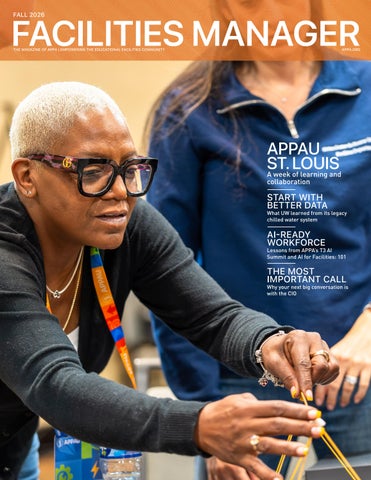
Jennifer Fite of Woodward Academy at work in Leadership Academy Level 1 at APPAU St. Louis. Photo credit: Jason Malino
Editors
Audrey Sorensen / marketing@appa.org Lindsay Wagner / publications@appa.org
7
LETTER FROM THE CHAIR COMMUNITY: OUR GREATEST STRENGTH B Y G A B E H A M P TO N
E
very time I attend an APPA event, I am reminded of a simple truth: our greatest resource is not the buildings we manage, the systems we maintain, or the technology we deploy. It is the people who make those environments successful. Our profession revolves around facilities, infrastructure, operations, sustainability, technology, and strategic planning. Yet at the center of every campus are people: the professionals who keep institutions running, the leaders who guide them, and the students, faculty, researchers, and staff who depend on those environments every day.
and the many responsibilities that come with managing increasingly sophisticated educational environments. The formal learning was exceptional. Yet some of the most valuable lessons emerged outside the classroom. They happened during conversations between sessions, over a cup of coffee, or around a dinner table where professionals from different institutions shared experiences and ideas. Time and again, I heard conversations begin with a challenge and end with practical solutions, new perspectives, and lasting connections.
That is why one of the things I value most about Someone described a problem they were APPA is something difficult to fully appreciate facing. Another responded, “We’ve dealt with until you experience it firsthand: community. that, too. Here’s what worked for us.” That spirit of openness is one of APPA’s defining In an era of increasingly complex challenges, characteristics. APPA brings together professionals who understand what it means to serve educational Our members willingly share successes, institutions. Whether you are just beginning lessons learned, resources, and expertise. We your career, stepping into your first leadership challenge one another’s thinking, exchange role, or bringing decades of experience to the ideas, and help each other become stronger profession, you become part of a network leaders. Over time, professional relationships committed to helping one another succeed. evolve into trusted partnerships and lifelong friendships. That is the power of the APPA Many of the challenges we face are remarkably community. similar. Aging infrastructure, workforce shortages, financial constraints, advancing Preparing Tomorrow’s Leaders technology, sustainability initiatives, and While we focus on the challenges directly in increasing expectations continue to reshape front of us, we also carry an equally important our work. While each institution is unique, few responsibility: preparing the next generation of these challenges are faced alone. Within of facilities professionals. APPA, we have colleagues, mentors, and peers who have likely encountered many of the same The profession continues to evolve rapidly. issues and are willing to share what they have Technical knowledge remains essential, but learned. tomorrow’s leaders will need far more than technical expertise. They must understand Learning Beyond the Classroom finance, technology, data, sustainability, This summer, we gathered in St. Louis for organizational culture, risk management, another successful APPA U. As always, communication, and strategic planning. participants expanded their knowledge of They must be capable of developing people, leadership, facilities management, operations, navigating complex institutions, and 8
demonstrating how facilities directly support should never change is the foundation upon institutional missions. which APPA was built: professionals helping professionals. Leadership in facilities has never been more important. APPA plays a critical role Our Community, Our Future in developing that leadership pipeline. When I think about APPA’s future, I am Through APPA U, credentialing programs, optimistic. Not because the challenges facing professional development opportunities, educational facilities are becoming easier. mentoring relationships, regional In many cases, they are becoming more engagement, and the everyday sharing of complex than ever before. knowledge among members, we are helping prepare professionals for the challenges and I am optimistic because of the people who opportunities ahead. make up this organization. Every APPA event reminds me of the extraordinary Few investments will have a greater long- depth of knowledge, experience, creativity, term impact on our profession than investing and commitment that exists within our in people. membership. When we bring that collective expertise together, there are very few An Organization That Continues to Evolve challenges we cannot begin to solve. Just as our profession continues to change, APPA must continue to evolve alongside it. As we move into APPA’s next chapter, I encourage each of us to fully engage in this Over the coming years, our strategic efforts community. Attend an event. Participate will focus on strengthening the value APPA in your region or chapter. Share an idea. provides to both individuals and institutions. Mentor an emerging professional. Reach That includes expanding meaningful out to a colleague at another institution. Ask professional development, strengthening questions. Offer guidance. Pass along what connections across regions and chapters, you have learned. supporting workforce development, improving access to information and Because APPA is more than an association. resources, embracing technology It is a community built by professionals who thoughtfully, and remaining responsive to believe that we are stronger when we learn the changing needs of the profession. from one another. It also requires listening. And the stronger we make that community, The strongest organizations continually the stronger our profession, our institutions, evaluate how they operate, challenge and the people we serve will become. ■ assumptions, and adapt while remaining grounded in their mission. APPA is committed to doing exactly that. As we build upon more than a century of history, we must also look ABOUT THE AUTHOR ahead and anticipate what our members will Gabe Hampton is Executive Director of Facilities and need five, ten, and twenty years from now. Operations at the University of Nebraska-Lincoln, where he The answers will continue to evolve because our profession will continue to evolve. What
oversees roughly 400 employees, and serves as Chair of the APPA Board of Directors. He holds a bachelor’s degree in education, with an emphasis in leadership, from the University of Nebraska. He can be reached at gabe@unl.edu.
9
START WITH BETTER DATA BEFORE REPLACING LEGACY CHILLED WATER INFRASTRUCTURE, THE UNIVERSITY OF WASHINGTON FIRST ASKED WHAT ITS EXISTING SYSTEM COULD TELL IT B Y S C O T T U S S E L M A N , N AT E M O S TA J O, A N D J O E W I L K I N S O N
A
cross higher education, campus facilities leaders are being asked to do more with infrastructure that was built for a different era. Central utility plants and chilled water systems must support growing demand, sustainability expectations, and tighter operational needs, often while major capital replacement dollars remain limited or years away. At the University of Washington, that familiar challenge came into focus within an aging chilled water system, served by two central plants (one modern and optimized, one legacy) serving a large and dynamic campus. The system itself had not changed dramatically, but the demands placed on it had. Facilities teams needed better information to operate the legacy plant efficiently while meeting increasing cooling loads and maintaining reliability during the cooling season. Rather than beginning with an assumption that the answer was wholesale equipment replacement, the project team focused first on a more fundamental question: What can we learn from the system we already have? The resulting work offers a practical lesson for other campuses: before replacing legacy infrastructure, it may be possible to unlock meaningful value by improving measurement, visibility, calibration, and operator confidence.
leaving the central utility plant, but not how many BTUs were moving through each of the five tunnels serving campus. That lack of visibility made optimization difficult. Without reliable tunnel-level flow and temperature data, the team could not confidently evaluate where energy was going, how loads were shifting, or which operational adjustments might have the greatest impact. The challenge was not simply that the infrastructure was old; it was that the system did not yet provide the level of information needed to manage it as strategically as campus needs required. Looking Beyond Replacement One obvious path would have been to focus immediately on chiller replacement. For many campuses, that is often where conversations about aging chilled water infrastructure begin. New equipment can be necessary and appropriate, but it is not always the first or only answer. In this case, the project team believed there were lowercost actions that could produce significant operational value before major capital decisions were made. The near-term opportunity centered on efficiency and reliability. If the campus could improve the accuracy of its sensors, establish trustworthy energy measurements, and give operators better information, it would be better positioned to operate the existing plant more effectively and plan future phases from a stronger factual foundation. For APPA member institutions facing similar capital pressures, that distinction matters. Optimization does not eliminate the need for renewal planning, but it can create a practical bridge between today’s operating realities and tomorrow’s capital investments.
Understanding the Campus Utility Challenge Like many institutional central plants, UW’s chilled water system is operating within the realities of age, complexity, and limited visibility. One of the plants serves the campus loads through multiple distribution tunnels, yet the team did not have a complete picture of how much chilled water energy was being delivered through each pathway from this Improving Visibility and Trust in the Data plant. Operators knew how much water was The first phase focused on instrumentation. 10
The team replaced 26 temperature sensors, one differential pressure sensor, and seven flow meters, while adding four additional flow sensors for the campus tunnels. Those improvements changed the quality of the data available to the facilities team. Sensor accuracy improved from errors of up to 10 percent to less than 3 percent, giving the team a much stronger basis for understanding plant performance.
created the foundation for better operational analysis and future control strategies.
Operator involvement was essential. The operators helped check calibration of the new sensors and identify issues that emerged along the way. The team also built confidence by showing operators, in real time, how the new readings compared with calibrated instruments. That process matters because automation cannot succeed on data alone. Just as important, the new tunnel flow Operators need to trust what the system sensors made it possible to understand is telling them before they can rely on it to how much energy was moving through support decisions. each tunnel. In chilled water systems, BTU measurement depends on accurate flow Preparing for Smarter Controls and and temperature data. If either input is Operations unreliable, the resulting energy picture can Although the long-term opportunity includes be misleading. By improving both the quality controls, automation, and system-level and granularity of the measurements, UW strategy, the project is still in the discovery
BELOW The University of Washington campus in Seattle.
11
phase. No major plant staging or chilled water distribution system balancing changes have been implemented yet. That is an important part of the story. The team did not leap directly into automation. Instead, it began by making sure the underlying information was accurate enough to support future decisions.
are driving load? Where might operational changes improve efficiency? Are future capital investments targeting the right problem? What should be fixed now, and what can be planned for later? The project also offers a useful reminder about the role of operators in technologyenabled facilities work. Instrumentation and automation are not separate from people; they depend on people. UW’s operators helped validate calibration, troubleshoot field conditions, and make the new data more usable. Their participation helped turn a technical upgrade into an operational tool. For institutions evaluating legacy chilled water systems, the takeaway is not that replacement is unnecessary. Some assets will need to be renewed. The lesson is that replacement should be informed by accurate system knowledge. Before buying new chillers because equipment is old or a sales recommendation suggests it, campuses can benefit from asking what can be improved with the infrastructure already in place.
For campus facilities leaders, this sequencing is instructive. Reliable automation depends on reliable inputs. A sophisticated control sequence built on questionable data can create confusion, erode operator trust, and make performance harder to diagnose. Because UW’s district energy system is served by both a modern central plant and a legacy plant, the team is no stranger to highly automated and optimized operations. The opportunity is not simply to introduce automation, but to extend greater visibility, consistency and control across a complex system with different generations of infrastructure. By starting with instrumentation, calibration, and visibility in the legacy plant, UW positioned itself to evaluate future operational strategies with greater confidence over the next six months and beyond. For campus facilities leaders, that perspective is both practical and strategic. Better sensors The work also had to be completed around will not solve every infrastructure challenge. an operating chiller plant in the middle of But better measurement can reveal which cooling season. That constraint required challenges matter most, help teams prioritize coordination with plant staff and reinforced limited resources, and create the confidence the value of practical, phased improvements. needed for smarter operations. In an era In many campus environments, the most when campuses must do more with existing useful solutions are not the most disruptive assets, that may be one of the most valuable ones; they are the ones that can be first steps. ■ implemented while mission-critical systems remain in service. Practical Lessons for Other Campuses The immediate result is a chilled water system that can be measured with far greater confidence. Before the sensor replacements, some readings included substantial noise and variability. After replacement, the new sensors produced cleaner, more stable data. The difference may sound technical, but its operational value is straightforward: better data helps facilities teams see what is actually happening, rather than what they assume is happening. That visibility is especially valuable as campuses pursue energy, carbon, and resilience goals. If a facilities team can see where chilled water energy is going, it can ask better questions: Which tunnels or zones 12
ABOUT THE AUTHORS Scott Usselman is a principal, and Nate Mostajo and Joe Wilkinson are senior project managers, with EEI Building Performance.
SUBMITyou TO FACILITIES MANAGER MAGAZINE What can submit Features
In-depth insights by and for facilities professionals.
Projects
Real-world work from across the membership: utilities, K12, trades, grounds and housing.
Institution and member spotlights
Case studies and field guides
Your campus, your team and the people behind
Research, strategies and innovations with results
the work.
others can apply.
Op-eds and editorials
News and events
Personal stories, advice and commentary from the
What's happening across campuses, chapters and
people doing the work.
regions.
Reviews
Partner projects
Bookshelf.
collaborative results and quotes from facilities
Books and resources worth sharing in The
Real partnerships with campuses, told through leaders.
Topics we cover Institution and business visibility
Energy and utilities
Planning, design and construction
Strategic facilities leadership
Campus asset management
Capital projects
Architecture and engineering
The sustainable campus
Technology and trends
Artificial intelligence
Membership matters
The Bookshelf
Before you submit
N E XT D E A D L I N E
December 1, 2026
Editorial, not promotional. Our Editorial Board reviews every submission for educational value, relevance and originality.
Article submissions for the Winter 2027 issue, publishing January 12, 2027.
Send a Word document with headings, subheads and author bylines. No strict word count. Send images separately as EPS, TIFF, JPEG or PSD at 300 dpi, with captions. No AI-generated images. Include author details: name, credentials, title, institution, city and state, and email.
Have an idea but no draft yet? Send a short proposal or question to the editorial team at the same address.
Original and unpublished. Authors keep ownership; APPA receives non-exclusive rights.
Send your article or idea.
Email a Word attachment with the subject line "Facilities Manager."
publications@appa.org Full guidelines: appa.org/fmmagazine
13
COMMISSIONING FOR CRITICAL PRIO WHY LIFE SAFETY SYSTEMS BELONG IN YOUR CX SCOPE, AND WHAT FIELD TESTING KEEPS FINDING WHEN THEY ARE LEFT OUT BY ADAM GOWER, PE, CEM, CCP
O
wners often commission HVAC, domestic hot water and lighting to meet energy, comfort, and incentive requirements. But the most consequential systems in a building are the ones that protect lives, so your plan should be to verify them with the same rigor.
“Whether verification is performed by a commissioning provider, owner staff, an AHJ, or contractors, the goal is the same: confirm that the most critical systems actually work under realistic conditions, across interfaces, and after corrective work is completed.”
OPPOSITE Example of a deformed smoke detector air sampling tube condition observed during field verification. 14
location-specific condition. A commissioning approach should independently verify installation and functional performance and confirm that critical information (such as the specific location of an activated device) is clear and actionable for first responders. When time is tight, some installing contractors Commissioning (Cx) requests for proposals or AHJs can accept some corrective work and scopes of work frequently prioritize based on verbal confirmation rather than energy performance and space comfort, demonstrated performance. often because those outcomes are visible on utility bills and are reinforced by code, LEED Another common gap is accountability. If pathways, or incentive programs. Yet many Cx field testing and reporting are assigned to scopes stop short of requiring commissioning the installing contractor, the project may of the life-safety systems. I encourage owners, end up relying on a contractor to verify their owner’s project managers (OPMs), facilities own work — making it easier for missed teams, and designers to treat life-safety steps, incomplete documentation, or “this is verification as a core commissioning priority, how we’ve always done it” habits to persist. not an optional add-on. Design teams can unintentionally contribute when specifications are not project specific Life Safety Goes Beyond Fire Alarm and (boilerplate language), creating a culture Sprinklers where requirements feel optional. Clearly When people hear “life safety,” they often specified field testing and startup deliverables think only of the fire protection and fire alarm and enforceable reporting expectations are systems referenced in the Life Safety Code also often not fully followed up on. (NFPA 101). In practice, life safety performance also depends on other interconnected systems Widely used commissioning specification that influence emergency response, occupant sections (for example, HVAC and electrical protection, and resilience, such as security, Cx CSI sections) reference many life safety access control, communications, plumbing, systems, but not necessarily all of them. The and emergency power. Below are some practical takeaway is simple: define your examples of subsystems for which life safety commissioning scope early, prior to design can extend to: completion, and make sure the specifications • Blue emergency phones and contractor time allowances support • Glass-break sensors and shooter detection thorough testing and documentation across systems the systems you consider important. • Decontamination tanks for hazardous plumbing waste Codes, Standards, and Owner Requirements • ASHRAE Guideline 0 (and related Many of these systems are intended to be guidance) emphasizes that the Owner’s tested by the installer and by the Authority Project Requirements should define Having Jurisdiction (AHJ) or fire marshal. which systems are commissioned for each In reality, AHJs may sample devices rather project. than validate every sequence, interface, and • The IECC includes commissioning
ORITIES
•
•
•
provisions (for example, Section 408) that commonly focus on mechanical thresholds and lighting controls — reinforcing why owners should proactively expand scope where risk warrants. State and local building code requirements may include specific provisions for smoke control, emergency power, and special inspections that influence testing and documentation needs. LEED and many utility programs tend to emphasize energy and environmental outcomes, which can unintentionally narrow Cx scope if life-safety priorities are not called out. Many state programs reference ASHRAE processes, providing an opportunity to embed life safety systems in the Owner’s Project Requirements from day one.
There is also a business case. When critical systems are independently verified and documented, owners reduce the likelihood of failures, disruptions, and costly corrective work after occupancy. A robust commissioning record can also support a stronger risk posture by demonstrating proactive due diligence. One example of an expanded commissioning approach is seen in programs that require comprehensive system verification across disciplines, pushing well beyond typical HVAC, domestic hot water, and lighting controls. Regardless of the program you follow, the key is aligning your Cx scope with what is truly mission-critical for occupants and operations. Field Findings: What We Discover When We Test The following real-world examples illustrate why independent verification matters — and why retesting after corrections is just as important as the initial functional testing. 15
Fire Alarm On one project, post-AHJ testing we revealed a critical issue: a fire/smoke damper failed to close when commanded, even though the indicator light suggested it had closed. This was found to still be an issue after it was said to have been corrected. The root cause was incorrect factory wiring. Verifying the actual damper position (eyeson open → closed → open) was the only way to confirm performance. We also routinely encounter basic but consequential oversights, such as missing access doors that prevent inspection and maintenance. In another case, thin-wall plastic air sampling tubes were installed on duct smoke detectors (see photo on page 15). The material deformed and bent over time, undermining detector functionality, even though the system might appear to “pass” a test rendered via the detector test switch.
Fire Protection During diesel fire pump startup, smoke accumulated and migrated into the corridor. Investigation found inadequate exhaust and makeup air in the pump room, which is an indoor air and reliability concern during an emergency event. Another example is an electric fire pump did not operate on emergency power. Further review traced the failure to generator wiring, highlighting why integrated testing across systems is essential.
Security and Access Control We have found surveillance coverage compromised by incorrect devices being installed; a 180° camera where a 360° field of view was intended. We have also verified panic buttons that did not uniquely identify which device was activated at the police department when multiple buttons exist, and responders need location certainty. We also see issues like magnetic hold-open doors that Additionally, key card access is often found to not function do not release and close on alarm, which is an outcome per design which could have serious consequences. that can compromise compartmentation and egress Public Address (PA) and Emergency Power assumptions. PA systems sometimes suffer from static, poor volume 16
BELOW Field verification confirms that life safety systems actually work under realistic conditions, across interfaces, and after corrective work is completed.
control, or miswiring since multiple systems are landed on the same speaker circuit. In emergency shelter or warming center scenarios, we have also seen critical electrical receptacles and sensor-controlled plumbing fixtures not supported by emergency power, creating avoidable operational issues. Bi-Directional Amplifier (BDA) / Radio Coverage We have encountered BDA performance issues caused by interference from nearby control components (such as building automation controllers). Because radio coverage is an integrated, building-wide function, troubleshooting often requires cross-trade coordination and verification under realistic operating conditions. Commission What Matters Most Whether verification is performed by a commissioning provider, owner staff, an AHJ, or contractors, the goal is the same: confirm that the most critical systems actually work under realistic conditions, across interfaces, and after corrective work is completed. For Cx, Retro-Cx, and Re-Cx alike, there is significant value in engaging commissioning early, so scope and schedules support thorough testing and documentation.
I often say I treat projects as if they were my own house. From that perspective, the fire alarm and security systems in my house are more important than HVAC energy savings. In a real emergency, performance is measured in outcomes, not efficiency. Who defines the commissioning scope varies by project: owner, OPM, facilities director, or design team. Regardless of who holds the pen, I encourage you to start with one question: what is most critical to protect people and keep the building operational? Then make sure your commissioning plan verifies those systems with the rigor they deserve. ■
ABOUT THE AUTHOR Adam Gower, PE, CEM, CCP, is an associate vice president and commissioning project manager with Salas O’Brien, with more than 15 years of design and commissioning experience. A licensed professional mechanical engineer and certified commissioning professional, he has commissioned projects ranging from complex renovations of academic, judicial, and healthcare facilities to new laboratories and research centers. He holds a bachelor’s degree in mechanical engineering from the University of Connecticut. 17
DESIGNING DISCOVERY WHY THE FUTURE OF UNIVERSITY RESEARCH DEPENDS ON SOCIAL INFRASTRUCTURE B Y R O B W. V O S S
A
s science grows more complex, institutions are rethinking laboratories not as containers for equipment but as ecosystems for collaboration, resilience, and change. As scientific inquiry becomes more interdisciplinary, data-driven, and globally interconnected, universities are confronting a critical truth: discovery no longer hinges solely on advanced equipment or individual expertise. It depends on systems — organizational, cultural, and spatial — that either enable collaboration or quietly constrain it. Increasingly, institutions are recognizing that research buildings are not passive backdrops for innovation but active agents shaping how science is conducted. In this context, architecture emerges as social infrastructure: a strategic tool capable of aligning institutional ambition with the daily realities of research work. This positions design as cultural infrastructure rather than just technical support. Case studies have demonstrated that intentionally designed collaboration spaces can become active engines for interdisciplinary exchange. In one large science and engineering facility, two-story collaboration hubs connecting research floors
evolved into regular forums where researchers shared their work across disciplines, creating opportunities for unplanned discoveries and new partnerships. Research environments with ubiquitous transparency, such as glass-enclosed labs, offices, and support spaces, can foster a collective sense of community. Rather than making occupants feel monitored, these environments help researchers feel connected to a larger ecosystem of inquiry, reinforcing collaboration and awareness of adjacent work. Collaboration Beyond Rhetoric Universities widely champion interdisciplinary research, yet many understandably remain structurally organized around departmental silos. Faculty appointments, space allocations, and funding hierarchies often reinforce separation, even as leaders call for convergence. The resulting tension is particularly acute when complex challenges demand integration across biology, chemistry, engineering, and data science. As a result, collaboration often exists in principle and can be significantly enhanced in practice.
TWO-STORY COLLABORATION HUBS CONNECT RESEARCH FLOORS AT THE SCIENCE & ENGINEERING HALL, GEORGE WASHINGTON UNIVERSITY. PHOTO: JUDY DAVIS FOR BALLINGER
Forward-thinking institutions are organizing research environments around shared missions rather than academic ownership — interdisciplinary centers and institutes aggregate faculty from multiple schools under unified goals, requiring new models of cooperation. Architecture plays a decisive role. By clustering teams by research themes and creating neutral, shared spaces that belong to no single discipline, buildings encourage proximity and informal interaction without mandating them. Visual connectivity is one effective lever. Open environments that allow occupants to see adjacent labs and support spaces foster awareness and curiosity, lowering psychological barriers to engagement. Rather than hiding researchers behind opaque walls, transparent planning normalizes collaboration. In this way, spatial strategy becomes a quiet catalyst for institutional change. Yet collaboration cannot thrive without environments that sustain the people doing the work. BELOW Flexible laboratories at the Chemistry Research Building, University of Maryland, College Park. Photos: James Ewing for Ballinger
20
Designing for Cognitive Endurance While collaboration captures headlines, the daily reality of research is defined by long experiments, high funding pressure, and sustained mental effort. Laboratories must support not only technical performance but also human resilience. Consequently, human-centered research design is gaining prominence. Scientists must comply with strict safety protocols — such as eating outside the lab — while still monitoring experiments and data streams. The placement of graduate workstations and monitoring stations shapes daily rhythms and cognitive flow. Providing visual connections between work areas and lab benches, along with access to natural light, helps reduce fatigue and sustain attention. At a broader level, the integration of dry research spaces where computational and theoretical work occurs, with wet labs reflects a cultural convergence in which theorists, computational scientists, and bench researchers
collaborate across traditional divides. As computational assumptions about laboratory planning. Buildings must research grows, these modalities must coexist, even as endure for decades, even as research priorities evolve. Designing around fixed disciplinary needs risks premature some dry researchers can work remotely. obsolescence. For this reason, flexibility has become the By acknowledging the emotional and cognitive labor defining attribute of contemporary research facilities. embedded in discovery, universities are designing environments that treat scientists as people, not just Planning flexibility begins with generous, unobstructed floorplates that can be reorganized over time. Positioning producers of results. cores at the ends of long structures creates expansive lab Many institutions now think of laboratory planning as zones that can be configured in multiple ways. Within creating a flexible chassis, or a framework that allows these zones, the ratio between lab and support space can utilities, equipment, and workstations to evolve over shift, with “gray zones” accommodating either open labs time. By designing systems that are continually additive or enclosed rooms as needs evolve. rather than requiring costly reconfiguration, facilities can Systems flexibility complements planning strategy. achieve greater long-term adaptability and value. Delivering utilities from overhead allows equipment Flexibility as a Strategic Imperative and casework to be reconfigured without structural If collaboration and well-being shape the present, upheaval. In chemistry facilities, planners have developed adaptability defines the future. Emerging fields such various lab “flavors” that can be swapped with minimal as quantum science and AI challenge longstanding cost impact. At the infrastructure level, leaving room in
21
mechanical penthouses for future air-handling capacity While vibration control often drives quantum laboratory planning, access to daylight and restorative environments enables growth without overbuilding on day one. remains essential. Innovative approaches such as recessed Such foresight can support institutional transformation. courtyards, planted light wells, and partially embedded In one large academic project, modular lab casework facilities can provide researchers with visual access to was designed to serve as either teaching stations or nature and respite from highly controlled laboratory research desks, allowing a university to pivot toward an R1 environments without compromising performance research identity without a wholesale renovation. In this requirements. context, adaptability is not a luxury; it is institutional risk management. 22
A LIVING WALL BRINGS NATURE INTO THE NEW JERSEY INSTITUTE FOR FOOD, NUTRITION & HEALTH, RUTGERS UNIVERSITY. PHOTO: ALBERT VECERKA/ESTO FOR BALLINGER
Confronting the Extremes: Quantum Science and Infrastructure Quantum research makes the relationship between architecture and scientific ambition especially visible. Quantum experiments demand environments free from vibration, light, temperature fluctuations, and noise — conditions so sensitive that even minor movement can compromise results. Because vibration increases with height, these laboratories are ideally located on grade or in basements, where the earth provides structural
resistance. Yet basements can be technically challenging in specific geographies. To balance performance and cost, some institutions designate restricted high-performance zones within larger buildings or distribute quantum spaces across adjacent facilities to leverage slab-on-grade conditions. These strategies illustrate a broader lesson: research architecture must reconcile extreme technical requirements with pragmatic constraints. 23
At the same time, sustainability and operations weigh heavily on facilities leaders. Laboratories are energyintensive, and universities are committed to climate action and carbon neutrality. Strategies such as reducing air changes when labs are unoccupied represent significant operational shifts. Redundancy is also essential to ensure research continuity in the event that systems fail. Meanwhile, supply chain competition — particularly for electrical equipment tied to AI data centers — requires procurement decisions made years in advance. Thus, the social infrastructure of science extends beyond campus boundaries into global economic systems. Leading institutions are increasingly exploring research facilities as mixed-use environments that extend beyond research alone. Public-facing amenities such as cafes, gathering spaces, and community-oriented programming can create vibrant destinations that connect scientific discovery with broader campus and public life while maintaining appropriate separation from sensitive research activities. Architecture as Institutional Strategy Ultimately, research buildings express institutional intent. They signal whether collaboration is operational, whether sustainability commitments are systemic, and whether adaptability is engineered. By treating architecture as social infrastructure, universities can translate convergence rhetoric into lived experience — shaping how researchers encounter one another, endure cognitive strain, and adapt to emerging disciplines. When architectural design aligns with culture, discovery does not simply occur within buildings — it is strengthened by them. ■
ABOUT THE AUTHOR Rob W. Voss, AIA, LEED AP, is Senior Principal with Ballinger. 24
BELOW Public-facing amenities connect research with campus life at the Wisconsin Institutes for Discovery, University of Wisconsin-Madison. Photo: Zane Williams
25
LOCKING OUT THE INVISIBLE HAZARD
HOW UBC BUILT A LOCK-OUT/TAG-OUT PROCEDURE FOR SAFE ROOFTOP ACCESS AROUND RADIO FREQUENCY ANTENNAS BY JEET AMRITSAR
E
very year, workers in British Columbia are killed or seriously injured because machinery or equipment was not properly de-energized and locked out. Electrical equipment that is not properly locked out can cause electric shock, burns, and electrocution. These accidents can be prevented by locking out equipment properly before any maintenance work is done, especially if the equipment could unexpectedly activate or the release of an energy source could cause injury. This is done through de-energization and lockout. De-energization and lockout is a procedure for preventing the release of energy that could injure a worker performing maintenance work. In 2022 we noticed several reactive Service Requests related to an academic building roof at the University of British Columbia were not getting completed. Upon investigation, it was found that some Trades were not comfortable going up on the roof to perform work because of the presence of Radio Frequency (RF) antennas and confusing signage. This is when the Safety & Risk Services (SRS) department was contacted on the next steps.
on a rooftop and call the RF hazard controlled. The process has to identify the energy source, the isolation point, who controls it, and how the worker verifies the safe condition, or in other words de-energize the device. Deenergization is a process used to disconnect and isolate a system from a source of energy to prevent the release of that energy. Deenergizing the system eliminates the chance that it could cause harm to a person through movement or through the release of radiation, electricity, chemicals, heat, light, or sound. Our review identified a gap between the existing rooftop access practices and the de-energization, lock-out, and verification requirements of the Regulation.
Additionally, after reviewing the Safety Code 6 document (ii) from Health Canada it was confirmed that the academic building in question has both controlled and uncontrolled environments. A controlled environment means that: 1. The location of the RF antennas is fenced and placed in a restricted zone. 2. Persons using the rooftop are aware of the potential health risks and are cognizant of the intensity of the RF energy in their Why Are We Doing This environment. The SRS department then pointed out 3. The RF energy can be controlled using section 10 (i) of the British Columbia (BC) risk mitigation strategies. Occupational Health and Safety Regulation (OHSR), specifically to lock-out/tag-out All situations that do not meet the energy-emitting devices or to de-energize specifications above are considered to be the device. This is an interesting regulation uncontrolled environments. The UBC building because section 10.1 defines an energy- did not meet points 2 and 3. Based on this isolating device as a device that physically review we contacted TELUS to assist us with prevents transmission or release of an energy this safety concern. See Figure 1 for reference. source to machinery or equipment. Section In addition, it was found that we did not have 10.6 also requires the worker to verify that a Safe Work Procedure (SWP) in place to energy sources have been effectively locked advise Trades and other stakeholders on how out before work begins. The RF exposure is to access the controlled environment safely. not necessarily the same thing as electrical energy that can be controlled through a In order to be compliant with the OHSR conventional lockout device. standard the following five basic steps were followed to de-energize and lock out the Note that the user cannot simply put a padlock machinery or equipment: identify equipment, 26
shut off equipment, de-energize energy sources, apply personal lock, and test the 3. de-energization and lock-out process. To deenergize the equipment we implemented a control box provided by TELUS on the roof, as shown in Figure 2. With the help of the above control box we were able to develop a safe work procedure that allowed the University to meet the 4. requirements of Safety Code 6, the Workers Compensation Act, and the Occupational Health & Safety Regulation. Safe Work Procedure 1. Worker submits request into Planon (UBC Platform) for rooftop access. 2. On the day of the work, the Facility Manager for the specific building will
meet the worker(s) and provide access. The Facility Manager and Worker will contact the cell company control centre to shut down the radio frequency to the required antennas. The safe work procedure has the phone numbers for the control centres for each cell company. The specific phone numbers are listed before you access the rooftop. Worker calls the appropriate cell company control centre and confirms: • Purpose for the request. • Duration of the shutdown. • Sector(s) to be shut down. • Name and contact phone number of the maintenance person on-site.
BELOW Figure 1. UBC building rooftop cell phone antennae and the demarcated controlled area (chain-link fencing).
27
to use a radio frequency (RF) radiation monitoring system to confirm no presence of RF radiation. 10. The Worker will only enter inside the demarcated zone lines when there is no presence of RF radiation. This can be confirmed using the RF meter. 11. When work is completed, Worker to position themselves and remain outside the demarcated zone lines and remove personal lock and tag from the control box. 12. Worker to open the control box and operate the switch(es) to the ON position (e.g. red light). 13. Worker to call back to the cell company control centre to inform them that the work is complete and that the sector can return to service. 14. Worker stays on the call until NOC confirms the sector is back up and operational. 15. Worker returns on-site control box to locked state and returns key to the Bluetooth lockbox before leaving site.
ABOVE Figure 2. TELUS control box to de-energize and lock out the RF antennas on the rooftop.
5.
6.
7.
8. 9. 28
Conclusion With the use of the above technology, we were able to determine a process for UBC staff, contractors, and public which includes a safe way to access rooftops of buildings that have RF antennas and perform work. Additionally, we made ourselves compliant with an important regulation of the Occupational Health and Safety Regulation to prevent injuries. This lock-out/tag-out process is currently being implemented in other buildings on campus with RF antennas. Student Housing has also The cell company control centre will shut engaged with UBC Facilities to have these down all radios in the requested sector, control boxes installed on their roofs for allowing cellular traffic to be de-energized safety purposes. ■ for the specific sector required. Once radios are shut down, the cell References company control centre will provide the i. Controlling Hazardous Energy: De-Energization and worker with the access code to the on- Lockout. ISSN 1712-4719. Workers’ Compensation Board (WorkSafe BC), 1999, 2005, and 2019. site control box. Worker can now open ii. Preliminary Safety Code 6 site validation, TELUS the control box and operate the switch for site BC0159, Main Mall/University Blvd (UBC West), Vancouver. only the sector to be shut down. Worker to operate the switch(es) to the OFF position. This will operate the relays within the cabinet, physically disconnecting power to the radios. Control box will indicate the sector is safe to enter (e.g. green light). Worker to close the control box and place their personal lock and tag on the control ABOUT THE AUTHOR box. Jeet Amritsar, CEFP, P.Eng (non-practising), PMP, M.A.Sc, MBA, To verify the effectiveness of the de- is with the University of British Columbia. He can be reached at energization and lockout process, worker Jeetender.amritsar@ubc.ca.
Define Your Journey With Us. Register for the Annual Conference 2027 The APPA Annual Conference is where the educational facilities community comes together to learn, connect, and lead. In 2027, we are gathering at The Grand America Hotel in Salt Lake City, Utah.
Take the next step in your facilities leadership journey and join us in Salt Lake City! Visit https:// www.appa.org/events/appa-2027-annual-conference 29
MAKING THE GRADE
A BACK-TO-SCHOOL SCORECARD FOR KEEPING HIGHER EDUCATION FACILITIES RELIABLE, RESPONSIVE, AND RESILIENT ALL YEAR BY ANGELA FIANDACA
W
hen students return to campus, facilities teams face a test of their own. Residence halls fill, classrooms reopen, and buildings that were relatively quiet during the summer suddenly operate at full speed. A smooth opening day matters, but it does not necessarily mean the campus is ready for the semester ahead. Facilities teams may be contending with aging buildings, deferred maintenance, tight budgets, and shortages of skilled workers. At the same time, many are expected to improve energy performance, prepare for more frequent disruptions, and decide how technologies such as automation
30
and artificial intelligence fit into their operations. A back-to-school scorecard can give facilities leaders an opportunity to step back from the rush and ask a broader question: Is the campus equipped to remain reliable, responsive, and resilient long after move-in is over? The answer begins with a clear understanding of its physical assets. Know Which Assets Put the Campus at Risk A chiller running on the first day of classes may appear to be a sign of readiness. But if its service history is incomplete, replacement
Work-order history can help reveal where that risk is building. Repeated repairs, missed preventive maintenance, and rising emergency calls may indicate that an asset is consuming more labor and money than it is worth. They can also show whether the team is staying ahead of problems or spending too much time reacting to them. This context is especially important when prioritizing deferred maintenance. A long list of aging assets tells senior leaders little about where to invest first. Connecting each project to its potential impact — such as interrupted research, displaced students, or canceled classes — makes the need much clearer. Better asset information also lays the groundwork for using newer technology effectively. Make Technology Solve Real Problems Campuses collect data through building automation systems, CMMS platforms, meters, sensors, mobile applications, and more. Yet having tons of data does not automatically provide greater insight. If those systems do not communicate, technicians may still enter the same information several times while managers struggle to see the full picture. Integration allows data to support daily work. An equipment alarm can inform a work order, occupancy data can guide HVAC schedules, and service histories can help technicians diagnose recurring problems. Automation can also route requests, document inspections, and produce routine reports, giving employees more time for work that requires experience and judgment. parts are difficult to find, and there is no contingency plan if it fails, that success could be short-lived. That’s why every scorecard should include a current inventory of critical HVAC, electrical, plumbing, life-safety, and buildingenvelope systems. Beyond documenting age and condition, that inventory should show service history, expected useful life, and the consequences of failure. Without this information, capital planning becomes less about managing risk and more about responding to whichever problem becomes urgent first.
AI builds on that foundation by finding patterns across larger amounts of information. It can flag unusual energy use, identify assets showing signs of trouble, or help prioritize incoming work. But it cannot correct incomplete records or inconsistent processes. Applying AI to unreliable data may only produce unreliable answers faster. The most useful technology strategy, therefore, starts with the operational problem — not the tool. Institutions should define what they want to improve, confirm that the necessary data is available, and establish appropriate human oversight, privacy protections, and cybersecurity controls. When evaluating FM 31
technology portfolios, be sure to focus on reducing workload, improving decisions, and delivering better services. And, ultimately, all services should be judged by how well campus spaces work for the people using them. See the Campus Through Users’ Eyes A building can be technically operational and still frustrate students and faculty. An uncomfortable classroom, unreliable elevator, inaccessible route, or neglected restroom can shape perceptions of the institution as much as a newer, more visible facility.
system or troubleshoot an older building. Cross-training and documented procedures can help reduce that dependence, while service histories and real-time, mobile access to information make valuable knowledge easier to share.
Apprenticeships, technical-school partnerships, and defined career paths can also help build the next generation of facilities employees. Technology can make their jobs more manageable by reducing paperwork, retrieving equipment histories, and helping prioritize work — as long as it Operational data can help teams find these strengthens the workforce and the services trouble spots. Comparing room schedules and they provide. occupancy patterns with comfort complaints, cleaning needs, and maintenance demand Facilities leaders should look beyond may reveal spaces that are overcrowded, vacancy numbers and consider turnover, underused, or no longer supported overtime, training, and undocumented appropriately. critical procedures. They should also listen to frontline employees, who often spot emerging Still, a dashboard cannot explain everything. problems well before they appear in a formal Sensors may show that students rarely use a report. common area, but not whether poor lighting, uncomfortable furniture, or inconsistent That knowledge becomes even more valuable temperatures are keeping them away. Walk when the campus faces conditions outside its the campus and listen to students, faculty, normal routine. accessibility leaders, and frontline employees to get the context that data lacks. Link Everyday Efficiency with Resilience Energy performance and emergency Together, response times, comfort complaints, readiness are often treated as separate and direct feedback provide a more complete priorities, but both depend on understanding view of the campus experience. They also help how buildings operate. A system that is poorly FM leaders concentrate limited resources scheduled or running outside its intended where improvements will be noticed most. parameters wastes money every day and may Delivering that level of service, however, be less dependable during a disruption. depends on having enough skilled people — and retaining what they know. Matching HVAC and lighting schedules to actual building use is a practical place to start. Protect Workforce Capacity and Institutional Calibrating sensors, correcting faulty controls, Knowledge and resolving unnecessary simultaneous It’s no secret that higher education facilities heating and cooling can produce savings departments are competing for engineers, without major capital investment. It can technicians, custodians, and skilled-trade also reveal weaknesses that might otherwise workers at the same time that longtime surface during extreme heat, severe weather, employees are retiring. A whopping 40% of or a utility failure. the 12 million people in the skilled trades workforce are older than 45, less than 9% of Campuses should know which buildings people in the age range of 19–24 are entering and systems are mission-critical, how long the trades, and 400,000 US trade jobs are they can operate during an outage, and unfilled. While the immediate concern is what is required to restore them. Test those staffing, the longer-term risk is losing years assumptions with public safety, IT, housing, of knowledge about campus buildings and dining, research teams, and senior leadership systems. to discover gaps before they can turn into emergencies. That risk becomes clear when only one employee knows how to operate a utility 32
Put the Scorecard to Work The value of a back-to-school scorecard is not the assessment itself, but what happens next. Facilities leaders should identify one or two areas where focused action could make the greatest difference, then assign an owner, a measurable goal, and a deadline. If technology is part of the solution, begin with a contained problem in one building and evaluate the results before expanding. Revisit the scorecard at midsemester and during winter break to see what has improved and where new pressures have emerged.
BELOW Mobile access to service histories and real-time data helps technicians troubleshoot faster and preserves knowledge across the team.
Opening day may put facilities teams in the spotlight, but their real test lasts all year. A campus that understands its risks, uses technology purposefully, and supports both its workforce and building users will be much better prepared for whatever the semester brings. ■ ABOUT THE AUTHOR Angela Fiandaca is Senior Director of Operations, Higher Education, at UG2. 33
PHASED RENOVATIONS TRIUMPH OVER BUILDING NEW HOW MILTON ACADEMY REIMAGINED SEVEN EXISTING BUILDINGS FOR THE COST OF A SINGLE NEW ONE B Y H E I D I VA N D E R B I LT- B R O W N A N D P E T E R R E I S S
With broad stakeholder input, Milton Academy’s leadership chose a master plan centered on renovation, adaptive reuse, and targeted upgrades rather than demolition and new construction. The strategy preserved the character of the historic campus, maximized the impact of available capital resources, and significantly reduced the carbon footprint associated with new construction.
of the quad from the street, was a priority. Objectives for the Master Plan included: • Meet institutional goals to respond to current and future pedagogical evolution of academic disciplines, including library services (including research) and STEM education • Address deferred maintenance and increase accessibility • Maximize the impact of available financial resources • Embody the school’s values, including sustainability, campus resilience, and carbon reduction
Among the many questions campus administrators and Trustees consider during master planning and capital upgrade initiatives is whether to build new or renovate existing campus assets. If renovation is preferred, the companion question is how Understanding Current Uses and to adapt older buildings creatively and Opportunities efficiently. To reach these objectives, the planning team examined space-use data and questioned Historically, new construction presents the ins and outs of how the campus actually as the more appealing option. After all, functioned day-to-day by talking with everyone loves a gleaming new building. Milton’s full range of stakeholders. That traditional view is rapidly shifting on campuses today. A wave of new pedagogical The team asked students, faculty, and staff needs and fiscal realities combine to open how they navigate the campus, how they new possibilities for creative thinking. experience each building, and how each segment of the campus is utilized. They also Exploring a Broader Campus Impact asked participants about the proximity of A recent adaptive reuse initiative on spaces used for similar vs. different purposes. the Milton Academy campus illustrates how a thoughtful, stakeholder-informed The result of this stakeholder research shaped rejuvenation can yield measurable the school’s priorities and informed planning outcomes that support renovation over new and design decisions. The school examined construction. The decision-making process how priorities could be turned into projects began with a strategic plan and subsequent and assessed the associated costs of several campus master plan. prospective options. A key hinge point in Trustee discussions was weighing the costs Milton Academy is a K–12, day and boarding and potential benefits of new construction independent school chartered in 1798 in versus repurposing space. Milton, MA. The school encompasses a suburban campus in Milton with 130 acres, Evidence mounted that stepping back and two major roads running through it, and looking at program function and proximity significant wetland areas, which constrained and aligning objectives across campus would available land for new construction. lead the school toward an adaptive reuse Preserving the campus’s historical look and solution. feel, including key sightlines such as the view 34
TOP The redesign of a 4-story, 28,000 sf concrete Brutalist building into the revitalized Farokhzad Mathematics Center exemplifies the opportunities of adaptive reuse. Photo: Robert Benson Photography BOTTOM The newly redesigned and relocated William Coburn Cox Library at Milton Academy in Milton, MA. Photo: Robert Benson Photography. 35
BELOW Before and after: The Cox Library relocation and redesign creatively adapted underused space in Wigglesworth Hall. The library now offers a choice of interactive spaces for group projects or quieter, more reflective places for studying. Before: Milton Academy; After: Robert Benson Photography
36
Creating a Ripple Effect A key takeaway from the planning and predesign stage was the value of the stakeholder interviews and conversations. Learning more about how Milton’s faculty taught, how teaching and learning were evolving, and how students engaged with one another led project leaders to the next formative steps in designing the adaptive reuse strategy.
library building be used to support other key priorities? Ultimately, this line of questioning evolved into the goal of meeting as many needs as possible by creatively reimagining existing square footage.
The all-in cost of renovations and upgrades across the campus was equivalent to the cost of constructing a single new building. In addition, this approach offered substantial Incorporating the changing needs of the sustainability benefits. school’s departments with the results of the strategic plan, and then reviewing the Making Bold Moves findings from Master Plan studies, the team The single most daunting reuse challenge started envisioning, for example, going was how to reimagine and adapt the midbeyond renovating the library in its current century Brutalist-style library building for place. Instead, the input allowed leaders to use as a math center. The library’s challenges consider the optimal location for the library were characteristic of many Brutalist-style and ask: if the library is no longer a single, buildings. These included concrete interior standalone building, how might the former materials, ineffective lighting fixtures, and outdated mechanical systems. Additionally, the building’s spaces were cramped by stacks of bookshelves and lacking in areas for student gatherings. The opportunity to renew the foreboding structure by relocating the library to another building and investing in an adaptive-reuse design consistent with the original building’s aesthetic opened the door to several additional realignments and consolidations. The most dramatic was the creation of a new mathematics building in the former library space. This adaptive reuse for math addressed current and future pedagogical needs for group and hands-on learning in classrooms, provided 20 new classrooms, added breakout and study spaces, and a new gathering space for 200 people. In addition to doubling the number of math classrooms, the new Farokhzad Mathematics Center (FMC) accommodates seventh- and eighth-grade classes and provides faculty and other flexible meeting areas to foster collaboration. Students love the writable surfaces on all four walls and tabletops in every classroom. The building also was redesigned to add a west entrance, connecting two quads, and anchoring a STEAM corridor with math, science, robotics, computer science, and visual arts in the same campus neighborhood. The new FMC building achieved noteworthy sustainability benchmarks: 37
• • •
Carbon impact savings: 95% reuse of the building’s existing concrete structure 1,100 metric tons of carbon reduction (CO2e) while keeping the existing envelope 50% energy reduction compared to benchmark standards of constructing a new facility
Touching Seven Existing Buildings In addition to the FMC success story, the phased renovation and realignment at Milton upgraded six other campus buildings and improved the quality and quantity of space for multiple school departments. ARC redesigned the library and relocated it, along with the school’s academic skills center, to Wigglesworth Hall across the street. This change connected the library to the school’s history and English departments, as well as the student center, to help create a new hub. Now complete, the multi-year renovations, comprising two full-year projects and multiple summer “slammers” in different locations across campus that allowed the school to avoid using temporary “trailer” classrooms — provided much-needed permanent classroom and assembly spaces for multiple departments beyond library and math. In total, the project produced 11 renovated and 28 new classrooms; added one assembly space, two elevators, and multiple bathrooms; and delivered approximately 95,000 square feet of adaptively redesigned space.
•
•
•
•
Use data and stakeholder input. These will help leaders understand the fundamental needs, how all the programs interact, and the major priorities needing action. Take on the challenges that feel unsolvable. What are the nagging, fundamental problems continually being put aside for another day? Remove the restrictions and consider this question: If that glaring need could be solved, what opportunities would that yield? Assume the solution will resemble solving a puzzle. Assume that a new building is not feasible and turn to testing the feasibility of moving some programs, including assembly space, classrooms, breakout spaces, and offices, in different configurations. Then, examine the logistics, costs, and opportunities. Socialize emerging perspectives to keep expectations in line. It’s important to share the evolving picture and bring ideas back to stakeholders to build consensus, support, and a shared vision among multiple stakeholders.
Taking these steps and applying a reuse-andrenovation strategy will require a significant investment of time. But the outcomes and future return are well worth it. At Milton, the enthusiastic response to the adapted and reimagined spaces reaffirms our aspirations for lasting improvements in learning and student life, a sustainable future, and the preservation of investment-worthy campus assets. ■
Despite the phased renovation and upgrade initiative, the day-to-day lives of Milton students and staff proceeded largely as usual, although there were times when additional assembly space fell short of the ideal. The construction schedule integrated a series of moves for involved departments, classrooms, and pedestrian circulation. Applying the Lessons Learned For administrators considering a multibuilding renovation and realignment, here are a few helpful takeaways from our upgrade initiative: • Do not consider master plan priorities in isolation. Step back and look at an overall land strategy and what the campus might look like in 50 to 100 years — how can the institution reuse and reinvent the buildings, grounds, and assets without adding a new building? 38
ABOUT THE AUTHORS Heidi Vanderbilt-Brown is Chief Financial and Operating Officer at Milton Academy, Milton, MA. Peter Reiss, AIA, LEED AP, is a Principal with design firm ARC, Boston, MA.
BELOW Before and after: With its variety of learning spaces and breakout rooms, the reimagined math center offers a high degree of flexibility for teaching and learning, including classrooms with writable surfaces on every wall. Before: Milton Academy; After: Robert Benson Photography
39
FROM ONE ROOM TO A WORKFORCE MODEL
LESSONS FROM THE SMITHSONIAN ON PRESERVING INSTITUTIONAL KNOWLEDGE AND BUILDING REAL CAREER PATHS IN FACILITIES
B Y M O H A M M E D A R A F AT
A
When the Pipeline Is Smaller Than the Need Facilities organizations are being squeezed from several directions at once. Experienced employees are retiring, skilled trades positions can be difficult to fill, and the buildings and systems employees are being asked to operate are becoming more complex. At the same time, expectations for safety, reliability, sustainability, technology “There are only a couple of us who really and customer service continue to grow. know this system,” he told me. Then came the part that stuck with me: “And one of us is During a recent conversation on My Facility Podcast, Judie Cooper, Associate Director retiring next year.” of Facilities Learning and Organizational Nothing failed that day. There was no Development at the Smithsonian Institution, emergency or frantic maintenance call. described the challenge in a wonderfully But I remember thinking about how much simple way: “Five does not equal two.” knowledge was standing in that room and Her point is simple: when five experienced how easily it could walk out the door. people leave the facilities profession and Anyone who has spent time with a facilities only two equally prepared people come organization has probably heard some in, the numbers don’t add up. Eventually version of that conversation. We talk a that gap catches up with us, which is why lot about aging infrastructure in facilities developing new talent and transferring management. We assess roofs, mechanical essential knowledge is so important to the systems, electrical equipment and building future of the profession. envelopes. We forecast replacement dates and build capital plans around the useful The Smithsonian has been confronting that life of physical assets. We are not always as challenge for years. Its example is particularly disciplined about planning for the useful life useful because its facilities operation is of institutional knowledge. That may be one anything but simple. The institution manages of the most important workforce challenges a broad and diverse portfolio of nearly 700 owned facilities, including museums, facing our profession. research facilities, grounds and other properties across multiple locations. Yet one few months ago, during a facility assessment at a community college in Colorado, I was walking through a mechanical room with a long-term facility employee. We stopped in front of an older control panel, and our conversation shifted from the equipment itself to the people who knew how to keep it running.
40
of the most interesting parts of Smithsonian’s workforce-development story is that its solution did not begin at that scale. It began with a room.
The square footage makes for a good story, but it is not really the lesson. The lesson is what happened between that first room and the academy that exists today.
One Room, Then Another Step In conversations about the Smithsonian’s workforce-development journey, Cooper described how what began as a single training room eventually developed into a 15,000-square-foot Facility Management Academy.
The Smithsonian formally launched its Facility Management Academy in 2020 as a comprehensive approach to learning and professional development. Its purpose was not simply to offer more classes. It was designed to help employees build the knowledge needed to operate, maintain and repair Smithsonian facilities while also
ABOVE Hands-on training at the Smithsonian's Facility Management Academy, which grew from a single training room into a full workforce development model.
41
creating a foundation for career development within the facilities organization. Over time, the approach became increasingly structured. The Smithsonian vetted more than 400 learning opportunities from third-party training providers to ensure that training outcomes aligned with organizational expectations. The academy also developed multiple areas, or “schools,” of learning, with maintenance and leadership among the most popular. That combination is worth paying attention to because Smithsonian was not simply trying to produce people who knew more about equipment. It was creating an environment in which people could build careers.
way to transfer and develop them. Build Pathways, Not Just Training Calendars There is an important distinction between training and workforce development. Training answers the question, what does this employee need to know? Workforce development asks a larger question: Where could this employee go next? Most facilities departments already provide training. We send people to safety classes, manufacturer training, certification programs, and conferences. Those opportunities are valuable, but a collection of individual courses does not equal a workforce-development strategy. Employees also need to understand how the pieces connect and where additional knowledge can take them.
For campus facilities leaders, that distinction matters. A workforce-development program does not have to begin with an academy, a large budget or hundreds of courses. It can If I am a maintenance mechanic today, what begin by identifying the skills an organization could I become three years from now? What cannot afford to lose and creating a deliberate skills would I need? Who can help me develop them? Is there an opportunity to move into controls, reliability, supervision, planning or another facilities specialty? Perhaps most importantly, can I see a future for myself here?
Cooper has spoken about how confusing facilities career paths can be. People often do not know certain jobs exist until someone exposes them to the possibilities. In that sense, the academy’s role is both educational and navigational. It helps employees develop skills while also showing them where those skills might lead. There is something particularly fitting about that philosophy coming from Cooper. Her own Smithsonian career began in 1978, and one of her earliest positions was as a file clerk in what was then the Office of Facility Planning and Engineering Services. From there, she advanced through a series of facilities roles and leadership responsibilities. Her career illustrates an important lesson for any organization: sometimes the person you will desperately need ten years from now is already working for you. They simply may not know what their future could look like yet.
42
ABOVE A Facility Management Academy class in session at the Smithsonian.
Do Not Separate Leadership Development from Technical Development Another aspect of the Smithsonian model that stands out is its emphasis on both maintenance and leadership development. That combination works because facilities organizations spend a great deal of time building technical competency. We need electricians who understand electrical systems, technicians who can troubleshoot HVAC equipment, and operators who understand how their buildings behave.
problem occurred. That knowledge has value, but it is also vulnerable. A database cannot automatically recreate decades of experience after someone retires. Knowledge transfer therefore must be intentional. Mentoring, shadowing, cross-training, job rotations, documented procedures, and opportunities for experienced employees to teach others should not be treated as side projects. They are forms of operational risk management.
But technical expertise alone does not create This is also where workforce development the next generation of facilities leaders. becomes more than a response to a labor shortage. Done well, it preserves A highly skilled technician may eventually organizational memory while giving another become a supervisor. When that happens, employee the opportunity to grow. the skills that made the employee exceptional at maintaining equipment are no longer The Smithsonian’s approach emphasizes that the only skills required. That person may connection between learning, mentorship, now need to communicate expectations, and opportunity, but Cooper’s advice to other coach employees, handle conflict, prioritize organizations has also been practical: start projects, explain facility needs to people small, pilot ideas, learn what works, and outside the department, make decisions with adapt as you go. imperfect information, and develop the next person behind them.
BELOW 'Five does not equal two': when five experienced people leave and only two equally prepared people come in, the numbers don't add up.
Those abilities deserve development too. One of the mistakes organizations can make is waiting until someone receives a new leadership title before beginning leadership development. By then, it may already be too late. A strong workforce-development program should prepare people for the work they are doing today while also helping them build toward responsibilities they may take on tomorrow. That is a lesson that extends far beyond the Smithsonian. In facilities organizations of every size, technical and leadership That is an important message for facilities development must work together to create leaders who may look at a 15,000-square-foot academy and think we could never do that. real career pathways. You do not have to. The Smithsonian did not Treat Institutional Knowledge Like an Asset begin there either. Facilities professionals spend their careers managing assets, and perhaps we should Start Small think about institutional knowledge the same For an organization wondering where to start, the first workforce-development effort way. does not need to be complicated. Start by Every facilities organization has people who identifying one position that would create know things that have never made it into a significant operational risk if the person procedure manual. They know which valve performing it left tomorrow. has its quirks, why a system was modified 15 years ago, which building behaves differently Ask who else understands that work. Identify during the first cold week of the year, and an employee who could grow into greater what worked the last time a particular responsibility. Pair that person with an 43
experienced colleague. Develop a simple which that potential can develop. learning plan, give both employees time to make the knowledge transfer happen, and The Lesson Is Not the 15,000 Square Feet then evaluate what changed. It would be easy to look at the Smithsonian’s Facility Management Academy today and That exercise alone can reveal a great conclude that a meaningful workforcedeal. It may expose positions where one development program requires significant employee holds nearly all the institutional space, money, and infrastructure. knowledge. It may identify employees with interests and abilities their managers did not That would miss the most important part of realize they had. It may also reveal gaps in the story. The Smithsonian started with one documentation, cross-training or succession room and kept building. What grew was not planning. Most importantly, it moves simply a physical academy but an approach workforce planning from a future concern to to learning, leadership, career development, a current management responsibility. and knowledge transfer. From there, an organization can build. One role becomes several. One mentoring relationship becomes a program. One course becomes a curriculum. One successful internal promotion may help another employee realize that a career path is possible. That is how a workforce-development culture begins to take shape. People Are Infrastructure, Too There is a line associated with the Smithsonian’s Facility Management Academy that captures its philosophy particularly well: “We are here to make good things happen for other people.” It would be easy to dismiss that as a nice sentiment, but it reflects something important about workforce development. The strongest programs create value for both the organization and the individuals.
That is the part any facilities organization can borrow. The starting point may be one difficult-to-fill position, one employee who wants to learn, one experienced technician willing to teach, one supervisor who recognizes potential, or one small pilot program that proves an idea can work. Facilities leaders already understand longterm planning. We routinely ask what our buildings will need five, 10, or 20 years from now. Workforce development asks us to apply that same thinking to the people who will operate them.
The mechanical room I walked through in Colorado looked like countless others I have visited over the years. What stayed with me was not the control panel. It was the reminder that some of the most valuable assets in our The organization develops stronger facilities do not appear on a capital plan. capabilities, deeper institutional knowledge, They are the people who know how greater flexibility, and a healthier internal everything works. talent pipeline. Employees gain opportunities to improve their skills, discover new career Our buildings may outlast many of our directions, take on greater responsibility, careers. Our knowledge should, too. ■ teach others and see a future for themselves within the organization. That is also why workforce development cannot belong exclusively to human resources. Facilities leaders must own part of it. We know where the technical risks are. We know which positions are difficult to fill. We know which employees carry enormous amounts of institutional knowledge, and we often recognize the people on our teams who have potential long before that potential appears on an organizational chart. Our responsibility is to create the conditions in 44
ABOUT THE AUTHOR Mohammed Arafat is a Business Development Specialist for FEA and works out of the FEA's Fairfax, Virginia headquarters.
APPA ADVISORS Strategic Guidance for Facilities Excellence in Higher Education
Trusted Peer Insight. Practical Solutions. Measurable Results. 45
SORTING OUT THE SYSTEM HOW HUMBER POLYTECHNIC LIFTED WASTE DIVERSION FROM 31% TO 39% IN ONE YEAR BY TREATING WASTE AS A FACILITIES SYSTEM
B Y T E S S A S O LT E N D I E C K A N D L I V I A VA L P A S S O S
A
recycling station can have clear labels and still fail. A compost program can look effective on paper while contaminated material continues to arrive at the loading dock. This gap between planning and daily operations has guided Humber Polytechnic’s waste diversion work since 2019. Humber established its sustainability goals, while its sustainability, facilities, and food service teams worked with BEST Service Pros to turn those goals into practical routines across the campus. The results show meaningful progress. Across eight buildings with complete reports for both 2024 and 2025, Humber’s combined diversion rate increased from 31% to 39%. The amount of material diverted from landfill grew by 119 metric tonnes, a 42% increase in one year. Seven buildings improved, one remained steady, and none declined. The most valuable lesson, however, was not a single percentage. It was learning how to identify the right action for each building. Waste Diversion Is a System, Not a Bin Waste diversion involves much more than bins and signs. It depends on several connected factors: • Whether the right collection streams are available • Where containers are located • How material moves through a building • How occupants sort their waste • How custodial employees respond to contamination • How observations and data reach the people who can improve the process
46
Each group has a role. Occupants make sorting decisions. Facilities teams manage containers, routes, and collection services. Custodial team members handle the material and see problems as they happen. Waste contractors record and report the results. If one part of this system is missing, the diversion rate can easily be misunderstood. Start with the People Closest to the Work Custodial team members see the waste
system at its most revealing point. They know which stations confuse occupants, which streams are regularly contaminated, where containers overflow, and where collection routes do not match the way a building is used.
common problems found in different types of buildings.
The program also created a way for frontline observations to reach BEST managers and Humber’s sustainability team. The goal was simple: when a team member noticed For this reason, training the full custodial a recurring issue, the information needed team became a priority. The training to reach someone who could improve the connected sorting instructions to daily station, service, or process. collection practices and focused on the
ABOVE Humber Polytechnic in Toronto lifted waste diversion across eight buildings from 31% to 39% in a single year.
47
“Humber’s success in waste management has come from building strong relationships and trust between all parties on campus that have a hand in reducing waste, improving diversion, and advancing our sustainability goals. When priorities align, staff training is more effective, and employees feel empowered to share onthe-ground insights, creating a feedback loop that strengthens and continuously improves the waste management system,” says Tessa Soltendieck, Sustainability Manager at Humber Polytechnic. This feedback is essential because a campus is not one uniform environment. Offices, residences, food service areas, and receiving facilities generate different materials and face different challenges. Training needs a consistent foundation, but it must also reflect the reality of each location.
Table 1: Combined results for the eight Humber Polytechnic buildings holding complete annual reports in both 2024 and 2025, the two most recent complete reporting years. Seven of the eight improved their diversion rate, one held steady, and none declined. Source: annual material diversion reports prepared for Humber Polytechnic by Wasteco.
48
Redesign the Routine, Not Just the Sign Training was supported by operational changes. Building audits showed what was actually entering each waste stream. Humber and BEST then adjusted signage, sorting arrangements, and collection practices where needed. Some changes focused on preventing waste before it entered the system. At Humber’s International Graduate School, an office pilot replaced paired desk-side waste and recycling bins with a desk-side recycling bin
and centralized sorting stations. Employees brought residual waste to the shared stations. This reduced the use of plastic liners and made sorting a more visible, personal action. Food service initiatives also introduced reusable containers. At the North Campus residence café, an internal observation found that waste decreased from about 60 pounds to about 20 pounds during one initiative. This was an operational observation rather than a formal audit result, so it should be understood as an indication of progress, not a verified outcome. What the Results Show The eight buildings with complete reports for both 2024 and 2025 provide the fairest comparison. These figures show why tonnage matters as much as the diversion rate. Humber managed a 16% increase in total reported material while keeping the increase in landfilled material to only 3%. About 85% of the additional material entered diverted streams instead of going to landfill. The reports, prepared by Wasteco, use scaled weights where available. When weights are unavailable, they rely on audit information or industry averages. The results are useful management indicators, but they are not audited environmental accounts.
Organics and Cardboard Drove the Gains These two examples show why a campus Two material streams accounted for most of average cannot provide the full answer. A low the improvement. rate may reflect behaviour, but it may also reflect missing or inconsistent service. Organics increased by 34%, from 154 to 206 metric tonnes. Every building that reported Review the Data Every Month organics in both years improved its capture. Annual averages are useful, but they can This broad progress suggests that training, hide operational changes. Monthly reporting clearer sorting, and better station design helps teams identify unusual results while were having an effect across the portfolio. there is still time to respond. (See Table 2 on next page) Cardboard increased from 74 to 157 metric tonnes. Most of this gain came from 3180 One caution applies to residence data in Lakeshore Boulevard West, where reported particular: occupancy and activity shift cardboard grew from 19.24 to 98.80 metric through the academic year, so comparisons tonnes. The building’s diversion rate rose there should use equivalent periods rather from 23% to 59%. than partial years. Because the cardboard increase was concentrated in one location, it likely reflects a change in collection or consolidation rather than a sudden change in occupant behaviour. This distinction matters. Broad improvement across several buildings may point to successful training, while a large change at one building may point to a service or infrastructure change that could be repeated elsewhere. Separate Service Gaps from Behaviour Problems Building-level reporting helped Humber identify an important issue at 3120 Lakeshore Boulevard West. The building recorded 0% diversion throughout 2024, 2025, and the first five months of 2026. No diverted stream appeared in its data. Training and signage cannot improve a diversion rate if there is no collection stream available. In this case, the data did not indicate poor sorting. It indicated a service gap. The experience led to a simple but important practice: before asking people to improve their sorting, confirm that every stream they are expected to use is available and collected consistently. The data at 3170 Lakeshore Boulevard West tells a different story. Its diversion rate increased from 28% in 2024 to 53% in 2025 and reached 77% through May 2026. Monthly reports showed that cardboard collection disappeared for a period and later returned. The change in the rate therefore reflected the availability of an entire stream, not only a gradual improvement in sorting.
A Practical Approach for Campus Facilities Teams Humber’s experience can be applied through a straightforward cycle: 1. Map the system. Follow material from disposal through collection, consolidation, and removal. 2. Confirm that services exist. Verify that every expected stream is collected at each building and that service has not stopped. 3. Train for each location. Provide a shared foundation, then address the materials and conditions found in each building. 4. Listen to custodial team members. Create a clear process for reporting contamination, confusing stations, missing services, and prevention opportunities. 5. Test focused improvements. Pilot centralized sorting, reusable containers, revised signage, or specialized collection where they are most likely to help. 6. Review data in context. Examine rates alongside tonnage, material categories, occupancy, seasonal changes, and known operational events. 7. Share what changed. Explain the results and tell employees what they should do next. Building a Learning System Humber’s progress came from connecting sustainability goals with facilities practices and frontline knowledge. Humber provided direction and brought together the teams responsible for sustainability, facilities, food service, and campus operations. BEST trained custodial employees and helped create a path for their observations to reach decision-makers. Regular reports showed 49
Table 2: How annual and monthly reporting were used at three locations.Central Receiving improved two years in a row, and its mid-year 2026 review prompted action before the annual report arrived. The North Campus residence gained 4 points in its second reported year. 3199 Lakeshore Boulevard West shows why months with little material produce volatile rates. Source: annual material diversion reports prepared for Humber Polytechnic by Wasteco.
where the system was working and where it needed attention. The measurable result was a 42% increase in diverted material in one year. Seven of eight comparable buildings improved, and none declined.
Sources • Wasteco. Material Diversion Report, 2023 through 2026. Individual annual reports prepared for Humber Polytechnic locations. • BEST Service Pros. Waste Diversion Case Study: Humber Polytechnic. Unpublished internal project record.
The more lasting result is the learning system behind those numbers. Team members can identify a problem, report it, test a response, and use the data to see whether the change worked. The most important checks are also among the simplest: confirm that a collection stream exists before training people to use it, and read every diversion rate beside the tonnage that produced it. For facilities leaders, the message is clear. Treat the people closest to the work as a source of operational knowledge, and treat every diversion rate as the beginning of a question, not the end of the discussion. ■
ABOUT THE AUTHORS Tessa Soltendieck holds a bachelor’s degree from McGill University and the McGill School of Environment, as well as a Master of Development Practice from the University of Waterloo’s School of Environment, Enterprise and Development. She is a Sustainability Manager at Humber Polytechnic in Toronto, Ontario. She can be reached at Tessa.Soltendieck@humber.ca. Livia Valpassos holds a degree in Journalism and a postgraduate certificate in Marketing, both earned in Brazil, as well as a diploma in Business Management earned in Vancouver, British Columbia. She is the Director of Marketing at BEST Service Pros in Coquitlam, British Columbia. She can be reached at lvalpassos@best.ca.
The Magazine for Facilities Leaders Facilities Manager is the flagship publication of APPA and the go-to resource for facilities professionals who want to go deeper. Unlike a newsletter, a magazine is lingered over, with readers spending meaningful time with each issue. With in-depth features, industry research, expert perspectives, and practical guidance, it is the trusted print and digital magazine for educational facility managers nationwide.
Full Page A strong presence without the full-page investment. This horizontal placement sits prominently on the page and captures reader attention right where editorial content draws them in, making it an ideal format for a focused message or product highlight. Ad Specifications | Size: 8.5” x 11” Bleed: 8.75” x 11.25” Non-member rate $5,000 | Member rate from $3,750
Half Page Ad Specifications | Size: 8” x 4” Bleed: 8.25” x 4.25” Non-member rate $3,500 | Member rate from $2,625
Quarter Page Ad Specifications | Size: 4” x 4” Bleed: 4.25” x 4.25” Non-member rate $2,000 | Member rate from $1,500
Eighth Page Ad Specifications | Size: 2” x 4” Bleed: 2.25” x 4.25” Non-member rate $1,500 | Member rate from $1,125
Full Page Spread The ultimate brand statement. A full two-page spread commands the entire reader’s view, delivering unmatched visual impact and making your message impossible to miss in the hands of facilities professionals nationwide. And the numbers back it up: studies show magazine ad recall averages 62% among readers, more than double that of television, and 82% of consumers say they trust magazine ads more than any other form of advertising. With readers spending an average of 20 or more minutes per issue, a full page spread in Facilities Manager is not just an ad, it is an investment in lasting brand recognition with the exact decision-makers you want to reach. Ad Specifications | Size: 17” x 11” Bleed: 17.25” x 11.25” Non-member rate $10,000 | Member rate from $7,500
Ready to Advertise? To purchase visit https://www. appa.org/purchase/advertisingopportunities Questions? Email marketing@ appa.org
Smart Facilities AIA
rtificial intelligence (AI) has arrived in facilities management faster than most departments were ready for it. The question facing campus operations leaders is no longer whether these tools will matter, but how to build the judgment to use them well — and how to bring an entire workforce along. Every generation of workplace technology arrives with a promise and a scramble, but the rapid pace with which AI continues to evolve sets it apart. The tools change month to month, the capabilities expand, and the guardrails shift underneath them — fast enough that waiting for the dust to settle is itself a decision, and usually the wrong one. Organizations that are late in adapting to this changing landscape risk watching their peers pull ahead and watching their most capable people leave for institutions that let them work with modern tools. In February 2026, APPA hosted “Targeted Titles and Topics (T3),” a two-day summit to take
52
measure of AI in Educational Facilities. T3 (Targeted Titles and Topics) is APPA’s ongoing workshop program that convenes specialists for a deep-dive discussion on emerging topics shaping the profession, with topics rotating as the trends and needs of the field evolve. More than sixty participants of widely varying skills but uniformly strong interest contributed across two days of presentations and roundtable discussion. Hearing from professionals on campuses and in businesspartner organizations, the conversation surfaced new insights, familiar concerns, and ultimately a shared conviction: more needs to be done, and more hands-on opportunities should be made available for people who want to develop their skills and advance their communities’ use of these tools. The summit was the second in an ongoing series of initiatives designed to encourage
-Ready Workforce LESSONS FROM APPA’S 2026 T3 AI SUMMIT AND THE AI FOR FACILITIES: 101 WORKSHOP SERIES B Y S I D T H AT H A M A N D P E T E Z U R AW
educational facilities leaders to look seriously at how AI can and will alter current practice. Given the extraordinary rate of adoption already underway, AI has the potential to disrupt daily life even more than the smartphone — a device that reshaped communication, socialization, personal productivity, access to information, and the movement of money. Smartphones also changed our society and our sense of self in ways we are only now understanding, nearly twenty years after the first iPhone. These conversations recognize that we have a chance to learn from that experience and more actively shape how AI contributes to society’s improvement, while managing areas of concern. One clear outcome of the summit was a call to action. The appetite for discussion was real, but participants wanted somewhere to practice. In response, AI for Facilities: 101, a hands-on
workshop series built to turn that interest into working skill, was developed. Its first three cohorts ran in April, June and August-September 2026, the the fourth will run in November. Documenting the summit and the workshops in full could consume an entire issue of APPA’s Facilities Manager magazine. What follows instead distills the most important lessons, organized to guide the reader from one to the next. The sequence is deliberate but does not imply priority; every theme matters. Begin Where You Are: Be Curious AI is a fluid and dynamic idea right now. Whether you have been dabbling for years or wading in for the first time, the one thing you can be sure of is that the world of AI is dramatically different today than it was almost four years ago when ChatGPT 53
Figure 1. Guidelines for deciding what data to share with an AI tool.
released, and in many respects different from what it was six months ago. The need to “learn at the speed of change” can be overwhelming and can create anxiety: Where do I start, and how do I even keep up? While AI has evolved over the past few years, what has remained (relatively) stable is your data and the world around it. Your utility data, maintenance records, budget trends, and workforce information all provide opportunities to explore how to leverage AI. You already understand the context of that data. So, with curiosity and an open mind, start there. Doing so will help you discover relationships and opportunities you may not have had time to explore before, while giving you a safe place to play with and learn about AI. The traditional approach of learning new software by studying an operations manual does not apply to AI tools. These tools — particularly those built for natural language, such as everyday English — are meant to be conversational, at least to begin with. What you do not need to get started • An understanding of how AI works internally • Time spent studying operations manuals • Expertise as a “prompt engineer” • Weeks of training before you see any value What you do need • Some public/non-confidential data • An understanding of some basic boundaries about data • A question you want to answer • A willingness to explore 54
Data sensitivity: explore, but protect While exploration is encouraged — even necessary — protecting confidential information still matters, maybe now more than ever. Use the guidelines below as a starting point to steer decisions about what to include in any AI use. Secure AI resources do exist but start with the assumption that your work is not secure until you confirm otherwise (See figure 1). The Real Bottleneck Is Data, Not AI Capability There has never been any doubt that colleges and universities are vast, complicated communities. That complexity is multidimensional (sheer quantity, technical sophistication, variety of activity, and a multiplicity of human interests, needs, and desires) and it can overwhelm even the best intentions to manage or add value to any part of it. AI has the potential to help us get our hands around at least some of that complexity, precisely because it excels at the tasks that scale poorly for humans: consolidating information, processing data, running basic analytics, and applying rulebased logic across enormous volumes. AI tools have been developed and trained using vast, widely available data that can seem boundless. The information it can tap into far outstrips the knowledge base of any single human being, which can make AI seem impossibly smart and capable of answering any question or solving any problem. But the data needed to solve many of the most pressing facilities problems facing college and university leaders was never part of AI’s
development. That data is locked in management systems, in file cabinets, and in people’s heads on those very campuses. Its quality — or at least its integrity — is often suspect, given how widely it is distributed and how frequently it lacks disciplined maintenance. The real constraint is not whether AI is capable, but whether your data is usable. Your data may be: • Scattered across multiple systems • Inconsistent across various sources • Noisy or incomplete Before delving too deep with AI, address a few questions about data quality (See figure 2). For AI to be useful, you need data that is accurate and properly defined; the ability to combine data from various sources; context for what the data does and does not include; and continuous maintenance and improvement of data quality. The summit made clear that the advent of AI accelerates the need for better data management, a discipline that may not have been a priority for years. AI has simply shone light on the cost of neglect much sooner. Facilities leaders should assess the current state of their data and prioritize high-impact datasets for readiness. Defining
and enforcing data standards will be necessary, along with validation rules, spot checks, and perhaps some training on why these definitions and standards matter. Clear data ownership and accountability will improve quality. Quick win: Assess, prioritize, and focus on one priority dataset to get immediate, actionable steps underway. Long term: Address data governance, system integration, and the ongoing management of data quality, integrity, and security. Not every best practice can be implemented immediately, but understanding the overall datamanagement landscape will support both AI adoption and better decision-making. Start Small, Pilot, Prove Value Learning something new can leave you overwhelmed by what you don’t know and by what you imagine you could do if you could just master the tool. That feeling is common with AI, regardless of experience level. Curiosity can overwhelm the best of intentions; channeling it toward the specific questions you want to answer turns curiosity into intentional, structured exploration.
Figure 2. Four questions to ask about data quality before relying on AI. 55
The instinct to use the most powerful new tool in your arsenal on your hardest problem is worth resisting. As the “human in the loop,” the fastest way to build real judgment is to point AI at a task you already understand well enough to check its work — something you could do yourself, that the tool might simply do faster or present differently. When you already know roughly what a good answer looks like, you can evaluate the tool without also wrestling with an outcome you can’t judge. For beginners, it is essential to focus learning on a very specific set of objectives. Making a list you can narrow to a single pilot area keeps learning focused and moving quickly. The goal is not to understand AI, but to understand whether AI can answer questions you care about, how long that takes, and what you learn along the way. Before starting, you will need to know: • What the task is. • What a good result would be. • How you will know whether using AI was worth the effort.
Figure 3. A confidence-versus-value matrix for reading the results of a first AI pilot. 56
Choose your pilot The key to picking a successful pilot is starting with a task or challenge for which you already believe you understand the answer and the likely solution process. Create a pilot where AI does work you can already do — but perhaps faster, or with a different depiction of the result. Before you begin, the pilot should have a clearly defined task, an expected result, and measurable value for you or your organization. This lets you test the process of interacting with AI without also introducing variables you don’t understand in the result. Also define what success looks like before you start. Consider criteria such as accuracy of results, time saved, insights gained, and ease of use. Pick a metric or two (time saved, a sharper insight, an easier workflow) that matter most to you and measure it. Once you feel comfortable, grow deliberately by changing one variable at a time. • Same tool, new questions. For example, in one tool, use a set of energy data to build a table showing performance over time with observations on possible causes; then, with the same data, explore likely future performance
•
and ways to improve it through changes in behavior, tools, or purchasing. Same questions, new tool. Having modeled the energy data in one tool, run the same future-performance exercise in a different one to compare.
Changing everything at once may not tell you anything about what worked or what did not work. What emerged from the summit was a simple way to read the results of these first experiments. Two things are worth tracking together: how confident you feel steering the tool, and how much value the output actually delivered. A simple confidence-versus-value matrix helps you decide what to do next. (See Figure 3) As you identify where AI adds value, you can accelerate your use in those areas of greatest benefit while remaining intentional about your learning. Keep the Human in Charge: Trust, but Verify The preceding steps establish trustworthy processes, confidence in your understanding of the tool, and trust in its work. But trust in the tool and trust in a given result are not the same, and the two must be distinguished. Since its explosion into public use, AI has been infamous for its ability to hallucinate answers that are simply not true. While that tendency is far less prominent today, it laid the groundwork for a principle that should govern work with any partner, artificial or otherwise: trust, but verify. As confidence grows in our relationships with other people, we rely on them more — yet healthy relationships are still marked by a willingness to validate work and to show the methods behind results. That transparency generates trust and gives us the chance to catch errors, whether in methodology or in fundamental assumptions. The same holds for AI. As tools advance, they increasingly show their work and cite their sources. But that transparency does not relieve us of the need to test answers in multiple ways to be sure the output is the result we want. That is why the human role becomes more important, not less. AI’s capabilities and limitations are not always clear to the general user, and that
uncertainty is exactly why people remain essential when AI-generated information carries real consequences. The most valuable work, from judgment to strategy, the interpretation to ethical and value-based decision-making, is the work humans do uniquely well. Used well, AI can increasingly handle much of what to do, freeing facilities professionals to focus on how and why. AI remains a technology deployed by the humans controlling it. Its power to process information, synthesize data into new relationships, and crunch numbers at astonishing speed will shift the kind of work humans need to do — lifting us away from the mundane and towards transformative work. But if you are not accustomed to transformative work, positioning yourself to leverage AI takes deliberate effort. Realistically, that begins with understanding where AI can go wrong. Types of errors to watch for • Hallucinations. The model generates incorrect or nonsensical information — for instance, stating that the Eiffel Tower is in Berlin. Verify by cross-referencing with reliable sources. • Garbage in, garbage out. Poor input data yields poor results, like cooking with spoiled ingredients. Verify by cleaning and doublechecking the data before use. • Assumptions. AI fills gaps with guesses — assuming, say, that everyone has internet access. Verify by questioning assumptions and testing them against real-world scenarios. • Context. Without background, AI can’t tell a riverbank from a financial bank, or the fruit from the tech company. Verify by supplying the details and examples the model needs. • Selection bias. Skewed or incomplete data distorts results — a model trained mostly on urban data may misunderstand rural life. Verify by comparing your data against the bigger picture. How much verification is “enough verification”? Because AI processes information so quickly, the time it saves in producing an answer usually leaves ample time to verify that answer, but how much verification is required depends on the stakes of being wrong. When stakes are low — the output influences thinking but does not drive consequential decisions — little double-checking is needed, 57
and correctness is often intuitively apparent. A recommended practice plan for a child’s littleleague team is a low-stakes example. At the other end are critical stakes with financial, safety, or legal impact. Here, answers may be far from intuitive, may require expertise beyond the requester’s, may demand significant analytical time, and may carry dire consequences if wrong. In such cases, the person guiding the process must seek multiple additional reference points before acting. Setting priorities for capital spending is an example of a critical-stakes query. Between these poles lie countless gradations. Every organization should establish a framework for deciding which AI-assisted actions may proceed with little intervention and which while still benefiting from AI’s processing power, require additional review, and how much. Master the Craft, Not the Tools Despite the prominence of a few notable AI tools in public conversation, hundreds of powerful tools already exist, with more arriving constantly — for presentation development, utility-system monitoring, audio transcription, and much more. Each is built to be user-friendly, interacting assertively with you and eagerly generating solutions.
Figure 4. Match the amount of verification to the stakes of being wrong. 58
Given this rapid proliferation, tools that don’t exist today will emerge within twelve months, or sooner. Trying to master every tool is unrealistic, and constant relearning likely wouldn’t be worth it even if you could. The key is not to master particular tools but to master the skills that let you use any tool proficiently. Chief among these is the ability to direct the tool through language, context, and prompting. As a technology driven by language prediction, AI reacts to queries and delivers responses that can be remarkably accurate and even inventive — but it is fundamentally reliant on the direction it is given. Each tool also has specific strengths and weaknesses, and subtle changes in wording can produce markedly different responses, or ones that vary in importantly nuanced ways. Learning to frame a problem, supply the right context, and iterate on prompts is a portable skill that outlives any single product. Someone who has developed that instinct can walk up to a tool they have never seen and be productive within minutes, because the skill lives in them, not in the software.
Change Management Is the Hard Part, Not the Technology
"Contrary to popular belief, digital transformation is more about people than technology." — George Westerman, MIT Sloan School of Management AI is changing how we think about leveraging technology of all kinds. But technology doesn’t adopt itself — people do the leveraging, and that process is slower and more complicated than one might imagine. Leaders and organizations often spend an inordinate amount of energy on “What tool should we use? What do we buy the license for? How do we implement it, and what does training look like?” Westerman’s point is that when people think of digital transformation, they fixate on the digital part when the emphasis belongs on the transformation. We must reshape how we think about AI adoption. The folly of treating AI as just another tool When AI is treated like any other piece of software, a familiar pattern emerges: it is implemented, a handful of people are excited, some use it when they must, and others ignore it. Adoption itself becomes the goal, measured in the percentage of staff trained. When uptake lags, the reflex is to blame reluctant employees or inadequate training. Treated this way, AI’s real potential is missed. A different framing changes the dynamic. Consider AI a new coworker — or at least a smart, capable intern who has been hired and is sitting in the building, ready to work. Your intern has a basic understanding of your field, integrates easily into the team, learns from and alongside you, and will make mistakes whose work needs verification, but who steadily improves. Framed this way, AI becomes someone you invest time in, and that investment pays off. Successful implementation is not measured by how many people were trained; it is measured by work getting done better, faster, and more efficiently. Treat AI like an intern or coworker — while remembering that it isn’t one. Change-management focus areas Adopting any new technology raises challenges; adopting one that people may initially find
confusing or even frightening demands real attention. Specific needs vary by community, but several areas always warrant focus: • Building understanding and building buy-in • Providing support and building capabilities • Managing fear of the unknown, including fear of being replaced • Addressing learning anxiety and an unclear value proposition • Confronting “we’ve always done it this way” • Accommodating shift work and 24×7 operations Leadership Sets the Ceiling The extent of AI readiness in an organization mirrors the belief and investment shown by its leadership. That conviction, or lack of it, will either accelerate AI-related innovation or stall it. Facilities leaders must communicate in two directions at once: upward to the leadership they report to, and outward to the personnel they lead. At the organizational level Senior leaders bear the responsibility of establishing a shared understanding of data, security, and privacy that reaches every department and level, and that understanding should be easily accessible. A major roadblock to adoption is the unanswered question, “What data am I allowed to use?” Too often this leaves individuals and departments in bureaucratic limbo — filling out forms and negotiating with data access controllers, in some cases gatekeepers, who lack operational context. Requests to use one’s own data get declined under blanket precautions written for sensitive personnel records but applied to, say, condenser-water pump cycles. Where risk-based data categories exist, they must be shared top-down as part of AI training, with clear guidance for escalating and evaluating data that doesn’t fit neatly into a category. Senior leadership needs to establish and communicate, with clarity: • How the institution sees AI contributing to its work, and where the risks lie • Which data categories pose genuine security risk, and why • Which operational decisions should be protected but remain analyzable through aggregation or anonymization • How IT and business units become partners in risk management rather than adversaries 59
•
That AI adoption serves the institutional mission and is therefore enabled and supported
At the department level Department leaders carry a two-fold task. First, they must be able to articulate why AI matters. Heads who have not spent time with AI may offer little beyond surface-level enthusiasm, “This is an amazing tool; it will save time and optimize our operations,” which, however well-meant, can ring hollow and hinder adoption. Second, they must address the legitimate anxieties that accompany change with honest, if imperfect, answers. Left unaddressed, these become barriers. Be prepared to speak to: • Why is this necessary now? • “But we’ve always done it this way.” • What changes day to day in each role — what stays and what goes away? • “With efficiency gains, will my position be eliminated?” • “How will this affect my evaluation, and what are the incentives?” • What support will help employees who consider themselves less tech-savvy? • How will learning accommodate staff on nights and weekends who don’t work a 9-to-5? Turning IT from access controllers to partner Facilities leaders must also engage actively with IT and information-security colleagues to define data categories by risk. In practice, many step back from this role. A proposal to use AI in a new way is often met with “No, that’s a data-security risk,” and if IT does not explain the rationale, the leader accepts the pushback as final. The conversation ends and the proposal dies. But IT is making a policy decision from limited operational context; lacking clarity about facility and utility data, it resorts to caution and applies broad restrictions. The missed opportunity lies in the leader’s response. Rather than accepting a flat no, treat it as the opening of a negotiation: • “What specifically is the risk?” • “What would reduce that risk?” • “Can we achieve security through anonymization or encryption?” • “Let’s document what we’re permitting and what safeguards we’re using.” 60
A collaborative approach to permissions, policies, and protections moves the organization toward responsible innovation rather than blocking it. Leaders do not necessarily need to understand AI themselves to lead its adoption, if someone on the team can guide the technical decisions. They must, however, anticipate the challenges their departments will face and create space for that expertise. The cost of passive leadership is real: talent leaving for places that support innovation, and the organization falling behind while peers continue to advance. The rate of AI innovation will track the rate of adoption, which in turn reflects leadership’s commitment to it. From Curious to Confident: Evidence from the Field The summit's central recommendation, that professionals need hands-on, practical ways to build AI skills, led to the development of the AI for Facilities: 101 workshop series. The founding cohort launched in April 2026, and demand was strong enough that a second cohort followed in June 2026. Built specifically for educational facilities professionals and requiring no prior AI experience, the program ran across four live virtual sessions totaling eight hours. Participants brought their own AI tool and work through real facilities scenarios: drafting executive communications, reviewing service contracts, modeling energy data, and prioritizing deferred maintenance. Each participant completed a capstone project applying AI to an actual task from their job. The four sessions were sequenced as a deliberate progression rather than a set of independent topics. The first session was designed to lower the intimidation factor and got participants using AI for everyday communication tasks, establishing a foundational mental model: working with AI is a conversation, not a search query, and the quality of the output depends on the context you provide. The second session moved from writing into operational analysis, using AI as a thinking partner on the kinds of facilities problems that carry real weight — and, just as importantly, teaching participants where to trust the tool and where not to. The third session introduced more advanced techniques and helped each participant assemble a personal, repeatable workflow, then launched them into a capstone. The fourth session
Figure 5. Post-workshop survey results from two AI for Facilities: 101 cohorts.
was given over to participants presenting what they built, learning from one another, and leaving with the confidence to continue on their own. Post-workshop survey responses from the two cohorts (26 respondents in total) point to a consistent shift from curiosity to confidence. On a 10-point scale, every measured statement averaged between 8.85 and 9.62. The strongest result concerned the ability to identify a meaningful use case for AI on the job — precisely the intentional, question-first mindset this article argues for.
"One of the important parts of the capstone reflection was not the finished product but the account of where (and why) participants had to step in and correct the tool, which counted for as much as a polished success."
The engagement signals were equally clear. Of 26 respondents, 25 asked to be added to an ongoing AI community for continued engagement, and 25 said they would recommend the workshop to colleagues. Interest in becoming a facilitator for future deliveries doubled between Cohort 1 and Cohort 2, from 25% to 50% of respondents. Nine participants across the two cohorts expressed readiness to teach. That trend is a notable sign that they moved not just toward using AI but toward helping others learn it. Respondents spanned a broad cross-section of the profession: grounds and operations supervisors, energy managers, directors of facilities, and vice presidents, drawn from universities, colleges, K–12 independent schools, business-partner organizations, and peer associations across the United States, Canada, the United Kingdom (AUDE), and Australia (TEFMA). The open-ended feedback reinforced the summit’s themes. Participants most valued applying AI to maintenance-specific and role-specific scenarios they could use immediately and collaborating with peers from other institutions to see how 61
far along others had come. The most common request for improvement was simply more: more time for the capstone, more open peer discussion, and more baseline orientation to different AI platforms before diving into exercises. That appetite for more practice is itself evidence of the summit’s core call to action. An explicit request has also emerged from participants: an advanced 201-level program. APPA is taking that feedback under advisement. The Time Is Now Artificial intelligence is already changing how work is done and business processes are being altered, but this path is navigable. The takeaways from both the summit and the workshops indicate that when it comes to AI, professionals who run higher-ed facilities have moved quickly from curious to confident — if they have had a handson opportunity to play around. The technical barrier is data readiness and governance. The human barrier is change management. Both succeed or fail as a matter of leadership. Starting small, but starting now, with a defined task and a clear measure of value will prove to be the most productive step in building momentum towards the surest foundation for what comes next. ■
ABOUT THE AUTHOR Sid Thatham works in energy and AI enablement at the University of Cincinnati, where he has served as an energy engineer and taught as an adjunct professor. A UC graduate, he holds a master’s degree in chemical engineering and an MBA. In 2026, he was recognized as a young professional of the year by both the Association of Energy Engineers and the Combined Heat & Power Alliance. Pete Zuraw is vice president of market strategy and development at Gordian, the company behind the annual State of Facilities in Higher Education report. He works with colleges and universities on using reliable facilities data to guide capital planning and long term investment decisions. 62
FA C I L I T I E S P E R F O R M A N C E I N D I C AT O R S
How does your campus compare?
FPI is APPA's benchmarking program built specifically for educational facilities, with decades of peer-comparable data collected from institutions across North America every year.
60%
5
participation growth Custodial
20+
functional areas Maintenance
pages of detailed findings
Grounds
Utilities
Administration
Three ways into the data A L L A P PA M E M B E R S
PA R T I C I PA N T S & P U R C H A S E R S
PA R T I C I PA N T S & P U R C H A S E R S
Summary
Detailed Report
FPI Dashboard
A two-page overview of the year's headline findings: what changed, what held steady, and what it signals for facilities leaders.
20 pages of findings across all five areas, broken out by region, Carnegie Classification, enrollment, energy sources and service levels.
Interactive screens and downloadable data to compare your campus against peers. Participants see actual school names.
How the annual cycle works AU G TO E ARLY D E C
DEC TO EAR LY JAN
JAN TO F E B
S PRI NG
Data collected
Data reviewed
Outliers verified
Findings published
Institutions submit data for the completed fiscal year.
APPA staff review submissions and identify outliers.
Participate in the FPI 2026 Survey. Opening fall 2026 on a new platform
Summary, Detailed Report and Dashboard released.
Institutions that complete the survey get it all at no cost: the FPI Dashboard with school names, the Detailed Report and prior-year data. Start gathering your data now.
See where your campus stands. Questions? analytics@appa.org
Participants confirm or correct flagged values.
appa.org/fpi
New this year: FPI moves to a new, modern platform when the survey opens this October, with an easier submission process and better analytics tools.
63
THE MOST IMPORTANT CALL
A FACILITIES L
Operational AI, IT/ next strategic con
F
or most of the profession’s history, facilities leadership was judged by silence. Lecture halls warm in January and cool in August. Lights on. Roofs dry. No one calling. Success was the absence of noise, and the department’s role was essentially custodial — managing, as gracefully as possible, the slow decline of a very expensive pile of brick, concrete, glass, and steel. That era has ended, and not gently. Deferred maintenance backlogs that outstrip any plausible capital plan. Binding net-zero commitments that LED retrofits cannot reach. A retiring workforce carrying decades of undocumented knowledge out the door. Hybrid schedules leaving conditioned buildings half-empty. And building systems quietly joining the network whether or not anyone planned for it. Under those pressures, the old operating model doesn’t fail loudly. It fails expensively, and mostly out of sight. Operational Technology Has Been Promoted The central reframing is that operational technology is no longer infrastructure to be maintained. It is a strategic asset that determines the institution’s financial resilience, carbon performance, risk posture, and the daily lived experience of everyone on campus. If the technology leader owns the institution’s digital nervous system, the facilities leader owns its skeletal, muscular, and circulatory systems. Air handlers, smart locks, occupancy sensors, solar inverters — each becomes a node in a cyber-physical network rather than an isolated piece of equipment. The chief facilities officer stops being a steward of decline and becomes what I refer to in The Smart Campus Manifesto as the Architect of the Built Environment, orchestrating a cognitive organism rather than maintaining a static shell.
64
BY STEVEN BURRELL
LEADER CAN MAKE
/ OT c o n ve rg e n c e , a n d w h y yo u r versation is with the CIO
65
That vision rests on three pillars: predictive resilience, driven by IoT telemetry and AI fault detection that surfaces failures before they happen; radical sustainability, moving past passive efficiency measures toward a grid-interactive campus that optimizes against real-time carbon intensity and pricing; and a frictionless occupant experience, where lighting tracks circadian rhythms, and ventilation responds minute by minute to actual air quality.
cloud displaced the data center. Facilities largely went from paper CMMS to digital CMMS without fundamentally changing the process underneath. The work stayed the same; the forms got a screen. Higher education also combines exactly the conditions where operational AI pays off fastest: significant scale, genuine mechanical complexity, centralized facilities management, aging infrastructure, ambitious decarbonization commitments, and hard budget constraints.
Operational AI Is Not the AI Everyone Is Talking About This distinction is worth pausing on, because it’s where a lot of campus conversations go sideways. Generative AI makes knowledge workers faster. It drafts, summarizes, and answers. Operational AI does something categorically different: it manages physical assets in real time. It talks to chillers. It forecasts equipment failure. It adjusts HVAC autonomously against occupancy and weather. The destination is not a better dashboard that measures conditions after the fact. It is a trusted, partly autonomous partner in running the building.
Where the Value Actually Shows Up The case for operational AI collapses if it can only be argued in the abstract. It is more useful to be specific about where money and risk actually move. Among modern operational AI solutions, there are three clear value streams: direct savings that land on the operating budget immediately, cost avoidance that prevents small faults from cascading into expensive remediation, and risk prevention that protects occupants, research, and continuity. The framing is worth borrowing regardless of platform because those three streams hit three different lines of the budget and answer to three different people at the cabinet table.
Campuses are unusually well suited to this shift. Nearly every other function in the institution has already been transformed by a wave of technology — spreadsheets displaced ledgers, email displaced the secretarial pool, CAD displaced drafting tables,
Direct savings: the meter moves this month. Heating, cooling, and ventilation account for a large share of what a campus spends to operate, and that is where the fastest returns sit. Operational AI
EVERY CAPABILITY OPERATIONAL AI PROMISES DEPENDS ON INFRASTRUCTURE FACILITIES DOESN’T OWN OUTRIGHT: THE NETWORK, THE DATA ESTATE, THE SECURITY ARCHITECTURE, AND THE AI PLATFORM.
66
attacks it from two directions. It finds the specific, unglamorous corrections conventional oversight misses — a damper position that needs adjusting, a setpoint schedule still running a building as though it were 2019, simultaneous heating and cooling in the same zone — and turns them into dispatched work rather than a line on a monthly report nobody reads. It also makes consumption responsive. Setpoints scale back against actual room occupancy rather than a schedule someone typed in during a previous administration. Loads shift based on grid conditions. Demand is watched against the prior month’s peak, so an expensive new demand charge is flagged as it is forming rather than discovered on the bill four weeks later. On a campus with a serious utility budget, avoiding a single ratchet event can fund a year of the platform. A second, quieter source of direct savings is technician time. Field staff lose a substantial share of the day searching for information — locating the asset, finding the O&M manual, retracing steps a colleague already took last week. When operational AI puts that context in front of them conversationally, drawing on maintenance history, equipment documentation, and troubleshooting guides, the same headcount closes more work. For an institution that cannot hire its way out of a vacancy problem, that is a real capacity gain, and it shows up in the labor line.
Cost avoidance: the failure that never happens. This is where the arithmetic gets dramatic, and it is better shown than argued. An outside-air damper gives occasional trouble closing all summer — unremarkable, never quite worth a ticket. Then it sticks open on the coldest morning of the year. Sub-freezing air floods the mixing box, the heating coil freezes, a tube splits, and the first anyone hears of it is water coming through a residence-hall ceiling. Every clue was already in the data: the damper commanded closed, position feedback disagreeing, mixed-air temperature diverging from setpoint, the low-limit inching toward trip. But no one was watching that one point among the tens of thousands a campus generates every minute. Operational AI watches all of them, continuously. The lead time is the difference between a work order to reseat an actuator and a burst-pipe remediation that displaces students, soaks the floors below, and lands on next year’s capital plan. This is antifragility realized — the system gets stronger from the stress it detects rather than weaker from the stress it absorbs. Or consider an institution that kept seeing unusually high water consumption in a vacant residence hall over the summer. Plumbers assumed faulty meters, or a bathtub left running. Initial checks found nothing, yet the meters — recently tied into a digital twin — still reported the same anomaly. The leak, when finally traced, was water leaching through volcanic soils, draining into an abandoned steam tunnel, and surfacing in a nearby culvert and creek. It had almost certainly been running for years. Detecting an anomaly in a consumption pattern is no longer a research project. It is a standing behavior of a competent operational AI platform, and early detection is precisely what keeps a slow, invisible loss from becoming a remediation project with a long tail of downstream costs. Risk prevention: the obligations that are not negotiable. The third stream rarely appears cleanly in an ROI model, and it often drives the first two to get funded. Indoor air quality is the clearest example. Tied to particulate, CO₂, and related sensors, operational 67
AI can evaluate conditions in a space against recognized standards — ASHRAE thresholds, for instance — and raise a specific, located alert when they drift, pointing at the likely cause: ventilation, filtration, or simply more people in the room than the system was told to expect. On a campus, that means continuously monitoring classrooms, labs, and residence halls rather than sampling after somebody complains. The same logic protects continuity. Negativepressure labs, vivaria, data closets, and cold storage all fail expensively and quietly. Continuous monitoring shortens the window in which an abnormal condition goes unnoticed, and conversational triage during an event — what changed, what depends on this, what happens if we wait until Monday — removes the uncertainty that makes 3:00 a.m. decisions bad ones. And the three compound. These streams aren’t independent, which is what most business cases understate. Energy savings accrue month over month. Early fault detection prevents the cascade that would have consumed those savings in a single event. Continuous environmental monitoring protects the occupants and the assets that generate both. That interaction is why operational AI looks very different over a five-year view than in a pilot’s first quarter, and why institutions routinely report double-digit reductions in energy, maintenance, and downtime costs — achieved not by cutting service levels, but by eliminating invisibility. From Alarm to Decision The obvious objection is that detection was never really the problem. Early smart building programs could identify faults perfectly well; what they produced was alert fatigue, because a human still had to interpret each signal, triage it against everything else, chase down context, and decide what to do — usually under time pressure. The answer is the operational AI agent: not a chatbot, but a role-aware, policy-bound digital coworker scoped to a specific job and a specific person. Rather than raising one more alarm, it assembles a decision-ready package — probable root cause, confidence level, the window in which intervention makes sense, parts required, safety constraints, and the cost of deferring — then
generates and routes the work order pre-populated with location data, lockout/tagout notes, and diagrams. The technician remains the authority; the agent removes the friction. Critically, this is built human-in-the-loop by design: agents execute lowrisk actions and escalate consequential ones, so autonomy expands only as fast as trust is earned. Over time, it converts tribal knowledge held by a retiring workforce into institutional operating memory. It also changes what gets measured. A mature operational AI practice does not report faults found. It reports avoidable cost identified, then tracks what share of that was converted into realized savings once a technician was actually dispatched. That single distinction is the most honest ROI test available, and it disciplines the entire program. It also surfaces an uncomfortable but valuable fact: a closed work order is not the same as a resolved root cause. The faults that keep recurring after the ticket is closed are the ones that deserve a leader’s attention. The energy side follows the same arc from watching to acting. Instead of a passive consumer, the campus becomes a dispatchable asset — battery storage flattening demand peaks, distributed generation aggregated into a virtual power plant, load shifted automatically toward hours when grid power is cleanest and cheapest. The Honest Obstacles Let’s be unromantic and honest about why Operational AI and OT capabilities stall: Run-to-failure is culturally entrenched. Facilities teams get recognized for heroic saves at 2:00 a.m., not for the quiet prevention that means nobody’s phone rang. Shifting to condition-based work means trusting data over instinct, which is a leadership problem before it is a technology one. The economics are circular. Institutions consumed by emergency repairs lack the time and money to deploy the very capabilities that would end the emergencies. They are too busy bailing water to patch the hole in the boat. Complexity can make things worse, not better. When every building is treated as a bespoke
HYBRID SCHEDULES LEAVE CONDITIONED BUILDINGS HALF-EMPTY. OPERATIONAL AI SCALES SETPOINTS BACK AGAINST ACTUAL ROOM OCCUPANCY RATHER THAN A SCHEDULE TYPED IN YEARS AGO.
ON A SMART CAMPUS, AIR HANDLERS, SMART LOCKS, OCCUPANCY SENSORS, AND SOLAR INVERTERS EACH BECOME A NODE IN A CYBER-PHYSICAL NETWORK RATHER THAN AN ISOLATED PIECE OF EQUIPMENT.
deployment — inconsistent naming, idiosyncratic alarm logic, undocumented integrations — you don’t get a smart campus. You get a fragile one that only two people understand. You cannot automate what you cannot operate predictably. Alarm floods become noise. Confusing interfaces breed workarounds. Analytics nobody can act on become theater. Deferred maintenance compounds beyond the balance sheet. Sensors bolted onto a degraded, drifting controls environment produce data you can’t fully trust, scale, or secure. Deferred maintenance is not a facilities problem — it is a strategic risk multiplier. And shadow OT is already here. Sensors and controllers reach the network without onboarding, ownership, lifecycle management, or segmentation. A compromised building automation system is not an IT inconvenience; it can freeze pipes, disrupt negative-pressure labs, or shut down a residence hall.
architecture, the AI platform. And the technology organization, however capable, cannot generate a single useful signal without a physical plant instrumented to produce it. The gap between these two functions is fundamentally a language barrier, and both dialects are legitimate. IT lives in continuous integration and rapid obsolescence, where a server architecture is legacy in three to five years. Facilities pours concrete and installs steam loops meant to last thirty to fifty years. IT’s instinct on a compromised system is to isolate and patch immediately; facilities operates under lifesafety and research-continuity obligations that make downtime close to impossible. Neither risk model is wrong. Left unmanaged, the mismatch produces fragility — pilot sprawl, vendors functioning as de facto architects, inconsistent security, and data that gets argued over instead of acted on.
The answer is a genuine executive alliance rather than a service relationship: a shared vision that functions as a Declaration of Interdependence, a Why the Next Call Is to Your CIO Every capability described above depends on governance structure with explicit decision rights, something the facilities organization does not own and a bilingual service catalog that expresses each outright — the network, the data estate, the security campus service in both operational dialects at once — 70
“YOU DON'T NEED A FINISHED STRATEGY TO MAKE THAT CALL. YOU NEED A COUNTERPART WHO WANTS THE SAME OUTCOME.” availability, integrity, and identity alongside uptime, • comfort, safety, and compliance. Ask your CIO for an hour this quarter. Not to request a system. To open the conversation only the two of you can have. Worth putting on the table: • Establishing operational truth. A current-state inventory and readiness assessment of OT assets, controllers, network segments, and vendor access. Modernization without it is guesswork. • A common semantic layer. Agreeing that a given room is identified identically in the BMS, the space scheduling system, and the energy dashboard — via an ontology such as Brick Schema or Project Haystack — is the unglamorous prerequisite for any AI use case. • API-first, digital-twin-ready procurement. Making digital handover a contractual term so that capital projects stop producing expensive buildings that can’t talk. • Joint ownership of the cyber-physical perimeter. Micro-segmentation, zones and conduits, and zero-trust access for third-party maintenance vendors. • One high-value proof point. Central plant optimization and residence hall energy and air quality are among the most reusable starting patterns.
•
A new scorecard. Mean time to predict rather than repair. Failures algorithmically avoided. Avoidable cost identified versus realized. Dispatch optimization. Demand-response yield. Capital debt avoided. These reframe the board conversation from the cost of keeping the lights on to defending the endowment and delivering the institution’s climate commitments.
You don’t need a finished strategy to make that call. You need a counterpart who wants the same outcome — and the willingness to go first. ■
ABOUT THE AUTHOR Dr. Steven Burrell brings more than forty years in higher education technology to the subject. He has served as vice president and chief information officer at five institutions, spanning doctoral research universities, private liberal arts institutions, and community colleges, most recently at Northern Arizona University. EdTech magazine named him one of the top 30 higher education IT influencers in 2020, and he has advised on statewide AI policy, tribal and rural broadband initiatives, and international CIO advisory boards. He is the author of The Smart Campus Manifesto: Transforming IT and OT for the AI-Enabled Sustainable Smart Campus. 71
N O W L I V E | A P PA C O M M U N I T Y
Ask the people who have already solved it.
APPA Community is your new home for connecting with fellow educational facilities professionals from your region, your chapter and beyond. Ask questions, share resources, and find the people who can help you solve your next challenge.
Discussions
Ask the community, share insight and join the conversation.
Communities
Your groups, chapters and committees in one place.
Find your contacts and connect through the member directory.
Events
Keep up with training, conferences and networking opportunities.
STEP 1
STEP 2
S T EP 3
Go to community.appa.org
Log in with your appa.org account
Update your profile
On your computer or phone.
No new account needed.
Your peers are already talking. Questions? membership@appa.org 72
Networking
Help peers find you, then start a discussion.
community.appa.org
N E W F R O M A P PA | O N D E M A N D
One standard for every space on campus.
APPA Custodial Guidelines Training brings APPA's custodial standards to your whole team, from the front line to the front office, in two on-demand video courses.
2
24
courses
5+
video modules
hours of training
2
APPA certificates
B U I LT O N A P PA' S F I V E L E V E L S O F C L E A N L I N E S S Level 1
Level 2
Level 3
Level 4
Orderly spotlessness
Ordinary tidiness
Casual inattention
Moderate dinginess
Level 5 Unkempt neglect
COURSE 1 | 11 MODULES
COURSE 2 | 13 MODULES
APPA Custodial Fundamentals
APPA Custodial Management & Leadership
For frontline custodians and cleaning professionals
For supervisors, managers and lead custodians
The custodial role in student success The five APPA service levels
Workloading and FTE calculations
Cleaning validation
Space inventory, SOPs and inspection data
PPE and chemical safety
Staffing for leave and non-cleaning duties
High-performance team cleaning and specialist procedures
Benchmarking with APPA's Facilities Performance Indicators Contracting options and green cleaning
Narrated video
Knowledge checks
APPA certificates
Team-ready
Every module is captioned and self-paced.
Learners score 80% or higher to advance.
A verified training record for each staff member.
Presenter notes and discussion prompts for staff meetings.
Save up to 50% on your first year.
Launch pricing ends December 31, 2026
Train your team to one standard. Questions? professionaldevelopment@appa.org
Institutional subscriptions include both courses with unlimited seats for your entire team. Single seats are available for APPA members and non-members. Spanish editions of both courses are coming soon.
appa.org/custodial-guidelines-training 73
INSIDE THE EVENT
EVENT PHOTOGRAPHY BY JASON MELINO
74
APPAU is not a conference you sit through. It is a week of coursework taught by people who run campuses themselves, with tables full of colleagues working on the same problems you are. This September, hundreds of facilities professionals from across North America gathered at the Hilton St. Louis at the Ballpark for four days of connection, collaboration and learning. Attendees worked through the Institute for Facilities Management curriculums, all four levels of the Leadership Academy, CEFP Exam Prep, and Targeted Titles and Topics (T3).
The Week in St. Louis Arrival. Attendees arrived on the afternoon of Sept. 14, and the opening reception brought all four programs together for the first time. A few innings at Busch Stadium made for a fitting St. Louis welcome. Day one. Members got down to business the next morning, with ten programs running side by side. What we love most about APPAU is the room next door. The courses are the backbone, and the conversations between sessions do the rest. Members come from very different campuses, run into the same problems, 75
View of the St. Louis Arch from the conference venue.
76
and are happy to share what worked and what they would do differently. That is why so many come back year after year. Day two. Every classroom was in session for a full day of instruction. With a day to get their bearings, attendees brought specific questions from their own campuses into the room. Day two also wrapped up Targeted Titles and Topics. Day three. On the last full day of class, cohorts finished their final sessions, and that evening we celebrated the Institute and Leadership Academy graduates who completed their programs this week. A Career Is a 1,000-Piece Puzzle Matthew Rom, associate vice president for facilities management at the University of Oklahoma, opened day two by sharing his APPA story. Rom serves on the APPA Board of Directors, chairs the Professional Development Advisory Committee, and is beginning his last year as CAPPA Regional Director. He compared a professional life to a 1,000-piece puzzle. Early in a career, you can only see a handful of pieces. Over time, each project, mentor, colleague and setback adds another piece, until a picture emerges that is uniquely your own. What inspires him most about APPA, he said, is being surrounded by people who willingly share their pieces. A seasoned leader’s insight or an emerging professional’s fresh idea can be the missing piece in someone else’s picture. His takeaway for the room: none of us complete our puzzle alone. 77
78
79
80
Congratulations, Graduates Thirty-eight facilities professionals graduated from the Leadership Academy or the Institute for Facilities Management at APPAU St. Louis. Most of them started years ago and came back one core or one level at a time while running a campus full time. That is worth applauding, and it was an honor to celebrate you. Leadership Academy: Newman Forrester, Michael McClelland, Tim Mininger, Almasi Sabir, Jerry Schrack, Mark Seal Institute for Facilities Management: Terry Bagwell, Carissa Bloom, Branin Boyack, Michelle Brown, Andy Croteau, Aaron Diaz, L.L. Everett, Chris Faught, Larry Floyd, Christine Grebenc, Maria Guillem-Pendas, Tony Huff, Nathanial Kosharek, Dave Lantz, Darren Lenois, Austin Marshall, Sam Merrick, Harry Meyer, Lazell Ofield, Mark Overturf, Brian Powell, Cole Pruitt, Gentry Reesor, Abel Rodriguez, Paul Rodriguez, Randy Spencer, Charles Stephens, Tiffany Tant, Edwin Trujillo, Skip Vaughn, Erin Westberry, Todd Woods
81
82
83
84
85
W R I T E F O R FA C I L I T I E S M A N A G E R
Your story belongs. Facilities Manager is APPA's flagship publication and the trusted voice of the profession, written for those who lead, plan and build the places where learning happens. Share your work with them.
4,600+ 8.5+ 4
impressions per issue average minutes per issue issues a year, plus special issues
Published the second Monday of January, April, July and October. Read and shared digitally, with print issues coming soon.
Fall 2026 issue
W H O YO U ' R E R E AC H I N G Higher education facilities leaders Powerplant and utility
86
K12 and educational facilities
Business and operations
Senior and institutional leaders
Custodial and environmental services
Architects and landscape architects
Engineers and planners
Safety and emergency management
Housing and maintenance
Trades
Construction, landscape and grounds
What you can submit Features
In-depth insights by and for facilities professionals.
Projects
Real-world work from across the membership: utilities, K12, trades, grounds and housing.
Institution and member spotlights
Case studies and field guides
Your campus, your team and the people behind
Research, strategies and innovations with results
the work.
others can apply.
Op-eds and editorials
News and events
Personal stories, advice and commentary from the
What's happening across campuses, chapters and
people doing the work.
regions.
Reviews
Partner projects
Bookshelf.
collaborative results and quotes from facilities
Books and resources worth sharing in The
Real partnerships with campuses, told through leaders.
Topics we cover Institution and business visibility
Energy and utilities
Planning, design and construction
Strategic facilities leadership
Campus asset management
Capital projects
Architecture and engineering
The sustainable campus
Technology and trends
Artificial intelligence
Membership matters
The Bookshelf
Before you submit
N E XT D E A D L I N E
December 1, 2026
Editorial, not promotional. Our Editorial Board reviews every submission for educational value, relevance and originality.
Article submissions for the Winter 2027 issue, publishing January 12, 2027.
Send a Word document with headings, subheads and author bylines. No strict word count. Send images separately as EPS, TIFF, JPEG or PSD at 300 dpi, with captions. No AI-generated images. Include author details: name, credentials, title, institution, city and state, and email.
Have an idea but no draft yet? Send a short proposal or question to the editorial team at the same address.
Original and unpublished. Authors keep ownership; APPA receives non-exclusive rights.
Send your article or idea.
Email a Word attachment with the subject line "Facilities Manager."
publications@appa.org Full guidelines: appa.org/fmmagazine
87
OVERVIEW
Attend the Conference
The APPA Annual Conference brings tog and K-12 institutions of every size. If you built for you.
Attendees come to Salt Lake City to hea who understand the work, and return to
We encourage you to bring your team. T continue back home, and the more voic
APPA membership is not required to att if you are not yet a member, now is a gre
Registration is currently open. Intereste announced early 2027.
What to Expect
General Sessions Thought-provoking keynotes and conve ties profession is headed from the leade
Educational Sessions and Breakouts Practical, peer-driven sessions across th you are managing a team of five or five
Senior Facilities Officer Summit A focused gathering for educational fac strategy, leadership, and the future of th
Define Your Journey With Us. Register for the Annual Conference 2027
Networking Events and Receptions Structured and informal opportunities to ucational facilities community. Some of happen outside the session rooms.
Business Partner Exhibit Hall Connect with leading solution providers shaping educational facilities today.
The full program will be announced in 20
Salt Lake City The APPA Annual Conference is where the educational facilities community comes together to learn, connect, and lead. In 2027, we are gathering at The Grand America Hotel in Salt Lake City, Utah.
Take the next step in your facilities leadership journey and join us in Salt Lake City! Visit https://www.appa.org/events/appa-2027-annual-conference 88
The Grand America Hotel sits in the hea class dining, cultural landmarks, and ea scapes in the country. National parks in day’s drive, and the Wasatch Mountains to forget.
Salt Lake City International Airport is a m North America, making travel straightfo
gether facilities professionals from higher education u work in educational facilities, this conference was
ar from experts in the field, learn alongside peers o their institutions with ideas they can actually use.
The conversations that start in a session room often ces your institution sends, the greater the return.
tend. Members enjoy preferred registration rates, so eat time to join.
ed in getting involved? Speaking opportunities will be
ersations that speak to where the educational faciliers helping shape it.
he topics that matter most to your work. Whether hundred, there is content built for where you are.
cilities directors to engage in high-level dialogue on he profession.
o build relationships with peers from across the edf the most valuable conversations at the conference
s and explore the tools, technologies, and services
2027.
art of downtown Salt Lake City, steps from worldasy access to some of the most spectacular landncluding Zion, Bryce Canyon, and Arches are within a s frame the city with an iconic backdrop that is hard
major hub with direct service from cities across orward no matter where you are coming from.
SPONSORSHIP OPPORTUNITIES
Partner With Us As a Business Partner, you are not just sponsoring an event—you are putting your organization in front of the decision-makers who specify, purchase, and advocate for the solutions you provide. Our sponsorship program is built around genuine connection. Every tier is designed to give your team meaningful access to the APPA community, from brand visibility throughout the conference to direct engagement in the exhibit hall and beyond.
2027 Sponsorship Tiers Leader Tier The highest level of partnership available. Leader sponsors receive prominent recognition throughout the conference and an introductory keynote opportunity that puts your brand at center stage in front of the full attendee audience.
Champion Tier Premier visibility and access, including sponsorship of the SFO Reception and the offic� cial conference bag carried by every attendee throughout the event.
Advocate Tier Prominent brand presence at signature conference moments, including the Opening Reception, attendee lanyards, and additional high-visibility touchpoints across the program.
Contributor Sponsorship of a functional conference experience, from meals and coffee stations to Wi-Fi and signage. Contributor sponsors are woven into the day-to-day fabric of the event.
Starter Tier Targeted brand exposure through a co-branded gift, mobile app advertising, or notebook sponsorship, reaching attendees directly in the spaces where they spend their time.
Entry Tier Get your brand into attendees’ hands from day one with a swag bag insert delivered to every conference participant.
Exhibitor A dedicated exhibit presence on the show floor with tabletop space and direct access to attendees, plus the option to add lead capture for follow-up after the conference. Sponsorships are available for purchase today. The full sponsorship prospectus, including tier benefits, is available on the event page (see QR code). To express interest or learn more, contact us at events@appa.org. 89