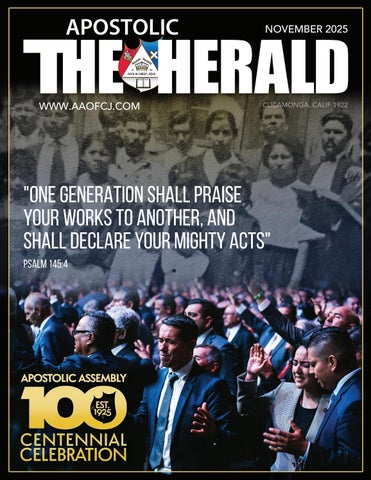
APOSTOLIC ASSEMBLY
1
TABLE OF CONTENTS
THE APOSTOLIC HERALD Advisor Bishop Felipe A. Salazar Editor Bishop Armando Tamez Editor’s Assistant Minister Alex Tarin Creative Director Dominic Moschetti Columnists Contributors Bishop Ismael Martín del Campo Pastor Ismael Martín del Campo III Minister Alex Tarin
FROM THE EDITOR ..................................... 3 PRESIDENTIAL GREETING ......................... 4 100 YEARS AGO: UNITED THEY TRIUMPHED ........................ 7 CRITICAL TIME OF OUR HISTORY .........14 ONE HUNDRED YEARS OF SPIRITUAL HARVEST .........................16 APOSTOLIC PIONEERS ...........................20 ARTHUR Y. HERMOSILLO EPIFANIO M. COTA LEONARDO SEPÚLVEDA MARCIAL DE LA CRUZ FAMILY SPOTLIGHT .................................24 JIMÉNEZ FAMILY VIZCARRA FAMILY AGUIRRE FAMILY VALDEZ FAMILY APOSTOLIC PRESIDENTS .......................28 CHRISTIAN EDUCATION .........................40 WWW.APOSTOLICEDUCATION.COM
The Apostolic Herald is the Official Gazette of the Apostolic Assembly of the Faith in Christ Jesus Attn: The Apostolic Herald 5401 Citrus Ave., Fontana, CA 92336 www.aaofcj.org www.apostoliceducation.com pr@apostolicassembly.org You can contact us by phone at (909) 987-3013
Lorenzo Salazar, Antonio Castañeda Nava, Daniel Janhall, Isaac Cota, Ernesto Cantu, Leonardo Sepúlveda, Roberto Ramirez, Jose Ortega , David Palma 2
THE APOSTOLIC HERALD
FROM THE EDITOR Praise the Lord, Welcome! Beloved church of the Lord, this week we celebrate a significant milestone: 100 years of history since our first general convention in 1925! Our pioneers, guided by the Holy Spirit, felt the need to organize and establish the administrative, financial, and ministerial structures that would sustain the purpose and mission of our group of congregations. Just five years later, in the midst of the Great Depression, we incorporated as “The Apostolic Assembly of Faith in Christ Jesus.” The grace of the Lord enabled us to face the era of global hardship in the 1930s, which was only the prelude to World War II and other conflicts. In the 1960s, the ideologies and music of sociocultural movements presented challenges for apostolic youth, and we cannot leave out the external and internal conflicts that tested our institutional structure. These segments of our history cannot be rejected and ignored; they are part of our journey. At the end of the last century, the internet and the media marked the beginning of the third millennium generation with the technological and virtual revolution in which we live today. The road has been scabrous, but now we have 100 years of history and experience. We look back to recognize and honor those who came before us, we seek to establish a platform that allows us to be protagonists in our present, and we look toward a hopeful future full of opportunities. There is still more to be done, and we continue to structure ourselves to achieve it. Today, let us celebrate our Centennial!
Fraternally, Bishop Armando Tamez Secretary of Christian Education
APOSTOLIC ASSEMBLY
3
PRESIDENTIAL GREETING Esteemed Bishops, Pastors, ministers, and members of the Apostolic Assembly of the Faith in Christ Jesus worldwide. Paz de Cristo. It is with deep gratitude that I greet you as we gather for this historic Centennial Convention. One hundred years of ministry testify to the grace of God and to the dedication of the men and women who carried the Apostolic message across cities, states, and nations. Their labor, prayer, sacrifice, and unwavering commitment shaped a spiritual heritage that continues to bless our churches today. We thank God for allowing us to reach this moment and for the journey that has brought us here. The Centennial invites us to remember the hand of the Lord upon our Assembly. Our founders preached the Gospel faithfully, formed disciples, and organized congregations with a clear sense of purpose. Their work established a foundation that continues to support our mission in this generation. As we honor their legacy, we also acknowledge the responsibility we now carry to strengthen the Church for the years ahead. Our calling remains centered on the mission Jesus entrusted to His disciples. Evangelism, discipleship, and small groups continue to guide our focus. These values give direction to our efforts and shape the vision expressed in Build the Church. We desire to see an Apostolic Assembly that grows, matures, and expands through the power of the Holy Spirit and the obedience of God’s people. This vision aligns with the early Church, which advanced through teaching, fellowship, prayer, and a deep commitment to the Gospel. As we celebrate a century of God’s faithfulness, we reaffirm the essential elements that define us as an Apostolic people. We hold fast to the saving Name of Jesus, the operation of the Holy Spirit, the doctrine handed down to us, and the call to live lives that reflect the character of Christ. These commitments have sustained us for 100 years and will continue to guide our Assembly into the future. Looking ahead, we recognize the importance of strong and focused leadership. The future of the Apostolic Assembly will flourish as Bishops, Pastors, and congregations work together with unity and clarity of purpose. The next 4
THE APOSTOLIC HERALD
century will bring opportunities for expansion, new generations of believers, and doors of ministry we are only beginning to see. As we prepare for what is to come, we place our trust in the guidance of the Holy Spirit and in the wisdom of God’s Word. This Centennial Convention is a moment of celebration, reflection, and renewed commitment. I invite every member of the Apostolic Assembly to embrace this occasion as an opportunity to strengthen our dedication to the mission. Let this meeting inspire us to reach more souls, make more disciples, build healthier congregations filled with the Holy Spirit, supporting one another in the work of the Kingdom. May the Lord continue to bless your churches, your families, and your leaders. Together, with gratitude for the past, striving today, and walking with hope toward the future, let us build up the Church and move forward in the purpose God has set before you. As you reflect on this historic moment, I also pray you enjoy this special Centennial Edition of the Apostolic Herald, prepared to honor our past and strengthen our vision for the future. In Christ, Bishop Felipe A. Salazar President Apostolic Assembly of the Faith in Christ Jesus
“work together with unity and clarity of purpose” APOSTOLIC ASSEMBLY
5
6
THE APOSTOLIC HERALD
100 YEARS AGO: UNITED THEY TRIUMPHED By Ismael Martin del Campo III This year, the Apostolic Assembly celebrates a century since its first general convention, held in San Bernardino, California, from December 1-5, 1925. That historic gathering proved to be the catalyst for the formation of the oldest and largest independent Hispanic denomination in the United States—a movement now spanning 51 countries and 48 states. As we look toward the future God is calling us into, we remember the memorial stones our predecessors raised and the faithfulness of the Lord throughout our entire journey.
Precursors
The organizer of the first convention was Bishop Antonio C. Nava. Baptized in 1916 in Southern California, a man from the Mexican desert state of Durango, he spent the next decade establishing churches in California’s agricultural Imperial Valley—where summer temperatures regularly exceed 100 degrees—and in Yuma, Arizona. His early evangelistic efforts focused on migratory farm workers laboring in these harsh conditions. Late in 1924, Bishop Nava recounts in his autobiography, he was reading the first chapter of Acts when words appeared before him in red: “United you shall triumph and divided you shall fail.” Bishop Nava persisted in prayer, and the Lord impressed upon him the urgent need to organize the scattered churches. Months later, he was invited by pastors in San Bernardino and Redlands to a meeting on July 5, 1925. They agreed to host a convention in December and sent invitational letters to several churches and ministers. At this time, most ministers who would later affiliate with the Apostolic Assembly (incorporated in 1930) were connected to the Pentecostal Assemblies of the World (PAW). From 1918 to 1924, the PAW held a unique distinction among American religious organizations: it was completely racially integrated among its ministers and leaders, virtually uniting the entire Oneness Pentecostal movement. However, on October 15, 1924, many white ministers walked out of the PAW convention, beginning a chain of events that continued through 1925, during which most white ministers departed the organization. With this organizational turmoil centered in the East—where most Oneness Pentecostal ministers were located—and minimal support for Spanish-language outreach on the West Coast, our ministers recognized the necessity of organizing on their own terms. APOSTOLIC ASSEMBLY
7
The First Day
The first general convention began on December 1, 1925. Several speakers opened the gathering by explaining the importance of doctrinal unity. As they prepared to begin their joint study of Scripture, since they would be voting on different doctrines and church practices, Bishop Francisco Llorente proposed six essential values for reading the Word of God together: Reconciliation Forgiveness Fraternal Love Mutual Respect Unity Doctrine These conditions were approved unanimously, and the minutes record that everyone present knelt to pray and agree. As they prayed, they reconciled to each other. The minutes don’t state what kind of grievances existed, but perhaps it was a kind of reconciliation that comes from joining together and not so much grievances. These several ministers and churches had always understood themselves to be independent, but in this act of tearful prayer they were joining together in the Holy Spirit to found the Apostolic Assembly. To them, love wasn’t just something talked about, but something acted upon through prayer.
8
THE APOSTOLIC HERALD
At the close of the first business meeting, the initial leadership team for the first day of the convention was elected: Francisco Llorente as President of the Convention, with Antonio Nava and Antonio Morales serving as his assistants. After this first business meeting, a “revival service” was held. This pattern of a morning business pastoral meeting followed by a service with all of God’s people has been a pattern of our convention for 100 years. It was a service that started at 7:30 PM and ended thirty minutes past midnight with two people deciding to be baptized in the Name of Jesus Christ in a local river. These long services bring to mind the services recounted in the Book of Acts that would prolong deep into the night. The vigilias preserve this ancient practice that originates in the Lord Jesus Christ himself keeping vigil throughout the night.
Key Attendees
Francisco Llorente was elected to preside over the meetings and later served as the movement’s president. He was an early Pentecostal convert from coastal Acapulco, baptized in Jesus’ Name in 1912. From the moment he was baptized he became acquainted with several of the leading Oneness ministers on the West Coast. Though he was never technically president of the legal entity called the Apostolic Assembly (which only came into legal existence in 1930), our church historians and leaders recognize him as the first president. Bishop Nava tells us that Bishop Llorente was resistant to “organization”—a characterization that seems difficult to reconcile with the fact that Llorente served as liaison between the small group of Mexican ministers and the PAW, acquiring PAW credentials for them and thus seeking organizational coverage. Perhaps what is meant is that Llorente opposed a fully independent Hispanic organization, which would explain why he never legally incorporated the Assembly and
APOSTOLIC ASSEMBLY
9
why early letterheads of the church preserve the words “Pentecostal Assemblies of the World.” Perhaps he conceived of the movement as a kind of Spanish-language ministry for the PAW? He may have remained idealistic about the PAW’s potential to unite the American Oneness Pentecostal movement—a hope that history would prove unrealistic for that moment. Llorente had told Nava he would not attend the convention, yet he appeared on the first day and was elected president of the meeting, recognized as the most senior minister. Bishop Llorente had recently endured profound personal loss: his wife Delfina died on May 21, 1925, at only 24 years old, leaving him to care for their four young children. This surely would have limited Llorente’s ability to support Nava in organizing this first convention. Curiously, on December 6, the day after the convention concluded, Bishop Nava officiated Llorente’s wedding to his second wife, Juanita. Jose L. Martinez was the pastor of the San Bernardino church and was elected Secretary of the movement in 1925, but separated in 1926 to form his own organization. Bernardo Hernandez served as secretary of minutes for the first convention—a prophetic start, as he would go on to serve as General Secretary from 1927 to 1948. A man from the central Mexican state of Puebla, he founded the first church in Jimtown, California (present-day Whittier). Marcial de la Cruz was the Apostolic Assembly’s first great hymnwriter. He evangelized Brother Nava in 1916 and planted churches throughout the Inland Empire, founding the Apostolic work in Ventura County. A tall, gaunt man with large piercing eyes from Mexico’s “La Laguna,” his participation in the convention was notable for keeping discussions focused on doctrinal unity and relevant questions on church practice. Arthur Hermosillo was evangelized in Los Angeles in 1922. He is listed in a census for Native Americans as a member of the Pima tribe, now recognized as Akimel O’odham. He became the first American-born member of the General Board and served in Board leadership for twenty-nine years—second only to Antonio C. Nava in years of service. An evangelist by calling, he identified unreached areas during church visits and opened new works. Jesus Torres received the Gospel through Bishop Nava’s ministry in Yuma in 1919. He founded the Indio Church and later served as the first Bishop of the Southern California District (which was from San Diego all the way to Bakersfield) Juan Rodriguez founded the First Bakersfield Church. After receiving the Apostolic doctrine and relocating to Bakersfield in 1924, he was invited to speak at a Methodist church. He preached so convincingly about Jesus Name baptism that most of that congregation chose to be rebaptized in the name of Jesus Christ, establishing the first church in the San Joaquin Valley. Tomas Martinez was an early New Mexico evangelist credited with bringing into the Assembly the future first bishops of New Mexico and Arizona: Cirilo Leyba and Pablo Garcia, respectively. Just the year before, in 1924, he had been baptized in Jesus’ Name by Miguel Garcia. The next year he 10
THE APOSTOLIC HERALD
is recorded as being the Pastor of the Lordsburg church. His ministerial career would be cut short when he died in 1929, but he was able to start five churches in just five years. Miguel Garcia served as pastor and evangelist in the Los Angeles area. Before 1925, he had planted the First Apostolic Church of Torreon in 1917—the “cradle” of Mexico’s Iglesia Apostolica. He was nephew to Romanita Valenzuela, who in 1914 shared the Gospel with her family and in November prayed with several family members to receive the gift of the Holy Spirit. This occurrence on November 1, 1914, marks the first documented experience of Pentecost in Mexico. Ramon Ocampo was the “Silas” to Bishop Nava, accompanying him in establishing several churches. He went on to pastor eight different congregations in Mexico and the United States, in California and Arizona. Isaias Cecena founded the Otay Apostolic Church around 1922. He immigrated from Sinaloa to the United States, working farms and following the harvests. He later returned to Sinaloa to plant many other churches; records indicate he established a church in Mexico in 1925. Jose Aguilar heard the Gospel for the first time at this convention and would be baptized in Jesus’ Name on December 27 that year. When his Pastor, Jose Martinez, left the movement, he remained and started the First San Bernardino Church. He was able to build a temple in 1929, which hosted our 1929 convention, and which still stands to this day. Albino Jimenez was an Inland Empire evangelist with a PAW credential dated to 1921. He was the adoptive father of Bishop Abel Jimenez, who later founded the Ontario Church. E. Manuel Walker presents a fascinating footnote in early Apostolic history. Historical records identify him as an African-American minister who attended both the first convention of the Apostolic Assembly in 1925 and the first convention of Mexico’s Iglesia Apostolica in 1932. After that, records of his ministry cease.
The Second Day: A Recapitulation
After a long service that went past midnight the night before, the business meeting began at 11:05 AM on the second day of the convention. They had an election to decide who would run the meeting that day. Francisco Llorente was again elected as President. Antonio Nava and Jose Martinez were elected as “Convention Elders” and Bernardo Hernandez was elected as the Secretary for Minutes. Francisco Llorente preached about the ministry from Ezekiel 34 and 1 Timothy 3. Bishop Nava followed by repeating the points made the day before by Bishop Llorente for newcomers to the meeting. Another prayer of reconciliation was had, and the meeting was dismissed to go to service.
APOSTOLIC ASSEMBLY
11
Day Three: Discussions Begin
As the day before, Bishop Llorente opened the meeting and spoke about several things: first, on the need to persevere in the doctrine; second, on divine healing; third, overcoming temptation; fourth, mercy and humility. Bishop Nava and Jose Martinez followed with their own words. But on this day, something changed. Marcial de la Cruz stood up and asked a series of questions to the convention leadership and the ministerial attendees. One of his questions was whether it was permitted for members to seek professional medical help when they fell sick, which was affirmed by the pastors. He was allowed to ask this question and others until the time came to go to service. All attendees were dismissed with the first ever original Apostolic song mentioned in a convention minute, “La Rosa de Saron” being sung by Marcial de la Cruz.
Bishop Llorente Confirms Doctrines on Day Four
The convention began around ten in the morning and on this day Bishop Llorente was moved to confirm several doctrines that the Apostolic Assembly believes until this day and that are revealed by the Holy Spirit in the Bible: The Bible is true and comes from God. God created the world. God created human beings. John the Baptist was the last man to hold the office of Prophet. Jesus is the Light that shines beyond all other lights. All these were confirmed by the attendees. Bishop Llorente continued with the following points: People should follow Jesus not out of self-interest. Pastors can be paid by their churches for their work. Pastors should be filled with the Holy Spirit. Holiness is the sign of all of God’s servants. Miraculous signs take place according to God’s sovereign will. Jesus is the Bread of Life. Whoever dies in Christ is resting. The Heavenly Father brings his children into his kingdom. 12
THE APOSTOLIC HERALD
God teaches his children through his ministers. The Lord’s Supper is symbolic. Foot washing separated by gender. The holy kiss is to be practiced by members of the same gender. Some of these points may seem trivial, but the doctrinal precision was necessary because there was no Constitution, no manual, no writings. In the evening service that followed, two different speakers preached on the Name of Jesus Christ. A final call was made by Antonio C. Nava for people to be filled with the Holy Spirit or to be baptized in the name of Jesus Christ.
The Last Day
On the last day there were only topics of discussion and no speeches from leadership. Many of these questions regarding church practice we continue to discuss, in the Apostolic Assembly and in the wider Christian sphere, like divorce and remarriage and repentance. Many of the questions dealt with marriage. There were people who wanted to divorce their unconverted spouse because they were “being led by the Holy Spirit” to marry someone in the church. The convention voted against this, for such a desire originates in the flesh, they said. The veil was confirmed as church practice at this convention. You can read many of the votes and appreciate the firm stances of our pioneers. The themes of the last evening service revolved around the Apostolic doctrine, the imminent return of Christ, and the victory that the convention proved to be. At some point during the convention, or maybe after, the movement was named as: “Iglesia de la Fe Apostolica Pentecostes,” which in English we can translate as “Church of the Pentecostal Apostolic Faith.” Interestingly, the name would be tweaked year after year. Though the minutes do not mention the leadership remaining in place, it was understood that the leaders voted on would remain until the next convention. As we celebrate this centennial milestone, we give glory to God for His faithfulness across generations and anticipate His continued guidance in the years ahead. APOSTOLIC ASSEMBLY
13
CRITICAL TIME OF OUR HISTORY By: Bishop Ismael Martín del Campo Bernardo Hernandez was born in the city of Puebla, Mexico on August 20, 1884. During his early childhood he became an orphan and was sent to study at a Catholic seminary. It was here that he emerged as a skillful musician. Subsequently, he migrated to the United States of America where he was converted and trained to minister by the Baptist Church. In the Baptist congregation of Yuma, Arizona he held the position of Elder. In 1918 while brother Antonio C. Nava was in San Bernardino, California he received news that one of his sisters was seriously ill. Accompanied by brother Ramon Ocampo he traveled to Yuma, Arizona. Without knowing that she had cancer, he went to the hospital to pray for her. As a result of their prayer she was miraculously healed. This motivated brothers Nava and Ocampo to begin preaching through the streets. They were invited to visit the Baptist church in Yuma, where they began to testify of the name of Jesus Christ. A few days later brother Bernardo Hernandez and several members were baptized with the Holy Spirit speaking in new tongues, and immediately were baptized in the name of Jesus Christ. This served to establish the first Apostolic congregation in Yuma. Brother Bernardo Hernandez developed a close friendship with Francisco Llorente, the first General Pastor of the Hispanic Apostolic movement. In 1922 he moved with his family to Jimtown, California (today known as West Whittier) where he won many new believers by meeting in different homes. By 1924 he is known as a pastor in that city. In 1925 he attended the first convention as the pastor of the church in Santa Paula, California. It is for this reason that this congregation recognizes him as the founding pastor. In 1926 he was officially named as pastor of the new church in Jimtown where he served until 1936. In 1927 the congregation inaugurated their first temple. However, this building was set on fire and destroyed by a criminal act in 1935. The first headquarters office of our organization was in that temple from 1927 until 19354. At the beginning of the first convention in 1925 he was elected Secretary of the Convention (To take minutes). At the end of the same he was elected as one of the four members of the new Board of Directors as the Assistant Secretary.
14
THE APOSTOLIC HERALD
In the 1926 convention he was elected as the Secretary of the General Council. It is acknowledged that pioneers Bernardo Hernandez, Francisco Llorente, and Antonio Castañeda Nava were the key ministers in organizing the first convention of 1925. Also, it is noted that he contributed important ideas to organize the first Board of Directors of this Hispanic Apostolic Church. Unexpectedly on September 8, 1928 the first General Pastor Francisco Llorente passed away. In the absence of the other leader (pioneer Antonio C. Nava) who they were notified would not return to the United Bishop Hernández signing as General Pastor on September 1, 1929 States until 1929, pioneer Bernardo Hernandez assumed the position of General Pastor. This was with the support of ministers Marcial de la Cruz and Jesus P. Torres. He held this responsibility for 16 months, from September 1928 until December 1929. During this time of crisis, God gave him the wisdom and strength necessary to lead the church while replacing the church’s leader since 1916. In this task he: Organized and led the Fourth Convention held in December 1928. Supported the organization of the Youth Department. Confronted the wave of doctrinal conflicts that threatened the unity of the church. Organized the welcoming of pioneer Antonio C. Nava. Organized the Fifth Convention held in December 1929. Handed over in an orderly fashion the position of General Pastor to the patriarch Nava, who was elected with acclamation in 1929. In 1929 brother Bernardo Hernandez was reelected as Secretary. He served for 22 years as the General Secretary of the Apostolic Assembly dating from 1926 until his death on February 8, 1948. In the Organization’s Headquarters a photo has been placed on the presidential wall alongside those that have served as presidents of our church. This was done to recognize and honor his work as president in such a critical time of our history. Through the historical experience of pioneer Hernandez, Jesus Christ reminds us that the church is always in His hands, He watches over her, and always provides for her needs.
“Through the historical experience of pioneer Hernandez, Jesus Christ reminds us that the church is always in His hands, He watches over her, and always provides for her needs.” APOSTOLIC ASSEMBLY
15
ONE HUNDRED YEARS OF SPIRITUAL HARVEST By Bishop Ismael Martín del Campo, General Secretary One Hundred Years The history of God’s people tells us that there are promises that are fulfilled after one hundred years. The Word of God tells us that “Abraham was one hundred years old when his son Isaac was born” (Genesis 21:5). One hundred years after the first Passover and the Exodus, there are no longer slaves by the Nile, and the people have settled in Israel. The journey of God’s people to the Promised Land lasted forty years. Joshua led the people in conquest for fifty-two years. And for eight years Mesopotamia occupied the land of Israel until God (on the centenary of the Exodus) raised up Othoniel and gave peace for forty years. On the centenary of the death and resurrection of our Savior Jesus Christ, the Church continued to celebrate its Lord and preach Christ in homes and catacombs, despite the terrible persecutions of the cruel Emperor Hadrian, who was about to die. The message of the gospel continued to spread, guarded by bishops who were disciples of the apostles, such as Polycarp and Papias. The Church continued to win thousands upon thousands in the Roman Empire and its Greek culture
16
THE APOSTOLIC HERALD
and to convert brilliant minds such as Aristides and Quadratus to Christ. The history of God’s people tells of the fulfillment of great promises after a hundred years, but like the patriarchs, prophets, and apostles, we must earnestly contend for the faith that was once for all delivered to the saints.
The First Convention of 1925
The first convention of the Apostolic Assembly was characterized by a desire, a search for organization. There was really no structure among us, no oversight or identity that distinguished us. Our history tells us that there were differences in doctrine, not about the name of Jesus Christ, but on other biblical issues. The first convention catalyzed the formation of a movement of preachers and churches that had previously worked in isolation. Additionally, this first convention occurred during the first great wave of migration from Latin America, the first of several waves that have continued for a hundred years. Like the ancient Hebrews, our people emigrated from their countries to the United States of America, and although the spiritual dimension was not on their minds, God allowed them to enter the promised land of the Kingdom of God. The first convention was simple, humble, without great production, and everything was conducted in Spanish. What the first convention did have was much love in Christ, simplicity of heart, and the power of the anointing of the Holy Spirit. Would our few Hispanic Apostolic churches have achieved the global impact that the Apostolic Assembly has today, working only independently and without organization? As a result of the Pentecostal revival on Azusa Street in the heart of Los Angeles, California, many independent Hispanic Pentecostal groups and churches were born, but they disappeared. Disunity or inadequate organization prevented them from continuing their mission. The words of Patriarch Antonio Castañeda Nava perfectly describe the vision he received from God in 1924, in obedience to which he worked tenaciously until our first convention was held in San Bernardino, California, in 1925: APOSTOLIC ASSEMBLY
17
“One night, while reading the Holy Bible, in chapter 1 of Acts, I saw in red letters a sign that said: United you will triumph and divided you will fail. I read that and wiped my eyes, but I looked again and saw the same thing. Then I felt a tremor in my body and began to pray. I spent most of the night thinking about what the Lord meant by that. I analyzed the matter, thinking that it might refer to a local church, but the Lord declared to me that it referred not only to the church under my care, but to all churches in total.” The Great Commission that Jesus Christ gave to the apostles led them to organize the mission of the Early Church as it expanded throughout Jerusalem, Judea, Samaria, and to the ends of the earth. And that is the vision that inspired our pioneers a hundred years ago to organize the mission of our congregations. Thanks to the organizational vision given by our Lord Jesus Christ, the Apostolic Assembly has established, organized, and sustained more than 800 congregations in 48 states of the United States of America and more than 2,000 congregations in 52 nations on the continents of America, Europe, Africa, and Asia. The doctrinal principles, spiritual values, hymnology, and models of ecclesiastical organization of the Apostolic Assembly have inspired and influenced all Hispanic and Latin American apostolic organizations. The centennial of our apostolic conventions is formidable proof of the instrumental importance of the unity of the Church and the value of organized work for the Mission of the Church.
The Centennial Convention
The Apostolic Assembly has grown in many ways: in baptized members, in the production of Christian educational materials, in the construction of churches, in gifts, talents, and organizational skills. If our brothers and sisters gathered in a small church for their first convention in 1925, we now fill large convention centers with a capacity for thousands of convention attendees. If the brothers and sisters stayed in the homes of other brothers and sisters, we now fill dozens of hotels to their full capacity. The musical instruments at our first convention were basic equipment. Now we use tremendous professional equipment that rivals the best productions anywhere in the world. If our first convention attendees were humble farm workers, we now have thousands of professionals, businessmen and women, and hundreds of pastors with academic degrees in theology and other disciplines. If in 1925 the only language spoken was Spanish, now our national conventions are in English and Spanish. Radio began to be used popularly in the 1920s. Now we make extensive use of
18
THE APOSTOLIC HERALD
mass media to broadcast our services live and through various social media, allowing Assembly members to have a tremendous spiritual impact. Just as in 1925, when the powerful anointing of the Holy Spirit gave our first pastors and congregations the direction, resources, and talents they needed, today, after a hundred years, we must seek and depend on the same anointing of the fire of the Holy Spirit to continue expanding the spiritual harvest among every race, people, language, and social class, both in the United States of America and among all the nations of the earth. The multiple organizational, educational, financial, and real estate resources, along with a century of accumulated experience, must be placed at the feet of Jesus Christ, Lord of the Church, the center of the Mission, the Strategist of the Spiritual Harvest. Separated from Him, as John 15:5 says, we can do nothing, but united with Jesus Christ, we will bear much fruit for the glory of God!
APOSTOLIC ASSEMBLY
19
APOSTOLIC PIONEERS
THE BISHOP EVANGELIST Arthur Y. Hermosillo Arthur Y. Hermosillo (1892 – 1960), was born November 16, 1892 in Yuma, Arizona. Bishop Hermosillo was baptized in the name of Jesus on November 21, 1922 in an Anglo-Saxon church in Los Angeles. Soon after he began to affiliate with Hispanic ministers, he would be set apart for the ministry by Pastor Miguel C. García and ordained by Bishop Francisco Llorente. Pioneer Hermosillo’s ministry encompassed the American southwest and the state of California. His wife was sister Rita Adame whom he married later in life. Powerfully used of God, he received many visions from the Lord, the most well known being “Prophetic Outline of the New Jerusalem.” The main theme of his sermons was prophecy, frequently citing the Song of Songs. The great passion of his life was evangelism. He supervised and helped local pastors in their churches all throughout the southwest. Pioneer Hermosillo labored for twentynine years on the General Board; the second longest serving member after Pioneer Nava. Elected for the first time in 1927, he was the first General Board Member born in the United States: He served as Executive Elder, Bishop Vice President, General Secretary, General Treasurer and the only Bishop of the whole state of California. The Lord called him into his Presence on August 20, 1960 at the age of 68.
20
THE APOSTOLIC HERALD
PATRIARCH OF NORTHERN CALIFORNIA Epifanio M. Cota Epifanio M. Cota (1899 – 1962), was born in Tempe, Arizona on October 18, 1899. He was baptized in the name of Jesus Christ on November 11, 1922 in Brawley, California. His ministry developed alongside his distinguished wife Lupita from 1922 onward in the Imperial Valley. Later he continued on in the Los Angeles area, preaching and teaching the Apostolic message. 1930 would be historic for his life, for he would be commissioned to assume the church in Tulare, California and soon after he would become Elder of Northern California. By the end of his Christian race the Northern California district was the largest in the Apostolic Assembly, encompassing all the San Joaquin Valley and the Bay Area: he himself helped to establish thirtyfive churches. A gifted composer, he helped to translate many hymns from English to Spanish like “Día Alegre.” His son was Bishop Isaac H. Cota who also became a distinguished leader in the Apostolic Assembly. He was elected General Secretary of the Apostolic Assembly in 1950 and served in this capacity for twelve years until he was called to the Lord’s rest on April 3, 1962.
APOSTOLIC ASSEMBLY
21
APOSTOLIC PIONEERS
INTERNATIONAL MISSIONS FOUNDER Leonardo Sepúlveda Leonardo Sepúlveda (1911 – 2006), was born March 18, 1911 in Montemorelos, Nuevo León, México. His mother died when he was still a child. He abandoned his father’s home as the age of nine and aided by God’s protection, he immigrated to the United States. He visited an Apostolic congregation for the first time in his life in Gonzales, California. That same day in 1934, after hearing Pioneer Nava’s message he was baptized in the name of Jesus Christ. In México, he was Pastor of the historic First Church in Torreon, Coahuila (wherein he married sister Carmen Reyes) and founding Pastor of the first apostolic congregation in México City. In 1948 he travelled to Nicaragua being sent out as our first missionary. He established the Apostolic work in Nicaragua, El Salvador and Guatemala. Nine months after his return from Central America he left again to South America in 1952. Pioneer Sepúlveda established the Apostolic work in Argentina and Uruguay. He served with distinction in many capacities such as Bishop Vice President, Secretary of International Missions, Secretary of National Missions, Secretary of Christian Education, and as Bishop Supervisor in the districts of Southern California, Los Angeles and Arizona. He died February 14, 2006 still being a Pastor in South Central Los Angeles at the age of 95.
22
THE APOSTOLIC HERALD
THE FIRST GREAT HYMN WRITER Marcial de la Cruz Marcial de la Cruz (1875 – 1935), was born in 1875 in Torreón, Coahuila, México. Pioneer Francisco Llorente baptized him in the Name of Jesus Christ in 1914, the same year he immigrated to the United States. He rose to be a prominent Evangelist throughout the Inland Empire of California and was granted ministerial license as our first Bishop, for the state of Arizona, by the Pentecostal Assemblies of the World (P.A.W.). This pioneer evangelized our brother Antonio Castañeda Nava, he was his Father in the Faith, who instructed him in the Doctrine, and who shared his home. Arduously working alongside his wife Candelaria in Arizona and New Mexico, he is a recognized pioneer in both states. He composed more than twenty-five hymns of prophetic character and doctrinal depth with his harp and guitar. Some of his hymns are “Ven a la Luz” and “Señor, a ti te alabare.” His last moments of earthly life were in service to his King Jesus Christ, composing yet on his deathbed “Aleluya al Señor,” and in this way he fell asleep on July 7, 1935 at the age of 50.
APOSTOLIC ASSEMBLY
23
FAMILY SPOTLIGHT
JIMENEZ FAMILY My parents, Abel Jimenez, originally from Nayarit, Mexico, and Noemi Varela were baptized near the Jalisco-Zacatecas border. Under the ministry of Zeferino & Matiana Minjares, they received the Holy Spirit. My parents fled after severe church persecution led by a local priest, following the murder of a visiting pastor and the abduction of a young church member, they traveled for eight days through the mountains, facing threats, they escaped and settled in Mexicali (my birthplace), B.C. There, they joined the 2nd Apostolic Church, deepened their commitment, my dad was ordained as a minister in Tijuana in 1962 after being set aside for ministry by Pastor Silvestre Pena. In 1964, Bishop Jimenez moved to California and joined Pastor Ernesto Cantu in Corona. Pastor Cantu soon encouraged him to establish a church in Chino at his mother’s home. After earning the trust of the Apostolic Assembly’s Board, my dad was chosen to lead a small group in Ontario when their pastor stepped down due to health issues. He began as pastor there in 1966. Because of my father’s faith and vision, he launched out by faith and constructed the church building we use now. On June 19, 2004, after 38 years of service, my father transitioned the pastorate to my wife and me. We’re honored to serve CLC for 20 years now. In 2020, covid claimed both my parents and two sisters. It would be impossible to speak about my family without speaking about our Lord and Savior, Jesus Christ, as our life is defined by the God we love and serve.
24
THE APOSTOLIC HERALD
VIZCARRA FAMILY The Word of God reached our Vizcarra family in the 1930s in the Salinas Valley of California. The first brethren we encountered were Pastor Valentín Medina of the church in Gonzalez, California, and Brothers Arturo Hermosillo and Leonardo Sepúlveda, who frequently visited the congregation there. One day, Brother Juan Amaya and several brethren came to our home while evangelizing. My grandmother, Carmen Vizcarra, was gravely ill. Brother Amaya prayed for her, and the Lord instantly healed her. That miracle marked the beginning of our family’s conversion to the gospel. Her illness had caused fear among the entire family, as she suffered violent seizures and would collapse unexpectedly. Witnessing her healing left the family in awe of God’s power. My grandmother was later baptized in 1938 by Pastor Valentín Medina. Years later, at 20 years of age, my father was visiting the Apostolic church in San Jose, California, located on San Antonio Street. During a service, he asked to be baptized and was baptized in the Name of Jesus Christ in December 1945 by his pastor, Juan Amaya. We give thanks to God for the privilege of sering His Church, especially within our beloved Apostolic Assembly of the Faith in Christ Jesus. Milca V. Montañez
APOSTOLIC ASSEMBLY
25
AGUIRRE FAMILY Following the Azusa Street Revival of the early twentieth century, Spirit-filled Apostolics carried the message of Jesus Christ throughout California’s Central Valley. In the midst of agricultural fields where many labored daily, they proclaimed the saving Name of Jesus with bold conviction. This is where my Apostolic heritage begins. One day, my great-great-grandmother, Bridget Arellano, heard a group of Apostolics singing and preaching the gospel. Moved by what she witnessed, she ran home to share the news with her husband. Together they received the message and were baptized in Jesus’ Name. Her obedience to the gospel and Apostolic doctrine established a spiritual lineage that continues to this day. I am a fifthgeneration Apostolic, and my children are sixth-generation on my mother’s side. A similar miracle occurred on my father’s side. My grandfather, Julian Aguirre Sr., then a Methodist, was walking down the street when he heard singing coming from a small storefront church. Drawn by the sound, he stepped inside and was immediately filled with the Holy Spirit. When he later spoke in tongues in his Methodist congregation, his pastor directed him to the “Holy Roller church.” In obedience, Julian and his wife returned to that storefront and received the full Apostolic message. Although he lacked formal education, he went on to establish several churches across California—planting seeds of revival that still bear fruit today. Our family’s testimony stands as a witness to the enduring power of Apostolic doctrine and the faithfulness of God from generation to generation. Pastor Benjamin Aguirre
26
THE APOSTOLIC HERALD
VALDEZ FAMILY In 1965, our family traveled from Mission, Texas, to California to visit my mother’s ill brother. During that visit, my aunt, Sister San Juana Perez, a faithful member of the Apostolic Church in Reedley, shared the gospel with my mother, the late Sister Alicia Valdez. That same year, my mother was baptized in Cutler, California, by the late Pastor Reyes Coronado. Shortly thereafter, we moved to East Palo Alto, where we came under the spiritual care of the late Pastor Elias B. Castillo. For an entire year, Pastor Castillo witnessed to my father, the late Pastor Edgardo López Valdez, who gave his life to the Lord in 1967. Together, my parents helped establish the Apostolic church that still stands in East Palo Alto. They served faithfully in several roles, including CoPastor, District Treasurer, and Ladies Sector President. Following God’s direction, my father founded a new Apostolic church in Redwood City in September 1976. I received the gift of the Holy Ghost, with the evidence of speaking in tongues, in 1969, and two weeks later I was baptized in Jesus’ Name. In 1974, I was ordained to the ministry by Bishop Manuel Vizcarra. By the grace of God, I have served the Northern Pacific Coast District for more than 30 years in various capacities, including Youth President, Pastor, Sector Elder, District Secretary, and now as Bishop of the Northern Pacific Coast District. God has sustained us as we carry forward the legacy of faith and service entrusted to our family. Since 2007, I have been honored to pastor the Apostolic Church in Redwood City, where the Lord continues to bless His work. Bishop Jesse A. Valdez
APOSTOLIC ASSEMBLY
27
APOSTOLIC PRESIDENTS
FRANCISCO F. LLORENTE GENERAL PASTOR (1925-1928) From Artist to Preacher Francisco F. Llorente (1886 – 1928) was born in the coastal city of Acapulco, Guerrero, México on March 9, 1886. He was the first Bishop President of the Apostolic Assembly and the only one to have died in office. A painter, he immigrated to the United States in 1909. The Lord reached him through Minister Juan Navarro and he was baptized in Jesus’ Name in 1912. He established various churches, concentrating his ministry in the largest cities of California: San Francisco, Los Angeles and San Diego. People would be slain in the Spirit as he preached and miracles followed him. Brother Llorente was the author of many hymns, including “Jesús me habló.” His first spouse was sister Delfina Raygoza with whom he had three children.
First Bishop President A reluctant leader, his fellow ministers elected him their General Pastor in 1925 at the first General Convention in San Bernardino, California. After this first Convention, pioneer Nava married brother Llorente with sister Juanita Peachy. Brother Llorente led the first three Conventions from 1925 to 1927, he provided the first ministers with their credentials from the Pentecostal Assemblies of the World, established the first three districts, presided over the first Convention agreements and he published our first Doctrinal Statement. He rested in the Lord at Yuma, Arizona on September 8, 1928.
28
THE APOSTOLIC HERALD
BERNARDO C. HERNÁNDEZ GENERAL PASTOR (1928–1929) Finding the Apostolic Message Bernardo C. Hernández (1884 – 1948) was the second Bishop President of the Apostolic Assembly and the shortest serving. He was born in Central Mexico, in the city of Puebla on September 18, 1884. Orphaned at a young age he attended a Catholic seminary and later the Baptist Church reached him: He eventually became a Baptist Elder. He received both Catholic and Baptist theological training. In 1919 pioneer Antonio Castañeda Nava arrived in Yuma, Arizona preaching the Apostolic message and it was through him that brother Bernardo was evangelized. He would later move to Jimtown, present-day Whittier, California to establish the historic church there alongside his wife Carmen and children.
Leadership in spite of Crisis Upon Bishop President Llorente’s death, and due to the absence of Pioneer Antonio Castañeda Nava, Bishop Hernández assumed the leadership of the Apostolic Assembly as interim General Pastor. A schism had already started in 1927 against the new Assembly; it was his decisive leadership that kept the Assembly united. He led the 1928 Convention in Indio, California where for the first time youth choirs sang. After his term as Interim General Pastor, he would serve for another twenty years as General Secretary until the Lord called him into his presence on February 2, 1948.
APOSTOLIC ASSEMBLY
29
APOSTOLIC PRESIDENTS
ANTONIO CASTAÑEDA NAVA BISHOP PRESIDENT (1929-1950) (1963-1966) A Vision in the Night Antonio Castañeda Nava (1892 – 1999) born October 4, 1892, in Durango’s desert in Nazas, was the third Bishop President of the Apostolic Assembly. He has the distinction of being the longest-serving Bishop President. Distinguished hymn writer Marcial de la Cruz, evangelized brother Nava and was his spiritual mentor. While looking for work one day in San Bernardino along with Pioneer de la Cruz, brother Nava was filled with the Holy Spirit and baptized on November 23, 1916. Soon after he set himself to preaching and planting churches. The Lord gave him a vision one night in 1925 that the new Apostolic Hispanic churches should organize; as such he planned the first General Convention in 1925. Bishop Nava married his wife Dolores Ochoa in 1933. His ministry crossed borders; he was instrumental in organizing the “Iglesia Apostólica” in Mexico by providing orientation to their first Bishop President, Pioneer Felipe Rivas, and credentials to Mexican ministers.
Laying the Foundations The Ministerial Body gave its overwhelming support and vote of confidence to pioneer Nava in 1929 upon his return from México and in the wake of the Great Depression. The Lord was with Bishop Nava, his ministry had many miracles and healings. He presided over the Apostolic Assembly in the decades when the Church faced forced repatriation, terrible poverty, and the Second World War. His achievements include incorporating the Apostolic Assembly in 1930, the first Constitution, the first Hymnal, the celebration of the Apostolic Assembly’s 50th Anniversary, the International Apostolic Bible College, the auxiliaries, and the publishing of the Apostolic Herald. Pioneer Nava was also a hymn writer; he composed “El Nombre del Mesias” which is the Apostolic Assembly’s anthem. He rested in the Lord full of days at the age of 106 on August 10, 1999.
30
THE APOSTOLIC HERALD
BENJAMÍN CANTÚ BISHOP PRESIDENT (1950–1963) Apostolic Presidents A Bilingual Church Benjamín Cantú (1913 – 1998) was the fourth Bishop President of the Apostolic Assembly. He was the first Bishop President born in the United States. Cantú was born in a Methodist family on February 20, 1913, and was a zealous Trinitarian preacher until he was filled with the Holy Spirit to his surprise at an Apostolic service. Minister José Guerra baptized him in 1931. His pastoral ministry began in Mission, Texas and his wife was our sister Tomasita Saenz whom he married in 1935. During these first years, he rose as the natural leader of South Texan Apostolic churches and in 1933 he connected these churches with the “Iglesia Apostólica”. In 1937 he led these Texan churches to work with their counterparts in California. He was appointed Elder for all the state of Texas. Bishop Cantú was a gifted preacher, eloquently commanding both English and Spanish.
Toward New Horizons At the death of Pioneer Bernardo Hernández, he succeeded him as General Secretary. Being an effective administrator, the pastors elected him Bishop President in 1950. The hallmarks of his presidency include the creation and expansion of the Apostolic Assembly’s missionary program, the Department of Christian Education, and the first Expositors. Bishop Cantú composed “Cristo es Nuestro Jefe,” and “El Pionero Predicador.” He died July 28, 1998, as Pastor of Emmanuel Apostolic Church, a church he began in downtown Los Angeles.
APOSTOLIC ASSEMBLY
31
APOSTOLIC PRESIDENTS
EFRAÍM G. VALVERDE BISHOP PRESIDENT (1966–1970) Maranatha! Efraím G. Valverde (1928 – 2003) was the fifth Bishop President of the Apostolic Assembly. He was born September 21, 1928, in Pinedale, California, and married sister Catalina Ponce in 1948, the following year they were both baptized in the Name of Jesus. His family had belonged for generations to the Baptist Church until his family and he were reached with the Apostolic doctrine in Tijuana, México. Brother Efraím quickly set himself to preaching in his characteristic animated and firm manner. The Lord used him to compose many hymns, which include “Indelible,” and “Agradecimiento.”
Challenging Times He received a divine call to move from Tijuana to northern California. Quickly appointed a Pastor, he was elected Bishop of Northern California in 1962 when Pioneer Epifanio Cota died. In 1966 he was elected Bishop President of the Apostolic Assembly presiding over the church during this time of social changes and unrest. As President he rented and later purchased the first office building to house the Church’s headquarters in Los Angeles, he created new districts beyond the American Southwest and he advised future leaders of the United Pentecostal Church of Colombia. He died on July 4, 2003.
32
THE APOSTOLIC HERALD
LORENZO E. SALAZAR BISHOP PRESIDENT (1970–1978) Veteran & Missionary Lorenzo E. Salazar (1924 – 1991) was the sixth Bishop President of the Apostolic Assembly. He is the only one to have been a veteran and the first missionary to become Bishop President. Born April 1, 1924 his mother came to the Apostolic faith at brother Nava’s church when he was still young, he practically grew up in the Assembly. He left the church, but after tasting the world renounced it, and was baptized in 1944. Soon after, he served in the military during the Second World War. After his return he soon went to the missionary field in El Salvador and Nicaragua from 1951 to 1955. During his time as missionary he met and married sister Crucita Gaitán in 1953.
Revival before the King’s Arrival He served as Secretary of Missions and Bishop of the new Los Angeles District. In 1970 he would be elected Bishop President. His presidency brought stability after a decade of changes; he organized the first Pastoral retreats and legislative congresses. During his tenure, missionaries were sent to Spain and the Caribbean. Bishop Salazar was the first President to graduate with a theological degree, a Master of Divinity (M. Div.) from Fuller Theological Seminary. Lastly, he is the greatest Apostolic Assembly hymn writer after Marcial de la Cruz; among his hymns are “Fuente de Misericordia” and “Los Diez Mandamientos.” He died surrounded by family on September 23, 1991 in La Mirada, California.
APOSTOLIC ASSEMBLY
33
APOSTOLIC PRESIDENTS
BALDEMAR RODRÍGUEZ BISHOP PRESIDENT (1978–1986) (1994–2002) Charismatic Leadership Baldemar Rodríguez (1941 – 2015) was the seventh and second-longest serving Bishop President of the Apostolic Assembly. He was born in Santa Rosa, Texas, on February 4, 1941 to Luis and Soila Rodríguez. Raised in a family of musicians, he came to the Lord at the age of twenty when his father died of cancer in 1961. In 1965 he married our sister Homa Lee Candelaria. A charismatic preacher, the leadership soon saw great potential in him: He was quickly ordained, served as Sector Elder and later as Bishop Supervisor in the South Texas District (1971 – 1975) and Southeast Texas District (1975 – 1979). Later he would become Bishop Supervisor for the Interior District of California and Nevada for seven years (1987 – 1994).
“Run Church, Run!” Bishop Rodríguez was a talented musician and hymn writer, composing many hymns like “Cuando Cristo me hallo” and “Quiero orar al Padre” in his Tejano style. His election in 1978 was a welcomed surprise by the pastors and people of the Apostolic Assembly. His first (1978) and last sermon (2002) at a General Convention was: “Run Church, Run!” Bishop Rodríguez’s leadership saw many districts established, the first General Conventions in Texas and New Mexico, and he expanded the Apostolic Assembly in numeric growth here in the United States and abroad. He graduated with a Master of Divinity (M. Div.) degree from Fuller Theological Seminary. The Lord called him to his presence on July 30, 2015 at the age of 74.
34
THE APOSTOLIC HERALD
MANUEL J. VIZCARRA BISHOP PRESIDENT (1986–1994) Committed Gravity Manuel J. Vizcarra (1924 – 2003) was the eighth Bishop President of the Apostolic Assembly. Born in Juarez, México June 19, 1924 he was serious and formal from his youth. He was baptized in 1945 at the First Church of San José, California. On December 6, 1953 he married sister Martha Araujo. Seeking to better prepare himself he studied at the “Iglesia Apostólica’s” ITAI (Instituto Teológico Apostólico Internacional) until his return to Northern California. He was elected Bishop Supervisor of this district in 1967. He is the most recent hymn writer to serve as Bishop President, composing “No Sueltes las Manceras.”
Honesty & Faithfulness Bishop Vizcarra’s leadership first came to light here in Northern California. He would later be elected Secretary of Christian Education, General Secretary and Bishop Vice President. He was elected Bishop President in 1986. The Vizcarra presidency saw the purchase of our current Headquarters, the Plan of Action, the strengthening of the Assembly’s finances, and the establishment of the A.C. Nava Foundation. He was the first Bishop President of the Apostolic Assembly in Mexico and would return to be Pastor in the church he was baptized until April 7, 2003 when he was called into the Lord’s presence.
APOSTOLIC ASSEMBLY
35
APOSTOLIC PRESIDENTS
DANIEL G. SÁNCHEZ BISHOP PRESIDENT (2002–2010) A Son of the Assembly Daniel G. Sánchez (1939) is the ninth Bishop President of the Apostolic Assembly. He is the first one to have been an Apostolic Assembly’s Pastor’s son. Born November 16, 1939 his father, Pastor Trinidad Sánchez, established the church in El Centro, California in the thirties. Bishop Sánchez left the Church at a young age. After marrying Evangelina Fierro on September 25, 1960 the Lord saved them when Pastor Enrique Salcido baptized them in September 24, 1961. He was soon placed in ministerial service, and pastored churches in the Imperial Valley and later in the Los Angeles area. His peers confirmed his leadership electing him Bishop of the East Los Angeles District in 1987.
Our Apostolic Identity Bishop Sánchez would be elected Secretary of Social Assistance in 1990, and would later serve as General Secretary and Bishop Vice President. He organized the Nuestro Canto concert and documentary in 1994. His defining leadership, at all times founded on Apostolic history and legacy, adopted our Vision Statement (Exalt Christ, Equip the Church, and Evangelize the World), and began programs like the Strategy of Jesus and RoadMap. He has a Master of Arts (M.A.) in Religion from the Evangelical Seminary of Puerto Rico and is currently living in Anaheim , CA.
36
THE APOSTOLIC HERALD
SAMUEL VALVERDE BISHOP PRESIDENT (2010–2013) General office Bishops Fresh Dynamism Samuel Valverde (1957) is the tenth Bishop President of the Apostolic Assembly. He was born April 29, 1957 in San Diego, California, the son of Pastor Miguel Valverde, his ministry began at the local church and rose to the Messengers of Peace National Board. He married our sister Raquel Contreras on December 30, 1978. He is a very talented and dynamic preacher.
Keeping the Flame Alive Bishop Valverde was first elected to the General Board in 1990 as Secretary of Christian Education. He later served as General Secretary and Bishop Vice President. He was elected Bishop President in 2010. His achievements as Bishop President were the Nuestro Canto II concert, the School of Pastors inauguration and a record 7,000 baptisms in one year through the Strategy of Jesus program. He has a Master of Arts in Religion from the Evangelical Seminary of Puerto Rico and served as Pastor of Fountain of Truth Apostolic Church from 1984 to 2018 in Fontana, CA.
APOSTOLIC ASSEMBLY
37
APOSTOLIC PRESIDENTS
JOHN FORTINO BISHOP PRESIDENT (2013–2022) Born on January 4, 1960 in Buenos Aires, Argentina to Italian immigrants, he heard and unreservedly obeyed the apostolic message in his youth, overcoming his family’s religious opposition. He was filled with the Holy Spirit at thirteen years of age on January 15, 1973 and would be baptized in the Name of Jesus Christ seven days later by Apostolic Argentine pioneer Wuckola Jactzuc. His characteristic missionary passion comes from him being the first President that emerges from the missionary field. Immigrating to the United States in the early eighties to study at Fuller Theological Seminary, he was called to be a National Evangelist in 1981 by then Secretary of National Missions, Bishop Roberto Ramírez. The Lord used him powerfully in revivals throughout the nation. As a minister he helped in the Apostolic Assembly’s development in Washington D.C. The Lord called him to plant in 1987 “Fountain of Life” Apostolic Church in Miami, Florida. After twenty-seven years he continues to shepherd this large, flourishing and multicultural church of more than 700 members. His trailblazing leadership was demonstrated when he was elected Bishop Supervisor in 1997 to reestablish the Florida District. He served in this position for seven years. From “Fountain of Life,” the church he pastors, he has planted eighteen new congregations. Near the dawn of the new millennium, the 1998 General Convention elected him as Secretary of National Missions where he spearheaded for eight years the planting of churches all throughout the East Coast and the Heartland of our nation. He is a prolific author of fifteen books, which include “The Life of the Redeemer” and “The Spiritual Life”. In the 2010 General Convention he was elected Bishop Vice President and he was the School of Pastors founding director. The 2014 General Convention elected as our eleventh Bishop President. He obtained a Doctor of Ministry (D. Min.) degree from Knox Theological Seminary (Fort Lauderdale, Florida) in May 2013
38
THE APOSTOLIC HERALD
FELIPE A. SALAZAR BISHOP PRESIDENT (CURRENT) Bishop Felipe A. Salazar is the President of the Apostolic Assembly, elected for the 2022 to 2026 term. He was born on May 27, 1959, in National City, California. His father, Pastor Felipe Valles Salazar, was an early Apostolic missionary to the Mexican state of Oaxaca and he also pastored in Northern Mexico, Arizona, and the Los Angeles area. Inspired at a very early age by his father to preach the Gospel, he was baptized in the Name of Jesus Christ on April 13, 1975. Bishop Salazar was ordained to the ministry in 1984. He served the Los Angeles District as Youth President and in other positions in the youth department. On January 29, 1993, he was appointed Pastor of the Second Church of San Pedro, California. On December 16, 1998, he assumed the pastorate of the congregation of Compton, California, known today as “Hosanna Apostolic Church.” After serving for eight years as District Treasurer, the pastors of the Los Angeles district elected him to serve as their Bishop Supervisor. He served in that office for eight years. Bishop Salazar was elected to serve as the General Secretary of the Apostolic Assembly at the 2014 General Convention. Then, four years later, he was elected by the pastoral body to serve as the Vice President of the general assembly. Bishop Salazar was elected to serve as the twelfth President of the Apostolic Assembly on November 26, 2022 by the General Convention Throughout his presidency, Bishop Salazar has shared his vision for thegrowth of the church by emphasizing heavily the need for an overall 7% growth through evangelism, discipleship, healthy leaders, and healthy churches. This has been emphasized in using the themes: Build the Church: Mission (2023), Build the Church: Mission - Holy Spirit (2024), Build the Church: Mission - Doctrine (2025), Build the Church: Mission - Holy Spirit (2026) and the printing of the Global Vision Manual to communicate the vision clearly to all Bishops, Pastors, Leaders, and Members of the Apostolic Assembly..
APOSTOLIC ASSEMBLY
39
Paz de Cristo! Dear Church, the motto established by the Secretariat of Christian Education is more than just a slogan: “The most powerful means of transformation: Education.” This motto emphasizes the importance and urgency of education in all our beloved congregations. We live in the age of information technology, but not necessarily with the best content. Never in history, since the beginning of the church, have the seeds of weeds (false theologies, doctrines, and liberalism) been spread and introduced into every home in the church and the world. They no longer need to knock and enter through the door; they are already inside our homes through the internet. This requires and demands an information technology front that transcends simple countermeasures. We need a comprehensive platform that directs the vision of the Apostolic Assembly with solid and relevant education for the church today. This is the main reason why various and multiple coordinations have been created, seeking to guarantee an academic and educational future that can sustain the church of the third millennium. I ask for your prayers for each coordinator, director, and collaborator and for the tasks entrusted to them. To all of them, thank you for your diligence and effort. Let us collaborate and participate, for it is our future, the future of the Apostolic Assembly of Faith in Christ Jesus.
Bishop Armando Tamez Secretary of Christian Education
WWW.APOSTOLICEDUCATION.COM 40
THE APOSTOLIC HERALD
GENERAL ADVISOR Bishop President Felipe A. Salazar Bishop President Felipe A. Salazar serves as the General Advisor to the Department of Christian Education, providing spiritual leadership and executive oversight. He offers guidance and direction for all national and international initiatives, ensuring that each aligns with the Apostolic Assembly’s mission and vision. As part of his advisory role, he reviews monthly progress reports and supports the department’s continued growth and excellence.
SECRETARY OF CHRISTIAN EDUCATION Bishop Armando Tamez Bishop Armando Tamez provides leadership and direction to the Department of Christian Education, overseeing all projects and initiatives carried out by its national and international coordinations. He manages departmental budgets, strategic planning, and deadlines, ensuring excellence and accountability in the board. Additionally, he leads the efforts toward the accreditation and development of Nava College, advancing the department’s educational mission.
EXECUTIVE ASSISTANT Minister Alex Tarin Minister Alex Tarin serves as Executive Assistant to the Secretary of Christian Education, supporting all administrative and departmental functions. He coordinates and monitors the productivity of the CE Coordinations, ensuring projects are completed efficiently and in alignment with departmental goals. In addition, he oversees all operations of the Apostolic Bookstore, providing leadership in resource development and distribution.
IABC DEAN, CENTRAL CAMPUS DIRECTOR, POSTGRADUATE STUDIES COORDINATOR Dr. Janae E. Quezada Dr. Janae E. Quezada provides leadership and oversight to all operations of the International Apostolic Bible College, including academic affairs, online and district campuses, the alumni association, and the IABC Writers. She coordinates the three Central Campus extensions and manages postgraduate cohorts and scholarship programs. All initiatives are carried out under the advisement and direction of the Secretary of Christian Education to ensure excellence in theological education and ministerial training.
APOSTOLIC ASSEMBLY
41
IABC ADMINISTRATOR Sis. Gladia Pacheco Sis. Gladia Pacheco serves as Administrator of the International Apostolic Bible College, assisting the Dean in all administrative and operational functions. She manages student records, financial processes, and logistical coordination for both national and international campuses. Additionally, she oversees the preparation and distribution of graduation regalia and diplomas for IABC ceremonies held around the world.
IABC ONLINE CAMPUS COORDINATOR Pastor Steven G. Rodríguez Pastor Steven G. Rodríguez oversees the operations of the IABC Online Campus, managing student enrollment, academic progress, and graduation support for students completing or making up courses. He leads the continued expansion of the online platform to include renovated Associate and Bachelor of Arts programs, as well as Spanish-language AA and BA courses, ensuring accessibility and excellence in Apostolic higher education.
IABC ALUMNI ASSOCIATION PRESIDENT Dr. Lisa Marroquín Dr. Lisa Marroquín leads the IABC Alumni Association, fostering connections between graduates and the Department of Christian Education. She provides opportunities for alumni to utilize their academic training to serve the Apostolic Assembly and strengthen the educational mission of the CE Department.
IABC WRITERS COORDINATOR Dr. Roberto Tinoco Dr. Roberto Tinoco leads the comprehensive revamp of the IABC curriculum, ensuring the preservation of Apostolic values and educational integrity. He oversees the professional publication of textbooks to make them accessible digitally and through major platforms such as Kindle and Amazon, expanding IABC’s academic reach worldwide.
ANNUAL IABC DIRECTORS’ WORKSHOP Dr. Janae E. Quezada & Sis. Gladia Pacheco Dr. Janae E. Quezada and Sis. Gladia Pacheco organize and execute the Annual IABC Directors’ Workshop, gathering campus directors from across the globe. They oversee workshop sessions, logistics, and hotel accommodations to provide a cohesive and enriching leadership development experience for all directors. 42
THE APOSTOLIC HERALD
SCHOOL OF PASTORAL FORMATION COORDINATOR Bishop Jesse Valdez Bishop Jesse Valdez coordinates the annual School of Pastoral Formation (SOPF) Conference for ministers called to pastoral service. He also manages the follow-up courses offered via Zoom throughout the year, equipping candidates for effective and biblically grounded ministry within the Apostolic Assembly.
ACCREDITATION PROCESS COORDINATOR / APOSTOLIC THEOLOGICAL SEMINARY Dr. Arnulfo Cedillo Dr. Arnulfo Cedillo oversees the accreditation process of “Nava College,” working closely with an accreditation consultant to establish the Apostolic Assembly’s first fully accredited college. His leadership ensures academic excellence, institutional credibility, and long-term sustainability for future generations of Apostolic scholars.
NATIONAL APOSTOLIC LITERATURE COORDINATOR Dr. Omar Arzate Dr. Omar Arzate coordinates the development and publication of Apostolic expository materials for the Christian Education Department. He oversees teams producing curriculum for adults, youth, juniors, and children, ensuring doctrinal soundness and high-quality educational resources for local churches.
CE FOR INTERNATIONAL MISSIONS COORDINATOR Dr. Luis E. Montero Dr. Luis E. Montero directs the expansion of Christian Education in the international mission field. His work includes the implementation of IABC programs with specialized curricula designed for ministerial training, church growth, and church planting in diverse global contexts.
APOSTOLIC ASSEMBLY
43
ACE COORDINATOR (APOSTOLIC COMMITTEE OF EDUCATORS) Dr. Ruth Crutchfield Dr. Ruth Crutchfield leads the Apostolic Committee of Educators, dedicated to producing professional-grade Sunday School materials for local churches. She has assembled a team of credentialed educators to develop lesson plans spanning from Pre-K through university level, promoting academic excellence and Apostolic faith formation.
APOSTOLIC CHRISTIAN ACADEMIES NATIONAL COORDINATOR Elder Omar Cortez Elder Omar Cortez provides guidance and resources to pastors who wish to establish Christian academies within their local churches across the United States. He assists in developing strong educational frameworks that uphold Apostolic doctrine while offering high-quality academic instruction.
NATIONAL APOSTOLIC HOMESCHOOL NETWORK DIRECTOR Sis. Maria Fernanda Zuñiga Sis. Maria Fernanda Zuñiga directs the National Apostolic Homeschool Network, equipping families with effective and affordable homeschooling resources. She leads the creation of cooperative groups throughout the U.S., supported by a committee with over 50 years of combined homeschooling experience.
DISTRICT TRAINING SEMINARS District Training Seminars are organized and led by various coordinators throughout the year, providing specialized training for pastors and educators. Recent seminars have included Teaching Techniques (2023), and upcoming sessions will address emerging topics such as Artificial Intelligence and many more.
CE BOOKSTORE Minister David Garcia Minister David García oversees the operations of the Christian Education Bookstore, processing orders, managing inventory, and ensuring the timely distribution of educational materials. He works under the advisement of the Executive Assistant to maintain excellence in resource management and customer service.
44
THE APOSTOLIC HERALD
CREATIVE DIRECTOR - VIDEO AND DIGITAL PROMOTIONS Bro. Dominic Moschetti Bro. Dominic Moschetti leads the department’s media production and digital promotions, including graphic design, videography, editing, and publication formatting. He manages online presence for both the Christian Education and Bookstore websites, ensuring a consistent and engaging digital outreach.
VBS CURRICULUM COMMITTEE DIRECTOR Sis. Cynthia Guzmán Sis. Cynthia Guzmán directs the Vacation Bible School Curriculum Committee, responsible for creating Apostolic VBS programs tailored for local church use. She oversees the development of creative, biblically sound materials that inspire and disciple children across all age groups.
EDUCATIONAL TRIPS COORDINATOR Pastor Daniel Martinez Pastor Daniel Martinez coordinates and leads international educational trips that provide immersive biblical learning experiences. Recent journeys have included Greece (2025) and an upcoming tour of Israel (2026), designed to deepen participants’ understanding of Scripture and Apostolic heritage.
APOSTOLIC DOCTRINE REVISORY COMMISSION COORDINATOR Bishop José Castro Bishop José Castro chairs the Apostolic Doctrine Revisory Commission, responsi ble for reviewing all doctrinal publications produced by the Department of Christian Education. The commission ensures that all materials align with Scripture and uphold the core values and teachings of the Apostolic Assembly.
APOSTOLIC ASSEMBLY
45
46
THE APOSTOLIC HERALD