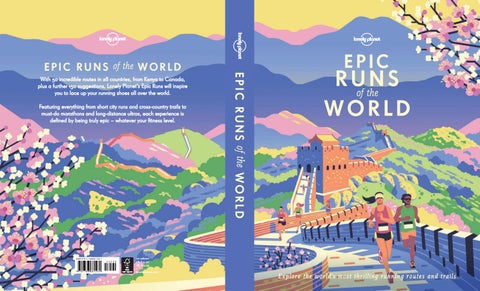
With 50 incredible routes in 28 countries, from Kenya to Canada, plus a further 150 suggestions, Lonely Planet’s Epic Runs will inspire you to lace up your running shoes all over the world. Featuring everything from short city runs and cross-country trails to must-do marathons and long-distance ultras, each experience is defined by being truly epic – whatever your fitness level.
1st edition US $35.00 UK £24.99 lonelyplanet.com
E P I C R U N S of the W O R L D
E P I C R U N S of the W O R L D
EPIC
R Uof theN S WORLD
Ex plore the world’s most thrilling running routes and trails
© Courtesy of Big Sur Marathon | Reg Regalado © Ian Walton for Virgin Money London Marathon
06
The Dipsea Trail Race (USA) 82 Copacabana at Dawn (Brazil) 88 The Chicago Shoreline (USA) 94 Badwater 135 (USA) 100 Bay to Breakers (USA) 106 A Winter Warm-Up in Québec City (Canada) 112 The Big Sur Marathon (USA) 118 An Illuminating Ascent in La Paz (Bolivia) 124 Portland’s Epic Park Run (USA) 130 The Grand Canyon’s Rim-to-Rim Challenge (USA) 136
AFRICA 08 The Safaricom Half Marathon (Kenya) 10 The Marathon des Sables (Morocco) 18 The Great Ethiopian Run 24 The Comrades Marathon (South Africa) 30 AMERICAS 36 The Boston Marathon (USA) 38 Havana’s El Malecón (Cuba) 44 Mesa Trail (USA) 52 A Tour of Vancouver’s World-Class Seawall (Canada) 58 The Barkley Marathons (USA) 64 A Rainforest Run in Costa Rica 70 A Patriotic Path Around the National Mall (USA) 76
ASIA The Jinshanling Great Wall Marathon (China) Hong Kong’s Victoria Peak (China) An Adventure Run in India Kyoto’s Kamo Riverfront (Japan) 2
142 144 150 156 162
© © 2013 Hugo Hagman / Getty Images
INTRODUCTION
Easy
The Angkor Wat Half Marathon (Cambodia) The Marathon of Afghanistan A Climb into the Foothills of Nepal Seoul’s Han River (South Korea)
168 174 180 186
EUROPE A Tightrope Run Along the Amalfi Coast (Italy) A Sightseeing Lap Around Edinburgh (Scotland) An Ode to a Czech Running Hero (Czech Republic) A Portal to the Past in Pembrokeshire (Wales) Barcelona’s Sea-to-Summit (Spain) A Classic Round in the Lake District (England) Berlin’s Greatest Hits (Germany) The London Marathon (England) A Quiet Run in Rome (Italy) Dublin’s Wild and Windswept Peninsula (Ireland)
192 194 202 208 214 220 226 232 238 244 250 3
Harder
Epic
The Athens Marathon (Greece) Arrancabirra (Italy) The North Pole Marathon
256 262 268
OCEANIA The Great Ocean Road Marathon (Australia) Melbourne’s Must-Do Park Run (Australia) The Ormiston Gorge Pound Loop (Australia) The Kepler Track (New Zealand) Sydney’s Spectacular Seafront (Australia) Ultra-Trail Australia The Ghost Run of Waihi Gorge (New Zealand) Tasmania’s Freycinet Peninsula (Australia)
274 276 282 288 294 300 306 312 318
INDEX
324
© Stefano Jeantet
CONTENTS
4 5 © Chris Ord
- EPIC RUNS OF THE WORLD -
Clockwise from left: pounding New Zealand’s Kepler Track; running the Great Ocean Road in Australia; Positano, a picturesque pit-stop on Italy’s Amalfi Coast. Previous page: negotiating tricky terrain on Australia’s Larapinta Trail
HOW TO USE THIS BOOK Each of the five chapters in this book includes a special collection of runs from that particular region, from easy-access park runs and city loops to iconic marathons and epic ultras. A colour-coded key on the contents page will help you identify which are easy, which require serious fitness and fortitude, and which fall somewhere in between (based almost entirely on distance and elevation gain). Accompanying each main story is some practical information to help you follow in the author’s footsteps. The authors have also included three extra routes or races that have a similar character to their featured run, but may be closer to home or more accessible. It’s important to point out that there are a handful of insanely difficult runs in this book that only a few of us will ever be able to do. In many cases, the people who have written about them are professional runners, paid to train on a daily basis. But the armchair adventure value of these tales cannot be overstated. You will no doubt become parched just reading about Death Valley’s Badwater 135 and become dizzy reading about the notoriously disorienting Barkley Marathons. These are stories that will inspire you to kick things up a notch, to train for something bold and, perhaps, someday sign up for a race you never thought possible. Whichever runs you decide to add to your bucket list, take the time to source and study your own detailed maps and to gear up properly for any routes that might take you off the beaten path. Be kind to your fellow runners and even kinder to the wild landscapes you travel through. Be prepared for a few weird looks from locals and, most importantly, never forget to pack your running shoes. 6
© Courtesy of the Great Ocean Road Marathon
© Francesco Riccardo Iacomino | ronnybas | 500px
T
running – some even do it for a living – but also about the idea that to have run somewhere is to know it. These are stories that will convince you there are times when a run is the way to see a place. You’ll learn why the 120-year-old Boston Marathon has become a symbol of pride for America’s oldest major city, and how a simple run from Bondi to Coogee beaches allows you to become one of Sydney’s fitness-mad beach bums (if only for an hour). You’ll understand why a stage race like the Sahara’s brutal 156-mile (250km) Marathon des Sables sears its way into your psyche, and how a quick run around Québec in winter reveals the city’s beauty.
oday running is more than just exercise. Marathons are no longer just for fitness junkies, and the sport has spawned a surprisingly rabid and diverse subculture. Sure, people still run to get into shape, but these days just as many do it to meditate. Some do it for the high or just to clear their head, while others enter races as a way to make a dozen friends all at once. Many stick to pavements, though more are running off-road and into the wilderness. Regardless of how or where they do it, most runners agree that it is the great grounding constant in their life. Most runners will also agree that moving through a landscape while also breaking a sweat has an oddly profound effect on one’s sense of place. Whether you’re repeating a well-worn loop close to home or exploring an exotic new land while travelling, running affords a deeper understanding of a town or city and its citizens. Unlike a walking tour, it has a way of forcing more self-reflection, while also allowing you to cover more ground in a short amount of time. In fact, one of the best, and quickest, ways to get to know an unfamiliar place is by competing in a local race, and it is perhaps the only way one can work out and go sightseeing all at once. Indeed, running now has a surprisingly symbiotic relationship with travel itself – experienced vagabonds insist it cures jetlag, while running seems to be the one exercise we actually do when travelling, whether for a short business trip or during a round-the-world adventure. There is nothing easier than stuffing a pair of running shoes into our luggage, and those running shoes can now take us to places such as Everest Base Camp, the Australian Outback and even to the North Pole. As more and more people seek out running travel adventures, organised races are popping up in the most extreme corners of the globe. And not only marathons – ultradistance events are booming. And this is perhaps the most remarkable thing to happen in the world of running in the past decade: those of us who used to run a few miles after work now run 10Ks; those who used to run 10Ks now run marathons; and those who have run a couple of marathons now have their eyes on ultramarathons. In this book are 200 of the greatest runs on the planet, in some 60 countries across all seven continents. The 50 featured runs are firsthand accounts, written by people who are not only passionate about
© Kepler Challenge | Graham Dainty
INTRODUC TION
7
Opening spread, clockwise from left: experience ancient Angkor Wat and the sunshine of California’s Big Sur on foot; Alpine fancy dress on Italy’s Arrancabirra; the classic London Marathon
- EPIC RUNS OF THE WORLD -
- EPIC RUNS OF THE WORLD -
W This iconic 150-mile (240km) multiday run across Morocco’s unforgiving Sahara makes for a great introduction to the world of stage racing.
18
START M'SSICI FINISH MERZOUGA
© Jean-Philippe Ksiazek | Getty Images
T H E M A R AT H O N DES SABLES
henever I think of Morocco I think of sensory overload. I remember street vendors selling monkeys, snakes and exotic knives. I see bags of spices in every colour imaginable and scents that are like nothing I’m familiar with back home in Virginia. But I’ve never fully understood why this is what I remember about Morocco – of the 40 days I’ve spent in the region, 99% of that time has been spent in what could only be described as Saharan sensory deprivation. For me, Morocco is where I go to compete in the gruelling stage race known as the Marathon des Sables, a seven-day, 150-mile (240km) run across the North African desert, where average temps top out around 104°F (40°C). In the past decade, I’ve run the MdS twice, in 2009 and 2010, when I even finished third. After years as a sponsored ultrarunner – having also now run both the Badwater 135 and the Barkley Marathons – the MdS remains one of the hardest races I have ever attempted. But that’s probably
19
- EPIC RUNS OF THE WORLD -
- EPIC RUNS OF THE WORLD -
CARRY-ON
“Pre-race jitters are normal. But it doesn’t help when they play AC/DC’s ‘Highway to Hell’ over the loudspeakers at the start”
© Jean-Philippe Ksiazek | Getty Images
© Jean-Philippe Ksiazek | Getty Images
MdS rules require you to carry everything you will use for the seven days on your back. In addition to 2000 calories of food per day, you must also carry a sleeping bag, snake bite kit and an emergency flare (which, if used, immediately disqualifies you). Thankfully, the required 9L of water per day is provided along the way, though it does involve a tightly controlled punchcard system. to stay cool during the day and warm at night, how to deal with limited calories, how to go to the bathroom and how to sleep in a crowded tent. The atmosphere was a little like summer camp. But conversation always seemed to come back to ‘the long day’. We had three more runs before it, but if I didn’t start figuring out my strategy, I wouldn’t even make it that far. The Berbers who helped setup and host the tent villages dress in such a way that makes them resemble the Sandpeople from Star Wars, but without the menace. They always wore big smiles and a twinkle in their eyes. Once we had bunked down for the night, the stars came out quickly and we were overwhelmed with the surreal glow from the Milky Way. The next few days of racing can only be described as body blows. We were covering between 20 and 25 miles (32–40km) on terrain that varied from two-storey-high maize-soft sand dunes to dusty river beds known as wadies. One minute quicksand was grasping at our feet, the next jagged rocks were shredding our shoes. Distance perception was thrown off as one dune blended into the next. Nonetheless, I began to fall in love with the openness and the endless sightlines. By day three, I was suffering as hunger became more of an issue than running. As I puked from lack of calories, a Spanish competitor yelled two simple words: ‘Bebe! Come!’ I understood just enough Spanish to know he was imploring me to drink and eat.
because my first experience running it in 2000 was basically as an inexperienced ‘weekend warrior’. The longest run I had ever done was the JFK 50 Mile. It was a time when I still partied, and ran less than 50 miles per week – which was shorter than the longest single stage at MdS. Of course, that is the MdS that’s seared into my soul. Needless to say, I was terrified. And, while I could have just as easily experimented with multiday racing closer to home, this event, in a faraway exotic country, captivated me. The ‘marathon of the sands’ was founded in 1986 by Patrick Bauer, a Frenchman who hiked across the Sahara on foot and decided it was such a transformative experience that other people should do the same. It was my first ever visit to the African continent. Pre-race jitters are part of every event I’ve ever competed in. But it doesn’t help when the organisers like to play AC/DC’s ‘Highway to Hell’ over the loudspeakers at the start – each and every day. Thankfully, the actual running opens ‘easy’ with an 18-mile (30km) day on rolling hills of hard packed dirt, with just a short section of sand dunes. Yet, as I finished that first leg – dusty, dirty, tired, hungry and exhausted – I still wondered how anyone runs the entire thing. I had made plenty of mistakes, such as miscalculating how much sand there would be, wasting a lot of time stopping and dumping out my shoes. The camaraderie at this event was my lifeline. As I came in for a landing after that first day, I knew I could get some much-needed advice from my tentmates. Veterans were key in teaching me how AFRICA
20
Day five – the long day – is crucial. It’s said that if you can get over this hump, you will likely finish. This stage is around 50 miles (80km) and athletes are given just 48 hours to complete it. It also happened to be my 25th birthday, making me the second-youngest there. Though I started off slow, I went on to have one of those perfect runs, when everything goes your way. The temperatures felt mild and the wind felt like a gentle caress. I actually led the second wave of runners and ended up finishing as the top American. The final two stages are simple 26.2-mile/42km marathon distances over forgiving and relatively flat jeep roads. At this point, things begin to look and feel like a party. I suppose it has a lot to do with knowing you are so close and that nothing is going to stop you from reaching the finish line. As we did, we were handed ice-cold soft drinks as an orchestra played. As I came down from my runner’s high, my mind was both fuzzy and sharp. I thought of the mountains we traversed, the valleys we navigated, the shockingly white salt flats and sharp black stones that destroyed my swollen feet. Now, after so many years in this sport, having done a lot of unique races, this remains one of my favourites. Strangely, the MdS is a great beginner’s stage race. One thing I learned early in my career is that accomplishing something as huge as this makes everything else in life – whether it’s a long run or any other challenge – feel a bit more attainable. It gave me a bottomless belief in my ability. MW
From left: camps are created in the Moroccan Sahara between each stage of the MdS; the gruelling stage five run. Previous page: rough terrain during stage three of the seven-day race
ORIENTATION Start/End // Ouarzazate, Morocco Distance // Approx 150–156 miles (240–250km) Getting there // Fly into Marrakesh and then fly or drive 125 miles (200km) to Ouarzazate. When to go // MdS is held annually in April. Where to stay // Bivouac tents are set up at the end of each stage. More info // www.marathondessables.com Things to know // Mastering your gear is an artform in itself. A couple of things worth noting: you don’t need a stove as it is so hot you can literally cook your meals by leaving them on a rock in the sun. With clothing, the goal is to stay cool but also covered. Always use shade wisely at every rest and after the day of running is over.
21
The Marathon des Sables
© Erik Sampers | Getty Images
- EPIC RUNS OF THE WORLD -
RACING THE PLANET, NAMIBIA, MONGOLIA, ATACAMA, ANTARCTICA
ULTRA GOBI 400K, GOBI DESERT, CHINA
THE COASTAL CHALLENGE, COSTA RICA
The Racing the Planet events take place all over the world, though each race takes place in a desolate unforgiving desert of sorts. And they directly mimic the Marathon des Sables, in distance and organisation. Each 4 Deserts event – most people choose one, though some have done all four – is a seven-day, six-stage, 150-mile (240km), marked course. During the event, competitors must carry their own personal gear and the only assistance provided during the race is water. The exact location of the start and finish of each race is kept secret so that competitors cannot cache food or supplies along the route. At each location you can expect an incredibly remote, raw and beautiful landscape. Distance // 150 miles (240km) More info // www.racingtheplanet.com
The Ultra Gobi 400K is a self-navigated, self-supported race, held in the southern Gobi Desert, on the edge of the Tibetan Plateau in Gansu province, Western China. This is a graduate-level event that requires advanced orienteering. But with the right GPS unit and the knowledge to use the device it’s pretty straightforward. The challenges are deciding when to eat, what to pack for the rest stations and when – and if – to sleep. Expect lots of sand dunes, mountains, shepherds and their massive flocks, wild dogs, wolves and flies (lots of flies). Also expect temperature swings from below freezing to scorching sun and wind. Start/End // Guazhou County, China, about 125 miles (2ookm) from the Mongolian border Distance // 250 miles (400km) More info // www.ultragobi.com
The Coastal Challenge is a terrific introduction to stage racing. The six-day race has two categories: the beginner 96-mile (155km) Adventure run and the Expedition run, which is longer and more difficult. Both events showcase all that Costa Rica has to offer, including jungle waterfalls, beautiful beaches and rainforest teeming with howler monkeys, poison dart frogs, snakes and the most vibrant butterflies you’ve ever seen. Competitors need only bring a small running bag for each of the stages, as traditional Costa Rican food and drinks are provided along the way. You have the option of setting up your own tent or having race staff do it. Most days, the race ends near a beach. Start // Playa del Rey End // Drake’s Bay Distance // 96 miles (155km) More info // www. thecoastalchallengecostarica.com
AFRICA
22
From top: the 400km Ultra Gobi in China is one of the longest stage races in the world; Costa Rica’s Coastal Challenge is great for those who are new to stage racing
© Gabriel Lago | EyeEm | Getty Images
MORE LIKE THIS EPI C S TAGE R ACE S
23
The Marathon des Sables
- EPIC RUNS OF THE WORLD -
I
TH E B IG SU R MAR ATH ON California’s ruggedly stunning Highway 1 is a race venue that’s perfect for deep thinking and self reflection – if you can forget about the quad pain, that is.
t was mile 22 when I hit the wall. I remember it pretty clearly. My calves pulled up into a sinewy ball, muscles went into spasm and I felt like I could no longer breathe. I had survived the brutal two-mile ascent to Hurricane Point, and sailed across Bixby Bridge, spurred on by vast ocean views and the sound of crashing waves. Yet, here I was, with one last steep climb and just 4 miles to go, and finishing no longer seemed possible. Making matters worse, in that moment, it felt as though if I didn’t finish I’d probably end up in a life of ruins. You see, the reason I was running the Big Sur Marathon along California’s central coast in the first place was because life wasn’t going quite as planned. I was in what you might call a rut. Heck, some might even say my life was a shambles. I was overweight, single and inspired by nothing. My assets in life amounted to the computer I used for a job I didn’t love and some debt. I was a beat-down 30-something writer and emergent alcoholic. Worst of all, I was starting to feel numb to it all.
FINISH CARMEL
GARRAPATA BRIDGE
LITTLE SUR RIVER BRIDGE
BIG SUR
START
Perhaps more out of survival instinct than intention, I turned to the one thing in my life that had always remained a constant companion: running. My friend Brian had always had this beautiful poster of the Big Sur Marathon hung on his office wall. One day, I asked him if I could have it. The very next day I showed up to my own office with the poster in hand, and promptly hung it right beside that damn computer. And it stayed there for three full months as I trained for the 26.2-mile race that allows VIP access to one of the most beautiful stretches of highway on earth, completely devoid of cars between the villages of Big Sur and Carmel, a stretch that is normally swarmed with road-trippers. The Big Sur International Marathon hosts roughly 4,500 runners, mostly from other states and countries. No one comes here to set any records or qualify for anything. Runners come to simply soak in the ocean views, rolling hills and rugged coastal wilderness. The race’s motto is ‘running on the ragged edge of the western world.’ Ragged is another way of saying it’s really hilly. It has 2182ft (665m) of elevation gain and 2528ft (770m) of loss – it’s not the race to try for that personal record. It’s a run where you tune into the sounds of huge waves crashing against tall rock cliffs of tungsten and orange, where you can stare out across coastal mountains that ripple with verdant green ferns and redwoods so tall they seem to touch the sky. 118
The Big Sur Marathon
© Courtesy of Big Sur Marathon Foundation | Ian Higuera
- EPIC RUNS OF THE WORLD -
- EPIC RUNS OF THE WORLD -
- EPIC RUNS OF THE WORLD -
120
RACE WITH A VIEW
“No one comes here to set any records or qualify for anything. Runners come to soak in the ocean views and rugged coastal wilderness”
Big Sur Marathon founder Bill Burleigh was a Superior Court judge who commuted between Big Sur and Monterey every day. On his way home, Burleigh always passed a sign that indicated Big Sur was 26 miles away. Then lightning struck. The recreational runner who had never finished a marathon himself decided to test the waters. The first run took place in 1986.
ORIENTATION Start // Big Sur, California End // Carmel, California Distance // 26.2 miles (42km) Getting there // Monterey has an airport, but flights are cheaper to San Jose or San Francisco (100 miles and 130 miles; 160 and 210km north, respectively). There are shuttles to the start, from Carmel and Monterey. When to go // Last Sunday of April. Where to stay // Big Sur has some of the most beautiful campgrounds in the world, as well as some of the most honeymoon-worthy – and expensive – hotels in the world. More modest B&Bs can be found in Carmel or Monterey. More info // www.bigsurmarathon.org Things to know // Leave a few days to explore the coastal redwoods, killer restaurants and Monterey Aquarium.
© Courtesy of Big Sur Marathon Foundation | Jason Bump
back nine. The curving bridge provides what are perhaps the best panoramic views of the coast along the course. Right about the time the views start to get monotonous in their beauty, there is more live music and some costumed race fans cheering us on from the sidelines. But there are also a few runners lying splayed out in front of the first-aid tents. That’s exactly when I began to think about my own precarious state. I stopped momentarily to take a deep breath, stretch my calves and scarf down a banana. Then I began moving again. Not fast, just forwards. One step after another. I looked up at the clouds in the sky, then down to the crashing waves. I looked back at vaulting mountains behind us. That’s when the proverbial lightbulb appeared. I actually began gaining speed. Working through it. Finding what I guess you could call ‘the now’. My mile 22 catharsis came and went in the blink of an eye. As I moved through the final miles I realised that, while I was here with 4,500 other people, I was actually running this race alone. Likewise, my dissatisfaction with the world around me – my job, my computer – was about me. And if I could only focus on the me in every moment of every day, just as I was here in every step of this race, I knew I’d be OK. Some might call this runner’s high. Whatever it is, it freed my mind to take in the powerful beauty of the coast all the way to the finish. More importantly. it allowed me to finish that race in a Brian-beating 4 hours and 2 minutes. GB
Even my training regimen began to lift me out of my malaise. I was able to prep for all those hills with a few of my old familiar routes around my house, in the funky college enclave of Berkeley a few hour’s drive north from the race’s start. I also made regular training trips up around the gorgeous stone buildings and quads of the University of California campus, as well along the paved trails of Inspiration Point in Tilden Park. Eventually, my body began to feel tighter, stronger. More importantly, my mind was clearer. Despite the fact that I had never run a marathon, and that my longest training run had only topped out at 18 miles, I even felt ready. On race day, I mingled among the other runners, including a handful of elites up front, a few diehards that use the Big Sur Marathon as a way of training for another upcoming race, and then, of course, a bunch of middle-of-the-packers, like me. Shivering with excitement and slightly chilly from California’s icy coastal mist, we huddled together, talking about race strategies. My stated goal was simple: to finish. However, secretly, I wanted to do it under 4 hours 10 minutes so I could beat my friend Brian’s time. The race began slightly inland, but when California’s glorious coastline finally revealed itself, the runners let out a collective gasp. The pace even picked up, and there were a few whoops and cheers. At the midway point is Bixby Bridge, perhaps one of the most famous landmarks along the way. Race organisers had tuxedoed musicians playing on grand pianos here to energise us for the AMERICAS
© Courtesy of Big Sur Marathon Foundation | Jason Bump
© Courtesy of Big Sur Marathon Foundation | Chris Cleary
© Courtesy of Big Sur Marathon Foundation | Heather McWhirter
Clockwise from left: runners high; the coastal road is rarely closed to cars; clifftop views keeps things exciting; some hills help, most hurt. Previous page: Bixby Bridge marks halfway
121
The Big Sur Marathon
- EPIC RUNS OF THE WORLD -
Opposite: cliffs and ocean views of Acadia National Park, Maine
M ORE LI KE TH IS RUGGED US COA STAL RUNS MT DESERT ISLAND MARATHON, MAINE
The Outer Banks is a string of barrier islands off North Carolina offering spectacular coastal views and amazing sand dunes. The Outer Banks Marathon starts in Kitty Hawk – where the Wright Brothers flew their way into the history books with the first powered flights – then cuts through the Nags Head Woods Ecological Preserve on a hard-packed dirt road, before heading out for several miles below the East Coast’s largest sand dunes. The final miles take you rocketing past the arching Washington Baum Bridge and Roanoke Island. Start // Kitty Hawk End // Manteo Distance // 26.2 miles (42km) More info // www.outerbanks.com
With over 1500ft (450m) of ascents, this hilly marathon passes through six gorgeously preserved New England villages, surrounding Maine’s Acadia National Park. Runners will see the East Coast’s only fjord, Somes Sound, and quintessentially New England scenes of golden trees, misty coasts and centuries-old maritime villages. It all starts in downtown Bar Harbor, heads over the ridges of the Champlain and Dorr Mountains, past the rugged cliffs and headlands of the island’s southeast tip. It all ends with a fast milelong descent to the charming village of Southwest Harbor, and a cup of piping-hot clam chowder. Start // Bar Harbor End // Southwest Harbor Distance // 26.2 miles (42km) More info // www.runmdi.org
AMERICAS
122
CAPE LOOKOUT, OREGON
This rugged 4.7-mile (7.5km) out-and-back takes you through mossy fern forests and cedar groves, to a lookout over the Pacific Ocean. Fallen logs and slippery roots add some fun technicality and gentle switchbacks ease the climbing. Expect rain and mud – it is the Pacific Northwest, after all – and embrace it as you continue on for spectacular views of the cape, 400ft (122m) drops down to the sea, wildflowers, and the final vista, which feels like the edge of the world. The trail is easily accessed from Tillamook, Oregon, where you’ll find world-famous cheese factories and access to excellent hiking, kayaking and other adventuring along this less crowded portion of Oregon’s coast. Start/End // Cape Lookout Trailhead Distance // 4.7 miles (7.5km) More info // www.oregonstateparks.org
© Raimund Koch | Getty Images
OUTER BANKS MARATHON, NORTH CAROLINA
123
- EPIC RUNS OF THE WORLD -
A TIGHTROPE RU N ALONG TH E AMALFI COA ST Southern Italy’s cliff-side ‘Path of the Gods’ is becoming a trail-running mecca. Bring a head for heights and legs for brutal stair climbs.
I
Calvino and DH Lawrence. I stopped momentarily to read the short poetic stanzas, wondering which other literary giants had passed this way. Had they walked the path? I mused. Or travelled by mule? Or, inspired by the Olympian spirit, had they attempted to run it, as I hoped to do? Glancing ahead at the narrow trail grafted into the cliffside, it looked as if running in the conventional sense was going to be a challenge, unless I grew wings on my feet and flew. Italy’s Amalfi is known for its lemons, ceramics, storied maritime history and style-conscious summer visitors. But that’s only half the story. Beyond the tourist-mobbed towns is a paradise for runners who love hills. Backed by the precipitous slopes of the Monti
was a mere 1640ft (500m) above Bomerano’s main piazza, but the scenery was already starting to look other-worldly. ‘Sentiero degli Dei’ announced the sign on a large stone monument high up in the mountains of Italy’s Amalfi, a 30-mile (48km) stretch of spectacular coastline just south of Naples. I didn’t need an English-Italian dictionary to work out what it meant. The aptly named ‘Path of the Gods’, pioneered and mythologised by the ancient Greeks, is well-known throughout the Italian peninsula for its heavenly vistas of terraced fields and hazy peaks. Before I had even gone a dozen more paces I encountered another monumental sign, this one inscribed with quotes by Italo
FINISH POSITANO START BOMERANO
START PRAIANO
EUROPE
194
© Michael Abid | 500px
FINISH NOCELLE
195
© Mark Read / Lonely Planet
- EPIC RUNS OF THE WORLD -
Lattari, there isn’t much flat land in these parts. Instead, the steep hillsides have been tamed by well-built stone stairways, many of them dating back to medieval times. Iron leg muscles are a prerequisite, as are ultra-strong knee joints for the descents. Though runners still aren’t a common sight on the stairways, their numbers are increasing. These days, locals don’t bat an eyelid as you canter past, although the resident dogs might raise a chorus of barking. In fact, if you’re keen to compete, several ultra-runs have established themselves on the Amalfi Coast in the past few years, led by the Amalfi-Positano Ultra Trail, a 34-mile (55km) circuit that incorporates the Sentiero degli Dei. When it comes to climbing, the Sentiero degli Dei is different from other Amalfi trails. Despite its location high above the winding coast road leading to and from the cliffside town of Positano, the trail itself is relatively flat, if you stick to the traditional route. This four-and-a-half-mile stretch traverses the lofty hillsides between the villages of Bomerano and Nocelle. This is trail running at its finest, a quick escape into a rugged mountainous realm: safe but a little edgy, tough but not too technical, and guaranteed to get your adrenaline flowing more than once. A bus from Amalfi town had delivered me to the main plaza in the village of Bomerano. From here I jogged languidly down an attractive rural lane, negotiated a few undemanding steps, and quickly found myself beholding the two hard-to-miss welcome signs that mark the start of the official route. Beyond the Lawrence-Calvino monument, foggy views of terraced fields and red-roofed farm buildings quickly unfolded as the path contoured around the mountain and passed beneath the overhanging Grotta del Biscotto (Biscuit Cave), a surreal natural feature where ruined houses are built right into the cliffs. Fortuitously, I had chosen to run the trail in the morning before the hiking crowds hit. The sun was slowly burning off an ethereal mist as I tracked west, revealing a long, jagged coastline dotted with pinprick towns far below. The main challenge on the Sentiero degli Dei is the narrowness of the path and the intermittent rocky sections underfoot. Occasionally the trail becomes mildly exposed; periodically, it even disappears into small thickets of trees. Aspiring runners won’t just need to have a head for heights, they’ll also need to be suitably sure-footed and adept at sidestepping groups of hikers along the way. The first landmark after the Grotta del Biscotto is an important junction at Colle Serra. Here, you get to choose between a low route or a high route. In search of sky-scraping views, I chose the high route, which ascended steadily past old lime kilns and abandoned farmhouses to a spectacular traverse with ever-present vistas of the azure Mediterranean, dotted with bobbing pleasure boats. Just south of the Colle Serra, a path from the Sentiero degli Dei’s alternative start in Praiano joins the main trail. Runners with masochistic tendencies will revel in this gruelling ascent. More redolent of a Stairmaster workout than a run, the path counts 1000 steps in a short thigh-pulverising climb. EUROPE
- EPIC RUNS OF THE WORLD -
Clockwise from top: the view towards Ravello; stairs leading to Positano; a welcome sign ushers runners and hikers onto the trails. Previous page: the oceanside perch of Amalfi town. Opening page: Positano at sunset
© Brendan Sainsbury
“I chose the high route with ever-present vistas of the azure Mediterranean, dotted with bobbing pleasure boats”
198
© Brendan Sainsbury
The Amalfi Coast is laced with ancient footpaths, many of them dating back to the 10th and 11th centuries when this part of the coastline was an independent city state. Until the coastal road was built in the 1850s, the trails were the primary means of getting around. Italy’s main hiking body, the CAI (Club Alpino Italiano) maintains a list of 124 numbered trails in the region, all marked with distinctive red-andwhite paint. They measure out a total distance of 330 miles (530km).
© Francesco Riccardo Iacomino | 500px
ANCIENT AMALFI
Both low and high routes meet again a mile west of Colle Serra. Invigorated by my lofty mountain traverse, I came galloping down from the high trail like a runaway mountain goat, still feeling relatively fresh. But there comes a point on the Sentiero degli Dei when you’re forced to concede that this is no place to attempt a personal best. Aside from the jagged rocks, edgy drop-offs and traffic-jams of international tourists blocking your path, various lookouts along the way practically scream out at you to slow down and savour the moment. So, slow down I did. In fact, I parked myself on a Hercules-sized boulder perched precariously on the hillside like an abandoned meteorite. From my bird’s eye position above the crinkled mountains I gazed towards my destination: the steeply stacked houses of Positano, with the whale-like island of Capri winking beyond. Around this point, the scenery radically changes, with dry Mediterranean scrub giving way to shady oak and chestnut forest. The main path tracks west toward Positano, kinks around some halfobscured grotte (caves) and descends into the Valle Grarelle, before climbing back up to the official finish point in the village of Nocelle. A small kiosk serving cold drinks on a flowery terrace greeted me as I jogged into the village, but I resisted the temptation to indulge. In common with many Sentiero degli Dei hikers, I was determined to press on to the posh Amalfi resort of Positano, just 1500 steps further (all of them downhill). Why bother? Ice cream, a throat-warming glass of limoncello, a recuperative swim in the sea, and most importantly, a bus back to Amalfi town. BS
ORIENTATION Start // Bomerano or Praiano End // Nocelle or Positano Distance // 4.5 miles (7km) Getting there // Catch a SITA bus in Amalfi town for Agerola and get off in Bomerano’s main square. When to go // April to June, or September and October. Where to stay // Positano is plush but expensive. Agerola and the towns to the east (Minori, Maiori, Cetara) offer better value with no significant drop in quality. Agriturismi (farm-stays) provide a more peaceful rural option. More info // www.caimontilattari.it; the Club Alpino Italiano website (www.cai.it) has maps and descriptions for all Amalfi trails, including the ‘Path of the Gods’. Things to know // If you’re too tired to walk from Nocelle to Positano, a local bus departs Nocelle 10 times a day.
199
The Amalfi Coast
- EPIC RUNS OF THE WORLD -
CABO DE GATA, SPAIN
GOLFO DI OROSEI, SARDINIA, ITALY
If there is one coastal trail in Italy that can rival the Path of the Gods for all-round seductiveness, it’s the Sentiero Azzurro. Meandering for 7.5 miles (12km) across the Unesco-listed landscapes of Cinque Terre in the Liguria region east of Genoa, the Azzurro traverses windswept olive groves and seemingly impregnable vineyards before dipping serendipitously into the region’s five ancient fishing villages, where plenty of historical distractions await. Protected in a national park, the trail charges a small fee (€7.50), but the investment is undoubtedly worth it. Adding to the allure, the trail is readily accessible by train, with a quintet of handy stations (one in each village) giving you the option to head back on public transport if you don’t want to retrace your steps at the end. Start // Riomaggiore End // Monterosso al Mare Distance // 7.4 miles (12km) More info // www.cinqueterre.eu.com
If you can find anyone old enough to remember the Costa del Sol before Spain’s 1960s tourist boom, they’d probably say it looked a bit like Cabo de Gata. Some of the country’s most beautiful and least crowded beaches are strung between the grand cliffs and capes east of Almería city, where dark volcanic hills tumble into a sparkling turquoise sea. Though Cabo de Gata is not undiscovered, it still has a wild, elemental feel, and its scattered fishing villages (remember those?) remain low-key. Running here is a solitary pleasure and particularly recommended off-season (October to April) when the weather remains mild, but the tourists stay away. You can run all the way along the coast in a multi-day run from Retamar in the west to Agua Amarga in the east (37 miles; 61km) or split the route into shorter segments, setting out from various towns en route. Whitewashed San José is the most convenient base. Start // Retamar End // Agua Amarga Distance // 6–37 miles (10–61km) More info // www.cabogataalmeria.com
In a country with surprisingly few coastal trails, Sardinia’s Golfo di Orosei adds a new dimension. This is the Mediterranean as modern tourists rarely see it: untamed, isolated and wonderfully untarnished. Whereas runners on Amalfi Coast and Cinque Terre trails require deft footwork to sidestep the steady streams of enthusiastic hikers, athletes in this roadless region have only sheep, eagles and the odd whistling farmer for company. The set of trails that run along Sardinia’s east coast between the villages of Cala Gonone and Baunei are usually hiked in four days. But there’s no reason why strong, adventurous, well-prepared runners can’t complete the 28 miles (54km) in just one. Note the area’s relative isolation and purchase a map, bring plenty of water and start early. Several beach restaurants and a rifugio provide various eating and sleeping options along the way. Start // Cala Gonone End // Baunei Distance // 28 miles (45km)
EUROPE
200
© Justin Foulkes | Lonely Planet
CINQUE TERRE, ITALY
© Justin Foulkes | Lonely Planet
M ORE LI KE TH IS MEDITERR ANE AN ESC APES
© Justin Foulkes | Lonely Planet
Clockwise from top: the town of Vernazza along Italy’s Cinque Terre; Cinque Terre signposting; a rugged undeveloped stretch of the area
The Amalfi Coast
- EPIC RUNS OF THE WORLD -
T
Wales’ westernmost point sits in one of Britain’s most beautif ul national parks. This world-class trail run is a race through time as it passes stunning ancient monuments.
WHITESANDS BAY
START/FINISH ST DAVIDS
PORTHCLAIS
© Sarahstirling.com
A PORTAL TO TH E PA ST I N PEM B ROKES H I RE
he southwest tip of Wales is a geologist’s playground where rock scars and layered cliffs leave striking clues about our past. Some of this rock dates right back to the Precambrian era, before multi-cellular life first emerged. With its remnants of ancient civilisations littering the coastline, this edge of Wales is also heaven for history lovers, as Britain’s earliest architects had a penchant for north Pembrokeshire rock (Stonehenge was built from bluestones found in nearby hills). And yet to my mind this stretch of cliffs and beaches holds something even more exciting than all of that: one of the most beautiful trail runs in all of Britain. Over the years I’ve compiled a fat file of runs in Wales, and this 13-miler (21km) skirting the country’s westernmost peninsula remains my favourite. It begins off-road along the Pembrokeshire Coast Path and completes the loop on country lanes. Indeed, the in-your-face history and geological beauty are inspiring, but the natural flow, isolation and ruggedness make it feel as though it was built for early morning half-marathons.
215
- EPIC RUNS OF THE WORLD -
- EPIC RUNS OF THE WORLD -
NATURE’S CALL
© Ian Littlewood |Alamy Stock Photo
Between April and September, the islands around the Pembrokeshire coastline become loud, noisy cities of sex-mad birds in the height of mating season. The best island to visit during the wildlife love-fest is Skomer, home to the largest Atlantic puffin colony in southern Britain. There are 21,000 of them, all remarkably unbothered by tourists so watch your step. There are also 23,000 guillemots and 7000 razorbills!
I power along the clifftop to a promontory at the end of Caerfai Bay, then pause to look back. Opposite is another piece of land jutting out, connected by a narrow natural bridge. I can just make out the banks and ditches of the Iron Age fort here, which is slowly being dismantled by the sea. Legend has it King Arthur roamed these parts during this era, fighting raiding tribes from overseas. What emerged is the idea of Wales itself. The Anglo-Saxons who began to dominate England called the Celts ‘Wealhs’ – foreigners. Just a half-mile in and my feet start to fly as I settle into the flow of the path. I leap over a few tendrils of scratchy gorse bushes to reach the stone ruins of St Non’s Chapel. Thought to be one of Wales’ oldest Christian buildings, it is said to mark the birthplace of David, patron saint of Wales. In 1081, William the Conqueror himself made a pilgrimage to the monastery. Not long after, work on St Davids Cathedral began, on the site of the monastery. Two pilgrimages to this cathedral were then declared equal to one made to Rome. I trot carefully downhill towards a deep inlet with a tiny picturesque 12th-century stone harbour known as Porthclais. Originally used for importing coal and timber, these days it’s a great place to launch a kayak. In fact, it’s here that I feel as though I leave the ancient world behind and step into this park’s future, as adventurous daytrippers are launching colourful boats into the bay and I can hear the jangle of rock climbers placing gear into the cliffs. As I carry on, the chatter of swimmers rises up from Porthlysgi Bay; soon I will see surfers riding the waves in Whitesands Bay. Reaching Pen Dal-aderyn, the westernmost tip of mainland
Immediately upon setting off, I feel the freedom and exhilaration of the path. It’s rocky in places but rarely awkward enough to demand my gaze. The rock all around me, however, is hard to ignore. Colourful cliffs rise around me, some of the faces a deep purple, others a shade of rose. Red-and-white striped pebbles on the beach resemble boiled sweets. The cliffs jutting into the sea seem primeval and alive. The path ahead rolls into the distance, bursting with wildflowers in pink, blue and gold. Today – and every time I run here – there seems to be a deeply spiritual vibe. But it’s only if you really tune into the environment that you begin to trip over the ghosts of Welsh mythology. The area has been so lightly touched by modern man that you’ll pass by forgotten Stone Age monuments, crumbling Bronze Age roundhouses, the ramparts of an Iron Age fort, Dark Age chapel ruins and even a hidden medieval cathedral. But it’s not as simple as scanning the landscape as you jog. You have to run mindfully, and even explore off the path a little to spot the ruins among the rocks and earth that have begun to hide them. Most importantly, there is hardly anyone else here. In fact, it feels as though hardly anyone has ever been here. Thankfully, the ribbons of frustrating country lanes, slow tractors and sheep between Pembrokeshire and the rest of the world defend this corner from all but the determined few. Even if the crowds do discover it someday, I take solace in the fact that it will always enjoy some level of protection, thanks to its status as a national park. It was in fact one of Britain’s very first national parks – designated way back in 1952 – and remains the only coastal one. EUROPE
216
© Sarahstirling.com
© Kerry Christiani | Lonely Planet
“I can just make out the banks and ditches of the Iron Age fort here, which is slowly being dismantled by the sea”
Wales, I sit down to bite into a sandwich. This is a good place to spot seals and dolphins. I can see a boat in the water, taking tourists out for a closer look at the sealife and to spot puffins waddling on the nearby islands. Thinking about what a peaceful natural playground this place is today, I can’t help but wonder what the ghosts of the Pembrokeshire coast make of all the brightly coloured Gore-Tex and Lycra. The next stretch is a clifftop blast that rewards you with views of Whitesand Bay’s vast beach. Beyond the beach, the rocky top of Carn Llidi pokes up through the hill’s green flanks. On its hillside stands the oldest monuments on this run: a lichen-covered 20ft slab, hefted into place in the late Stone Age, around 3000 BC, to mark a tomb. Nearby are several low, circular stone walls – once Bronze Age roundhouses – along with ancient animal enclosures. I like to veer off-trail to explore these, somehow drawn to enter the gaps that were doors and gateways, even though the tumbled walls are low enough to step over. Heading south on country lanes, there’s no avoiding civilisation as I enter the village of St Davids, which, because of the aforementioned cathedral, claims to be Britain’s smallest ‘city’. It may be small but this village is well aware of its natural assets. From regular beach clean-ups to carbon neutrality, St Davids is known for its progressive thinking when it comes to saving the environment. This forward-thinking community is hell-bent on preserving this coastline, allowing the Stone Age men, warriors, saints, kings and medieval pilgrims haunting the clifftops to continue their business unbothered. SS
From left: St Davids Cathedral; a member of Pembrokeshire’s impressive puffin colony; a trail-runner’s dream. Previous page: where the Irish Sea meets Wales
ORIENTATION Start/End // St Davids Distance // 13 miles (21km) Getting there // St Davids is 16 miles (26km) from the nearest train station, which is in Haverfordwest. When to go // Spring and summer are the seasons for spectacular wildflower shows. Autumn and winter promise big surf and the ultimate peace and quiet. Where to stay // You’ll get a warm Celtic welcome at the well-kept Ty Boia B&B (www.ty-boia.co.uk). Or there’s camping at Caerfai Farm (www.caerfaifarm.co.uk). More info // www.pembrokeshirecoast.wales Things to know // Be sure to top off your run with a Celtic Crunch ice cream at Gianni’s.
217
A Portal to the Past in Pembrokeshire
HOLY ISLAND
THE GOWER PENINSULA
The Llŷn Peninsula extends into the sea west of Snowdonia. It is a particularly rural, quaint and quiet spot at the very fingertip of the peninsula, where a huge carpet of white sand is laid out in front of the village of Aberdaron. Head west, following the coastal path round to Pen y Cil, the southwestern point of the headland, looking out for dolphins and seals. Continue north to Braich y Pwll, the westernmost point on the North Walian mainland, admiring Bardsey Island with its 19th-century lighthouse (the tallest squaretowered one in the UK), and imagining medieval pilgrims rowing across to visit the 1500-year-old monastery. Archaeological finds prove that the island has been inhabited for at least 4000 years. Now either retrace your steps or follow the minor road back. Start/End // Aberdaron Distance // 6 miles (9.6km) More info // www.llyn.info
Just beyond the west coast of Anglesey lies a much smaller island, connected by a bridge. The quartzite rocks of its highest summit, Holyhead Mountain (722ft; 220m), can be seen from miles around; in summer the lower slopes are cushioned with purple heather. Around these lower slopes, and elsewhere on the island, there are a number of standing stones and burial chambers, hence the name Holy Island. From South Stack car park, follow the coast path up past the photogenic lighthouse, which clings to an offshore islet. In spring, guillemots and puffins breed and chatter noisily on these cliffs, and you can see choughs all year round. Follow the path round to North Stack before scrambling up to the summit of Holyhead Mountain for more views. Descend west to return to the car park. Start/End // South Stack Distance // 4.5 miles (7.2km) More info // www.visitanglesey.co.uk
This tongue of land jutting into the sea just west of Swansea was designated an ‘Area of Outstanding Natural Beauty’ back in 1956, and it hasn’t changed much since. Right at the tip lies a 3-mile (4.8km) strip of pure butterscotch beach with the spine of Rhossili Down behind it. Run along the beach, then follow the path up and along the top of the low cliffs that mark the northern end of the Gower Peninsula. Continue round Foxhole Point, before picking up footpaths and slogging up and along the dunes behind the beach to reach The Beacon (633ft; 193m). There are spectacular views down to the village of Rhossili and Worms Head beyond. The latter is a narrow tail of land that dips into the sea and then rises again to a little headland. Scramble down steeply to return to the car park. Start/End // Rhossili Distance // 9.5 miles (15km) More info // www.explore-gower.co.uk
EUROPE
218
Clockwise from top: the desolate beach of Aberdaron on the Llŷn Peninsula; South Stack lighthouse on Holy Island; Rhossili Bay beach on the Gower Peninsula 219
A Portal to the Past in Pembrokeshire
© Alan Copson | Getty Images
THE LLYN PENINSULA
©Johnny Greig | Getty Images
M ORE LI KE TH IS WILD WEL SH HE ADL ANDS
© David Toase | Getty Images
- EPIC RUNS OF THE WORLD -
- EPIC RUNS OF THE WORLD -
TH E N ORTH POLE MAR ATH ON Not a lot of people on this planet can say they’ve been to the North Pole – even fewer have run a marathon here. Those who have the cash can kill two epic birds with one stone.
I
adventure. Everyone I met had a passion for collecting unique experiences like this one, and it was inspiring. This event is particularly popular with runners who have completed a marathon on every continent and want to add a bonus race to their CV. Once in Oslo, I boarded a connecting flight to Svalbard, the northernmost year-round settlement on earth. Here, runners and support crew sit and wait for a break in the weather so they can
n its 15-year history, the North Pole Marathon has only been cancelled once because of weather. Which is funny considering the conditions – every year the life- and limb-threatening cold are enough to shut down any other marathon, anywhere else on the planet. And that’s exactly what kept me awake at night for a full week before the race. I hate being cold. I actually get a little stressed if I know I’ll be racing in temperatures below 60°F (15°C). But a race around the Arctic also sounded like nothing I had experienced in my running career. It was 2014 and I was about to turn 40. It seemed like a good excuse to do something extreme. Despite the danger, the North Pole is beautiful and otherworldly. While you inherently know you shouldn’t be there, it captivates your complete attention and respect, much the same way a remote desert does. To this day it remains one of the most memorable races I’ve ever competed in – despite being one of my slowest marathons ever – and it’s certainly one of the most stunning places I’ve ever visited. And the running is only a small part of the experience. As I made my way towards Norway that spring, it became clear why it costs €16k (£14,000) to run this race. As a sponsored runner I was lucky enough to have my expenses covered, but I couldn’t help but wonder who could afford it. In many ways, it’s who you would expect: investment bankers and hedge fund managers, charity runners, and a few professional athletes like me, all from a dozen or so countries. But I was surprised by the shared lust for EUROPE
START/FINISH
RUNWAY
268
© Mark Conlon | North Pole Marathon
CAMP BARNEO
269
- EPIC RUNS OF THE WORLD -
- EPIC RUNS OF THE WORLD -
DAILY DRIFT
© Mark Conlon | North Pole Marathon
© Mark Conlon | North Pole Marathon
There is no land beneath the ice mass of the Arctic. North Pole Marathon runners are essentially running on an ocean. The ice is between 6ft (1.8m) and 12ft (3.6m) thick atop a 12,000ft (3600m)-deep ocean. Because the ice shifts, it is unlikely the course will pass over the Pole itself, which is why race organisers have a helicopter standing by to drop runners at the Pole afterwards.
“The tight course keeps us within screaming distance of camp, which is extremely comforting in a place where losing a glove could have lifechanging consequences”
undertaking and the ploughed and flattened areas of camp are easier on the legs. More importantly, the tight course keeps us within screaming distance of help. This is extremely comforting – the North Pole is not a place where one wants to be miles away from camp. Even being far out front or far behind the pack here is unnerving. If you were to lose a glove or, worse, punch through the ice, the consequences could be life-changing, if not life ending. On the second day, the marathon began with little fanfare. There were no spectators – except the gun-toting Russians guarding against stalking polar bears – and the silence is amplified by the sound-deadening ice. Instead, I began to tune into the sounds of the Arctic. As we started our first frosty loop, I could hear the snow crunch and crack beneath me. The firm surface gave slightly under my weight with each step. During the second lap, runners stay in the lanes created during the first lap in order to avoid having to break trail all over again. I, however, had a slightly different challenge. I was here to set a record and, therefore, had to take the lead for most of the run. In order to pass people, I would often have to pass them by going off trail, sometimes venturing into knee-deep snow. As the course became more and more travelled, the laps began to pass quickly. Before I knew it, I had covered 18 miles (30km). And once you get past the cold, which you eventually do, the true beauty begins to sink in. With two thirds of the race behind me, I
board a past-its-prime Russian plane to fly them a further 650 miles (1045km) to the Pole itself. From the air, the white is blinding. Against the featureless terrain is Camp Barneo, a makeshift headquarters and landing strip, carved out of the ice flow by Russian paratroopers, specifically for the race. As we came in for a bumpy landing, the only sign of humanity is this small cluster of blue tents against an endless expanse of nothingness. It’s a stark sight, for sure. But it’s only once you step off the plane into the dry stinging cold that you feel the North Pole. The tiny runway is surrounded by sleeping quarters, a mess hall and an outhouse. Though outhouse in this context just means a large bucket lined with a heavy rubbish bag and topped with a polystyrene toilet seat (if it were made of anything else it might freeze to your skin). I quickly found my cot, stowed my gear and met my ‘roommate’ Kolja, a German Formula One sponsor scout. We exchanged pleasantries, but all I kept wondering was how the hell I’d be able to run here. The race itself takes place atop a thick layer of ice and crusty snow that shifts beneath your feet. Temperatures range from -13°F (-25°C) to -41°F (-41°C). The race course is actually just a giant loop that competitors run five times to hit 26.2 miles. It feels like kind of a gimmick at first – running in a giant circle over and over – until I learn why it’s done this way. For one, breaking trail here is a serious EUROPE
270
needed more fuel to carry me through the back nine. I stopped to scarf down an energy gel. This would normally be a pretty quick pit stop, but I was wearing so many layers I burned precious minutes just exposing enough skin to eat. Once my hands were free, I tried to loosen my facemask. But it wouldn’t budge: it was frozen to my face from the sweat and exhalation moisture. My eyelashes had also frozen together and I could barely see, and I couldn’t pull any of the layers away from my skin without severe pain. I had no choice but to duck into a dining hall to warm up for several minutes. Many who do this race duck into the shelters after every lap in order to warm up and refuel. As I stepped back into the cold, I was blinded by the glare. My vision slowly returned as I began my final few laps. I still couldn’t feel much, but I could feel myself smiling as I cruised the final third of the race, now plodding along well-trodden lanes. My official time was a little over four hours – officially my slowest marathon. The next finisher came in an hour after me. Understandably, there is no hard cutoff at this race. If you’ve made the effort to get here – and paid for it – they’ll let you run for as long as you like, within reason, until you finish. Despite my slow time, it was a course record. But another race record was not the only thing I brought home from the Arctic. It’s a landscape I’ll never forget. The North Pole marathon also recalibrated my idea of cold – I ran the Antarctica Marathon just three years later. MW
From left: Greece’s Argyrios Papathanasopoulos claims victory at 2018’s North Pole Marathon; competitors tackle the Arctic wilderness. Previous page: the right running gear is essential for survival
ORIENTATION Start/End // Camp Barneo Distance // 26.2 miles (42km) Getting there //Fly to Oslo (OSL) then Svalbard (LYR) then travel by chartered plane to the North Pole. When to go // The race is held in April. Where to stay // The blue tents at Camp Barneo are your only option. More info // www.npmarathon.com Things to know // Sweat is the enemy in the Arctic. The goal is to be cold at the start of the race – like really cold – so that when you start running you stay just under the point of sweating. Gear wise, a facemask is a must (I like the Cold Avenger) and be sure to bring trail-running shoes that are a full size bigger than what you normally wear to accommodate two pairs of thick socks.
271
The North Pole Marathon
© Mike King | Alamy Stock Photo
- EPIC RUNS OF THE WORLD -
M ORE LI KE TH IS ICE- COLD RUNS This sister race to the North Pole Marathon is the southernmost footrace in the world, as recognised by Guinness. Union Glacier is remote, situated in the Heritage mountain range. The conditions are extreme with temperatures ranging from 0°F to (-18°C) to -40°F (-40°C). Expect to see nothing living, no animals, no insects, no birds (the penguins live closer to the coast here). The race takes place among a landscape of white snow, ice and mountains, in a part of the wold where the sun does something different and the light plays across the desolation. Start/End // Union Glacier, Antarctica Distance // 26.2 miles (42km) More info // www.icemarathon.com
EUROPE
THE POLAR CIRCLE MARATHON, GREENLAND
THE LAUGAVEGUR ULTRAMARATHON, ICELAND
The Polar-Circle Marathon is not as lifeless as other similar races. For one, you may spot an arctic fox or musk ox, or even a dog from the nearby town of Kangerlussuaq, just north of the Polar Circle itself. The race takes place mostly on gravel roads, with forays onto the ice sheet, but it affords great views of glaciers and Arctic lakes. The course has a substantial climb in the first few miles, but after that it’s mostly rolling downhill to the finish. The temperatures can range from -5°F (-20°C) up to a balmy 50°F (10°C). Start/End // Kangerlussuaq, Greenland Distance // 26.2 miles (42km) More info // www.polar-circlemarathon.com
The Laugavegur Ultramarathon traces the most popular hiking trail in Iceland. Most people hike this trail in four days but ultra runners will cover the entire thing for this one event. Short but steep hills and shockingly cold water crossings make this a challenging course. But steaming volcanoes, black sand riverbeds and mountains provide plenty of motivation to go the distance. Plus, the race organisation is Icelandic so you can expect things to be pretty dialled in. Start // Landmannalaugar, Iceland End // Pórsmörk, Iceland Distance // 34 miles (55km) More info // www.marathon. is.laugavegur
272
© John Warburton-Lee Photography | Alamy Stock Photo
THE ICE MARATHON, ANTARCTICA
From top: the Ice Marathon in Antarctica; Iceland’s Laugavegur ultramarathon
273
The North Pole Marathon
- EPIC RUNS OF THE WORLD -
I N DEX A
Afghanistan Marathon of Afghanistan 174–177 Amalfi Coast, Italy 194–199 Angkor Wat Half Marathon, Cambodia 168–171 Antarctica Racing the Planet 22 Ice Marathon 272 Argentina Cerro Guanaco 74 Arrancabirra, Italian Alps 262–265 Athens Marathon, Greece 256–259 Australia Albert Park, Melbourne 286 Canberra 80 Carnarvon Gorge, Queensland 292 Cradle Mountain, Tasmania 74 Dunny Derby, Queensland 110 Flinders Ranges, South Australia 292 Gone Nuts 101, Tasmania 310 Great Ocean Road Marathon, Victoria 276–279 Lane Cove National Park, Sydney 304 Larapinta Trail, Northern Territory 292 Maroubra to Malabar, Sydney 304 Melbourne 236 Melbourne Park Run 282–285 Ormiston Gorge Pound Loop, Northern Territory 288–291 Outback Marathon, Northern Territory 16 Perth 224 Razorback, Victoria 298 Royal Botanic Garden to Barangaroo Reserve, Sydney 304 Surf Coast Trail Marathon, Victoria 280 Sydney Harbour 62 Sydney seafront 300–303 Tasmania’s Freycinet Peninsula 318–321 Ultra-Trail Australia, NSW 306–309 Warburton Trail Fest, Victoria 310 Wilson’s Promontory, Victoria 322
B
Badwater 135, USA 100–103 Barcelona’s sea-to-summit, Spain 220–223 Barkley Marathons, USA 64–67 Bay to Breakers, San Francisco, USA 106–109 Belgium Beer Lovers’ Marathon 266 Berlin sightseeing, Germany 232–235 Bermuda Bermuda Marathon 280 Bhutan Paro to Taktshang Goemba 184 Big Sur Marathon, USA 118–121 Bolivia Isla del Sol Marathon 128 La Paz 124–127 Boston Marathon, USA 38–41 Brazil Brazil 135 104 Copacabana at dawn 88–91
C
Cambodia Angkor Wat Half Marathon 168–171 Koh Ker 160 Canada Grouse Grind Mountain Run, BC 86 Mt Royal Park, Montréal 116 Mt Tremblant, Québec 116 Ottawa 80 Québec City in winter 112–115 St John’s, Newfoundland 116 Vancouver Seawall 58–61 Chicago shoreline, USA 94–97 Chile Patagonian International Marathon 16 Racing the Planet 22 Valparaiso 128 China Hong Kong’s Victoria Peak 150–153 Jinshanling Great Wall Marathon 144–147 Ultra Gobi 400k 22 city runs Addis Ababa, Ethiopia 24–27 Amsterdam, Netherlands 206; 242 Athens, Greece 256–259 Bangkok, Thailand 206 Barcelona, Spain 220–223 Berlin, Germany 232–235; 242 Boston, USA 38–41 Brighton, England 74 Canberra, Australia 80 Cape Town, South Africa 62 Chicago, USA 42; 94–97 Cienfuegos, Cuba 50 Dublin, Ireland 286 Durban, South Africa 34 Edinburgh, Scotland 202–205 Havana, Cuba 44–49 Hong Kong, China 150–153 Honolulu, Hawaii, USA 92 Johannesburg, South Africa 28 Košice, Slovakia 260 Kyoto, Japan 162–165 La Paz, Bolivia 124–127 Las Vegas, USA 110 Lisbon, Portugal 154 London, England 236; 238–241; 286 Los Angeles, USA 134 Lyon, France 224 Madrid, Spain 248 Marrakesh, Morocco 28; 206 Melbourne, Australia 236; 282–285; 286 Miami, USA 92 Minneapolis, USA 98 Montréal, Canada 116 Moscow, Russia 80 Munich, Germany 248 New York, USA 42; 98; 134 Nice, France 92 Ottawa, Canada 80 Paris, France 236 Perth, Australia 224 Philadelphia, USA 134 Portland, USA 130–133 Prague, Czech Republic 242 Québec City, Canada 112–115 Rio de Janeiro, Brazil 88–91 324
- EPIC RUNS OF THE WORLD -
Rome, Italy 244–247 St John’s, Canada 116 San Francisco, USA 98; 106–109 Seattle, USA 224 Seoul, South Korea 186–189; 190 Stockholm, Sweden 62 Sydney, Australia 62; 300–303; 304 Tbilisi, Georgia 154 Tokyo, Japan 166 Valparaiso, Chile 128 Vancouver, Canada 58–61 Venice, Italy 248 Washington DC, USA 76–79 coastal runs Amalfi Coast, Italy 194–199 Bermuda Marathon 280 Big Sur Marathon, USA 118–121 Cabo de Gata, Spain 200 Cape Lookout, USA 122 Cinque Terre, Italy 200 Cliffs of Moher Coastal Trail, Ireland 254 Copacabana, Brazil 88–91 Costa Rica Coastal Challenge 22 Costa Rica rainforest 70–73 Dingle Marathon, Ireland 280 Dublin Peninsula, Ireland 250–253 Golfi di Orosei, Italy 200 Gower Peninsula, Wales 218 Great Ocean Road Marathon, Australia 276–279 Halong Bay Heritage Marathon, Vietnam 172 Holy Island, Wales 218 Isle of Purbeck, England 322 Ko Phi Phi, Thailand 172 Llyn Peninsula, Wales 218 Maroubra to Malabar, Sydney, Australia 304 Miami Beach, USA 92 Mt Desert Island Marathon, USA 122 Outer Banks Marathon, USA 122 Pembrokeshire, Wales 214–217 Portballintrae Causeway Loop, Ireland 254 Promenade des Anglais, Nice, France 92 Sheep’s Head, Ireland 322 Surf Coast Trail Marathon, Australia 280 Sydney seafront, Australia 300–303 Tasmania’s Freycinet Peninsula, Australia 318–321 Two Oceans Marathon, South Africa 34 Waikiki Beach, Honolulu, USA 92 Wilson’s Promontory, Australia 322 Comrades Marathon, South Africa 30–33 Copacabana at dawn, Brazil 88–91 Costa Rica Coastal Challenge 22 rainforest 70–73 Costa Rica rainforest 70–73 Cuba Cienfuegos 50 Havana’s El Malecón 44–49 Sierra Maestra 50 Viñales National Park 50 Czech Republic Emil Zátopek race 208–211 Prague Marathon 242 Velka Kunraticka 212
Cooper’s Hill Cheese-Rolling and Wake, England 110 Disney Marathon, USA 42 Great Ethiopian Run 24–27 Marathon des Châteaux du Médoc, France 266 Rock ’n’ Roll Las Vegas Half Marathon, USA 110 Tau’a Banana Race, Easter Island 148 Warburton Trail Fest, Australia 310
D
desert runs Iranian Silk Road Ultramarathon 178 Marathon des Sables, Morocco 18–21 Petra Desert Marathon, Jordan 148 Pharaonic Race, Egypt 260 Ultra Gobi 400k, China 22 Dipsea Trail Race, USA 82–85 Dublin Peninsula, Ireland 250–253
E
Easter Island Tau’a Banana Race 148 Ecuador Vilcabamba 128 Edinburgh sightseeing, Scotland 202–205 Egypt Pharaonic Race 260 Emil Zátopek race, Czech Republic 208–211 England Bacchus Marathon 266 Blencathra, Lake District 230 Brighton seafront 74 Bushy Park, London 286 Cooper’s Hill Cheese-Rolling and Wake 110 Dale Head Fell Race 86 Great Gable and Glaramara, Lake District 230 Isle of Purbeck 322 Lake District Classic Round 226–229 London Marathon 238–241 London sightseeing 236 Yewbarrow, Red Pike, Scott Fell, Pillar, Kirk Fell, Lake District 230 Yorkshire Three Peaks 212 Ethiopia Great Ethiopian Run 24–27 extreme runs, see also desert runs, mountain runs, ultramarathons Arrowhead 135, USA 104 Badwater 135, USA 100–103 Barkley Marathons, USA 64–67 Big Dog Backyard Ultra, USA 68 Brazil 135 104 Chartreuse Terminorum, France 68 Himalaya Run & Trek, India 298 Ice Marathon, Antarctica 272 Marathon des Sables. Morocco 18–21 North Pole Marathon 268–271 Racing the Planet 22 Spartathlon, Greece 104 Ultra Gobi 400K, China 22
F
France Chartreuse Terminorum 68 Lyon 224 Marathon des Châteaux du Médoc 266 Paris sightseeing 236 Promenade des Anglais, Nice 92 fun runs Arrancabirra, Italy 262–265 Australian Dunny Derby, Queensland 110 Bacchus Marathon, England 266 Bay to Breakers, San Francisco, USA 106–109 Beer Lovers’ Marathon, Belgium 266
G
Georgia Tbilisi 154 Germany Berlin Marathon 242 Berlin sightseeing 232–235 Munich’s Isar River 248 Grand Canyon Rim to Rim Challenge, USA 136–139 Great Ethiopian Run 24–27 Great Ocean Road Marathon, Australia 276–279 Greece Athens Marathon 256–259 Spartathlon 104 Greenland Polar Circle Marathon 272
H
half marathons Angkor Wat Half Marathon, Cambodia 168–171 Disney Marathon, USA 42 Rock ’n’ Roll Las Vegas Half Marathon, USA 110 Safaricom, Kenya 10–15 Havana’s El Malecón, Cuba 44–49 Hong Kong’s Victoria Peak 150–153
I
Iceland Laugavegur Ultramarathon 272 India Fatehpur Sikri 160 Himalaya Run & Trek 298 Karnataka adventure run 156–159 Leh to Thiksey 184 Indian adventure run (Karnataka) 156–159 Iran Iranian Silk Road Ultramarathon 178 Iraq Erbil Marathon, Kurdistan 178 Ireland Cliffs of Moher Coastal Trail 254 Dingle Marathon 280 Dublin Peninsula 250–253 Killarney National Park 254 Phoenix Park, Dublin 286 Portballintrae Causeway Loop 254 Sheep’s Head 322 Italy Amalfi Coast 194–199 Arrancabirra 262–265 Cinque Terre 200 Golfo di Orosei, Sardinia 200 Rome morning run 244–247 Venice 248 325
J
Japan Hakone Trails 166 Kyoto’s Kamo Riverfront 162–165 Mt Hiei, Kyoto 166 Tokyo Marathon 166 Jinshanling Great Wall Marathon, China 144–147 Jordan Petra Desert Marathon 148
K
Kenya Safaricom Half Marathon 10–15 Kepler Track, New Zealand 294–297 Kyoto’s Kamo Riverfront, Japan 162–165
L
La Paz, Bolivia 124–127 Lake District Classic Round, England 226–229 Laos Vang Vieng Trail 172 London Marathon, England 238–241
M
Malawi Impact Marathon 28 Marathon des Sables, Morocco 18–21 Marathon of Afghanistan 174–177 marathons Acadia Mountain Marathon, USA 140 Amsterdam Marathon 242 Athens Marathon, Greece 256–259 Australian Outback Marathon 16 Bacchus Marathon, England 266 Beer Lovers’ Marathon, Belgium 266 Berlin Marathon, Germany 242 Bermuda Marathon 280 Big Five Marathon, South Africa 16 Big Sur Marathon, USA 118–121 Boston Marathon, USA 38–41 Carthage Race, Tunisia 260 Chicago Marathon, USA 42 Dingle Marathon, Ireland 280 Disney Marathon, USA 42 Erbil Marathon, Iraq 178 Everest Marathon, Nepal 184 Great Ocean Road Marathon, Australia 276–279 Halong Bay Heritage Marathon, Vietnam 172 Ice Marathon, Antarctica 272 Inca Trail to Machu Picchu Marathon, Peru 148 Isla del Sol Marathon, Bolivia 128 Jinshanling Great Wall Marathon, China 144–147 Košice Marathon, Slovakia 260 London Marathon, England 238–241 Malawi Impact Marathon 28 Marathon des Châteaux du Médoc, France 266 Marathon of Afghanistan 174–177 Marrakesh Marathon, Morocco 28 Mt Desert Island Marathon, USA 122
- EPIC RUNS OF THE WORLD -
New York City Marathon, USA 42 North Pole Marathon 268–271 Old Croton Aqueduct Trail, USA 56 Outer Banks Marathon, USA 122 Palestine Marathon 178 Patagonian International Marathon, Chile 16 Petra Desert Marathon, Jordan 148 Polar Circle Marathon, Greenland 272 Prague Marathon, Czech Republic 242 Soweto Marathon Festival, South Africa 28 Surf Coast Trail Marathon, Australia 280 Tokyo Marathon, Japan 166 Mauritius Dodo Run 298 Melbourne Park Run, Australia 282–285 Mesa Trail, USA 52–55 Mongolia Racing the Planet 22 Morocco Marathon des Sables 18–21 Marrakesh city walls 206 Marrakesh Marathon 28 mountain runs Arrancabirra, Italy 262–265 Beh Hrebenom Nízkych Tatier, Slovakia 212 Cradle Mountain, Australia 74 Dodo Run, Mauritius 298 Everest Marathon, Nepal 184 Flinders Ranges, Australia 292 Grouse Grind Mountain Run, Canada 86 Himalaya Run & Trek, India 298 Inca Trail to Machu Picchu Marathon, Peru 148 Kepler Track, New Zealand 294–297 La Paz, Bolivia 124–127 Lake District Classic Round, England 226–229 Leh to Thiksey, India 184 Mt Hiei, Kyoto, Japan 166 Mt Pirongia, New Zealand 316 Namsan Park, Seoul, South Korea 190 Nepal foothills 180–183 Paro to Taktshang Goemba, Bhutan 184 Pikes Peak Ascent, USA 86 Razorback, Australia 298 Tbilisi, Georgia 154 Ultra-Trail Australia 306–309 Warburton Trail Fest, Australia 310 Myanmar Bagan 160
N
Namibia Racing the Planet 22 National Mall, Washington DC, USA 76–79 Nepal Everest Marathon 184 Foothills of Nepal 180–183 Nepal foothills 180–183 Netherlands Amsterdam sightseeing 206 Amsterdam Marathon 242 New Zealand Duneden 154 Kepler Track 294–297 Mt Pirongia 316
Pinnacles 316 Tarawera Trail Run 310 Waihi Gorge 312–315 Wairere Falls 316 North Pole Marathon 268–271
O
Ormiston Gorge Pound Loop, Australia 288–291
P
Palestine (West Bank) Palestine Marathon 178 Pembrokeshire, Wales 214–217 Peru Inca Trail to Machu Picchu Marathon 148 Portland’s Park Run, USA 130–133 Portugal Lisbon 154
Q
Québec City in winter, Canada 112–115
R
Romania Transylvania Bear Race 212 Rome morning run, Italy 244–247 Russia Moscow 80
S
Safaricom Half Marathon 10–15 Scotland Edinburgh sightseeing 202–205 Seoul’s Han River, South Korea 186–189 Slovakia Košice Marathon 260 Non-Stop Beh Hrebenom Nízkych Tatier 212 South Africa Big Five Marathon 16 Cape Town shoreline 62 Comrades Marathon 30–33 Durban City Marathon 34 Soweto Marathon Festival 28 Two Oceans Marathon 34 South Korea Cheonggyecheon Stream, Seoul 190 DMZ Trail Runs Running Festival 190 Namsan Park, Seoul 190 Seoul’s Han River 186–189 Spain Barcelona’s sea-to-summit 220–223 Cabo de Gata 200 Madrid 248 stage races, see also ultramarathons Carnarvon Gorge, Australia 292 Costa Rica Coastal Challenge 22 Himalaya Run & Trek, India 298 Iranian Silk Road Ultramarathon 178 Larapinta Trail, Australia 292 Marathon des Sables, Morocco 18–21 Racing the Planet 22 Ultra Gobi 400K, China 22 Sweden Stockholm waterfront 62 Sydney seafront, Australia 300–303
326
- EPIC RUNS OF THE WORLD -
T
Tasmania’s Freycinet Peninsula, Australia 318–321 Thailand Bangkok old town 206 Ko Phi Phi 172 trail runs Acadia National Park, USA 140 Amalfi Coast, Italy 194–199 Arrancabirra, Italy 262–265 Arrowhead 135, USA 104 Art Loeb Trail, USA 56 Big Five Marathon, South Africa 16 Blencathra, England 230 Cape Lookout, USA 122 Carnarvon Gorge, Australia 292 Cerro Guanaco, Argentina 74 Cinque Terre, Italy 200 Cliffs of Moher Coastal Trail, Ireland 254 Costa Rica rainforest run 70–73 Cradle Mountain, Australia 74 Dale Head Fell Race, England 86 Dipsea Trail Race, USA 82–85 Dodo Run, Mauritius 298 Dublin Peninsula, Ireland 250–253 Duneden, New Zealand 154 Everest Marathon, Nepal 184 Flinders Ranges, Australia 292 Golfo di Orosei, Italy 200 Gone Nuts 101, Australia 310 Grand Canyon Rim to Rim Challenge, USA 136–139 Great Gable and Glaramara, England 230 Grouse Grind Mountain Run, Canada 86 Hakone Trails, Japan 166 Holy Island, Wales 218 Inca Trail to Machu Picchu Marathon, Peru 148 Indian adventure run 156–159 Isla del Sol Marathon, Bolivia 128 Isle of Purbeck, England 322 JFK 50, USA 34 Kepler Track, New Zealand 294–297 Killarney National Park, Ireland 254 Koh Ker, Cambodia 160 Ko Phi Phi, Thailand 172 Lake District Classic Round, England 226–229 Larapinta Trail, Australia 292 Leh to Thiksey, India 184 Malawi Impact Marathon 28 Mesa Trail, USA 52–55 Mt Hiei, Japan 166 Mt Pirongia, New Zealand 316 Mt Tremblant, Québec, Canada 116 Ohio & Erie Towpath Trail, USA 140 Old Croton Aqueduct Trail, USA 56 Ormiston Gorge Pound Loop, Australia 288–291 Paro to Taktshang Goemba, Bhutan 184 Pembrokeshire, Wales 214–217 Pikes Peak Ascent, USA 86 Pinnacles, New Zealand 316 Portballintrae Causeway Loop, Ireland 254 Portland Park Run, USA 130–133 Razorback, Australia 298
Safaricom Half Marathon, Kenya 10–15 Sheep’s Head, Ireland 322 Surf Coast Trail Marathon, Australia 280 Tarawera Trail Run, New Zealand 310 Tasmania’s Freycinet Peninsula, Australia 318–321 Transylvania Bear Race, Romania 212 Ultra-Trail Australia 306–309 Vang Vieng Trail, Laos 172 Vilcabamba, Ecuador 128 Viñales National Park, Cuba 50 Waihi Gorge, New Zealand 312–315 Wairere Falls, New Zealand 316 Warburton Trail Fest, Australia 310 Waterfall Glen Trail, USA 56 Wilson’s Promontory, Australia 322 Wissahickon Valley Park, USA 134 Yewbarrow, Red Pike, Scott Fell, Pillar, Kirk Fell, England 230 Zion National Park, USA 140 Tunisia Carthage Race 260
U
UK, see England, Scotland, Wales ultramarathons & ultra-distance, see also extreme runs, stage races Arrowhead 135, USA 104 Badwater 135, USA 100–103 Barkley Fall Classic, USA 68 Barkley Marathons, USA 64–67 Beh Hrebenom Nízkych Tatier, Slovakia 212 Big Dog Backyard Ultra, USA 68 Brazil 135 104 Carnarvon Gorge, Australia 292 Chartreuse Terminorum, France 68 Comrades Marathon, South Africa 30–33 Dodo Run, Mauritius 298 Durban City Marathon, South Africa 34 Gone Nuts 101, Australia 310 Grand Canyon Rim to Rim Challenge, USA 136–139 Himalaya Run & Trek, India 298 Iranian Silk Road Ultramarathon 178 JFK 50, USA 34 Kepler Track, New Zealand 294–297 Larapinta Trail, Australia 292 Laugavegur Ultramarathon, Iceland 272 Pharaonic Race, Egypt 260 Spartathlon, Greece 104 Tarawera Trail Run, New Zealand 310 Transylvania Bear Race, Romania 212 Two Oceans Marathon, South Africa 34 Ultra-Trail Australia 306–309 Vang Vieng Ultramarathon, Laos 172 Warburton Trail Fest, Australia 310 Wilson’s Promontory, Australia 322 Zion National Park, USA 140 Ultra-Trail Australia 306–309 USA Acadia National Park, Maine 140 Arrowhead 135, Minnesota 104 Art Loeb Trail, North Carolina 56 Badwater 135, California 100–103 Barkley Fall Classic, Tennessee 68 Barkley Marathons, Tennessee 64–67 Bay to Breakers, San Francisco 106–109
Big Dog Backyard Ultra, Tennessee 68 Big Sur Marathon, California 118–121 Boston Marathon 38–41 Brooklyn Bridge, New York City 98 Cape Lookout, Oregon 122 Central Park, New York City 134 Chicago Marathon 42 Chicago shoreline 94–97 Dipsea Trail Race, California 82–85 Disney Marathon, Florida 42 Embarcadero, San Francisco 98 Grand Canyon Rim to Rim Challenge, Arizona 136–139 Griffith Park, Los Angeles 134 JFK 50, Maryland 34 Mesa Trail, Colorado 52–55 Miami Beach, Florida 92 Mt Desert Island Marathon, Maine 122 National Mall, Washington DC 76–79 New York City Marathon 42 Ohio & Erie Towpath Trail 140 Old Croton Aqueduct Trail, New York 56 Outer Banks Marathon, North Carolina 122 Pikes Peak Ascent, Colorado 86 Portland Park Run, Oregon 130–133 Rock ‘n’ Roll Las Vegas Half Marathon, 110 Seattle, Washington 224 Waikiki Beach, Honolulu, Hawaii 92 Waterfall Glen Trail, Illinois 56 West River Parkway, Minneapolis 98 Wissahickon Valley Park, Philadelphia 134 Zion National Park, Utah 140
V
Vancouver Seawall, Canada 58–61 Vietnam Halong Bay Heritage Marathon 172
W
Waihi Gorge, New Zealand 312–315 Wales Gower Peninsula 218 Holy Island 218 Llyn Peninsula 218 Pembrokeshire 214–217
327
- EPIC RUNS OF THE WORLD -
Managing Director, Publishing Piers Pickard Associate Publisher Robin Barton Commissioning Editor Will Cockrell Art Director Daniel Di Paolo Designer Ben Brannan Image Research Ceri James Editors Will Cockrell, Nick Mee, Yolanda Zappatera Print Production Nigel Longuet
August 2019 Published by Lonely Planet Global Limited CRN 554153 www.lonelyplanet.com 10 9 8 7 6 5 4 3 2 1 Printed in Malaysia ISBN 978 17886 8126 1 © Lonely Planet 2019 © photographers as indicated 2019
Although the authors and Lonely Planet have taken all reasonable care in preparing this book, we make no warranty about the accuracy or completeness of its content and, to the maximum extent permitted, disclaim all liability from its use. All rights reserved. No part of this publication may be reproduced, stored in a retrieval system or transmitted in any form by any means, electronic, mechanical, photocopying, recording or otherwise except brief extracts for the purpose of review, without the written permission of the publisher. Lonely Planet and the Lonely Planet logo are trademarks of Lonely Planet and are registered in the US patent and Trademark Office and in other countries. Lonely Planet Offices Australia The Malt Store, Level 3, 551 Swanston St, Carlton, Victoria 3053 T: 03 8379 8000
Ireland Digital Depot, Roe Lane (off Thomas St), Digital Hub, Dublin 8, D08 TCV4
USA 124 Linden St, Oakland, CA 94607 T: 510 250 6400
Europe 240 Blackfriars Rd, London SE1 8NW T: 020 3771 5100
STAY IN TOUCH lonelyplanet.com/contact Authors Richard Askwith (RA) is author of Today We Die A Little: Emil Zátopek, Olympic Legend to Cold War Hero (Yellow Jersey); Greg Benchwick (GB) has paced friends at the Leadville 100, run one marathon in Big Sur, and jogged across the globe – @gregbenchwick; Joe Bindloss (JBS); John Branch (JB) is the author of the Dipsea story from The New York Times June 17 © 2018 The New York Times. All rights reserved. Used by permission and protected by the copyright laws of the United States. The printing, copying, redistribution, or retransmission of this Content without express permission is prohibited. Kate Carter (KC); Stephanie Case (SC) is @runningcase on Twitter and www.ultrarunnergirl.com; Jayne D’Arcy’s (JD) latest attempts of extreme wellness feature on www.jaynedarcy.com.au; Charlie Engle (CE) – learn more about 5.8, his biggest adventure yet, at www.charlieengle.com; Adharanand Finn (AF) is the author of Running with the Kenyans and The Rise of the Ultra Runners; follow him @adharanand. Damian Hall (DH) is an outdoor journalist, author, record-breaking ultra runner, public speaker and tea guzzler – www.damianhall.info. Patrick Kinsella (PK) is a journalist and author who specialises in tales about trails (and, often, ales) – @paddy_kinsella. Rachel Levin (RL) is a journalist and the author of LOOK BIG: And Other Tips for Surviving Animal Encounters of All Kinds (Ten Speed, 2018) – byrachellevin.com (Reprinted with permission of The Wall Street Journal, Copyright © 2019 Dow Jones & Company, Inc. All Rights Reserved Worldwide). Brian Metzler (BM) is a Boulder-based journalist who has run in 30 countries and authored several books – brianmetzler.com. Gabi Mocatta (GM); Sebastian Neylan (SN) is based in Melbourne after half a decade in London working with Lonely Planet – @swobba. Etain O’Carroll (EO) has been writing for Lonely Planet for more than 15 years and running all her life – Etaino.co.uk. Chris Ord (CO) is the editor of www.trailrunmag.com, a race director, and guides trail run holidays (www.tourdetrails.com). Matt Phillips’ (MP) latest exploits include racing up London’s 52-storey Cheesegrater for charity – @Go2MattPhillips; Piers Pickard (PP); Alicia Raeburn (AR) – www.mileslesstraveled.com; Mark Remy (MR) is the author of Runners of North America – A Definitive Guide to the Species and creator of www.DumbRunner.com. Brendan Sainsbury (BS) has authored over 50 Lonely Planet guides and run thousands of miles in the process. Sarah Stirling (SS) is an adventure writer based in Snowdonia – SarahStirling.com; @sarah_stirling. Regis St. Louis (RS); Michael Wardian (MW) is a professional runner with many national championships and first place finishes – @mikewardian; Vicki Woolley (VW); Karla Zimmerman (KZ) lives in Chicago; follow her @karlazimmerman. Cover and illustrations by Ross Murray (www.rossmurray.com) Paper in this book is certified against the Forest Stewardship Council™ standards. FSC™ promotes environmentally responsible, socially beneficial and economically viable management of the world’s forests.
328