nzherald.co.nz / business
ANALYSIS, TRENDS AND INTERVIEWS
Thursday, August 20, 2026
Reality
CHECK
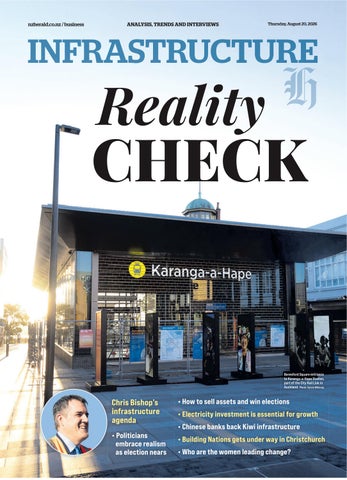
Beresford Square entrance to Karanga-a-Hape Station, part of the City Rail Link in Auckland. Photo: Sylvie Whinray
C Chris Bishop’s in infrastructure aagenda • Politicians embrace realism as election nears
• How to sell assets and win elections • Electricity investment is essential for growth • Chinese banks back Kiwi infrastructure • Building Nations gets under way in Christchurch • Who are the women leading change?
B2
nzherald.co.nz | The New Zealand Herald | Thursday, August 20, 2026
INFRASTRUCTURE A Herald Business report
Chris Bishop on Infrastructure:
“The second Auckland harbour crossing needs a credible process, not another round of empty promises. There’ve been successive transport ministers who’ve stood up and said, ‘We’re going to do X, we’re going to do Y,’ and nothing’s happened. I don’t want to be that guy.”
“We’ve put another $400 million into state highway resilience. When routes like the Waioeka Gorge or the Brynderwyns go down, you’re talking millions of dollars a week in damage to the regional economy. It’s going to be a defining theme of the next decade.”
Infrastructure Executive Editor: Fran O’Sullivan Writers: Cameron Bagrie, Bill Bennett; Andrea Fox, Richard Harman, Tim McCready, Graham Skellern. Subeditor: Isobel Marriner Layouts: Isobel Marriner Cover: Richard Dale Graphics: Richard Dale Online editor: Sue Baxalle Proofs: Tim McCready; Graham Skellern Advertising: Neil Jackson nzherald.co.nz/business
“Time-of-use charging passed Parliament unanimously, which I’m really pleased about. It’s about using demand-side tools to get more efficient use of the network that’s already there. The real test will come when the bills bite.”
“For years we’ve imposed long-term planning disciplines on lines companies, airports and local government, but we’ve had no equivalent require ments for central government. We’re committed to changing the Public Finance Act to fix that.”
The Herald’s Infrastructure report is supported with sponsorship from: Auckland Airport, Auckland Business Chamber, Beca, China Construction Bank (NZ), Fortinet, Indian Consulate in Auckland, ICBC, Infrastructure New Zealand, IPWEA, PwC, Vector and WSP.
Building Nations turns 21 today Leading politicians, experts, financiers and infrastructure players will descend on Te Pae, Ōtautahi Christchurch today for Building Nations 2026, New Zealand’s leading infrastructure conference. Infrastructure New Zealand says the two-day summit will bring together the “people shaping our cities, transport, energy, and water systems to focus on how we can lift productivity, speed up delivery, secure new funding models and achieve better long-term outcomes. “From reforming procurement and planning systems to harnessing data, innovation, and capability, the 2026 programme tackles what must change to deliver infrastructure at pace without compromising quality,” Infrastructure NZ says. Building Nations began 21 years ago as the brainchild of former NZ Council for Infrastructure Development CEO Stephen Selwood. NZCID morphed into Infrastructure NZ. There’s been a major change in attendance. The organisers says 32% of registrations are from women
reflecting the growth of their participation in the sector; there is 40% female representation on this year’s agenda. This year, to celebrate 10 years of Women in Infrastructure, an award for “Outstanding Woman in Infrastructure” has been created. The winner will be announced at tonight’s Gala dinner. Profiles of some leading women in the sector are published in this report. Reality check The theme of the Herald’s 2026 Infrastructure report is Reality Check. The New Zealand Government’s ambition to build more projects such as four-lane Roads of National Significance (RONS) has been tempered by fiscal realities and rising build costs. Auckland’s big ticket City Rail Link will open on September 13: Its gold-plated approach — where stations look like art galleries — resulted in busted budgets and delays. There is little room to move. New Zealand’s “stop go” approach to infrastructure projects has been
costly. Economist Shamubeel Eaquab estimates that over the past 25 years we have started, paused, reviewed, restarted and cancelled public projects with every economic shock and every change of government. He estimates the cost of that stop-start cycle at $11.8 billion since 2000. Infrastructure lawyer Sarah Sinclair is among those who want more focus on the maintenance of existing assets — fewer opportunities for politicians to cut ribbons, but important in the long run. Oliver Hartwich from the New Zealand Initiative estimates some $24b could be freed up to invest in asset recycling to build social infrastructure and more if the Government sold commercial assets. New South Wales Government did so and won the state election. The Summit Infrastructure NZ makes the point that New Zealand already spends significant amounts on infrastructure. “The challenge is that we achieve poor outcomes for what we spend.”
They want to see better planning, governance, asset management and investment decisions. Reduced delays and faster consenting, procurement and decision-making to achieve higher quality infrastructure, stronger productivity and better value for every taxpayer dollar. The summit will be informed by two international keynote speakers: Mark Thurston, Chief Executive Officer of Anglian Water Services will draw on his involvement in some of the UK’s most significant infrastructure programmes, including the London 2012 Olympics, Crossrail and HS2, to explore what enables major projects to succeed, and what causes them to falter. Derek Thompson, the #1 New York Times bestselling co-author — with Ezra Klein — of Abundance argues that many of today’s biggest challenges are not caused by lack of ideas, technology or investment, but by a declining capacity to build. Housing, transport, energy and other essential infrastructure have become slower, more expensive and
more difficult to deliver, not because we no longer know what needs to be built, but because layers of regulation, fragmented decision-making and an increasing number of veto points have made it harder to turn ambition into reality. Thompson argues that many Western democracies have become better at identifying risks than creating opportunities — better at saying “no” than finding ways to say “yes”. For New Zealand, the implications are significant. At Building Nations, Derek Thompson will challenge delegates to consider whether New Zealand’s greatest infrastructure constraint is no longer money or engineering capability, but whether our political and institutional systems still possess the confidence, capacity and ambition to build the nation we want. Enjoy the report.
Fran O’Sullivan
B3
nzherald.co.nz | The New Zealand Herald | Thursday, August 20, 2026
Getting our priorities right A bipartisan commitment and better planning will mean better infrastructure, says Chris Bishop
with a more flexible Development Levies system that will match our new flexible planning system.
Minister for Infrastructure, Chris Bishop, at The Port of Auckland, which is undergoing a $200 million infrastructure upgrade. Photo / Dean Purcell
T
hree years ago, I had the enormous privilege of being appointed Minister for Infrastructure. From my time in Opposition, where I’d deliberately consulted widely and worked hard, I knew there was an enormous amount to do. From 2019 to 2023, research from the New Zealand Infrastructure Commission showed that our system wasn’t in good shape. Despite being in the top 10% of OECD countries for infrastructure spending, we are in the bottom 10% for what we get for our spend. We rank fourth to last in the OECD for asset management. Half of all capitalintensive central government agencies reported that they did not have robust asset registers or adequate asset management plans — and even fewer had long-term investment plans. And around half of all proposals for investments in recent Budgets did not have complete business cases. On top of this, the time between funding and delivery has been too long — with some projects starting many years after a project has been announced, which has been incredibly frustrating for the construction sector. Every New Zealander experiences the flow-on effects of our underperforming infrastructure system. I can rattle off too many failures like communities waiting years for basic investments in schools, while a lucky few get architectural masterpieces; frequent transport disruptions due to weather events; and leaky, mouldy, asbestosridden hospitals that haven’t been looked after properly. We had no long-term plan to fix these underlying issues. This is not what Kiwis expect and it is my strong view that the Government needs to do better. Six priorities I had six priorities on coming to office: ● Developing a 30-year National Infrastructure Plan; ● Strengthening asset management; ● Establishing a national infrastructure agency; ● Improving infrastructure funding and financing; ● Improving the consenting framework; ● Improving education and health infrastructure. I’m proud we’ve made significant progress on all of these priorities. This is an enormous amount of work done in just three years. On the National Infrastructure Plan (NIP), we asked the independent Infrastructure Commission to produce a 30-year NIP, and in June this year the Government provided a formal response — supporting all 16 recommendations either in full or in part. I won’t go into all the details, but there are a few main actions that are critical. For example, the Government has agreed to introduce legislative requirements for asset registers, asset management plans, and long-term capital plans in the Public Finance Act. Regulated utilities and local government are required to have these artefacts by law, but we currently don’t hold central government to the same standard. That is going to change. We are also shifting independent
We should commit to building bipartisan consensus on the idea that governments of all flavours should use best practice to plan, select, fund and finance, deliver, and look after infrastructure. assurance for central governmentfunded infrastructure from Treasury to the Infrastructure Commission and creating a new assurance function for asset management plans and longterm capital plans. Ministers want better quality information, and we want clear, actionable advice from the experts: Is this a good or bad project? Is it needed now? Is it consistent with the asset management plan or long-term plan? Can we strip some cost out? We want those answers because, ultimately, Ministers are accountable to the public for investment decisions. When it comes to strengthening asset management, the NIP was instrumental — actions like legislating for asset registers and asset management plans as well as having independent assurance over these will be a game changer. Fixing the fundamentals of our system is the single best thing we can do to build a pipeline that endures political cycles. Right now, there is about $290 billion worth of infrastructure projects in the pipeline — around $190b with a confirmed funding source. I reckon all parties probably agree on 90 to 99% of those projects.
But I think we should move away from the rhetoric of needing a fully bipartisan pipeline — we are never going to agree on every single project, and that’s okay. That’s the nature of politics and of people having different views. Instead, we should commit to building bipartisan consensus on the idea that governments of all flavours should use best practice to plan, select, fund and finance, deliver, and look after infrastructure. A robust system will make it politically untenable for ministers to just announce unfunded, inadequately planned projects. Where farcical projects have been stopped, like in the case of Auckland Light Rail, there are legitimate reasons for that. Equally, a robust system should make it punishing for a new government to stop or pause genuinely good, funded projects that make it through the rigours of the system. The missing piece That was the missing piece — a credible and clear evidence-base for the public, the sector, and others to properly hold governments to account for their investment choices. We are fixing that. On establishing a national infrastructure agency, we established National Infrastructure Funding and Financing Limited (NIFFCo) on December 1, 2024 to be New Zealand’s shopfront for private capital in public infrastructure and the Government’s centre of expertise on funding and financing. To date, NIFFCo has delivered key transactions including arranging the Te Awa Lakes Infrastructure Funding and Financing (IFF) Act Levy, which will support 1500 new homes in Hamilton. They also led the early monetisation of the Crown’s loans to Chorus, which we provided back in the day to accelerate the UFB rollout. This deal delivered $702 million in net proceeds to the Crown and allowed the Government to reinvest the funds into more of the infrastructure New Zealand needs — including Cambridge to Piarere,
upgrades to hospitals, and hundreds of new classrooms. On improving infrastructure funding and financing, public infrastructure in New Zealand has historically been primarily funded by taxpayers or ratepayers. But our heavy reliance on this blunt approach has not served us well and has led to perverse outcomes including congestion, run-down assets, and the unresponsive provision of enabling infrastructure — contributing to unaffordable housing. At the end of 2024, the Government released a suite of frameworks and guidance — like Treasury’s Funding and Financing Framework and the refreshed PPP blueprint — to help the Government be a smarter owner and purchaser of infrastructure services. In the transport space alone, we have made significant progress on utilising a broader range of funding tools. We are making tolling rules more flexible so they can better support funding for new roads and are exploring the use of toll concessions. In addition, the New Zealand Transport Agency (NZTA) can now use IFF Act Levies, light electric vehicles and plug-in hybrids are now required to pay their fair share through road user charges (RUC), we are transitioning New Zealand’s entire vehicle fleet to RUC, and we are believed to be the first country in the world to pass law enabling time of use charging with completely unanimous cross-party support. When it comes to infrastructure to support housing growth, we have pulled multiple levers. In Budget 2026, we set up the Incentives for Growth Fund so that all councils are rewarded for every single home consented. Just last month the IFF Amendment Bill passed into law, making it easier for developers, councils, and other infrastructure providers like NZTA to use levies to help fund infrastructure. On top of this, we are also progressing the replacement of the failed Development Contributions regime
Resource Management Arguably, the biggest improvement to the infrastructure system is fixing the Resource Management Act (RMA). Consenting takes too long, costs too much, and makes delivering the infrastructure we need too difficult. We are not just improving but are fundamentally transforming the consenting framework by replacing the RMA with two new pieces of legislation: the Planning Bill and the Natural Environment Bill. Our new system will be effectsbased, embrace standardised zoning, and be far more permissive and enabling while also protecting the environment. We knew that the new planning system would take time to bed in. So, in 2024, we established the fast-track consents process, which has been incredibly successful. As of August 14, 32 projects had been approved — representing tens of thousands of jobs and billions in investment, with more in the pipeline. Lastly, we have improved education and health infrastructure. When we came into office, the average cost of a classroom was $1.2m; that has now fallen to around $620,000. At the same time, we delivered more classrooms in 2024 than Labour did in 2023 — and even more again in 2025. To continue this good work, we have established the New Zealand School Property Agency, which will be focused on ensuring all Kiwi kids can learn in safe, warm, and dry buildings. We are also getting health infrastructure back on track, including through our Building Hospitals Better approach. This means taking a staged approach to building and redeveloping hospitals; applying standardised designs; considering alternative financing and funding arrangements; and aligning the design of hospitals with wider digital, clinical, and service planning for health. Smaller build packages rather than one large mega project is enabling us to deliver healthcare faster to communities, and that’s what they want. All this work across the infrastructure system is not necessarily sexy, but it’s what’s needed to fix the basics and to set New Zealand up for years of prosperity into the 2030s and beyond. If that’s my legacy as Minister for Infrastructure, I’ll be happy. However, I am hungry to do more for New Zealand. So, what’s next? We’ll be releasing our infrastructure manifesto soon, and I have a few announcements for Building Nations. But we also need to keep doing what we’re doing. The new planning system. Assurance changes. Better asset management. We know that achieving genuine economic prosperity — the great challenge facing this country — depends on infrastructure that meets our needs, is good value for money, and is deliverable. It’s the foundation everything else is built on. For me, getting infrastructure right means people less concerned about the backdrop of an ordinary day, like: “When is my train coming?” or “Will my street be okay in this rain?” — and instead be better able to focus on the ideas that are important to them. I want Kiwis to be free, ambitious, and have access to abundant opportunities — knowing they are backed by an equally enterprising nation. I want all of us to enjoy better lives. I truly believe that our country, at the bottom of the world, can choose to be wealthy, modern — and prosperous. That’s why I’m in politics. ● Chris Bishop is Minister for Infrastructure, Housing and Transport and is also Minister responsible for RMA Reform
B4
nzherald.co.nz | The New Zealand Herald | Thursday, August 20, 2026
INFRASTRUCTURE A Herald Business report
A national ambition is needed N ew Zealand has never lacked ambition. We have always believed we can compete with larger nations, solve difficult problems and build a better future for the next generation. What we have lacked, in recent decades anyway, is a plan for what kind of country we want to be. We need a national ambition. Right now, our public conversation focuses on managing decline rather than creating growth. We are debating what should be cut before we discuss what should be built. We ask where savings can be found before asking how prosperity can be created. You cannot multiply by dividing. We want to know what sort of infrastructure needs to be built over the next 30 or 50 years, but first we have to answer some bigger questions. What kind of nation are we seeking to become? Who will live here, where will they live and how big do we want our population to be? What industries will make New Zealand wealthier? These questions then help answer the next set of challenges. Which exports will generate future prosperity? What role will energy, technology and advanced manufacturing play in our economy. Once we know, we will have a clearer picture about where we want to invest. Coherent planning These aren’t questions that belong exclusively to governments or business leaders. They are questions for the country, for all citizens to think about. Once we have greater agreement about where we are heading, infrastructure and economic
Bipartisan long-term infrastructure planning is the key to success, writes Nick Leggett
New Zealand loves admiring a problem, but when it comes to finding solutions and turning them into action, we go round in circles. Nick Leggett
planning become far more coherent. Without this kind of plan, every new Government starts from scratch. Priorities shift, projects are cancelled, strategies are rewritten and debates are reopened. Rather than building on previous decisions, we revisit them. All of which means we spend an
extraordinary amount of time discussing what to do, and far less time actually doing it. New Zealand loves admiring a problem, but when it comes to finding solutions and turning them into action, we go round in circles. This is obvious when it comes to infrastructure — billions of dollars wasted, railways and energy solutions that are never built. But we are not the only sector impacted by thumb-twiddling, and all New Zealanders lose out as a result. Countries that know what they want to become build infrastructure that supports that future. This has been one of the strongest lessons from Infrastructure New Zealand’s international study delegations.
Whether in Ireland, Northern Ireland, England, Denmark, Sweden, Norway or Canada, we have repeatedly seen nations asking the same question before deciding what infrastructure to build: what kind of economy are we trying to create? In these countries infrastructure is not viewed as an end in itself. Every road, bridge, or tunnel that is built grows the economy. Transmission lines and railways are seen as a mean to achieve social progress and climate resilience. Ports and water systems exist because they help deliver a national purpose. The ability to think long-term means that construction follows a path that makes sense: transmission investment follows energy ambition. Ports follow export and import ambition. Housing follows employment ambition. Transport follows economic geography. The ‘what’ before the ‘why’ In New Zealand we argue about individual roads and rail lines before we have agreed what economic future they are supposed to support, let alone the network they are part of. We debate the “what” before agreeing on the “why”. That is why Infrastructure New Zealand has been calling for a national economic ambition. This is not about governments picking winners or writing prescriptive industrial plans as markets will always more strongly determine which firms succeed. But successful countries are clear about the sectors they intend to
compete in and build the conditions that allow those sectors to flourish. The countries doing better than us still have political disagreements. They still change governments. But they have built institutional settings that allow long-term objectives to endure. Their per capita exports also dwarf New Zealand’s, meaning the money they earn offshore helps fund the quality of lives and lifestyles of their respective populations. That is the lesson New Zealand should take. Infrastructure New Zealand believes three things are needed. First, we need a shared national economic ambition that gives greater clarity about the industries and opportunities that will underpin future prosperity. Secondly, we need bipartisan commitment to the longterm institutional settings that support infrastructure planning, funding and delivery. Governments should debate priorities, but they should not continually redesign the system itself. Third, infrastructure investment should be aligned with that national ambition so that every major investment contributes to a coherent long-term direction. The question is no longer whether New Zealand can build infrastructure. It is whether we can build the shared ambition and purpose; creating a more productive, prosperous and resilient nation for generations to come. ● Nick Leggett is chief executive of Infrastructure New Zealand. Infrastructure New Zealand is a sponsor of the Herald’s Infrastructure report.
B5
nzherald.co.nz | The New Zealand Herald | Thursday, August 20, 2026
Bipartisanship to the fore as election nears
New Zealand needs plans that outlast election cycles
I
Kieran McAnulty
f there’s one thing New Zealand has become far too good at, it’s changing its mind about infrastructure. A road gets announced. A rail project gets cancelled. A public transport plan gets redesigned. A new government comes in and decides it knows better than the last one. Years disappear, costs go through the roof, and the people waiting for the infrastructure are left wondering whether it’ll ever happen. Whether you’re sitting in traffic in Auckland, waiting for safer roads in the Wairarapa, trying to move freight through the regions, or relying on ageing water infrastructure, you don’t care which party gets the credit. You just want the job done. That’s the attitude Labour is taking. Infrastructure shouldn’t be built around election cycles. It should be built around what’s best for New Zealand over the next 30 or 40 years. The constant stop-start approach is costing us a fortune. Every time governments scrap projects that are already underway, we don’t just lose time, we throw away years of planning, redesign work, procurement and investment. Then, when the need inevitably comes back, taxpayers end up paying even more to start again. That’s not being fiscally responsible. It’s wasting money. That’s why Labour will commit to
not cancelling major infrastructure projects that are already contracted or funded for delivery. Once we’ve made the decision to build something and signed on the dotted line, governments should follow through. Businesses, workers and communities deserve that certainty. Anyone running a construction company will tell you the same thing. They can’t invest in apprentices, machinery or new technology if they have no idea whether work will disappear after the next election. The boom-and-bust cycle doesn’t just hurt the industry, it drives up prices for everyone. We’ll also make sure every major new infrastructure commitment is independently reviewed by the Infrastructure Commission. Politicians will always make the final call, that’s democracy, but those decisions should be informed by evidence, not whoever can shout the loudest or cut the biggest ribbon.
Good governments aren’t afraid of good advice. Labour also believes we should work alongside the private sector to get projects built while keeping strategic infrastructure in public hands. This isn’t an ideological debate. It’s about getting the best outcome for taxpayers while making sure New Zealanders continue to own the assets that matter. We’ll also protect the transport corridors we’ll need in the future. It’s a lot cheaper to preserve space for a road or a rail line today than it is to bulldoze houses or businesses 20 years from now because no one thought ahead. This shouldn’t be a left versus right issue. The bridge doesn’t know who voted for it. The road doesn’t care which party announced it. A train line doesn’t become more or less useful depending on who’s sitting on the Treasury benches. If we can build a broad agreement on the infrastructure New Zealand needs, everyone benefits. Communities get certainty. Businesses get confidence to invest. Workers get steady jobs. Taxpayers get better value for money. Most importantly, we stop wasting time arguing about whether to build and get on with actually building. That’s how we leave the country in better shape than we found it. ● Kieran McAnulty is Labour’s Infrastructure spokesperson
RMA reform to ease the burden
N
Simon Court
ew Zealand has spent more than 30 years making it too difficult to build. It is too hard to build a home, a power station, a business, or the infrastructure a growing country needs. Often it takes longer to get permission than it does to actually build. Everyone has a Resource Management Act horror story. For infrastructure alone, consenting costs are estimated at $1.3 billion a year. Those costs do not disappear. They end up in your power bill, the price of a new home, council rates, or they kill projects before a shovel hits the ground. Act has long understood the RMA is a millstone around New Zealand’s neck. David Seymour recruited me to fix that problem. This term, alongside Minister Chris Bishop, I have been getting on with it. We have introduced fast-track consenting, amended the RMA and improved national direction. The National Policy Statement for Infrastructure means that, for the first time, the planning system explicitly recognises the importance of infrastructure. These changes help, but there is only so much you can do with a law that is fundamentally broken. That is why we are replacing the RMA with the Planning Bill and Natural Environment Bill. The principle behind the new system is simple. Your land is your land. You should be able to use it as
you see fit, provided you are not harming someone else’s property or the environment. That means a higher bar for the effects the Government regulates. It means standard approaches that can be used again and again, instead of councils and applicants reinventing the wheel for every consent. It also means having the big arguments when national instruments and plans are developed. We should not force individual projects to relitigate the same issues every time somebody applies for a consent. There will be stronger accountability too. The Planning Tribunal and regulatory relief will give people somewhere to turn when council rules and processes go too far. The economic gains are substantial. Estimates suggest the new system could reduce consenting volumes by up to 46% and add up to $3.1b a year to GDP by 2050. The select committee has now reported the bills back after hearing from New Zealanders. We will make
final refinements at the committee of the whole house. There is still plenty of work to do. Reducing the number of consents demanded from over 40,000 per annum to closer to 20,000 will make a huge impact on every New Zealander. If that still seems like a lot of consents, that is because it is still a lot of consents. In the 1990s, around 5000 per year was typical. We have set the direction but there is much more to do to unlock New Zealand’s potential. The infrastructure sector wants to know what the rules underneath the legislation will look like. Fair enough. We will soon release an illustrative National Policy Direction so councils, developers and infrastructure providers can see where the system is heading and tell us what works before formal consultation. National standards will also be rolled out progressively. If an approach works, there is no good reason to invent a different one in every council area. For decades New Zealand has argued about how to fix the RMA, while the cost of building has gone up and projects have stalled or disappeared. We are finally replacing it. New Zealanders want affordable homes, reliable power and the infrastructure of a first-world country. To unlock New Zealand’s potential, we have to let people build. It’s time to build. ● Simon Court is Parliamentary Under-Secretary to the Minister Responsible for RMA Reform
Consensus needed to stop infrastructure going backward
T
Julie Anne Genter
he New Zealand public and industry are increasingly keen on cross-party agreement on infrastructure, and I’ve seen that reflected in political panels I’ve participated in recently. There is no question that our country has not benefited from some infrastructure projects being treated as political footballs. Large projects take multiple electoral terms to be built, and changes of government have seen significant projects cancelled or delayed, like the replacement of the Interislander ferries and associated wharf infrastructure. In many cases, the problem definition had not been clearly identified before embarking on project design and delivery, and scope creep or ballooning costs was the reason given for cancelling a project. It is fair enough to want to spend public funds in a careful way. The stop-start approach, however, is also increasing costs and damaging for building up our capability and capacity to deliver infrastructure. In other cases, public entities have not undertaken appropriate asset management and public infrastructure has been run down, often because building new things or saving money has taken priority and there wasn’t an explicit requirement to invest in maintenance and renewals. This also has costs and consequences for the public. The National Infrastructure Plan, delivered by the Infrastructure Commission earlier this year, identifies a number of priority recommendations that have been all or in part accepted by the Coalition Government, and fully accepted by the Green Party and other opposition parties. This offers a clear direction for a level of political consensus. We have limited resources, so determining how they will be used will always be somewhat political. But hopefully we can reach a level of agreement to significantly lift our asset management game, with an evidence-informed approach to prioritising new infrastructure. With volatile fossil-fuel prices and increasing uncertainty about supply, I hope we can also get a level of political consensus about energy efficiency and electrification. This has long been a core Green goal. Jeanette Fitzsimons, the founding Green Party co-leader, introduced the legislation that set up EECA, the Energy Efficiency and Conservation Authority, and led the work that resulted in a highly successful home insulation scheme, as well as pilots
of home solar projects and clean heating devices. EECA over the last decade has also supported electrification of vehicles, and the GIDI fund that supported businesses transitioning to electric. Now we have the opportunity to go much further. By prioritising energy efficiency in our transport system, of our vehicles, in domestic manufacturing, and in our buildings, New Zealand has the opportunity for real productivity gains. Public infrastructure choices are critical to this end. How we regulate vehicles and building standards will influence how much energy we need to use every day. Government policy, such as grants or low-interest finance, can support people and businesses to switch to electric machines, powered by affordable and abundant renewable energy like home solar and batteries. This offers us productivity gains and more affordable lives. It will support cleaner air. This, in turn, will mean less sickness and fewer hospital admissions. On a panel hosted by Engineering NZ, I was pleasantly surprised to hear ministers Chris Bishop and Shane Jones crediting me for talking about some sensible improvements to road investments for more than a decade and a half. After confronting the unaffordable policy of Roads of National Significance promoted by former Minister of Transport Simeon Brown, the Coalition Government has now conceded that we can’t afford to build many more four-lane expressways and certainly not at a design speed of 110km/h. This is no longer just a Green view, it has political consensus because the maths just doesn’t add up. Nevertheless, we can improve the ability to move people and goods around the country. We can better maintain our existing roads and improve their safety. We can invest in affordable passenger transport services and better use our existing rail and sea routes for some freight. This is precisely what the Green Party has been supporting for decades. The swap to electric cars and machines is happening, and growth of renewable generation like solar, wind and geothermal is inevitable. The faster it can move, with Government support, the better off our country will be. I hope to see more support across the political aisle for a move to energy efficiency and renewables, and away from fossil fuels, that will make New Zealand more affordable and productive. ● Julie Anne Genter is the Green Party’s spokesperson on infrastructure.
B6
nzherald.co.nz | The New Zealand Herald | Thursday, August 20, 2026
INFRASTRUCTURE A Herald Business report
Plan for risks and opportunities Boards can’t just manage risk, they have to seize opportunities, Julia Hoare tells Fran O’Sullivan
Five questions every NZ infrastructure board should ask 1. Why do we need this asset and will it build resilience for the company and New Zealand Inc over multiple cycles? 2. How exposed is this project to shifting regulation, consenting rules, market design and geopolitical risk — and how can we reduce that volatility? 3. Have we run credible ‘scorched earth’ scenarios, and does our capital structure still hold under those conditions? 4. For each major geopolitical risk on our register, what corresponding opportunity could we be chasing? 5. Do we have the diversity of experience — and the helicopter view — to challenge management on both the risks and the opportunities?
N
ew Zealand’s infrastructure deficit is visible in ports that can’t keep pace with export growth, terminals past their use-by dates, and electricity demand rising faster than new generation is consented and built. The question is no longer whether companies need to invest — but how boards can responsibly commit to large projects in a world of policy churn and geopolitical shocks — without scaring off the very investors needed to pay for them. Julia Hoare, who sits on some of the most strategically important boards in the country — across aviation, ports and electricity — emphasises big infrastructure demands long-term certainty. When companies embark on major developments, she says, “the ideal is to have as much domestic certainty over numerous political cycles, irrespective of who may be in power.” Directors recognise that democracy brings change. But constant tinkering with market design, consenting rules or sector policy comes at a cost. “If we think about infrastructure and large infrastructure investment, it’s a lot of money and it’s large, it’s lumpy,” Hoare told the Herald. “Therefore, the ideal is to have as much domestic certainty as possible because it’s got to last for the long term. “If we think about who’s actually paying for the infrastructure, it’s investors. You really want to make sure that they’re going to be comfortable and willing to invest, and they don’t get spooked.” New Zealand still enjoys a structural advantage as a relatively stable, transparent, low-corruption jurisdiction in an increasingly turbulent world. “New Zealand is a very stable country, and I think it’s becoming a more desirable country for investment,” Hoare says. In a period of heightened sovereign risk, that matters.
If you have too many people just focusing on risk without taking the time to think about opportunities, then you’re likely to miss the opportunities.
so seven new projects in seven years — and lots of fabulous other projects in the longer term pipeline as well.” For Hoare, this is not just an energy story, “It’s very good for New Zealand Inc to grow our renewable energy resources. I think you’re going to see a lot more renewable development, and that’s going to enable a lot more electrification.”
Julia Hoare
From risk registers to opportunity registers If policy risk is one side of the ledger, geopolitics is the other. The Middle East conflict and wider global tensions have forced boards to lift their gaze from static risk registers to more dynamic scenario planning. At Auckland Airport which she chairs, Hoare recalls the “scorched earth” exercises the board ran during Covid, and how that discipline has carried into the current environment. In early 2020, the company had already embarked on a major infrastructure build to expand the airport when the global aviation market effectively shut down. “Back in 2020, obviously we had pressed the button on a very, very large infrastructure build, and all of a sudden we could see a train wreck coming toward us,” she says. The board and management moved into intense scenario planning: “We had full-on board scenario planning. We called it our scorched
But that advantage can be eroded. Policy volatility, especially around core infrastructure regimes, feeds directly into the cost of capital and the willingness of boards to “press the button” on major projects. Electrification — the promise The electricity sector is a case in point. Boards are staring at a wall of demand as the economy decarbonises. Hoare points to the twin drivers: “Obviously, the transport sector is one that jumps to mind. Then you start to think about the industrial processes, and you’ve got a lot of great businesses that are moving off, say, coal-fired boilers and moving into electrification.” The gentailers, including Meridian Energy on which she is a director, are responding with significant renewable pipelines. At Meridian,“we’ve got what we call a ‘seven and seven’ —
earth, and it wasn’t scorched enough, and we kept scorching and scorching and scorching to find out what our worst-case scenario would be.” The results were sobering, but actionable: “We were from that able to really adapt. We survived. We cancelled a lot of major contracts, and that cost us a lot of money. We slowed down other contracts. “We did what was at that stage New Zealand’s largest capital raise, and we went very, very quickly because we’d thought through the funding pieces, and we just had to continue with essential infrastructure.” As the latest Middle East crisis unfolded, they moved again: “We actually advanced certain arrangements that we wouldn’t have otherwise done because we wanted to make sure that if the whole thing did collapse in the European situation, we actually had access to funds when we really, really needed them.” When carriers rerouted away from conflict zones, aircraft capacity had to be redeployed. For New Zealand, that presented a chance to deepen international connectivity for both passengers and high value cargo. A similar pattern is playing out at Port of Tauranga, which she also chairs. Disrupted shipping schedules make a deep water aggregation hub more valuable. Fuel and supply chain risks, meanwhile, strengthen the case for accelerated automation and elec-
trification on the wharves. Across sectors, Hoare argues that boards must go beyond risk registers and deliberately build “opportunity registers” as well: identify the shock, mitigate what you can — then ask where the upside might be for the company and for New Zealand. Boards fit for major bets Hoare is a strong advocate of a disciplined skills matrix approach: starting by defining the capabilities specific businesses need then mapping which directors actually have them. “What skills do you need around the board table for your specific business?” she asks. “And then who actually has those skills?” At Auckland Airport that means directors who understand the sector from hub-airport leadership to airline, engineering and large-project experience alongside strong financial and capital markets expertise. Crucially, she says, boards must be “quite dispassionate” about fit. A good director is not always the right director for a particular company or phase. Hoare is careful not to dismiss risk specialists; they are essential. But she is wary of board cultures dominated by “black hat” thinking. “It’s critical that you actually understand what your risks are,” she says. “If you have too many people just focusing on risk without taking the time to think about opportunities, then you’re likely to miss the opportunities.” The answer is people who will interrogate risk rigorously, and people who will ask, even in the midst of crisis, where the strategic upside might lie. The deficit won’t fix itself Hoare is clear about the stakes. “New Zealand has a massive infrastructure deficit, and it’s growing, and we really need to address the deficit,” she says. That does not mean cutting corners on environmental or social standards. But it does mean creating conditions in which boards and investors are confident enough to commit. “We need to think about how do we not spook investors, and get on with the infrastructure development,” she argues. At heart, that requires a stable, credible platform — across political cycles — and boards equipped not just to survive shocks, but to turn them into long-term opportunities for New Zealand Inc.
Port delays mean exporters face uncertainty
F
or the last several months, ExportNZ has talked to exporters all over the country regarding the things they want from the next government, ahead of releasing our Pre-Election Blueprint. One concern mentioned more frequently than any other is the cost and reliability of the infrastructure used to get their goods to international markets. According to our most recent Export Barometer, a majority of exporters named the cost and availability of transport and logistics as a major obstacle, and more than half stated that they had experienced delayed transit times. New Zealand can’t do much about events playing out in the Strait of Hormuz, but it can make a difference to bottlenecks closer to home. Tauranga Harbour is just one example. It is the nation’s biggest and most important export entry point and deals with nearly 40% of New Zealand’s exports, comprising almost all of our kiwifruit and a large part of our dairy and forestry products. The port is also working near its capacity. Last year it had to turn down a suggested new shipping
service to the Americas which would have saved exporters and importers an estimated $65 to $90 million each year in freight charges. A proposal to extend the port’s berths, the Stella Passage development, was indicated in regional plans as far back as 2003, and preparation for a resource consent application began in 2018. In 2020 the port unsuccessfully sought fast-track approval under the Covid-19 recovery legislation, before its application was referred instead to the Environment Court, where partial consent was granted — but that decision was appealed before it could take effect. Nearly a decade on, the matter is still waiting for a decision one way or the other, after the port opted to put the court process on hold and pursue an application under the new Fast-track Approvals Act. Those who challenged the development were, for the most part, local hapū — among them Ngāti Kuku and Ngā Hapū o Ngā Moutere, hapū affiliated with Whareroa Marae, which sits close to the Mount Maunganui wharves. Their objections rested on inadequate
International shipping won’t wait while our internal issues are being decided on, writes Joshua Tan consultation and the cultural effects of the development on Te Awanui Tauranga Harbour — concerns that nearly a decade of process has still not resolved, and for which the Environment Court has since ordered the Port to compensate them for the wasted cost of preparing cultural evidence the company itself should have addressed from the outset. Te Awanui Tauranga Harbour is of great importance to local iwi and hapū. Having to go through the courts time and again to challenge the same issue, at a cost of hundreds of thousands of dollars, is as much a frustration for them as the lack of certainty is for exporters. That is the main issue. It’s not about whether one side has won and another has lost. Rather, the system
has taken up most of a decade without providing any lasting solution to anybody. Moreover, Tauranga is not an isolated example. A 2021 report by the Infrastructure Commission stated that consenting delays were costing the country about $1.29 billion each year and that it was taking almost twice as long to grant consent for a major project as it had five years before. Such uncertainty is damaging because it discourages investment, causes shipping companies (whose competitive rivalry helps to keep freight costs in check) to pull back and, over time, makes New Zealand a less appealing place for international services. As BusinessNZ has already noted in its submission on the Resource Management Act reforms, constant changes of
direction undermine the certainty on which infrastructure investment depends. International shipping won’t wait while these issues are being decided upon; instead, ships are getting bigger, the routes are changing, and the first fleets using low-emission fuels (such as the green hydrogen, ammonia and biofuels that New Zealand may one day produce and export) are appearing. Ports that cannot handle them will be left aside. Regardless of who is in government, business needs a system that can properly and promptly deal with these matters: one that allows timely investment in transport, digital and water infrastructure of national and regional importance whereby goods can get to market, together with a long-term national freight strategy which ensures that our ports, railroads, roads and border systems are ready to handle larger vessels and new types of fuel. Exporters are not looking for shortcuts; they want certainty so they can plan accordingly. ● Joshua Tan is executive director, ExportNZ
B7
nzherald.co.nz | The New Zealand Herald | Thursday, August 20, 2026
Future generations need assets, not liabilities Asset maintenance isn’t sexy – it’s never the glamorous idea in the room. But actually, it can be just as ribbon cutting-worthy.
Infrastructure maintenance is key to growth, jobs and prosperity, writes Sarah Sinclair
I
t’s frankly a long overdue relief to see our politicians — from all sides and from central and local government — acknowledging the need to commit to an infrastructure pipeline that endures through political cycles and ensures the market prepares and responds. A pipeline that supports growth, jobs, prosperity. Great stuff — we need this. And we keep pushing — asking our politicians and leaders to articulate an ambitious vision for future growth underpinned by infrastructure investment. But addressing our infrastructure deficit is not just about what we should build next: arguably our most urgent challenge is how we properly maintain — and get the greatest benefit — out of what we already own. This has been clearly called out by the Infrastructure Commission Te Waihanga. The commission notes most of the infrastructure we will rely on in coming decades already exists. The National Infrastructure Plan recommends maintenance and renewals need to be the first
Sarah Sinclair
investment priority. Like death and taxes, nothing is more certain than asset maintenance and renewal. In many areas, New Zealand has been doing a poor job of it. There are a set of clear recommendations in the National Infrastructure Plan for our public sector, including understanding what assets we’ve actually got and what state they are in, ensuring asset management systems are put in place, and allocating funding to renewals first — all rightly linked to a long-term view of performance and service levels. And to be fair, the Government is responding. There are sensible initiatives that, although obvious and
overdue, we should be loudly applauding: a work programme to support asset management and longterm investment planning and the state highway and rail renewal programmes. When infrastructure is maintained properly, the roads stay open, the water keeps flowing, the lights stay on, the hospitals keep operating, schools remain warm and dry. This is not an argument against growth or new projects — in fact quite the opposite. How we choose the right new projects to invest in — the foundation for economic growth — must be based on making the most of what we already have. There are so many reasons why
prioritising maintenance of our existing infrastructure is about growth, jobs and prosperity. It is one of the clearest opportunities to improve productivity. Planned maintenance is better than expensive reactive fixes; making sure we get maximum value and performance from existing assets (including network optimisation and demand management) means we can work out what is the best additional asset to invest in; and integrating asset renewal with climate adaptation and resilience planning helps avoid digging the road up twice. We can stop kicking liabilities down the road and minimise the risks of maintenance backlogs and unnecessary asset failures. We need to squeeze every last drop of benefit from our existing assets by looking after them so we can maximise the funds that are available for new projects. On the face of it, championing an infrastructure priority of “fix it first” may not sound like an inspiring national mission — but it is. The question of whether we are being good stewards of the assets that underpin our economy deserves as much attention as planning reform, infrastructure deficits and funding gaps. The blunt challenge, of course, is that asset maintenance just isn’t that sexy — it’s never the glamorous idea in the room. But actually, it can be just as ribbon cutting-worthy. There are offshore examples of innovative delivery structures
supporting long-term contracts for maintenance, renewal and expansion of existing asset networks. Innovative funding and finance structures that access private capital, capability and resources and lock in long-term service standards and quality over asset life can be used. This does require a culture shift — from all of us. As we look forward to what New Zealand needs to support a productive economy in which we all thrive, we need to be beating our drums just as loudly about looking after what we’ve got as we have been for demanding the new shiny projects. If we are to build the best platform for growth and future generations, we should be demanding that a key measure of success is “what doesn’t fail”. We have an intergenerational responsibility with infrastructure decisions — we want future generations to inherit assets, not liabilities. Thirty years from now we won’t be judged on the new projects we decided to build but on how all of our infrastructure — old and new — supports the everyday life of communities so that people and businesses thrive. Let’s make the most of what we have so we can build what we need. ● Sarah Sinclair is a director at law firm Harmos Horton Lusk and a former member of the board of the New Zealand Infrastructure Commission Te Waihanga.
B8
nzherald.co.nz | The New Zealand Herald | Thursday, August 20, 2026
INFRASTRUCTURE A Herald Business report
Why we have to get the maths right New Zealand builds infrastructure but struggles to manage it, writes Cameron Bagrie
H
ere is the basic infrastructure equation — and it comes from the Infrastructure Commission. ● “We spend a lot on infrastructure, but we don’t always get good value. New Zealand invested around 5.8% of gross domestic product (GDP) annually on infrastructure over the past 20 years, making us one of the top spending countries in the Organisation for Economic Cooperation and Development (OECD).” ● “Yet we rank towards the bottom for efficiency, or ‘bang for buck’.” ● “In 2022, we spent almost $5000 for every person in the country (in 2025 dollars).” ● “We have 1175 land-use zones across 67 territorial authorities. Japan — which has more than 20 times the population of New Zealand — has 13.” ● “New Zealand must get better at asset management. At present, asset management maturity varies between sectors, and tends to be lowest for central government social infrastructure providers like health, justice and education. Contributing factors include a lack of understanding and awareness of the importance of asset management, inadequate information on assets, a lack of transparency and accoun-
Measure, assess, and monitor, as the guardians of tomorrow’s infrastructure are the students of today. Cameron Bagrie
tability, and insufficient enforcement of best practices.” Prioritising the right projects, better assurance around projects, efficient legislation and regulation, better spatial planning, a better strategy for capital allowances across the political cycle that gives better funding signals, effective land transport funding, asset management performance reporting . . . the list goes on in terms of what needs to be done. These are near-term levers. I’m more worried about the fundamentals and the long-term. Let’s get real and honest about things. There is no point building stuff (the spend) if you can’t manage it. We build and mismanage. We can see that in the capital productivity numbers (how efficiently we use
capital to drive growth), which is consistently a negative number. So, let’s have a talk about education and linking it to infrastructure; both are long-term investments. The infrastructure managers and engineers of tomorrow are the schoolkids of today. I’ve consistently taken the view that the education standards of today will define where New Zealand will be in 30 years. Today’s students are tomorrow’s leaders. According to the Ipsos Issues Monitor, education is ranked number 10 on importance. It needs to be at the epicentre of the upcoming election. It traverses so many areas. Student achievement is declining and equity is not improving. That will have long-term consequences economically and on the social/political footprint. The empirical evidence is pretty clear, according to the OECD, “Schooling quality and equity are important determinants of individual earnings, the distribution of incomes, productivity and economic growth.” Common sense tells us better-educated students should be able to manage projects better, that is they will be better at maths. If you want a defining issue, here is a basic one: Infrastructure involves maths. Any project inherently involves a lot of data and measurement. Get the specification right on building that bridge or road. Lacking those basic requirements, you are heading in the wrong direction or mismanagement of assets. According to the OECD, New Zealand has seen a decline of almost 29 points in the average PISA schooling measure score between 2006 and 2018. That will eventually
reduce aggregate productivity by close to four percentage points. Ouch. The fact that the OECD had an entire chapter on education in its 2024 Economic Survey of New Zealand was telling. So, heading into this election, my suggestion is we heed the words of the OECD when it comes to numbers. Measure, assess, and monitor, as the guardians of tomorrow’s infrastructure are the students of today. After all, a lot of numbers sit behind every infrastructure project. Let’s be numbers-literate and not the reverse. This needs to be fully embraced across the political spectrum. ● “Valid and reliable evaluation and assessment that leads to improvements of education practices and lifts student learning are key to establishing a high-performing education system.” (OECD, 2013) ● There is no single best-practice model for an assessment system, but it is important to be based on a highquality, coherent curriculum with standards and learning progression documents; with a wide range of assessments; and that it sets clear external reference points in terms of expected levels of student performance at different levels of education. ● There is also insufficient measurement of individual child progress against achievement standards and systematic schoollevel reporting to administration throughout primary and secondary schooling. ● There is an urgent need to complement the existing assessment system by systematically better measuring how much individual progress children are making against well-specified standards.
Our plan for Auckland: Investing $5.4 billion over the next 10 years. We’re focused on ensuring Auckland gets the investment it needs for growth and resilience, while keeping power prices fair for our 1.8 million customers. So, what are we doing with the $5.4 billion? Read the interview above for more information. vector.co.nz
● Introducing new regular assessments of students in reading, writing and mathematics from years three and eight; introducing common reporting templates so parents know how their child is progressing in these core areas; introducing a new assessment near the end of year 2 to check basic skills like counting, phonics, and letter formation. ● A revised national data collection and reporting framework that focuses on children’s progress towards common achievement standards in literacy, numeracy, science, etc, should be rapidly reinstated. Any political party that pushes against such basic concepts needs calling out. Not measuring or accepting benchmarking goes right to the heart of future effectiveness in many areas, including infrastructure and asset management. Student achievement at the primary and secondary levels is getting more attention, and rightly so. The tertiary sector sneaks under the radar somewhat. Maybe it needs more attention. New Zealand universities do not rank highly when compared to global peers. Lord knows what is happening with the polytechnic debacle in Hamilton, which seems to have gone off the radar. The bottom line We need more “bang for buck” when it comes to infrastructure. At the heart of that is having people capable of delivering. Today’s students are tomorrow’s asset and project managers. Make sure they know maths. ● Cameron Bagrie is principal economist at Bagrie Economics
B9
nzherald.co.nz | The New Zealand Herald | Thursday, August 20, 2026
From expensive to indispensable We know the cost of infrastructure, but do we know its value, asks Beca New Zealand’s Andrea Rickard
N
ew Zealand rightly focuses on the cost of infrastructure. We need the same level of focus on the value it creates. We debate what infrastructure costs us today far more than we discuss what it enables for us and for the next generation. Before we’ve finished our morning coffee we’ve already relied on billions of dollars of infrastructure. Water arrived at our taps. Wastewater left our houses. Electricity powered our kettles. Roads got kids to school. Mobile towers connected our phones. Stormwater drains protected our streets from flooding. None of this happens by accident. This is a landmark period for New Zealand infrastructure and cityshaping. Watercare’s new Central Interceptor wastewater tunnel is running underneath swathes of Auckland. Auckland’s City Rail Link is opening. One New Zealand Stadium at Te Kaha is pulling packed houses in Christchurch. Stage 1 of the Takitimu North Link in the Bay of Plenty is progressively opening. Two brand new railway stations have just opened in southern Auckland, supporting new homes, jobs and communities, and new wharf and terminal developments and the electrification of ferries are revitalising the Port of Auckland. Each of these projects and many others that are smaller but regionally critical are the result of years of effort to plan, agree, fund and deliver. Every project is an opportunity to create lasting value for a community, city and nation. Many New Zealanders understandably don’t spend much time thinking about infrastructure. Yet every service depends on assets that must be continually maintained, renewed and eventually replaced. We readily see the cost of those investments, but we rarely stop to consider the value they deliver every single day. The visionary 1950s The decisions taken in the 1950s to construct New Zealand’s hydro energy schemes are a great example of infrastructure vision. There was an imperative because of persistent power cuts across the country. The nation understood something major needed to be done. Today the effects are more diffuse but no less stressed: traffic congestion, energy costs, extreme weather, natural hazards, regional debt burden. The incredible thing about the 1950s hydro energy schemes is that they built five times the capacity that was needed at the time. Perhaps they simply understood that future prosperity required confidence, not caution. The ideal outcome of everything we do as planners, designers and engineers is that things just work, seamlessly, almost unnoticed. Things go better, smoother, faster, cleaner, more joined-up and use less carbon, every day. Beca has been privileged to contribute to the formative steps of the City Rail Link in a wider team planning the route selection, designation and consenting, and more recently getting the back-ofhouse systems operational. The 13km-long Central Interceptor tunnel under Auckland has involved Beca in ground engineering, environmental and sustainability services. These landmark projects have involved big decisions and huge teams working together to plan and execute. That’s what helping our cities grow and thrive looks like. This is infrastructure to celebrate. Infrastructure ROI is hard to argue with Consider that nearly every conse-
Imagine Auckland without the Harbour Bridge. Yet when it was proposed, many questioned whether the cost could ever be justified. Today it is difficult to imagine the city’s economy and way of life without it.
Decisions taken in the 1950s to construct hydro schemes are a great example of infrastructure vision, says Andrea Rickard.
quential piece of infrastructure ever built has been called too expensive at the time. Within a generation, almost every one of them has been recognised as being irreplaceable. The Eiffel Tower was denounced as a disgraceful skeleton. The Sydney Opera House was called a scandal. London’s Elizabeth Line came in £4
billion over budget and has already added £42 billion to the UK economy. The US Interstate system was opposed at every mile and is now valued as one of the most significant peacetime economic assets any government has ever built. The Golden Gate Bridge, Hoover Dam, Channel Tunnel and Panama Canal
all went over budget and were vigorously opposed. Imagine Auckland without the Harbour Bridge. Yet when it was proposed, many questioned whether the cost could ever be justified. Today it is difficult to imagine the city’s economy and way of life without it. What once looked expensive now looks indispensable. The insight is that we often focus intensely on the cost of infrastructure and pay far less attention to the value it creates over generations. World Bank benefit-cost ratio analysis across 3000 modelled infrastructure investment scenarios found that 96% produced net positive benefit-cost ratios. I believe that these equations apply equally to Aotearoa. A 2026 Sustainable Business Council report estimated that the first stage of investment to transition to an innovation-driven, low-emission economy could deliver annual GDP increases of $33 billion by 2050. To be clear, I fully endorse the laser focus on the cost of infrastructure. We also need boldness upfront to invest in truly powering growth and productivity. Defence and offence The geography of Aotearoa shapes our infrastructure challenge. We are geologically young, exposed to natural hazards, and much of our population and infrastructure is close to the coast.
We need to protect what we have from storms, floods and natural hazards, while also building for growth. That means making smart decisions about where we build homes, businesses and public services, and ensuring transport, water and energy systems work together, rather than in isolation. The challenge boils down to how projects are funded through government, which has the principal role of advancing the nation, and private investment, which is available around the world for wellplanned projects. The stop-start incremental approach to infrastructure between electoral cycles over the past decades has delivered highly valuable individual projects, but has woefully deferred asset maintenance, leaked skilled talent from our infrastructure workforce, and largely ignored a once-in-a-generation opportunity to unlock more renewable energy. Getting us to hum Too often, infrastructure decisions are driven by what looks affordable in this year’s budget rather than what will create the greatest value over the next 50 years. There is understandable caution about borrowing to fund the infrastructure that could really get us to hum. But poor-quality infrastructure is still debt. Deferring maintenance on infrastructure is like refusing to fix a leaking roof because you’re trying to save money this year. The bill doesn’t disappear. It gets bigger. The choice is not whether we pay for infrastructure, but when. We can invest deliberately today or pay far more for failure tomorrow. Every generation benefits from infrastructure it did not build itself. Future New Zealanders won’t thank us for the infrastructure we talked about. They’ll thank us for the infrastructure we built. ● Andrea Rickard is Managing Director New Zealand, Beca. Beca is a sponsor of the Herald’s Infrastructure report.
B10
nzherald.co.nz | The New Zealand Herald | Thursday, August 20, 2026
INFRASTRUCTURE A Herald Business report
How to sell assets — and win elections New Zealand could learn from New South Wales’ asset recycling model, says Oliver Hartwich
A
fortnight ago, the Government agreed a sale worth $702 million. Nicola Willis and Chris Bishop sold the loans the Crown made to Chorus to help build the ultrafast broadband network, for $60m above book value. The money, we were told, will go to the Cambridge to Piarere expressway, hospital upgrades and new classrooms. It was strange that the Chorus sale got hardly any coverage. Because this swapping of old assets for new is an issue on which this year’s election could be fought. On November 7, New Zealanders will choose between two stories about what the state owns and what to do with its holdings. Christopher Luxon wants a “mature conversation” about selling assets the Crown has no reason to hold. Chris Hipkins promises to sell nothing, and to try to lock public assets away in a new Future Fund. However, a comprehensive, bipartisan strategy on asset management is still missing. The Chorus sale was an isolated incident and, after a change of government, the $702m could still be used for something else. No matter who wins in November, they will face the same challenge. Net debt is heading for a peak of 46% of GDP in 2028, close to the 50% Treasury calls prudent and well above its 40% target. Surplus arrives in 2029 at best. But the longer view is even worse: Treasury projects that debt will reach 200% of GDP by 2065 as the population ages, unless superannuation and health settings change. The allowances for new capital spending, $3.5 billion a year, stand against an infrastructure shortfall the Infrastructure Commission has put in the tens of billions. The next Finance Minister cannot borrow the gap away. And increasing taxes would be the surest way to choke whatever green shoots growth we might get. But the next Finance Minister will have a substantial portfolio of assets, about $600b worth. It includes some the Crown never needed: 112 farms, a postal service, a television channel and some $15b of shares in four listed companies. For now, the law forbids the Crown from falling below 51% of the three power companies; the airline is held there by policy. When one of them needs fresh capital, taxpayers should have the option of diluting the Crown’s stake. Selling assets the state does not need, and investing the proceeds in new infrastructure, is called asset recycling, as opposed to selling to repay debt. My colleague Roger Partridge made the case in Renovating the Nation, published in February. The Crown has no particular reason to own farms, and every reason to want hospitals that work. The honest objection is that selling assets means giving up their dividends. Treasury’s own Investment Statement provides half an answer: the Crown’s listed companies have beaten their cost of equity, while its wholly-owned ones have not. But past returns are no reason to keep carrying risks the Crown need not hold. The NSW model I was in Sydney when New South Wales started asset recycling. The idea appeared sensible yet politically bold and risky. It required political leadership, and New South Wales was lucky to have it. Between 2012 and 2024, the state raised more than A$50b selling and leasing assets, its electricity network
From assets to infrastructure
CROWN COMMERCIAL HOLDINGS Meridian*
Mercury*
Genesis*
Air New Zealand*
TVNZ
Transpower
Kiwibuild
Pāmu
NZ Post
About $24 billion** Asset recycling converts mature commercial holdings into infrastructure that New Zealand needs, with proceeds ring-fenced for capital investment only.
INFRASTRUCTURE INVESTMENT
* Mixed Ownership Model Businesses where the New Zealand Government holds a majority stake of 51%.
NATIONAL INFRASTRUCTURE FUND
** Based on market valuations and independent commercial assessments.
Hospitals als Scho Sc Schools Water systems
Light rail
Major structures
Roading
Source: Renovating the Nation – New Zealand Initiative; 123RF. Herald Network graphic / RICHARD DALE
Could Nicola Willis and Barbara Edmonds sit down together to find out whether bipartisanship on asset management is possible, asks Oliver Hartwich. Photo / Michael Craig
It was strange that the $702 million Chorus sale got hardly any coverage. Because this swapping of old assets for new is an issue on which this year’s election could be fought.
Oliver Hartwich
among them. Sydneysiders watched the old poles and wires turn into a driverless metro. Support grew once people could see what the sales had built. Of course, it was not a clean run: WestConnex and the metro blew their budgets, and the union campaign against the electricity lease was ferocious. Still, three disciplines held. The proceeds went into a fund protected by statute, a locked box ministers could not raid. Canberra paid a bonus only for proceeds spent on new
projects. And an independent body ranked what got built. New Zealand has tried the other way. The partial floats of the three power companies, and a sell-down of Air New Zealand, raised $4.7 billion for a Future Investment Fund in 2013 and 2014. But that fund was a label, not a lock. The money went out through ordinary budgets, mixed in with everything else the Government was buying. Nobody could point at a single project and say the sales built it. Test the Chorus deal against those
three disciplines and it fails two at once. There is no locked box, only an assurance. And the projects it names were promised long before the sale, so the proceeds confirm the Budget rather than add to it. That is 2014 in miniature. Labour’s Future Fund comes with its own issues. Ten months after the announcement, Barbara Edmonds, citing commercial sensitivity, has not said which assets would go in, how big the fund would be, how much it could borrow or what return it should earn. Voters are being asked to approve a box without being told what is in it. One thing we do know: assets placed in the fund would be protected by law from ever being sold. A fund that can never sell is not an investment fund but a museum. Its real purpose looks like the opposite of asset recycling: locking the status quo in place. The public seems readier for this conversation than the politicians. In fact, Freshwater Strategy polling for Infrastructure New Zealand found in January that 49% would support selling a state-owned company if the money were locked away for hospitals, schools and infrastructure, against 19% opposed. Selling majority stakes in the power companies found 34% in support and 40% opposed, with the rest undecided. Building Nations opens in Christchurch today. Somebody should ask Willis and Edmonds: would they be willing to sit down together to find out whether bipartisanship on asset management is possible? And would either of them, or better both, learn from the leadership New South Wales showed over the past 15 years? Because it can be done. New South Wales pressed ahead against every warning of political suicide and was rewarded with re-election and a transformed state. New Zealand could write a similar success story. It just needs leaders willing to start. ● Dr Oliver Hartwich is the Executive Director of The New Zealand Initiative (www.nzinitiative.org.nz).
B11
nzherald.co.nz | The New Zealand Herald | Thursday, August 20, 2026
Nephs off the couch — and on the fast track Infrastructure Richard Harman
Infrastructure pipeline faces $97.2b funding gap over next 10 years
N
ew Zealand First arrived at the coalition negotiating talks in November 2023 with a draft of the Fast Track Approvals Act. If there was anything the party wanted in Government, it was an easier consenting path for mining and the infrastructure that would be needed to underpin the industry. But Shane Jones is now not only Minister of Resources (and therefore mining) but also Minister for Regional Development. That portfolio is at the core of New Zealand First’s political pitch; inspired by what both Winston Peters and Shane Jones see around them in their home patch of Northland, which has the highest unemployment rate in New Zealand. Simply, as Jones has often said, they want to get the “nephs off the couch”, and both the construction of infrastructure and then its role as an economic enabler is fundamental to addressing the unemployment challenge. The first step is to get Parliament as a whole to agree on the infrastructure pipeline. “We should back the pipeline of work articulated by Waihanga, the Infrastructure Commission and get the two parties to, by and large, agree with each other,” Jones said. “There will always be, at the margins, things that we argue about. “Some, for example, may not believe that a dry dock in Whangārei is absolutely necessary and important, but the big improvements of our hospitals, our bridges, our roads, they should be agreed upon through Waihanga so that not only the workforce, the firms, the professionals, but the investors can see a pathway forward. “We should try to depoliticise the choice of projects and the sequencing of projects.” That means the focus then shifts to the financing of the proposed projects. Looking out 10 years, the New Zealand Infrastructure Commission is projecting a total national infrastructure spend of $290 billion, of which $97.2b (a third) is unfunded. Given that Finance Minister Nicola Willis in this year’s Budget set out capital allowances for 2027 and 2028 at $3.5b, it is clear something has got to give. Willis warned that if Government capital expenditure got too high, it would bring a risk that government debt as a percentage of GDP would continue to rise. That is now the major obstacle standing in the way of infrastructure development, and one which Jones wants to address. He is proposing to pick up an idea put forward by the New Zealand Superannuation Fund to the 2019 Tax Working Group chaired by Michael Cullen, which would offer tax concessions on infrastructure
Chris Bishop and Shane Jones at a NZ Green Building Council summit this month.
When Winston and I initiated the fast-track negotiations as a part of our coalition, it was designed to deliver on energy infrastructure, designed to deliver mining opportunities, quarries and fish farming, And it’s been something of a revelation for me to watch how easy it’s been for property projects to scoot through the fast track, yet my beloved mining ones have been removed. Shane Jones
developments of national significance. The Super Fund suggested that investors pay a concessionary rate of 14% (i.e. half of the current company rate of 28%) on profits made in New Zealand from qualifying projects. Qualifying investors would need to have a demonstrated capability to deliver world-class infrastructure projects; they would also need to bring expertise that was not ordinarily available in New Zealand. But at the same time, Jones is concerned about the cost of some of the projects in the pipeline, particularly roads and the $3.6 billion for the 26km Warkworth to Te Hana expressway that was contracted last month. “Winston Peters and I were astounded by how costly that relatively short piece of four-lane highway up north is,” he said. “At that price it’s extraordinarily difficult to see how any further fourlane highways will be built in the near term.” In part, Jones said that was the consequence of what he calls the “unaffordable engineering standards being enforced through NZTA.” So he has two solutions. “Infrastructure Minister Chris Bishop has promised us he’s going to get an international reviewer to get his head around why these things have ended up so expensive,” he said. “And the other idea that Waihanga is pushing is that maybe New Zealand should move to a model where the Commerce Commission regulates how much a road should cost and how much profit should be permitted
from the construction of a utility such as a road.” Across the broader infrastructure spectrum, Jones has the same concerns he has about roads; he is sceptical about how much hospitals and other facilities are costing. “Health New Zealand should no longer be permitted to manage the construction of any hospitals,” he said. “Anything above $50 million should be run by a dedicated commercial capital development agency. “Murray McCully is in charge of a commercial group to deliver infrastructure for the education system, and I think it’s fair to say that the imbroglio surrounding funding and delivering the Dunedin hospital shows us that Health NZ should focus on hip operations and keeping Kiwis healthy and hand over capital development to people who know what they’re doing.” There is already an agency theoretically tasked with doing that. The Crown Infrastructure Delivery Agency is supposed to provide infrastructure delivery services to Crown agencies for whom infrastructure project delivery is not a core function. It has only a very modest list of customers. However, Jones prefers that the role should go to National Infrastructure Funding and Financing (NIFFCo), which bills itself as the Government’s “investor shopfront for private capital investments into public infrastructure and the centre of expertise on the funding and
financing of New Zealand infrastructure.” “I’ll say it on the record, that we could do a lot worse than hand over to NIFFCo,” he said. Jones is not entirely a build-or-bust advocate. Hence his concern about the Fast Track Approvals Act being used for the recent approval of the 1200 homes Delmore subdivision at Ōrewa, which Auckland Mayor Wayne Brown has described as consigning Auckland to a future of more congestion, more unaffordable housing, and could lead to homeowners paying thousands of dollars a year in levies to truck treated wastewater across the city and potentially to other regions. “No one should be under any doubt. When Winston and I initiated the fast-track negotiations as a part of our coalition, it was designed to deliver on energy infrastructure, designed to deliver mining opportunities, quarries and fish farming,” he said. “And it’s been something of a revelation for me to watch how easy it’s been for property projects to scoot through the fast track, yet my beloved mining ones have been removed. “So there’s definitely scope for, uh, reducing elements of the fast-track legislation.” That is what it all comes back to with Jones: building infrastructure that will enable economic development that will get the “nephs off the couch”. ● Richard Harman is a senior political journalist and publisher of the Politik newsletter.
B12
nzherald.co.nz | The New Zealand Herald | Thursday, August 20, 2026
INFRASTRUCTURE A Herald Business report
Breaking out of the stalemate Our energy policy has become a waiting game. It’s time for action, says Danielle Uniza, of Infrastructure NZ
O
ur energy system is stuck in a strange kind of stalemate. Everyone is waiting for someone else to move first. Households wait for power bills to come down. Big electricity users wait for supply they can actually rely on. Developers wait for the right conditions before they’ll break ground. Transmission waits for demand before expanding the network. Each part of the system is holding its breath for the next. The disconnect It isn’t that the will is missing, or the money. The problem is a disconnect between ideology and reality. The Government wants the market to drive this transition — and fair enough, it should. But markets can only react to the parameters they’ve been given. They respond to policy and regulations, not create them. If New Zealand is serious about its energy future, the Government has to give the country a direction, and create the settings that let the system move in a way that achieves that. We’re already starting from a really strong position. Over the last two quarters, more than 94% of our
If New Zealand is serious about its energy future, the Government has to give the country a direction, and create the settings that let the system move. Danielle Uniza
electricity came from renewable sources. We have hydro, geothermal and wind resources in genuine abundance, and investors who want in. Government has said, rightly, that predictable market settings should drive investment rather than taxpayers. That’s reasonable. But somewhere along the way, letting the market lead has turned into stepping back and hoping it all works out. Take transmission. Right now, investment can happen only after
demand turns up, not before. We ask the market to think ahead, then build rules that make it impossible to take action. The pattern repeats everywhere you look. Consenting favours whatever generation technology can get through the process fastest, not necessarily what the grid will need in 20 years. Businesses weighing up major electrification projects are asked to commit millions without knowing what power will cost, or whether there’ll be enough of it a decade from now. Faced with that kind of uncertainty, you come to realise that waiting is actually just a rational response. Except the world outside isn’t waiting for us to sort ourselves out. Demand for clean electricity is picking up speed. The data centre recently consented near Invercargill will, on its own, draw power on a scale close to Tiwai Point. Agree with it or not, it’s a signal of where demand is heading and more will inevitably follow. We will continue to be faced with industries looking for abundant, reliable, renewable power — all things we have, or could have more of, if we made a move. What we leave on the table by waiting might be exactly what we need to secure our prosperity. Natural advantages This is bigger than an energy story. It’s a question of whether Aotearoa turns one of its best natural advantages into something that lasts and grows, or just waits until it’s too late. Cheap, reliable, renewable electricity should be what draws industry here, lifts productivity, and takes some of the weight off households doing the sums each
month. None of that happens by accident. It takes a long-term plan, and settings built to carry that plan through. We recently took a delegation to Norway, where almost every new car sold is electric. In March, only one petrol vehicle was sold in the entire country. Its grid operator, Statnett, is doubling network investment for the decade ahead because it knows, with confidence, that the demand is coming. Denmark tells a similar story. After the oil shocks of the 70s, it was importing almost all of its energy, far behind where New Zealand stood at the time. Now it produces about a fifth more energy than it uses, far outpacing where we are today. Both countries got there not because government built every project, but because it pointed to a horizon and held the settings steady long enough for the system to make it happen. New Zealand could do the same. A long-term strategy We aren’t short on renewable resources, or appetite from investors, or will. What we’re short on is a longterm national energy strategy, a clear destination, backed by the right policies to actually get us there. If we keep waiting for the system to sort itself out, our energy future will not be shaped by deliberate choices. It will be shaped by default. This doesn’t have to be a waiting game. The system is ready. All that’s missing is the direction and settings that will let us get on with it. It’s time. ● Danielle Uniza is Policy Manager, Infrastructure New Zealand. Infrastructure New Zealand is a sponsor of the Herald’s Infrastructure report.
B13
nzherald.co.nz | The New Zealand Herald | Thursday, August 20, 2026
Energy is the lifeblood of the economy — we are at risk of bleeding out Simon Bridges on why New Zealand’s gentailer model is holding back energy investment
S
tepping out of the office the other day, I happened upon a group protesting against what they saw as a looming data centre Armageddon. I had half a mind to stop and explain to them that regardless of any impact data centres might or might not have on water resources, local democracy, or the electricity grid, they really had nothing to fear. That’s because under current energy market settings we’ll be lucky if a single new data centre is built in this country, let alone the wave of investment the protesters seem to anticipate. Most international investors will take one look at New Zealand’s scarce energy supply and high prices, and choose to shop elsewhere. I’m being flippant, but the underlying message is extremely serious, and it is one that our political leaders must listen to. On one hand, it’s about risk: unless and until New Zealand businesses and households can access an abundant supply of energy at affordable prices, our country will remain stuck in a spiral of deindustrialisation and relative decline in living standards. Energy is the lifeblood of the economy, and we are bleeding out. On the other, it’s about opportunity: modelling by Transpower shows that, if New Zealand were to bring on an additional 20 terawatt-hours of supply, the subsequent reduction in prices would unlock large-scale international investment into new, high-value sectors — not just data centres, but the likes of green tech and high-performance computing — as well as widespread electrification of domestic industry. This, in turn, is expected to drive growth of $30 billion-plus each year, which is nothing short of transformational. The 20 terawatt-hour target is bold — roughly equivalent to four times the new supply gentailers have committed to as part of a so-called “renewables boom” — but it’s certainly achievable. Above all, it will require preparedness on the part of decision-
makers to address two fundamental problems with the way the energy market is structured. The first is concentration in generation, with the gentailers controlling 85% of generation capacity and 95% of firming capacity (that’s to say, the power to back up intermittent renewable sources). This concentration means that any investment in new generation results in a portfolio disbenefit for gentailers. Bringing on new supply leads to a reduction in wholesale prices and, in turn, to an erosion in the value of the rest of the gentailer portfolio. Further, it means that gentailers are able to self-firm their own projects, while independent generators and retailers are forced to seek firming from a gentailer. For most independent projects, access to firming is a precondition for securing finance. It all comes down to incentives. In response to portfolio disbenefit, gentailers will invest in just enough new supply to keep prices around the cost of new entry (and avoid an energy security crisis), but no more than that. Leveraging their control of firming, gentailers will decline or delay access to firming for independents, so that new projects can’t go ahead.
With projects required to repay the Government for any net support received, the potential for fiscal drag on the Government is minimal. This is not an exercise in corporate welfare.
Simon Bridges
To be clear, gentailers are not behaving in an underhand or nefarious way. They are simply responding rationally to the rules of the game, and seeking to deliver maximum return to shareholders. The second issue is the vertically integrated gentailer model, which primarily affects the retail side of the market (where gentailers also have a
combined 85% market share). The fact that the generation and retail arms are integrated into a single business means that gentailers are able to sell energy to themselves, at prices that are invisible to the rest of the market. The result: a shallow and illiquid contracts market, where independent players are shut out and minimal competition has evolved. So what needs to happen? Earlier this month, the Auckland Business Chamber, Northern Infrastructure Forum and a host of independent energy companies launched a two-step plan designed to address these structural problems, and to break the gentailer incentive cycle. Step one will be well known to most readers: separation of the generation and retail functions of the gentailers. In the first instance at least, separation would be operational rather than structural, meaning that gentailers would retain ownership of their generation and retail arms, but would be required to run them as legally distinct businesses, with separate boards, management and commercial decision-making. The intention would be to unlock competition in the retail market (and
PB013Newshole1
BUSINESS REPORT SERIES 2026
PROJECT CANTERBURY Can Canterbury's modern infrastructure, innovation ecosystem and affordability transform the region into New Zealand's next economic powerhouse?
Read the report Thursday 10th September Fran O'Sullivan – Head of Business
ONWARDS & UPWARDS?
thus drive down prices). Some would argue that recent policy changes requiring gentailers to treat competing retailers the same way they treat their own retail arms when supplying hedge contracts will achieve the same outcome. We don’t believe it will. Compliance will be hard to monitor, while finding non-price ways to favour the in-house retail arm will be relatively easy. Ultimately, little will be achieved until the root causes of the anti-competitive conduct — specifically, the gentailer incentive to forestall retail competition — are addressed. The second step will be less familiar, and entails establishing Long-Term Energy Supply Agreements (LTESAs) for generation. The idea is to provide an alternative pathway for independent projects to reach financial close (bypassing the firming barrier) — this is key to unlocking the massive uptick in new renewable generation that is required. The LTESA model is used at federal and state level in Australia, and consists of a long-term (20-year) contract between a new-generation project and a Crown-backed entity. The LTESA gives the project the option to sell all or part of its generation each year, at a competitively bid fixed price. When wholesale prices are below the fixed price, the Crown-backed entity pays the difference; when wholesale prices are above the fixed price, the project pays the difference. In this sense, the LTESA functions as a price backstop. With projects required to repay the Government for any net support received, the potential for fiscal drag on the Government is minimal. This is not an exercise in corporate welfare. Will these two steps solve all of the sector’s ills? Of course not. Implemented together, however, they will have a material impact and, contrary to what the Government might suggest, can be put in place relatively quickly (within the next 12-18 months). We’re calling on those aspiring to be part of the next government to recognise the opportunity that stands before us, and to adopt these two steps as policies. New Zealand needs an energy market that delivers abundance, not abundant returns for incumbents. ● Simon Bridges is CEO of the Auckland Business Chamber and a former Minister of Energy and Resources. Auckland Business Chamber is a sponsor of the Herald’s Infrastructure report
B14
nzherald.co.nz | The New Zealand Herald | Thursday, August 20, 2026
INFRASTRUCTURE A Herald Business report
Walking a line: Vector is planning The challenge facing Auckland’s lines company is deciding where and when to spend the money, writes Bill Bennett
A
uckland’s electricity network is preparing for a future shaped by electric vehicles, data centres, public transport electrification and growing demand from homes and businesses. Meeting that demand requires billions of dollars of infrastructure investment. The challenge facing Vector, Auckland’s lines company, is deciding where and when to spend the money. Vector chief operating officer — electricity, gas and fibre Peter Ryan, says the company is investing $10 billion over 20 years while trying to strike a careful balance between staying ahead of demand and avoiding unnecessary costs for customers. “We’re walking a line between making sure that we don’t invest too late and put a brake on the economy here in Auckland versus investing too early,” Ryan says. “Because all the investments we make to some degree may flow back into consumers’ bills.” The company has already invested about $4.5 billion over the past decade and plans to spend another $5.4b between 2026 and 2036. Ryan says the investment has two broad purposes. About half is needed to support Auckland’s growth by connecting new homes, businesses and large electricity users such as data centres. That often means more than simply running cables to a new development. It can also require new zone substations, larger transformers and extra capacity deeper in the network. The other half replaces ageing infrastructure and prepares the network for future demand. Older transformers and other equipment reaching the end of their working lives are replaced, often with higher-capacity assets, while parts of the network are strengthened to improve resilience. Planning has to happen years before new demand appears. Ryan says designing, consenting, building and commissioning a new zone substation can take around three years, while large transformers can take up to 18 months to procure. “We’re planning that well ahead of that demand coming into our network,” he says. Electricity use is changing Vector’s investment programme reflects the changing ways Auckland uses electricity. New homes remain an important source of demand growth, with the company connecting about 12,000 to 13,000 new premises each year. But Ryan says the biggest changes are coming from transport electrification, data centres and, increasingly, the prospect of industrial users switching from gas to electricity. “The question has always been the take-up of electric vehicles and the impact on the peak demand,” he says. Vector builds its network to cope with periods of maximum demand rather than average electricity use. The company continually updates its forecasts, analysing everything from Auckland Council building approvals and EV uptake to charging behaviour and improvements in battery technology. The challenge is not simply estimating how much electricity Auckland will need, but where that demand will appear. Ryan says Vector models demand down to individual suburbs and
We’re walking a line between making sure that we don’t invest too late and put a brake on the economy here in Auckland versus investing too early.
Peter Ryan
Vector’s Peter Ryan (below) says the biggest changes are coming from transport electrification, data centres and the prospect of industrial users switching from gas to electricity. Photos / Brett Phibbs Photography
feeders, looking at likely EV ownership, gas conversion and other changes in customer behaviour. “Historically it was quite easy. You know where the homes were being built is where the demand was, but increasingly it’s also about where the EVs are being bought and plugged in.” Data centres are among the largest new electricity loads Vector expects to see, but Ryan says the company is careful not to assume every proposed project will proceed as announced. “There are a number of players trying to get into the data centre market. If everybody achieves the market share that they’re espousing in the public space, there’s more than the market could take.” Even where projects go ahead, Ryan says they may not immediately draw the amount of electricity they initially seek. Existing consumers count Vector’s approach is to ensure existing customers do not subsidise that growth. Ryan says the company’s principle is “growth pays for growth”, with new developments paying for the dedicated infrastructure they require as well as contributing to the wider network capacity they use. “Existing consumers are not bearing any financial burden as a consequence of a new data centre popping up in the Auckland area,” he says. The principle that growth pays for growth also applies to new homes and small businesses. A typical connection averages $8000. That’s roughly $5000 for physical works and $3000 toward wider capacity. There is industry friction around connection costs, Ryan says Vector offers price transparency by letting customers unbundle civil works and traffic management or
B15
nzherald.co.nz | The New Zealand Herald | Thursday, August 20, 2026
$10b power network investment select from competing contractors for electrical installation. “Customers want to know it’s a competitive price, and they want transparency on how we derive that,” he says. Beyond individual connections, Vector is leveraging regulatory mechanisms that fund 75% of innovation trials. Partnering with retailers and market operators, Vector aims to orchestrate peak demand, potentially saving billions in future network expenditure. Technology impact Technology plays a growing role in helping Vector decide where to spend its capital. Instead of relying solely on technicians inspecting overhead lines from the ground, the company now uses drones and helicopters to survey its network. The images are analysed using GridAware, an AI tool that Vector is co-developing with Tapestry, an electricity network project at X Development, Alphabet’s moonshot factory. GridAware identifies individual network assets, assesses their condition and flags potential defects before they become failures. Ryan says the technology is becoming increasingly accurate at spotting problems that would be difficult to detect from ground level, while still keeping people involved in the decision-making process. The same approach is being applied elsewhere across the network. As more smart meters are installed, Vector gains visibility into parts of the electricity system it could not previously monitor. Ryan says the data helps identify outages more quickly, locate faults more accurately and better understand how electricity is
Vector by numbers ● Network scale: More than 19,000 km of network servicing more than 1.8 million people. ● Imaging scale: 8000 km of overhead lines scanned via drone or helicopter capturing more than 1 million images every 2.5 years. ● Bill comparisons: Household bills remaining steady in real terms ($60.20 a month in 2013 vs $65.10 a month in 2026). ● Battery savings: Non-wire battery solutions deferring investments and saving about $15 million.
We don’t want to be in a position where we’ve built a new substation and then suddenly somebody’s invented a way of reducing peak demand by 30%. Peter Ryan
being used across Auckland. For Ryan, the objective is not simply automation. Better information allows Vector to target maintenance, improve reliability and invest where it is needed rather than replacing assets on a fixed schedule. He says batteries and other flexible technologies will become increasingly important as Auckland electrifies. Solar generation helps reduce electricity demand during the day, but Auckland’s peak demand typically comes in the evening when people return home. Batteries can store en-
ergy generated earlier in the day and release it when demand is highest, reducing pressure on the network. Looking further ahead, Ryan sees opportunities to co-ordinate household batteries, electric vehicles and other distributed energy resources to manage peak demand more efficiently. If electricity demand can be shifted or smoothed across the day, Vector may be able to defer or avoid expensive upgrades to substations and other network infrastructure. For Ryan, that points to a very different electricity network by the mid-
Bring on the World We’re building for the future while continuing to welcome around 50,000 travellers every day — keeping New Zealand moving now and creating the gateway we’ll need tomorrow. See what’s changing at FutureAKL.co.nz
2030s. Auckland will need more capacity to support population growth and electrification, but it will also need a more intelligent network. “We don’t want to be in a position where we’ve built a new substation and then suddenly somebody’s invented a way of reducing peak demand by 30%,” he says. Instead, the aim is to use better data, smarter technology and more flexible energy resources to ensure investment is made only where it is genuinely needed. ● Vector is a sponsor of the Herald’s Infrastructure report
B16
nzherald.co.nz | The New Zealand Herald | Thursday, August 20, 2026
INFRASTRUCTURE A Herald Business report If there isn’t a human validating AI outcomes, there are significant risks, says Eric Peissel. Photo / 123rf
‘Data rich, but information poor’ Human judgment is vital when AI informs infrastructure decisions, WSP director tells Bill Bennett
A
rtificial intelligence, advanced analytics and digital technologies are reshaping the infrastructure sector. It’s not simply a matter of automating traditional tasks. Modern digital tools are changing how organisations analyse and understand complex systems. Infrastructure builders use the technologies to better evaluate future options and get the maximum value from existing assets. That will become increasingly important as New Zealand faces harder choices about which infrastructure projects to fund and how to make limited investment go further. Eric Peissel, WSP’s global director of transport and infrastructure, says digital technology can help agencies analyse more information and evaluate more options. Yet he warns it should be seen as an essential part of the toolkit, not the answer. “People often think that digital and AI are some sort of magic wand, but what they really do is help decision making, and help optimise things at a scale that previously was a lot more difficult.” Asset management Today, one of the most tangible impacts of these tools is in asset management. They allow infrastructure operators to move from rigid, schedule-based maintenance to a predictive model. Traditionally, assets like pipes, power lines and roads were maintained on fixed schedules. Advanced analytics and digital sensors can add a more detailed picture of their condition. Agencies can monitor assets in real time, identify early warning signs and predict where failures are most likely to occur. Peissel says WSP is applying these techniques to detect early signs of
A lot of making AI and these tools successful is the data analytics and the data quality. It’s not very sexy, but it can make a big difference in terms of your decision making. Eric Peissel
landslips, identify potential pipe failures and predict traffic congestion and accident risks. Instead of relying solely on fixed maintenance schedules, agencies can direct scarce maintenance funding towards assets where the need is greatest. “We use advanced analytics and AI to take a look at a lot of data around real-time information, such as scanning for landslips and for where we’re starting to see potential landslips,” Peissel explains. “We’re also using the tools with our clients on the water side as well. They have a whole bunch of data saying, ‘Hey, how can we do early detection of where a pipe might fail?’ We’re finding that really being able to deep dive into some of these data sets can actually give you a lot of insights, not only on what happened, but actually start doing some predictive work.” Peissel says the growing use of advanced analytics and AI does not reduce the need for professional judgment. Digital tools can identify patterns and produce insights from vast
amounts of information, but people must still interpret the results and take responsibility for the decisionmaking. That is particularly important in engineering, where calculations must be accurate, repeatable and traceable. AI systems can produce misleading results if they are given incomplete or poor-quality information or if the questions put to them are flawed. “For us, especially in the engineering industry, the human in the loop is such an important piece of our concept because if there isn’t a human validating what’s being done and checking the outcomes, there actually are significant risks.” Peissel says infrastructure decisions also involve factors that cannot be reduced to data or engineering calculations. Environmental impacts, community views, heritage considerations and the requirements of iwi can all influence where and how a project is built. “We make the decision of where this needs to go for the soft reasons. Then we figure out the en-
gineering solution to make it work.” Quality information Making the predictive tools work in practice relies on the quality and consistency of the underlying information. Peissel points out that most infrastructure owners aren’t suffering from a lack of data, they are drowning in it. As Peissel puts it, modern infrastructure owners are often “data rich, but information poor.” Between internet-connected sensors, visual scans and vehicle telemetry, agencies hold vast amounts of data. The challenge is turning data into information that can be acted on. “A lot of making AI and these tools successful is the data analytics and the data quality. It’s not very sexy, but it can make a big difference in terms of your decision making,” Peissel says. A project WSP undertook with NZ Transport Agency Waka Kotahi illustrates this. There are around 70 local road-controlling authorities collecting asset management data on their respective networks. Historically, each council gathered, logged and formatted that data differently. The lack of consistency made it nearly impossible for NZTA to get a unified picture of the national road network or evaluate maintenance needs on a like-for-like basis. WSP worked with the agency to develop a standardised digital process to clean and harmonise that data across all 70 regions. “Before, it was really each region doing it a little differently. “This created a system where they really couldn’t figure out if something being done on the North Island and something being done in Queenstown were comparable. “By helping develop a standardised way of looking at and processing
the data, they could actually get a full country view of the assets, understand what they were doing, and start having a like-for-like comparison.” Peissel says getting the foundational level of data quality right requires leadership from the top. “There needs to be clear regulation, maybe not laws, but clear standards put in place. Governments need to take a certain hand in saying, ‘This is the way we’re going to be collecting data, these are the standards, this is the common data environment I’m looking for.’ Once the recipe is there, everyone can work through it. “Without those common standards, agencies risk wasting time and capital trying to reconcile incompatible systems. A lot of times people think they’re all using the same recipe, but they’re reading it out of different recipe books. One person’s adding a pinch of salt, another’s putting in two pinches; then we’re trying to figure out why it doesn’t work at the end of the day. Governments need to get into how the sausage is made.” Peissel warns infrastructure agencies against taking a “salt and pepper approach”, that is trying to spread resources thinly across too many trendy technologies at once. He advises concentrating on core asset management foundations and exercising caution with unproven tech. “In our sector, in the civils world, in the transport world, you want to be on the leading edge, not the bleeding edge. “Focus on the good foundational elements that set you up for success. Don’t go chasing the shiny, coollooking toy, because in the sectors we serve, there is a high opportunity for it not to pan out for a large degree of investment and time that could be much better placed elsewhere.” ● WSP is a sponsor of the Herald’s Infrastructure report.
B17
nzherald.co.nz | The New Zealand Herald | Thursday, August 20, 2026
We need to make it to the finish New Zealand wastes precious money and resources with silly political stop-start, writes Shamubeel Eaqub
W
e have an infrastructure deficit, we don’t maintain what we have, we don’t build what we need, and we waste precious money and resources with silly political stopstart. New Zealand has an infrastructure deficit of about $210 billion. Because we need to keep maintaining and renewing what we have, investing out of this would cost nearly $1 trillion. We don’t have that kind of money, so we must be clever and less wasteful. The waste is large. Over the past 25 years we have started, paused, reviewed, restarted and cancelled public projects with every economic shock and every change of government. I estimate the cost of that stop-start cycle at $11.8b since 2000. That would buy us a lot of new infrastructure that would make New Zealand better. Pausing a project can feel like a prudent decision. Deferring a project can make the books look better today, or remove a political thorn. But, these have real costs on the sector, it has real consequences for communities who need that infrastructure and from my analysis, we end up paying more, often for less, later. The real costs of deferral I think of our construction sector as a flywheel. It takes enormous energy to get it spinning, but once there it can tick over easily. Give it a steady flow of work, with certainty, and there will be investment in people, capital and technology. But when there are sudden stops and the pipeline is uncertain, there are real costs. Business closures and job losses often mean we lose people to other sectors, and often to Australia where wages are nearly 50% higher. We also lose their know-how and connections. The latter may seem frivolous, but in an industry that works with a large network of specialist suppliers, those networks are a key ingredient of efficiency and productivity. Designs and consents expire, so restarting means paying twice for the same work. And construction costs have risen 3.5% a year over the past quarter century, against general inflation of 2.7%, so the same project costs more every year we wait. There are also costs I haven’t counted here: the sunk costs on projects that were never fully started, because they aren’t easily visible in the economic data. But a couple of case studies make the point well and give shape to my frustration at silly political bickering. The iReX ferry replacement was cancelled in December 2023, two and a half years after the ships were contracted. The write-off was $643 million. Of the $671m spent, only $85m produced anything physical. The replacement ferries will now arrive in 2029, three years later than the ones we cancelled. Auckland Light Rail spent $228m over seven years and three institutional resets without producing a completed business case or laying any track. No political party has clean hands. The damage to the sector runs deep. About 95% of firms in civil construction have fewer than 10 staff, with thin buffers and no forward book to fall back on. They often hold large amounts of specialist equipment, and fixed costs sink them if the work dries up. After the Global Financial Crisis, the sector lost 2500 jobs and 900 businesses closed. The current downturn has already cost 1800 jobs. Rebuilding those teams takes up to five years, and we will pay for that lost capacity and capability for years to come.
What a pause actually costs Percentage of project and cost component ponent
Direct costs
Example used is a state highway upgrade, e, ears. at cost of $500 million, shelved for 3 years.
Freight and delivery, materials, equipment, site preparation
A major highway upgrade is approved and enters procurement. Design, consenting and early works absorb 25 ent per cent of the budget. Then government priorities shi . The project sits for three years before a new procurement round brings it back to life.
26.8% • $134m
Total cost of pause
56.7% • $284m E ective BCR drops from 2.2 to 1.7, a 21 per cent reduction in what the project delivers per dollar. Jobs at risk 578 direct and 1694 across the supply chain. A er three years, 80 per cent of the original project workforce will have le the industry.
ROADWORKS AHEAD EXPECT DELAYS
Sunk costs
Cost escalation
Business cases, planning and consenting, design and engineering work
Material shortages and changes, inflationary pressures, scope changes
Deferred benefits to citizens
8.3% • $42m
29.9% • $150m
Resumption costs
6% • $30m
Securing and stabilising site for shutdown (if construction in progress) project respecification, re-procuring materials, project coordination and logistics
7.5% • $38m
Workforce costs
Wage inflation, specialised skill shortages, increased regulatory compliance
5% • $25m
Source:: Sham Sou S Shamubeel hamube ham ubeel ube el Eaq Eaqub: ub: ‘‘The The Co Cost st of Sto Stopping Stopping’, pping ng’’, 2026 2 2026. 026.. Herald 026 H ld Net Network k graphic g hic
The cost of stop-start 2000-2024 Over the last 25 years the cost of stop-start has been huge, both to the sector and to society. Channel
Scenarios Low
Central
High
Inflation cost of deferral
$17m
$1074m
$2130m
Productivity penalty
$5021m
$8647m
$12,272m
Deferred benefits (NPV loss)
$1015m
$2115m
$3215m
Total
$6053m
$11,835m
$17,617m
The Cost of Stopping Economist Shamubeel Eaqub authored the The cost of stopping: Assessing the true cost of delaying, deferring and cancelling infrastructure projects. The report was commissioned by Civil Contractors New Zealand, Infrastructure New Zealand and Water New Zealand. It concludes inconsistent investment pipelines are driving up costs, eroding productivity and delaying critical public benefits. The report is accompanied by a new interactive “Cost of Stopping” tool to help decision-makers assess the full impacts of pausing or cancelling projects, maintenance and renewals. https://costofstopping.nz/
Source: Shamubeel Eaqub: ‘The Cost of Stopping’, 2026. Herald Network graphic
Pausing a project can feel like a prudent decision. Deferring a project can make the books look better today, or remove a political thorn. But, these have real costs on the sector, it has real consequences for communities who need that infrastructure and from my analysis, we end up paying more, often for less, later. Shamubeel Eaqub
Five good ideas We know what to do. Five ideas that I think would help. ● Ring-fence maintenance and renewals. Deferred maintenance costs two to five times more to fix later. Cutting renewals in a fiscal squeeze is a false economy. ● Fund the pipeline, don’t just publish it. The UK has committed £725b over ten years. Australia gives its industry five to seven years of funded visibility. Our unfunded lists give firms nothing to invest against. ● Publish the cost of stopping. Any minister or council proposing to pause, review or cancel a project should first publish the expected exit fees, remobilisation costs and lost benefits. Then decide, in the open. ● Build in the downturns. When
private work retreats, capacity is available and prices moderate. Cramming projects into boom windows inflates procurement costs by up to 30%. ● Bring in long-term capital. KiwiSaver holds $142b currently and will be around $1 trillion by 2050. At the average infrastructure allocation of Australian pension funds, that could be around $50b of patient money looking for exactly these assets. None of this is technically hard. The barrier is political: the temptation to treat every inherited project as the previous government’s mistake. We have spent 25 years and nearly $12b repeating the same mistakes. The cheapest infrastructure policy is to finish what we start and lift our sights beyond the political term.
B18
nzherald.co.nz | The New Zealand Herald | Thursday, August 20, 2026
INFRASTRUCTURE A Herald Business report
Top women in infrastructure New Zealand needs a system that aligns infrastructure, investment, skills, housing and economic development around a common growth agenda.
Infrastructure Andrea Fox
New Zealand's spend is high, but efficiency is near-bottom Tracey Ryan To be a world-class infrastructure nation, New Zealand needs to “flip” its thinking about the objective of infrastructure, says Tracey Ryan, chief executive of design and engineering consultancy Aurecon New Zealand. “If we really think about New Zealand’s future, growth is the overall objective and infrastructure is ultimately a tool that enables growth, rather than just being a series of construction projects,” says the Ireland-born business leader with more than 30 years of international experience in engineering, environmental consulting and infrastructure advisory. Originally a hydrogeologist, Ryan has more than 800 staff in five offices in New Zealand and is a member of the global executive leadership team for the Asia-Pacific engineering consultancy. She chairs BusinessNZ’s major companies’ CEO forum, is a member
Tracey Ryan
of Infrastructure NZ’s advisory council and is a former chair of this organisation. “We need to be flipping the overall objective. Then everything becomes very much integrated as to how we think about planning, skills, housing, digital — all of that as a whole. “The challenge of fragmented
responsibilities in terms of attracting capital, accelerating delivery and improving productivity is how do we integrate, how do we have an integrated system?” New Zealand is generally good at identifying complex systems, but its institutions, incentives and political cycles are still largely designed to
manage projects rather than systems, Ryan says. “That’s why countries such as Singapore, Denmark and Ireland often appear more coherent. It’s not necessarily because they have smarter people — it’s because they have formed a defined national vision, that enables relative long-term alignment on desired goals across governments, agencies and industries. “Infrastructure is just one part of that vision but because the desired outcomes of that investment are clear and defined, they are able to make progress. “New Zealand needs a system that aligns infrastructure, investment, skills, housing and economic development around a common growth agenda.” Ryan says this clarity would help decision-making and enable the business community, local and central government to work collectively on the steps needed to get there. “How do we support our sectors and institutions to think in systems while still operating in an environment that rewards short-term results?” Ryan says it’s wonderful to see more women leading major infrastructure projects and organisations. “We need them there to ensure our infrastructure reflects the communities we serve. “We need leaders who are willing to challenge the status quo and say ‘we can do better than this’. “One of the strengths of women is that they tend to be big picture
thinkers, so they have a lot of value to add. “However, I believe good leadership can be gender neutral.” Ryan cites one of her main concerns as workforce capacity. She says the skilled workforce needs to grow to respond to the infrastructure deficit. However, New Zealand has an ageing population, has lost many skills overseas in the downturn, and is competing globally for talent. “We’ll need to think differently about how we attract and retain diverse talent in the sector, and leverage AI, automation and other technologies to increase our productivity.” Looking ahead 10 years, Ryan says “real success” for her would be New Zealanders feeling the benefits of better infrastructure daily. “Feeling more optimistic and prosperous and that they have more opportunities, their connectivity has improved and they have communities that are vibrant and where they want to spend time. “A (Building Nations 2036) headline worth celebrating would be one that recognises New Zealand as a world-leading small economy that has successfully used infrastructure as a catalyst for growth and productivity. “The role of women would be evident in the decisions that got us there.” Mayurie Gunatilaka It may come as a surprise to Kiwis used to hearing about New Zealand’s big infrastructure deficit but the issue is not that it doesn’t spend enough
B19
nzherald.co.nz | The New Zealand Herald | Thursday, August 20, 2026
urge long-term planning on infrastructure. Mayurie Gunatilaka, New Zealand leader for the global multi-disciplinary consultancy Arup, says in fact, this country is one of the highest public infrastructure spenders in the OECD — but it’s close to the bottom for efficiency. So the real question, she says, is how do we get a better return on that investment? “There’s a lot of talk about it and I really think if we’re serious about improving productivity we have to stop viewing infrastructure as a series of disconnected projects and have a long-term system view across transport, energy, water and digital infrastructure. “Places that stand out globally have a really clear story on this.” A nuclear physicist with extensive international infrastructure delivery experience, Gunatilaka says cities with the world’s best infrastructure aren’t necessarily those with the biggest budgets. “They tend to show three things: they have certainty, they show integration, and they’re very usercentred in how they design their cities. “If you think about cities like Singapore, Copenhagen and Brisbane, they have clear, long-term visions of what they want to be. They back that with a stable multi-year funding plan and with some independent oversight on how it is delivered so the plan survives things like elections and political cycles.” These cities think in an integrated way, how to plan housing, transport, water and energy together, she says. “They link these things so you can get better productivity and proper behaviour. They’re also very centred around user-centred design — how will people use this, how will they feel when they’re here?” These cities aimed to build a beautiful place to live while thinking about the whole-of-life performance of infrastructure and being fully cognisant of money, Gunatilaka says. Infrastructure should reflect the people using it so inclusive planning and design becomes very important. Getting input from users is something New Zealand needs to do more of and better, she says. Is New Zealand ambitious enough about nation-building? “Ambitious is not about building more, it’s about building things that change how a country works, and then how we connect things. Transport that unlocks housing, energy that powers growth, and cities that can plan as a system and not as 10 separate projects. “It’s a harder kind of ambition but it makes us make choices beyond a specific announcement. It’s the ambition that actually builds the nation.” New Zealand has around $200 billion of work in the infrastructure pipeline, but that pipeline keeps Gunatilaka awake at night. “Will we have the people to deliver on this pipeline? Once we have a pipeline we need certainty on it, and then clarity on how that pipeline will be executed. But in that whole process we’re losing people. “We’re short of 2300 engineers at any point and a third of those who do engineering leave within two years. When projects stall, skilled people look to big international projects. This year we saw hundreds going offshore. “The danger of this stop-start is that we lose capability just when we need it and it takes a decade to rebuild. Countries round us are competing for the same sort of outcomes from infrastructure. We really need to consider how we ensure New Zealand has a talent pipeline to build our nation into the future.” When Building Nations 2036 comes around, Gunatilaka says for
The way we think about long-term infrastructure planning it isn’t just about deciding what to build, it’s deciding what options to keep open. Carrie Hurihanganui
Cities with the world’s best infrastructure aren’t necessarily those with the biggest budgets. Mayurie Gunatilaka
her, a headline declaring success would read “New Zealand builds what it plans and plans for the next generation”. “I’d love to have seen women shaping not just the projects, but more of the decisions in the rooms where we choose what to build, how to fund it and who to bring with us.” Carrie Hurihanganui When you’re building the plane while you’re flying it, there’s been no shortage of lessons about major infrastructure redevelopment for the woman heading the job at Auckland Airport. Chief executive Carrie Hurihanganui is overseeing a “live” $5.7 billion development planned to 2032 at New Zealand’s main gateway. Under way while the critical piece of national infrastructure remains operating, the task includes a new integrated passenger terminal housing domestic
and international travel due to open between 2028 and 2029. Auckland Airport handles more than 18 million passengers and 158,000 aircraft movements a year and facilitates around $32b in trade annually — activities which have not stopped during the master-planned redevelopment. “Building while you’re running an airport is not easy,” says Hurihanganui, who came to New Zealand from Illinois aged 18, fell in love, then built a career that has made her one of the country’s most powerful women in aviation. What was meant to be a short, preuniversity stay with a friend in 1989 has turned into more than 30 years and a stellar CV at Air New Zealand, her workplace before becoming Auckland Airport’s first woman chief executive in 2022. “We’re in the peak phase at the moment, the most complex phase. About 50,000 travellers move through the airport each day. If I think about the lessons we’ve learned over the past couple of years, and will continue to apply, the first would be (handling) the stakeholder. “You’ve got a complex stakeholder — an ecosystem of regulators, investors, business partners, airlines,
travellers, iwi, suppliers and freight. “The lesson is that often it’s easy to communicate the ‘what’, but for us it’s the ‘why’ we’re doing it and the ‘when’. For the machine to work, it’s all interconnected, and sometimes you have competing agendas between the ecosystem stakeholders.” Another lesson has been securing the workforce. “We had a seven-year programme which gave our delivery partners the confidence to go and secure the talent and set up their operations. “Early contractor engagement is another, just because of the scale and complexity. Getting their input before you firmed up and contracted things. That helped us break it down into work packages that could be managed when you’ve got the interface complexity between projects.” “Non-negotiable” throughout has been maintaining operations. Another lesson has been public communication. “We’ve been trying to really front-foot the fact that big infrastructure is hard and sometimes a bit of a grind. That short-term pain is for long-term gain. “We’ve tried to manage expectations with the public to say
‘be aware, things are going to change each time you come to the airport. Give yourself a little bit more time’. We’ve been very active in that piece.” With aviation certain to change over the next 30 years due to fastevolving technology, decarbonisation and alternative fuel use, the airport has the tough job of planning for decades ahead without knowing the shape of those changes. “It’s why master planning is key. We published our finalised master plan in June. “It’s based on a framework that allows us to adapt over time. It’s designed purposely with flexibility in mind, staged investment that depends on growth but also preserves options. “The way we think about long-term infrastructure planning it isn’t just about deciding what to build, it’s deciding what options to keep open.” Hurihanganui says people think of infrastructure as a physical asset, but it’s actually how to deliver outcomes. If she was Infrastructure Minister for a day, she’d ensure regulatory stability to be certain plans and intent turn into action. “And I don’t know what the reform would be, but the other shift for me is treating infrastructure as one connected system rather than a collection of individual projects. Solutions need to be system-based.” A sign that New Zealand had become a world-class infrastructure nation for Hurihanganui would be the headline at Building Nations 2036: ‘New Zealand’s infrastructure advantage — how it’s shaping competitiveness, efficiency and resilience.’ “And the subtext would be that by 2036 we’re closer to normalising diversity in the sector.” Amelia Linzey Electrification of New Zealand’s energy system and renewable energy resource is probably the country’s biggest opportunity to lift productivity, says Beca Group chief executive Amelia Linzey. “Not because it’s an end in itself, but because it becomes a building foundation for a platform that will be attractive to regional and high quality manufacturing opportunities for growth and to support innovative reindustrialisation and enable vibrant regional communities,” says the head of one of the biggest employeeowned engineering and consultancy firms in the Asia-Pacific region. Trained as a geographer and
I’m a very strong believer that infrastructure is there to support communities and the prosperity of communities. Amelia Linzey
planner, Linzey joined the New Zealand-founded company in 1997 and became chief executive in 2023. She is a director of Beca Group. As a planner, Linzey says she can look at systems rather than individual components of a system. “(Infrastructure) is about how people, places, environment, continued on B21
B20
nzherald.co.nz | The New Zealand Herald | Thursday, August 20, 2026
INFRASTRUCTURE A Herald Business report
The next generation call
A
There is a strong sense of pride, commitment and camaraderie across the infrastructure sector.
Andrea Fox
new generation of young women rising through the ranks of infrastructure management says progress has been made in recognising the value of women in the sector — but there’s still a lot of work to be done. Among keen young ambassadors for Infrastructure New Zealand’s Women in Infrastructure Network (WIN), and well-placed to see perceptions change in the past decade, is Northpower executive Arden Hermans. Construction director, renewable energy and new business, at the energy company, Hermans has been involved in WIN for a decade, and for eight years has delivered Girls in Infrastructure events, a programme introducing secondary school students to careers in engineering, utilities and infrastructure. In that time she’s seen a positive shift in attitudes and participation, but says “there is still considerable work to do”. Noting the sector continues to have significant skill shortages across almost every discipline, Hermans says building the workforce requires long-term planning, significant investment, greater awareness of opportunities and continued efforts to attract more women and under-represented groups. Also urging more work on those efforts is senior civil engineer Erica Jeon at engineering and design consultancy Aurecon Group. “When it comes to diversity, equity and inclusion, we should be proud of the progress the industry has made over the past decade in ensuring this
Erica Jeon
is a priority. “However, we must ensure this progress is not lost and recognise that there is still much more work to do.” Jeon cites an Infrastructure Commission report showing women remain significantly under-represented and that the workforce will not necessarily move towards greater gender balance in future. “There is a need for greater visibility, stronger support systems and more robust peer networks to help women succeed and progress in the sector.” It shouldn’t be hard to attract women to the sector as the opportunities and variety of roles available are
How can we attract people into our industry if they do not know it exists? Arden Hermans
“endless”, says another young active WIN member. Zoe Thompson works across transport, planning and advisory at consultancy AECOM. She says the sector offers dozens of specialty areas from hands-on big machinery to designing and building roads, ports and airports and assessing environmental and social impacts. What skills do new entrants need? “Young women need to be curious, innovative and diverse thinkers,” Thompson says. “STEM (science, technology, engineering and math) subjects will drive technical skill sets, which, coupled with ‘soft’ skills such as being an effective communicator and an ability to organise and problem-solve will open up a huge variety of careers in the infrastructure world.” Civil engineer Stacey Millar, general manager at Waters & Farr/PKS Civil, has governance experience with WIN and Infrastructure New Zealand. She says it’s important women are represented in governance roles generally, and especially in infrastructure because they represent a significant portion of key sector stakeholders. “It is important we are represented at all levels of influence and that the outcomes delivered meet the needs of women as much as everyone else’s.”
nz.ccb.com
B21
nzherald.co.nz | The New Zealand Herald | Thursday, August 20, 2026
for stronger support Millar says governance experience and knowledge shape direction and decision-making. Having diversity among directors adds to collective insight and well-rounded judgment on boards. “Women are currently underrepresented in governance roles, particularly as directorships get larger, more complex and more publicly visible. It serves nobody for the same small pool of expertise and experience to be spread thin. “As with other under-represented groups, we need to grow the pool.” Hermans says when she was at school, infrastructure was never discussed as a career option. How can we attract people into our industry if they do not know it exists?” She says the sector requires people in many roles, including health, safety, quality and environmental professionals, traffic management specialists, inspectors, testers, surveyors, operators, asset managers and geotechnical experts. “There is a common misconception that infrastructure and construction are industries only suited to physically strong men. In reality, the sector requires a diverse workforce with a wide range of skills, backgrounds and interests, to help build a better New Zealand for everyone. “One of the most effective ways to showcase our sector is through realworld experiences, which is exactly what Girls in Infrastructure provides. There is a significant difference between speaking with a marketing representative at a careers expo and speaking directly with women who work in the industry every day.” Students meet women working ac-
Stay curious and take opportunities to expose yourself to new experiences, challenges and viewpoints. It will help develop your judgment and broaden your skill set as an infrastructure professional and steward. Stacey Millar
STEM subjects will drive technical skill sets, which, coupled with ‘soft’ skills such as being an effective communicator and an ability to organise and problem-solve will open up a huge variety of careers in the infrastructure world
ross a wide range of infrastructure roles and visit active worksites to see projects being delivered. Hermans says as more women enter the sector, they bring new perspectives, experiences and approaches to problem-solving. “Diverse teams consistently deliver stronger outcomes because they bring a broader range of skills and viewpoints to projects. “A diverse workforce also helps ensure New Zealand’s infrastructure is designed by New Zealanders, for New Zealanders, reflecting the needs of the
communities it serves.” Aurecon’s Jeon says early exposure to STEM and infrastructure careers to girls before they reach the final years of secondary school is critical to building a more diverse future pipeline that better reflects the communities served. Millar’s message for young sector professionals? “Don’t lose sight of who you are delivering for and why. “Infrastructure is an enabler and it’s about delivering better outcomes for people and building resilient communities,
be it economic, social or environmental. “Talk about the ‘why’ often — with your family, friends and colleagues. The more you crystallise the why, the more clarity you have around your purpose and where you can add value. “Stay curious and take opportunities to expose yourself to new experiences, challenges and viewpoints. It will help develop your judgment and broaden your skill set as an infrastructure professional and steward.” Civil engineer Jeon says, “There is
a strong sense of pride, commitment and camaraderie across the infrastructure sector. “People are motivated by the opportunity to deliver outcomes that improve the lives of New Zealanders and support the growth and resilience of our communities.”
we see that being an island country with remarkable natural assets, abundant renewable energy potential and unique cultural values. “It defines us and has given us strong environmental credentials on the world stage and supports our economic activities. “There’s an opportunity to dig into that competitive advantage but it will require ongoing investment and stewardship to remain strengths.” Decarbonisation and digital transformation are global challenges and New Zealand has an opportunity to respond quickly and reposition itself as a leader in meeting them, Linzey says. It has the advantage of being resilient through its exposure to earthquakes and volcanic activity
and being isolated. “We are creative. We’ve drawn on the cultural diversity of New Zealand and we’re technically strong. These things have provided some genuine international advantages.” As the country embarks on one of its largest infrastructure programmes in decades, Linzey’s concern is “resistance to change and trying new things” will lead to overlooked opportunities. “It’s less about our inability to deliver but more about what happens if we fail to deliver due to risk aversion or looking for perfection. “I’m more concerned about falling short than over-extending.” While she says the tension between short political cycles and infrastructure’s need for long-term
planning “needs to be called out”, she thinks being a remote country with a small population and difficult connectivity challenges is a greater contributor to our lowering GDP growth and declining productivity. On sector skills education, she would like to see more teaching of “making and creating things”. “We’d certainly welcome an increased focus on civics in schools, invoking more curiosity about how we make the society we want and how those societies make decisions to deliver them. “And communication is still 50% of the solution to how we drive and reach decisions. “It’s an area we often separate from some of the hard sciences or engineering disciplines.”
Linzey doesn’t believe the advance of AI will be at the expense of that communication and relationships but will help streamline research and analysis. “The computational skills of AI will show us what can be accelerated but more importantly, what can be amplified, what we can scale efficiently. “Those are the big opportunities because they will enable us to start meeting the gap between infrastructure demand and the shortfall of people to deliver it.” At Building Nations 2036, sector success for Linzey would be New Zealand being able to say it had used renewable energy to achieve energy sovereignty and inclusive, prosperous economic growth.
Zoe Thompson
Top women urge long-term planning continued from B19
economics, culture and policy interact. I’m a very strong believer that infrastructure is there to support communities and the prosperity of communities.” The world is in a period of significant transition, says Linzey, who advocates for future infrastructure delivery requiring faster decarbonisation, digital transformation, better systems thinking and greater collaboration across disciplines. “We are living in a changed climate. These issues are not isolated, they’re not separate, they are interdependent. “New Zealand has some real competitive advantages in the way
PB021Newshole1
THE ECONOMY OF
EVERYTHING Real conversations about New Zealand's economy with Tamsyn Parker and Liam Dann
SPONSORED BY
Watch on nzherald.co.nz/podcasts or listen on
B22
nzherald.co.nz | The New Zealand Herald | Thursday, August 20, 2026
INFRASTRUCTURE A Herald Business report
There’s no shortage of ambition The country needs to first create a longterm economic plan and then connect the dots with critical infrastructure projects, writes Graham Skellern
N
ew Zealand has no shortage of infrastructure ambition. The challenge is connecting the projects into long-term plans and creating economic growth and prosperity. Simon Healy, PwC New Zealand Partner Corporate Finance and Infrastructure, says infrastructure itself isn’t a growth strategy — it’s an enabler. It underpins the economy and drives growth. “It’s about taking a longer lens and treating infrastructure as an investment, not a cost,” he says. “It’s really important to think first about what the country is trying to achieve and how does infrastructure get built to achieve this. When you think about infrastructure as a system, you need to know how the different parts are going to come together. “It’s pieces like how does digital come together with your energy infrastructure. How does transport support your port infrastructure for exports. Thinking about projects individually misaligns pieces or doesn’t have connected planning.” Healy says infrastructure isn’t a collection of projects — it’s the operating system of the economy. “What we have been seeing in New Zealand is a project-by-project approach and a shorter-term view on infrastructure than a lot of other countries. Infrastructure is a long-term investment. It’s something that’s intergenerational and it needs to be thought of as long-term planning with long-term pipelines,” he says. “When you put the investment frame on it, pieces like maintenance come to the front. We’ve had a maintenance deficit in some areas. “When you’ve got a project, you look at what are the outcomes it delivers, both economically and socially. And you look at it as an inter-generational piece. You put a long-term commitment into the asset from the start,” Healy says. “The investment is not just the build at the start — it’s the maintenance of it over time.” He says infrastructure investment is most effective when it supports regions’ economic advantages. Examples include renewable energy opportunities in Southland, energy transition projects in Taranaki, logistics and freight across the Upper North Island, and export opportunities linked to ports. Healy joined the Infrastructure New Zealand delegation to Stockholm and Oslo in May to study how they manage long-term infrastructure. The resulting report — The Nordic Model: Infrastructure, Innovation, and Inclusion — highlighted core lessons from Sweden and Norway: ● Remove political cycles. Both nations use funded 12-year plans that survive changes in government, giving the industry certainty. ● Maintain before building. Priority goes to maintaining and renewing existing assets before starting new projects. ● System coherence. Energy, water, and transport are planned as connected networks rather than isolated silos. ● Transparent choices. Decision-
Renewable energy resources can provide a base where industry could flock back to New Zealand, says Simon Healy.
What long-term planning cycles do well is bring maintenance to the front. It is always going to be more economic to maintain an existing asset than build a new one. Simon Healy
making relies on robust data, making trade-offs and funding limits clear to the public. Healy says one of his strongest observations during the trip was that infrastructure planning starts with the economy a country wants to create, rather than the assets it wants to build. As a result, transport, energy, housing, water and digital infrastructure are planned together to support longterm economic objectives. He says a new industrial precinct, for example, requires more than transport connections. It needs electricity transmission, substations, water, wastewater, fibre connectivity, housing and freight access. “If one element arrives years later than the others, the entire investment can be delayed. Rather than planning infrastructure sector by sector, leading countries increasingly plan around their desired movement of people, freight, energy, water and information. The systems-based approach (for infrastructure) reduces bottlenecks and improves long-term productivity.” Healy says Sweden and Norway have 12-year transport plans that are revisited every four years but this is
in the middle of the political cycle, so there are no stops and starts and disruptions to the underlying plan. “A new government comes in and keeps the pipeline going that was already there. Every political party has a different priority motivation and some things do change in the middle of action cycles but [for Sweden and Norway] there is longevity to the pipeline. “I definitely think it’ll be good if New Zealand moved infrastructure planning to mid-cycle. We should be aiming for a growth ambition of 20-30 years and underneath that, building infrastructure plans of at least 8-10 years. “Twelve years would be nice if it’s between election cycles. This allows for longevity,” says Healy. “We are starting to get more commonality in planning.” NZTA last month unveiled its 10year major transport projects pipeline, and the Infrastructure Commission published its 30-year national plan in February. Healy says Infrastructure NZ has estimated an $11.8 billion cost over the last 25 years for stopping projects. “That’s a lot for a country like us. What long-term planning cycles do well is bring maintenance to the front. It is always going to be more economic to maintain an existing asset than build a new one. “To be honest, it takes at least three to four years to go through the early planning stages and thinking about a project. I go back to the first point on infrastructure — it is an enabler on a wider growth strategy for a country, and having commonality in what we are trying to achieve helps us align the priorities for infrastructure spend.” Healy says Sweden and Norway put in place 12 years of funding commitments, “which is what we don’t have in New Zealand. It doesn’t give us a kind of visibility on a funding pipeline.” Sweden and Norway have a slightly different model with funding at both government and municipality level. “They do have more wealthy municipalities than we have councilwise in New Zealand. “There’s more of an even contribution but their infrastructure spend as a portion of gross domestic product isn’t too different to ours in New Zealand,” says Healy. “By planning longer term, they are making allocations across the sectors.
They talk to contractors on efficiencies they can gain by planning multiple projects over time. “Commitments to funding pipelines over the long term will give the market more clarity and certainty to support the plan. “If contractors have got clarity on, say, a roading pipeline, they will invest in equipment, house and train staff in the country. It flows right through to other parts of the economy that help us do things cheaper and more effectively in the long term.” The PwC Global Infrastructure Outlook 2025-50 report said “a staggering” US$151.1 trillion was needed to build and maintain infrastructure including digital, clean energy and resilient transport systems that support economic progress. Asia-Pacific The Asia-Pacific region is the engine of global infrastructure growth, accounting for 52.4% of total investment. Regional spending will increase from $2.3 trillion to $3.6t by 2050. A projected 1.8 billion more people will live in cities by 2050 — mostly in the Asia-Pacific region and Africa — and the number of megacities worldwide will nearly double. The report said that Asia-Pacific annual spending on transport, accounting for 40.8% of total investment, will grow by 86%, led by major expansions in roads, rail and airports. Power sector investment will increase 51%, with rapid growth in transmission and distribution (197%) and utility-scale storage (300%). Digital investment will climb 21% as data centres, fibre and 5G networks expand across the region, the report said. “Advanced economies in the region, including Australia, Japan, New Zealand and the Republic of Korea, are increasingly focused on the renewal of ageing assets, the expansion of digital and defence infrastructure, and the resilience of core networks.” The report predicts that by 2050, the world will be increasingly dependent on electrification, data, automation, and circular resource flows. And infrastructure will no longer be defined solely by isolated physical assets like roads, grids or plants. It will span the digital, environmental, industrial and social systems that underpin productivity and human wellbeing. Importantly, these systems will all be interconnected — and they
will rely on one another for smooth functioning. “New energy and digital assets will scale rapidly, accelerating the application of artificial intelligence computing hubs and high-density data centres, carbon capture networks, and microgrids that give users real-time control over reliability and cost,” the report said. Healy says New Zealand has world-class renewable energy resources that we can access. “The world is looking for these types of decarbonisation systems, and we are already well ahead in terms of renewable percentage of electricity. “We do have the ability to move even faster and attract industries that want green electricity — from aluminium smelters to data centres. “Data centres are going to be a bigger part of our digital infrastructure and society. We can serve them with clean energy.” Healy says “our great renewable resources” provide the opportunity for New Zealand to increase electrification and replace fossil fuels to power industry, cities and society. “The one that is talked about very often is electric transport. We can use electricity effectively for areas such as process heat, which is a big component of industry. “We need to think about connecting up the new energy resources and building transmission systems in advance. There’s work to do with consumers in terms of pricing them. And how it gets spread over generations. “The hardest thing is building in advance but renewable energy resources can provide a base where industry could flock back to New Zealand.” Healy says Infrastructure NZ estimates there are almost 12,000 identified projects representing about $275b of investment, although some $193b currently have no confirmed funding. The organisation estimates that a more certain and co-ordinated pipeline could unlock an additional $2.3b to $4.7b of infrastructure delivery each year. “The opportunity is therefore not simply identifying more projects. It is creating a connected, prioritised and investable pipeline that government, industry and investors have confidence can be delivered,” Healy says. ● PwC NZ is a sponsor of the Herald’s Infrastructure report
B23
nzherald.co.nz | The New Zealand Herald | Thursday, August 20, 2026
Finding the model that works for New Zealand ICBC’s Jing Li on the Infrastructure New Zealand delegation to Scandinavia.
Infrastructure Tim McCready
From water and ports to logistics and schools, ICBC is financing a growing range of NZ infrastructure projects
J
ing Li returned from Stockholm and Oslo earlier this year more optimistic about New Zealand’s infrastructure outlook. Li, ICBC New Zealand’s chief sales officer, was part of Infrastructure New Zealand’s delegation to Sweden and Norway, where he spent a week looking at infrastructure systems, governance, investment planning and long-term development strategies. The experience gave him a deeper appreciation of the New Zealand Government’s and business community’s ambitions for infrastructure development. “The visit left me feeling very optimistic and confident about the future of this market,” he says. “What encouraged me was the level of ambition we are starting to see in New Zealand. “There is a stronger pipeline developing, and there is a real willingness across government and business to look at how these projects can be funded and delivered.” The Nordic visit also provided Li with a useful point of comparison. Infrastructure New Zealand’s report on the delegation highlighted the emphasis Sweden and Norway place on long-term planning, including making infrastructure decisions early enough for projects to be properly developed before major financial commitments are made. “A project with a clear purpose, well-understood risks and a credible route to delivery is easier to assess — particularly when the financing needs to stretch over many years,” says Li. He says New Zealand does not need to replicate another country’s infrastructure model, but can draw on international experience. “Every country is different,” Li says. “China has its own experience of developing infrastructure at scale, and Sweden and Norway have different systems again. New Zealand has to find the model that works here.” That confidence is reflected in the projects ICBC has backed locally. The bank has been involved in financing projects across water, ports, logistics, urban development and education. Its latest involvement is the $3.6 billion Warkworth to Te Hana publicprivate partnership, which reached financial close in July. ICBC New Zealand was a mandated lead arranger as part of the banking group supporting Accionia Concesiones SL and Aberdeen Investments through the Northway Consortium. The project is the largest roading PPP in New Zealand’s history. It will deliver 26km of four-lane highway, including an 850m twin-bore tunnel through Dome Valley and new
ICBC’s latest involvement is the $3.6 billion Warkworth to Te Hana public-private partnership.
There is a stronger pipeline developing, and there is a real willingness across government and business to look at how these projects can be funded and delivered.
Jing Li
interchanges along the route. Part of the Government’s Roads of National Significance programme, it is intended to provide a safer and more resilient freight and travel connection between Auckland and Northland. ICBC New Zealand’s involvement in the Northland Expressway follows its earlier backing of the Transmission Gully PPP. ICBC New Zealand was also part of the banking group supporting Tainui’s development of the Ruakura Superhub in Hamilton. Ruakura is one of New Zealand’s largest multi-use developments and is anchored by an inland port. When completed, it will include logistics, industrial, commercial and retail activity, residential development and green space.
Around 4500 homes are planned, and the development is expected to create between 6000 and 12,000 jobs for the region. “Ruakura stood out because it is much more than a single piece of infrastructure,” Li says. “It brings together logistics, industry, housing and employment and will be developed over many years. For a bank like ICBC, that long-term view and the wider economic impact are important.” Drawing on a global network ICBC has a presence in 49 countries and regions worldwide, and its New Zealand business can source funding through different financial markets for larger or more complex transactions.
ICBC New Zealand and Hong Kongbased ICBC Asia provided funding to assist Napier Port with its capital investment programme, which included the development of 6 Wharf. The 350m multi-purpose wharf sits along the northern face of the port’s existing container terminal and was a major part of Napier Port’s investment programme. “The involvement of ICBC Asia, alongside the New Zealand operation, provides a practical example of how ICBC New Zealand can draw on its wider international network to support investment here,” says Li. “We are a New Zealand bank, but we also have access to the wider ICBC network. “That gives us another layer of capability when we are looking at large projects, whether that is funding, international experience or bringing in other parts of the group where appropriate.” ICBC New Zealand is the sole lender to the Hobsonville Point Schools public-private partnership project in Auckland. The project includes primary and secondary schools with combined capacity for more than 2000 students. The investment reflects a broader focus that extends beyond traditional economic infrastructure into areas such as education, healthcare and aged care. “Infrastructure is ultimately about enabling people and economic activity,” Li says. “A school might look very different from a port or wastewater facility, but they all require long-term investment and they all support the growth of communities.” Li says that New Zealand’s infrastructure requirement is large and will require capital from a wide range of sources. “If New Zealand can continue to build a strong, credible pipeline of projects, we want to be part of financing it.” ● ICBC New Zealand is a sponsor of the Herald’s Infrastructure report.
B24
nzherald.co.nz | The New Zealand Herald | Thursday, August 20, 2026
INFRASTRUCTURE A Herald Business report
‘We can’t keep on
Auckland Airport backs mass transit for the future, writes Bill Bennett
A
uckland Airport is more than New Zealand’s international gateway. It is the nation’s thirdlargest port by value and an economic engine supporting 25,400 local jobs. With $39.5 billion in annual output at stake, its success relies entirely on working roads and public transport links. The airport projects that passenger demand will reach 38 million annually by the late 2040s. With a major development already in progress, the airport needs to plan and deliver a transport strategy that can cope with the increased demand. Mary-Liz Tuck, the airport’s chief strategic planning officer, says managing growth demands a total rethink of how people and freight move. “Everything that we see in modelling shows that we need some form of mass rapid transit to the airport. We simply just can’t keep on building more roads.” The airport’s recently released master plan provides a long-term framework to bring together the multi-billion-dollar infrastructure projects. It includes safeguards for future rapid transit corridors to build a seamless transport network.
AI CAN ENHANCE INFRASTRUCTURE OUTCOMES. HUMAN JUDGEMENT REMAINS ESSENTIAL. As AI and digital innovation gain momentum in infrastructure, the conversation is shifting from possibility to practicality. The opportunity is real, but in infrastructure, human judgement remains essential. The focus must therefore be on balancing AI potential with strong data, expert oversight and real-world context.
wsp.com/nz
B25
nzherald.co.nz | The New Zealand Herald | Thursday, August 20, 2026
building more roads
Together with the new Auckland City Deal and targeted roading upgrades, Tuck says Auckland Airport is actively tackling the challenge. Getting these connections right isn’t just about easing the airport run, it is a key part of South Auckland and New Zealand’s economic future. Currently, 95% of workers commute to the airport precinct in private vehicles, while public buses carry just 2% of trips. With passenger numbers expected to rise from 19 million today to 24m by 2033, Tuck says changing how people travel is essential. “It’s not the complete answer, but you’ve got to have some form of mass rapid transit to an airport. You just can’t rely on cars,” she says. With light rail delayed, the airport is pushing for pragmatic, immediate bus solutions. This includes a dedicated Northern Busway-style corridor and the proposed Airport to Botany route. Modelling shows the Airport to Botany link could bring an extra 269,000 people within a 45-minute public transport journey by 2048. “We think we are going to need buses as an interim solution at a minimum. Wouldn’t it be fantastic having something like what they’ve got on the North Shore coming out to the airport precinct?” Active transport is also taking off. Tuck notes strong worker pick-up for cycleway connections and bike-towork schemes. “Surprisingly, that’s the thing that most people have really jumped on,” she says. The airport views the opening of the City Rail Link (CRL) as a potential catalyst for public transport reliability. It will also provide an opportunity to make more of the Puhinui bus-rail interchange. “We see CRL as a real opportunity. With CRL opening and all of the focus on rail, we have a real opportunity to start getting people thinking again about catching the train and the airport link bus to get to the airport.” Tuck says it will make the most difference for airport workers. “That’s where we like to focus because those are the people we can communicate with easiest. If you’re pushing public transport for people
It’s not the complete answer, but you’ve got to have some form of mass rapid transit to an airport. You just can’t rely on cars.
Mary-Liz Tuck
who work at the airport, it has to be an efficient system so they can get to work on time.” While waiting for major long-term projects to materialise, the airport is optimising its existing assets. A key focus is removing local bottlenecks through smart infrastructure upgrades. This includes reconfiguring the two-lane Pūkaki Bridge into three dynamic lanes with overhead gantries to manage peak traffic into the precinct. “The biggest issue is actually making sure that all of the network grows at the same time. We can do things at the airport, but if you can’t get to us, it doesn’t matter. It’s about being clever with what we’ve got, but also planning together for the future.” Beyond passenger travel, the air-
port ranks as the country’s thirdlargest port by trade value, handling $31.8b in high-value imports and exports every year. That makes fast, reliable freight corridors between the airport precinct and the Port of Auckland critical for national supply chains. “I think a lot of people don’t realise how much high-value export aggregates at Auckland need to get out to international markets fast. Connecting the Port of Auckland and the airport and creating a good corridor to get freight through is essential.” The Landing, a 100ha business park at the airport, houses distribution operations for major logistics and retail brands. Trade through the precinct is projected to hit $41.8b annually by 2033.
Cargo growth relies heavily on international flight connections to get products to market. Tuck points to strategic routes like the Southern Link, which connects South America to Asia via Auckland, as a critical driver underpinning the precinct’s expanding freight role. These economic linkages are explicitly recognised in the new Auckland City Deal. Under the agreement, central government, Auckland Council and Auckland Airport will deliver a joint, long-term development plan to safeguard freight movement across key access points like Pūkaki Bridge, Puhinui Rd and the southeastern corridor. “The crucial part of the City Deal is that public and private sectors have to work together and come up with solutions together. Auckland being prosperous is really important, and it’s about how we support the growth of these major economic engines.” Delivering this requires alignment across transport agencies. While Auckland Airport operates as a road controlling authority for its 24km internal road network, external access relies entirely on NZTA, Auckland Transport and Auckland Council. The newly-signed Auckland City Deal provides the framework to bring these parties together. It commits central government, Auckland Council and the airport to jointly prepare a long-term development and investment plan for the precinct. Crucially, it identifies key connection points like the southeastern corridor and explores new funding and financing tools to unlock transport investment. “The crucial part of the City Deal is that public and private sectors have to work together and come up with solutions together. It shines a light on the fact that you’ve got to support the growth of these major economic engines. “We can provide really good data on where people are coming from and going to, so we can be far more targeted in how we plan together for the future,” she says. ● Auckland Airport is a sponsor of the Herald’s Infrastructure report
B26
nzherald.co.nz | The New Zealand Herald | Thursday, August 20, 2026
INFRASTRUCTURE A Herald Business report
Technology the way forward Infrastructure Graham Skellern
A Chinese bank operating in New Zealand has plenty of ideas to improve infrastructure development and get back on top of the ratings
A
dopting advanced technologies in the agriculture, building, financial and energy sectors will help plug New Zealand’s infrastructure gap, says a leading Chinese banker. Yong Wang, chief executive of the China Construction Bank (New Zealand), says technological innovation is the key driving force for economic growth, helping increase productivity, control costs and upgrade the whole society. “When you think about issues, problems and solutions, the first step is to keep an open mind — to be open to new ideas. You cannot live like 60 years ago — that’s not the way to catch up. The only way out is making better use of technology.” He says utilising the most advanced technology provides late mover advantage and China is among the candidate providers in areas such as: ● Expressways, high-speed railways, metro and light rail, ports, airports; ● New energy generation — photovoltaic (PV), wind and hydrogen, and energy storage including pumped hydroelectricity and battery systems; ● Ultra-high voltage transmission, reducing leakage from 4% to 2% (a UHV project connected Sichuan and Chongqing, 313km apart in China); ● Robots and drones for construction; ● Electric vehicles; ● 5G and 6G cellular mobile communications. In a presentation, Infrastructure Growth: Closing the Delivery and Financing Gap, Wang says New Zealand has lagged behind in GDP per capita. Using the World Bank as a source, New Zealand was second in 1960 with GDP per capita of US$2334; by 2024 it had fallen to 25th in the world with $48,747. Ireland with a similar population rose from 25th ($707 per capita) to second ($107,316) during that period. Singapore was 34th ($428) in 1960 and fourth in 2024 ($90,674). Australia fell from seventh ($1811) to 13th ($64,407) and China moved from 94th ($90) to 72nd ($13,303). Wang says GDP per capita growth has been phenomenal in all economies over the past 65 years. China, as one of the world’s most populous countries, delivered the quickest growth rate. He says New Zealand was once a leader, now it’s a bit old-fashioned. In 2024 New Zealand had 4128km of railway, no high-speed rail, 428km of expressways, and 122,866 electric and plug-in hybrid vehicles. China had 162,000km of railway, 48,000km of high-speed rail, 191, 000km of expressways and 24.72 million electric and hybrid vehicles. As an illustration, the Wellington Railway Station opened in June 1937 with nine platforms and trains having an average speed of 80km/h. North High Speed Railway Station in Xi’an opened in January 2011 with 34 plat-
China Construction Bank is the sustainability co-ordinator and a lead arranger in the $400m Wellington Moa Point Sludge Minimisation facility.
You cannot live like 60 years ago — that’s not the way to catch up. The only way out is making better use of technology. Yong Wang
forms and trains averaging 190260km/h, carrying 48.79 million passengers in 2024. Wang says New Zealand’s infrastructure investment produced lower-than-average performance compared with peer countries. The gap between investment and outcomes suggests systemic inefficiencies. Between 2010 and 2019, New Zealand was ranked first in the OECD for public capital investment as a share of GDP — 5.4%. But the estimated efficiency score, as at 2019, was 81% and 37th in the OECD. He says New Zealand’s energy supply is yet to be increased and become more affordable. Residential electricity prices in New Zealand in March last year were US20c per kilowatthour and 14c for business. China was 8c and 0.11c (Source: globalpetroprices.com). He suggests an energy internet would better manage supply and demand. Many small generating facilities, including alternative sources such as wind and solar, are orchestrated using real-time monitoring and control systems. Offices or hospitals generate their own power and sell the excess back to the grid. Hydrogen-powered cars can act as generators when not in use. Energy storage technologies smooth out the fluctuations in supply from wind and solar power. Distributing power in this way reduces transmission losses, operating costs and the environmental impact of overhead power lines. Wang says New Zealand faces an infrastructure gap to be filled over the next 30 years. “The commonly cited
$210 billion deficit is the discounted value of 30 years of annual infrastructure gaps. “New Zealand’s GDP in 2020 was $320b and its long-run GDP growth rate was 2.55% based on 1987-2023 data. The cumulative GDP for 30 years from 2021-2050 is estimated at around $15 trillion. When these annual deficits — each equal to 2.5% of future GDP — are discounted back, the combined value is about $210b.” The required investment is 9.6% of GDP and only 5.5% is planned. He suggests eight ways of filling the infrastructure gap “quicker, cheaper and smarter”. ● Building a broader consensus across regions, industries, government and politicians, environmentalists and households — creating a systematic approach, benefit and cost analysis, and technology and expertise. ● Thinking bigger with a longer future — a national plan should be drafted and carried out with commitment and consistency. Following a trip to Queenstown, Wang asked: “Is it possible to build the whole Otago region as the second Switzerland?” ● Benchmarking against the past and best projects. Wang says the Te Kaha Stadium was built on time and on budget of $683m — “that’s good news” — but the cost per unit (seats) was too expensive and it won’t be easy to make a profit from the investment. ● Leveraging the top-tier technology. ● Managing with system support — the delivery issue of delay and overbudget is about efficiency, transparency and accountability of project management. Introducing a manage-
ment platform and software, with artificial intelligence embedded, to enhance efficiency is as important as the building. ● Catching up with the necessary skills and expertise — fixing all kinds of structural bottlenecks by providing training to different people, not only to improve efficiency and build broader consensus but be better prepared against all kinds of risks and safety hazards. ● Selecting the most capable engineering, procurement and construction contractor — the EPC is the enabler to integrate all factors into a commercial success. ● Financing together means a combination of government, business, bank and financial institutions. Wang says the New Zealand Government is capable of offering more funding for an infrastructure project if the efficiency issue is addressed and improved. Wang says uncertainty is the killer of confidence, and quicker means cheaper and smarter if the power of compounding is taken into consideration. An internal rate of return of 5.65% for 20 years will triple the principal. A 1% over-budget means a 1% decrease of internal rate of return over 20 years. Likewise, a 1% saving upfront delivers a 1% increase in the return. Procurement matters, especially for big and long-term projects. He says commercial banks are willing to provide long-term funding support and financial services for the whole lifecycle of a project. They would like early involve-
ment during the feasibility study. They would check that the revenue and cost were on track, and provide stress testing to detect any uncertainty and find a solution to control the risk. “Investment banking is also crucial to utilise the capital markets and foster much-needed entrepreneurship,” says Wang. China Construction Bank, which established its New Zealand operation in 2014, wants to play an integral role in the infrastructure development. It wants to use its projectfinance expertise and international/ China connections to help close the financing gap. As Wang puts it: “We wish to focus on constructive solutions for New Zealand infrastructure.” Wang, who has a master’s degree in engineering with honours and bachelor’s degree in economics from Tsinghua University’s School of Economics and Management, joined the bank as a trader in 1995. He pioneered the proprietary trading for the bank’s Financial Markets division, established the Commodity and Futures department, was appointed general manager of Investment Banking and then general manager of the Risk Management department, integrating internal ratings-based environmental, social and governance (ESG) attributes for more than one million corporate clients. In New Zealand, China Construction Bank is involved in one education, one correction facility and two transport public-private partnerships (PPPs), lasting between 20-30 years. It was a mandated lead arranger and initial lender for the NX2 PPP that financed the $900m Pūhoi-Warkworth motorway north of Auckland. It has the same role in the recentlyclosed $3.65b Northway PPP designing, building and operating the 26km from Warkworth to Te Hana, the first stage of the Northland Expressway. China Construction Bank was also a lead arranger in the New Zealand Schools II PPP that built four state schools, and in the Auckland Prison PPP. It is the sustainability co-ordinator and a lead arranger in the $400m Wellington Moa Point Sludge Minimisation facility, providing an innovative 20-year bifurcated debt structure. The transaction was recognised as the Debt Deal of the Year at the 2024 Infinz Awards. The bank helped fund the $420m Central Plains Water Enhancement Scheme in Canterbury, providing irrigation capacity for some 63,000ha between the Rakaia and Waimakariri rivers. China Construction Bank followed up its strong interest in new energy sources and technology with financing in the 169MW Kōwhai Park Solar Farm, being developed by Contact Energy and Lightsource bp on Christchurch Airport land. The farm has 300,000 solar panels and the ability to power 26,000 homes with 275GWh generation a year. Recently, the bank reached financial close as a lead arranger and initial lender for the 171MW Glorit Solar Park on the Kaipara Coast, further supporting New Zealand’s renewable energy pipeline and the growing infrastructure requirement associated with electrification and emerging artificial intelligence-related demand. Wang says China Construction Bank wants to play an active role and land more infrastructure projects in New Zealand. “We haven’t been able to join some projects because of market pricing and other reasons — which is a pity. “But we wish to be located here for the next 100 years — just like an evergreen tree,” he says. ● China Construction Bank (New Zealand) is a sponsor of the Herald’s Infrastructure report.
B27
nzherald.co.nz | The New Zealand Herald | Thursday, August 20, 2026
Planning beyond the next Budget W e are very good at fixing yesterday’s problems. Across our cities and communities, people work hard every day to repair roads, maintain water systems, and keep infrastructure running. But too often, the way decisions are made forces them into a cycle of short-term fixes, responding to what’s urgent today rather than shaping what’s needed for tomorrow. That’s the real challenge. The infrastructure we rely on — roads, water, parks — must serve communities for decades, even generations. Yet many decisions are made within short political cycles and annual budgets. It’s not a lack of skill or effort. It’s a system that prioritises the short-term over the long-term. Most public works professionals can see the bigger picture. They know what good looks like. But too often, they are asked to deliver quick wins rather than lasting outcomes. And that matters, because infrastructure doesn’t exist in isolation. A road affects how a city grows. Water systems influence where people live. Green spaces impact health, biodiversity, and how communities cope with heat and climate change. When we plan each piece separately, we miss the bigger picture. When we plan them together, we get better results and we are already seeing what this looks like. In Melbourne, planting more trees and designing better water systems isn’t just about making the city look nicer. It helps cool suburbs, manage stormwater, and improve well-being. In Christchurch, after the
Infrastructure needs long-term strategies, not quick fixes, says David Jenkins David Jenkins is chief executive of the Institute of Public Works Engineering Australasia (IPWEA) and is widely regarded as a global authority on infrastructure, asset management, and the future of education. He also hosts the Infrastructure Matters podcast.
Decisions made today will shape communities for decades. Getting it wrong is no longer a small issue; it has longterm consequences. David Jenkins
earthquakes, parts of the city weren’t simply rebuilt as they were. Instead, areas were transformed into green corridors — reducing flood risk, creating public spaces, and supporting nature. In the Netherlands, rather than building ever-higher flood barriers, planners made room for rivers to expand safely. The result is less risk and better environmental and social outcomes. These approaches share a common idea: don’t just fix the
problem in front of you, understand how everything connects. Because when we don’t, we often create new problems. A seawall might protect one stretch of coast but worsen erosion elsewhere. Widening a road may ease traffic for a time, only to attract more cars and bring congestion back. These are not engineering failures. They are failures to see the whole system. And the risk is growing. Climate change, population growth, and urban expansion are putting more pressure on our infrastructure than ever before. Decisions made today will shape communities for decades. Getting it wrong is no longer a small issue; it has long-term consequences. Technology is helping. We can now use data and modelling to better understand how infrastructure will perform over time. Sensors can alert us to problems before they happen, allowing maintenance to be planned rather than reactive. But technology alone won’t fix this. The real shift is about leadership. Those responsible for infrastructure need to step beyond
technical delivery and help explain why long-term thinking matters, not just within their organisations, but to governments, boards, and communities. And that means telling the story differently. We can’t assume people understand terms or technical frameworks. We need to connect decisions to outcomes people care about: safer communities, better places to live, stronger economies, and a healthier environment. Because this isn’t just a technical issue, it’s about the kind of future we want to build. If we keep focusing only on the short term, we will continue patching potholes, literally and figuratively. But if we take a broader view, make decisions with the future in mind, and have the courage to challenge short-term thinking, we can do something more. We can build infrastructure that doesn’t just fix today’s problems but helps create better communities for tomorrow. And ultimately, that’s the real test: not how well we respond to what’s in front of us now, but whether we are building something that will stand the test of time. ● The Institute of Public Works Engineering Australasia is the peak association for municipal and public works professionals in Australia and New Zealand. IPWEA is a global leader in the delivery of sustainable infrastructure asset management, financial planning and reporting. www.ipwea.org
B28
nzherald.co.nz | The New Zealand Herald | Thursday, August 20, 2026
INFRASTRUCTURE A Herald Business report
Investment should start with outcomes, not assets
The next generation won’t judge us on what we owned, says Aurecon’s Matt Capon
I
magine it’s August 2100. What kind of communities have we left behind? What opportunities do our children and grandchildren enjoy? What does success look like? The answers to these questions are the outcomes we will leave behind, yet too often our infrastructure debates start with assets rather than outcomes — focusing on what we should build instead of what we are trying to achieve. Unlocking the full toolkit Determining the outcomes we wish to achieve should be the starting point for any conversation about infrastructure investment. Too often we narrowly focus on a couple of questions — do we build or not build? Renew or defer? Who should own this asset? But these are only a handful of the choices available to us. An outcomes-focused approach recognises that new infrastructure is just one tool among many. We can maintain what we have, renew ageing assets, adapt or repurpose existing infrastructure, consolidate services, change operating models, release capital from underperforming assets, or transfer ownership where it creates greater value. In some cases, the answer will be to build something new. In others, it won’t. The objective is not to create more assets. The objective is to create better outcomes. This requires us to expand our thinking beyond traditional asset management and incorporate investment management. While asset management helps us understand our assets and how they should be operated, maintained, and renewed, investment management helps us evaluate the choices we have, and how scarce capital can be deployed across an entire portfolio to achieve the greatest value. Bringing the two together brings clarity to enable trade-offs, allocate resources, and invest where the greatest impact can be achieved, without requiring a perfect solution. That means we can see momentum on priority goals sooner than under a traditional approach, where full funding would be needed before progress is made. Importantly, it creates a stronger connection between the performance of physical assets and the outcomes they deliver for communities. Infrastructure decisions should not start with assets. They should start with outcomes we are trying to achieve and then work backwards to determine the best intervention. Choosing the right intervention Different countries have used different mechanisms to improve outcomes, but the lesson is remarkably consistent: start with the desired outcome and then choose the intervention that best delivers it. The New South Wales Government needed to invest in highpriority infrastructure projects to improve the state’s economic growth and productivity but lacked the funding to do so. They selected asset recycling as a lever to release capital and fund new priority assets. Restart NSW is a closed-loop fund that since
Perfect solutions can be lengthy to develop and costly to deliver, significantly delaying, or in some cases completely removing the benefits we expect, so our focus should be on how we can deliver community benefits as early as possible. An okay solution delivered on time is always better than a perfect solution delivered late. Matt Capon
We need to adopt a long-term view for infrastructure: defining outcomes that transcend political cycles, says Matt Capon.
2011 has redirected more than A$35 billion from sold assets into priority projects — spread across infrastructure sectors, with 30% mandated to be spent in the regions. Critically, its success was underpinned by two things — strong governance and assurance, and a long-term strategic view. Projects funded had already been deemed a priority through 10-year capital investment plans, agency-level asset
management plans and a whole-ofgovernment pipeline. Investments were independently cost benefittested, with Infrastructure NSW holding an independent assurance role. The UK adopted a different approach to generate more from its collective assets and create economic growth by unlocking more land for new homes. The One Public Estate began in 2013 and brought together
local government agencies with central government to support locally led partnerships aimed at kickstarting regeneration and transforming public service delivery. These partnerships combined land and building assets traditionally managed by several different public entities (councils, NHS, emergency services and education) into a portfolio, enabling the release of surplus land for housing, regeneration and commercial development; improving public services through co-location services and significantly reducing operating costs. To date, the programme has unlocked more than 93,000 job opportunities, released land for more than 55,000 homes, raised more than £800 million in capital and reduced operating costs by more than £211m. Norway chose to reinvest oil profits overseas, creating a US$2.2 trillion intergenerational fund that has turned a windfall into a permanent source of wealth for the country. Two factors have made the fund so successful: a defined governance structure and a longterm horizon. To ensure benefits in perpetuity, only the fund’s expected long-term real return (currently estimated at around 3% per year) can be spent rather than drawing down the principal. Although this represents only a small part of the fund, it effectively amounts to almost 20% of the government budget. While each country chose different tools, they were all underpinned by the same idea — infrastructure success is not determined by how much capital you have. It is determined by how well you steward what you have. For Aotearoa New Zealand, that may be the most important infrastructure lesson of all. We’ll
never have all the capital we need to deliver our infrastructure wish-list, so what we need to do is extract greater value from the assets, resources and opportunities we already have. Becoming good stewards It’s easy to focus on the challenge ahead of us — a small country with a significant infrastructure deficit, ageing assets, and constrained public finances. A stewardship approach allows us greater control of our future. It’s clear we cannot continue as we are. While we cannot afford to default to building new every time, we can leverage the full toolkit available to us across both asset and investment management. To do that, we need to adopt a longterm view: defining outcomes that transcend political cycles and establishing a robust governance framework to hold ourselves to account. We need to balance costs, service, and future needs; and evaluate the opportunity costs of our decisions — understanding that a dollar spent in one place is a dollar that cannot be spent somewhere else. It might also mean making difficult and, at times, unpopular decisions about what we keep, what we let go of, and how we prioritise scarce resources. Most importantly, we need to take into account the value of time. Perfect solutions can be lengthy to develop and costly to deliver, significantly delaying, or in some cases completely removing the benefits we expect, so our focus should be on how we can deliver community benefits as early as possible. An okay solution delivered on time is always better than a perfect solution delivered late. If we do this well, we will see benefits like faster decision-making; smaller, less complicated and more affordable projects or staging of more ambitious projects; and genuine reflection and debate on whether something new is required or whether there is another pathway. They’ll judge us on what we achieved Imagine those New Zealanders of 2100 looking back at the choices we made. They won’t ask how much infrastructure we built. They’ll ask whether we had the courage to make thoughtful decisions, whether we protected and enhanced the assets entrusted to us, and whether we left them more opportunity than we inherited ourselves. The next generation won’t judge us on what we owned. They’ll judge us on what we achieved. ● Matt Capon is Sustaining Capital Leader at Aurecon
B29
nzherald.co.nz | The New Zealand Herald | Thursday, August 20, 2026
Hidden threats: designing for resilience NZ’s critical infrastructure risks remain hidden, Fortinet security manager tells Bill Bennett
N
ew Zealand is getting better at protecting critical infrastructure from cyber attacks, but many organisations still do not have a complete picture of the systems they need to defend, says Joshua Alcock. Alcock is Fortinet’s regional operational technology security and threat intelligence manager. His work gives him a close view of how organisations protect the systems that keep essential services operating, including electricity, water and telecommunications. He says New Zealand’s critical infrastructure sector is considerably better prepared than it was three or four years ago. Organisations are paying more attention to cyber risks and adopting practices developed overseas. “A lot of organisations in the critical infrastructure sector have looked at what’s happened in Australia over the last few years with the Security of Critical Infrastructure Act 2018 and further amendments and thought: ‘We probably need to align with that’,” says Alcock. “The things they are being asked to do are not really outside what is considered cybersecurity best practice.” Yet better cybersecurity does not necessarily mean organisations understand every part of their operational environment. Only 14% of respondents to Fortinet’s 2026 State of Operational Technology and Cybersecurity Report said they had full visibility of their operational technology (OT) environments. Almost a quarter could see only about half of their systems. That does not necessarily mean organisations are unaware of the equipment they operate. They may know they have particular pumps, control systems, substations or other critical assets and understand their role in delivering a service. The greater challenge is knowing what is happening across the operational network. Organisations need to understand how devices communicate, where operational systems connect with corporate IT networks and which systems depend on one another. The importance of connections Many components in operational environments are pre-digital. They were designed to work in isolation and were never built with modern cyber threats in mind. Over time, they have been connected to business networks, cloud services, remote monitoring systems and third-party suppliers. Retrofitting protection can be difficult and expensive, especially when essential services cannot simply be shut down while systems are upgraded. Those connections are important. They can improve efficiency and make infrastructure easier to manage. They can also create new pathways for disruption. Alcock says organisations can have a good understanding of their major assets while still lacking visibility into activity within the operational environment. “If you connect the traditionally isolated operational technology environment, which once had an air gap, you often don’t know what’s happening within these environments. A motivated threat actor can
Joshua Alcock says New Zealand’s level of preparedness is “a double-edged sword”.
get inside and remain unnoticed for a considerable amount of time.” That’s concerning, but operational technology security and resilience problems are not limited to deliberate cyber-attacks. Indeed, keeping attackers out is only part of the challenge. As infrastructure becomes more connected, failures, technical errors and unexpected interactions can also spread beyond the systems where they begin. An organisation may have strong
security controls but still struggle to respond if it does not understand how its operational systems fit together. That is one of the key differences between conventional IT security and operational technology security. Alcock says: “In IT, it’s about securing the data and securing the environment. That’s just stuff that supports the business.” If those systems fail, the consequences can be serious. An organisation may still be able to function
How visible are your OT systems? What percentage of your operational technology systems are visible within your organisation’s central cybersecurity operations? Although most OT environments are visible to security teams, 23% of respondents say they only have visibilty into about half of their network, potentially leading to vulnerabilities related to siloed information, lack of awareness and monitoring challenges. 3%
3%
3%
2%
3%
23%
28%
26%
30%
23%
61%
59%
67%
62%
59%
13%
10%
5%
6%
14%
2022
2023
2024
2025
2026
About 50%
About 75%
100% Full visibility
OT SYSTEMS VISIBILITY 0% About 25% No visibility
Source: Fortinet. 2026 State of Operational Technology and Cybersecurity report. More than 700 OT-related professionals surveyed. Herald Network graphic
without email or other business applications for a period. “The operational technology side of things is the business,” Alcock explains. “If that goes down and you can’t make the widget or treat the water, then everything kind of goes haywire.” For organisations operating critical infrastructure, that means the goal is not just about keeping attackers out. They also need to detect problems early, limit the damage and maintain essential services when an incident occurs. Alcock describes this as a shift from designing purely for prevention to designing for resilience. “It’s a question of how do we detect threats early, contain the damage fast and then recover without hopefully anyone noticing,” he says. “It’s about taking a hit and continuing to run, as opposed to taking a hit and fall over.” Alcock says New Zealand’s overall preparedness is mixed: “I think it’s a double-edged sword.” Because New Zealand is small, critical infrastructure operators may not have the resources available to larger organisations overseas. At the same time, being small means the country can also be more agile, with a close-knit industry able to share information and respond quickly to new risks. “There is a really good community when it comes to this sort of thing. They share a lot.” Strengths and vulnerabilities Informal collaboration is one of New Zealand’s strengths. The country’s small cybersecurity sector means many specialists know one another and can share experience across industries. Alcock helps bring those people together through Fortinet’s OT Security Exchange Forum, where operators and security specialists discuss emerging risks and lessons from other sectors. Yet New Zealand’s size can also create vulnerabilities. Some regional infrastructure operators have limited funding and only a small number of people with specialist knowledge. In some cases, critical operational knowledge may rest with one experienced employee. Alcock says water infrastructure
and systems operated by regional councils are particular concerns, not because organisations are ignoring the risks, but because they may have fewer resources available to address them. “The biggest gap that I see right now is just the fact that we don’t have any actual requirement to do any of this stuff.” Australia has introduced strong cybersecurity obligations for critical infrastructure operators. Alcock says Australia’s regulations have helped drive greater maturity because organisations must meet defined requirements rather than relying solely on voluntary action. New Zealand does not have the same level of cyber regulation for critical infrastructure. That means organisations are left to improve their defences because they recognise the operational and business risks, rather than because they face a legal requirement. Alcock says many are already adopting recognised practices and looking to Australian requirements for guidance. The challenge will be to develop an approach suited to New Zealand’s smaller scale, rather than simply copying overseas rules. He says regulation could provide clearer direction and help ensure cybersecurity is treated more consistently across the sector. But it would need to recognise the different resources and capabilities of large national operators and smaller regional organisations. “Whether or not we can scale it down properly to our sort of environment is another thing,” he says. For Alcock, the most difficult risks are often the ones organisations have not yet identified. “What we do know, we can identify as a risk and we can mitigate it. But it’s the stuff that we don’t know yet.” New Zealand’s critical infrastructure sector is becoming more aware of cyber risk and better prepared to respond. But resilience depends on understanding not only the systems operators know about, but also the connections, dependencies and vulnerabilities that remain hidden. ● Fortinet is a sponsor of the Herald’s Infrastructure report.
B30
nzherald.co.nz | The New Zealand Herald | Thursday, August 20, 2026
INFRASTRUCTURE A Herald Business report
The energy trilemma While forward prices are beginning to come down, the normalisation of prices has been slower than most consumers would like. Prices are still above estimates of the long-run cost to build new generation. The report queries whether the sustained period of prices above the cost of supply raises the issue of whether a return to normal price levels could have been achieved earlier — and if there are frictions preventing that adaptability.
More co-ordination is needed among all players to operate a new energy system and meet future demand and expectations, writes Graham Skellern
Much of the future demand for electricity will arise as consumers and businesses switch from fossil fuels to electricity as part of our net-zero goals.
N
ew Zealand needs an energy system that is low priced, reliably supplied and low emitting to lift economic performance and the wellbeing of all Kiwis. A recent report, Shifting currents: Energy infrastructure in transition, by the New Zealand Infrastructure Commission Te Waihanga examines the challenges the country faces as the energy system shifts to power a lowcarbon economy. “Already we’ve seen an increased shift in the proportion of our energy system that is renewable. As this shift continues, the way our energy system works will likely change,” says Graham Campbell, director of economics and research for the Infrastructure Commission. But he says the focus should be on achieving balance between three key outcomes: affordability, reliability, and low emissions, often described as the ‘energy trilemma’. “New Zealand has traditionally performed well relative to international peers on these measures,” says Campbell. “The vast majority of our electricity generation relies on cost-effective renewable sources like hydro, wind, and geothermal. Maintaining this performance will be more challenging in the future. “To meet our emissions goals and take advantage of new technologies, the traditional ways we have powered our vehicles, industries, and businesses are going to have to shift to low-emission electricity.” More infrastructure will only be part of the transition; the system will also need to become more sophisticated in the way it responds to supply and demand pressures. Under a system with more renewables, prices will often be very low but could also occasionally be very high during intermittent periods to ensure balance between supply and demand. “This means the ability to shift demand away from peaks (whether daily or seasonally) will become more valuable. “We’d anticipate that demand flexibility and financial hedging will need to be used to smooth price volatility. “In the longer term, competitive generation markets with low barriers to new entry, and managing risk will all play a greater role in keeping the system affordable and resilient,” Campbell says. The report suggests four ways New Zealand can navigate the latest challenges and join the path to affordable prices, stable supply, and low emissions: Building low-cost electricity infrastructure will keep prices low in the long term The shift toward renewables is fundamentally changing the economics of electricity generation. Wind and solar have become much cheaper to build and have low operating costs, while thermal generation has become more expensive to run. As cheaper renewable generation continues to displace more expensive thermal capacity, this should put sustained downward pressure on prices in normal periods. The challenge is ensuring that the
Graham Campbell
Generation Electricity generation including wind and solar has become increasingly renewable and cheaper, making much thermal generation uneconomic. ● Thermal power stations that have closed since 2007 are: ● Te Awamutu Gas turbine 54MW, closed 2007 ● New Plymouth Gas/oil turbine 600MW, 2008 ● Huntly 3 Coal/gas steam turbine 250MW, 2012 ● Otahuhu B Gas combined cycle 404MW, 2015 ● Southdown Gas combined cycle/cogeneration 170MWm 2015 ● Te Rapa Gas cogeneration 44MW, 2023 ● Stratford Gas combined cycle 377MW, 2026 commercial case for firming generation, which is needed when renewables fall short, remains viable so the system can handle demand peaks and dry years without severe price spikes.
Policy certainty and coherence are critical Infrastructure providers need confidence that demand will be there before committing to large, long-lived investments. In the short term, clearer policy signals, for instance around the gas transition and the role of government supply interventions, could have reduced price volatility and improved investment conditions. Over the long term, certainty about New Zealand’s path to net zero is essential. Without it, the investment needed to meet decarbonisation-consistent electricity demand is unlikely to materialise at the pace required. An adaptable and flexible system will keep costs down and supply reliable As the energy mix shifts towards renewables, wholesale prices will increasingly be either very low or very high, making the ability to shift demand away from peaks more valuable. Demand flexibility, competitive generation markets with low barriers to new entry, and well-functioning financial hedging markets will all play a greater role in keeping the system affordable and resilient. Infrastructure is only part of the answer; the system needs to become more sophisticated in how it responds to supply and demand pressures. Players in the energy system will need to adapt and co-ordinate The energy system involves many players — asset owners, regulators, investors, and consumers. Change in one part of the system can have consequences elsewhere. More active co-ordination will be
needed to track these interactions and ensure that interventions in one area do not inadvertently create problems in another. However, coordination alone is not sufficient — the governance arrangements overseeing the system will also need to evolve as the transition progresses. Gas transition is a cautionary example. Limited visibility over production risks caused disruption that better institutional arrangements could have reduced. As the energy transition gathers momentum, the ability to monitor progress, anticipate emerging risks, and provide clear signals to all players will become increasingly important. The report says after a long period of stable electricity prices, the market has become increasingly volatile since 2019 and average prices have trended up. This has had a significant impact on industrial consumers who are most exposed to price variability. After initially being protected by long-run price contracts, residential customers are starting to feel the impacts: 6.7% of households reported not being able to afford to keep their homes adequately warm in 2024. In 2025, 63% of retail prices were due to generation, retail and administrative costs; while 37% were due to the transmission and distribution components. So, what happened? From 1995 through to 2019, futures contract prices, which indicate electricity generators’ and buyers’ expectations for future wholesale prices, were almost exactly in line with the estimated long-run cost of building new generation. Beginning in 2019, prices spiked upwards and remained elevated.
This includes regulatory barriers to quickly adding supply and ensuring the market is sufficiently competitive to incentivise new entrants to build new generation when prices are high. More active co-ordination across agencies and organisations will be needed, tracking how decisions in one part of the system affect outcomes in another and ensuring interventions to solve one problem do not inadvertently create others. The commission forecasts that business-as-usual demand for electricity and gas infrastructure investment would equate to between $2 billion and $5b a year. However, an additional $26b of investment will be required above business-as-usual investment needs to meet decarbonisation goals (net zero emissions for all greenhouse gases except biogenic methane by 2050), and related future demand. Campbell says because New Zealand’s electricity market operates on a commercial basis, infrastructure providers won’t build new generation, transmission, or distribution unless they have reasonable certainty that the demand will be there. Build too early, and they risk financial implications. However, the risk is that if they build too late, demand will outpace supply, leading to higher prices than is necessary. “Currently, developers believe there will be some increase in demand in the next 10 years, but not enough that would be consistent with decarbonisation of transport, heating, and industry,” says Campbell. “Starting in 2019, electricity prices began rising well in excess of estimated costs of adding new supply and persisted this way for the next few years. “In a functioning market, we would expect additional supply to be commissioned and prices to be coming down. Therefore, the solution to the current turbulence in energy prices is most likely increasing supply.” “Much of the future demand for electricity will arise as consumers and businesses switch from fossil fuels to electricity as part of our netzero goals,” Campbell says. Policy, regulatory, and market settings should give consistent investment signals, reduce uncertainty and support timely build-out of generation, storage, and networks. The transition will require greater co-ordination between the players in the system. The complexity of the energy system means that policy and operational changes in one part of the system can have consequences elsewhere.
B31
nzherald.co.nz | The New Zealand Herald | Thursday, August 20, 2026
E
A Scandinavian lesson for NZ
very overseas delegation returns with ideas. Some are interesting. A few have the potential to reshape how we think. Our recent visit to Scandinavia was firmly in the second category. The lesson wasn’t that Norway and Sweden are wealthier than New Zealand, although they are. Nor was it simply that they build better roads or railways. The real lesson was that they have built systems designed to deliver on a long-term national ambition, regardless of which political party happens to be in government. That should give New Zealand pause. Both Norway and Sweden operate long-term, 12-year national transport and infrastructure programmes that provide genuine certainty about future investment. They are updated deliberately outside election years, allowing governments to respond to changing circumstances, new technologies and evolving priorities. But the fundamental direction remains stable and that distinction is important. These are not rigid plans that lock future governments into every project. Priorities can change, projects can be delayed or accelerated, and new opportunities can emerge. What doesn’t change at every three-year review or change of government is the overall commitment to sustained investment and the confidence the country is moving in a consistent direction. Here, we have become accustomed to a different model. Every Budget and election brings a new list of announcements. Governments arrive with ambitious infrastructure promises, only for many to be revisited, reprioritised or abandoned by the next administration — some-
New Zealand needs infrastructure plans that outlast governments, writes Nick Leggett times those who authored them. Businesses recruit, invest and purchase equipment based on pipelines that can disappear overnight. That isn’t strategic infrastructure planning. It is short-term politics driving long-term investment decisions. The consequences are real. Infrastructure businesses hesitate to invest in new capability. Skills leave the industry during inevitable gaps in work. International investors see
Continually reopening the country’s long-term infrastructure direction every election comes at a significant fiscal cost. Nick Leggett
Construction for the Fornebu Line (Norwegian: Fornebubanen), a fully underground extension of the Oslo Metro.
uncertainty rather than opportunity. Local government struggles to align its own programmes with those of central government. Too often, maintenance is deferred because it is easier to raid the tin and announce new projects than preserve existing assets. Scandinavia has reached a different conclusion. Long-term funding programmes reduce risk, improve planning and create better value for taxpayers. Agencies can sequence work more efficiently. Industry can invest with confidence in people, equipment and innovation. Asset owners can maintain infrastructure before failures become more expensive. Communities gain confidence that agreed projects will
actually proceed. In other words, certainty becomes an economic asset in its own right. This thinking sits at the heart of Infrastructure New Zealand’s election manifesto. Before we debate individual roads, hospitals or rail lines, we should first agree on New Zealand’s long-term economic ambition. Infrastructure should follow those answers. If we can build broad political agreement around our long-term direction, we can create greater stability around the investment required to support it. Governments will always disagree on priorities and timing. They should. That is democracy. But continually reopening the country’s long-term infrastructure direction every election comes at a significant fiscal cost. We feel that in the amount we pay for our infrastructure. We get the silver medal for poor value for money across the developed world. Part of that cause is stop-start, overly politically driven infrastructure agenda. Norway and Sweden reminded us that prosperity is not created by bigger wish lists or better press releases. It is created by institutions that give governments, industry and communities the confidence to invest for the long term. New Zealand has the talent and skills, the capital and the expertise. What we need now is the political leadership that continues to build a system that can stay the course. ● Nick Leggett is chief executive of Infrastructure New Zealand. Infrastructure New Zealand is a sponsor of the Herald’s Infrastructure report.
Costs are up! Let’s fix that.
Chamber members SAVE on energy, telco, insurance, supplies and staffing - through partners we’ve hand-picked and negotiated for you. Ready to do business smarter?
One membership. Endless savings. Time to join.
B32
nzherald.co.nz | The New Zealand Herald | Thursday, August 20, 2026
INFRASTRUCTURE A Herald Business report
Why control matters identify opportunities for growth and long-term resilience.
Infrastructure Bill Bennett
New Zealand’s digital backbone faces risks from cables to cyber attacks
Datacom’s Peter Nelson says New Zealand needs to start treating data and the infrastructure that supports it as part of the country’s critical infrastructure base.
E
ssential infrastructure does not always involve concrete, steel or bitumen. New Zealand’s fibre and wireless networks, data centres, cloud services and cybersecurity are now every bit as vital as roads, water and electricity. While civil engineering assets remain important, the digital backbone represents the nation’s economic future. We need to move electrons and photons as well as atoms. The challenge isn’t just building data centres. It’s building an interconnected digital system resilient enough to support them. Peter Nelson is managing director of Datacom, New Zealand’s largest technology company. He says: “Datacom’s view is that New Zealand needs to start treating data and the infrastructure that supports it as part of the country’s critical infrastructure base.” Nelson is not making an abstract point. He says boards and policymakers need to know which data and digital services are genuinely critical, where they are stored and processed, who controls the infrastructure they depend on and whether those services can keep running through a major disruption. Datacom conducted research that suggests many New Zealand organisations are still catching up to that reality and its risks. In a survey of 155 senior business and technology leaders, 85% said they were confident they could keep critical services running through a major disruption. Yet only 39% had tested their disaster recovery plans in the past six months and 13% had never tested them at all. We’ve done this before Despite fears expressed elsewhere, New Zealand’s electricity grid is not among the risks. Professor Nirmal Nair of the University of Auckland’s Power Systems Group says the grid can cope with a wave of new data centres. “We don’t have to go much further back than when Lake Manapouri was dammed to generate power for the aluminium smelter. We’ve done this before, add a large load and the generation will follow. It’s not like our grid has never handled a very large load suddenly coming on board.” The harder question is what gets built. Here, two of New Zealand’s biggest data centre players are placing different bets. TenPeaks, the data centre business carved out of Spark just over a year ago, is building broad capacity for largely domestic use. The company’s chief executive Michael Stribling is wary of framing the industry purely around artificial intelligence. He says: “Sometimes there’s a lot of focus on AI. The reality of a data centre is it’s much broader than just AI.” TenPeaks’ 11 facilities already carry the everyday infrastructure of New Zealand life: banking systems, health records and government services. Stribling says its growth will track how New Zealanders and New
Professor Nirmal Nair says the more realistic threats are earthquakes and volcanoes rather than ransomware.
Dr Ilan Oshri, director of the University of Auckland Business School’s Centre of Digital Enterprise, says sovereignty has quietly overtaken cost as a key consideration in digital investment. “Cost was the classic driver for outsourcing,” he says. “It still matters, but for this kind of investment it is no longer the headline. Investors are looking for long-term power stability, where renewable energy is the key factor, alongside data sovereignty and political stability.” Louise Francis says New Zealand risks misunderstanding its own advantage if it treats data sovereignty as a matter of geography. “It’s not about building big data centres and holding the data onshore. Sovereignty is more about control: having the right people, the way the data is used, where and how it’s stored.” Elsewhere, she says, countries are “going in with a bulldozer, putting a ring fence around everything and saying it’s sovereign because it’s air-
TenPeaks chief executive Michael Stribling is wary of framing the industry purely around artificial intelligence.
Zealand businesses consume digital services, not the AI cycle alone. A concept for the whole country Datagrid is making the opposite bet: a single hyperscale campus at Makarewa in Southland, built specifically for AI training and export.
Chief executive Remi Galasso sees his project as proof of concept for the whole country. “For a long time the assumption was that hyperscale infrastructure would always be built somewhere else. Makarewa says otherwise,” Galasso says.
gapped”. New Zealand’s more pragmatic approach, she believes, is an underrated advantage rather than a weakness. Francis is country manager for Ecosystm, a consulting firm. She works with clients on rapid technology change and helps them
Sovereignty is unsettled One NZ’s CFO Kieran Byrne says the sector’s understanding of sovereignty remains unsettled. “I don’t really have a point of view at this point around how important that’s going to be.” Byrne says that most New Zealand AI workloads already go offshore, to the data centres run by firms like Anthropic and OpenAI. Even so, he says building local capacity is close to a free option: “At best, we create our own sovereign productivity infrastructure. At worst, we create a low-carbon solution for overseas AI labs to train their models in our clean environment. That feels like an absolute no-regrets, nobrainer.” For Datagrid’s Galasso, sovereignty is less about where data sits than the institutions around it. “A stable democracy, the rule of law, strong privacy foundations and institutions that are respected around the world” are the real draw for international customers, he says. Trust, not geography, is the product. This thinking underpins the massive AI factory Datagrid plans to build in Southland. Datacom’s Nelson is more sceptical that New Zealand has caught up in practical terms with the thinking around data sovereignty. In the Datacom survey, 83% said they were concerned about the risks of storing data offshore. Yet only 35% had a formal data sovereignty policy in place. While power has dominated the conversation about New Zealand’s data centres until now, Chorus chief technology officer Martin Sharrock thinks that is changing. He says: “Connectivity is now moving from a secondary consideration to a strategic one. A site can have access to power, but if it lacks resilient, diverse fibre connectivity, low latency and the ability to scale as demand grows, it may struggle to remain commercially viable over the long term.” The scale of what is coming is significant. Chorus commissioned research suggesting AI could account for 15% to 20% of all New Zealand internet traffic by 2030, rising towards 40% internationally by 2033. The traffic itself looks different. “Where people used to stream entertainment, gaming, web browsing, AI is starting to change that with more upload activity,” Sharrock says. Connectivity is key That growth brings New Zealand’s digital backbone vulnerability into sharper focus. Ecosystm’s Francis says the country has spent too long fixated on electricity supply while a more immediate risk goes largely undiscussed. “Even if you’ve got all the electricity in the world, it’s not going to do much good if you lose that connectivity link.” She points to recent Telstra and Optus outages in Australia as a warning of what cascading network failure can look like for critical infrastructure. New Zealand had its own preview during Cyclone Gabrielle, when all four cables connecting Hawke’s Bay to the rest of the network went down at once, despite planning that assumed at most two would fail. Sharrock says resilience now means more than back-up power. “It’s about ensuring sites remain connected through diverse fibre routes, can withstand outages or disruptions and continue operating as part of a wider connected system,” he says. Recently, Chorus has begun offering TimeSync, a network-based
B33
nzherald.co.nz | The New Zealand Herald | Thursday, August 20, 2026
more than location wholesale precision timing service. Sharrock says this links to the growing need for critical digital infrastructure to be not just connected but synchronised. Timing matters as much as connectivity when building a digital backbone. 5G mobile networks, financial systems and distributed data centres all depend on precisely synchronised clocks. At present, that timing signal almost always comes from GPS satellites — which presents another risk. Louise Francis fears satellites are vulnerable to solar flares while One NZ’s Byrne says there’s nothing sovereign about satellites. Chorus’ new locally-based wholesale precision timing network sidesteps that dependency, keeping critical infrastructure synchronised even if satellite signals are degraded or unavailable. Connectivity and timing are only part of the resilience question. The other is what happens when someone deliberately tries to disrupt the infrastructure. Nair believes one aspect of cybersecurity is a serious concern for New Zealand. “There are three pillars to cybersecurity. In the first two, confidentiality and integrity, we’re comparable with the rest of the world, and perfectly comfortable. But availability is the critical one, particularly for AI, because it needs to be available all the time.” New Zealand’s size, he argues, is a genuine advantage here. “We’re a smaller system to attack. Our core grid is a difficult problem. We’ve been
Ecosystm’s Louise Francis says New Zealand risks misunderstanding its own advantage if it treats data sovereignty as a matter of geography. One NZ’s Kieran Byrne says the sector’s understanding of sovereignty remains unsettled.
operating a digital grid and market for 30 years.” He is not troubled by the prospect of a hacker-triggered blackout: the country’s analogue back-up systems remain robust, he says. The more realistic threats are natural rather than digital or human. He fears earthquakes and volcanoes rather than ransomware.
The red queen effect One NZ’s Byrne is even more sanguine. He expects the current wave of AI-discovered software vulnerabilities to make the internet safer rather than more dangerous. “I think the red queen effect applies. Threat actors are going to get smarter, but so will the defence. I think it’s going to be good for the
world to patch itself over the next six to 12 months and we’ll be good from there.” If the engineering part of the digital backbone is solved, the investment environment is less certain. While Nair is confident about the electricity grid’s physical capacity, he is concerned about the market structure around it.
“We’ve already started hearing comparisons to Enron, which is the wrong kind of sentiment. “There’s a structural risk here. I’ll wait for the November election to see what comes out the other side. If the electricity market is going to be restructured, that’s a structural risk, you won’t get capital here. They’ll wait and watch.” That uncertainty around ownership and incentives runs through the industry itself. TenPeaks was carved out of Spark just over a year ago, taking on a private equity investor alongside the telco’s remaining stake. Stribling calls it “almost the best of both worlds”. Spark’s heritage and customer relationships, paired with an independent balance sheet. “Our sole focus now is owning, operating and developing digital infrastructure and data centre capacity in the New Zealand market. “Previously that was part of the mission at Spark. Now it’s the whole mission for us.” That change in ownership has quietly changed what gets talked about. Spark once made headlines buying entire solar farms to power its data centres; today, largely, only Datagrid in Southland still makes that kind of announcement. Stribling says the substance of sustainable power has not disappeared. “Spark made an agreement prior to the separation and investment by Pacific Equity Partners, around the Lauriston solar farm in South Canterbury. continued on B34
B34
nzherald.co.nz | The New Zealand Herald | Thursday, August 20, 2026
INFRASTRUCTURE A Herald Business report
Why control trumps location continued from B33
TenPeaks continues to work with Spark; we continue to power many of our data centres through that agreement,” says Stribling. Datagrid’s Galasso, by contrast, wants the Government to intervene — not with favours, but with certainty. “We’re not asking for a special pathway or a lower bar for data centres. “Where the country can genuinely improve is clarity, not leniency: clear national expectations, so developers know the standards they’ll be held to before they commit. “Clear rules, consistently applied, are what attract serious investment. Not easier ones.” Nelson frames the underlying issue in terms of ownership, not geography, deciding who really controls this infrastructure. “Infrastructure can be physically located in New Zealand but still be owned, governed or controlled offshore. That is not automatically a problem, but it is something organisations and policymakers need to understand.” Not everyone agrees on how much New Zealand stands to gain from international participation. Oshri, who has spent his career studying global sourcing decisions, doubts the country will win the most valuable work. “There will certainly be investment in data centres, because there is a genuine case for it in New Zealand. Attracting multinational AI training work is a different matter,” he says. “My expectation is that New Zealand captures real value from hosting and storage, but the highervalue AI training work is harder to win and much of that value may accrue elsewhere.” Given Datagrid’s ambition, Galasso is understandably more optimistic. He points to 2030. “The picture is of a New Zealand with two internationally connected islands instead of one, exporting compute and connectivity rather than importing all of it, and competing for AI workloads it could never have hosted before.” The constraints, in his view, are now people and politics rather than physics: “Power first. Then skills. Consenting certainty sits alongside both.” Whether New Zealand ends up hosting the world’s data or training its intelligence, Sharrock’s assessment of what is now at stake needs no qualification. “New Zealand’s digital economy is built upon a foundation of digital infrastructure. “Without it, we cannot grow.”
BUSINESS REPORTS THE INFRASTRUCTURE REPORT is one of a series of nine premier Business Reports published annually in the New Zealand Herald. These reports are premier, business-to-business publications providing critical sector insights alongside robust informed content and commentary about issues that matter to NZ businesses. The reports canvas the views of Cabinet Ministers, business leaders, and business organisation chiefs. This sits alongside expert commentary from respected thought-leaders through interviews and in-depth articles written by the Herald Business Reports team.
The reports are distributed within the Herald and the editorial content is carried online at nzherald.co.nz/business.
Top: Remi Galasso and Datagrid’s single hyperscale campus at Makarewa in Southland, built specifically for AI training and export; Chorus chief technology officer Martin Sharrock, left, says connectivity is now becoming a strategic consideration; Dr Ilan Oshri, above, says investors are looking for long-term power stability, where renewable energy is the key factor.
PUBLISHING CALENDAR FOR THE BUSINESS REPORT SERIES 2026: Project Auckland
Published
Capital Markets & Investment
Published
Indian Business Report Agribusiness & Trade Infrastructure
Published Published Published
Project Canterbury Mood of the Boardroom
Thu 10 Sep Thu 22 Oct
Sustainable Business & Finance Dynamic Business
Thu 12 Nov Thu 3 Dec
To coincide with the annual Project Auckland luncheon To coincide with the INFINZ Awards
To coincide with Infrastructure NZ’s Building Nations Summit 2026
To coincide with the Mood of the Boardroom breakfast and finance debate
To follow the Deloitte Top 200 Awards
Managed & edited by Fran O’Sullivan: fran.o’sullivan@nzme.co.nz | 021 986 145 Commercial enquiries to Neil Jackson: neil.jackson@nzme.co.nz | 021 944 825
B35
nzherald.co.nz | The New Zealand Herald | Thursday, August 20, 2026
How India’s vision can benefit NZ Transformative infrastructure expansion is a timely opportunity for NZ, says Dr Madan Mohan Sethi
● Dr Madan Mohan Sethi is India’s Consul-General based in Auckland. The Consulate General of India in Auckland is a sponsor of the Herald’s Infrastructure report.
WITH THANKS TO OUR SPONSORS
य तावा स
at
e
Ge
uc
ul
kla
Cons
nd
ड कल ऑ
ण वा
A
BUSINESS REPORTS
New Zealand opportunity New Zealand brings strengths that complement India’s scale remarkably well. Its reputation for engineering quality, sustainable construction, environmental management, advanced timber technologies, project planning and resilient infrastructure is recognised internationally. Leading New Zealand organisations such as Fletcher Building, Downer, HEB Construction, Fulton Hogan, Beca, and WSP, have developed globally recognised capabilities in transport infrastructure, civil engineering, project delivery, environmental consulting and resilient infrastructure design. Combined with New Zealand’s premium radiata pine, highgrade aluminium products and advanced construction technologies, these capabilities can complement India’s manufacturing scale and infrastructure ambitions. New Zealand’s own infrastructure agenda — including transport up-
ा
Dr Madan Mohan Sethi
business procedures, strengthening investor confidence. Infrastructure growth is also being reinforced by strong international investor confidence. According to the Department for Promotion of Industry and Internal Trade (DPIIT), Singapore, Canada, the UK, United Arab Emirates and Australia have become increasingly active in transport, renewable energy, logistics, airports, ports, industrial parks, digital infrastructure and urban development. Their long-term commitments reflect growing confidence in India’s policy reforms, economic stability and infrastructure-led growth trajectory. The scale of India’s market makes this opportunity particularly compelling. Home to more than 1.4 billion people, India remains the world’s fastest-growing major economy and one of the largest consumers of construction materials globally. Demand is rising across housing, commercial developments, transport infrastructure, healthcare, education, tourism and manufacturing facilities. Cities such as Delhi-NCR, Mumbai,
grades, water reform, renewable energy projects and resilient public infrastructure — creates opportunities for high-quality construction materials, engineering products and specialised manufacturing sourced from India. An important catalyst could be the hosting of an India-New Zealand Infrastructure Summit, bringing together government agencies, developers, engineering companies, material suppliers, financial institutions and technology providers from both countries. Such a platform could facilitate partnerships across transport infrastructure, sustainable construction, affordable housing, smart cities, renewable energy, urban planning and advanced building materials, while encouraging joint ventures, technology transfer and long-term investment. The Consulate General of India in Auckland remains committed to facilitate this growing partnership by connecting New Zealand businesses with relevant ministries, state governments, infrastructure developers, industry associations and credible private-sector partners across India. Through business delegations, investment facilitation, B2B meetings, market intelligence and business visa assistance, the Consulate seeks to transform commercial interest into tangible outcomes. Infrastructure has always shaped civilisations. Today, it also shapes economic partnerships. By combining India’s scale, manufacturing capability and investment momentum with New Zealand’s expertise in sustainable engineering, innovation and high-quality construction solutions, both countries have an opportunity to build not only roads, ports and cities, but also a modern economic partnership founded on shared growth, resilience and longterm prosperity.
क
By combining India’s scale, manufacturing capability and investment momentum with New Zealand’s expertise in sustainable engineering, innovation and high-quality construction solutions, both countries have an opportunity to build not only roads, ports and cities, but also a modern economic partnership.
Bengaluru, Hyderabad, Chennai, Pune and Ahmedabad are leading this transformation, while emerging industrial clusters across states including Gujarat, Maharashtra, Tamil Nadu, Uttar Pradesh and Karnataka continue to attract domestic and international investment. India also offers considerable strengths as a manufacturing partner. It is among the world’s leading producers of steel, cement and aluminium and is a major exporter of granite, marble, ceramic tiles, engineered stone, construction machinery and fabricated engineering products. Indigenous innovation is accelerating, exemplified by the recent development of India’s first domestically manufactured tunnel boring machine, demonstrating growing capabilities in advanced engineering and heavy equipment manufacturing. Combined with a large skilled workforce and competitive production ecosystem, India is increasingly becoming both a significant market and a dependable global supplier for infrastructure projects.
भारत
F
ew countries illustrate the transformative power of infrastructure as vividly as India. From engineering marvels such as the rock-cut Kailasa Temple at Ellora, the Sun Temple at Konark, the Khajuraho monuments and the Taj Mahal, India’s history reflects a tradition of world-class construction and engineering excellence. Today, that legacy is being reimagined on an unprecedented scale. Driven by rapid urbanisation, industrialisation and the vision of Viksit Bharat (Developed India) 2047, India is undertaking one of the world’s largest infrastructure programmes, creating significant opportunities for international partnerships. For New Zealand businesses, particularly those engaged in construction, engineering, building materials, design, sustainability and project management, this transformation presents a timely commercial opportunity. India’s infrastructure expansion extends far beyond roads and buildings. The country is investing heavily in multimodal logistics, industrial corridors, metro rail systems, airports, ports, renewable energy, smart cities, digital connectivity, data centres and urban utilities. Government initiatives such as the National Infrastructure Pipeline, PM Gati Shakti National Master Plan and National Logistics Policy are improving connectivity while reducing logistics costs. The scale of execution is reflected in the participation of globally recognised Indian companies including Larsen & Toubro (L&T), Adani Group, Tata Projects, Shapoorji Pallonji, GMR Group, Afcons Infrastructure, NCC Limited, IRB Infrastructure Developers and Dilip Buildcon, delivering some of India’s largest transport, energy, industrial and urban development projects. Simultaneously, India continues to improve its investment climate through regulatory reforms, digitisation of approvals and simplified
n e r al o f I n di
a
B36
nzherald.co.nz | The New Zealand Herald | Thursday, August 20, 2026
INFRASTRUCTURE A Herald Business report
The fundamental misalignment N
ew Zealand is investing billions of dollars in infrastructure. From the City Rail Link and rapid transit corridors to major water and wastewater upgrades, we continue to commit significant public funding to projects designed to support growth. The business cases for these investments consistently point to benefits such as increased housing supply, urban regeneration, agglomeration, productivity gains and more liveable communities. Yet too often those benefits take years to emerge, arrive only partially, or fail to materialise at the scale originally anticipated. The problem is not necessarily a lack of infrastructure investment. Nor is it a lack of development demand. The missing piece is something far less visible, but equally important. It is the ability to aggregate disparate parcels of land into developmentscale precincts capable of attracting private sector investment and delivering the housing, employment and mixed-use outcomes on which many infrastructure business cases depend. Infrastructure benefits of this sort are realised at precinct-scale. Housing, commercial activity, public spaces and mixed-use neighbourhoods do not emerge lot by lot. They require coherent landholdings capable of supporting integrated development. Yet our urban areas, particularly around existing infrastructure corridors, transport hubs and town centres, are often characterised by fragmented ownership patterns made up of dozens — sometimes hundreds — of separate titles. We invest in the infrastructure, but leave the challenge of assembling the land largely to chance. Land aggregation is not a simple property transaction. It is a specialised process requiring commercial, planning, legal and stakeholder expertise to identify strategic sites, coordinate infrastructure servicing, negotiate with multiple landowners and engage with iwi where Treaty settlement interests, culturally significant sites and other matters of cultural importance may be involved, all in order to create development scale precincts. At present, that task largely falls to private developers, investors and their advisers. There is no dedicated public institution responsible for systematically aggregating land around major infrastructure investments, nor a dedicated funding mechanism or streamlined planning pathway designed to support the process. As a result, fragmented ownership, hold-out risk, planning complexity and infrastructure servicing challenges can delay projects for years before construction even begins. The result is a fundamental misalignment in the way we approach urban growth. Infrastructure is often delivered first, with an assumption that the market will subsequently aggregate surrounding land and unlock development opportunities. Sometimes that happens. More often it takes much longer than expected. New rail stations open while surrounding land remains fragmented and the housing, employment and investment opportunities anticipated in the business case remain unrealised. The challenge is not simply one of market demand. The public sector has the ability to cut through fragmented ownership, align planning and infrastructure delivery, and co-ordinate growth in a way the private sector cannot hope for. Every major infrastructure business case relies on assumptions about future development. Higher
We’re building the infrastructure. Who’s assembling the land, asks Adrienne L. Miller New rail stations open while surrounding land remains fragmented and the housing, employment and investment opportunities anticipated in the business case remain unrealised, writes Adrienne Miller.
Adrienne L. Miller is the CEO of the Urban Development Institute of New Zealand (UDINZ). She was previously General Manager NZ at the Infrastructure Sustainability Council and has served on the Construction Sector Accord’s Infrastructure Reference Group, the Civil Infrastructure Industry Advisory Group and on Freeman Media’s Future Roads Advisory Board. She also recently joined the Board of Engineers Without Borders NZ, an NGO working across the Pacific, and is a regular commentator on construction, infrastructure and development issues.
We invest in the infrastructure, but leave the challenge of assembling the land largely to chance.
Adrienne L. Miller
housing densities, increased economic activity and stronger public transport patronage are often central to the benefits calculation. But those outcomes depend on land being assembled into viable development precincts that support both the public and private realm required for densification. If aggregation does not occur, or occurs many years later, the benefits of the infrastructure investment are delayed as well. City Rail Link The City Rail Link illustrates the point. Even with a $5.5 billion investment, many benefits are still anticipated rather than realised. The Government mandated 15-storey minimum building allowances around Maungawhau, Kingsland and Morningside stations to maximise return on the CRL investment by unlocking major housing and travel time savings. Yet the precincts around those stations, particularly Maungawhau, have still to be
delivered. This is the classic infrastructure lag. We pay for capacity now and realise productivity and development benefits over the following decade, rather than aligning zoning, land assembly and precinct creation with the investment itself. Part of that lag is structural, part of it cultural. The entities that have historically delivered what we now recognise as transport projects have generally operated within narrow legislative powers, able only to acquire and hold land for a defined transport purpose. The powers of compulsion required to assemble land for broader urban outcomes have existed elsewhere in the system for some time, but there has also been reticence to use them. That reflects both the challenge of social licence and a lack of understanding and public appetite for the length of time associated with realising even a compelling overarching vision. While infrastructure projects can often be funded, designed and delivered within a relatively defined timeframe, the process of aggregating fragmented landholdings, creating development-ready precincts and ultimately delivering the housing, employment and mixed-use outcomes anticipated in the business case will inevitably take longer. Political cycles and public expectations do not always sit comfortably with those horizons. Auckland Mayor Wayne Brown himself flagged the precinct issue,
warning that on current plans the station risked opening with a “Gazalike piece of land in front of the station”. He characterised previous efforts as “access reducing and value reducing” and argued the objective should be to “get the maximum valuation out of the area”. The concern was not the station itself, but the gap between delivering the infrastructure and delivering the place. The challenge is not simply one of powers or institutions. Without legislative and institutional settings that enable value creation, coupled with political willingness, public understanding and patience around the broader purpose, we will continue to invest in infrastructure while waiting longer than necessary for many of its anticipated benefits to be realised. Other countries have recognised this challenge and responded differently. In the United Kingdom, development corporations have long been used to co-ordinate growth around major infrastructure investments. Australia has adopted similar approaches through state development agencies that aggregate land, co-ordinate rezoning and infrastructure delivery. Singapore has taken integration further still, coordinating land assembly, housing delivery and infrastructure planning at precinct-scale. While the institutional arrangements differ, the lesson is remarkably consistent. Successful
models do not assume that fragmented land ownership will somehow sort itself out after infrastructure has been built. They recognise that land aggregation is a critical enabling activity that sits between infrastructure investment and benefits realisation. New Zealand should be thinking in the same way. One option would be to establish a dedicated Land Assembly and Precinct Enablement Unit, potentially within the new multi-functional MCERT, (or Kāinga Ora or a councilcontrolled organisation). Supported by a revolving Precinct Enablement Fund, its role would be to identify strategic growth precincts around major infrastructure investments, co-ordinate land aggregation and finance the early stage activities that often prevent projects from progressing. There is also a strong case for aligning upzoning, consenting and infrastructure planning within a single programme for designated growth precincts, rather than progressing through multiple disconnected pathways. Creating opportunity Most importantly, we need to shift our thinking from infrastructure projects to place outcomes. Success should not be measured solely by kilometres of rail constructed or pipes laid underground. It should also be measured by the homes, jobs, public spaces and communities created around those investments. It is, after all, what the infrastructure is for. Infrastructure creates the opportunity. Land aggregation turns that opportunity into reality. If we are serious about increasing housing supply and capturing the full value of our infrastructure investments, then land aggregation cannot remain an afterthought. It must become a considered and deliberate part of the delivery model. For too long we have assumed the market would solve the problem of fragmented land ownership once the infrastructure has been built. The experience of the United Kingdom, Australia and Singapore suggests otherwise. Until New Zealand develops the institutional capability to aggregate land, align planning processes and prepare development-ready precincts, we will continue investing billions in infrastructure while waiting far too long for the benefits to arrive.