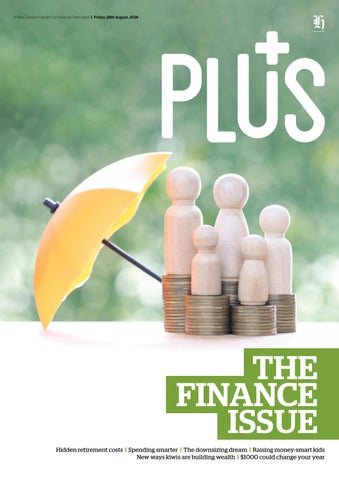
A New Zealand Herald Commercial Publication | Friday, 28th August, 2026
THE FINANCE ISSUE Hidden retirement costs | Spending smarter | The downsizing dream | Raising money-smart kids New ways kiwis are building wealth | $1000 could change your year
|3
inside
THE RETIREMENT COSTS NOBODY WARNS YOU ABOUT
4
RAISING MONEY-SMART KIDS
5
WHO WILL PROTECT YOUR MONEY IF YOU CAN’T?
6
THE $1,000 THAT COULD CHANGE YOUR YEAR
7
THE DOWNSIZING DREAM THAT DOESN’T ALWAYS DELIVER
8
THE FINANCIAL MINEFIELD AFTER A PARTNER’S DEATH
10
FROM MESSY TO MANAGED
11
NEW WAYS KIWIS ARE BUILDING WEALTH
12
SPENDING SMARTER WITHOUT MISSING OUT
13
HOW A WILL CAN CHANGE LIVES AROUND THE WORLD
14
Designer Carol Hannah | Contributors Diana Clement, Anna Morgan Commercial Revenue Manager - Print Kelly Spice Advertising enquiries E: advertise@nzme.co.nz | Cover Photo/GettyImages
Invest with confidence, grounded in property. Enjoy regular returns from investments secured against real assets. For more information and latest rates visit
southerncrosspartners.co.nz
Southern Cross Partners Ltd is licensed to provided peer-to-peer lending services under the Financial Markets Conduct Act 2013.
4|
Photo/GettyImages
The retirement costs nobody warns you about The mortgage may be gone, and work expenses may disappear, but retirement is not always cheaper. Unexpected costs such as medical bills, mobility changes, insurance increases and home maintenance can put pressure on even wellplanned retirement savings.
T
he hidden costs of ageing don’t arrive all at once. While some expenses drop in retirement, others come out of left field and land with a thud. Eyewatering insurance premium increases, a new roof, $7,000 hearing aids or replacing a car can all throw retirees’ budgets off track. With a bit of luck and hard work, the mortgage is gone, commuting costs disappear, and spending on work clothes and lunches is a thing of the past. It’s the unpredictable one-off “lumpy” expenses that are often left out of retirement budgets and catch retirees by surprise.
Insurance can become a major expense While some people can drop life and income support cover when they retire,
medical or health insurance can become increasingly important as we age, just as premiums leap to levels that some people simply can’t afford. It’s very important to review all your insurances as you approach retirement and then periodically, says Debbie Place, financial coach at AMP. Retirees without medical insurance sometimes find themselves paying out of pocket for everything from hip replacements to prescriptions not funded by Pharmac. Everyday medical expenses can catch retirees out as well. These include dental treatment, hearing aids, physiotherapy, podiatry and glasses. The bills that never retire Rates and household running costs still
have to be met. Rates seem to rise every year, and if you’re home more often, power and water bills can go up. Cars eventually wear out or become unreliable and may need upgrading. Computers, phones and home appliances will also need replacing if you live long enough. Home maintenance is another expense that doesn’t retire when we do. Roofs still need replacing, exterior paintwork deteriorates, and hot water cylinders eventually fail. Unlike monthly bills, these expenses tend to arrive without much warning.
Retirees in New Zealand also often help adult children and grandchildren with house deposits or contribute financially during family emergencies. If you need to move in retirement, there are costs involved too: lawyers, real estate agents’ fees, moving costs and renovations. And moving into aged care can be very expensive indeed. Residential care can easily be around $1,500 a week if you have assets. That is roughly $80,000 a year, which is a significant drawdown on retirement savings.
Staying independent has a price Mobility changes can create another wave of unexpected spending. Wheelchairs, walkers, handrails, ramps and accessible wet rooms can cost a small fortune. There are also support services that many people never expect to need, but often do eventually. A regular home clean can easily cost $60, lawn mowing $40 and gardening about the same per hour. Transport costs can change too. Some older New Zealanders eventually stop driving or choose to drive less. While the Gold Card provides free public transport in many areas, taxis, Uber and mobility services can quickly add up, especially for those living where public transport options are limited. Helping family and facing big transitions
Why you need a retirement plan It’s important to factor all of these costs into a retirement plan before clocking out of work. Your budget does need to involve an emergency fund of up to one year’s expenses, says Place. Building flexibility into a retirement budget, including a contingency fund for home repairs, healthcare and support services, can provide both financial resilience and peace of mind. Retirement may bring fewer daily expenses in some areas, but preparing for the hidden costs of ageing can make all the difference to remaining comfortable, independent and financially secure in later life.
|5
Raising moneysmart kids
Money habits start forming much earlier than we might think.
Children learn about money not just from what we tell them, but from what they see us do. It might be observing how we shop, save, talk about bills and make decisions about what we can and can’t afford.
T
he good news? You don’t need to be a financial expert to raise a moneysmart child. Some of the most valuable lessons can happen through everyday family life. Give them a little responsibility Pocket money can be a great starting point. Rather than simply handing over cash, give children some ownership of it. For younger children, a simple system of spend, save and give can work well. They might put some money towards something they want, save some for a bigger goal and choose whether to donate or give a small amount to someone else. The amounts don’t matter nearly as much as developing the habit. Let them make mistakes It can be tempting to steer children away from purchases we know they’ll regret. But spending $10 on something they lose interest in a week later can be a valuable lesson. Let them experience the difference between “I want it” and “I really want it.”
For bigger purchases, encourage them to wait a few days before buying. They may discover they don’t want it after all, or that it’s worth saving for. Those small decisions are practice for much bigger financial choices later in life. Make saving visible Saving can be difficult for children because the reward feels so far away. Help make their progress tangible. A clear jar, savings chart or goal thermometer can show them exactly how their money is growing. Whether they’re saving for a new toy, a special outing or a bigger long-term goal, watching the total increase can make saving exciting. You can also introduce the idea of matching savings. For example, you might agree to add $1 for every $5 they save towards a particular goal. This demonstrates how money can grow when you contribute consistently. Introduce the idea of investing You don’t need to turn your eight-year-old into a mini stockbroker, but it’s never too early to introduce the basic concept that money can
Photo/GettyImages grow over time. Explain the difference between saving and investing in simple terms: saving is generally about keeping money safe for something you’ll need relatively soon, while investing gives money the opportunity to grow over a longer period, although it can also go down in value. Older children might enjoy following a wellknown company or brand and learning how businesses make money. You can talk about shares, KiwiSaver and compound growth in age-appropriate language. The goal isn’t to teach them what to invest in. It’s to get them comfortable with the idea of making their money work for them. Talk about money openly Children don’t need to know every detail of the family finances, but avoiding money conversations altogether can make the subject seem mysterious or even uncomfortable. Include them in everyday decisions. Explain why you’re comparing prices at the
supermarket, choosing one holiday over another or waiting for something to go on sale. You can even give them a small family budgeting challenge: “We have $30 to spend on Friday night’s dinner, what could we make?” They’re learning about planning, priorities and value without even realising it. Focus on confidence, not perfection Perhaps the most important lesson is that being money-smart doesn’t mean never spending money or always choosing the cheapest option. It’s about understanding that money is a tool. We save for the things that matter to us, spend on the things we value and make thoughtful choices about the future. Give children opportunities to practise those decisions while the stakes are small, and they’ll gradually develop something far more valuable than a perfect budget: confidence in their ability to manage money.
4 DAYS
- ' '* '* '* % * /) (&$ '' ) ( *.!% (&$ 1 &( #2# '' ) ( *.!% (&$ +( % >,; &30. 6#+, /$ 63 /' 03 -)3*45#)63#) 50 %,,*/'50/ &03 /*')54 5 5)% & !6,064 0705%, )05%, ,, !3% +& 454 /$ $*//%34 */#,6$*/' 0# 20 0- - 0 " *!%+$ 4% 54 50 5)% 4)09 9*5) 4067%/*3 130'3 ..% 645 4+ /;0/% 9)0 ) 4 !%%/ 9*5) 64 )09 '00$ 063 4% 54 3% 1130: 590 )0634 0& /0/ 4501 %/5%35 */.%/5 9)*##) 9*,, 5 +% ;063 !3% 5) 9 ; &3%% $ ; */ %,,*/'50/ &03 063 09/ 4*')54%%*/' #)00*#%4 1%3) 14 7*4*5 50 % 1 03 % , /$* 8 ; 53*1 50 5)% #%/*# *3 3 1 9*5)) 5*.% &03 40.% 3%5 *, 5)%3 1; */ ?3%;509/ /$ ,*')5 ,6/#) 5 35*/!0306') >,; ! #+ )0.% 03 3%563/ 50 6#+, /$ 0/!0 3$ 5)% 035)%3/ =:1,03%3 3 */ ( 463#) 3'% 11,*%4 50 53 */ >3%% )0.% 1*#+ 61 /$ 3%563/ &30. 63 /' 6#+, /$ %,,*/'550/ 03 -)3*45#)63#) 9*5)*/ 0& *31035
/)
9 DAYS
'' ) ( *.!% - ' (*) * &,
>,; 50 86/%$$*/ &6,,, 0&& #05555*5*4)) @%3**5 '% /**'))54 *4**5 5))% ,! 53044 -0,,0/; "05 /**# ? 3$$%/4 *4**5 3/ #) - 45,% 9*5) '6*$%$ 50063 /$ )*') 5% -0 #) 5)306') 5)% 065)%3/ #%/*# 065% 5)% - 5,*/44 )36 363 , )% 35, /$ /$ 36''%$ #0 45,*/%4 *%94 &30. 6''%5 0*/5 /$ 5)% %53*&*%$ >03%45 5 -63*0 " ; 7%3/*')5 /7%%3# 3'*,, >,; 50 5%9 35 44, /$ /*')54 =:1,03%% ! / /$ ,%*463%,; #36*4% 0& 5%340/ /,%5 /$ 7*4*5 ,7 4, /$ 3%/09/%$ !*3$,*&% 4 /#56 3; 3;; 5)% ,0# , ",6% -0$ 4 9% $*/% 5 5)% 0655) % @055%,, >,; ! #++ 50 /7%3# 3'**,, /$$ #0 #)) 50 6%%/45509/ /**'))54 0705%, +%4*$% @05%, *4*5 33099509/ 5%1 !0 3$ 5)%% )*4503*# = 3/4, 9 &03 & 3%9%,, $*//%3 #36*4% 50 ,55%3 %% + %%563/ *3&& 3%%4 &300. 66#+, /$$ 63 /'' %%,,*/''50/ 03 -)3*445#)663##) 26 ,*55; ##0..0$ 5*0/ 4*')54%%*/' &6,, 4*<% 5063*/' #0 #) !3% +& 454 .045 $*//%34 /$ 40.% ,6/#)%4 > == )0.% 1*#+ 61 /$ 3%563/ 50 6#+, /$ %,,,*/'50/ 63 /' -)3*445#)63#)
6|
Photo/GettyImages
Who will protect your money if you can’t?
Losing the ability to manage your own money can be one of the most frightening consequences of dementia. Planning ahead can help ensure your finances are protected and your wishes respected.
M
ost of us would rather not think about ourselves developing dementia. We may worry about keeping our minds healthy but spend less time thinking about what happens to our finances if our decisionmaking ability declines. The financial risks are not just about forgetting where you put your bank card. Dementia can affect the parts of the brain involved in assessing risk, spotting inconsistencies and understanding complex information. Around 500 New Zealanders are diagnosed with dementia every week, according to Alzheimers New Zealand. That could be any of us. Someone experiencing cognitive decline may agree to unsuitable financial products, sign contracts they do not understand, or become vulnerable to people who see an
opportunity. Day-to-day money management can also become harder. Bills may go unpaid. Bank accounts can be forgotten. Spending patterns can change. And then there are the people who take advantage. Some family members and carers don’t behave honourably. Even people you trust can make poor decisions when they have access to someone else’s money. And scammers will take advantage of your judgement not being as sharp. You cannot completely dementia-proof your finances. The goal is to put protections in place while you still have the ability to make decisions yourself. The power of an EPOA. Having an enduring power of attorney (EPOA) for property becomes increasingly
important as you age. It allows someone you trust to make financial decisions on your behalf if you lose the ability to do so. The EPOA can include limits and conditions around how that authority is used. “An EPOA is like preparing for a fire,” says Darral Campbell, chief executive of Dementia Canterbury. “You don’t wait until you have a fire to have a fire extinguisher or an exit plan.” The key is setting up an EPOA while you still have mental capacity. You can choose whether it becomes active immediately or only after a medical assessment confirms you no longer have capacity. Practical steps that can help An EPOA is just one part of protecting yourself. Other steps include: Have a will. You do not want someone encouraging you to rewrite your will in their favour when you no longer have full capacity. Keep an independent person informed. Having someone outside the immediate situation aware of major financial changes can provide an extra layer of protection. Simplify your banking. Fewer accounts can make finances easier to manage. Avoid having large sums accessible through an Eftpos card and PIN given to someone else. Banks’ terms and conditions generally do not allow this, but it happens.
Automate regular payments. Direct debits and automatic payments reduce the risk of bills being missed. Set alerts and limits. Transaction limits and SMS, email or app alerts can help identify unusual activity. In some cases, alerts may be able to go to both the account holder and a trusted person. Be careful with joint accounts. Adding an adult child or another person to an account can give them full access to the money. Get legal advice before doing this. Stay sceptical. Pressure, urgency and persuasive sales tactics can lead people to make decisions they later regret. None of these protections are perfect. Unfortunately, not everyone who has access to an older person’s finances acts in their best interests. Money can change family and friend relationships. Also scammers are constantly finding new ways around safeguards. Dementia may affect any of us. Taking practical steps while we still have the ability to choose can help protect our money, our independence and our families from difficult decisions later.
|7
The $1,000 that could change your year What if you could find an extra $1,000 this year without taking on a second job, giving up every coffee or living like a hermit?
F
Photo/GettyImages
or many households, $1,000 can feel like a significant amount of money. It could pay for an unexpected bill, boost an emergency fund, reduce a credit card balance or give you a head start on something you’ve been dreaming about. The trick is to stop thinking about finding $1,000 all at once. Instead, look for lots of small wins. Start with $20 a week Saving $20 a week adds up to $1,040 over a year. That might mean one less takeaway coffee and snack, bringing lunch from home once a week, or putting the money from an unused subscription straight into a savings account. The important part is making it automatic. Set up an automatic payment on payday so the money disappears before you have a chance to spend it. Hunt down the forgotten money Have a look through your bank statements for the past few months. Are you still paying for streaming services you rarely use? Paying for memberships you’ve forgotten about? Automatically renewing apps or subscriptions? You don’t need to cancel everything. Just ask yourself whether you’re getting enough value from each expense. Even finding $10 a week in forgotten
spending gives you another $520 a year. Turn clutter into cash Most households have things sitting around that someone else would happily buy. Clothes, children’s toys, furniture, sporting equipment, electronics and unused appliances can all be worth money. Rather than thinking of decluttering as a chore, make it a financial challenge. Set a target, perhaps $250, and see what you can sell over a month. Put the proceeds straight into your savings rather than allowing them to disappear into everyday spending. Make your bills work harder Don’t automatically accept that your current bills are the best deal available. Check your insurance, broadband, mobile phone and electricity plans. Ask providers whether there are better options or discounts available. You don’t necessarily need to switch everything. Sometimes simply making a phone call can save you money. And if you do find a saving, redirect it straight into your $1,000 fund. Give windfalls a job A tax refund, work bonus, birthday money, cash gift or unexpected rebate can be tempting to spend immediately. Instead, consider giving every windfall a job before it arrives. You don’t have to save all of it. You could use a simple rule such as 50% for your future, 50% for fun. That way you’re still enjoying your money while making progress. Watch the little wins become a big one The beauty of a $1,000 goal is that it doesn’t require a dramatic lifestyle overhaul. Save $20 a week. Find a few unused subscriptions. Sell some clutter. Negotiate a couple of bills. Put part of a windfall aside. Individually, these decisions might not feel life-changing. Together, they can be.
Specialist Mortgage Mo ortgage Lender | Here Here to EXCEED Y Your our Expectationss
SHORT-TERM SHORT TERM BRIDGING B LOANS LO O OANS (Non-CCCFA)
Rates from
7.50% p.a.
*
Fixed rate for up to 12 months.
Looking for lending that fits? We work with customers and mortgage advisers to tailor lending solutions to your needs.
0800 11 22 74
loans@xceda.co.nz
* This advertisement relates solely to credit provided for business or investment purposes. It is not intended for personal, domestic, or household borrowing and is therefore not regulated by the Credit Contracts and Consumer Finance Act 2003 (CCCFA). All lending is subject to Xceda’s lending criteria, standard loan fees, and terms and conditions at www.xceda.co.nz.
8|
The downsizing dream that doesn’t always deliver Downsizing is often seen as the ticket to a more comfortable retirement. But selling the family home comes with emotional challenges, unexpected costs and financial decisions that can make or break the next chapter.
F
or many New Zealanders, the big downsize is the retirement dream: sell the family home, buy something smaller, bank the difference and enjoy a simpler life. But the reality is more complicated. Downsizing can release capital and reduce the burden of maintaining a large property. It can also come wrapped in emotional upheaval, unexpected costs and a level of risk that many people underestimate. And equity is only one part of a retiree’s financial picture, alongside NZ Super, KiwiSaver and other investments. Research from the Financial Services Council in 2017 found that 54% of Kiwis planned to downsize in retirement. However, on average, the equity released would cover only about 3.3 years of living costs.
The reality check Someone moving from a large home in an expensive suburb may release significant equity. Someone selling a modest home in a regional centre may not. Moving to a cheaper town or city can make a bigger difference. There is also the question of finding the right property. Homes suitable for downsizers can be in short supply, particularly in popular suburbs where buyers are competing for single-level, low-maintenance properties. Then there are the costs. Real estate fees, valuation, staging, storage, moving and pre-sale maintenance can easily eat into the money released from a sale. Spending tens of thousands of dollars on the transition is not unusual.
If the new home needs upgrades such as a kitchen, bathroom, carpet, curtains, landscaping, heat pumps, solar panels or double glazing, the nest egg can shrink quickly. The upside is that smaller homes often mean lower maintenance bills, and potentially lower rates, power, water and insurance costs. Finding the right fit Townhouses are often appealing because they provide a modern, low-maintenance lifestyle. However, buyers should consider practical issues such as stairs, shared walls and how easy the property will be to manage if problems arise later in life. Buyers need to do their homework. Past building failures have left some wary of apartments and multi-unit developments, while concerns about weathertightness, ventilation and design remain part of the conversation. Downsizers also need to think about where they will put visitors, grandchildren, hobbies and the modern collection of “stuff” we all accumulate in a smaller home. Making the move easier One of the biggest barriers to downsizing is not the desire to move. It is the complexity
Photo/GettyImages
of getting there. Selling one home while arranging another, managing timing and dealing with uncertainty can be enough to make people stay put for longer than they want. Some builders are responding to that gap with new approaches. Generation Homes, for example, has introduced a house tradein option designed to simplify the transition by allowing customers to secure a new build while remaining in their existing home until it is ready. The company says the model is aimed at people who do not want the stress of selling first. More than a financial decision For many older New Zealanders, the emotional side of downsizing is just as important as the financial side. Leaving the family home can be difficult. But if you have seen someone in their 90s struggling to maintain a large house with rooms they no longer use, you understand why moving earlier can make sense. If you are considering the big downsize, do it early, plan carefully and understand the numbers. The goal is not just a smaller home. It is a home that works better for the next stage of life.
ADVERTISEMENT
SECRETS OF AN AGEING POET is a succinct, wise and witty, tour de force of the meaning of life and philosophies of an afterlife, by bestselling Kiwi-American author John Wareham.* Business Week observed that “John Wareham was born shrewd.” In fact John’s wisdom stems from 38 years as life-coach to celebrated New York corporate teams, and, uniquely, gangs and max-security denizens of New York and New Zealand prisons.
A MEMOIR
& JOURNEY
“Too soon we grow old, too late we growJohn smart.” Wareham Unsheathing his rich experience and hard-won insight, John has created a 7-step masterwork that: 1. opens with a pithy panorama of the ideas of an afterlife, then closes with a startling conclusion; 2. reveals the “psychic contract” and “higher-head syndromes” that thwart fulfilment; 3. shows how the “unconscious” communicates through dreams, moments, hunches, and poetry; 4. resolves the riddle of existential loneliness;
Available Now At
Amazon.com.au Local Bookstores
Praise for Wareham’s Work “Every line led onward, creating crucial encounters with my own self... a must read, period.” Brian O’Dea, author, HIGH: Confessions of an International Drug Smuggler “Memoirist, philosopher and poet John Wareham reveals a witty, elegiac, life-changing journey. If we are truly Dancing in the Dark, there’s no better partner.” Reverend Craig Rubano, Ph.D. Princeton Theological Seminary. “Happily destined, like Milton’s Paradise Lost, to find its readers.” Don Foster, Professor of Literature, Vassar College “Stunning— an assured exploration of moral quandaries.” Publishers Weekly “Inspired—whimsical, philosophically savvy.” Kirkus Reviews
5. justifies divorce to find a soul-mate; 6. details how to quell apprehension of the “end of the line;” 7. clarifies how to create a great life before departing.
*John retains American citizenship but re-
cently relocated to a Kiwi retirement village.
Full bio and email contact,
+ backstory+reviews+Amazon link
at the Official Authors Guild Website www.johnwareham.com
The Flatiron Press New York
10 |
T financial The minefield after m a partner’s death d Losing a partner is devaastating enough hout discovering with thatt bank accounts, KiwiiSaver, property and inheritances do not alwaays end up where you expected. Here’s whaat every couple ds to know. need
W
Photo/GettyImages
hen your partner dies, what happens to your money? From joint bank accounts to investments and wills, the rules can be surprising, and the consequ uences can be particularly painful for blended d families. In thee weeks or months following a death the survviving partner may discover that bank accountts, investments and inheritances do not alwa ays work the way they expected. Bank acccounts Someetimes the most pressing issue is cash for living g expenses and funeral costs. If a bank accountt is in your spouse or partner’s name, the bank will usually freeze the account once it is notiified of the death and the money becomees part of their estate. Joint accounts are usually accessible to the survvivor but there can be complications if there are significant sums of money in the accountt. The willl A will names the people you want to inherit your asssets and appoints an executor to carry out your wishes. However, a will does not automa atically control everything you own. Some asssets may pass directly to another person because of how they are owned or becausee a beneficiary has been nominated. If your spouse or partner dies without a will, their esttate is distributed according to the Adminisstration Act 1969. The first $155,000 plus perrsonal possessions and furniture go to your spo ouse or partner. The remainder is split a third tto the spouse/partner and two thirds to the ch hildren if there are any. What ha appens to KiwiSaver/home/life insuran nce? With iinvestments, KiwiSaver, life insurance, and pro operties, the biggest surprise for many people iis that some money and investments sit outsiide the will and go directly to named uals. individu Saver: Many people think their partner KiwiS omatically receive their KiwiSaver. will auto dealt with through the estate process, But it’s d
Glenys Talivai, Public Trust
meaning the funds usually go to the estate to be distributed according to the will. The family home: If a family home is owned as joint tenants, the surviving partner will usually become the sole owner. However, if the couple own the property as tenants in common, the deceased person’s share will usually be distributed according to their will. Life insurance: If a life insurance policy has a nominated beneficiary. This can be a useful way of ensuring a partner has immediate access to funds, but it also needs to be reviewed regularly. Debts: Any debts held solely in your partner’s name generally become the responsibility of their estate and must be paid before assets can be distributed to beneficiaries. With joint debts, the surviving partner becomes responsible for that debt. Relationship property A will is not the only document that affects what happens after death. In New Zealand, relationship property laws can also come into play. A surviving partner may have the option to make a claim under the Property (Relationships) Act rather than accepting the provisions of the will. The outcome can change how the assets pass to beneficiaries. Be prepared In the immediate aftermath of a death, there are practical financial decisions to make at a time when people are grieving. Closing accounts, sorting through paperwork and estate administration often takes longer than people expect, says Glenys Talivai, Public Trust chief executive. “Having plans in place ahead of time can help make things easier for those left behind. Keep wills up to date and create enduring powers of attorney,” she says. “ If you have a blended family, consider how it might shape decisions. Talk through your wishes with loved ones today if you haven’t already. Being prepared is one of the best gifts you can give the people you care about.”
| 11
MONEY MAKEOVER:
Photo/GettyImages
From messy to managed
You don’t need to be wealthy to feel financially organised. Sometimes the biggest difference comes from simply knowing what you have, where your money is going and what you’re working towards.
I
f your finances have become a little messy, don’t beat yourself up. Life happens. Bills change, incomes change, families grow and priorities shift. Think of this as a financial spring clean. Six simple steps to get your money working better for you. 1. Know what you’ve got Start with the basics. List your bank accounts, savings, KiwiSaver, investments and other assets. Then make a separate list of
your debts, including credit cards, personal loans, car finance and your mortgage. You don’t need complicated spreadsheets. A simple snapshot is enough. Seeing the whole picture can be surprisingly empowering. You may discover you’re doing better than you thought. 2. Follow the money For one month, pay attention to where your money actually goes. Look beyond the big expenses and notice the smaller ones that add up such as takeaway lunches, online shopping, subscriptions, convenience purchases and spontaneous spending. This isn’t about judging yourself. It’s about gathering information. Once you know where your money is going, you can decide whether that’s where you want it to go. 3. Give your money a job Instead of letting your pay disappear into one large pool, divide it according to your priorities. You might have money for household bills, everyday spending, savings, debt repayments and fun. The exact percentages will depend on your circumstances, but the principle is
simple: decide what your money is for before you spend it. Automatic payments can make this much easier. Set up transfers for savings and bills around payday, so the important things are taken care of first. 4. Build a financial buffer One unexpected expense can throw an otherwise healthy budget into chaos. Start building an emergency fund, even if you can only put aside a small amount each payday. Your first target might be $500, then $1,000, and eventually enough to cover several weeks or months of essential expenses. Don’t worry if it takes time. The goal is progress. Having money available for an unexpected repair or bill can provide an enormous sense of security. 5. Tackle expensive debt Not all debt is created equal. High-interest debt can make it difficult to get ahead because you’re paying significant amounts simply for the privilege of borrowing. If you have credit card balances, personal loans or other expensive debt, consider making a plan to reduce them. That might mean paying more than
the minimum, consolidating debt where appropriate or directing extra money towards the highest-interest balance first. And celebrate every milestone. Seeing a debt balance fall is a genuine financial win. 6. Give yourself something to look forward to A financial makeover shouldn’t be all about bills, budgets and saying no. Make room for something that matters to you. Perhaps it’s a holiday, a new car, a home renovation, a family experience or simply building enough savings to feel comfortable taking a break. Give the goal a name and a number. Then automate a regular contribution towards it. Saving becomes much easier when you’re saving for something, rather than simply trying not to spend. Your money doesn’t need to be perfect Financial organisation isn’t about creating a flawless budget and sticking to it forever. It’s about having a system that works for your real life. Review your finances every few months. Adjust when your circumstances change. Celebrate progress rather than focusing on the occasional setback.
12 |
New ways Kiwis are building wealth From KiwiSaver to side hustles, smarter investing and making the most of what you already have.
F
or generations of kiwis, the traditional path to wealth was fairly straightforward: buy a house, pay off the mortgage and put money into KiwiSaver or the bank. Those things can still play an important role, but today’s Kiwis have more options than ever when it comes to building their financial future. You don’t necessarily need to own multiple properties or have a huge salary to start building wealth. Increasingly, it’s about making the most of small amounts, accessible technology and assets you already have. KiwiSaver is doing more of the heavy lifting KiwiSaver is the easiest way to invest because contributions happen automatically through your pay. But it’s worth remembering that KiwiSaver isn’t simply a savings account. The money is invested, often across a mix of shares, property, bonds and other assets, depending on the fund. The choice of fund can therefore make a difference over the long term. Growth-oriented funds generally hold a higher proportion of growth assets such as shares, although that also means greater ups and downs along the way. For anyone who hasn’t checked their KiwiSaver in a while, understanding what fund you’re in, what you’re paying in fees and whether it still suits your timeframe and comfort with risk can be a worthwhile financial spring clean. Investing is no longer just for the wealthy Technology has made investing considerably more accessible. Rather than needing thousands of dollars to get started,
some investment platforms allow people to invest relatively small amounts regularly and gain exposure to diversified funds or shares. That means someone with $25 or $50 a week to spare can potentially begin building an investment habit. The important shift is thinking beyond the idea that investing requires a large lump sum. Regular investing, over a long period, can be a powerful habit. Of course, investments can fall as well as rise, and investors should understand the risks, fees and tax implications before choosing an investment. Your home isn’t your only property opportunity Property remains an important part of New Zealand’s wealth story, but building wealth through property doesn’t necessarily mean buying another house. Some homeowners are finding ways to make their existing property work harder. This could include options such as taking in a boarder, creating a minor dwelling where permitted, renting out a room or using unused space for a legitimate income-generating purpose. For others, improvements that make a home more energy efficient or functional may provide benefits through lower running costs and potentially improved value. The key is to look at your home not just as somewhere you live, but as one part of your overall financial picture. Side hustles are becoming part of the
wealth equation A second income doesn’t have to mean taking on another full-time job. Many kiwis are increasingly turning hobbies, skills and spare time into additional income. From tutoring and freelance work to handmade products, photography, consulting, gardening, online businesses and selling unwanted goods. The first goal doesn’t have to be thousands of dollars a month. An extra $100 or $200 a week could instead be directed towards debt repayment, an emergency fund or investments. Over time, that additional income can become another building block in your financial plan. Your skills are an asset too One of the most overlooked ways to build wealth is to increase your earning potential. Learning a new skill, gaining a qualification, negotiating a pay rise or moving into a betterpaid role can have a much bigger impact on your finances than cutting a few dollars from the grocery bill. For people in their 40s, 50s and beyond, this can be particularly valuable. A career change, consulting work or flexible part-time role can potentially extend your earning years while giving you more choice about how you work. Think of your skills and experience as an asset that can continue producing income. Technology is changing the way we manage money New Zealand’s banking landscape is also becoming more digital. Open banking regulations are creating opportunities for new services that can securely connect financial information, with the potential for tools that help consumers compare mortgages, manage budgets and make payments more easily. The
Photo/GettyImages
opportunity isn’t simply having another app on your phone. Better technology could make it easier to see the bigger financial picture and make informed decisions. For consumers, the important thing is to understand what data they’re sharing, why they’re sharing it and whether a service is appropriately regulated or accredited. Wealth can be built in different ways Another interesting development is the broader range of investments becoming available through managed funds. Some KiwiSaver and managed funds now have exposure to assets such as infrastructure, private equity, private credit and unlisted property. The Financial Markets Authority says these types of private assets are becoming more common in KiwiSaver portfolios, although they remain a relatively small part of New Zealand’s retail investment market. For individual investors, the lesson isn’t that everyone should rush into these investments. It’s that diversification and access to different types of assets are becoming increasingly sophisticated. Start with what you have Perhaps the most encouraging part of today’s wealth-building landscape is that you don’t have to wait until you have “enough money” to begin. You can start with your existing KiwiSaver. You can automate a small investment. You can turn a skill into extra income. You can make your home more efficient. You can learn more about investing. None of these decisions is likely to make you wealthy overnight. But wealth is rarely built overnight.
| 13
Spending smarter without missing out Being financially savvy doesn’t have to mean saying no to everything you enjoy.
I
n fact, some of the smartest money decisions are not about spending less, they’re about spending better. For New Zealand households facing the cost of groceries, housing, power, insurance and everyday essentials, being intentional about where your money goes can create room for the things that make life enjoyable. The goal isn’t to become a person who never spends. It’s to become a person who knows what is worth spending on. Work out what matters to you Before cutting back, think about what you actually value. Maybe it’s travelling around New Zealand, eating out with friends, taking the kids on holidays, going to concerts, renovating your home or enjoying goodquality food. There is no universal list of “good” and “bad” spending. If something genuinely brings you happiness and fits within your budget, it can be money well spent. The trick is to identify those priorities, and then look for savings elsewhere. Spend more on what you love, less on what you don’t A simple exercise is to divide your spending into three categories: love it, need it and don’t really care. The first category gets priority. The second needs to be managed carefully. The third is where you may find easy savings. Perhaps you don’t care about having the latest phone, but love going away for long weekends. Or you’re happy to buy supermarket-brand cleaning products so you can afford better-quality ingredients for entertaining. It’s not about deprivation. It’s about making conscious choices. Become a smarter supermarket shopper Groceries are one of the easiest places to find savings without necessarily changing what you eat. Compare the unit price, rather than simply choosing the cheapest-looking packet. Look at supermarket specials but only buy them if you were going to use the product anyway.
New Zealand supermarkets also offer a wide range of own-brand products, which can be considerably cheaper for everyday staples. And don’t underestimate the freezer. Planning a few meals around what’s already in your pantry and freezer can reduce food waste and the number of expensive last-minute trips to the supermarket. The money you save can then be redirected towards something you actually enjoy. Enjoy New Zealand without spending a fortune You don’t always need a big overseas holiday to feel like you’ve had a break. New Zealand is full of experiences that can cost very little: beaches, regional parks, walks, markets, museums, galleries and community events. A family day trip can become a memorable adventure without a huge accommodation bill. And if you do want a proper getaway, travelling outside peak periods, comparing accommodation options and booking ahead can make a significant difference. Being smart about the cost doesn’t make the experience any less special. Make entertaining affordable Hospitality is part of Kiwi life, but regular dinners and drinks out can quickly add up. That doesn’t mean giving them up. Try rotating between restaurant nights and entertaining at home. A shared barbecue, pizza night or potluck dinner can be just as social, and often much cheaper. If you’re meeting friends for dinner, consider suggesting a less expensive restaurant or going out for lunch instead of dinner. You might even discover that your friends are relieved someone suggested it. Look after the big bills Small savings are useful, but the biggest opportunities often come from your largest regular expenses. Review your insurance, broadband, mobile plan, electricity provider and other household services periodically. Don’t assume your current deal is still the best
Photo/GettyImages one. If your circumstances have changed, ask providers whether there are more suitable plans. And when contracts or fixed terms come up for renewal, use the opportunity to compare. Saving $30 a month on a household bill might not feel exciting, but that’s $360 a year, potentially enough for a weekend away or several nights out. Beware of “cheap” spending Being a savvy shopper doesn’t mean buying something simply because it’s on sale. A $40 bargain you don’t need isn’t a $40 saving. Before making a purchase, ask three questions: Would I buy this at full price? Do I actually need or want it? And will I still be happy I bought it in three months’ time? For bigger purchases, give yourself a cooling-off period. Adding something to an online shopping cart and waiting 24 or 48 hours can be surprisingly effective. Spend on experiences, but plan for them One of the best ways to avoid feeling
restricted is to create a fun fund. Put a set amount aside each payday specifically for dinners, entertainment, hobbies, holidays or whatever makes life enjoyable. When the money is there, you can spend it without the guilt. This is particularly useful for families. A separate holiday or Christmas account can turn large annual expenses into manageable regular contributions. Smart spending is about freedom The ultimate goal isn’t to spend as little as possible. It’s to make sure your money is supporting the life you want to live. That might mean buying fewer things but choosing better quality. It might mean cooking at home during the week so you can enjoy a restaurant meal on Saturday. It might mean skipping a few impulse purchases so there’s money available for a family holiday. Spending smarter isn’t about missing out. It’s about making room for more of the things that matter.
/( , & ')( ) && )- $ ( ' '%# * ! $ && )- $ ( ' '%# *' $ $ ! '%%# (*&&! # $) %$!/ &&
2 6$+ 9 "/ "' 4/ $8 +9-/54' 52 .& 0 33$.&$23 2$ 42 .3%$22$# 4/ = -(+4/. 4/ )/(. 4'$ "/ "' 4 9 .(&'43 4 4'$ "$.42 + : =/ 3/. $ $.)/9 48/ %5++ # 93 /% & 2#$. 6(3(43 3/-$ /.+9 /0$. 4/ 4'$ &$.$2 + 05 +(" #52(.& 4'$ %$34(6 + $ "'//3$ 6 2($49 /% #( $2$.4 490$3 /% & 2#$.3 8'("' %$ 452$ % 5+/53 #(30+ 93 /% "/+/52%5+ 0$2$..( +3 '$2 "$/53 /2#$23 .# /% "/523$ 4'$ '/#/#$.#2/.3 4' 4 4'$ 2$ (3 % -/53 %/2 (-$ 4/ 6(3(4 $. 9$ < ++$29 4'$ (."2$#( +$ 8'(4( 53$5- .# 42 6$+ '/-$ 6( 4'$ ;/2&/44$. =(&'8 9 8(4' +5."' 4 4'$ ' .& -/-/. =/4$+ $%/2$ /6$2.(&'4 (. 50/ /6$2+//*(.& 4'$ *$ (3(4 4'$ 2$./8.$# = -(+4/. < 2#$.3 52 .& 0 33$.&$23 8(++ 4'$. $ 42 .3%$22$# "* 4/ 52 .& $%/2$ 2$452.(.& 4/ 5"*+ .# ."+5#(.& ++ 2$ *% 343 .# #(..$23 15 +(49 "/ "' ; :: '/-$ 0("* 50 .# 2$452. (. 5"*+ .# .# 52 .& 8(4'(. *- /% - (. (20/243 +$ 3$ "'$"* 8(4' 53 %/2 02("$3 4/ )/(. 4'$ 4/52 %2/- /4'$2 "$.42$3 8(4'(. $8 $ + .#
5 DAYS
0 )*' $ (( ! ' *! & 0 () + ! , & ')( )% ' && ( ' )- $ '%# * ! $ !! $ )%$ " ' () *' () ( $ ! '%%#( ) ( % ' - !! $%) .) $
5 DAYS
/(. 9/52 /52 . &$2 3 8$ %+9 4/ $+ /52.$$ .(&'43 4 /52 "$.42 ++9 +/" 4$# '/4$+ ++ 2$ *% 343 .# -/34 #(..$23 (."+5#$# $ 30$.# % 5+/53 # 9 4 4'$ $33$+ 2 5+(0 ;$34(6 + 8(4' '5.#2$#3 /% #( $2$.4 "/+/52$# 5+(03 /. #(30+ 9 4'$ + 2&$34 ,+/& (. 4'$ /54'$2. '$-(30'$2$ "'$$3$ #$-/.342 4(/..3 3"/.$3 .# 4$ .# -5"' -/2$ $ +3/ $.)/9 6(3(4 4/ $+ /52.$3 !/4 .(" < 2#$.3 %/2 3/-$ $ 544(%5+ 02(.& %+/8$2 /. #(30+ 9 4 *$ '(&' 4$ 4 4'$ '(34/2(" (.#3/2 =/4$+ :.)/9 #(..$2 ,25(3$ /. 4'$ 22 (6$2 4 *(.& (. 4'$ 3(&'43 %2/- #( $2$.4 .&$+ ."+5#(.& (2% 2$3 %2/- 5""*+ .# $++(.&4/. /2 ,'2(34"'52"' 3* /54 /4'$2 2$ 3 ""/--/# 4(/. (. 48(. #/5 +$ 2//-3 (.&+$ 2//- 3500+$-$.44 00+($3 ++ 2$ *% 343 "/-0+(-$.4 29 "'/"/+ 4$ '/52 $ "' %4$2.//. 4 4'$$ '/4$+ $.42 ."$ 4/ $33$$+ 2 5+(0 ;$34(6 + 22 (6$2 7(..$2 ,25(3$ =(&' $ 4 4'$ (.#3/2 .# /% "//523$ ; :: '/-$ 0("* 500 2$452. 8(4' /% - (. (20/24 /04(/. + ("*$4 4/ $(+ 7( -/.# 53(" + $ 54(%5+ ./(3$ ;2$$ '/-$ 0("* 50 .# 2$452. %2/- 52 .& 5"*+ .# $++(.&4/. /2 ,'2(34"'52"' 8(4'(. /% (20/24
14 |
Médecins Sans Frontières/ Doctos Without Borders Head of Mission, Anne Taylor, in the field.
A GIFT THAT OUTLIVES US:
How a will can change lives around the world
Josephine Gee
S
eventy-seven-year-old Anne Taylor has spent much of her life somewhere most of us will never go. Since joining Médecins Sans Frontières/Doctors Without Borders (MSF) in 2002, the Wellingtonian has completed 21 assignments in some of the world’s most challenging places – Palestine, Haiti, Nigeria, Nepal, South Sudan, the Democratic Republic of Congo, Ivory Coast, and Indonesia. Even when the world shut its borders in
2020, Anne wasn’t ready to hang up her aid worker hat. “Every placement has asked something different of me,” she says. “I started as a logistician - none of the medical work can happen without that groundwork - before moving into head of mission roles, leading teams through conflict, disease outbreaks and disaster across very different countries and cultures. “It’s the loyalty of our supporters that keeps MSF truly independent, letting us work in the toughest environments and do what’s needed, without compromise - something I’m incredibly proud of.” That independence, the freedom to go where the need is greatest, is what first drew Auckland-based Josephine Gee to MSF, before she ever considered leaving a gift in her Will. “I have travelled extensively, often in places where there was great need, and I have seen MSF in action,” Josephine says. Her own life has taken her from a childhood in New Zealand to teaching in China, Turkiyey and Egypt, with plans for Ethiopia, Afghanistan and Syria interrupted by revolution and invasion. “I have learnt that a lot of the world experiences far greater difficulty and danger than I do, and it gives me satisfaction to feel I can offer my part to help improve the lives of these people.”
When it came to including MSF in her Will, Josephine found the process simpler than she expected. “It was very easy, I had already mentioned it in my Will, but a conversation with the MSF Wills team was very helpful in clarifying my wishes. I now feel very comfortable.” Her gift, she hopes, will help relieve hunger and thirst in Gaza, and in Palestine and Afghanistan.
Her gift, she hopes, will help relieve hunger and thirst in Gaza, and in Palestine and Afghanistan. Teneale Cameron, senior fundraising manager, Gifts in Wills at MSF, says stories like Josephine’s sit at the heart of the organisation’s work. “In a world facing so much upheaval, conflict, displacement, disease outbreaks, bequests like Josephine’s are what allow MSF to keep showing up where it matters most. They are, quite simply, lifesaving. “Around 60 per cent of Kiwis give financially to charity each year, yet only six per cent of Wills include a charitable gift. With an
estimated $1.6 trillion expected to pass between generations over the next 25 years, Gifts in Wills represent an extraordinary opportunity for New Zealanders to extend the values and causes they care about today far into the future.” As an independent, impartial organisation, MSF receives no funding from the New Zealand or Australian governments, relying instead on donations to respond wherever the need is greatest. Last year, more than 65,000 global MSF staff members worked across more than 70 countries with New Zealand and Australian staff members contributing their skills through 132 assignments in 27 countries. September is Wills Month, a timely moment to think about your legacy. In New Zealand, according to the 2025 JBwere Bequest Report, bequests already contribute an estimated NZ$320 million a year. Teneale added: “You don’t need to leave a fortune to make a difference. Once your loved ones are cared for, even a small percentage of your estate can help MSF reach people with essential medical care when they need it most.” To learn more about leaving a legacy of expert medical care, contact MSF’s Gifts in Wills team on 0508 633 324 or gifts.wills@nz.msf.org.
LEAVE A LEGACY OF EXPERT MEDICAL CARE MédecinsSansFrontièresNewZealand reliesondonationstobringurgent medicalaidwhereit’s neededmost. Fromlifesavingsurgeriesinconflictzones tovaccinationsforchildren,youcanleave alegacyofexpertmedicalcare. Onceyourlovedonesarecaredfor, byleavingwhateveryouchoose,just onepercentofyourestatetoMSFcan makeabigdifference.Yourgiftwillhelp humanitarianmedicalcarealwaysbe thereandremainindependent– Today.Tomorrow. Alwaysthankstoyou.
SCAN FOR A FREE, NO OBLIGATION GIFTS IN WILLS INFORMATION PACK TODAY.
Always THERE. TODAY. TOMORROW.
Alwayys readyy…
Always THANKS TO YOU.
Phone. 0508 633 324 | NZBN: 2637615 | Copyright : Oliver Barth/MSF
W TODAY AND TOMORROW Always there
HOW PEOPLE LIKE YOU ARE LEAVING A LEGACY OF EXPERT MEDICAL CARE
F
MEDECINS SANS FRONTIERES AUSTRALIA LTD ABN: 74 068 758 654 © Rahul Dhankani/MSF
INFORMATION FOR YOUR
a gift in your Will Your guide to leaving Frontières. to Médecins Sans
SOLICITOR
HELP ENSURE MEDECINS FRONTIERES IS ALWAYS SANS INDEPENDENT AND READY TO
A legacy OF EXPERT MEDICAL CARE
bel Corthier/MSF © Isab
© Candida Lobes/MSF
– today andRESPOND tomorrow.
F
© Anna Pantelia/MS
© Mariana Abdalla/MSF
NORDIC POLAR CRUISER
GET FREEDOM NOW! SAVE $500!
$ .00 Now Only 6995 From only $
40
on NORDIC Mobility Scooters
per week** for 36 months with a $3500 Deposit
**subject to terms and conditions.
SPECIFICATIONS:
PACKAGE INCLUDES
Weight Capacity - 230kg Weight with Batteries - 160kg Motor Size – 24v/1400w Max Forward Speed – 15km/h Distance Range – up to 50 km Ground Clearance – 12cm Batteries – 12v/75ah x 2 Overall Dimensions - 1650 x 720 x 1400mm Full Front and Rear Suspension
A Get Home Safe program FREE 3 year AA FREE Tool Kit Adjustable Tiller Roof Spare Wheel Windscreen n and Windscreen Wiper Large Lockkable Storage Compartment Choice of Seats gh Back Adjustable Swivel Seat - Luxury Hig - Adjustable e Two Person High Back Seat
NORDIC COMPANION CRUISER
6995.00
$
r the o f d ne nd Desig ropean a ts ty Eu n Marke Quali erica m A h Nort
PACKAGE INCLUDES A Get Home Safe FREE 3 year AA FREE Tool Kit FREE Double Cane Holder FREE Rear Storage Bag Two Person Seat Roof and d Windscreen Adjustab ble Tiller
SPECIFICATIONS:
Weight Capacity - 200kg Weight with Batteries - 132kg Motor size - 24V 1400Watt Brushless Maximum Forward Speed - 15km/h Distance Range - Up to 50km Ground Clearance - 13cm Batteries - 12V/75Ah x 2 Overall Dimensions - W750 x L1350 x H1600 Full Front & Rear Suspension
Our company has been operating vehicle e garages in New Zealand for over 20 years with h an average annual turnover of over 4 million n NZ Dollars. We have a large mobility scooter workshop with an extensive and full range of parts and accessories.
expires Offer 29/02/2024
All NORDIC mobility scooters meet high international Quality and Safety standards.
technicians available for your peace of mind.
Phone: Phone:
0800 69 66 73
For yo our FREE demonstration n at your ho ome NOW *terms and cond ditions apply.
visit www.nordicmobility.nz
NORDIC CRUISER
Mid-S Mid Sized Town Sized Town C Cruiser. ruiser.
$ Fro om only 30per week**
for 36 months with a $1500 Deposit
**sub bject to terms and conditions.
SPECIFICATIONS:
Weight Capacity – 150kg Weight with Batteries – 85kg Motor Size – 24V / 400W PACKAGE INCLUDES Max Forward Speed – 10km/h FREE 3 year Get Home Safe program Distance Range – up to 30km Ground Clearance – 9cm FREE Tool Kit and d Safety Flag Batteries – 12V / 35Ahx2 FREE Cane and Cane Holder Overall Dimensions – 1270x610x1080mm FREE Dustcover &Rear Storage Bag Full Front and Rear Suspension High Back Swivel Seat and Adjjustable Tiller
NORDIC LUXURY EXPLORER LORER
NORDIC LUXURY CRUISER
$ From onlly 35 per week**
$ Fro om onlly 35 per week**
for 36 months with a $2000 Deposit
**subject to terms and conditions.
SPECIFICATIONS:
Weight Capacity – 180kg Weight with Batteries – 147kg Motor Size – 24V / 800W Max Forward Speed – 15km/h Distance Range – up to 60km Ground Clearance – 12cm Batteries – 12V / 75Ahx2 Overall Dimensions – 1480x640x1120mm Full Front and Rear Suspension
PACKAGE INCLUDES
for 36 month hs with a $1500 Deposit
Large e Heavy Dutyy Luxury Scooter..
FREE 3 year AA A Get Home Safe program FREE Tool Kiit and Saffety Flag FREE Cane and Cane e Holder FREE Rear Storage Bag FREE Dustco over F F REE Windscreen Luxury High Back Adju ustable Swivel Seat Adjustable Tiller
**su ubject to te erms and conditions.
SPECIFICATIONS:
Sport rty t Luxury
Scooter. Weight Capacity – 150kg PACKAGE INCLUDES Weight with Batteries – 110kg A Get Home Safe program FREE 3 year AA Motor Size – 24V / 800W FREE Tool Kit and d Safety Flag Max Forward Speed – 15km/h FREE Cane and Cane Holder Distance Range – up to 50km Ground Clearance – 12cm FREE Rear Storag ge Bag & Windscreen Batteries – 12V / 55Ahx2 FREE Dustcover Overall Dimensions – 1380x630x1150mm Luxury High Back Adjustable Swivel Seat Full Front and Rear Suspension Adjustable Tiller