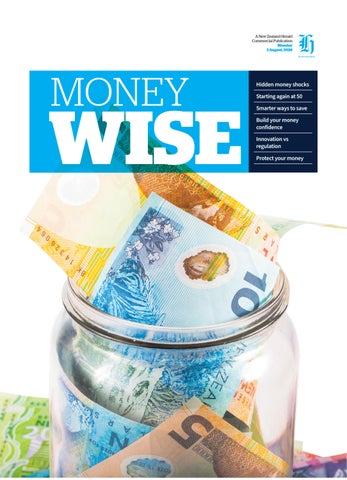
A New Zealand Herald Commercial Publication Monday 3 August, 2026
MONEY
WISE
Hidden money shocks Starting again at 50 Smarter ways to save Build your money confidence Innovation vs regulation Protect your money
G Great Results l Start with Great People. Loan Market Central, home of New Zealand’s Mortgage Adviser of the Year.
arcroft M n o er m a C
Reach out for a no-obligation chat and let’s get started. loanmarket.co.nz/central 027 687 5784 NZ Fi Financial i lS Services i Group Li G Limited i d (FSP286965)
ron Muggeridg Came e
Vijay G ound er
MONEYWISE | 3
inside
Building a retirement plan that works
4
The money shocks Kiwis don’t see coming
6
The safety nets that protect your money
8
The new digital tools helping Kiwis save
9
The financial check-up most of us keep putting off
10
Can regulation drive innovation in our fintech sector?
11
The sandwich generation
12
Retirement plans shattered: starting again in your 50s
13
The financial confidence gap
14
CREDITS
A NZME publication
Contributors Diana Clement, Anna Morgan, Tom Filmer Designer Carol Hannah Commercial Revenue Manager Kelly Spice Advertising Enquiries advertise@nzme.co.nz
You’re paying it. So why isn’t it going away?
WE WANT YOU. TO LEAVE US. ONE LOAN. ONE REPAYMENT REWARDS FOR LEARNING SET YOUR DEBT-FREE DATE
moneysweetspot.co.nz/apply The best place in Aotearoa to get out of debt. Lending criteria and affordability checks apply. Fees, terms and conditions apply. A Financial Reset Loan may not be suitable for everyone.”
4 | MONEYWISE
From saving to spending:
Building a retirement plan that works Retirement does not remove unforeseen costs, it simply changes how people must prepare for them. In retirement the ability to “replace” an emergency fund disappears. Once you’ve clocked out from work for the last time, strategic planning is needed to ensure investments last through retirement and unexpected costs.
T
he one-off expenses retirees face are often significant, including home repairs, health issues, helping family, replacing vehicles, and aged care needs. “It’s not about expecting things to go wrong,” says Place. “It’s being prepared when life changes. Planning helps reduce financial stress.” “When we’re working, we’d ideally be building towards about three to six months’ worth of expenses and call it emergency savings,” says AMP retirement coach Debbie Place. “But when it’s retirement, we can’t replace that emergency fund from income.” AMP generally recommends that retirees maintain 12 months’ worth of expenses in cash funds or the equivalent, depending on individual circumstances. Part of a broader plan An accessible emergency fund is vital and
must be part of a wider retirement strategy, balancing immediate needs with long-term growth, says Place. Keeping everything in cash may reduce long-term growth potential, while keeping everything invested can expose retirees to the risk of selling during a market downturn. It’s a “confidence tool”, says Place. It allows retirees to handle a hole in the roof or four new tyres without going into debt or accessing managed funds when investment markets are down. This also prevents “knee-jerk” emotional reactions to market news, ensuring retirees don’t lock in losses by selling units when prices are down. Identifying the “deficit” and “sensechecking” expenses Through AMP’s retirement coaching service, Place and her team help people nearing or in
retirement sense-check their plans and make the most of the savings they’ve spent years building. A typical conversation starts by understanding personal circumstances rather than applying a one-size-fits-all formula. “It depends on your expenses, lifestyle, dayto-day spending, hobbies, travel and family commitments.” She starts with “sense-checking” expenses and creating a 10-year cash flow forecast. The first step is a thorough understanding of the client’s spending. The AMP coach works with the client to fill in a detailed expenses form, which covers everything from food and subscriptions to hobbies. Place often finds that people may not be fully aware of their own spending habits, and have a surplus on paper that doesn’t exist in reality.
MONEYWISE | 5 “I’ll say, ‘right, this means you have this left over every fortnight,’ and sometimes they’ll go: ‘Oh, actually, I don’t’.” Costs such as vet bills, dog food, or hobbies are sometimes forgotten. The goal is to identify the “deficit”. The gap between guaranteed income such as NZ Super and actual lifestyle costs. For example, if a couple receives about $44,000 from NZ Super but spends $60,000, that $16,000 difference must be strategically drawn from their savings. A real-world application Place recently worked with a mortgage-free client living alone. Together they established that a year’s worth of emergency savings would be $40,000. The client had $30,000 set aside, expecting annual and retirement leave payouts to top it up. By identifying other buffers, including term deposits, Place helped the client understand how those funds could grow if invested appropriately while balancing immediate needs with longer-term savings goals. The three-bucket strategy: balancing access and growth Once a person’s financial position and deficits are understood, Place will often use a three-bucket approach to structure investments according to when the money is
likely to be needed. ● Bucket 1: supplements your NZ Super to cover short-term spending. This is cash set aside for immediate needs and is protected from market movements. “You can wake up and think, ‘what’s going on in the news?’” says Place. “But it’s not going to affect the money you have set aside in your cash fund.” ● Bucket 2: covers spending that is still several years away. This money is invested more conservatively than long-term savings, with a focus on preserving capital while achieving modest growth. Over time, it can be used to replenish Bucket 1 and help fund future travel, larger purchases, or other lifestyle expenses during retirement. ● Bucket 3: is designed for long-term growth. People can spend decades in retirement, so this bucket is invested in more growth-oriented investments to help money continue growing until it is needed later in life. This structure ensures clients are not accessing funds “willy-nilly,” and acknowledges that market volatility is a “when, and not an if”, Place says. An emergency fund sits alongside these buckets rather than inside them. Insurance and retirement planning Place often finds that retirees are still
paying for cover they needed when they had a mortgage or children at home. “You could save money with a review at that point,” she says. “My question to clients is, ‘have you reviewed your insurance’? Is the level of cover still appropriate? Are premiums affordable?”. Health insurance can become more important, but it’s worth reviewing carefully, particularly later in life when changing providers may result in different terms, conditions or exclusions. Before changing anything, options available under the existing policy should be explored. In some cases, adjustments such as changing the excess or reviewing the level of cover may help make premiums more affordable while still meeting their needs. The role of holistic coaching AMP’s retirement coaching service is distinct from traditional financial advice. While a financial advisor might look at insurances or investments, a coach looks at the whole financial life of a client, including their spending, savings and lifestyle goals. The service typically involves two calls: the first to understand the customer’s overall financial position and retirement goals, and the second to “tweak” their plan after they’ve had time to review it.
Plans that evolve A retirement plan is not a static document. AMP’s retirement coaches advocate for regular check-ins because life is “ever-changing”. Health, family circumstances, housing needs, lifestyle priorities, and markets can all change. Regular reviews ensure that your “buckets” remain filled correctly, giving you the freedom to enjoy your retirement without the shadow of financial stress.
This article is intended to provide general information only and does not take into account your objectives, financial situation or needs. Before taking any action, we strongly recommend you speak to a financial adviser. If you don’t have an adviser, contact AMP on 0800 267 5494. All forms of investment involve risk, and returns are not guaranteed.
6 | MONEYWISE
The money shocks Kiwis don’t see coming A healthy Kiwi household can look financially secure until the pay stops, a family member needs help, or a major bill arrives. The hidden emergencies are often the ones nobody plans for.
S
he’ll be right is still the attitude of many Kiwis to financial risks. ‘It’s never going to happen to me’. Unless they work in insurance or are very risk averse, many people don’t even know what hidden financial emergencies face them. Nor do they have the savings to cope. Te Ara Ahunga Ora Retirement Commission’s Financial Sentiment Tracker, which surveys approximately 1,000 New Zealanders aged 18+ per quarter, found that for the year
ended June 2026, the total number of New Zealanders without an emergency savings fund is 38%. Financial emergencies can be a single catastrophic event. For many people it’s a series of ordinary, but unavoidable expenses that pile up on top of each other. They include: Job loss. Redundancy belongs at the top of the list of financial disasters that come out of nowhere. For most people, their ability to earn is their largest financial asset. If the pay stops unexpectedly, financial pressure can start within weeks. Redundancy, reduced hours and business failure don’t just happen to others. They can happen to skilled, experienced workers. Illness and accident. Losing your income, even temporarily, can quickly lead to missed bill payments or loan instalments. Employees may have sick leave for a few weeks, and ACC covers part of earnings after an accident. But long-term illness, rather than accident, is the major reason Kiwis become disabled. If people cannot continue working, many end up on a benefit.
Relationship breakdowns. This is perhaps one of the most overlooked financial disasters for middle income households. The costs involved can be huge and can include loss of one income, the sudden doubling of housing costs, moving costs, legal costs, buying furniture and household goods again, and more. The lower earner is often hit very hard. Major house costs. Both homeowners and renters can face unexpected costs replacing expensive appliances. Homeowners can be hit with much larger bills, such as a leaking roof, failed retaining wall, burst water main or broken hot water cylinder. These repairs can cost many thousands of dollars and usually happen without warning. Even insurance claims involve an excess, and some repairs may not be covered, such as burst Dux Quest water pipes, which are common in Kiwi homes. Veterinary bills. Vet bills are a common cause of financial distress in New Zealand. It’s not unusual to pay $10,000 or more when a pet suffers a major illness or accident. Unlike human treatment, pets’ ailments are not
subsidised by the government. Vehicle repairs. A failed Warrant of Fitness, worn tyres, a failed transmission or timing belt can easily cost hundreds or thousands of dollars. Dental treatment. Root canals, crowns and emergency extractions are rarely budgeted for and can cost several thousand dollars. Family emergencies and caring for others. One of the least recognised financial emergencies is becoming a carer. People find they have to quit work, take unpaid leave, or reduce their hours when a loved one needs care. It might be a child with a serious illness or disability, a partner who falls mentally or physically ill, or has an accident, or an ageing parent who suddenly needs help with daily living. There may be a drop in household income at exactly the time expenses are rising. The aim is not to predict every possible emergency. It is to build enough financial breathing space that when life throws an unexpected bill, a job loss or a family crisis, your finances can bend without breaking.
MONEYWISE | 7
The silent squeeze hitting high-income households A bigger salary was once seen as the pathway to financial freedom. But for many Kiwi families, rising costs and growing commitments mean earning more still doesn’t feel like enough.
A
growing number of high earning Kiwi households are discovering an uncomfortable truth: more money doesn’t automatically mean greater financial security. Despite six-figure incomes, many families are still living payday to payday as rising costs and financial commitments consume a growing share of their income. “It’s one of the biggest myths in personal finance that a high income equals financial peace of mind,” says Tammy Barton, founder of MyBudget, which specialises in personal budgeting, debt help, cash flow management and savings plans. After helping more than 130,000 Australians take control of their finances, MyBudget is launching in New Zealand this month, bringing its personalised, hands-on approach
to budgeting to this side of the Tasman. The issue MyBudget is tackling is “the Silent Squeeze” that middle New Zealand doesn’t want to talk about, Barton adds: financial pressure affecting people who outwardly appear successful. “As people earn more, their baseline spending often rises,” she says. “A bigger mortgage, nicer cars, private schooling and the cost of maintaining a busy lifestyle gradually become the new normal.” Rising interest rates and higher living costs have compounded the problem. Fixed commitments are hard for households to reduce when circumstances change. “When you’re earning a good income, admitting you’re struggling can feel incredibly confronting,” Barton says. “Money is rarely just about dollars and cents. It represents security, trust and deeply held values.” The consequences often extend beyond bank balances. Money stress can fuel anxiety, disrupt sleep and place significant strain on relationships, Barton adds. Over time, that invisible responsibility can quietly become resentment, even when neither partner intends for that to happen. Barton believes the key to financial confidence isn’t earning more money but having the right system. “People don’t have a money problem. They have a structure problem,” she says. For
many households, that structure begins with something deceptively simple: a budget. “A budget is really the only way to see exactly where your money is going, where you are spending it, where you might be able to cut back and save and, most importantly what changes you may need to make to get ahead,” Barton says. “Without a clear budget, you’re essentially driving in the dark. You don’t actually know where you can trim back, what changes you need to make, or how much you’re truly able to save. That lack of visibility creates significant stress and anxiety.” “The moment you put a comprehensive budget together and give every dollar a purpose before it arrives, everything changes,” she says. “A budget isn’t about restriction or taking away your lifestyle; it’s about giving you control, peace of mind, and something exciting to build toward.” “Taking control of your finances with a budget doesn’t just give you financial freedom, it gives you the freedom to live your life free from money worries,” she says. “The next step is putting a clear plan in place. Rather than focusing only on tracking past spending, MyBudget works with clients to build a clear 12-month financial projection, handles the routine task of paying bills, and assigns a dedicated team of experts to
support you in paying off debt and creating savings. This is the difference between knowing what you should do and actually living without money worries. The aim is to shift people from reacting to financial surprises to having confidence in their financial future.” As Barton says, the moment people give every dollar a purpose before it arrives, their relationship with money can change. For many families, the peace of mind that comes from financial structure may be worth more than a pay rise.
Tammy Barton, MyBudget Founder & Director
8 | MONEYWISE
The safety nets that protect your money An emergency fund is the first line of defence when life takes an unexpected turn. But from insurance and KiwiSaver hardship withdrawals to Work and Income support and lender assistance, there are other safety nets that can help when finances come under pressure.
A
job loss, serious illness, relationship breakdown, or unexpected bill can quickly turn a comfortable financial position into a stressful one. Money Month this year is about preparing for the unexpected. The Te Ara Ahunga Ora Retirement Commission recommends having at least three months’ worth of expenses set aside in an emergency fund. An emergency fund can be accessed immediately without applications, approvals, or penalties. Savings are the first line of defence, but they are not the only one. There are a
number of ways to protect yourself from the financial shocks that can otherwise derail your plans. Insurance: House, Contents, Income Protection, Health, and Life Insurance is not a substitute for savings, but it can prevent a setback from turning into a major financial crisis. These are some of the insurances to consider: • House insurance can mean the difference between recovering from a disaster and facing financial ruin. Contents insurance can help replace belongings lost through fire, theft, or major damage. • Income protection insurance pays a percentage of income if you cannot work, while mortgage repayment cover helps meet mortgage payments. Trauma cover pays a lump sum for specified illnesses such as cancer. Life insurance, which pays out when you die can also include some of these other covers as add-ons. • Health insurance covers medical bills and can help some people get back to work more quickly by avoiding public hospital waiting times. KiwiSaver hardship withdrawals KiwiSaver is generally locked in until retirement age, but hardship withdrawals can offer a safety valve in a severe crisis if you
cannot meet minimum living expenses or have a medical emergency. Applications are assessed by KiwiSaver providers and require evidence of financial hardship. Work and Income assistance Work and Income provides support for people facing financial difficulty, including some people who are working but struggling to meet essential costs. Assistance may include Jobseeker Support, Accommodation Supplement, Temporary Additional Support, Disability Allowance, and Special Needs Grants for urgent costs. Eligibility depends on factors including income, assets, and household circumstances. Lender hardship provisions Homeowners experiencing a financial shock should contact lenders and Buy Now Pay Later companies about debts and repayments as soon as possible. They are required by law to consider options such as: • Temporarily reducing repayments • Extending the loan term • Switching to interest-only payments for a period • Restructuring lending The earlier you seek help, the more options are usually available from lenders. People
who ignore the problem sometimes lose their homes and other assets such as cars. Revolving credit and offset accounts Revolving credit and offset mortgage accounts can provide valuable flexibility when the unexpected happens. If you’ve built up a buffer by overpaying your mortgage in the good times, they can allow homeowners to access funds quickly. However, they are debt facilities and should be used as part of a broader financial safety net rather than a replacement for emergency savings. Community organisations Budgeting services are often a good place to start when you’re facing a crisis. Their mentors can help create a plan, negotiate with creditors, access financial assistance, and connect with other services. They can also provide an independent perspective when financial stress makes it difficult to see options clearly. Other organisations, including Citizens Advice Bureau, community law centres, food banks, and charities such as The Salvation Army and St Vincent de Paul, can provide practical support and referrals. These services are not just for low-income earners. Job loss, relationship breakdown, or illness can leave anyone needing help.
MONEYWISE | 9
Building a buffer:
The new digital tools helping Kiwis save From apps that analyse spending to tools that automatically move money into savings, technology is making it easier to understand your finances and build a financial buffer.
T
echnology is changing the way people manage money. Understanding where your money went, used to mean spreadsheets and manual tracking. Now, apps and artificial intelligence can analyse spending, spot patterns and help automate better financial habits. Technology that can help you understand your money New digital tools are making it easier to see where money is going and identify savings opportunities. One example is the free Sorted Buffer Builder app, launched this Money Month by Te Ara Ahunga Ora Retirement Commission in partnership with Christians Against Poverty. With a user’s permission, Buffer Builder connects to bank accounts, analyses your transactions and categorises spending. It is designed to help understand spending patterns and work out how much you have
available to build an emergency fund or financial buffer. The app also includes interesting tools designed to build that financial buffer. From within Buffer Builder you can set up regular transfers from your regular bank accounts into savings, round up purchases into savings or make one-off contributions. You set these up in Buffer Builder, which sends your instructions automatically to Kiwibank, BNZ, ASB and Westpac, while ANZ functionality is more limited. Buffer Builder is part of a wider trend towards technology-based money management. Commercial budgeting apps such as PocketSmith, BudgetBuddie and SortMe also allow users, with permission, to create budgets, import banking transactions and analyse their spending. Their focus is on budgeting. Many of these services rely on technology that connects banks with third-party apps. New Zealand fintech platform Akahu provides this connection, allowing approved services to access bank transaction information with customer consent. Artificial intelligence as a money coach Artificial intelligence is becoming a useful tool for people wanting to better manage their finances. Used well, it can act like a personal money assistant, helping analyse spending, create budgets, explain jargon and explore scenarios before major decisions.
For example, people can upload spending information and ask AI to identify patterns, suggest ways to cut costs or create a realistic savings plan. It can also challenge our thinking by asking questions such as “what could go wrong with this decision?” or “what would a cautious investor consider?” This is useful because financial mistakes are often driven by emotion, overconfidence or acting too quickly. However, AI should be treated as a research assistant rather than a financial adviser. It can produce confident-sounding answers that are wrong, and it does not understand the personal circumstances that a human adviser could tease out unless you provide that context. AI has no legal responsibility to act in your best interests, so important decisions about investments, insurance or retirement should still involve checking reliable sources or seeking professional advice. Bank account automation Banks offer a number of other electronic tools to help manage your money. They’re not always sexy, but they can be useful. Some banks and non-bank accounts can automatically split your incoming pay into different accounts such as bills, fun money and savings. Others can sweep money left at
the end of the month into savings or other accounts. Popular with some customers are round ups that automatically transfer the difference between a purchase and the nearest dollar into savings. For example, spending $5.49 would move 51 cents into savings. Over time, these small amounts can add up to meaningful savings. Some accounts also offer payment reminders, lowbalance alerts and unusual spending alerts. Anyone interested in tech solutions for money should check out some of the new fintechs in New Zealand, such as Debut, Dosh, Feijoa and Booster Savvy. Three soon-to-launch New Zealand apps are Dashr, Steady and PayDay.
10 | MONEYWISE
The financial check-up most of us keep putting off An hour today could save you thousands tomorrow.
W
hen was the last time you gave your finances a proper health check? Not just paying the bills or checking your bank balance, but really taking stock of where your money is going, whether your savings are working hard enough, or if your insurance still reflects the life you live today. For many of us, the answer is “it’s been a while.” It’s understandable. Between work, family commitments and the day-to-day cost of living, reviewing your finances rarely makes it to the top of the to-do list. Unlike a leaking tap or a flat tyre, money problems don’t always demand immediate attention. Instead, they quietly build over time. The irony is that some of the biggest financial gains don’t come from earning more, they come from making better use of what you already have. Take subscriptions, for example.
Streaming services, fitness apps, software memberships and digital storage plans can slowly accumulate until you’re paying for things you’ve forgotten about. A quick review could uncover hundreds of dollars a year that could be redirected towards savings or paying down debt. The same applies to insurance. Many people arrange cover after buying a first home or starting a family, then rarely revisit it. Years later, circumstances have changed, children have grown, mortgages have reduced, or valuable possessions have been added. A policy that was perfect five years ago may no longer reflect your needs today. Savings deserve the same attention.
Whether you’re building an emergency fund, putting money aside for a holiday or planning for retirement, it’s worth asking whether your savings strategy still matches your goals. Even increasing a regular automatic payment by a small amount can make a noticeable difference over time, particularly when it becomes part of your routine rather than a conscious decision. Then there’s retirement - something many people know they should think about but often postpone because it feels too far away. Yet retirement planning isn’t about predicting the future; it’s about giving yourself more choices later in life. Checking your KiwiSaver balance, reviewing your contribution rate or making
sure you’re in a fund that’s appropriate for your circumstances can take less than half an hour, but the benefits may last for decades. Perhaps the most overlooked part of financial wellbeing is simply talking about it. Money remains one of the last taboos in many households, despite being central to so many of life’s biggest decisions. Conversations about budgeting, financial goals or retirement plans don’t have to be uncomfortable. In fact, they’re often the first step towards making more confident decisions together. None of this requires a complete financial overhaul. In many cases, the biggest improvements come from small, deliberate actions taken consistently over time. Set aside an hour this weekend. Review your spending, check your insurance, look at your retirement savings and think about what financial goal matters most to you over the next 12 months. Your future self probably won’t remember the television show you watched instead. But they just might thank you for the hour you spent getting your finances back on track.
MONEYWISE | 11
OPINION
Can regulation drive innovation in our fintech sector? Tom Filmer, founder of Dashr, explains how New Zealand’s new open banking rules are pushing the big banks to open up, and giving startups the foundation to build services worth switching for. Four banks, little to choose between We don’t usually think of regulation as a friend of innovation. In banking, it may be the only thing that makes it possible. For decades, New Zealand’s sector has been dominated by four players whose core products barely differ. One might offer a revolving credit facility where another leans on an offset account; one stretches interestonly or fixed terms a little longer; servicing rates vary by a whisker. For the everyday Kiwi, little of it makes a real difference. With so little to set them apart, the big banks competed on advertising rather than genuinely useful features and had scant
reason to help customers see their full financial picture. Doing so would only make it easier to leave.
What the law actually changed Recent open banking legislation changes all that. Since the Government’s regulated framework went live on 1 December 2025, the major banks have been legally required to share customer data securely, with the customer’s explicit consent. “Sharing” and “data” have earned a bad name lately, so a rule about handing data around can sound like bad news. In fact, the impact is hugely positive. In short, the information your bank holds about you now belongs to you, rather than being tied to the bank. The proof is already overseas We don’t have to guess where this leads, because two comparable markets have already run the experiment. Britain introduced open banking in 2018, and by the end of 2025 more than 15 million people, one in five consumers and businesses, were using services built on it, in an ecosystem now worth around £4 billion. Australia followed in 2020 with its Consumer Data Right. Frollo research there in 2025 found people using money-management apps
saved around A$330 a month on average, with savings balances up about a fifth within three months. And when your data is yours rather than the bank’s, you become far less “sticky”, free to compare, move and choose. That hands power back to you. New Zealand’s turn The pattern is consistent: regulation forces the incumbents to open the door, nimble startups build the useful services on top, and consumers get tools the banks were never going to build themselves. New Zealand is at the start of that same curve, with access widening through 2026 and 2027, and a local wave of consumer fintech is already emerging. Why I built Dashr This is where the company I’m building, Dashr, fits in. It began with a simple question: “how much money do I actually have?” I didn’t set out to build another budgeting app, though as there are plenty already. I wanted something more holistic that helps Kiwis understand their money, across the three areas that together give full visibility: your employer, where most of us earn our income; your network of advisers and brokers; and access, the apps and
Tom Filmer
accounts themselves. Education is built in through simple, easy-to-apply prompts (check your rates, review your insurance, ask for a pay review), plus dedicated learning modules. We’re now piloting it through employers, helping their people get more from every pay packet: less financial stress, more engagement and a meaningful benefit. Becoming a registered bank here is deliberately hard: it takes tens of millions of dollars lodged with the Reserve Bank, so genuine challengers have been rare. Open banking changes the game, letting a small, self-funded Kiwi team build on the same data as the incumbents through consented, regulated channels far safer than the password-sharing of old methods. What it means for you So, can regulation drive innovation? In our fintech sector, it already is. And as Money Month begins it is a reminder that the balance of control has tipped back towards you. How will you make the most of it? Tom Filmer is the founder of independent financial wellbeing platform Dashr. Find out more at www.dashr.nz
12 | MONEYWISE
The Sandwich Generation:
Caring for everyone without losing sight of your own future If you feel like you’re being pulled in two directions, you’re not alone.
F
or many New Zealanders in their 40s, 50s and early 60s, life has become a balancing act. You’re helping your children get established, whether that’s supporting them through tertiary study, welcoming them back home, or contributing towards a first home, while also caring for ageing parents who need more time, attention or financial support. Welcome to the “sandwich generation”. While every family’s circumstances are different, the financial pressures can be remarkably similar. Mortgage repayments, rising living costs and retirement savings don’t stop simply because your loved ones need help. The challenge is finding a way to support others without sacrificing your own long-term financial security. The first step is recognising that it’s okay
to set boundaries. Many parents feel guilty saying no to adult children who need financial help. Likewise, many people feel obligated to shoulder the majority of responsibility for ageing parents. But before committing to ongoing financial support, take an honest look at your own budget. Ask yourself: can I afford this without taking on debt, reducing my retirement savings or compromising essential household expenses? Helping family should be sustainable, not stressful. Open conversations are equally important. If you’re supporting adult children, be clear about what help you’re able to provide and whether it’s a one-off contribution or ongoing assistance. Setting expectations early can prevent misunderstandings later. The same applies to caring for parents. If you have siblings, discuss how responsibilities, both practical and financial, can be shared. One person may be able to contribute time, another transport, and another financial assistance. Caring doesn’t have to fall on one set of shoulders.
It’s also worth taking stock of your own financial future. When life becomes busy, retirement savings are often one of the first things people pause. While there may be times when reducing contributions is unavoidable, try not to lose sight of your long-term goals. Even maintaining small, regular contributions can make a meaningful difference over time. Review your household budget at least once a year. Are there subscriptions you no longer use? Could refinancing your mortgage reduce repayments? Is your insurance still appropriate for your current stage of life? Small adjustments across several areas can free up money without requiring major lifestyle changes. An emergency fund becomes even more valuable during this stage of life. Whether it’s unexpected car repairs, helping a parent after a fall, or covering a period between jobs, having savings set aside provides flexibility when life doesn’t go according to plan. Perhaps the most overlooked aspect of
the sandwich generation is the emotional load. Supporting multiple generations can be rewarding, but it can also be exhausting. Financial stress is often intertwined with feelings of responsibility, guilt and the desire to do the right thing. Remember that looking after your own financial wellbeing isn’t selfish, it’s essential. The stronger your own financial position, the better equipped you’ll be to support the people you care about, both now and in the future. If you’re feeling overwhelmed, don’t try to solve everything at once. Start with one practical step this month. Review your budget, check your retirement savings, organise a family conversation or book time with a trusted financial adviser. Being part of the sandwich generation isn’t easy, but it doesn’t have to mean putting your own future on hold. With thoughtful planning, open communication and realistic expectations, it’s possible to care for the people you love while continuing to build the financial security you deserve.
MONEYWISE | 13
Retirement plans shattered:
Starting again in your 50s Years of saving and planning can be undone by events outside our control. Retirement Commissioner David Boyle reveals how he recovered after a devastating financial blow and the lessons he learned along the way.
F
or many people, reaching their 50s comes with an expectation of financial security. Years of work, saving, and paying down debt should mean life is becoming more comfortable. Then something happens that changes everything. A marriage ends. A business collapses. A job disappears. A health crisis hits. Suddenly, the financial foundations built over decades can be shaken, leaving people facing the daunting
prospect of starting again as they stare down the barrel of retirement. When life turns your finances upside down Retirement Commissioner David Boyle said unexpected events can affect almost anyone, regardless of income or age. It’s something Boyle understands firsthand because it happened to him in 2017. He’d built a good career in financial services, accumulated a financial buffer and had good plans in place for his future. Then his financial security was blown to bits when his home of 15 years turned out to be leaky. The repair cost came in at $600,000. Starting over after a major money shock A major financial setback can leave people wondering where to begin. The instinct may be to look for a get-rich-quick solution, such as the social media promises of “financial freedom”. But those shortcuts rarely deliver the answer and can leave people in an even worse financial position. After seeing years of financial progress wiped out, the temptation to find a fast way
back can be strong. But Boyle said rebuilding security is usually less about dramatic moves and more about returning to the basics. “There’s no secret sauce or magic approach,” he said. It’s better to sit down, consider the challenges, and work out what changes need to be made. In Boyle’s case, rebuilding meant taking a close look at everyday spending and making difficult choices about what mattered most. “Discipline really sharpened the senses when we went through that process.” Creating a new sense of security one dollar at a time Because every dollar mattered, the experience sharpened his focus on where his money was going. “I mitigated as much of the outgoings I possibly could that were, I guess, nice to have rather than what I needed,” he said. That even came down to the car, which wasn’t an essential in his life at the time. “I did without a car for a good period of time. For nearly two years.” He also stopped spending on hobbies,
including buying records, which was difficult because it was one of his passions in life. Building up a new buffer was more important. It’s not just about spending. Where possible, increasing income can also help, he said. It is also important to make sure you have good insurance in place. Moving from financial survival to stability Boyle said having a financial plan and buffer in place helped him weather the financial shock of owning a leaky home. “It wasn’t everything, but it was a really good buffer to mitigate that huge cost of something that we never, ever expected or planned for.” Boyle’s experience highlights that financial shocks are not always the result of poor planning or bad decisions. Sometimes they are simply the result of life happening. Having a buffer does not prevent unexpected events, but it can provide choices, reduce stress, and give people more time to work through the challenges.
14 | MONEYWISE
The financial confidence gap Why so many capable people feel overwhelmed by money and how to close the gap Ask someone if they’re confident driving a car, using a smartphone or planning a family holiday, and most people won’t hesitate to answer. Ask how confident they feel about their finances, however, and the response is often very different. Despite earning a good income, paying the bills on time and working hard, many New Zealanders admit they don’t feel confident when it comes to money. They put off making decisions, avoid opening financial statements or simply hope they’re doing enough. It’s what many experts refer to as the financial confidence gap - the difference between managing money and feeling in control of it. The encouraging news? Financial confidence isn’t something you’re born with. Like any skill, it can be built over time. Why do we avoid money? Money is emotional. It can be tied to our upbringing, our relationships, our sense of success and even our self-worth. That makes it easy to avoid. For some, it’s the fear of making the wrong decision. For others, it’s the belief they
don’t know enough to get started. Add in unfamiliar financial jargon and a constant stream of conflicting advice online, and it’s no surprise that many people simply do nothing. Ironically, doing nothing is often the most expensive decision of all. Leaving your KiwiSaver settings unchecked for years, forgetting to review your insurance, delaying a will or avoiding a conversation about retirement won’t usually create an immediate problem. Instead, the consequences build quietly over time. Confidence doesn’t come from having more money One of the biggest misconceptions is that financial confidence belongs to people with high incomes. In reality, confidence is far more closely linked to habits than bank balances. Someone earning a modest income who understands their spending, has a small emergency fund and regularly reviews their finances may feel far more secure than someone earning twice as much who avoids looking at their accounts. Financial wellbeing isn’t about perfection. It’s about knowing where you stand and feeling equipped to make informed decisions.
Small actions build momentum Confidence rarely arrives all at once. It grows through action. Booking an hour to review your household budget. Logging into your KiwiSaver account for the first time in months. Comparing insurance policies. Setting up an automatic savings transfer. Having a conversation with your partner about financial goals. None of these tasks are particularly difficult, but each one replaces uncertainty with knowledge. And knowledge has a way of making the next decision easier. Stop comparing your financial journey Social media has made it easy to compare our financial progress with everyone else’s. We see stories about investment success, mortgage-free families and overseas holidays, but rarely the full picture behind those milestones. Everyone’s financial journey is different. Some people are supporting ageing parents. Others are helping adult children. Some are rebuilding after redundancy, illness or divorce. Comparing yourself to someone else’s highlight reel is rarely helpful. The better question is: Am I in a stronger position than I was a year ago?
Build your confidence one decision at a time You don’t need a finance degree or an investment portfolio to feel more confident about money. You simply need to take ownership of the decisions within your control. Start by choosing one financial task you’ve been avoiding. It might be reviewing your KiwiSaver, checking your insurance cover, creating a simple budget or finally making an appointment to write a will. Then choose another next month. Over time, those small decisions become habits. Those habits become confidence. And confidence makes it easier to navigate whatever life throws your way. Financial confidence isn’t about having all the answers. It’s about knowing you can ask the right questions, make informed choices and adapt when circumstances change. The goal isn’t to become an expert overnight. It’s to feel empowered enough to take the next step. Because when you feel confident about your money, you’re not just improving your finances – you’re giving yourself greater freedom, more choices and peace of mind for the future.
AMP KiwiSaver. It just add adds up. When it comes to your KiwiSaver, a few simple sums can make a big difference. Add these together and you’ve got a provider that’s working just as hard for you as your savings will be.
Trust
Strong Returns
Track record of consistent positive returns
Helping Kiwis since 1854
Expertise
Award-winning
Specialists in KiwiSaver and investments
For AMP KiwiSaver Balanced Fund No. 2
Join today and let’s get your balance adding up. amp.co.nz/KiwiSaver
AMP Wealth Management NZ Ltd is the issuer and manager of the AMP KiwiSaver Scheme. The product disclosure statement is available at amp.co.nz. Past performance is not indicative of future performance. Investing involves risk. No person or entity guarantees the performance or any investment of the AMP KiwiSaver Scheme, including the returns on that investment. The Canstar 2025 Outstanding Value award was received in September 2025 for the AMP KiwiSaver Balanced Fund No 2.