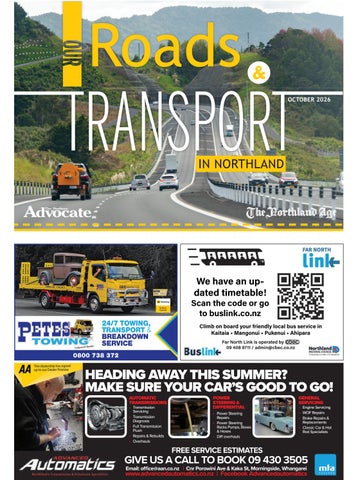
Roads OCTOBER 2026
IN NORTHLAND
) " ($ ' ' ! '
24/7 TOWING, TRANSPORT & BREAKDOWN SERVICE
" ' # #% # '# (& " # "+ ! #" # % *#(% % " * # (& & %) " ' " #"( ( "( $ % , % #%' " & #$ % ' * ! " # "+
0800 738 372
HEADING AWAY THIS SUMMER? MAKE SURE YOUR CAR’S GOOD TO GO! AUTOMATIC TRANSMISSIONS • Transmission Servicing • Transmission Diagnosis • Full Transmission Flush • Repairs & Rebuilds • Overhauls
POWER STEERING & DIFFERENTIAL
• Power Steering Repairs • Power Steering Racks Pumps, Boxes & Hoses • Diff overhauls
GENERAL SERVICING
• Engine Servicing • WOF Repairs • Brake Repairs & Replacements • Classic Car & Hot Rod Specialists
FREE SERVICE ESTIMATES
GIVE US A CALL TO BOOK 09 430 3505 Email: office@aan.co.nz | Cnr Porowini Ave & Kaka St, Morningside, Whangarei
www.advancedautomatics.co.nz | Facebook Advancedautomatics
ROADS Transport
OUR
2
Keeping Northland Moving: A Call for Action As New Zealand heads to the polls in 2026, it’s important that we focus on the issues that matter most to our communities. In Northland, few issues are more critical than the safety, resilience and reliability of our transport network.
By Tracey Rissetto AA Northland District Council
Resilience requires more than repairing damage after each event. Political parties should commit to a long-term programme of major road and public transport projects, delivered regardless of changes in government and treated as one connected system. For Northland, the Northern Corridor is crucial to getting people and goods moving. A firm timeline is needed for an alternative to the Brynderwyns route after delays caused by shifting central government priorities. Remedial work completed in 2024 was expected to last 10-15 years; that window is now 8-13 years. Further delay risks wasting public investment and prolonging safety, resilience and connectivity issues. Road safety must remain front and centre. Northland has New Zealand’s highest road fatality rate per head of population. As at the start of October, 27 people had died on Northland roads, compared with 23 during all of 2025.
A slip on State Highway 1 on the Brynderwyn Hills. Photo / NZME
N
orthlanders depend on roads to reach work, school and healthcare, move goods, and connect with friends and whānau. While the weather and lifestyle in our part of the country is unrivalled, a reality of living here is the slips, flooding and poor conditions that close key routes which can leave communities isolated and impose heavy economic and social costs. This year the New Zealand Automobile Association’s 2026 Election Calls have set some practical priorities that are particularly relevant to our region: put maintenance first, end stop-go decision-making on major projects, strengthen enforcement of seatbelt and mobile-phone rules, and reward safer driving. Maintenance and renewals should have the first call on transport funding.
Many Northlanders have limited transport options but to drive themselves and too often we have to put up with deteriorating road surfaces, potholes and deferred maintenance. A recent survey showed 99% of AA Northland members had taken a car trip in the previous four weeks, and 72% wanted smoother roads and fewer potholes. Deferred maintenance damages vehicles, raises costs and increases safety risks. While new projects are important, we need to ensure the infrastructure we already have is of a standard that delivers safe and reliable journeys. Resilience critical: 75% of surveyed members had their travel disrupted by a climate or weather event in the previous 12 months.
Alcohol, speed and poor driving remain leading contributors. However, around 60% of people who died in Northland crashes between 2021 and 2025 were not wearing a seatbelt. The AA supports the introduction of cameras that detect seatbelt and cell phone offences - technology widely used in Australia - to complement enforcement targeting alcohol and speed. A ‘rewards for safety’ programme could also reduce registration and licence-renewal costs for people who follow the rules and keep improving their skills. Motorcycle Awareness Month
Alongside these calls, the AA remains deeply committed to promoting road safety through community engagement and education such as Motorcycle Awareness Month, held each September. Motorcyclists are among our most vulnerable road users, and raising awareness among everyone on the road plays a crucial role in reducing crashes. Motorcycle Awareness Month is an opportunity to remind drivers to look twice, check blind spots carefully and share the road responsibly. It is also a chance to highlight the importance of rider training and ongoing safety initiatives. Better roads, consistent investment, stronger compliance and improved skills must work together to create safer journeys for everyone. As voters consider their choices in 2026, every political party should explain how it will deliver a transport system that is safe, resilient and fit for the future. Investing in transport is investing in Northland’s communities and economy. The challenges are clear, and so are the solutions. With sustained commitment and long-term planning, we can build a network that serves Northlanders for generations.
in Northland 2026
3
Building a Stronger, More Resilient Transport Network
N
orthland is a region shaped by connection — from rural roads linking remote communities to major highways carrying freight, visitors and commuters throughout Te Tai Tokerau. Our transport network plays a vital role in everyday life, supporting local livelihoods, regional industries and the connections that keep Northland thriving.
walking and cycling connections can help provide additional travel choices, improve accessibility and support healthier communities. Whangārei and surrounding areas continue to face the challenge of connecting growing communities with employment, education and essential services. Meanwhile, walking and cycling routes, including the Pou Herenga Tai – Twin Coast Cycle Trail, offer opportunities to support local tourism and encourage people to explore the region at a different pace.
Why Reliable Connections Matter
For Northlanders, dependable roads are essential to accessing employment, education, healthcare and essential services. With many communities spread across rural and coastal areas, safe and accessible transport remains fundamental to daily life.
A balanced approach to transport planning can help ensure that future investment considers the needs of residents, visitors and businesses across the region.
Maintaining existing roads, improving vulnerable routes and investing in stronger infrastructure are key to keeping people moving. These efforts are particularly important when heavy rain, flooding and slips disrupt travel, highlighting the need for a network that can withstand changing weather conditions and recover quickly from damage.
Keeping Business Moving
Northland’s economy depends on the efficient movement of people and goods. Agriculture, horticulture, forestry, fishing and tourism all rely on transport links that connect local producers and operators with customers, markets and visitors. From fresh produce travelling to distribution centres to freight moving between regional businesses and major ports, reliable roads help reduce delays and support productivity. For tourism operators, accessible routes make it easier for visitors to experience Northland’s beaches, heritage attractions and distinctive communities.
Planning for Northland’s Future
Looking ahead, the priorities are clear: maintain the roads we already rely on, improve safety, strengthen resilience and plan for the changing needs of a growing region. As the region continues to develop, transport infrastructure will remain an important consideration for businesses looking to invest, expand and create employment opportunities.
Improving Safety and Resilience
State Highway 1 remains a critical connection between Northland and Auckland, while regional highways and local roads provide essential links between towns, farms and coastal communities. The Brynderwyn Hills corridor continues to demonstrate the importance of reliable alternative routes and resilient infrastructure. Disruptions caused by severe weather have reinforced the need for ongoing
maintenance, strategic upgrades and careful planning to protect key transport connections. Alongside major projects, everyday work such as pavement repairs, drainage improvements, bridge maintenance and roadside safety upgrades helps keep journeys safer and more predictable. These practical improvements are an important part of maintaining a transport network that serves residents, businesses and visitors alike.
Looking Beyond the Highway
Ultimately, strong transport connections are about more than reaching a destination. They are about keeping communities connected, helping businesses succeed and ensuring Northland is well positioned for the opportunities ahead.
Northland’s transport future involves more than roads alone. Public transport,
ARE YOU IN CONTROL OF YOUR DRIIVERS? OR IS SOMETHIING ELSE? Our Mission: To Protect The Girll on the Bike
NZ: 0508 DRUGTEST TDDA.COM
Achieving these goals requires collaboration between local councils, central government, iwi, contractors, businesses and communities. By taking a long-term approach to infrastructure investment and maintenance, Northland can build a transport network that better supports regional prosperity and everyday life.
Driving on drugs can cost your business time, money, reputation and human lives. TDDA + Health Tick Your complete solution for transport safety and health. Call us today to protect your people and business.
ROADS Transport
OUR
4
Safer, smoother journeys in
ummer is when Northland’s state highways are at their busiest — and when NZ Transport Agency Waka Kotahi (NZTA) carries out much of the work needed to keep them safe, resilient and reliable.
Between September 2026 and May 2027, NZTA will renew about 174 lane kilometres of state highway across the region. The work is part of a $258.6 million programme — the largest investment ever made in maintaining and renewing Northland’s state highway network. The programme includes 21 lane kilometres of road rebuilds, four lane kilometres of resurfacing and 149 lane kilometres of resealing. Key sites include SH1 at Mangamuka, the Kawakawa bridges and Hewlett Road in Whangārei South; SH10 at Kerikeri and Taipa; SH11 at Paihia; and SH15 Port Marsden Highway. A large-scale resealing programme is also planned between Whangārei and Kawakawa. Drainage will be improved at several rebuild sites to help protect road foundations, reduce flooding risks and extend the life of new surfaces. Spring and summer provide the warmer, drier conditions needed for a durable finish before winter returns.
Crews will work during the day and at night, particularly in busier areas. Closures and stop/ go traffic management will sometimes be necessary, but work will be carefully staged and updates shared so people can plan ahead. “Northlanders rely on these roads every day, whether they’re commuting, running a business, moving freight or visiting whānau or the beach,” says NZTA Area Manager Asset and Operations, Steve Matene. “By investing now, we’re building a stronger, more resilient network that will benefit the region for years to come.” To ease congestion during the peak holiday period, work will pause from Friday 18 December 2026 until Monday 4 January 2027. NZTA’s Journey Manager, Steph Hudson, reminds drivers that a little preparation and patience will make summer journeys safer. “Check your vehicle before setting out, allow extra time, take regular breaks and drive to the conditions. Slow down through worksites, obey temporary speed limits and follow the directions of traffic controllers. A moment of impatience can put roadworkers and other road users at serious risk,” Ms Hudson says.
LIME MILLERS & BLUE METAL QUARRY OPERATORS 5 generations in quarrying, 4 in the Far North. Bellingham Quarries have been operating in the district since 1937, providing for the communities’ roading, concrete and drainage aggregate, agricultural lime and cartage needs. For supply, delivery or any enquiries give the team a call on 09 408 1340, or email bellingham.quarry@xtra.co.nz. You can also check out our website at bellinghamquarries.com
in Northland 2026
5
Northland this summer “Drivers should also understand how variable speed limits operate. Intersection speed zones lower the speed limit on the state highway when traffic is entering or leaving a side road, reducing the severity of a crash if one occurs. Variable limits outside schools generally do not operate during the holidays, but children may still be walking or cycling to school grounds to use courts, pools or playgrounds. Stay alert and be ready to slow down.
reports in Northland so far this year: 121 in the Far North District, 26 in Whangārei District and 16 in Kaipara District. Stock owners are responsible for keeping animals contained and should regularly check fences, secure gates and quickly repair damage,” Ms Hudson says. Anyone who sees stock on or near a state highway should call 0800 4 HIGHWAYS (0800 44 44 49).
“On rural highways, wandering stock remains a serious hazard. NZTA has received 163
Safe speeds matter everywhere. Seven fixed NZTA safety cameras now operate
Recent road reconstruction works in Paihia, captured after dark.
in Northland. On SH1 between Moerewa and Kawakawa, the proportion of vehicles complying with the speed limit has risen from 34 percent before the camera was installed to 99 percent. The purpose is straightforward: safer speeds reduce the likelihood and severity of crashes.
We’re proud to be Northlanders – and we know summer is when the region shines for visitors, so we’re also urging people to do the right thing and not litter. Dispose of rubbish in the bin or take it home with you if a bin isn’t available.
Let’s work together to keep Northland’s highways clean, safe, and efficient.
• Hiab Hire • Container Sales and Shifts • General Cartage Get a no obligation quote hello@DEHiabhaulage.co.nz
021 777 808 dehiabhaulage.co.nz
MANGONUI HAULAGE
Proudly Far North Owned and Operated for over 40 years.
SERVICES Livestock Cartage Water • Ready Mix Concrete General Carriers • Heavy Haulage Balance Bulk Store 3229 State Highway 10, Mangonui 286 State Highway1, Kaitaia • 171 Waipapa Road, Kerikeri 09 406 0087 (Office) • 0800 626 466 (Livestock) office@mangonuihaulage.co.nz • Ready Mix 0800 626 467, General 0800 626 468, Bulk Store 027 430 3985
OUR
ROADS Transport
6
KEEPING NORTHLAND MOVING
By Christo Jansen van Vuuren, Chair, Civil Contractors New Zealand Northland Branch
A
s Northlanders, we understand better than most that roads are far more than stretches of tarmac connecting towns and communities. They are lifelines. Every school run, freight delivery, medical appointment, tourist journey and commute to work depends on a transport network that is reliable, resilient and fit for purpose.
Over recent years, Northland has faced its share of challenges. Severe weather events have repeatedly shown just how vulnerable parts of our transport network can be. When roads are damaged or closed, the effects are immediate. Businesses face delays, freight is disrupted, emergency services struggle with access and, in some cases, communities become isolated. For individuals, the focus quickly shifts from bigger-picture thinking about careers, businesses and the future to something much more basic: “How am I getting home tonight?” These events have reinforced the importance of investing not only in maintenance and repairs, but in making our transport network more resilient for the long term. Encouragingly, there is growing recognition of the role transport infrastructure plays in unlocking Northland’s potential. Investment in our key transport corridors, resilience projects and vital connections should not be viewed simply as just another expense. It is an investment in our region’s future. Safety must remain at the heart of that investment. Improving intersections, widening shoulders, upgrading road surfaces and improving drainage may not attract the same headlines as major new highways, but these projects make a real difference. Safer and more resilient roads mean fewer disruptions,
Springs Flat Roundabout project on SH1 in Te Kamo.
fewer crashes and better outcomes for Northland’s families and businesses. It is imperative that these improvements continue, regardless of promises of high-specification four-lane highways somewhere in the near, or perhaps not-so-near, future. We cannot put today’s needs on hold while we wait for tomorrow’s roads. Our transport network is also fundamental to Northland’s economy. Agriculture, forestry, construction, manufacturing and tourism all depend on being able to move people, products and materials efficiently. When transport works well, businesses are more productive, communities are better connected and the benefits flow throughout our region. But infrastructure isn’t delivered by plans and policies alone. It is delivered by people. Across Northland, skilled people plan, design,
build and maintain the roads and transport assets we rely on every day. These are real careers offering long-term opportunities for Northlanders. Our industry must continue attracting new people, supporting apprenticeships and developing the skills we will need for the future. The roads we build and maintain today will have a lasting impact on generations of Northlanders. Decision-makers and our industry therefore share a responsibility to get this right. Councils, central government, transport agencies, contractors, consultants and communities all have a part to play. And with another election approaching, continuity matters. We have heard encouraging commitments to the forward works programme from across the political spectrum. Whatever the election outcome, we
need those commitments to translate into a reliable pipeline of work rather than another stop-start cycle for infrastructure. Northland does not need investment for investment’s sake. We need to invest aggressively where the need is clear, but wisely enough to get lasting value from every dollar. We need to collaborate widely, but effectively enough to turn discussion into delivery. And we need to plan boldly for the future without neglecting the roads, bridges and communities that need our attention today. Northland’s potential is enormous. Let’s have the confidence to invest in it, the discipline to invest wisely, and the determination to keep our people, our businesses and our region growing and even prospering.
Bus and Coach Charters Nationwide We have more locations than any other operators throughout New Zealand.
We provide bus and coach transport for: Groups Incentive Groups Corporate Groups
Transport for Sports Teams School Camps and Charters
Kaitaia Depot (09) 408 3008 | Dargaville Depot (09) 439 4902 | Whangarei Depot (09) 438 7142
www.ritchies.co.nz/branch-locations
in Northland 2026
7
ALL TRUCK REPAIRS LTD WHANGAREI COF’S / ALL TRACTOR REPAIRS
E
stablished in 2023, Whangarei COF’s is locally owned and operated by Gary Crane.
Gary’s vision was to provide an independent COF inspection lane to inspect vehicles at a fair price.
He designed the purpose-built lane to ensure that it was functional and easy to use for customers and the inspectors. 3 years on, Whangarei COF’s is going from strength to strength. Our professional, NZTAaccredited inspectors help to keep your vehicle in a safe, roadworthy condition by checking your vehicle, bumper to bumper, top to bottom. Our lane is now also accredited to inspect PSV (passenger service vehicles), forklifts and tractors.
With 5 NZTA-accredited inspectors on staff, our skilled team is committed to providing: A user-friendly, can-do service Excellent communication with customers Value for money COF appointment bookings for customers’ convenience Self-book online appointment booking system A truck repair workshop next door, providing repair options for customers to utilise if they wish Gary is always looking for new ideas to expand the All Truck Repairs brand. In May 2026, he started All Tractor Repairs. With award-winning John Deere tractor technician Bryce Dickson leading the team, All Tractors offers reliable mobile tractor repairs, servicing and breakdown support across Northland. All Tractors has the cutting edge in technology
We work on all major tractor brands, including John Deere, Case IH, Fendt, Kubota, Massey Ferguson, Ford, Iseki and more. As well as mobile servicing, we also offer workshop repairs for bigger jobs, with transport help if your tractor needs to come into the workshop. There’s no job too big or complex for our team to handle.
Gary’s business journey started in 1998 with All Truck Repairs, based in South End Ave. ATR has built its success on the reputation of the staff, honesty, a can-do attitude, and providing the best service it can for a competitive price for its customers. All Truck Repairs’ commitment goes beyond specific brands. We service all truck makes and models, including Hino, Howo, Isuzu, Kenworth, MAN, Mitsubishi, Mack, Nissan, Sino, Sitrak and UD Trucks, to name a few. We service and repair trucks of ALL makes, ALL models and ALL years, including pre-90’s models. All Truck Repairs is your one-stop truck and trailer repairs and maintenance shop. With a loyal following of well-established trucking and contracting companies in Northland, and an ever-increasing client base of motor homers and horse truck owners, All Truck Repairs continues to develop its on-site services. ATR currently offers sandblasting, paint and panel repairs, wheel alignments, windscreen chips, welding repairs, truck and trailer servicing, COF repairs, LT400 certification service and air conditioning regassing.
Proudly supporting Northland truck owners since 1998 Your one-stop workshop for all tractor servicing, repairs and parts
Independent COF / VCA services
• Bookings essential – no wait times! • Book online • Or call our friendly team today
www.whangareicof.co.nz
•
www.alltractor.co.nz
24 South End Ave, Raumanga, Whangarei | 09 4300 803 | www.alltruck.co.nz
WHERE YOUR SAFETY IS OUR PRIORITY
• • •
Tractor servicing, maintenance & mechanical repairs Diagnostics, fault-finding & breakdown support Parts, engineering and specialist repairs All makes, all models, all sizes and all ages.
ADVERTISEMENT
Northland rangatahi leading the way on road safety Since our last update in November 2025, SADD students across Northland have continued to turn road safety education into visible, practical action within their schools and communities.
K
aitiaki o Ara/SADD is built on the belief that young people are powerful influencers. When road safety messages come from friends and classmates, they can generate conversations and encourage safer choices in ways that adults do not always achieve. Northland’s SADD students have embraced this opportunity, combining creativity, leadership and local knowledge to help protect their peers. A highlight was Northland’s Road Safety Week activity in May. Students joined community organisations, workplaces and road safety partners for the annual Road Safety Hero Walk around Whangārei’s Hātea Loop. The event provided a positive and highly visible way for participants to demonstrate their commitment to safer roads. It also reinforced an important message: everyone can be a road safety hero. Whether we are driving, walking, cycling or travelling as passengers, we all have a role in looking after one another. The Hātea event is a great example of collective action. It brought rangatahi together with local road safety organisations and members of the wider community, showing students that their voices and actions are an important part of Northland’s road safety effort.
Northland students also attended the 2026 SADD Conference in Cambridge, joining young people from around Aotearoa for three days of learning, leadership development and collaboration. During the conference, students explored key road safety issues and worked in teams to transform their ideas into practical resources, videos, social-media content and activities. They developed confidence, strengthened their ability to work with others and returned home with fresh ideas to share with their SADD groups. The real value of conference is what happens afterwards. Students bring their learning back into their schools, where they can plan activities that reflect the issues affecting their own peers and communities. Throughout the year, Northland SADD groups have also participated in workshops and school-based activities. These sessions have helped new groups get started and supported established
groups to strengthen their plans, messaging and leadership. Tikipunga High School students, for example, took part in a SADD workshop supported by SADD, local road safety representatives and Police. Within schools, students have been encouraging conversations about issues including distraction, speed, seatbelt use, impairment, driver-licence conditions and the responsibility passengers have to speak up. Activities may include quizzes, interactive challenges, assemblies, posters, lunchtime events, social-media messages and peer-led discussions. While these activities can be fun, they address serious issues. They encourage students to think about everyday decisions: putting away a phone, wearing a seatbelt, supporting a friend to follow their licence conditions, planning a safe way home, avoiding distractions and speaking up when something does not feel right. What makes SADD different is that students decide which issues matter most in their communities and how best to reach their peers. They are not simply
receiving road safety messages; they are designing, leading and sharing them. We are proud of the Northland students who have stepped up this year. Their mahi demonstrates leadership, care for their friends and whānau, and a genuine commitment to preventing loss on our roads. Kaitiaki o Ara/SADD thanks the teachers, Police, councils, Northland Road Safety Trust, community partners and supporters who help make this work possible. Every activity and conversation contributes to a stronger road safety culture. Northland’s rangatahi are showing that meaningful change does not always begin with a major campaign. Sometimes it begins with one student having the courage to speak up—and inspiring others to do the same.