Huaki “To bring to Light”
Edition 36
Friday, September 25, 2026
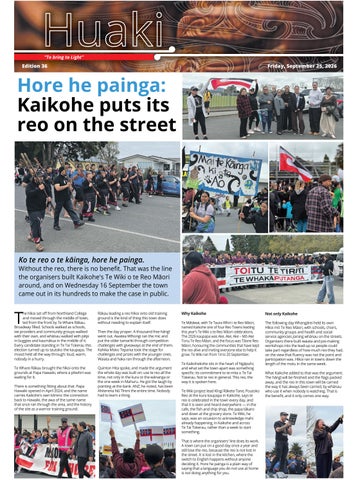
Hore he painga: Kaikohe puts its reo on the street
Ko te reo o te kāinga, hore he painga.
Without the reo, there is no benefit. That was the line the organisers built Kaikohe's Te Wiki o te Reo Māori around, and on Wednesday 16 September the town came out in its hundreds to make the case in public.
T
he hīkoi set off from Northland College and moved through the middle of town, led from the front by Te Whare Rākau. Broadway filled. Schools walked as schools, iwi providers and community groups walked with their own, and whānau walked with pēpi in buggies and kaumātua in the middle of it. Every candidate standing in Te Tai Tokerau this election turned up to tautoko the kaupapa. The mood held all the way through: loud, warm, nobody in a hurry. Te Whare Rākau brought the hīkoi onto the grounds at Papa Hawaiki, where a pōwhiri was waiting for it. There is something fitting about that. Papa Hawaiki opened in April 2024, and the name carries Kaikohe's own kōrero: the connection back to Hawaiki, the awa of the same name that once ran through the area, and the history of the site as a warrior training ground.
Rākau leading a reo hīkoi onto old training ground is the kind of thing this town does without needing to explain itself. Then the day proper. A thousand free hāngī went out. Awatea Wīhongi ran the mic and put the older tamariki through competition challenges with giveaways at the end of them. Kahika Moko Tepania took the stage for challenges and prizes with the younger ones. Waiata and haka ran through the afternoon. Quinton Hita spoke, and made the argument the whole day was built on: use te reo all the time, not only in the kura or the wānanga or the one week in Mahuru. He got the laugh by pointing at the bank. ANZ, he noted, has been Ahitereria Nū Tīreni the entire time. Nobody had to learn a thing.
Why Kaikohe
Not only Kaikohe
Te Mātāwai, with Te Taura Whiri i te Reo Māori, named Kaikohe one of four Reo Towns leading this year's Te Wiki o te Reo Māori celebrations. The 2026 kaupapa was Ake, Ake, Ake – Mō Ake Tonu Te Reo Māori, and the focus was Tāone Reo Māori, honouring the communities that have kept the reo alive and inviting everyone else to help it grow. Te Wiki ran from 14 to 20 September.
The following day Whangārei held its own Hīkoi mō Te Reo Māori, with schools, choirs, community groups and health and social service agencies joining whānau on the streets. Organisers there built waiata and poi-making workshops into the lead-up so people could take part regardless of how much reo they had, on the view that fluency was not the point and participation was. Hīkoi ran in towns down the length of the motu in the same week.
Te Kaikohekohe sits in the heart of Ngāpuhi, and what set the town apart was something specific: its commitment to te mita o Te Tai Tokerau. Not te reo in general. This reo, the way it is spoken here. Te Wiki project lead Kīngi Rākete-Tane, Poutoko Reo at the kura kaupapa in Kaikohe, says te reo is celebrated in the town every day, and that it is seen and heard everywhere — in the cafe, the fish and chip shop, the papa tākaro and down at the grocery store. Te Wiki, he says, was an occasion to acknowledge mahi already happening, in Kaikohe and across Te Tai Tokerau, rather than a week to start something. That is where the organisers' line does its work. A town can put on a good day once a year and still lose the reo, because the reo is not lost in the street. It is lost in the kitchen, where the switch to English happens without anyone deciding it. Hore he painga is a plain way of saying that a language you do not use at home is not doing anything for you.
What Kaikohe added to that was the argument. The hāngī will be finished and the flags packed away, and the reo in this town will be carried the way it has always been carried, by whānau who use it when nobody is watching. That is the benefit, and it only comes one way.
• Kia Māori • Kia Mātau • Kia Tū Rangatira Ai
WE ARE TAKING ENROLMENTS FOR BOTH OUR KURA! TE KĀPEHU WHETŪ – WHANGĀREI
YEAR 1 TO YEAR 13 DAY STUDENTS
TE KĀPEHU WHETŪ – TĀMAKI YEAR 10 TO YEAR 13 BOARDING & DAY STUDENTS
For more information about Te Kāpehu Whetū and its expansion into Tāmaki Makaurau, visit: • • •
Te Kāpehu Whetū website - www.tkw.ac.nz Tāmaki Makaurau landing page - www.tkwtamaki.ac.nz Email info@tkwtamaki.ac.nz
3
HUAKI
Taitamariki Bring the Energy to Hygiene & Hustle Youth Expo Fitness, teamwork, and healthy habits took centre stage at the recent Hygiene & Hustle Youth Expo, where taitamariki came together for a fun-filled day at Moerewa Bar Park. “It was really cool to see the kids having fun doing something I'm passionate about, and even better to see some of them discover a passion for it themselves.”
P
articipants took part in a range of CrossFit and calisthenics activities, testing their skills and endurance throughout the day. Just as important were the opportunities to work alongside new people and encourage one another. Learning was woven throughout the event, with hygiene stations providing practical health education alongside the fitness challenges. The interactive approach helped keep taitamariki engaged while reinforcing important wellbeing messages and healthy habits.
Bay of Islands College and Moerewa School students brought plenty of energy to the event, embracing every challenge and creating a positive atmosphere from start to finish. Event organiser Dayton Reihana said seeing taitamariki get involved and enjoy the activities was one of the most rewarding parts of the day. “The highlight for me was definitely getting involved with the taitamariki in the physical activities and giving them that extra little push to complete the challenges.
Alongside the activities, participants enjoyed games, kai, competitions and prize giveaways, making for a day that celebrated both healthy lifestyles and positive social connections. Looking ahead, Dayton hopes to build on the success of the event and create more opportunities for taitamariki to get involved. “We definitely plan to run another event like this. It's been a great learning experience, and I'd love to see even more schools from across the Mid North get involved so more taitamariki
have the opportunity to take part.” The Hygiene & Hustle Youth Expo reflects Ngāti Hine Health Trust's commitment to supporting the wellbeing of taitamariki through initiatives that promote healthy habits, physical activity, and meaningful community connections.
4
HUAKI
Waitangi National Trust Board
Welcomes Government Investment in the Treaty Grounds The Waitangi National Trust wishes to express its deep appreciation to the Government for its announcement of financial support for the Waitangi Treaty Grounds and Estate, with $8 million to be provided from the Regional Infrastructure Fund.
O
ver recent years, notable improvements have been made to the Treaty Grounds' capital infrastructure through the generous support of RIF funding, preserving treasured cultural heritage such as the Treaty House, James and Agnes Busby's original residence, and Te Whare Rūnanga, while also investing in two museums – Te Kōngahu Museum of Waitangi and Te Rau Aroha Museum of the Price of Citizenship, the story of the Māori Battalion ‘A’ Company. This latest funding will be used to support and strengthen the continued operation and preservation of the Waitangi Treaty Grounds and to build a strong base to plan for the important upcoming bicentennial events through to 2040.
Trust Board Chair Dame Jenny Shipley says: “As we approach 200 years as a nation, this investment helps us prepare to welcome all New Zealanders and visitors from around the world to the birthplace of our nation, and to share the Treaty's unique gift in new ways — the gift that forms the very basis of who we are.” “These new resources will allow the Trust to make improvements in how it presents and shares the experiences and stories of Waitangi. This includes exploring further how it might use modern digital investment to unlock the remarkable voices that were present when our nation was founded.”
“The investment will boost our ambition to ensure Waitangi is and remains a place where all New Zealanders wish to visit, and in doing so will see all aspects of our history and who we are as a nation together.” Chief Executive Ben Dalton notes that: “More than 160,000 people visit the Treaty Grounds each year, making it one of Northland's leading visitor destinations and a key hub for wider tourism across the region as well as an important contributor to the regional economy.” The Board notes this investment builds on previous Government support for the Treaty Grounds and surrounding infrastructure, including for Treaty Grounds infrastructure
AUNTY’S GARDEN Hanui Lawrence
upgrades, for sealing Haruru Falls Road, and the construction of Te Rau Aroha – the Māori Battalion Museum. Dame Jenny says "We are extremely grateful to the Government for this new investment. We look forward to the opportunities it will create going forward to work alongside the Crown and our new key partner, Foundation North, to ensure Waitangi remains a living, enduring taonga where two peoples came together to form a nation.”
For more information about the Waitangi Treaty Grounds visit: https://www.waitangi.org.nz
Pasta Salad
Spinach and Noodle Soup
Ingredients
Method
•
Ingredients
• • • • • •
Cook your pasta and place it into a bowl. Grate the carrot, broccoli and cauliflower and add them to the pasta. Add the cheese, salt and pepper, then mix everything together with your favourite dressing. Nice and simple. It’s delicious!
• • • • • •
3-4 pork fingers bunchof spaghetti noodles bunch of spinach 2 medium kumara 1onion salt and pepper
2 cups cooked pasta, or enough for your family 1 large carrot 2 florets of broccoli 2-3 florets of cauliflower 3⁄4 cup cheese Salt and pepper Your favourite dressing, from a jar or homemade
Method Cut the pork fingers into chunks and slice the onion then ‘chunky cut’ the kumara. Put intoapot with water and bring to the boil then simmer until softened. Cook noodles separately then add with the spinach and bring back to the boil then add salt and pepper. Spinach and noodle soup is a must try.
Aunty’s pasta salad is easy and delicious.
HUAKI
5
Māori trust-led resilience project restores culturally significant wetland Te Ramaroa, the maunga that once guided Kupe into Hokianga Harbour for the first time, now watches over a project that uses nature-based solutions to improve climate resilience.
T
he Pakanae 5A Māori Trust leads the project, supported by $30,000 of funding through Northland Regional Council’s Climate Resilient Communities Fund.
The project combines mātauranga Māori and traditional practices with modern conservation techniques to restore native ecosystems and strengthen cultural and ecological resilience. Project manager Tania Bristow says building resilience is important for the local people and environment.
From left: Kaitiaki Syd Bristow and Helene Leaf with project manager Tania Bristow at a project planting day in August. “Flooding and drought touch us heavily here in Hokianga and our home of Whirinaki. Climate resilience helps us soften the blow that comes from climate change,” she says. The council funding enables a community that is accustomed to activating in times of need, and as kaitiaki over the whenua and the wai, to “reach further and last longer”. The project focuses on restoring a wetland
TAONGA O TE AO TRE ASURE S OF THE WORLD
Showcasing local artists The little shop with a big heart. 36 Gillies St, Kawakawa Ph 09 404 0732 Mon-Fri 9am–4pm & Sat-Sun 9am-3pm
around a stream that experiences torrential flooding in heavy rain, with floodwaters overtopping culverts and blocking roads. Over two hectares, pest plants and willows that were clogging water flows are being replaced with native vegetation to stabilise the wetland margin, slow and absorb stormwater, and reduce erosion. Tania says the project is “reconnection and regeneration in practice”.
“Our kaupapa rests on three pillars: Tikanga in the way the site was chosen, consented and worked; Taiao in the restoration of the wetland and the protection of the wai; and Tangata in the hapū members, trustees and kaitiaki who did the mahi,” she says. The next steps for the project include ongoing maintenance of planting areas and a monitoring programme to track water quality, biodiversity, and plant health.
Northland let’s get ready for this weekend’s home game
TRIPPLE HEADER
AS THE TANIWHA ONCE AGAIN DEFEND THE RANFURLY SHIELD. Tickets available online at: northlandrugby.flicket.co.nz FPC NORTHLAND KAURI V HAWKE’S BAY
KICK OFF: 11:35PM
NPC NORTHLAND TANIWHA V COUNTIES MANUKAU
KICK OFF: 2:05PM
NORTHLAND DEVELOPMENT KAURI V COUNTIES MANUKAU
KICK OFF: 4:35PM
7
HUAKI
From Our Tūpuna to Our Mokopuna: NGĀ TAI O TE TAITOKERAU, TOITŪ TE REO, TOITŪ TE TIRITI
E
very September, we celebrate Te Wiki o Te Reo Māori. But behind the waiata, kōrero and celebrations is a whakapapa of courage and determination, a movement led by Māori to protect the language handed down to us by our Tūpuna.
In 1972, more than 30,000 people signed the Māori Language Petition calling for te reo Māori to be taught in schools. On 14 September 1972, the petition was presented to Parliament, and in 1975 Māori Language Day became Te Wiki o Te Reo Māori. The reo we celebrate today survived because our people stood up and said: “Our reo matters.” Last week, we saw that same spirit alive in Te Hiku o Te Ika, as our hapori gathered in Kaitaia to honour Te Wiki o Te Reo Māori. Our tamariki and mokopuna from Kura Kaupapa Māori led the way through the streets, their voices reminding us that the mahi of those before us was never only for their generation, it was for us, and for those who come after us. Our community also stood in support of the kaupapa led by Ngāti Kahungunu, who travelled from Waimārama to Wellington to
deliver their petition calling for the protection of Te Tiriti o Waitangi and its principles in legislation. More than 52,000 signatures were gathered in support.
For us, Te Tiriti is not simply history. It remains part of the relationship between Māori and the Crown and is connected to the rights, voices and interests of Māori in Aotearoa. This week here in Te Taitokerau Ngā Manu Kōrero is bringing rangatahi from across the motu to Kaikohekohe. Here, our young people are standing proudly, speaking their whakaaro and using the reo that generations before them fought to protect. That is Te Wiki o Te Reo Māori in action.
Hikoi 2024 photo, ANT Trust archives.
At Aupōuri Ngāti Kahu Te Rarawa Trust, we believe this kaupapa belongs in our workplaces too. As we powhiri 10 new staff, we are creating opportunities for those who want to explore their taha Māori, experience kaupapa Māori and be immersed in the environment of Ngā Manu Kōrero, listening, learning and awhi where we can.
the year. It is about creating spaces where our people can connect with whakapapa, participate in kaupapa and stand proudly in who they are.
Honouring Te Tiriti and te ao Māori is not something we should do for one week of
It survived because our Tūpuna fought for it.
Te Wiki o Te Reo Māori reminds us that our reo did not survive by accident.
From our Tūpuna, to us, to our mokopuna — the legacy continues. Toitū te reo. Toitū te Tiriti. Toitū te whakapapa. Toitū te mana o ngā uri whakatipu. Mauri ora, Nā Huriana Nathan.
+ 0 3 1 itors
Exhib
AMAZING SHOW-ONLY DEALS! Th is Fri da y to Su nd ay at Mc Ka y Sta diu m homeandlifestyleshow.co.nz