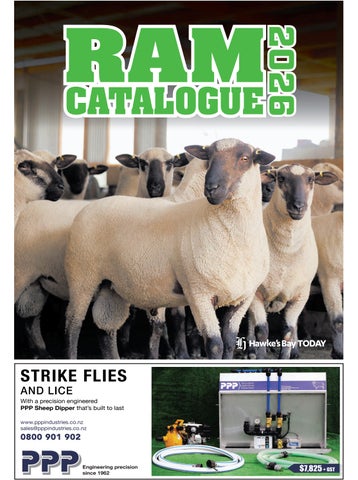
2026
STRIKE FLIES AND LICE
With a precision engineered PPP Sheep Dipper that’s built to last www.pppindustries.co.nz sales@pppindustries.co.nz
Engineering precision since 1962
$7,825 + GST
LK0118762©
0800 901 902
2026
2
Connecting breeders and buyers Genetic Alongside ram sale details, readers will find stories and photographs that offer insight into the people, families and businesses behind the studs. These profiles recognise the dedication and innovation that continue to drive New Zealand sheep breeding and support the wider farming sector.
Welcome to the 2026 Ram Catalogue, proudly produced by Hawke’s Bay Today. This publication showcases some of New Zealand’s leading ram breeders and the genetics available for the coming season. Designed to connect commercial sheep farmers with breeders, the catalogue highlights a range of breeds, breeding philosophies and farming systems that reflect the diversity and strength of the New Zealand sheep industry. The breeders featured share a commitment to genetic improvement, animal performance and practical farming outcomes. Whether your focus is growth, fertility, maternal traits, carcass quality, resilience or ease of management, this catalogue provides information to help identify breeding programmes suited to your farming goals.
Investing in quality genetics remains one of the most effective ways to influence flock performance and long-term farm profitability. The choices made today can deliver benefits for years to come. We hope this catalogue is a valuable resource as you plan for the season ahead. We encourage readers to contact the breeders featured, attend their sales and learn more about the genetics on offer. Thank you to all advertisers and contributors for their support. We wish both breeders and buyers every success for the 2026 ram selling season.
FEATURES MANAGER Shirley Randell | shirley.randell@nzme.co.nz FEATURES WRITER Chrys Ayley | chrys.ayley@nzme.co.nz CREATIVE DESIGN Carol Hannah COVER PHOTOGRAPH Courtesy of Mangahauhau Stud, photograph by Rebecca Williams. PHOTOGRAPH THIS PAGE Courtesy of Mill Valley Stud, photograph by Anthill Photography.
Choice By Alastair Reeves
W
ith Sheep & Beef farmers profitability at historical highs, is it time for them to invest back into their businesses, to be more resilient when the next shock occurs. Fertiliser, repairs and maintenance, and plant replacements are always at front of mine, but what about Genetics? Maximising the genetic potential of livestock to convert pasture into highvalue saleable product, efficiently, is one of the key pillars that separate top-performing livestock farmers from average operators. At Waimai Romney & CharaBlack terminal, we believe we have those genetic traits, and it is your choice to use them. At Waimai Romney, we have been selecting for eczema tolerance (FE Gold), worm resistance (WormFec Gold), and low dag score for many years, and they are now well embedded into our genetic program. We have been able to do this, while still having high production traits, which inevitably, are the traits that make sheep farmers money!! Our sires used in 2026 averaged 3461 NZMW which is in the top 10% for New Zealand Maternal Worth (NZMW), with our major focus on reproduction, growth, and survival. We regularly have animals in the
Are these traits important to you? Annual sales commence 1 November: secure your pick today.
ROMNEY
ROMTEX
SUFTEX
Selection for maternal traits at scale for over 45 yrs mothering ability – survival - fertility - weaning weight -growth - longevity • Worm resilience • Dag score • Body condition score • FE sires tested at .54 Sporadesmin Predictable, repeatable performance
• Open points • Worm resilience • Dag score • Body condition score Hardy, meaty maternal option
• Growth • Meat • Longevity • Lambing ease Sought-after store lamb option
FE tolerant Romney sires now available Zandy Wallace
M: 0226 580 680
E: farm@waiitirams.co.nz
www.waiitirams.co.nz
2026
top 5% in New Zealand for each of these genetic production traits. These traits have the greatest effect on a sheep breeder’s profitability and once again we need to exercise our choice and use them! Eczema is moving down the country, with the whole of the North Island and a large part of the South Island now affected. Trevor Cook, (well-respected vet) believes,” not to use eczema genetics, while knowingly in an eczema area is an animal health transgression, but to do so is production enhancing.” As farmers, we are responsible for the health of the livestock we care for. Eczema, like winter, is coming! Drench failure is becoming a huge
problem in New Zealand sheep operations. Selecting worm-resistant genetics is one of the tools we can use to help mitigate this. Along with integrated stock policies, good feeding, crops, refugia, and strategic use of anthelmintics, they all play a part in helping to reduce drench resistance. As farm managers, we need to be mindful of this! Sheep breeders are actively trying to find ways to minimise the “touch time,” we have with our livestock, as invariably it takes time and costs money. Low dags and bare breeches are traits, as breeders, we can select for, which make a huge difference to the costs and workload on a farm. If your breeder isn’t testing for worm resistance and low dags, you need to question,” Why
Low Input High Profit Genetics
Open Day
2026 Waimai Sires Av 3461 for NZ Maternal Worth — Top 10% in SIL.
Worm FEC Gold Beat drench resistance by using worm resistant genetics as one of your tools to mitigate worm burdens.
FE Gold 40 Years selecting for tolerance to facial Eczema. Like winter, it’s coming.
Easy Care Selecting for Low Dags and Bare Breech
ALASTAIR REEVES
Our Waimai CharaBlack terminals have been selected for carcass weight (growth and yield), as well as Meat Quality (IMF and Tenderness). It was very pleasing to have our two sires 1st and 3rd best sires for carcass weight and 4th & 6th for tenderness at a recent progeny trial, while still achieving an average marble score. This is very pleasing, as it validates our genetic decisions we have been making at Waimai CharaBlack.
Thursday 15th Oct 10am – 4pm
High Production
Alastair Reeves 027 457 3615 waimairomney.co.nz waimairomney@gmail.com
Not’! And find a breeder who is! At Waimai Romney this year, all our 2025 born rams selected for stud use, have positive (good) figures for DPD, Dual Purpose Daggs, which shows our genetics program, to produce Low Input genetics, is working.
Sale
Thursday 5th Nov 12pm Start Private Treaty to follow
3
As sheep farmers, we have a choice as to what genetics we purchase. Make sure you make an informed choice, which is best for you and your business, but most importantly the health of your livestock. They are your responsibility and you need to be very mindful of this. At Waimai Romney we believe we have the right combination of genetics for the modern sheep farmer. Low Input. High Production! Contact us today, to secure your Waimai genetics, for tomorrow. Alastair Reeves waimairomney@gmail.com 0274 573 615
2026
4
Better genetics. Better sheep. Better farm performance. Nearly 60 years of genetic improvement, performance recording and rigorous selection have given ARDG breeders one clear focus: producing Romney genetics that deliver measurable gains for New Zealand commercial farmers.
C
hoosing a ram is an investment in your flock’s future performance. The genetics introduced today will influence productivity, animal health and profitability for generations – which is why the numbers behind those genetics matter. ARDG brings together five specialist Romney breeders in one connected genetic programme, with a shared focus on producing high-performing sheep for New Zealand commercial farming conditions. That work began in 1968 with a straightforward goal: to breed an easycare, productive and profitable Romney. Nearly 60 years later, the objective remains the same, but the tools have advanced considerably. ARDG breeders now combine rigorous performance recording and practical selection with genetic evaluation, genomics and DNA technologies. And the genetic progress is measurable. Current ARDG data shows an additional lifetime value of $10.10 per ewe compared with the national recorded average, alongside a 114% advantage in facial eczema tolerance and a 227% advantage in worm resistance (FEC). ARDG genetics have also continued to improve growth and weaning weight. These gains matter because disease and parasite pressure directly affect farm performance. Facial eczema alone is estimated to cost New Zealand farmers around $332 million annually in lost production. A three-year nationwide study found FE-causing spores in pastures throughout the country, making FE tolerance increasingly relevant beyond areas traditionally associated with the disease. ARDG has been addressing these
PATAKANUI SOUTH SUFFOLKS (FORMERLY GLENDONALD)
RAM AUCTION APPROX 80 RAMS
THURSDAY NOVEMBER 19 2026 AT 3PM | VIEWING FROM 1PM M at 813 Lake Ferry Rd, Dyerville, Martinborough • Easy lambing, selected for body shape & conformation • Rapid growth from day one, we focus on weaning weights and growth rate • DNA recorded • Suited to summer dry climates
• Evenly marked, attractive store lamb lines • Premium for female progeny at weaning vs maternal breed ewe lambs • Soundness; strict culling for feet issues & structural soundness
Alan Evans
P 027 446 9022 | E farm@patakanui.co.nz Andrew Jennings | P 0275 946 820 Tom Suttor | P 0274 469 967
challenges for decades. Its first facial eczema field trials began in 1979, followed by sporidesmin testing of rams from 1984. In 2026, more than 100 ARDG sires have been tested for FE tolerance at a level of 0.71. ARDG breeders are both FE Gold and WormFEC Gold accredited, providing commercial farmers with independent assurance around the depth of selection behind both facial eczema tolerance and worm resistance genetics. The current membership information for both accreditation groups confirms ARDG breeders across the two programmes. Importantly, this selection does not come at the expense of production. ARDG rams are selected across commercially important traits including maternal performance, growth, facial eczema tolerance, worm resistance, structural soundness and longevity. The five breeders operate independently, but genetic connectedness across their flocks enables performance comparisons and the sharing of superior genetics – continually increasing genetic gain across the traits that matter to commercial farmers. And those gains don’t stop with one generation. Selecting superior genetics delivers cumulative improvement over time. The WormFEC Gold material reinforces this, specifically for parasite resistance: improvement begins with the first cross to superior genetics and builds over subsequent generations. That makes the ram you choose today part of a longer-term strategy for a more productive, lower-input flock. Find an ARDG breeder at ardg.co.nz
Breed More Profitable Sheep THE NUMBERS BEHIND THE GENETICS Average index values across 2025-born progeny from ARDG’s five flocks show strong genetic advantages over the national recorded average.
45%
HIGHER
NZ MATERNAL WORTH | $10.10 greater genetic value per ewe
114% HIGHER
227% HIGHER
FACIAL ECZEMA TOLERANCE
WORM RESISTANCE
100+ sires tested at 0.71 dose rate FE genetic gain has nearly doubled in five years through genomics.
ARDG ewe flocks don’t require drenching, which cuts costs and helps prevent drench resistance.
CONSISTENT GROWTH IMPROVEMENT (WEANING WEIGHT)
Dargaville Kaukapakapa Maramarua Matamata
DARGAVILLE
KAUKAPAKAPA
MARAMARUA
Bob Steed / Rhys & Helen Dackers
Adrian & Jenny Savannah
John & Jan Marchant
Bob 027 777 0832 Rhys 027 241 5564
09 427 6393 027 481 6599
09 232 5613 027 442 3130
Dannevirke
Masterton
MATAMATA
MASTERTON
Craig & Tina Alexander
Paul Crick & Dayanne Almeida
07 888 1703 027 774 6644
027 450 4085
BETTER GENETICS. BETTER SHEEP. BETTER FARM PERFORMANCE.
www.ardg.co.nz
SCAN TO FIND OUT MORE
cre8ive 10204
ARDG BREEDERS
2026
6
Shaping the future of farming
W
hile studying agricultural economics at Massey University in 1990, David Arvidson came to a simple conclusion: wool had no future. The cost of production was exceeding returns, and he began looking for alternatives. In 1995, Arvidson purchased Wiltshire sheep, including some with Texel bloodlines. More than 30 years later, that decision has helped establish one of New Zealand’s leading shedding sheep flocks, with genetics now widely used throughout the country, particularly in the North Island. A major focus has been breeding resistance to facial eczema (FE). Arvidson began FE testing in 2006 and describes the work as a long-term commitment. “Facial eczema is a 30-year project,” he says. “I’ve probably still got another five to 10 years before they’re absolutely bombproof, but they’re at the top of the game for shedding sheep.” His background in agricultural economics
continues to shape his analytical approach. He has long used the New Zealand SIL (Sheep Improvement Limited) system to identify and select superior genetics. Before SIL was developed, he used Animal Plan through the Animal Breeding Trust at Massey University. Clients purchasing Arvidson’s Wiltshire genetics are effectively buying decades of breeding progress. In 2011, he became the first shedding sheep breeder to use the CARLA system to breed for parasite tolerance. The trait also showed a positive correlation with growth rates, and he has accumulated almost 15 years of performance data. By 2017, Arvidson shifted attention to improving muscling and condition score. High-milking ewes were losing too much body condition, so the breeding objective became sheep that could maintain condition while producing strong, fast-growing lambs. In 2024, the flock began muscle scanning to further accelerate progress. Last year he introduced out-of-season lambing, believing split flocks and multiple lambing periods could significantly improve profitability. “I’m trying to convince sheep farmers they’re really in the business of producing milk. The milk grows the lambs,” he says. Rather than running all sheep on the same system, Arvidson advocates using land similarly to dairy operations. Highquality country is reserved for lactating
ewes, while drier stock can utilise steeper hill country. His vision is to demonstrate that sheep farming can be as profitable as dairy farming.
The results have been encouraging. Lambs have averaged 47kg liveweight at four months of age, producing carcasses of more than 20kg. With multiple lambing opportunities throughout the year, Arvidson believes sheep farmers could better match market demand and improve returns from
both productive and steeper land classes. His current focus is breeding sheep capable of lambing naturally at any time of year without hormone intervention. So far, around 70 percent of ewes, mated naturally lambed in May and June. About 80 rams will be offered for sale on November 24 at the Taupō sale yards, 14 Oruanui Road. Additional rams will be available on farm, with sales often continuing through February and March.
* '( 0 " # / . % %* ') "#+*!") * )," *'& "#+*!") * )* "& +! - , #'(% &+ ' ! "& ! ( "&
• FUTURE FOCUSED 30 Years of Performance Recording Shedding Sheep. • FIRST for FACIAL ECZEMA Ramguard™ since 2006, 0.55. • FIRST for PARASITES Carla™ antibody test since 2012. • FIRST for MEAT, FERTILITY AnimalPlan/SIL recording since 1995. • TOP MEAT YIELDING RAMS Low Input Trial Results. • HOOF SCORING Every Ewe and Ram Hogget.
# ! $ " & 0 )% # * / 0 - - ," )," *'& )," *'&. % "# '% $ % 1 "
GENETIC VALUE YOU CAN SEE
Watch nProve Tracker in action
Connect today’s sire decisions with future flock performance. nProve Tracker is a new tool within the nProve platform that helps farmers monitor the genetic progress of their flock through the sires they use. By providing visibility of how flock genetics are improving over time, nProve Tracker supports more informed sire purchasing and breeding decisions, enables farmers to track genetic progress, and realise the long-term impact of genetics in their flock.
Genetic value you can see See the impact of breeding decisions over time.
Tracker
Find out more at nprovetracker.nz
Make informed decisions. Use genetic insights to guide sire selection.
2026
8
Modern, proven, reliable, trusted and in high demand
W
hen buying rams, it is important to choose proven genetics backed by an independently assessed track record. Take a close look at the performance graphs. The longer a breeder has been recording and selling sires, the more confidence you can have in the consistency of their genetics.
• Ewe wastage reduced from 22% to 4%
The continual use of SIL (Sheep Improvement Limited) and the compounding effect of genetic gain remain powerful tools for improving flock performance. At Hildreth Romneys, we have taken a Warren Buffett-style approach to breeding: steadily compounding genetic gains over more than 60 years.
Now is also an excellent time to start breeding your own replacements. Progeny come directly from ewes that have demonstrated their ability to survive, lamb and successfully rear their offspring in your environment.
A top-performing ram can return around $85,000 over its lifetime, compared with approximately $58,000 for a below-average ram. The difference becomes even more significant across 1,000 ewes over a 10year period. On average, Hildreth Romneys are 52% more productive than the New Zealand average. While farmers may save a few hundred dollars by purchasing cheaper rams, they can lose tens of thousands of dollars in missed production opportunities. The figures speak for themselves. Sixty years of SIL performance recording at Hildreth Romney Stud has delivered: • Lambing percentage increased from 95% to 155% • weights increased from 22kg to 32kg
• Ewe hogget lambing increased from 30% to 100% • Lambing assistance reduced from 40% to just .25% It’s hard to imagine a better return on investment.
Selecting directly for maternal performance creates cumulative genetic gain over time. You also know the history of your flock, eliminating the risk of introducing unwanted health issues or undesirable traits. Breeding your own sheep gives you complete control over the direction of your flock. Build a strong capital stock flock with a modern Romney maternal ram. Hildreth Romney rams produce fertile, efficient and low-maintenance daughters that perform under pressure and remain productive and profitable for longer. Our Romney flock has been performing in New Zealand hill-country conditions for more than six decades. Visitors are welcome to view our rams, ewes and lambs from early October.
2025 A u
at Ma ction ta Sale Y whero ards
Friday 11th December at 12pm We will have 80 Poll Dorset, 20 Poll Texel and 30 Suffolk rams this year.
Full flock SIL performance recorded and DNA tested for accurate pedigree information using Zoetis Shepherd Ultra technology.
! & $ " # %
R O M N E Y S
SIL WEANING WEIGHT LAMBS AT 12 WEEK
FE DPX
SIL FACIAL ECZEMA 5 * STAR RATED
NZ Average
Hildreth Average
Hildreth FE Flock Hildreth FE Top Average
SIL LIVEWEIGHT 8 MONTHS HOGGETS IN APRIL
SIL Index
SIL DUAL PURPOSE SURVIVAL LAMB SURVIVAL
NZ Average
Hildreth Average
CONTACT: David Hildreth 027 468 0281 Marcus Hildreth 027 353 0405
hildrethromneys.co.nz
Hildreth Top
2026
10
HANDYPIECE for time efficiency and being proactive with animal health
T
he main benefit of the Handypiece is that you can work anywhere at any time with NO MAINS POWER required. If you do want to use the Handypiece with mains power, you can do that too, by purchasing a Handypiece inverter. Farmers of all abilities are able to keep on top of those dirty jobs resulting in better animal health and all-round farming efficiency. The need for a portable shearing/clipping machine that one could use on stock in the yards, prompted David Short from Manawatu to use his previous car building skills to invent the Handypiece back in 2008. Roll forward 18 years and the Handypiece is used all over the world, for diverse applications. Being a traditional handpiece, it takes all standard combs and cutters of any brand the user chooses. The Handypiece is the Rolls-Royce version of portable shearing and tail trimming equipment, and yet is still available at a reasonable price, with a variety of battery options, including a top up vehicle charger (new product). Customers often say to team Handypiece, “I don’t want to ever have to drag another ewe over the board again. My Handypiece is one of my main tools on the farm”.
The Handypiece Pro has the added feature of variable speed from 2600 – 3500rpm. Dagging, crutching and trimming cows tails operate well at a mid-speed of 2800 rpm, while anyone wanting to get a nice cut while shearing can wind it all of the way up to 3500rpm. Alpaca shearers can use a traditional handpiece that is slim to hold but now with the speed that they can reduce to the same as a clipper. The brushless motor means the battery lasts even longer as it is possible to crutch up to 300-400 sheep from one charge. The Handypiece also can be customised for left hand users or a model made with the cord out of the middle of the motor, which is especially designed for situations where the Handypiece will be used by right and left hand users. There is also a specially designed long cord Handypiece option for people using the Handypiece for mostly shearing. This model is also the best option for those using the Handypiece with a sheep handler, giving the user more length of cord to stretch & reach. Handypiece has a comprehensive website at www.handypiece.co.nz or FREE PHONE 0800474327 to discuss FREE freight to your door.
Jake Short dagging with the standard Handypiece.
Shearing with the long cord Handypiece.
COOPWORTH • COOPDALE • SUFTEX
!#% " "% # " " " # &( *("$$"% &-) * "#) )! ("% )! ' #' ) % & *)
Bred Under Pressure. Low input genetics for NZ hill country. Sheep that hold condition, fight worms naturally and tolerate facial eczema.
(" # )' (&$ ('$ * )* (+)!# )) $&*&( * !%&#& . $ %) $"%"$ # ! * +"# +' $) $ %) $) #" !* ( *! % )* % ( ! % '" * ('$ *! ,&#* #"*!"+$ ** (. -"## *("$ +' *& &-) * "#) &( (+* ! )! '
30 OCT OPEN DAY 10AM - 3PM 13 NOV RAM SALE 1PM ON FARM
GENOMIC TESTED & PARENT VERIFIED
+)*&$") # ) &( #" )*.# )! ("%
)' )
(
'(( '
20 20 1 20 0 0 " - "% *"&% & *& --- ! % .'" & %/ ' $ % &
STRUCTURE FIRST
PERFORM UNDER PRESSURE
WORM TOLERANT
COOPDALE & COOPWORTH FE TESTED
Alan & Kerri-Anne Blake • triplefarmslimited@gmail.com • 027 896 8313 2741 Ngakonui-Ongarue Rd, Ongarue, NZ T R I P L E FA R M S . C O. N Z
2026
Photography by Rebecca Williams.
Hill country breeding success J ust 25 minutes from Gisborne in the hill country of Waerenga-o-Kuri, Mark and Rose Candy operate Mangahauhau Stud, where they are building a reputation for producing high-performing Hampshire and South Suffolk sheep under genuine commercial farming conditions.
Gabrielle. Recovery remains ongoing, with areas of scouring and slips still visible across the property, but the couple focused on rebuilding for the future rather than simply restoring what was there before.
Along with the sheep stud they also farm Romney mixed age ewes and Angus cows.
To help future-proof the station, fences have been relocated to more practical positions, vulnerable areas have been retired from grazing and around 200 poplar
Like many East Coast farmers, the Candys faced enormous challenges during Cyclone
“The infrastructure is in better shape than it was before the cyclone,” Mark says.
poles are planted each year to help reduce erosion. The same long-term thinking drives the stud’s breeding programme. Mark has bred Hampshire sheep for many years, establishing the flock with genetics sourced from a former Gisborne stud and Blue View Stud in Ashburton. Three years ago, he expanded into South Suffolks after being impressed by the breed’s scanning data, eye muscle area (EMA) and intramuscular fat (IMF) figures. “They’ve thrived and we’ve got regular clients enjoying them, so it’s going well,” he says. Both breeds run on steep hill country under the same commercial conditions faced by their clients. Rather than being specially treated, the stud animals are expected to perform in a real farming environment. “They’re probably farmed harder than most people’s commercial ewes,” Mark says. That approach has helped produce sheep that are both productive and resilient. Mark believes the flock has improved dramatically over time through a steady focus on lifting all traits rather than concentrating on a single one. He credits sheep scanner Chris Spark with providing some valuable advice early on. “Chris suggested that instead of focusing on one trait, slowly improve all the traits.” Today, the stud consists of around 300 stud ewes and 110 ewe hoggets, including 250 Hampshire mixed-age ewes and 50 South Suffolk ewes. The flock is fully recorded through SIL, with performance and parentage data available to buyers.
11
The Candys have also recently joined neXtgen Agri and are looking forward to using further analysis to continue improving the flock. Mark believes IMF is becoming increasingly important as consumers and processors place greater emphasis on eating quality. “We’ve got buyers who are interested in that and are coming to look for that in our sheep.” Despite years in the industry, he continues to seek out new genetics and test new ideas. “We tried a Beltex cross which didn’t really work for us,” he says. “I’m always looking at new things or trying new things to compare.” That willingness to keep learning and adapting continues to shape the future of Mangahauhau Stud. The Ram sale will be held on 4 December, 12 noon, at the Matawhero Sale Yards, Gisborne. 85 rams will be for sale and the sale can be viewed on bidr.
RAM SALE
5
4
Friday 4th December 2026 12 noon
Matawhero Sale Yards, Gisborne Hampshire and Southsuffolk Rams DNA percentage & SIL recorded
Contact Mark & Rose Candy
0273575651 mjandrecandy@gmail.com Mangahauhau Hampshires IMF and EMA scanned
'" 0 ." %/,-! 2 .%" .% *# 0" "( ", ( . **'-%"! &1& ''"2 * ! &,* )-+" .&*) 5,*( ( )!,"1 )! , "2 *1!,"'' % ,+*1!,"'' ./,&,* * )3 , */, * ' $").
12
A positive outlook for the season ahead
S A L E DAT E & T I M E : 2ND DEC 2026 @ 2PM V I E W I N G F RO M 1 2 P M
S A L E LO C AT I O N :
By Patrick Crawshaw, Director, Beef + Lamb New Zealand
R ATA N U I S A L E S H E D W A I M OA N A S TAT I O N 3 8 3 3 L A K E ROA D T UA I , W A I ROA
RO BU S T 90 M E AT Y AC T I V E GOOD FEET
SUFFMAX RAMS FOR SALE
P L E A S E F E E L F R E E TO C O N TAC T U S I F YO U A R E N ’ T O N O U R M A I L I N G L I S T A N D WO U L D L I K E A C ATA LO G U E !
022 130 7125 | r atanuiangus@gmail.com facebook.com/ratanuiangus
2025
G RU N T Y H I L L C O U N T RY R A M S
@ratanui_angus
OUR DORSET DOWN RAMS WILL PROVIDE:
- Genetics with exceptional growth - Well muscled and great eating lambs - Strong lambs with thick skin that survive and thrive - Good framed lambs to pack lots of meat on
Our flock is accredited brucellosis free and all rams palpated and vetted prior to sale. Willy Philip 027 450 9398, 06 374 8857 | anui@xtra.co.nz 102 Laws Road, Dannevirke George Philip 027 306 2369, 06 374 2861 | gwphilip@hotmail.com 923 Mangatuna Road, Dannevirke
Patrick Crawshaw, Director, Beef + Lamb New Zealand.
2026
W
e are well and truly into a new year in the farming calendar as we start seeing the results of the previous year’s management in docking tallies. Docking is always an exciting time and while it is a busy, it is rewarding seeing this year’s lamb crop on the ground. Last year was an exceptional one with that rare combination of strong returns and favourable weather conditions and Beef + Lamb New Zealand’s recently released New Season Outlook continues to paint a positive picture. Global red meat supplies remain tight while demand remains steady. Farm-gate prices are forecast to ease in the year ahead but remain well above historical levels. At a forecast average of $267,200 per farm, farm profit continues to be well above the five-year average, which gives us confidence to continue to invest in repairs and maintenance, fertiliser programmes and capital development. Inevitably, there will be some challenges this season and the one we are hearing most about is the forecast El Niño. For many of us here in the Hawke’s Bay, it’s not our first rodeo, so just a reminder to focus on what’s in front of you and review your feed situation regularly. As we all know, we need to concentrate on protecting the performance of our capital stock to ensure the effects of any drought don’t linger any longer than they need to. B+LNZ has some useful drought resources on its website, including case studies of Hawke’s Bay farmers affected by the 2020 drought and some of the strategies they used to get through. They are well worth a read.
Other possible challenges to our otherwise thriving sector are events in international markets, such as the US investigation into lamb imports, and volatility in the Middle East. As farmers, we can’t influence the weather or the vagaries of geopolitics, but we can control our actions on farm and that’s where we need to focus our efforts. We now have so many tools and technologies that can support our-decision making and this includes choosing which genetics are the best fit for our individual businesses and breeding objectives. Genetics are a long-term game and in the sheep industry, a focus on productive traits over the past 30 years, combined with management factors, has meant the carcase weight output per ewe has doubled. This has allowed us to maintain production despite a 46 percent fall in sheep numbers since 2000. We can also use genetics to help build resilience into our sheep flocks and include traits such as dags, internal parasite and facial eczema resistance in our selection criteria, along with methane production. As we head into ram buying season, B+LNZ’s levy-funded on-line tool nProve can help commercial breeders find both the rams and stud breeders that meet their individual objectives and the recently released nProve Tracker can help farmers track their genetic progress over time. Launched in May, nProve Tracker combines sire information with flock data to help farmers better understand how their ram buying decisions influence the future genetic performance of their flock. nProve Tracker allows users to create mating mob scenarios and assess the
estimated merit of future progeny which helps take the guess work out of genetic buying and management decisions. nProve and nProve Tracker are just two of many tools and resources funded by B+LNZ levies to help farmers become more productive and profitable. Other examples include Wormwise, which has wealth of information on maintaining production while reducing our reliance on drenches, and Focus Groups -which give a small, closed group of farmers the opportunity to focus on one topic, (examples include animal production, lamb survival and financial management) for two years.
13
But these are just scratching the surface. I strongly encourage all sheep and beef farmers to engage with the organisation whether it be by attending field days, workshops, webinars or accessing podcasts, articles, interactive tools, and industry information. Jump on the website and see how, through your levies, B+LNZ can add value to your business. One tool I use regularly is Bella, B+LNZ’s AI-powered assistant. This delves into the organisation’s Knowledge Hub to instantly answer questions about anything to do with sheep and beef farming and our sector. I highly recommend going on and having a play.
While farm-gate prices for red meat are expected to ease, they remain well above historical levels.
AWAPIKO PERENDALES & ROMDALES Cheviots available
No drenching of adult sheep for 30 years Sires facial eczema tolerance - SIL recorded Bred on big hill country for:
Strong Constitution - High Fertility - Good Wool Quality Flock No. 532
Visit us at: 1370 Mairoa Rd, RD1, Piopio 3971 Phone Neil Langlands 07 877 8801 or Dan Langlands 021 042 5660
2026
14
Ipurua’s shedding sheep evolution pays off
W
hat began as an experiment has become a firm direction for King Country farmer Peter Foss, whose commitment to breeding shedding sheep is delivering stronger results every year. Foss says the benefits of shedding are becoming increasingly clear, both in the quality of the animals and in the economics behind the system. “Anything to do with farming is an ongoing experiment,” he says. “But the shedding sheep aspect is far from an experiment now. It’s all for real and things are just getting better and better.” At Ipurua, the transition away from traditional Romney sheep is now largely complete. The Romney flock has been phased out and replaced through a gradual breeding programme aimed at developing sheep that naturally shed their wool, reducing or eliminating the need for shearing. Foss currently has about 700 SIL-recorded ewes and says the quality of the shedding flock continues to improve rapidly. Independent analysis by AgFirst commissioned by Focus Genetics for the Sheep of the Future programme has reinforced his belief that the industry has long underestimated the true cost of wool production. “The take-home message is that people have way underestimated the cost of wool production,” he says. The study found that greasy crossbred wool
would need to reach $7.77 per kilogram just to break even, a figure Foss notes has not been achieved consistently since the late 1980s. “When I took over the business in 1988, a mixed-age Romney ewe was worth about $5 and we were getting $7 a kilo for hogget wool. The economics were very different back then.” While shedding genetics remain the focus, Foss has also continued exploring new bloodlines. Around 60 females bred from imported United Kingdom embryos are now in the flock, bringing strong shedding performance, improved carcass traits and quieter temperaments. However, because British sheep have never faced New Zealand’s facial eczema challenge, Foss has carefully crossed the imported genetics with his best facial eczema-tolerant animals. “The results are very promising,” he says. “We’re getting sheep with the shedding and carcass traits we want, while maintaining eczema tolerance.” The genetic programme has expanded further this year, with the AI of 40 ewes with an UltraWhite sire. Developed from Dorset and Dorper genetics, UltraWhites are known for shorter tails, a characteristic Foss hopes could eventually eliminate the need for tail docking. “If we can shorten the tails and take docking out of the equation, that’s massive, particularly with where animal welfare regulations are heading,” he says.
New AI lambs with a short tail.
Reflecting the broader genetic mix now present in the flock, the business has rebranded from Ipurua Wiltshires to Ipurua Genetics and Ipurua Shedding Sheep. Foss believes the shedding sheep industry has also reached an important turning point. “The numbers available have increased to the point where people are no longer forced to pay scarcity value for rubbish that should go straight to the works,” he says. With more quality animals available, he says selection pressure is increasing and standards are rising. “That’s good for breeders, good for buyers and good for the future of shedding sheep.”
The AI sire that Peter used also with a short tail.
Shedding Sheep Peter & Caroline Foss 495 Potaka Road, Aria (07) 8777 881 • pcfossy@xtra.co.nz Find us on Facebook:
Ipurua Genetics
SHEDDING SHEEP 2TH RAM SALE
✓ No shearing
✓ No dipping
✓ No dagging
SALE DAY THURSDAY 26TH NOVEMBER, 1PM ON FARM AT 495 POTAKA RD, ARIA
✓ SIL Recorded
✓ FE dosing
SELLING APPROX. 70 FULL SHED 2T RAMS
✓ Live streamed sale
IN CONJUNCTION WITH
Waterfields Wiltshires Anna Martyn • 021 247 2278 • akmartyn@yahoo.com.au
TOP QUALITY ROMNEY AND BORDER LEICESTER RAMS PERFORMANCE AND PROFITABILITY Good stockmanship and attention to detail are the key to our top performing sheep, beef and deer family farming operation. Proven Gladstone, Wairarapa Hill Country Genetics
Real Peformance, Real Results
48th Annual Poll Hereford R2 Bull Sale June 2nd 2027
Hereford Yearling Bulls for beef and dairy mating available for sale now Performance recorded and registered
• Te Taumata Ewes have not been drenched for over 20 years. • Minimal drenching of young stock • Regular set stocking of young stock to test resilience and resistance to worm burden • Constitution, longevity and structural soundness are cornerstones of our programme • Focus on Efficiency and Profitability • Unwavering commitment to Top Quality Wool
ECZEMA TOLERANT ROMNEYS RAMGUARD TESTING SINCE 1985 • 5 star rating • Structurally sound • Robust functional sheep that survive • Minimum input • Selecting for parasite tolerance and less dags • No ewes worm drenched, dipped or vaccinated
2025
16
Breeding sheep that work for the farmer
KEITH ABBOTT, RAGLAN 027 463 9859 www.waiteikaromneys.co.nz @waiteikaromneys
Dean and Antoinette established the stud in 2021.
TOUGH SHEEP THAT PERFORMS Rams put under high parasite pressure Cull what doesn’t handle the burden Strong emphasis placed on structure Cull those that don’t meet our fit Indepth DNA sampling Quantify our strong genetic traits. CARLA Testing
Motu-nui Rams, 9263 Route 52, Weber
Call Ben on 027 350 2424 admin@motu-nuirams.co.nz | www.motu-nuirams.co.nz
CALL BEN TO ORDER YOUR 2026 RAMS See our latest newsletter online
2026
F
or Dean and Antoinette Martin, breeding sheep at Glenlands Farm comes down to a simple question: can the animal perform without creating more work for the farmer? On their 244-hectare family farm in Hawke’s Bay’s Esk Valley, the Martins are developing a SheepMaster flock designed around practical, low-input farming. Their focus is on sheep that shed naturally, grow efficiently, reproduce reliably and remain resilient through challenging conditions. The Martin family has farmed Glenlands since 1970 and today the property operates under a regenerative farming system, a philosophy that has shaped the development of the Glenlands SheepMaster stud. “We want to breed sheep that work for the farmer,” Dean says. “We want a balanced animal that is productive, resilient and easy to manage.” The stud was established in 2021 when Australian SheepMaster semen was used over predominantly Wiltshire ewes. Since then, genetics from leading Australian sires have been introduced through an artificial insemination programme to help build the characteristics the Martins are targeting. Today Glenlands runs around 500 recorded ewes with SheepMaster percentages ranging from one-quarter to seven-eighths. While practical paddock performance remains paramount, science plays a major role in the breeding programme. Every lamb is DNA tested and recorded with Sheep Improvement Limited (SIL), providing accurate parentage and breeding information. Selection decisions are supported by neXtgen Agri, whose expertise
helps guide the stud’s genetic development. Using DNA to determine parentage improves pedigree accuracy and breeding values, allowing the Martins to make informed breeding decisions aimed at producing commercially relevant sheep. Shedding remains a high priority, but it is only one part of the picture. The Martins focus on key performance traits including shedding ability, body condition score, faecal egg count, number of lambs born, weaning weight and liveweight at eight months. Rams are also scanned for eye muscle area and intramuscular fat, providing information about carcass quality and eating performance. The breeding programme balances both maternal and terminal genetics to improve fertility, lamb survival, parasite resilience, growth, structure, muscle development and meat yield. The aim is not to breed animals that simply look impressive on sale day, but sheep capable of delivering real results in commercial farming systems. The SheepMaster breed was developed
over 30 years by Western Australian Merino breeder Neil Garnett. It is a composite meat breed created from eight core breeds: Damara, Dorper, Van Rooy, White Suffolk, Finn, East Friesian, Kojak and UltraWhite. The breed combines fertility, early growth, hardiness and easy management with natural shedding, eliminating the need for shearing, crutching and flystrike treatment. Alongside shedding ability, the Martins have seen strong early lamb growth, increased twin lamb percentages, good mothering ability, improved temperament and easier mustering. The sheep have proven hardy in Hawke’s Bay’s often dry environment while maintaining productivity. Another characteristic attracting interest is the breed’s aseasonal breeding potential, offering greater lambing flexibility and helping create a more productive flock. The performance of Glenlands genetics is increasingly being assessed beyond the farm gate. Rams have been included in the PML progeny trial at Porangahau, where they have performed strongly. The stud has
17
also leased rams and sold hoggets to other farmers, with positive feedback on lamb growth and performance under a range of farming systems. Ultimately, Dean believes commercial performance remains the true measure of success. “We can collect a lot of information and measurements, and that is incredibly valuable when we’re making breeding decisions,” he says. “But the sheep still have to go out into the paddock and do the job.” Glenlands will hold its fourth annual SheepMaster Stud Ram Sale on Thursday, November 26, at 1pm, with viewing from 11am at 1330 State Highway 5, Glengarry, Napier. This year, 40 two-tooth rams will be offered, with 30 two-tooth ewes also available unless sold prior. For Dean and Antoinette, however, the sale is the end result rather than the starting point. “Our goal is to produce a sheep that is low maintenance but still performs,” Dean says. “At the end of the day, we want to breed sheep that work for you.”
GLENLANDS SHEEPMASTER STUD RAM SALE THURSDAY 26 NOVEMBER 2026 AT 1PM Viewing from 11am 1330 State Highway 5, Glengarry, Napier Dean & Antoinette Martin Ph +64 27 250 2850 info@glenlandsfarm.co.nz/www.glenlandsfarm.co.nz
On offer 40 2th Rams 30 2th Ewes will also be available unless sold prior
Sustainability No crutching No shearing
Scott Heasley 021 0827 3867 Carol Milligan 027 263 2241
Profitability No tailing No flies
Will Maxwell 027 539 4140 Hamish MacDonald 027 821 0445
SILKY 100% SHEDDING • Fertility • Feet – walkability • Productivity
Dean Freeman 027 445 1944 Clint Worthington 021 209 2236
• Easy manage • Early maturity • Drought tolerant
Ken Simpson 027 223 3169 Philip Webb 027 801 8057
• Hardy, tick resistant • Productive all regions • Aseasonal
Available on z
LK0125113©
What makes a SheepMaster?
2026
18
The Mill Valley difference
Photo credit Antill Photography.
P
erched in the rugged hill country east of Stratford, Mill Valley Stud has grown from a handful of Wiltshire ewes purchased during a honeymoon into one of the country’s respected Wiltshire breeding operations. For Aaron and Amanda Harris, the journey began in 2010 when they bought their first Wiltshire ewes while newly married. At the time, the couple were living on Aaron’s family farm with limited land available, running a small flock in spare paddocks while they established themselves. Today, the couple own around 530 hectares and lease a further 1,200 hectares near Whangamōmona, about 50 kilometres east of Stratford. The predominantly sandstone farm is challenging country, with only about 60 hectares of flat land and much of the property requiring skilled dog work rather than vehicles. The Harrises run a sheep and beef operation, with sheep making up about
60 percent of the business. Alongside commercial stock, they operate both Wiltshire and Shorthorn studs. Despite Wiltshires now enjoying widespread popularity, the breed was relatively uncommon in their region when they started. “We were interested in seeing how their natural foraging ability would perform on our country,” Amanda says. The breed’s shedding ability was another attraction, particularly for Aaron, who spent much of his early working life shearing. Sixteen years later, the couple remain committed to the breed. “We really rate Wiltshires,” Amanda says. “They’re an excellent breed for our type of country. Even if the wool market came back strongly, we wouldn’t change.” Aaron describes them as agile, hardy sheep perfectly suited to steep hill country. “They’re always moving and foraging.
They handle the hills really well.” A disciplined breeding approach has been central to the stud’s development. Rather than expanding rapidly, the Harrises chose to maintain a relatively small flock of around 120 mixed-age ewes and 50 hoggets. “We have a higher threshold for stock retention,” Amanda says. “That gives us the ability to be really hard on animal selection.” Today, Mill Valley sells just over 40 rams annually, with its sixth annual on-farm sale scheduled for November 23. The breeding programme places strong emphasis on facial eczema tolerance, growth rates and meat yield, alongside sound structure, fertility and constitution. Every lamb born at Mill Valley is individually recorded and performance measured. Birth weights, growth rates, shedding performance, carcass traits and worm burdens are collected and analysed through SIL recording systems, allowing estimated breeding values to be generated for each animal. The couple have also made a conscious decision to remain focused on purebred Wiltshire genetics. “Our foundation ewes were Morrison bred, and over time we’ve used bloodlines from breeders such as Ipurua and Arvidson,” Amanda explains. “One point of difference for us is we’ve deliberately kept the flock purebred Wiltshire rather than introducing other shedding breeds.”
Running the operation is largely a family effort. The couple are supported by a Growing Future Farmers student and a network of helpful friends, while daughters Ruby and Lucy are growing up immersed in farm life. Both Aaron and Amanda arrived in farming through unconventional pathways. Aaron trained as a builder and worked as a shearer before returning full-time to the farm, while Amanda trained as a hairdresser and later worked in accountancy. As demand for Wiltshires continues to grow, Aaron believes one of the biggest misconceptions surrounding the breed is that they are difficult to handle. “They are more mobile and agile than many breeds, but that doesn’t necessarily mean they’re harder to manage,” he says. “Because you handle them less, they often require less overall management.” For farmers considering Wiltshires, Amanda’s advice is simple. “Do your homework. There are some excellent breeders doing really good work, and performance-recorded genetics matter.” After 16 years of careful breeding, Mill Valley Stud continues to focus on producing sheep that can thrive in some of New Zealand’s toughest hill country. For Aaron and Amanda Harris, the Wiltshire’s combination of hardiness, maternal ability and self-shedding wool remains a winning formula.
Cam Heggie: 027 501 8182
Jeremy: 027 664 8835
40 x 2th SIL recorded purebred Wiltshire rams
Monday 23rd November 2026 12pm 360 Arnold Road, RD 25, Stratford, Taranaki 027 698 8291 (Amanda) millvalleynz@gmail.com millvalleyshorthorns
2026
19
Flock: 510 EMA Scanned
23 Years of Eczema Testing Star Rating 2026 Sires Dosed @ .60
33rd Annual NI Perendale Ram Sale 12 noon Monday 16th November 2026 Te Kuiti Saleyards 50 Top Rams for sale by 5 North Island Breeders Contact:
Sale Secretary:
Cam Heggie PGG Wrightson
Philip Brandon
Ph: 027 501 8182
Ph: 027 406 4336 E: pa.brandon@farmside.co.nz
Catalogue available online 7th Nov: www.perendalenz.com
Philip Brandon 897 Waitomo Valley Rd RD 7 Otorohanga 3977 Ph 027 406 4336 Email: pa.brandon@far mside.co.nz
2025
20
CLEAN, KEEN, SHAGGING MACHINES
PPP Jetter: PURE WILTSHIRE simple, reliable, 2TH RAMS effective
Selected for: Structure, Growth and Shedding ability. Ideal for Maternal and Terminal mating. • FE tested • Eye muscle and skin thickness measured SOLD VIA AUCTION: 27TH NOVEMBER – NOON Feilding Saleyards. Viewing from 11am
Bid, buy, sell all things rural
Contact: Charles (farm owner) 027 753 2099 Matt (stock agent) 027 242 9479
We’re passionate about our region. Find us online: www.mcia.co.nz
➔ Tax Preparation ➔ Business Planning ➔ General Accounting
49th Annual Sale SALE DATE
Friday 6 November 2026
Frankton Saleyards – 12.30pm
OPEN DAY
Friday 30 October 2026
122 Kokonga West Rd, Waikaretu
Trusted and proven from Balclutha to Northland Founding member of FE Gold and WormFEC GoldSuperior maternal ability of the Coopworth coupled with Industry leading genetics for Performance and Health traits All rams presented for sale have had minimal drench, never been dagged, and sit in the top 25th % for Growth. on SIL. Selected for performance under pressure in a hot FE / parasite environment
09 2333 230 broadbent.ka@gmail.com www.nikaucoopworth.co.nz
The Jetter’s appeal comes down to simplicity.
2026
21
P
PP began manufacturing the sheep Jetter in the early 1980s under licence from Harrington of Australia. When Harrington closed their business approximately 15 years later, PPP committed to R&D and relaunched with the new electronic-eye sheep jetter in 2013. The model has proven highly successful both domestically and across export markets including Australia, South America, India, Europe, and the UK. The Jetter’s appeal comes down to simplicity. Farm staff can operate it from day one, camlock fittings on all hoses mean setup takes minutes, and a pressure gauge gives operators an at-aglance reading at all times. Weighing just 50kg, the stainless-steel unit is easy to move around the farm or load onto a trailer without assistance. The nozzle configuration delivers 2.5–3 litres of product per adult ewe, ensuring thorough saturation and maximising the longevity of the treatment applied. Throughput of easily 800– 1,000 ewes per hour, combined with the most competitive pricing on the market, has made it the go-to choice for operations of all sizes. Key Features • Stainless steel construction • Thorough, consistent saturation • Ewes and lambs can be dipped simultaneously • Effective for both fly and lice control • Easily 800–1,000 ewes per hour • Fast, easy setup with camlock fittings • Most competitively priced jetter on the market PPP manufactures two models: the Lincoln, the standard choice for New Zealand conditions, and the larger Saxon, favoured in Australia for its bigger breeding ewes and in export markets such as the Middle East where horned sheep are common. Available direct from PPP Industries or through your local farm merchandise store.
Jetter and trailer.
19TH ANNUAL ON FARM RAM SALE
130 South Suffolks | 60 Poll Dorsets | up for Auction
• Eye muscle scanned • SIL Recorded • All Sires are DNA foot scored
Thursday 3rd December 2026 | Time: 1pm. Viewing from 11am onwards | 1529 Ngapaeruru Road, RD3 Dannevirke
Neville Clark - 027 598 6537 | Tom Suttor - 027 446 9967 | Bjorn Anderson - 027 440 5888
2026
22
This 1933 Hawke’s Bay Tribune article highlights a farming issue that remains relevant today: the importance of maintaining ram health and condition throughout the year, not just during the breeding season.
Feeding The Rams Necessity For Condition Obtaining Good Lambing Percentages
A
lthough the rams are essential for sheep breeding, some sheep farmers take very little care of their rams. The importance of maintaining vigour and condition of the rams is recognised, yet rams are often neglected in the off season. It is a surprising fact that although sheepmen in Hawke’s Bay are prepared to pay relatively high prices for good quality rams, they are prone to take very little care of these animals. The work of a ram requires a vigorous and lively sheep, yet some farmers treat these animals as if they were merely the culls of the flock, instead of the foundation of the owner’s success. A few suggestions on the care and feeding of the rams when the mating season is finished may be of interest to Hawke’s Bay sheepmen. After the rams have been used, and are not required till the next season, some farmers run the rams into a small paddock, with a medium amount of reed in it, and, having done this, they promptly forget about the rams till shearing time, or when next season comes round. Tho result is that when they are required again, the rams are in poor condition and are not in a very fit condition. Their vigour is impaired, and they are not able to work as efficiently as they should. With valuable rams, this is an unprofitable way. What is the use of paying twenty guineas for a good ram if he is not able to give the best results? Good feeding of rams, and careful treatment, is
just as important with these members of the flocks, if not more so than with ewes, wethers, and lambs. A machine will not work as well when given poor quality fuel and lubricated inefficiently as it will when it is given the best fuel and the best mechanical attention. Similarly with the rains. Once the season is over, the rams should be overhauled. Any feet affected with footrot should be dressed, and if any dosing for intestinal and stomach parasites is required, it can then be done. Any necessary crutching and dagging can also be carried out. The rams should then be put onto a good pasture, containing plenty of nutritious herbage, and allowed to build up their condition and constitutional vigour. An over-fat condition is not required, or desired, as this will have the effect of making the rams not so active when the breeding season comes round again. If good pasture is not available, the rams may be put on to some crop, which is ready, or else supplementary feeding of hay, ensilage, or root crops in the paddock may be done. By maintaining the rams in good condition and toning them up with some luscious grass prior to mating, the rams should be capable of giving excellent results, and good lambing percentages. Hawke’s Bay Tribune, Volume XXIII, Issue 75, 10 March 1933, Page 11
ON FARM SUFTEX RAM AUCTION THURSDAY 19TH NOVEMBER 2026 3243 Puketitiri Road Patoka, Hawkes Bay
BEN & MOLLY DAWSON
021 081 61057 WAIHAU TERMINAL SIRES
2026
23
Waihau Terminal Sires built to perform W hat started as a childhood fascination with black-faced sheep has grown into one of Hawke’s Bay’s emerging sheep breeding operations, with Waihau Terminal Sires earning a reputation for producing resilient, commercially focused terminal sires. Founder Ben Dawson established the stud when he was just nine years old, after purchasing 30 ewes from an uncle’s Suffolk stud in Geraldine. “I quite liked the black-faced sheep, and it just turned into an expensive hobby,” he laughs. Since then, the stud has steadily expanded and now runs around 400 stud ewes and 150 hoggets, with more than 700 lambs expected this season. Together with wife Molly, Ben leases a rolling Hawke’s Bay hill-country property where they operate a sheep and cattle business. While farm ownership remains a long-term goal, the couple have already built a thriving enterprise based on careful breeding decisions and hard work. Waihau specialises in Suffolk-cross terminal sires, based on the widely used Suftex composite breed. The black-headed sheep are instantly recognisable and have become a familiar sight for commercial farmers looking to improve growth rates, carcass quality and lamb survival. “We want sheep that are commercially relevant,” Ben says. “Growth, survival and meat traits are important, but we’re also putting a lot of emphasis on reducing labour.”
That includes breeding sheep with fewer dag issues and improving parasite resilience. Ewes are no longer drenched, while lamb drenching is being reduced through selective breeding and performance recording. The operation’s breeding philosophy has evolved significantly over time. “When we first started, it was all about feeding everything really well and producing a big, shiny ram. But often those sheep struggled when they went somewhere else. Now we put a bit more pressure on them and make sure they’re resilient enough to perform in commercial conditions.” Performance recording plays a major role in achieving those goals. Waihau conducts extensive weighing and measurement programmes, with all data submitted through SIL. The stud’s rankings have steadily improved as the flock matures. Despite the sophisticated genetic tools now available, Ben still prefers a handson approach. Every lamb is tagged at birth, allowing detailed monitoring of ewe performance and lamb vigour from day one. The stud has also embraced technology in its marketing. Waihau’s annual on-farm sale, held each November, is supported by online bidding through bidr, allowing buyers from throughout New Zealand to participate. Demand continues to grow. Around 150 rams have been sold annually in recent years, with clients stretching from Northland to Southland.
The business has not been without its challenges. Cyclone Gabrielle left a significant mark on the leased property in 2023, damaging water systems, fences and leaving slips in virtually every paddock.
“We’re well past the major repairs, but those effects will be around for a long time,” Ben says. Recognition followed this year when Ben received the Bioeconomy Science Institute Emerging Achiever Award at the Beef+ Lamb Awards, acknowledging his contribution to the sheep industry. For Ben, however, one of the proudest moments remains the stud’s first auction sale in 2021. “It felt like years of work coming together. People turned up, the rams sold well and it proved there was demand for what we were trying to achieve.”
Looking ahead, Waihau Terminal Sires plan to continue expanding while maintaining its hands-on approach and strong focus on quality. “At the end of the day it’s just Molly and me,” Ben says. “We do the work ourselves and know exactly what’s going on. We’re big enough to offer selection and scale, but small enough to maintain quality and performance.” For commercial farmers seeking practical, performance-focused genetics, that combination is proving increasingly attractive. As Waihau Terminal Sires continues to grow, its success story remains grounded in the enthusiasm that first inspired a nine-year-old boy to buy his first black-faced sheep. The Waihau annual on-farm Suftex ram sale is on Thursday 19th November 2026.
Lamb Growth Paparata Priority 300gm/day liveweight growth rates achieved Lambs killed at 40kgs & above
www.paparata.co.nz
38th Annual Ram Sale Thurs 19th Nov 2026
All Rams Sold With
A FE INDEX FE
CARLA Testing:
Methane Testing:
Testing for 26 years
For worm resistance
Selecting for lower emissions
Eye Muscle Scanning
2026
24
No weight loss drugs here! O n stud breeder Warren Kittow’s farm, you won’t find any sheep watching their figures or counting their calory intake. In fact, big bums are actively encouraged.
“Right from the beginnings of this flock, I’ve bred for solid, meaty sheep,” Warren noted. “When I started 27 years ago, the prevailing school of thought was to pursue growth, and the leaner, the better. I thought that was rubbish, because you must have meat with a degree of fat for a good eating experience. Thankfully the “experts” have now realised that breeding sheep like giraffes was a mistake.”
Flexible learning for future industry leaders M
assey University has introduced four new qualifications aimed at meeting the growing demand for skilled professionals across New Zealand’s agriculture and horticulture sectors. Developed in consultation with industry, the programmes provide flexible study options for people wanting to strengthen their knowledge and advance their careers without committing to a full degree. The new Graduate Diploma in Agriculture and Graduate Diploma in Horticulture are designed for people who already hold an undergraduate degree in another discipline and wish to gain specialist knowledge in a new field. No previous agriculture or horticulture study is required, making the qualifications well suited to career changers and professionals looking to broaden their expertise. The Graduate Diploma in Agriculture provides a foundation in agricultural production, farm systems, resource management and sustainability. Students gain practical and scientific knowledge relevant to careers throughout the food and fibre sector, while also creating opportunities for further postgraduate study. The Graduate Diploma in Horticulture focuses on sustainable production systems, plant science and environmental management. Students develop expertise relevant to one of New Zealand’s most innovative and fast-evolving industries. Head of Te Kura Whenua Ora School of Agriculture and Horticulture Professor Paul Kenyon says the qualifications offer an accessible pathway into the primary sector. “The graduate diplomas are ideal for people who already hold an undergraduate degree in another discipline but want to build their understanding of agriculture and horticulture. Whether they’re working alongside the primary industries or looking to transition into the sector, these qualifications provide valuable knowledge that can be applied immediately.” For those who already have a background in agriculture or horticulture,
Massey has also introduced the Postgraduate Diploma in Agriculture and Postgraduate Diploma in Horticulture. These advanced qualifications are designed to deepen expertise in areas including sustainable production, innovation, leadership and the science underpinning New Zealand’s primary industries. They also provide a pathway to master’s-level study while helping graduates strengthen their professional capability and career prospects. As Massey approaches its centenary in 2027, demand for agriculture and horticulture education continues to increase, particularly among students balancing study with employment and family commitments. Professor Kenyon says distance learning has been a major contributor to enrolment growth. “Many of our students are already working in agriculture and horticulture and want to continue developing their skills while remaining in the workforce. Distance study allows them to gain a recognised qualification, apply their learning directly to their jobs and continue advancing their careers.” More than 300 postgraduate students are currently enrolled in the School of Agriculture and Horticulture, reflecting strong demand for advanced industry education. Professor Kenyon says ongoing professional development is becoming increasingly important as the primary sector evolves. “The primary industries are changing rapidly, creating demand for new skills, fresh thinking and deeper expertise. These qualifications help ensure people can continue learning throughout their careers.” He says that commitment reflects Massey’s Māori name, Te Kunenga ki Pūrehuroa, meaning “from inception to infinity”, and its long-standing mission to support the future growth and success of New Zealand’s agriculture and horticulture sectors.
Warren has focussed on a Suffolk Texel cross (Suftex) as the optimum terminal sire. Other breeds were trialled in the mix early on but quickly discontinued when they failed to perform.
Now well stabilised after 27 years of breeding, his Weightlifter sheep have performed for buyers in a range of environments, from Northland to the Wairarapa, and even a consignment to the Chathams. The flock is run at Ongaonga, Central Hawke’s Bay, on a typically summer dry farm, and that environment, combined with stringent culling over the years, has produced a resilient sheep (“bombproof,” Warren calls it.) All auction rams are recorded for weaning weight, 200-day weight, eye muscle area, fat depth and IMF (intramuscular fat). Warren pointed out that some traits, such as IMF, are things to aim for but keep in perspective. “Unless you are targeting a specific market that rewards IMF, the main drivers of profit are still growth and meat yield. It’s about balance. A higher growth animal tends to be less meaty; a higher yielding animal tends to grow more slowly. Selecting heavily for one of those traits tends to depress the other, but there are always exceptional animals that excel in both, and that’s been my focus for the stud since day one.” Ram lambs typically wean at 38 – 46 kg for twins, and 44 – 50 kg for singles. The heaviest animal last year weighed a whopping 54 kg, which, allowing for a 4 kg
SPECIALISING IN A VAST AREA OF EARTH WORKS, SERVICING WITHIN AND OUT TO THE WIDER HAWKE’S BAY AREA.
022 139 1965 | nicollsexcavators@gmail.com
2026
birthweight, produced a growth rate of 500 grams a day. “The best result I’ve heard, was a ram client who docked 150% and sent 82% of lambs to the works at weaning, at 20.2 kg. I’d like to claim all the credit, of course, but that also comes down to his top stockmanship.” Warren also challenged the perception of terminal sires in maternal flocks as just something to get the cull ewes in lamb. “If you start seeing the terminal sire programme in your maternal flock as the objective, you’ll approach breeding
differently. Terminal sire lambs to the works, straight off mum, at heavier weights, that’s the key to profit.” “You only need enough maternal ewes to the maternal ram to provide both flocks (maternal and terminal) with replacements. There’s huge potential to increase the terminal sire component on farms.” An often-overlooked trait, particularly in terminal sires, is the effect of scald in the growth of young lambs. Warren examines and foot scores all lambs at 3 – 4 weeks of age. This year, he recorded only two lambs with scald.
“If you’ve seen the debilitating effect of scald, you’ll know how it knocks the lambs back,” says Warren. “I’ve seen lambs, from other breeds, that had scald so bad, the resulting infection meant their hooves dropped off.” The 213-hectare farm is put to good use. Some is leased to a neighbour who runs dairy replacements and dairy beef, as well as 20 hectares that has historically grown healthy maize crops. A new venture has been a small Hereford stud of around 30 animals, selected and bred for moderate birth weight, shortened
25
gestation, and ease of calving. “It’s early days,” says Warren. “I’ve AI’d (artificially inseminated) all the cows each year to the best genetics I can source, and the progeny are looking great.” Bulls used so far include Bechwood Irish Eyes, Injemira Robert Redford, and Kairuru Umaga, all top sires, and the stud has just recently purchased Otoki Muhamed Ali, a low birth weight, high growth bull that ticks all the boxes. It’s been a good spring so far and Warren says this year’s ram offering is the best yet.
! ! ! " ! " " "
" !
2026
26
Tracking the long-term value of genetics Supplied by Beef + Lamb New Zealand
B
eef + Lamb New Zealand’s recently launched online tool, nProve Tracker, will enable farmers to track the genetic progress of their flock over time. Launched in May, nProve Tracker is the most recent addition to the nProve platform. It combines sire information with flock data to help farmers better understand how their breeding decisions influence the future genetic performance of their flock. Sarah Powdrell, B+LNZ’s Genetics Extension and Operations Manager says nProve Tracker enables farmers to follow their sire genetics through to their ewe flock. “Investing in genetics is a long-term commitment. Farmers can wait several seasons before seeing the full impact of ram buying and breeding decisions in their flock, making genetic progress difficult to visualise and quantify. “nProve Tracker bridges that gap by helping connect sire decisions with measurable genetic progress within the flock, making genetics more visible and actionable on-farm.” She says the tool was developed through extensive farmer engagement, testing and feedback to ensure the tool was both userfriendly and capable of adding real value to farmers’ businesses. Sarah says users can monitor the genetic progress of their flocks over time across
all traits. They can establish a genetic baseline for their ewe flock, view the merit of individual rams and assess the combined merit of their ram teams. “nProve Tracker also allows users to create mating mob scenarios and assess the estimated merit of future progeny, helping take the guesswork out of ram purchasing and mating decisions to meet their breeding objectives.” She says setting up nProve Tracker is straightforward. Farmers create an account and, after purchasing rams, they can receive a link from their breeder to add their purchased rams directly to their farm account.
Once those sires have been accepted, farmers can add information about their ewe flock to establish a genetic baseline.
supported with funding from Ministry for Primary Industries through the Cool Sheep programme. In addition to visualising genetic progress across all traits, the tool supports optional genetics-based greenhouse gas reporting for farmers who choose to include methane emissions in their breeding criteria.
The account can be updated as new rams are brought in and assigned to mating mobs. This allows a farm’s genetic progress to be tracked over time based on the sires used and their contribution to the ewe flock. Sarah says there are resources available on B+LNZ’s website, including videos, to show farmers how to set up an nProve Tracker account and make the most of the tool.
nProve Tracker, nProve Sheep and nProve Beef have all been developed to help commercial sheep and beef farmers make more informed genetic decisions for their individual businesses and breeding objectives.
The development of nProve Tracker was
To access the tool go to nprovetracker.nz
Eye muscle scanning IMF
CO
W
years of performance recording
low inputs high out puts
Clean points
TH & ROM
FE Gold - tested at .6 Worm resistance
High survival All sale rams over 2800 MW+M
Worm FEC SIL recored
To p 1 0 % o n S I L Structural integrity
TH
Facial eczema resistant
W
OR
OR
GENETICS
OP
m
0p 3 . 1 r at tion e b em Auc v o rm hN 10t on Fa
High Fertlilty
M A R L O W C O O P W O R T H S . C O. N Z Jason and Rosa Wyn-Harris
J.W Y N-H A R R I S@H OT M A I L.C O M MARLOW GENE TICS 027 710 9426
Raupuha Studs Where every day is an open day
Russell and Mavis Proffit: M 027 355 2927 2033 State Highway 3, RD, Mahoenui 3978 E: raupuhastud@gmail.com www.raupuhastud.co.nz
The only NZ Perendale & Romdale breeder with rams tested at 0.6! Start your genetic progress here.
RAUPUHA #1 Follow the leader
Perendales & Romdales are
PERENDALE 2TH RAMS TESTED 0.6 ROMDALE 2TH RAMS TESTED 0.6
Suffolk and Suftex
terminal 2ths are available
ON FARM SALE Tues 17th Nov 2026 at 12 Noon OPEN DAY Tuesday 3rd November, 1pm-3pm at SH3, Mahoenui
FOCUSPRIME® Breeding sires that deliver results where it matters most. Our FocusPrime™ terminal flocks are designed to combine cutting-edge science with practical on-farm performance, producing sires that drive profit, fast finishing and meat quality. • Targeting growth, lamb survival, meat yield, and meat quality (MQ) • 30 years of CT scanning for meat yield and MQ testing since 2010 – proven gains in IMF and tenderness
• Consistently ranked at the top of the B+LNZ nProve database. Current sales cohort average in top 5% of industry for NZTW • Sires balanced for performance and low-input traits – dags and bareness • FocusPrime™ rams are averaging +2.86 kg liveweight at weaning above the industry average on B+LNZ’s nProve database, for born 2024 animals
HIGHLANDER® With traits focused on efficiency, the Highlander® delivers a profitable, resilient ewe with excellent fertility, survivability, and ease of management. FEATURES: • 10+ years of facial eczema tolerance testing, current dose rate 0.30 mg/kg • High milking ability for strong lamb growth • Proven ewe efficiency – 2ths at 60–65kg and ewes weaning 83% of bodyweight
• Low-input traits: WormFEC, dags and breech bareness • Selected for lower methane emissions (measured since 2021) • Current sales cohort average in top 30% of industry for NZMW.
VALORA® Resilient, low-input genetics designed for future farming systems. Valora® sheep are bred for efficiency, durability, and resilience, delivering strong performance under challenging commercial farming conditions while reducing management inputs.
• Shedding and bareness genetics supporting low-input management systems • Strong structural soundness and durability across commercial environments
• Ranked among the leading shedding-type • Selected for facial eczema tolerance, strong lamb sheep for NZMW, Meat, and FE on nProve growth, and body condition
PERFORMANCE HIGHLIGHTS:
• Proven performance under parasite challenge, seasonal feed variation, heat stress, and humidity
Breeding resilient, fit-for-purpose animals that can thrive in evolving farming conditions
For more information, or to order, please contact Digby Philip 027 433 9501 or visit www.focusgenetics.com