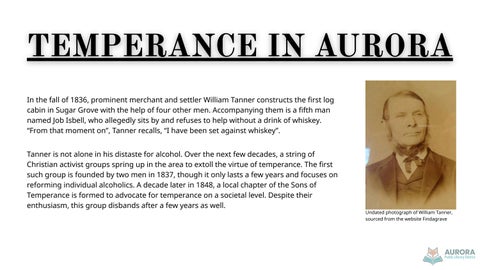
TEMPERANCE IN AURORA In the fall of 1836, prominent merchant and settler William Tanner constructs the first log cabin in Sugar Grove with the help of four other men. Accompanying them is a fifth man named Job Isbell, who allegedly sits by and refuses to help without a drink of whiskey. “From that moment on”, Tanner recalls, “I have been set against whiskey”. Tanner is not alone in his distaste for alcohol. Over the next few decades, a string of Christian activist groups spring up in the area to extoll the virtue of temperance. The first such group is founded by two men in 1837, though it only lasts a few years and focuses on reforming individual alcoholics. A decade later in 1848, a local chapter of the Sons of Temperance is formed to advocate for temperance on a societal level. Despite their enthusiasm, this group disbands after a few years as well.
Undated photograph of William Tanner, sourced from the website Findagrave
Several attempts are made to establish temperance newspapers around this time. Two of them are spun up in 1858: The Temperance Monitor and The Reformer. A third is spun up in 1860 – the Temperance Tocsin – but all of them only last a few years. Temperance activists in Aurora would have to wait until the end of the Civil War to build a lasting movement. That’s when a second industrial revolution kicks off, yielding advancements in transportation, communication, and manufacturing, which fuel a rapid growth of the alcohol industry. According to Emeritus Professor Austin Kerr at The Ohio State University, “the number of saloons [proliferate]; it [is] not uncommon for towns to have a saloon for every 150 or 200 persons.” As saloons proliferate, tensions grow between them and temperance activists. On March 30th, 1874, a group of Aurora women meet at the local Y.M.C.A. building to form a new temperance group called the Ladies’ Temperance Union. Their constitution is published in its entirety on the front page of the Beacon-News, which clearly outlines their vision of a sober Aurora: “Whereas, intemperance is one of the greatest evils of our land, entailing upon us an incalculable amount of misery, poverty and crime – more by far than all other causes combined; and whereas, we deem the legalized traffic in intoxicating drinks to be the chief cause of impermanence; therefore for the sake of arousing the indifferent to a realizing sense of the ravages of this great evil, and of their duty in regard to it - for the purpose of awakening, intensifying, organizaing public opinion against this traffic, we, the ladies of the city of Aurora, do organize ourselves into a working body for these purposes, and adopt for our guidance the following...”
Later that same year, an organization called the Women’s Christian Temperance Union (WCTU) is founded in Ohio. Before long, there are dozens of local WCTU chapters around the country. In 1882, the Aurora Ladies’ Temperance Union becomes one such chapter. In 1892, the Aurora WCTU hosts a “Grandmothers Rally” to solicit funds and spread the gospel of temperance. The grandmothers, mostly comprised of current or former Aurora WCTU members, contribute brief biographical sketches that are made into distributable pamphlets. Some of the women provide insights into why they joined the movement, like Mrs. C. Hough, who recalls the following: “I was born in 1816. When sixteen years of age an incident occurred which made a great impression on my mind. I was present at the execution of a man who had shot another when drunk. He went to the hotel and drank until he was drunken, and the owner threw him out of the door. He was angry and procured a gun and went back and shot (as he supposed) the man but it proved to be the man's son; he was arrested and sentenced... My temperance principals were fixed from that time. I have lived in Aurora 35 years.”
One of the “Grandmothers Rally” Pamphlets distributed by the Aurora WCTU, 1892. Held by the Aurora Historical Society.
Hough’s testimony underscores a key argument made by temperance activists: that alcohol consumption destroys lives. Of particular concern to the WCTU is how women and children bear the brunt of that destruction in the form of domestic abuse and poverty. This argument dovetails with the fight for women’s suffrage, which the WCTU expands to include during Frances Willard’s leadership in the 1880s.
By the turn of the century, the WCTU is spearheading both the temperance and women’s suffrage movements. This culminates in the ratification of the 18th and 19th Amendments in 1919, which enshrine women’s voting rights and prohibit the manufacturing, selling, or transporting of liquor nationwide respectively. On Friday, January 16th, 1920 – the day before prohibition comes into effect – the Aurora WCTU celebrates with rousing speeches and prayers. A local religious leader by the name of Reverend R. H. Claxon lauds their achievements by comparing it to other historical events in American history:
Aurora Beacon-News, Jan 17, 1920
“...the Renaissance, the Reformation, the Emanicpation Proclamation, were not greater victories that this today. Home is the greatest word that lips have learned to lisp and there has never been a more insidious enemy to the home than the liquor traffic... It behooves the American people to elect men to the presidency who believe in the constitution and the eighteenth amendment. We are going to see that prohibtion continues and are going to guarantee its immortality. Our job now is to see that law is enforced.”
After decades of organized activism, the temperance movement finds itself on the defensive for the first time. If prohibition is to be “immortal”, as Reverend Claxon hopes, then enforcement has to be flawless. The WCTU immediately gets to work to this effect, regularly sharing their activities in the Beacon-News. Aurora Beacon-News, Jul 18, 1926
They host fundraisers, lobby lawmakers to strengthen enforcement measures, and bolster temperance education efforts in Sunday School. They try to inculcate a sense of civic pride in the defense of prohibition, which is apparent in this article on “Good Citizenship” in 1925:
“Our nation celebrates the birthday of Washington, than whom none ever spoke more emphatically regarding obedience to law as vital to good government. When, in his day a ‘whiskey rebellion’ defied the laws of the land, he crushed it. We, who love Old Glory, could not more appropriately honor the memory of Washington, on this Sabbath, his birthday, the day of our temperance lesson, than by highly resolving that the present booze rebellion against this government of the people, by the people and for the people, must and shall be suppressed.“ Aurora Beacon-News, Feb 22, 1925
It’s not long, however, before the cracks start to form. The Volstead Act – passed by Congress in 1919 to set enforcement standards – did little to help with the logistics of enforcement; as a result, law enforcement agencies and judicial bodies around the country get overwhelmed by the explosion of liquor-related crime, from organized mob activity to smaller-scale bootlegging operations. Raids on private homes only further tarnish the reputation of prohibition, particularly when they result in tragedy.
One such tragedy occurs in Aurora. In March of 1929, Lillian DeKing, her husband Joseph, and her son Gerald are home when they’re raided by law enforcement on suspicion of smuggling alcohol. When authorities enter the home, one of the officers knocks Joseph unconscious. Deputy Sheriff Smith fatally shoots Lillian as she’s calling for help on the phone. Gerald, witness to all of this, then shoots Smith in the leg. The failures of prohibition enforcement cause rifts to form in the temperance movement. Many temperance activists still support prohibition, but others – including those in the Women’s Organization for National Prohibition Reform (WONPR) – begin advocating for its repeal. By the 1930s, the tide is definitively on the side of repeal. The 21st Amendment is sent to the states for ratification in February of 1933, and on December 5th, the prohibition era ends. The WCTU is silent in the pages of the Beacon-News immediately following the repeal, until they reappear on December 10th. Mrs. S. B. Wright. president of the Kane County chapter, issues a message of defiant resignation, clinging to the hope that younger generations will weather the storm of an intemperant society: “...For the persistent faith of our Crusade Mothers lives on. That fire kindled on thousands of altars in Crusade days has never been extinguished. It burns today with a steady flame in the hearts of multiplied thousands of their daughters – women who, as they witness the wrecking of the Federal Constitution, are saying over and over with solemn sound: ‘You may repeal the law, but you cannot repeal the effects of alcohol’...”
Aurora Beacon-News, Dec 10, 1933